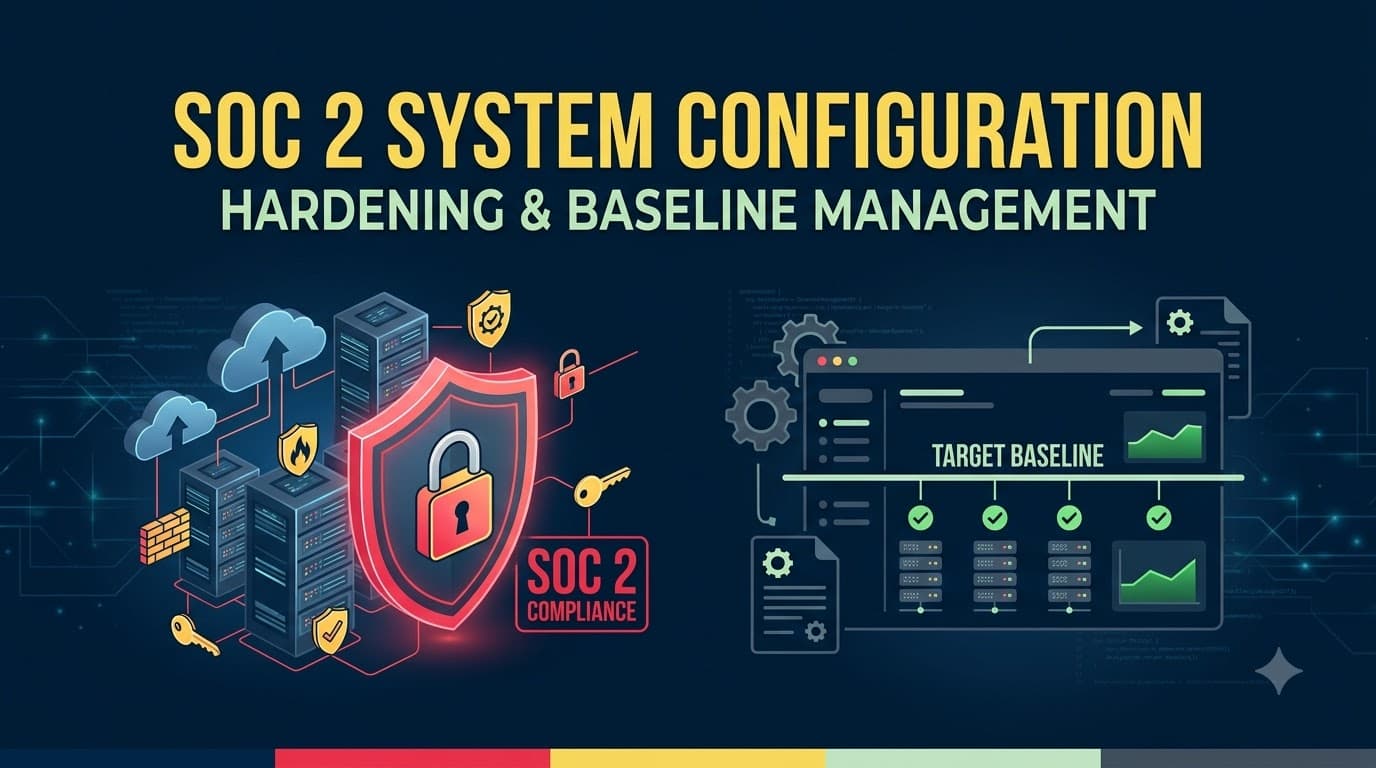
Priya Anand found out her company had a configuration problem on a Tuesday afternoon, three weeks before her Type II observation period closed. She was the VP of Engineering at Coral Reef Logistics, a 140-person supply-chain SaaS platform processing shipment data for around 60 mid-market retailers, and she had spent the better part of a year telling her board that the company's SOC 2 program was "basically done." The readiness assessment had gone fine. Access controls were tight. Encryption was everywhere it needed to be. Then the fieldwork auditor pulled a random sample of twenty-five production servers and asked for evidence that each one matched the company's documented hardening standard.
Nine didn't. Two had SSH configured to allow root login. Four were missing disk encryption that the baseline required. One had a default administrative account still active from a vendor's install script, password unchanged, eleven months after the box went live. The auditor didn't call it a catastrophe — auditors rarely use that word — but the finding language was blunt: the entity's configuration management control did not operate effectively across the population tested. Coral Reef's Type II report shipped six weeks late, with a qualified opinion on one criterion, a corrective action plan attached, and a board conversation Priya still describes as "the worst ninety minutes of my career." The direct cost — extended audit fees, a delayed enterprise contract worth roughly $380,000 in annual recurring revenue that a prospect had frozen pending a clean report, and the internal hours spent re-imaging and re-documenting — ran past $210,000 by her own accounting.
The maddening part, as Priya would tell you now, is that nothing in that finding was exotic. No zero-day, no clever attacker, no novel technique. It was configuration drift — the slow, unglamorous divergence between what a system is supposed to look like and what it actually looks like — and it is one of the most common, most preventable reasons a SOC 2 audit goes sideways. I've watched this exact pattern play out in dozens of engagements over fifteen-plus years of consulting: strong policies on paper, real investment in access control and encryption, and then a hardening standard that exists in a wiki nobody enforces against live infrastructure. This article is about closing that gap — for good, not just for the week before fieldwork.
Who This Is For
This is for engineering leaders, security architects, DevOps and platform teams, and compliance managers building or maturing a SOC 2 program who need configuration hardening to be a living control, not a one-time exercise. You'll walk away with a practical model for baseline standards, golden images, and infrastructure-as-code enforcement; a concrete drift-detection and monitoring approach auditors will recognize; and a clear map of how configuration management ties into Common Criteria 7.1 and 8, plus the evidence package that keeps a fieldwork sample from turning into a finding. If you've ever had an auditor ask "show me your baseline" and felt your stomach drop, this article is written for that exact moment — and for making sure it never happens to you again.
Why Configuration Hardening Sits at the Center of SOC 2
Every SOC 2 examination tests whether an organization's controls are suitably designed and, for a Type II report, operating effectively over the audit period. Configuration hardening is one of the quieter controls in that story, but it's foundational, because almost every other control assumes the underlying system is configured securely. Access control policies mean little if a server's default accounts are still enabled. Encryption commitments mean little if a misconfigured storage bucket is publicly readable. Logging and monitoring mean little if the agent that ships logs was never installed because the golden image predates the requirement.
Auditors evaluate configuration primarily under two Common Criteria: CC7.1, which requires the entity to use detection and monitoring procedures to identify changes to configurations that could introduce vulnerabilities, and to implement configurations that support meeting its security commitments and objectives; and CC8, the change management criteria family, which requires that changes to infrastructure, data, and software — including configuration changes — are authorized, designed, developed or acquired, tested, approved, and implemented in a controlled manner. CC7.1 asks "is the system configured correctly and are you watching for when it stops being configured correctly?" CC8 asks "when configuration changes, did it go through a controlled process?" Together they cover the full lifecycle: define the standard, build to it, detect deviation from it, and control any change to it.
Table 1: CC7.1 and CC8 Mapped to Configuration Management Activities
Common Criteria | Criterion Focus | Configuration Management Activity | Typical Evidence |
|---|---|---|---|
CC7.1 | Detect configuration changes that introduce vulnerabilities | Hardening baseline definition, golden image builds, drift detection scanning | Baseline documents, scan reports, remediation tickets |
CC7.1 | Configurations support security commitments/objectives | Mapping baseline controls to Trust Services commitments | Control-to-commitment crosswalk, benchmark scoring |
CC7.2 | Monitor for anomalies and security events | Configuration monitoring integrated with SIEM | Alert logs, monitoring dashboards |
CC8.1 | Authorize, test, and approve changes | Change tickets for baseline and IaC modifications | Change tickets, approval records, test results |
CC8.1 | Manage system, data, and infrastructure changes | Version-controlled infrastructure as code, peer review | Git history, pull-request approvals, pipeline logs |
CC6.1 | Logical access consistent with configuration | Baseline enforcement of account and privilege settings | Configuration scan output, account inventories |
This dual coverage is why configuration hardening deserves its own operating rhythm rather than living as a checkbox inside a broader "security controls" bucket. A team that treats hardening as a one-time server-build task, rather than a continuous control, will eventually produce a Coral Reef Logistics story of its own.
"The auditors don't expect perfection. They expect a defined standard, evidence you built to it, and evidence you're watching for drift. Most of the qualified opinions I've seen on configuration controls happened because the standard existed but nobody could prove it was actually being enforced." — Devon Marsh, Director of Security Engineering, Alderwood Financial Technologies
What "Secure Configuration" Actually Means
"Secure configuration" is a deceptively simple phrase that covers an enormous surface: operating system settings, installed software, network services, user accounts, file permissions, logging agents, encryption settings, and dozens of other parameters on every server, workstation, container, and cloud resource in scope. A hardening baseline is the documented, approved answer to the question "what does secure look like for this asset type, in this environment?" It is not a philosophy — it's a specific, testable list of settings.
The practical mistake I see most often isn't a missing baseline; it's a baseline written once during initial SOC 2 preparation and never revisited, applied inconsistently between environments (production hardened, staging ignored, because "staging doesn't have real data" — until it does), or documented in a way that can't actually be verified against a running system. A baseline that can't be scanned and scored isn't a control; it's a wish.
Table 2: Core Elements of a Secure Configuration Baseline
Element | What It Covers | Why Auditors Care |
|---|---|---|
Account and authentication settings | Default accounts disabled, password/lockout policy, MFA enforcement | Ties directly to CC6 logical access criteria |
Network service exposure | Unused ports/services disabled, listening services documented | Reduces attack surface, supports CC6.6/CC6.7 |
File system and permissions | Least-privilege file/directory permissions, no world-writable system paths | Prevents privilege escalation paths |
Logging and audit configuration | Audit logging enabled, log forwarding to central collection | Supports CC7.2 monitoring evidence |
Encryption settings | Disk/volume encryption enabled, TLS versions and ciphers pinned | Supports CC6.1 and confidentiality commitments |
Patch/update configuration | Automatic or scheduled patching enabled where appropriate | Feeds patch management (see cross-link below) |
Remote access configuration | SSH/RDP restrictions, key-based auth, session timeouts | Common source of Type II exceptions |
Software inventory | Only approved software installed, unnecessary packages removed | Reduces vulnerability surface |
A baseline is only useful once it's specific enough that two engineers, working independently, would configure a server the same way and a scanner could confirm they did.
Building a Baseline Standard: CIS Benchmarks as a Starting Point
Very few organizations write hardening standards from a blank page, and I don't recommend it. The most efficient starting point I've used across dozens of engagements is the CIS Benchmarks — the freely available, community-vetted configuration guides published by the Center for Internet Security for operating systems, cloud platforms, and common software. I'm citing CIS Benchmarks here as an illustrative, widely used reference point, not as a SOC 2 requirement — the Trust Services Criteria don't mandate any specific benchmark. What CC7.1 requires is that you define a configuration standard suited to your environment and demonstrate you're building and monitoring against it; CIS Benchmarks (and comparable references such as vendor hardening guides or DISA STIGs) are simply a mature, well-documented way to get there rather than reinventing settings line by line.
The practical move is to adopt a recognized benchmark as your starting template, then tailor it: some settings will be too strict for your application stack (a benchmark control that breaks a required service), some too loose for your risk profile, and some simply not applicable. Document every deviation with a reason — auditors expect a rationale, not blind adoption or blind rejection.
Table 3: Illustrative CIS Benchmark Structure Across Common Platforms
Platform | Benchmark Scope (Illustrative) | Example Hardening Areas | Typical Adoption Pattern |
|---|---|---|---|
Linux server distributions | OS-level hardening guide | Filesystem config, SSH, cron, auditd, sysctl network settings | Level 1 baseline org-wide, Level 2 for high-sensitivity tiers |
Windows Server | OS-level hardening guide | Local policies, Windows Firewall, services, registry settings | Level 1 baseline via Group Policy |
Cloud provider (IaaS/PaaS) | Account and service configuration | IAM, storage bucket policy, network security groups, logging | Mapped to CSPM rule sets |
Containers/Kubernetes | Orchestration and runtime configuration | Pod security context, network policy, image provenance | Layered onto CI/CD pipeline gates |
Endpoint/workstation OS | Desktop hardening guide | Disk encryption, local admin restriction, browser policy | Enforced via MDM profiles |
"Level 1" and "Level 2" in CIS's own terminology refer to a tiering most organizations recognize: Level 1 settings are broadly applicable with low operational impact; Level 2 settings are more restrictive and intended for higher-sensitivity environments where some functionality trade-off is acceptable. Most SOC 2 scopes I've worked land on Level 1 as the org-wide floor, with Level 2 selectively applied to systems handling the most sensitive data.
"We didn't write a hardening standard from scratch — we took a recognized benchmark, cut it down to what actually applied to our stack, and documented every exception. That exception log became one of the auditor's favorite pieces of evidence, because it showed judgment, not just copy-paste." — Renata Ibarra, Head of Platform Security, Coral Reef Logistics
Golden Images: Baking the Baseline In
A hardening standard is only as good as its enforcement mechanism, and the most reliable enforcement mechanism I've seen for servers and virtual machines is the golden image — a pre-configured, pre-hardened machine image that serves as the single approved starting point for new infrastructure. Instead of provisioning a server and then applying hardening scripts after the fact (a pattern that reliably produces drift because someone eventually skips a step), teams build the hardening into the image itself, so every new instance starts compliant by construction.
A mature golden image pipeline treats the image as a versioned artifact: a defined build process, a security scan gate before publication, a version number, and a deprecation policy for older images. When the baseline standard changes — say, a new TLS requirement — the image gets rebuilt and republished, and old images are retired from the approved catalog rather than patched in place indefinitely.
Table 4: Golden Image Lifecycle Stages
Stage | Activity | Control Purpose |
|---|---|---|
1. Base selection | Choose vetted OS/base image from trusted source | Prevents supply-chain risk from unverified sources |
2. Hardening build | Apply baseline configuration via automated build script | Enforces the documented standard consistently |
3. Security scanning | Run vulnerability and configuration compliance scan against the built image | Catches misconfiguration before deployment |
4. Approval and versioning | Security/engineering sign-off, version tag assigned | Creates auditable approval trail (supports CC8) |
5. Publication | Image published to approved catalog/registry | Restricts provisioning to approved sources only |
6. Periodic rebuild | Scheduled rebuild cycle (e.g., monthly) plus event-triggered rebuild | Keeps patches and baseline current |
7. Deprecation | Old image versions retired, in-use instances flagged for replacement | Prevents indefinite use of stale, unpatched images |
A golden image program doesn't eliminate the need for drift detection — configurations still change after deployment through manual intervention, application installs, or automation gone wrong — but it dramatically shrinks the starting gap. When Coral Reef Logistics rebuilt its program after the qualified opinion, moving from ad hoc server setup to a golden-image pipeline cut its measured configuration exception rate by roughly 70% within two audit cycles, according to Renata Ibarra's internal tracking.
Infrastructure as Code: Making the Baseline Enforceable, Not Just Documented
Golden images solve the "what does a new server look like on day one" problem. Infrastructure as Code (IaC) — tools like Terraform, AWS CloudFormation, Azure Resource Manager templates, Ansible, and Chef/Puppet-style configuration management — solves the harder problem: keeping configuration consistent and reviewable as it changes over time, across potentially hundreds or thousands of resources, without relying on any individual engineer's memory or discipline.
The compliance value of IaC is specific and significant for SOC 2: configuration definitions live in version control, which means every change has an author, a timestamp, a diff, and — if the team enforces peer review — an approver. That's CC8 change management evidence generated as a byproduct of normal engineering work rather than a separate compliance task bolted on afterward. It's also a powerful CC7.1 control, because the declared state in code is the audit-able baseline: a scanner can compare live infrastructure against the IaC definition and flag drift automatically.
Table 5: Infrastructure as Code Tool Categories and SOC 2 Relevance
Category | Example Approach | Primary Use | SOC 2 Evidence Generated |
|---|---|---|---|
Declarative provisioning | Terraform-style, CloudFormation-style templates | Define cloud resources, networking, IAM as code | Git history, plan/apply logs, PR approvals |
Configuration management | Ansible/Puppet/Chef-style tooling | Enforce OS and application-level settings on running hosts | Run logs, compliance reports, change diffs |
Policy as code | Rule engines evaluating IaC before deployment | Block non-compliant resources pre-deployment | Pipeline gate logs, policy violation reports |
Container/orchestration manifests | Kubernetes YAML, Helm charts | Define pod security, network policy, resource limits | Git history, admission-controller logs |
Image build automation | Image-building pipelines | Bake golden image hardening into repeatable builds | Build logs, scan gate results |
"The moment we moved our network security group rules into Terraform and required a pull request for any change, our change management evidence basically wrote itself. The auditor could trace every firewall rule change back to a ticket and an approver without us assembling a single spreadsheet." — Tobias Reyes, Cloud Infrastructure Lead, Alderwood Financial Technologies
IaC doesn't remove the need for a documented baseline standard — code still needs to encode a decision about what "secure" means — but it removes the gap between the standard and reality that sank Coral Reef's first audit. When the baseline lives in an unenforced document and the infrastructure lives independently, the two inevitably diverge. When the baseline lives in the infrastructure definition itself, divergence requires an explicit, logged, reviewable change.
Hardening Servers: The Traditional Core of Configuration Management
Servers — physical or virtual, on-premises or cloud-hosted — remain the asset class where configuration hardening has the deepest audit history, and it's the area where auditors have the clearest expectations. A server hardening standard needs to address the operating system layer, the application/runtime layer, and the network-facing layer, because a well-hardened OS sitting behind a wide-open application configuration still fails the intent of CC7.1.
Table 6: Server Hardening Checklist — High-Priority Items
Category | Control | Common Failure Mode |
|---|---|---|
Accounts | Disable/rename default and vendor accounts; enforce least privilege for service accounts | Vendor default account left active post-install |
Remote access | Disable root/administrator direct login; require key-based SSH or MFA for RDP | Password-only remote access left enabled |
Network exposure | Close unused ports; restrict management interfaces to internal networks | Management port exposed to the public internet |
Encryption | Enable full-disk or volume encryption; enforce TLS 1.2+ on services | Encryption enabled at build time but disabled during troubleshooting and not re-enabled |
Logging | Enable OS-level audit logging; forward logs to central collection | Logging enabled locally but never shipped to SIEM |
Patching | Configure automatic security patch application or scheduled patch windows | Patch schedule defined but not enforced on legacy hosts |
File integrity | Enable file integrity monitoring on critical system paths | No visibility into unauthorized binary or config changes |
Time synchronization | Enforce NTP with a trusted source | Clock drift undermining log correlation and audit trail accuracy |
Server hardening is also where the "documented but not enforced" gap is most visible to auditors, because server population sampling is a standard fieldwork technique — exactly what caught Coral Reef. The fix isn't more documentation; it's automated, periodic scanning against the baseline (covered below) so that any of those checklist items drifting out of compliance gets caught before an auditor's sample does.
Hardening Endpoints: The Overlooked Half of the Estate
Servers get the bulk of hardening attention because they hold production data, but endpoints — employee laptops and workstations — carry real SOC 2 exposure too, particularly for organizations where engineers have direct access to production systems, credentials, or customer data from their local machines. A compromised or misconfigured endpoint is frequently the initial foothold in real-world breaches, and auditors increasingly ask about endpoint baseline standards as part of the broader access and system operations narrative.
Table 7: Endpoint Hardening Controls by Category
Category | Control | Enforcement Mechanism |
|---|---|---|
Disk encryption | Full-disk encryption required on all company-issued devices | MDM compliance policy |
Local privilege | Standard user accounts by default; admin rights via just-in-time elevation | MDM/PAM integration |
Screen lock | Automatic lock after defined inactivity period | MDM configuration profile |
Endpoint protection | Anti-malware/EDR agent installed and reporting | MDM enrollment + agent health check |
OS patching | Automatic OS and browser update enforcement | MDM patch compliance policy |
Application allow-listing | Restrict installation to approved software sources | MDM application policy |
Network connection | VPN or zero trust network access required for internal resource access | Conditional access policy |
Device compliance gating | Non-compliant devices blocked from accessing sensitive systems | Conditional access tied to MDM compliance status |
The most efficient endpoint hardening programs I've helped build tie MDM compliance status directly into access decisions: a device that falls out of baseline compliance — encryption disabled, patch overdue, EDR agent unhealthy — automatically loses access to production systems and sensitive SaaS applications until it's remediated. That linkage turns a static checklist into a continuously enforced control, and it produces exactly the kind of "detection and response to configuration deviation" evidence CC7.1 is looking for.
Cloud Configuration: Where Scale Meets Risk
Cloud environments introduce a configuration management challenge that traditional server hardening never had to solve at the same scale: the sheer number of independently configurable resources — storage buckets, IAM roles, security groups, managed database instances, serverless functions, API gateways — each with its own settings surface, spun up and torn down by dozens of engineers without a central provisioning gatekeeper. Misconfiguration, not sophisticated exploitation, remains the leading cause of cloud data exposure incidents I've reviewed in post-mortems across client engagements.
Cloud Security Posture Management (CSPM) tooling exists specifically to address this: continuous, automated scanning of cloud account configuration against a defined rule set (often mapped to a benchmark, again illustratively including CIS's cloud-specific benchmarks), flagging deviations like publicly readable storage, overly permissive IAM policies, disabled logging, or unencrypted resources.
Table 8: Common Cloud Misconfiguration Categories and Risk
Misconfiguration Category | Example | Risk |
|---|---|---|
Storage exposure | Object storage bucket set to public read | Direct data exposure, primary cause of cloud breach headlines |
Overly permissive IAM | Wildcard resource/action permissions on a role | Privilege escalation, lateral movement |
Disabled logging | Cloud audit logging turned off or not centrally retained | Loss of audit trail, undermines CC7.2 monitoring evidence |
Open network security groups | Inbound rule allowing 0.0.0.0/0 on sensitive ports | Direct exposure of management interfaces |
Unencrypted resources | Database or volume created without encryption enabled | Confidentiality commitment failure |
Unrestricted public network access | Missing VPC segmentation, flat network design | Increased blast radius from any single compromise |
Default credentials/keys | Long-lived access keys instead of short-lived roles | Increased exposure window if credentials leak |
A CSPM program only earns its keep when findings feed a real remediation workflow with ownership and SLAs — a dashboard full of red flags nobody actions is worse for audit purposes than no dashboard at all, because it demonstrates the organization knew about the gap and didn't close it. I generally recommend tiering findings (critical/high/medium/low) with matched remediation SLAs, and tracking mean-time-to-remediate as a program metric auditors can review directly.
"Our CSPM tool flagged twenty-plus misconfigurations in our first week of deployment — nothing catastrophic, mostly overly broad IAM policies from early prototyping. The important part wasn't the number, it was that we could show the auditor a closed ticket for every single one within our SLA." — Naomi Castellano, Senior Cloud Security Engineer, Ironclad Payments Group
Containers and Kubernetes: Hardening at a Different Layer
Containerized workloads add a configuration layer that doesn't map cleanly onto traditional server or cloud-account hardening: the container image itself, the orchestration platform's configuration (most commonly Kubernetes), and the runtime security context each need their own baseline. I've seen organizations do excellent server and cloud-account hardening and still walk into a Type II finding because nobody had defined what "hardened" meant for a pod spec.
Table 9: Container and Kubernetes Hardening Checklist
Layer | Control | Why It Matters |
|---|---|---|
Image | Build from minimal, vetted base images; scan for known vulnerabilities pre-deployment | Reduces attack surface baked into every container instance |
Image | Disallow ":latest" tags in production; pin immutable digests | Prevents unreviewed drift via tag reuse |
Runtime | Enforce non-root container execution | Limits blast radius of container compromise |
Runtime | Read-only root filesystem where feasible | Prevents runtime tampering |
Orchestration | Network policies restricting pod-to-pod traffic | Enforces network segmentation inside the cluster |
Orchestration | Role-based access control on the Kubernetes API | Prevents excessive cluster-admin sprawl |
Orchestration | Admission controllers blocking non-compliant manifests | Enforces baseline before deployment, not after |
Secrets | No hardcoded credentials in manifests; use a secrets manager | Prevents credential exposure via config review or image inspection |
The admission-controller pattern — where a policy engine evaluates every deployment manifest against the baseline and rejects non-compliant ones before they ever run — is the container-world equivalent of the golden image: it makes the secure configuration the path of least resistance rather than something applied after the fact. That's the same principle running through every asset class in this article, just implemented differently at each layer.
Drift Detection: Catching the Gap Before the Auditor Does
Every mechanism discussed so far — golden images, IaC, admission controllers — reduces how often configuration drifts from baseline. None of them eliminate drift entirely, because production systems change: engineers troubleshoot live issues and forget to revert a setting, automation misfires, a manual hotfix bypasses the pipeline under deadline pressure. Drift detection is the control that catches what prevention missed, and it's the single most important evidence source for demonstrating CC7.1's monitoring requirement operated continuously across the audit period — not just at a point in time.
Table 10: Drift Detection Methods Compared
Method | How It Works | Strength | Limitation |
|---|---|---|---|
Agent-based configuration scanning | Software agent on each host reports current state against baseline | Deep OS-level visibility | Requires agent deployment/maintenance |
Agentless configuration scanning | Remote scan (API/credentialed) against hosts or cloud accounts | Faster rollout, no agent overhead | May miss some host-internal state |
IaC state comparison | Compares live infrastructure state against declared code | Ties drift directly to a version-controlled source of truth | Only covers resources actually managed via IaC |
CSPM continuous scanning | Ongoing scan of cloud account configuration against rule set | Broad cloud coverage, near-real-time | Cloud-account scope only, not OS-internal |
File integrity monitoring | Detects unauthorized changes to defined critical files/paths | High-fidelity change detection | Narrow scope, tuned to specific paths |
Manual periodic audit | Scheduled human review of a configuration sample | Catches gaps automated tools miss | Point-in-time, resource-intensive, lower frequency |
I generally recommend layering at least two of these — most commonly IaC state comparison for anything provisioned through code, plus agent-based or agentless scanning for the OS-level settings IaC doesn't reach — because no single method covers the full configuration surface. The scan cadence matters as much as the method: a control that scans once a quarter will still leave months of undetected drift inside a Type II observation window. Continuous or daily scanning, with automated ticket creation on deviation, is what most mature programs I've worked with settle on for production systems.
"We run configuration drift scans daily against production and weekly against everything else, and every deviation opens a ticket automatically with an SLA attached. When the auditor asked for evidence the control operated for the full nine-month period, we handed over nine months of scan history and closed tickets instead of a single point-in-time screenshot." — Devon Marsh, Director of Security Engineering, Alderwood Financial Technologies
Configuration Monitoring and Continuous Compliance
Drift detection tells you when a single system has moved off baseline. Configuration monitoring, in the fuller sense auditors expect under CC7.1 and CC7.2, means that signal is integrated into the organization's broader continuous monitoring program — feeding alerts into the same operational workflow that handles security events generally, not sitting in a separate tool nobody but the platform team ever opens.
flowchart LR
    A[Baseline Standard\nDefined & Approved] --> B[Golden Image / IaC\nBuild to Baseline]
    B --> C[Deployed Systems\nServers, Endpoints, Cloud, Containers]
    C --> D[Continuous Config Scanning\nAgent, Agentless, CSPM, IaC-state]
    D --> E{Drift\nDetected?}
    E -- No --> D
    E -- Yes --> F[Ticket Created\nOwner + SLA Assigned]
    F --> G[Remediation]
    G --> H[Verification Scan]
    H --> C
    D --> I[Evidence Repository\nScan History, Tickets, Approvals]
    I --> J[Audit Evidence Package]
This loop — baseline, build, deploy, scan, detect, remediate, verify, log — is the operating model I recommend to every client building or repairing a configuration management program. Each stage produces its own evidence artifact, and that evidence, accumulated continuously rather than assembled retroactively, is what turns a Type II audit from an archaeology project into a data pull.
Table 11: Configuration Monitoring Signal Routing
Signal Source | Routes To | Response Expectation |
|---|---|---|
Drift scan finding | Ticketing system, owner assigned by asset tag | Remediate within defined SLA by severity |
CSPM alert | Cloud security queue, SIEM correlation | Triaged alongside other security alerts, not siloed |
File integrity alert | Security operations queue | Investigated as a potential incident indicator |
IaC drift (state mismatch) | Engineering on-call/change queue | Reconciled: either revert to code or update code via reviewed PR |
Failed admission-controller check | Deployment pipeline, blocks release | Developer fixes manifest before redeploy attempt |
The through-line is that configuration signals shouldn't live in a silo the security team checks separately from everything else — they belong in the same monitoring fabric discussed in SOC 2 Security Monitoring: SIEM and Log Management, because a configuration deviation is very often the leading indicator of — or the exact mechanism enabling — a security event.
Evidence: What Auditors Actually Want to See
Everything above is worth building, but for SOC 2 purposes it only counts if it produces evidence an auditor can independently verify against the population they sample. I tell every client the same thing during readiness prep: assume the auditor will pick systems you didn't expect them to pick, and ask for a period, not a snapshot.
Table 12: Configuration Evidence by Control Area
Control Area | Evidence Type | Collection Frequency |
|---|---|---|
Baseline standard | Approved, versioned hardening standard document | Reviewed/updated at least annually or on major change |
Golden image build | Build pipeline logs, scan gate results, approval record | Per image build/publish |
IaC change control | Git commit history, pull-request approvals, pipeline apply logs | Continuous, per change |
Drift scanning | Scan reports across the audit period, not a single sample date | Continuous/daily-weekly per system tier |
Deviation remediation | Tickets showing detection date, owner, resolution date | Continuous, tied to each finding |
Exception handling | Documented, approved exceptions to the baseline with rationale and expiry | Reviewed periodically, logged centrally |
CSPM/cloud posture | Historical posture score/trend, not just current state | Continuous |
Endpoint compliance | MDM compliance reporting across the population | Continuous/near-real-time |
The pattern across every row in that table is the same: auditors testing operating effectiveness for a Type II report want evidence that spans the entire observation period, generated as a byproduct of the control actually running — not evidence manufactured retroactively to satisfy the request. A hardening standard that was only ever checked once, the week before fieldwork began, will not survive a population sample the way Coral Reef Logistics discovered the hard way.
"I ask every client the same question during readiness prep: if I picked ten systems at random today, would they pass against your own documented standard? If the honest answer is 'probably, but let me check,' we have work to do before fieldwork starts, not during it." — Renata Ibarra, Head of Platform Security, Coral Reef Logistics
Case Study: Coral Reef Logistics — From Qualified Opinion to Clean Report
Coral Reef Logistics' story didn't end with the qualified opinion. Over the following two quarters, Priya Anand's team rebuilt configuration management from the ground up: they adopted a CIS-Benchmark-derived Linux and cloud baseline, tailored and documented with exceptions logged; moved server provisioning to a golden-image pipeline built from that baseline; migrated roughly 85% of cloud infrastructure into Terraform with mandatory pull-request review; and deployed daily drift scanning across production with automated ticketing and a 5-business-day remediation SLA for high-severity findings.
The next Type II audit, covering a nine-month period, sampled thirty systems — a larger sample than the first audit, reflecting the auditor's awareness of the prior finding. All thirty passed. The exception log the team maintained (documenting nineteen deliberate, approved deviations from the default CIS baseline, each with a written rationale) became, in Priya's words, "the thing the auditor spent the most time on, in a good way — it showed we understood our own standard well enough to know when to deviate from it." The report shipped on schedule with an unqualified opinion, and the enterprise contract that had stalled during the first audit closed within five weeks of the report's delivery.
Case Study: Ironclad Payments Group — Cloud Sprawl to CSPM Discipline
Ironclad Payments Group, a payments-adjacent fintech with roughly 90 engineers and a cloud footprint spanning three accounts and over 400 discrete resources, came to a SOC 2 readiness engagement with no centralized cloud configuration visibility at all — infrastructure had grown organically across two years of rapid hiring, with no consistent tagging, no CSPM tooling, and IAM policies that had accumulated permissions rather than been designed. The readiness assessment surfaced 47 findings in the first automated CSPM scan, including six publicly accessible storage resources (none containing production customer data, fortunately, but two containing internal build artifacts with embedded configuration secrets) and eleven IAM roles with wildcard permissions.
Rather than treat this as a one-time cleanup, Ironclad's security team (led by Naomi Castellano) used the findings to build a permanent posture management program: CSPM scanning running continuously, findings triaged into severity tiers with matched SLAs (48 hours for critical, 5 days for high, 30 days for medium), and a monthly posture review presented to engineering leadership. Within four months, the finding backlog dropped from 47 to a steady-state average of 3–5 open findings at any time — mostly low-severity items caught and closed within SLA. Their subsequent SOC 2 Type II examination, covering a six-month period, showed zero configuration-related exceptions, and the auditor specifically cited the posture trend data as strong evidence of continuous operating effectiveness.
Case Study: Voss Analytics — Containers Without a Baseline
Voss Analytics, a 35-person data analytics startup running its entire product on Kubernetes, learned a narrower but instructive lesson. The company had strong server and cloud-account hardening (inherited from its managed Kubernetes provider's secure defaults) but had never defined an explicit container/pod-level hardening baseline of its own — developers wrote manifests however they saw fit, several running containers as root "because it was faster to get working," with no network policies restricting pod-to-pod traffic inside the cluster.
During readiness assessment, this surfaced not as a security incident but as a design gap: nothing in the environment technically violated a documented standard, because no standard existed for that layer. The fix took about six weeks: the team wrote a container hardening baseline (non-root execution, read-only root filesystem where feasible, mandatory network policies, image vulnerability scanning gate in CI), rolled it out incrementally starting with new deployments, and used an admission controller to prevent new non-compliant manifests while a backlog of legacy workloads was migrated over the following quarter. The lesson Voss's engineering lead now shares with other startups: a hardening program that stops at the server and cloud-account layer will leave exactly the kind of gap an auditor — or an attacker — eventually finds, simply one layer down from where most teams look first.
Common Pitfalls in Configuration Hardening Programs
Table 13: Common Configuration Management Pitfalls
Pitfall | Consequence | Fix |
|---|---|---|
Baseline written once, never revisited | Standard drifts out of relevance as platforms/threats evolve | Scheduled annual (minimum) baseline review, plus event-triggered updates |
Baseline applied to production only | Staging/dev environments become the weak link, sometimes touching real data | Apply baseline tiering across all environments, scaled by data sensitivity |
No documented exceptions | Deviations look unmanaged, invite deeper auditor scrutiny | Formal exception process with rationale, owner, and expiry/review date |
Drift detection without remediation workflow | Findings pile up unaddressed, undermining the control's credibility | Every finding gets a ticket, owner, and SLA — no exceptions |
Golden image never rebuilt | New instances launch already out of date on patches/config | Scheduled rebuild cadence plus event-triggered rebuild on baseline change |
Manual hardening with no automation | Inconsistent application, unsustainable at scale, hard to evidence | Move to IaC/golden image enforcement as the default path |
Configuration monitoring siloed from security monitoring | Configuration-driven security events missed or handled slowly | Route configuration signals into the same monitoring/alerting fabric |
Evidence collected only before audits | Point-in-time evidence fails Type II's "over a period" requirement | Continuous evidence generation as a control byproduct |
Every one of these pitfalls shows up in this article's case studies in one form or another — they're not hypothetical, they're the pattern I've watched repeat across a wide range of company sizes and industries.
Roles and Responsibilities
Configuration hardening fails as often from unclear ownership as from missing tooling. A RACI model that names actual roles, not just "the security team," is one of the most valuable one-page artifacts a program can produce — and it's something auditors like to see documented as evidence the control has a real operational owner.
Table 14: Configuration Management RACI
Activity | Security/GRC | Platform/Infra Engineering | Application Engineering | Engineering Leadership |
|---|---|---|---|---|
Define baseline standard | Responsible | Consulted | Consulted | Accountable |
Build golden images | Consulted | Responsible | Informed | Accountable |
Maintain IaC repositories | Consulted | Responsible | Responsible (app-tier) | Accountable |
Run drift detection scans | Responsible | Consulted | Informed | Informed |
Remediate drift findings | Consulted | Responsible | Responsible (app-tier) | Informed |
Approve baseline exceptions | Responsible | Consulted | Consulted | Accountable |
Maintain audit evidence repository | Responsible | Consulted | Informed | Informed |
Present posture to leadership | Responsible | Consulted | Informed | Accountable |
Tooling Landscape
Organizations frequently ask what category of tooling they need, and the honest answer is "several, working together" — no single tool covers golden images, IaC, drift detection, and cloud posture management end to end.
Table 15: Configuration Management Tooling Categories
Category | Function | Fits Best For |
|---|---|---|
Image-building automation | Constructs hardened, versioned machine images | Server/VM fleets |
Declarative provisioning (IaC) | Defines and applies cloud/infrastructure state as code | Cloud resources, networking, IAM |
Configuration management engines | Enforces OS/application settings on running hosts | Fleets not fully replaced via golden images |
CSPM platforms | Continuous cloud configuration posture scanning | Multi-account cloud environments |
Container security/admission control | Scans images, enforces manifest policy pre-deploy | Kubernetes/container platforms |
MDM/endpoint management | Enforces and reports endpoint configuration compliance | Workforce laptops/desktops |
GRC/evidence platforms | Aggregates control evidence for audit readiness | Cross-functional audit evidence management |
Measuring the Program: KPIs That Matter to Auditors and Leadership
Table 16: Configuration Management KPIs
KPI | What It Measures | Healthy Target (Illustrative) |
|---|---|---|
Baseline coverage | % of in-scope assets built from an approved golden image/IaC template | 90%+ for production tiers |
Drift detection frequency | How often scans run per asset tier | Daily for production, weekly minimum elsewhere |
Mean time to remediate (MTTR) drift findings | Average time from detection to closed remediation | Under 5 business days for high severity |
Open exception count | Number of active, approved baseline exceptions | Tracked and trending flat or down, not silently growing |
Golden image freshness | Age of most recently published golden image vs. rebuild cadence | Within defined rebuild window (e.g., 30 days) |
CSPM critical finding backlog | Count of unresolved critical/high cloud posture findings | Near zero, with defined SLA compliance rate tracked |
Endpoint compliance rate | % of managed endpoints passing MDM compliance policy | 95%+ |
Tracking these as a standing dashboard, reviewed monthly by security and engineering leadership together, does double duty: it drives the operational discipline that prevents drift in the first place, and it produces exactly the trend evidence auditors want for Type II operating-effectiveness testing.
Implementation Timeline and Cost Considerations
Table 17: Illustrative Program Build-Out Timeline
Phase | Duration | Key Activities | Illustrative Cost Range* |
|---|---|---|---|
Baseline definition | 3–5 weeks | Adopt/tailor benchmark, document standard, exception process | $8,000–$20,000 (internal time + light consulting) |
Golden image / IaC build-out | 6–10 weeks | Build image pipelines, migrate resources into IaC, peer-review workflow | $25,000–$70,000 depending on fleet size |
Drift detection deployment | 3–6 weeks | Deploy scanning tooling, integrate ticketing, define SLAs | $15,000–$40,000 (tooling + integration effort) |
Evidence and monitoring integration | 2–4 weeks | Route signals into monitoring/evidence repository | $5,000–$15,000 |
Steady-state operation | Ongoing | Scanning, remediation, quarterly reviews, annual baseline refresh | Primarily headcount time, tooling subscription costs |
*Figures are illustrative, drawn from the range of engagement sizes I've seen across mid-market clients, and will vary substantially with fleet size, cloud complexity, and existing tooling maturity.
Connecting Configuration Hardening to Change Management
Configuration hardening and change management are two sides of the same control story, and auditors generally expect to see them working together rather than as parallel, disconnected processes. Every baseline update, every golden image rebuild, every IaC modification is itself a change — and it needs to flow through the same authorization, testing, and approval discipline covered in depth in SOC 2 Change Management: System and Application Updates. The strongest evidence packages I've helped clients assemble show a single, continuous thread: a baseline change is proposed, goes through change management approval, is implemented via IaC or an updated golden image, and is then verified by the next drift scan cycle — one control reinforcing the other rather than existing in isolation.
Connecting Configuration Hardening to Vulnerability Management
Configuration hardening and vulnerability management overlap but aren't the same control, and it's worth being precise about the distinction for audit purposes: hardening addresses how a system is set up (accounts, services, permissions, encryption), while vulnerability management, covered in SOC 2 Vulnerability Management: Scanning and Remediation Programs, addresses known software weaknesses that need patching or remediation. A perfectly hardened server can still run vulnerable software; a fully patched server can still have a wide-open configuration. Mature programs run both scanning types together — configuration compliance scanning alongside vulnerability scanning — often through the same platform, because the operational workflow (detect, ticket, remediate, verify) is nearly identical, and separating them into different tools with different SLAs tends to create gaps.
Connecting Configuration Hardening to Security Monitoring
The drift detection and CSPM signals this article has walked through are only as valuable as the response they trigger, and that response lives inside the broader security monitoring program described in SOC 2 Security Monitoring: SIEM and Log Management. A configuration deviation — a newly opened port, a disabled logging agent, a public storage bucket — is frequently either the precursor to an incident or evidence one is already underway, and routing that signal into the same monitoring fabric that handles authentication anomalies, malware alerts, and network intrusion signs ensures it gets triaged with appropriate urgency rather than sitting in a compliance dashboard nobody checks between audits.
Cross-Pillar Context: Configuration Management Beyond SOC 2
Organizations pursuing both frameworks — a common path for companies selling into enterprise and regulated markets — will recognize configuration hardening as a near-identical requirement across standards, even though the language differs. ISO/IEC 27001's Annex A includes a dedicated configuration management control, and readers building a dual-framework program should see ISO 27001 vs SOC 2: Which One Do You Need for how the two map at a program level, and Running ISO 27001 and SOC 2 Together for how to build one evidence set that satisfies both. For teams juggling a third framework, the ISO 27001, SOC 2 & NIST CSF Crosswalk is worth reviewing before designing a baseline standard from scratch, since a single, well-tailored baseline can often serve all three simultaneously with framework-specific evidence mapping layered on top rather than three separate hardening programs.
Configuration Hardening as a Competitive Advantage, Not Just a Compliance Line Item
It's easy to frame configuration hardening purely as audit defense — the thing you do so a fieldwork sample doesn't blow up your Type II report. That framing isn't wrong, but it undersells what a mature program actually buys an organization. Every client I've worked with who built genuine golden-image and IaC discipline told me, independently, that their infrastructure got measurably faster to provision and easier to reason about as a side effect — new environments spin up in minutes instead of days, and "why is this server different from that one" stopped being a debugging question anyone had to ask. Configuration hardening done well isn't friction layered onto engineering velocity; done right, it removes friction, because consistent, known-good infrastructure is simply easier to operate than a fleet of unique, hand-tuned snowflakes.
There's a sales and trust dimension too, and it's not abstract. Enterprise security questionnaires increasingly ask specific questions about configuration standards, golden image practices, and drift detection — not just "do you have a SOC 2 report." Being able to answer those questions with a concrete, evidenced program, rather than a vague assurance, shortens sales cycles and builds the kind of prospect confidence that a report alone doesn't fully convey. Priya Anand's team at Coral Reef Logistics didn't just fix an audit finding; they built a program that became a genuine differentiator in enterprise deals over the following year, cited by name in at least two procurement conversations she's told me about directly.
If you're building or repairing a configuration hardening program and want a second set of eyes on your baseline standard, your drift detection coverage, or your evidence package before an auditor finds the gaps for you, PentesterWorld's assessment team works with organizations at every stage of this journey — from writing a first hardening standard to auditing an existing golden-image pipeline against Type II evidence expectations. A short conversation now is considerably cheaper than a qualified opinion later.
To put some of the tools referenced in this article into your own hands, PentesterWorld's SOC 2 Readiness Checklist walks through configuration and the surrounding control areas step by step, the SOC 2 Control Matrix / RACI Template gives you a starting point for the ownership model in Table 14, and the SOC 2 Gap Analysis Tool can help you benchmark your current baseline coverage before your next audit cycle begins.