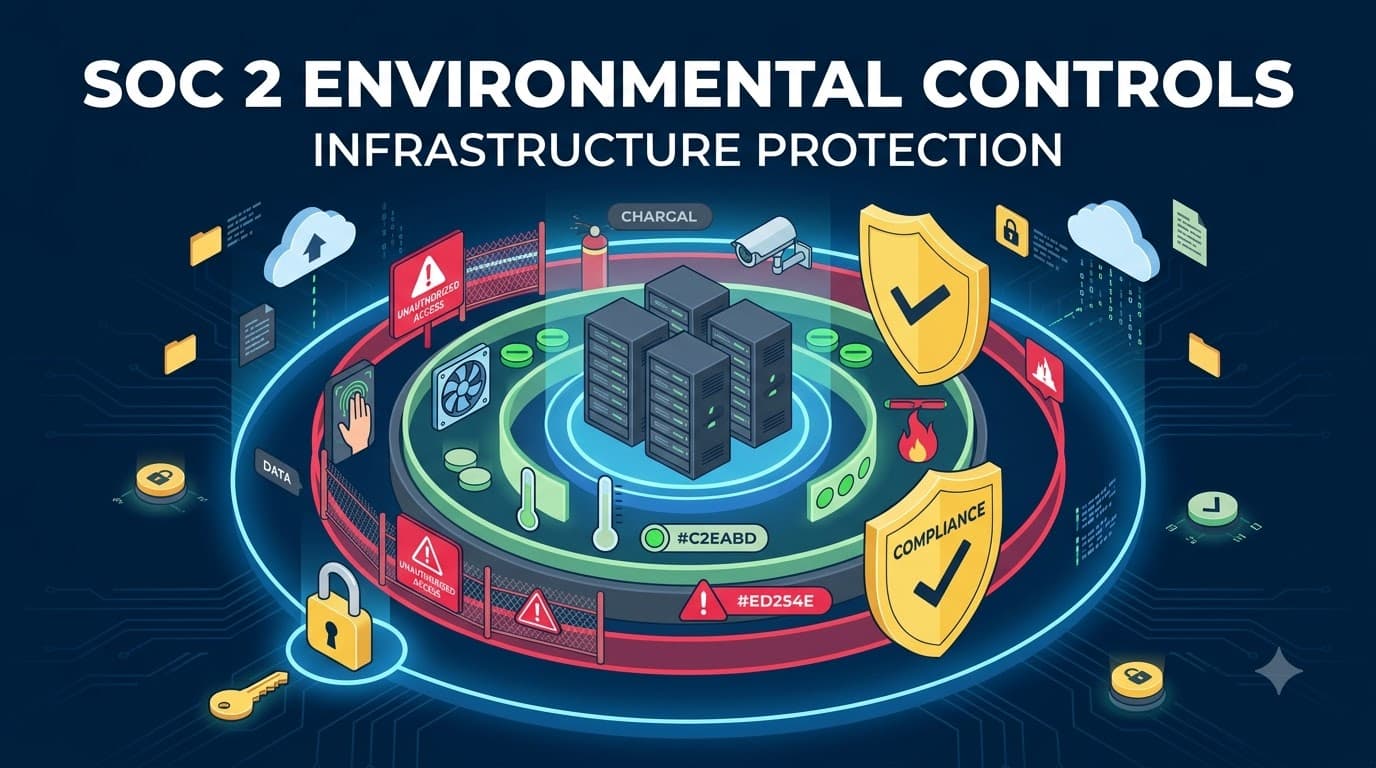
Marcus Webb had eleven days until the Type II report was due to land in the inbox of Cascadia Health Systems' procurement team, and eleven days until a $2.3 million, three-year contract either closed or slipped to next quarter. Marcus was Director of Compliance at Latitude Health, a 140-person telehealth platform that ran its production workloads across two AWS regions and kept a small rack of legacy imaging servers in a regional colocation facility a few miles from headquarters. The Type II fieldwork had gone smoothly for six weeks — access reviews were clean, change management tickets were airtight, encryption evidence was exactly where it should be. Then the auditor, a sharp, no-nonsense senior manager named Deborah Ansah, asked a question that stopped Marcus cold: "Can you show me evidence that the colocation facility's fire suppression system was tested during the review period, and who's responsible for confirming that?"
Marcus didn't have it. Nobody at Latitude Health had ever asked the colo provider for it. The system description referenced "environmental protections consistent with industry standards," but there was no SOC 2 report from the colo vendor on file, no certificate of fire suppression testing, no documented review cadence, and no one internally who owned the relationship. AWS's environmental controls were well-documented and easy to point to — but the colo facility housing the imaging servers was a black box. Deborah flagged it as a potential exception. The clock kept running. Marcus spent the next nine days chasing down a facilities manager who had never been asked for this information before, requesting a SOC 2 report the colo provider turned out to have but had never proactively shared, and building — for the first time — a vendor file that should have existed a year earlier. The report shipped four days late, with a qualified note. The deal survived, barely, but the renewal conversation the following year included pointed questions about the company's vendor oversight maturity.
This article exists so you don't have to learn that lesson the hard way. Environmental controls are the least glamorous, most frequently under-documented part of a SOC 2 program, largely because most organizations don't own the data center anymore — the cloud provider or colo facility does. That doesn't make the controls optional. It changes who performs them and shifts your job from "build a generator" to "prove someone else built one, tested it, and will tell you if it fails."
Who This Is For, and What You'll Walk Away With
This is written for compliance leads, security engineers, IT operations managers, and founders at service organizations preparing for or maintaining a SOC 2 report — whether you run entirely in the cloud, split workloads across colocation facilities, or still operate a physical server room. You'll walk away with a working model of how environmental controls map to the Trust Services Criteria, a practical shared-responsibility framework for cloud versus colo versus on-premises infrastructure, the exact evidence auditors expect to see (and where to get it without becoming a data center engineer yourself), and a vendor-management workflow that turns "we assume our provider handles that" into a defensible, auditable answer.
What "Environmental Controls" Actually Covers
Environmental controls are the physical safeguards that protect the infrastructure hosting your systems and data from non-human, non-cyber threats: power loss, temperature and humidity extremes, fire, water intrusion, and other facility-level hazards. They sit alongside — but are distinct from — physical access security (badge readers, mantraps, visitor logs), which controls who can get to the equipment. Environmental controls protect the equipment from the building itself failing around it: a tripped breaker, a failed chiller, an electrical fire, a burst pipe on the floor above the server room.
In a SOC 2 examination, environmental controls typically show up in two places. First, under the Common Criteria, specifically CC6.4, which addresses physical access restrictions to facilities, but whose points of focus and related narrative commonly extend into environmental protections when auditors assess the full physical security posture of a facility. Second, and more directly, under the Availability criteria — specifically A1.2 — which explicitly calls out environmental protections, software, data backup processes, and recovery infrastructure as things the entity must implement and maintain to meet its availability commitments. If your SOC 2 scope includes the Availability criteria, environmental controls are not optional supporting evidence — they are a named, tested criterion.
Where Environmental Controls Sit in the Trust Services Criteria
It helps to see the two anchor points side by side before going further, because auditors will pull evidence for both, and organizations often prepare for only one.
Table 1: Environmental Control Domains Mapped to SOC 2 Criteria
Environmental Domain | Primary TSC Reference | Secondary Reference | Typical Evidence Owner |
|---|---|---|---|
Fire detection and suppression | A1.2 (Availability) | CC6.4 (Common Criteria) | Facilities / cloud or colo provider |
Power (UPS, generators, redundant feeds) | A1.2 (Availability) | CC6.4 | Facilities / cloud or colo provider |
Cooling / HVAC (temperature, humidity) | A1.2 (Availability) | CC6.4 | Facilities / cloud or colo provider |
Water / flood detection and mitigation | A1.2 (Availability) | CC6.4 | Facilities / cloud or colo provider |
Environmental monitoring and alerting | A1.2 (Availability) | CC7.2 (system monitoring) | Facilities / IT operations |
Backup infrastructure siting (geographic redundancy) | A1.2 (Availability) | CC9.1 (risk mitigation) | Infrastructure / cloud architecture team |
Physical access controls (badges, mantraps, escorts) | CC6.4 | — | Facilities / provider |
Notice that nearly every row lists the service organization as only a secondary or shared owner. That's the defining reality of this topic: unless you operate your own data center, your job is oversight and evidence collection, not engineering.
"The single biggest misconception I run into is teams thinking environmental controls are 'not applicable' because they're in the cloud. They're absolutely applicable — you've just outsourced the control, not the accountability. Your auditor still needs to see that you know who's responsible, what they do, and how you confirmed it." — Deborah Ansah, Senior Manager, Fieldstone Assurance Partners
The Shared Responsibility Model, Applied to Environmental Controls
Cloud computing didn't eliminate environmental risk — it consolidated it into a small number of hyperscale operators who do this at a scale and rigor most individual companies could never match on their own. AWS, Microsoft Azure, and Google Cloud run redundant power feeds, N+1 or 2N cooling, gaseous fire suppression, and continuous environmental monitoring across every region, and they subject those controls to their own independent audits — SOC 2 reports, ISO 27001 certifications, and others — that you can request and review. Colocation providers occupy a middle ground: they own the building, power, and cooling, while you (or your infrastructure vendor) own the racks and servers inside it. On-premises deployments put 100% of the environmental burden on you.
Table 2: Shared Responsibility Matrix — Cloud vs. Colocation vs. On-Premises
Control Area | Public Cloud (AWS/Azure/GCP) | Colocation Facility | On-Premises / Owned Data Center |
|---|---|---|---|
Building power feed & utility redundancy | Provider | Provider | You |
UPS and battery systems | Provider | Provider (sometimes shared racks) | You |
Backup generators & fuel contracts | Provider | Provider | You |
HVAC / precision cooling | Provider | Provider | You |
Fire detection (VESDA, smoke) | Provider | Provider | You |
Fire suppression (clean agent, sprinkler) | Provider | Provider | You |
Water/flood detection at the facility level | Provider | Provider | You |
Environmental monitoring of the building | Provider | Provider (may share dashboards) | You |
Environmental monitoring of your equipment/racks | Provider (abstracted) | You (sensors in your rack) | You |
Reviewing provider's SOC/ISO reports | You | You | N/A |
Selecting geographically diverse regions/facilities | You | You | You (if multi-site) |
Documenting the vendor relationship & CUECs | You | You | N/A |
This is the table to pin above your desk. It's also the table most auditors will implicitly expect you to be able to draw from memory during fieldwork.
Power: Keeping the Lights On
Power is the most consequential environmental control because it's the one whose failure has the fastest, most visible blast radius — a power event doesn't degrade a system, it stops it. Modern data centers layer three defenses: utility redundancy (multiple independent grid feeds), uninterruptible power supply (UPS) systems that bridge the gap in milliseconds, and diesel or natural gas generators that take over within seconds to minutes and can run for days given fuel contracts.
Table 3: Power Redundancy Architectures Compared
Architecture | Description | Typical Downtime on Single Failure | Common In |
|---|---|---|---|
N (no redundancy) | One power path, no backup component | Full outage until repaired | Small offices, legacy on-prem closets |
N+1 | One extra redundant component beyond minimum need | Near-zero (automatic failover) | Mid-tier colo facilities |
2N | Fully duplicated, independent power paths end-to-end | Zero (concurrently maintainable) | Tier III/IV data centers, hyperscale cloud regions |
2N+1 | Two fully redundant systems plus one extra component | Zero, with maintenance headroom | Top-tier hyperscale, financial-sector data centers |
The Uptime Institute's tiering system is the industry's most widely referenced framework for describing this redundancy, and while SOC 2 doesn't require any particular tier, auditors and sophisticated customers increasingly ask which tier a facility maps to as a proxy for maturity.
Table 4: Data Center Tier Standards and What They Imply for Availability
Tier | Redundancy Level | Annual Uptime (Illustrative Target) | Concurrently Maintainable? |
|---|---|---|---|
Tier I | Basic, single path | ~99.67% | No |
Tier II | Redundant components, single path | ~99.75% | No |
Tier III | Multiple paths, one active | ~99.98% | Yes |
Tier IV | Fully fault-tolerant, dual active paths | ~99.99%+ | Yes |
Hyperscale cloud providers generally design to Tier III/IV-equivalent standards for core regions, though they publish their own availability commitments rather than formal Uptime Institute certifications for every facility. Your job as the service organization is not to certify the tier yourself — it's to obtain documentation (a SOC 2 report, an ISO 27001 certificate, a data center fact sheet, or a direct attestation) that describes the redundancy level, and to keep that documentation current in your vendor file.
"I ask every prospective client the same first question about power: 'If your colo's utility feed drops right now, what happens in the next sixty seconds?' Half the time, nobody in the room actually knows. That's the gap we're closing." — Tom Larkin, Data Center Operations Manager, Meridian Colocation Group
Cooling and HVAC: The Quiet Failure Mode
Power failures are dramatic and immediate. Cooling failures are slower and, in some ways, more dangerous precisely because they're not immediately obvious — a data hall can drift out of safe temperature and humidity range for twenty or thirty minutes before hardware starts throwing errors, and by the time it does, you may already be looking at thermal shutdowns, accelerated hardware failure, or condensation-related short circuits.
Data centers manage this with precision cooling systems (computer room air conditioning/handling units), hot-aisle/cold-aisle containment to prevent mixing of intake and exhaust air, and redundant chiller plants so that a single compressor or pump failure doesn't take the whole hall out of spec.
Table 5: Cooling / HVAC Redundancy Configurations
Configuration | Description | Failure Impact |
|---|---|---|
Single CRAC/CRAH unit, no redundancy | One cooling unit serves the space | Full loss of cooling on failure |
N+1 cooling units | One extra unit beyond calculated load | Automatic compensation, no service impact |
Redundant chiller loops | Duplicate chilled-water paths | Continued cooling during maintenance or failure |
Hot-aisle/cold-aisle containment | Physical separation of intake/exhaust airflow | Improves efficiency, reduces thermal risk zones |
Free/economizer cooling | Uses outside air when conditions allow | Reduces mechanical dependency, adds resilience |
Target ranges matter for evidence purposes too. Most data centers operate to something close to the ASHRAE Thermal Guidelines' recommended envelope — commonly cited as roughly 64–80°F (18–27°C) with humidity controlled to avoid both static buildup (too dry) and condensation (too humid). When you request environmental documentation from a provider, ask specifically whether they monitor against a defined temperature/humidity range and what triggers an alert versus an escalation.
Fire Detection and Suppression
Fire is the environmental risk with the highest potential for total, unrecoverable loss, which is why data centers invest disproportionately in early detection. The gold standard is aspirating smoke detection — commonly known by the brand name VESDA (Very Early Smoke Detection Apparatus) — which continuously samples air and can detect combustion byproducts long before a conventional smoke detector would trigger, giving operators time to isolate and address a problem before it becomes a fire.
Suppression is where design choices really diverge, because water-based systems and electronics don't mix well.
Table 6: Fire Detection and Suppression Technologies Compared
Technology | How It Works | Typical Use | Risk to Equipment |
|---|---|---|---|
VESDA / aspirating smoke detection | Continuously samples air for combustion particles | Early warning across all data center tiers | None (detection only) |
Clean agent suppression (e.g., FM-200, Novec 1230) | Displaces oxygen / interrupts combustion chemically, gaseous | High-density server halls | Low — safe for electronics |
Inert gas suppression (e.g., nitrogen, argon blends) | Reduces oxygen concentration below combustion threshold | High-value equipment rooms | Low — safe for electronics |
Pre-action dry-pipe sprinklers | Pipes stay dry until detection confirms fire, then fill | Common in modern data centers as backup layer | Moderate — activates only on confirmed fire |
Wet-pipe sprinklers | Pipes are always charged with water | Office space, non-critical areas | High — not typically used over active server rows |
Double-interlock pre-action | Requires two independent triggers before water release | Highest-value, highest-risk equipment rooms | Very low false-activation risk |
When you're reviewing a provider's environmental documentation, the specific chemistry or brand name matters far less than three things: is the system inspected and tested on a defined schedule (commonly annually, per NFPA guidance), is there a documented alarm-to-response procedure, and is the documentation less than twelve months old.
Water and Flood Protection
Water risk gets less airtime than fire or power, but it's a recurring cause of real incidents — a failed cooling unit condensate line, a pipe break on a floor above a server room, or, in the worst cases, actual flooding from external weather events. Data centers mitigate this with raised floors that route cabling and create a buffer, water-detection sensors along the floor and near pipe runs, moisture-sensing cable that can pinpoint the location of a leak, and, at the site-selection level, deliberately choosing facilities outside flood zones.
Table 7: Water / Flood Detection and Mitigation Controls
Control | Purpose | Detection Speed |
|---|---|---|
Perimeter water-sensing cable | Detects moisture along cable runs near equipment | Minutes |
Point water sensors near CRAC units and pipe joints | Detects leaks at high-risk equipment | Near-immediate |
Raised floor with drainage | Channels water away from live equipment | N/A (passive mitigation) |
Flood-zone site selection (FEMA/local flood maps) | Reduces exposure to external flood events at the design stage | N/A (preventive) |
Automated shutoff valves on cooling water loops | Limits volume of water released on pipe failure | Seconds |
Sump pumps and drainage systems | Removes accumulated water before it reaches equipment | Ongoing |
This is one of the areas where the Latitude Health story from the opening of this article is most instructive: the colo facility, it turned out, had excellent water detection — moisture cable throughout the raised floor, automated shutoff valves, the works. None of it mattered for audit purposes until Marcus actually obtained and filed the documentation. Good controls that exist somewhere in a provider's facility are not evidence. Documented, requested, and reviewed controls are.
Environmental Monitoring: Turning Controls Into Continuous Assurance
Detection and suppression systems are only half the picture. The other half is monitoring — the sensors, dashboards, and alerting logic that give operations teams real-time visibility into environmental conditions and, critically, generate the logs and alert history that become audit evidence.
Table 8: Environmental Monitoring Sensor Types and Typical Alert Thresholds
Sensor Type | What It Measures | Illustrative Alert Trigger |
|---|---|---|
Temperature sensors (rack-level and room-level) | Ambient and intake air temperature | Deviation beyond ASHRAE recommended envelope |
Humidity sensors | Relative humidity | Below ~20% or above ~80% RH (illustrative) |
Airflow/differential pressure sensors | Under-floor and containment airflow | Drop below designed CFM threshold |
Smoke/particulate sensors (VESDA) | Early combustion byproducts | Any detection above baseline |
Water sensors | Presence of moisture | Any positive detection |
Power quality meters | Voltage, frequency, load | Deviation from utility/UPS spec |
Door/access sensors near environmental equipment | Unauthorized access to mechanical/electrical rooms | Any unlogged access event |
For cloud-hosted organizations, this monitoring happens entirely inside the provider's operational tooling — you don't get a raw sensor feed from an AWS availability zone. What you can get, and what you should be asking for, is the provider's own attestation that environmental monitoring is continuous, that alerting escalates to trained personnel, and that this is independently tested as part of their own SOC 2 or ISO 27001 audit.
Reading the Cloud Providers' Environmental Documentation
Every major hyperscaler publishes compliance documentation describing its physical and environmental controls, typically as part of a broader security/compliance program, and makes SOC 2 and ISO 27001 certifications available under NDA or through a self-service trust portal. None of this is a substitute for reading it — but knowing roughly what to expect saves a lot of time when you're building your vendor file.
Table 9: Illustrative Environmental Control Documentation Available from Major Cloud Providers
Provider | Typical Documentation Available | Access Method |
|---|---|---|
AWS | SOC 2 Type II report, ISO 27001 certificate, data center controls whitepaper | AWS Artifact (self-service) |
Microsoft Azure | SOC 2 Type II report, ISO 27001/27017/27018 certificates, physical security overview | Microsoft Trust Portal / Service Trust Portal |
Google Cloud | SOC 2/3 reports, ISO 27001 certification, data center security overview | Google Cloud compliance resource center |
Regional colocation providers | SOC 2 report (varies), fire/power test logs (on request), facility fact sheet | Direct request to account/facilities team |
A practical note: hyperscalers generally do not disclose the exact physical address, floor plans, or granular technical specifications of individual data centers, for obvious security reasons. Your auditor understands this and will not expect facility-level blueprints — they'll expect evidence that you obtained the provider's relevant attestation report, reviewed it, and can speak to what it says about environmental controls.
"Cloud didn't remove environmental risk from the equation, it professionalized it. The companies that struggle in audits aren't the ones with weak infrastructure — they're the ones who never read the SOC 2 report they downloaded eighteen months ago and forgot about." — Elena Voss, CISO, Brightline SaaS
Carve-Out vs. Inclusive Method: The Decision That Shapes Your Evidence Trail
Every SOC 2 report that relies on a subservice organization — which is nearly every SOC 2 report today, given how universal cloud and colo hosting has become — must state how that reliance is handled: the carve-out method or the inclusive method. This decision, made early in scoping, directly determines how much environmental control evidence you personally need to collect versus how much your auditor tests at the subservice organization itself.
Table 10: Carve-Out vs. Inclusive Method for Environmental Controls
Factor | Carve-Out Method | Inclusive Method |
|---|---|---|
Who is tested for environmental controls | Not tested directly; excluded from scope with a description | The subservice organization's controls, tested directly as part of the report |
Your evidence burden | You must show you monitor/review the subservice org's own attestation | Minimal — the auditor tests the subservice org directly |
Practical use with hyperscale cloud (AWS/Azure/GCP) | Standard and expected — providers won't participate in your individual audit | Essentially never used |
Practical use with a small regional colo | Common, but requires more active vendor oversight from you | Occasionally used for smaller or newer colo relationships willing to participate |
Report language | "Complementary subservice organization controls" section describes what's excluded | Subservice organization's controls appear directly in the description and testing matrix |
Impact on system description | Must disclose which subservice organizations are carved out and why | Subservice organization named with its controls integrated |
Almost every organization reading this article uses the carve-out method for its cloud and colo providers, because AWS, Azure, and Google Cloud will not open their global data center operations to be individually tested inside a customer's SOC 2 examination — there are simply too many customers for that to scale. What the carve-out method demands of you in return is active oversight: reviewing the provider's own attestation reports, documenting that review, and being able to describe — not perform, but describe — the environmental controls in place.
CUECs and CSOCs: Who Owns What, in Writing
Two closely related concepts formalize this division of labor. Complementary user entity controls (CUECs) are controls the report explicitly states you must operate for the overall system to work as intended. Complementary subservice organization controls (CSOCs) are the mirror image — controls the report assumes the subservice organization operates, under the carve-out method.
Table 11: CUECs vs. CSOCs for Environmental Protection
Category | Example Control | Owned By |
|---|---|---|
CSOC | "The cloud provider maintains redundant power and generator backup at each data center." | Subservice organization (AWS/Azure/GCP/colo) |
CSOC | "The colocation facility maintains fire detection and clean-agent suppression systems, tested annually." | Subservice organization |
CUEC | "The entity selects hosting regions/facilities and reviews the subservice organization's SOC 2 report at least annually." | You (service organization) |
CUEC | "The entity maintains a documented vendor risk management process covering all infrastructure subservice organizations." | You |
CUEC | "The entity configures workloads across multiple availability zones/regions to mitigate single-facility environmental risk." | You |
CUEC | "The entity escalates and investigates any provider-reported environmental incident affecting in-scope systems." | You |
This table is worth turning into an actual internal document. Most environmental-control audit exceptions we see trace back to a CUEC that exists in the report language but was never operationalized — nobody assigned to review the provider's report annually, nobody responsible for the multi-region architecture decision, nobody who owns the vendor relationship day to day.
Evidence: What Auditors Actually Want to See
This is the section to bookmark. Environmental control evidence for cloud- and colo-hosted organizations is fundamentally a documentation and vendor-oversight exercise, not an engineering one.
Table 12: Evidence Types and Sources for Environmental Controls
Evidence Needed | Where to Get It | How Often to Refresh |
|---|---|---|
Subservice organization's current SOC 2 Type II report | Provider trust portal / direct request | Annually (aligned to your audit period) |
Subservice organization's ISO 27001 certificate (if applicable) | Provider trust portal | Annually or on renewal |
Written record of your review of the above reports, including noted exceptions | Internal (your GRC tool or shared drive) | Each time a report is received |
Vendor risk assessment for each infrastructure subservice organization | Internal vendor management process | Annually or on onboarding |
Architecture documentation showing multi-region/multi-AZ or multi-facility design | Internal (cloud architecture team) | On change |
Incident history — any provider-reported environmental events during the period | Provider status page / incident notifications, logged internally | Ongoing, reviewed quarterly |
Contract/DPA language referencing physical/environmental security commitments | Legal / procurement records | On contract signing or renewal |
For owned facilities: test logs (fire suppression, generator load tests, UPS battery tests) | Facilities team | Per test schedule (often quarterly/annually) |
For owned facilities: HVAC maintenance and calibration records | Facilities team / HVAC vendor | Per maintenance schedule |
Notice that most of this evidence is not technical — it's process discipline. A single shared folder with the current SOC 2 reports for every infrastructure vendor, a one-page review log showing who read each report and when, and a documented multi-region architecture decision will resolve the overwhelming majority of environmental control testing for a cloud-native organization.
"Auditors aren't asking you to reprove that AWS's generators work. We're asking you to prove that you did your job: that you knew which subservice organizations mattered, that you got their reports, that you read them, and that you'd notice and act if something changed." — Deborah Ansah, Senior Manager, Fieldstone Assurance Partners
Building a Vendor Oversight Program for Environmental Assurance
The mechanics of subservice organization oversight are the same regardless of whether you're reviewing environmental, security, or availability commitments, but environmental controls are the category most likely to fall through the cracks because they feel furthest from your day-to-day work. A lightweight, repeatable program fixes this.
Table 13: Subservice Organization / Vendor Review Checklist
Step | Action | Owner |
|---|---|---|
1 | Inventory every subservice organization hosting or physically touching in-scope infrastructure | Compliance lead |
2 | Determine carve-out vs. inclusive status for each | Compliance lead + auditor |
3 | Request current SOC 2 report (or ISO 27001 certificate) from each vendor | Vendor manager |
4 | Read the report; specifically check the environmental/physical section and any noted exceptions | Compliance lead |
5 | Log the review with date, reviewer, and any follow-up items | Compliance lead (in GRC tool) |
6 | Flag and escalate any qualified opinions, exceptions, or gaps found | Compliance lead → security leadership |
7 | Confirm contractual right to receive incident notifications from the provider | Legal / procurement |
8 | Re-run this cycle at least annually, or on any material change (new region, new colo) | Compliance lead |
This is exactly the process Marcus built at Latitude Health in the nine frantic days before the report shipped — the difference between doing it under audit pressure and doing it as a standing quarterly habit is the difference between a clean report and a qualified one.
Case Study: The Cooling Failure That Redefined "Availability" at Cascade Fintech
Cascade Fintech, a payments infrastructure provider processing roughly $40 million a month in transaction volume for mid-market retailers, operated a self-managed rack environment inside a shared colocation facility. Priya Raman, VP of Infrastructure, had scoped Availability into their SOC 2 report because customers explicitly asked for uptime commitments in contracts. Eight months into the observation period, one of the facility's two chiller units failed during a heatwave, and the redundant unit — which had not been load-tested in over a year — couldn't fully carry the thermal load on its own. Rack temperatures in Cascade's row crept above the safe operating envelope for nearly ninety minutes before facilities staff intervened. Two application servers thermal-throttled and one triggered an automatic shutdown, causing a 40-minute service disruption for a subset of customers.
The financial impact was real but contained: approximately $65,000 in SLA credits issued to affected customers, plus roughly 120 engineering hours spent on incident response and post-mortem. What made it a defining moment for the compliance program, though, was what happened next. Priya used the incident as the forcing function to formalize exactly the vendor oversight process described above — requesting the colo's maintenance logs, discovering the redundant chiller's test cadence had lapsed, and negotiating a contractual commitment to quarterly load testing with proactive notification to tenants. When the SOC 2 auditor tested Availability controls for that period, the incident itself became evidence of a functioning detection and response process rather than an unexplained gap, because Cascade could show root cause analysis, the corrective action taken with the vendor, and a revised monitoring threshold that would catch a similar drift earlier next time.
"The incident wasn't the failure. Not having a documented answer for it would have been the failure. Auditors don't expect infrastructure to be perfect — they expect you to detect, respond, and demonstrably improve." — Priya Raman, VP of Infrastructure, Cascade Fintech
Availability, RTO/RPO, and Environmental Risk
Environmental controls connect directly to your organization's recovery time objective (RTO) and recovery point objective (RPO) commitments, because a facility-level environmental event — fire, flood, extended power loss — is precisely the kind of scenario your disaster recovery plan and backup infrastructure exist to survive. This is where environmental controls, Availability criteria, and your backup and recovery program intersect directly in an audit.
Table 14: RTO/RPO Considerations Tied to Environmental Risk
Environmental Scenario | Typical Impact Without Mitigation | Mitigation Strategy | Effect on RTO/RPO |
|---|---|---|---|
Single data center power loss | Full outage of workloads hosted there | Multi-AZ or multi-region failover | RTO reduced from hours to minutes |
Regional colo fire/suppression event | Potential total loss of physical hardware in that facility | Geographically separate backup site, offsite backups | RPO bounded by backup frequency, not facility loss |
HVAC failure causing thermal shutdown | Partial or full service degradation | Auto-scaling into unaffected zones, load shedding | RTO reduced via automated failover |
Flood/water event | Hardware damage, potential data loss if backups co-located | Backups stored in a separate facility/region | RPO protected regardless of primary site status |
Extended utility outage beyond generator fuel capacity | Full outage until power restored | Multi-region architecture, generator refueling contracts | RTO depends on failover automation, not fuel logistics |
The practical takeaway: multi-region or multi-availability-zone architecture is, functionally, an environmental control. It's rarely labeled that way internally, but when an auditor asks how you mitigate the risk of a single facility's environmental failure, "we run active-active across two regions" is a complete and strong answer — arguably stronger than any single facility's fire suppression system, because it removes single-facility dependency entirely.
flowchart TD
    A[Facility-Level Environmental Control<br/>Power / Cooling / Fire / Water] --> B{Who Operates It?}
    B -->|Cloud region / AZ| C[Cloud Provider<br/>Carve-out subservice org]
    B -->|Colocation facility| D[Colo Provider<br/>Carve-out subservice org]
    B -->|Owned data center| E[Internal Facilities Team<br/>Direct control]
    C --> F[Provider's SOC 2 / ISO 27001 Report]
    D --> F
    E --> G[Internal Test Logs<br/>Fire, Generator, UPS, HVAC]
    F --> H[Vendor Oversight Review<br/>CUEC: Annual report review + log]
    G --> H
    H --> I[Evidence Package for SOC 2 Auditor]
    I --> J[A1.2 Availability + CC6.4 Testing]
When You Still Own the Building: On-Premises and Hybrid Environments
Not every organization has fully migrated to cloud or colo. Healthcare providers, manufacturers, government contractors, and some financial institutions still run meaningful workloads in owned server rooms or data centers, whether for latency, regulatory, legacy, or cost reasons. For these organizations, environmental controls are not a vendor-oversight exercise — they're a direct engineering and operations responsibility, and the evidence bar is correspondingly higher.
Table 15: On-Premises Environmental Controls Checklist
Control Area | Minimum Expectation | Strong Practice |
|---|---|---|
Power | UPS covering safe shutdown window | UPS + generator with documented monthly test runs |
Cooling | Dedicated HVAC for server room, separate from office HVAC | Redundant (N+1) precision cooling with 24/7 monitoring |
Fire detection | Smoke detectors, tied to a monitored alarm system | Aspirating (VESDA) detection with facilities on-call escalation |
Fire suppression | Documented, appropriate for electronics (not wet-pipe only) | Clean agent system, annually inspected and certified |
Water detection | None acceptable as a permanent state | Under-floor/near-pipe water sensors with automated alerting |
Monitoring | Manual temperature/humidity checks logged | Automated environmental monitoring with alert thresholds and escalation runbook |
Testing cadence | Annual, at minimum | Quarterly generator load tests, annual fire suppression certification, continuous UPS battery health checks |
Documentation | Test results filed somewhere findable | Centralized log accessible to compliance team, tied to a ticketing/CAP process for any failed test |
If your organization is in this category, budget for this honestly during planning. It's also worth reading how these same physical protections intersect with access control and facility security in our companion piece on SOC 2 physical security for data centers and offices — the two programs share ownership in most on-premises environments and are usually best built together rather than as separate initiatives.
Case Study: Brightline SaaS Turns Environmental Evidence Into a Two-Week Head Start
Brightline SaaS, a 90-person HR technology company running entirely on a mix of AWS and a secondary colo facility for archival storage, had historically treated environmental control evidence as a last-minute scramble — the same pattern that nearly derailed Latitude Health. Elena Voss, Brightline's CISO, restructured the approach ahead of their third annual Type II examination by assigning a single vendor manager to maintain a living folder of current SOC 2 and ISO 27001 reports for every infrastructure subservice organization, reviewed and re-logged every quarter regardless of audit timing.
When the audit period opened, the evidence request for environmental and subservice organization controls — historically the single slowest item to satisfy, taking Brightline's team an average of three weeks in prior years — was fully assembled and delivered to the auditor on day one of fieldwork. Elena estimated the change saved roughly 60 hours of internal scrambling and shaved close to two weeks off the overall audit timeline, allowing the report to ship a full cycle earlier than the previous year and freeing the team to focus fieldwork time on more complex testing areas like access reviews and change management.
"We stopped treating vendor report review as an audit-season task and started treating it as a quarterly hygiene task, like patching. The volume of work didn't change. The panic did." — Jonah Pierce, Compliance Program Manager, Ironclad DevOps (consulting engagement lead on Brightline's readiness program)
Common Audit Findings and How to Prevent Them
Across the environmental controls category, a small number of issues account for the overwhelming majority of exceptions and observations we see in practice.
Table 16: Common Audit Findings and Remediation
Finding | Root Cause | Remediation |
|---|---|---|
No current SOC 2/ISO report on file for a colo or cloud vendor | Vendor relationship never formally onboarded into compliance process | Build vendor inventory; request reports proactively, not reactively |
Report on file is outdated (older than the audit period) | No refresh cadence | Set a recurring calendar reminder tied to each vendor's report renewal date |
No documented review of the vendor's report | Report was filed but never actually read | Require a one-page review log with reviewer, date, and notable exceptions |
CUECs listed in the report aren't operationalized anywhere internally | No owner assigned to CUECs at scoping time | Map every CUEC to a named owner and a recurring task |
Environmental monitoring evidence for owned facilities is manual and inconsistent | No automated monitoring system in place | Deploy environmental sensors with logged, timestamped alert history |
Generator/UPS test logs missing or infrequent | No formal maintenance schedule | Contract with facilities vendor for scheduled, documented testing |
Multi-region architecture exists but isn't documented as a risk mitigation | Architecture decisions made for performance, not framed for compliance | Add architecture diagrams and a short rationale memo to the evidence package |
Incident (e.g., cooling failure, power blip) occurred but has no formal record | No incident logging process for facility-level events | Extend incident response process to cover provider-reported environmental events |
Illustrative Costs of an Environmental Controls Evidence Program
These figures are illustrative, drawn from the kinds of engagements described throughout this article, and will vary by company size, hosting model, and whether you operate any owned facilities.
Table 17: Illustrative Cost Ranges for Environmental Control Programs
Organization Profile | Primary Cost Driver | Illustrative Annual Range |
|---|---|---|
Small SaaS, fully cloud-hosted (AWS/Azure/GCP only) | Internal staff time for vendor report review (quarterly cadence) | $2,000–$6,000 (staff time equivalent) |
Mid-size SaaS, cloud + single colo facility | Vendor management time + occasional consulting support | $8,000–$20,000 |
Larger org with hybrid colo + owned equipment racks | Environmental monitoring hardware, testing contracts, staff time | $25,000–$75,000 |
Organization operating a full owned data center | Generator/UPS/HVAC/fire suppression maintenance contracts, monitoring systems, engineering staff | $150,000–$750,000+ |
For most readers of this article — cloud-native and colo-hosted organizations — the real cost is not capital expenditure on infrastructure, it's the disciplined, recurring labor of vendor oversight. That's good news: it means the fix for most environmental control gaps is a process change, not a budget request.
Implementation Timeline: Standing Up the Program
Table 18: Implementation Timeline for an Environmental Controls Evidence Program
Phase | Timeframe | Key Activities |
|---|---|---|
Phase 1: Inventory | Weeks 1–2 | Identify every subservice organization touching in-scope infrastructure; determine carve-out status |
Phase 2: Collection | Weeks 2–4 | Request current SOC 2/ISO reports from each vendor; request architecture documentation internally |
Phase 3: Review | Weeks 4–5 | Read each report's environmental/physical section; log findings and exceptions |
Phase 4: Gap remediation | Weeks 5–8 | Follow up on missing reports, unresolved exceptions, or lapsed test cadences |
Phase 5: Ownership assignment | Weeks 6–8 (parallel) | Map every CUEC to a named internal owner with a recurring task |
Phase 6: Steady state | Ongoing, quarterly | Recurring vendor report review, incident monitoring, architecture change tracking |
Most organizations starting from zero can reach a defensible steady state within a single quarter, which is exactly the kind of timeline you want to be running before your auditor's fieldwork begins, not during it.
Environmental Controls and the ISO 27001 Overlap
Organizations pursuing both frameworks — an increasingly common posture for companies selling into enterprise and regulated markets — will recognize this territory. ISO 27001's Annex A physical controls theme covers substantially the same ground: protecting equipment from environmental threats, siting considerations, and supporting utilities. If your organization is navigating both standards simultaneously, the evidence you build for SOC 2 environmental controls — vendor reports, review logs, architecture documentation — largely satisfies the equivalent ISO 27001 requirements too, which is one of the most efficient dual-compliance wins available. For a structured comparison of how the two frameworks handle overlapping requirements like this one, see our guide on running ISO 27001 and SOC 2 together, and for a broader side-by-side of scope and philosophy, ISO 27001 vs. SOC 2: which one do you need walks through the decision in more detail.
Environmental Controls as a Trust Signal, Not Just a Checkbox
It's tempting to treat this whole category as boilerplate — a section of the report that says, in effect, "our cloud provider handles it." That framing undersells what a mature environmental controls program actually signals to customers and prospects. When a security-conscious buyer's due diligence team asks how you mitigate the risk of a data center fire, a regional power grid failure, or a flood at your hosting facility, "we selected providers with independently audited environmental controls, we review those attestations on a defined cadence, and our architecture is distributed across multiple facilities so no single environmental event takes us down" is a genuinely strong, differentiated answer — and it's one a surprising number of competitors can't give with confidence, because they never built the underlying discipline.
That gap is a real sales advantage. Enterprise buyers, especially in regulated industries, increasingly ask pointed questions about subservice organization oversight during security reviews, not just during formal audits. A well-organized vendor file, a clear shared-responsibility narrative, and evidence that you treat your cloud and colo providers as an extension of your own control environment — rather than an afterthought — shortens sales cycles and reduces the friction Marcus Webb experienced at Latitude Health from a near-miss into a non-event.
If you're building or tightening this program, PentesterWorld's SOC 2 Readiness Checklist is a practical starting point for scoping exactly which subservice organizations and environmental evidence you'll need before fieldwork begins, and the SOC 2 Control Matrix / RACI Template is built specifically to help you assign CUEC and CSOC ownership the way this article describes, so nothing falls through the cracks between "we assume the provider handles it" and an actual named owner. For teams weighing both frameworks, the SOC 2 vs. ISO 27001 Comparison Guide breaks down exactly where evidence like this can be reused across both audits, and our SOC 2 Gap Analysis Tool will flag missing subservice organization documentation before your auditor does. If you'd rather have an outside team pressure-test your vendor oversight program and evidence trail before it's tested for you under audit pressure, PentesterWorld's compliance advisory team runs exactly this kind of readiness review — reach out and we'll walk your environmental controls evidence, end to end, before your auditor asks the question Marcus Webb wasn't ready for.