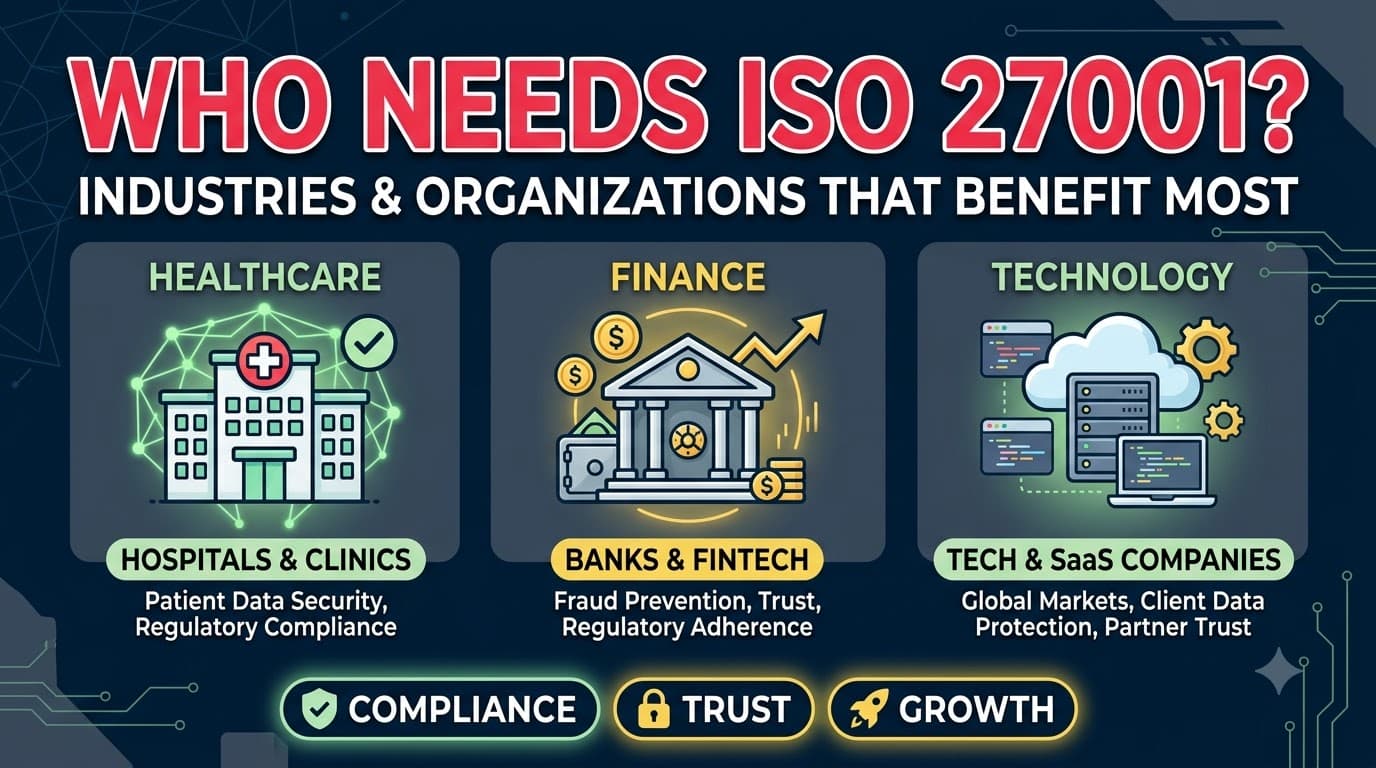
If you're reading this, you're probably trying to decide whether ISO 27001 is worth the money, the headcount, and the six-to-twelve months of your life it's about to consume — and you want to see your own situation reflected in the answer, not a generic sales pitch.
The $1.4 Million Question Priya Almost Didn't Ask
In March 2022, Priya Raman was six weeks from closing the largest contract in her company's history — a $1.4 million, three-year deal with a mid-size regional health system that wanted her startup's patient-engagement platform rolled out across eleven clinics. Priya had built Meridian Health Analytics from a two-person side project into a 34-person company with real revenue, real customers, and a product clinicians actually liked. She thought the deal was done. Verbal agreement, signed term sheet, champagne literally in the office fridge.
Then the health system's vendor risk team sent over a security questionnaire. Two hundred and eleven questions. Followed by a note: "Please also share your ISO 27001 certificate or SOC 2 Type II report so we can complete third-party risk review."
Meridian had neither. They had a password policy in a Google Doc, an AWS account with reasonably sensible IAM roles, and a founder who was pretty sure they encrypted things "in most places." The health system's procurement team didn't say no. They said "not yet" — which, as anyone who has lost a deal this way knows, is often slower and more expensive than a flat no. The deal slipped a full two quarters while Meridian scrambled, eventually closing at a reduced scope after the health system carved out the two clinics with the strictest state privacy requirements from the initial rollout. Priya estimates the delay and scope reduction cost her company somewhere between $380,000 and $520,000 in that fiscal year alone, plus the opportunity cost of the sales team's attention being tied up in a deal that should have closed in thirty days.
Eighteen months later, Meridian holds ISO/IEC 27001:2022 certification. Priya now closes enterprise healthcare deals in weeks, not quarters, and her security questionnaire response time dropped from an average of 19 business days to under 3. She tells this story to every founder she mentors, usually with the same line: "I didn't get certified because I was scared of hackers. I got certified because I was tired of losing deals to a piece of paper I didn't have."
I've spent more than fifteen years advising organizations — over 200 of them, from three-person fintech startups to multinational manufacturers — on information security management, and Priya's story is not unusual. It's the median story. The question I get asked most often isn't "what is ISO 27001" (though we cover that in our complete beginner's guide to ISO 27001). It's this: does an organization like mine actually need it, or is this a compliance tax I can defer another year?
This article is my honest answer, built from two decades of watching who benefits, who stalls, and who wastes money chasing a certificate they didn't need yet.
Who This Is For / What You'll Walk Away With
This article is for you if you are:
A founder or executive at a B2B company (SaaS, healthcare tech, fintech, MSP, or professional services) fielding security questionnaires, vendor risk reviews, or RFPs that mention "ISO 27001" or "independent security certification"
A compliance, security, or IT leader trying to build the business case for certification to a skeptical CFO or board
Someone evaluating ISO 27001 against alternatives like SOC 2, Cyber Essentials, or "just answering the questionnaires manually"
A consultant or advisor trying to help a client figure out timing — now, in twelve months, or not at all
By the end of this article, you'll walk away with:
A clear framework for the four universal drivers that push organizations toward certification, regardless of industry
Industry-by-industry benefit breakdowns for ten sectors, with concrete tables showing typical drivers, urgency, and payoff
A company-profile lens (startup vs. scale-up vs. enterprise, B2B vs. B2C, data processor vs. data controller) that matters more than industry alone in some cases
An honest list of situations where ISO 27001 is premature or the wrong tool
ROI and cost-benefit tables you can adapt for your own board conversation
A self-assessment scoring framework to answer "do we need this now?" for your specific organization
Real (composited, anonymized) case studies with quantified outcomes across sectors
The Core Question: Who Actually Needs ISO 27001?
Let's cut through the marketing noise. ISO 27001 is not a legal requirement for almost anyone. There is no government agency that will fine you for lacking it (with a handful of narrow exceptions in specific public-sector procurement contexts, which we'll cover). Nobody is arrested for not having an Information Security Management System. So why do organizations spend anywhere from $25,000 to $250,000+ and six to eighteen months of internal effort pursuing it?
Because in my experience, four forces converge, and when at least two of them are pulling hard on your organization simultaneously, certification stops being optional in any practical sense — it becomes the cost of staying in the market you're already in.
Those four forces are commercial (customers and procurement demanding it), regulatory (a legal or quasi-legal framework that rewards or expects it), risk-based (your actual threat exposure justifies the rigor), and competitive (your rivals have it and you're being compared against them in every deal).
Here's the blunt truth I tell clients in the first meeting: ISO 27001 is a business decision disguised as a technical one. The controls in Annex A — all 93 of them across the four themes of Organizational, People, Physical, and Technological controls — are genuinely good security practice. But almost nobody pays $80,000 for an external audit purely because it's good practice. They pay because a customer, a regulator, or a competitor is forcing the question. Understanding which of those forces applies to you is the entire game.
The Universal Drivers: What Pushes Any Organization Toward Certification
Before we get into industry specifics, it's worth mapping the drivers themselves, because they cut across every sector I've worked in.
Driver Category | What It Looks Like in Practice | How Urgent It Typically Is | Who Feels It Most |
|---|---|---|---|
Sales & procurement gatekeeping | Security questionnaires, vendor risk assessments, RFP mandatory requirements listing "ISO 27001 or equivalent" | High — can block or delay signed revenue | B2B SaaS, MSPs, any vendor selling to enterprise or regulated buyers |
Regulatory alignment | Frameworks like GDPR, HIPAA, DORA, or national cybersecurity laws that reward demonstrable ISMS maturity even without mandating the standard by name | Medium-to-high, grows over time | Financial services, healthcare, telecom, critical infrastructure |
Risk reduction (genuine security need) | High-value IP, sensitive personal data, safety-critical systems, or history of incidents | Medium, but compounds silently until an incident happens | Manufacturing/IoT, healthcare, any data processor |
Competitive/market positioning | "Everyone else in our category already has it" — differentiation reverses into table stakes | Medium, accelerates as a sector matures | Cloud/SaaS, professional services, government contractors |
Investor and M&A due diligence | Series B+ investors, acquirers, and cyber-insurance underwriters ask for it explicitly | Medium-high at specific growth/exit milestones | Venture-backed startups approaching Series B/C or acquisition |
Insurance and contractual risk transfer | Cyber-insurance premium reductions, indemnification clause negotiations | Low-medium, growing fast | Mid-market and enterprise across all sectors |
Notice something: only one row of that table is really "security" in the pure sense. The other five are business drivers wearing a security costume. That's not cynicism — it's just how the economics actually work, and it's why the ROI conversation later in this article matters as much as the control mapping.
"I stopped pitching ISO 27001 to my board as a security initiative and started pitching it as a sales-enablement initiative. The moment I did that, the budget got approved in one meeting instead of three." — Derek Owusu, VP of Engineering, a Series C logistics-tech company
Multi-Framework Stacking: Where ISO 27001 Fits Alongside Everything Else
One question I get in almost every scoping call, regardless of industry, is some version of "don't we already have this covered with X?" Usually X is SOC 2, sometimes it's NIST CSF, sometimes it's a sector-specific rule like HIPAA or PCI DSS. The honest answer is that ISO 27001 rarely operates alone — it operates alongside whichever frameworks your regulators, buyers, or payment networks already require, and understanding how the pieces fit together prevents a lot of wasted board debate.
Here's the mental model I use with clients: ISO 27001 is the management system — the governance layer that says "we have identified our risks, decided how to treat them, and can prove it systematically, year after year." Most of the frameworks people compare it against are either narrower technical standards (PCI DSS, which governs cardholder data specifically) or legal obligations (GDPR, HIPAA) that ISO 27001 supports evidentially without replacing. SOC 2 is the closest true alternative because it's also a broad, auditor-attested security posture assessment — but it's an attestation report describing controls in place over a review period, not an accredited certification against an international management-system standard, and that distinction matters more to some buyers (especially outside North America) than others.
NIST CSF deserves its own mention because I see it misunderstood constantly. It's a voluntary framework organized around five (now six, with the 2.0 update's addition of Govern) functions — Identify, Protect, Detect, Respond, Recover, and Govern — and it isn't something you get "certified" against in the way you do with ISO 27001. Organizations selling into US federal, defense-adjacent, or critical-infrastructure customers often need to demonstrate NIST CSF alignment specifically, and the practical move is mapping your existing ISO 27001 Annex A controls to the relevant NIST CSF categories rather than running a second, parallel control implementation from scratch.
Framework | What It Actually Is | How It Relates to ISO 27001 | Typical Reason Organizations Need Both |
|---|---|---|---|
SOC 2 Type II | Independent auditor's report on controls over a review period, based on Trust Services Criteria | Overlapping control intent, different attestation model; complementary rather than redundant | North American buyers ask for SOC 2, international or regulated buyers ask for ISO 27001 |
NIST CSF | Voluntary risk-management framework with informative references, not a certifiable standard | ISO 27001 controls can be mapped to NIST CSF functions/categories | US federal, defense-adjacent, or critical-infrastructure customers reference NIST specifically |
PCI DSS | Mandatory, narrowly scoped standard for organizations handling cardholder data | ISO 27001 supports the governance around PCI DSS but does not replace it | Any organization processing card payments, regardless of ISO 27001 status |
GDPR / data protection law | Legal obligation, not a certifiable standard | ISO 27001 (often paired with ISO 27701) evidences the "appropriate technical and organizational measures" GDPR requires | Any organization processing EU personal data |
HIPAA | US legal requirement for safeguarding protected health information | ISO 27001 maps well onto HIPAA's administrative/technical/physical safeguard categories without constituting HIPAA compliance itself | Healthcare vendors and covered entities in the US |
DORA | EU regulation for financial-sector ICT risk management and resilience | A mature ISO 27001 ISMS gives a strong head start on DORA's risk-management and third-party-risk expectations | EU financial entities and their critical ICT providers |
The practical takeaway: don't ask "ISO 27001 or [other framework]" as if it's a single binary choice. Ask "which of these does our specific buyer base, regulator, or payment network actually require by name, and does our ISO 27001 program give us a running start on the others?" In my experience, organizations that map this out before they start save 20–30% of the total effort compared to those that bolt on a second framework a year later as an afterthought.
Industry-by-Industry Breakdown
Industry matters because it shapes which of the six drivers above dominates, how fast the pressure builds, and what "good enough" looks like to your specific buyers or regulators. Let's go sector by sector.
1. SaaS and Technology Companies
If there is one sector where ISO 27001 has gone from "nice differentiator" to "cost of entry," it's B2B SaaS. Enterprise buyers — and increasingly, mid-market buyers — now run every vendor through a security review before signing, and that review almost always asks for either a SOC 2 Type II report, an ISO 27001 certificate, or both. I've watched this shift happen in real time over the past six or seven years: in 2017, maybe one in five enterprise deals I saw asked for a certification. By 2023, it was closer to four in five for deals above $50,000 ACV.
The specific pain point for SaaS companies is speed. Sales cycles compress or stall entirely around the security review stage, and founders consistently underestimate how much revenue sits trapped behind an unanswered questionnaire. The good news: SaaS companies are also the fastest sector to implement, because the infrastructure (cloud-native, often single environment, smaller physical footprint) maps cleanly onto the Annex A control set, particularly the Technological controls theme (A.8.1–A.8.34) covering things like access control, encryption, and secure development.
SaaS/Tech Factor | Detail |
|---|---|
Primary driver | Sales/procurement gatekeeping, investor due diligence |
Typical trigger point | First $50K+ enterprise deal or Series B fundraise |
Time to certify (realistic) | 4–9 months for a lean, cloud-native org |
Most relevant Annex A theme | Technological controls (A.8) — access control, cryptography, secure development lifecycle |
Common alternative considered | SOC 2 Type II, or both in parallel |
Typical payoff | Shortened sales cycle, fewer stalled deals, reduced questionnaire fatigue |
I'll be direct about something practitioners often dodge: SOC 2 and ISO 27001 overlap heavily but aren't interchangeable, and the decision between them (or running both) deserves its own detailed comparison — something we cover in a companion piece on choosing between ISO 27001 and SOC 2 for a growing SaaS company. If your buyers are mostly North American, SOC 2 often comes first; if you sell internationally or into regulated industries, ISO 27001 tends to open more doors because it's recognized globally as an accredited, third-party-audited standard rather than an attestation report.
One nuance that trips up first-time SaaS founders: a security questionnaire asking for "ISO 27001 or equivalent" is often satisfied earlier than expected by a well-documented SOC 2 Type I in progress plus a committed certification timeline, especially for mid-market deals. The mistake is waiting for perfect certainty before engaging the buyer's security team at all — most enterprise procurement contacts will work with you on timing if you're transparent and moving, and disappear if you go quiet for six weeks while you "figure out compliance internally."
2. Financial Services and Fintech
Financial services is where regulatory alignment and commercial pressure hit simultaneously hardest. Banks, payment processors, lenders, and fintech platforms operate under a dense stack of regulatory expectations — and while ISO 27001 doesn't equal compliance with any specific financial regulation, it demonstrably supports the kind of systematic risk management that regulators like to see evidenced. In the EU, the Digital Operational Resilience Act (DORA) pushes financial entities and their critical ICT providers toward exactly the kind of risk-based, auditable ICT risk management framework that an ISMS produces — a mature ISO 27001 program gives you a huge head start on DORA's ICT risk management and third-party risk requirements, even though DORA has its own distinct obligations you'll still need to map separately.
Fintechs additionally face a specific commercial dynamic: banks and payment networks that fintechs need to partner with (for card issuing, banking-as-a-service, or open banking APIs) routinely require ISO 27001 or an equivalent framework as a condition of the partnership agreement, not just as a customer-facing nicety.
Financial Services Factor | Detail |
|---|---|
Primary driver | Regulatory alignment, banking-partner requirements, customer trust |
Typical trigger point | First banking-as-a-service partnership or payment network integration |
Time to certify (realistic) | 6–14 months, longer with legacy infrastructure |
Most relevant Annex A theme | Organizational controls (A.5) — supplier relationships, incident management, and Technological (A.8) — cryptography, network security |
Regulatory context | Supports DORA ICT risk management expectations (EU); complements broader financial-sector security expectations elsewhere — always verify specific local regulator guidance |
Typical payoff | Faster banking-partner onboarding, reduced audit fatigue from regulators, credibility with institutional customers |
"In fintech, ISO 27001 doesn't replace your regulatory obligations — but it gives your regulator, your banking partners, and your auditors a shared language. That alone cuts weeks off every partnership negotiation." — Fatima Chowdhury, Head of GRC, a cross-border payments platform
A pattern worth naming: early-stage fintechs sometimes assume their banking-as-a-service provider's certification covers them by extension. It doesn't. Sponsor banks and BaaS providers routinely push security accountability down the chain contractually, meaning the fintech itself still needs to demonstrate its own control environment — your provider's certificate proves their posture, not yours.
3. Healthcare and Health-Tech
Healthcare organizations — hospitals, clinics, health insurers, and the growing category of health-tech vendors selling into them — sit at the intersection of extremely sensitive data (protected health information) and extremely risk-averse buyers. In the US, HIPAA sets the baseline legal requirement for safeguarding protected health information, but HIPAA itself doesn't mandate ISO 27001; what happens in practice is that health systems, increasingly burned by ransomware attacks against their vendor ecosystem, use ISO 27001 (or SOC 2) as a proxy for "has this vendor actually built a security program, or are they just checking HIPAA's minimum boxes?" ISO 27001 certification maps well onto the administrative, technical, and physical safeguard categories referenced in HIPAA's security rule, which is exactly why Priya's story at the top of this article played out the way it did.
Healthcare/Health-Tech Factor | Detail |
|---|---|
Primary driver | Vendor risk review gatekeeping, regulatory alignment, patient trust |
Typical trigger point | First health-system or payer contract requiring third-party risk assessment |
Time to certify (realistic) | 6–12 months |
Most relevant Annex A theme | Physical controls (A.7) for facilities handling PHI, Technological (A.8) for encryption and access logging |
Regulatory context | Complements HIPAA security-rule expectations in the US; supports broader patient-data protection obligations internationally — does not itself constitute HIPAA compliance |
Typical payoff | Faster procurement approval with hospital systems, reduced questionnaire burden, stronger position in RFPs against uncertified competitors |
Health-tech vendors specifically should expect subprocessor scrutiny to intensify after certification, not disappear. Health systems increasingly ask certified vendors to demonstrate that their own subprocessors (cloud hosting, analytics, customer support tooling) meet equivalent standards — a well-run ISMS should already have this mapped in your supplier relationship controls, but I've seen more than one newly certified vendor caught flat-footed when a hospital's procurement team asked for evidence one layer down the supply chain.
4. Cloud Providers, MSPs, and IT Services Firms
Managed service providers and cloud infrastructure firms occupy a strange dual position: they are simultaneously a vendor needing to prove trustworthiness to their own clients, and a supply-chain risk that their clients' own auditors will scrutinize. If you're an MSP managing IT infrastructure, help desk, or security operations for a portfolio of clients — some of whom are themselves ISO 27001 certified or SOC 2 audited — you will eventually be asked to prove your own security posture as part of your clients' vendor risk management obligations. I've seen MSPs lose entire client portfolios in a single renewal cycle because a client's new CISO tightened vendor requirements and the MSP couldn't produce a certificate.
MSP/Cloud/IT Services Factor | Detail |
|---|---|
Primary driver | Client vendor-risk cascading requirements, competitive differentiation in a crowded market |
Typical trigger point | Losing or nearly losing a contract renewal to a vendor-risk review |
Time to certify (realistic) | 5–10 months |
Most relevant Annex A theme | All four themes tend to matter equally given breadth of client environments touched |
Common alternative considered | Cyber Essentials (UK) as an interim lighter-weight credential, later upgraded to ISO 27001 |
Typical payoff | Retained enterprise client contracts, ability to win RFPs with mandatory certification requirements, premium pricing justification |
A note on scope: MSPs often make the mistake of certifying too broadly (every service line, every office) when a tightly scoped ISMS covering the services clients actually care about — say, managed security operations and remote access — gets them client trust faster and cheaper than boiling the ocean.
MSPs also carry a distinct risk that other sectors don't: because they hold privileged administrative access into dozens of client environments simultaneously, a single MSP compromise can cascade into every downstream client at once — the exact scenario several high-profile supply-chain incidents over the past few years have illustrated publicly. That structural risk is precisely why enterprise clients increasingly treat MSP certification as non-negotiable rather than a nice-to-have, and why I generally advise MSPs to move on certification earlier in their growth curve than comparable-size companies in other sectors.
5. Professional Services and Legal Firms
Law firms, accounting firms, and consultancies handle some of the most sensitive information that exists — privileged client communications, M&A deal data, unreleased financial results, litigation strategy. Historically, this sector under-invested in formal security management relative to the sensitivity of what it holds, largely because the driver was weak: nobody was asking. That has changed sharply over the past five years. Corporate legal departments and general counsel offices, particularly at large clients, now run outside-counsel security assessments before engagement, sometimes requiring ISO 27001 or an equivalent as a panel-inclusion criterion.
Professional Services/Legal Factor | Detail |
|---|---|
Primary driver | Client panel-inclusion requirements (especially from large corporate/financial clients), insurer requirements |
Typical trigger point | Being dropped from or excluded from a major client's approved-vendor panel |
Time to certify (realistic) | 6–12 months, often slower due to partnership governance structures |
Most relevant Annex A theme | Organizational controls (A.5) — access control policy, information classification, confidentiality agreements |
Typical payoff | Panel inclusion with major corporate/financial clients, reduced professional indemnity insurance premiums, differentiation against competing firms |
"Our biggest client told us, in writing, that we'd be removed from their approved panel within eighteen months if we didn't get certified. That letter did more to move our partners than three years of me raising it internally." — Marcus Whitfield, Director of Risk, a mid-size corporate law firm
Partnership governance is the real bottleneck in this sector more than technical control gaps — I've watched a law firm's technical implementation finish in four months while partner sign-off on the information classification policy dragged on for another five, simply because getting sixty equity partners to agree on anything requires its own project plan. If you're advising a partnership-governed firm, budget the political timeline separately from the technical timeline.
6. Manufacturing and IoT/OT Environments
Manufacturing has historically treated "IT security" and "the factory floor" as two separate worlds — until ransomware operators figured out that halting production lines is an extremely effective way to extort payment, and until connected/IoT products started shipping with security as an afterthought. Manufacturers now face pressure from two directions: operational technology (OT) risk (a compromised industrial control system can stop physical production, not just leak data) and product security (IoT device manufacturers are increasingly required by customers, and in some jurisdictions by emerging product-security regulation, to demonstrate a genuine security development lifecycle).
Manufacturing/IoT Factor | Detail |
|---|---|
Primary driver | Operational risk (ransomware/production downtime), OEM/customer supply-chain requirements, emerging product-security expectations |
Typical trigger point | A near-miss or actual ransomware incident affecting production, or a major OEM customer requiring supplier security certification |
Time to certify (realistic) | 9–18 months given OT/IT convergence complexity |
Most relevant Annex A theme | Physical controls (A.7) and Technological (A.8), often paired with sector-specific OT security frameworks |
Typical payoff | Reduced production-downtime risk, retained OEM supply contracts, demonstrable due diligence for cyber-insurance |
The single hardest conversation in this sector is scope: plant managers and IT security leads frequently disagree about where the ISMS boundary should sit relative to safety-instrumented systems and production-critical OT. My consistent advice is to keep safety-critical OT systems governed by their existing safety-management discipline while layering the ISMS's risk-assessment and access-control rigor around the IT/OT boundary and the systems that touch both worlds — trying to certify the entire OT estate under a single generic ISMS scope on day one is the most common reason manufacturing engagements stall past the 12-month mark.
7. Government, Defense, and Public-Sector Contractors
Government agencies themselves adopt ISO 27001 to manage citizen data and critical services, but the more common driver I see is on the contractor side: private companies that sell into government (IT services, defense supply chain, critical infrastructure operators) are increasingly required, as a tender condition, to hold ISO 27001 or demonstrate equivalent controls, particularly for contracts touching sensitive, classified-adjacent, or critical-infrastructure data. In several countries, public procurement frameworks explicitly list ISO 27001 as an acceptable (sometimes mandatory) evidence of supplier security maturity for specific contract categories.
Government/Public-Sector Contractor Factor | Detail |
|---|---|
Primary driver | Tender/procurement mandatory requirements, national critical-infrastructure supplier obligations |
Typical trigger point | Bidding on a government contract that lists certification as a mandatory or scored criterion |
Time to certify (realistic) | 8–16 months, often paired with additional national-scheme requirements |
Most relevant Annex A theme | All four themes, often supplemented by national security clearance/vetting frameworks |
Typical payoff | Tender eligibility, competitive scoring advantage, multi-year contract retention |
One thing I always flag to contractors new to this space: national security clearance/vetting frameworks (personnel security, facility security) run on a completely separate track from ISO 27001 and often on a much longer timeline. Don't assume that starting your ISO 27001 clock also starts your clearance clock — map both timelines independently from day one, because the clearance process is frequently the longer pole in the tent, not the ISMS build.
8. E-Commerce and Retail
E-commerce and retail organizations sit under a specific dual pressure: payment card data (governed by PCI DSS, a payment-industry security standard distinct from but complementary to ISO 27001) and rapidly scaling customer data volumes that create outsized breach impact if things go wrong. Retailers with omnichannel operations — storefronts, apps, loyalty programs, marketplaces — accumulate huge, sprawling data footprints, and ISO 27001 gives them a structured way to bring order to that sprawl. It's worth being precise here: ISO 27001 does not replace PCI DSS obligations for anyone handling cardholder data — PCI DSS remains its own mandatory, narrowly scoped standard — but a functioning ISMS makes PCI DSS compliance activities noticeably easier to sustain year over year because the governance, risk assessment, and access-control disciplines already exist.
E-Commerce/Retail Factor | Detail |
|---|---|
Primary driver | Marketplace/platform partner requirements, customer trust following sector breach headlines, easing PCI DSS maintenance |
Typical trigger point | Scaling past a single-country storefront into a multi-market, multi-payment-processor operation |
Time to certify (realistic) | 6–12 months |
Most relevant Annex A theme | Technological (A.8) — access control, cryptography; Organizational (A.5) — supplier and third-party risk |
Cross-pillar context | Complements but does not replace PCI DSS requirements for cardholder data environments |
Typical payoff | Reduced breach-related brand risk, smoother marketplace/partner onboarding, easier annual PCI DSS maintenance |
Seasonal retail creates a scoping wrinkle worth planning for explicitly: many e-commerce operations scale infrastructure and temporary staff dramatically around peak periods, and an ISMS that only accounts for steady-state operations will fail to reflect real risk during the highest-exposure weeks of the year. Build seasonal scaling explicitly into your risk assessment and access-control processes rather than treating peak season as an exception to the documented norm.
9. Telecommunications
Telecom operators sit inside critical national infrastructure almost everywhere in the world, which means they face regulatory attention, nation-state threat actor interest, and enormous customer data volumes simultaneously. Telecom's driver profile looks unusually mature and long-standing compared to other sectors — many large telecom operators have carried ISO 27001 or its precursor standards for over a decade, largely because national regulators and critical-infrastructure protection frameworks have long expected formalized security governance from this sector. Newer entrants (MVNOs, telecom-adjacent SaaS providers) are now being pulled into the same expectations as they interconnect with incumbent carrier infrastructure.
Telecom Factor | Detail |
|---|---|
Primary driver | Critical-infrastructure regulatory expectations, interconnection-partner requirements, national security considerations |
Typical trigger point | Interconnection agreement negotiation with an incumbent carrier, or new national critical-infrastructure regulation |
Time to certify (realistic) | 9–18 months given network scale |
Most relevant Annex A theme | All four themes; particular weight on Technological (A.8) for network security and Organizational (A.5) for incident management |
Typical payoff | Interconnection eligibility, regulatory goodwill, reduced incident-response friction during national-level cyber events |
Newer entrants to this space — MVNOs and telecom-adjacent SaaS providers riding on incumbent infrastructure — often underestimate how much of their certification timeline depends on documenting third-party and interconnection risk rather than their own internal environment. If your service depends on an upstream carrier's network, your risk assessment needs to explicitly address that dependency, not just your own data center or cloud footprint.
10. Education (Higher Ed and EdTech)
Universities and EdTech vendors handle a surprisingly sensitive mix of data: student records, research IP (sometimes with national-security or export-control sensitivity), financial aid information, and — for EdTech vendors specifically — children's and minors' data in K-12 contexts, which draws additional scrutiny. Higher education institutions have historically been softer targets, and ransomware groups know it; the sector has seen a steady drumroll of incidents that have pushed university IT security offices toward more formal governance. EdTech vendors selling into school districts increasingly face the same procurement gatekeeping dynamic as healthtech vendors selling into hospitals — district and university procurement offices asking for ISO 27001 or SOC 2 as a condition of contract.
Education Factor | Detail |
|---|---|
Primary driver | Procurement gatekeeping (EdTech selling to districts/universities), research-data protection, ransomware exposure |
Typical trigger point | Losing an RFP to a certified competitor, or a sector ransomware incident prompting board-level review |
Time to certify (realistic) | 6–14 months depending on institutional size |
Most relevant Annex A theme | Organizational (A.5) — access control and asset management across sprawling, decentralized IT estates |
Typical payoff | RFP eligibility with school districts and universities, reduced ransomware exposure, research-partner trust |
Comparative Snapshot: Benefit Intensity by Industry
To make the sector comparison easier to digest at a glance, here's how I'd rate the relative intensity of each driver by industry, based on patterns across the 200+ engagements I've run. This isn't a scientific measurement — it's a practitioner's calibrated judgment, useful for orienting yourself, not for citing as external research.
Industry | Sales/Procurement Pressure | Regulatory Pressure | Risk Exposure | Time-to-Payoff |
|---|---|---|---|---|
SaaS/Tech | Very High | Medium | Medium | Fast (weeks-months) |
Financial Services/Fintech | High | Very High | High | Medium (months) |
Healthcare/Health-Tech | Very High | High | High | Fast-Medium |
Cloud/MSP/IT Services | Very High | Medium | High | Fast |
Professional Services/Legal | Medium-High | Low-Medium | Medium | Medium |
Manufacturing/IoT | Medium | Medium | Very High | Slow (production cycles) |
Government Contractors | Very High | High | High | Medium |
E-Commerce/Retail | Medium-High | Medium | Medium-High | Medium |
Telecom | Medium | Very High | High | Slow |
Education | Medium | Medium | Medium-High | Medium |
If you want a visual version of this comparison for an internal deck, picture a radar chart with five axes — Sales/Procurement Pressure, Regulatory Pressure, Risk Exposure, Implementation Speed, and Competitive Necessity — plotted for your specific industry against the sector average. In client workshops, I typically draw this live on a whiteboard: SaaS and MSPs spike hard on Sales/Procurement Pressure and Implementation Speed; Financial Services and Telecom spike on Regulatory Pressure; Manufacturing spikes almost alone on Risk Exposure while lagging on Implementation Speed. The shape of your radar chart, more than any single number, tells you how urgently to move.
Regional and Regulatory Nuances
Industry is only half the picture — where you operate, and where your customers sit, changes the calculus too. I've run engagements on four continents, and the regional texture is real enough that it deserves its own section rather than a footnote.
The European Union layers several forces on top of each other: GDPR's accountability principle rewards demonstrable technical and organizational measures; DORA now formalizes ICT risk management expectations for financial entities and their critical providers; and the NIS2 Directive extends baseline cybersecurity risk-management obligations to a much wider set of "essential" and "important" entities across energy, transport, health, digital infrastructure, and manufacturing than its predecessor did. None of these three name ISO 27001 as mandatory, but all three reward organizations that can point to a certified ISMS as evidence of systematic risk management — which is why EU-headquartered mid-market companies I advise increasingly treat certification as a hedge against several regulatory conversations at once rather than a single-purpose exercise.
The United Kingdom offers a genuinely useful on-ramp that doesn't exist in most markets: Cyber Essentials and Cyber Essentials Plus, both government-backed and considerably lighter-weight than ISO 27001. A large share of UK public-sector tenders and SME-level supply chains treat Cyber Essentials as sufficient, and I've guided several clients through Cyber Essentials first, then ISO 27001 twelve to eighteen months later once their customer base or contract values justified the heavier lift.
The United States lacks a single federal privacy or security law equivalent to GDPR, but the patchwork of state privacy laws, sector rules (HIPAA, GLBA for financial services), and federal contracting frameworks creates the same underlying pressure through a different mechanism — buyer-side vendor risk questionnaires do a huge amount of the enforcement work that a single national law would otherwise do elsewhere. This is part of why the commercial driver (sales/procurement gatekeeping) tends to dominate over the regulatory driver for US-headquartered companies compared to their EU counterparts.
Asia-Pacific markets vary enormously — Singapore, Japan, and Australia all have mature data-protection and cybersecurity regimes that reference international standards favorably, while other markets in the region are earlier in that maturity curve. Multinational companies selling across APAC borders often find ISO 27001 valuable precisely because it's internationally recognized and doesn't require re-proving security posture separately in each jurisdiction the way some purely national schemes do.
Region | Notable Framework Context | Practical Implication for ISO 27001 Decision |
|---|---|---|
European Union | GDPR, DORA (financial sector), NIS2 (critical/important entities) | Certification increasingly treated as multi-regulator hedge, not single-purpose |
United Kingdom | Cyber Essentials / Cyber Essentials Plus as a lighter on-ramp | Common two-stage path: Cyber Essentials first, ISO 27001 later at scale |
United States | State privacy laws, HIPAA, GLBA, federal contracting requirements | Commercial/procurement driver often outweighs direct regulatory driver |
Asia-Pacific | Mixed maturity; several markets reference international standards favorably | Certification valuable for cross-border recognition without re-proving posture per jurisdiction |
Beyond Industry: The Company-Profile Lens
Industry gets you 70% of the way to an answer, but I've seen two companies in the identical sector reach opposite conclusions because their company profile differed. Three dimensions matter almost as much as industry: growth stage, business model (B2B vs. B2C), and data role (processor vs. controller).
Startup vs. Scale-Up vs. Enterprise
Company Stage | Typical ISO 27001 Posture | Reasoning |
|---|---|---|
Early-stage startup (pre-seed to seed, <20 employees) | Usually premature | Product-market fit risk outweighs compliance risk; certification cost relative to runway is high; few enterprise deals yet require it |
Growth-stage/Series A-B (20–150 employees) | Frequently the right moment | First enterprise deals and first serious investor due diligence start demanding it; team small enough to implement fast |
Scale-up/Series C+ (150–500 employees) | Usually necessary | Sales motion now depends on enterprise logos; security team exists to own the ISMS; deferring it costs real revenue |
Enterprise (500+ employees) | Near-mandatory in most B2B contexts | Expected by default in RFPs; often already required by existing large customers; usually paired with SOC 2, ISO 27701, or additional frameworks |
The mistake I see most often with early-stage startups is chasing certification to "look credible" before they have paying enterprise customers demanding it. I've talked at least a dozen founders out of premature certification, redirecting that $40-60K budget toward sales and product instead, with a plan to revisit at the first serious enterprise deal or Series B raise.
B2B vs. B2C
Business model matters enormously. B2B companies face buyer-side procurement gatekeeping directly — a named person at the customer organization reviews your security posture before signing a contract. B2C companies rarely face that direct gatekeeping (individual consumers don't run vendor risk assessments), so the driver shifts almost entirely toward regulatory alignment (particularly data protection law) and reputational/breach risk rather than sales enablement. A B2C fintech app or health app, for instance, often pursues ISO 27001 less because a customer demanded it and more because it strengthens their GDPR accountability posture — GDPR's accountability principle expects organizations to demonstrate appropriate technical and organizational measures, and a certified ISMS is one of the clearest ways to evidence that.
Dimension | B2B Organizations | B2C Organizations |
|---|---|---|
Primary driver | Direct customer/procurement gatekeeping | Regulatory alignment, brand/reputational risk, data protection accountability |
Decision trigger | Specific stalled or at-risk deal | Data protection audit, breach near-miss, scaling user base |
Who asks for the certificate | Named procurement/security contact at the buying company | Regulators, auditors, occasionally app-store/platform partners |
Typical urgency signal | Questionnaire backlog, lost deals | DPA correspondence, planned data protection impact assessment, app-store security review |
Data Processor vs. Data Controller
If your organization primarily processes data on behalf of other companies (a payroll platform, a marketing automation tool, a cloud storage provider), you are a data processor in the language of most privacy law, and your customers — the data controllers — carry legal accountability for how you, their processor, handle that data. This dynamic pushes processors toward certification even harder than controllers, because your customers' own compliance obligations depend on your posture, and increasingly get written into data processing agreements as an explicit requirement ("Processor shall maintain ISO 27001 certification or equivalent throughout the term of this agreement").
Single-Country vs. Multinational Operations
There's a fourth dimension I raise less often but that changes the calculus meaningfully: whether you operate in one jurisdiction or many. A single-country company selling to single-country customers deals with one regulatory regime and often one dominant certification expectation. A multinational — or even a single-country company with customers spread across the EU, UK, and US — faces a fragmented set of expectations that a single ISO 27001 certificate, scoped correctly, can meaningfully simplify. I've worked with companies that were maintaining three or four separate, overlapping "prove you're secure" processes for different regional sales teams before consolidating around one certified ISMS that every regional team could point to. The consolidation savings — in sales engineering time alone, not just audit cost — were often larger than the certification cost itself within the first year.
Operating Profile | Typical Certification Value | Common Pitfall |
|---|---|---|
Single-country, single-market | Moderate — value depends heavily on sector/regulatory driver | Certifying before a real local driver exists |
Multi-region, single legal entity | High — one certificate replaces multiple ad hoc regional proof processes | Scoping the ISMS too narrowly to satisfy only the loudest region |
Multinational with regional subsidiaries | High, but requires careful scope decisions | Failing to define which legal entities and locations sit inside the certified scope, causing audit and sales confusion later |
When You Might NOT Need ISO 27001 (Yet)
I'd be doing you a disservice if I only told you the upside. Some of my most valuable client conversations have ended with "let's not do this yet," and here's when that call tends to be right.
You're pre-product-market-fit. If you don't yet have a repeatable, validated product that customers pay for, certification is a distraction. Your biggest risk isn't a security incident; it's running out of runway before you find product-market fit. Spend the $40-80K elsewhere.
No enterprise or regulated buyer has asked, and none is on the near-term roadmap. If your entire customer base is small business or consumer, and your sales motion is self-serve with no security questionnaires in sight, the commercial driver simply isn't there yet. Revisit when your ACV or customer profile shifts.
A lighter framework genuinely fits better. In the UK, Cyber Essentials (and Cyber Essentials Plus) offers a much lighter-weight, faster, cheaper government-backed certification that satisfies many SME-level procurement requirements without the full ISMS build-out ISO 27001 requires. If your buyers are UK SMEs or you're bidding on UK public contracts with Cyber Essentials as the stated bar, it may be the right first step — sometimes a deliberate stepping stone toward ISO 27001 later, sometimes sufficient on its own.
You lack the internal ownership to sustain it. ISO 27001 isn't a one-time project; it's a management system that requires an internal owner, a management review cadence, and ongoing internal audits. If nobody in your organization has the bandwidth or authority to own an ISMS for the next three-plus years, certifying now sets you up to lose it at the first surveillance audit.
You genuinely have negligible risk exposure and no compliance driver. This is rare, but it exists — a purely internal tool with no customer data, no regulatory footprint, and no B2B sales motion involving security review. Not every organization needs this, and pretending otherwise wastes money that could go toward actual risk reduction elsewhere.
"The worst ISO 27001 engagements I've ever run were the ones where a founder wanted the certificate before they had the customers to justify it. We finished, they were compliant, and eighteen months later half the documented processes had rotted because nobody owned them. Timing is everything." — Aisha Nakamura, independent ISMS consultant, formerly Big Four advisory
ROI and Business-Case Tables
If you're building the case to your board or CFO, framing this as pure cost is the fastest way to get rejected. Frame it as an investment with a payback period, and you'll get a very different conversation. Here's how I typically break down the numbers for clients (illustrative figures based on patterns across engagements, not a formal industry study — always model your own).
Typical Cost Ranges by Organization Size
Organization Size | Typical Total First-Year Cost (Consulting + Audit + Tooling + Internal Time) | Typical Ongoing Annual Cost (Surveillance Audits + Maintenance) |
|---|---|---|
Small (< 50 employees) | $25,000–$60,000 | $8,000–$18,000 |
Mid-size (50–250 employees) | $60,000–$130,000 | $18,000–$40,000 |
Large (250–1000 employees) | $130,000–$280,000 | $40,000–$90,000 |
Enterprise (1000+ employees) | $280,000–$600,000+ | $90,000–$200,000+ |
These figures are illustrative estimates drawn from patterns I've seen across engagements, not a formal published benchmark — your actual cost depends heavily on scope, existing security maturity, whether you use a consultant or build in-house, and your chosen certification body. A companion piece on the full breakdown of ISO 27001 certification cost and ROI walks through every line item in more depth.
Illustrative ROI Model: SaaS Company Example
Metric | Before Certification | After Certification (12 months later) |
|---|---|---|
Average security questionnaire response time | 15–20 business days | 2–4 business days |
Enterprise deals stalled in security review | 30–40% of enterprise pipeline | 5–10% of enterprise pipeline |
Average enterprise sales cycle length | 90–120 days | 60–75 days |
Cyber-insurance premium | Baseline | 10–20% reduction (illustrative, varies by insurer) |
Estimated recovered/accelerated revenue | — | Often exceeds certification cost within 12–18 months for companies with $500K+ enterprise pipeline |
Cost of NOT Certifying (Opportunity Cost View)
Consequence of No Certification | Typical Business Impact |
|---|---|
Stalled/lost enterprise deals | Direct, quantifiable revenue delay or loss (Priya's story: $380K–$520K in one fiscal year) |
Extended sales cycles across the board | Increased customer acquisition cost, sales team bandwidth tied up in repeat questionnaire cycles |
Vendor panel exclusion (legal, professional services, MSPs) | Loss of entire client relationships, not just individual deals |
Higher cyber-insurance premiums | Recurring annual cost increase, compounding over years |
Investor due-diligence friction | Slower fundraising, potential valuation discount at Series B+ |
The Hidden Driver: Cyber Insurance and Risk Transfer
The universal-drivers table earlier flagged insurance as "low-medium, growing fast," and I want to unpack that because it's the driver clients most consistently underestimate. Cyber-insurance underwriters have tightened their questionnaires substantially over the past several years, largely in response to ransomware losses across their portfolios, and a growing number now ask detailed questions that map almost one-to-one onto Annex A control areas — multi-factor authentication coverage, backup and recovery testing, incident response planning, and third-party risk management among them.
What I tell clients is that ISO 27001 certification doesn't automatically produce a specific premium discount — no underwriter will promise you a fixed percentage in advance — but it does two things reliably: it shortens and simplifies the underwriting questionnaire process (because much of what they're asking, you already have documented and audited), and it strengthens your negotiating position on coverage limits, exclusions, and retention amounts, because you can substantiate your risk posture with third-party evidence rather than self-attestation alone.
There's a second, quieter angle here too: post-incident, insurers and their appointed forensics teams scrutinize whether the insured had "reasonable" security measures in place. Organizations with a certified ISMS and a documented incident response process tend to have materially smoother claims processes than organizations relying on informal practices, because the burden of proving "we took this seriously" has already been discharged by the audit trail an ISMS produces.
Insurance-Related Factor | Without ISO 27001 | With ISO 27001 |
|---|---|---|
Underwriting questionnaire effort | Often 4–8 hours of manual security narrative per renewal | Frequently reduced to referencing existing certification and SoA documentation |
Premium negotiation leverage | Self-attested claims only | Third-party audited evidence supporting risk posture |
Post-incident claims friction | Higher — insurer must independently verify "reasonable" security measures | Lower — documented ISMS and incident response records support the claim |
Coverage limit/exclusion negotiation | Limited leverage | Stronger position, particularly for social engineering and ransomware sub-limits |
Common Objections from the Board (and How I Answer Them)
Every board conversation I've sat in eventually surfaces the same handful of objections, and how you answer them determines whether the budget gets approved this quarter or gets tabled for a year. I'll give you the honest version of each response, not the sales-pitch version.
"We don't have the headcount to run an ISMS." True at the start, less true after the first year. Most of the ongoing burden is a fraction of an FTE for a small-to-mid-size company — a part-time ISMS owner plus periodic internal audit support — not a dedicated team. If you genuinely can't find even that fraction, that's a real signal you're not ready yet, not an argument against the standard itself.
"Our competitors don't have it, so why should we spend first?" Sometimes true, and worth checking rather than assuming — I've talked clients out of certifying based on this exact question when a quick competitive scan showed the market hadn't matured yet. But in sectors where it has started moving (SaaS, MSPs, health-tech), being first tends to be a sales advantage; being last tends to be a survival requirement.
"Can't we just answer the questionnaires manually instead?" You can, until questionnaire volume outpaces your team's capacity to answer them consistently and accurately, which happens faster than most leadership teams expect once enterprise deal flow increases. Manual questionnaire response is also a weaker due-diligence signal to increasingly sophisticated buyer security teams who know the difference between self-reported answers and third-party audited evidence.
"What if we fail the audit?" You won't, if you scope the assessment properly and don't book the certification audit before your internal audit and management review have actually run. Reputable certification bodies structure this as a two-stage process (Stage 1 documentation review, Stage 2 full audit) specifically to catch gaps before they become a failed certification.
Board Objection | Honest Response |
|---|---|
"We don't have headcount for this" | Ongoing burden is typically a fraction of an FTE; if you can't find that fraction, you may not be ready — that's useful information, not a dismissal |
"Competitors don't have it yet" | Worth verifying with a real competitive scan before assuming; sector maturity determines whether being first is an advantage or premature |
"Can't we just answer questionnaires manually?" | Works until volume outpaces capacity; also a weaker signal to sophisticated buyer security teams |
"What if we fail the audit?" | Proper internal audit and management review before the external Stage 2 audit largely eliminates this risk |
Self-Assessment Framework: Do You Need It Now?
Score your organization honestly against the following ten factors. One point for each "yes."
# | Question | Yes = 1 point |
|---|---|---|
1 | Have you lost or stalled a deal in the last 12 months specifically due to a security questionnaire or vendor risk review? | |
2 | Do more than 20% of your target customers require ISO 27001, SOC 2, or "equivalent independent certification" in RFPs? | |
3 | Are you approaching a Series B raise or later, or an acquisition process? | |
4 | Do you process sensitive personal data, financial data, health data, or IP on behalf of other organizations? | |
5 | Does your sector face specific regulatory expectations around information security governance (finance, health, telecom, critical infrastructure)? | |
6 | Have you experienced a security incident, near-miss, or vendor-flagged risk in the past 18 months? | |
7 | Do your top 3 competitors already hold ISO 27001 or SOC 2? | |
8 | Do you have (or can you hire/assign) a credible internal owner for an ongoing ISMS? | |
9 | Is your annual contract value or deal size large enough that a multi-month sales delay meaningfully hurts revenue? | |
10 | Would cyber-insurance premium reduction or renewal terms materially matter to your budget? |
Scoring guide:
0–2 points: Not yet. Revisit this self-assessment in 6–12 months or at your next major growth milestone.
3–5 points: Worth active planning. Start with a gap analysis and a 12–18 month roadmap rather than jumping straight to audit booking.
6–8 points: Strong case for near-term certification. Begin scoping consultant/tooling options now.
9–10 points: Certification is close to unavoidable if you want to keep growing in your current market. Treat this as urgent, board-level priority.
Our Is Your Organization ISO 27001 Ready? quiz walks through a more detailed, interactive version of this same framework if you want a guided assessment rather than a static table.
Decision Flow: A Visual Walkthrough
Sometimes the fastest way to communicate this to a co-founder or board member is a simple flowchart rather than a scoring table. Here's the decision tree I sketch on a whiteboard in almost every first client conversation.
flowchart TD
    A[Start: Are you considering ISO 27001?] --> B{Have customers/prospects\nasked for certification\nor security questionnaires?}
    B -- No --> C{Do you handle sensitive\ndata: health, financial,\nchildren's, or large-scale PII?}
    B -- Yes --> D{Is this affecting\nmore than 1 in 5\nof your deals?}
    C -- No --> E[Likely too early.\nRevisit in 6-12 months\nor at next growth milestone]
    C -- Yes --> F{Is there a lighter-weight\nalternative that fits\nyour buyer base, e.g.\nCyber Essentials?}
    D -- No --> G[Monitor trend.\nStart informal gap analysis\nbut don't commit budget yet]
    D -- Yes --> H[Strong driver present.\nProceed to scoping\nand gap analysis]
    F -- Yes, and it's sufficient --> I[Consider lighter framework\nfirst, ISO 27001 later\nif you scale further]
    F -- No, buyers expect\nfull ISO 27001 --> H
    H --> J{Do you have an internal\nowner and 6-18 months\nof runway to sustain it?}
    J -- No --> K[Fix ownership gap first.\nHire or assign an ISMS\nowner before starting]
    J -- Yes --> L[Proceed: gap analysis,\nrisk assessment, Statement\nof Applicability, and\ncertification roadmap]
Mini Case Studies
Case Study 1: SaaS — Meridian Health Analytics (Priya's Company, Revisited)
We opened with Priya's story; here's the fuller arc with numbers. Meridian began its ISO 27001 journey four months after the stalled $1.4 million health-system deal. Starting state: no formal ISMS, ad hoc security documentation, a 34-person team with one part-time security-conscious engineer. Using a fractional ISMS consultant plus an internal project owner (their Head of Engineering), Meridian completed gap analysis in month 1, risk assessment and Statement of Applicability in months 2–3, control implementation across months 3–7, internal audit in month 8, and passed Stage 1 and Stage 2 external audits in months 9 and 10 respectively.
Quantified outcomes 12 months post-certification: - Average security questionnaire turnaround dropped from 19 business days to 3 business days - Closed two additional health-system contracts (combined value approximately $2.1 million) that explicitly required third-party certification in their RFP - Reduced the health-system security review stage of the sales cycle from an average of 45 days to 12 days - Certification and first-year maintenance cost: approximately $78,000; attributable new revenue closed within 12 months: approximately $2.1 million
Case Study 2: MSP — a Regional Managed Security Services Provider
A 60-person MSP I advised (details anonymized/composited at client request) provided managed IT and security operations to roughly 45 mid-market clients. Their trigger was blunt: one client, itself newly SOC 2 certified, informed the MSP they had 12 months to demonstrate equivalent certification or the contract — worth roughly $340,000 annually — would go to a competing MSP at renewal.
Quantified outcomes: - Certified within 8 months, scoped tightly to their managed security operations and remote-access service lines rather than the entire company - Retained the at-risk $340,000 client contract and used the certificate to win 6 new client contracts in the following 18 months, combined new annual recurring revenue of approximately $410,000 - Reduced average new-client security due-diligence period from roughly 6 weeks to 10 days - First-year cost: approximately $52,000; documented new + retained revenue attributable to certification within 18 months: approximately $750,000 combined
Case Study 3: Manufacturing — a Mid-Size Industrial IoT Component Manufacturer
A 210-employee manufacturer producing connected industrial sensors faced two converging pressures: a near-miss ransomware incident that froze one production line for 36 hours (estimated direct cost of the incident: roughly $190,000 in lost production and recovery labor), and a major OEM customer that updated its supplier security requirements to mandate ISO 27001 or an equivalent within 24 months for all Tier 1 suppliers.
Quantified outcomes: - Took 14 months to certify given the complexity of integrating IT and OT (operational technology) environments and physical plant controls - Retained OEM contract status worth approximately $4.3 million annually across their top three OEM relationships - Implemented segmentation and access controls that, per their internal incident log, prevented a second attempted intrusion from reaching production systems 9 months after certification - First-year cost: approximately $165,000; contract retention value protected: approximately $4.3 million annually
"Manufacturing people think of ISO 27001 as an IT thing that doesn't touch the factory floor. It touches the factory floor the day ransomware stops your line. We just got there before the second incident instead of after it." — Tomas Herrera, Director of Operations, industrial IoT manufacturer
"I've sat on both sides of the table — as a vendor risk reviewer at a hospital system and now as a consultant helping health-tech vendors get certified. The vendors with ISO 27001 don't get a free pass, but they get a much shorter conversation." — Dr. Naomi Osei, healthcare vendor risk consultant
Common Implementation Pitfalls by Sector
Across 200+ engagements, the technical control gaps vary by sector, but the implementation pitfalls — the ones that blow budgets and timelines — repeat in surprisingly predictable, sector-flavored patterns. I keep this table close at hand in scoping calls because naming the pitfall early is often enough to avoid it entirely.
Sector | Most Common Implementation Pitfall | How to Avoid It |
|---|---|---|
SaaS/Tech | Scoping the ISMS around the whole company instead of the product/infrastructure that actually matters to buyers | Scope tightly around the systems and services in scope for customer data, expand later if needed |
Financial Services/Fintech | Treating ISO 27001 as separate from existing regulatory compliance programs, duplicating effort | Map ISO 27001 controls directly onto existing regulatory control libraries before starting |
Healthcare/Health-Tech | Underestimating physical and third-party control requirements around PHI-handling facilities and vendors | Include facilities and subprocessor risk assessment in the initial gap analysis, not as an afterthought |
Cloud/MSP/IT Services | Certifying every service line instead of the ones clients actually scrutinize | Scope initially around managed security/remote access services, expand only if commercially justified |
Professional Services/Legal | Partnership governance slows decision-making on policy adoption | Assign a single accountable partner early, not a rotating committee |
Manufacturing/IoT | Treating IT and OT security as one undifferentiated project | Run separate risk assessments for IT and OT environments, then unify at the ISMS governance layer |
Government Contractors | Underestimating national scheme/vetting requirements layered on top of ISO 27001 | Map all required schemes at the outset, not sequentially after ISO 27001 scoping |
E-Commerce/Retail | Conflating PCI DSS scope with ISO 27001 ISMS scope, causing audit confusion | Define both scopes explicitly and document where they overlap and where they diverge |
Telecom | Attempting to certify entire network estate in one pass | Phase certification by business unit or network segment where feasible |
Education | Decentralized IT ownership across departments stalls policy adoption | Establish a central ISMS governance function with explicit authority over decentralized units |
Strategic Close: Compliance as a Growth Lever, Not Just a Cost Center
Here's the reframe I want to leave you with, because it's the one that changes how organizations actually make this decision. Every client I've worked with who treated ISO 27001 purely as a defensive cost — a box to check, a fire to put out after a lost deal — got through certification eventually, but resented every dollar of it. Every client who treated it as a growth lever — a way to shorten sales cycles, unlock new market segments, win larger contracts, and reduce insurance and financing friction — got the same certificate, at similar cost, and walked away calling it one of the best investments they'd made that year.
The difference isn't the standard. It's the framing. ISO 27001, done properly, is a sales asset, a fundraising asset, and a risk-reduction asset simultaneously. The 93 controls across Organizational, People, Physical, and Technological themes aren't bureaucratic overhead for its own sake — they're the scaffolding that lets you say "yes" faster to bigger customers, tougher regulators, and more skeptical investors, with evidence instead of assurances.
If you've read this far and you're seeing your own organization in Priya's stalled deal, Fatima's banking-partner conversations, Marcus's client panel letter, or Tomas's near-miss production line, that's not a coincidence — it's the pattern repeating itself because these forces are structural, not situational. The question was never really "is ISO 27001 worth it in general." It's "which of the four universal drivers is already pulling on us, and how much is waiting costing us every quarter we defer."
For deeper grounding before you commit to a roadmap, our beginner's guide to ISO 27001 walks through the standard from first principles, our piece on ISO 27001 vs ISO 27002 clarifies a distinction that trips up almost every first-time buyer, and our look at what changed between ISO 27001:2013 and ISO 27001:2022 matters if you're evaluating a consultant or vendor still quoting the older control set. If you want the origin story of how we got here, our piece on the history and evolution of ISO 27001 from BS 7799 is worth the twenty minutes.
If you're ready to move from "should we?" to "how do we, and how fast?" — that's exactly where PentesterWorld's ISO 27001 advisory practice picks up. We run gap analyses, build risk registers and Statements of Applicability, prepare teams for Stage 1 and Stage 2 audits, and — because we're a penetration testing firm at our core — we stress-test the controls you're documenting against real attacker techniques before your auditor ever shows up. Reach out for a scoped readiness conversation, or start with our free Certification Readiness Checklist and Certification Cost Calculator to get a concrete first-pass estimate for your organization before you talk to anyone, including us. If you want the full walkthrough before committing to a roadmap, our Complete ISO 27001 Implementation Guide eBook covers the entire journey from initial gap analysis through surveillance audits in one place.