Aditi Rao took over the ISO 27001 project at Solvex Analytics in its seventh month. There was no month-one kickoff deck to inherit — there was a shared drive with four different "scope statements," a risk register that had been rebuilt from scratch twice by two different consultants, and a Statement of Applicability that nobody could explain the logic behind. The project had started with real urgency: a regional bank had offered Solvex a three-year, $2.6 million data-analytics contract, contingent on ISO 27001 certification landing before the contract's compliance-review deadline. Nine months out from that deadline, the original plan looked simple enough on a single slide — "gap analysis, fix gaps, get certified." Nobody had broken it into phases, assigned owners, or built in the months of operating history an auditor would actually want to see.
By month seven, the scope had quietly grown from "the customer analytics platform and its supporting AWS environment" to "basically the whole company, including two acquired subsidiaries nobody had integrated yet." Three different departments believed three different things about who owned risk acceptance. The security team had written policies nobody had trained on, so there was no awareness evidence to show an auditor. And the original nine-month timeline had never accounted for the simple, unglamorous fact that a Stage 2 auditor needs to see months of controls actually operating — not just documents describing them. Aditi's honest estimate, once she mapped what was actually done against what a certification body would expect, was that the company was two months of documentation work and four to six months of operating history away from being audit-ready — a timeline that put the bank contract's compliance deadline in real jeopardy.
This is not a story about bad people or a bad standard. It's a story about a project run without a roadmap — no phase gates, no named owners, no explicit dependency between "risk assessment must exist before controls can be selected" and "controls must run before Stage 2 can succeed." I've seen the same failure pattern at manufacturing firms, healthtech startups, and 400-person logistics companies: the technical work of an ISMS is rarely the hard part. The hard part is sequencing, ownership, and patience with the parts that can't be compressed. This article is the roadmap I wish had existed for Aditi in month one — the phase-by-phase project plan that turns "we need ISO 27001" into a certificate on the wall, with the milestones, dependencies, and realistic effort a project sponsor can actually put into a plan.
Who This Is For
This is written for the person who owns the build — a project manager, information security manager, or newly appointed CISO tasked with taking an organization from "no ISMS" (or a partial, undocumented one) to a certified Information Security Management System. It assumes you already know why you're pursuing ISO 27001; if you need the business case, our ISO 27001 certification process roadmap covers the audit side of the journey in more depth, while this article stays focused on the implementation project that has to happen before an auditor ever shows up. You'll walk away with a phase-by-phase plan, a RACI structure, a sample project timeline, and the pitfalls that stall projects like Solvex's.
The Roadmap at a Glance
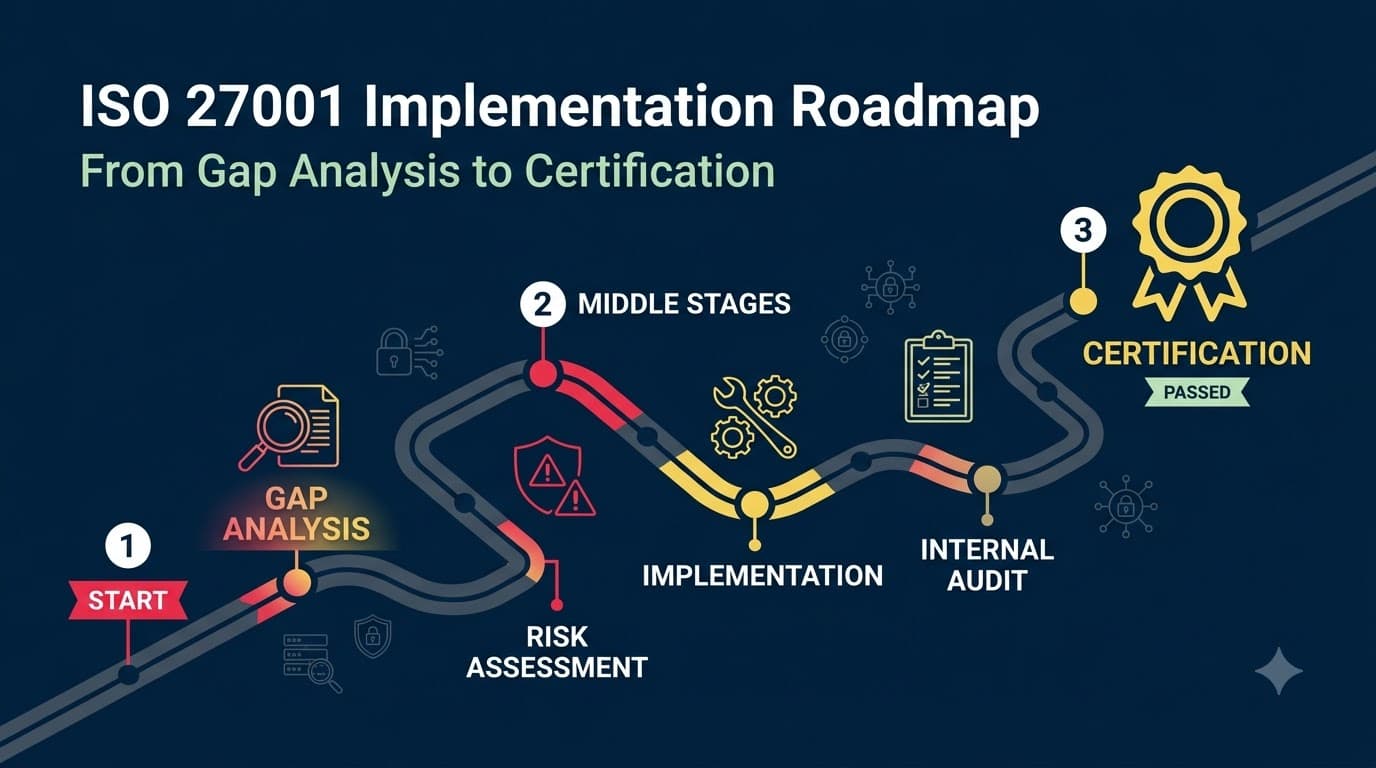
Before the detail, here's the shape of the whole project. Treat the effort column as illustrative — actual duration depends heavily on organization size, scope, and how much of the ISMS already exists informally.
Phase | Key Activities | Outputs | Typical Owner | Typical Effort (mid-size org) |
|---|---|---|---|---|
1. Mobilize & Scope | Secure sponsorship, define ISMS scope, appoint owners, set up governance | Project charter, scope statement, RACI | Project Lead / CISO | 2–4 weeks |
2. Gap Analysis | Assess current state against Clauses 4–10 and Annex A | Gap report, prioritized remediation backlog | Project Lead + Consultant (if used) | 3–5 weeks |
3. Risk Assessment & Treatment | Identify assets/risks, score, select treatments | Risk register, risk treatment plan, draft SoA | Risk Owner / ISMS Manager | 4–8 weeks |
4. Build Controls & Documentation | Write policies, implement technical/physical controls, finalize SoA | Mandatory documents, control evidence, final SoA | Control Owners (cross-functional) | 8–16 weeks |
5. Operate & Embed | Run controls live, generate logs/records, train staff | Months of operational evidence | All control owners | 3–6 months (cannot be compressed) |
6. Internal Audit | Independent review of ISMS conformance | Internal audit report, corrective actions | Internal Auditor (independent of build) | 1–3 weeks + follow-up |
7. Management Review | Leadership reviews ISMS performance and resourcing | Management review minutes, decisions log | Top Management | 1 day + prep |
8. Certification Audits | Stage 1 readiness review, Stage 2 certification audit | Stage 1 findings, certificate | Certification Body + Project Lead | 4–10 weeks (incl. remediation) |
Two things jump out when you lay it out this way. First, Phase 5 — operating the ISMS long enough to generate real evidence — is usually the longest single phase and the one most often left out of the original plan entirely. Second, phases 6 and 7 are not optional "nice to haves" before certification; ISO 27001 Clause 9.2 (internal audit) and Clause 9.3 (management review) are themselves auditable requirements, and a certification body will ask for evidence both occurred before Stage 2. For a fuller view of how long the whole journey typically takes end-to-end, see how long ISO 27001 certification actually takes.
"The projects that stall are never the ones with a hard technical problem. They're the ones where nobody could tell me, in one sentence, who owned the decision to accept a risk. Get ownership right in week one and the rest of the roadmap takes care of itself." — Grace Liu, ISO 27001 Lead Auditor, Meridian Certification Partners
Phase 1: Mobilize and Scope
Every project that later suffers scope creep can usually be traced back to a scoping exercise that was rushed or skipped in week one. Mobilization has three jobs: secure real (not nominal) top-management sponsorship per Clause 5, appoint the people who will own the work, and write down — precisely — what is and is not inside the ISMS boundary.
Scope is the single highest-leverage decision in the entire project. A narrow, well-justified scope (a specific product line, a specific data center, a specific business unit) is legitimate under ISO 27001 as long as it doesn't exclude information or systems needed to deliver services to the customers who care about the certificate. A scope that's too broad drags in business units with no real security maturity and adds months of remediation; a scope that's transparently too narrow to be credible will get challenged at Stage 1. I've watched both mistakes sink timelines. Our dedicated guide on defining the scope of your ISMS walks through the boundary-setting exercise in detail — treat it as required reading before this phase, not optional background.
Outputs from this phase: a signed project charter, a documented ISMS scope statement (including justified exclusions), a RACI for the project, and a governance cadence (steering committee, reporting rhythm). Typical owner: the project lead or newly appointed CISO, with an executive sponsor signing off on scope and resourcing. Typical effort: two to four weeks for a mid-size organization — longer if leadership alignment on scope takes multiple rounds, which it often does.
Mobilization Deliverable | Purpose | Sign-off Required From |
|---|---|---|
Project charter | States objective, budget envelope, target certification date | Executive sponsor |
ISMS scope statement | Defines boundary: locations, systems, business units, exclusions | Top management |
Project RACI | Names owners for each phase and control domain | Steering committee |
Governance cadence | Sets steering committee frequency and escalation path | Project sponsor |
Phase 2: Gap Analysis
With scope fixed, the next step is an honest inventory of where the organization already stands against Clauses 4–10 and the 93 Annex A controls. A gap analysis is not a risk assessment and it's not a control implementation exercise — it's a structured comparison of "what the standard requires" against "what currently exists," producing a prioritized backlog of work for the phases that follow. Our detailed walkthrough of how to run an ISO 27001 gap analysis covers the assessment methodology in full; here, the point is where it sits in the sequence — after scope is fixed, before risk assessment or control build begins, because you can't meaningfully score "how far are we from compliant" until you know the boundary you're measuring against.
A good gap analysis scores each clause and control area on a simple maturity scale and tags it with rough remediation effort, so the output becomes an input to project planning rather than a static PDF. Solvex's original gap analysis, done before scope was finalized, had to be redone almost entirely once the subsidiaries were pulled into scope — a wasted five weeks that a stricter phase gate would have prevented.
Maturity Rating | Description | Typical Remediation Effort |
|---|---|---|
0 – Absent | No policy, process, or control exists | High |
1 – Ad hoc | Exists informally, undocumented, inconsistent | Medium–High |
2 – Defined | Documented but not consistently followed | Medium |
3 – Managed | Documented, followed, and monitored | Low |
4 – Optimized | Documented, monitored, and continuously improved | None (maintain) |
Outputs: a gap report scored against every clause and applicable control, and a remediation backlog fed directly into Phase 3 and Phase 4 planning. Typical owner: the project lead, often paired with an external consultant for an independent first pass. Typical effort: three to five weeks depending on organization complexity and how many business units are in scope. Scoring every clause and control by hand in a spreadsheet works, but the PentesterWorld Gap Analysis Tool can speed up the first pass if you want a structured starting template rather than building the scoring matrix from scratch.
"A gap analysis that isn't tied to the final scope is just an expensive rough draft. I make clients lock scope in writing before I'll start scoring anything against Annex A." — Tomas Varga, CISO, NordStar Underwriting
Phase 3: Risk Assessment and Treatment
This is the phase where the ISMS stops being a paperwork exercise and starts being a decision-making framework. Clause 6.1.2 requires a documented risk assessment methodology; Clause 6.1.3 requires a risk treatment process that produces the Statement of Applicability. Our step-by-step risk assessment methodology guide covers the mechanics of identifying assets, threats, and vulnerabilities and scoring likelihood and impact — worth reading in full before this phase starts, because the methodology itself has to be documented and defensible before any scoring begins.
In project-planning terms, this phase has a clear internal sequence: build or update the asset inventory, identify risks against those assets, score them against a pre-agreed criteria (illustrative example below), decide treatment (accept, avoid, transfer, or reduce/mitigate), and select Annex A controls to address the risks you're treating by reduction. That control-selection step is what produces the draft Statement of Applicability — every one of the 93 controls marked applicable or excluded, with justification either way.
Risk Score (Likelihood × Impact) | Risk Level | Typical Treatment Decision |
|---|---|---|
1–4 | Low | Accept, monitor at next review |
5–9 | Medium | Mitigate — select proportionate controls |
10–15 | High | Mitigate urgently or transfer (e.g., insurance) |
16–25 | Critical | Mitigate before other project work proceeds, or avoid the activity entirely |
Once risks are treated, the resulting decisions need to be captured in a formal risk treatment plan — the document an auditor will ask for to see the line from "identified risk" to "selected control" to "implementation status." The Statement of Applicability itself is technically produced here in draft form, though it's finalized once controls are actually built in Phase 4 — treat the two documents as living together, updated in lockstep, not sequential one-and-done deliverables.
Outputs: an asset inventory, a completed risk register, a risk treatment plan, and a draft SoA. Typical owner: a designated risk owner or ISMS manager, working with department heads who own individual risks. Typical effort: four to eight weeks, and this is a phase worth resisting the urge to rush — a risk assessment that's clearly superficial is one of the fastest ways to draw auditor scrutiny at Stage 1. If your team has never built a treatment plan before, working through the PentesterWorld "Build a Sample Risk Treatment Plan" lab before tackling the real one is a low-risk way to get the format right on the first attempt.
Our PentesterWorld Risk Assessment Methodology guide and companion Risk Scoring Calculator are useful here if you want to standardize scoring across a distributed set of risk owners rather than leaving it to individual judgment.
Phase 4: Build Controls and Documentation
With the SoA drafted, this phase turns "control X is applicable" into an actual working control with owned documentation, technical implementation, and initial evidence. It is almost always the longest phase measured in raw work-hours, because it spans policy writing, technical configuration, physical security changes, and cross-functional coordination — HR for screening and onboarding controls, IT for endpoint and access controls, facilities for physical security, engineering for secure development practices.
Two documentation tracks run in parallel here. The first is the set of documents ISO 27001 explicitly requires regardless of which controls are in scope — see our complete mandatory documents checklist for the full list, which includes the ISMS scope statement, information security policy, risk assessment methodology, risk treatment plan, SoA, and several operational records. The second track is control-specific documentation — the policies and procedures that support whichever Annex A controls the SoA marked applicable, from access control policies to supplier security requirements to incident management procedures.
A practical sequencing tip that saves weeks: build controls in dependency order, not alphabetical or numerical Annex A order. Roles and responsibilities (5.2), asset inventory (5.9), and access control (5.15–5.18) tend to be foundational — other controls reference or depend on them. Leave controls that need long lead times (background screening processes, physical security retrofits, cryptography key management builds) as early starts even if their documentation isn't finished, because the operating-evidence clock in Phase 5 doesn't start until the control is actually live.
Documentation Track | Example Deliverables | Typical Owner |
|---|---|---|
Mandatory ISMS documents | Scope statement, ISMS policy, risk methodology, SoA, internal audit program | ISMS Manager |
Control-specific policies | Access control policy, acceptable use policy, incident response plan | Control owners (IT, HR, Legal, Facilities) |
Operational records | Access reviews, training logs, vulnerability scan reports, incident logs | Control owners (ongoing, feeds Phase 5) |
Outputs: finalized mandatory documents, control-specific policies and procedures, initial technical/physical implementation, and a finalized SoA. Typical owner: a cross-functional set of control owners coordinated by the project lead. Typical effort: eight to sixteen weeks for a mid-size organization with a moderate control set — startups with lean scopes can compress this; regulated enterprises with complex supply chains often extend it.
"Documentation is necessary but it isn't the finish line — I've seen beautifully written policies with zero evidence anyone ever followed them. That gap is exactly what Stage 2 auditors are trained to find." — Sarah Mumford, Head of GRC, Aegis Cloud Services
Phase 5: Operate and Embed
This is the phase Solvex's original plan skipped entirely, and it's the one I've come to think of as the real dividing line between organizations that pass Stage 2 on the first attempt and organizations that don't. Every control in your finalized SoA now has to run, in production, generating the records an auditor will sample. Clause 9.1 requires monitoring, measurement, analysis, and evaluation of the ISMS — which is a formal way of saying "prove it's actually happening," and proof takes calendar time to accumulate. You cannot write an access review policy on Monday and show a completed quarterly access review on Tuesday.
The mechanics of this phase are less about new work and more about discipline: access reviews run on schedule and get logged; vulnerability scans run and findings get tracked to closure; security awareness training gets delivered and attendance gets recorded; the incident management process gets tested, even if only through a tabletop exercise, and the exercise gets minuted; supplier reviews happen on the cadence the policy promises. Every one of these generates a record, and records are what an auditor actually samples — not the policy PDF.
A rule of thumb I give every client: assume a certification body wants to see a minimum of three months of operating evidence for most controls, and closer to six months for controls with quarterly or less-frequent cadences (some access reviews, some supplier assessments, business continuity testing). Trying to compress this by back-dating records or running every control "for the first time" the week before Stage 2 is not just bad practice — auditors are trained to spot suspiciously uniform timestamps and freshly-created logs, and it is one of the fastest ways to turn a routine Stage 2 into a major nonconformity.
Operating Activity | Evidence Generated | Typical Cadence | Owner |
|---|---|---|---|
Access reviews | Signed-off access review records | Quarterly (higher-risk systems more often) | System/application owners |
Vulnerability scanning | Scan reports, remediation tickets | Monthly or continuous | IT/Security operations |
Security awareness training | Completion records, quiz scores | At onboarding + annually | HR / Security team |
Incident response testing | Tabletop exercise minutes, lessons-learned log | At least annually | Incident response lead |
Supplier security reviews | Review records, updated risk ratings | Annually or per contract | Procurement/vendor owner |
Management/security metrics reporting | KPI dashboards, steering committee minutes | Monthly | ISMS Manager |
Outputs: months of accumulated operational records across every applicable control, plus early visibility into which controls are actually workable in practice versus which need redesign. Typical owner: every control owner, coordinated by the ISMS manager who tracks completion against the operating calendar. Typical effort: three to six months of elapsed calendar time — this is a phase you cannot buy your way out of with more headcount, only start earlier.
"Clients ask me all the time if we can skip straight to Stage 2 once the policies are done. I tell them the standard doesn't care how good your policy is — it cares whether you can show me the last three access reviews actually happened." — Priya Chandran, Internal Audit Lead, Fenwick Health Systems
Phase 6: Internal Audit
Clause 9.2 requires a documented internal audit program covering the whole ISMS across a defined cycle, and this audit has to be conducted by someone independent of the work being audited — which is why an internal auditor reviewing their own control implementation doesn't satisfy the requirement, even if they're highly competent. For organizations without a dedicated internal audit function, this is commonly handled by a trained employee from an unrelated department, a peer company's security lead under a reciprocal arrangement, or an external consultant hired specifically for this one task.
The internal audit's job is to independently test whether the ISMS conforms to both the organization's own documented requirements and the standard itself, and whether it's been effectively implemented and maintained — not just whether documents exist. A good internal audit will sample the same kind of evidence a certification body will sample in Phase 8, which is precisely the point: it's a dress rehearsal that surfaces nonconformities while there's still time to fix them without an external audit clock running. Our internal audit planning, execution, and reporting guide covers building the audit program, writing findings, and reporting to management in full detail.
Internal Audit Activity | Output | Owner |
|---|---|---|
Audit program and schedule | Documented audit plan covering full ISMS scope over the certification cycle | ISMS Manager |
Audit execution (interviews, evidence sampling) | Findings log, evidence references | Independent internal auditor |
Nonconformity classification | Major/minor nonconformity register | Internal auditor |
Corrective action tracking | Closed corrective actions with evidence | Control owners |
Audit report to management | Formal report feeding Phase 7 | Internal auditor |
Outputs: a completed internal audit report, a nonconformity register, and evidence of corrective actions either closed or in progress with realistic target dates. Typical owner: an internal auditor independent of the ISMS build team. Typical effort: one to three weeks of active audit work, plus however long corrective actions take to close — budget at least two to three weeks of buffer before Phase 7, because management review needs the audit's findings as an input, not a placeholder saying "audit in progress."
A nonconformity found here is not a failure of the project — it's the internal audit doing its job. What sinks timelines is discovering the same finding for the first time in front of a certification body.
Phase 7: Management Review
Clause 9.3 requires top management to formally review the ISMS at planned intervals, and the standard specifies what that review has to cover: the status of previous review actions, changes in external and internal issues relevant to the ISMS, feedback on ISMS performance (nonconformities, monitoring results, audit results, and objective achievement), stakeholder feedback, risk assessment results and treatment plan status, and opportunities for continual improvement. This is a substantive governance activity, not a rubber-stamp meeting — certification bodies will ask to see the minutes and will check whether the required inputs were actually discussed.
In practice, this meeting works best when it's scheduled deliberately after the internal audit closes (or is far enough along to report meaningful findings), because the internal audit report is one of its most important inputs. Skipping straight from control build to Stage 1 without a documented management review is one of the more common — and entirely avoidable — reasons a certification body pushes back a Stage 1 date.
Management Review Input | Source |
|---|---|
Status of actions from previous review | Decisions log |
Changes in internal/external context | Risk register updates, business changes |
ISMS performance | Metrics, nonconformities, audit results, objective tracking |
Interested party feedback | Customer/regulator/stakeholder input |
Risk assessment and treatment status | Risk register, risk treatment plan |
Improvement opportunities | Steering committee input, lessons learned |
Outputs: documented management review minutes, decisions on resourcing or scope changes, and a record that leadership formally reviewed ISMS performance — a mandatory record under Clause 9.3. Typical owner: top management, with the ISMS manager preparing materials and drafting minutes. Typical effort: one focused half-day to full-day meeting, but expect a week or more of preparation gathering inputs from every control owner.
Phase 8: Certification Audits — Stage 1 and Stage 2
This is the phase everything else in this roadmap has been building toward, and it's worth being precise about what each stage actually checks, because conflating them is a common source of misplaced anxiety. The Stage 1 audit is a documentation and readiness review: the auditor confirms your ISMS scope, checks that mandatory documents exist and are internally consistent, reviews your risk assessment methodology and SoA, and assesses whether you're genuinely ready for Stage 2. It is not primarily an evidence-sampling exercise, though a sharp Stage 1 auditor will still ask pointed questions about operating maturity.
The Stage 2 audit is where operating evidence gets tested directly: the auditor samples records, interviews control owners and staff at multiple levels, and verifies that controls described in your documentation are actually functioning as described, with evidence covering a meaningful period of time. This is exactly why Phase 5's operating history matters so much — a Stage 2 auditor asking to see the last two quarters of access reviews is not a hypothetical, it's the standard interview pattern.
Gaps found at either stage become nonconformities, classified as minor (isolated, doesn't undermine the ISMS, closed with a corrective action plan) or major (systemic, or the ISMS clearly isn't operating — this blocks certification until resolved and often re-audited). A well-run Phase 5 through Phase 7 dramatically reduces the odds of a major nonconformity surfacing here, which is the entire point of sequencing this roadmap the way it's laid out.
Certification Step | Focus | Typical Duration | Possible Outcome |
|---|---|---|---|
Stage 1 audit | Documentation, scope, readiness for Stage 2 | 1–2 days on-site/remote | Proceed to Stage 2, or remediate findings first |
Stage 1 remediation (if needed) | Closing gaps identified in Stage 1 | 1–4 weeks | Readiness confirmed |
Stage 2 audit | Operating evidence, control effectiveness, staff interviews | 2–5 days depending on scope/size | Certification recommended, or nonconformities raised |
Nonconformity closure (if needed) | Corrective action evidence submitted to certification body | 2–8 weeks depending on severity | Certificate issued |
Outputs: Stage 1 findings report, Stage 2 audit report, and — assuming nonconformities are resolved or absent — a formal ISO 27001 certificate, typically valid for three years subject to annual surveillance audits. Typical owner: the certification body conducts the audit; the project lead owns preparation and remediation coordination. Typical effort: four to ten weeks from Stage 1 through certificate issuance, depending on how many findings need closing between stages.
"The organizations that breeze through Stage 2 are never the ones with zero findings in Stage 1 — they're the ones who treated Stage 1 feedback as free consulting and fixed it properly instead of arguing about severity." — Grace Liu, ISO 27001 Lead Auditor, Meridian Certification Partners
Project Management Essentials: Governance, RACI, and Tooling
Everything above describes what has to happen. Just as important is how the project gets managed while it happens, because an eight-phase, six-to-twelve-month project with cross-functional dependencies will drift without deliberate project management — not because anyone is negligent, but because ISMS work competes for attention with everyone's actual day job.
Governance. A working structure I recommend to almost every client: a steering committee (executive sponsor, project lead, and one representative each from IT, HR, and Legal/Compliance) meeting every two to four weeks to review status, unblock decisions, and approve any scope changes. Below that, the project lead runs a weekly working-level sync with active control owners. This two-tier cadence keeps executives out of the weekly weeds while giving them a fast escalation path when a control owner needs a decision only leadership can make — budget for a new tool, for instance, or a call on whether a legacy system falls inside scope.
RACI. Ambiguity about who's Accountable versus who's Responsible is the single most common governance failure I see, especially around risk acceptance and control ownership. The table below is illustrative for a mid-size organization; adapt the roles to your structure, but keep the discipline of naming exactly one "A" per activity.
Activity | Responsible | Accountable | Consulted | Informed |
|---|---|---|---|---|
ISMS scope definition | Project Lead | Executive Sponsor | Legal, Business Unit Heads | All staff |
Gap analysis | Project Lead / Consultant | CISO | Control Owners | Steering Committee |
Risk assessment | Risk Owners | ISMS Manager | Department Heads | Steering Committee |
Risk acceptance decisions | Risk Owner | Executive Sponsor / Risk Committee | ISMS Manager | Steering Committee |
SoA finalization | ISMS Manager | CISO | Control Owners | Executive Sponsor |
Control implementation | Control Owners (IT, HR, Facilities) | Function Head | Project Lead | Steering Committee |
Internal audit | Internal Auditor | ISMS Manager | Control Owners | Top Management |
Management review | ISMS Manager (prep) | Top Management | Internal Auditor | All control owners |
Certification audit coordination | Project Lead | CISO | Certification Body Liaison | Executive Sponsor |
Tooling. You don't need an enterprise GRC platform to run this project well, though one can help at scale. What you do need is a single source of truth for the risk register, the SoA, and the document set — spreadsheets work fine for smaller scopes; dedicated ISMS/GRC tooling earns its cost once you're tracking dozens of controls across multiple business units with recurring evidence collection. Whatever you choose, resist the temptation to run the project plan in one tool, the risk register in another, and the document repository in a third with no cross-referencing — that fragmentation is exactly what left Solvex's project unable to answer basic questions about its own status by month seven. If you do decide dedicated tooling is worth the cost at your stage, our review of the best ISO 27001 compliance software compares the leading options against exactly this kind of single-source-of-truth requirement.
Milestones. Tie funding and steering committee check-ins to phase-gate milestones rather than calendar dates alone: scope sign-off, gap analysis complete, SoA finalized, mandatory documents complete, operating evidence threshold reached (e.g., three months), internal audit closed, management review held, Stage 1 passed, Stage 2 passed. Reviewing progress against milestones rather than a fixed Gantt chart makes it far easier to have an honest conversation when Phase 5's operating-evidence clock inevitably takes longer than the optimistic case.
"I ask every new client the same question in week one: if I asked your CFO who's accountable for accepting a medium risk on the finance system, would they know? Half the time nobody can answer, and that's the real gap I'm there to close." — Marcus Webb, Founder, Webb Compliance Advisory
Resourcing: Internal Team vs. External Consultant
Almost every organization I work with asks some version of "should we do this ourselves or bring in a consultant?" The honest answer is that it's rarely all-or-nothing — most successful projects use some blend, and the right blend depends on internal security maturity, available headcount, and how much the target certification date can flex. Realistic ISO 27001 implementation cost breakdowns cover the budget side of this decision in depth; here, the focus is on what each resourcing model actually buys you in project terms.
Factor | Fully Internal | Consultant-Led | Hybrid (most common) |
|---|---|---|---|
Speed to Stage 1 | Slowest — team learns as it goes | Fastest — experienced pattern-matching | Moderate, depends on split |
Direct cost | Lower cash outlay, higher opportunity cost | Higher cash outlay | Moderate |
Institutional knowledge retained | Highest | Lowest unless deliberately transferred | High, if consultant coaches rather than does |
Risk of "consultant-shaped" ISMS that staff don't understand | Low | Higher — a real risk at Stage 2 interviews | Low, if internal owners stay accountable |
Best fit | Organizations with existing security/compliance staff | Organizations with hard deadlines and thin internal bandwidth | Most mid-size organizations |
The failure mode worth naming explicitly: hiring a consultant to write the ISMS rather than to guide the team that owns it. Stage 2 auditors interview control owners directly, and a control owner who can't speak to their own control because a consultant wrote the policy and ran the first review is a nonconformity waiting to happen. The consultant model that works is one where internal staff remain the named control owners throughout, with the consultant providing methodology, review, and acceleration — not authorship of a system nobody inside the company actually runs.
For organizations weighing the two paths against a hard budget, our implementation cost breakdown and the PentesterWorld Certification Cost Calculator are useful starting points before committing to a resourcing model.
Common Pitfalls That Stall Implementation Projects
Every one of the pitfalls below shows up in the majority of stalled or delayed projects I've been called in to rescue — including, in some form, at Solvex.
Pitfall | Why It Happens | How to Avoid It |
|---|---|---|
Scope creep after gap analysis has started | New stakeholders discover the project and push to add business units | Lock scope in writing before gap analysis; require formal change control for scope changes |
No single accountable owner per phase | RACI was never built, or was built but never enforced | Name one "A" per phase in writing; revisit at every steering committee |
Big-bang control rollout with no dependency order | Team tries to implement all 93 applicable controls simultaneously | Sequence foundational controls first (roles, asset inventory, access control); phase the rest |
Treating Phase 5 as optional or compressible | Original timeline assumed documentation equals readiness | Build the operating-evidence period into the plan from day one, not as a discovered surprise |
Consultant writes the ISMS instead of coaching it | Speed pressure, thin internal bandwidth | Keep internal staff as named control owners; use consultants for methodology and review |
Skipping or rubber-stamping internal audit | Seen as a formality rather than a real check | Assign an independent auditor and treat findings as valuable, not embarrassing |
No documented management review | Leadership assumes a status email counts | Schedule a dedicated meeting with the Clause 9.3 required inputs and minute it formally |
Risk register built once and never revisited | Treated as a Phase 3 deliverable rather than a living document | Assign a review cadence and an owner responsible for keeping it current through Phase 5 and beyond |
"The projects I get called into as a rescue consultant almost never have a technical problem at their core. They have a sequencing problem — someone tried to jump from 'we wrote a policy' straight to 'book Stage 2,' and skipped the months in between where the policy has to actually become real." — Daniel Osei, VP Engineering, Kestrel Manufacturing
A Sample Project Plan
The table below lays out an illustrative timeline for a mid-size organization (roughly 150–400 employees, moderate technical complexity, no highly regulated overlapping frameworks) running phases with realistic overlap rather than a strict waterfall. Treat every duration as a planning starting point to be adjusted against your own gap analysis findings, not a promise.
Month | Primary Phase Activity | Secondary/Overlapping Activity |
|---|---|---|
1 | Mobilize & scope; secure sponsorship | — |
2 | Gap analysis | Begin asset inventory for Phase 3 |
3 | Risk assessment; risk register build | Draft risk treatment approach |
4 | Risk treatment decisions; draft SoA | Begin mandatory document drafting |
5 | Control build (foundational controls first) | Finalize SoA |
6 | Control build continues (technical/physical) | Early controls go live, evidence clock starts |
7 | Control build completes; documentation finalized | Operating evidence accumulates for early-start controls |
8–10 | Operate & embed — all controls live, evidence accumulating | Mid-project management review checkpoint |
11 | Internal audit | Corrective action closure |
12 | Management review | Stage 1 audit scheduling |
13 | Stage 1 audit + remediation | — |
14–15 | Continued operating evidence; remediation closure | Stage 2 preparation |
15–16 | Stage 2 audit | Certificate issuance |
This runs roughly fifteen to sixteen months end-to-end for a first-time mid-size implementation — on the longer end of typical ranges, because it assumes a moderate starting maturity level rather than significant pre-existing security practice. Leaner organizations with strong existing IT hygiene, or narrowly scoped implementations, regularly complete in nine to twelve months; complex, multi-entity, highly regulated organizations often run fifteen to twenty-four months. For the full range of realistic scenarios and what drives them, see how long ISO 27001 certification actually takes.
Dependencies and the Critical Path
Not every phase can run in parallel, and knowing exactly which dependencies are hard (cannot start until the predecessor finishes) versus soft (can overlap with care) is what separates a project plan that holds up from one that quietly slips every month.
Dependency | Type | Why It's Hard/Soft |
|---|---|---|
Scope must be final before gap analysis is scored | Hard | Can't measure compliance against a moving boundary — rescoring wastes weeks, as Solvex learned |
Risk assessment methodology must be documented before risk scoring begins | Hard | Clause 6.1.2 requires a defined, repeatable methodology before results are defensible |
Risk treatment decisions must exist before the SoA is finalized | Hard | SoA justifications derive directly from treatment decisions |
Controls must be implemented before they can generate operating evidence | Hard | Evidence cannot predate the control's existence |
Internal audit should follow a meaningful period of operating evidence | Soft | An audit with nothing to sample yields a hollow report, though early audits can check documentation readiness |
Management review should follow internal audit | Soft | Clause 9.3 expects audit results as an input, but can proceed with partial results if timeline pressure requires |
Stage 1 can run in parallel with late-stage operating evidence accumulation | Soft | Stage 1 focuses on documentation readiness, not deep evidence sampling |
Stage 2 cannot proceed until Stage 1 findings are resolved | Hard | Certification bodies require Stage 1 closure before scheduling Stage 2 |
The practical implication: the critical path running through most implementations is Scope → Risk Assessment/Treatment → SoA → Control Build (foundational controls) → Operating Evidence Period → Internal Audit → Management Review → Stage 1 → Stage 2. Everything else — mandatory document drafting, non-foundational control build, training rollout — has more flexibility to overlap with that spine, and that's exactly where a project manager should look for opportunities to compress the overall timeline without cutting corners on the parts that genuinely can't be rushed.
gantt
    title ISO 27001 Implementation Roadmap
    dateFormat  YYYY-MM-DD
    axisFormat  %b
    section Foundation
    Mobilize & Scope           :done, p1, 2026-01-01, 4w
    Gap Analysis               :done, p2, after p1, 5w
    section Risk & Controls
    Risk Assessment & Treatment:active, p3, after p2, 6w
    Build Controls & Docs      :p4, after p3, 12w
    section Evidence
    Operate & Embed            :p5, after p4, 16w
    section Verification
    Internal Audit             :p6, after p5, 2w
    Management Review          :milestone, m1, after p6, 0d
    Stage 1 Audit              :p7, after m1, 2w
    Stage 2 Audit              :p8, after p7, 6w
    Certificate Issued         :milestone, m2, after p8, 0d
Case Studies: Three Projects, Three Outcomes
Solvex Analytics (resolution). Once Aditi rebuilt the plan around the phase structure above, the honest math held: scope was finalized (dropping one of the two acquired subsidiaries into a documented future-phase exclusion rather than forcing it into year one), the gap analysis was redone against the final boundary, and the risk assessment and SoA were completed in nine weeks. Controls went live on a staggered schedule with the highest-dependency ones (roles/responsibilities, asset inventory, access control) started first. The company banked five months of operating evidence, passed Stage 1 with two minor documentation findings, and cleared Stage 2 with one minor nonconformity (a supplier review that had run ninety days late). Total elapsed time from the rebuilt plan to certificate: eleven months — three months past the original nine-month target, but early enough to renegotiate the compliance-review checkpoint with the bank rather than lose the $2.6 million contract outright.
Bramwell FinTech (lean success). A 60-person payments startup with strong existing DevOps and cloud-security practices scoped its ISMS tightly around a single product and its supporting AWS environment, explicitly excluding a legacy internal tool with no customer data. Because engineering already had reasonable logging, access control, and change management in place, the gap analysis surfaced mostly documentation and governance gaps rather than technical ones. Bramwell moved from kickoff to certificate in eight months, with a total project cost (internal time plus a part-time consultant plus certification body fees) of roughly $95,000 — a case that illustrates how much starting technical maturity compresses Phases 2 through 5 specifically.
Kestrel Manufacturing (a Stage 1 stumble). A 500-person manufacturer with distributed plant locations rushed from control build directly into scheduling Stage 1, skipping a documented internal audit and holding only an informal leadership check-in instead of a formal management review. Stage 1 auditors flagged the missing Clause 9.2 and 9.3 records as a readiness blocker, not a certifiable finding, but the certification body would not proceed to Stage 2 without them. The delay cost Kestrel roughly ten weeks and an estimated $40,000 in consultant fees to run a compressed internal audit and management review after the fact — the exact rescue scenario Daniel Osei describes above, and one that a two-week phase-gate check would have avoided entirely.
Case Study | Starting Point | Elapsed Time to Certificate | Notable Outcome |
|---|---|---|---|
Solvex Analytics | No phased plan, scope in flux | 11 months (from replan) | Retained $2.6M contract via renegotiated deadline |
Bramwell FinTech | Strong existing technical maturity, tight scope | 8 months | ~$95,000 total project cost |
Kestrel Manufacturing | Skipped internal audit/management review | +10 weeks, ~$40,000 in rescue costs | Stage 1 readiness blocker, not a failed audit |
From Compliance Project to Business Asset
It's easy to experience this roadmap purely as a compliance burden — eight phases, months of evidence-gathering, an audit at the end. I'd push back on that framing, because in every organization I've walked through this process, the ISMS that comes out the other end is a genuinely useful piece of business infrastructure, not just a certificate. A well-run risk register becomes the tool leadership actually uses to prioritize security spending. A properly maintained SoA becomes the fastest possible answer to a customer's security questionnaire. And the governance habits built in Phases 1 and 6 through 7 — regular risk review, independent audit, documented management accountability — tend to outlast the certificate itself, because they're simply better ways to run a security program than the ad hoc approach most organizations start with.
There's also a compounding effect worth planning for deliberately: the risk assessment, asset inventory, and control evidence you build for ISO 27001 substantially overlaps with what you'd need for SOC 2 attestation, PCI DSS scoping if you handle card data, or evidencing controls under frameworks like GDPR and DORA. Organizations that map this overlap early — rather than running each framework as an isolated project — routinely cut 30–40% off the incremental effort of the second framework. If multiple frameworks are on your roadmap, it's worth having that conversation with your project sponsor before Phase 1 closes, not after certificate number one is already on the wall.
Solvex got its certificate, kept the bank contract, and — six months later — used the same risk register and control evidence base as the starting point for a SOC 2 Type II engagement the bank's own compliance team asked for next. That's the real payoff of running this as a roadmap instead of a scramble: the second framework is dramatically cheaper than the first, because the hard infrastructure work is already done.
If you're at the start of this journey and want a second set of eyes on your plan, PentesterWorld's team works with organizations at every stage of ISO 27001 implementation — from initial gap analysis through Stage 2 preparation — and our Complete ISO 27001 Implementation Guide and Certification Readiness Checklist are good next stops if you're building out your own phase-by-phase plan. Reach out when you're ready to talk through your specific scope, timeline, and resourcing — a second opinion in week one is a lot cheaper than a rescue project in month seven.