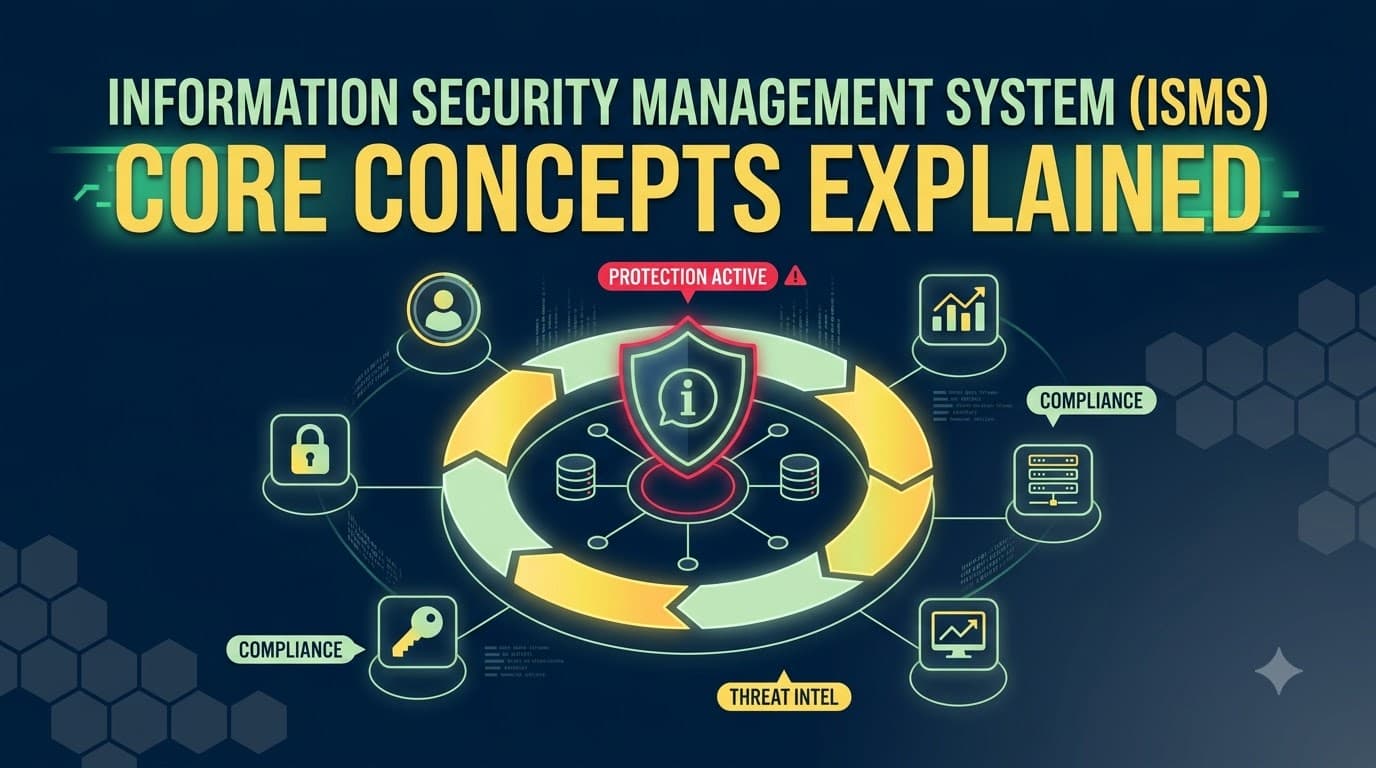
You keep hearing the word "ISMS" in board meetings, audit reports, and vendor questionnaires — and you need to actually understand what it is as a living system, not just recite the definition, so you can picture it running end to end and explain it to anyone who asks.
The $340,000 Lesson: When "Having Controls" Isn't Having a System
Marcus Idowu had done everything right, or so he thought. As the newly minted Head of IT for Solvane Logistics, a 260-person freight brokerage in Charlotte, he'd spent eight months and roughly $180,000 buying and configuring the tools an auditor's checklist told him he needed: a SIEM, an EDR agent on every laptop, a password manager rollout, MFA on the email tenant, a fancy DLP add-on, and a glossy 40-page "Information Security Policy" a consultant had sold him as a template. When the Stage 1 certification audit was scheduled, Marcus felt ready. He had, in his words, "more security tooling than companies twice our size."
The auditor, a soft-spoken but exacting woman named Priya Chandrasekaran, spent the first ninety minutes not looking at a single dashboard. She asked for the risk assessment methodology. Marcus produced a spreadsheet someone had built two years earlier and never revisited. She asked who owned the risk register and when it was last reviewed by leadership. Silence. She asked for evidence of a management review meeting — minutes, attendance, decisions taken. There wasn't one; the CEO had never been in a room where the ISMS was discussed as a business concern. She asked how the Statement of Applicability connected to the actual risks Solvane faced. The SoA existed, but it had been copy-pasted from the same consultant's other client and nobody had mapped it back to Solvane's own risk assessment. She asked for evidence that competence requirements for the two people running the SIEM had been defined and verified. There were none.
Priya's conclusion, delivered kindly but plainly, was this: "You have controls. You do not have a management system. A pile of tools with no scope, no risk-driven logic, no ownership, and no feedback loop isn't an ISMS — it's an expensive collection of good intentions." Solvane failed Stage 1. The rework — building an actual context assessment, a functioning risk methodology, a real management review cadence, and documented competence records — took four more months and roughly $160,000 in consulting and internal labor, on top of the $180,000 already spent on tooling that, in truth, had been only modestly reconfigured. The delayed certificate cost Solvane a nine-figure logistics contract that required proof of ISO 27001 within a fixed bidding window. Total cost of "buying controls instead of building a system": north of $340,000 in direct spend and lost revenue, plus a bruised relationship with the board that had approved the original budget on Marcus's confident timeline.
The lesson that took Solvane a year and a third of a million dollars to learn is one this article can give you in the next twenty minutes: an ISMS is not a set of security tools. It is a management system — a structured, interlocking set of processes for governing information risk, the same species of thing as a quality management system or an environmental management system, just aimed at information security. Understanding what actually makes it "a system" rather than "a stack of controls" is the single highest-leverage piece of ISO 27001 knowledge you can acquire, whether you are building one, auditing one, or simply trying to hold your own in a conversation about one.
Who This Is For / What You'll Walk Away With
This article is written for people who already know that "ISMS" stands for Information Security Management System and are past needing the one-sentence definition. It is for the newly appointed ISMS manager staring at Clauses 4 through 10 for the first time, the security engineer who has been asked to "own compliance" without a governance background, the auditor-in-training who needs the mental model before the checklist, and the executive sponsor who wants to understand what they are actually accountable for before they sign off on a budget.
If you are brand new to ISO 27001 itself, start with What Is ISO 27001? A Complete Beginner's Guide to Information Security Management first, then come back here.
By the end of this article you will be able to:
Explain, in plain language, why an ISMS is a system and not a control checklist
Describe how the PDCA (Plan-Do-Check-Act) continual-improvement engine actually drives an ISMS through a calendar year
Walk someone through Clauses 4–10 of ISO/IEC 27001:2022 and name what each clause contributes to the working system
Explain how the Statement of Applicability (SoA) connects Annex A's 93 controls to real, assessed risk
Name the mandatory documented information an auditor will expect to see, and why each document exists
Describe who does what in a functioning ISMS — from the board to the control owner
Recognize the early warning signs that an ISMS is decaying into "paper compliance"
What an ISMS Actually Is: System, Not Toolset
Strip away the acronym and the standard's clause numbers, and an ISMS is simply this: a deliberate, documented, and continually operated set of processes an organization uses to identify information security risks, decide what to do about them, assign people to do it, check whether it worked, and correct course when it didn't. It is management infrastructure, not security infrastructure. The firewall, the EDR agent, and the encryption policy are outputs of the system — decisions the ISMS produced after weighing risk. They are not the system itself.
This distinction matters because it's the most common failure mode in ISO 27001 programs, and Marcus's story above is disturbingly typical of it. It's also one of the most persistent misconceptions covered in ISO 27001 Myths and Misconceptions Debunked — the belief that certification is fundamentally a shopping list rather than a governance discipline. Organizations that treat "getting ISO 27001 certified" as a shopping list — buy a SIEM, write a policy, run a phishing test, done — build something an auditor will politely but firmly reject, because none of those activities are connected to anything. There's no risk assessment establishing why the SIEM matters more than, say, a data classification scheme. There's no leadership commitment ensuring the SIEM gets funded next year. There's no measurement telling anyone whether the SIEM is actually reducing risk. There's no review cycle asking whether the SIEM is still the right investment given how the business has changed.
A management system, by contrast, is defined by the relationships between its parts. ISO/IEC 27001:2022 is built on the Annex SL harmonized high-level structure that all modern ISO management-system standards share — the same skeleton underlies ISO 9001 (quality), ISO 14001 (environmental), and ISO 22301 (business continuity). This is deliberate: it lets an organization run one integrated governance engine across multiple disciplines instead of maintaining parallel, disconnected bureaucracies. If your quality team already runs management reviews, internal audits, and a document control process under ISO 9001, your ISMS can plug into that same machinery rather than reinventing it. That shared structure is why Clauses 4 through 10 look the way they do — and why understanding them as interlocking gears, not as a compliance checklist, is the goal of the rest of this article.
"The moment a client tells me their ISMS is 'basically a SharePoint folder of policies,' I know exactly what the Stage 1 audit is going to look like. A folder isn't a system. A system has inputs, decisions, owners, and a way of checking its own work." — Renata Filsak, ISO 27001 Lead Auditor, 14 years in the field
The Management-System Engine: PDCA and Continual Improvement
The mechanism that turns a static pile of documents into a living management system is the Plan-Do-Check-Act (PDCA) cycle — sometimes called the Deming cycle after the quality pioneer who popularized it. ISO/IEC 27001:2022 doesn't use the literal words "Plan-Do-Check-Act" in its clause headings the way the 2005 edition did, but the logic is unmistakably preserved across Clauses 4–10, and it's the most useful mental model for understanding how an ISMS actually runs rather than merely exists. The standard's own lineage traces this same continual-improvement thinking back through BS 7799, as detailed in History and Evolution of ISO 27001: From BS 7799 to ISO 27001:2022.
Plan — Understand the organization's context, secure leadership commitment, assess risk, and set objectives (Clauses 4, 5, 6)
Do — Resource, staff, and operate the controls and processes that treat the identified risks (Clauses 7, 8)
Check — Monitor, measure, internally audit, and formally review whether the system is working (Clause 9)
Act — Correct nonconformities and drive continual improvement back into the next planning cycle (Clause 10)
The critical word is cycle. An ISMS that runs Plan and Do once, at implementation, and never returns to Check and Act is not a management system — it's a project that happened to finish. Certification bodies test for the cycle specifically: a surveillance auditor in year two will want to see evidence that Check and Act actually fed back into a revised Plan, not that the organization is still operating off the exact same risk assessment it wrote before Stage 1.
flowchart LR
    subgraph PLAN["PLAN — Clauses 4, 5, 6"]
        A["Clause 4: Context, interested parties, scope"] --> B["Clause 5: Leadership, policy, roles"]
        B --> C["Clause 6: Risk assessment, treatment, objectives, SoA"]
    end
    subgraph DO["DO — Clauses 7, 8"]
        D["Clause 7: Resources, competence, awareness, docs"] --> E["Clause 8: Operational planning, risk treatment execution"]
    end
    subgraph CHECK["CHECK — Clause 9"]
        F["Monitoring & measurement"] --> G["Internal audit"] --> H["Management review"]
    end
    subgraph ACT["ACT — Clause 10"]
        I["Nonconformity & corrective action"] --> J["Continual improvement"]
    end
    C --> D
    E --> F
    H --> I
    J -.->|feeds back into| A
Every section from here forward maps directly onto one of these four phases. Keep the diagram in mind — it is the skeleton the rest of the article hangs on.
"I tell every new ISMS manager the same thing: your job isn't to finish the ISMS. There is no finish line. Your job is to keep the wheel turning — plan, do, check, act, plan again — a little better each lap." — Devon Okafor, Information Security Manager, mid-market fintech
Clause 4: Context of the Organization — Drawing the Boundary
Every ISMS begins with a boundary problem. Before you can manage information security risk, you have to decide whose information, which processes, which locations, and which dependencies actually count. Clause 4 is where that boundary gets drawn, and it is the single most under-appreciated clause in the standard — get it wrong and every subsequent clause inherits the mistake.
Clause 4 requires the organization to determine external and internal issues relevant to its purpose (market pressure, regulatory exposure, talent constraints, technology dependencies), identify interested parties and their requirements (customers, regulators, shareholders, employees, insurers), and use both to define the scope of the ISMS — a documented statement of what's in and what's out. It also requires establishing the ISMS itself as an ongoing process, not a one-time exercise.
Solvane's failure traces directly back here: nobody had ever asked "who actually needs this ISMS to exist, and why?" The scope had been set arbitrarily around "IT systems" without reference to the freight-brokerage processes that created Solvane's actual risk exposure — the EDI feeds to carrier partners, the customer portal handling shipment data, the finance team's exposure to invoice fraud. A scope disconnected from context produces a risk assessment disconnected from reality.
Clause 4 Sub-Requirement | What It Actually Produces | Common Failure Mode |
|---|---|---|
4.1 Understanding the organization and its context | A documented list of internal/external issues (market, legal, technology, culture) | Treated as a one-off brainstorm, never revisited |
4.2 Understanding needs and expectations of interested parties | Register of parties (customers, regulators, staff, insurers) and their requirements | Only customer contracts considered; regulators and staff ignored |
4.3 Determining the scope of the ISMS | A written, boundaried scope statement referencing 4.1 and 4.2 | Scope copied from a template, unrelated to actual business context |
4.4 Information security management system | Commitment to establish, implement, maintain, and continually improve the ISMS | Read as "build it once," not as an ongoing obligation |
Interested Parties: The Requirements Layer Underneath Scope
Clause 4.2's "interested parties" requirement is easy to treat as a formality — a box to tick with "customers, regulators" and move on. Done properly, it's the layer that keeps the entire ISMS honest about whose requirements it actually needs to satisfy, which in turn keeps risk assessment (Clause 6) grounded in real obligations rather than generic industry assumptions.
Interested Party | Typical Requirement | Where It Shows Up Downstream |
|---|---|---|
Customers | Contractual security clauses, SLAs, right-to-audit provisions | Risk treatment priorities, SoA justification |
Regulators | Sector-specific legal obligations (data protection, financial services rules) | Mandatory controls regardless of risk appetite |
Employees | Reasonable working conditions, clear disciplinary process, privacy | Clause 6 and 7 people-related controls |
Shareholders/board | Protection of enterprise value, breach cost avoidance | Leadership commitment, resourcing decisions |
Insurers | Evidence of baseline controls as a condition of coverage | SoA scope, incident response requirements |
Suppliers/partners | Reciprocal security expectations in shared-service arrangements | Supplier relationship controls in Annex A |
Solvane's original scope statement never asked this question of its carrier partners or insurer, which is part of why the eventual risk assessment (once built properly) surfaced EDI-feed risks nobody had previously considered material.
Our guide on defining your ISMS scope is a natural companion piece for readers who want to go deeper on scoping specifically.
Clause 5: Leadership — Where Accountability Actually Lives
If Clause 4 draws the boundary, Clause 5 answers the question every auditor asks within the first hour: does top management actually own this, or has it been delegated so far down that no one with budget authority is accountable? Clause 5 requires top management to demonstrate leadership and commitment (not just "support"), establish and communicate an information security policy, and assign organizational roles, responsibilities, and authorities.
This is where Marcus's story again shows the gap. Solvane's CEO had signed a policy document without ever attending a meeting where security risk was discussed as a business risk alongside sales pipeline or cash flow. Clause 5 does not require the CEO to configure a firewall; it requires the CEO to ensure the ISMS's objectives are compatible with the organization's strategic direction, that resources are made available, and that the importance of the ISMS is communicated throughout the business. Auditors test this with a simple, devastating question to leadership: "What does the ISMS cost you if it fails, and how do you know it's working?" A hesitant answer is a leadership-commitment nonconformity waiting to be written up.
Clause 5 Component | Owner | Evidence an Auditor Will Ask For |
|---|---|---|
5.1 Leadership and commitment | Top management | Meeting minutes showing security discussed as a business risk |
5.2 Policy | Top management, drafted by ISMS manager | Approved, communicated Information Security Policy, version history |
5.3 Organizational roles, responsibilities, authorities | Top management | Org chart or RACI showing named individuals, not just job titles |
"The fastest way I can predict a failed audit is to ask the CEO what's in the risk register. If they've never seen it, the ISMS has no real owner — it has a delegate, and delegates get overruled the first time budget gets tight." — Priya Chandrasekaran, Lead Auditor, ANAB-accredited certification body
Clause 6: Planning — Where Risk Becomes a Decision Engine
Clause 6 is the intellectual heart of the ISMS: the process that converts "we could get breached in a hundred different ways" into a prioritized, resourced, and defensible set of decisions. It covers actions to address risks and opportunities, the information security risk assessment process, the information security risk treatment process (including the Statement of Applicability), information security objectives, and — since the 2022 revision — explicit planning for changes to the ISMS.
The risk assessment needs a consistent methodology (how likelihood and impact are scored, what thresholds trigger treatment), applied against identified information assets, threats, and vulnerabilities — or, as many organizations now do, against defined risk scenarios. The output is a risk register: a living document, not a report generated once for the auditor and shelved. Risk treatment then selects one of four standard responses to each unacceptable risk — modify (apply a control), retain (accept it, usually below a documented threshold), avoid (stop the activity that creates it), or share (transfer it, typically via insurance or a contract). Every control selected during treatment must be cross-referenced against Annex A in the Statement of Applicability, with a justification for inclusion and, just as importantly, a justification for any Annex A control excluded.
Clause 6 Sub-Process | Key Output | Why It Matters to the System |
|---|---|---|
6.1.1–6.1.3 Risk assessment & treatment | Risk register, risk treatment plan, Statement of Applicability | Converts abstract exposure into ranked, owned, budgeted decisions |
6.2 Information security objectives | SMART, measurable objectives at relevant functions/levels | Gives Clause 9 something concrete to measure against |
6.3 Planning of changes (2022 addition) | Change assessment before ISMS modifications | Prevents ad hoc changes from silently invalidating the risk picture |
Solvane's SoA failure is worth dwelling on because it's so common: a document copied from another client, listing controls that had never been checked against Solvane's own risk register. An SoA disconnected from its risk assessment is arguably worse than no SoA at all, because it looks compliant while hiding the fact that no real risk-based decision was ever made. We cover the mechanics of building a defensible SoA in more depth further down, and our dedicated guide on how to create a Statement of Applicability goes deeper still.
"A risk register that hasn't changed in eighteen months isn't evidence of stability. It's evidence nobody's looking at it." — Devon Okafor, Information Security Manager, mid-market fintech
Risk Assessment Methodologies: Picking an Approach That Fits
The standard doesn't mandate a specific risk assessment methodology, which is liberating and dangerous in equal measure — liberating because a 20-person startup and a 5,000-person bank can both comply using approaches proportionate to their complexity, dangerous because "no mandated method" is sometimes read as "no method needed." In practice, most organizations land on one of three broad approaches, or a blend of the first two.
Methodology | How It Works | Best Fit |
|---|---|---|
Qualitative (High/Medium/Low) | Likelihood and impact scored on descriptive scales, combined via a simple matrix | Smaller organizations, first-time implementations, faster stakeholder buy-in |
Quantitative | Likelihood and impact expressed numerically (e.g., annualized loss expectancy) | Organizations with mature loss data, insurers, regulated finance |
Scenario-based | Specific plausible incident scenarios (e.g., "ransomware in the customer database") assessed end to end | Organizations wanting board-level narratives rather than abstract scores; complements either approach above |
Whichever methodology is chosen, Clause 6.1.2 requires it to be documented, consistently applied, and capable of producing comparable, repeatable results over time — a spreadsheet with inconsistent scoring logic from one risk to the next, which is closer to what Solvane had, will not survive audit scrutiny even if it technically "exists."
Setting Objectives That Actually Drive Behavior
Clause 6.2 objectives are where good intentions either become measurable commitments or remain vague aspirations nobody can be held to. The difference is almost always specificity.
Weak Objective (Fails 6.2) | Strong Objective (Passes 6.2) |
|---|---|
"Improve our security posture" | "Reduce mean time to patch critical vulnerabilities to under 15 days by Q3" |
"Train employees on security" | "Achieve 95% completion of annual awareness training with a post-training quiz score above 80%" |
"Manage supplier risk" | "Complete risk assessments for 100% of critical suppliers before contract renewal" |
"Be more secure than last year" | "Reduce repeat-incident rate (same root cause) below 10% year over year" |
Notice that every strong objective in the right-hand column maps directly onto one of the metrics in the monitoring and measurement table later in this article — that's not a coincidence. Objectives that can't be measured by Clause 9.1 monitoring were never real objectives to begin with; they were slogans.
Clause 7: Support — Resourcing the System So It Doesn't Rely on Heroics
Clause 7 is where an ISMS either gets the fuel it needs to run or quietly starves. It covers resources, competence, awareness, communication, and documented information — five unglamorous requirements that determine whether the rest of the system is sustainable or dependent on one overworked person who happens to remember everything.
Resources means the ISMS manager actually has budget and headcount authority commensurate with the risk treatment plan — not a title with no lever to pull. Competence requires the organization to determine what skills people in security-relevant roles need, verify they have them (training records, certifications, experience), and close gaps. Awareness is broader: every employee, not just the security team, needs to understand the policy, their contribution to it, and the consequences of noncompliance. Communication requires a deliberate plan for what gets communicated, when, by whom, and to whom — internally and externally. Documented information, covered in its own dedicated section below, is the clause that generates the mandatory-document list auditors check first.
Clause 7 Component | Practical Test | Typical Gap Found in Audits |
|---|---|---|
7.1 Resources | Budget line and headcount tied to the risk treatment plan | ISMS manager has responsibility but no purchasing authority |
7.2 Competence | Training records, role-based skill matrices | Competence "assumed" from job title, never verified |
7.3 Awareness | All-staff training completion records, policy acknowledgment | Awareness training run once at onboarding, never refreshed |
7.4 Communication | Documented communication plan (what/who/when/how) | Ad hoc emails; no plan for security incidents reaching customers |
7.5 Documented information | Controlled, version-tracked, approved documents | Uncontrolled copies circulating; no review cycle |
Clause 8: Operation — Where Risk Treatment Meets Reality
Clause 8 is the shortest clause in the standard and the one most often mistaken for the whole ISMS. It requires the organization to plan, implement, and control the processes needed to meet requirements and carry out the risk treatment plan, to keep documented information confirming those processes were carried out as planned, to control planned changes, and to perform the information security risk assessment and treatment at planned intervals or when significant changes occur.
In practice, Clause 8 is where Annex A controls get executed — where access provisioning actually happens according to the access control policy chosen in Clause 6, where the vulnerability management process actually scans and patches, where supplier due diligence actually gets performed before a contract is signed. It's also where operational planning has to account for outsourced processes: if a critical function is handled by a third party, the organization still has to determine and control it, which is why supplier risk assessment shows up repeatedly in Annex A's organizational controls.
The mistake Solvane made — buying tools without first completing Clause 6's risk-driven prioritization — is really a Clause 8 mistake wearing a Clause 6 costume: they jumped straight to operation without a plan to operate against. Tools deployed before risk assessment tend to protect the wrong things well and the right things not at all.
Clause 8 Requirement | What "Good" Looks Like | What Solvane Had Instead |
|---|---|---|
8.1 Operational planning and control | Documented processes tied back to specific risks in the register | Tools deployed generically, with no risk cross-reference |
8.2 Information security risk assessment | Assessment repeated at planned intervals, not just pre-audit | A single assessment, two years stale |
8.3 Information security risk treatment | Treatment plan executed, tracked, and evidenced | A treatment plan that existed on paper only |
"Clause 8 is where good intentions either become muscle memory or become theater. If your access reviews only happen the month before an audit, that's not operation — that's a performance." — Renata Filsak, ISO 27001 Lead Auditor
Clause 9: Performance Evaluation — Does the System Actually Work?
Clause 9 is the "Check" in PDCA, and it's built from three distinct mechanisms that together answer one question: is the ISMS actually reducing risk, or just generating paperwork? Those three mechanisms are monitoring and measurement, internal audit, and management review — each with a different vantage point and a different cadence.
Monitoring and measurement (9.1) requires the organization to decide what needs to be measured, the methods for measurement, when it happens, who does it, and when results are analyzed and evaluated — turning the objectives set in Clause 6.2 into tracked, quantified reality. Internal audit (9.2) is a periodic, independent (meaning: not performed by the person who owns the process being audited) check that the ISMS conforms to both the organization's own requirements and ISO 27001's requirements, and that it's effectively implemented and maintained. Management review (9.3) is top management's own formal, minuted evaluation of the ISMS's continuing suitability, adequacy, and effectiveness — and per the 2022 revision, it must explicitly consider changes in the needs of interested parties.
Clause 9 Mechanism | Frequency (Typical) | Performed By | Primary Question Answered |
|---|---|---|---|
9.1 Monitoring & measurement | Continuous / monthly reporting | Control owners, ISMS manager | Are the controls performing as intended? |
9.2 Internal audit | At least annually, often in a rolling program | Independent internal or contracted auditor | Does the ISMS conform to its own and ISO's requirements? |
9.3 Management review | At least annually, often quarterly in mature programs | Top management | Is the ISMS still fit for purpose given the business today? |
Solvane's Stage 1 failure exposed a total absence of Clause 9: no metrics program, no internal audit history, and — most damning to Priya — no management review minutes at all. An ISMS with no Check mechanism is, by definition, not a management system; it's a static document set with no way of knowing if it's still true.
Internal Audit: The Independent Gut-Check
A common misconception is that internal audit exists to catch people doing something wrong. Its real purpose is more useful than that: it's the organization's own early-warning system, finding nonconformities before an external certification auditor does, when they're still cheap and private to fix. An internal audit program (a schedule covering the full ISMS scope over a defined cycle, typically annually or biannually) needs criteria, scope, and an auditor without a conflict of interest — which is why smaller organizations often bring in an external contractor to fulfil this requirement rather than have someone audit their own work. A more detailed walk-through of running that program — ISO 27001 Internal Audit: Planning, Execution, and Reporting — is a natural next read for anyone standing one up for the first time, and an Internal Audit Report Template and Internal Audit Interview Question Script are useful starting scaffolds for the actual fieldwork.
Management Review: Where the Business Actually Owns the System
Management review is not a status update; it's a decision-making meeting with defined, standard inputs — status of actions from previous reviews, changes in external/internal issues, ISMS performance data (nonconformities, audit results, objective achievement, monitoring results), interested-party feedback, risk assessment results, and improvement opportunities — and defined outputs, principally decisions related to continual improvement and any resourcing or ISMS changes needed. A meeting that only reviews slides without producing decisions and minuted actions does not satisfy 9.3, no matter how senior the attendees are.
Management Review Element | Required Input or Output | Evidence Standard |
|---|---|---|
Inputs | Prior action status, context changes, performance data, audit results, risks, feedback | Agenda referencing each input category explicitly |
Outputs | Decisions on improvement, resource needs, ISMS changes | Minutes with named owners and target dates |
A dedicated deep dive — Management Review Meetings: Agenda, Inputs, and Outputs — covers how to structure these meetings so they generate decisions rather than status theater, which is precisely the gap that sank Solvane's original attempt.
Clause 10: Improvement — Closing the Loop
Clause 10 is the "Act" in PDCA and, structurally, the most important clause for proving an ISMS is a system rather than a one-time project. It covers two things: handling nonconformities and corrective action, and continual improvement of the suitability, adequacy, and effectiveness of the ISMS.
When something goes wrong — a control fails, an audit finds a gap, an incident reveals a blind spot — Clause 10 requires the organization to react to it, evaluate the need for action to eliminate the root cause (not just patch the symptom), implement any action needed, review the effectiveness of the corrective action, and make changes to the ISMS if necessary. Crucially, the 2022 revision dropped the separate "preventive action" clause that existed in the 2013 version, folding that forward-looking risk-anticipation logic into Clause 6's risk assessment and treatment process instead — a subtle but important structural change worth knowing if you're used to the older standard (a fuller comparison lives in ISO 27001:2013 vs ISO 27001:2022: What Changed and Why It Matters).
Continual improvement, the second half of Clause 10, is deliberately open-ended: there's no prescribed method, only the requirement that the organization keep improving. In practice, mature ISMS programs draw improvement inputs from everywhere Clause 9 generates data — audit findings, review decisions, near-miss incidents, metric trends, even employee suggestions — and feed them back into the next Clause 6 planning cycle, closing the loop shown in the PDCA diagram earlier in this article.
Clause 10 Component | Trigger | Output |
|---|---|---|
10.1 Continual improvement | Ongoing — every Check-phase input | Updated objectives, risk treatment, or controls |
10.2 Nonconformity and corrective action | Audit finding, incident, control failure, complaint | Root-cause analysis, corrective action record, effectiveness review |
"The clients who scare me are the ones with zero recorded nonconformities. That's not a perfect ISMS — that's a system too afraid, or too immature, to look at itself honestly." — Priya Chandrasekaran, Lead Auditor
How Annex A Controls Plug Into the System: The Statement of Applicability
Everything above — context, leadership, risk, resourcing, operation, evaluation, improvement — is the management system. Annex A's 93 controls, organized into four themes, are the toolbox the system draws from once risk treatment (Clause 6.1.3) decides which tools are actually needed. The connective tissue between the risk-driven management system and the practical control toolbox is the Statement of Applicability (SoA) — arguably the single most-referenced document in any ISO 27001 audit, and the one Solvane got catastrophically wrong by copying someone else's.
Annex A Theme | Control Range | Number of Controls | Example Focus Areas |
|---|---|---|---|
5. Organizational controls | 5.1–5.37 | 37 | Policies, roles, supplier relationships, incident management, compliance |
6. People controls | 6.1–6.8 | 8 | Screening, terms of employment, awareness, disciplinary process, remote working |
7. Physical controls | 7.1–7.14 | 14 | Secure areas, equipment security, clear desk/screen, cabling security |
8. Technological controls | 8.1–8.34 | 34 | Access control, malware protection, logging, cryptography, secure development |
The SoA is not a list of controls the organization implemented because they seemed sensible. It is a documented, control-by-control justification: which of the 93 controls are included, why, whether they're already implemented, and — just as important for audit defensibility — which controls are excluded and why that exclusion is justified given the actual risk assessment. A control excluded because "we don't do that kind of processing" is a legitimate, auditable statement. A control excluded because nobody thought about it is a nonconformity waiting to be found.
For readers who want the full mapping of every control number, a good companion reference is the Annex A — All 93 Controls at a Glance cheat sheet, and for understanding how Annex A relates to the sister standard that provides implementation guidance for these same controls, see ISO 27001 vs ISO 27002: Understanding the Difference. Teams building their SoA from scratch also tend to lean on the SoA Template to keep the inclusion/exclusion justification format consistent across control families.
"I've seen SoAs that were clearly written backward — someone implemented a control because a vendor sold it to them, then reverse-engineered a risk justification to make the SoA look tidy. Auditors can tell. The risk assessment has to come first, every time." — Renata Filsak, ISO 27001 Lead Auditor
Documented Information: The "Mandatory Documents" That Prove the System Ran
Every clause above generates a documentation obligation, but ISO/IEC 27001:2022 is deliberately non-prescriptive about format — it never says "you must have a document called X." What it does say, scattered across the clauses, is that certain information must be retained or maintained as evidence that specific activities happened. Practitioners have converged on an informal "mandatory documents" list distilled from those scattered requirements, and it's worth knowing both what's on it and which clause actually generates the requirement.
Documented Information | Generating Clause(s) | Purpose |
|---|---|---|
ISMS scope statement | 4.3 | Defines system boundaries |
Information security policy | 5.2 | States top management's commitment and direction |
Risk assessment methodology and results | 6.1.2 | Basis for all treatment decisions |
Risk treatment plan | 6.1.3, 8.3 | Documents chosen response to each risk |
Statement of Applicability | 6.1.3 | Links risk treatment to Annex A controls, with justifications |
Information security objectives | 6.2 | Measurable targets the system is steering toward |
Evidence of competence | 7.2 | Proof relevant roles have needed skills |
Monitoring and measurement results | 9.1 | Evidence controls are performing as intended |
Internal audit program and reports | 9.2 | Evidence of independent conformity checks |
Management review records/minutes | 9.3 | Evidence of top management's ongoing oversight |
Nonconformities and corrective actions | 10.2 | Evidence the system corrects itself |
A subtlety worth understanding: ISO/IEC 27001:2022 uses the single term "documented information" for two conceptually different things that older standards called "documents" and "records." A policy or procedure is documented information that describes intended behavior and needs periodic review and approval; a completed risk assessment, a training log, or a set of management review minutes is documented information that provides evidence of what already happened and, once created, generally shouldn't be edited, only superseded by a new version. Confusing the two — for instance, "correcting" a past management review's minutes instead of noting the correction as a new action — is a subtle but real nonconformity trigger, because it undermines the evidentiary integrity Clause 9 and Clause 10 depend on.
Solvane's rework after the failed Stage 1 audit was, functionally, a project to produce every single row of this table with real content instead of placeholders. The Mandatory Documents Checklist and an Information Security Policy Template can shortcut a large share of this work for teams starting from zero, provided the templates get genuinely adapted to the organization's own context rather than copied wholesale — the exact mistake that sank Solvane's original SoA. A companion Risk Register Template is worth pairing with it, since the risk register is the document every other row in the table ultimately traces back to.
Roles and Governance: Who Actually Runs the Machine
An ISMS is not "IT's job" any more than financial controls are "the accountant's job" — both require broad organizational participation with a small number of people accountable for the system as a whole. Getting the RACI (Responsible, Accountable, Consulted, Informed) model right early avoids the single most common political failure mode: an ISMS manager with responsibility but no authority, reporting to someone who never attends a management review.
Role | Typical Title | Core Responsibility in the ISMS |
|---|---|---|
Ultimate accountability | CEO / Board | Approves policy, resources the system, owns residual risk decisions |
Day-to-day ownership | ISMS Manager / CISO | Runs the PDCA cycle, maintains risk register and SoA, coordinates audits |
Control owners | Function heads (IT, HR, Facilities, Legal) | Implement and operate specific Annex A controls within their domain |
Independent assurance | Internal auditor (internal or contracted) | Performs Clause 9.2 audits without conflict of interest |
Governance/oversight | Steering committee (if present) | Reviews risk register, approves treatment decisions between formal reviews |
Workforce | All employees | Complete awareness training, follow policy, report incidents |
A steering committee is not required by the standard, but in organizations above roughly 150–200 people, we consistently see it fill a gap: management review happens only annually or quarterly, but risk decisions can't wait that long, so a smaller recurring forum (monthly or bi-monthly) keeps the risk register alive between formal reviews. Smaller organizations often fold this function directly into a monthly leadership meeting agenda item instead of standing up a separate committee.
"The org chart question I always ask is: if the ISMS manager and a business unit head disagree about a risk, who wins? If the honest answer is 'whoever shouts loudest,' the governance model isn't finished yet." — Naomi Kessler, GRC Director, healthcare technology sector
A Year in the Life of a Working ISMS
Reading Clauses 4–10 in sequence can make an ISMS look like a linear project with a beginning and end. It isn't. In a mature program, the clauses run as overlapping, recurring rhythms across the calendar. Here is what that rhythm typically looks like in an organization that has moved past first certification into steady-state operation.
Timeframe | Primary Activity | Clause(s) in Motion |
|---|---|---|
Monthly | Control monitoring reports, patch/vulnerability metrics, access review sampling | 8, 9.1 |
Monthly or bi-monthly | Steering committee / risk register review | 6, 8 |
Quarterly | Objective progress tracking, awareness campaign refresh | 6.2, 7.3, 9.1 |
Quarterly or annually | Management review meeting | 9.3 |
Annually (rolling program) | Internal audit cycle covering full ISMS scope | 9.2 |
Annually | Risk assessment refresh (or triggered earlier by significant change) | 6.1, 8.2 |
Annually | Supplier security reviews, penetration test, SoA revalidation | 6.1.3, 8.1 |
Ongoing | Incident handling, nonconformity logging, corrective action tracking | 10.2 |
Triggered by external audit calendar | Surveillance audit (years 1–2) or recertification audit (year 3) | All |
Certification itself follows its own three-year rhythm: an initial two-stage certification audit, annual surveillance audits in years one and two that sample parts of the ISMS, and a full recertification audit in year three that re-examines the whole system. Surveillance auditors specifically look for evidence the PDCA wheel kept turning between visits — updated risk registers, minuted management reviews with real decisions, a completed internal audit cycle, and closed corrective actions. An ISMS that looks identical at year two surveillance to how it looked at initial certification is a red flag, not a compliment.
"Certification day is not the finish line, it's the starting gun. The programs that struggle at surveillance are always the ones that treated the certificate like a plaque to hang on the wall instead of a system to keep running." — Devon Okafor, Information Security Manager
Common Ways an ISMS Decays Into Paper Compliance
Every ISMS that fails a surveillance or recertification audit fails for recognizable reasons. Having sat across the table from dozens of organizations post-mortem-ing a failed audit, the same patterns recur often enough to be worth naming explicitly, so you can recognize them in your own program before an auditor does.
Decay Pattern | Early Warning Sign | Underlying Cause |
|---|---|---|
Risk register ossification | Same risks, same ratings, quarter after quarter | Risk review became a calendar formality, not real reassessment |
Management review theater | Meeting happens, minutes exist, but no decisions were made | Top management attends but doesn't engage with the content |
SoA drift | Controls in the SoA no longer match what's actually implemented | Changes made in Clause 8 operations never fed back into Clause 6 planning |
Training as a checkbox | 100% completion rate, zero behavior change, phishing click-rate unchanged | Awareness treated as an LMS metric, not a culture outcome |
Internal audit self-grading | Auditor reports to the person whose work is being audited | Independence requirement quietly ignored for convenience |
Documentation without ownership | Policies exist but no one can say who approved the last revision | Document control process (7.5) exists on paper only |
Objective drift | Objectives from year one still being "measured" though the business changed | Clause 6.2 objectives never revisited against Clause 4 context changes |
Marcus's post-mortem at Solvane touched at least four of these seven patterns simultaneously — which is itself a pattern: decay is rarely a single failure, it's usually several small abdications compounding quietly until an external auditor forces the reckoning all at once.
"An ISMS doesn't collapse in a day. It erodes one skipped management review, one un-updated risk register, one 'we'll fix the SoA after the audit' at a time. By the time it fails, the failure has usually been six months in the making." — Naomi Kessler, GRC Director
Monitoring and Measurement in Practice: Making Clause 9.1 Real
Clause 9.1 is often the hardest requirement to operationalize because it demands specificity the standard itself doesn't provide: the organization has to decide, in its own words, what gets measured, how, when, by whom, and what "good" looks like. Vague metrics ("we monitor security") fail; specific, threshold-based metrics tied back to Clause 6.2 objectives pass.
Objective (Clause 6.2 example) | Metric (Clause 9.1) | Target Threshold | Reporting Frequency |
|---|---|---|---|
Reduce unpatched critical vulnerabilities | Mean time to patch (critical CVEs) | Under 15 days | Monthly |
Improve phishing resilience | Simulated phishing click-rate | Under 8% | Quarterly |
Maintain access hygiene | % of access reviews completed on schedule | 100% | Quarterly |
Reduce security incident recurrence | Repeat incident rate (same root cause) | Under 10% | Per incident, reviewed quarterly |
Ensure supplier risk visibility | % of critical suppliers with current risk assessment | 100% | Annually, tracked continuously |
A metrics program built this way does double duty: it satisfies Clause 9.1's evidentiary requirement, and it gives the steering committee and management review something concrete to actually discuss, rather than the generic "security is fine" status update that characterizes paper-compliance programs. A Risk Scoring Calculator can help standardize how likelihood and impact translate into the numeric thresholds a metrics program depends on, and pairing it with the Internal Audit Checklist keeps Clause 9.1 metrics and Clause 9.2 audit sampling pointed at the same evidence base.
Case Study: The Payments Startup That Rebuilt Trust in Fourteen Months
Vantor Pay, a 90-person payments API startup, lost its first ISO 27001 certification attempt for reasons nearly identical to Solvane's: strong engineering culture, weak governance. Their CTO, Aisha Boumediene, had built genuinely excellent technical controls — mTLS everywhere, immutable infrastructure, solid key management — but the ISMS existed only in the engineering team's heads. There was no leadership-level policy, no risk register outside a few Jira tickets tagged "security," and no management review because the leadership team didn't believe one was necessary given how technically strong the engineering was.
The rebuild took fourteen months and centered on governance, not technology, because the technology was already sound. Aisha's team stood up a proper risk register mapped to Vantor's actual payment-processing context, ran a real Clause 6 risk assessment that, notably, validated most of the existing technical controls were correctly prioritized, and instituted quarterly management reviews that the CEO personally chaired. The SoA, once built from the real risk assessment rather than reverse-engineered from existing tools, showed 89 of 93 Annex A controls as applicable given the payments context — an unusually high number reflecting genuinely comprehensive engineering practice, but one that only became auditable once tied to documented risk logic.
The result: Vantor passed Stage 1 and Stage 2 on the second attempt, closed a strategic partnership with a Tier 1 bank that had explicitly required ISO 27001 as a precondition (worth an estimated $2.1M in first-year contract value), and — perhaps more importantly for Aisha's own account of it — cut the CTO's personal on-call burden by roughly 30%, because decisions that used to require her direct sign-off now had documented owners and thresholds elsewhere in the organization.
"We had better technical controls than most of our auditor's other clients, and we still failed Stage 1. That was the moment I understood the standard isn't testing your firewall — it's testing whether the business, not just engineering, actually owns the risk." — Aisha Boumediene, CTO, Vantor Pay
Case Study: The Regional Hospital Network That Turned Audits Into Culture
Meridian Health Partners, a three-hospital regional network, took a different path. Rather than treating ISO 27001 as an IT initiative, their compliance director, Tobias Reyes, deliberately embedded the ISMS into existing clinical governance structures the hospital already trusted — patient safety committees, incident reporting culture, and existing HIPAA compliance rhythms — rather than standing up a parallel security bureaucracy that clinical staff would resent.
The clever move was reusing Meridian's existing patient-safety incident reporting culture (where near-misses were already reported without blame) as the on-ramp for security incident reporting. Nurses and administrative staff who were already comfortable reporting a medication near-miss found it a small step to report a suspicious email or a misdirected fax containing patient data. Within the first year, security incident reporting volume increased 340% — not because Meridian got less secure, but because staff started actually telling someone about the near-misses that used to go unreported. That reporting volume became the raw material for genuinely data-driven risk assessments and management reviews, rather than the theoretical exercises Clause 6 can become when nobody reports anything.
Meridian achieved certification in ten months with minimal external consulting spend (under $40,000, well below the market-typical range for an organization its size) precisely because the governance muscle already existed; the ISMS didn't need to invent culture, only redirect it.
"We didn't build a security reporting culture from nothing. We borrowed the one clinical staff already trusted for patient safety and pointed it at a second problem. People don't need two different courage muscles to speak up." — Tobias Reyes, Compliance Director, Meridian Health Partners
Case Study: The Manufacturing Firm That Nearly Lost Certification to Scope Creep
Halvorsen Industrial, a precision-parts manufacturer, held ISO 27001 certification for one cycle successfully before nearly losing it at recertification — not because controls failed, but because the business had changed and the ISMS hadn't kept pace. Between certification and recertification, Halvorsen acquired a smaller competitor, added a cloud-based MES (manufacturing execution system) integrated with customer ERP systems, and opened a second facility overseas — none of which had triggered a Clause 4.3 scope re-evaluation or a Clause 6.3 planned-change assessment.
The recertification auditor found the ISMS scope statement still described the organization as it existed two years earlier: single facility, no cloud MES, no acquired subsidiary. Every risk assessment, every control in the SoA, was answering questions about a company that no longer fully existed in that form. This produced eleven nonconformities, several major, and put the existing certificate at real risk of suspension pending a corrective action plan.
Halvorsen's recovery — a 90-day major nonconformity closure window — involved re-running Clause 4 context analysis from scratch, updating scope to explicitly include the new facility and MES, re-assessing risk against the acquired subsidiary's own (differently mature) security posture, and revising the SoA accordingly. They retained certification, but the near-miss became the case study Halvorsen's own compliance team now uses internally to justify a standing rule: any acquisition, new major system, or new facility triggers an immediate Clause 6.3 planned-change review before it triggers anything else.
How the Pieces Interlock: A Synthesis
It's worth stepping back from the clause-by-clause walkthrough to state plainly what makes this a system rather than seven independent obligations. Each clause both consumes the output of the clause before it and produces an input the next clause needs — a dependency chain, not a checklist to tick in any order.
Context (Clause 4) defines the boundary that leadership (Clause 5) commits resources to protect. Leadership's policy and role assignments give planning (Clause 6) the authority to run a risk assessment and make treatment decisions, which produce the risk register, objectives, and Statement of Applicability. Support (Clause 7) then resources, staffs, and documents what planning decided needs to happen. Operation (Clause 8) is planning and support put into motion — the actual doing. Performance evaluation (Clause 9) checks whether the doing achieved what planning intended, using the objectives Clause 6 set as the yardstick. Improvement (Clause 10) takes evaluation's findings and feeds them back into a revised Clause 6 plan — closing the loop the mermaid diagram earlier in this article illustrates.
If This Clause Is Weak... | ...This Is What Breaks Downstream |
|---|---|
Clause 4 (Context/Scope) | Risk assessment protects the wrong assets; SoA answers questions about a business that doesn't exist |
Clause 5 (Leadership) | Resources dry up under budget pressure; policy has no teeth |
Clause 6 (Planning/Risk) | Controls get selected by vendor pitch instead of risk; SoA becomes indefensible |
Clause 7 (Support) | Controls exist on paper but nobody is trained, resourced, or accountable to run them |
Clause 8 (Operation) | Risk treatment decisions never actually get executed; the SoA is fiction |
Clause 9 (Evaluation) | Nobody knows if the ISMS works until an external auditor finds out first |
Clause 10 (Improvement) | The system freezes at whatever maturity it had on certification day |
This is why an experienced auditor like Priya Chandrasekaran or Renata Filsak can often predict a nonconformity in one clause simply by observing weakness in an upstream clause — the dependency chain makes failure modes highly correlated, which is exactly what happened at Solvane, Vantor Pay, and Halvorsen Industrial in the case studies above, each in a different corner of the same chain.
ISMS Maturity: From Paper to Practice
Not every ISMS that passes certification is equally alive. In practice, we see four recognizable maturity levels, and it's useful for any reader — manager, auditor, or executive — to be able to place a given organization on this spectrum honestly.
Maturity Level | Characteristic Behavior | Typical Audit Outcome |
|---|---|---|
Level 1: Paper ISMS | Documents exist, largely templated; little evidence of real use | Fails Stage 1 or accumulates major nonconformities quickly |
Level 2: Compliant but Static | Documents are organization-specific but rarely revisited between audits | Passes certification; struggles at surveillance as context drifts |
Level 3: Operating System | PDCA cycle genuinely runs; metrics, reviews, and audits drive real decisions | Passes surveillance and recertification with minor findings |
Level 4: Embedded Culture | Security risk thinking is part of normal business decision-making, not a parallel process | Consistently clean audits; ISMS anticipates rather than reacts to change |
Solvane began at Level 1 and, after its expensive rework, landed around Level 2 — compliant but not yet a habit. Vantor Pay moved from an ungoverned Level 1 (technically excellent but institutionally invisible) to Level 3 within fourteen months. Meridian Health Partners reached Level 3 unusually quickly by borrowing an existing Level 4 culture (clinical incident reporting) and redirecting it toward security. Recognizing which level your own organization sits at is often more useful diagnostically than any single audit finding, because it predicts where the next failure will come from before it happens.
ISMS and Other Frameworks: Same Engine, Different Fuel
Because the PDCA management-system model is so general, organizations juggling multiple compliance obligations often ask whether they need a separate "system" for each one. In most cases the answer is no — the governance engine (context, leadership, risk, resourcing, operation, evaluation, improvement) can be shared, while the specific control set changes.
Framework | Primary Nature | How It Relates to an ISO 27001 ISMS |
|---|---|---|
ISO/IEC 27001 | Certifiable management system with an audited risk-based control set (Annex A) | The system this article describes |
Attestation report against Trust Services Criteria, not a management system | Can often reuse ISMS risk data and evidence collection, not a replacement for governance | |
Voluntary risk-management framework organized around five functions | Complements Clause 6 risk language; not independently certifiable | |
Prescriptive, mandatory control standard for cardholder data | Can sit as a subset of Annex A treatment decisions where cardholder data is in scope | |
Legal/regulatory requirement, not a voluntary standard | Often a Clause 4 interested-party requirement driving specific risk treatment |
A deeper side-by-side of how these map control-for-control is covered in ISO 27001 vs Other Security Frameworks: NIST, SOC 2, and PCI DSS Compared — worth reading once the ISMS itself, rather than any single framework, is your mental starting point.
Quick Reference: The ISMS Component Checklist
Before the strategic close, here's a single consolidated view tying every component covered in this article back to its clause of origin — useful as a gut-check for anyone assessing whether an existing ISMS is actually complete.
ISMS Component | Clause | One-Line Test |
|---|---|---|
Context & interested parties | 4.1, 4.2 | Can you name three external issues and three interested-party requirements shaping scope? |
Scope | 4.3 | Is the scope statement current with today's business, not two reorganizations ago? |
Leadership commitment | 5.1 | Has top management ever discussed the ISMS as a business risk, unprompted? |
Policy | 5.2 | Is it approved, communicated, and actually referenced by staff? |
Roles and authorities | 5.3 | Are responsibilities assigned to named individuals, not just departments? |
Risk assessment & treatment | 6.1 | Is the risk register alive — changing as the business changes? |
Objectives | 6.2 | Are they measurable and actually measured? |
Planning of changes | 6.3 | Does a new system or acquisition trigger a documented change review? |
Resources | 7.1 | Does the ISMS owner control budget, or just responsibility? |
Competence | 7.2 | Can you produce evidence, not just assertion, of relevant skills? |
Awareness | 7.3 | Would a random employee describe security as "my job too"? |
Communication | 7.4 | Is there a plan, or does communication only happen reactively? |
Documented information | 7.5 | Is there version control and a real review cycle? |
Operational planning & control | 8.1 | Do operational processes trace back to specific risks? |
Risk assessment/treatment execution | 8.2, 8.3 | Is the treatment plan being executed, not just written? |
Monitoring & measurement | 9.1 | Do metrics tie to objectives with real thresholds? |
Internal audit | 9.2 | Is the auditor genuinely independent of what they're auditing? |
Management review | 9.3 | Do meetings produce decisions and minutes, not just slides? |
Nonconformity & corrective action | 10.1, 10.2 | Are root causes fixed, not just symptoms patched? |
Continual improvement | 10.1 | Does last year's audit finding show up as this year's improved control? |
The Strategic Close: An ISMS Is a Competitive Asset, Not a Compliance Tax
It's tempting, after a chapter this dense with clause numbers, to file the ISMS mentally under "regulatory overhead" — something the business tolerates because a customer's procurement team demanded it. That framing is exactly backward, and it's the framing that produced Solvane's $340,000 lesson in the first place. An ISMS that actually runs as a system, the way this article has described, does something no firewall or policy document can do alone: it gives an organization a defensible, repeatable, continually-improving answer to the question every serious customer, insurer, acquirer, and regulator eventually asks — "how do you know your security decisions are any good?"
Organizations that internalize this tend to stop asking "when will we be done with ISO 27001" — a question that assumes a finish line that doesn't exist — and start asking "what did this quarter's Check phase teach us that changes next quarter's Plan." That shift in framing is the real dividing line between the Level 1 paper ISMS and the Level 4 embedded-culture ISMS described earlier. It's also, not coincidentally, the dividing line between organizations that treat every audit as a threat and organizations — like Vantor Pay after its rebuild — that treat certification as a competitive differentiator worth marketing, because it converts an abstract security posture into a concrete, third-party-verified claim a sales team can put in a proposal.
If you're building or repairing an ISMS right now, the practical next step isn't another policy document — it's an honest gap assessment against the twenty components in the checklist above, done before an external auditor does it for you and on their timeline instead of yours. A Gap Analysis Tool and Certification Readiness Checklist are built for exactly that exercise, and the Complete ISO 27001 Implementation Guide (eBook) walks through building each clause's machinery in sequence for teams starting closer to Solvane's Level 1 than Meridian's Level 3.
PentesterWorld's team has walked more than 200 organizations through exactly this exercise, from first-time implementations to post-failure rebuilds like Solvane's. If you want a second set of eyes on whether your ISMS is a genuine operating system or a well-organized pile of documents, get in touch with PentesterWorld's ISO 27001 advisory team for a readiness conversation — before your next audit finds out for you.