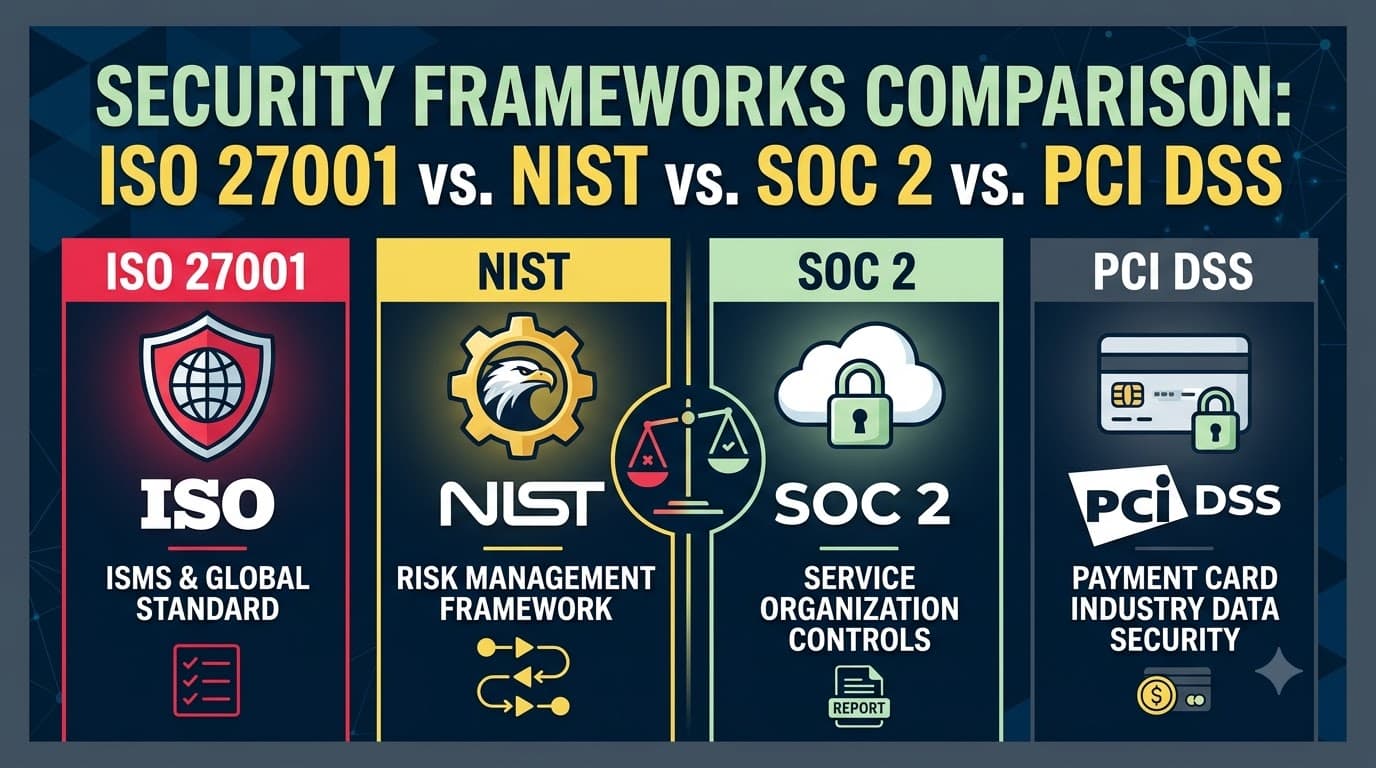
If you have three enterprise customers each demanding a different security framework, and a board that just wants "the compliance thing" handled, this article is the one conversation that will save you a year of wasted motion — here's how ISO 27001, NIST, SOC 2, and PCI DSS actually differ, where they overlap, and which ones you actually need.
The Day Three Customers Asked for Three Different Things
Dana Whitfield had been VP of Security and Compliance at Alderpoint Analytics for eleven months when the email chain that would define her year landed in her inbox on a Tuesday morning in March.
Alderpoint sold inventory-and-payments software to mid-market retailers — the kind of platform that sits between a store's point-of-sale system and its accounting software, quietly reconciling transactions and forecasting stock. Two hundred and forty employees, roughly $38 million in annual recurring revenue, and — as of that Tuesday — three deals worth a combined $4.1 million sitting in the pipeline, each stalled on a compliance question.
The first email came from the procurement team at a national grocery chain: their vendor risk questionnaire required "a current SOC 2 Type II report covering the trailing twelve months, or the deal cannot proceed past legal review." The second came from a European logistics company Alderpoint had been courting for eight months — their CISO's office had replied to the contract draft with a single line: "We require ISO 27001 certification for any vendor touching operational data. Please confirm certificate number." The third, buried at the bottom of a fifty-page addendum from a payments processor, simply said Alderpoint would need to "attest to PCI DSS compliance for the card-data-adjacent components of the integration" before go-live.
Dana's CEO, on hearing all three in the same afternoon, asked the question every compliance leader eventually gets asked: "Can't we just do one of these and tell the others it's basically the same thing?"
It is not basically the same thing. It is one of the most consequential misunderstandings in enterprise security — the assumption that "compliance" is a single destination rather than four different roads that happen to run parallel for long stretches. Dana had watched this mistake sink budgets and timelines at two previous employers. At one, a company spent seven months and $180,000 building toward SOC 2 only to discover their biggest prospective customer's actual requirement was ISO 27001 certification recognized by an accreditation body their SOC 2 auditor had no relationship with. At another, an engineering team treated a PCI DSS Attestation of Compliance as interchangeable with "being secure," and the resulting overconfidence contributed to a breach that had nothing to do with card data and everything to do with an exposed admin panel PCI DSS was never designed to catch.
The $4.1 million in stalled pipeline at Alderpoint was not really a compliance problem. It was a translation problem — the same underlying security maturity needed to be expressed in three different vocabularies, verified by three different types of assessors, against three different rulebooks with three different owners. Get the mapping right, and a single control set can serve all three customers with maybe 30–40% incremental work per additional framework. Get it wrong, and you rebuild the same program three times, badly, under deadline pressure, at three times the cost.
This article is the conversation Dana wished she'd had eleven months earlier — a straight, no-hype comparison of ISO 27001, the NIST frameworks, SOC 2, and PCI DSS: what each one actually is, who requires it, what "compliant" even means in each case, and how to decide — with evidence, not guesswork — which ones your organization actually needs.
Who This Is For / What You'll Walk Away With
This article is written for the person who just got asked, in some form, "which of these do we need?" — a founder fielding a security questionnaire for the first time, a compliance manager inheriting three half-finished frameworks, an IT director whose board wants "SOC 2 or ISO or whatever's cheaper," or a consultant advising a client who conflates certification with attestation with regulatory mandate.
By the end, you will be able to:
State precisely what ISO 27001, NIST CSF (with a note on NIST SP 800-53), SOC 2, and PCI DSS each are — and are not.
Explain the difference between a certification (ISO 27001), a CPA attestation (SOC 2), a voluntary framework (NIST CSF), and an industry mandate (PCI DSS) — a distinction that trips up even experienced buyers.
Read a vendor's compliance claim critically: does "we're SOC 2 compliant" even mean anything on its own? (It doesn't, quite — more on that below.)
Compare the four frameworks across purpose, scope, geography, cost, timeline, audit model, and renewal cycle.
Use a crosswalk to see how ISO 27001's Annex A controls, SOC 2's Trust Services Criteria, and NIST CSF's functions overlap — so you're not rebuilding the same control five times.
Apply a decision framework to your own situation, based on industry, customer base, and geography.
Understand why running two or three frameworks together, on a shared control set, is usually far cheaper than running them one at a time.
We are not going to tell you ISO 27001 and SOC 2 are "basically interchangeable," because they aren't, and vendors who say so are usually trying to sell you the cheaper of the two regardless of fit. We're also not going to tell you that any of these frameworks makes you "legally compliant" in some general sense — none of them is a law, and each intersects with legal obligations (GDPR, HIPAA, state breach-notification statutes, and so on) differently and partially.
Fast Orientation: All Four Frameworks at a Glance
Before the deep dives, here is the table Dana wishes someone had handed her on that Tuesday morning.
Dimension | ISO/IEC 27001 | NIST CSF (+ 800-53) | SOC 2 | PCI DSS |
|---|---|---|---|---|
What it is | International ISMS standard | US voluntary framework (CSF) / federal control catalog (800-53) | AICPA attestation standard | Card-industry mandated standard |
Verification type | Certification (accredited body) | Self-assessment / alignment (no certification) | Attestation (licensed CPA firm) | Compliance validation (SAQ or QSA/ROC) |
Who "owns" it | ISO/IEC (international) | NIST (US government agency) | AICPA (US professional body) | PCI Security Standards Council (card brands) |
Primary audience | Any organization, any sector, global | US federal agencies, contractors, increasingly any org | Primarily US B2B SaaS/service providers | Any org that stores, processes, or transmits cardholder data |
Core artifact | Certificate + Statement of Applicability | Framework profile / maturity tier | SOC 2 report (Type I or Type II) | Attestation of Compliance (AOC) |
Renewal cycle | 3-year cycle, annual surveillance audits | No fixed cycle (continuous alignment) | Typically annual (12-month look-back for Type II) | Annual validation + quarterly scans |
Mandated by law anywhere? | No (but often contractually required) | No | No | No (contractual/card-brand requirement) |
That's the skeleton. Now let's put flesh on each one.
Deep Profile: ISO/IEC 27001
ISO/IEC 27001 is the international standard for an Information Security Management System (ISMS) — not a checklist of technical controls, but a management system: a structured, documented way of identifying risks to information, deciding how to treat them, and continually improving that process. If you're unfamiliar with the standard's shape at all, What Is ISO 27001? A Complete Beginner's Guide to Information Security Management is the right starting point before this comparison goes any deeper.
Structurally, ISO 27001 has two halves. Clauses 4–10 are the mandatory management-system requirements: context of the organization, leadership commitment, planning (including risk assessment and treatment), support, operation, performance evaluation, and improvement. These clauses are non-negotiable — you cannot certify without satisfying every one of them. The second half is Annex A, a reference set of controls organized into four themes in the current ISO 27001:2022 revision: Organizational controls (5.1–5.37), People controls (6.1–6.8), Physical controls (7.1–7.14), and Technological controls (8.1–8.34) — 93 controls in total. Organizations don't have to implement every Annex A control; they select and justify their choices in a Statement of Applicability (SoA), based on their own risk assessment. That's a critical, frequently misunderstood point: ISO 27001 doesn't mandate a fixed technical baseline the way PCI DSS does. It mandates a risk-driven process for arriving at your own baseline — and the discipline of that process is what an auditor is actually certifying.
If you want the fine-grained detail on what shifted between the 2013 and 2022 versions of Annex A (control consolidation, new controls like threat intelligence and data masking), that's covered thoroughly in ISO 27001:2013 vs ISO 27001:2022: What Changed and Why It Matters, and the standard's lineage back to BS 7799 is traced in History and Evolution of ISO 27001: From BS 7799 to ISO 27001:2022. It's also worth being clear that ISO 27001 (the certifiable management-system standard) and ISO 27002 (a companion code of practice offering implementation guidance for Annex A controls) are two different documents that get conflated constantly — ISO 27001 vs ISO 27002: Understanding the Difference untangles that specifically, and the distinction matters here because auditors certify against 27001, never against 27002.
Critically, ISO 27001 is certifiable. An accredited certification body — itself accredited by a national accreditation body under ISO/IEC 17021 — conducts a two-stage audit (Stage 1 documentation review, Stage 2 implementation review), and if you pass, you receive a certificate valid for three years, subject to annual surveillance audits and a recertification audit at the end of the cycle. That certificate is a genuinely portable, internationally recognized artifact: a certification body in Singapore and one in Germany are both operating against the same international standard, under the same accreditation rules, which is precisely why the European logistics company in our opening story wanted "certificate number," not a narrative report.
"The single biggest misconception I run into is people treating Annex A like a compliance checklist you tick down. It's not. It's a menu, and your risk assessment is what tells you what to order. I've seen organizations spend a fortune implementing controls their own risk register never asked for, while genuinely high risks went untreated because nobody looked." — Priya Nakamura, lead ISO 27001 auditor, 14 years in the field
ISO 27001 is sector-agnostic and geography-agnostic by design — it was built to be usable by a five-person startup or a multinational bank, in any country. That universality is both its strength (one certificate, globally portable) and the source of its biggest weakness relative to sector-specific standards like PCI DSS: it will not tell an auditor whether you've implemented card-data tokenization correctly, because that's simply outside its scope. For a fuller picture of the underlying management-system concepts — risk treatment, the PDCA cycle, mandatory documentation — see Information Security Management System (ISMS): Core Concepts Explained, and for the vocabulary itself, ISO 27001 Terminology and Glossary: Key Terms Every Practitioner Should Know is worth bookmarking — auditors and consultants use this language constantly, and getting it wrong in front of one is a fast way to lose credibility in a Stage 1 interview.
Deep Profile: NIST CSF (and a Necessary Note on NIST SP 800-53)
The National Institute of Standards and Technology (NIST) publishes several security frameworks, and conflating them is one of the most common errors buyers make — so it's worth being precise before anything else: the NIST Cybersecurity Framework (CSF) is a high-level, voluntary framework for organizing and communicating cybersecurity risk. It is emphatically not certifiable. There is no accredited body that audits you against the CSF and issues a certificate, and any vendor claiming "NIST CSF certified" is misusing the term — the correct language is that an organization has aligned to or assessed itself against the CSF, typically expressing maturity as a set of tiers (Partial, Risk Informed, Repeatable, Adaptive) across a target "profile."
NIST CSF 2.0, published in 2024, reorganized the framework around six core Functions rather than the original five. The original CSF (1.1) organized activity into Identify, Protect, Detect, Respond, Recover. CSF 2.0 added a sixth function, Govern, sitting conceptually above the other five — covering organizational context, risk management strategy, roles and responsibilities, policy, and oversight of supply-chain risk. That addition matters for this comparison specifically because it pulls CSF 2.0 noticeably closer to the governance-heavy structure ISO 27001 has always had in Clauses 4–10; the two frameworks now overlap more at the top of the house than they did a few years ago, even though CSF remains voluntary and unauditable in the certification sense.
Separately — and this is the distinction that trips up almost everyone outside US federal contracting — NIST SP 800-53 is a detailed, granular catalog of security and privacy controls (organized into control families like Access Control, Audit and Accountability, Incident Response) used primarily to secure US federal information systems. It's the backbone of the FedRAMP authorization process for cloud services selling to US federal agencies, and it's far more prescriptive than the CSF's function-based structure — closer in spirit to Annex A than to the CSF itself. A closely related catalog, NIST SP 800-171, exists specifically to protect Controlled Unclassified Information (CUI) and underlies the Department of Defense's CMMC program for contractors. If your organization sells to the US federal government or handles CUI, 800-53 or 800-171 (not the CSF) is usually the actual requirement in the contract — and unlike the CSF, 800-53 compliance in a FedRAMP context does involve formal third-party assessment (by a FedRAMP-accredited 3PAO), even though it isn't "certification" in the ISO sense either.
"I get calls every quarter from companies that put 'NIST certified' on their homepage. There's no such thing, and a sharp customer's security team will ask you to produce the certificate, and you won't have one, and now you look like you don't understand your own compliance posture. Say 'aligned to NIST CSF' or 'assessed against 800-53 controls.' It's not pedantry — it's the difference between being credible and not." — Marcus Ihejirika, GRC director, financial services sector
Practically, NIST CSF is most useful as a communication and gap-analysis layer — a common vocabulary for boards, cyber-insurance underwriters, and cross-functional teams to discuss risk posture — rather than as an end-state you certify against. Many US organizations use it as the framework they benchmark against internally, while pursuing SOC 2 or ISO 27001 as the artifact they actually hand to a customer or auditor.
Deep Profile: SOC 2
SOC 2 (System and Organization Controls 2) is an American Institute of Certified Public Accountants (AICPA) reporting framework, and the first thing to fix in your vocabulary is that SOC 2 is not a certification — it's an attestation. A licensed CPA firm examines your controls and issues an opinion, following AICPA attestation standards, much the same way a financial auditor issues an opinion on financial statements. There is no "SOC 2 certificate"; there is a SOC 2 report, and the report itself — often 40 to 100+ pages — is the deliverable, typically shared under NDA rather than published.
SOC 2 reports are built around the Trust Services Criteria (TSC): Security (the "Common Criteria," mandatory in every SOC 2 report), Availability, Processing Integrity, Confidentiality, and Privacy. An organization scopes its report to Security alone, or Security plus any combination of the other four, based on what it wants to represent to customers. A SaaS company whose main customer concern is uptime will typically add Availability; one handling sensitive customer PII may add Confidentiality or Privacy.
The second axis every buyer needs to understand is Type I versus Type II. A Type I report attests that controls were suitably designed as of a specific point in time. A Type II report — the one enterprise procurement teams almost always actually want, as Dana's grocery-chain prospect demonstrated — attests that those controls operated effectively over a period, typically 6 to 12 months. Type I is faster and cheaper to obtain but proves far less; a company presenting only a Type I report to a sophisticated buyer should expect follow-up questions about why they haven't yet completed a Type II observation period.
SOC 2 Report Type | What It Proves | Typical Observation Window | Common Use |
|---|---|---|---|
Type I | Controls are suitably designed at a single point in time | N/A (point-in-time) | First-time attestation, fast initial signal to customers |
Type II | Controls operated effectively over a period | 3–12 months (6–12 typical) | Ongoing enterprise vendor requirement, renewed annually |
SOC 2 is overwhelmingly a US market expectation — it emerged from, and is still primarily requested by, American enterprise buyers and their procurement/vendor-risk processes, especially in SaaS, cloud infrastructure, and technology services. It travels internationally reasonably well when a US company is doing the buying, but a European or Asia-Pacific customer is statistically far more likely to ask for ISO 27001 than for a SOC 2 report, simply because SOC 2 is not a recognized standard in most non-US procurement frameworks.
"SOC 2 is a report, not a badge. I've had clients try to put a SOC 2 'seal' on their marketing site the way they would an ISO certification mark, and technically that's not how this works — you don't get a logo, you get a document you hand to people who sign an NDA first. It changes how you use it in sales." — Renata Solis, SOC 2 practice lead at a regional CPA firm
Deep Profile: PCI DSS
The Payment Card Industry Data Security Standard (PCI DSS) is maintained by the PCI Security Standards Council, a body founded by the major card brands (Visa, Mastercard, American Express, Discover, JCB). It is not a law and not issued by any government — it is a contractual mandate flowing from the card brands through acquiring banks and payment processors down to any merchant or service provider that stores, processes, or transmits cardholder data. If your organization touches a primary account number (PAN), you are contractually on the hook for PCI DSS regardless of size, and the enforcement mechanism runs through your merchant agreement and acquiring bank, not through a courtroom.
The current version, PCI DSS v4.0 (with v4.0.1 as the latest maintenance update), organizes its requirements into six control objectives comprising twelve core requirements:
Goal | Core Requirements (summary) |
|---|---|
Build and Maintain a Secure Network and Systems | 1. Install and maintain network security controls · 2. Apply secure configurations |
Protect Account Data | 3. Protect stored account data · 4. Protect cardholder data with strong cryptography during transmission |
Maintain a Vulnerability Management Program | 5. Protect systems from malware · 6. Develop and maintain secure systems and software |
Implement Strong Access Control Measures | 7. Restrict access by business need to know · 8. Identify users and authenticate access · 9. Restrict physical access |
Regularly Monitor and Test Networks | 10. Log and monitor all access · 11. Test security of systems and networks regularly |
Maintain an Information Security Policy | 12. Support information security with organizational policies and programs |
Validation depends on transaction volume and risk profile. Smaller merchants typically self-validate using a Self-Assessment Questionnaire (SAQ) — there are several SAQ variants depending on how card data is handled (e.g., fully outsourced payment pages versus in-house processing). Larger merchants and most service providers are required to engage a Qualified Security Assessor (QSA) to produce a formal Report on Compliance (ROC), which supports the Attestation of Compliance (AOC) submitted to acquiring banks and card brands. On top of the annual validation cycle, PCI DSS also requires quarterly external vulnerability scans by an Approved Scanning Vendor (ASV) for most merchants — a cadence none of the other three frameworks impose.
"PCI DSS is the most binary of the four. There's no 'risk-based decision to accept that gap' the way there is in ISO 27001 — if requirement 8.3 says multi-factor authentication for remote access into the cardholder data environment, you either have it or you have a finding. That rigidity is exactly why it's so effective for the narrow thing it covers, and why it's a poor substitute for a general security program." — Devon Achterberg, QSA and payments security consultant
The crucial scope distinction: PCI DSS only cares about the cardholder data environment (CDE) — systems that store, process, or transmit card data, plus anything connected to or that could impact the security of the CDE. It says nothing about your HR data, your source code repository security, or your incident response plan for a ransomware attack that never touches card data. This is the sharpest scope boundary among the four frameworks, and it's the one most often misunderstood by executives who hear "PCI compliant" and assume it means "secure, generally."
Head-to-Head: Purpose and Scope
Every downstream decision in this article flows from getting this dimension right first: these frameworks were built to answer different questions, and forcing one to answer another's question is where most wasted compliance spend originates.
Framework | Core Question It Answers | Scope Boundary |
|---|---|---|
ISO 27001 | "Do you have a systematic, risk-based process for managing information security?" | Whatever you define in your ISMS scope statement — can be the whole org or a defined subset |
NIST CSF | "How mature is your cybersecurity risk management across six functional areas?" | Flexible — organizations define their own "current" and "target" profiles |
SOC 2 | "Do your controls, as designed and operated, meet the Trust Services Criteria you've chosen to be assessed against?" | The specific system/service the report covers, plus the TSC categories selected |
PCI DSS | "Is cardholder data protected according to a fixed, prescriptive control set?" | The cardholder data environment (CDE) and connected systems only |
Notice the pattern: ISO 27001 and NIST CSF both ask process-and-maturity questions, SOC 2 asks a controls-attestation question tied to a specific service, and PCI DSS asks a narrow, binary compliance question about one specific type of data. A vendor risk questionnaire that asks "are you PCI compliant?" of a company with no payment processing is a nonsensical question; the correct answer is "not applicable — we don't touch cardholder data," not "no."
Head-to-Head: Certifiable vs. Attestation vs. Mandate
This is the distinction Dana's CEO glossed over, and it's the one that determines what kind of document you'll actually be able to hand a customer.
Framework | Verification Type | Who Performs It | What You Receive |
|---|---|---|---|
ISO 27001 | Certification | Accredited certification body | Certificate (3-year validity, annual surveillance) |
NIST CSF | Self-assessment / alignment | Internal team, sometimes third-party advisory review | Framework profile / maturity assessment (no certificate) |
NIST 800-53 (FedRAMP context) | Formal authorization | FedRAMP-accredited Third Party Assessment Organization (3PAO) | Authorization to Operate (ATO) — not an "ISO-style" certificate |
SOC 2 | Attestation | Licensed CPA firm | SOC 2 report (Type I or Type II), shared under NDA |
PCI DSS | Compliance validation | Self (SAQ) or Qualified Security Assessor (QSA) | Attestation of Compliance (AOC), supported by ROC where applicable |
The practical consequence: only ISO 27001 gives you a portable, brandable certificate you can reference publicly (subject to the certification body's usage rules) and a certificate number a customer can verify. SOC 2 gives you a detailed but confidential report you disclose selectively. NIST CSF gives you an internal maturity narrative with no external artifact at all unless you commission a third party to assess and document it. PCI DSS gives you a compliance attestation specific to payment scope, typically shared with acquiring banks and, on request, with business partners.
Head-to-Head: Geography and Market Expectation
Framework | Strongest Geographic Pull | Notes |
|---|---|---|
ISO 27001 | Global — especially Europe, APAC, Middle East, and any cross-border enterprise sales | Single international standard; one certificate is recognized (subject to accreditation equivalence) across most markets |
NIST CSF / 800-53 | United States, especially federal and federally-adjacent supply chains | 800-53 essentially required for FedRAMP/federal work; CSF increasingly referenced in US state and sector guidance |
SOC 2 | United States, particularly SaaS, cloud, and technology services | Recognized elsewhere mainly when the buyer is a US enterprise; less familiar to European or APAC procurement teams |
PCI DSS | Global, but scope-limited | Applies anywhere cardholder data is handled, regardless of country — the standard itself is geography-agnostic, but the demand is driven by card-network participation, which is worldwide |
A useful rule of thumb Dana eventually adopted: if your growth strategy runs primarily through US enterprise SaaS procurement, SOC 2 will come up constantly and ISO 27001 occasionally. If your growth strategy involves European, Middle Eastern, or Asia-Pacific enterprise or government buyers, flip that — ISO 27001 will be the default ask and SOC 2 will rarely be mentioned. If you process card payments anywhere in the world, PCI DSS applies regardless of where your customers or headquarters sit.
Head-to-Head: Who Actually Requires It
"Who requires it" is a different question from "who's affected by it," and conflating the two is how organizations end up pursuing frameworks nobody actually asked for.
Framework | Typically Required By | Typically Requested/Expected By |
|---|---|---|
ISO 27001 | Rarely a hard legal requirement anywhere, though some government tenders and regulated sectors reference it | Enterprise customers (especially international), government and public-sector procurement, cyber-insurance underwriters |
NIST CSF | Not required by law for private industry generally; referenced in some US federal guidance and critical-infrastructure sector expectations | Boards and risk committees wanting a common risk vocabulary; increasingly appears in vendor questionnaires as "do you align to NIST CSF" |
NIST 800-53 / 800-171 | Required for US federal agencies and, via flow-down contract clauses, their contractors and cloud service providers (FedRAMP, CMMC-adjacent) | N/A outside that supply chain |
SOC 2 | Not a legal requirement anywhere | US enterprise procurement/vendor-risk teams, especially for SaaS and cloud services; investors and board audit committees |
PCI DSS | Card brands, via the merchant agreement chain (acquiring banks contractually enforce it) | Payment processors, acquiring banks, and increasingly business partners in the payments ecosystem |
The pattern worth internalizing: none of these four is, itself, a statute. Even PCI DSS — often loosely called "mandatory" — is a contractual requirement flowing from private card-network rules, not government law (though some US states have referenced PCI DSS in their own data-security statutes, which is a separate, narrower point). Meeting any of these frameworks does not, by itself, satisfy GDPR, HIPAA, or other statutory obligations — it can support that compliance, sometimes substantially, but the legal obligation and the framework are not the same thing and should never be presented to a board as equivalent.
Head-to-Head: Cost, Effort, and Timeline
These figures are illustrative — every organization's numbers will differ based on starting maturity, headcount, tooling, and scope — but they reflect the rough order of magnitude Dana used to set expectations with Alderpoint's board.
Framework | Typical Timeline (from a reasonable security baseline) | Typical Cost Range (illustrative, mid-market org) | Primary Cost Drivers |
|---|---|---|---|
ISO 27001 (first certification) | 6–12 months | $40,000–$150,000+ (consulting, audit fees, tooling, internal time) | Risk assessment work, documentation, internal audit, certification body fees, remediation |
NIST CSF alignment | 2–6 months for an initial profile/gap assessment | $15,000–$60,000 if using outside advisory (can be $0 in hard cost if done fully in-house) | Internal staff time, optional advisory support, no certification fee since none is issued |
SOC 2 Type I | 2–4 months | $20,000–$60,000 | Readiness assessment, control implementation, CPA firm examination fee |
SOC 2 Type II | 8–14 months (readiness + observation window) | $30,000–$100,000+ | Same as Type I, plus extended observation period and evidence collection over 6–12 months |
PCI DSS (SAQ path) | 1–3 months | $5,000–$30,000 | Scoping, scan fees, internal remediation |
PCI DSS (QSA/ROC path) | 3–6 months | $30,000–$120,000+ | QSA engagement, quarterly ASV scans, penetration testing, remediation |
"The number that surprises boards every time isn't the audit fee — it's the internal labor cost. A QSA engagement or a certification audit is often the smaller line item; the bigger one is the six months of an engineering team's time spent implementing logging, access reviews, and evidence collection they should arguably have been doing anyway." — Priya Nakamura, lead ISO 27001 auditor
Head-to-Head: Audit Model
Framework | Assessment Structure | Assessor Type | Report/Artifact Depth |
|---|---|---|---|
ISO 27001 | Two-stage initial audit (Stage 1 documentation review, Stage 2 implementation review), then annual surveillance | Accredited certification body auditor | Certificate + internal audit findings; certification body issues a short public-facing certificate, not a public report |
NIST CSF | Self-assessment or advisory-led gap assessment; no formal audit body exists | Internal team or advisory consultant | Internal profile document; no standardized external report format |
SOC 2 | Examination under AICPA attestation standards (AT-C 105/205), evidence sampling over the observation period for Type II | Licensed CPA firm (often with in-house or partnered security specialists) | Long-form report (often 40–100+ pages) including a detailed description of the system and testing results |
PCI DSS | Annual assessment (self-assessment or QSA-led), plus quarterly ASV scans and periodic penetration testing | Internal (SAQ) or Qualified Security Assessor (ROC) | AOC (short, standardized) plus a detailed ROC for QSA-led assessments |
The SOC 2 report is, by a wide margin, the most granular and detailed artifact of the four — which is precisely why it's shared under NDA rather than published, and why enterprise security teams that receive one often spend real analyst time reading it line by line rather than just checking a box for "report received."
Head-to-Head: Renewal and Ongoing Maintenance
Framework | Renewal Cadence | What Happens If You Lapse |
|---|---|---|
ISO 27001 | Annual surveillance audits, full recertification audit every 3 years | Certificate can be suspended or withdrawn; must restart certification process |
NIST CSF | No formal renewal — continuous alignment activity, revisited as risk or the framework version changes | No formal consequence, but stale profiles lose credibility with boards/insurers |
SOC 2 | New report typically commissioned annually (each Type II report covers a defined period, usually 12 months) | No "lapse" mechanism per se, but an expired report (commonly anything older than 12 months) is treated by most enterprise buyers as unacceptable |
PCI DSS | Annual reassessment; quarterly vulnerability scans; ongoing evidence of the 12 requirements | Non-compliance can trigger fines from acquiring banks, increased transaction fees, or loss of ability to process cards |
This cadence difference matters commercially: a SOC 2 Type II report has a shelf life that customers watch closely (a report covering last year's July–December period is a much weaker signal in the following autumn), while ISO 27001's three-year certificate feels more durable to a customer at first glance — though the annual surveillance audits mean the underlying program is being checked just as often in practice.
Overlap and Crosswalk: Where the Frameworks Actually Line Up
Here is the part that turns "we need three frameworks" from a threatening sentence into a manageable project: ISO 27001, SOC 2, and NIST CSF overlap substantially at the level of underlying controls, even though they package and verify them completely differently. Access control is access control; logging and monitoring is logging and monitoring; vendor risk management is vendor risk management — regardless of which framework's language you're using to describe it. A mature security program built once, mapped three ways, is dramatically cheaper than three separate programs.
The diagram below shows the conceptual relationship: a shared core of underlying security controls sits beneath all three frameworks, each of which represents, packages, and verifies that core differently.
flowchart TD
    A[Shared Underlying Control Set<br/>Access control, logging, encryption,<br/>incident response, vendor risk, HR security]
    A --> B[ISO 27001<br/>Annex A control themes<br/>Organizational / People / Physical / Technological]
    A --> C[SOC 2<br/>Trust Services Criteria<br/>Security, Availability, Confidentiality, PI, Privacy]
    A --> D[NIST CSF 2.0<br/>Govern, Identify, Protect,<br/>Detect, Respond, Recover]
    B --> E[Certification: 3-yr certificate + surveillance]
    C --> F[Attestation: CPA-issued report, Type I/II]
    D --> G[Self-assessed maturity profile, no certificate]
    H[PCI DSS<br/>12 requirements, CDE-scoped only] -.narrow overlap on<br/>access control, encryption,<br/>logging, vuln mgmt.-> A
The crosswalk table below is intentionally high-level — a full clause-by-clause mapping is a meaningfully larger document, and PentesterWorld has that available as a dedicated eBook — but it illustrates where the heaviest overlap sits.
Control Domain | ISO 27001 Annex A (2022 themes) | SOC 2 TSC | NIST CSF 2.0 Function |
|---|---|---|---|
Access control & authentication | Technological controls (8.x) | Security (Common Criteria, CC6 series) | Protect |
Logging, monitoring, detection | Technological controls (8.15–8.16) | Security (CC7 series) | Detect |
Risk assessment & treatment | Organizational controls (5.x) + Clause 6 | Security (CC3 series) | Identify |
Incident response | Organizational controls (5.24–5.28) | Security (CC7.3–CC7.5) | Respond |
Business continuity / resilience | Organizational controls (5.29–5.30) | Availability | Recover |
HR / people security | People controls (6.x) | Security (CC1 series) | Protect / Govern |
Physical security | Physical controls (7.x) | Security (CC6.4) | Protect |
Vendor / third-party risk | Organizational controls (5.19–5.22) | Security (CC9 series) | Govern |
Governance, policy, leadership | Clauses 4–5 (management system) | Common Criteria (CC1–CC2) | Govern |
Cryptography | Technological controls (8.24) | Security (CC6.1, CC6.7) | Protect |
A properly built ISO 27001 ISMS will satisfy roughly 70–85% of what a SOC 2 Security-only examination is looking for, in substance if not in exact wording — the remaining gap is mostly in evidence format and the SOC 2-specific requirement to demonstrate operation over a defined observation window rather than just point-in-time design. NIST CSF, being function-based rather than control-based, maps even more loosely — it's better understood as a lens you can view either ISO 27001 or SOC 2 controls through, rather than a parallel control set you implement separately. For a deeper, clause-by-clause treatment, a resource we'd call "ISO 27001, SOC 2, and NIST CSF Crosswalk: Full Control Mapping Guide" would be the natural companion piece to this article — it doesn't exist yet as a published title, but it's the logical next read for anyone building a shared control matrix.
Where PCI DSS Genuinely Diverges
PCI DSS is the outlier in the crosswalk above, and it's worth being explicit about why, because the temptation to assume "if we're ISO 27001 certified, PCI DSS must be mostly covered" causes real problems. PCI DSS overlaps with the others on general security hygiene — access control, encryption, logging, vulnerability management — but it introduces requirements with no real analogue in ISO 27001, SOC 2, or NIST CSF:
Fixed, prescriptive technical requirements. PCI DSS specifies things like quarterly external vulnerability scans by an Approved Scanning Vendor and specific cryptographic requirements for cardholder data in transit and at rest. ISO 27001 would ask "have you assessed the risk and chosen appropriate controls"; PCI DSS simply says "do this."
A hard scope boundary around one data type. ISO 27001 and SOC 2 scope to a system, service, or the whole organization. PCI DSS scopes strictly to the cardholder data environment — a company can be fully PCI compliant while having serious, unaddressed security gaps in systems that never touch card data, which is precisely the trap the CEO in our opening story nearly fell into.
Segmentation testing. PCI DSS requires validating that network segmentation actually isolates the CDE from the rest of the environment — a specific, technical test with no direct equivalent in the other three frameworks.
No risk-acceptance mechanism. ISO 27001's entire model is built around the idea that an organization can assess a risk and formally accept it. PCI DSS requirements are largely non-negotiable for in-scope systems; there's no formal "risk acceptance" pathway the way there is in an ISMS.
A resource worth having on the shelf for anyone navigating this specific overlap — call it "PCI DSS and ISO 27001: Do You Need Both?" — doesn't exist as a published title yet, but the honest answer, covered in more depth than we have room for here, is: if you process card payments and sell to enterprise or international customers, you very likely need both, and PCI DSS should be treated as an additional, narrowly-scoped layer on top of an ISO 27001 or SOC 2 program, not a substitute for one.
Decision Framework: Which Framework(s) Fit Your Situation
There is no universal answer, but there is a reliable method: work through customer geography, industry, and data type in that order, and the right combination usually becomes obvious.
Your Situation | Likely Best Fit | Reasoning |
|---|---|---|
US-based SaaS, selling primarily to US enterprise customers | SOC 2 Type II | Matches the dominant procurement expectation in your market |
Selling into Europe, Middle East, or Asia-Pacific enterprise/government accounts | ISO 27001 | Internationally recognized certificate; often a hard requirement in non-US tenders |
Selling into both US and international enterprise markets | ISO 27001 + SOC 2 together | Covers both procurement expectations from a shared control base (see next section) |
Processing, storing, or transmitting cardholder data | PCI DSS (mandatory in practice), plus ISO 27001 or SOC 2 for general security posture | PCI DSS alone does not cover non-payment systems or general governance |
US federal government contractor or FedRAMP-track cloud provider | NIST SP 800-53 (via FedRAMP authorization), often alongside SOC 2 | Federal supply chains specifically require the 800-53 control catalog, not the CSF or ISO 27001 |
Early-stage startup, first enterprise deal on the table | Start with whichever framework the specific deal requires; use NIST CSF internally for gap analysis in the meantime | Avoid building toward a framework nobody has asked for yet |
Regulated industry (healthcare, financial services) with existing sector rules | ISO 27001 or SOC 2 as the general security layer, mapped against sector-specific rules (e.g., HIPAA) separately | Frameworks support but do not replace sector regulatory compliance |
Board/insurer wants a maturity narrative, no customer is asking for a report yet | NIST CSF self-assessment | Lowest-cost way to produce a defensible risk narrative without committing to a full audit cycle |
For a more detailed breakdown of which industries and organization types tend to need ISO 27001 specifically (as opposed to the alternatives above), see Who Needs ISO 27001? Industries and Organizations That Benefit Most — it's the natural next step once you've narrowed the field using the table above.
"The question I ask every client before we pick a framework is 'who, specifically, has asked you for this — by name?' Not 'who might.' If nobody's asked yet, we do a NIST-style internal gap assessment and wait, because building toward the wrong framework is the single most expensive mistake in this whole industry." — Devon Achterberg, QSA and payments security consultant
Industry patterns are a reasonable secondary signal once geography and specific customer asks are accounted for. Healthcare technology vendors selling to US hospital systems lean SOC 2 (often with a HIPAA-mapped supplement, since HIPAA compliance is a separate statutory obligation neither SOC 2 nor ISO 27001 substitutes for). European manufacturing and industrial-IoT vendors lean ISO 27001 almost by default. Fintechs and e-commerce platforms of any geography typically need PCI DSS layered onto whichever general framework fits their customer base. Global professional services and consultancies increasingly pursue ISO 27001 first, because it travels best across the widest range of client jurisdictions.
Doing Several Together: The Shared Control Set Advantage
This is the section that should change how your organization budgets for compliance, because the naive assumption — that three frameworks cost three times as much as one — is wrong by a wide margin once you build a shared control set rather than three parallel programs.
The logic is straightforward. Roughly 60–70% of the operational work behind ISO 27001, SOC 2, and NIST CSF alignment is the same underlying activity: maintaining an access control matrix, running vulnerability scans, logging and reviewing security events, conducting vendor risk assessments, training staff, testing incident response, and documenting all of it. What differs is the packaging — how that evidence gets organized, labeled, and presented to satisfy each framework's specific language and audit format.
Approach | Approximate Relative Cost (vs. doing ISO 27001 alone = 1.0x) | Approximate Relative Timeline |
|---|---|---|
ISO 27001 only | 1.0x | Baseline (6–12 months) |
ISO 27001 + SOC 2, built on one shared control set | ~1.3–1.5x | +2–4 months over ISO 27001 alone |
ISO 27001 + SOC 2 + PCI DSS (if cardholder data in scope), shared control set | ~1.6–2.0x | +4–6 months over ISO 27001 alone |
Three frameworks pursued sequentially and independently, no shared mapping | ~2.7–3.0x | Often 18–30 months total, with rework |
The mechanism that makes this work is a single, well-maintained control matrix or GRC platform where each control is tagged against every framework it satisfies — a firewall change-management control, for instance, gets logged once but tagged to ISO 27001 Annex A 8.20, SOC 2 CC6.6, and NIST CSF's Protect function simultaneously. Evidence collected for one audit (an access review spreadsheet, a penetration test report, an incident response tabletop exercise record) becomes reusable evidence for the others, rather than being recreated in a different format for each auditor.
"Once a client understands that the auditor for ISO 27001 and the CPA firm for SOC 2 are, underneath the different terminology, asking to see largely the same evidence, the whole program gets calmer. We stop treating each audit as a fire drill and start treating it as a quarterly evidence-refresh against a matrix we already maintain." — Renata Solis, SOC 2 practice lead
A resource we'd recommend building toward — "Running ISO 27001 and SOC 2 Together: A Shared Control Framework" — is exactly the kind of practical playbook this section gestures at; it isn't published yet, but the core discipline it would describe (one control matrix, multiple framework tags, one evidence repository) is the single highest-leverage decision a multi-framework compliance program can make.
Mini Case Study: The SaaS Vendor That Chose Both
Alderpoint Analytics — Dana Whitfield's company from our opening story — ultimately built a shared control matrix over five months, pursuing ISO 27001 certification and a SOC 2 Type II report in parallel rather than sequentially. The ISO 27001 Stage 2 audit and the close of the SOC 2 observation window landed within six weeks of each other. Total incremental cost of adding SOC 2 on top of the ISO 27001 program: approximately 34% above the ISO-only budget, versus the roughly 90–100% premium the earlier sequential attempt at a previous employer had cost Dana. The European logistics deal closed within three weeks of the ISO 27001 certificate being issued; the grocery chain's SOC 2 Type II requirement was satisfied by the report delivered the same quarter. The PCI DSS question resolved differently — Alderpoint's payments component ran entirely through a PCI-validated third-party processor using tokenization, meaning Alderpoint itself never stored, processed, or transmitted raw cardholder data and completed a much shorter SAQ rather than a full ROC, cutting that piece of the puzzle down to about six weeks of scoping work.
Mini Case Study: The Regional Healthcare Software Vendor
A mid-sized health-tech vendor (a case Dana consulted on two years prior, details altered for confidentiality) served hospital networks across both the US and Western Europe. Their initial instinct, driven by a US-heavy sales team, was to pursue SOC 2 exclusively. Six months in, a European hospital group's procurement office rejected their SOC 2 report outright — not because of quality, but because European public-sector procurement rules in that jurisdiction specifically named ISO 27001 certification as a qualifying criterion and did not recognize SOC 2 attestations as an equivalent substitute. The vendor pivoted, mapped roughly 65% of their existing SOC 2 control evidence directly onto Annex A control language, and achieved ISO 27001 certification in an additional four months rather than starting from zero. Net effect: a nine-month total program (versus an estimated fourteen if ISO 27001 had been bolted on without reusing the SOC 2 evidence base) and a recovered €1.8 million European contract that had gone dormant during the gap.
Mini Case Study: The Mid-Market Retailer and PCI DSS Scope Creep
A regional retail chain processing in-store and e-commerce card payments directly (rather than through a fully outsourced, tokenized processor) discovered during a QSA-led PCI DSS assessment that their cardholder data environment was far larger than assumed — a legacy reporting server, never formally decommissioned, was pulling nightly extracts that included unmasked PAN data for "historical analytics," expanding the CDE boundary into a system nobody had scoped for the assessment. Remediation (decommissioning the extract job, re-architecting the reporting pipeline to consume tokenized data only) added roughly seven weeks and $40,000 to the original PCI DSS timeline and budget. The lesson the retailer's CISO drew, and one worth stating plainly here: PCI DSS scoping exercises routinely surface shadow systems that a general ISO 27001 or SOC 2 risk assessment — scoped more broadly but sometimes less forensically around one specific data type — had not flagged, which is itself an argument for running a PCI DSS scoping exercise even in organizations that believe their card-data footprint is small and well-contained.
Strategic Close: Compliance as a Business Opportunity, Not a Cost Center
Every framework in this article was, at its origin, a response to buyers who got burned and started asking harder questions. That's worth remembering when a board frames compliance purely as overhead: the organizations winning the enterprise deals in Dana's story weren't the ones with the most controls — they were the ones who could produce the right proof, in the right format, for the specific buyer asking. ISO 27001's certificate, SOC 2's attestation, PCI DSS's AOC, and a NIST CSF-aligned risk narrative are four different keys, and the business case for holding more than one isn't compliance for its own sake — it's sales velocity, reduced deal friction, and access to markets a single framework can't unlock alone. The fuller business case, including how certification shortens sales cycles and reduces vendor-risk review time, is laid out in ISO 27001 Certification Benefits: Business Case and ROI — worth reading before you present a framework decision to your own board, because the ROI argument lands very differently when it's framed around specific deals rather than abstract risk reduction.
The organizations that get this right treat framework selection the way Dana eventually did: as a mapping exercise against real, named customer demands and a shared control set built once and reused everywhere — not as a series of one-off fire drills each time a new deal stalls in legal review.
If you're standing where Dana stood — three different frameworks requested by three different stakeholders, and a board asking whether you can just pick one — an independent gap assessment against your actual customer requirements is the fastest way to get a defensible answer. PentesterWorld's security assessment and compliance advisory team has walked more than 200 organizations through exactly this decision, mapping existing controls against ISO 27001, SOC 2, NIST CSF, and PCI DSS simultaneously so you build once and satisfy all of them. Talk to PentesterWorld about a multi-framework gap assessment to see exactly where your current controls already satisfy each framework — and where the real gaps are before a customer's procurement team finds them for you.
For readers building out the underlying vocabulary and control detail referenced throughout this comparison, PentesterWorld also maintains a growing library of ISO 27001-specific resources, several of which are referenced below.