Priya Nkemelu had closed the same nonconformity twice before she realized she'd never actually closed it at all.
She was the information security manager at Halvorsen Freight Analytics, a 260-person logistics-data company in Rotterdam that had been certified to ISO 27001 for just under two years. The first time a certification auditor flagged it, the finding was almost trivial: a departed contractor's VPN account was still active three weeks after his last day. Priya's team disabled the account, wrote up a short correction, attached a screenshot of the deactivated user in the identity provider, and the auditor closed the nonconformity in the surveillance audit report. Done, she thought.
Eleven months later, at the next surveillance visit, a different auditor pulled a sample of ten departed employees and found two more accounts still live — one for nineteen days, one for six weeks. Same root cause, different names. This time the auditor didn't just write it up as a repeat — she escalated it from minor to major, because the evidence now showed the control had failed systemically, not once. A major nonconformity meant Halvorsen had 90 days to close it with evidence of effectiveness or risk suspension of certification, right in the middle of a due-diligence data room review by a potential acquirer who had made "clean ISO 27001 status" a term in the letter of intent. Priya's CEO put a number on it in the hallway outside the audit closing meeting: the deal was worth an incremental $4.2 million in valuation premium tied to that unbroken certification. It was now genuinely at risk over an offboarding checkbox.
What went wrong wasn't the deactivation — that correction was fine, both times. What went wrong is that nobody ever asked why the account stayed active. Was it a missed step in a manual checklist? A broken integration between HR's termination workflow and the identity provider? A ticketing SLA nobody was tracking? Priya had fixed the symptom twice without ever finding the cause once. That's the gap this article closes.
Who this is for
You're reading this because you (or someone on your team) has a nonconformity sitting open — flagged in an internal audit, a Stage 2 certification audit, or a surveillance visit — and you need to write a root cause analysis and corrective action that will survive scrutiny at the next audit. This article assumes you already understand the basic mechanics of Clause 10 nonconformity and corrective action requirements and have probably already read about the common nonconformities auditors raise; this piece goes one layer deeper into the how of root cause analysis itself. By the end, you'll be able to run a proper 5 Whys or fishbone session, tell the difference between a correction and a corrective action in your own documentation, and write a CAPA record that an auditor reads and closes on the first pass instead of bouncing back to you with "insufficient root cause identified."
Correction vs. corrective action vs. root cause analysis
These three terms get flattened into one another constantly, and that flattening is precisely what produces nonconformities like Priya's. ISO 27001 Clause 10.2 (Nonconformity and corrective action) is explicit that an organization shall react to a nonconformity — take action to control and correct it, and deal with the consequences — and separately evaluate the need for action to eliminate the cause(s) of the nonconformity so that it does not recur or occur elsewhere. Those are two different obligations, and the standard names them differently on purpose.
Term | What it means | Halvorsen example | Does it satisfy Clause 10.2 alone? |
|---|---|---|---|
Correction | Immediate fix to the specific instance of the problem | Disabling the one departed contractor's VPN account | No — this is the "react" half only |
Root cause analysis | Structured investigation into why the nonconformity occurred | Discovering the HR-to-IdP termination handoff had no automated trigger and depended on a manual email | Not itself an action, but the required input to one |
Corrective action | Action taken to eliminate the identified root cause, preventing recurrence | Automating account deprovisioning as part of the HR offboarding workflow, with a control to catch failures | Yes, when informed by genuine root cause analysis |
A correction with no root cause analysis behind it is exactly what got Halvorsen a repeat finding. Correction addresses "this specific thing that happened." Corrective action addresses "the mechanism that let this kind of thing happen." Root cause analysis is the bridge between the two — it's the investigative step that tells you what the corrective action actually needs to change. Skip it, and your corrective action is really just a second correction wearing a corrective-action label. If any of this vocabulary is still fuzzy across your own team, it's worth getting everyone aligned using our ISO 27001 terminology and glossary primer before you're mid-audit trying to explain the difference on the fly.
It's worth noting explicitly here: ISO 27001:2022 does not carry a standalone "preventive action" clause the way the 2005 version of ISO 27001 and many older management-system standards did. In the current structure, that forward-looking, before-something-breaks thinking is folded into the risk-based approach that runs through Clauses 4 through 6 — your risk assessment and risk treatment plan are effectively doing the preventive-action job continuously, rather than as a reactive clause triggered by a nonconformity. Corrective action, by contrast, is inherently reactive: something already happened (or was found not to conform), and Clause 10.2 governs what you do about it.
Why auditors reject shallow root cause analysis
Certification body auditors see thousands of CAPA records a year, and they develop a very fast nose for the ones where "root cause" was filled in as an afterthought — usually in the last ten minutes before a document was due to the audit team. The tells are remarkably consistent across auditors and certification bodies, which is useful, because it means you can pattern-match against what gets rejected before you submit anything.
Shallow RCA pattern | What the auditor sees | Why it gets rejected |
|---|---|---|
Root cause = "human error" | No investigation into what made the error possible or likely | Doesn't explain why the same error hasn't happened to every other employee doing the same task |
Root cause = the nonconformity restated | "Root cause: the account wasn't deactivated" | That's the finding, not the cause — it answers "what," not "why" |
Root cause = a training gap, with no analysis of why training failed | "Employee needed more training" | Training gaps are themselves symptoms of a system issue (no onboarding checklist, no competency verification) unless proven otherwise |
One "why" and stop | 5 Whys chain with a single iteration | Auditors are trained to ask "and why did that happen?" back at you in the closing meeting |
No evidence the RCA process was actually followed | A conclusion with no supporting notes, interview record, or data | Looks fabricated after the fact to satisfy the paperwork requirement |
Corrective action doesn't map back to the stated root cause | Action plan addresses a different problem than the one identified | Suggests the RCA and the CAPA were written independently, not as cause-and-effect |
The underlying principle auditors are applying is simple: Clause 9.2 internal audit and Clause 9 performance evaluation exist to generate real signal about whether the ISMS is working, and Clause 10.2 exists to make sure that signal actually changes something. If your RCA doesn't survive a skeptical second read, the auditor has no basis to believe your corrective action will prevent recurrence — and preventing recurrence is the entire point of the clause. An auditor who accepts weak RCA on your file today is the same auditor who has to explain a repeat major nonconformity to their own accreditation body eighteen months from now. They have every incentive to push back hard, and they will.
"I can tell within thirty seconds of reading a CAPA record whether root cause analysis actually happened or whether someone reverse-engineered a plausible-sounding cause to justify the fix they'd already decided on. The giveaway is always the same: the 'why' and the 'what we're doing about it' don't quite line up." — Marcus Oduya, Lead Auditor, Kestrel Certification Partners
What Clause 10.2 actually requires — and what it leaves to you
It helps to separate, line by line, what the standard mandates from what is left to practitioner judgment, because a lot of RCA anxiety comes from organizations assuming ISO 27001 prescribes a specific methodology. It doesn't.
Clause 10.2 element | What the standard requires | What it does NOT specify |
|---|---|---|
React to the nonconformity | Take action to control and correct it; deal with the consequences | Which correction tool or ticketing system to use |
Evaluate the need for action on the cause | Review the nonconformity; determine its causes; determine if similar nonconformities exist or could potentially occur | Which RCA technique (5 Whys, fishbone, etc.) to use — this is entirely your choice |
Implement any action needed | Carry out the corrective action determined necessary | A specific implementation timeline (though certification bodies typically expect 90 days for major NCs) |
Review the effectiveness of any corrective action taken | Confirm the action actually worked | A specific effectiveness-review method — you define what "worked" means and how you'll check |
Make changes to the ISMS if necessary | Update the management system if the RCA reveals a broader issue | Which documents must change — that's case by case |
Retain documented information | Keep records as evidence of the nature of the nonconformities, actions taken, and results | A specific record template — you build your own |
That last column matters enormously. Auditors are not checking your work against a hidden ISO-mandated checklist of RCA steps; they're checking whether your process was rigorous enough that a reasonable person would believe the cause you identified is the real cause. That's a judgment call, which is exactly why the practitioner techniques in the next section exist — they're not ISO requirements, they're the tools experienced practitioners use to make that judgment call defensible.
A quick word on where these techniques come from
None of the following methods — 5 Whys, Ishikawa/fishbone diagrams, fault tree analysis, Pareto analysis, or barrier analysis — are named or required anywhere in ISO/IEC 27001 or ISO/IEC 27002. They are quality-management and reliability-engineering techniques with decades of use across manufacturing, aviation safety, healthcare, and IT service management, long predating and existing entirely independent of ISO 27001. I'm including them here because in 15+ years of running ISMS implementations and audits across 200-plus organizations, these are the tools that actually produce defensible root causes — not because a clause anywhere tells you to use them. Pick the one that fits the nonconformity in front of you; auditors don't grade you on which acronym you used, only on whether the cause you landed on holds up.
Technique | Best suited for | Typical time investment | Output format |
|---|---|---|---|
5 Whys | Single, relatively linear nonconformities with one clear causal chain | 20–45 minutes | A short chain of cause-and-effect statements |
Ishikawa / fishbone diagram | Nonconformities that could stem from multiple contributing categories (people, process, technology, etc.) | 45–90 minutes, often in a group workshop | A visual diagram with branching causes |
Fault tree analysis | Complex or safety-critical failures with multiple possible failure paths and combinations | Several hours to a full day | A logic diagram with AND/OR gates showing failure combinations |
Pareto analysis | Recurring or high-volume nonconformities where you need to prioritize which causes to tackle first | 1–2 hours, requires existing data | A ranked bar chart of causes by frequency or impact |
Barrier analysis | Incidents where a control existed but failed to stop the event | 30–60 minutes | A table of intended barriers vs. what actually happened at each one |
The 5 Whys: fast, cheap, and the right first move for most single-instance nonconformities
The 5 Whys technique is exactly what it sounds like: you state the problem, ask "why did that happen," write down the answer, and then ask "why" again about that answer — repeating until you hit a cause that, if fixed, would plausibly have prevented the original nonconformity. Five is a convention, not a rule; some chains resolve in three iterations, others need seven. The discipline is not stopping at the first answer that sounds sufficient, which is the single most common way 5 Whys sessions fail.
Here's how it should have gone at Halvorsen the first time, instead of stopping at "we disabled the account":
Step | Question | Answer |
|---|---|---|
Problem statement | — | A departed contractor's VPN account was still active 3 weeks after his last day |
Why 1 | Why was the account still active? | Because IT was never notified that the contractor's engagement had ended |
Why 2 | Why wasn't IT notified? | Because offboarding notification depends on the hiring manager submitting a manual offboarding form, which the manager forgot to submit |
Why 3 | Why does notification depend on a manual form with no backstop? | Because the HR system and the identity provider are not integrated — there's no automated trigger tied to contract end dates |
Why 4 | Why isn't there an automated trigger, given HR already stores contract end dates? | Because the ISMS implementation in 2023 treated offboarding as a policy/procedure control (Control 6.5) rather than a system integration project, and no one revisited it after go-live |
Why 5 (root cause) | Why did no one revisit it? | Because there is no periodic review step that checks whether manual controls tied to HR events are still adequate as headcount grows — the control was never re-risk-assessed after the contractor population tripled |
That fifth answer is a genuinely actionable root cause: the organization scaled its contractor headcount without re-evaluating whether a manual, memory-dependent control could keep up. Contrast that with stopping at Why 2 ("the manager forgot") — a corrective action built on that shallow answer would probably just be "retrain the hiring manager," which does nothing for the next manager who forgets, and nothing structural changes. This is precisely the failure pattern that produced Halvorsen's repeat finding.
5 Whys works best on nonconformities with a single, fairly linear causal thread. When you find the chain branching — "well, it could be A or it could be B" — that's your signal to switch to a fishbone diagram instead, which is built to hold multiple branches at once.
"5 Whys is deceptively simple, which is exactly why teams botch it. The failure mode I see constantly is treating the fifth 'why' as sacred — stopping because you hit the number five, not because you hit an actual system-level cause. Sometimes the real root cause is at why three. Sometimes it's at why eight. Count the whys, don't worship them." — Elena Farkas, ISMS Program Lead, Brindlewood Health Systems
The Ishikawa (fishbone) diagram: when the cause could be coming from several directions at once
Named for Kaoru Ishikawa, the quality-management pioneer who popularized it, the fishbone diagram gets its name from its shape: a horizontal spine pointing at the problem, with diagonal "bones" branching off representing categories of possible cause. The classic manufacturing categories are the "6 Ms" — Machine, Method, Material, Manpower, Measurement, Environment — but for information-security nonconformities, most practitioners adapt the categories to something like People, Process, Technology, Policy, Third Parties, and Physical Environment.
The value of a fishbone over 5 Whys is that it doesn't force a single linear chain. It's a brainstorming structure that lets a cross-functional team throw multiple candidate causes onto the board simultaneously, across categories, before converging on which branch actually explains the evidence. This matters for nonconformities where the cause genuinely could be more than one thing — say, a finding that vulnerability scan remediation SLAs were routinely missed (a common flag under technical vulnerability management, Control 8.8).
Category | Candidate causes raised in the workshop | Retained after evidence review? |
|---|---|---|
People | Security team understaffed relative to ticket volume | Yes — headcount data confirmed a 40% increase in scan findings with no corresponding staffing increase |
Process | No formal SLA escalation process when a ticket ages past threshold | Yes — ticketing system showed zero automated escalations configured |
Technology | Scanning tool generating excessive false positives, causing fatigue and deprioritization | Partially — contributed, but not the primary driver |
Policy | Vulnerability management policy states 30-day SLA for critical findings but doesn't define enforcement mechanism | Yes — policy silent on what happens when SLA is breached |
Third parties | Patch dependencies on vendor release cycles outside the org's control | No — sampled tickets showed in-house-patchable systems missing SLA too |
Physical environment | Not applicable to this finding | N/A |
Notice the workshop generated six candidate branches but the evidence review only retained three as genuine contributing causes, discarded one as an outsider factor, and ruled one irrelevant entirely. That discipline — going back to evidence after the brainstorm, not just writing down whatever the loudest person in the room proposed — is what separates a fishbone diagram that survives audit scrutiny from one that's really just a meeting artifact. A good fishbone session usually feeds directly into a Pareto analysis (below) to rank which of the retained branches to fix first.
Fault tree analysis: for nonconformities where failure requires a combination of things going wrong
Fault tree analysis (FTA) comes out of aerospace and nuclear reliability engineering, and it earns its keep on ISO 27001 nonconformities that clearly involved more than one independent failure lining up — the kind of finding where, if any single layer had held, the nonconformity wouldn't have occurred. It's a top-down logic diagram: you start with the undesired top event, then work downward through intermediate events connected by AND gates (all conditions must be true) and OR gates (any one condition is sufficient) until you reach basic events — the lowest-level, independently verifiable causes.
FTA is more effort than 5 Whys or fishbone, and it's overkill for a single-cause finding like a missed patch. It earns its place when the nonconformity looks like a near-miss that could easily have become an incident — for example, a finding that a terminated employee retained badge access to a data center for eleven days, which only didn't result in unauthorized physical access because the employee happened not to attempt entry.
Level | Event | Gate type | Basic causes underneath |
|---|---|---|---|
Top event | Terminated employee retained physical data center access | — | — |
Intermediate event A | Badge deactivation did not occur at termination | OR | Facilities team not notified (see People branch) OR badge system sync job failed silently |
Intermediate event B | No compensating control caught the gap before day 11 | AND | Access review report exists AND was not reviewed within SLA |
Basic event 1 | Facilities notification depends on a Slack message from HR, not a system trigger | — | Confirmed via process walkthrough |
Basic event 2 | Badge system's nightly sync with HR system had been failing silently for six weeks | — | Confirmed via system logs; no alerting configured on sync failures |
Basic event 3 | Weekly access review report was generated but sat unread in a shared mailbox | — | Confirmed via mailbox timestamps |
What FTA surfaces that 5 Whys typically wouldn't is the AND-gate structure: the badge stayed active and the compensating control (the weekly access review) also failed to catch it. A corrective action that only fixes the badge sync job leaves the second failure — an access review nobody reads — completely unaddressed, and the next similarly independent failure sails right through. FTA forces you to write a corrective action for every branch, not just the most visible one.
Pareto analysis: prioritizing causes when you have volume, not just a single incident
Not every nonconformity is a single event like a stuck VPN account. Some are volume findings — an auditor samples 25 access requests and finds 9 without documented manager approval, or an internal audit reviews 40 security awareness training completions and finds 12 overdue. When you have enough data points to categorize, Pareto analysis (built on the 80/20 principle that a small number of causes typically account for most occurrences) tells you where a corrective action will have the most leverage.
Cause category (from 9 unapproved access requests sampled) | Count | Cumulative % |
|---|---|---|
Requester used a legacy paper form no longer routed to the approval workflow | 5 | 55.6% |
Approval granted verbally, never logged in the ticketing system | 2 | 77.8% |
Approver was on leave; request auto-escalated to someone without approval authority | 1 | 88.9% |
Genuine one-off process bypass, no systemic pattern | 1 | 100% |
Five of nine cases trace to a single cause: a legacy paper form still circulating somewhere in the organization despite the workflow having moved to a ticketing system two years earlier. That's a Pareto-classic result — fixing the top cause (retiring the legacy form and blocking its use) resolves 56% of the sampled failures in one corrective action, versus writing four separate fixes for four separate low-frequency causes. Pareto analysis is what tells a resource-constrained security team where to spend its 90-day corrective action window first, and it's also excellent audit evidence — it shows the auditor you didn't just react to the specific 9 samples they found, you quantified the underlying pattern across your own broader population.
"The question I ask every client staring down a volume nonconformity is: did you fix the nine cases the auditor found, or did you fix the thing that's going to produce case number ten? Pareto data is how you prove it's the second one." — Tomasz Wieczorek, Principal Consultant, Ferro Compliance Advisory
Barrier analysis: for incidents where a control existed but didn't work
Barrier analysis assumes you already had a defense in place — a "barrier" meant to prevent or detect the failure — and asks specifically why that barrier didn't do its job. It's a natural fit for nonconformities discovered because an incident happened despite existing controls, since it maps cleanly onto incident learning (relevant to incident management under Controls 5.24–5.28) as well as pure audit findings.
Intended barrier | Was it present? | Did it function as designed? | What actually happened |
|---|---|---|---|
DLP rule blocking bulk export of customer records to personal email | Yes, configured | No | Rule only covered attachments over 10MB; export was split into three smaller emails, each under threshold |
Manager approval required for bulk data exports | Yes, documented in policy | No | Policy existed but no technical control enforced it — reliant on employee self-reporting |
Quarterly access review to catch unnecessary export permissions | Yes | Partially | Review occurred but export permission wasn't in scope of the review template |
Security awareness training on data handling | Yes | Yes, in principle | Employee had completed training 14 months earlier; content didn't cover email-based exfiltration specifically |
Barrier analysis is valuable precisely because it resists the temptation to conclude "the employee was careless." Every barrier in this table either had a design gap (the DLP threshold), an enforcement gap (policy with no technical backstop), a scope gap (the access review template), or a currency gap (training that didn't cover the actual technique used). None of those are "blame the person" conclusions, and all four point to specific, fixable corrective actions. This is the technique I reach for most often when a nonconformity originates from an actual security incident rather than a routine audit sample, because it naturally produces a barrier-by-barrier action list instead of one vague fix.
Choosing the right technique for the nonconformity in front of you
You don't need to master all five techniques before you're allowed to close a nonconformity — most ISMS managers lean on 5 Whys for 70% or more of findings and reach for the others situationally. Use this table as a quick decision aid the next time a nonconformity lands on your desk.
If the nonconformity looks like... | Reach for... | Why |
|---|---|---|
A single, isolated instance with an apparent linear cause | 5 Whys | Fast, requires no special facilitation, usually sufficient |
Something that could plausibly stem from several unrelated directions (people, tech, process all plausible) | Fishbone / Ishikawa | Structures a cross-functional brainstorm before you commit to one theory |
A near-miss or incident where multiple independent things had to go wrong together | Fault tree analysis | Forces you to address every failure path, not just the most visible one |
A pattern across many samples, not a single event | Pareto analysis | Tells you which cause to fix first for maximum coverage |
An incident where an existing control failed to do its job | Barrier analysis | Evaluates each defense layer individually instead of assuming one generic failure |
A recurring or escalated nonconformity (like Halvorsen's) | 5 Whys or fishbone, but go one layer deeper than last time | The first-round RCA almost certainly stopped too early — recurrence is itself evidence of that |
It's also entirely legitimate — and often the right move — to combine techniques: run a fishbone session to identify candidate categories, then Pareto the evidence within each category, then 5 Whys the top-ranked branch down to a specific fixable cause. Auditors don't penalize you for layering methods; they penalize you for a conclusion that isn't supported by the evidence you show them.
Scaling RCA rigor to the severity of the nonconformity
Not every finding deserves a two-hour fishbone workshop, and treating every nonconformity with maximum rigor is its own kind of failure — it burns goodwill with the business, trains people to see RCA as bureaucratic theater, and slows down the findings that genuinely need deep investigation. Certification bodies classify nonconformities as minor or major, and that classification is a reasonable proxy for how much RCA effort the finding warrants, though recurrence and potential impact should also weigh in even when the formal classification is minor.
Nonconformity characteristic | Typical classification | Recommended RCA depth |
|---|---|---|
Isolated, first-time, low-impact (e.g., one missing signature on a document) | Minor | Quick 5 Whys, single owner, documented in a few sentences |
Isolated but touches a security-relevant control (e.g., one overdue access review) | Minor | 5 Whys with at least one other stakeholder consulted; check for similar instances |
Pattern across a sample (e.g., 20% of a sampled population fails) | Minor or major, depending on sample size and control criticality | Pareto analysis to quantify the pattern, then 5 Whys or fishbone on the top cause |
Repeat finding of any kind | Often escalated to major on the second occurrence | Fishbone or fault tree — the first RCA is now known to have been insufficient |
Tied to an actual security incident or near-miss | Frequently major, especially if data or availability was affected | Fault tree or barrier analysis, cross-functional, formally documented |
Systemic (affects multiple business units, sites, or control domains) | Major | Fishbone plus Pareto to prioritize, likely requiring ISMS document updates and possibly a scope reassessment |
A practical rule I give clients: if you're not sure whether a finding warrants a deeper technique, ask what the cost of being wrong is. A minor nonconformity around a single overdue document review costs you very little if your RCA turns out to be superficial — worst case, it recurs and you do a better RCA next time. A nonconformity that touches access control, incident response, or anything with a plausible path to data exposure costs you a great deal if the RCA is superficial, because the "next time" might be an actual breach rather than another audit finding. Calibrate effort to consequence, not to how the finding happened to be worded in the audit report.
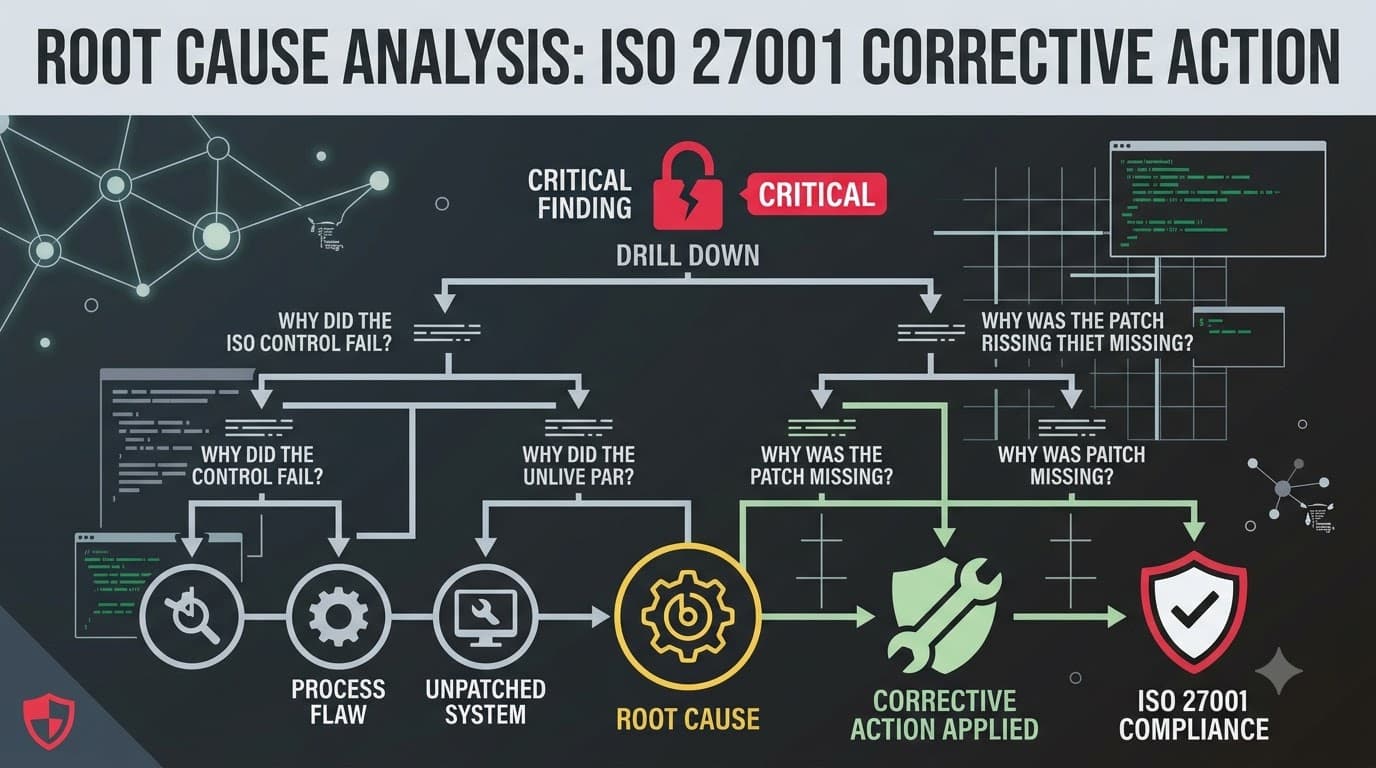
From nonconformity to closed corrective action: the flow
The diagram below lays out the sequence auditors expect to see reflected in your documented information, from the moment a nonconformity is identified through to closure. Each stage maps to a specific Clause 10.2 obligation.
flowchart TD
    A[Nonconformity identified<br/>internal audit, external audit, incident, complaint] --> B[Correction<br/>react and fix the immediate instance]
    B --> C[Root cause analysis<br/>5 Whys / fishbone / fault tree / Pareto / barrier analysis]
    C --> D{Root cause identified<br/>and evidenced?}
    D -- No, needs deeper investigation --> C
    D -- Yes --> E[Determine if similar<br/>nonconformities exist elsewhere]
    E --> F[Design corrective action<br/>targets the root cause, not the symptom]
    F --> G[Implement corrective action<br/>with owner and target date]
    G --> H[Effectiveness verification<br/>after sufficient time has elapsed]
    H --> I{Effective?}
    I -- No --> C
    I -- Yes --> J[Update ISMS documentation<br/>if systemic changes needed]
    J --> K[Retain documented information<br/>and close the nonconformity]
The loop-back arrows are the important part of this diagram, and the part most organizations' internal processes skip. If effectiveness verification fails, the correct response is not to write a new correction and call it done — it's to go back into root cause analysis, because an ineffective corrective action is strong evidence that the cause you identified wasn't the real one, or wasn't the only one.
Turning a root cause into a CAPA record that passes
Once you have a defensible root cause, the corrective action and preventive action (CAPA) record is where you convert analysis into a documented commitment. Auditors are reading this record specifically to check that the stated action addresses the stated cause — not a related cause, not a symptom, the actual identified cause. Use the template structure below as a baseline for your own CAPA record; the column headers are the fields an auditor will look for.
Field | Purpose | Halvorsen example (post-escalation) |
|---|---|---|
Nonconformity reference | Ties the CAPA to a specific audit finding number | Surveillance Audit NC-2026-03 |
Nonconformity description | The specific finding, in the auditor's or internal audit's own words | 2 of 10 sampled departed employees retained active VPN accounts beyond termination date |
Correction taken | Immediate fix, dated | Both accounts disabled same day; confirmed via IdP audit log, dated |
Root cause (from RCA) | The specific, evidenced cause identified through 5 Whys/fishbone/etc. | Manual, memory-dependent offboarding notification with no automated trigger; control never re-risk-assessed as contractor headcount tripled |
Similar nonconformities check | Whether the same cause could affect other areas | Reviewed all systems relying on manual HR-triggered deprovisioning (badge access, SaaS app licenses); found 2 additional systems with the same gap |
Corrective action | The specific action(s) that eliminate the root cause | Implement automated HR-to-IdP deprovisioning trigger on contract end date; extend same trigger to badge system and SaaS app provisioning tool |
Action owner | Named individual accountable | IT Operations Manager |
Target completion date | Realistic date, tied to the nature of the fix | 60 days from NC issuance (within the 90-day major NC window) |
ISMS document updates | Any policy/procedure changes required | Updated offboarding procedure to reflect automated trigger; updated risk register entry for termination-related access risk |
Effectiveness verification method and date | How and when you'll confirm it worked | Sample of all terminations in the 90 days following implementation, reviewed at day 120 |
Status | Open / in progress / effectiveness pending / closed | Tracked through to closure with dated evidence at each stage |
Two rows deserve emphasis because they're the ones organizations skip most often even when the root cause itself is solid. The "similar nonconformities check" row is a direct requirement of Clause 10.2 — the standard explicitly calls for reviewing whether similar nonconformities exist or could occur elsewhere, not just fixing the specific instance found. Halvorsen's second pass caught two additional systems with the identical manual-trigger gap; had they done that check the first time, badge access and SaaS licensing wouldn't have been separate future findings. The "effectiveness verification method and date" row is the one that turns a corrective action from a promise into evidence — and it's the subject of the next section.
"A corrective action without a stated effectiveness verification date is just a to-do item with extra paperwork. I want to see, in the same record, exactly how and when you're going to prove this worked — not a vague 'we'll monitor it.'" — Renata Sowinski, ISO 27001 Lead Auditor, Aldergate Assurance Group
Who should be in the room: RCA roles and responsibilities
A recurring reason RCA sessions produce weak conclusions is that the wrong mix of people is in the room — either too narrow (one analyst guessing at causes outside their visibility) or too broad and unstructured (a dozen people with no clear facilitator, drifting into blame or speculation). The table below reflects the role structure that tends to produce defensible RCA outcomes, adaptable to your organization's size; in a smaller company, one person may reasonably wear two or three of these hats.
Role | Responsibility in the RCA process | Who typically fills it |
|---|---|---|
Facilitator | Runs the session, keeps the group from stopping at the first plausible answer, ensures evidence backs each conclusion | ISMS manager, internal auditor, or an outside consultant for major/sensitive findings |
Process owner | Provides ground-truth detail on how the affected process actually works day to day (not how it's documented to work) | The manager or team lead who owns the process where the nonconformity occurred |
Technical subject matter expert | Confirms or refutes technical hypotheses with system data (logs, configurations, tickets) | IT operations, engineering, or the relevant control owner |
Evidence gatherer / scribe | Pulls the actual data referenced during the session (timestamps, ticket counts, configuration exports) and documents the session | Internal audit support, compliance analyst |
Corrective action owner | Accountable for implementing and tracking the resulting action once the root cause is agreed | Named individual, ideally someone with authority to actually make the change, not just report on it |
Sponsor / approver | Reviews and signs off on the final RCA and CAPA record, especially for major nonconformities | ISMS manager, CISO, or equivalent — the person accountable to leadership and the certification body |
Two staffing mistakes show up constantly. The first is having the same person serve as facilitator and process owner on a finding that touches their own area — it's very hard to rigorously interrogate a process you designed and are also defending, which is exactly why an outside facilitator (internal audit, or an external consultant for major findings) adds real value even in organizations that otherwise run lean. The second is skipping the sponsor/approver step for anything beyond a trivial minor finding — a CAPA record that never had a second set of eyes above the person who wrote it is far more likely to contain the reverse-engineered-conclusion problem auditors are trained to spot.
Effectiveness verification: proving the corrective action actually worked
Clause 10.2 requires the organization to review the effectiveness of any corrective action taken — this is not optional, and it's not satisfied by simply implementing the fix and moving on. Effectiveness verification is a distinct, later step that asks a specific question: after enough time has passed for the new control to be exercised under real conditions, did the nonconformity (or the pattern behind it) actually stop occurring?
The two mistakes I see most often here are checking too early and checking the wrong thing. Checking too early means verifying the day after implementation, which only proves the fix was deployed, not that it works under real operating conditions — a new automated deprovisioning trigger might work perfectly for the one test case you ran and then fail silently on the next edge case (a contractor extension, a rehire, a name change) three weeks later. Checking the wrong thing means confirming the specific instance that triggered the nonconformity is resolved, without checking whether the pattern is resolved — which is really just correction dressed up as effectiveness verification.
Verification approach | What it checks | When to use it |
|---|---|---|
Re-sample the same population | Pull a fresh sample from the same control area the original nonconformity came from (e.g., another batch of terminated employees) | Best default for most access- and process-related corrective actions |
Monitor a defined metric over a set window | Track a quantitative indicator (SLA breach rate, overdue training count, failed sync alerts) over 30–90 days | Best for volume-pattern nonconformities identified via Pareto analysis |
Targeted re-test of the specific control | Re-run the exact scenario that failed (e.g., simulate a termination end-to-end) | Best for technical/system controls where you can safely simulate the failure condition |
Independent internal audit follow-up | A separate internal audit cycle specifically re-checks the control area | Best for major nonconformities or ones tied to a systemic ISMS gap |
Management review confirmation | Effectiveness data presented and confirmed at a management review meeting | Appropriate as a closing formality after one of the above methods has produced evidence |
A reasonable rule of thumb: give the corrective action at least one full operating cycle before verifying — for something that happens continuously (like terminations), 60–90 days is typical; for something that happens on a fixed schedule (like quarterly access reviews), wait for at least one full quarter to pass. If the corrective action is time-critical because it closes a major nonconformity against a 90-day certification-body deadline, you can present interim evidence (the fix is implemented, initial spot-checks are clean) while committing to a follow-up effectiveness check at the next scheduled internal audit or surveillance visit — auditors generally accept this staged approach as long as it's explicit in the record rather than implied.
Documenting root cause analysis so an auditor can follow your reasoning
Clause 10.2 requires you to retain documented information as evidence of the nature of the nonconformities, the actions taken, and the results. In practice, that means your RCA needs to leave a paper trail an auditor who wasn't in the room can reconstruct and evaluate on their own — not just a one-line conclusion.
Documentation element | Why an auditor looks for it | Common gap |
|---|---|---|
Which technique was used (5 Whys, fishbone, etc.) | Shows a structured method was applied, not a guess | Often omitted entirely — record jumps straight to "root cause: X" |
Who participated in the analysis | Cross-functional input increases credibility, especially for fishbone/FTA | Records show one person's name, suggesting no challenge or peer review occurred |
Evidence reviewed during the analysis (logs, interviews, tickets, data) | Distinguishes evidence-based conclusions from speculation | Conclusions stated with no supporting artifact referenced |
The full chain or diagram, not just the final answer | Lets the auditor see whether the analysis actually reached a system-level cause or stopped early | Only the final "root cause" line is kept; working notes discarded |
Date the RCA was performed relative to the nonconformity being raised | Confirms RCA happened as part of the corrective action process, not retrofitted before an audit | RCA dated suspiciously close to the audit date it's meant to satisfy |
Link to the resulting corrective action record | Shows traceability from cause to action | RCA and CAPA stored in different systems with no cross-reference |
None of this needs to be elaborate. A one-page 5 Whys table with participant names, a date, and a note on what evidence was checked at each "why" is entirely sufficient for the majority of minor nonconformities. Save the heavier documentation (full fishbone diagrams, fault trees) for major nonconformities or recurring findings where the auditor's scrutiny — reasonably — will be higher. The goal is always the same: someone who reads the file six months from now, with no memory of the meeting, should be able to see exactly how you got from the finding to the fix.
Common RCA mistakes that keep nonconformities open (or bring them back)
Across 200-plus ISMS engagements, the same handful of RCA failure patterns account for the overwhelming majority of rejected CAPAs and repeat findings. Worth checking your own draft against this list before you submit anything to an auditor.
Mistake | What it looks like | Why it fails | What to do instead |
|---|---|---|---|
Stopping at the symptom | "Root cause: the patch wasn't applied" | Restates the finding instead of explaining it | Ask why the patch process allowed this to happen, not just that it did |
Blaming the individual | "Root cause: employee error / employee didn't follow procedure" | Rarely survives a second "why" — ask why the system let one person's error cause a nonconformity with no catch | Ask what would need to be true for this error to be structurally impossible or automatically caught |
Treating training as a root cause rather than a symptom | "Root cause: insufficient training" | Training gaps are usually themselves caused by something (no onboarding trigger, no competency check) | Ask why the training gap existed and whether a competency verification step, not just more content, is the real fix |
Confusing correlation with causation | Assuming the most recent change caused the failure because it's the most visible variable | Can send the corrective action in a completely wrong direction | Verify the causal link with actual evidence (logs, timelines, reproduction) before committing |
Single-person RCA on a cross-functional problem | One security analyst writes the RCA alone for a finding that spans HR, IT, and a business unit | Misses causes outside that person's visibility | Pull in the process owners actually involved, even briefly |
RCA performed after the corrective action was already decided | The "root cause" conveniently matches whatever fix was already budgeted or planned | Auditors can usually tell when the causal chain was reverse-engineered | Do the analysis first, let the evidence lead to the cause, then design the action |
Ignoring the "similar nonconformities" check | Fixing only the exact instance found, not checking adjacent systems/processes for the same gap | Leaves Clause 10.2's explicit requirement unmet and invites a related repeat finding | Always ask "where else could this same cause be operating?" before closing |
The individual-blame pattern deserves its own callout because it's both the most common and the most consequential. It's not that individual error never happens — people do make mistakes — but a well-designed ISMS is supposed to be resilient to individual error, and a root cause analysis that ends at "the person made a mistake" has, by definition, failed to examine why the system had no way to catch that mistake. If your corrective action for a training-related finding is "retrain the employee" and nothing else, ask yourself honestly whether the next employee in that role, on their busiest day, would make the same mistake. If the honest answer is yes, you haven't found the root cause yet.
"The moment someone in the room says 'the employee should have known better,' I know we're not done. That sentence is a signpost pointing straight at the actual root cause, which is almost always a process or system gap wearing a person's name." — David Achterberg, VP of Information Security, Loomcraft Insurance Group
Case study one: Halvorsen Freight Analytics — from repeat major NC to closed within the deadline
Back to Priya's situation. With the acquisition-linked deadline pressure, Halvorsen brought in an outside facilitator to run a proper fishbone session within 48 hours of the major nonconformity being raised, pulling in IT operations, HR, and the security team together rather than leaving Priya to write the RCA alone. The session confirmed the manual, memory-dependent notification chain as the dominant branch, and a Pareto pass across two years of offboarding tickets showed 71% of any offboarding-related delay traced back to that same manual handoff, regardless of which system was affected (VPN, badge, or SaaS licensing).
The corrective action built an automated trigger from the HR system's contract-end-date field directly to the identity provider's deprovisioning API, with badge access and the SaaS license management tool wired to the same trigger — addressing the "similar nonconformities" requirement in one build rather than three separate projects. Effectiveness verification was scheduled for day 75 of the 90-day window: a re-sample of every termination processed since go-live, cross-checked against system logs for deprovisioning timestamps. Zero exceptions across 34 terminations in that window. The certification body closed the major nonconformity on schedule, the acquisition's due-diligence data room reflected a clean status, and the $4.2 million valuation premium Priya's CEO had flagged stayed intact. The total cost of the fix — engineering time plus a modest identity-governance module — was $38,000, a number Priya now cites internally every time someone questions whether RCA rigor is "worth the time."
Case study two: Verdant Analytics — the fishbone session that found three causes, not one
Verdant Analytics, a 90-person SaaS company preparing for its first Stage 2 audit, hit a nonconformity during a mock audit dry run: security awareness training completion sat at 68% against a policy commitment of 95% within 30 days of hire. The instinctive first draft of the RCA, written by the compliance lead alone, concluded "employees are too busy and deprioritize non-urgent training" — a classic individual-blame conclusion that the outside auditor prepping them for Stage 2 flatly rejected as insufficient.
A fishbone workshop with People Ops, engineering management, and the compliance lead surfaced three genuine contributing causes instead of one: the training platform's completion reminders were going to a company email alias that new hires didn't have access to until their second week; managers had no visibility into their own reports' completion status, so there was no natural escalation path; and the training assignment itself was triggered manually by HR rather than automatically at account provisioning, causing a lag of up to 12 days for some hires. Verdant's corrective action addressed all three: reminders redirected to personal onboarding email until company access was active, a manager dashboard added to the training platform, and assignment automated at the identity-provisioning step tied to their endpoint and authentication controls. Completion rates hit 97% within the following quarter, verified at the 90-day mark, and the auditor closed the finding during Stage 2 itself rather than requiring a follow-up visit — saving Verdant an estimated $6,500 in additional audit fees and roughly six weeks of schedule risk on their certification target date.
Case study three: Northfield Public Utilities — when 5 Whys wasn't enough
Northfield Public Utilities, a regional infrastructure operator, had a near-miss: a decommissioned test server, believed to be fully offline, was found still reachable on the internal network eight months after its supposed retirement, with an outdated, unpatched OS and no monitoring coverage. A quick 5 Whys by the network team concluded "the decommissioning checklist item for network isolation was skipped" and proposed adding a checklist verification step — a correction masquerading as a corrective action, and one that ignored the fact this was the second time a "decommissioned" asset had turned up live in eighteen months.
Given the recurrence and the potential severity (an unpatched, unmonitored server on an internal utility network), the ISMS manager escalated to fault tree analysis. The FTA revealed an AND-gate structure that 5 Whys had missed entirely: the server stayed reachable AND was invisible to monitoring AND was absent from the asset inventory used for vulnerability management scanning — three independent gaps, each of which alone might have been caught by one of the others, none of which were. Basic events underneath included a decommissioning process that removed assets from the ticketing system before confirming network isolation, an asset inventory that was updated manually and had drifted from reality, and a monitoring tool onboarding process that depended on the same asset inventory being accurate. The corrective action rebuilt asset decommissioning as a single automated workflow — network isolation confirmed via active scan before ticket closure, inventory updated automatically from the scan result, and monitoring de-enrollment triggered from the same event — closing all three gates at once instead of patching one checklist item. Effectiveness verification six months later, using a full network discovery scan reconciled against the asset inventory, found zero orphaned assets, and the internal audit team flagged the case as a model example in Northfield's next management review.
Case | RCA technique used | Root cause found | Outcome |
|---|---|---|---|
Halvorsen Freight Analytics | Fishbone + Pareto | Manual, memory-dependent HR-to-IT offboarding handoff, never re-assessed as headcount scaled | Major NC closed within 90-day deadline; $4.2M valuation premium preserved |
Verdant Analytics | Fishbone | Three independent causes: email routing, manager visibility gap, manual assignment lag | Finding closed during Stage 2 itself; ~$6,500 and 6 weeks saved |
Northfield Public Utilities | Fault tree analysis | Three independent gaps (isolation, inventory, monitoring) that each masked the others | Zero orphaned assets on 6-month re-verification; used as internal training example |
Where RCA fits into the bigger picture of ongoing certification
Root cause analysis doesn't happen in a vacuum — it's one node in a continuous-improvement loop that runs for as long as your certification does. Nonconformities surface through several different channels, and each one carries slightly different expectations for how fast and how deep your RCA needs to go.
Where the nonconformity comes from | Typical RCA expectation | Notes |
|---|---|---|
Internal audit finding | Full RCA before the next management review cycle | Internal audits are your own early-warning system; use them to practice RCA rigor before an external auditor ever sees the finding |
Stage 2 certification audit | RCA and CAPA usually required before the certificate is issued (for major findings) or within an agreed follow-up window (for minor) | The certification body will not issue or maintain certification against unresolved major nonconformities |
Same 90-day major / next-visit minor convention as Stage 2, but with added scrutiny for anything resembling a repeat finding | This is exactly the channel that escalated Halvorsen's finding from minor to major | |
Security incident, independent of any audit | RCA typically expected as part of incident closure, feeding into the same CAPA process | Ties directly to the "learning from incidents" intent behind information security incident management |
Internal complaint or self-identified gap | No external deadline, but Clause 10.2 still applies once you've classified it as a nonconformity | Don't let the absence of an audit deadline become an excuse to skip the RCA step |
Whichever channel surfaces the nonconformity, the resulting root cause and corrective action should also inform whether your Statement of Applicability or risk register needs updating — a root cause that traces back to a control being applied inconsistently, or a risk that was under-assessed, is exactly the kind of signal that should flow back into your next risk review rather than staying siloed in a closed audit finding. If any of the terminology in this article — nonconformity, correction, corrective action, effectiveness — still feels slippery in your own documentation, PentesterWorld's ISO 27001 Glossary of Terms is a fast way to get your team using consistent language, which matters more than it sounds like it should when three different departments are all writing sections of the same CAPA record.
It's also worth knowing that this discipline isn't unique to ISO 27001. If your organization holds or is pursuing SOC 2 alongside ISO 27001, or maps its controls to the NIST Cybersecurity Framework, you'll find the underlying logic of "fix the symptom, then find and fix the cause" shows up under different labels — SOC 2 exception remediation and NIST's Respond/Recover functions both expect essentially the same rigor. A mature RCA process built for ISO 27001 corrective action transfers almost directly to those frameworks, which is a meaningful efficiency if you're managing more than one certification or attestation at once.
Making RCA repeatable instead of reinventing it every time
The organizations that struggle most with RCA aren't the ones lacking technical knowledge of 5 Whys or fishbone diagrams — it's usually a five-minute explanation away. They struggle because RCA isn't a habit yet; every nonconformity triggers a scramble to remember what template to use, who should be in the room, and where the last one was even filed. Building light infrastructure around the process pays for itself the second or third time you use it.
Infrastructure element | What it solves | Minimum viable version |
|---|---|---|
A standing RCA template | Prevents every analyst from inventing their own format, which makes records inconsistent and harder for auditors to follow | A single shared document or spreadsheet tab with the CAPA fields from earlier in this article |
A technique quick-reference | Removes the "which method do I even use" hesitation that delays getting started | The choosing-technique table from this article, pinned somewhere your team actually looks |
A defined severity-to-rigor mapping | Stops both over-investing in trivial findings and under-investing in serious ones | The severity table from this article, adapted to your own minor/major definitions |
A tracking log of open and closed CAPAs | Makes the "similar nonconformities" check possible — you can't check for patterns you haven't logged | Even a basic spreadsheet with nonconformity ID, root cause, status, and effectiveness verification date is sufficient at small scale |
A cadence for reviewing open CAPAs | Prevents corrective actions from quietly stalling past their target date | A standing agenda item in your regular security or ISMS meeting, escalating to management review for anything overdue |
None of this requires purpose-built GRC software, though a GRC platform does make the tracking and cross-referencing meaningfully easier once you're running more than a handful of nonconformities a year across multiple frameworks. What matters more than the tooling is that the habit exists at all — that the next nonconformity doesn't start from a blank page. PentesterWorld's Internal Audit Report Template is built to capture findings in a format that flows directly into this kind of RCA tracking, and pairing it with the ISO 27001 Mandatory Documents Checklist helps confirm your CAPA records are sitting alongside the other documented information a certification body will expect to see retained.
Root cause analysis as a business advantage, not just an audit requirement
It's tempting to treat RCA purely as an audit-survival exercise — the thing you do because a nonconformity report demands it. That framing undersells what's actually happening when you do it well. Every rigorous root cause analysis is, in effect, free organizational diagnostics: it tells you where a process depends on someone remembering something, where a control's design doesn't match how the business actually operates today, and where two teams have quietly stopped talking to each other about a handoff that used to work. Halvorsen didn't just close a nonconformity — they found and fixed a scaling problem in their offboarding process that would have kept generating security exposure (and eventually a genuine incident, not just an audit finding) regardless of whether an auditor ever caught it. That's the case worth making to a CFO who sees RCA as compliance overhead: it's risk reduction with an audit trail attached, and the common risk assessment mistakes that create nonconformities in the first place are frequently the same gaps RCA surfaces.
The organizations that get the most value from ISO 27001 — the ones for whom certification becomes a genuine competitive differentiator rather than a checkbox — are consistently the ones that treat every nonconformity as a free audit of their own operational assumptions. If your RCA process is mature enough that a customer's security questionnaire, a SOC 2 auditor's request for evidence of continuous improvement, or your own board asking "how do you know this won't happen again" all get answered by the same disciplined CAPA record, you've turned a Clause 10.2 obligation into genuine organizational muscle.
If you're building or refining your own root cause analysis and corrective action process, PentesterWorld's Internal Audit Report Template gives you a structured place to capture findings that feed directly into RCA, and the Internal Audit Checklist helps make sure your internal audits are surfacing the real issues before a certification body finds them for you. If you're heading toward your first certification audit and want to know where nonconformities are most likely to originate, the Certification Readiness Checklist and The Complete ISO 27001 Implementation Guide eBook are both built for exactly that gap-closing work, and the ISO 27001 Glossary of Terms is a quick reference if any of the Clause 10.2 terminology in this article needs a second look.
Whichever technique you reach for next time a nonconformity lands on your desk, the test is always the same one Priya learned the hard way: if the corrective action you write down could plausibly fail to prevent the exact same finding twelve months from now, you haven't found the root cause yet — you've found another correction.