Priya Nathan had two risk heat maps on her laptop, and they disagreed with each other.
Priya was the newly appointed CISO at Halloway Grain, a mid-sized commodities trading and logistics firm out of Kansas City with about 900 employees and just over $410 million in annual revenue. Halloway had run a mature enterprise risk management (ERM) function for nearly a decade — commodity price risk, counterparty credit risk, weather and supply-chain disruption, regulatory risk, all rolled up quarterly into a single risk register that the audit committee reviewed line by line. It was, by Priya's own admission, one of the better ERM shops she'd seen in a company this size.
Then there was her risk register. Six months into building Halloway's ISMS for an ISO 27001 certification the board had promised a major grain-handling customer, Priya had produced her own information security risk register: ransomware exposure on the OT-adjacent scheduling systems, third-party access from a logistics broker with weak MFA, an unencrypted legacy EDI feed carrying pricing data. Rated on her own 1–5 likelihood/impact scale. Reviewed by nobody outside the security team.
When the CFO asked Priya to present her top five risks alongside the ERM function's top five at the next audit committee meeting, the room went quiet in a bad way. The ERM register rated "cyber incident" as a single generic line item at "moderate" likelihood, "high" impact — sitting comfortably in the middle of the enterprise heat map. Priya's register showed three of her top five items scored as "severe," using a scale that didn't map to the enterprise scale at all. Same company, same week, two committees, two incompatible stories about how much danger Halloway was actually in. One board member asked the obvious, uncomfortable question: "Which one of you is wrong?"
Neither was wrong. They were using two different vocabularies to describe the same risk universe, and nobody had ever sat down to translate between them. Halloway's general counsel later estimated that the resulting confusion — extra board sessions, a delayed audit committee sign-off, and three weeks of the CFO's office reconciling numbers by hand — cost the company somewhere in the neighborhood of $60,000 in wasted executive and consulting time, to say nothing of the credibility hit when the certification body's Stage 1 auditor asked, politely, how the ISMS risk process related to the enterprise risk framework and got two different answers from two different Halloway executives in the same meeting.
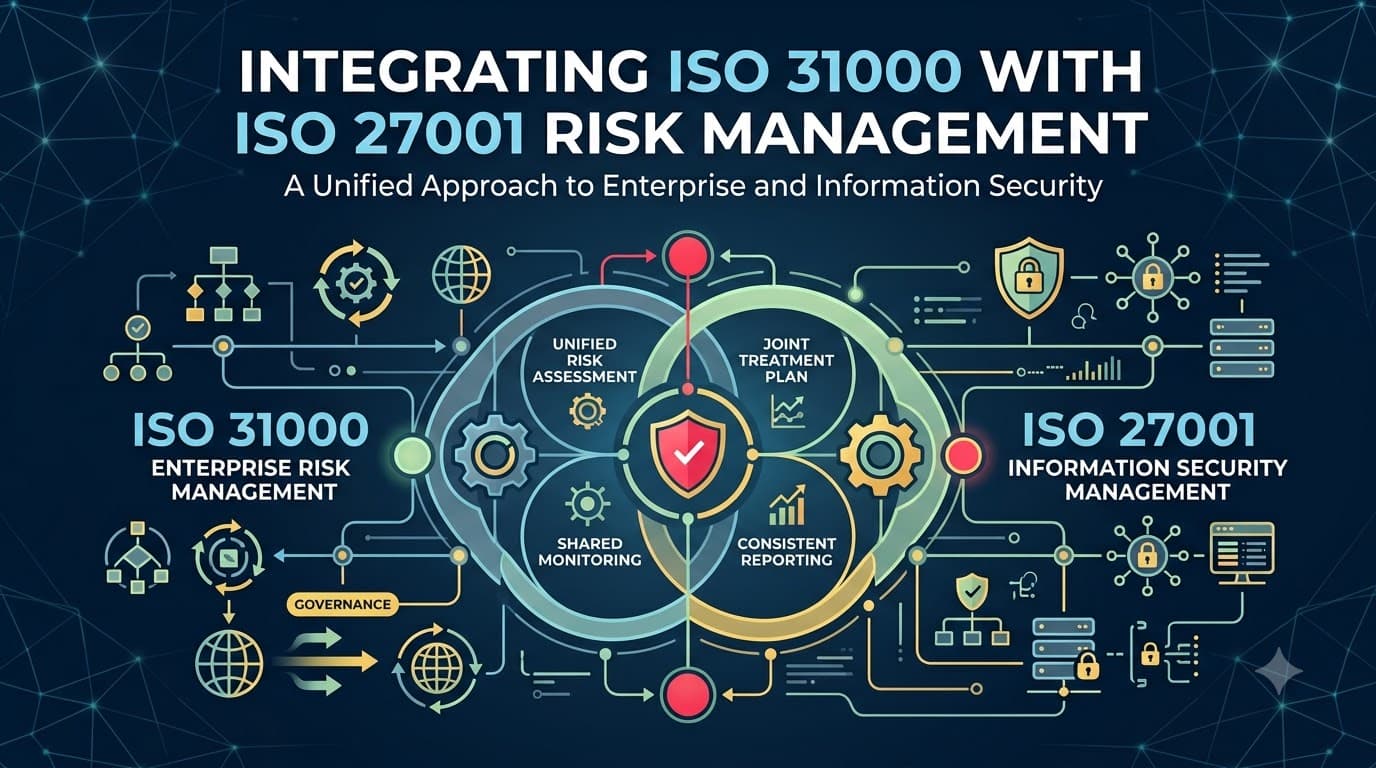
This is not a rare story. It is, in my experience, close to the default outcome whenever an organization builds information security risk management as an island. ISO 27001 tells you, correctly and specifically, what your ISMS must do with risk. It does not tell you how to talk to your enterprise risk committee, your internal audit function, or your board about that risk in language they already use for everything else. That translation layer is exactly what ISO 31000 provides — and it's the subject of this article.
Who This Is For
This article is written for CISOs, information security managers, ISO 27001 project leads, and internal auditors working inside organizations that already have — or are building — an enterprise risk management capability, and who need the ISMS risk process to plug into it rather than compete with it. You should walk away understanding what ISO 31000 actually is (and isn't), how its principles, framework, and process map onto ISO 27001's Clause 6 requirements, and a concrete, phased approach for merging information security risk into one enterprise risk conversation — without inventing new bureaucracy, duplicating registers, or diluting the rigor an ISMS audit demands. If you manage risk in a silo today, by the end of this piece you should have a plan for not doing that anymore. If any of the terminology below is unfamiliar, our ISO 27001 Terminology and Glossary is worth keeping open in a second tab.
What ISO 31000 Actually Is (And Isn't)
Let's clear up the single most common misunderstanding I run into on this topic, because it derails half the conversations I have with clients: ISO 31000:2018, Risk Management — Guidelines, is not a management system standard, and you cannot get certified to it. There is no accredited certification body that will issue you an "ISO 31000 certificate," no Stage 1 and Stage 2 audit, no surveillance cycle. Anyone offering to certify you to ISO 31000 is selling something that doesn't exist.
What ISO 31000 actually is: a generic guidance document, applicable to any organization and any type of risk — financial, strategic, operational, reputational, safety, environmental, and yes, information security. It was built to sit above and behind the risk-related clauses of other management system standards, including ISO 27001, ISO 9001, ISO 14001, and ISO 22301 — a family of standards that share a common structure worth understanding on its own terms if you haven't already reviewed how the wider ISO/IEC 27000 family fits together. It gives you a common vocabulary and a common process shape so that risk management doesn't have to be reinvented separately for every function and every standard an organization happens to adopt — which is also exactly why organizations running multiple ISO management systems side by side increasingly look at building a single integrated management system rather than maintaining parallel ones.
ISO 31000 organizes risk management into three interlocking pieces: a set of principles (why you manage risk and what "good" looks like), a framework (the organizational scaffolding — leadership, integration, design, implementation, evaluation, and improvement — that makes risk management durable rather than a one-off project), and a process (the repeatable, step-by-step activity of actually identifying, analyzing, evaluating, and treating risk). Understanding all three matters, because most organizations that struggle with ISO 27001 risk management have actually only ever built the process — they've never built the framework around it, which is exactly why it stays siloed.
The ISO 31000 Principles
The 2018 revision of ISO 31000 sets out eight principles that describe what effective risk management should look like in practice. These aren't audit criteria — nobody checks a box against them — but they're a useful gut-check for whether your ISMS risk process is doing more than ticking a compliance requirement.
Principle | What It Means in Practice |
|---|---|
Integrated | Risk management is part of all organizational activities, not a bolt-on parallel process |
Structured and comprehensive | A consistent, complete approach produces comparable, reliable results |
Customized | The framework and process are proportionate to the organization's context, not a generic template |
Inclusive | Appropriate and timely involvement of stakeholders — including those who own the risk |
Dynamic | Risk management anticipates, detects, and responds to changes as they occur |
Best available information | Decisions draw on historical data, current information, and forward-looking expectations, with acknowledged limitations |
Human and cultural factors | People's behavior and culture materially influence risk management at every level |
Continual improvement | The organization learns and improves through experience |
Read that list again with Priya's Halloway story in mind. The problem wasn't that her information security risk analysis was wrong — it was that it wasn't "integrated" (it sat apart from the enterprise process) and it wasn't "inclusive" (nobody outside security had been consulted on how the scoring worked). Those two failures alone were enough to make two technically defensible risk assessments look contradictory to a board that had no reason to reconcile them itself.
The ISO 31000 Framework
The framework is the part of ISO 31000 most organizations skip, because it's the least tangible. It's not a document you produce; it's the organizational commitment and structure that makes risk management something more than an annual spreadsheet exercise. ISO 31000 describes it as a continuous cycle with five components sitting underneath top management leadership and commitment.
Framework Component | Core Question It Answers |
|---|---|
Leadership and commitment | Does top management visibly own risk management and allocate resources to it? |
Integration | Is risk management built into governance, strategy, planning, and operations — not run alongside them? |
Design | Has the organization understood its context and designed a framework proportionate to it (mandate, roles, resources, communication)? |
Implementation | Is the framework actually put into action, with a plan, timeline, and resources, not left as policy on paper? |
Evaluation | Does the organization periodically assess whether the framework is still effective and fit for purpose? |
Improvement | Are gaps and changing conditions used to adapt and improve the framework over time? |
For an ISO 27001 practitioner, this framework should look familiar, because it's structurally almost identical to the Plan-Do-Check-Act rhythm baked into every ISO management system standard, including ISO 27001's own Clauses 4 through 10. That's not a coincidence — it's exactly why the two standards integrate so cleanly. If your organization already has an ISO 27001 ISMS Core Concepts instantiation of leadership, planning, support, operation, evaluation, and improvement, you already have most of the ISO 31000 framework built — you just haven't labeled it that way or connected it to risks outside information security.
The ISO 31000 Process
The process is what most people actually mean when they say "risk management," and it is also the piece with the most direct one-to-one relationship to ISO 27001 Clause 6. ISO 31000 describes six activities, with communication and consultation, and monitoring and review, running continuously alongside the core sequence of establishing scope/context/criteria, risk assessment, and risk treatment.
Process Step | What Happens Here |
|---|---|
Communication and consultation | Ongoing dialogue with internal and external stakeholders throughout the process |
Scope, context, and criteria | Defining what's being risk-assessed, the internal/external environment, and the criteria for evaluating significance |
Risk identification | Finding, recognizing, and describing risks that could affect objectives |
Risk analysis | Understanding the nature of each risk, its causes, sources, likelihood, and consequences |
Risk evaluation | Comparing analysis results against risk criteria to decide if further action is needed |
Risk treatment | Selecting and implementing options to modify risk |
Monitoring and review | Ongoing checks on the process and its outputs, at planned intervals or in response to change |
Recording and reporting | Documenting and communicating risk management activities and outcomes through appropriate mechanisms |
Note that "risk assessment" in ISO 31000 is an umbrella term covering identification, analysis, and evaluation together — the same three-part structure ISO 27001 uses, which is one reason ISO 27005 Guidance — the information-security-specific risk management standard written to sit underneath ISO 27001 — was deliberately aligned to the ISO 31000 process rather than inventing a separate one.
"People hear '31000' and assume it's another certification to chase. It isn't. I tell clients: think of it as the shared grammar your enterprise risk team already speaks. Your ISMS just needs to learn to speak it too." — Daniel Okafor, Director of GRC, Chartwell Beckman Advisory
What ISO 27001 Actually Requires (Clause 6 Recap)
Before mapping the two standards together, it's worth being precise about what ISO 27001:2022 itself demands, because the temptation once you discover ISO 31000 is to treat it as a checklist you can substitute for Clause 6. You can't — ISO 31000 is guidance; Clause 6 is the certifiable requirement, and an auditor will test conformance against Clause 6's specific wording, not against ISO 31000.
ISO 27001 Clause 6: Planning requires the organization to determine risks and opportunities that need to be addressed (6.1.1), and then sets out three specific sub-requirements that carry the real audit weight.
Sub-clause | Requirement (in plain terms) |
|---|---|
6.1.2 Information security risk assessment | Establish and apply a documented risk assessment process with defined criteria (risk acceptance criteria and criteria for performing assessments); ensure repeated assessments produce consistent, valid, and comparable results; identify risks to confidentiality, integrity, and availability of information within the ISMS scope; identify risk owners; analyze likelihood and consequence; determine risk levels; evaluate against criteria and prioritize for treatment |
6.1.3 Information security risk treatment | Select appropriate risk treatment options; determine controls necessary to implement the chosen options; compare against Annex A to verify no necessary controls are omitted; produce a Statement of Applicability; formulate a risk treatment plan; obtain risk owners' approval of the plan and acceptance of residual risk |
6.2 Information security objectives | Establish measurable (where practicable) security objectives at relevant functions and levels, consistent with policy, taking risk assessment/treatment results into account, and plan how to achieve them |
Clause 6 does not tell you how to run the process operationally — it doesn't mandate a specific scale, a specific taxonomy, or a specific cadence beyond "planned intervals or when significant changes occur." That silence is deliberate: ISO 27001 leaves organizations free to plug in whatever risk methodology suits them, provided it's documented, consistently applied, and produces the specific outputs Clause 6 demands. This is precisely the gap ISO 31000 is built to fill — it's a ready-made, internationally recognized methodology an organization can adopt rather than invent from scratch, and if the organization already runs ISO 31000-aligned ERM, adopting it for the ISMS means building on a foundation that already exists rather than laying a second one next to it.
It's worth being equally clear about what this integration is not: adopting ISO 31000 does not reduce or replace any ISO 27001 requirement. You still need the documented risk assessment methodology, the risk owners, the Statement of Applicability, the Risk Treatment Plan, and the risk acceptance sign-off — an auditor checking Clause 6 conformance will look for all of it regardless of whether your risk process is badged "ISO 31000-aligned." What changes is the vocabulary, the governance home, and the reporting line the ISMS risk process plugs into.
Mapping ISO 31000 to ISO 27001 Clause 6
This is the table I build with almost every client who has an existing ERM function, because it's the fastest way to show a skeptical enterprise risk director that the ISMS isn't asking for a competing process — it's asking to be a specialized instance of the one they already run.
ISO 31000 Process Step | Corresponding ISO 27001 Clause 6 Requirement | Integration Note |
|---|---|---|
Communication and consultation | Implicit throughout 6.1.2/6.1.3 (risk owner engagement, management review) | Route information security risk communication through the same channels/cadence as enterprise risk reporting |
Scope, context, and criteria | 6.1.2(a): risk assessment criteria, incl. risk acceptance criteria; ISMS scope (Clause 4.3) | Align the ISMS's risk acceptance criteria and scales with enterprise-level criteria wherever the risk types are comparable |
Risk identification | 6.1.2(c)(1): identify risks to confidentiality, integrity, availability within scope | Use the enterprise risk taxonomy's categories as parent categories for information security risk types |
Risk analysis | 6.1.2(c)(2)–(3): analyze likelihood/consequence; determine risk levels | Use one likelihood/impact scale (or a documented, defensible mapping between scales) across ISMS and ERM |
Risk evaluation | 6.1.2(d): evaluate against criteria and prioritize | Feed prioritized information security risks into the same evaluation/prioritization forum as other enterprise risks |
Risk treatment | 6.1.3: select treatment options, determine controls, produce SoA, formulate treatment plan | ISMS treatment plans remain Annex-A-driven and technical, but treatment decisions and residual risk acceptance are visible to enterprise risk governance |
Monitoring and review | Clause 9 (Performance Evaluation): internal audit, management review, monitoring of objectives | Report ISMS risk monitoring metrics into the enterprise risk committee's standing review cycle |
Recording and reporting | Documented information requirements (Clause 7.5); risk register; SoA | Use a common register format/fields so entries can be filtered into either an ISMS-only view or a full enterprise view |
The pattern across every row is the same: ISO 27001 tells you the minimum output a given step must produce to pass an audit; ISO 31000 tells you the shape that step should take so its output is usable by people who aren't information security specialists. Neither one substitutes for the other, but running them side by side means you build the ISMS risk process once, in a form the rest of the enterprise can actually consume.
flowchart TB
    subgraph ISO31000["ISO 31000 Risk Management Process"]
        A["Communication & Consultation"]
        B["Scope, Context & Criteria"]
        C["Risk Identification"]
        D["Risk Analysis"]
        E["Risk Evaluation"]
        F["Risk Treatment"]
        G["Monitoring & Review"]
        H["Recording & Reporting"]
    end
    subgraph ISO27001["ISO 27001 Clause 6 Outputs"]
        B2["6.1.1 / 4.3: ISMS Scope + Risk Criteria"]
        C2["6.1.2(c)(1): CIA Risks Identified, Risk Owners Assigned"]
        D2["6.1.2(c)(2-3): Likelihood, Consequence, Risk Level"]
        E2["6.1.2(d): Risks Evaluated & Prioritized"]
        F2["6.1.3: Controls Selected, SoA, Risk Treatment Plan"]
        G2["Clause 9: Monitoring, Internal Audit, Management Review"]
        H2["Clause 7.5: Documented Information / Risk Register"]
    end
    A -.-> ISO27001
    B --> B2
    C --> C2
    D --> D2
    E --> E2
    F --> F2
    G --> G2
    H --> H2
    B2 --> C2 --> D2 --> E2 --> F2 --> G2 --> H2
Reading the diagram left to right (or top to bottom, depending on how your renderer lays it out): every ISO 31000 process box has a direct ISO 27001 output on the other side. Nothing in the ISMS risk process needs to be invented independently of the enterprise process — it needs to be specialized for information security risk and plugged back in at scope/criteria setting, at evaluation, and at monitoring/reporting.
Integrating Information Security Risk Into Enterprise Risk Management
Mapping the two standards on paper is the easy part. The harder, more valuable work is structural: deciding who owns what, which vocabulary wins when the ISMS and the ERM function disagree, and how the information reaches the board in a single, coherent narrative. I've found this comes down to three concrete moves — governance, taxonomy, and reporting — that are worth tackling in roughly that order.
Governance: One Risk Committee, Not Two
The single highest-leverage change most organizations can make is structural, not documentary: put information security risk on the agenda of the same committee that owns enterprise risk, with the CISO (or a delegate) as a standing member, rather than running a parallel "security risk committee" that reports somewhere else and only surfaces to the board through a separate channel.
Governance Model | How It Works | Typical Fit |
|---|---|---|
Fully integrated | One enterprise risk committee; CISO is a standing voting/advisory member; information security risk is a standard agenda category alongside financial, operational, and strategic risk | Mid-size to large organizations with a mature ERM function and a CISO with enough seniority to sit at that table |
Federated | Separate ISMS risk forum feeds a defined set of top risks into the enterprise committee on a fixed cadence via a documented escalation threshold | Organizations where information security risk volume is high (frequent technical findings) and full integration would overload the enterprise agenda |
Liaison-only (weakest) | ISMS risk register exists independently; a liaison occasionally briefs the enterprise committee informally, with no defined threshold or cadence | Common in early-stage ISMS builds; workable short-term but the pattern that produced Halloway Grain's contradictory heat maps |
Most organizations I work with land on the federated model in year one and migrate toward fully integrated by year two or three, once the enterprise risk function trusts the ISMS's numbers enough to stop wanting a separate lower-level review of every entry.
"The moment we put our CISO on the same risk committee as our CFO and VP of Supply Chain, the quality of the conversation changed overnight. Suddenly 'ransomware' wasn't a scary word on a slide — it was a line item competing for the same finite risk-appetite budget as a warehouse fire. That's the right fight to have." — Marisol Vega, Chief Risk Officer, Ashgrove Federal Credit Union
Building a Shared Risk Taxonomy and Scoring Scale
Nothing undermines integration faster than two teams using the number "4" to mean different things. ISO 31000's principle of being "structured and comprehensive" only pays off if the structure is genuinely shared, which means agreeing on a single likelihood scale, a single impact/consequence scale, and — critically — a documented way to translate any legacy scale that a particular business unit refuses to give up.
Scale Element | Enterprise (Illustrative) | ISMS-Only (Before Integration) | Integrated (After) |
|---|---|---|---|
Likelihood levels | 5-point (Rare → Almost Certain) | 4-point (Low/Medium/High/Critical) | Adopt enterprise 5-point scale; map legacy ISMS "Critical" to enterprise "Almost Certain" band with documented rationale |
Impact dimensions | Financial, Regulatory, Reputational, Operational | Confidentiality, Integrity, Availability | Add C/I/A as a sub-dimension of "Operational" impact so ISMS findings roll up without losing security-specific nuance |
Risk appetite statement | One enterprise appetite statement, tiered by risk category | None (only ISMS acceptance criteria) | Risk Acceptance Criteria explicitly derived from, and cross-referenced to, the enterprise appetite statement |
Risk register fields | Risk ID, category, owner, likelihood, impact, score, treatment, status | Asset, threat, vulnerability, CIA impact, control reference | Common register schema with an "ISMS extension" field set so one export serves both audiences |
This is genuinely the single most time-consuming piece of integration work, and it's worth budgeting real calendar time for it — in my experience, four to eight weeks of workshop time with both the enterprise risk owner and the ISMS risk owner in the room, not an email thread. It is also the piece that pays off longest: once the scales are unified, every subsequent Risk Assessment Methodology cycle produces numbers the board already knows how to read.
Aggregated Reporting to the Board
Once governance and taxonomy are aligned, reporting becomes almost mechanical: information security risk becomes a category on the enterprise heat map rather than a separate slide deck. The practical output most boards want is a single consolidated top-risks view, refreshed on the enterprise's normal cadence (typically quarterly), with a clearly labeled information security sub-section for the operational detail that internal audit and the certification body will still want to see.
Reporting Layer | Audience | Content | Typical Cadence |
|---|---|---|---|
Board / audit committee | Board of directors, audit committee | Top enterprise risks including information security as an integrated category; trend lines; risk appetite status | Quarterly |
Enterprise risk committee | CRO, CFO, CISO, business unit heads | Full consolidated risk register with drill-down by category; treatment plan status across all risk types | Monthly or quarterly |
ISMS management review | Top management, ISMS owner, risk owners | Full Clause 6 outputs — risk assessment results, SoA changes, treatment plan detail, internal audit findings | At least annually, or per Clause 9 schedule |
Operational / technical | Security team, IT, control owners | Granular technical risk detail, control performance metrics, remediation tracking | Continuous / monthly |
The point of this structure isn't to produce more paperwork — it's to make sure the same underlying data supports four different altitudes of conversation without needing four different risk assessments. The ISMS management review still has to happen and still has to produce everything Clause 9 requires; what changes is that its outputs now feed upward into a board report that already speaks the enterprise's language, instead of arriving as a translation problem the CFO has to solve by hand, the way it did at Halloway Grain.
Aligning Risk Appetite and Acceptance Criteria
The last structural piece — and the one that most directly touches an ISO 27001 audit — is making sure the ISMS's documented risk acceptance criteria (a hard 6.1.2(a) requirement) are visibly derived from the enterprise's risk appetite statement, not invented independently by the security team. An auditor reviewing 6.1.2 wants to see that your criteria are defined, applied consistently, and owned by management; a board wants to see that the threshold at which the CISO can accept a residual risk without escalation matches the threshold every other risk owner in the company operates under. Getting this right is largely a matter of one workshop and one short cross-reference document — but skipping it is the single most common reason I see a technically sound ISMS risk process still look disconnected from the rest of the business a year after certification.
Benefits of Integration
The case for doing this work is not abstract. Organizations that genuinely integrate information security risk into an ISO 31000-aligned ERM function see consistent, tangible payoffs.
Benefit | Why It Happens |
|---|---|
Faster board sign-off on risk decisions | One shared vocabulary means the board isn't reconciling two versions of reality before it can act |
Reduced audit friction (both internal audit and certification body) | A single, traceable risk process is easier to sample and test than two overlapping ones |
Better resource allocation | Information security investment competes fairly for budget against other risk categories, using the same appetite framework |
Stronger risk owner accountability | One escalation path and one register means risk ownership can't quietly fall between two committees |
Improved regulatory narrative | Regulators (and customers doing due diligence) see a mature, unified risk function rather than a compliance-driven security afterthought |
Lower long-term process cost | One taxonomy, one register schema, and one reporting cadence to maintain instead of two |
"We used to spend the first twenty minutes of every quarterly risk meeting just explaining to each other what our numbers meant. Once we unified the scoring scale, that time went straight into actually discussing what to do about the risks. It sounds small. It wasn't." — Thomas Reiner, VP of Internal Audit, Bellcastle Insurance Group
Pitfalls of Integration Done Poorly
Integration is not automatically good news, and I've watched organizations do real damage by rushing it. The failure modes below are the ones I see most often.
Pitfall | What Goes Wrong | How to Avoid It |
|---|---|---|
Diluting the ISMS's technical granularity | Forcing every information security finding into a coarse enterprise scale loses the detail needed to actually treat the risk | Keep a granular technical register underneath the aggregated view; roll up, don't flatten |
Losing sight of Clause 6's specific outputs | Assuming "we do ISO 31000 now" satisfies 6.1.2/6.1.3 without checking every sub-requirement is still met | Map every Clause 6 requirement explicitly (see the mapping table above) and confirm each still has a documented owner and output |
One-sided translation | The ISMS adopts the enterprise's scale wholesale, even where it can't meaningfully express confidentiality/integrity/availability impact | Negotiate; add a C/I/A sub-dimension rather than discarding it |
Treating integration as a one-time project | Taxonomies and governance models drift apart again within 12–18 months without active maintenance | Put taxonomy alignment on the same review cycle as Clause 9 performance evaluation |
Certification-driven integration with no real governance change | The paperwork says "integrated" but the CISO still isn't in the room where enterprise risk decisions get made | Insist on the governance change (committee membership, standing agenda item) before or alongside the documentation update |
"The worst version of this I've seen was a company that literally copy-pasted their enterprise risk appetite statement into their ISMS documentation without changing a word — including a line about 'currency hedging risk.' It passed nobody's smell test, least of all the auditor's." — Renata Alcaraz, Lead Implementer and ISO 27001 Auditor, Vantpoint Consulting
Practical Integration Steps
Here's the phased approach I use with clients moving from a siloed ISMS risk process to genuine ERM integration. It's deliberately sequenced so that governance and taxonomy work happens before the reporting layer is rebuilt — reversing that order is the most common reason integration projects stall.
Phase | Duration (Typical) | Key Activities | Primary Owner |
|---|---|---|---|
1. Baseline and gap review | 2–4 weeks | Compare existing ISMS risk process against ISO 31000 principles/framework/process; compare enterprise ERM taxonomy against ISMS taxonomy; identify governance gaps | CISO + Chief Risk Officer (or equivalent) jointly |
2. Governance alignment | 3–6 weeks | Decide on governance model (integrated/federated/liaison); update committee charters; formally add CISO or delegate to enterprise risk governance | Chief Risk Officer, sponsored by executive leadership |
3. Taxonomy and scale unification | 4–8 weeks | Workshop a shared likelihood/impact scale; map or retire legacy ISMS scales; cross-reference risk acceptance criteria to enterprise appetite | CISO and ERM lead jointly, with risk owners consulted |
4. Register and tooling consolidation | 4–6 weeks | Rebuild or extend the risk register schema to serve both audiences; migrate historical entries; confirm Clause 6 traceability is preserved | ISMS risk owner / GRC tooling lead |
5. Reporting cadence rebuild | 2–3 weeks | Redesign board/committee reporting templates; align meeting cadence; run one full reporting cycle as a dry run | Chief Risk Officer, with CISO input |
6. Monitor and formalize | Ongoing | Fold taxonomy/governance review into Clause 9 management review and annual ERM policy refresh | Both functions, formally scheduled |
Budget four to six months end to end for a mid-size organization running this for the first time, and expect phase 3 to take longer than planned — it always does, because it's the phase where genuine disagreement about what "high impact" means finally surfaces and has to be resolved rather than avoided.
Tooling helps every phase move faster. Teams starting phase 4 from scratch generally do better adapting a proven structure than designing a schema from a blank sheet — our own ISO 27001 Risk Register Template is built with an extensible field set precisely so a technical register can be filtered up into an enterprise-facing view without a rebuild. If you're earlier in the process and still scoping how much effort this integration will realistically take, our Risk Scoring Calculator can help pressure-test whether a proposed unified scale actually produces sensible, comparable results across both information security and non-security risk types before you socialize it with the enterprise risk committee.
Common Mistakes When Integrating ISO 31000 and ISO 27001
Beyond the pitfalls already covered, a handful of specific mistakes show up repeatedly enough to call out on their own.
Mistake | Consequence | Fix |
|---|---|---|
Assuming ISO 31000 replaces the need for a documented ISO 27001 risk methodology | Auditor cites nonconformity against 6.1.2(a) — no documented, applied methodology specific to the ISMS scope | Keep a written ISMS risk assessment methodology that explicitly references ISO 31000 as its guiding framework |
Confusing "risk appetite" (enterprise concept) with "risk acceptance criteria" (ISO 27001 term) | Documentation uses the terms interchangeably, confusing risk owners about what they're actually approving | Define both terms explicitly and show the derivation from appetite to acceptance criteria |
Letting the enterprise risk register absorb information security risks without technical detail | Root-cause analysis and control selection become impossible; treatment plans lack substance | Maintain the technical-level register as the source of truth; the enterprise register is a rollup view |
Skipping risk owner reconciliation | The same asset or process has two "owners" — one at ISMS level, one at enterprise level — with no agreement on who signs off | Reconcile risk ownership explicitly during taxonomy alignment; document a single accountable owner per risk with clear escalation |
Treating this as purely a documentation exercise for the auditor | Governance and culture never actually change; the integration doesn't survive past certification | Prioritize the governance and reporting changes over the paperwork; let documentation follow behavior |
Ignoring existing common mistakes in the underlying ISMS risk process itself | Integration amplifies bad inputs — a flawed scoring approach now flows into enterprise reporting too | Fix known issues in the ISMS's own risk assessment discipline (see Common ISO 27001 Risk Assessment Mistakes) before scaling it up to enterprise visibility |
How ISO 31000 Relates to Other Risk Frameworks
ISO 31000 isn't the only generic risk framework an ERM function might already be using, and it's worth knowing where it sits relative to the two most common alternatives so you're not caught flat-footed when a risk committee member asks how they relate.
Framework | Scope | Certifiable? | Relationship to ISO 27001 |
|---|---|---|---|
ISO 31000:2018 | Generic, all risk types | No — guidance only | Directly compatible; ISO 27005 explicitly aligns its structure to the ISO 31000 process |
COSO ERM Framework | Generic enterprise risk, strategy-and-performance oriented, common in US public companies | No — voluntary framework | Conceptually compatible (both use a continuous risk identification/assessment/response/monitoring cycle); many US organizations run COSO ERM at the enterprise level and ISO 31000/ISO 27005 concepts at the ISMS level without conflict |
NIST SP 800-39 (Managing Information Security Risk) | Information-security-specific, three-tiered (organization/mission/system) risk management | No — guidance only | Complements ISO 27001 similarly to ISO 31000, but is security-specific rather than generic; useful reference for US federal or federally-adjacent organizations already using the NIST Risk Management Framework |
If your organization already runs the COSO Enterprise Risk Management framework (common in US public companies) or references NIST SP 800-39 risk management guidance, the integration principles in this article don't change — you're still unifying taxonomy, governance, and reporting cadence between an enterprise-level framework and the ISO 27001 Clause 6 requirements. The specific framework name on the enterprise side matters less than making sure the translation actually happens.
Case Study 1: Halloway Grain Reconciles Two Heat Maps
Returning to Priya Nathan's story: after the audit committee meeting that exposed the contradiction between the ERM and ISMS risk views, Halloway Grain's board sponsored a formal integration project. Priya and the company's newly hired Chief Risk Officer ran the six-phase approach described above over roughly five months. The single biggest structural change was governance: Priya moved from an informal quarterly briefing to the risk committee to a standing seat on it, with information security risk as a permanent agenda category rather than a special appearance.
The taxonomy work took nine weeks rather than the four to eight planned, mostly because Halloway's commodity-risk team resisted giving up their existing five-tier consequence scale — the fix was adding a documented C/I/A sub-dimension under "Operational Impact" rather than asking them to abandon a scale their own regulators were already used to seeing. By the following year's Stage 2 recertification audit, the auditor specifically noted, as a strength rather than a finding, that the ISMS risk register cross-referenced directly to the enterprise risk appetite statement. Halloway's CFO estimated the integration project itself cost about $85,000 in consulting and internal time — a real number, but one the board considered fully justified against the roughly $60,000 in wasted time the original disconnect had already caused in a single quarter, to say nothing of the credibility repair that isn't easily priced.
Case Study 2: A Regional Bank Aligns ISMS Risk With Model Risk Governance
Fairstead Regional Bank, a $2.1 billion-asset community bank, had an unusually mature model risk governance function (common in banking, driven by regulatory expectations) but had built its ISO 27001 ISMS almost entirely inside the IT department, with minimal connection to the bank's broader risk committee. The information security risk register used a bespoke 3x3 matrix that nobody outside IT had ever seen.
Fairstead's Chief Risk Officer, aware that examiners would eventually ask how cyber risk related to the bank's overall risk appetite framework, sponsored an integration effort explicitly modeled on ISO 31000's framework component around "integration" and "design." Rather than rebuilding the ISMS's technical risk register, the bank added a translation layer: every information security risk above a defined severity threshold was automatically mapped into the bank's existing five-tier operational risk taxonomy and appeared in the quarterly enterprise risk report under "Technology and Cyber Risk," alongside vendor risk and business continuity risk. The ISMS's own risk treatment plan process and Statement of Applicability remained untouched — only the reporting and escalation layer changed.
The result, eighteen months in: Fairstead's next regulatory exam cited the bank's "well-integrated approach to technology risk within the enterprise risk framework" as a positive observation, a first for the institution on that specific point. Internally, the bank's risk committee chair noted that cyber risk discussions went from being treated as a specialist briefing that ran long and lost the room, to a normal five-minute agenda item that competed for attention on the same footing as credit risk — which, in her words, was "exactly the outcome we needed, because it meant the board actually understood it."
Case Study 3: A SaaS Scale-Up Builds Integration In From the Start
Not every integration story starts with a painful reconciliation. Verdant Ledger, a 140-person B2B SaaS company preparing for its first ISO 27001 certification to satisfy enterprise customers, had never run formal ERM before — but its new VP of Finance, who'd previously worked at a company with a mature COSO ERM program, insisted the ISMS risk process be built ISO 31000-aligned from day one rather than retrofitted later.
Verdant's approach was deliberately lightweight: a single risk register covering financial, operational, and information security risk from the start, one shared 5x5 likelihood/impact scale, and a monthly leadership risk review where the Head of Security presented alongside Finance and Product. Because there was no legacy taxonomy to reconcile and no entrenched separate committee to dissolve, the entire setup — scope, criteria, taxonomy, and first full risk assessment cycle — took about ten weeks, well under half the time the larger case studies above required.
The payoff showed up during due diligence: when Verdant's largest prospective enterprise customer's procurement team asked to see how information security risk fit into the company's overall risk management approach, Verdant produced one register and one risk appetite statement instead of scrambling to reconcile two documents on the spot. The deal, worth an estimated $340,000 in annual recurring revenue, closed within the quarter — with the customer's security team specifically flagging the unified risk view as a factor that shortened their own review cycle.
Case Study | Starting Point | Integration Approach | Key Outcome |
|---|---|---|---|
Halloway Grain | Mature ERM, siloed ISMS risk register, board-level confusion | Full six-phase retrofit, governance + taxonomy unification | Auditor-noted strength at recertification; ~$85K project cost against ~$60K quarterly cost of the prior disconnect |
Fairstead Regional Bank | Mature model risk governance, IT-siloed ISMS | Translation/rollup layer into existing operational risk taxonomy, no ISMS register rebuild | Positive regulatory examiner observation; cyber risk normalized as a standing board topic |
Verdant Ledger | No prior formal ERM, first-time ISO 27001 | Built ISO 31000-aligned taxonomy and single register from day one | ~10-week setup; unified risk view cited as a factor in closing a $340K ARR enterprise deal |
"The best compliment I ever got from a customer's security reviewer was that our risk register was 'boring.' One format, one scale, everything traceable. Boring, in this line of work, is the goal." — Aditi Sharma, Head of Security, Verdant Ledger
Turning Risk Integration Into a Strategic Advantage
Every organization I've worked with that pushed through this integration eventually stopped thinking of it as compliance overhead and started treating it as a genuine strategic asset. A unified risk view does more than satisfy an auditor's curiosity about how Clause 6 relates to the rest of the business — it changes how fast a board can make decisions, how credible your risk story is to a due-diligence team, an insurer, or a regulator, and how much weight information security carries when it's competing for budget against every other category of enterprise risk. Halloway Grain didn't just fix an awkward board meeting; it built a risk function that could defend its numbers to skeptical outsiders without flinching. Fairstead Regional Bank turned a regulatory blind spot into a cited strength. Verdant Ledger turned a clean risk story into a closed deal.
None of that requires abandoning what ISO 27001 already demands of you. It requires recognizing that ISO 31000's principles, framework, and process were built precisely to make a certifiable, technical risk process like the one Clause 6 requires legible to the rest of the enterprise — and that the work of building that legibility is worth doing deliberately, on a plan, rather than discovering the gap the way Priya Nathan did, in front of an audit committee that had already lost patience with two different answers to the same question.
If your organization is somewhere in the middle of that journey — a mature ERM function that's never quite absorbed information security risk, or an ISMS risk register that's never been shown to anyone outside the security team — PentesterWorld's consulting and advisory practice works with organizations on exactly this kind of cross-framework alignment, from initial gap assessment through governance redesign and first integrated reporting cycle. Reach out to talk through where your organization sits today and what a realistic integration roadmap would look like for your size and industry.
Before you start, it's worth grounding your project team in a shared vocabulary — our ISO 27001 Glossary of Terms is a quick way to make sure "risk appetite," "risk criteria," and "residual risk" mean the same thing to everyone in the room, which is half the battle described in this article. If you're further along and want an independent read on how complete your current ISMS risk process is before you try to plug it into ERM, our ISO 27001 Gap Analysis Tool will flag any Clause 6 gaps first, so you're not integrating a process that wasn't fully conformant to begin with. And if you're building the ISMS itself alongside this integration work, The Complete ISO 27001 Implementation Guide walks through the full certification path, risk management included, end to end.