The $2.4 Million Spreadsheet Error
Priya Nandakumar found out the hard way, on a Tuesday afternoon video call with a lead auditor named Marcus Webb, that her company had spent six weeks and roughly $18,000 preparing for the wrong thing.
Priya was Head of Information Security at Veltrix Payments, a Toronto-based payments infrastructure startup with 140 employees and a very impatient enterprise customer. That customer — a regional bank — had made ISO 27001 certification a contractual condition of a $2.4 million, three-year processing agreement. Legal had signed the term sheet. Sales had already booked the revenue in the pipeline forecast. All Priya had to do was get Veltrix certified within six months.
She did what a lot of smart, busy people do under deadline pressure: she delegated the research to a junior compliance analyst and told him to "get us the ISO 27002 materials so we can start building the controls." He came back with an ISO 27002:2022 implementation guidance document, a slide deck from a training vendor titled "ISO 27002 Certification Bootcamp," and a project plan that treated ISO 27002 as the thing you get audited against.
For six weeks, Veltrix's security team built a control library mapped to ISO 27002 section numbers, wrote policies referencing "ISO 27002 compliance," and told the sales team they were "on track for ISO 27002 certification by Q3." Nobody caught the error internally, because nobody on the team had been through a real ISO management-system audit before.
Marcus Webb caught it in five minutes. He was the lead auditor Veltrix had engaged for a certification readiness call ahead of formally booking Stage 1 with a certification body.
"I've done this call maybe four hundred times in my career, and the ISO 27002 mix-up is the single most common thing I hear in the first ten minutes. Priya's team wasn't incompetent — they were following a project plan built on a false premise. There is no such thing as 'ISO 27002 certification.' You cannot get certified against a guidance document. You get certified against ISO 27001, full stop. Every time someone tells me they're 'implementing ISO 27002' as their certification goal, I know we're about to lose two to six weeks re-scoping the entire project." — Marcus Webb, Lead Auditor, Meridian Certification Body
Priya remembers staring at her second monitor during that call, scrolling through six weeks of Slack messages where her own team had congratulated each other on "27002 milestones," while Marcus calmly explained, without a trace of judgment in his voice, that none of it counted toward what the bank's contract actually required. She remembers the specific sinking feeling of doing the math in her head — six weeks against a six-month deadline, with a Stage 1 audit still to schedule, a Stage 2 audit after that, and a board meeting in ten days where she'd have to explain the delay to a CEO who had already told the sales team the deal was "basically done."
That call was the moment Priya understood, viscerally, why this distinction matters — not as pedantic standards trivia, but as a project-risk issue with a dollar figure attached to it. Veltrix had to re-scope its entire ISMS project around the actual certifiable standard, ISO/IEC 27001:2022, while keeping the ISO 27002 material they'd already built — because that material wasn't wasted, it was just misclassified. It turned out to be useful implementation guidance for the Annex A controls Veltrix now had to formally adopt under a Statement of Applicability. But the six weeks of runway toward a hard contractual deadline were gone, and Priya spent the rest of the project explaining to her CEO why "we were already doing ISO 27002" didn't mean they were three-quarters of the way to certified.
I've watched some version of this story play out at well over 200 organizations over the past fifteen years — fintech startups, manufacturing conglomerates, healthcare SaaS platforms, logistics networks, and everything in between. Some version of the Veltrix mix-up shows up in roughly one out of every four kickoff calls I run, which tells you it isn't a knowledge gap unique to any one industry or team size. The confusion is almost never about security competence. It's about not knowing that ISO 27001 and ISO 27002 are two different documents with two different jobs, published by the same committee, describing the same 93 controls, but serving entirely different purposes in your certification project. Get that distinction wrong early, and it costs you weeks and real money. Get it right, and the two standards become one of the most efficient one-two punches in the entire compliance world.
This article is the explanation I wish someone had given Priya's team before that first project kickoff meeting.
Who This Is For / What You'll Walk Away With
This article is for security leaders, compliance managers, auditors-in-training, salespeople trying to answer a prospect's RFP question correctly, and anyone who has typed "ISO 27001 vs ISO 27002" into a search bar because two vendors, two consultants, or two internal stakeholders gave them contradictory answers. You'll walk away with a precise, defensible one-sentence explanation of the difference; a clear map of how the two standards relate to each other structurally (Clauses 4–10, Annex A, and the 93 controls across four themes); a practical understanding of which standard you buy for which purpose; and enough real-project context — including what happens when teams get it wrong — to scope your own ISO 27001 project correctly the first time.
The One-Sentence Difference
If you only remember one sentence from this entire article, make it this one:
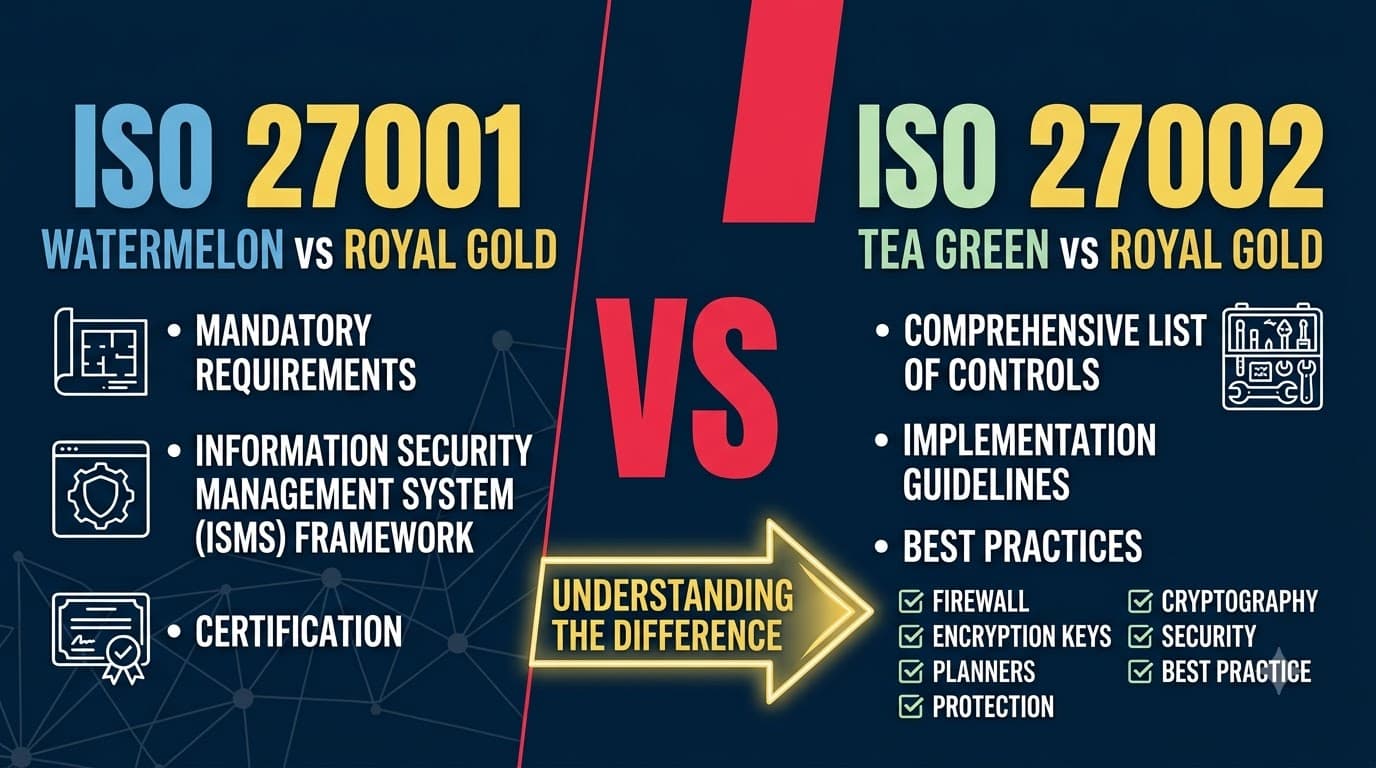
ISO 27001 is the certifiable requirements standard for your Information Security Management System (ISMS) — including a mandatory list of control objectives in Annex A — while ISO 27002 is the non-certifiable guidance standard that tells you, in practical detail, how to actually implement those same controls.
You get audited against ISO 27001. You get a certificate that says "ISO/IEC 27001:2022" on it, issued by an accredited certification body, valid for three years with annual surveillance audits. Nobody issues a certificate that says "ISO/IEC 27002:2022" because ISO 27002 was never designed to be audited against — it has no requirements clauses, no "shall" statements about a management system, and no certification scheme built around it. It's a reference book. A very good one. But a reference book, not an exam.
Here's the compressed version I give clients in the first five minutes of a scoping call:
Question | ISO 27001 | ISO 27002 |
|---|---|---|
Can you get certified against it? | Yes | No |
Does it contain management system requirements (Clauses 4–10)? | Yes | No |
Does it contain the Annex A control list (93 controls)? | Yes, in Annex A | No — it covers the same controls in the main body, without the "Annex A" label |
Does it tell you how to implement each control in practice? | Briefly — control text and purpose only | Yes — detailed implementation guidance per control |
Do auditors check conformance against it directly? | Yes | No — auditors use it as reference material to judge whether your controls are "adequate" |
Do you need to buy/read it to get certified? | Yes, mandatory | No, but strongly recommended |
That table is the skeleton of everything else in this article. Now let's build out the muscle.
Why Are There Two Separate Documents At All?
This question comes up in almost every scoping call I run, usually phrased some version of "why didn't they just publish one standard with everything in it?" It's a fair question, and the answer says a lot about how ISO standards are meant to function across wildly different organizations.
ISO/IEC JTC 1/SC 27 — the joint technical committee that owns the entire 27000 family — made a deliberate design choice going back to the standard's earliest ancestor, the British standard BS 7799, which itself was split into two parts: BS 7799-1 (a code of practice, the ancestor of today's ISO 27002) and BS 7799-2 (a specification for certification, the ancestor of today's ISO 27001). Our article on the history and evolution of ISO 27001 from BS 7799 to ISO 27001:2022 covers that lineage in full, but the short version is: the two-document structure isn't an accident of modern committee politics, it's baked into the standard's DNA from the mid-1990s onward.
The reasoning holds up well thirty years later. A requirements standard that also tried to be a detailed implementation manual would either be too generic to certify against consistently (if it stayed high-level) or too prescriptive to apply across a five-person startup and a fifty-thousand-person bank (if it went deep on implementation detail). Splitting the two jobs across two documents lets ISO 27001 stay lean, universal, and auditable, while ISO 27002 can go as deep as it needs to on implementation nuance without ever becoming part of what an auditor is required to check.
There's a second, more practical reason the split persists: revision cadence. Implementation guidance ages faster than management-system requirements. The way you implement "web filtering" or "data leakage prevention" changes as technology evolves; the requirement that your organization run a risk-based, leadership-sponsored management system with regular internal audits does not change nearly as often. Keeping the volatile, technology-specific guidance in a separate document means ISO can, in theory, refresh ISO 27002 more frequently without having to re-open the entire certification scheme every time a control's best-practice guidance needs updating.
"Clients sometimes ask me if the split is just bureaucratic bloat — two documents where one would do. I tell them to imagine a doctor's licensing exam that also tried to be the entire textbook of medicine crammed into the same booklet. You'd either dumb down the exam or make it four thousand pages long. Two documents, two jobs, is the right call." — Elena Voss, ISMS Implementation Consultant, Voss Compliance Partners
Shall vs. Should: The Language That Encodes the Whole Distinction
If you want a single linguistic tell that separates the two documents without reading a word of the surrounding context, look for the verb. ISO 27001's Clauses 4–10 are written almost entirely in "shall" language — "the organization shall establish, implement, maintain and continually improve an information security management system," "top management shall demonstrate leadership," "the organization shall conduct internal audits." In standards drafting, "shall" is mandatory, testable language. An auditor can point to a "shall" statement and ask you to prove conformance, and a missing or inadequate answer becomes a documented nonconformity on the spot.
ISO 27002, by contrast, is written almost entirely in "should" language. "Access rights should be reviewed at regular intervals," "logs should be retained for a period that reflects business and compliance requirements," "organizations should consider segregating duties." "Should" in ISO drafting convention signals a recommendation, not an obligation — it tells you what good practice generally looks like while leaving room for you to justify a different approach based on your own risk assessment.
This isn't a stylistic accident; it's the same requirements-versus-guidance split showing up at the sentence level. When a client tells me their legal or procurement team is nervous about "compliance obligations" under ISO 27002, I point them to this pattern first — there are no compliance obligations under ISO 27002, because there are essentially no "shall" statements in it to be obligated to. That single grammatical distinction, once a team internalizes it, does more to resolve day-to-day confusion about which document is binding than any amount of abstract explanation about certification schemes.
"I train new auditors to literally highlight every 'shall' in a client's ISMS documentation before a Stage 1 review. If a policy references ISO 27002 guidance using 'shall' language instead of 'should,' that's usually a sign the writer copy-pasted from the wrong source document without understanding which one carries obligation and which one carries advice." — Marcus Webb, Lead Auditor, Meridian Certification Body
What Is ISO 27001? The Certifiable Requirements Standard
ISO/IEC 27001:2022, formally titled "Information security, cybersecurity and privacy protection — Information security management systems — Requirements," is the standard your organization actually gets audited and certified against. It is published jointly by the International Organization for Standardization (ISO) and the International Electrotechnical Commission (IEC), maintained by the same joint technical committee (ISO/IEC JTC 1/SC 27) that owns the entire 27000 family.
ISO 27001 has two structural halves, and understanding both is essential to understanding why ISO 27002 exists at all.
Half one: Clauses 4 through 10. These are the mandatory management-system requirements — the "shall" statements that an external auditor checks line by line during a certification audit. If you've read our complete beginner's guide to ISO 27001, you already know these clauses cover how your organization runs its Information Security Management System (ISMS) as an ongoing governance structure, not a one-time project.
Clause | Title | What It Actually Requires |
|---|---|---|
4 | Context of the Organization | Identify internal/external issues, interested parties, and define ISMS scope |
5 | Leadership | Top management commitment, information security policy, roles and responsibilities |
6 | Planning | Risk assessment methodology, risk treatment plan, Statement of Applicability, security objectives |
7 | Support | Resources, competence, awareness, communication, documented information control |
8 | Operation | Operational planning and control, risk assessment execution, risk treatment execution |
9 | Performance Evaluation | Monitoring, measurement, internal audit program, management review |
10 | Improvement | Nonconformity handling, corrective action, continual improvement |
Half two: Annex A. This is a normative (mandatory-to-consider) list of 93 information security controls, organized into four themes, that your risk assessment and treatment process must reference. You don't have to implement every control in Annex A — that's the whole point of the risk-based approach and the Statement of Applicability — but you do have to formally justify, in writing, why you excluded any control you didn't adopt.
Annex A Theme | Control Range | Number of Controls |
|---|---|---|
A.5 Organizational controls | 5.1–5.37 | 37 |
A.6 People controls | 6.1–6.8 | 8 |
A.7 Physical controls | 7.1–7.14 | 14 |
A.8 Technological controls | 8.1–8.34 | 34 |
Total | 93 |
Here's the part that trips people up: Annex A gives you a control's title and a one- or two-sentence control statement describing what the control is. That's it. Annex A tells you that you need "threat intelligence" (control 5.7) or "data leakage prevention" (control 8.12) as candidate controls to consider — it does not tell you how to actually operationalize threat intelligence collection or configure a DLP tool. ISO 27001 was deliberately written this thin on implementation detail, because the standard needed to stay generic enough to apply to a five-person startup and a fifty-thousand-person multinational without becoming an unreadable technical manual.
That's the gap ISO 27002 exists to fill. If you want a control-by-control walkthrough of all 93 Annex A entries on their own, without the ISO 27002 layer mixed in, our companion piece Annex A: All 93 Controls Explained breaks down every control's title, theme, and one-line statement in a single reference table — useful as a standalone cheat sheet before you dive into ISO 27002's deeper guidance.
"People assume ISO 27001 is the 'meaty' document because it's the one you get certified against. It's actually the leaner of the two. Clauses 4 through 10 are maybe fifteen pages of actual requirements text. Annex A is a control list with one-line descriptions. If that's all you read, you'll pass an audit on paper and still build a security program full of gaps, because you never got the implementation detail you needed." — Elena Voss, ISMS Implementation Consultant, Voss Compliance Partners
Every organization that wants a certificate needs ISO 27001, and only ISO 27001. It is the mandatory document. If your industry, contract, or regulator requires "ISO 27001 certification" — which is the standard phrase you'll see in RFPs, vendor security questionnaires, and enterprise procurement checklists — this is the standard you are being asked to conform to. Our article on who needs ISO 27001 across industries goes deeper into exactly which sectors face this requirement most often, but in short: if you sell software or services to enterprise, financial, healthcare, or government customers, you will run into this requirement sooner rather than later.
What Is ISO 27002? The Implementation Guidance Standard
ISO/IEC 27002:2022, titled "Information security, cybersecurity and privacy protection — Information security controls," is the companion document that takes each of those same 93 controls and gives it real substance: purpose, detailed guidance on how to implement it, and — new in the 2022 revision — a set of five control attributes you can use to filter, sort, and cross-reference controls against other frameworks.
ISO 27002 is not a management system standard. It has no Clauses 4–10 equivalent. It has no requirements about leadership commitment, internal audit programs, or management review. It is, structurally, a controls encyclopedia. Each of the 93 controls gets its own entry with four consistent sections:
ISO 27002 Control Entry Structure | What It Contains |
|---|---|
Control | Restates the control text (same wording as Annex A in ISO 27001) |
Purpose | Why this control exists — what risk or objective it addresses |
Guidance | Detailed, practical implementation advice — often a full page or more per control |
Other Information | Cross-references, related standards, additional context |
Take control 8.16, "Monitoring activities," as an example. In ISO 27001's Annex A, you get a control statement roughly along the lines of: networks, systems, and applications should be monitored for anomalous behavior, and appropriate actions taken to evaluate potential information security incidents. That's the entire text you'll find in ISO 27001 itself.
In ISO 27002, the same control gets an extended guidance section covering what to monitor (outbound/inbound traffic, system access logs, configuration changes, resource utilization, and more), how long to retain logs, how to correlate events across systems, how to handle monitoring tool limitations, and how to balance monitoring against privacy obligations. That's the difference between "you need to monitor things" and "here is how a competent security team actually builds a monitoring capability."
This is why I tell every client the same thing in kickoff week: you will read ISO 27001 once, carefully, and refer back to Clauses 4–10 constantly throughout the project life of your ISMS. You will read ISO 27002 control-by-control, repeatedly, every time you sit down to actually design or evidence a specific control. They get used differently because they're built for different jobs.
Let's look at one more worked example, because seeing the gap between the two documents side by side is far more convincing than being told about it abstractly. Take control 5.15, "Access control," one of the controls almost every organization adopts.
In ISO 27001's Annex A, the entire control text reads, in substance: rules to control physical and logical access to information and other associated assets shall be established and implemented based on business and information security requirements. That's the whole entry. It tells you that access control needs to exist and why (business and security requirements), but it gives you zero detail on role-based access models, joiner-mover-leaver processes, privileged access handling, or periodic access review cadence.
In ISO 27002, the same control gets an extended guidance section that walks through: the difference between discretionary and role-based access control models and when each is appropriate; how to structure access rules around "need to know" and "need to use" principles; guidance on segregating access requests, approvals, and provisioning duties; recommendations on how frequently to review access rights (and to weight that frequency toward higher-risk systems); and how to handle emergency "break-glass" access scenarios. That's the difference between a one-paragraph requirement and an actual design brief a security engineer can build from.
This is exactly the gap that caught Bramwell Industrial off guard in the case study later in this article — they implemented "access control" in the sense that Annex A demanded, but without ISO 27002's guidance on periodic review cadence, their implementation had no evidence trail an auditor could accept as adequate.
"I tell every new client the same thing: ISO 27001 is your contract with the auditor. ISO 27002 is your contract with your own engineers. One tells you what you must prove. The other tells you how to actually build the thing you're proving." — Tom Reyes, Independent ISO 27001 Lead Implementer
Because ISO 27002 is guidance rather than requirements, you can deviate from it. If your organization has a better, more mature, or more specific way of implementing a control than what ISO 27002 describes, you're free to use it — as long as your risk assessment and Statement of Applicability show the control objective is still met. Auditors reference ISO 27002 to judge whether your implementation is "reasonable" and "adequate" for your risk context, but they are not checking your evidence against ISO 27002 line by line the way they check your management system against Clauses 4–10.
The Annex A ↔ ISO 27002 Relationship, Explained Properly
This is the part most explainer articles get muddy, so let's be precise about it.
ISO 27001's Annex A and ISO 27002's main body describe the exact same 93 controls, organized under the exact same four themes and the exact same numbering scheme. This wasn't always true — under the 2013 versions of both standards, Annex A had 114 controls across 14 categories, and the two documents had grown somewhat out of sync over the years. The 2022 revision of both standards was a coordinated, simultaneous rewrite specifically designed to fix that: ISO 27002:2022 was published first (February 2022), consolidating and restructuring the controls into the new four-theme, 93-control model, and ISO 27001:2022 followed later that same year (October 2022) with Annex A updated to match ISO 27002's new structure exactly, control-for-control. If you want the full history of how we got here, our article on the history and evolution of ISO 27001 from BS 7799 to ISO 27001:2022 covers the earlier revisions in detail, and our piece on what changed between ISO 27001:2013 and ISO 27001:2022 walks through the control consolidation specifically.
So today, control 8.23 ("Web filtering") in ISO 27001 Annex A and control 8.23 ("Web filtering") in ISO 27002 are the same control, with the same number, the same title, and the same one-sentence control statement. The only difference is depth: Annex A gives you the control statement and stops there; ISO 27002 gives you the control statement plus purpose, plus a full guidance section, plus the five control attributes described below.
Here's a small sample of that relationship in table form, so you can see exactly how the same control looks in each document:
Control # | Control Name | What ISO 27001 Annex A Gives You | What ISO 27002 Adds |
|---|---|---|---|
5.7 | Threat intelligence | One-line control statement: collect and analyze information relating to threats | Guidance on strategic/operational/tactical intelligence, sourcing, internal correlation |
5.23 | Information security for use of cloud services | Control statement on establishing processes for cloud service acquisition, use, and exit | Guidance on cloud provider due diligence, shared responsibility, exit planning detail |
6.3 | Information security awareness, education, and training | Control statement requiring ongoing training program | Guidance on training cadence, role-based content, phishing simulation, effectiveness measurement |
7.4 | Physical security monitoring | Control statement on monitoring premises for unauthorized access | Guidance on CCTV placement, alarm integration, monitoring staff responsibilities |
8.12 | Data leakage prevention | Control statement requiring DLP measures across systems | Guidance on DLP tooling categories, classification integration, exception handling |
Notice the pattern: same control, same number, same one-line summary — but ISO 27002 gives you two or three paragraphs of "here's how" for every one of those entries.
The Five Control Attributes (New in the 2022 Revision)
One genuinely new thing ISO 27002:2022 introduced — and it did not exist in the 2013 edition of either standard — is a formal attribute-tagging system for every control. Each of the 93 controls is tagged with values across five attribute categories, which lets you filter and view the control set through different lenses depending on what you're trying to communicate or analyze.
Attribute | Purpose | Example Values |
|---|---|---|
Control type | When/how the control acts on risk | Preventive, Detective, Corrective |
Information security properties | Which CIA triad element(s) it protects | Confidentiality, Integrity, Availability |
Cybersecurity concepts | Alignment to the NIST Cybersecurity Framework functions | Identify, Protect, Detect, Respond, Recover |
Operational capabilities | The practitioner-facing security domain | Governance, Asset management, Identity and access management, Threat and vulnerability management, and others |
Security domains | High-level strategic groupings | Governance and ecosystem, Protection, Defence, Resilience |
These attributes live only in ISO 27002, not in ISO 27001's Annex A. Their practical value is significant: a CISO can pull every control tagged "Detect" under cybersecurity concepts to build a NIST CSF crosswalk, or every control tagged "Corrective" to brief the board on incident-response maturity, without having to manually classify all 93 controls themselves. This is one of the clearest, most concrete reasons ISO 27002 earns its keep as a working document rather than a nice-to-have — nobody would hand-build this classification scheme from scratch for an internal project when ISO 27002 ships with it already done. We go deeper on how to actually use all five attribute categories in practice — including a worked example of building a NIST CSF crosswalk from scratch — in Understanding the Five ISO 27002 Control Attributes, a companion deep-dive worth bookmarking once you're past the basic distinction covered here.
Visualizing the Relationship
Here's how the two standards, and the ISMS they jointly support, actually fit together structurally:
flowchart TB
    A["ISO/IEC 27001:2022\n(Certifiable Requirements Standard)"] --> B["Clauses 4-10\nISMS Management Requirements"]
    A --> C["Annex A\n93 Controls, 4 Themes\n(Control statements only)"]
    C --> D["A.5 Organizational\n37 controls"]
    C --> E["A.6 People\n8 controls"]
    C --> F["A.7 Physical\n14 controls"]
    C --> G["A.8 Technological\n34 controls"]
    H["ISO/IEC 27002:2022\n(Non-Certifiable Guidance Standard)"] --> I["Same 93 Controls\nOrganized identically"]
    I --> D
    I --> E
    I --> F
    I --> G
    H --> J["Implementation Guidance\nper control"]
    H --> K["5 Control Attributes\nType, CIA, Cyber concepts,\nOp. capabilities, Domains"]
    C -. "Statement of Applicability\nselects & justifies controls" .-> L["Your Actual ISMS\nOperating Controls"]
    J -. "Used to design HOW\neach control is built" .-> L
    K -. "Used to filter/report\ncontrols by lens" .-> L
The auditor's pen only ever touches the left side of that diagram — Clauses 4–10 and your Statement of Applicability's justification of Annex A controls. The right side, ISO 27002, is the workbench your team uses to actually build what the left side requires.
I use this diagram literally on a whiteboard in almost every kickoff workshop I run, because it collapses an hour of verbal explanation into thirty seconds of pointing. The moment a new project team can trace their finger from Annex A's control list, down through the four themes, across to ISO 27002's guidance and attributes, and back into "our actual ISMS" at the bottom, the confusion that cost Veltrix six weeks simply stops being possible. It's not a complicated relationship once you can see it drawn out — it's only confusing when it's described purely in prose, one abstract sentence at a time, which is exactly the format most of the vendor marketing and search-result snippets people encounter get it from.
Side-by-Side Comparison: Every Angle That Matters
Let's put everything into one comprehensive reference table, because this is the section people bookmark and come back to.
Dimension | ISO 27001:2022 | ISO 27002:2022 |
|---|---|---|
Full title | Information security management systems — Requirements | Information security controls |
Document type | Requirements standard (normative) | Guidance/code of practice (informative) |
Certifiable? | Yes | No |
Contains Clauses 4–10? | Yes | No |
Contains Annex A control list? | Yes (as Annex A, control statements only) | Covers same controls in main body with full detail |
Number of controls covered | 93 (via Annex A) | 93 (identical set) |
Control themes | 4 (Organizational, People, Physical, Technological) | Same 4 themes |
Includes control attributes? | No | Yes — 5 attribute categories per control |
Audience | Top management, ISMS owners, auditors | Security engineers, control implementers, risk owners |
Used by external auditors as... | The audit criteria itself | Reference material to judge control adequacy |
Typical reading pattern | Read once thoroughly, refer back occasionally | Consulted repeatedly, control-by-control, throughout implementation |
Requires a Statement of Applicability? | Yes, mandatory | No such requirement |
Publication relationship | Published October 2022, Annex A aligned to 27002 | Published February 2022, released first |
Who "owns" the document in a project | ISMS Manager / Compliance Lead | Control Owners / Security Engineers |
Typical purchase decision | Mandatory — every certification project needs it | Strongly recommended but not contractually required |
Analogous document in other frameworks | SOC 2's Trust Services Criteria | SOC 2's suggested criteria mapping / NIST 800-53 control catalog |
That last row matters if you're mentally cross-referencing frameworks, which most security leaders eventually do. If you've worked with SOC 2, you can think of ISO 27001's Clauses 4–10 and Annex A as roughly analogous to the Trust Services Criteria — the thing you're actually audited against — while ISO 27002 plays a role similar to a detailed controls-implementation reference the way NIST 800-53 or the NIST Cybersecurity Framework subcategories function relative to a certification scheme. The comparison isn't perfect — ISO's structure is genuinely unique — but it helps orient people coming from other compliance backgrounds.
Where the Two Standards Sit in the Broader ISO 27000 Family
ISO 27001 and ISO 27002 don't exist in isolation — they're the two most commercially important members of a much larger family of standards maintained by the same committee, and understanding where they sit relative to their siblings helps prevent a second, less common but still real, layer of confusion: mixing up ISO 27001/27002 with adjacent standards that sound similar but serve narrower purposes.
Standard | Full Focus | Certifiable? | Relationship to ISO 27001/27002 |
|---|---|---|---|
ISO/IEC 27000 | Overview and vocabulary for the entire 27000 family | No | Defines shared terms (like "asset," "risk," "control") used consistently across 27001 and 27002; free to download from ISO |
ISO/IEC 27001 | ISMS requirements | Yes | The certifiable standard this article centers on |
ISO/IEC 27002 | Implementation guidance for Annex A controls | No | The companion guidance standard this article centers on |
ISO/IEC 27005 | Information security risk management guidance | No | Expands on how to actually perform the risk assessment ISO 27001 Clause 6.1 requires |
ISO/IEC 27017 | Cloud services security controls | Primarily guidance; some certification bodies offer it only as an add-on to an existing ISO 27001 certificate | Extension guidance for cloud-specific implementation of relevant Annex A controls |
ISO/IEC 27018 | Protection of personally identifiable information (PII) in public clouds | Primarily guidance; some certification bodies offer it only as an add-on to an existing ISO 27001 certificate | Sector-specific guidance layered on top of the same control set for cloud PII handling |
ISO/IEC 27701 | Privacy information management system (PIMS) extension | Yes, but only as an extension to an existing ISO 27001 certificate | Adds privacy-specific requirements on top of an existing ISMS, rather than replacing it |
The pattern holds across the whole family, not just the 27001/27002 pair: certifiable requirements standards stay lean, and non-certifiable guidance standards carry the implementation depth. ISO 27005 does for risk management what ISO 27002 does for controls — it's the "how" document behind Clause 6.1's "what." ISO 27701 is the one interesting exception worth flagging, because it is certifiable, but only as a bolt-on extension to an organization that already holds ISO 27001 certification — you can't get a standalone ISO 27701 certificate without an underlying ISMS to attach it to.
I mention this family context mainly to head off a conversation I still have a few times a year, usually with a client who's been told by a well-meaning vendor that they need "ISO 27017 certification" for a cloud product, full stop, with no mention of ISO 27001 at all. In practice, ISO 27017 (like ISO 27018 and ISO 27701) is layered on top of an existing ISO 27001 ISMS rather than standing alone the way a completely independent certification scheme would — you can't walk into a Stage 1 audit for ISO 27017 alone the way you can for ISO 27001. The core requirements-versus-guidance pattern from the rest of this article — one certifiable anchor standard, surrounded by guidance and extension documents that deepen or extend it — repeats itself across the entire 27000 family, not just the 27001/27002 pair.
How They Work Together in a Real Project
Theory is nice. Here's what actually happens on the ground, phase by phase, in a real ISO 27001 certification project — and where each standard earns its place.
Project Phase | Primary Standard in Use | What You're Doing With It |
|---|---|---|
Scoping & gap analysis | ISO 27001 (Clauses 4–10) | Defining ISMS boundaries, identifying which requirements you already meet |
Risk assessment methodology | ISO 27001 (Clause 6) | Building your risk assessment and treatment methodology |
Control selection | ISO 27001 (Annex A) | Deciding which of the 93 controls apply to your risk profile |
Control design & build | ISO 27002 | Pulling detailed guidance to actually design each selected control |
Policy and procedure writing | Both | ISO 27001 tells you documentation is required; ISO 27002 tells you what good policy content covers |
Statement of Applicability drafting | ISO 27001 (Annex A) + ISO 27002 (justification detail) | Formally documenting inclusion/exclusion decisions for all 93 controls |
Internal audit | ISO 27001 (Clause 9) | Testing conformance to management system requirements and control operation |
Management review | ISO 27001 (Clause 9) | Top management evaluates ISMS performance |
Stage 1 audit (documentation review) | ISO 27001 | Auditor checks your documented ISMS against Clauses 4–10 and Annex A coverage |
Stage 2 audit (implementation review) | ISO 27001, informed by ISO 27002 | Auditor tests control operation; ISO 27002 informs their judgment of "adequate" implementation |
Surveillance audits (years 1 & 2) | ISO 27001 | Ongoing conformance checks against the same criteria |
Recertification (year 3) | ISO 27001 | Full re-audit against current version of the standard |
Notice something important in that table: ISO 27002 never appears as the standard being audited against, in any phase, at any point. It shows up as an input to your work — something your team consults — but never as the audit criteria itself. That's the practical, day-to-day version of the one-sentence difference from earlier in this article. If you want the full phase-by-phase breakdown of everything between Stage 1 booking and certificate issuance, our companion piece The ISO 27001 Certification Process Explained walks through each milestone in more detail than the table above has room for, and ISO 27001 Internal Audits: How to Prepare and Pass goes deep specifically on the Clause 9.2 internal audit step most first-time project teams underestimate.
A Realistic Timeline and Cost View
Clients almost always ask me two follow-up questions once they understand the conceptual difference: "how long does this take" and "what does it cost, given I apparently need both documents." Here's an honest, illustrative range based on the mid-sized projects (100–300 employees, single-scope ISMS) I see most often.
Line Item | Typical Range | Notes |
|---|---|---|
ISO 27001:2022 standard purchase | $130–$160 per license | Mandatory; purchased from ISO or a licensed national body |
ISO 27002:2022 standard purchase | $150–$180 per license | Strongly recommended; not contractually mandatory |
Gap analysis (consultant-led) | $6,000–$18,000 | Scales with organizational complexity |
Control implementation (internal labor + tooling) | $30,000–$150,000 | Widest variance; depends on how many gaps exist and control automation choices |
Internal audit (external or contracted) | $4,000–$10,000 | Per audit cycle |
Certification body audit fees (Stage 1 + Stage 2) | $12,000–$35,000 | Scales with employee count and scope complexity |
Annual surveillance audits (years 1–2) | $6,000–$15,000 per year | Smaller than initial certification audit |
Total time to first certification | 4–9 months | Organizations that correctly scope against ISO 27001 from day one land at the faster end |
The number that jumps out in that table isn't the standards themselves — $130 to $180 per license is a rounding error in any real project budget. It's the time cost of getting the scoping wrong, which is exactly what happened to Veltrix Payments. Six weeks of a nine-month project is over 15% of your total runway, spent building the wrong artifact.
Where to Actually Buy Official Copies
I get asked this constantly, usually right after a client has finally internalized that they need both documents: where do you actually purchase legitimate, current copies of ISO 27001:2022 and ISO 27002:2022, and how do you avoid outdated or unofficial versions circulating online?
Source | What You Get | Notes |
|---|---|---|
ISO's official online store (iso.org) | PDF or print copy, current edition, official language versions | Most direct source; single-user PDF license is the default |
Your national standards body (e.g., ANSI in the US, BSI in the UK, SCC in Canada) | Same standard, often bundled with national adoption notes | Sometimes slightly cheaper than ISO's own store; check for corporate/enterprise licensing options |
Accredited training providers (as part of Lead Implementer/Lead Auditor courses) | Standard copy bundled with training materials | Useful if you're also sending staff through formal certification training |
Your certification body | Sometimes provides reference copies for active audit clients | Not a substitute for your own licensed copy — always confirm licensing terms |
A word of caution: free "ISO 27001 PDF download" links circulating outside these official channels are almost always outdated (frequently the 2013 edition, sometimes even older drafts), and using an outdated version to scope your project is its own category of expensive mistake — one I've seen cost clients weeks of rework when their control set didn't match the version their certification body was actually auditing against. Buy the current 2022 edition of both documents directly from an official channel, every time.
"The standards documents cost less than a team dinner. The mistake people make isn't a budget mistake, it's a sequencing mistake — they read ISO 27002 first because it's the meatier, more satisfying document to read, and they build their whole mental model of the project around it before they've internalized that ISO 27001 is the actual scope of what they'll be judged on." — David Okonkwo, CISO, Bramwell Industrial
Documents You'll Actually Produce, Mapped to Source Standard
Document | Required By | Content Drawn Primarily From |
|---|---|---|
ISMS Scope Statement | ISO 27001 Clause 4.3 | ISO 27001 |
Information Security Policy | ISO 27001 Clause 5.2 | ISO 27001 structure, ISO 27002 content depth |
Risk Assessment & Treatment Methodology | ISO 27001 Clause 6.1 | ISO 27001 |
Risk Register | ISO 27001 Clause 6.1.2 | ISO 27001 process, informed by ISO 27002 control detail |
Statement of Applicability (SoA) | ISO 27001 Clause 6.1.3 | ISO 27001 Annex A control list, ISO 27002 justification detail |
Control-specific procedures (e.g., access control procedure, incident response plan) | ISO 27001 Annex A (existence), varies by control | ISO 27002 (implementation detail) |
Internal Audit Program & Reports | ISO 27001 Clause 9.2 | ISO 27001 |
Management Review Minutes | ISO 27001 Clause 9.3 | ISO 27001 |
Corrective Action Log | ISO 27001 Clause 10 | ISO 27001 |
If you're building these documents from scratch, don't reinvent the wheel — a working Statement of Applicability (SoA) template and an ISO 27001 risk register template will save you the several days most teams spend just getting the document structure right before they've written a word of actual content. For a walkthrough of how to actually populate the SoA column by column — inclusion rationale, exclusion justification, control owner, implementation status — our piece How to Build a Statement of Applicability (SoA) covers the process most teams find hardest to get right on the first attempt.
The Auditor's Perspective: What Actually Gets Checked
I asked Marcus Webb — the lead auditor from the Veltrix story — what he actually does with his personal knowledge of ISO 27002 during a Stage 2 audit, since it's never the document he's formally checking conformance against. His answer is the clearest explanation of the auditor-side relationship between the two standards I've heard in fifteen years of sitting through readiness calls.
"During Stage 2, I'm testing whether your ISMS conforms to Clauses 4 through 10 and whether the controls in your Statement of Applicability are actually operating the way you say they are. ISO 27002 isn't on my checklist as a document. But it's absolutely in my head. When I look at your vulnerability management evidence, I'm unconsciously comparing it to what good practice looks like — and my mental model of 'good practice' for these 93 controls comes directly from ISO 27002's guidance, refined by a few hundred audits' worth of pattern-matching. So indirectly, yes, you're being judged against it, just not in the mechanical, box-ticking way people assume." — Marcus Webb, Lead Auditor, Meridian Certification Body
That distinction — audited against ISO 27001, judged with an auditor's ISO 27002-informed professional judgment — is worth internalizing because it explains why two organizations can both technically "have" the same 93 controls in their Statement of Applicability and get very different audit outcomes. Here's a simplified version of the kind of question set an experienced auditor runs through control by control:
Audit Question | What It's Really Testing |
|---|---|
"Show me the control is documented." | ISO 27001 Clause 7.5 (documented information requirement) |
"Show me the control is operating, not just written down." | ISO 27001 Clause 8 (operational planning and control) |
"Walk me through how this control was designed — why this approach?" | Implicit ISO 27002 benchmark — does the design reflect recognized good practice? |
"Show me evidence this control has been reviewed/tested recently." | ISO 27001 Clause 9 (monitoring, internal audit) |
"What happens when this control fails or is bypassed?" | ISO 27001 Clause 10 (nonconformity and corrective action), informed by ISO 27002's guidance on control limitations |
Every one of those five questions gets asked about nearly every control in your Statement of Applicability, sometimes dozens of times across a multi-day Stage 2 audit. Teams that built their controls with ISO 27002's guidance open on a second monitor — like Sana Malik's team at Halcyon Health Analytics — tend to sail through the third question especially, because they can articulate a design rationale that maps directly to recognized practice rather than improvising an answer on the spot.
Common Misconceptions I Still Hear in 2026
Even fifteen years and a full standard revision later, the same handful of misunderstandings keep surfacing. I've collected the most persistent ones here, because naming them precisely is the fastest way to stop repeating them.
Misconception | Reality |
|---|---|
"We need to get ISO 27002 certified." | There is no ISO 27002 certification. Only ISO 27001 is certifiable. |
"ISO 27002 is the 'old' or 'lite' version of ISO 27001." | They're not versions of each other at all — one is requirements, the other is guidance, published as companion documents by the same committee. |
"If we follow ISO 27002 closely, we're basically ISO 27001 compliant." | Following ISO 27002's control guidance addresses only the Annex A half of ISO 27001. You still need to satisfy Clauses 4–10 — leadership commitment, risk methodology, internal audit, management review — none of which ISO 27002 covers at all. |
"Auditors check our evidence against ISO 27002 word for word." | Auditors use ISO 27002 as a professional reference to judge whether your control implementation is reasonable for your risk context — it's a benchmark for judgment, not a checklist they tick line by line. |
"We only need to buy one of the two standards." | You're only contractually required to have ISO 27001. But most experienced implementers buy both, because building controls from Annex A's one-line descriptions alone is like assembling furniture from a parts list with no instruction booklet. |
"ISO 27002 has requirements we have to comply with." | ISO 27002 uses recommending language ("should"), not requirement language ("shall"). It has no compliance obligations of its own. |
"Since ISO 27002 isn't certifiable, it's optional and low-value." | It's optional in the sense that no auditor demands your copy of it — but skipping it means your team designs 93 controls from one-line summaries with no implementation reference, which is exactly the kind of gap that produces Stage 2 audit nonconformities. |
"ISO 27002 is only useful during initial implementation, not afterward." | It's just as valuable during surveillance audits and recertification — control guidance evolves, threats evolve, and re-reading the relevant ISO 27002 sections before each surveillance cycle is a habit worth building into your ISMS calendar. |
"You need to formally cite ISO 27002 in your Statement of Applicability for it to 'count.'" | There's no requirement to cite ISO 27002 anywhere in your ISO 27001 documentation. Auditors don't check for citations — they check whether the control demonstrably works, however you got there. |
That last row deserves its own moment, because it's the mirror image of the mistake Veltrix made. Priya's team over-indexed on ISO 27002 as the certification target. A different, equally common failure mode is treating ISO 27002 as skippable dead weight because "it's not the one that matters for certification" — which is technically true and practically dangerous, as our next case study shows.
Who Needs Which Standard
Role / Situation | Needs ISO 27001 | Needs ISO 27002 |
|---|---|---|
Organization pursuing certification | Yes — mandatory | Strongly recommended |
ISMS Manager / Compliance Lead | Yes — primary reference | Yes — for control-level detail |
Security engineers building specific controls | Reference only | Yes — primary working document |
External certification auditor | Yes — audit criteria | Reference for judgment calls |
Internal auditor | Yes — audit criteria | Yes — to assess control adequacy |
Sales / customer success answering RFPs | Yes — to cite certification scope | Rarely needed directly |
Procurement teams vetting vendors | Yes — to verify certificate validity/scope | Rarely needed directly |
Board / executive sponsors | Summary level only | Not needed |
Consultants scoping a new ISMS project | Yes | Yes |
Organizations only wanting a security framework without certification | Optional | Yes — many organizations adopt ISO 27002's control catalog informally, without ever certifying against ISO 27001 |
That last row is worth sitting with. Not every organization that touches these standards is chasing a certificate. Some mid-market companies deliberately adopt ISO 27002's control catalog as an internal best-practice framework — essentially borrowing the "recipe book" without ever sitting the "exam" — because it gives them a structured, internationally recognized control set without the cost and audit overhead of formal ISO 27001 certification. That's a legitimate strategy for organizations not facing an external certification requirement, but it's worth being explicit with your stakeholders about which path you're on, since "we follow ISO 27002" and "we're ISO 27001 certified" mean very different things to a customer reading your security page.
A Maturity Path: How Most Organizations Actually Progress
In practice, I see organizations move through these standards along a fairly predictable maturity curve rather than adopting both at full strength on day one. Recognizing where you sit on this curve helps you decide how much of each document you actually need right now versus six months from now.
Maturity Stage | Typical Organization Profile | ISO 27001 Usage | ISO 27002 Usage |
|---|---|---|---|
Stage 1: Informal security practices | Early-stage startup, no customer certification demands yet | Not yet in use | Sometimes referenced informally for "best practice" ideas |
Stage 2: Framework-curious | Growing company, first enterprise deals surfacing security questionnaires | Being read/scoped for the first time | Adopted informally as a control catalog, no formal audit planned |
Stage 3: Certification-committed | Contractual or regulatory pressure forces a formal certification timeline | Full Clause 4–10 and Annex A implementation underway | Used control-by-control as the implementation reference |
Stage 4: Certified and maturing | Certificate achieved, now in surveillance-audit cycle | Ongoing conformance, annual surveillance | Re-consulted whenever controls are redesigned or new risks emerge |
Stage 5: Multi-framework operator | Certified organization also managing SOC 2, HIPAA, or other overlapping obligations | ISO 27001 as the anchor framework | ISO 27002's control attributes used to cross-map controls across frameworks, reducing duplicate evidence collection |
Most of the confusion documented in this article happens at the Stage 2-to-3 transition — exactly where Veltrix Payments was sitting when Priya's team built their project plan around the wrong document. If you recognize your organization in Stage 2 right now, that's the moment to get the ISO 27001/27002 distinction locked in, before a project plan gets built on the wrong foundation.
Case Studies
Case Study 1: Veltrix Payments — Recovering From a Six-Week Scoping Error
We already met Veltrix and Priya Nandakumar in the cold open, but the recovery is worth detailing because it shows exactly how a team course-corrects once the ISO 27001/27002 distinction clicks into place.
After the readiness call with Marcus Webb, Priya's team spent one week re-scoping the project entirely around ISO 27001's Clauses 4–10 and Annex A, formally building out a Statement of Applicability that covered all 93 controls with documented inclusion/exclusion rationale. Crucially, they didn't throw away the ISO 27002 guidance material the junior analyst had originally pulled together — they re-purposed it as the implementation reference for the Annex A controls they'd now formally adopted, which meant the six wasted weeks weren't a total loss, just misapplied labor.
Metric | Before Correction | After Correction |
|---|---|---|
Project target | "ISO 27002 certification" (non-existent) | ISO 27001:2022 certification (correct target) |
Weeks lost to rework | 6 weeks | — |
Direct cost of rework | ~$18,000 (analyst time, vendor training package) | Absorbed; ISO 27002 material repurposed as implementation guidance |
Time to Stage 2 audit from re-scope | — | 4.5 months |
Total project timeline | Originally projected 6 months from a false start | 5.5 months from correction to certificate issuance |
Contract outcome | $2.4M contract at risk of deadline breach | Certificate issued 2 weeks before contractual deadline; contract closed |
Priya's own reflection, a few weeks after certification:
"The most expensive sentence in our entire project was 'let's build our controls around ISO 27002.' It sounds so reasonable when you say it out loud, because ISO 27002 genuinely is the more detailed, more useful-feeling document. Nobody on my team was being lazy or careless — we just didn't know there were two standards doing two different jobs until an outside auditor told us on a call. I tell every new hire on my team now, in their first week: ISO 27001 is what we're judged on, ISO 27002 is how we build the thing we're judged on. Never confuse the two again." — Priya Nandakumar, Head of Information Security, Veltrix Payments
Case Study 2: Bramwell Industrial — The Opposite Mistake
Bramwell Industrial, a mid-sized industrial equipment manufacturer (roughly 400 employees, previously mentioned CISO David Okonkwo), made the mirror-image error to Veltrix's. Bramwell's team knew perfectly well that ISO 27001 was the certifiable standard and scoped their project correctly around Clauses 4–10 and Annex A from day one. Their mistake was treating ISO 27002 as optional overhead — "we know what the 93 controls are, we don't need a guidance document to tell us how to do access control or patch management" — and building their control implementations from internal engineering judgment alone, without ever consulting ISO 27002's detailed guidance.
The result surfaced at Stage 2 audit: seven nonconformities, several of them tied directly to controls that were technically "in place" but implemented in a way that didn't demonstrate the depth of coverage ISO 27002's guidance would have flagged as necessary — for example, a vulnerability management process (control 8.8) that patched critical systems but had no documented process for tracking remediation timelines or verifying fix effectiveness, and an access control implementation (control 5.15) that lacked periodic access review evidence.
Metric | Initial Stage 2 Audit | After Remediation |
|---|---|---|
Nonconformities raised | 7 (2 major, 5 minor) | 0 — full closure verified at re-audit |
Root cause | Controls built from internal judgment only, no ISO 27002 guidance consulted | Controls redesigned using ISO 27002 implementation detail for each flagged area |
Remediation timeline | — | 10 weeks |
Additional consulting cost for remediation | — | ~$22,000 |
Re-audit outcome | — | Certification granted |
Estimated cost if ISO 27002 guidance had been used from the start | — | ~$95,000 in avoided rework, consulting fees, and delayed certificate issuance (roughly 2.5 months faster) |
David Okonkwo's reflection after the fact:
"We were so confident we understood the distinction — 'ISO 27001 is the exam, ISO 27002 is optional reading' — that we skipped the optional reading entirely. That was our mistake, not a misunderstanding of which standard mattered, but underestimating how much implementation detail we needed to actually pass. Knowing ISO 27002 isn't mandatory and treating it as worthless are two very different conclusions, and we'd accidentally landed on the second one." — David Okonkwo, CISO, Bramwell Industrial
Case Study 3: Halcyon Health Analytics — Getting Both Right From Day One
Halcyon Health Analytics, a healthcare data analytics SaaS company (roughly 85 employees, subject to both HIPAA obligations for its US healthcare clients and increasing enterprise demand for ISO 27001), is the case study I point to when clients ask "what does doing this correctly actually look like end to end." Security engineer Sana Malik led the control implementation workstream, working directly from both standards in parallel from week one: ISO 27001's Clauses 4–10 and Annex A defined the project's scope and formal requirements, while ISO 27002 served as the day-to-day design reference for every control the risk assessment selected.
Metric | Halcyon Result |
|---|---|
Time from kickoff to Stage 2 certificate | 4.5 months |
Nonconformities at Stage 2 audit | 1 minor (closed within 15 days) |
Controls selected from Annex A's 93 | 81 (12 formally excluded and justified in the SoA, primarily physical controls not relevant to a fully remote workforce) |
New enterprise contracts won within 6 months of certification | 3, worth a combined $1.1M in new ARR |
Consulting spend on rework/remediation | $0 — no material rework required |
"I built our access control implementation, our vulnerability management process, and our incident response plan literally with ISO 27002 open in a second monitor the entire time. Annex A told us the 81 controls we needed to cover. ISO 27002 told me what 'covering' each one actually looked like in practice — what evidence a mature program has, what a lazy implementation looks like versus a defensible one. We passed Stage 2 with a single minor nonconformity, and it wasn't even in an area ISO 27002 covers — it was a documentation formatting issue on our management review minutes." — Sana Malik, Security Engineer, Halcyon Health Analytics
The comparison across all three case studies is the cleanest illustration of everything this article has been building toward:
Case Study | Approach Taken | Outcome |
|---|---|---|
Veltrix Payments | Mistakenly scoped project around ISO 27002 as if it were certifiable | 6 weeks lost, ~$18,000 rework, recovered to certify 2 weeks before deadline |
Bramwell Industrial | Correctly scoped around ISO 27001, but skipped ISO 27002 guidance entirely | 7 nonconformities at Stage 2, ~$22,000 and 10 weeks to remediate |
Halcyon Health Analytics | Used ISO 27001 for scope/requirements and ISO 27002 for implementation guidance, in parallel, from day one | 4.5-month certification timeline, 1 minor nonconformity, $1.1M in new business |
Lessons Learned Across All Three Case Studies
Stepping back from Veltrix, Bramwell, and Halcyon individually, the pattern across all three is consistent enough that I now use it as a diagnostic during every new client's kickoff call. There are really only three ways a project can play out on this specific dimension, and only one of them is actually good.
Pattern | What Happens | Typical Cost of Getting It Wrong | Typical Fix |
|---|---|---|---|
Scope confusion (Veltrix pattern) | Team mistakenly treats ISO 27002 as the certification target itself | 4–8 weeks of rework, $10,000–$25,000 in wasted labor and materials | Re-scope the project immediately around ISO 27001's Clauses 4–10 and Annex A; repurpose existing ISO 27002 material as implementation guidance rather than discarding it |
Guidance neglect (Bramwell pattern) | Team correctly scopes against ISO 27001 but skips ISO 27002's implementation guidance entirely | 5–10 Stage 2 nonconformities, $15,000–$40,000 in remediation and re-audit costs, 6–12 weeks of delay | Redesign flagged controls using ISO 27002's guidance section by section, prioritizing controls tied to major nonconformities first |
Correct dual use (Halcyon pattern) | Team uses ISO 27001 for scope/requirements and ISO 27002 for implementation detail in parallel from day one | Near-zero — occasional single minor nonconformities unrelated to the core distinction | Maintain the practice through surveillance audits; re-consult ISO 27002 whenever a control is redesigned or a new risk emerges |
I ask every new client, in the very first working session, which of these three patterns their current project plan most resembles. It's a blunt question, but it's saved more projects from a Veltrix-style detour than any other single thing I do in a kickoff meeting. If your team can't confidently say "we know exactly which document we get audited against, and we know exactly which document we're using to design each control," you're not yet ready to start building — you're one clarifying conversation away from it, and that conversation is worth having before any implementation labor is spent.
Quick-Reference Card: The Distinction in Ten Lines
Before we close, here's the condensed version I actually pin above my desk and hand to every new analyst on my team in their first week, because it's the fastest way to internalize everything above without re-reading the whole article:
ISO 27001 is the certifiable standard. ISO 27002 is not certifiable.
ISO 27001 contains Clauses 4–10 (management system requirements). ISO 27002 does not.
ISO 27001's Annex A lists 93 controls with one-line statements. ISO 27002 covers the identical 93 controls with full implementation guidance.
Both documents share the same four themes: Organizational (37), People (8), Physical (14), Technological (34).
Only ISO 27002 carries the five control attributes (type, CIA properties, cybersecurity concepts, operational capabilities, security domains).
Your Statement of Applicability is built from Annex A, justified with help from ISO 27002.
Auditors check conformance against ISO 27001. They use ISO 27002 as professional judgment, not as a formal checklist.
Buy both. ISO 27001 is mandatory for certification; ISO 27002 is optional but strongly recommended for anyone actually building controls.
"ISO 27002 certification" does not exist as an accredited scheme — treat any vendor claiming otherwise as a red flag.
When in doubt: ISO 27001 tells you what and whether. ISO 27002 tells you how.
Strategic Close: Treat This Distinction as Leverage, Not Trivia
Here's the reframe I leave every client with, because it's the one that actually changes behavior: the ISO 27001/27002 distinction isn't a piece of compliance trivia you memorize to sound credible in an audit — it's a project-management lever. Every week your team spends confused about which standard governs which decision is a week you're not spending building a security program that wins contracts, survives due diligence, and holds up under real audit scrutiny. Priya's $2.4 million contract, Bramwell's $95,000 in avoidable rework, and Halcyon's $1.1M in new business booked within six months of certification aren't abstractions — they're what's actually at stake when a team either does or doesn't understand this one distinction clearly enough to build a project plan around it correctly the first time.
Get the target right — ISO 27001, and only ISO 27001, is what you're certified against. Get the method right — ISO 27002's guidance and control attributes are what actually let your team build defensible, auditor-proof controls instead of guessing from one-line Annex A summaries. Do both, and certification stops being a scary unknown and starts being a predictable, schedulable business outcome, the way it was for Halcyon Health Analytics.
If you're scoping a project right now and want to skip the six-week detour Veltrix had to recover from, start with our Certification Readiness Checklist to confirm you're building against the right target from day one, and pull our Annex A — All 93 Controls at a Glance reference alongside our Clauses 4–10 Cheat Sheet so your team has both halves of ISO 27001 mapped out before your first working session. If you're comparing frameworks for a broader strategic decision, our ISO 27001 vs SOC 2 vs NIST CSF Comparison Guide is worth the read before you commit budget. And if terminology like "normative," "Statement of Applicability," or "control attribute" is still fuzzy, bookmark our ISO 27001 Glossary of Terms — it's the fastest way to get your whole team speaking the same language before the first auditor call.
PentesterWorld works with organizations at every stage of this journey — from the first gap analysis conversation through Stage 2 audit and beyond into ongoing surveillance-audit support. If you want a second set of eyes on whether your project is scoped against the right standard, whether your Statement of Applicability will survive real audit scrutiny, or whether your control implementations have the depth ISO 27002 recommends rather than just the one-line coverage Annex A requires, reach out to our team for a readiness consultation before you spend six weeks — or six figures — finding out the hard way.
Compliance done right isn't a cost center you tolerate to keep procurement happy — it's a business development lever. Priya's certificate unlocked a $2.4M contract. Halcyon's unlocked $1.1M in new ARR within six months. The organizations that treat the ISO 27001/27002 distinction as a minor technicality tend to be the same organizations still explaining six-month delays to their board a year later. The organizations that get it right the first time are the ones already onboarding the next enterprise customer while their competitors are still arguing about which standard they're supposed to be reading.