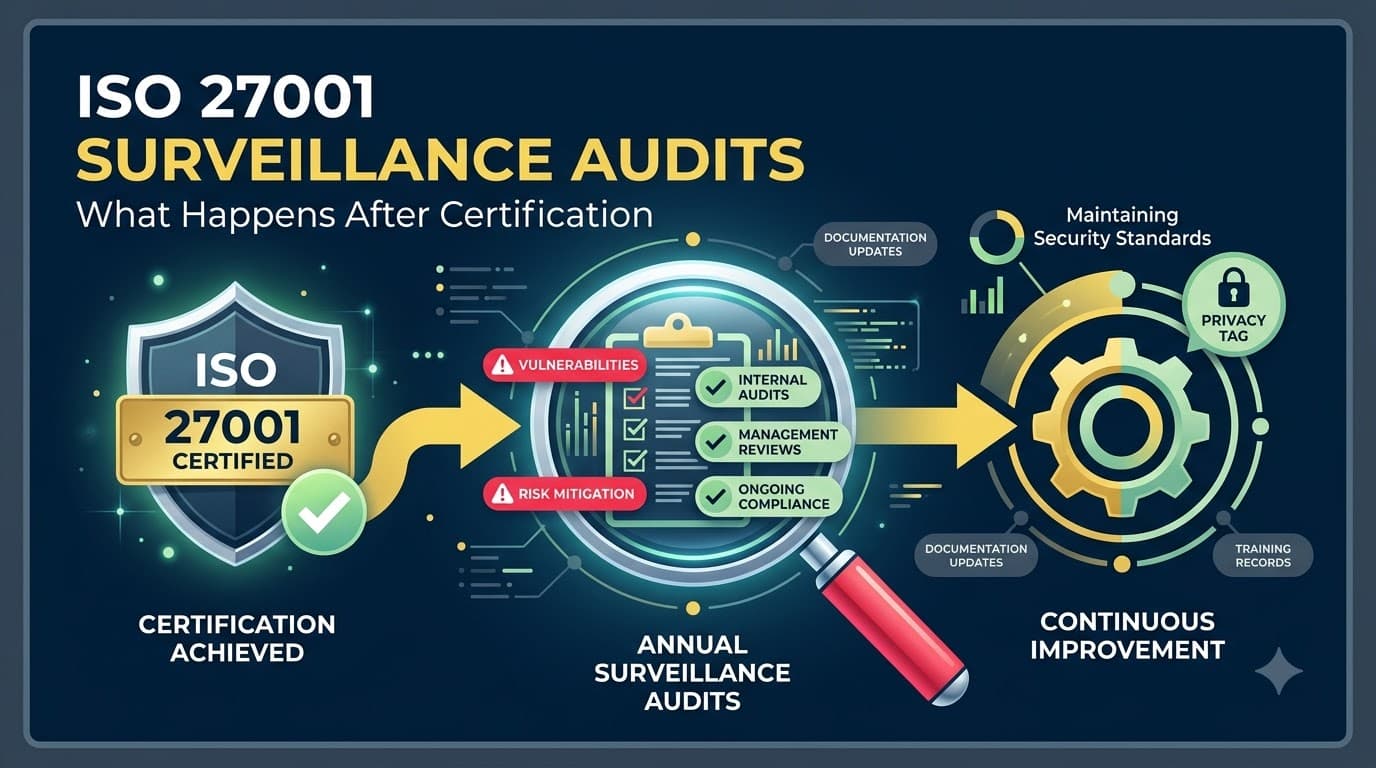
Marcus Webb had the framed certificate on his office wall for fourteen months before he thought about it again.
Marcus was VP of IT at Callisto Freight Systems, a mid-sized logistics and freight-brokerage firm out of Charlotte that had spent nine months and just under $190,000 getting ISO/IEC 27001 certified so it could win a transportation-management contract with a Fortune 500 retailer. The retailer's procurement team had made certification a hard gate — no certificate, no contract — and Callisto's Stage 2 audit had gone about as smoothly as a Stage 2 audit can go. Two minor nonconformities, both closed within three weeks, and a certificate that unlocked a $2.1 million annual freight-management deal.
Then life happened. The information security manager who had built the ISMS left for a competitor four months after certification. Internal audits, which were supposed to run quarterly, quietly stopped after the second one. The risk register hadn't been touched since the week of the Stage 2 audit — meanwhile Callisto had onboarded two new cloud logistics platforms, opened a satellite office in Memphis, and let three access-review cycles slip. Management review meetings, which the ISMS manual said would happen every six months, had been "combined" into a fifteen-minute agenda item at a quarterly ops meeting, with no minutes kept.
Twelve months and three weeks after the certification decision, the surveillance auditor showed up. She asked for the last internal audit report — it was nine months old and covered only two of fourteen applicable Annex A control areas. She asked for evidence of management review — there wasn't any in the format the standard requires. She asked how the ISMS had accounted for the Memphis office and the two new cloud platforms — nobody had a clear answer. She raised one major nonconformity (internal audit programme not implemented as documented) and two minors, and told Marcus plainly that if the major wasn't closed with a verified corrective action within the certification body's standard window, Callisto's certificate would be suspended.
A suspended certificate isn't a paperwork inconvenience. Callisto's contract with the retailer had a clause requiring "continuously valid ISO/IEC 27001 certification" — and the retailer's vendor-risk team had already flagged the account for review. Marcus spent six weeks in crisis mode — rebuilding the internal audit programme, running a real management review, updating the risk register and Statement of Applicability for the new office and platforms — to close the finding before the deadline. It worked, but it cost more in overtime, contractor hours, and executive attention than the entire first year of maintaining the ISMS properly would have.
Nothing in that story required a new attacker, a new law, or a new auditor being unreasonable. It required exactly one thing: treating certification as a finish line instead of a maintenance contract. This article exists so you don't make Marcus's mistake.
Who This Is For
This article is for security, compliance, and IT leaders who have just completed the ISO 27001 certification process, or expect to within the next few months, and want a clear, honest picture of what happens next. It's also useful for internal audit teams and management-review owners who need to understand exactly what a surveillance auditor will ask for. You'll walk away knowing what a surveillance audit is (and isn't), where it sits in the three-year certification cycle, the specific areas auditors sample, a maintenance rhythm that keeps you "always audit-ready" instead of doing a pre-audit fire drill, and what actually happens — step by step — if a nonconformity is raised.
What a Surveillance Audit Actually Is
A surveillance audit is a scheduled, partial audit that your certification body performs during the two years between your initial certification (or recertification) decision and your next full recertification audit. Its purpose is narrow and specific: confirm that the ISMS is still operating, still being maintained, and still improving — not to re-examine every clause and every one of the 93 Annex A controls from scratch.
That distinction matters enormously in practice. Your Stage 2 certification audit was a full-scope examination: every applicable control in your Statement of Applicability, every mandatory clause requirement, tested with enough depth for the certification body to make an initial decision to grant a certificate. A surveillance audit is a sample. The auditor picks a subset of controls and clauses, checks a defined set of "always in scope" management-system elements, and forms a judgment about whether the ISMS as a whole remains capable of being certified. It's oversight, not re-litigation.
Surveillance sits squarely inside what the standard calls Clause 9 performance evaluation — it's the external counterpart to the monitoring, internal audit, and management review your own organization is already required to run. That doesn't make surveillance a formality. Auditors can and do raise nonconformities — including majors — during surveillance visits, and a poorly maintained ISMS gets caught quickly because the "always in scope" items (internal audit, management review, corrective actions) are exactly the parts that decay first when an organization stops paying attention after the champagne.
"The certificate on the wall is a snapshot of one week. Surveillance is the certification body's way of checking whether that snapshot is still true a year later. Most of my clients who get a bad surprise in surveillance didn't get worse at security — they just stopped doing the unglamorous maintenance work nobody was watching." — Denise Okafor, Director of GRC, Solvant Consulting Group
Surveillance Audit vs. Certification Audit: The Core Differences
The single most common misconception I run into with newly certified clients is assuming the surveillance audit will feel like a smaller version of Stage 2. It doesn't. The scope, the depth, the duration, and the psychological posture of the auditor are all different, and understanding those differences up front prevents a lot of wasted preparation effort.
Dimension | Stage 2 Certification Audit | Surveillance Audit |
|---|---|---|
Purpose | Decide whether to grant certification | Confirm the ISMS is maintained and improving |
Scope | Full — all applicable clauses and Annex A controls in the SoA | Partial — sampled clauses/controls plus fixed "always reviewed" items |
Typical duration | Multiple days, scaled to headcount/complexity | Usually 1 day to a fraction of the original audit duration |
Frequency | Once, at initial certification (and again at recertification) | At least annually during years 1 and 2 of the cycle |
Outcome if failed | Certification withheld or delayed | Certificate can be suspended if major nonconformities aren't resolved |
Documents reviewed | Full ISMS documentation set | Updated/changed documents plus mandatory always-in-scope records |
Auditor's starting assumption | Untested — must be verified from scratch | Certified — verifying continued conformity and improvement |
Nonconformity handling | Must close before certificate is issued | Must close within CB-defined timeframe or risk suspension |
The practical takeaway: surveillance is faster, cheaper, and narrower than your original audit — but it is not lower stakes. Because the auditor starts from a position of trust ("this organization already proved it could do this"), a finding that the ISMS has visibly decayed lands harder than the same finding would during Stage 2, precisely because it suggests the organization can't sustain what it built.
Where Surveillance Sits in the Three-Year Certification Cycle
ISO/IEC 27001 certificates are issued on a three-year cycle. Your certification body doesn't re-examine everything every year; instead, the standard rhythm looks like an initial certification decision, followed by two surveillance audits (one in each of the following two years), followed by a full recertification audit before the three-year certificate expires. The diagram below illustrates the typical placement — treat the exact month counts as illustrative, since certification bodies set their own scheduling windows within the accreditation rules they operate under.
flowchart LR
    A["Stage 1 + Stage 2\nCertification Audit\n(Month 0)"] --> B["Certification Decision\nCertificate Issued"]
    B --> C["Surveillance Audit 1\n(~Month 12)\nPARTIAL / SAMPLED"]
    C --> D["Surveillance Audit 2\n(~Month 24)\nPARTIAL / SAMPLED"]
    D --> E["Recertification Audit\n(~Month 33-36)\nFULL SCOPE"]
    E --> F["New 3-Year Cycle Begins"]
    style C fill:#fef3c7,stroke:#b45309
    style D fill:#fef3c7,stroke:#b45309
    style E fill:#dbeafe,stroke:#1d4ed8
Notice what the diagram highlights: the two surveillance audits are the "maintenance checkpoints" sandwiched between the full-scope events at the start and end of the cycle. The recertification audit is a return to full-scope examination — closer in depth to your original Stage 2 audit than to either surveillance visit — because the certification body is deciding whether to issue you a brand-new three-year certificate, not just confirming continued conformity.
Cycle Year | Event | Typical Scope | Illustrative Timing |
|---|---|---|---|
Year 0 | Stage 1 + Stage 2 audit | Full — all applicable clauses/controls | Certification decision |
Year 1 | Surveillance audit 1 | Partial — sampled controls + fixed items | ~10–14 months after certification |
Year 2 | Surveillance audit 2 | Partial — sampled controls + fixed items | ~22–26 months after certification |
Year 3 | Recertification audit | Full — all applicable clauses/controls | ~33–36 months after certification |
One nuance worth internalizing early: because the sampled controls rotate between surveillance visits (the auditor typically won't sample the exact same control set twice in a row), you can't assume that whatever wasn't examined in surveillance 1 is "safe" from surveillance 2. Over the full three-year cycle, most certification bodies aim to have touched a representative cross-section of your Annex A controls at least once before the recertification audit arrives to close the loop on everything else.
What Auditors Focus On During Surveillance
Every certification body designs its own audit programme, but in the 200-plus ISMS engagements I've been part of, the surveillance visits converge on the same core set of "always in scope" items, regardless of which certification body is running the audit. These are the elements that prove your ISMS is a living system rather than a project that shipped once. Treat this table as your surveillance preparation checklist.
Focus Area | What the Auditor Is Really Checking | Evidence You Should Have Ready |
|---|---|---|
Internal audit programme | Has it run as planned, and does it actually find things? | Internal audit schedule, reports, evidence of findings and closure |
Management review | Is leadership actively reviewing ISMS performance, not rubber-stamping it? | Meeting minutes, inputs/outputs mapped to Clause 9.3 requirements |
Corrective actions & prior nonconformities | Were previous findings genuinely fixed, with root cause addressed? | Corrective action log, root-cause analysis, verification evidence |
Changes to scope, organization, or risk | Has the ISMS kept pace with new offices, systems, products, or risks? | Updated SoA, risk register, scope statement, change log |
Complaints | Are security-related complaints logged, investigated, and resolved? | Complaints/incident log with resolution records |
Continual improvement | Is there evidence of the ISMS getting measurably better, not just staying static? | Objective tracking, KPI trends, improvement initiatives |
Use of the certification mark/logo | Is the certificate and logo being used correctly and not misrepresented? | Marketing materials, website footer, sales collateral referencing certification |
Sampled Annex A controls | Spot-check a rotating subset of controls from the SoA | Control-specific records: access reviews, logs, training records, etc. |
Effectiveness of treatment of risks | Are risk treatments still appropriate given the current threat and business context? | Risk register with current ratings, treatment plans, residual risk sign-off |
A quick gut check before we go deeper into each row: if you can't produce evidence for the first four rows within about ten minutes of being asked, you have a surveillance problem regardless of how well any individual control is implemented. Those four — internal audit, management review, corrective actions, and change management — are the load-bearing elements of "is this a living management system," and they're exactly where organizations like Callisto Freight let things slip.
Internal Audit: The First Thing Auditors Ask About
Surveillance auditors almost always start by asking for your internal audit programme and the most recent report. This isn't arbitrary — the internal audit function is your own quality-control mechanism, and if it isn't running, the certification body has no independent signal that anyone inside the organization is checking the ISMS between external visits. Auditors want to see: a documented internal audit programme covering a full cycle across all clauses and applicable controls, evidence that audits were actually conducted on schedule (not just planned), findings that show the internal auditors are genuinely testing rather than rubber-stamping, and — critically — evidence that findings led to real corrective action.
An internal audit report with zero findings, cycle after cycle, is itself a mild red flag. Experienced auditors know that a mature ISMS of any real size surfaces something — a stale access list, an overdue training record, a policy that hasn't been reviewed on schedule. A spotless internal audit history over multiple cycles more often signals a superficial audit than a flawless ISMS.
Management Review: Evidence of Active Leadership Engagement
Management review is the mechanism the standard uses to prove that top management isn't just sponsoring the ISMS on paper — they're actively steering it. Surveillance auditors check the review cadence against what your own ISMS documentation commits to, then check the content against the inputs and outputs Clause 9.3 expects: status of previous actions, changes in external/internal issues, performance trends (nonconformities, audit results, objective achievement), stakeholder feedback, resource adequacy, and improvement opportunities. A fifteen-minute agenda item folded into an unrelated operations meeting, with no minutes and no clear decisions recorded, will not satisfy this requirement — and it's precisely the pattern that got Marcus Webb's team into trouble.
"I've seen management review done well in twenty minutes and done badly in two hours. Length isn't the test. The test is: did leadership actually make a decision, allocate a resource, or change a priority as a result of this meeting? If the answer every quarter is 'no changes needed,' that's not evidence of oversight — it's evidence nobody's looking closely enough to find anything." — Raymond Achebe, Lead Auditor (Bio: former accredited certification body assessor, now independent ISMS consultant)
Corrective Actions and Status of Previous Nonconformities
If your Stage 1 audit, Stage 2 certification audit, or prior surveillance visit raised nonconformities — terms fully defined in our ISO 27001 glossary of terms — closing them is not optional homework you can quietly let slide once the certificate is issued. Surveillance auditors will pull the corrective action log and verify, item by item, that the root cause was identified (not just the symptom patched), that the fix was actually implemented, and that there's objective evidence the fix is holding — not just a signed-off form. A corrective action that says "retrained the employee" without addressing why the control failed in the first place (a process gap, unclear ownership, a missing automated check) tends to resurface as the same nonconformity again at the next visit, which is a much worse outcome than the original finding.
Changes to Scope, Organization, and Risk Environment
Businesses change — new offices, new products, new cloud vendors, mergers, headcount growth, departed staff who owned key controls. Surveillance auditors specifically probe whether your ISMS documentation has kept pace with those changes. This is where Callisto Freight's Memphis office and two new cloud platforms became a problem: the risk register, Statement of Applicability, and asset inventory hadn't been updated to reflect them, meaning the certified ISMS no longer accurately described the organization it was supposed to be protecting. Any material change to your organizational context should trigger a review of scope, risk assessment, and the SoA — waiting for the next scheduled review cycle to "catch up" is exactly the gap auditors are trained to find.
Complaints and Continual Improvement
Two smaller but genuinely revealing checks round out the "always in scope" list. First, complaints: any formal complaints related to information security — from customers, employees, or other interested parties — should be logged, investigated, and resolved with a documented trail. An auditor asking "have you received any security-related complaints since the last audit, and how were they handled?" is testing whether your incident and feedback channels actually surface issues rather than letting them evaporate into an inbox.
Second, continual improvement — the requirement, baked into Clause 10, that the ISMS doesn't just stay static but demonstrably gets better over time. Auditors look for evidence like trending metrics on security objectives, a track record of proactive improvements that weren't triggered by a nonconformity, and lessons learned from incidents being fed back into policy or control changes. An ISMS that looks identical at surveillance 2 as it did at initial certification — same risk register entries, same objectives, same numbers — reads as stagnant, not stable.
Correct Use of the Certification Mark and Logo
This one surprises a lot of newly certified clients: certification bodies genuinely do check how you're using their mark and the word "certified." Misuse — using the logo on a product you didn't scope into certification, implying the certification body itself endorses your services, using an expired or superseded mark, or applying the mark beyond the scope statement on your certificate — is a real finding category, not a technicality. Marketing teams often make this mistake innocently, slapping the certification badge across every page of a website or every product line, when the certificate scope only covers one business unit or one data center. Review your marketing site, sales decks, and proposal templates against your actual certificate scope before every surveillance visit.
How a Surveillance Audit Actually Runs
Surveillance audits are shorter and more contained than a Stage 2 audit, but they still follow a formal agenda with an opening meeting, fieldwork, and a closing meeting. Knowing the shape of the day in advance takes a lot of the anxiety out of it — this is a working session with a defined agenda, not a surprise inspection.
Agenda Stage | What Happens | Typical Duration |
|---|---|---|
Opening meeting | Auditor confirms scope of the visit, confirms any changes since last visit, sets logistics | 15–30 minutes |
Review of prior nonconformities | Auditor checks status and evidence for any open corrective actions | 30–60 minutes |
Document and record review | Internal audit reports, management review minutes, risk register, SoA updates | 1–2 hours |
Sampled control walkthroughs | Interviews and evidence checks for the rotating subset of Annex A controls | 1–3 hours |
Change and context review | Discussion of organizational changes, new systems, scope changes | 30–60 minutes |
Findings consolidation | Auditor drafts observations, nonconformities (if any), and opportunities for improvement | 30–60 minutes |
Closing meeting | Findings presented to management, next steps and timelines agreed | 30–45 minutes |
For a single-site, moderately sized ISMS, this typically compresses into a single day on-site (sometimes conducted remotely in part, depending on the certification body's approach). Larger, multi-site, or higher-risk-sector organizations may see a longer visit or multiple sampled locations, but the surveillance visit is still built around the same "confirm, don't re-litigate" logic described earlier.
Role | Responsibility During the Visit |
|---|---|
ISMS manager / CISO | Primary point of contact, walks through programme status, coordinates evidence |
Internal audit lead | Presents internal audit programme results and evidence of findings closure |
Control owners (sampled) | Answer walkthrough questions for their specific Annex A controls |
Executive sponsor | Attends opening/closing meetings, represents management review ownership |
Document controller | Retrieves current, version-controlled records quickly on request |
A well-run surveillance visit has one obvious tell: nobody is searching for documents in real time. If your team is opening five different shared drives trying to locate "the current risk register" while the auditor waits, that friction itself becomes a data point about how mature the ISMS really is.
Keeping the ISMS "Always Audit-Ready" Between Visits
The organizations I've worked with that sail through every surveillance visit share one habit: they never do a dedicated "audit prep" sprint, because the ISMS never stops running long enough to need one. The alternative — treating certification maintenance as a once-a-year scramble in the weeks before the auditor arrives — is exactly the pattern that produces Callisto-style near-misses. Below is the maintenance rhythm I recommend building into your ISMS calendar from day one after certification.
Cadence | Activity | Owner |
|---|---|---|
Monthly | Review access rights changes, new hires/leavers, and incident/complaint log | Security team / IT ops |
Monthly | Spot-check one or two control areas against SoA commitments (rotating) | Control owners |
Quarterly | Update risk register for new/changed risks; review treatment plan progress | Risk owner / ISMS manager |
Quarterly | Run at least a partial internal audit against the annual programme | Internal audit lead |
Semi-annually | Formal management review meeting with documented inputs/outputs | Top management |
Semi-annually | Review and refresh security awareness training completion | HR / security team |
Annually | Full internal audit cycle completed across all applicable clauses/controls | Internal audit lead |
Annually | Review and update the Statement of Applicability against current context | ISMS manager |
Ongoing / event-triggered | Update scope statement, risk register, and SoA whenever org context changes | ISMS manager |
Ongoing | Track certification mark usage across marketing/sales materials | Marketing / compliance liaison |
Two things make this rhythm actually stick rather than becoming another neglected calendar reminder. First, assign a single named owner for "ISMS maintenance" who isn't also the person who owned the original certification project — continuity matters more than the original architect, because certification projects are often owned by a consultant or a since-departed manager, and the ISMS needs a permanent home in the org chart. Second, put the internal audit schedule and management review dates directly into the same calendar system leadership already uses for board or ops meetings, rather than a separate compliance tracker nobody outside the security team opens.
"Certification is the easy part, honestly. Passing Stage 2 is a sprint with a clear finish line and a consultant helping you cross it. Staying certified is a completely different discipline — it's the unglamorous, repetitive work of running the same meetings and the same audits quarter after quarter, with no external deadline forcing you to do it. That's where most of my clients who fail surveillance actually fail: not on security, on routine." — Priya Anand, CISO, Larkspur Health Systems
What Happens If Nonconformities Are Found
Surveillance audits absolutely can and do produce nonconformities — the "partial audit" framing doesn't mean lower scrutiny, just narrower scope. Understanding the severity tiers and what each one triggers takes the fear out of the conversation and lets you respond proportionately instead of panicking at any finding.
Finding Type | What It Means | Typical Consequence |
|---|---|---|
Observation / opportunity for improvement | Not a nonconformity — a suggestion, or an early warning sign | No formal action required, but worth tracking |
Minor nonconformity | An isolated lapse that doesn't undermine the ISMS as a whole | Corrective action plan required, verified at next visit or via evidence submission |
Major nonconformity | A systemic failure, an absence of a required process, or an accumulation of minors pointing to a bigger gap | Corrective action required within a defined short window; certificate can be suspended if unresolved |
Repeated nonconformity | The same issue recurring from a prior audit | Treated more severely — signals the corrective action never addressed root cause |
If a major nonconformity is raised and not resolved within the certification body's required timeframe, the certification body can suspend your certificate. Suspension means the certificate is not valid for reliance during the suspension period — a serious problem if, like Callisto Freight, your customer contracts require continuous valid certification. If the underlying issue still isn't resolved after suspension, the next step is withdrawal of the certificate entirely, which means starting the certification journey essentially from scratch, including a new Stage 1 and Stage 2 audit.
The common nonconformities and how to address them guide goes deeper on remediation technique, but the surveillance-specific point worth emphasizing here is speed and evidence quality: certification bodies want to see a genuine root-cause analysis, not a same-day patch. A corrective action submitted the day before the deadline, with a one-line explanation and no supporting evidence, tends to get challenged and can extend the risk window rather than closing it.
Escalation Path | Trigger | Typical Timeframe Pressure |
|---|---|---|
Corrective action requested | Minor or major nonconformity raised | Weeks, per CB's standard timeframe |
Certificate under review | Corrective action deadline missed or evidence insufficient | Certification body escalates internally |
Suspension | Major nonconformity remains unresolved past the deadline | Certificate invalid for reliance during suspension |
Withdrawal | Suspension not resolved, or organization unable/unwilling to remediate | Certification lost; re-application usually required |
The good news buried in this escalation table: every step before withdrawal is designed to be avoidable with a timely, well-evidenced response. I have never seen a client lose a certificate over a single, isolated major nonconformity that was fixed properly and promptly. The clients who reach suspension are almost always the ones who let a fixable finding sit untouched past the deadline because nobody owned the follow-through.
Common Mistakes Organizations Make After Certification
Across two hundred-plus ISMS engagements, the same handful of post-certification mistakes show up again and again. None of them are exotic; all of them are entirely preventable with a modest, consistent maintenance rhythm.
Mistake | Why It Happens | Consequence |
|---|---|---|
Treating certification as "one and done" | Project fatigue after a long certification push; champion moves on | ISMS decays quietly until surveillance exposes it |
Letting internal audits lapse or become superficial | No dedicated owner once the certification consultant leaves | First thing a surveillance auditor checks — and first thing found missing |
Combining management review into an unrelated meeting | Perceived time savings, underestimating the requirement | Fails to produce required inputs/outputs; reads as inattentive leadership |
Not updating the SoA/risk register after organizational change | No trigger process tied to change management | ISMS no longer reflects the real organization |
Over-using the certification mark beyond scope | Marketing teams unaware of scope boundaries | Direct nonconformity for mark misuse |
Ignoring minor nonconformities until the deadline looms | Deprioritized against "real work" | Late, rushed, weak evidence; risk of escalation |
Losing institutional knowledge when the ISMS owner leaves | No succession plan for compliance roles | Same gaps repeat because nobody remembers why controls exist |
Assuming last year's sampled controls are settled forever | Misunderstanding how sampling rotates | Blind spots accumulate in unsampled areas until recertification |
The thread running through all eight rows is the same one from Marcus Webb's story: certification is treated as a project with an end date rather than an operating discipline with a permanent owner. The fix isn't more documentation — Callisto had plenty of documentation, most of it stale. The fix is a named, accountable owner and a maintenance calendar that runs regardless of who's watching.
Case Study: The Freight Company That Nearly Lost Its Certificate
Callisto Freight Systems, introduced at the top of this article, is worth returning to with the numbers filled in. The company's ISMS covered roughly 140 employees across its Charlotte headquarters and, after certification, the new Memphis satellite office. The retailer contract tied to certification was worth $2.1 million annually, with a contractual requirement for continuously valid ISO/IEC 27001 certification and a 30-day cure period for any lapse.
When the surveillance auditor raised a major nonconformity for the internal audit programme not being implemented as documented, Marcus had roughly six weeks before the certification body's corrective-action deadline. His team rebuilt the internal audit schedule, ran two internal audits covering the gaps (spending approximately $22,000 on contractor support to move fast), held a properly documented management review with real inputs and outputs, and updated the risk register and SoA to reflect the Memphis office and two new cloud platforms. The corrective action was accepted, the certificate remained valid, and the retailer contract was preserved — but the six-week sprint cost more than a full year of properly staffed ISMS maintenance would have, and it consumed roughly 300 hours of overtime across IT, security, and executive time that could have been avoided entirely with a maintenance rhythm in place from month one.
Case Study: The SaaS Company That Made Surveillance Boring (On Purpose)
Halcyon Data Systems, a 90-person SaaS analytics vendor, took the opposite approach after certification. Its CISO, a client I advised through their initial certification, built the maintenance rhythm described earlier directly into the company's existing quarterly OKR review process — internal audit status, risk register changes, and corrective action tracking became standing agenda items reviewed by the same leadership team already meeting for other reasons, rather than a separate compliance ritual.
Two surveillance audits later, Halcyon's total external preparation time before each visit was under four hours — mostly organizing evidence that already existed rather than creating anything new. Both surveillance visits produced zero nonconformities and a combined total of three minor observations, each addressed within days. The CISO estimated that the "always ready" approach cost roughly 15% more in ongoing internal labor than a minimal-compliance approach would have, but eliminated the unpredictable spike costs — contractor sprints, executive fire drills, lost sales momentum from a contract-blocking suspension risk — that hit organizations like Callisto. When the company later closed a $4.6 million enterprise deal that required proof of continuously maintained certification (not just a certificate number), the procurement team specifically cited the clean surveillance history as a differentiator over a competitor who had a documented major nonconformity on record.
Case Study: The Nonprofit That Let Scope Drift Go Unnoticed
Ferrow Community Health Alliance, a regional nonprofit healthcare coordinator, was certified with an ISMS scope covering a single data center and its patient-scheduling platform. Between certification and its first surveillance visit, Ferrow migrated that platform to a new cloud provider and added a telehealth video system — a materially different technology stack operating under the same certified scope statement, without anyone updating the SoA or risk register to reflect it.
The surveillance auditor didn't raise a major nonconformity outright; instead, the visit surfaced two minors (an outdated asset inventory and a risk register that hadn't been reviewed in over a year) with a pointed note that the scope statement itself might no longer accurately describe the ISMS boundary — a finding that, left unaddressed, was flagged as likely to become a major at the next visit if not corrected. Ferrow's compliance lead treated the note seriously, ran an off-cycle risk assessment on the new cloud and telehealth systems within eight weeks (at a cost of roughly $14,000 for external risk-assessment support), and updated the scope statement and SoA accordingly. The lesson Ferrow's leadership took away, in the words of their compliance director, was that "a minor finding is a gift — it's the certification body telling you exactly where the major is going to be next year if you ignore it."
The Cost Picture: Surveillance Audits vs. Fire-Drill Remediation
Budgeting for surveillance is straightforward when the ISMS is maintained continuously, and expensive when it isn't. The fee itself is largely fixed by the certification body you selected during the original certification body selection process — what varies enormously between organizations is everything else in the table below. The table below lays out the illustrative cost pattern I see across client engagements — treat these as planning ranges, not quoted fees, since certification body pricing and organizational size vary widely.
Cost Category | "Always Ready" Organization | "Fire Drill" Organization |
|---|---|---|
Certification body surveillance audit fee | Standard fee, unaffected by preparation approach | Standard fee, unaffected by preparation approach |
Internal prep labor before each visit | A few hours organizing existing evidence | Days to weeks of scrambling, cross-team pressure |
Corrective action remediation (if findings arise) | Minor, low-cost fixes closed quickly | Contractor sprints, overtime, executive attention diverted |
Risk of contract disruption | Minimal — certification stays continuously valid | Real — suspension risk can trigger contractual review clauses |
Institutional knowledge cost | Low — maintenance is routine and documented | High — knowledge gaps compound each cycle |
Total 3-year cycle cost trend | Predictable, roughly flat | Spiky, with expensive surprise peaks |
Cross-pillar context is useful here too. Organizations that also carry a SOC 2 Type II attestation often adapt more easily to the ISO 27001 surveillance rhythm, because SOC 2's annual audit cycle already forces a similar "keep evidence current all year" discipline — continuous control operation over an observation period rather than a point-in-time check. The mental model transfers well: ISO 27001 surveillance and SOC 2's annual Type II renewal are both, at bottom, tests of whether your controls are a living system or a static artifact produced once for an audit and then left untouched. Organizations juggling PCI DSS alongside ISO 27001 will recognize the same pattern again — annual reassessment cycles exist across nearly every major security framework precisely because point-in-time attestations lose credibility fast without continuous upkeep.
Building a Surveillance-Ready Evidence Calendar
The single highest-leverage thing you can do in the first month after certification is build an evidence calendar — a simple, shared document mapping every recurring ISMS obligation to a date, an owner, and a place where the evidence lives. This sounds almost too basic to mention, but in practice it's the artifact that separates the Halcyon Data Systems outcome from the Callisto Freight outcome more than any difference in security maturity ever did.
Obligation | Frequency | Owner | Evidence Location |
|---|---|---|---|
Internal audit (full cycle) | Annual, with quarterly partial audits | Internal audit lead | Internal Audit Report Template, shared audit folder |
Management review meeting | Semi-annual (minimum) | CEO/executive sponsor + ISMS manager | Meeting minutes repository |
Risk register review | Quarterly, plus event-triggered | Risk owner | Risk Register Template |
SoA review | Annual, plus event-triggered | ISMS manager | SoA Template, version-controlled |
Access rights review | Quarterly | IT/security operations | Access review logs |
Security awareness training completion | Semi-annual | HR / security team | LMS completion reports |
Corrective action tracking | Continuous | Whoever owns the specific finding | Corrective action log |
Vendor/supplier security review | Annual, per contract terms | Procurement / security liaison | Supplier assessment records |
Certification mark usage audit | Semi-annual | Marketing / compliance liaison | Marketing asset inventory |
Business continuity/DR test | Annual | Business continuity owner | Test reports and after-action notes |
Keeping this calendar tied to a well-structured ISMS manual and a disciplined approach to document control and records management means every owner in the table above can find the current, version-controlled evidence in seconds rather than hunting through outdated copies. Once this calendar exists, the "surveillance prep" conversation changes shape entirely. Instead of asking "what do we need to pull together before the auditor arrives," the ISMS manager is asking "which of these ten rows have owners currently behind schedule, and what do we need to catch up before the visit." That's a fifteen-minute status check, not a six-week sprint.
"The organizations that struggle with surveillance almost never have a technology problem. They have a calendar problem. Nobody owns the recurring cadence once the consultant who built the ISMS walks out the door. Fix the ownership question in month one, and ninety percent of surveillance risk disappears with it." — Tomás Reyes, Principal, Ferrow & Reyes Security Advisory
The Internal Audit Function as Your Surveillance Insurance Policy
It's worth stating plainly: a strong internal audit programme is the closest thing to insurance against a bad surveillance outcome. If your internal auditors are finding and fixing issues throughout the year — using the same rigor and documentation standard an external auditor would expect — a surveillance visit becomes confirmatory rather than discovery-driven. The auditor's sampled walkthrough simply corroborates what your own internal audit already found and fixed months earlier.
This is also why certification bodies weight internal audit so heavily in their surveillance checklist: a functioning internal audit programme is evidence that the organization doesn't need an external party to catch its own problems. Conversely, an internal audit programme that exists only on paper — a document nobody follows — removes that safety net entirely and leaves every gap to be discovered cold, by an outsider, during a visit that has real consequences attached.
If your internal audit programme needs a rebuild or a refresh, the practical starting point is a documented annual schedule covering every clause and applicable control at least once, competent (and where possible, independent) auditors who aren't reviewing their own work, and a reporting format that captures findings, evidence, root cause, and corrective action ownership in one place. Pulling from a structured internal audit checklist rather than building the programme from scratch each cycle saves real time and reduces the risk of missing a clause.
Documenting Change: The Habit That Prevents the Biggest Surveillance Risk
If there's one single habit I'd ask a newly certified client to adopt above all others, it's this: whenever something material changes in the business — a new office, a new vendor, a new product line, a departed employee who owned a control, a new regulatory obligation — treat it as an automatic trigger to ask "does this affect our ISMS scope, risk register, or SoA?" rather than waiting for the next scheduled review.
Change Type | ISMS Documents Likely Affected | Action Trigger |
|---|---|---|
New office or facility | Scope statement, physical control records, asset inventory | Immediate — before go-live if possible |
New cloud vendor or SaaS tool | Risk register, SoA (cloud services control), supplier assessment | Before contract signature |
New product or business line | Scope statement, risk assessment, SoA | Before launch |
Key ISMS role departs | Roles and responsibilities documentation, succession plan | Immediately — identify interim/permanent owner |
Merger or acquisition | Scope statement, full risk assessment, asset inventory | As early in the transaction as security can be looped in |
New regulatory obligation | Legal/statutory requirements register, risk register | Upon identification of the obligation |
Significant security incident | Risk register, incident log, corrective action log | Immediately following incident closure |
Treating these triggers as automatic rather than calendar-driven is what keeps the SoA and risk register perpetually accurate, instead of accurate only in the weeks immediately following certification and drifting further from reality every month after that. This single habit would have prevented the core finding in Callisto Freight Systems' near-suspension — the Memphis office and new cloud platforms weren't secret; they simply weren't connected to a process that updated the ISMS documentation automatically.
A Quick Self-Check Before Every Surveillance Visit
Regardless of how mature your maintenance rhythm is, it's worth running a short internal readiness check — cross-referenced against a full audit checklist covering every clause and control — about four to six weeks before a scheduled surveillance visit — not to cram, but to confirm the routine work has actually happened on schedule. This isn't a substitute for the ongoing rhythm described above; think of it as a final sanity check, not the first time any of this gets reviewed.
Readiness Question | If "No" — Action Needed |
|---|---|
Has the internal audit programme run on schedule since the last visit? | Run any missed audits immediately, even abbreviated ones, and document why |
Has a management review happened with documented inputs/outputs? | Schedule one now with a proper agenda mapped to Clause 9.3 |
Are all prior nonconformities' corrective actions closed with evidence? | Gather verification evidence; escalate any still-open items to leadership |
Does the SoA reflect every organizational change since certification? | Update the SoA and risk register before the visit, not during it |
Is the risk register current, with treatment progress documented? | Assign an owner to refresh entries older than one quarter |
Are training completion records current for all in-scope staff? | Chase down outstanding completions before the visit |
Is the certification mark used correctly across all marketing materials? | Audit marketing assets against the certificate's actual scope |
Can every control owner explain their control's purpose and evidence in under two minutes? | Run a short internal briefing or walkthrough rehearsal |
If most of these come back "yes" without a scramble, you're in Halcyon Data Systems territory. If several come back "no," you have a few weeks of legitimate catch-up work ahead of you — better to do it proactively than have the auditor surface it as a formal finding.
"I tell every client the same thing after their certificate is issued: the hardest part of this journey isn't the eighteen months it took to get here. It's the next thirty-six. Certification proves you could build an ISMS. Surveillance proves you can run one." — Sana Whitfield, Lead Assessor, Northbridge Certification Body
Who Should Own Surveillance Readiness: In-House vs. Outsourced Support
One question I get constantly from newly certified clients is whether ongoing ISMS maintenance needs a dedicated in-house hire, or whether it can be handled through periodic outsourced support. The honest answer is that it depends less on headcount than on whether someone inside the organization has both the authority and the time to keep the maintenance rhythm running — outsourcing can supply expertise, but it can't supply organizational authority.
Model | Strengths | Risks | Best Fit |
|---|---|---|---|
Dedicated in-house ISMS owner | Deep institutional knowledge, immediate authority, consistent presence | Single point of failure if the role isn't backed up | Mid-size to large organizations with complex or fast-changing scope |
Outsourced virtual CISO / compliance retainer | Specialist expertise, cost-effective for smaller teams, external objectivity | Less day-to-day visibility into operational changes unless engagement is frequent | Smaller organizations without a full-time compliance function |
Hybrid: in-house owner + periodic external audit support | Combines internal authority with external rigor for internal audits | Requires clear division of responsibility to avoid gaps | Organizations that want independent internal audits without a dedicated auditor headcount |
No clear owner (ISMS treated as "everyone's job") | Low apparent cost | Highest risk — this is the pattern behind almost every surveillance near-miss I've seen | Not recommended under any circumstances |
Regardless of which model you choose, the non-negotiable is a single named person whose job description explicitly includes ISMS maintenance and who reports status to leadership on a fixed cadence. Callisto Freight Systems' near-suspension happened specifically because the fourth row in that table — "no clear owner" — quietly became the default the moment the original information security manager left, and nobody in leadership noticed the gap until the surveillance auditor did.
"Outsourcing internal audit or virtual CISO support isn't a weakness — plenty of well-run ISMSs lean on external specialists. The mistake is outsourcing the ownership. Somebody inside the building has to wake up every quarter and ask whether the maintenance rhythm actually happened. That job can't live in a vendor contract." — Marisol Fenwick, vCISO, Aldergate Risk Partners
Preparing Your Team Before the Auditor Arrives
A surveillance visit that goes smoothly usually has one thing in common behind the scenes: the people who'll actually be interviewed knew it was coming and knew, roughly, what to expect. Control owners who are ambushed with a walkthrough request they weren't briefed on tend to under-perform relative to what their actual control implementation would support — not because the control is weak, but because nobody prepared them to explain it clearly under mild pressure.
A short briefing, a week or two before the visit, covering who's likely to be interviewed, what the auditor will probably ask about their specific control area, where to find the evidence they'll be asked to produce, and a reminder that "I don't know, let me check" is a perfectly acceptable answer (far better than guessing) — this fifteen-minute investment consistently pays for itself. Pair it with a quick walk-through of your internal audit interview question script so control owners have already heard similar questions phrased in a similar way during your own internal audits, and the external visit feels like a continuation of a familiar process rather than an unfamiliar interrogation.
Surveillance Audits as a Business Opportunity, Not Just an Obligation
It's tempting to frame everything in this article as risk management — avoid the nonconformity, avoid the suspension, avoid the contract disruption. That framing isn't wrong, but it's incomplete. Organizations that treat surveillance readiness as a continuous operating discipline rather than an annual chore end up with something more valuable than a clean audit history: they end up with an ISMS that's actually doing its job, catching real gaps before they become real incidents, and giving sales and procurement teams a genuinely defensible answer when a prospect's security questionnaire asks "how do you maintain your certification, not just how did you get it."
That's a meaningfully different sales conversation. "We're certified" answers one question. "We've had two consecutive clean surveillance audits, our internal audit programme runs on a documented quarterly cadence, and our last recertification found zero major nonconformities" answers the question enterprise procurement teams are actually asking — can we trust this vendor's security posture to still be true next year. Halcyon Data Systems' $4.6 million contract win, described earlier, is a direct example of that dynamic playing out in a competitive deal.
The organizations I've seen extract the most value from ISO 27001 over a full three-year cycle are the ones that stopped thinking about "the audit" as a singular event and started thinking about "the cycle" as an operating rhythm — internal audits, management reviews, and continuous documentation hygiene running quietly in the background, with surveillance and recertification visits simply confirming what was already true. If you're newly certified, the best time to build that rhythm is now, in the calm period before your first surveillance visit, not in the six weeks of crisis mode after a major nonconformity lands.
If you want a structured way to translate everything in this article into an actual working calendar, PentesterWorld's Certification Readiness Checklist and Internal Audit Checklist are built to map directly onto the maintenance rhythm described here, and our Internal Audit Report Template gives your internal audit programme the same documentation standard a surveillance auditor will expect to see. For teams rebuilding their foundational documentation after a lapse like Callisto's, the ISO 27001 Mandatory Documents Checklist and The Complete ISO 27001 Implementation Guide eBook are the fastest way to get back to a defensible baseline before the next visit arrives.
Bringing It All Together
Surveillance audits are not a re-test of everything you proved during Stage 2 — they're a recurring, partial check that the ISMS you built is still alive, still owned, and still improving. The organizations that treat them as routine confirmation rather than crisis events share the same underlying habit: a named owner, a maintenance calendar that runs regardless of who's watching, and a willingness to treat every organizational change as a trigger to update the ISMS rather than a footnote to deal with later. The table below summarizes the two audit types side by side one more time, followed by a summary of the maintenance disciplines that keep surveillance boring — in the best possible sense.
Discipline | What "Good" Looks Like | What "At Risk" Looks Like |
|---|---|---|
Internal audit | Full annual cycle completed on schedule, findings closed with evidence | Lapsed, superficial, or years out of date |
Management review | Documented, cadenced, tied to real inputs/outputs and decisions | Folded into an unrelated meeting with no minutes |
Change management | Every material change triggers a scope/risk/SoA review | Documentation frozen at the certification date |
Corrective actions | Root-cause driven, closed with verified evidence, tracked to completion | Symptom patches, recurring findings, missed deadlines |
Certification mark usage | Reviewed periodically against actual certificate scope | Applied broadly across marketing with no scope check |
Ownership | Named, permanent role independent of who built the original ISMS | Tied to a departed consultant or one employee who has since left |
Whichever stage of the cycle you're in right now — fresh off Stage 2, gearing up for your first surveillance visit, or staring down recertification in a few months — the fundamentals are the same: keep the evidence current, keep leadership genuinely engaged, and keep treating the ISMS as an operating system for the business rather than a project that ended the day the certificate arrived. PentesterWorld's ISO 27001 resource library, checklists, and templates exist to make that ongoing discipline easier to sustain — reach out to our team if you want a structured second opinion on where your ISMS stands before your next surveillance visit.