The Three Spreadsheets Problem
Priya Nair keeps three browser tabs open more or less permanently. Tab one is the ISO 27001 Statement of Applicability for Lumenpath Analytics, the 400-person SaaS company where she's VP of Security & Compliance. Tab two is the SOC 2 control matrix her Type II auditor uses every year. Tab three — the newest, messiest one — is a NIST CSF 2.0 tracker she started six weeks ago in a hurry, because a regional bank evaluating Lumenpath's fraud-analytics platform for a three-year, $2.4 million contract sent back a vendor security questionnaire with a single non-negotiable line: "Vendor must demonstrate alignment to NIST CSF 2.0 functions, mapped to existing certifications, within 10 business days."
Lumenpath already had the receipts. It held a clean ISO/IEC 27001:2022 certificate and a SOC 2 Type II report with zero exceptions. But "we have two certifications" wasn't the question. The bank's procurement team wanted to see, function by function, how Lumenpath's actual controls lined up with GOVERN, IDENTIFY, PROTECT, DETECT, RESPOND, and RECOVER — and they wanted it in a format their own risk committee could read without translating ISO clause numbers in their heads.
Priya's first instinct was to build tab three from scratch, control by control, cross-referencing two other documents that were themselves maintained by different people on different update cycles. Her access-control lead owned the ISO evidence. Her SOC 2 auditor's liaison owned the control matrix. Nobody owned a NIST view, because nobody had ever needed one before. Three weeks in, with the deal clock ticking, she stopped trying to build a third parallel system and instead built one crosswalk table that let a single control — say, multi-factor authentication for privileged accounts — show up correctly as ISO Annex A control 8.2 and 8.5, as SOC 2 CC6.1 and CC6.2, and as NIST CSF PR.AA at the same time. The crosswalk didn't just answer the bank's question in nine days. It became the artifact Lumenpath now updates once, quarterly, instead of maintaining three drifting spreadsheets that quietly disagreed with each other by the second audit cycle.
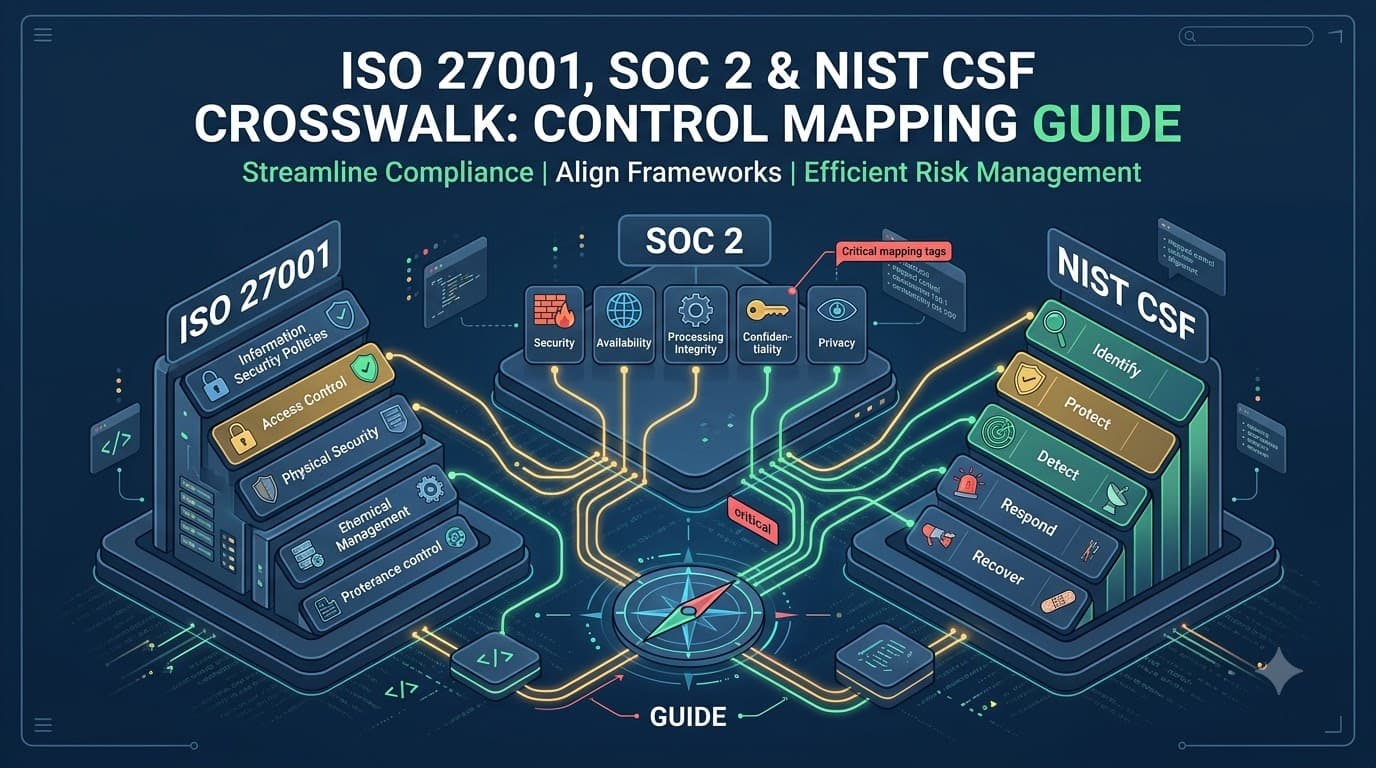
This is the article that crosswalk is built from. It's a practitioner-level mapping — not an official equivalence table published by ISO, the AICPA, or NIST — between ISO 27001 Annex A's 93 controls, SOC 2's Trust Services Criteria, and NIST CSF 2.0's six functions. Used correctly, it turns three audit programs into one control set with three reporting outputs. Used carelessly, it becomes a false-confidence document that tells an auditor "we've got this covered" when you haven't actually looked at the gap.
Who This Is For
This guide is for compliance, security, and GRC leaders who already run — or are about to run — more than one of these three frameworks at once: the SaaS company juggling a customer-mandated SOC 2 report alongside EU-market ISO 27001 certification; the critical-infrastructure-adjacent vendor whose federal or large-enterprise customers now ask for NIST CSF 2.0 alignment on top of existing certifications; the internal auditor trying to stop three teams from independently gathering evidence for what is functionally the same control. You'll walk away with cluster-level and representative control-level crosswalk tables across all four ISO Annex A themes, a clear picture of what each framework covers that the other two don't, a short list of mapping mistakes that cause audit findings, and a repeatable method for running one control set that feeds three different outputs.
Why Bother Crosswalking at All
The honest case for a crosswalk isn't philosophical — it's a spreadsheet-hours argument. Every control that exists in more than one framework, if managed separately, gets implemented once but documented, evidenced, and audited multiple times. Multiply that by 90-plus ISO controls, roughly 30 SOC 2 Common Criteria points of focus, and six NIST CSF functions with more than 20 categories underneath them, and you get duplicated policy documents, duplicated evidence folders, duplicated auditor interviews, and — the part finance actually notices — duplicated consulting and audit fees for control sets that are, underneath the different vocabulary, the same access review or the same vulnerability scan cadence.
A crosswalk collapses that duplication into a single control library with multiple "tags." You implement and evidence encryption-in-transit once; the crosswalk tells you that single piece of evidence also satisfies ISO 27001 control 8.24, SOC 2 criterion CC6.1, and NIST CSF's PR.DS-related protect activities. You're not doing three security programs — you're doing one security program that happens to produce three different reports for three different audiences: a certification body, an audit firm, and (increasingly) a customer procurement team that speaks NIST CSF natively because that's the language federal guidance and critical-infrastructure sector regulators use.
This is also the natural companion to two other pieces in this series: the framework overview in ISO 27001 vs Other Security Frameworks: NIST, SOC 2, and PCI DSS Compared, and the decision-oriented ISO 27001 vs SOC 2: Which One Do You Need?. Those two answer "which framework, and why." This one answers "I already need two or three — how do I stop running them as three unrelated projects?" It sits alongside Running ISO 27001 and SOC 2 Together: A Shared Control Framework, which covers the program-management side of dual certification; this article is the control-level reference you pull up while you're actually building that shared framework.
The Cost of Three Separate Programs vs. One Unified Program
Numbers make the efficiency case concrete, so here's an illustrative breakdown — figures drawn from the pattern I've seen repeat across mid-market clients running two or three of these frameworks, not a published benchmark. Treat the dollar amounts as directional, not a quote you can hand to your CFO unmodified.
Cost Category | Three Separate Programs (illustrative) | One Unified Control Set (illustrative) | Approximate Savings |
|---|---|---|---|
Internal evidence-collection hours per audit cycle | ~640 hours (roughly 210–220 hours per framework, largely duplicated) | ~380 hours (shared evidence pool, framework-specific packaging only) | ~40% reduction |
External audit/consulting fees | $95,000–$140,000/year combined (ISO surveillance + SOC 2 Type II fieldwork + ad hoc CSF advisory) | $70,000–$100,000/year (less rework, fewer clarification cycles with auditors) | ~20–25% reduction |
Time to respond to a framework-specific customer RFP | 4–6 weeks (building a mapping from scratch under deadline pressure) | 3–10 business days (crosswalk already exists, just needs refreshing) | Multi-week acceleration |
Tooling/spreadsheet overhead | 3 separate tracking systems, manual reconciliation | 1 tagged control library | Fewer reconciliation errors, less version drift |
The efficiency case is real, but it's not the only reason this matters. Look at the third row again: a multi-week acceleration on a customer RFP response is frequently the difference between winning and losing a deal that's already gone through months of technical evaluation — which is exactly the position Priya Nair was in in the cold open, and exactly why the strategic close of this guide argues a crosswalk is a sales asset as much as an audit shortcut.
The Three Frameworks, in Brief
Before the crosswalk tables make sense, you need the shape of each framework, because they're not built the same way and the differences matter more than the similarities. If any of the terminology below is unfamiliar, the ISO 27001 Terminology and Glossary is worth keeping open in a second tab.
ISO/IEC 27001:2022 is a certifiable management-system standard. Clauses 4–10 define the Information Security Management System (ISMS) — context, leadership, planning, support, operation, performance evaluation, improvement — and Annex A supplies a reference set of 93 controls across four themes (Organizational, People, Physical, Technological) that the organization selects from and documents in a Statement of Applicability. Certification is issued by an accredited body after a two-stage audit and is reassessed via annual surveillance audits over a three-year cycle.
SOC 2 is not a certification; it's an attestation. If you need the fuller picture of how the SOC 2 Trust Services Criteria are structured before diving into the crosswalk tables, that's worth a detour first. An independent CPA firm examines your controls against the AICPA's Trust Services Criteria and issues a report — Type I (design, at a point in time) or Type II (design and operating effectiveness, over a 3–12 month window). The Security category (Common Criteria, CC1–CC9) is mandatory; Availability, Processing Integrity, Confidentiality, and Privacy are optional add-on categories you select based on what your service commitments actually promise customers.
NIST CSF 2.0, published in February 2024 — see our NIST CSF 2.0 functions and categories explained for the standalone deep dive — is a voluntary risk-management framework, not a certifiable standard and not an attestation. There's no NIST CSF "certificate" to earn. It organizes cybersecurity outcomes into six functions — GOVERN, IDENTIFY, PROTECT, DETECT, RESPOND, RECOVER — with GOVERN added in the 2.0 revision specifically to elevate cybersecurity governance, risk strategy, and supply-chain risk to the same level as the operational functions. Organizations self-assess against CSF using informative references and organizational profiles; some regulators and large enterprise customers now request a CSF-mapped narrative as part of vendor risk reviews, which is exactly the situation Priya Nair found herself in.
Attribute | ISO/IEC 27001:2022 | SOC 2 | NIST CSF 2.0 |
|---|---|---|---|
Nature | Certifiable management-system standard | Independent attestation (auditor's report) | Voluntary risk-management framework |
Issued by / governed by | ISO/IEC, assessed by accredited certification bodies | AICPA Trust Services Criteria, assessed by licensed CPA firms | NIST (U.S. Department of Commerce) |
Core structure | Clauses 4–10 (ISMS) + Annex A (93 controls, 4 themes) | Trust Services Criteria: Security (CC1–CC9) + optional A, PI, C, P | 6 functions: GOVERN, IDENTIFY, PROTECT, DETECT, RESPOND, RECOVER, with categories/subcategories beneath each |
Output | Certificate, valid 3 years with annual surveillance | Type I or Type II report, typically renewed annually | Organizational Profile / self-assessment narrative, no formal output document mandated |
Scope flexibility | Defined ISMS scope, documented in scope statement | Defined system/service boundary in report | Framework-wide or tailored profile; highly flexible |
Typical driver | International sales, EU customers, regulatory alignment | U.S. enterprise/SaaS customer trust, vendor risk questionnaires | Federal/critical-infrastructure alignment, enterprise vendor risk programs, internal maturity benchmarking |
How to Read a Crosswalk (Read This Before the Tables)
Every table below maps ISO Annex A controls to NIST CSF 2.0 functions/categories and SOC 2 Trust Services Criteria. Before you copy any of it into a customer-facing document or an audit workpaper, understand four caveats that practitioners routinely skip and regret skipping.
First, these are practitioner crosswalks, not official equivalence tables. No standards body has published a binding "ISO control X equals SOC 2 criterion Y equals CSF subcategory Z" translation. Third-party crosswalks — including this one, and including the ones published by consulting firms, GRC platforms, and the Secure Controls Framework — are informed judgment calls about where control intent overlaps. They're extremely useful for planning and efficiency. They are not something an auditor is obligated to accept, and they don't substitute for that auditor's own testing.
Second, mapping is rarely 1:1. A single ISO control frequently supports multiple CSF subcategories and multiple SOC 2 criteria, and the reverse is just as common — one SOC 2 criterion (say, CC6.1, logical access) draws on evidence from half a dozen ISO controls (5.15 through 5.18, 8.2, 8.5). Where this guide shows one row per control, read it as "primary alignment," not "exclusive alignment."
Third, breadth isn't depth. Two frameworks both "covering" access control doesn't mean they demand identical evidence. ISO 27001 wants documented access control policy and risk-based justification tied to your ISMS; SOC 2 wants operating-effectiveness testing over a review period showing the access reviews actually happened on schedule; NIST CSF wants you to describe your access-management outcomes and maturity within an organizational profile. Same territory, different proof.
Fourth, and most important: a crosswalk tells you where to look for overlapping evidence, not what to skip. Treat every "this satisfies both" row as a hypothesis to confirm with your actual auditor or certification body, not a shortcut to take unverified into a Stage 2 audit or a Type II examination.
"The crosswalk isn't the compliance program. It's the index card that tells you which drawer the evidence is in. I've watched teams treat a mapping spreadsheet as proof of coverage and get blindsided in a SOC 2 walkthrough because the mapped control existed on paper but nobody could produce the quarter's access review." — Marcus Webb, CISO, Northfield Insurance Group
NIST CSF 2.0: Functions and Categories at a Glance
Since the crosswalk tables reference CSF functions and categories throughout, here's the reference layer. NIST CSF 2.0 organizes outcomes into six functions, each broken into categories (subcategories exist below these but aren't needed for a theme-level crosswalk).
CSF 2.0 Function | Representative Categories | What It Covers |
|---|---|---|
GOVERN (GV) | Organizational Context, Risk Management Strategy, Roles/Responsibilities/Authorities, Policy, Oversight, Cybersecurity Supply Chain Risk Management | Leadership, strategy, policy, accountability, third-party risk governance — new as a standalone function in 2.0 |
IDENTIFY (ID) | Asset Management, Risk Assessment, Improvement | Understanding assets, risks, and vulnerabilities across the organization |
PROTECT (PR) | Identity Management & Access Control, Awareness & Training, Data Security, Platform Security, Technology Infrastructure Resilience | Safeguards that limit or contain a cybersecurity event |
DETECT (DE) | Continuous Monitoring, Adverse Event Analysis | Timely discovery of anomalies and security events |
RESPOND (RS) | Incident Management, Incident Analysis, Incident Response Reporting & Communication, Incident Mitigation | Actions taken once an incident is detected |
RECOVER (RC) | Incident Recovery Plan Execution, Incident Recovery Communication | Restoring capabilities and services impaired by an incident |
SOC 2 Trust Services Criteria at a Glance
TSC Category | Code | Covers |
|---|---|---|
Security (Common Criteria — mandatory) | CC1–CC9 | Control environment, communication, risk assessment, monitoring, control activities, logical/physical access, system operations, change management, risk mitigation |
Availability | A1 | System uptime, capacity, disaster recovery commitments |
Processing Integrity | PI1 | Complete, valid, accurate, timely, authorized processing |
Confidentiality | C1 | Protection of information designated as confidential |
Privacy | P1–P8 | Collection, use, retention, disclosure, and disposal of personal information |
With those two reference tables in hand, the theme-by-theme crosswalks below will make sense without you flipping back and forth.
Crosswalk: Organizational Controls (Annex A 5.1–5.37)
The Organizational theme is the largest of the four — 37 controls — and it's also where the three frameworks overlap most heavily, because governance, access, supplier risk, and incident management are core to all three. The cluster table below groups the 37 controls into logical families and maps each family to its primary CSF function and SOC 2 criteria.
ISO 27001 Cluster | Controls | Primary NIST CSF 2.0 Function(s) | Representative CSF Category | Primary SOC 2 TSC |
|---|---|---|---|---|
Policies, roles, and governance | 5.1–5.4 | GOVERN | Policy (GV.PO), Roles/Responsibilities/Authorities (GV.RR) | CC1.1–CC1.4 |
External engagement | 5.5–5.6 | GOVERN / IDENTIFY | Organizational Context (GV.OC) | CC1.1, CC2.3 |
Threat intelligence | 5.7 | IDENTIFY / DETECT | Risk Assessment (ID.RA), Adverse Event Analysis (DE.AE) | CC3.2, CC7.2 |
Security in project management | 5.8 | GOVERN / PROTECT | Policy (GV.PO), Platform Security (PR.PS) | CC8.1 |
Asset management | 5.9–5.14 | IDENTIFY / PROTECT | Asset Management (ID.AM), Data Security (PR.DS) | CC6.1, CC6.5, C1.1 |
Access control family | 5.15–5.18 | PROTECT | Identity Management, Authentication & Access Control (PR.AA) | CC6.1, CC6.2, CC6.3 |
Supplier & cloud risk | 5.19–5.23 | GOVERN | Cybersecurity Supply Chain Risk Management (GV.SC) | CC9.2, CC7.4 |
Incident management | 5.24–5.28 | RESPOND | Incident Management (RS.MA), Incident Analysis (RS.AN) | CC7.3, CC7.4, CC7.5 |
Business continuity & ICT readiness | 5.29–5.30 | RECOVER | Incident Recovery Plan Execution (RC.RP) | A1.2, A1.3, CC9.1 |
Legal, IP, and records | 5.31–5.33 | GOVERN / IDENTIFY | Organizational Context (GV.OC) | CC1.1, CC2.3 |
Privacy | 5.34 | GOVERN / PROTECT | Data Security (PR.DS) | P1–P8, C1.1 |
Independent review & compliance | 5.35–5.36 | GOVERN | Oversight (GV.OV) | CC4.1, CC4.2 |
Documented operating procedures | 5.37 | PROTECT | Platform Security (PR.PS) | CC5.2, CC8.1 |
For deeper reading on the full theme, see ISO 27001 Annex A Organizational Controls: Complete Overview (5.1–5.37).
Representative Individual Control Mappings — Organizational
Cluster-level mapping is useful for planning; individual-control mapping is what your evidence library actually needs. Here are six representative examples pulled to control-ID granularity.
ISO 27001 Control | Control Name | NIST CSF 2.0 Function/Category | SOC 2 Criterion | Mapping Note |
|---|---|---|---|---|
5.1 | Policies for information security | GOVERN — GV.PO (Policy) | CC1.1, CC1.2 | Both frameworks expect a documented, board/leadership-endorsed policy set reviewed on a cadence. |
5.15 | Access control | PROTECT — PR.AA | CC6.1 | Anchor control for logical access across all three frameworks; nearly every access-related test traces back here. |
5.23 | Information security for use of cloud services | GOVERN — GV.SC | CC9.2 | 2022-new ISO control; aligns closely with CSF's supply-chain risk category and SOC 2's vendor risk criterion. |
5.24 | Incident management planning and preparation | RESPOND — RS.MA | CC7.3 | ISO wants a documented plan; SOC 2 wants evidence the plan was tested/followed; CSF wants the outcome described in the profile. |
5.30 | ICT readiness for business continuity | RECOVER — RC.RP | A1.2 | Only relevant to SOC 2 if you've selected the Availability category — see coverage gaps below. |
5.34 | Privacy and protection of PII | PROTECT — PR.DS | P-series (if selected) | SOC 2 Privacy category is opt-in; ISO 5.34 applies regardless of TSC selection. |
"The single biggest efficiency win in our crosswalk was realizing 5.15 through 5.18 and CC6.1 through CC6.3 are basically the same access-review evidence with different cover pages. We used to run two separate quarterly access certifications. Now we run one and route the output to both auditors." — Priya Nair, VP of Security & Compliance, Lumenpath Analytics
Crosswalk: People Controls (Annex A 6.1–6.8)
The People theme is small — eight controls — but it's a good illustration of where SOC 2's Common Criteria are genuinely thinner than ISO's people-focused coverage. Because there are only eight controls, we map them individually rather than by cluster. Background reading: ISO 27001 People Controls Overview: Controls 6.1–6.8 Explained.
ISO 27001 Control | Control Name | NIST CSF 2.0 Function/Category | SOC 2 Criterion | Mapping Note |
|---|---|---|---|---|
6.1 | Screening | PROTECT — PR.AA | CC1.4 | ISO requires proportional background checks; SOC 2's CC1.4 addresses competence/suitability more generally, so evidence needs is often the thinner side of this pairing. |
6.2 | Terms and conditions of employment | GOVERN — GV.RR | CC1.4 | Contractual security obligations woven into HR onboarding. |
6.3 | Security awareness, education, and training | PROTECT — PR.AT | CC1.4, CC2.2 | Strong three-way overlap; all three frameworks expect ongoing, tracked training. See Security Awareness, Education, and Training: ISO 27001 Control 6.3. |
6.4 | Disciplinary process | GOVERN — GV.RR | CC1.1 | Largely a policy-existence control in all three; rarely deeply tested. |
6.5 | Responsibilities after termination or change of employment | PROTECT — PR.AA | CC6.3 | Offboarding/access-revocation timing is a common audit-finding area in every framework. |
6.6 | Confidentiality or non-disclosure agreements | GOVERN — GV.OC | CC1.1, C1.1 | Standard contractual-obligation control across all three frameworks. |
6.7 | Remote working | PROTECT — PR.AA, PR.PS | CC6.6, CC6.7 | Increasingly scrutinized post-2020; SOC 2 auditors now routinely test remote-access controls under CC6.6. |
6.8 | Information security event reporting | DETECT / RESPOND — DE.AE, RS.CO | CC7.3 | Employee-facing reporting channel; feeds the same incident log used for 5.24–5.28. |
Note the gap: ISO 27001 gives you eight standalone controls dedicated entirely to personnel security. SOC 2's Common Criteria fold most personnel expectations into CC1 (Control Environment) and CC6 (Access Controls) rather than treating "people" as its own category — which means an ISO-certified organization documenting to CC1.4 alone is likely under-evidencing what its ISO program already does.
Crosswalk: Physical Controls (Annex A 7.1–7.14)
Physical controls are where NIST CSF is noticeably thinner than the other two — CSF 2.0 treats physical security mostly as a subset of Platform Security and Technology Infrastructure Resilience rather than a dedicated function, reflecting its origin as a framework written for critical-infrastructure cybersecurity rather than facilities security. All 14 controls, mapped individually. Background: ISO 27001 Physical Controls Overview: Controls 7.1–7.14 Explained.
ISO 27001 Control | Control Name | NIST CSF 2.0 Function/Category | SOC 2 Criterion | Mapping Note |
|---|---|---|---|---|
7.1 | Physical security perimeters | PROTECT — PR.PS | CC6.4 | Foundational perimeter-control evidence (fencing, doors, barriers). |
7.2 | Physical entry | PROTECT — PR.AA, PR.PS | CC6.4 | Badge/entry-log evidence typically satisfies both. |
7.3 | Securing offices, rooms and facilities | PROTECT — PR.PS | CC6.4 | Facility-level controls layered on top of 7.1–7.2. |
7.4 | Physical security monitoring | DETECT — DE.CM | CC6.4, CC7.2 | 2022-new ISO control; camera/monitoring logs. See Physical Security Monitoring: ISO 27001 Control 7.4. |
7.5 | Protecting against physical and environmental threats | PROTECT — PR.IR | A1.2 | |
7.6 | Working in secure areas | PROTECT — PR.PS | CC6.4 | Paired with 7.5 above. |
7.7 | Clear desk and clear screen | PROTECT — PR.DS | CC6.7 | Common visual-inspection item during on-site SOC 2 and ISO audits alike. |
7.8 | Equipment siting and protection | PROTECT — PR.IR | CC6.4 | Part of the broader equipment-security control cluster (7.8–7.13). |
7.9 | Security of assets off-premises | PROTECT — PR.DS | CC6.7 | Laptop/mobile-asset handling for remote and traveling staff. |
7.10 | Storage media | PROTECT — PR.DS | CC6.5 | Media handling and encryption-at-rest evidence overlaps here. |
7.11 | Supporting utilities | PROTECT — PR.IR | A1.2 | Power/cooling redundancy; mostly relevant if SOC 2 Availability is in scope. |
7.12 | Cabling security | PROTECT — PR.IR | CC6.4 | Rarely deeply tested by SOC 2 auditors but present in ISO. |
7.13 | Equipment maintenance | PROTECT — PR.IR | CC7.1 | Maintenance logs and patch-adjacent hardware upkeep. |
7.14 | Secure disposal or re-use of equipment | PROTECT — PR.DS | CC6.5 | Media sanitization and destruction records. |
"Physical controls are the theme where I tell clients not to force a NIST CSF equivalence just because a spreadsheet template has a column for it. CSF genuinely doesn't dedicate the same real estate to badge readers and cabling closets that ISO does. Map it honestly as 'partial' rather than inventing a subcategory that isn't really there." — Aisha Bello, Founder & Principal Consultant, Meridian Risk Partners
Crosswalk: Technological Controls (Annex A 8.1–8.34)
Technological is the largest theme (34 controls) and the one where SOC 2 and NIST CSF both have the deepest, most mature coverage — this is the territory of access management, vulnerability management, logging, network security, cryptography, and secure development that every one of these frameworks was fundamentally built to address. Cluster view first, covering all 34 controls in eleven families; individual representative rows follow. Background: ISO 27001 Technological Controls Overview: Controls 8.1–8.34 Explained.
ISO 27001 Cluster | Controls | Primary NIST CSF 2.0 Function(s) | Representative CSF Category | Primary SOC 2 TSC |
|---|---|---|---|---|
Endpoint & access management | 8.1–8.5 | PROTECT | Identity Management, Authentication & Access Control (PR.AA) | CC6.1, CC6.2, CC6.3 |
Capacity & redundancy | 8.6, 8.14 | PROTECT / RECOVER | Technology Infrastructure Resilience (PR.IR) | A1.1, A1.2 |
Malware protection | 8.7 | PROTECT / DETECT | Platform Security (PR.PS), Continuous Monitoring (DE.CM) | CC6.8 |
Vulnerability management | 8.8 | IDENTIFY / PROTECT | Risk Assessment (ID.RA), Platform Security (PR.PS) | CC7.1 |
Configuration management | 8.9 | PROTECT | Platform Security (PR.PS) | CC8.1 |
Data protection (deletion, masking, DLP) | 8.10–8.12 | PROTECT | Data Security (PR.DS) | C1.1, C1.2 |
Backup | 8.13 | RECOVER | Incident Recovery Plan Execution (RC.RP) | A1.2 |
Logging & monitoring | 8.15–8.16 | DETECT | Continuous Monitoring (DE.CM), Adverse Event Analysis (DE.AE) | CC7.2 |
Operational hygiene | 8.17–8.19 | PROTECT | Platform Security (PR.PS) | CC8.1 |
Network security | 8.20–8.23 | PROTECT | Technology Infrastructure Resilience (PR.IR), Platform Security (PR.PS) | CC6.6 |
Cryptography | 8.24 | PROTECT | Data Security (PR.DS) | CC6.1, C1.1 |
Secure development lifecycle | 8.25–8.29 | PROTECT | Platform Security (PR.PS) | CC8.1 |
Outsourced dev & environment separation | 8.30–8.31 | PROTECT | Platform Security (PR.PS) | CC8.1 |
Change management | 8.32 | PROTECT | Platform Security (PR.PS) | CC8.1 |
Test information & audit protection | 8.33–8.34 | PROTECT / GOVERN | Data Security (PR.DS), Oversight (GV.OV) | CC4.1, CC8.1 |
Representative Individual Control Mappings — Technological
ISO 27001 Control | Control Name | NIST CSF 2.0 Function/Category | SOC 2 Criterion | Mapping Note |
|---|---|---|---|---|
8.2 | Privileged access rights | PROTECT — PR.AA | CC6.1, CC6.3 | Elevated-access review evidence; typically the same artifact as 5.18 access rights review. |
8.7 | Protection against malware | PROTECT — PR.PS | CC6.8 | Endpoint protection deployment and alert-response records. |
8.8 | Management of technical vulnerabilities | IDENTIFY — ID.RA | CC7.1 | See Technical Vulnerability Management: ISO 27001 Control 8.8. |
8.15 | Logging | DETECT — DE.AE | CC7.2 | Log retention and review evidence; paired with 8.16 monitoring. |
8.24 | Use of cryptography | PROTECT — PR.DS | CC6.1, C1.1 | |
8.28 | Secure coding | PROTECT — PR.PS | CC8.1 | Part of the secure development lifecycle cluster (8.25–8.29); 2022-new control. |
8.32 | Change management | PROTECT — PR.PS | CC8.1 |
"Technological is the theme where I stop clients from over-engineering the crosswalk. Network security controls, logging, vulnerability management — these things map so cleanly across all three frameworks that you genuinely can run one tool, one dashboard, one evidence pipeline, and just relabel the export for whichever auditor is asking." — Tomás Rivera, Senior Compliance Manager, BrightAxis Payments
Visualizing the Overlap
flowchart TB
    subgraph ISO["ISO 27001 Annex A — 93 Controls"]
        ISOa["Organizational 5.1–5.37"]
        ISOb["People 6.1–6.8"]
        ISOc["Physical 7.1–7.14"]
        ISOd["Technological 8.1–8.34"]
    end

    subgraph CORE["Unified Control Set"]
        C1["Governance & Policy"]
        C2["Access Management"]
        C3["Asset & Data Protection"]
        C4["Monitoring & Incident Response"]
        C5["Resilience & Recovery"]
        C6["Supplier / Third-Party Risk"]
    end

    subgraph SOC2["SOC 2 Trust Services Criteria"]
        S1["Security CC1–CC9"]
        S2["Availability A1"]
        S3["Confidentiality C1"]
        S4["Privacy P1–P8"]
        S5["Processing Integrity PI1"]
    end

    subgraph CSF["NIST CSF 2.0 Functions"]
        N1["GOVERN"]
        N2["IDENTIFY"]
        N3["PROTECT"]
        N4["DETECT"]
        N5["RESPOND"]
        N6["RECOVER"]
    end

    ISOa --> C1
    ISOa --> C6
    ISOb --> C1
    ISOc --> C3
    ISOd --> C2
    ISOd --> C3
    ISOd --> C4
    ISOa --> C4
    ISOa --> C5

    C1 --> S1
    C1 --> N1
    C2 --> S1
    C2 --> N3
    C3 --> S3
    C3 --> S4
    C3 --> N3
    C4 --> S1
    C4 --> N4
    C4 --> N5
    C5 --> S2
    C5 --> N6
    C6 --> S1
    C6 --> N1
The diagram is deliberately not a literal Venn diagram — with 93 ISO controls, nine SOC 2 Common Criteria points plus four optional categories, and six CSF functions, a true three-circle overlap would be unreadable. Instead it shows the practical workflow: ISO's four themes feed a small number of unified control clusters, and those clusters map outward into both SOC 2 criteria and CSF functions simultaneously. That middle layer — "Unified Control Set" — is the thing you actually want to build and maintain. It's also, not coincidentally, close to what a mature GRC platform's control library looks like once you've mapped it against all three frameworks.
Mapping SOC 2's Optional Categories: Availability, Confidentiality, Privacy, Processing Integrity
The theme-by-theme tables above mostly reference SOC 2's mandatory Security (Common Criteria) category, because that's the category every SOC 2 report includes and the one with the deepest ISO and CSF overlap. But the four optional Trust Services Categories deserve their own pass, because they map to specific, identifiable slices of ISO's control set rather than spreading evenly across all four themes — and because whether they're relevant to your crosswalk depends entirely on which categories you've actually selected for your SOC 2 report.
SOC 2 Optional Category | Primary ISO 27001 Controls | Primary NIST CSF 2.0 Alignment | When It Matters |
|---|---|---|---|
Availability (A1) | 5.29–5.30 (business continuity, ICT readiness), 8.6 (capacity), 8.13–8.14 (backup, redundancy), 7.11 (supporting utilities) | RECOVER (RC.RP), PROTECT (PR.IR) | Relevant if your service has uptime commitments — SLAs, hosted infrastructure, customer-facing platforms |
Confidentiality (C1) | 5.12–5.14 (classification, labelling, transfer), 8.10–8.12 (deletion, masking, DLP), 8.24 (cryptography) | PROTECT (PR.DS) | Relevant whenever you handle information customers have designated as confidential beyond standard security expectations |
Processing Integrity (PI1) | 8.25–8.29 (secure development), 8.32 (change management), 5.8 (security in project management) | PROTECT (PR.PS) | Relevant for platforms where customers depend on complete, accurate, timely processing — payments, billing, data pipelines |
Privacy (P1–P8) | 5.34 (privacy and PII), 5.9–5.14 (asset/data handling), 8.10–8.11 (deletion, masking) | GOVERN (GV.OC), PROTECT (PR.DS) | Relevant when you process personal information as a distinct commitment to data subjects, separate from general confidentiality |
This is a case where the crosswalk actively prevents a specific, common overclaiming mistake: an organization with ISO control 5.34 (Privacy and protection of PII) fully implemented will sometimes assume that automatically extends to a SOC 2 Privacy category claim — but if Privacy was never selected as an in-scope TSC category for that SOC 2 engagement, there's no SOC 2 assurance covering it at all, regardless of how mature the ISO control is. Always check TSC category selection before drawing the crosswalk line.
Coverage Gaps: What Each Framework Has That the Others Don't
A crosswalk that only shows overlap is misleading. Just as important is naming what one framework covers that has no clean equivalent elsewhere — because these gaps are exactly where teams get caught assuming "we're ISO certified, so we're covered" when a specific SOC 2 or CSF expectation was never actually addressed.
Framework | Unique Coverage | Why It Doesn't Crosswalk Cleanly |
|---|---|---|
ISO 27001 | Clauses 4–10 (ISMS): context of the organization, leadership commitment, planning, competence/awareness, documented management review, internal audit program, corrective action | These are management-system process requirements, not individual controls. SOC 2 and CSF both assume some level of governance exists but don't mandate an ISMS structure, a management review cadence, or a formal internal audit program the way ISO Clauses 9–10 do. |
ISO 27001 | Formal third-party certification with a fixed 3-year cycle and annual surveillance audits | Neither SOC 2 nor CSF issues a certificate. SOC 2 issues a report; CSF issues nothing at all. If a customer specifically requires "certification," only ISO 27001 (or PCI DSS, in a different pillar) satisfies that literally. |
SOC 2 | The attestation itself — an independent CPA firm's opinion on operating effectiveness over a review period | ISO audits assess conformance to the standard at a point in time (plus surveillance); NIST CSF has no independent examination at all. SOC 2's Type II operating-effectiveness testing over 3–12 months is a distinct assurance model neither of the others replicates. |
SOC 2 | Granular, opt-in Trust Services Categories (Availability, Processing Integrity, Confidentiality, Privacy) tailored to specific customer commitments | ISO and CSF don't offer this menu structure — ISO applies (or excuses, via the SoA) controls across the whole ISMS scope; CSF applies functions across the whole profile. SOC 2's a-la-carte category selection is unique to it. |
NIST CSF 2.0 | GOVERN as an equal, standalone function — including Cybersecurity Supply Chain Risk Management (GV.SC) as its own category | ISO folds governance into ISMS Clauses 5–7 and supplier risk into Annex A 5.19–5.23; SOC 2 folds governance into CC1 and vendor risk into CC9.2. Neither elevates governance and supply-chain risk to the top-level prominence CSF 2.0 gives them. |
NIST CSF 2.0 | Organizational Profiles (Current Profile vs. Target Profile) as a structured gap-analysis and maturity-benchmarking tool | ISO's closest analogue is a risk assessment plus SoA; SOC 2 has no equivalent tool at all. CSF's profile mechanism is designed specifically for benchmarking and prioritization, not certification. |
Read the table as a checklist: if your customer or regulator cares about any row in the right-hand column, having the other two frameworks in place does not close that gap. Priya Nair's bank prospect, for instance, wanted the CSF GOVERN narrative specifically — something her ISO certificate and SOC 2 report implied but never stated in CSF's own vocabulary. That's the gap the crosswalk exists to bridge, not eliminate.
Using the Crosswalk to Run One Control Set
The point of all this mapping isn't a reference document you consult once during an RFP response — it's a way to restructure how your team actually implements and evidences controls. Here's the model that works in practice, framed as a single unified control with three downstream outputs.
Unified Control | Implementation (once) | ISO 27001 Output | SOC 2 Output | NIST CSF Output |
|---|---|---|---|---|
Quarterly access certification | Access review workflow run once per quarter across all in-scope systems | Evidence for 5.15–5.18, 8.2 | Evidence for CC6.1, CC6.2, CC6.3 (operating effectiveness across the review period) | Narrative/maturity input for PR.AA |
Vulnerability scanning & patch cadence | Continuous scanning tool + monthly remediation SLA tracking | Evidence for 8.8 | Evidence for CC7.1 | Narrative input for ID.RA and PR.PS |
Centralized logging & SIEM alerting | One logging pipeline with defined alert thresholds | Evidence for 8.15–8.16 | Evidence for CC7.2 | Narrative input for DE.CM, DE.AE |
Incident response plan + tabletop exercise | One IR plan, tested annually, one ticketing system for incidents | Evidence for 5.24–5.28 | Evidence for CC7.3–CC7.5 | Narrative input for RS.MA, RS.AN, RC.RP |
Vendor risk assessment program | One vendor questionnaire + risk-tiering process for all new and renewing vendors | Evidence for 5.19–5.23 | Evidence for CC9.2 | Narrative input for GV.SC |
Security awareness training | One LMS-tracked training program, delivered annually plus at onboarding | Evidence for 6.3 | Evidence for CC1.4, CC2.2 | Narrative input for PR.AT |
Build your control library this way — one implementation, three tagged outputs — and the audit-prep workload stops scaling linearly with the number of frameworks you carry. The team still has three deliverables at the end (a certificate, a report, and a profile/narrative), but they're drawing from the same evidence folder instead of three separate ones.
"We stopped asking 'what does ISO need' and 'what does SOC 2 need' as two different questions. We ask 'what does this control need to prove, once, well enough that we can hand the same evidence to three different reviewers.' That single reframe cut our audit-prep calendar by about a third." — Dana Ilves, Director of GRC, Corvid Health Systems
This is also where the four Annex A theme overviews in this series earn their keep as reference material while you build the unified library: ISO 27001 Annex A Organizational Controls: Complete Overview (5.1–5.37), ISO 27001 People Controls Overview: Controls 6.1–6.8 Explained, ISO 27001 Physical Controls Overview: Controls 7.1–7.14 Explained, and ISO 27001 Technological Controls Overview: Controls 8.1–8.34 Explained. Your Statement of Applicability is the natural starting inventory for this exercise — if you haven't built one yet, ISO 27001 Statement of Applicability (SoA): How to Create One walks through it.
Building Your Own Crosswalk: A Step-by-Step Method
The tables in this guide give you a starting reference, but a crosswalk that's actually useful to your organization has to be built (or at least verified) against your own control implementation, not copied wholesale from an article. Here's the sequence that works, drawn from how Lumenpath, Corvid, and a handful of other clients I've worked with actually built theirs.
Step | Activity | Owner | Output |
|---|---|---|---|
1. Inventory | Pull your ISO 27001 Statement of Applicability, your SOC 2 control matrix (from your auditor or GRC platform), and a list of NIST CSF 2.0 categories relevant to your customer/regulator ask | Compliance/GRC lead | Three source lists, reconciled into one spreadsheet |
2. Scope reconciliation | Compare your ISMS scope, SOC 2 system boundary, and intended CSF profile boundary; flag anything in one but not the others | Compliance lead + system owners | Documented scope-gap list |
3. First-pass mapping | Map each ISO control to its primary CSF function/category and SOC 2 criterion, using cluster-level judgment where a 1:1 match doesn't exist | Compliance/GRC lead, using this guide's tables as a starting reference | Draft crosswalk spreadsheet |
4. Evidence verification | For each mapped row, confirm the actual evidence (log, ticket, signed document) exists and genuinely supports all three framework claims — not just the ISO one | Control owners, one per domain (access, network, HR, etc.) | Verified crosswalk with evidence links |
5. Auditor/assessor sanity check | Walk the highest-stakes mappings (access control, incident response, vendor risk) past your ISO auditor and SOC 2 examiner informally, before presenting externally | Compliance lead | Confidence rating per mapped cluster |
6. Publish and assign ownership | Store the finished crosswalk in your GRC system or shared documentation platform; assign one named owner responsible for keeping it current | Compliance/GRC lead | Living crosswalk document with a review cadence |
7. Review cadence | Re-run steps 3–5 whenever a framework revises (e.g., CSF 1.1 to 2.0), your scope changes, or quarterly at minimum | Compliance/GRC lead | Updated crosswalk, versioned |
Step 4 is where most homegrown crosswalks fall apart, and it's worth dwelling on. It's tempting to treat the mapping exercise as a desk exercise — compare control language, decide it's "close enough," move on. But a mapped row is only as good as the evidence behind it, and the BrightAxis case study earlier in this guide exists specifically because that verification step got skipped under deadline pressure.
Tooling: Do You Need a GRC Platform to Do This?
Not necessarily, at least not at first. A well-maintained spreadsheet with clear ownership, version control, and a quarterly review cadence is a perfectly credible crosswalk for an organization managing two or three frameworks across a few hundred controls. Where the spreadsheet approach breaks down is scale and drift: once you're tracking evidence freshness across 90-plus ISO controls, nine SOC 2 Common Criteria points plus optional categories, and six CSF functions, manually updating cross-references every time a control owner changes or a piece of evidence expires becomes its own part-time job.
GRC platforms that support multi-framework control libraries — where one control record can carry tags for ISO, SOC 2, and NIST CSF simultaneously, with a single evidence attachment satisfying all three — solve that scaling problem directly, and it's the direction most organizations running more than two frameworks eventually move toward. The caveat from earlier still applies at full force here, though: a platform's pre-built crosswalk content is generic. It reflects how the vendor's team interprets typical control overlap, not your specific implementation. Treat platform-generated mappings the same way you'd treat this article's tables — a strong starting point that needs verification against your actual evidence before you present it to an auditor or a customer. If you're evaluating whether a platform investment makes sense for your organization's size and framework count, ISO 27001 Software and GRC Tools: Do You Need One? walks through that decision in more depth.
When a Formal Crosswalk Isn't Worth Building Yet
Not every organization running two frameworks needs the full exercise described in this guide, and I'd rather say that plainly than let every reader assume they need a 93-control mapping spreadsheet by next quarter. If you're a 20-person startup with SOC 2 Type I in progress and ISO 27001 still a year or two away, a formal crosswalk is premature — build your control set with reuse in mind (label things clearly, keep evidence centralized) but don't invest in a maintained mapping document until you're actually running both assessments concurrently. Similarly, if NIST CSF alignment is a one-time ask from a single prospect rather than a recurring customer expectation, a lightweight narrative response referencing your existing ISO and SOC 2 evidence is usually more proportionate than building and maintaining a permanent CSF profile. Save the full crosswalk investment for the point where you're running two or more of these assessments on a recurring, overlapping basis — that's where the duplicated-effort math actually justifies the up-front mapping work.
Common Mapping Mistakes
I've reviewed a lot of homegrown crosswalks over the years — some built by internal GRC teams, some inherited from consultants, some exported wholesale from a GRC platform without anyone checking whether the platform's mapping matched the organization's actual scope. The same handful of mistakes shows up again and again.
Mistake | Why It Happens | The Fix |
|---|---|---|
Treating a crosswalk as proof of compliance | Under deadline pressure, "it's mapped" quietly becomes "it's done" | Keep the crosswalk as an index, not evidence. Every mapped cell still needs its own artifact — a log, a ticket, a signed review — behind it. |
Forcing 1:1 mappings where none exist | Spreadsheet templates encourage one-row-per-control thinking | Allow many-to-many relationships. One SOC 2 criterion often draws on five or six ISO controls; don't compress that into a false single match. |
Ignoring scope mismatches | ISO's ISMS scope, SOC 2's system boundary, and a CSF profile's scope are rarely defined identically | Before mapping controls, reconcile the three scope statements first. A control mapped perfectly but out of scope for one framework is a landmine at audit time. |
Mapping to CSF subcategories that don't exist in 2.0 | Teams copy older CSF 1.1 crosswalks (which lacked GOVERN) without updating them | Rebuild CSF mappings against the current 2.0 function/category list, especially anything supplier- or governance-related that now belongs under GOVERN. |
Assuming SOC 2 optional categories are automatically covered | ISO's privacy or availability controls exist regardless of TSC selection; SOC 2's Privacy and Availability categories are opt-in | Confirm which TSC categories are actually in your SOC 2 scope before claiming ISO-to-SOC 2 coverage for Availability or Privacy controls. |
Letting three different teams maintain three different versions of "the" crosswalk | No single owner, no version control, spreadsheets emailed around | Assign one crosswalk owner, store it in the same system as your control library, and review it every time any of the three frameworks issues a revision. |
Presenting the crosswalk to a customer as an official equivalence | Sales/legal teams under RFP pressure want a clean "yes, equivalent" answer | Caveat explicitly, every time: "informed practitioner mapping, not a formal equivalence issued by ISO, AICPA, or NIST." Auditors and sophisticated procurement teams will ask, and an unqualified claim damages credibility fast. |
"The mistake I see most in vendor questionnaires is a company claiming NIST CSF alignment because a GRC tool auto-generated a mapping from their ISO SoA. Nobody on their team could actually walk me through the GOVERN function outcomes. That's not alignment — that's a spreadsheet export." — Sam Okafor, Internal Audit Lead, Portside Logistics
Case Studies
Case Study 1: Lumenpath Analytics — Winning the $2.4M Deal in 9 Days
Picking back up where the cold open left off: Priya Nair's team built the unified crosswalk under real time pressure. Their approach was pragmatic rather than exhaustive — they didn't map all 93 ISO controls to CSF subcategories in nine days; they mapped the roughly 40 controls most relevant to the bank's actual concerns (access management, incident response, encryption, vendor risk, and business continuity) and clearly labeled the rest as "aligned at the framework level, detailed mapping available on request." That honesty mattered: the bank's risk committee had seen vendors overclaim before and specifically flagged Lumenpath's response as more credible for scoping what it hadn't yet finished. The deal closed on schedule. More durably, the crosswalk table became a living document — Priya's team now updates it quarterly instead of rebuilding a NIST view from scratch for the next customer who asks. Estimated ongoing savings: roughly $95,000 a year in reduced duplicate audit-prep hours across the ISO and SOC 2 cycles, once evidence collection was consolidated behind the unified control set described earlier in this guide.
Case Study 2: Corvid Health Systems — Three Frameworks, One Evidence Pipeline
Corvid Health Systems, a healthcare analytics SaaS vendor, already held ISO 27001 certification and a SOC 2 Type II report when a federal-contractor customer's subcontract terms required a documented NIST CSF 2.0 profile as part of pass-through cybersecurity obligations. Dana Ilves, Corvid's Director of GRC, had watched three prior audit cycles run as three semi-independent projects, each with its own evidence-collection sprint scheduled in the weeks before the relevant deadline — a pattern that consistently produced overtime hours and reviewer fatigue heading into the SOC 2 Type II fieldwork. Corvid built a control library modeled on the "unified control, three outputs" approach, prioritizing the highest-overlap clusters first: access management, logging and monitoring, and incident response. Within two audit cycles, evidence-collection time for the overlapping controls dropped by roughly 35%, and the NIST CSF profile — previously nonexistent — was produced as a byproduct of already-scheduled ISO and SOC 2 evidence gathering rather than a fourth separate project.
Case Study 3: BrightAxis Payments — A Cautionary Tale on Overclaiming
Not every crosswalk story ends cleanly. BrightAxis Payments, a payments-adjacent fintech, had a consultant build a crosswalk spreadsheet ahead of a SOC 2 Type II renewal, mapping ISO controls to SOC 2 criteria at a granularity the consultant hadn't actually verified against BrightAxis's real evidence. Several rows claimed that ISO evidence for supplier risk management (5.19–5.23) fully satisfied SOC 2's CC9.2, when in practice BrightAxis's ISO supplier reviews covered a narrower vendor population than its SOC 2 system boundary required. The SOC 2 auditor's sample testing caught the gap during fieldwork, resulting in a qualified finding on vendor risk management that delayed the Type II report by several weeks and required a remediation letter to two enterprise customers who'd been waiting on the report to complete their own vendor-risk renewals. Tomás Rivera, BrightAxis's Senior Compliance Manager at the time, now requires every crosswalk row to be spot-checked against actual evidence before it's presented externally — the lesson that shaped the mapping-mistakes table earlier in this guide.
Case Study | Frameworks in Play | Key Metric | Outcome |
|---|---|---|---|
Lumenpath Analytics | ISO 27001, SOC 2 Type II, NIST CSF 2.0 (customer-requested) | 9 business days to produce CSF-mapped response (vs. ~6 weeks estimated from scratch) | $2.4M three-year contract signed; ~$95K/year in ongoing audit-prep savings |
Corvid Health Systems | ISO 27001, SOC 2 Type II, NIST CSF 2.0 (subcontract requirement) | ~35% reduction in evidence-collection time across two audit cycles | Federal pass-through requirement satisfied without a standalone CSF project |
BrightAxis Payments | ISO 27001, SOC 2 Type II | Type II report delayed several weeks due to a qualified vendor-risk finding | Crosswalk verification process rebuilt; row-level evidence spot-checks now mandatory |
Quick Reference: Where to Find X Across All Three Frameworks
Auditors, procurement teams, and internal stakeholders tend to ask the same handful of questions regardless of which framework they're most comfortable with. This reverse-lookup table is the one worth printing and keeping next to your desk during audit season — it answers "where does control topic X live" across all three frameworks in one glance, without needing to trace back through the theme-by-theme tables above.
Audit Topic | ISO 27001 Annex A | SOC 2 TSC | NIST CSF 2.0 |
|---|---|---|---|
Who owns security decisions | 5.2–5.4 | CC1.1, CC1.3 | GV.RR |
Third-party / vendor risk | 5.19–5.23 | CC9.2 | GV.SC |
Asset inventory | 5.9 | CC6.1 (implicit) | ID.AM |
User access provisioning/deprovisioning | 5.15–5.18, 8.2, 8.5 | CC6.1–CC6.3 | PR.AA |
Security awareness training | 6.3 | CC1.4, CC2.2 | PR.AT |
Encryption | 8.24 | CC6.1, C1.1 | PR.DS |
Vulnerability scanning & patching | 8.8 | CC7.1 | ID.RA, PR.PS |
Logging and alerting | 8.15–8.16 | CC7.2 | DE.CM, DE.AE |
Incident response plan | 5.24–5.28 | CC7.3–CC7.5 | RS.MA, RS.AN, RS.CO, RS.MI |
Backup and disaster recovery | 8.13, 5.30 | A1.2, A1.3 | RC.RP |
Change management | 8.32 | CC8.1 | PR.PS |
Physical access to facilities | 7.1–7.3 | CC6.4 | PR.PS |
Audit Cadence and Evidence Windows Compared
One thing a control-level crosswalk can't show on its own is when each framework wants to see evidence, and that difference drives a lot of the scheduling friction teams run into. Understanding the cadence mismatch up front prevents the common mistake of assuming that because a control is "mapped," its evidence-collection timing automatically lines up too.
Framework | Assessment Frequency | Evidence Period | What Changes Year to Year |
|---|---|---|---|
ISO 27001 | Initial 2-stage audit, then annual surveillance, full recertification every 3 years | Point-in-time conformance plus evidence of ongoing ISMS operation (management reviews, internal audits) since the last audit | Surveillance audits sample a subset of controls each year rather than reviewing all 93 every cycle |
SOC 2 Type II | Typically annual, at the customer's or market's expectation | Operating effectiveness tested continuously across a defined window, usually 3–12 months | The review period itself resets each report; gaps in evidence during the window can't be backfilled retroactively |
NIST CSF 2.0 | No fixed cadence — self-determined | Current Profile reflects present-state; Target Profile reflects planned maturity | Organizations typically refresh profiles annually or when a material control change occurs; no external clock forces this |
If your ISO surveillance audit, your SOC 2 Type II review window, and your internal CSF profile refresh are all on different calendars — which they usually are when built independently — the unified control set described earlier becomes even more valuable, because at least the underlying evidence stream is continuous rather than bursty around three separate deadlines.
The Strategic Close: A Crosswalk Is a Sales Asset, Not Just an Audit Shortcut
It's easy to frame a crosswalk purely as an internal efficiency play — fewer duplicated evidence requests, fewer overtime hours before an audit. That's real, and it's the case Priya Nair, Dana Ilves, and Tomás Rivera all made in this guide. But the sharper framing, the one worth taking to your leadership team, is that a well-maintained crosswalk is a sales enablement asset. Enterprise procurement teams increasingly run vendor risk reviews that speak the language of whichever framework their own risk committee reports against — sometimes ISO, sometimes SOC 2, sometimes, as with Lumenpath's bank prospect, NIST CSF specifically because that's what their own regulator expects them to reference. A company that can answer "show me your NIST CSF alignment" in nine days instead of six weeks isn't just running a tighter compliance program — it's removing a deal-velocity bottleneck that competitors carrying only one certification can't match.
That's the pitch worth making internally when you ask for the time to build this properly: the crosswalk isn't overhead on top of your ISO and SOC 2 programs. It's the artifact that turns two (or three) certifications into a single, fast, credible answer to whatever framework the next big customer happens to ask about.
If you're building this crosswalk for the first time, don't start from a blank spreadsheet. Our ISO 27001 vs SOC 2 vs NIST CSF Comparison Guide eBook walks through the same theme-by-theme mapping approach used in this article in a format built for internal stakeholder review, and the Annex A — All 93 Controls at a Glance cheat sheet is the fastest way to inventory your ISO control set before you start tagging it against SOC 2 and CSF. If you haven't yet identified where your existing controls actually stand relative to all three frameworks, run them through our ISO 27001 Gap Analysis Tool before you build the crosswalk — mapping controls you haven't actually implemented just produces a more convincing-looking version of the same gap. And if ISO 27001 certification itself is still ahead of you, The Complete ISO 27001 Implementation Guide eBook and our Statement of Applicability (SoA) Template give you the foundation this entire crosswalk exercise builds on top of.