Priya Nandan found the spreadsheet on a Tuesday, three weeks before her Stage 2 audit.
She'd been Information Security Manager at Cascade Ridge Health Network for eleven months — long enough to inherit the ISMS her predecessor built, not long enough to have personally stress-tested every artifact in it. The file was called ISO27001_RiskAssessment_FINAL_v3.xlsx. It had forty-one rows, each one an IT asset: firewalls, servers, the EHR database, a handful of laptops. Each row had a "Risk Score" column, colored green, amber, or red by conditional formatting. There was no methodology document behind it. There were no documented risk criteria. There was no likelihood scale, no impact scale, and no record of who had decided that the file-server row deserved a 6 out of 25 while the VPN concentrator deserved a 20. Every row had been filled in by one person — the outgoing IT manager — in what appeared to be a single afternoon, eighteen months earlier. Nobody had touched it since.
I've seen this exact document, with different fonts, at more than a dozen organizations. It's what I call a compliance-theatre risk assessment: it exists, it has the right column headers, and it would pass a five-minute skim. It does not survive an auditor who asks three follow-up questions.
Cascade Ridge's auditor asked the obvious one first: "Who is the risk owner for the EHR database, and can I speak with them?" There wasn't one — the field was populated with "IT Department," which is not a person and cannot accept, own, or be accountable for a risk. The second question was worse: "Show me how this likelihood score was derived." There was no scale, no criteria document, nothing to point to — the number was, in the auditor's words, "an opinion with a font." The third question is the one that actually cost Cascade Ridge money: "This spreadsheet lists your servers and networks. Where is the risk associated with your legacy infusion-pump network, which I noticed connects to your guest Wi-Fi segment via a shared switch?" It wasn't there. Nobody had ever assessed it, because the original exercise had been an asset inventory dressed up as a risk assessment, and biomedical devices weren't on the IT asset list that got copied into the spreadsheet.
That gap became a major nonconformity. Cascade Ridge had to run a proper risk assessment — this time end to end, with a documented methodology, calibrated criteria, named owners, and evidence of consistency — before certification could proceed. The rework took eleven weeks, cost roughly $340,000 in consultant time, internal hours, and a segmentation project that the assessment surfaced as urgent, and pushed certification past the deadline attached to a $2.1 million managed-services contract that required it. The contract survived, barely, after an awkward call asking the customer for a sixty-day extension.
None of that needed to happen. A properly run risk assessment — the kind this article walks you through — would have caught the infusion-pump network in week one, because scenario-based identification asks "what could go wrong across our ISMS scope" rather than "which servers do we already know about." Cascade Ridge's failure wasn't a lack of effort. It was a lack of method.
That's what this article gives you: a repeatable ISO 27001 risk assessment methodology you can actually run, from the first criteria-setting workshop through a defensible, prioritized set of risks ready to feed a treatment plan. This is the companion piece to our broader walkthrough of Clause 6 planning requirements — where that article explains what Clause 6.1.2 requires at a conceptual level, this one is the hands-on version. You're going to build the thing, not just read about it.
Who This Is For
This article is for the person who has to actually produce a risk assessment — an information security manager, ISMS implementer, internal auditor, or consultant staring at a blank template with a certification deadline attached. You should already have your ISMS scope defined and your interested-party requirements documented; if you don't, back up to those steps first, because a risk assessment without a defined scope has nothing to bound it. What you'll walk away with here is a documented methodology you can defend to an auditor, a calibrated set of risk criteria (likelihood, impact, and acceptance thresholds), a step-by-step process for identifying, analyzing, and evaluating risks, and a fully worked example with real sample risks scored end to end — the kind of artifact you can adapt directly rather than build from a blank page.
Risk Fundamentals: The Vocabulary You Need Before You Start
Before touching a template, get four concepts straight, because sloppy vocabulary is where most risk assessments start to drift.
Asset, threat, vulnerability. An asset is anything of value within your ISMS scope — information, systems, people, facilities, reputation. A threat is a potential cause of an unwanted incident (a malicious actor, a natural event, human error, equipment failure). A vulnerability is a weakness that a threat can exploit (an unpatched server, an untrained employee, a missing access review). Risk, classically, is what happens when a threat exploits a vulnerability affecting an asset — but note the qualifier below: ISO 27001:2022 no longer requires you to march through this exact three-part chain for every risk. It's still the mental model most practitioners default to, and it's still useful for asset-based identification, but the standard now also permits scenario-based identification, which starts from "what could happen" rather than "what do we own." More on that distinction in Step 2.
Likelihood and impact. Likelihood is how probable it is that a given risk scenario materializes in a defined period, usually expressed on a qualitative scale (rare to almost certain) or, in more mature programs, as a quantified probability or frequency. Impact (also called consequence) is the effect on the organization if it does — usually expressed against confidentiality, integrity, and availability, and often translated into business terms like financial loss, regulatory exposure, or reputational damage. Clause 6.1.2 is explicit that you must assess both.
Level of risk. This is the output of combining likelihood and impact — typically likelihood × impact on a numeric scale, or a look-up against a risk matrix. It's not a philosophical exercise; it's the number (or category) that lets you rank forty risks against each other and decide which ones get attention first.
Inherent vs. residual risk. Inherent risk is the level of risk before any controls are considered — the raw exposure. Residual risk is what remains after existing or planned controls are applied. Confusing these two is one of the most common analysis errors: assessors either score inherent risk but forget to note which controls already reduce it, or they score residual risk without ever recording what inherent risk looked like, which makes it impossible to demonstrate that a control is actually earning its keep. A disciplined methodology scores both, or at minimum documents which one you're scoring and why, every time.
Term | Plain-English Definition | Common Assessment Mistake |
|---|---|---|
Asset | Anything of value in scope: data, systems, people, facilities | Limiting the asset list to IT hardware and missing information, processes, or third-party assets |
Threat | A potential cause of an unwanted incident | Treating "hacking" as one threat instead of specific, assessable scenarios |
Vulnerability | A weakness a threat can exploit | Confusing a vulnerability with the risk itself |
Likelihood | Probability the risk materializes in a defined period | No documented scale — likelihood becomes a gut feeling |
Impact | Consequence to the organization if it does | Scoring only IT impact, ignoring legal, regulatory, or reputational consequence |
Level of risk | Likelihood × impact, or matrix look-up | No consistent formula across assessors or business units |
Inherent risk | Risk before controls are considered | Never explicitly scored — jumps straight to residual |
Residual risk | Risk remaining after existing/planned controls | Confused with inherent risk, making control effectiveness unmeasurable |
For a fuller reference on any term above, our ISO 27001 glossary of terms is worth bookmarking — you'll be using this vocabulary in every conversation with auditors, risk owners, and management for the life of the ISMS.
The Process, End to End
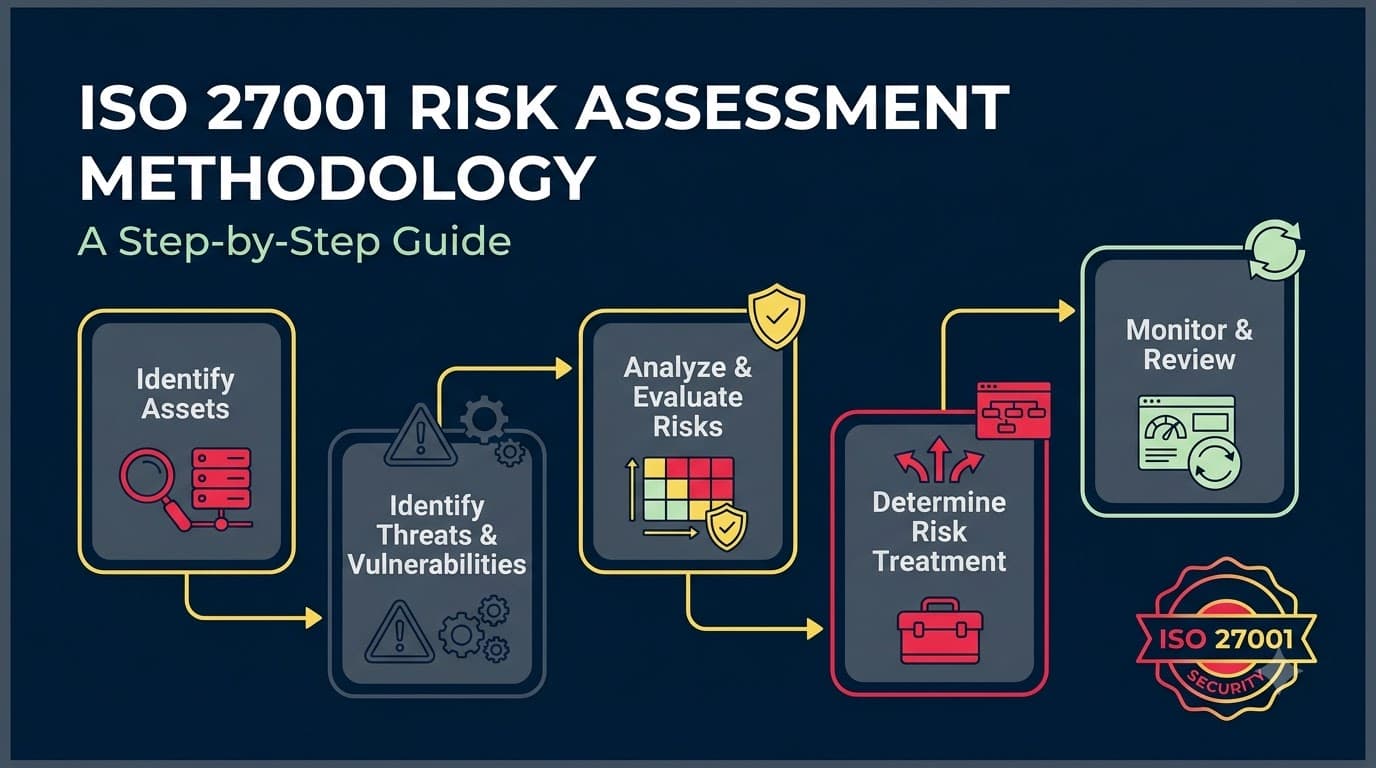
Clause 6.1.2 describes five things a risk assessment process must do: establish and maintain risk criteria, ensure repeatable and comparable results, identify risks, analyse them, and evaluate them against your criteria to prioritize treatment. Here's how those requirements chain together in practice.
flowchart LR
    A[Define Methodology<br/>& Risk Criteria] --> B[Identify Risks<br/>Asset- or Scenario-Based]
    B --> C[Assign<br/>Risk Owners]
    C --> D[Analyse Risks<br/>Likelihood x Impact]
    D --> E[Evaluate & Prioritize<br/>Against Criteria]
    E --> F[Document &<br/>Hand Off]
    F --> G[Risk Treatment Plan]
    G -.feedback loop.-> B
Notice the feedback loop at the end. Risk assessment isn't a one-time exercise that terminates when you hand the output to treatment planning — it's a cycle that reruns on a schedule, after significant changes, and whenever new threat information surfaces. Keep that loop in mind as we walk through each stage.
"The single biggest predictor of a clean Stage 2 audit isn't how sophisticated your risk matrix looks. It's whether you can hand an auditor your criteria document and your risk register and watch the two connect, line by line, without you having to explain anything." — Marcus Feldt, Lead Auditor, Ridgeline Certification Partners
STEP 1: Define Your Methodology and Risk Criteria
Clause 6.1.2(a) requires you to establish and maintain risk criteria — and it specifically calls out two kinds: criteria for performing risk assessments (so results are consistent, valid, and comparable) and criteria for risk acceptance (the threshold above which a risk cannot simply be left alone). This is the step every rushed implementation skips, and it's the one auditors probe first, because everything downstream depends on it. If your criteria aren't documented and consistently applied, every number in your risk register is arbitrary — which is exactly what happened to Cascade Ridge.
Start by deciding your scale. Most organizations use a qualitative or semi-quantitative 3-, 4-, or 5-point scale for likelihood and impact rather than full quantitative modeling (annualized loss expectancy, Monte Carlo simulation, and similar techniques belong to a more mature stage of the program, and we cover the trade-off in detail in our qualitative vs. quantitative risk assessment comparison). A 5-point scale gives you enough granularity to differentiate risks meaningfully without descending into false precision. Here's a defensible starting point.
Likelihood scale (illustrative — calibrate to your organization and threat landscape):
Level | Rating | Description | Illustrative Frequency |
|---|---|---|---|
1 | Rare | Would only occur in exceptional circumstances | Less than once in 5 years |
2 | Unlikely | Could occur but not expected | Once every 2–5 years |
3 | Possible | Might occur at some point | Once every 1–2 years |
4 | Likely | Will probably occur in most circumstances | Multiple times per year |
5 | Almost Certain | Expected to occur in most circumstances | Monthly or more frequently |
Impact scale (illustrative — anchor each level to real business consequences, not adjectives alone):
Level | Rating | Financial (Illustrative) | Operational | Regulatory/Legal | Reputational |
|---|---|---|---|---|---|
1 | Negligible | Under $10,000 | No disruption | No reporting obligation | No external visibility |
2 | Minor | $10,000–$50,000 | Localized, recoverable within hours | Internal note; no notification required | Limited to internal stakeholders |
3 | Moderate | $50,000–$250,000 | Department-level disruption, 1–2 days | Possible regulatory inquiry | Customer-facing complaint or local media |
4 | Major | $250,000–$1,000,000 | Organization-wide disruption, days | Mandatory breach notification likely | Regional media, customer attrition |
5 | Severe | Over $1,000,000 | Multi-week outage or recovery | Regulatory fines, enforcement action | National media, executive-level fallout |
Anchoring impact to dollar ranges and concrete operational effects — rather than leaving it as "high/medium/low" with no definition — is what makes a risk assessment comparable across assessors. Two people scoring the same scenario against these tables should land within one level of each other; two people scoring against unanchored labels routinely disagree by three.
Next, combine the two scales into a risk matrix that produces a level of risk.
Likelihood \ Impact | 1 Negligible | 2 Minor | 3 Moderate | 4 Major | 5 Severe |
|---|---|---|---|---|---|
5 Almost Certain | 5 | 10 | 15 | 20 | 25 |
4 Likely | 4 | 8 | 12 | 16 | 20 |
3 Possible | 3 | 6 | 9 | 12 | 15 |
2 Unlikely | 2 | 4 | 6 | 8 | 10 |
1 Rare | 1 | 2 | 3 | 4 | 5 |
Then translate the numeric score into risk bands that map to action, and — critically — define your risk acceptance criteria: the threshold at which a risk owner can accept a risk as-is versus where treatment is mandatory before you can proceed.
Risk Score | Band | Acceptance Criteria | Required Action |
|---|---|---|---|
1–4 | Low | Automatically acceptable | Monitor; no mandatory treatment |
5–9 | Medium | Acceptable with risk owner sign-off | Treat if cost-effective; document rationale if accepted |
10–15 | High | Not acceptable without executive approval | Treatment plan required; target date assigned |
16–25 | Critical | Not acceptable | Immediate treatment; management review; interim controls if needed |
Document all of this — the scales, the matrix, the acceptance bands, who approved them, and the date — in a single Risk Assessment Methodology document. That document, not the register itself, is what an auditor will ask for first, because it's the yardstick every other artifact gets measured against. Review and re-approve it at least annually, or sooner if a major incident reveals your bands were miscalibrated (more on that in the "Keeping It Repeatable" section below).
STEP 2: Identify Risks
With criteria fixed, you can move to identification — surfacing the actual risks you're going to score. ISO 27001:2022 deliberately loosened the old requirement here: earlier guidance effectively pushed everyone toward a rigid asset/threat/vulnerability inventory. The current standard lets you choose asset-based identification (start from your information asset inventory, then ask what threats and vulnerabilities apply to each one), scenario-based identification (start from plausible incident scenarios — "a former employee's credentials are used to exfiltrate customer data" — and work out what assets and controls are involved), or a blend of both.
Cascade Ridge's failure was a symptom of picking asset-based identification and then executing it against an incomplete asset list — nobody had walked the facility asking "what devices touch our network that aren't in the IT asset register?" Scenario-based identification is often more effective at catching exactly this kind of gap, because it starts from business-relevant "what could go wrong" questions rather than from a list that can quietly be missing things. We go deep on when to use which approach — including a decision framework and worked comparisons — in asset-based vs. scenario-based risk assessment; for this guide, the operative point is simpler: pick one as your primary method, document why, and use the other as a cross-check. A hybrid approach — asset inventory as the backbone, scenario workshops to pressure-test coverage — is what I recommend to most clients above a few hundred employees.
Wherever you start, run identification input from more than one source: interviews with system and process owners, your threat intelligence function under control 5.7, prior incident and near-miss records, internal and external audit findings, vendor and supplier risk questionnaires, and — for regulated organizations — statutory and contractual obligations. A risk assessment built entirely from an IT team's internal knowledge will reliably miss physical, third-party, and process risks that live outside IT's field of view.
Identification Source | What It Surfaces | Who to Involve |
|---|---|---|
Information asset inventory | Asset-based risks tied to known systems and data stores | Asset owners, IT/OT teams |
Scenario workshops | Cross-functional "what could go wrong" risks, including process and people risks | Department heads, security team, legal |
Threat intelligence feeds | Emerging external threats relevant to your sector | Security operations, threat intel lead |
Incident and near-miss history | Risks that have already partially materialized | Incident response team |
Supplier and third-party questionnaires | Supply-chain and outsourcing risks | Procurement, vendor risk owners |
Internal/external audit findings | Control gaps already identified | Internal audit, compliance |
Legal and regulatory review | Statutory, contractual, and jurisdictional risks | Legal counsel, DPO/privacy lead |
Capture each identified risk with a short, specific description — "ransomware encrypts production file shares via a phished helpdesk credential" is assessable; "cybersecurity risk" is not. A useful test: if two different people would score your risk description differently because it's ambiguous about what actually happens, rewrite it before it goes any further.
STEP 3: Assign Risk Owners
Clause 6.1.2(c) is explicit that identified risks must have an owner, and this is the requirement Cascade Ridge's auditor tested first because it's the fastest way to expose a paper exercise. A risk owner is not "whoever's department the asset sits in" — it is a specific, named individual with the authority to make decisions about the risk: accept it, direct treatment, allocate budget, and be accountable for the outcome. "IT Department" is not an owner. "Priya Nandan, Information Security Manager" or "Daniel Osei, VP of Claims Processing" is.
Get the owner assignment wrong and two things happen downstream: nobody is accountable when a treatment action stalls, and — worse for audit purposes — you can't demonstrate that risk decisions were made by people with the authority to make them. Assign owners at the point of identification, not as an afterthought once scoring is done, because the owner is frequently the best-positioned person to validate likelihood and impact for risks in their domain.
Risk Owner Should Be | Risk Owner Should NOT Be |
|---|---|
A named individual with budget or decision authority over the affected asset/process | A department name, a distribution list, or "the team" |
Someone who can accept, treat, transfer, or escalate the risk | Someone who can only implement controls but not decide the risk response |
Accountable in the ISMS documentation, reviewed at management review | Assigned once and never revisited as roles change |
Typically a business process owner or senior IT/security leader, not always the CISO | Automatically defaulted to the security team for every risk regardless of domain |
A common misstep worth naming directly: routing every risk to the CISO or security manager as owner because it's the path of least resistance. It creates a bottleneck, and it misrepresents accountability — a risk about a third-party payroll vendor belongs with the HR or finance leader who holds that vendor relationship, with security as an advisor, not the decision-maker. Roles and responsibilities under controls 5.2–5.4 should already define who typically owns risk in which domain — use that structure rather than reinventing it for each assessment cycle.
"I ask one question in almost every risk interview: 'If this risk materializes tomorrow, whose job is on the line?' If nobody can answer that in under five seconds, the risk doesn't have an owner — it has a placeholder." — Renata Kowalczyk, Senior ISMS Consultant, Northfield Advisory Group
STEP 4: Analyse Risks — Likelihood, Impact, and Level of Risk
Analysis is where you apply the criteria from Step 1 to the risks from Step 2, with input from the owners assigned in Step 3. For each risk, the analysis has three moving parts: assess the likelihood using your documented scale, assess the impact (typically across confidentiality, integrity, and availability, then rolled up to a business consequence), and calculate the level of risk from your matrix.
Do this consistently by having the same small group — not one person working alone — score every risk in a single sitting or a tightly scheduled set of workshops, ideally with the risk owner present or consulted for their domain. Consistency is explicitly required by Clause 6.1.2(b): your process has to produce results that are valid and comparable across repeated exercises, which is difficult to achieve if scoring happens piecemeal, over months, by whoever happens to be free that week.
A practical technique that improves consistency dramatically: score inherent risk first (before considering any existing controls), note which controls currently exist and are operating effectively, then score residual risk separately. This two-pass approach does three things — it shows you the raw exposure your organization would face with zero controls (useful context for management), it gives you a defensible way to demonstrate that existing controls are earning their place in the Statement of Applicability, and it prevents the common error of assessors unconsciously discounting likelihood because "well, we have a firewall" without ever writing that reasoning down.
Analysis Step | What You're Doing | Common Failure Mode |
|---|---|---|
Assess likelihood | Rate against the documented scale, informed by threat intelligence, incident history, and owner input | Guessing without reference to the scale definitions |
Assess impact (C/I/A + business consequence) | Rate against the impact table, considering financial, operational, legal, and reputational dimensions | Scoring only technical impact and ignoring business consequence |
Calculate inherent risk | Likelihood × impact before controls | Skipped entirely — jumps straight to residual |
Identify existing controls | List controls currently in place and their operating effectiveness | Assuming a control works because it's documented, not because it's verified |
Calculate residual risk | Likelihood × impact after existing controls are factored in | Confusing residual with inherent, or double-counting control effect |
Watch for two analytical traps in particular. The first is anchoring bias: once one risk in a session gets scored a 15, every subsequent risk tends to get judged relative to that one rather than against the criteria table — recalibrate by returning to the scale definitions for every single risk, not the previous score. The second is optimism bias from the control owner: the person who built a control is a poor sole judge of its effectiveness, because they have an incentive to believe it works. Cross-check self-reported control effectiveness against independent evidence — technical vulnerability management scan results, logging and monitoring data, or recent internal audit findings — before you let it reduce a residual score.
STEP 5: Evaluate and Prioritize
Evaluation is the comparison step: take the level of risk calculated in Step 4 and check it against the risk acceptance criteria you defined in Step 1. This is a distinct activity from analysis, and Clause 6.1.2(d) treats it as such — analysis tells you how big the risk is; evaluation tells you what that size means for action.
For each risk, evaluation produces one of three outcomes: accept (the risk falls at or below your acceptance threshold and the owner formally accepts it, with that decision documented — not silently ignored), treat (the risk exceeds acceptance criteria and must go into a treatment plan), or escalate (the risk owner lacks authority to accept or fund treatment at this level, and it needs to go to a more senior body — typically top management at a Critical band). Prioritization then ranks the "treat" and "escalate" risks against each other so limited budget and attention go where they'll reduce the most exposure first.
Risk Level | Score Range | Evaluation Outcome | Typical Prioritization |
|---|---|---|---|
Critical | 16–25 | Escalate to top management; immediate treatment | Addressed first, often with interim compensating controls while a permanent fix is built |
High | 10–15 | Treat; owner defines treatment plan with target date | Second priority tier; resourced in current planning cycle |
Medium | 5–9 | Treat if cost-effective, or accept with documented rationale | Addressed opportunistically or in next planning cycle |
Low | 1–4 | Accept | Monitored; revisited at next scheduled review |
A prioritization detail that gets missed: don't rank purely by numeric score when two risks land in the same band. Layer in secondary factors — cost and speed of treatment, regulatory deadlines, dependency on other treatment actions, and whether the risk sits on a critical business process — to break ties. A 12-scored risk tied to an upcoming regulatory audit deadline may reasonably jump ahead of a 12-scored risk with no external deadline, even though the matrix treats them identically. Document that reasoning; auditors are comfortable with professional judgment as long as you can show your work.
STEP 6: Document and Hand Off to Treatment
The output of evaluation isn't the end of the risk assessment process — it's the input to risk treatment. Clause 6.1.2(e) requires you to retain documented information about the whole process, and Clause 6.1.3 picks up immediately where this leaves off, requiring a risk treatment process and a Statement of Applicability. Practically, that means every risk that comes out of evaluation as "treat" or "escalate" needs to land in two places: your risk register, as the single source of truth for risk status, and — for risks where new or modified controls are selected — your Statement of Applicability, which documents which Annex A controls you've selected and why.
Build your risk register directly from the fields you've already generated in Steps 1–5: risk description, asset or scenario, owner, inherent likelihood/impact/score, existing controls, residual likelihood/impact/score, evaluation outcome, and treatment status. Resist the temptation to re-derive these fields differently in the register than in the assessment workshop output — the two documents should be one continuous record, not a summary that quietly drops detail an auditor might ask to trace back.
From there, the risks marked "treat" or "escalate" flow into a risk treatment plan, where each gets a treatment option (modify, retain, avoid, or share the risk), specific control selections, an owner, a target date, and a target residual risk level. That handoff is where risk assessment ends and risk treatment begins — and it's worth building your assessment documentation with that handoff explicitly in mind, rather than treating it as a separate project once assessment is "done."
Documentation Artifact | What It Must Contain | Where It's Reviewed |
|---|---|---|
Risk Assessment Methodology | Criteria, scales, matrix, acceptance thresholds, approval record | Management review, internal/external audit |
Risk Register | Every identified risk with owner, scores, evaluation outcome, treatment status | Ongoing operational reference; audited directly |
Statement of Applicability | Selected/excluded Annex A controls with justification, tied back to risks | Certification audit centerpiece |
Risk Treatment Plan | Treatment option, control selection, owner, target date, target residual risk | Progress tracked at management review |
"The auditors who fail people aren't looking for a perfect risk register. They're looking for a straight line — criteria to identification to analysis to evaluation to treatment — with no document that contradicts another one along the way." — Devon Achterberg, ISO 27001 Lead Implementer, Fifth Meridian Consulting
How Long Should This Actually Take?
One of the first questions I get from a newly appointed ISMS manager is some version of "how many weeks do I need to block off for this?" There's no universal answer, because it scales with organizational complexity, but a realistic planning range helps you set expectations with management before you commit to a certification date.
For a small organization (under 100 employees, a handful of systems, a single location), a first full cycle through all six steps typically runs three to five weeks, most of it spent on identification workshops and getting risk owners to actually sit down with you. For a mid-size organization (100–1,000 employees, multiple business units, some third-party dependencies), plan for six to ten weeks, with Step 2 (identification) and Step 4 (analysis) as the two stages most likely to run long because they require the most cross-functional coordination. For a large or complex organization — multiple locations, regulated data, significant third-party and cloud dependencies — a first cycle can reasonably take twelve to sixteen weeks, and trying to compress it invites exactly the kind of shortcut that produced Cascade Ridge's spreadsheet.
Subsequent annual cycles run considerably faster than the first, because the criteria document doesn't need rebuilding, risk owners already understand their role, and you're updating and re-scoring existing risks rather than starting from a blank register. Most mature programs complete an annual refresh in two to four weeks.
Step | Small Org (Weeks) | Mid-Size Org (Weeks) | Large/Complex Org (Weeks) | Primary Time Driver |
|---|---|---|---|---|
Step 1: Define methodology & criteria | 0.5–1 | 1–1.5 | 1.5–2 | Management approval cycles for criteria and acceptance thresholds |
Step 2: Identify risks | 1–1.5 | 2–3 | 3–5 | Scheduling cross-functional workshops and interviews |
Step 3: Assign risk owners | 0.5 | 0.5–1 | 1–1.5 | Confirming authority and availability of named owners |
Step 4: Analyse risks | 1 | 1.5–2.5 | 3–4 | Scoring sessions, gathering control-effectiveness evidence |
Step 5: Evaluate & prioritize | 0.5 | 1 | 1–1.5 | Reconciling ties and secondary prioritization factors |
Step 6: Document & hand off | 0.5–1 | 1–1.5 | 2–2.5 | Populating the register and Statement of Applicability cross-references |
Total (first cycle) | 3–5 | 6–10 | 12–16 | |
Total (subsequent annual cycles) | 1–1.5 | 2–3 | 4–6 |
Build slack into the first cycle's timeline specifically around Step 2 and Step 4 — they're the steps most dependent on other people's calendars, and they're also the steps where rushing produces the shallow, single-assessor results that fail audit scrutiny. It is far better to tell management the first assessment needs ten weeks and deliver something defensible than to promise four weeks and deliver Cascade Ridge's spreadsheet.
A Full Worked Example: Six Risks, Start to Finish
Here's what the six steps above produce when actually run, using the methodology, matrix, and acceptance bands defined in Step 1. These are illustrative risks modeled on the kind of findings a mid-size organization typically surfaces in a first assessment cycle — treat the scores as demonstrations of method, not universal benchmarks for your own environment.
# | Risk Description | Owner | Inherent L / I / Score | Existing Controls | Residual L / I / Score | Evaluation Outcome |
|---|---|---|---|---|---|---|
1 | Phishing email leads to compromised credentials used to access the finance ERP system | Marcus Adeyemi, Finance Director | 4 / 4 / 16 | MFA on ERP login, annual phishing awareness training | 3 / 4 / 12 | Treat — High |
2 | Legacy biomedical device network shares a switch with the general corporate network, allowing lateral movement from a compromised endpoint | Priya Nandan, Info Security Manager | 4 / 5 / 20 | None currently implemented | 4 / 5 / 20 | Escalate — Critical |
3 | Departing employee retains access to cloud file storage after termination due to manual, inconsistent offboarding | Lena Vasquez, HR Director | 3 / 3 / 9 | Termination checklist (manual), quarterly access review | 2 / 3 / 6 | Accept with sign-off — Medium |
4 | Third-party payroll processor suffers a breach exposing employee PII held on our behalf | Daniel Osei, VP Finance Operations | 3 / 4 / 12 | Vendor security addendum in contract, annual vendor questionnaire | 3 / 3 / 9 | Treat — Medium/High boundary |
5 | Unpatched public-facing web application server is exploited via a known CVE | Tomas Berger, IT Infrastructure Lead | 4 / 4 / 16 | Monthly patch cycle, external vulnerability scanning | 2 / 4 / 8 | Treat if cost-effective — Medium |
6 | Backup files are not tested for restorability, risking failed recovery after a ransomware event | Tomas Berger, IT Infrastructure Lead | 3 / 5 / 15 | Nightly automated backups (untested restores) | 3 / 5 / 15 | Treat — High |
Two things worth noticing in this table. First, risk #2 — Cascade Ridge's actual gap — scores identically at inherent and residual because there were no existing controls to reduce it; that flat line from inherent to residual is itself a signal worth flagging at management review, because it usually means the risk has gone unaddressed for a long time. Second, risk #5 shows the clearest before/after story: existing patch and scan controls take a 16 down to an 8, which is the kind of evidence that justifies why those controls stay in your Statement of Applicability rather than getting cut during a cost review.
Prioritized for treatment, this set would run: risk #2 first (Critical, escalated to top management, likely with an immediate compensating control — network segmentation — while a permanent redesign is scoped), then risk #1 and risk #6 (both High), then risk #4 and risk #5 (Medium, addressed in the current planning cycle), with risk #3 accepted on the record by its owner given the residual score falls within the Medium band and the owner has judged further investment not currently justified.
Keeping It Repeatable and Consistent
A risk assessment done once, well, is a good start. A risk assessment that produces comparable results every time you run it — across different assessors, different business units, and different years — is what Clause 6.1.2 actually asks for, and it's harder to achieve than it looks. A few practices make the difference.
Run calibration sessions before scoring, not after. Before a group scores risks independently, walk through two or three example scenarios together and agree on where they land on the likelihood and impact scales. This single hour of alignment prevents the widest source of inconsistency: different people quietly interpreting "Likely" or "Major" differently.
Reuse the same criteria document across cycles — don't redraft it. If your likelihood scale changes definition between this year's assessment and last year's, you can no longer compare risk trends over time, which undermines one of the main uses of a mature risk register: showing management whether your risk posture is improving.
Rotate who conducts interviews, but keep scoring centralized. Interviews with asset and process owners benefit from fresh perspectives; the actual scoring against the matrix should go through a small, consistent group (often the ISMS manager plus one or two others) so the same judgment calibration applies everywhere.
Revisit criteria at least annually, and document why if you change them. Business context shifts — new regulatory exposure, a new market, a major incident that reveals your impact table underestimated a category. When you do recalibrate, record the change and the reasoning in the methodology document itself; an auditor who sees your bands shifted from last year will want to know it was a deliberate management decision, not drift.
Consistency Practice | Why It Matters | How Often |
|---|---|---|
Calibration session before scoring | Aligns interpretation of scale definitions across assessors | Before every assessment cycle |
Fixed criteria document, versioned | Enables trend comparison across cycles | Reviewed annually, changed deliberately |
Centralized scoring group | Reduces inter-assessor variance | Every cycle |
Independent evidence for control effectiveness | Prevents optimism bias from control owners | Every risk involving existing controls |
Documented rationale for tie-breaks and exceptions | Gives auditors a traceable decision path | Whenever professional judgment overrides the raw matrix score |
Common Mistakes That Undermine an Otherwise Good Assessment
Even organizations that genuinely try to do this properly trip over the same handful of errors. I've seen every one of these more than once, and most of them are easy to fix once you know to look for them.
Treating the risk assessment as an IT-only exercise. Information security risk touches HR, legal, facilities, finance, and vendor management. An assessment run entirely inside the IT department will systematically miss process and people risks — exactly the kind of gap that shows up as a nonconformity.
Scoring risks in isolation from business context. A server outage that would be catastrophic for an e-commerce company might be a minor inconvenience for an organization with a manual fallback process. Impact scores need business input, not just technical severity.
No documented rationale for scores. An auditor doesn't just want the number — they want to see why. Keep a short justification field in your register for every score, especially outliers.
Confusing risk assessment with a vulnerability scan. A vulnerability scanner tells you about technical weaknesses; it doesn't assess business impact, likelihood in your specific context, or assign an owner. Feed scan output into your assessment as evidence — don't mistake it for the assessment itself.
Letting the register go stale. A risk assessment frozen at the moment of certification and never revisited is a bigger red flag at surveillance audits than a smaller, honestly maintained register. Risks change as the business changes; the register should too.
Skipping acceptance documentation. When a risk owner decides to accept a risk, that decision — and its rationale — needs to be recorded, dated, and signed off. An unrecorded "we decided this was fine" is functionally identical to an oversight, from an auditor's perspective.
Over-engineering the matrix. I've seen 7x7 matrices with decimal weightings that no one in the room can explain during an audit interview. A well-anchored 5x5 matrix that everyone understands beats an elaborate one nobody can defend.
Mistake | Consequence | Fix |
|---|---|---|
IT-only assessment | Missing process, people, and physical risks | Cross-functional identification workshops |
No business context in impact scoring | Impact scores disconnected from real consequence | Anchor impact table to dollar figures and business effects |
No documented rationale | Auditor treats scores as arbitrary | Justification field for every score in the register |
Vulnerability scan mistaken for risk assessment | Missing likelihood, business impact, and ownership | Use scan output as evidence, not the assessment itself |
Stale register | Nonconformity at surveillance audit | Scheduled review cadence, event-triggered updates |
Undocumented risk acceptance | Accountability gap, audit finding | Formal, dated, signed acceptance record |
Overcomplicated matrix | Nobody can explain scoring logic under audit | Keep the matrix simple and well-anchored |
Tying Risk Assessment Into the Wider ISMS
A risk assessment that lives in isolation from the rest of your management system is a paper exercise waiting to be discovered as one. The six steps in this article need to connect visibly to at least three other ISMS mechanisms, and auditors will specifically look for that connective tissue.
Management review. Top management should see a summary of risk assessment results — new Critical and High risks, trend versus the prior cycle, and treatment progress — at every management review. If your management review minutes never mention risk assessment outcomes, that's a gap an auditor will notice quickly, because Clause 9.3 explicitly expects the ISMS's performance, including risk treatment, to feed leadership decision-making.
Internal audit. Your internal audit program should periodically test the risk assessment process itself — not just whether the register exists, but whether scores are defensible, owners can speak to their risks, and the methodology has actually been followed as documented. Treat your own risk assessment as auditable, because it will be.
Corrective action. When an internal or external audit finds a gap in your risk assessment — an unscored asset, an owner who can't explain their risk, a stale score — that finding should flow into your Clause 10 corrective action process like any other nonconformity, with a root cause and a fix that prevents recurrence, not just a one-time correction of the specific row in question.
ISMS Mechanism | What It Should Receive From Risk Assessment | Clause Reference |
|---|---|---|
Management review | Summary of risk levels, trends, and treatment progress | Clause 9.3 |
Internal audit program | Periodic testing of methodology adherence and score defensibility | Clause 9.2 |
Corrective action process | Root-cause fixes for gaps found in the assessment itself | Clause 10 |
Statement of Applicability | Control selection justification traced back to specific risks | Clause 6.1.3 |
Get these connections visible and documented, and your risk assessment stops looking like an isolated deliverable produced once for certification — it starts looking like what it's supposed to be: the engine that drives the rest of the management system's decisions.
Case Studies
Case Study 1: The Regional Credit Union That Found Its Real Exposure
Fenwick Valley Credit Union ran its first ISO 27001 risk assessment using a pure asset-based approach, scoring forty-two IT assets against a basic matrix. It passed an internal review but felt thin to the ISMS manager, who added a scenario-based cross-check as recommended by her consultant. The scenario workshop surfaced a risk nobody had scored: a single shared service account used by three overnight batch processes had domain administrator privileges and no logging on its usage. Scored properly, that scenario landed at 20 (Critical) — higher than anything on the original asset list. Remediation (breaking the shared account into three scoped service accounts with logging) took eleven days and roughly $18,000 in contractor time. The credit union's auditor later cited the scenario-based cross-check specifically as a strength in the certification report.
Case Study 2: The SaaS Vendor That Fixed Its Ownership Problem
Lattermark Analytics, a 90-person SaaS company, had a technically sound risk register with accurate scores — but every one of its thirty-one risks listed "Security Team" as owner. During a mock audit ahead of Stage 2, the internal auditor asked five risk owners to explain their risk in a five-minute interview; none of the five people contacted (all pulled from the security team) could speak knowledgeably about the business risks tied to sales, HR, or product data. The company spent three weeks reassigning ownership to actual process owners — the VP of Sales for the CRM data risk, the Head of People for the HRIS risk — and running a short briefing session with each new owner. At the real Stage 2 audit six weeks later, the auditor interviewed two risk owners at random and found both able to speak fluently about their risk, its treatment status, and their acceptance rationale. Zero nonconformities were raised against Clause 6.1.2.
Case Study 3: The Manufacturer That Stopped Re-Scoring From Scratch Every Year
Halbrook Industrial Systems had run three annual risk assessments, each one essentially starting over: new consultants, a redrafted matrix, and scores that bore no resemblance to the prior year's numbers. Management couldn't tell if security posture was improving or not — the numbers moved, but nobody knew if that reflected real change or just different people scoring differently. The company fixed this by locking its methodology document for a three-year cycle (reviewed but not redrafted annually), keeping the same core scoring group each year, and running a one-hour calibration session before each cycle. Year-over-year, the register showed fourteen risks trending down (evidence treatment was working), three trending up (flagged for management attention), and the rest stable — the first time the company had a defensible trend line to show its board.
"The moment a client tells me their risk scores from last year don't compare to this year's, I know the methodology got rewritten, not just applied. That's a fixable problem, but only if you catch it before the audit does." — Sofia Reinholt, Principal Consultant, Ashgrove Risk & Compliance
How This Compares to Risk Assessment Under Other Frameworks
If your organization is juggling multiple compliance obligations, it helps to know that the risk assessment muscle you build here isn't ISO-specific — the underlying discipline transfers, even though the terminology and mandatory artifacts differ.
NIST SP 800-30 describes a risk assessment methodology that maps closely to what's in this article — identify threat sources and events, identify vulnerabilities, determine likelihood, determine impact, and calculate risk — and organizations aligning to NIST 800-30's risk assessment guidance will find the concepts here directly reusable, with NIST tending toward more granular, quantitatively-flavored scoring guidance than ISO 27001 mandates.
SOC 2 doesn't prescribe a specific risk assessment methodology the way ISO 27001's Clause 6.1.2 does, but the Trust Services Criteria (specifically the CC3 series) require a documented risk assessment process for SOC 2 that identifies risks to the audit's objectives and evaluates how they're mitigated — organizations pursuing both certifications typically run one unified risk assessment and map the outputs to each framework's specific documentation requirements rather than duplicating the exercise.
GDPR's Data Protection Impact Assessment (DPIA) is a narrower, purpose-built cousin of what you've just built — required specifically for processing likely to result in high risk to individuals' rights and freedoms, focused on privacy impact rather than general information security risk. A mature ISO 27001 risk assessment process makes DPIAs under GDPR considerably easier to produce, because you already have the asset inventory, the scenario-identification muscle, and the impact-scoring discipline — you're narrowing the lens to personal data processing rather than starting from zero.
Framework | Risk Assessment Requirement | Relationship to ISO 27001 Approach |
|---|---|---|
ISO 27001 (Clause 6.1.2) | Documented criteria, identification, analysis, evaluation, prioritization | The methodology built in this article |
NIST SP 800-30 | Threat/vulnerability-based likelihood and impact assessment | Conceptually near-identical; often more granular scoring |
SOC 2 (CC3 series) | Risk identification and mitigation tied to Trust Services Criteria | Can share one underlying assessment, mapped to different documentation |
GDPR DPIA | Privacy-focused impact assessment for high-risk processing | A narrower, purpose-specific application of the same skills |
From Compliance Exercise to Competitive Advantage
It's tempting to treat risk assessment as the tedious middle chapter between scoping your ISMS and getting to the controls everyone actually wants to talk about. That's a mistake, and it's the mistake Cascade Ridge made the first time around. A risk assessment done properly is the single artifact that lets you say — to a customer, a regulator, a board, or an auditor — exactly what could go wrong, how bad it would be, who's accountable, and what you're doing about it, in that order, with evidence behind every claim. Organizations that treat this step as a genuine planning exercise, rather than a box-check, consistently find it pays for itself well beyond certification: it sharpens security budget conversations, gives incident response teams a pre-built map of what matters most, and turns "trust us, we're secure" into a documented, defensible answer that closes enterprise deals faster.
The methodology in this article — criteria, identification, ownership, analysis, evaluation, prioritization — isn't a one-time certification hurdle. It's a management tool you'll run every year for as long as the ISMS exists, and the quality of your first pass sets the baseline everything after it gets measured against. Get the criteria right, get the ownership real, and get the documentation tight, and the rest of the ISMS — the Statement of Applicability, the treatment plan, the internal audit program — follows naturally from a foundation that can actually bear the weight.
"Clients ask me why the risk assessment takes longer than they expected. I tell them: because it's the only document in your entire ISMS that has to be individually defensible, line by line, to a skeptical stranger. Everything else in the system points back to it." — Harlan Voss, Director of Advisory Services, Sentry Peak Consulting
If you're building this for the first time and want to move faster than a blank spreadsheet allows, PentesterWorld's Risk Scoring Calculator will apply the likelihood-times-impact logic from Step 4 automatically once you've calibrated your own scales, and the ISO 27001 Risk Register Template is pre-built with every field this article's worked example uses — owner, inherent score, existing controls, residual score, and evaluation outcome — so you're populating a structure auditors already recognize rather than inventing one under deadline pressure. Once your assessment produces its first set of "treat" and "escalate" risks, our hands-on lab, Build a Sample Risk Treatment Plan, walks you through turning those outputs into a real treatment plan using the same worked risks referenced throughout this guide. And if you're not yet sure where your ISMS stands overall, PentesterWorld's ISO 27001 Gap Analysis Tool will tell you whether risk assessment is your next priority or whether earlier foundational work needs attention first — with the full method laid out in The Complete ISO 27001 Implementation Guide if you want the end-to-end roadmap in one place.
Run this methodology once, well, and you won't dread the next cycle — you'll have a repeatable process, a calibrated set of criteria, and a register that tells a consistent story year over year. That's the difference between a risk assessment that exists and one that actually protects the organization it's written for.