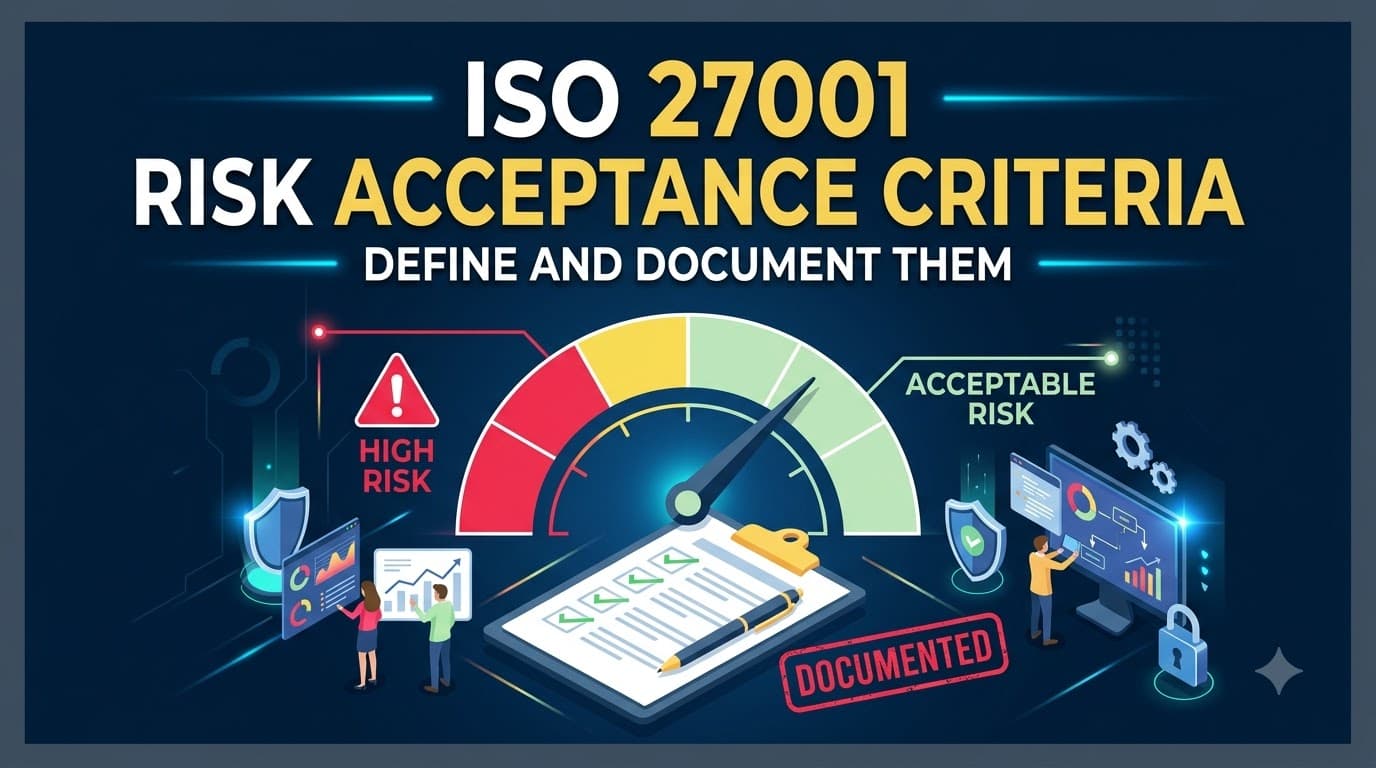
Marcus Webb had been operations manager at Halcyon Logistics for six years, and he'd never once been asked to sign off on a risk. That was the problem.
Halcyon was a mid-market third-party logistics provider — about 900 employees, warehouses in four states, and a growing book of retail clients who shipped through Halcyon's EDI (electronic data interchange) network to move purchase orders, invoices, and shipping manifests. In the run-up to Halcyon's ISO 27001 recertification audit, the internal risk register flagged something Marcus already knew about: a legacy EDI gateway that still accepted unencrypted file transfers from two smaller regional retail partners who hadn't yet migrated to the newer SFTP-based integration.
The risk assessment scored it correctly — moderate likelihood, high impact, given that the files contained customer PII and order-level financial data. The recommended treatment was to force encryption or decommission the legacy gateway within 90 days. Marcus looked at the cost — roughly $40,000 in engineering time plus the political cost of telling two retail partners they had 90 days to re-integrate — and made a call. He typed "risk accepted, low likelihood of exploitation, monitoring in place" into a spreadsheet column, and moved on. Nobody asked him to. Nobody stopped him. There was no acceptance workflow, no named risk owner, no expiry date, and certainly no signature from anyone with the authority to accept a risk of that magnitude on behalf of the organization.
Fourteen months later, one of those regional retail partners was compromised. The attacker pivoted through the unencrypted file transfer path directly into Halcyon's environment, sat in the network for eleven days, and exfiltrated order data covering roughly 140,000 customer records before Halcyon's monitoring caught the anomaly. The total cost — forensic investigation, breach counsel, regulatory notification across three states, a lost enterprise contract, and a very uncomfortable stage 2 surveillance audit — came to just over $2.3 million. When Halcyon's new CISO went looking for who had accepted the residual risk and why, she found a spreadsheet cell with Marcus's initials and no supporting rationale, no time limit, and no evidence that anyone with actual authority over the ISMS had ever seen it.
That is the failure mode this article exists to prevent. Not a failure of risk assessment — Halcyon's assessment process correctly identified and scored the risk — but a failure of risk acceptance: the absence of a defined, documented, board-aligned set of criteria for what "acceptable" actually means, and who is allowed to say so.
Who this is for, and what you'll walk away with
This article is for the person who owns Clause 6.1.2 in a real ISMS: the ISMS manager, CISO, or GRC lead who has a risk assessment methodology and a risk register that mostly works, but whose "risk acceptance" step is still an informal nod rather than a documented, defensible decision. You should already have (or be building) a risk assessment methodology and a working risk register; this piece picks up exactly where those leave off — at the moment a residual risk score comes back and someone has to decide whether it's good enough to leave alone. You'll walk away with a working definition of risk appetite versus risk tolerance versus acceptance criteria, a worked example of criteria mapped onto a risk matrix, an authority-tier table for who can accept what, a documented-acceptance template with the fields an auditor will look for, and a practical process for time-bounding and reviewing acceptances so they don't quietly rot into permanent, unexamined exposure.
Why Clause 6.1.2 exists — and what it actually requires
ISO/IEC 27001:2022 Clause 6.1.2, "Information security risk assessment," requires the organization to define and apply an information security risk assessment process. Within that clause, the standard requires the organization to establish and maintain information security risk acceptance criteria, and criteria for performing information security risk assessments, ensuring that repeated risk assessments produce consistent, valid, and comparable results. This is a narrower and more specific requirement than people often assume. Clause 6.1.2 does not just ask you to assess risk — it asks you to define, in advance, the rule you will use to decide whether a given level of risk is acceptable, and to apply that rule consistently across every risk assessment cycle.
Clause 6.1.3, "Information security risk treatment," is where the companion requirement lives: risk owners must approve the risk treatment plan and accept the residual risks, along with any associated conditions. Read together, 6.1.2 and 6.1.3 describe a two-part discipline. First, you set the criteria — the threshold, defined before you know what specific risks you'll be scoring, that tells you when a risk needs treatment and when it doesn't. Second, for each individual risk, the accountable risk owner formally accepts the residual risk that remains after treatment, against those pre-defined criteria. Halcyon's failure was that it never did the first part properly, which meant the second part had no rule to be applied against — Marcus wasn't violating a documented threshold, because no threshold existed for him to violate. That absence is itself the nonconformity an auditor will write up, well before they get to the question of authority.
"The single most common Stage 2 finding I write in risk management is not 'you accepted the wrong risk.' It's 'you have no documented criteria for what an acceptable risk looks like, so I can't tell whether any acceptance decision in this register was made correctly.' Criteria have to exist on paper before a single risk is scored against them." — Dr. Frida Kessler, Lead Auditor, Nordholm Certification Body
Three terms people conflate — and why the difference matters
Almost every organization I've worked with over fifteen years of ISMS consulting uses "risk appetite" and "risk tolerance" interchangeably, and then wonders why their acceptance criteria feel arbitrary. They are related but distinct concepts, and ISO 27001 acceptance criteria only work when you've built them on top of the first two.
Risk appetite is the broad, qualitative statement of how much risk the organization is willing to pursue or retain in service of its objectives. It's set at board or executive level, usually in a single paragraph or short policy statement, and it rarely changes more than once a year. "Halcyon Logistics will not accept risks that could result in unauthorized disclosure of customer PII, and will accept low-to-moderate operational risks in pursuit of service reliability and cost efficiency" is a risk appetite statement. It tells you the direction, not the number.
Risk tolerance is the acceptable variation around that appetite — the band of deviation the organization can absorb before it becomes a problem. Tolerance translates appetite into something closer to a boundary: "the organization will tolerate up to 4 hours of unplanned downtime per critical system per quarter" or "the organization will tolerate a residual risk score of up to 12 (on a 25-point scale) for risks affecting non-regulated data." Tolerance is still somewhat abstract, but it's measurable.
Risk acceptance criteria are the operational rule that sits on top of both — the specific, applied threshold written into your risk assessment methodology that tells an assessor, in the moment, whether a scored risk is acceptable as-is or must go to treatment. Acceptance criteria are what actually gets typed into the risk register: "residual risk scores of 1–8 are accepted without further approval; 9–15 require risk owner sign-off with documented rationale; 16–25 require treatment before acceptance is even considered." Appetite sets the philosophy, tolerance sets the boundary, and acceptance criteria set the rule that gets applied risk by risk.
Concept | What it answers | Who sets it | How often it changes | Where it lives |
|---|---|---|---|---|
Risk appetite | "How much risk are we generally willing to take in pursuit of our objectives?" | Board / executive committee | Annually, or after major strategic shift | Risk appetite statement, ISMS policy |
Risk tolerance | "How much variation from that appetite can we absorb before it's a problem?" | Executive committee, informed by risk management | Annually, reviewed at each management review | Risk management policy, tolerance bands |
Risk acceptance criteria | "Given a scored risk, is it acceptable as-is or does it need treatment?" | ISMS manager / CISO, approved by top management | Reviewed at each risk methodology update | Risk assessment methodology, risk register rules |
A quick way to keep these straight when you're drafting documentation: appetite is a sentence, tolerance is a boundary, and acceptance criteria are a rule you can apply to a spreadsheet row without having to ask anyone what they meant.
"I ask every client the same question in the first workshop: if I handed you a risk register with fifty scored risks in it right now, could you tell me — without asking anyone — which ones are acceptable? If the answer is no, you don't have acceptance criteria. You have a scoring exercise." — Elena Vasquez, CISO, Marlowe Dover Insurance
Defining acceptance criteria on the risk matrix
Most organizations already have a risk matrix from their risk assessment methodology — likelihood on one axis, impact on the other, producing a risk level or numeric score. Acceptance criteria are the layer you add on top of that matrix: a mapping from risk level to required action. This is the single most concrete, auditable artifact in the entire acceptance process, and it's worth getting the thresholds right the first time, because changing them retroactively raises awkward questions about every prior acceptance decision made under the old rule.
Here's a worked example using a 5x5 qualitative matrix (Likelihood 1–5 x Impact 1–5, producing scores from 1–25), of the kind I've built with dozens of mid-market clients:
Risk score range | Risk level | Acceptance criteria (default rule) |
|---|---|---|
1–4 | Very Low | Accepted automatically; logged in register, no separate sign-off required |
5–8 | Low | Accepted by risk owner without escalation; annual review at minimum |
9–12 | Medium | Requires documented risk owner acceptance with rationale; reviewed at each management review |
13–16 | High | Requires treatment plan OR documented acceptance by senior management with compensating controls and defined review date |
17–20 | Very High | Treatment required; acceptance only permitted with executive committee sign-off, time-bound, and quarterly review |
21–25 | Critical | Treatment mandatory; acceptance not permitted except by the board or equivalent governing body, with a documented, time-limited exception |
Note what this table is doing: it isn't just labeling risk levels, it's tying each level to a specific action and a specific authority tier — which is exactly what Clause 6.1.2 asks you to maintain, and exactly what was missing at Halcyon. Marcus's EDI risk, scored honestly, would have landed at 15 or 16 on this scale — squarely in the "requires treatment or senior management acceptance with compensating controls" band. Under this table, an operations manager six levels below the CISO has no authority to touch it.
It's worth being explicit in your documentation about what "acceptable" means at the very bottom band too. A common mistake is treating "Very Low" risks as invisible — not tracked, not reviewed, quietly dropped from the register. Under Clause 6.1.2's consistency requirement, even automatically-accepted risks should remain visible in the register with their score and date, because your criteria for performing assessments have to produce results that are "valid and comparable" — which means someone re-running the same assessment eighteen months later should get the same treatment decision, not a different one because the risk quietly disappeared.
If your organization uses quantitative or semi-quantitative scoring (annualized loss expectancy, dollar-denominated impact bands), the same logic applies with dollar thresholds instead of ordinal scores — see our companion piece on qualitative vs quantitative risk assessment for how to choose between the two and where hybrid models tend to land in practice.
A dollar-denominated version of the same table might look like this for a mid-sized organization:
Estimated annualized impact | Risk level | Acceptance rule |
|---|---|---|
Under $10,000 | Negligible | Accepted, logged, no sign-off |
$10,000–$75,000 | Minor | Risk owner acceptance, documented rationale |
$75,000–$500,000 | Moderate | Department head acceptance, treatment options must be documented as considered |
$500,000–$2,000,000 | Major | Executive committee acceptance only, compensating controls mandatory |
Over $2,000,000 | Severe | Board-level acceptance only, treatment strongly preferred over acceptance |
Whichever model you use, write the thresholds into your risk assessment methodology document, not just into a spreadsheet's conditional formatting rules. Auditors will ask to see the criteria as a controlled document, separate from any individual risk register entry, precisely because Clause 6.1.2 requires the criteria to be established and maintained — a phrase that implies a governed, versioned artifact, not a tacit understanding among the risk team.
Aligning acceptance criteria to business objectives and the board
Acceptance criteria that are set by the security team in isolation tend to drift toward one of two failure modes: they're either far too conservative, generating constant escalations and treatment-plan overload that frustrates the business, or they're quietly loosened over time by whoever's under the most delivery pressure that quarter, until the criteria mean nothing. Both failure modes come from the same root cause — the criteria were never actually anchored to what the board and executive team have said about acceptable risk in pursuit of the organization's objectives.
The fix is procedural, not clever: acceptance criteria have to be derived from, and periodically reconciled against, a risk appetite statement that top management has actually reviewed and signed. This is a direct extension of the leadership commitment obligations in Clause 5 and the planning obligations in Clause 6 — top management is required to ensure the ISMS achieves its intended outcomes, and a risk acceptance framework that nobody senior has ever reviewed cannot credibly claim to reflect the organization's actual risk appetite.
In practice, this alignment happens through a short annual (or post-major-change) exercise: the CISO or ISMS manager brings the proposed acceptance criteria table to the executive committee or board risk committee alongside a plain-language translation — "under this table, a ransomware event affecting our order management system would land in the 'High' band, which means it requires either treatment within 60 days or your direct sign-off with compensating controls." Boards rarely want to argue about matrix mathematics, but they absolutely want to see, and approve, the real-world consequences of the thresholds you're proposing. That conversation is also where you surface any mismatch between what the board believes its appetite to be and what the criteria actually produce — a surprisingly common gap, since executives tend to describe themselves as more risk-averse in a workshop than the numbers they later approve reflect.
Business objective | Risk appetite implication | How it shapes acceptance criteria |
|---|---|---|
Aggressive market expansion into a new region | Higher tolerance for operational/process risk, low tolerance for regulatory risk | Lower acceptance threshold for compliance-related risks; higher threshold for internal process risk |
Cost leadership / thin margins | Lower tolerance for risks requiring capital investment to treat | Acceptance criteria may permit more "accept with compensating control" outcomes vs. mandatory treatment |
Premium / trust-based brand positioning (e.g., healthcare, fintech) | Very low tolerance for confidentiality and integrity risk | Tighter thresholds specifically for risks touching customer data, even if the numeric score is moderate |
Heavily regulated sector (insurance, critical infrastructure) | Low tolerance across the board; some risks non-negotiable regardless of score | Certain risk categories flagged as "no acceptance permitted" irrespective of matrix position |
That last row deserves its own callout: mature acceptance frameworks usually include a short list of risk categories that cannot be accepted at any score — often tied to statutory or contractual obligations under legal and regulatory requirements. A risk that would put the organization in breach of a data protection law, for instance, isn't really a candidate for the matrix at all; it goes straight to mandatory treatment regardless of likelihood, because "acceptable" and "illegal" aren't compatible states. I recommend writing this list explicitly into your criteria document rather than leaving it as tribal knowledge — it's one of the first things a good internal auditor will ask you to produce.
"Boards don't reject acceptance criteria because the math is wrong. They reject them because nobody translated the math into a sentence they could actually evaluate against the company's strategy. Show them the consequence, not the formula." — Tom Ryerson, Risk Manager, BrightPeak Software
Who can accept what: building an authority tier table
This is the piece that was entirely missing at Halcyon, and it's the piece I see missing most often even in organizations that otherwise have a decent risk matrix. Clause 6.1.3 requires that risk owners approve the risk treatment plan and accept residual risks — but "risk owner" is not a synonym for "whoever is closest to the risk." A risk owner, per ISO 27001, is a person with the accountability and authority to manage a risk, and accountability without matching authority is exactly how you get a Marcus Webb situation: someone close enough to the risk to feel responsible for it, but without the organizational authority to actually make an acceptance decision stick.
The fix is an explicit authority tier table, published as part of your risk management policy, that ties acceptance authority to risk level (from the matrix above) rather than to job title alone. This also gives you a clean way to handle the awkward case where the "obvious" risk owner (say, a department manager) doesn't have sufficient authority for what the risk actually scores — the table tells them, in advance, that they need to escalate rather than sign off themselves.
Risk level (from matrix) | Minimum acceptance authority | Escalation required if exceeded | Typical role example |
|---|---|---|---|
Very Low / Low (1–8) | Risk owner (process or system owner) | No | IT manager, department supervisor |
Medium (9–12) | Risk owner + ISMS manager review | Escalate to department head if owner requests | Department head, function lead |
High (13–16) | Senior management (director level or above) | Escalate to executive committee if no treatment plan is proposed | CISO, VP of Operations |
Very High (17–20) | Executive committee | Escalate to board if acceptance is proposed rather than treatment | CEO, COO, executive risk committee |
Critical (21–25) | Board or governing body | N/A — this is the ceiling | Board risk committee, audit committee |
Two design details make this table actually work in practice rather than just look good in a policy binder. First, tie it to a named role or committee, not a person — people leave, roles persist, and your Statement of Applicability and internal audit evidence should reference the role. Second, build in a rule for what happens when the "correct" authority is unavailable (out of office, vacant seat) — typically, escalate one tier up rather than letting the decision default downward. The instinct under deadline pressure is always to let the most available person sign, and that instinct is precisely how authority erodes.
It's also worth stating explicitly, in the policy, that acceptance authority cannot be delegated informally. If a director tells a manager "just accept that one, I trust your judgment," that's a verbal delegation with no paper trail — and it recreates the exact structural gap that let Marcus's decision stand unchallenged for fourteen months. Formal delegation (a named deputy with documented, bounded authority, used when the primary owner is unavailable) is fine and common; informal delegation is the failure mode. See our related piece on risk owners and accountability for how to formally assign and document ownership across a risk register at scale.
"I've sat across the table from executives who were shocked to learn a $1.4 million exposure had been sitting in their register as 'accepted' for two years, signed off by someone three levels below the authority the company's own policy required. The policy existed. Nobody had built a mechanism to check that acceptances matched it." — Renata Silva, Head of GRC, Castellan Health Systems
Documenting the acceptance decision: the fields that survive an audit
A verbal or implicit acceptance is not an acceptance under ISO 27001 — it's an audit finding waiting to be written. Clause 6.1.3 requires that the organization retain documented information about the results of the risk treatment process, which in practice means every accepted risk needs a record that stands on its own: readable by an auditor two years later, without needing to ask the person who wrote it what they meant.
At minimum, a defensible risk acceptance record includes the following fields. I've built variations of this table into risk register templates for organizations ranging from 40-person startups to 4,000-person manufacturers, and the core fields don't change much with scale — only the volume of records does.
Field | Purpose | Example |
|---|---|---|
Risk ID / register reference | Ties the acceptance to the scored risk in the register | RISK-2026-0142 |
Risk description | Plain-language statement of the risk being accepted | Unencrypted EDI file transfer from legacy retail partner gateway |
Inherent and residual risk score | Shows the score the acceptance is being made against | Inherent: 20 (Very High) / Residual: 15 (High) — after partial monitoring control |
Acceptance criteria band applied | Which threshold rule justified this level of authority | "High" band — requires senior management acceptance per policy §4.3 |
Risk owner (named role) | Accountable person/role for the risk | VP of IT Operations |
Accepting authority (named role, signature, date) | Who actually approved the acceptance, matched against the authority tier table | CISO, signed 2026-02-14 |
Rationale for acceptance | Why treatment was not pursued or was only partial | Full remediation requires 90-day partner migration; interim monitoring control (SIEM alert on file transfer anomalies) reduces likelihood; cost of immediate decommission exceeds near-term benefit given partner's own migration timeline |
Compensating controls in place | What's mitigating the risk in the interim | Enhanced logging, weekly manual review of transfer logs, partner contractually committed to migration date |
Expiry / review date | When this acceptance must be revisited | 2026-05-14 (90 days) |
Linked treatment plan reference (if any) | Cross-reference to a parallel treatment effort | TREAT-2026-0031 — SFTP migration project |
Notice that "rationale" is its own field, distinct from "risk description." This is the field auditors read most closely, and it's the field organizations most often leave blank or fill with a placeholder like "risk accepted by management" — which tells an auditor nothing about whether the decision was actually reasoned or just rubber-stamped. A rationale should answer three questions in plain language: why wasn't full treatment pursued (or why is it delayed), what is currently reducing the risk in the interim, and why does the accepting authority believe the remaining exposure is proportionate to the cost or disruption of eliminating it entirely.
Weak rationale (fails audit scrutiny) | Strong rationale (defensible) |
|---|---|
"Low priority, accepted." | "Treatment deferred to Q3 due to vendor contract renewal timeline; interim compensating control (MFA enforcement on the affected admin accounts) reduces likelihood from Likely to Possible; residual exposure judged proportionate given no PII involved in this specific data flow." |
"Business doesn't want to spend the money." | "Full remediation cost ($180K) exceeds the estimated annualized loss exposure ($45K) by a factor that the executive committee judged not proportionate; a lower-cost compensating control ($22K) has been implemented instead, reducing residual score from 18 to 12." |
"IT says it's fine." | "IT operations lead assessed exploitability as low given network segmentation already in place (ref: Control 8.22); CISO concurs based on independent review of segmentation architecture dated 2026-01-10." |
This documentation isn't paperwork for its own sake — it's the evidence trail that turns "someone decided this was fine" into "the organization, through its designated authority, made a reasoned, proportionate, time-bound decision it can explain." That distinction is the entire difference between a defensible ISMS and Halcyon's spreadsheet cell.
Time-bound acceptance: every acceptance expires
An acceptance decision that never expires is not a decision — it's an abdication. One of the most consequential upgrades I make to a client's risk management process is often the simplest structurally: requiring every accepted risk to carry an explicit review or expiry date at the moment it's accepted, with no exceptions and no "permanent" acceptances.
The reasoning is straightforward. Risk acceptance is a judgment made against a specific set of facts at a specific moment: the current threat landscape, the current compensating controls, the current cost of treatment, the current regulatory environment. All four of those inputs change over time, usually without anyone deliberately deciding to revisit the acceptance. A risk that was reasonably acceptable when accepted eighteen months ago — because the compensating control was new and effective, treatment was prohibitively expensive, and the threat actors targeting that vector were rare — can become entirely unacceptable as the compensating control degrades, cheaper treatment options emerge, or the threat landscape shifts. Without a forced expiry, nobody is ever prompted to notice.
I recommend tying expiry duration to the risk level itself, so higher-risk acceptances get revisited more often:
Risk level at acceptance | Maximum acceptance duration before mandatory review | Review trigger |
|---|---|---|
Very Low / Low | 12 months | Annual risk assessment cycle |
Medium | 6 months | Mid-cycle review or management review meeting |
High | 90 days | Dedicated review; treatment plan progress check |
Very High / Critical | 30 days | Executive/board review; typically paired with an active treatment plan already underway |
At the review point, there are only three legitimate outcomes: renew the acceptance (with fresh rationale reflecting current conditions — never simply re-dating the old entry), move the risk into active treatment, or escalate to a higher authority tier if conditions have worsened. "Silently let it roll over" should not be a system-supported option; if your risk register is a spreadsheet, build in conditional formatting that flags any acceptance past its review date in red, and make that the first thing your ISMS manager checks each month.
Conditional acceptance: accepting a risk with strings attached
Not every acceptance is unconditional. In fact, the majority of well-run acceptance decisions I see in mature ISMSs are conditional — the risk is accepted only as long as specific compensating controls remain in place, specific monitoring thresholds aren't breached, or specific external conditions hold true. Conditional acceptance is a legitimate and often preferable middle ground between "fully treat" and "fully accept," but it only works if the conditions are written down as concretely as the acceptance itself.
A well-formed conditional acceptance specifies: the compensating control(s) the acceptance depends on, a named owner for monitoring that control's continued effectiveness, a trigger that automatically voids the acceptance if breached, and what happens automatically when it's voided (typically: the risk reverts to its unmitigated score and treatment becomes mandatory, without requiring a fresh committee meeting to re-establish that obvious fact).
Condition type | Example | Monitoring owner | Automatic trigger |
|---|---|---|---|
Compensating control dependency | Acceptance valid only while network segmentation (Control 8.22) remains in place around the legacy system | Network engineering lead | Any change request affecting the segmented VLAN triggers automatic re-review |
Volume/threshold dependency | Acceptance valid while affected system processes fewer than 5,000 records/month | Data owner | Monthly volume report; breach of threshold triggers automatic re-review |
Vendor/contract dependency | Acceptance valid until vendor's committed migration date | Vendor relationship manager | Missed milestone in vendor status report triggers automatic re-review |
Personnel dependency | Acceptance valid while a specific trained analyst monitors the affected system daily | HR / team lead | Role vacancy or leave of absence triggers automatic re-review |
Halcyon's EDI risk, had it been handled correctly, is a textbook conditional-acceptance candidate: accept the residual risk for 90 days, conditional on the retail partners maintaining an active migration timeline and enhanced monitoring remaining in place, with an automatic reversion to "treatment mandatory" if either partner missed a milestone. That structure would have forced a re-review the moment the migration stalled — which, in the real timeline, it did, quietly, for months before the breach.
Reviewing accepted risks: the Clause 9 tie-in
Time-bound and conditional acceptance only work if there's an actual mechanism reviewing them on schedule, and that mechanism is not a separate process you invent — it's the monitoring, measurement, and management review machinery you're already required to run under Clause 9. Clause 9.1 requires the organization to monitor and measure the performance and effectiveness of the ISMS; Clause 9.3 requires top management to review the ISMS at planned intervals, and those management reviews explicitly need to consider the status of risk treatment and the results of risk assessments. Accepted risks approaching or past their expiry date are exactly the kind of input a management review agenda should surface as a standing item, not an afterthought.
In practice, I build this into three layers so it doesn't depend on any one person remembering:
Operational layer (monthly or continuous): the risk register owner runs a simple query — any accepted risk past its review date, or any conditional acceptance whose monitoring trigger has fired — and escalates it immediately, independent of the broader review cycle.
Internal audit layer (per audit cycle): internal audit samples a portion of accepted risks each cycle specifically to test whether the acceptance was made by the correct authority tier, whether the rationale is substantive, and whether expiry/review dates have actually been honored rather than rubber-stamped forward.
Management review layer (per Clause 9.3 cycle): a summary of accepted risks — count by level, count overdue for review, count where conditions have changed materially — goes to top management as a standing agenda item, giving the board or executive committee the aggregate view Clause 6.1.2's board-alignment intent actually requires.
Review layer | Frequency | Who performs it | What it catches |
|---|---|---|---|
Operational register check | Monthly | Risk register owner / ISMS coordinator | Overdue acceptances, triggered conditions |
Internal audit sampling | Per internal audit cycle (typically annual, or per audit program) | Internal audit function | Authority mismatches, weak rationale, rubber-stamped renewals |
Management review | Per Clause 9.3 schedule (commonly quarterly or semi-annually) | Top management / executive committee | Aggregate exposure trends, appetite drift, need to revise criteria |
This layered review is also where you catch appetite drift — the slow phenomenon where acceptance criteria that were reasonable a year ago no longer reflect current conditions, because the organization has grown, entered a new regulatory jurisdiction, or had a near-miss that should tighten tolerance. Management review is the correct forum to formally revise the acceptance criteria table itself, and any revision should be version-controlled with a clear effective date, because you'll need to show an auditor which criteria were in force when any given historical acceptance was made.
"I sample accepted risks the same way I sample access reviews — pull a handful, trace them back to the criteria in force at the time, and check whether the authority who signed actually had the standing to sign. About one time in three, in a first-year ISMS, I find at least one acceptance that wouldn't have passed if the criteria had been applied correctly." — James Okafor, Internal Audit Director, Union Freight Group
How acceptance flows from appetite to a per-risk decision
It helps to see the whole chain in one picture — from the board's broad appetite statement down to the specific accept-or-treat decision made against a single scored risk. The diagram below is the mental model I hand every client on day one of a risk acceptance workshop, because most of the mistakes I catch later trace back to a step in this chain that was skipped entirely.
flowchart TD
    A[Board / Top Management<br/>sets Risk Appetite Statement] --> B[Executive Committee<br/>translates appetite into<br/>Risk Tolerance bands]
    B --> C[ISMS Manager / CISO<br/>drafts Risk Acceptance Criteria<br/>mapped to risk matrix]
    C --> D[Top Management approves<br/>Acceptance Criteria as<br/>controlled document]
    D --> E[Risk Assessment scores<br/>an individual risk]
    E --> F{Residual score vs.<br/>Acceptance Criteria band}
    F -->|Within band, owner has authority| G[Risk Owner documents<br/>and accepts residual risk]
    F -->|Exceeds owner's authority tier| H[Escalate to next<br/>authority tier]
    H --> F
    F -->|Score requires treatment| I[Risk Treatment Plan<br/>initiated]
    I --> J[Residual risk re-scored<br/>after treatment]
    J --> F
    G --> K[Acceptance logged with<br/>rationale, conditions,<br/>expiry date]
    K --> L[Clause 9 monitoring &<br/>management review]
    L -->|Conditions changed / expired| E
The loop at the bottom is deliberate: acceptance is never a one-time event in a well-run ISMS. It's a decision that re-enters the assessment cycle every time it expires, every time a condition is breached, and every time a management review flags appetite drift. Organizations that treat the flowchart as a straight line — score once, accept once, forget — are the ones that end up defending a Marcus Webb-style decision two years after the fact with no idea it was still "live."
Common mistakes in defining and documenting acceptance criteria
After reviewing risk registers across well over 200 ISMS implementations, the same handful of mistakes recur so often that I now check for them by default in any gap assessment, before I even look at the risk scores themselves.
Mistake | Why it happens | Consequence |
|---|---|---|
No documented acceptance criteria at all — just informal judgment calls | Organization built a risk matrix but never added the "what happens at each score" layer | Auditor cannot verify any acceptance decision was made consistently; direct nonconformity against 6.1.2 |
Acceptance criteria set by security team without executive sign-off | Perceived as a "technical" document, not brought to the board | Criteria don't reflect actual organizational risk appetite; business later overrides them informally |
Authority to accept not tied to risk level | Job titles used as a proxy for authority instead of an explicit tier table | Lower-level staff accept high risks they have no standing to accept (the Halcyon pattern) |
Acceptances with no expiry date | Treated as a one-time decision rather than a time-bound judgment | Stale acceptances persist for years past the conditions that justified them |
Rationale field left blank or filled with a placeholder | Acceptance treated as an administrative checkbox rather than a reasoned decision | Cannot demonstrate proportionality or reasoning to an auditor or, worse, a regulator after an incident |
Conditional acceptances with no monitored trigger | Conditions written in prose but nobody assigned to watch them | Conditions silently lapse; risk reverts to unmitigated level without anyone noticing |
Criteria never revisited after business changes (new market, new regulation, acquisition) | Criteria treated as "set once" rather than a living, versioned document | Acceptance thresholds no longer reflect current risk appetite; appetite drift goes undetected |
Confusing "risk appetite" with "acceptance criteria" in documentation | Terms used loosely because they sound similar | Auditors and internal stakeholders can't tell whether a specific decision maps back to a governing rule |
Treating accepted risks as closed / removed from the register | Register perceived as a "to-do list" rather than a continuous record | Historical acceptances become invisible, defeating the audit trail entirely |
No internal audit sampling of acceptance decisions specifically | Internal audit focuses on controls testing, not governance of the acceptance process itself | Authority and rationale failures go undetected until an external auditor or incident surfaces them |
If you only fix three things after reading this article, fix the first three rows of this table — a documented criteria table, executive sign-off on it, and an authority tier mapping. Those three alone close the majority of the gap I find in first-time ISMS risk management processes.
"The mistake I see most in mature-looking risk registers is the one that looks the most professional: a beautifully formatted spreadsheet with scores, owners, and dates — and every single rationale field says some version of 'accepted per management discretion.' That's not a rationale. That's the absence of one, dressed up." — Elena Vasquez, CISO, Marlowe Dover Insurance
Case study: the cost of undocumented acceptance (Halcyon Logistics)
Returning to Marcus Webb's story with the full accounting: Halcyon's breach cost $2.3 million across forensic investigation ($310,000), legal counsel and regulatory notification across three states ($480,000), credit monitoring for affected customers ($260,000), and — the largest single line item — the loss of a five-year enterprise retail contract worth an estimated $1.1 million annually, terminated by the client for cause following the breach disclosure. The recertification audit that had originally surfaced the EDI risk turned into a major nonconformity against Clause 6.1.2 and 6.1.3 once the assessor traced the acceptance back to an unauthorized decision-maker with no documented rationale or expiry.
Halcyon's remediation, ironically, cost a fraction of the breach: they built the exact authority tier table and documentation fields described in this article, spent roughly $65,000 in consulting and internal engineering time formalizing the process, and closed the nonconformity within the standard's corrective action window. Eighteen months later, the new CISO reported to the board that the acceptance process had itself caught and escalated four other legacy risks that, under the old informal system, would likely have followed the same silent path as the EDI gateway.
Case study: a well-run process catching a lapsing acceptance (Castellan Health Systems)
Castellan Health Systems, a regional healthcare technology provider, had accepted a moderate residual risk related to a legacy patient scheduling integration, conditional on a compensating network segmentation control remaining in place and a vendor's committed patching cadence continuing. Castellan's monthly operational register check — the first layer of the review model described earlier in this article — flagged the acceptance as approaching its 90-day review window at the same time the vendor relationship manager reported the vendor had missed its second consecutive patch milestone.
Because the conditional acceptance had an explicit, monitored trigger tied to exactly that milestone, the risk automatically reverted to "treatment mandatory" status without requiring anyone to argue the point in a meeting. Castellan's security team accelerated a planned migration to a supported alternative, completing it six weeks ahead of the original schedule. A post-incident industry peer of Castellan's, using a similar vendor and a similar legacy integration but without conditional-acceptance monitoring, experienced a compromise through the same unpatched vulnerability roughly four months later. Castellan's GRC lead estimated the avoided cost — based on comparable breach-response benchmarks from that peer's public disclosure — at approximately $1.8 million, achieved through a monitoring mechanism that cost less than $15,000 a year to run.
Case study: acceptance criteria too rigid to survive contact with the business (BrightPeak Software)
Not every failure runs in the direction of being too loose. BrightPeak Software, a SaaS vendor pursuing ISO 27001 certification to support enterprise sales, initially built acceptance criteria so conservative — requiring board-level sign-off for any risk scoring above 9 out of 25 — that the executive team stopped engaging with the process within two quarters. Nearly every operational risk in a fast-moving engineering organization landed above that threshold, and board members, overwhelmed with routine acceptance requests, began approving them in batches without individual review — which is functionally identical to no review at all, just with better paperwork.
BrightPeak's internal auditor flagged this during a routine review: the criteria were technically being followed, but the authority tier had been set so low that it defeated its own purpose, producing rubber-stamp approvals rather than considered ones. BrightPeak revised its matrix to the tiered structure shown earlier in this article — spreading acceptance authority across risk owners, department heads, the executive committee, and the board according to actual risk level — and reported that board-level acceptance requests dropped by roughly 80%, while the quality of documented rationale (assessed by internal audit sampling) improved sharply because each remaining board-level request now received genuine attention rather than being one of forty in a batch.
Case | Root issue | Financial/operational impact | Fix applied |
|---|---|---|---|
Halcyon Logistics | No documented acceptance criteria or authority tiers; informal acceptance by unauthorized staff | $2.3M breach cost; lost $1.1M/year contract; major audit nonconformity | Built authority tier table, documentation fields, and criteria as controlled document; ~$65K remediation cost |
Castellan Health Systems | N/A (process worked as designed) | Avoided an estimated $1.8M breach cost via conditional acceptance monitoring | Continued and reinforced conditional-acceptance trigger monitoring |
BrightPeak Software | Acceptance criteria too conservative; overwhelmed board rubber-stamped batches | Board disengagement; reduced quality of oversight despite "compliant" paperwork | Retiered authority table; ~80% reduction in board-level requests, improved rationale quality |
Building your acceptance criteria: a practical, step-by-step process
If you're starting from a blank page — or, more commonly, from a risk matrix with no acceptance layer at all — here is the sequence I run with clients, typically over two to four weeks depending on how quickly the executive team is available for the alignment workshop described earlier.
Step | Action | Typical owner | Output |
|---|---|---|---|
1 | Confirm or draft a risk appetite statement with top management | ISMS manager, facilitated with CEO/board | One-paragraph appetite statement, signed |
2 | Translate appetite into tolerance bands for key risk categories | CISO / risk committee | Tolerance thresholds by category (confidentiality, availability, integrity, regulatory) |
3 | Map tolerance bands onto the existing risk matrix to produce acceptance criteria | ISMS manager | Draft acceptance criteria table (score range → action) |
4 | Build the authority tier table, matched to acceptance criteria bands | ISMS manager, HR/governance input | Authority tier table with named roles |
5 | Present both tables to executive committee/board with plain-language consequence examples | CISO | Formal sign-off / approval minutes |
6 | Update risk assessment methodology and risk register template with new fields (rationale, expiry, conditions) | ISMS manager | Updated controlled documents |
7 | Re-score existing accepted risks in the register against the new criteria | Risk owners, ISMS manager | Reconciled register; flagged mismatches for escalation |
8 | Brief risk owners and department heads on their tier and documentation obligations | ISMS manager / internal comms | Training record, updated role descriptions |
9 | Build the three-layer review mechanism (operational, internal audit, management review) | ISMS manager, internal audit | Review calendar, audit sample plan |
10 | Schedule first management review cycle to test the full loop end to end | Top management | Management review minutes referencing accepted risk status |
Step 7 is the one organizations most often skip, and it's the one that produces the most immediate value: taking your existing register and re-testing every currently "accepted" risk against the new criteria and authority table almost always surfaces at least one Marcus Webb-shaped gap — a risk accepted by someone who, under the new (and more honest) rules, never had the standing to accept it. Finding that gap yourself, before an external auditor does, is worth the discomfort of the conversation it requires.
What a certification auditor actually checks
Having sat on both sides of this — building ISMSs and, informally, understanding how certification bodies structure their sampling — I can tell you the acceptance-criteria evidence trail an assessor typically pulls at Stage 2 and at surveillance audits follows a predictable pattern. Preparing evidence against each row below before the audit will save you the scramble of assembling it live in front of the assessor.
What the auditor asks for | What you should have ready |
|---|---|
The documented risk acceptance criteria (as a controlled document) | Risk assessment methodology or dedicated criteria document, version-controlled, with approval date and approver |
Evidence the criteria were approved by top management | Management review minutes or a dedicated sign-off record referencing the criteria document version |
A sample of individual risk acceptances traced back to the criteria | Risk register entries showing risk score, criteria band applied, and matching authority |
Confirmation the accepting authority matches the authority tier table | Named role/signature on the acceptance record cross-referenced against the tier table |
Rationale for each sampled acceptance | Populated rationale field, not a placeholder phrase |
Evidence of review/expiry being honored | Register showing review dates met, or escalation records where they weren't |
Evidence conditional acceptances are actively monitored | Monitoring records tied to the specific condition (e.g., patch cadence reports, segmentation change logs) |
Evidence of criteria review over time | Version history of the criteria document, ideally tied to management review agendas |
Assessors are not looking for perfection — they are looking for a system that catches its own gaps. A risk register with zero overdue acceptances and zero escalations across two years is, counterintuitively, sometimes more suspicious to an experienced auditor than one showing a handful of caught-and-corrected issues, because real organizations under real pressure occasionally miss a review date; what matters is whether your process notices and corrects it, which is exactly what the three-layer review model earlier in this article is designed to demonstrate.
Tools and templates that make this easier
You don't need to build every artifact in this article from a blank spreadsheet. A properly structured ISO 27001 risk register template already includes columns for acceptance criteria band, accepting authority, rationale, and expiry date, which saves the redesign work described in Step 6 above. If you're still calibrating where your numeric or qualitative thresholds should sit, PentesterWorld's Risk Scoring Calculator lets you model likelihood and impact scenarios against different threshold configurations before you commit them to a controlled document the board has to approve. For the treatment side of the equation — what happens when a risk doesn't meet acceptance criteria and needs a documented plan instead — our Build a Sample Risk Treatment Plan lab walks through constructing one from a real scored risk, which pairs directly with the acceptance workflow described here. If your risk appetite statement or acceptance policy still needs a home in your documentation set, the Information Security Policy Template gives you a structure to house it in without starting from a blank page, and teams building out their full documentation set from scratch may find The Complete ISO 27001 Implementation Guide eBook useful for sequencing this work against everything else Clause 6 requires.
It's also worth noting that risk acceptance governance isn't unique to ISO 27001 — organizations running parallel SOC 2 risk assessment processes or aligning with NIST CSF's approach to risk tolerance will find the appetite-tolerance-criteria structure described here translates directly, since all three frameworks converge on the same underlying governance principle: someone with real authority has to own the decision, in writing, with a reason.
How this fits with the rest of your risk management documentation
Acceptance criteria don't stand alone — they're the hinge between your assessment process and your treatment process, and getting the surrounding documentation consistent matters as much as getting the criteria table itself right. Your risk assessment methodology should explicitly reference where the acceptance criteria live and how they're applied, rather than leaving the connection implicit. Your risk register needs the fields described earlier (criteria band, accepting authority, rationale, expiry) built in as standing columns, not bolted on for audit season. Your risk treatment plan process should have a clean handoff: any risk that fails to meet acceptance criteria enters treatment, and any risk whose treatment is later deprioritized or delayed re-enters the acceptance conversation as a conditional, time-bound decision rather than defaulting to silent inaction. And your broader Clause 6 planning documentation should show the acceptance criteria as one deliverable among the several 6.1.2 and 6.1.3 require, not an isolated add-on.
Whether you assess risk on an asset basis or a scenario basis also shapes how granular your acceptance criteria need to be — see asset-based vs scenario-based risk assessment for how that upstream choice affects the volume and shape of risks flowing into your acceptance process. And if any of the terminology in this article — risk owner, residual risk, risk treatment, compensating control — feels unfamiliar, the ISO 27001 glossary is worth bookmarking; precise, consistent terminology matters more in this specific domain than almost anywhere else in the ISMS, because an auditor testing acceptance decisions is testing whether your organization uses these words the same way twice.
Two adjacent pieces are worth flagging even though they don't exist on our site yet: a dedicated deep-dive on writing a board-ready risk appetite statement from scratch, and a practitioner's guide to how internal audit specifically tests risk acceptance decisions during a sampling exercise. Both are natural companions to this article and are logged in the closing tables below as future additions rather than fabricated links.
The strategic opportunity hiding inside a compliance requirement
It's easy to read this entire article as a defensive exercise — close the gap, satisfy the auditor, avoid the next Halcyon-style headline. That's a fair reading, but it undersells what a genuinely well-run acceptance framework does for a business. Every organization I've worked with is already making risk acceptance decisions constantly, at every level, whether or not anyone calls them that. Engineers decide not to fix a low-severity finding this sprint. Sales leadership decides to sign a contract with a vendor whose security posture is unverified. Operations decides a legacy system can run one more year before replacement. None of that stops because you write a policy — it happens regardless. What a documented acceptance framework does is drag those decisions into the light, attach them to a named, accountable authority, and give the organization a real-time, aggregated view of exactly how much risk it is currently carrying and why.
That aggregated view is a genuine competitive asset, not just an audit artifact. Enterprise buyers increasingly ask security questionnaires that probe exactly this — not "do you have a risk register" but "who approves your risk exceptions and how long do they last." Cyber insurers are beginning to ask similar questions when underwriting policies and setting premiums, because an organization that can produce a clean, time-bound, authority-matched acceptance trail is demonstrably a better risk to insure than one that can't. And internally, a board that receives a clear quarterly summary of accepted risk exposure — count, aggregate score, trend versus last quarter — is a board that can actually govern security as a business function, rather than treating it as an opaque technical cost center it's asked to fund without understanding.
Halcyon Logistics didn't just close its audit nonconformity when it fixed this process — it used the rebuilt framework as a selling point in its next round of enterprise retail contract renewals, walking prospective clients through exactly how residual risk gets scored, escalated, and time-bound before it's ever accepted. The same discipline that prevents the next $2.3 million breach is the discipline that shortens due-diligence cycles with your most demanding customers. That's the reframe worth carrying out of this article: acceptance criteria aren't the paperwork you do after the real security work is finished — they're the mechanism that proves, to your board, your customers, and your auditor, that every risk left standing in your environment is there on purpose.
If you're building or hardening this part of your ISMS and want a second set of eyes on your criteria table, your authority tiers, or your documentation fields before your next audit cycle, PentesterWorld's ISO 27001 advisory team works with organizations at exactly this stage — from first-draft criteria through full board alignment and internal audit sampling design. Reach out to talk through where your current process stands and what it would take to close the gap before an assessor, or an incident, finds it for you.