Maria Delgado found out her certificate had a countdown timer the hard way — six weeks before it hit zero.
Maria is the CISO at Northbridge Data Solutions, a 340-person managed services provider that handles backup, disaster recovery, and endpoint management for mid-market law firms and regional banks. Northbridge earned its ISO 27001 certificate three years earlier, rode two clean surveillance audits, and then — as Maria put it to me over coffee months later — "we just kept doing the work and stopped watching the calendar." The ISMS was healthy. Risk assessments were current. Internal audits happened on schedule. What nobody had flagged on a shared calendar was the one date that mattered most: the day the certificate itself expired.
The problem surfaced when Northbridge's largest client, a regional bank with $2.4 million in annual contract value, sent its annual vendor security questionnaire. Question one: "Please attach your current, valid ISO/IEC 27001:2022 certificate." Maria pulled the PDF, glanced at the expiry date, and did the math. Ninety-one days. Her certification body's average lead time to schedule and complete a recertification audit, clear any findings, and issue a new certificate ran closer to four months for a company Northbridge's size — and that assumed no major nonconformities surfaced. She had, at best, a coin-flip chance of renewing before the bank's contract renewal review. Losing certification, even temporarily, would have triggered a contractual review clause that let the bank re-bid the entire relationship.
Northbridge got there — I'll walk through exactly how later in this article — but it cost them a compressed, expensive scramble that a working countdown spreadsheet would have prevented entirely. That's the story behind almost every certification lapse I've seen in fifteen-plus years of consulting: not a broken ISMS, but a broken calendar.
This article exists because "surveillance audit" and "recertification audit" get used almost interchangeably by people who've never sat through both, and that confusion is exactly what creates Maria's kind of last-minute panic. They are not the same audit, they are not the same scope, and they do not carry the same stakes.
I've now sat through this exact scenario — a certificate holder discovering their expiry date is closer than their preparation — more times than I can count across fifteen-plus years advising organizations through ISO 27001 certification and its aftermath. The pattern is remarkably consistent regardless of industry: a company invests heavily in the initial certification push, treats the two subsequent surveillance audits as relatively low-stakes check-ins (because, relative to Stage 1 and Stage 2, they usually are), and then somewhere around month thirty, someone finally asks the question that should have been asked at month twenty-four: "When exactly does our recertification audit need to happen, and have we started?" Too often, the honest answer is "we're not sure" and "no." This article is designed to make sure that's never your answer.
It's worth being explicit about why this particular gap in understanding is so common. Certification bodies don't always proactively flag the recertification milestone with the same urgency they bring to scheduling the initial Stage 2 visit — after all, from their perspective, the client relationship is already established, and reminders are typically framed as routine account management rather than urgent business risk communication. The result is that the responsibility for tracking the clock lands squarely on the certified organization, and if nobody owns that responsibility explicitly, it falls through the cracks between the compliance team, IT, and whoever originally championed the certification project three years earlier — who may well have moved on to a different role or a different company by the time recertification comes due.
Who this is for
This article is for information security managers, CISOs, and ISMS owners somewhere between month 24 and month 36 of their current 3-year certification cycle — close enough to recertification to start feeling the pressure, but not yet sure exactly what the audit will demand or when to start the clock. You'll walk away knowing precisely how a recertification audit differs from the surveillance audits you've already been through, a realistic planning timeline that starts months before your expiry date (not weeks), what a fuller reassessment of your ISMS actually examines, and how to handle the accumulated scope changes, staff turnover, and standard updates that three years inevitably produce. If you're earlier in your cycle, read this now anyway — the biggest lever for a smooth recertification is what you do in years one and two, not the scramble in month 34.
Recertification vs. Surveillance vs. Initial Certification
The single most common misunderstanding I encounter is treating recertification as "just another surveillance audit, but bigger." It's closer to the truth to say recertification is a condensed reassessment of your entire ISMS against the full requirements of ISO/IEC 27001 — informed by, but not limited to, everything that happened across the preceding three years. Surveillance audits are narrower check-ins by design; recertification audits are deliberately comprehensive.
Here's how the three audit types compare directly:
Dimension | Initial Certification (Stage 1 + Stage 2) | Surveillance Audit (Years 1 & 2) | Recertification Audit (Year 3, before expiry) |
|---|---|---|---|
Purpose | Establish that the ISMS meets ISO 27001 requirements for the first time | Confirm the ISMS remains effective and is being maintained between full assessments | Confirm the ISMS still meets all of ISO 27001 across the whole certification period and can be renewed for another 3 years |
Typical scope | Full Clause 4–10 review plus full Annex A control sample via the Statement of Applicability | Partial sample — often focused on a rotating subset of controls, prior findings, and management review | Full Clause 4–10 review plus a comprehensive Annex A sample, generally broader than any single surveillance visit |
Depth of Annex A sampling | Comprehensive, first-time baseline | Light to moderate — a rotating slice each year | Comprehensive again — closer in depth to the original Stage 2 |
Looks back at history? | No prior history to assess | Reviews the period since the last visit (roughly 12 months) | Reviews ISMS performance and effectiveness across the full 3-year cycle |
Typical on-site duration | Longest (two separate visits: Stage 1 + Stage 2) | Shortest of the three | Shorter than initial Stage 1+2 combined, but noticeably longer than a single surveillance visit |
Outcome if passed cleanly | New 3-year certificate issued | Existing certificate remains valid, no change to expiry date | New 3-year certificate issued, cycle restarts from a new date |
Outcome if major nonconformity found | Certification withheld until resolved | Certificate can be suspended if unresolved within agreed timeframe | Certificate can lapse entirely if not resolved before the current certificate's expiry |
Where documented in this pillar | ISO 27001 Certification Process: A Complete Step-by-Step Roadmap | ISO 27001 Surveillance Audits: What Happens After Certification | This article |
Notice the pattern: surveillance audits are sampling exercises that trust the ISMS is basically sound and check for drift. A recertification audit doesn't extend that trust automatically — it re-establishes it, using a scope much closer to your original Stage 2 certification audit than to last year's surveillance visit.
"Clients hear 'recertification' and mentally file it next to their last two surveillance visits — half-day, low-stress, mostly a formality. Then they see the audit plan and realize the auditor wants three years of management review minutes, not one. That gap between expectation and reality is where the last-minute scrambling starts." — James Okafor, Lead Auditor, Ashford Certification Services
One nuance worth naming precisely: a recertification audit is not a repeat of Stage 1. There's no separate documentation-readiness review split from the main audit the way there was initially — your management system has been operating and being audited for three years, so the certification body already has a working relationship with it. But "already has a relationship with it" is exactly why the audit digs into performance over time rather than a fresh snapshot. Auditors will ask how your risk register evolved, whether your Clause 9 performance evaluation and internal audit program actually drove corrective action, and whether nonconformities raised in year one were closed and stayed closed, not just closed on paper.
Where Recertification Sits in the 3-Year Cycle
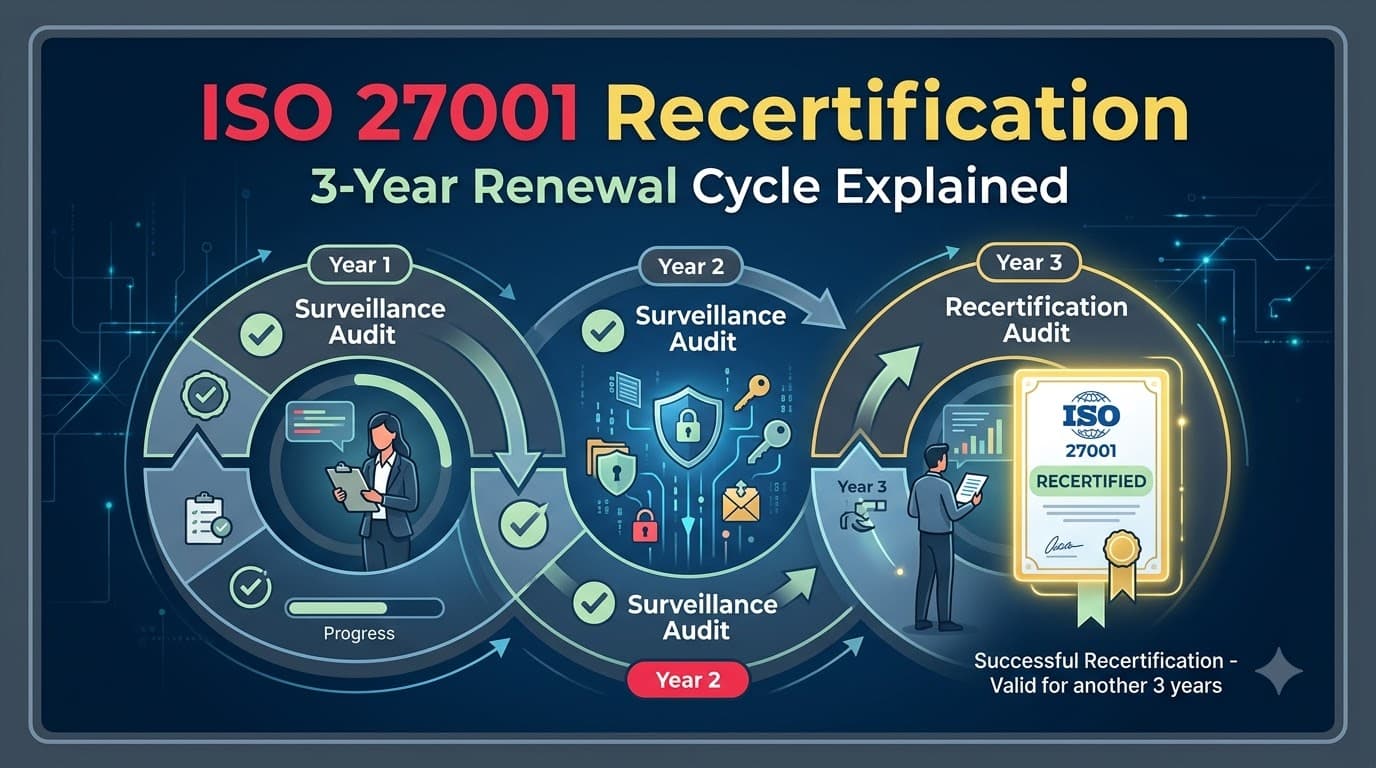
An ISO 27001 certificate is typically issued for a validity period of around three years, but that three-year figure is not a single static grant — it's a cycle with checkpoints built in. Illustratively, the pattern most certification bodies follow looks like this: initial certification (Stage 1 and Stage 2) issues the certificate and starts the clock; roughly twelve months later, a surveillance audit checks in; roughly twenty-four months in, a second surveillance audit checks in again; and somewhere in the window before the three-year mark, the recertification audit takes place and, if passed, resets the clock for another three-year cycle. Miss that window and the certificate simply expires — there is no automatic grace period once the original expiry date passes.
flowchart LR
    A["Initial Certification\n(Stage 1 + Stage 2)\nCertificate Issued"] --> B["Year 1\nSurveillance Audit"]
    B --> C["Year 2\nSurveillance Audit"]
    C --> D["Year 3\nRecertification Audit\n(full ISMS reassessment)"]
    D -->|"Passed / NCs cleared\nbefore expiry"| A2["New 3-Year Certificate\nCycle Restarts"]
    D -->|"Not completed\nbefore expiry"| E["Certificate Lapses\nMust restart at\nStage 1 + Stage 2"]
    A2 --> B
That last branch is the one Maria Delgado at Northbridge came within weeks of hitting. A lapsed certificate isn't a "renewal that's running a bit late" — from the certification body's perspective, and from the perspective of any client whose contract requires continuous certification, a lapsed certificate is no certificate at all. Some certification bodies will allow a short, tightly bounded extension if the recertification audit is already scheduled and merely awaiting completion of corrective actions, but that's a courtesy extended at the certification body's discretion, not a right — and it is never guaranteed. Treating the recertification deadline as a soft target is the single riskiest assumption I see ISMS owners make.
The other detail worth sitting with: the recertification audit is explicitly designed to take into account ISMS performance over the entire certification period, not just the months immediately before the audit. That's a meaningfully different lens than a surveillance audit, which mostly looks at "what's changed since we were last here." A recertification auditor is assembling a three-year picture: did the ISMS mature, did it stagnate, did management review actually function as a governance mechanism, and — critically — is there evidence the organization treated information security as a living system rather than a certificate to hang on the wall.
Planning and Timing: Start Earlier Than You Think
Every certification body sets its own scheduling norms, and yours will confirm exact lead times when you engage them — but as a planning heuristic, I tell every client to treat "three months before expiry" as the latest acceptable date to have the recertification audit itself underway, not the date to start thinking about it. The preparation work needs to start well before that.
Here's the countdown structure I use with clients, expressed as illustrative milestones rather than fixed requirements — your certification body's own scheduling windows always take precedence:
Time Before Certificate Expiry | Milestone |
|---|---|
~9–12 months out | Confirm the exact expiry date with your certification body in writing; begin an internal gap review against ISO 27001 as it stands today, not as it stood three years ago |
~6–9 months out | Contact your certification body to request the recertification audit slot; ask specifically whether an on-site or hybrid visit is expected and how many auditor-days are anticipated |
~5–6 months out | Run a dedicated internal audit cycle focused on recertification readiness, not just routine internal audit coverage; review the full Statement of Applicability against current operations |
~4 months out | Hold a formal management review with recertification explicitly on the agenda; review three years of incident, nonconformity, and corrective action history as a package |
~3 months out | Recertification audit should be scheduled and, ideally, already underway; any known gaps should already be in active remediation, not "planned for next quarter" |
~1–2 months out | Close out any nonconformities raised during the recertification audit; confirm the certification body's timeline for issuing the new certificate |
Before expiry date | New certificate issued and in hand; new 3-year cycle begins |
The reason this timeline front-loads so heavily is simple: certification bodies have limited auditor capacity, and recertification audits require more auditor-days than a surveillance visit, which means popular scheduling windows fill up months in advance. Waiting until ninety days out to even request a date — which is roughly where Maria Delgado found herself — puts you at the mercy of whatever slot happens to be open, which may land uncomfortably close to (or past) your actual expiry.
"I ask every client the same question at month twenty-four: 'If your certificate expired tomorrow, what would that cost you?' The answer is almost always a specific contract or a specific client. Once they can name the dollar figure, the recertification date stops feeling like a paperwork exercise and starts feeling like a business deadline with a name attached." — Tom Reyes, Independent Information Security Consultant
It's also worth deliberately decoupling "when the audit happens" from "when the certificate expires." Many organizations schedule the recertification audit six to ten weeks before the actual expiry date specifically to leave a buffer for closing out any nonconformities the auditor raises. If the audit itself happens two weeks before expiry and a major nonconformity turns up, there may not be enough runway left to remediate and get sign-off before the clock runs out.
What the Recertification Audit Actually Covers
Because the recertification audit is a fuller reassessment, it's worth being concrete about what "fuller" means in practice rather than leaving it abstract. The audit revisits the management system Clauses 4 through 10 in depth, re-samples Annex A controls broadly rather than narrowly, and layers in a look-back component that surveillance audits don't carry to the same degree.
Area of Focus | What the Auditor Is Actually Checking |
|---|---|
Context of the organization (Clause 4) | Whether the documented scope, internal/external issues, and interested-party requirements still reflect reality after three years of organizational change |
Leadership and governance (Clause 5) | Whether top management involvement in the ISMS has been sustained, not just present at the original Stage 2 |
Risk assessment and treatment (Clause 6) | Whether the risk methodology has been applied consistently across the full period and whether the risk register reflects current threats, not the threat landscape from three years ago |
Support and resources (Clause 7) | Whether competence, awareness, and resourcing kept pace with any growth, restructuring, or turnover across the cycle |
Operational planning (Clause 8) | Whether risk treatment plans were actually executed, tracked to closure, and re-evaluated as risks changed |
Performance evaluation (Clause 9) | Whether internal audits, management reviews, and metrics were performed on schedule across all three years — a spotty record here is one of the most common recertification findings |
Improvement (Clause 10) | Whether nonconformities from prior surveillance visits and internal audits were closed with root-cause corrective action, not surface-level fixes |
Annex A control sample | A broader sample than any single surveillance visit — often approaching, though not necessarily matching, the breadth of the original Stage 2 sample |
Statement of Applicability | Whether exclusions and justifications documented three years ago are still valid, and whether new risks have introduced controls that should now be marked applicable |
Incident and nonconformity history | A full three-year review of security incidents, audit findings, and how effectively they were handled — this is the "performance over the whole certification period" component that most distinguishes recertification from surveillance |
That last row deserves emphasis. A surveillance audit typically asks "what's happened since the last visit?" A recertification audit asks "what's the trend across three years?" An auditor who sees the same category of minor nonconformity recur at year one, year two, and again heading into recertification isn't going to treat that as three isolated minor findings — they're going to treat it as evidence of a systemic gap in corrective action effectiveness, which is exactly the kind of pattern that escalates a finding from minor to major.
"The single biggest 'aha' moment I watch clients have during recertification prep is realizing the auditor doesn't just want to see this year's management review minutes — they want all three years side by side, so they can watch whether the same risks kept reappearing on the agenda without ever getting resolved." — Priya Nair, ISMS Manager, Vantage Health Analytics
If your organization transitioned from ISO/IEC 27001:2013 to the 2022 revision partway through this cycle — or is approaching a transition deadline — recertification is also the point where the certification body confirms that transition was completed properly, including updated control mapping against the 93 Annex A controls in the 2022 structure. I cover the mechanics of that transition in more detail in ISO 27001:2013 vs ISO 27001:2022: What Changed and Why It Matters, but the short version for recertification purposes: don't assume your last certificate's edition is automatically compatible with your next one without confirming it explicitly with your certification body.
Major vs. Minor Nonconformities: Why the Distinction Matters More at Recertification
Every ISO 27001 audit — surveillance or recertification — can produce nonconformities, and understanding the practical difference between a minor and a major finding is essential to planning your recertification timeline realistically. A minor nonconformity typically reflects an isolated lapse that doesn't undermine the ISMS's overall ability to meet its objectives; a major nonconformity typically reflects either a systemic failure, a complete absence of a required element, or an accumulation of related minor issues that together indicate the ISMS isn't functioning as intended. The distinction isn't just academic — it directly determines whether your certificate can be renewed on the spot or only after a defined remediation window closes.
Finding Type | What It Typically Looks Like | Effect on Recertification Timeline |
|---|---|---|
Observation / opportunity for improvement | A suggestion for strengthening a control that isn't currently a requirement violation | No effect on certification decision; worth acting on but not a blocker |
Minor nonconformity | An isolated gap — a missed review date, an incomplete record, a control applied inconsistently in one area | Certificate can generally still be renewed, with corrective action tracked and verified at the next surveillance visit |
Major nonconformity | A systemic gap, a required element entirely missing, or a recurring pattern of minor issues across the cycle | Certification is typically withheld until the organization demonstrates the issue is resolved, which can push the renewal decision past the original expiry date if discovered late |
This is precisely why the "handling accumulated changes" work described throughout this article matters so much: a single missed control review is a minor nonconformity almost anywhere. But the same missed review, repeated at every surveillance visit and still unresolved at recertification, stops looking like an isolated slip and starts looking like a systemic failure of your corrective action process — which is exactly the kind of pattern auditors are trained to escalate. Ironclad Fabrication Group's scope integrity issue, described later in this article, is a clear example of a major nonconformity: it wasn't one missed form, it was an entire acquisition and a new operational technology platform operating outside the documented ISMS boundary.
"I explain the minor-versus-major distinction to every client the same way: a minor finding is something I trust you to fix because your system is otherwise working. A major finding means I can no longer trust the system to catch its own problems, and that's a much bigger conversation." — James Okafor, Lead Auditor, Ashford Certification Services
The practical takeaway for recertification planning is to build in enough runway that even a major nonconformity — the worst-case outcome — still leaves time to remediate and secure sign-off before your certificate's expiry date. Organizations that schedule their recertification audit with only a few weeks of buffer are implicitly betting that no major nonconformity will surface. Given that recertification audits look back across three full years of ISMS history, that's a bet I don't recommend making.
Handling Three Years of Accumulated Change
Three years is a long time for any organization to stay static, and recertification is where every deferred update comes due at once. I've sat in more recertification prep meetings than I can count where the real work isn't fixing a control gap — it's reconstructing a paper trail for changes nobody documented as they happened.
Type of Change Over the Cycle | What Typically Drifts | What Recertification Prep Needs to Reconcile |
|---|---|---|
Scope changes | New product lines, acquired subsidiaries, decommissioned systems, new office locations or cloud regions added without updating the documented ISMS scope | Confirm the scope statement in your Statement of Applicability and management system documentation matches what the organization actually looks like today |
Organizational changes | CISO or ISMS Manager turnover, restructured reporting lines, outsourced functions that used to be in-house (or vice versa) | Ensure roles and responsibilities documentation (aligned to control 5.2) reflects current org structure, not the org chart from the original Stage 2 |
Supplier and vendor changes | New cloud providers, new outsourced SOC or MDR vendor, expired or renegotiated contracts | Revisit supplier security clauses and the supplier risk assessment record for anyone added or changed mid-cycle |
Standard/version updates | Migration from ISO/IEC 27001:2013 to 2022, or accumulated interpretive guidance changes from the certification body | Confirm formal transition was completed, documented, and accepted by the certification body — not just informally adopted internally |
Technology changes | New SaaS tools, new development pipelines, cloud migrations, decommissioned legacy systems still listed in the asset inventory | Reconcile the asset inventory and risk register against what's actually deployed; stale asset records are a near-universal recertification finding |
Risk landscape changes | New threat categories (ransomware-as-a-service, supply chain compromise, AI-assisted phishing) that didn't exist as prominent risks three years ago | Confirm the risk assessment methodology has actually been re-run with current threat intelligence inputs, referencing control 5.7, not just re-approved on autopilot |
The scope question deserves particular attention because it's the change most likely to go unnoticed until an auditor asks a pointed question. Organizations rarely sit down and deliberately decide to expand or shrink their ISMS scope — it happens by accretion, as new business lines get folded into existing infrastructure without anyone updating the boundary document. A recertification auditor who discovers systems or business units operating inside what should be certified scope, but never formally added, will treat that as a scope integrity issue — potentially a significant finding, because it calls into question what the certificate has actually been covering.
"By year three, I've usually seen at least one department nobody remembers exists in the ISMS scope, and one that everybody assumes is covered but was never formally added. Reconciling that gap always takes longer than clients expect, because it's not a technical fix — it's an archaeology project through three years of change tickets and org charts." — Dana Whitfield, VP of Compliance, Ironclad Fabrication Group
The 2013-to-2022 transition deserves its own callout because it interacts directly with recertification timing for organizations whose current certificate was issued under the older edition. Certification bodies have generally required all certificates to reflect the 2022 revision's Clause structure and 93-control Annex A structure by a defined transition deadline, and recertification is frequently the natural checkpoint where that transition gets formally verified and closed out — but the exact transition mechanics and deadlines are set by the accreditation bodies and certification schemes, not by this article, so confirm your specific obligations directly with your certification body well before your recertification date.
Staff Turnover and the Institutional Knowledge Problem
Of all the accumulated changes a three-year cycle produces, staff turnover is the one I see cause the most avoidable pain at recertification, precisely because it's rarely treated as a documentation risk until it's too late. The person who made a specific risk acceptance decision in year one, who negotiated a particular control exception with the original Stage 2 auditor, or who understood exactly why a certain legacy system was excluded from scope, may simply not be at the organization anymore by the time recertification arrives. If that rationale was never written down — just understood and carried in someone's head — the new ISMS Manager is left trying to reconstruct history for an auditor who's asking pointed, specific questions.
The fix is not complicated, but it does require discipline: every significant ISMS decision — a risk acceptance, a control exclusion, a scope boundary call, a corrective action closure — should be documented with enough context that someone with zero institutional memory could read it two years later and understand not just what was decided, but why. This is a habit worth instilling from the very first management review after initial certification, not something to retrofit in month thirty-four when the original decision-maker is three jobs removed and unreachable. Organizations that maintain this discipline consistently tell me recertification prep feels like an audit of documents; organizations that don't tell me it feels like an investigation.
"The hardest recertification prep sessions I run aren't the ones with the most control gaps — they're the ones where nobody in the room can explain a decision that's sitting right there in the risk register from two ISMS Managers ago. 'I think that's just how we've always done it' is not an answer an auditor will accept." — Tom Reyes, Independent Information Security Consultant
Multi-Site and Multi-Certificate Considerations
Organizations with more than one certified location, or with multiple certificates covering different business units, face a wrinkle that single-site organizations don't: recertification timing has to be coordinated across every site in scope, not just planned once. I've seen two versions of this go wrong. In the first, a parent organization renews its headquarters certificate on schedule but overlooks that a subsidiary office, added to scope eighteen months into the cycle, has its own sampling requirement that the certification body expects to see satisfied at recertification — and nobody scheduled the site visit. In the second, an organization holding separate certificates for two business units treats them as fully independent, only to discover during one unit's recertification audit that shared infrastructure (a common data center, a shared identity provider) creates dependencies the auditor expects to see addressed consistently across both certificates.
Multi-Site/Multi-Certificate Scenario | Key Recertification Planning Consideration |
|---|---|
Single certificate, multiple physical sites in scope | Confirm the certification body's sampling plan covers a representative selection of sites across the cycle, not just headquarters, and that any new sites added mid-cycle have been formally incorporated |
Multiple certificates across separate business units | Identify shared infrastructure, shared policies, or shared personnel between units and ensure consistency is demonstrable across both certificates' evidence sets |
Certificate covering a business unit that was later divested or restructured | Formally update scope documentation immediately upon divestiture — don't wait until recertification to discover a scope statement describing a unit that no longer exists |
Newly acquired entity brought under an existing certificate mid-cycle | Treat the acquisition's onboarding into the ISMS scope as its own mini risk assessment and control implementation project, timed well ahead of recertification, not folded in quietly |
The coordination overhead here is a big part of why larger, more complex organizations should start their recertification planning at the earlier end of the nine-to-twelve-month window rather than the later end. Site-visit logistics, in particular, can be a genuine scheduling constraint — certification bodies need to plan auditor travel and availability across every location in scope, and that's not something that can be compressed the way document review sometimes can be.
Signs Your ISMS Is Recertification-Ready — and Signs It Isn't
Beyond the countdown milestones covered earlier, it helps to have a quick gut-check for where your ISMS actually stands as recertification approaches, independent of the calendar. These are patterns I look for during a readiness assessment, and they tend to be reliable predictors of how smoothly the external audit will go.
Signal | Recertification-Ready | Recertification At-Risk |
|---|---|---|
Management review consistency | Regular cadence maintained across all three years, with documented decisions and follow-through | Cadence slipped at some point, or reviews became a formality without substantive discussion |
Nonconformity closure pattern | Every finding closed with root-cause corrective action, verified at the next review | Findings closed quickly with surface fixes, or some remain technically "open" past their target date |
Scope documentation currency | Scope statement and SoA updated as changes happened, not retroactively | Scope statement hasn't been touched since the original Stage 2, despite known organizational changes |
Risk register currency | Reflects current threats and has evidence of periodic re-assessment | Risk register reads the same as it did three years ago, with the same risks and same ratings |
Institutional knowledge | Decisions and rationale documented well enough to survive staff turnover | Key context lives only in the memory of one or two long-tenured staff |
Internal audit coverage | Full clause and broad Annex A coverage achieved across the cycle | Internal audits consistently sampled the same easy areas, avoiding known problem spots |
If your organization is showing more signals in the right-hand column than the left as you approach your recertification window, that's not cause for panic — it's exactly the kind of finding a focused readiness assessment several months out is designed to catch and correct before an external auditor does.
Avoiding a Lapse: What Expiry Actually Costs You
It's worth being blunt about what happens if the recertification audit and any resulting corrective actions aren't completed before the certificate's expiry date, because I've watched organizations treat this as a soft deadline right up until it wasn't.
Consequence of a Lapsed Certificate | Practical Impact |
|---|---|
Certificate status reverts to "not certified" | Your organization can no longer represent itself as ISO 27001 certified in proposals, contracts, or marketing — immediately, not gradually |
No automatic grace period | Unlike a surveillance audit running slightly behind schedule, a lapsed certificate generally cannot simply be "picked back up" — most certification bodies require restarting at Stage 1 and Stage 2 as if pursuing certification for the first time |
Contractual exposure | Clients or partners whose contracts require continuous ISO 27001 certification may treat a lapse as a breach, triggering renegotiation, penalty clauses, or a formal re-bid of the relationship |
Sales and procurement disruption | Deals in flight that list "current ISO 27001 certification" as a procurement gate can stall or be lost outright while recertification is pursued from scratch |
Reputational cost | Existing for a period as a "formerly certified" organization is a harder story to tell prospects than "certified since [year]," even after recertification is eventually completed |
Cost escalation | Restarting at Stage 1 and Stage 2, rather than completing a recertification audit, typically means a larger audit scope, more auditor-days, and a higher total cost than timely renewal would have required |
Internal morale and credibility | Teams who worked hard to build and maintain the ISMS understandably read a preventable lapse as a leadership and planning failure, not a technical one |
The mechanism behind the "no grace period" point is worth understanding rather than just accepting: certification bodies issue certificates with a defined validity period specifically because accreditation rules require ongoing, timely verification that the ISMS remains effective. A certificate that has expired is, by definition, no longer backed by current audit evidence — which is precisely why most schemes don't allow it to simply be reactivated later. The safeguard against ever reaching this point is not a clever contingency plan; it's the planning timeline in the section above, treated as non-negotiable rather than aspirational.
"I tell every ISMS owner the same thing at their first surveillance audit: write the recertification deadline into next year's calendar today, with a hard alert at the nine-month mark. Nobody has ever regretted planning too early. I have watched several regret planning too late." — James Okafor, Lead Auditor, Ashford Certification Services
Communicating With Your Certification Body Throughout the Cycle
One habit separates the organizations that recertify smoothly from the ones that scramble: they treat their certification body as an ongoing relationship to manage proactively, not a vendor they hear from once a year when an auditor shows up. That relationship becomes especially important as recertification approaches, because your certification body is the only party who can confirm the exact scheduling lead times, sampling expectations, and transition requirements that apply to your specific certificate.
Point in the Cycle | Recommended Communication With Your Certification Body |
|---|---|
Immediately after initial certification | Confirm in writing the exact certificate expiry date and the certification body's standard recertification scheduling lead time |
After each surveillance audit | Ask directly whether any observations suggest areas that could become nonconformities at recertification if left unaddressed |
~9–12 months before expiry | Formally request recertification audit scheduling; confirm whether any standard-updates or transition requirements (e.g., 2013-to-2022) apply to your certificate |
~6 months before expiry | Confirm the finalized audit plan, expected auditor-days, and which sites or business units will be sampled |
After the recertification audit | Confirm in writing the exact timeline for certificate issuance, especially if any nonconformities require closure first |
Certification bodies vary in how proactively they reach out to remind clients of upcoming recertification deadlines — some send automated notices well in advance, others expect the client to initiate contact. Never assume your certification body will chase you down as the deadline approaches; treat the responsibility for initiating that conversation as squarely your own. This is a small operational habit with an outsized payoff: organizations that maintain an open, proactive dialogue with their certification body rarely get surprised by a scheduling conflict, a sampling requirement they didn't anticipate, or a transition deadline they missed.
How to Prepare: A Practical Playbook
Preparation for recertification is less about generating new documentation and more about assembling and validating three years of evidence that already exists somewhere in your organization — the risk is that it's scattered, stale, or was never consolidated in the first place.
Preparation Task | Owner (Illustrative) | Why It Matters at Recertification |
|---|---|---|
Consolidate all management review minutes from the full cycle into one reviewable package | ISMS Manager | Auditors will look for a consistent thread of governance across three years, not just the most recent meeting |
Reconcile the Statement of Applicability against current operations, scope, and risk register | ISMS Manager / Risk Owner | Outdated exclusions or missing new risks are among the most common recertification findings |
Run a full internal audit cycle covering every clause and a broad Annex A sample, not a partial rotation | Internal Audit Lead | Mirrors the breadth the external recertification audit will use, surfacing gaps while there's still time to fix them |
Review and close out every nonconformity raised across both surveillance audits, with documented root-cause corrective action | ISMS Manager / Control Owners | Recurring or unresolved nonconformities are treated as a trend, not isolated incidents, and can escalate audit findings |
Update the risk assessment with current threats and confirm risk treatment plans were executed, not just documented | Risk Owners | Demonstrates the ISMS responded to a changing risk landscape rather than staying frozen at initial certification |
Confirm scope statement reflects every current business unit, location, and system in operation | Top Management / ISMS Manager | Prevents scope integrity findings that can be difficult to resolve quickly once identified by an external auditor |
Verify any 2013-to-2022 transition activity is fully documented and accepted by the certification body | ISMS Manager | Avoids a last-minute discovery that the transition wasn't formally closed out |
Brief control owners and interviewees on what a recertification audit covers versus a surveillance audit | ISMS Manager | Reduces the risk of staff underpreparing because they assume it's "just another surveillance visit" |
Confirm the recertification audit date, auditor-day estimate, and certificate issuance timeline directly with the certification body | ISMS Manager / Procurement | Anchors your internal deadline planning to your certification body's actual capacity, not assumptions |
Two of these deserve extra weight. First, running a genuinely comprehensive internal audit ahead of recertification — not the lighter, rotating-scope internal audits that may have sufficed between surveillance visits — is the closest thing to a dress rehearsal you'll get. I go into the mechanics of planning and executing that kind of audit in ISO 27001 Internal Audit: Planning, Execution, and Reporting, and the timing principle is simple: your internal audit should surface the same categories of gaps a recertification auditor would find, several months before that auditor arrives.
Second, closing out prior nonconformities isn't just a documentation exercise — auditors specifically look for evidence that corrective action addressed the root cause rather than the symptom. If you want a clearer picture of how nonconformities are categorized and what "properly addressed" looks like in practice, see Common ISO 27001 Nonconformities and How to Address Them. A pattern of quick, surface-level fixes that let the same issue resurface is precisely the kind of trend a recertification audit is designed to catch.
Several PentesterWorld resources are built specifically for this stretch of the cycle. The Certification Readiness Checklist walks through the same categories of evidence auditors expect, organized so nothing gets missed in the final push. The Internal Audit Checklist is useful for structuring the comprehensive pre-recertification internal audit described above. And if you're trying to build the business case internally for the time and budget recertification requires, The Complete ISO 27001 Implementation Guide eBook includes a section specifically on sustaining an ISMS across renewal cycles, not just standing one up initially.
Documents to Gather Before the Auditor Arrives
Recertification prep goes faster when you know exactly which documents to pull together first, rather than discovering gaps mid-audit. Most of these should already exist as part of your ongoing mandatory documentation set — the work at recertification is confirming each one is current, not creating it from scratch.
Document Category | What to Confirm Before the Audit |
|---|---|
ISMS scope statement | Reflects every current business unit, site, and system — including anything acquired, launched, or decommissioned during the cycle |
Statement of Applicability | Every control's applicability justification is current; new risks are reflected; no orphaned exclusions remain from three years ago |
Risk register and risk treatment plan | Updated with current threats; every treatment action has a documented status, not just an original target date |
Three years of management review minutes | Consolidated into one reviewable package showing a consistent thread of governance decisions |
Three years of internal audit reports | Demonstrate full-clause and broad Annex A coverage was achieved across the cycle, not just in the final months |
Nonconformity and corrective action log | Every item from both surveillance audits and internal audits shows root-cause analysis and verified closure |
Incident log and post-incident reviews | Covers the full cycle, with evidence that lessons learned fed back into the risk register or controls |
Training and awareness records | Show consistent delivery across the cycle, including onboarding for any new hires or acquired staff |
Supplier risk assessments and agreements | Cover every current supplier, including any added mid-cycle, with security clauses current |
Evidence of any 2013-to-2022 transition activity | Formal confirmation from the certification body that the transition was reviewed and accepted |
The ISO 27001 Mandatory Documents Checklist maps directly onto this list and is worth running as a line-by-line reconciliation exercise several months before your recertification date, rather than the week before.
Roles and Responsibilities: Who Owns What During Recertification Prep
Recertification prep tends to stall when it's treated as a single person's project rather than a coordinated effort across the roles that actually hold the evidence. Here's the illustrative division of labor I recommend:
Role | Recertification Prep Responsibility |
|---|---|
Top management / executive sponsor | Ensures recertification prep is resourced and prioritized; participates in the pre-recertification management review; owns the ultimate business decision on timeline and budget |
ISMS Manager / CISO | Coordinates the overall prep timeline; owns communication with the certification body; consolidates cross-cycle evidence |
Internal audit lead | Executes the comprehensive dress-rehearsal internal audit; tracks findings through to closure before the external audit |
Control owners (IT, HR, Facilities, Legal, etc.) | Confirm their specific Annex A controls are current, evidenced, and consistent with documented procedures |
Risk owners | Confirm risk register entries under their ownership reflect current threats and treatment status |
Procurement / vendor management | Confirms supplier risk assessments and agreements are current for every active supplier |
HR | Confirms screening, training, and termination-related records (controls 6.1–6.5) are complete for all current and departed staff across the cycle |
Top management involvement deserves particular emphasis because it's the row most often underweighted. Auditors specifically look for evidence that leadership engagement in the ISMS was sustained, not just present at the original Stage 2 audit — and a management team that can speak knowledgeably about risk trends, resourcing decisions, and corrective action outcomes across the full three years sends a very different signal than one that has to be briefed by the ISMS Manager five minutes before the interview.
Common Mistakes That Turn Recertification Into a Fire Drill
Mistake | Why It Happens | Consequence |
|---|---|---|
Treating recertification as "surveillance audit, but longer" | Two clean surveillance audits create a false sense that the ISMS is fully audit-ready at any moment | Underestimating scope and depth, leading to under-preparation for the full Clause 4–10 and broad Annex A review |
Not confirming the recertification date until 60–90 days before expiry | No calendar reminder was set at the original certification date | Limited scheduling options with the certification body, risking a date that lands too close to (or after) expiry |
Letting the Statement of Applicability go stale | SoA updates get deprioritized against day-to-day operational security work | Scope and applicability findings that are hard to resolve on short notice |
Closing nonconformities with quick fixes instead of root-cause corrective action | Pressure to close findings fast during surveillance audits | Recurring findings that recertification auditors read as a systemic trend, risking escalation to major nonconformity |
Losing institutional knowledge to staff turnover without documenting rationale for past decisions | ISMS Manager or CISO turnover mid-cycle with incomplete handover | New owner cannot explain historical risk acceptance decisions or control justifications during the audit |
Assuming the 2013-to-2022 transition was "handled" without written confirmation from the certification body | Informal internal adoption of 2022 controls without a formal transition audit or sign-off | Discovery during recertification that the transition was never formally closed, adding scope and delay |
Scheduling the audit for the exact week before expiry with no buffer | Trying to delay the audit as long as possible to include the most recent evidence | No time left to remediate nonconformities before the certificate lapses |
"The organizations that struggle at recertification are almost never the ones with the weakest ISMS. They're the ones who let two clean surveillance audits convince them the hard part was over." — Sam Osei, Director of Risk, Northbridge Data Solutions
Case Study: Northbridge Data Solutions — The Ninety-One-Day Scramble
Returning to Maria Delgado's story from the opening: with ninety-one days left before expiry and no recertification audit scheduled, Northbridge Data Solutions had to compress a process that should have started six months earlier. Maria's first call was to their certification body to ask, bluntly, what the earliest possible recertification audit slot was — the answer came back at fifty-five days out, workable but tight. In parallel, she pulled together a cross-functional team (IT, HR, legal, and two control owners) for a two-week internal audit sprint covering every clause and a wide Annex A sample, specifically hunting for anything that could become a major nonconformity under audit scrutiny.
They found three issues: a supplier risk assessment for a cloud backup vendor onboarded eighteen months earlier that had never been formally documented, a management review cadence that had quietly slipped from quarterly to twice yearly without anyone flagging it as a deviation, and an SoA that still listed a legacy data center as in-scope three years after Northbridge had migrated fully to cloud infrastructure. None of these were catastrophic individually, but together they represented exactly the kind of "three-year drift" a recertification auditor is trained to find.
Northbridge closed the supplier assessment gap in eight business days, documented the management review deviation with a corrective action plan and evidence of a return to quarterly cadence, and updated the SoA and scope statement before the audit. The recertification audit itself took two auditor-days on-site plus follow-up documentation review, surfaced one minor nonconformity (the management review cadence, formally recorded despite the interim fix), and closed with a new three-year certificate issued eleven days before the original expiry date. Northbridge kept the $2.4 million banking contract, but Maria was candid about the cost: the compressed timeline required pulling four staff off other priorities for most of two months, and the certification body's expedited scheduling carried a premium versus a standard-lead-time booking. "We didn't lose the contract," she told me, "but we spent about triple what a calmly planned recertification would have cost us in time alone."
What changed at Northbridge afterward is instructive. Maria didn't just fix the three findings and move on — she built a standing recertification countdown into the ISMS calendar with automated alerts at twelve, nine, six, and three months out, assigned explicit ownership for each milestone in the countdown table earlier in this article, and added a quarterly "scope reconciliation" item to management review specifically to catch the kind of drift that caused the legacy-data-center finding. Eighteen months later, at their next regular management review, the team ran a mock recertification readiness check well ahead of schedule specifically so they'd never again be doing this math with ninety-one days on the clock.
Case Study: Vantage Health Analytics — The Boring, Successful Recertification
Priya Nair's team at Vantage Health Analytics, a healthcare data analytics firm serving hospital systems, offers the counterpoint. Vantage built recertification planning into its ISMS calendar from the day its first certificate was issued: a standing nine-month-out reminder, a dedicated recertification-readiness internal audit distinct from routine quarterly internal audits, and a rule that every nonconformity — internal or external — got a documented root-cause analysis before being marked closed, not just a fix.
By the time Vantage's recertification audit rolled around, there was very little drama to report. The SoA had been reviewed and updated twice during the cycle as new cloud services were added. Management review minutes across all three years told a consistent story of risks being raised, tracked, and resolved. The one open item — a control gap around a newly adopted data masking tool that hadn't yet been formally incorporated into the risk register — was caught during Vantage's own internal audit five months before recertification and closed with time to spare. The external recertification audit ran two and a half auditor-days, raised zero major nonconformities and one minor observation (unrelated to the masking tool, which by then was already resolved), and Vantage received its new certificate three weeks before expiry with no scrambling at all. Priya's own assessment: "Recertification is only stressful if you spend three years treating the ISMS as something you did once. We treat it as something we do continuously, so recertification is just the moment someone else checks our homework."
Priya credits a specific practice for Vantage's consistency: every quarterly management review included a standing agenda item asking "what would a recertification auditor flag about this quarter?" — a small reframing that kept the team looking at their own evidence the way an external auditor eventually would, rather than only the way an internal team naturally does. It also meant that when a hospital-system client asked, mid-cycle, for evidence of continuous ISMS effectiveness ahead of a major contract renewal, Vantage could produce three years of consistent management review minutes on short notice — turning what could have been a scramble into a same-day request.
Case Study: Ironclad Fabrication Group — The Scope Creep Problem
Dana Whitfield's experience at Ironclad Fabrication Group, a manufacturing company with ISO 27001 covering its enterprise IT and order management systems, illustrates the scope-drift risk described earlier in this article. Over three years, Ironclad had acquired a smaller fabrication shop, integrated its inventory system into the certified environment, and stood up a new IoT-connected production monitoring platform — none of which had been formally evaluated against the ISMS scope boundary.
The recertification auditor identified the gap during document review, before ever setting foot on-site: the acquired shop's systems were processing data that flowed into scope-covered systems, but neither the acquired shop nor the new monitoring platform appeared anywhere in the scope statement or risk register. This was recorded as a major nonconformity — a genuine scope integrity issue, not a paperwork technicality — and Ironclad was given a defined corrective action window to remediate before certification could be renewed. Dana's team spent six weeks conducting a retroactive risk assessment of both the acquired shop and the monitoring platform, formally updating the ISMS scope, and implementing several controls (network segmentation for the IoT platform among them) that hadn't previously existed. Ironclad ultimately renewed certification, but nine days after the original expiry — creating a short, technical lapse that required direct, proactive communication with two key clients to explain the gap and the remediation already underway. "We were lucky our clients gave us the benefit of the doubt," Dana told me. "I wouldn't want to test that luck twice. Every acquisition and every new platform now gets an ISMS scope review as a standing item, not an afterthought."
The nine-day lapse, brief as it was, still triggered a formal notification requirement to two clients whose contracts specifically referenced continuous ISO 27001 certification as a condition of the relationship. Dana's team drafted a proactive disclosure — explaining the gap, the root cause, and the remediation timeline before either client had a chance to discover the lapse independently through a certificate registry check. Both clients ultimately accepted a short grace period given the transparency and the evidence of active remediation, but Dana was candid that this outcome was far from guaranteed: "If either of those clients had a stricter procurement policy, or less trust built up over the relationship, that nine-day gap could have cost us the contract outright, major nonconformity or not."
Case Study | Core Issue | Outcome | Days Relative to Expiry |
|---|---|---|---|
Northbridge Data Solutions | Late start — recertification not scheduled until 91 days before expiry | New certificate issued; contract retained; costs roughly tripled versus planned timeline | Issued 11 days before expiry |
Vantage Health Analytics | Proactive, continuous readiness practice built into ISMS calendar | New certificate issued with zero major nonconformities | Issued 21 days before expiry |
Ironclad Fabrication Group | Undocumented scope creep from acquisition and new IoT platform | Major nonconformity; certification renewed after a short technical lapse | Issued 9 days after expiry |
Illustrative Cost and Effort by Organization Size
Recertification audit cost and effort scale with the size and complexity of the ISMS scope, much like initial certification did. These figures are illustrative planning ranges drawn from patterns I've seen across client engagements, not published fee schedules — always confirm current pricing directly with your chosen certification body.
Organization Profile | Illustrative Recertification Auditor-Days | Illustrative Internal Prep Effort | Relative Cost vs. Original Stage 1 + Stage 2 |
|---|---|---|---|
Small (under 50 employees, single site, narrow scope) | 1–2 auditor-days | 2–4 weeks part-time across ISMS Manager and control owners | Roughly 40–55% of original certification cost |
Mid-size (50–500 employees, multiple sites or cloud environments) | 2–4 auditor-days | 4–8 weeks part-time, often with a short dedicated sprint | Roughly 50–65% of original certification cost |
Large/complex (500+ employees, multiple business units, regulated industry) | 4–8+ auditor-days | 8–12+ weeks with a dedicated project team | Roughly 55–70% of original certification cost |
Use the ISO 27001 Certification Cost Calculator to model a more specific estimate against your own headcount, scope, and site count before you finalize budget requests for the recertification cycle — it's a far more reliable starting point than the ranges above, which are intentionally broad.
Making the Business Case for Recertification Investment
Budget conversations around recertification are, in my experience, one of the easiest internal sells in the entire ISO 27001 lifecycle — provided you frame the ask correctly. The mistake I see security leaders make is presenting recertification prep as a compliance line item competing against other operational priorities for headcount and budget. A stronger frame ties the investment directly to what the certificate protects: specific contracts, specific procurement gates, specific competitive positioning against uncertified rivals.
Maria Delgado's experience at Northbridge is the clearest illustration available in this article: a compressed, reactive recertification cost roughly triple what a calmly planned one would have, and that's before accounting for the risk — real, if narrowly avoided — of losing a $2.4 million contract outright. That comparison, contract value against preparation cost, is the argument that gets budget approved without friction. It's also worth quantifying the opportunity cost of a lapse specifically, using the consequences described earlier in this article: every week of lost certification status is a week where procurement gates requiring current ISO 27001 certification simply can't be cleared, regardless of how strong your actual security posture is.
Business Case Element | How to Frame It Internally |
|---|---|
Cost of proactive recertification prep | A predictable, budgeted expense scaled to organization size (see cost table above) |
Cost of reactive, last-minute recertification | Typically 2–3x higher due to expedited scheduling, overtime, and diverted staff time |
Cost of a lapsed certificate | Contract risk, procurement disqualification, and a full restart at Stage 1/Stage 2 pricing |
Non-financial return | A verified, mature ISMS that survived three years of real operating pressure — a stronger market claim than initial certification alone |
Framing the ask this way also has a secondary benefit: it turns the ISMS Manager or CISO from someone perpetually asking for compliance budget into someone protecting identifiable revenue, which tends to change how that budget request is received at the executive level.
How ISO 27001's 3-Year Cycle Compares to Other Frameworks
CISOs managing multiple compliance frameworks often ask why ISO 27001 runs on a three-year certificate with annual surveillance, when other frameworks they hold renew every twelve months. It's a fair question, and understanding the contrast helps set internal expectations correctly.
Framework | Renewal / Reassessment Cadence | How It Compares to ISO 27001's Cycle |
|---|---|---|
ISO/IEC 27001 | 3-year certificate, annual surveillance audits, full recertification audit before year-three expiry | Longest full-reassessment interval, but includes lighter annual check-ins between full reassessments |
SOC 2 Type II | Typically a new audit report issued annually, covering a defined observation period (often 6–12 months) | No multi-year certificate — the report itself has a shelf life that most clients treat as roughly twelve months before requiring a fresh one |
PCI DSS | Annual assessment (self-assessment questionnaire or Report on Compliance depending on merchant level) | Full annual reassessment every year, with no equivalent to ISO 27001's lighter surveillance-year model |
The practical implication: an organization holding both ISO 27001 and SOC 2, for example, is managing two very different rhythms — a three-year ISO cycle with annual check-ins, layered against an essentially annual SOC 2 renewal cadence. I generally recommend calendaring both independently rather than assuming one framework's audit prep automatically covers the other, even though the underlying control evidence overlaps substantially. If you're weighing which framework(s) best fit your buyer requirements in the first place, ISO 27001 vs Other Security Frameworks: NIST, SOC 2, and PCI DSS Compared walks through that decision in more depth, and PentesterWorld's SOC 2 content covers the annual SOC 2 Type II renewal cycle and its own preparation rhythm in more detail, alongside guidance on PCI DSS annual assessment and reporting cycles for organizations holding both certifications.
Internal Audit Cadence Across the Full Cycle
Because internal audits are your best early-warning system for recertification readiness, it's worth mapping how internal audit intensity should track against the external audit calendar rather than running at a flat pace throughout.
Cycle Stage | Internal Audit Focus | Relative Intensity |
|---|---|---|
Months 1–11 (before first surveillance) | Bedding in new or corrected controls; closing Stage 2 findings | Moderate — focused on recent findings |
Months 12–23 (between surveillance audits) | Rotating Annex A sample; monitoring risk register currency | Moderate, steady cadence |
Months 24–30 (after second surveillance) | Full-scope review begins; SoA and scope reconciliation | Increasing — begin recertification-specific prep |
Months 31–33 (final stretch) | Comprehensive dress-rehearsal audit across all clauses and a broad control sample | Highest — mirrors external audit breadth |
Months 34–36 (recertification window) | Final gap closure; evidence consolidation for the external audit | Focused on remediation, not discovery |
This isn't a universal requirement — your certification body doesn't mandate this exact cadence — but it reflects how the organizations I've worked with that recertify smoothly actually structure their internal audit program. The ISO 27001 Internal Audit Checklist is built to flex across both the lighter rotating-scope audits of years one and two and the comprehensive dress-rehearsal audit in year three.
What a Recertification Audit Agenda Typically Looks Like
Seeing an illustrative agenda structure can make the abstract "fuller reassessment" description concrete. Certification bodies vary in exact format, but the shape below is representative of how a multi-day recertification audit is typically organized for a mid-size organization.
Audit Day | Illustrative Focus |
|---|---|
Day 1, morning | Opening meeting; review of ISMS scope, context, and any changes since the last audit; review of the three-year management review and internal audit history |
Day 1, afternoon | Clause 4–7 review (context, leadership, planning, support); interviews with top management and the ISMS Manager |
Day 2, morning | Clause 8–10 review (operation, performance evaluation, improvement); review of risk register, risk treatment plans, and nonconformity/corrective action trends |
Day 2, afternoon | Broad Annex A control sample — organizational, people, physical, and technological controls, weighted toward areas of higher risk or prior findings |
Day 3 (if applicable, larger scope) | Additional site visits, supplier/vendor evidence review, technical control verification (access logs, vulnerability management records, backup testing evidence) |
Closing meeting | Presentation of findings, classification of any nonconformities, and agreement on corrective action timelines before the certification decision is finalized |
Smaller organizations with a single site and narrow scope may compress this into one or two days; larger, multi-site organizations may extend it well beyond three. The consistent thread across every version of this agenda is the look-back component — auditors are explicitly instructed to evaluate evidence across the full three-year period, not just what's in front of them on the day of the visit.
Recertification's Role in Supporting Broader Regulatory and Contractual Obligations
It's worth being precise about what a renewed ISO 27001 certificate does and doesn't do for an organization's broader compliance picture. Recertification confirms your ISMS continues to meet ISO/IEC 27001 requirements — it does not, by itself, make your organization "legally compliant" with GDPR, HIPAA, DORA, or any other regulatory framework. What a well-maintained, successfully recertified ISMS does is provide a structured, evidenced foundation that supports meeting those obligations: documented risk management, access controls, incident response processes, and supplier oversight that regulators and auditors under other frameworks frequently want to see evidence of anyway.
This distinction matters specifically at recertification because it's a natural moment to check whether your ISMS's supporting role for other regulatory obligations has kept pace with those obligations' own changes over three years. A healthcare organization's HIPAA obligations, a financial organization's DORA-related operational resilience requirements, or a multinational's evolving GDPR data transfer obligations may all have shifted since your last full ISMS reassessment. Recertification prep is a reasonable checkpoint to confirm your risk register and control set still reflect those current obligations, even though the ISO 27001 certificate itself doesn't certify compliance with any of them directly.
"Clients sometimes assume the ISO 27001 certificate is a shield against every other regulatory conversation. I always correct that gently: it's a very strong foundation, and auditors and regulators under other frameworks respect it, but it's a foundation, not a substitute. Recertification is a good moment to check that foundation is still supporting everything you've built on top of it since your last full reassessment." — Priya Nair, ISMS Manager, Vantage Health Analytics
Post-Recertification: Setting Up the Next Three-Year Cycle Correctly
The moment a new certificate is issued is also the moment the next three-year cycle quietly begins — and the organizations that handle this transition well are the same ones who avoid Maria Delgado's ninety-one-day scramble the next time around. It's worth treating certificate renewal as an explicit trigger for a short set of follow-up actions, rather than simply filing the new certificate away and returning to business as usual.
Post-Recertification Action | Why It Matters for the Next Cycle |
|---|---|
Immediately calendar the new expiry date with milestone alerts at 12, 9, 6, and 3 months out | Prevents the exact "we stopped watching the calendar" failure mode described at the start of this article |
Debrief the recertification audit with the full prep team | Captures lessons on what evidence was hardest to assemble, feeding directly into next cycle's documentation habits |
Update the risk register and SoA immediately with any changes agreed during the audit | Starts the new cycle with current documentation rather than carrying forward gaps |
Assign explicit ownership for ongoing scope and organizational-change tracking | Prevents the scope-drift problem that caused Ironclad Fabrication Group's major nonconformity from recurring |
Communicate the successful renewal to clients and prospects proactively | Turns a compliance milestone into a business development moment, reinforcing the certificate's value to procurement contacts |
This is also the right moment to revisit whether your internal audit program's cadence (described earlier in this article) actually matched the intensity your organization needed, or whether it should be adjusted going into the new cycle. An organization that found itself scrambling at month thirty-four has clear evidence its internal audit intensity needed to ramp up earlier; an organization that sailed through, like Vantage Health Analytics, has evidence its existing cadence is working and worth maintaining rather than reinventing.
The Strategic Close: Recertification as Proof, Not Just Paperwork
It's tempting to treat recertification as a compliance chore to survive every three years — get through the audit, get the new certificate, move on. I'd push back on that framing. Recertification is one of the only moments in a three-year cycle where an independent, accredited third party formally validates that your organization didn't just build an ISMS once, but sustained and matured it under real operating pressure — through staff turnover, scope changes, new technology, and a shifting threat landscape. That's a materially stronger claim to make to a prospect, a regulator, or a board than "we got certified once."
Organizations that treat the three-year cycle as a continuous discipline rather than a triennial event tend to walk away from recertification with more than a renewed certificate — they walk away with a security program that's genuinely more mature than it was three years ago, because the preparation work forces exactly the kind of retrospective review most organizations otherwise never make time for. Northbridge's Maria Delgado said it best once the dust settled: "The scramble taught us more about where our ISMS had actually drifted than any surveillance audit did. I just wish we'd learned it on our own timeline instead of the certification body's."
If you're heading toward your own recertification window, start with an honest internal gap check against where your ISMS actually stands today — not where it stood at your last audit. Review your Statement of Applicability line by line, pull three years of management review minutes into one place, and confirm your recertification date with your certification body in writing before the countdown gets as tight as Maria's did. The ISO 27001 Mandatory Documents Checklist is a solid starting point for confirming your core documentation set is current and complete before the auditor asks to see it.
PentesterWorld works with organizations at every stage of the ISO 27001 lifecycle — from first gap assessment through initial certification, surveillance audits, and recertification. If your renewal window is approaching and you want an outside read on where your ISMS actually stands before the certification body arrives, that's exactly the kind of readiness review our team supports; reach out to talk through your timeline before the countdown gets tighter than you'd like.
If any of the terminology in this article — Stage 1, Stage 2, nonconformity, Statement of Applicability, surveillance audit — felt unfamiliar, the ISO 27001 Glossary of Terms is a quick reference worth bookmarking before your recertification prep begins in earnest.