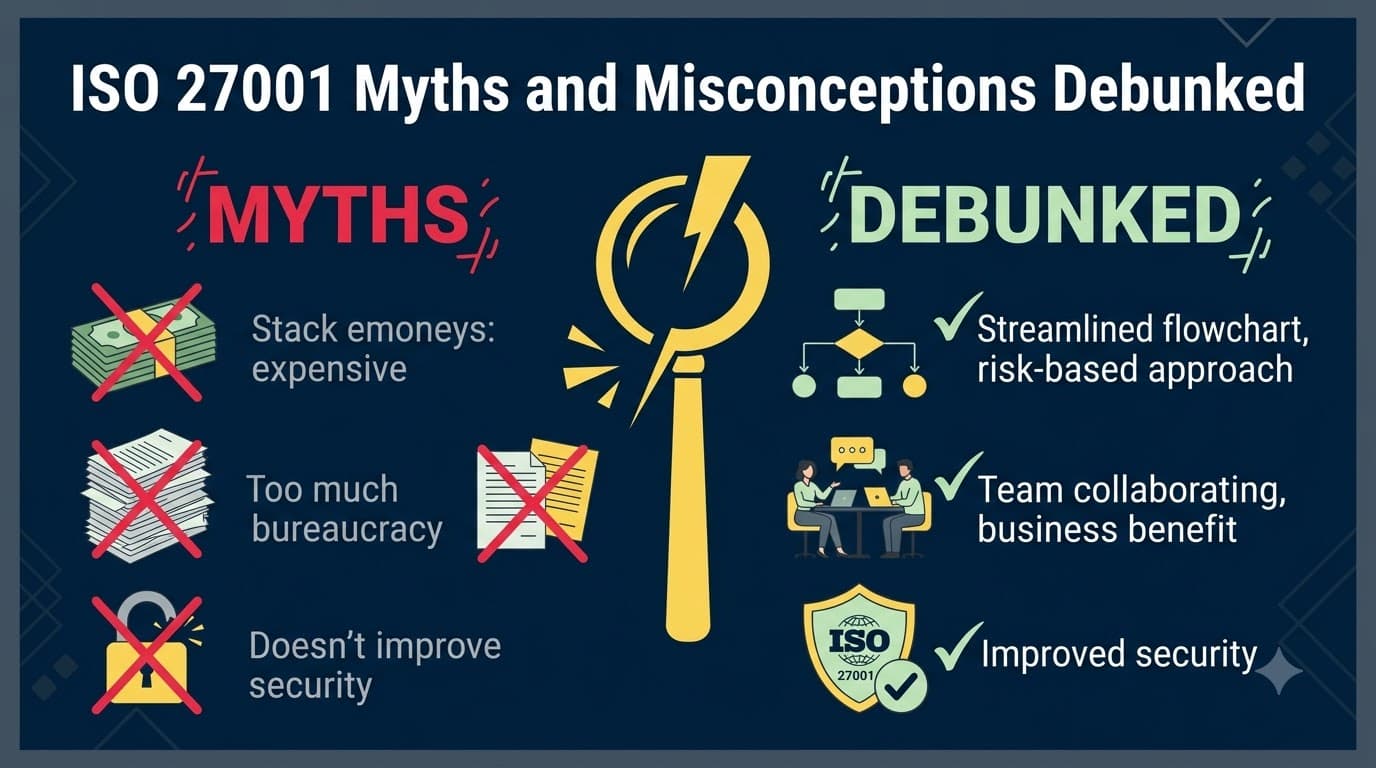
You've heard the scary claims — it's just paperwork, you need all 93 controls, only big companies need it, certification makes you unhackable, it takes years and costs a fortune, and once you're certified you're done forever. Here's what's actually true, myth by myth, so you can make the call with confidence instead of fear.
The $180,000 Decision Built on a Myth
Marcus Reyes had eleven weeks to get his company's biggest enterprise deal across the line. He was the VP of Engineering at a 40-person supply-chain analytics startup called Corvalux, and the prospect — a Fortune 500 logistics company — had made ISO 27001 certification a hard contractual requirement. No certificate, no signature, no seven-figure contract.
Marcus did what most people first do: he Googled it, skimmed a few forum threads, and talked to a consultant who was, frankly, more salesman than advisor. The picture he walked away with was terrifying. ISO 27001, he was told, meant implementing all 93 Annex A controls, hiring a compliance team, buying a six-figure GRC platform, and budgeting twelve to eighteen months before an auditor would even look at them. His CFO did the math: consultant fees, tooling, headcount, audit costs — north of $180,000, plus a timeline that blew past the client's procurement deadline entirely.
So Corvalux walked away from the deal. Six months later, Marcus sat in on a debrief with a fractional CISO brought in for an unrelated project, and learned the truth: none of that was accurate. ISO 27001 doesn't require implementing every control — it requires a documented, risk-based justification for which ones apply, recorded in a Statement of Applicability. A lean 40-person company with a well-scoped ISMS could realistically have been certified in five to seven months for a fraction of that budget. The deal Corvalux lost to a competitor that quarter was worth $2.4 million over three years. The cost wasn't the standard. The cost was the myth.
I've spent more than fifteen years doing this work — running gap assessments, sitting through Stage 1 and Stage 2 audits, and helping more than 200 organizations (from nine-person startups to multinational manufacturers) get certified and stay certified. In that time I have heard nearly every myth in this article stated as fact, usually with total confidence, usually by someone who read one blog post or talked to one overpriced vendor. This piece exists to take those myths apart one at a time, show you the kernel of truth buried inside each one, and hand you the accurate reality you can repeat in a meeting without hedging.
What happened to Corvalux isn't a rare edge case — it's the single most common story I encounter in this line of work. A misinformed cost estimate, an inflated timeline, or a scope built on the wrong assumption gets treated as fact somewhere in an organization's decision chain, and a real business decision (sign the deal, pursue the certification, hire the consultant, buy the platform) gets made on top of it. The standard itself rarely changes shape once you actually read it carefully. What changes is whether the people making the decision were working from the accurate version or the myth.
Who This Is For / What You'll Walk Away With
This article is for the engineering leader, founder, compliance manager, or security hire who has been handed an ISO 27001 requirement — by a customer, a board, or their own risk appetite — and is now wading through conflicting, often fear-driven information about what it actually demands.
By the end, you will be able to:
Name the twelve to eighteen most common ISO 27001 myths and correct each one accurately, on the spot, in a meeting.
Explain why "all 93 controls" is a misunderstanding of how Annex A and the Statement of Applicability actually work.
Give a realistic cost and timeline range for a company your size, instead of repeating inflated consultant estimates.
Distinguish what ISO 27001 certification actually guarantees (a managed, audited security process) from what it does not (unhackability, automatic legal compliance with GDPR or any other law).
Walk into a renewal or surveillance audit understanding that certification is a three-year cycle with ongoing obligations, not a plaque you hang and forget.
If you're brand new to the standard itself, it's worth pairing this piece with What Is ISO 27001? A Complete Beginner's Guide to Information Security Management — this article assumes you know roughly what ISO 27001 is and focuses entirely on correcting what people get wrong about it.
How This Article Is Organized
I've grouped nineteen myths into six themes that mirror the way they actually come up in real conversations: cost and effort, scope and controls, security outcomes, the certification process itself, applicability (who needs it), and ongoing maintenance. For each myth you'll get four things: the myth as it's usually stated, the kernel of truth (because most myths aren't pure fiction — they're a real fact stretched past its breaking point), the reality, and a practical takeaway you can act on. Many sections include a table because these distinctions are easiest to internalize side by side.
Why These Myths Take Root in the First Place
Before we get into the myths themselves, it's worth understanding why they spread so effectively, because the mechanism is consistent across all nineteen. First, incentive misalignment: a consultant who tells you the project is small and cheap has less to sell than one who tells you it's enormous and complex. I don't think most of them are being deliberately dishonest — many genuinely believe the exaggerated version because it's what they were taught by someone with the same incentive one rung up. Second, worst-case anchoring: the internet is full of horror stories from organizations that genuinely did have an 18-month, $300,000 certification project, usually because they started from zero security maturity in a large, complex environment. Those stories get repeated as if they're the baseline, not the ceiling.
Third, and this one is subtle: ISO 27001 documentation itself is dense, and Annex A really does list 93 named controls in a way that looks, at a glance, like a mandatory checklist. Someone skimming the standard for the first time, without understanding how the Statement of Applicability and risk assessment process actually work together, will walk away with an entirely reasonable-sounding but wrong conclusion. The myth isn't stupidity — it's an incomplete read of a genuinely complex document, repeated by people who never went back to correct the record once they learned better.
Finally, there's a marketing effect that runs in both directions: vendors selling GRC platforms benefit from the "you need expensive tools" myth, while overly aggressive certification-prep firms benefit from the "you need us for eighteen months" myth. Neither group is necessarily lying to you outright, but neither has an incentive to hand you the cheaper, faster, more accurate picture unprompted. That's precisely why a myth-busting reference like this one is worth having on hand before your first conversation with either.
Red Flags: How to Tell When Someone Is Selling You a Myth
Over 200 engagements, I've noticed the inaccurate claims cluster around a handful of recognizable phrases. If you hear any of the following from a consultant, vendor, or even a well-meaning colleague, treat it as a prompt to verify against the actual clause or control number rather than accept it at face value.
Red-Flag Phrase | What It Usually Signals | What To Ask Instead |
|---|---|---|
"You need to implement all 93 controls" | Vendor/consultant hasn't explained the SoA process | "Can you show me how the SoA determines applicability for our environment?" |
"This will take at least 18 months, no exceptions" | Generic estimate not based on your actual gap analysis | "What does a gap analysis specific to us show for timeline?" |
"You can't get certified without our platform" | Sales pitch disguised as a compliance requirement | "Which specific clause requires this tool?" |
"Once you're certified, you're covered indefinitely" | Misunderstanding (or concealment) of the three-year cycle | "What does our surveillance audit and recertification schedule look like?" |
"Our certificate means we're fully secure" | Marketing overreach that misrepresents what certification means | "What does the certificate's scope statement actually cover?" |
Theme 1: Cost & Effort Myths
Myth 1: "ISO 27001 costs a fortune — six figures minimum"
The myth: Every founder I talk to has a number in their head, usually somewhere between $150,000 and $300,000, and usually sourced from one bad consultant quote or a scary LinkedIn post.
The kernel of truth: For a large, multi-site enterprise with a complex environment and no existing security program, six figures is entirely plausible once you add consulting, tooling, internal labor, and audit fees together.
The reality: Cost scales almost entirely with organizational size, environment complexity, and how much of your existing security program you can reuse. A lean 20–50 person SaaS company with reasonable security hygiene already in place can often certify for $25,000–$60,000 all-in across a first cycle, including audit fees. The number isn't fixed by the standard — it's a function of your starting point.
The takeaway: Before you accept anyone's cost estimate, run — or have someone run — a gap analysis against your current controls. The gap, not the standard, determines the budget. A Gap Analysis Tool and a Certification Cost Calculator will get you a defensible range faster than any sales call.
Organization Profile | Realistic First-Cycle Cost Range | Primary Cost Drivers |
|---|---|---|
Startup, 10–50 employees, cloud-native, no legacy debt | $25,000–$60,000 | Audit fees, part-time consultant, existing tooling reused |
Mid-market, 50–250 employees, some legacy systems | $60,000–$150,000 | Gap remediation, policy build-out, internal audit function |
Enterprise, 250+ employees, multiple sites/subsidiaries | $150,000–$400,000+ | Multi-site scoping, dedicated compliance headcount, complex SoA |
Regulated (finance, healthcare), any size | Add 20–40% to the above | Overlapping regulatory controls, evidence volume |
Myth 2: "It takes at least two years to get certified"
The myth: Somewhere the number "18–24 months" became gospel, repeated so often that people plan their sales pipelines around it.
The kernel of truth: If you're starting from zero — no documented policies, no risk assessment culture, no security ownership — eighteen months isn't unreasonable, especially if the project competes with other priorities for attention.
The reality: A focused organization with executive sponsorship and a dedicated project owner can realistically move from kickoff to certificate in five to nine months. The timeline myth usually reflects organizations where the project stalled repeatedly because nobody owned it full-time, not an inherent property of the standard.
The takeaway: Timeline is a function of dedicated ownership and momentum, not standard complexity. Assign one accountable owner, block calendar time weekly, and the clock moves faster than the horror stories suggest.
Phase | Typical Duration (Focused Team) | Typical Duration (Part-Time, Stalled) |
|---|---|---|
Gap analysis and scoping | 2–4 weeks | 6–10 weeks |
Risk assessment and treatment | 3–5 weeks | 8–14 weeks |
Control implementation | 8–14 weeks | 20–40 weeks |
Internal audit and management review | 2–3 weeks | 4–8 weeks |
Stage 1 + Stage 2 external audit | 4–8 weeks | 4–8 weeks |
Total to certificate | 5–9 months | 14–24 months |
Myth 3: "You need a huge dedicated compliance team"
The myth: People picture a standalone department of five or six full-time compliance staff before they've even scoped the ISMS.
The kernel of truth: Large, complex organizations with continuous audit cycles across multiple frameworks genuinely do staff dedicated GRC teams — because the scale of evidence and control ownership justifies it, not because ISO 27001 demands it.
The reality: Clause 5.3 of ISO 27001 requires that responsibilities for information security roles be assigned and communicated — it does not mandate headcount. Most companies under 200 employees run their ISMS with a single management representative (often a fractional CISO, security lead, or engineering manager) supported part-time by department heads who already own the relevant processes.
The takeaway: Map ISMS responsibilities onto existing role owners (engineering owns access control, HR owns onboarding/offboarding security, IT owns backups) rather than creating a parallel compliance org from scratch. The Information Security Management System (ISMS): Core Concepts Explained article walks through how responsibility mapping actually works inside the ISMS structure.
"The team that shows up for the Stage 2 audit isn't a compliance department — it's the engineering manager, the head of HR, and me, splitting evidence collection across our existing jobs. That's the entire staffing model at most of the companies I've certified." — Priya Nandakumar, Fractional CISO, Northlight Security Advisory
Myth 4: "You must buy an expensive GRC platform to get certified"
The myth: Software vendors have done an excellent job convincing the market that certification is impossible without a $20,000–$40,000-a-year compliance automation subscription.
The kernel of truth: GRC platforms genuinely save time on evidence collection, policy version control, and continuous control monitoring — and for organizations juggling multiple frameworks (ISO 27001 plus SOC 2 plus PCI DSS), the time saved can justify the cost quickly.
The reality: ISO 27001 does not require any specific tool. Organizations have been certified for over two decades using spreadsheets, shared drives, and disciplined document control. What the standard actually requires is documented information, version control, and evidence of operating effectiveness — a well-organized folder structure and a maintained Risk Register Template can satisfy that for a first certification.
The takeaway: Start manual, especially for a first certification. Adopt automation later once you know which evidence collection tasks are genuinely repetitive and painful — buying the platform before you understand your own evidence flow usually means buying the wrong platform.
Approach | Upfront Cost | Best Fit |
|---|---|---|
Spreadsheets + shared drive + templates | $0–$2,000 | First certification, single framework, small team |
Mid-tier GRC tool (policy + evidence tracking) | $5,000–$15,000/yr | Growing company, annual surveillance audits, 1–2 frameworks |
Enterprise GRC/automation platform | $20,000–$60,000+/yr | Multi-framework, continuous controls monitoring, large evidence volume |
Theme 2: Scope & Controls Myths
Myth 5: "You have to implement all 93 Annex A controls"
The myth: This is the single most damaging misconception in the entire standard, and it's the one that derailed Marcus's deal in the cold open. People assume ISO 27001 hands you a checklist of 93 mandatory boxes.
The kernel of truth: Annex A does list a genuine, fixed set of controls — under ISO/IEC 27001:2022 there are 93 controls across four themes: Organizational (37, numbered 5.1–5.37), People (8, numbered 6.1–6.8), Physical (14, numbered 7.1–7.14), and Technological (34, numbered 8.1–8.34). That part is accurate.
The reality: You do not implement all 93 blindly. Clause 6.1.3 requires a risk assessment, and the Statement of Applicability (SoA) is the document where you justify, control by control, whether each one applies to your organization, is already implemented, or is explicitly excluded — with a documented rationale. A control can legitimately be excluded if the corresponding risk doesn't exist in your environment (a company with no physical office and a fully remote, cloud-only workforce, for example, can justify excluding several physical security controls).
The takeaway: The SoA — not Annex A — is the actual scoping document that matters. Get comfortable building one early; it drives your entire implementation roadmap. A SoA Template removes most of the guesswork on format. For the difference between the control catalog (Annex A, drawn from ISO 27002) and the certifiable management-system requirements, see ISO 27001 vs ISO 27002: Understanding the Difference.
Annex A Theme | Number of Controls | Typical Exclusion Candidates |
|---|---|---|
A.5 Organizational | 37 | Rare — most apply to any organization with data |
A.6 People | 8 | Rarely excluded — applies to any employer |
A.7 Physical | 14 | Common exclusions for fully remote/cloud-only orgs |
A.8 Technological | 34 | Occasional exclusions where a specific tech isn't in use |
"I've reviewed hundreds of Statements of Applicability. The ones that get flagged in audit aren't the ones with exclusions — auditors expect some. The ones that get flagged are the ones where every single control says 'applicable' with a copy-pasted justification, because that tells the auditor nobody actually did the risk assessment." — Daniel Okonkwo, Lead Auditor, Meridian Certification Body
Myth 6: "The Statement of Applicability is just a formality"
The myth: Because the SoA looks like a spreadsheet with checkboxes, people treat it as an administrative afterthought to fill in right before the audit.
The kernel of truth: It is, mechanically, a document with checkboxes — so the formality impression isn't baseless on the surface.
The reality: The SoA is arguably the single most audited artifact in the entire ISMS, because it's the thread that ties your risk assessment to your actual control implementation. Auditors trace specific risks in your risk register forward into the SoA, and trace specific controls in the SoA back into evidence of implementation. A sloppy or copy-pasted SoA is one of the fastest routes to a nonconformity.
The takeaway: Build the SoA iteratively, throughout the risk assessment — not as a final step. Every exclusion needs a one-to-two-sentence rationale tied to an actual risk conclusion, not a generic statement. (We cover line-by-line SoA construction in more depth in a dedicated Statement of Applicability walkthrough, if you want the control-by-control mechanics beyond what fits here.)
Myth 7: "Scope has to cover the whole company or it doesn't count"
The myth: Some organizations assume that if the ISMS doesn't cover every department, every office, and every product line, the certificate is somehow invalid or "cheating."
The kernel of truth: An overly narrow scope, carved out specifically to dodge inconvenient systems that actually hold sensitive data, will get challenged by both auditors and increasingly savvy enterprise customers doing due diligence.
The reality: ISO 27001 explicitly allows organizations to define scope around a specific product, business unit, or service — Clause 4.3 requires the scope to be documented and justified, not to be company-wide. Plenty of legitimate certificates cover "the SaaS platform and supporting infrastructure" while excluding, say, a physical retail division under a different subsidiary.
The takeaway: Scope tightly around what your customers actually care about (usually the product/service handling their data), document the boundary clearly, and be ready to explain it. Vague or dishonest scoping is the problem — narrow, well-justified scoping is normal practice.
Myth 8: "ISO 27001 tells you exactly which security tools and controls to buy"
The myth: Newcomers expect the standard to function like a shopping list — buy this firewall, this SIEM, this encryption module — because that's how vendor marketing frequently frames it.
The kernel of truth: Annex A does describe control objectives (encryption, access control, logging, and so on) that map naturally onto categories of tooling.
The reality: ISO 27001 is deliberately technology-agnostic. It specifies outcomes ("information shall be protected against unauthorized access") and leaves the how to your risk assessment and organizational context. Two certified companies can satisfy the same control with completely different tools — one with a $500/month SaaS product, another with an open-source equivalent — as long as both can demonstrate the control is operating effectively.
The takeaway: Resist vendors who claim their product is "required for ISO 27001 compliance." None are. Start from your risk assessment, then pick tools that address the risk — not the other way around.
Theme 3: Security-Outcome Myths
Myth 9: "ISO 27001 certification means you can't be breached"
The myth: This is the myth that keeps me up at night, because it's the one that gets repeated in board rooms and sales decks as if it were a guarantee.
The kernel of truth: Certified organizations statistically tend to have more mature security practices — better incident response, clearer access control, more consistent patching — because the ISMS forces discipline around those areas.
The reality: ISO 27001 certifies that you have a functioning, audited management system for identifying and treating information security risk — it does not certify the absence of vulnerabilities, and it is not a guarantee against breach. Certified companies get breached. What certification changes is the organization's ability to detect the incident faster, respond in a structured way, and demonstrate to regulators and customers that reasonable, documented controls were in place.
The takeaway: Never market certification as "unhackable" — that's a claim that will embarrass you the day an incident happens, and it invites exactly the kind of scrutiny that turns a minor incident into a reputational crisis. Market it accurately: a demonstrated, independently audited security management process.
"I had a client's marketing team put 'ISO 27001 certified — completely secure' on their homepage. I made them take it down the same day. That sentence is a liability waiting to be quoted back to you in a breach disclosure lawsuit." — Sarah Whitfield, Principal Consultant, Ashgrove Risk Partners
Myth 10: "ISO 27001 certification automatically makes you GDPR compliant"
The myth: Because both ISO 27001 and GDPR deal with "data protection," people conflate the two and assume one certificate covers both obligations.
The kernel of truth: There is real, substantial overlap — GDPR's Article 32 requirement for "appropriate technical and organizational measures" maps closely onto ISO 27001 controls around encryption, access control, and incident response, and a functioning ISMS makes GDPR compliance considerably easier to demonstrate.
The reality: ISO 27001 is an information security management standard; GDPR is a legal framework governing the processing of personal data, with requirements — lawful basis for processing, data subject rights, breach notification timelines, cross-border transfer mechanisms — that fall entirely outside ISO 27001's scope. Certification supports and evidences good security practice relevant to GDPR Article 32, but a legal or compliance review is still required to confirm actual GDPR compliance.
The takeaway: Use ISO 27001 as strong supporting evidence in a GDPR compliance program, not as a substitute for one. If your organization processes EU personal data, pair your ISMS work with a dedicated review of GDPR compliance requirements (cross-pillar – verify) rather than assuming the certificate covers it.
What ISO 27001 Covers | What GDPR Additionally Requires |
|---|---|
Information security risk management process | Lawful basis for processing personal data |
Access control, encryption, logging controls | Data subject access/erasure/portability rights |
Incident detection and response process | 72-hour breach notification to regulator |
Supplier/third-party security requirements | Data processing agreements, cross-border transfer mechanisms |
Myth 11: "ISO 27001 guarantees your vendors and supply chain are secure"
The myth: Some procurement teams treat a vendor's ISO 27001 certificate as an unconditional green light — "they're certified, so we don't need to assess them further."
The kernel of truth: A certified vendor has, at minimum, been through an independent audit of their security management practices, which is meaningfully more assurance than an uncertified vendor with no external validation at all.
The reality: Certification scope matters enormously here. A vendor might be certified for their corporate IT environment while the specific product or service you're buying sits entirely outside that scope. Annex A control 5.19–5.23 (supplier relationships) requires the vendor to manage their own suppliers, but it doesn't extend automatic assurance to every product line under a parent company's badge.
The takeaway: Always check the certificate's actual scope statement — issued by the certification body, not just the vendor's marketing page — before treating it as sufficient due diligence for the specific service you're procuring.
Theme 4: Certification-Process Myths
Myth 12: "Certification is a one-time event — you get the certificate and you're done"
The myth: This is the second-most damaging myth after "all 93 controls," because it leads organizations to treat the audit as a finish line rather than a starting gate.
The kernel of truth: The Stage 1 and Stage 2 audit process does culminate in an actual certificate with your name on it, so the "finish line" feeling is understandable in the moment.
The reality: ISO 27001 certification runs on a three-year cycle. After initial certification, you undergo annual surveillance audits (typically at the 12-month and 24-month marks) to confirm the ISMS is still operating effectively, and a full recertification audit at month 36. Skip a surveillance audit or accumulate unresolved major nonconformities, and the certification body can suspend or withdraw your certificate entirely.
The takeaway: Budget and staff for the full three-year cycle from day one, not just the initial push. The ongoing management review, internal audits, and surveillance audits are not optional extensions — they're baked into how certification works.
Cycle Milestone | Timing | What Happens |
|---|---|---|
Initial certification (Stage 1 + Stage 2) | Month 0 | Full audit of ISMS design and operating effectiveness |
Surveillance audit 1 | ~Month 12 | Sample-based review confirming continued conformity |
Surveillance audit 2 | ~Month 24 | Sample-based review, often with deeper focus on prior findings |
Recertification audit | ~Month 36 | Full audit equivalent to initial certification |
"New clients ask me when the compliance work 'ends.' I tell them it doesn't — it becomes a rhythm. Quarterly risk review, annual internal audit, surveillance audit every year. The companies that struggle are the ones that staffed up hard for the initial audit and then let the whole system go dormant for eleven months." — Elena Vasquez, ISMS Program Manager, Corvalux (composite client account)
Myth 13: "Any auditor or firm can issue a valid ISO 27001 certificate"
The myth: People assume any consultancy that says "we do ISO 27001 audits" can hand them a legitimate certificate.
The kernel of truth: There genuinely are consultancies that help you prepare for certification — and that work is valuable and legitimate.
The reality: A valid ISO 27001 certificate must be issued by a certification body that is itself accredited by a recognized national accreditation body (in the US, ANAB; in the UK, UKAS; and equivalents worldwide), and that accreditation is specifically against ISO/IEC 17021-1, the standard governing management system certification bodies. Certificates from unaccredited bodies, or ones issued by the same consultancy that did your implementation work (a fundamental conflict of interest), will not be recognized by informed enterprise customers or regulators.
The takeaway: Verify accreditation before you sign a contract with a certification body. Your implementation consultant and your certification auditor should always be two different, independent organizations.
Myth 14: "The audit is a pass/fail test — one mistake and you fail"
The myth: Teams walk into Stage 2 audits terrified that a single missing log or one outdated policy will sink the entire certification.
The kernel of truth: Auditors do issue findings, and enough of the wrong kind of finding can genuinely block certification — so the fear isn't entirely irrational.
The reality: Audit findings are categorized by severity. A "major nonconformity" (a systemic failure, or absence of a required process) does block certification until resolved. A "minor nonconformity" (an isolated gap or inconsistency) typically requires a corrective action plan but does not block the certificate. "Observations" or "opportunities for improvement" carry no formal weight at all. Most first-time audits produce a handful of minor nonconformities — that's normal, not a failure.
The takeaway: Don't aim for a zero-finding audit; aim for a well-documented, honestly operated ISMS. A few minor nonconformities with clean corrective action plans are a far better signal to an auditor than a suspiciously perfect audit.
Finding Type | Blocks Certification? | Typical Response Required |
|---|---|---|
Major nonconformity | Yes, until resolved | Root cause analysis + corrective action, often re-audit |
Minor nonconformity | No | Documented corrective action plan, verified at next audit |
Observation / OFI | No | Optional improvement, no formal response required |
Theme 5: Applicability Myths
Myth 15: "Only huge enterprises and tech companies need ISO 27001"
The myth: Founders of small companies routinely assume certification is something Fortune 500 firms do, not something relevant to a 15-person startup.
The kernel of truth: Large enterprises were historically the earliest and most visible adopters, and the standard's origins in BS 7799 do trace back to large-organization information security practice.
The reality: Certification demand today is driven overwhelmingly by supply-chain requirements — enterprise customers requiring their vendors, of any size, to certify before signing a contract. I've certified single-digit-employee companies specifically because a bank or healthcare client made it a procurement gate. Sector matters more than size: fintech, healthcare, SaaS, and managed service providers of any headcount face this pressure constantly. For a fuller breakdown of which sectors see the most demand, see Who Needs ISO 27001? Industries and Organizations That Benefit Most.
The takeaway: Company size is a poor predictor of whether you need certification. The better question is: do your customers, regulators, or investors require independent evidence of your security posture? If yes, size doesn't exempt you.
Myth 16: "ISO 27001 is only for companies handling highly sensitive data"
The myth: Some teams assume that unless they're processing health records or financial account numbers, the standard doesn't apply to them.
The kernel of truth: Organizations in regulated, high-sensitivity sectors do face the most explicit external pressure to certify, so the association isn't baseless.
The reality: ISO 27001 is data-agnostic by design — it applies to the management of information security risk generally, which includes intellectual property, operational data, employee data, and system availability, not just "sensitive" categories like health or payment data. A logistics company with no personal data at all but a critical dependency on system uptime has real information security risk (availability, integrity of shipment data) that the ISMS addresses just as legitimately as a healthcare provider's confidentiality risk.
The takeaway: Don't self-disqualify based on data sensitivity alone. If an outage, data loss, or unauthorized access event would meaningfully hurt your business or your customers, you have information security risk worth managing formally.
Risk Type | Example | Applies Even Without "Sensitive" Data? |
|---|---|---|
Confidentiality | Unauthorized disclosure of data | Sometimes n/a, but rarely zero |
Integrity | Data tampered with or corrupted | Yes — affects any data-dependent business |
Availability | System downtime or data loss | Yes — arguably the most universal risk |
Theme 6: Maintenance Myths
Myth 17: "Once certified, you don't need to update your risk assessment"
The myth: Teams file the risk assessment away after certification and assume it's a static, one-time artifact.
The kernel of truth: The initial risk assessment is indeed a substantial, front-loaded piece of work — so there's a natural (if mistaken) sense that "we already did that."
The reality: Clause 6.1 and Clause 9 both point toward risk assessment being a living process, not a project deliverable. Auditors expect to see risk assessments reviewed and updated at least annually, and immediately after significant changes — a new product launch, a cloud migration, an acquisition, or a major vendor change. A stale risk assessment that doesn't reflect your current environment is one of the most common sources of nonconformities at surveillance audits.
The takeaway: Put risk assessment review on a recurring calendar cadence (at minimum annually, ideally quarterly for fast-moving companies) and trigger an off-cycle review any time the business changes materially.
Myth 18: "Internal audits and management reviews are just bureaucratic box-ticking"
The myth: These two clauses (9.2 internal audit, 9.3 management review) get treated as paperwork exercises nobody reads.
The kernel of truth: Done badly — a rubber-stamp internal audit and a five-minute management review meeting — they absolutely can become meaningless box-ticking, and plenty of organizations do them exactly that way.
The reality: Done properly, the internal audit is your best early-warning system for exactly the kind of gap that would otherwise surface as a major nonconformity in front of an external auditor. Management review (Clause 9.3) is where leadership is supposed to actually engage with ISMS performance data, resource needs, and risk trends — auditors specifically check whether management review inputs and outputs match the clause's required content, and a superficial review is an easy nonconformity to spot.
The takeaway: Treat the internal audit as a genuine self-check, ideally performed by someone independent of the process being audited, and make management review a substantive discussion with real decisions logged — not a status update nobody challenges. A structured internal audit checklist and report template help keep this from becoming theater.
Myth 19: "ISO 27001 is just paperwork — you write the policies once and file them away"
The myth: This is the myth I hear most often from skeptical engineers and middle managers who've sat through a compliance project elsewhere that genuinely was hollow paperwork — policies drafted, signed, and never looked at again.
The kernel of truth: The ISMS does produce a real stack of documented information — policies, procedures, records, the SoA, the risk register — and if an organization treats that documentation as the finish line rather than a description of how the business actually operates, it absolutely can degrade into exactly the box-ticking exercise people fear. I've walked into audits of "certified" organizations where the access control policy described a process nobody in IT had ever heard of, and that's a real, common failure mode, not a hypothetical one.
The reality: A properly run ISMS is an operating system, not an archive. Clause 9 (performance evaluation) and Clause 10 (improvement) exist specifically to prevent the paperwork-only outcome — internal audits are designed to catch policies that don't match reality, and management review is designed to force leadership engagement with whether the system is actually working. The documentation is evidence of an operating process, not the process itself; auditors increasingly interview staff and observe actual practice specifically to catch the gap between what's written and what's done.
The takeaway: If your ISMS documentation doesn't match what your team actually does day to day, that's not a sign the standard is "just paperwork" — it's a sign your ISMS isn't operating correctly yet, and it's exactly the kind of gap an honest internal audit should surface before an external auditor finds it for you.
"Paperwork" Symptom | What a Working ISMS Looks Like Instead |
|---|---|
Policy describes a process nobody follows | Policy is reviewed against actual practice at each internal audit |
Risk register was built once, never touched again | Risk register updated quarterly and after major change |
Staff can't describe security responsibilities in their own words | Staff can explain their role in the ISMS during an audit interview |
Documentation exists only to pass the external audit | Documentation reflects and supports daily operational decisions |
"The fastest way to spot a paperwork-only ISMS in an audit interview is to ask an employee what the access control policy actually says, in their own words. If they can't answer, the policy is decoration, not a control." — Daniel Okonkwo, Lead Auditor, Meridian Certification Body
How These Myths Play Out Differently by Industry
Not every myth lands with equal force in every sector, and it's worth knowing where your industry's blind spot is likely to be before you walk into your own gap analysis. Fintech and payments companies tend to over-index on the "all 93 controls" myth, because they're simultaneously juggling PCI DSS and often SOC 2, and the instinct is to over-implement ISO 27001 controls "to be safe" rather than scope them against actual risk. Healthcare and health-tech organizations most often collide with the GDPR/HIPAA conflation myth, assuming ISO 27001 certification satisfies healthcare-specific legal obligations it was never designed to cover. SaaS and B2B software companies are the most frequent victims of the cost and timeline myths, largely because they're the segment most heavily targeted by consultant and GRC vendor sales outreach.
Manufacturing and industrial companies, like Kestrel Fabrication in the case studies above, are the group most likely to believe the applicability myths — "we're not tech, this doesn't apply to us" — right up until a customer contract forces the issue on a compressed timeline. Managed service providers and IT outsourcers tend to face the vendor-assurance myth from both directions: their customers assume the MSP's certificate covers everything, while the MSP itself sometimes assumes its own certified subcontractors are fully vetted without checking scope.
Industry | Myth Most Likely to Bite | Practical Note |
|---|---|---|
Fintech / Payments | Myth 5 (all 93 controls) | Often juggling PCI DSS and SOC 2 simultaneously — scope discipline matters more, not less |
Healthcare / Health-tech | Myth 10 (automatic GDPR/legal compliance) | ISO 27001 supports but doesn't replace HIPAA or regional health data law |
SaaS / B2B Software | Myths 1, 2 (cost, timeline) | Heaviest target of consultant and GRC vendor sales outreach |
Manufacturing / Industrial | Myths 15, 16 (size, data sensitivity exemptions) | Often triggered late, by a single customer contract, under time pressure |
MSPs / IT Outsourcers | Myth 11 (vendor assurance) | Scope-checking obligations run in both directions — as customer and as vendor |
None of this changes the underlying reality of any myth — the corrections in this article hold regardless of sector — but knowing where your industry's blind spot tends to sit is a useful gut-check before your own kickoff conversation. If your sector isn't listed here, the Who Needs ISO 27001? Industries and Organizations That Benefit Most article breaks down sector-specific demand drivers in more detail.
The Complete Myth-vs-Reality Reference Table
If you only bookmark one table in this article, make it this one. It's the summary I hand to clients before their first board presentation on ISO 27001 — every myth from this piece, condensed to one line each.
# | Myth | Reality (One Line) |
|---|---|---|
1 | Costs a fortune, six figures minimum | Scales with size/complexity; lean companies often certify for $25K–$60K |
2 | Takes at least two years | Focused teams with an owner can do it in 5–9 months |
3 | Requires a huge dedicated compliance team | Roles map onto existing staff; no headcount mandate exists |
4 | Requires an expensive GRC platform | No tool is mandated; spreadsheets work for first certification |
5 | Must implement all 93 Annex A controls | The SoA lets you justify inclusion, implementation, or exclusion per risk |
6 | The SoA is just a formality | It's the most heavily audited document in the ISMS |
7 | Scope must cover the whole company | Scope can legitimately be a specific product/business unit |
8 | The standard tells you which tools to buy | It's technology-agnostic; outcomes matter, not specific products |
9 | Certification means you can't be breached | Certifies a managed process, not invulnerability |
10 | Certification = automatic GDPR compliance | Supports GDPR evidence but doesn't cover legal requirements |
11 | Certification guarantees vendor security | Only within the vendor's actual certified scope |
12 | Certification is a one-time event | Three-year cycle with annual surveillance audits |
13 | Any firm can issue a valid certificate | Must be an accredited certification body, independent of your consultant |
14 | The audit is pure pass/fail | Findings are tiered; minor nonconformities don't block certification |
15 | Only huge enterprises/tech companies need it | Driven by supply-chain requirements regardless of size |
16 | Only needed for highly sensitive data | Applies to availability/integrity risk too, not just confidentiality |
17 | Risk assessment is a one-time deliverable | Must be reviewed at least annually and after major change |
18 | Internal audits/management review are box-ticking | They're the early-warning system that prevents major nonconformities |
19 | ISO 27001 is just paperwork | Documentation is evidence of an operating process, verified through audits and reviews |
Visualizing the Real Decision: Does This Control Apply to Us?
The myth that causes the most wasted budget — "implement all 93 controls" — usually collapses the moment you walk through the actual decision logic behind the Statement of Applicability. Here's the flow I use with clients scoping their SoA for the first time.
flowchart TD
    A["Annex A control identified"] --> B{"Does a related risk exist\nin our risk assessment?"}
    B -- "No" --> C["Mark as Not Applicable\nDocument rationale in SoA"]
    B -- "Yes" --> D{"Is the risk already\ntreated by an existing\ncontrol or process?"}
    D -- "Yes" --> E["Mark as Applicable — Implemented\nAttach evidence"]
    D -- "No" --> F{"Do we accept, transfer,\nor avoid the risk instead\nof implementing the control?"}
    F -- "Accept/Transfer/Avoid" --> G["Mark as Applicable — Alternative Treatment\nDocument justification"]
    F -- "No, must mitigate" --> H["Mark as Applicable — Planned\nAdd to implementation roadmap"]
    C --> I["Statement of Applicability entry complete"]
    E --> I
    G --> I
    H --> I
This is the entire logic that replaces the myth. No control is a foregone conclusion, but no control is casually dismissed either — each one runs through the same risk-based decision tree, and the SoA simply records the outcome with a paper trail an auditor can follow.
Notice what's absent from this flow: there's no branch where a control gets marked applicable simply because it's on the list, and no branch where a control gets excluded simply because implementing it looks inconvenient. Every path terminates in a documented decision tied back to an actual risk conclusion, which is exactly what an auditor is trained to trace during a Stage 2 review. Organizations that run every control through this logic, honestly, rarely struggle to defend their SoA under audit scrutiny — the ones that struggle are the ones that skipped the decision tree and filled in the spreadsheet from a template instead.
Case Studies: When a Myth Cost Real Money
Case Study 1: The Healthcare Startup That Over-Scoped by 40%
A telehealth scheduling startup I'll call Ferrow Health (composite case, details altered) came to me nine months into their own ISO 27001 project, badly over budget and behind schedule. The founding team had believed the "implement all 93 controls" myth so thoroughly that they'd built physical-security procedures — badge access logs, visitor sign-in sheets, clean-desk audits — for an office they'd abandoned eighteen months earlier when they went fully remote. They'd spent roughly $34,000 in consultant hours documenting controls for a threat model that didn't exist in their actual environment.
Once we rebuilt their Statement of Applicability around their real risk profile (cloud-hosted infrastructure, remote workforce, no physical premises holding company data), fourteen physical security controls were justifiably marked not applicable. The rework cost $6,000 and three weeks. They certified two months later than their original plan, but roughly $28,000 under what they'd already sunk into the wrong scope. The myth cost them a month of rework and a five-figure sum — not because the standard demanded it, but because nobody had challenged the "all 93" assumption until it was expensive to unwind.
Case Study 2: The Manufacturer Who Thought Size Exempted Them
A 30-person industrial parts manufacturer, referred to me as Kestrel Fabrication for this account, had turned down a request to pursue ISO 27001 for two consecutive years, reasoning that "we're too small, that's for tech companies." Their largest customer — an automotive OEM — eventually made certification a condition of contract renewal, giving them four months to comply or lose 35% of annual revenue.
Because they started from genuine zero (no documented ISMS, no formal risk assessment) under serious time pressure, the compressed timeline cost them a rush premium — roughly 25% more in consulting fees than a company planning eight months ahead would have paid, plus expedited audit scheduling fees. They still certified in time, at a total cost near $95,000, but a full $20,000 of that was avoidable rush pricing. Had they started when the myth "only tech companies need this" was first challenged internally two years earlier, they'd have had a calm, well-planned project instead of an expensive scramble.
Case Study 3: The SaaS Company That Thought Certification Was Forever
A mid-market HR software company, which I'll call Ambervale People Systems, certified successfully in year one and then treated the certificate as a permanent asset — no scheduled internal audits, no risk register updates, no budget allocated for surveillance audits. Eleven months later, their year-one surveillance audit turned up three major nonconformities: a risk assessment that hadn't been touched since initial certification despite a full platform re-architecture, an access control policy that no longer matched how the company actually provisioned accounts, and no evidence of a functioning internal audit process at all.
The certification body issued a formal corrective action requirement with a 90-day deadline, and Ambervale lost a $340,000 enterprise renewal in the interim because the customer's procurement team flagged the open nonconformities during their annual vendor review. Correcting the gaps cost about $18,000 in consulting fees — modest compared to the lost renewal, which was purely a consequence of believing certification was a one-time event rather than a three-year cycle with real ongoing obligations.
Case Study | Myth Involved | Direct Cost of the Myth |
|---|---|---|
Ferrow Health (telehealth, composite) | "Implement all 93 controls" | ~$28,000 in unnecessary scoping/documentation work |
Kestrel Fabrication (manufacturing, composite) | "Only tech companies need this" | ~$20,000 in avoidable rush-timeline premiums |
Ambervale People Systems (SaaS, composite) | "Certification is a one-time event" | $340,000 lost renewal + $18,000 remediation |
Logistics software vendor (composite) | "It's just paperwork sitting in a folder" | ~$14,000 remediation, two major nonconformities |
A shorter fourth example rounds out the pattern. A logistics software vendor's IT director once told me, on our first call, "we already did ISO 27001 two years ago, it's just paperwork sitting in a folder — we don't need to touch it." The Stage 2 surveillance audit that followed found that the access control policy in that folder described a quarterly access review process nobody had ever run, an onboarding checklist that referenced a ticketing system the company had migrated away from eighteen months earlier, and an incident response plan that named two employees who'd since left the company. None of this was a Stage 1-level failure, but it produced two major nonconformities and a scramble to rebuild the documentation to match reality within the certification body's 90-day corrective window — a five-week, roughly $14,000 remediation effort that a single annual internal audit would have caught for a fraction of the cost.
"Every one of these stories has the same shape. Nobody loses money because ISO 27001 is expensive. They lose money because they acted on a wrong assumption about what it required, for months, before anyone checked." — Marcus Reyes, VP of Engineering, Corvalux (composite account, cold open)
How to Correct These Myths in the Room, Not Just on Paper
Knowing the accurate version of each myth is only half the job — the other half is being able to say it out loud, confidently, in the exact meeting where the myth just got repeated by your CFO, your board, or a nervous colleague. I keep a mental "one-liner" for the four myths that come up most often in real conversations, and I'd encourage you to memorize your own versions rather than relying on this article mid-meeting.
For "we need all 93 controls," the line is: "Annex A lists 93 controls, but the Statement of Applicability lets us justify which ones actually apply to our risk profile — we're not implementing all of them blindly." For "this will take two years," it's: "That estimate usually reflects a stalled project with no dedicated owner. With focused ownership, we're looking at five to nine months." For "we're too small for this," it's: "Certification demand is driven by what our customers require, not our headcount — plenty of ten-person companies are certified because a single enterprise contract required it." And for "we're done once we're certified," it's: "This is a three-year cycle with annual surveillance audits — we need to budget for the ongoing rhythm, not just the initial push."
Having these ready, in your own words, is what separates confidently correcting a misconception from just having read an article about it once. The goal of this piece isn't to make you an ISO 27001 expert overnight — it's to make sure the next time a myth gets stated as fact in a meeting you're in, you're the person who corrects it accurately instead of the person who repeats it.
Stakeholder Cheat Sheet: Who Believes Which Myth
One pattern I've noticed across 200-plus engagements is that different roles inside the same company tend to gravitate toward different myths, largely because each role is exposed to a different slice of misinformation. Knowing which myth is likely coming from which direction makes it easier to head off the conversation before it derails a decision the way it derailed Marcus's deal in the cold open.
Finance and executive leadership most often repeat the cost and timeline myths (1, 2, 12), usually sourced from a single alarming quote or a peer at another company who had an unusually rough project. Engineering and IT teams tend to repeat the tooling and control-scope myths (4, 5, 8), often because vendor sales material is aimed squarely at technical buyers. Sales and customer success teams are the most likely source of the security-outcome myths (9, 10), because "we're ISO 27001 certified, so we're fully secure and compliant" is an easy, if inaccurate, sentence to put in a pitch deck. Procurement and legal teams tend to over-trust vendor certificates without checking scope (myth 11), while founders of smaller companies are the primary source of the applicability myths (15, 16).
Role | Myths Most Likely to Repeat | Why |
|---|---|---|
Finance / Executive leadership | 1, 2, 12 (cost, timeline, one-time event) | Exposed mainly to headline estimates, not gap-analysis specifics |
Engineering / IT | 4, 5, 8 (tooling, all 93 controls, tool mandates) | Vendor marketing targets technical buyers directly |
Sales / Customer Success | 9, 10 (unhackable, GDPR-compliant) | Pressure to oversimplify certification value in pitches |
Procurement / Legal | 11 (vendor security guaranteed) | Certificates are treated as a checkbox rather than read for scope |
Founders (small companies) | 15, 16 (size and data-sensitivity exemptions) | Self-assessment based on company size, not customer/regulatory demand |
Skeptical employees / middle management | 19 (just paperwork) | Prior exposure to a poorly run compliance project elsewhere |
Sharing this table internally before a certification kickoff meeting is, in my experience, one of the fastest ways to get every stakeholder starting from the same accurate baseline instead of five different half-true assumptions.
A 90-Day Myth-Free Starting Plan
If you're about to kick off a certification project and want to avoid every mistake described in this article, here's the sequence I use with new clients in the first ninety days — deliberately built so that no step depends on believing one of the nineteen myths above.
In the first thirty days, run a proper gap analysis against your current controls and existing security practices, rather than accepting a generic cost or timeline estimate from a vendor before anyone has looked at your actual environment. Use that gap analysis, not a template, to build your initial Statement of Applicability draft — expect it to be revised repeatedly, not finalized in one sitting. In parallel, assign a single accountable ISMS owner and map responsibilities onto existing role holders instead of creating new headcount, and hold a kickoff conversation with finance, engineering, and leadership using the stakeholder cheat sheet above to head off the cost and tooling myths before they take hold.
In days thirty-one through sixty, complete the formal risk assessment, finalize risk treatment decisions, and update the SoA to reflect actual conclusions rather than assumptions. Start closing whatever real gaps the risk assessment surfaces, prioritizing by risk level rather than trying to implement every possible control simultaneously. This is also the point to decide, with real data in hand, whether a GRC platform is actually worth the spend or whether spreadsheets will comfortably carry you through the first certification cycle.
In days sixty-one through ninety, run your first internal audit, hold a substantive management review with real decisions logged, and select an accredited certification body — verifying their accreditation directly rather than taking their word for it. By day ninety you should have a realistic, evidence-based Stage 1 audit date on the calendar, built from your own gap analysis and risk assessment rather than a generic industry estimate.
Days | Primary Focus | Myths This Step Directly Prevents |
|---|---|---|
1–30 | Gap analysis, initial SoA draft, ownership assignment | Myths 1, 3, 4, 5 (cost, headcount, tooling, all 93 controls) |
31–60 | Risk assessment, treatment, gap remediation | Myths 6, 8, 17 (SoA as formality, tool mandates, static risk assessment) |
61–90 | Internal audit, management review, certification body selection | Myths 12, 13, 14, 18, 19 (one-time event, unaccredited bodies, pass/fail fear, box-ticking) |
The Strategic Close: Treat Accurate Information as a Competitive Advantage
Every myth in this article shares a common failure mode: it turns a manageable, well-defined project into an imagined monster, and the imagined monster either scares organizations away from certification entirely or drives them to massively over-invest in the wrong things. Marcus's company walked away from a $2.4 million deal because of a cost estimate built on a misunderstanding of the Statement of Applicability. Ferrow Health spent six figures partially documenting security theater for an office they didn't have anymore. Ambervale lost a $340,000 renewal because they thought a certificate was a permanent trophy instead of a three-year commitment.
None of those outcomes were caused by ISO 27001 itself. They were caused by acting on the myth instead of the standard. The organizations that get real value out of this certification — faster sales cycles, fewer redundant security questionnaires, a genuine reduction in operational risk — are almost always the ones that treated the accurate scope of the requirement as a starting point for a right-sized, well-planned program, not as an intimidating black box to either avoid or over-engineer.
That's the actual strategic opportunity here: knowing precisely what ISO 27001 requires, and what it doesn't, is itself a competitive advantage. It lets you quote accurate timelines to a board that's nervous about a twelve-month horror story. It lets you push back on a vendor selling a $40,000 GRC platform you don't yet need. It lets you scope a Statement of Applicability that reflects your actual environment instead of a generic template built for a company twice your size. Every one of the nineteen myths in this piece, once corrected, turns into either time saved, money saved, or a stronger negotiating position — with auditors, with vendors, and with the customers gating contracts on your certificate.
This also changes the relationship you have with your certification body and any outside advisor going forward. Organizations that walk into a Stage 1 audit with an accurate understanding of what's actually required tend to have shorter, calmer audits, because they've already had the hard conversations internally about scope, risk acceptance, and control ownership — the auditor's questions rarely surprise them. Organizations working from the myth-driven version of the standard tend to have tense audits, because every finding feels like a violation of an assumption they never should have made in the first place. The difference isn't the auditor. It's whether the organization walked in with the accurate picture or the scary one.
If you're heading into a gap analysis, a renewal negotiation, or a board conversation about whether to pursue certification at all, start from the corrected reality in this article, not the version of ISO 27001 that shows up in scare-tactic sales decks. Pull the Certification Readiness Checklist (Existing – verify URL) and the Mandatory Documents Checklist (Existing – verify URL) to see exactly what's actually required before you commit budget to anything beyond it — a quick reference for Annex A's 93 controls and the Clause 4–10 requirements alongside it will separate the fixed management-system requirements from the risk-based control decisions covered in this article.
For teams weighing ISO 27001 against — or alongside — other frameworks, a deeper comparison guide and a complete implementation guide go further than any single article can on execution.
PentesterWorld helps organizations separate ISO 27001 fact from fiction before it costs them a deal, a renewal, or a year of misdirected budget. If you're scoping a first certification, prepping for a surveillance audit, or just need a second opinion on a consultant's claims, our ISO 27001 advisory team has walked more than 200 organizations through exactly this process — talk to a PentesterWorld ISO 27001 specialist before you budget another dollar based on a myth.
Five Things to Remember Before Your Next Conversation
If this is the only section you re-read before a board meeting, a sales call, or a kickoff conversation, make it this one:
The Statement of Applicability, not Annex A's raw list of 93 controls, is what actually determines your scope — exclusions with documented justification are normal, not a red flag.
Realistic cost and timeline depend on your starting point, not a fixed industry number — get a gap analysis before you accept any estimate.
Certification proves you operate a managed, audited security process — it does not prove you're unhackable or automatically compliant with GDPR, HIPAA, or any other law.
The certificate runs on a three-year cycle with annual surveillance audits — budget, staff, and calendar for the full cycle, not just the initial push.
A working ISMS is judged by whether your documentation matches what your team actually does, not by how much paperwork exists in a folder.