Derek Voss ran Aurelia Cloud Systems' internal audit the way he ran everything else on his plate that quarter: fast. Derek was the IT operations manager at Aurelia, a 340-person payroll and benefits SaaS platform based outside Columbus, and somewhere in his job description was a line about "supporting the ISMS internal audit programme." Nobody had ever trained him on what that meant, so when the calendar reminder popped up six weeks before Aurelia's Stage 2 certification audit, Derek did what felt reasonable: he pulled up the Annex A control list, walked around asking people "are we doing this, yes or no," and typed "Conforms" next to every answer that sounded confident.
The internal audit report he produced was four pages long, contained zero nonconformities, and took him about nine hours spread across a week. It said, in effect, that Aurelia's ISMS was in excellent health. Six weeks later, the certification body's lead auditor spent eleven minutes on user access reviews and found that fourteen former employees — three of them terminated more than eight months earlier — still had active VPN credentials, and two of those fourteen still held privileged admin rights inside the production payroll database. That is a direct hit on control 8.2, Privileged access rights, and on the access revocation elements of 5.18, Access rights. The CB auditor didn't stop there; once trust in the ISMS evidence broke, she pulled threads on logging, on supplier reviews, on the risk register, and found three more gaps that a real internal audit would have caught in the ordinary course of sampling. The certification body issued a major nonconformity. Stage 2 could not conclude. Aurelia's sales team had been counting on the certificate to close a $2.1 million multi-year contract with an enterprise HR outsourcing client whose procurement team required ISO 27001 as a hard gate — and that deal now sat frozen for the ten weeks it took Aurelia to remediate, evidence its way through a follow-up visit, and get the certificate issued. Between the delayed contract, the emergency consulting spend, and the internal hours burned on a redo, Aurelia's CFO later put the cost of that "successful" internal audit at somewhere north of $85,000.
The internal audit had not been fraudulent. It had been theater. Derek asked the right general questions and got confident answers, but he never once asked to see the actual user list against the actual HR termination log, never sampled a real ticket, never checked whether the access review that the policy required every quarter had actually happened. He checked a box that said "internal audit completed" without ever performing an audit in the sense ISO 27001 Clause 9.2 actually requires: evidence-based, planned, criteria-driven, and independent of whoever built the thing being reviewed.
I've been brought in to clean up more of these than I can count over fifteen-plus years of ISO 27001 consulting work across financial services firms, healthcare data processors, manufacturers, and SaaS companies of every size. The pattern repeats: organizations treat the internal audit as an administrative formality to satisfy an auditor's document request, rather than as the single highest-leverage control they have for catching their own gaps before someone with the power to withhold a certificate finds them first. This article is the one I wish I could hand every new internal auditor, audit programme manager, and CISO on day one. It walks through building a defensible audit programme, planning individual audits with real scope and criteria, protecting auditor independence, running the audit itself — interviews, evidence, sampling — writing findings that survive scrutiny, reporting them to management in a way that actually drives action, and closing the loop with corrective action and management review. Nothing here is theoretical. It's the mechanics of an internal audit function that does its job.
Who This Is For
This is written for the person who now owns "internal audit" on an ISO 27001 programme — an internal audit lead, ISMS manager, GRC analyst, IT manager, or CISO who has been told the organization needs Clause 9.2 satisfied and needs to figure out what that actually looks like in practice. You should already have a working ISMS with a defined scope, a Statement of Applicability, and some history of risk assessment; this article assumes those foundations exist and focuses entirely on the audit function itself. You'll walk away with a concrete method for building a risk-based multi-year audit schedule, templates and criteria for scoping individual audits, a defensible model for auditor independence even in a small team, a practical interview and sampling method, a structure for writing findings and reports that certification bodies respect, and a closed loop back into corrective action and management review.
Why Internal Audit Matters: Your Safety Net Before the CB Ever Shows Up
Here is the mental model that changes how people run internal audits once it clicks: your certification body's auditor is not looking for reasons to fail you. She is looking for evidence that your organization catches its own problems. A mature internal audit programme, with real findings, real corrective actions, and a visible trend of things getting better over time, is one of the strongest signals of a functioning ISMS that a CB auditor can see. A internal audit programme with zero findings, ever, across every cycle, reads as exactly the opposite — either the organization is genuinely flawless (nobody's is) or nobody is really looking.
Clause 9.2.1 requires the organization to conduct internal audits at planned intervals to determine whether the ISMS conforms to the organization's own requirements for its information security management system and to the requirements of ISO/IEC 27001 itself, and whether the ISMS is effectively implemented and maintained. Notice the two-part test embedded in that sentence: conformance to your own documented ISMS (your policies, your risk treatment plan, your procedures) and conformance to the standard's clauses and, via your Statement of Applicability, the Annex A controls you've deemed applicable. An internal audit that only checks "did we do what the standard says" without checking "did we do what our own policy says we'd do" is incomplete — and it's usually the gap between what a policy promises and what actually happens on the ground where the real risk lives.
The organizational payoff runs in three directions. First, it's the safety net: findings caught in March don't turn into major nonconformities in the CB's September Stage 2 visit, and a major nonconformity found by a certification body is expensive in exactly the way Aurelia's was — lost time, lost deals, emergency consulting fees, and a credibility hit with whoever is sponsoring the certification internally. Second, it's a genuine improvement engine: a well-run internal audit surfaces process breakdowns — access reviews that quietly stopped happening, a supplier contract renewed without the required security addendum, log retention configured wrong after a platform migration — long before they become incidents. Third, it's evidence the ISMS is a living system rather than a compliance artifact, which matters enormously at management review under Clause 9 Performance Evaluation and feeds directly into the corrective action obligations of Clause 10 Nonconformity and Corrective Action.
It's worth being precise about what internal audit is not. It is a first-party audit — your organization auditing itself, using auditors selected for their objectivity from the process being audited, but still internal to the organization (or contracted specifically to perform that role on the organization's behalf). That's different from a second-party audit, where a customer or partner audits your organization, and different again from the third-party Stage 2 audit your certification body performs to actually issue or maintain your certificate. Confusing the two is a common and costly mistake — I've seen organizations treat their internal audit as a dress rehearsal where the goal is to "pass," rather than as an independent mechanism whose entire value comes from finding real problems. ISO 19011, "Guidelines for auditing management systems," offers detailed optional guidance on how to run any of these audit types — it isn't a certifiable requirement of ISO 27001 itself, but it's the closest thing the industry has to a shared playbook, and this article draws on its practices throughout.
Dimension | Internal Audit (Clause 9.2) | Certification Body Audit (Stage 1 / Stage 2 / Surveillance) |
|---|---|---|
Audit party | First-party — the organization auditing itself | Third-party — an accredited, independent certification body |
Purpose | Determine conformance to the org's own requirements and ISO 27001, and effective operation | Determine whether to issue, continue, or withdraw certification |
Frequency | Set by the organization's own audit programme | Set by the certification body's cycle — Stage 1/2 initially, then annual surveillance, full recertification every 3 years |
Findings terminology | Conformity, minor/major nonconformity, OFI — organization-defined severity criteria | Minor/major nonconformity per the CB's accredited methodology; can gate certificate issuance |
Consequence of major findings | Triggers internal Clause 10 corrective action; no external consequence by itself | Can delay or block certificate issuance, or trigger a certificate suspension |
Where it's documented | Internal audit reports and corrective action tracker, retained as documented information | CB audit reports, issued to the organization and retained by the CB |
If you haven't yet nailed down the terminology this whole discipline runs on — nonconformity, corrective action, objective evidence, audit criteria — our ISO 27001 terminology and glossary guide is worth bookmarking before your first audit cycle, and it's the same terminology your certification body's auditors will use.
flowchart LR
    A[Audit Programme<br/>frequency, methods,<br/>responsibilities] --> B[Plan Each Audit<br/>scope & criteria<br/>defined]
    B --> C[Conduct Audit<br/>interviews, evidence,<br/>sampling]
    C --> D[Findings<br/>conformity / NC / OFI]
    D --> E[Report to<br/>Management]
    E --> F[Corrective Action<br/>Clause 10]
    F --> G[Follow-up &<br/>Verification of Closure]
    G --> H[Feeds Management<br/>Review — Clause 9.3]
    H -.influences next cycle.-> A
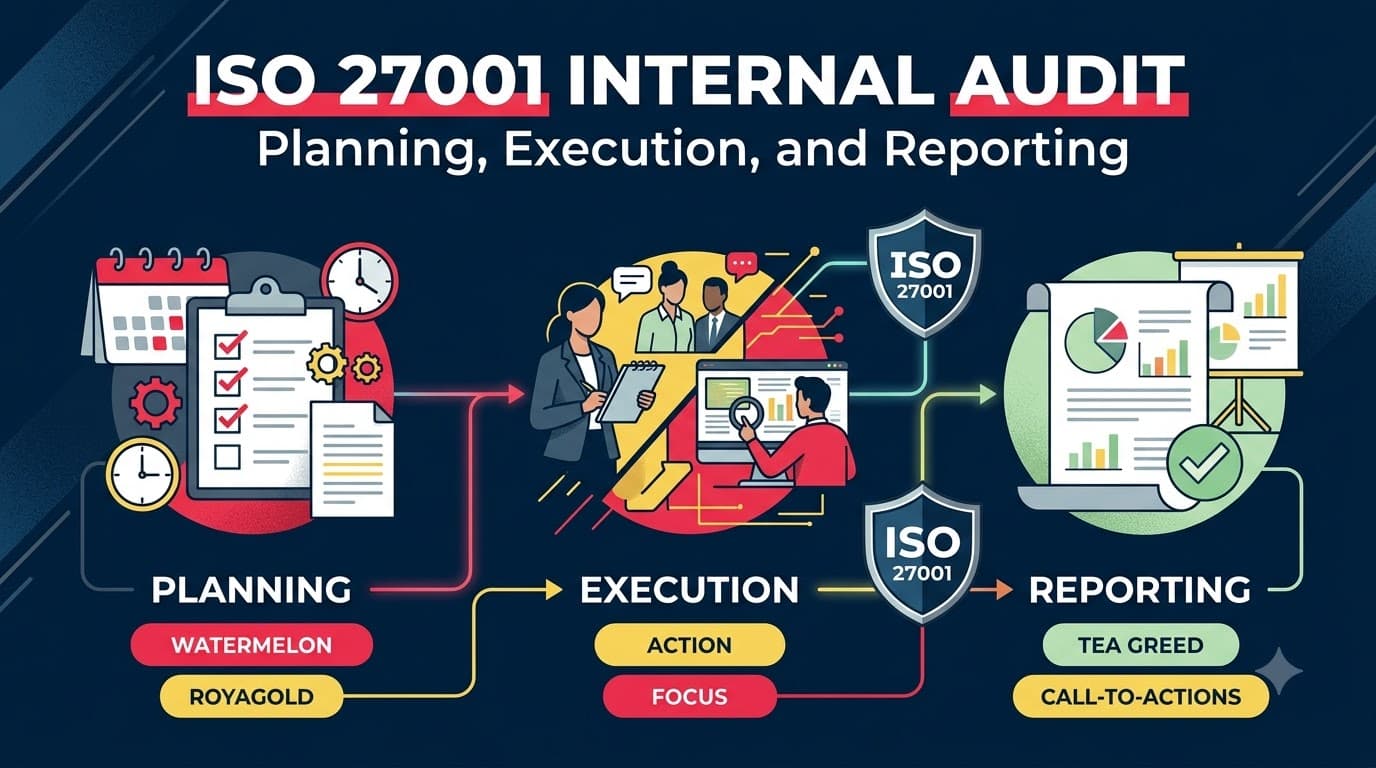
The diagram above is the spine of this article, and it's also the spine of a defensible Clause 9.2 file: a certification body auditor reviewing your internal audit evidence wants to see every one of those boxes, in order, with documented information behind each one. Let's build it, starting at the top.
PLANNING
The Audit Programme: Your Multi-Year, Risk-Based Blueprint
Clause 9.2.2 uses a specific word that trips people up: programme, singular, established, implemented, and maintained. Your audit programme is not any one audit — it's the overarching plan that governs every audit you'll run over a defined cycle, typically covering your full ISMS scope across one to three years, refreshed annually. The standard requires the programme to address frequency, methods, responsibilities, planning requirements, and reporting, and it explicitly requires you to take into account the importance of the processes concerned and the results of previous audits.
That "importance of processes" clause is where most first-time programmes go wrong. The naive approach is to audit every control area with identical frequency and depth — a flat, undifferentiated sweep through all 93 Annex A controls plus the management system clauses every twelve months. It feels fair and thorough. It's actually a poor use of scarce audit hours, because it treats a low-risk control like clear desk policy (7.7) with the same weight as privileged access management (8.2) or supplier information security (5.19–5.23) sitting on top of your highest-impact data flows. A risk-based programme instead assigns audit frequency and depth in proportion to the risk register's own findings, the criticality of the asset or process, the history of prior nonconformities in that area, and the rate of change (a process that changed vendors or platforms this year deserves a closer look than one that's been stable for five).
I build audit programmes around a simple three-tier model: high-priority areas audited every cycle (often every six to twelve months), medium-priority areas audited annually, and lower-risk, stable areas audited on a rotating two-to-three-year basis, with the entire ISMS scope guaranteed coverage within that rotation window — because Clause 9.2.1 requires the whole management system's conformance and effectiveness to be assessed over time, not just the parts you find interesting. Here's what that looks like in a real annual/multi-year schedule for a mid-sized organization:
Area / Process | Priority Tier | Audit Frequency | Rationale | Typical Auditor Assignment |
|---|---|---|---|---|
Access control & privileged access (5.15–5.18, 8.2) | High | Every 6 months | High-impact asset exposure; prior NC history | Internal audit lead + IT security peer |
Supplier & cloud service security (5.19–5.23) | High | Annually, plus ad hoc on new vendors | Third-party risk, recent cloud migration | GRC analyst |
Incident management (5.24–5.28) | High | Annually | Regulatory exposure, tests response readiness | Internal audit lead |
Logging & monitoring (8.15–8.16) | Medium | Annually | Detective control critical to other findings | IT operations peer (independent of SIEM owner) |
Risk assessment & treatment process (Clause 6, Clause 8) | Medium | Annually | Feeds entire ISMS; changes yearly | GRC analyst |
HR security & training (6.1–6.4) | Medium | Every 18 months | Stable process, low change rate | HR-adjacent trained auditor |
Physical security (7.1–7.3, 7.7–7.13) | Medium-Low | Every 18–24 months | Single-office footprint, low incident history | Facilities-adjacent trained auditor |
Cryptography & secure development (8.24–8.29) | High | Annually | Core to SaaS product; frequent code changes | External contract auditor (specialist skill gap) |
Business continuity (5.29–5.30) | Medium | Every 18 months | Tested separately via BC/DR exercises | Internal audit lead |
Document control & records (Clause 7.5, 5.33) | Low | Every 2–3 years | Low risk, stable, infrequent findings | GRC analyst |
Two things about that table are worth calling out explicitly. First, the "rationale" column is not decoration — a certification body auditor reviewing your programme will ask why you chose these frequencies, and "we made it up" is a finding. Tie every frequency decision back to your risk register, your risk assessment methodology, and your history of prior audit results. Second, notice the auditor assignment column already reflects independence thinking — the person who owns the SIEM doesn't audit logging and monitoring; that's Clause 9.2.2's objectivity and impartiality requirement showing up at the programme-design stage, not as an afterthought.
The programme document itself, as documented information retained per Clause 9.2.2, typically includes: the full multi-year schedule, the methods you'll use (document review, interview, sampling, technical verification, remote vs. on-site), named responsibilities for programme ownership versus individual audit execution, resourcing and budget, and a statement of how the programme itself gets reviewed and improved over time — because the programme, like everything else in the ISMS, is subject to continual improvement.
Your Statement of Applicability is the single most useful input when you sit down to build the programme's priority tiers, because it already tells you which of the 93 Annex A controls the organization has declared applicable and why — the SoA's own justification column is often a direct proxy for "importance of the process" as Clause 9.2.2 requires you to consider.
Clear ownership across the programme also matters as much as the schedule itself. A programme with a schedule but no named accountability for each role tends to slip the first time someone goes on leave or a deadline collides with a product launch.
Role | Core Responsibility | Typical Holder |
|---|---|---|
Audit programme manager | Owns the multi-year schedule, resourcing, and programme-level reporting to management | ISMS manager, GRC lead, or CISO |
Lead auditor (per audit) | Plans the individual audit, confirms scope/criteria, leads fieldwork, signs the report | Trained internal auditor or external contractor |
Auditee / process owner | Provides access, documentation, and interview time; owns resulting corrective actions | Department manager or system/process owner |
Corrective action owner | Implements and evidences the fix for an assigned nonconformity | Named individual, often the process owner or a delegate |
Top management | Receives audit results, allocates resources for corrective action, reviews programme effectiveness at management review | CEO/COO, executive sponsor of the ISMS |
Scope and Criteria: Defining Every Individual Audit Before You Start
The programme tells you what gets audited and when. Each individual audit needs its own scope and criteria, defined and documented before the audit begins — this is a separate Clause 9.2.2 requirement and one of the most commonly skipped steps. Skipping it is exactly how you end up with a Derek Voss situation: an "audit" with no defined boundary that wanders wherever the auditor's attention happens to go, and no defined standard against which to judge what's found.
Scope answers "what are we looking at": which processes, departments, locations, systems, or Annex A controls are in bounds for this specific audit cycle. Criteria answers "what are we judging it against": the specific clauses of ISO 27001, the specific Annex A controls per your Statement of Applicability, your own internal policies and procedures, applicable legal, regulatory or contractual requirements, and prior audit results or corrective actions still open from earlier cycles.
Element | Example (Access Control Audit) | Example (Supplier Security Audit) |
|---|---|---|
Scope — process/area | User access provisioning, review, and deprovisioning across production and corporate systems | Onboarding and ongoing monitoring of critical third-party service providers |
Scope — locations/systems | HQ office, primary AWS production environment, HR system integration | All vendors classified "critical" or "high" in the supplier risk register |
Scope — time period | Access changes and reviews from the prior 6 months | Contracts renewed or onboarded in the prior 12 months |
Criteria — ISO 27001 clauses | Clause 8 (Operation), Clause 9.1 (Monitoring, measurement) | Clause 8 (Operation), Clause 6.1.3 (risk treatment) |
Criteria — Annex A controls | 5.15, 5.16, 5.17, 5.18, 8.2, 8.5 | 5.19, 5.20, 5.21, 5.22, 5.23 |
Criteria — internal documents | Access Control Policy v3.2, Joiner-Mover-Leaver Procedure | Supplier Security Policy, Vendor Risk Assessment Procedure |
Criteria — external requirements | Customer contractual SLAs referencing access review cadence | Data processing agreements, applicable data protection law |
Prior findings to verify | NC-2025-03 (delayed deprovisioning) — verify closure | OFI-2025-01 (informal vendor review) — verify status |
Writing this out before the audit forces a discipline that pays off twice: it stops scope creep during the audit itself (auditors chasing an interesting tangent outside the defined boundary, which wastes time and can feel like a fishing expedition to the auditee), and it gives you an unambiguous basis for every finding you eventually write, because "nonconformity against what, exactly" needs a citable answer.
Auditor Competence and Independence: The Non-Negotiable Requirement
Clause 9.2.2 is explicit that the organization must select auditors and conduct audits that ensure the objectivity and impartiality of the audit process. The standard's own clarifying note is blunt: auditors shall not audit their own work. This is not a suggestion — it is the mechanism that keeps an internal audit from being the department manager grading his own homework, and it's one of the first things a competent certification body auditor will probe when reviewing your internal audit records.
Independence doesn't require a dedicated internal audit department (most organizations running ISO 27001, especially under a few hundred employees, don't have one). It requires structural separation between the auditor and the process, system, or control being audited. In practice this means: the person who configured the firewall rules doesn't audit network security controls; the person who manages supplier contracts doesn't audit supplier security reviews; the ISMS manager who wrote the risk treatment plan can audit HR security controls but shouldn't audit the risk management process they personally own. Smaller organizations solve this with cross-functional peer auditing — IT audits HR controls, HR-adjacent staff (with security training) audit IT general controls, and an external contractor or fractional GRC consultant fills any gap the internal team can't cover independently. This is also where using external auditors for particular audit cycles earns its keep, which we'll return to later.
Competence is the second half of the requirement, and it's assessed, not assumed. An internal auditor needs three things: a working understanding of ISO/IEC 27001's clause structure and the applicable Annex A controls, familiarity with audit techniques (how to plan, sample, interview, and evidence a finding), and enough domain knowledge of the area under audit to recognize when an answer doesn't add up. None of that requires a lead auditor certificate, though formal ISO 27001 Lead Auditor training (often built around ISO 19011 principles) is the fastest way to get a first-time internal auditor competent quickly, and it's a credential worth budgeting for at least one person on the team.
Independence Model | How It Works | Best Fit | Key Risk to Manage |
|---|---|---|---|
Dedicated internal audit function | One or more staff whose sole job is internal audit across the org | Large enterprises, regulated industries | Cost; risk of becoming disconnected from operations |
Cross-functional peer auditing | Staff from Department A audit Department B's controls, and vice versa | Small-to-mid organizations (50–500 staff) | Requires real training investment; informal favor-trading risk |
ISMS manager + external contractor | ISMS manager audits areas outside their own ownership; contractor covers the rest | Lean GRC teams, first 1–2 certification cycles | Cost of ongoing contractor relationship |
Fully outsourced internal audit | External firm runs the entire programme under contract | Very small organizations, or as an interim bridge | Weaker institutional knowledge transfer if not managed well |
Rotating internal audit committee | Trained pool of auditors rotates assignments each cycle to avoid repeat pairings | Mid-to-large organizations wanting resilience | Coordination overhead; needs a strong programme manager |
Whichever model you choose, document it. The audit plan for each cycle should record who's assigned, why they're independent of the area being audited, and what competence basis qualifies them (training completed, prior audit experience, domain background). This becomes part of the retained documented information Clause 9.2.2 requires, and it's usually one of the first things I check when I'm brought in to review a client's readiness before a Stage 1 audit — a programme with no visible independence rationale is a red flag the CB will find on its own.
"The single fastest way to spot a paper-tiger internal audit is to ask the auditor one question: 'Whose work are you reviewing right now, and who signs off on their objectives?' If the answer is 'mine,' I already know what I'll find when I pull the evidence file." — Marcus Webb, Lead Auditor, Trident Assurance Group
EXECUTION
Preparation: The Work That Happens Before Anyone Walks In
A good internal audit is 60% preparation, 30% conducting the fieldwork, and 10% writing it up — and it's the organizations that flip that ratio, spending almost no time preparing and then trying to improvise their way through interviews, that produce Derek Voss-style reports. Preparation starts the moment the scope and criteria are signed off and runs through the days immediately before the audit.
Concretely, preparation means: notifying the audit team of the schedule with enough lead time (typically two to four weeks) that they aren't ambushed; requesting the relevant documented information in advance — policies, procedures, the risk register entries relevant to scope, prior audit reports and corrective action logs, the SoA extract covering the controls in scope; reviewing that documentation before setting foot in an interview so questions are informed rather than generic; building or refreshing the interview question set and sample plan specific to this audit's scope and criteria; and communicating a short audit plan to the auditee area — who will be interviewed, roughly when, what will be reviewed, and how long it will take. None of this should surprise the auditee on the day; surprise interviews produce defensive, guarded answers, not useful evidence, and that's not what a first-party audit is for.
Preparation Step | Typical Timing | Owner | Output |
|---|---|---|---|
Confirm scope, criteria, and audit team | 3–4 weeks before | Audit programme manager | Signed audit plan |
Request and review documented information | 2–3 weeks before | Assigned auditor(s) | Document review notes, gap list |
Review prior audit results and open corrective actions in scope | 2 weeks before | Assigned auditor(s) | Follow-up item list |
Build interview question set and sampling plan | 1–2 weeks before | Assigned auditor(s) | Interview guide, sample selection |
Notify auditee area with logistics | 1–2 weeks before | Audit programme manager | Calendar invites, room/call logistics |
Final readiness check | 1–3 days before | Assigned auditor(s) | Go/no-go confirmation |
The Opening Meeting: Setting the Tone
Every audit, however small, should open with a brief meeting between the auditor(s) and the relevant auditee representatives — five minutes for a narrow single-control audit, thirty minutes for a broad multi-department cycle. The opening meeting confirms scope and criteria out loud, introduces the audit team and confirms their independence, sets expectations on timing and logistics, explains how findings will be classified and communicated, and — critically — reinforces that the internal audit exists to find and fix gaps, not to assign blame. That last point matters enormously for the quality of evidence you'll get in the interviews that follow: an auditee who believes an honest "actually, we've been behind on that for two months" will be treated as useful information rather than a personal failure is an auditee who tells you the truth. One who fears the audit is a performance review in disguise will tell you what you want to hear, and you'll end up with another four-page report full of confident "yes" answers that don't survive a certification body's scrutiny.
Interviews and Evidence Gathering: Where the Real Work Happens
The core of fieldwork is triangulating three sources: what the documentation says should happen, what people say does happen, and what the actual records, systems, and artifacts show did happen. A finding earns its weight only when at least two of those three align on a gap — a single unsupported verbal claim ("oh yeah, we do that") is not evidence, and neither is a policy document sitting unread on a file share. This is exactly the distinction Derek's audit missed: he collected only the second source, verbal confidence, and treated it as sufficient.
Interviews work best as structured conversations, not interrogations and not open-ended chats. Start broad to build context and rapport, then narrow toward specific, evidence-seeking questions, and always follow a claim with "can you show me" — pull up the actual access review spreadsheet, the actual ticket, the actual log. Auditors who ask to see things, rather than accepting descriptions of things, find the gaps that matter.
Audit Area | Sample Opening Question | Follow-Up (Evidence-Seeking) | Evidence to Request |
|---|---|---|---|
Access control (5.15–5.18) | "Walk me through what happens when someone joins the company and needs system access." | "Can you show me the access request and approval for the last new hire in the finance team?" | Access request tickets, approval workflow, provisioning logs |
Privileged access (8.2) | "How do you decide who gets admin rights, and how often is that reviewed?" | "Show me the last quarterly privileged access review and who signed off." | Privileged access register, review sign-off, revocation evidence |
Termination/deprovisioning | "What's the process when someone leaves the company?" | "Pull up the HR termination log for the last quarter and let's cross-check it against active accounts." | HR termination records, account deactivation logs, offboarding checklist |
Supplier security (5.19–5.22) | "How do you assess a new vendor's security posture before signing?" | "Show me the vendor risk assessment for the supplier you onboarded most recently." | Vendor risk assessment forms, security questionnaires, contract clauses |
Incident management (5.24–5.26) | "Tell me about the last security incident or near-miss you handled." | "Show me the incident ticket, the timeline, and where it's logged in the incident register." | Incident tickets, post-incident reviews, the incident log itself |
Logging & monitoring (8.15–8.16) | "What systems generate logs, and who reviews them?" | "Show me an example of an alert that was triaged in the last month, start to finish." | SIEM alert history, triage notes, escalation records |
Training & awareness (6.3) | "How do new employees get security training, and how do you know it happened?" | "Show me completion records for the last training cycle, including any overdue staff." | LMS completion reports, training content, overdue-staff follow-up |
Change management (8.32) | "Walk me through how a code or infrastructure change gets approved and deployed." | "Show me a recent change ticket end-to-end, including who approved it and whether it was tested." | Change tickets, approval records, segregation-of-duties evidence |
Evidence gathering isn't limited to interviews. Document review (policies against actual dated versions, not drafts), observation (watching a control operate in real time — a badge reader in use, a screen-lock timeout actually firing), and technical verification (pulling a report directly from a system rather than accepting a screenshot someone prepared in advance) all belong in the toolkit. ISO 19011 groups these under the general heading of audit methods, and a mature internal audit programme mixes them deliberately rather than defaulting to interviews alone, because interviews alone are exactly what produced Aurelia's blind spot.
Handling Difficult Interviews: Common Pitfalls and What to Do Instead
Even well-prepared auditors run into predictable friction during fieldwork, and how you handle it in the moment often determines whether the resulting finding is credible or contestable. The most common pattern is the defensive auditee who answers every question with a policy citation rather than a description of actual practice — "our policy requires quarterly reviews" is not the same statement as "here's the quarterly review we did in March." A calm, repeated redirect back to "and can you show me that specific instance" usually breaks through without turning the interview adversarial. The second common pattern is the over-helpful auditee who prepares evidence in advance that happens to be the cleanest example in the population — which is exactly why sampling should be selected by the auditor, not offered by the auditee, and why a request like "pull up the March 2026 review, not whichever one you have ready" matters more than it sounds like it should. The third is scope creep in the other direction: an auditee who tries to broaden the conversation into unrelated wins and improvements to dilute attention from the specific area under review, which a disciplined auditor acknowledges briefly and then steers firmly back to the defined criteria.
Pitfall | What It Looks Like | Auditor Response |
|---|---|---|
Policy-citation deflection | Auditee describes what should happen, not what did happen | Redirect to a specific dated instance: "show me the one from last quarter" |
Cherry-picked evidence | Auditee proactively offers their best-looking example | Auditor selects the sample independently, not the auditee |
Scope dilution | Auditee steers toward unrelated positive initiatives | Acknowledge briefly, then return to the defined scope and criteria |
Defensive or anxious auditee | Vague, guarded, minimal answers | Reinforce the opening meeting's framing: findings improve the ISMS, they aren't a performance review |
Evidence that doesn't match the claim | Auditee says one thing, the system or record shows another | Note the discrepancy factually in working papers; this is often where the real finding lives |
Sampling: You Cannot (and Should Not) Check Everything
Most internal audits don't have the time or the mandate to review every single user account, every single vendor contract, or every single change ticket in the audit period, and trying to do so is usually a worse use of the fieldwork window than a well-designed sample. Sampling means selecting a representative subset of a population large enough to draw a reasonable conclusion, using a rationale you can defend if challenged.
The two sampling approaches that matter most in practice are risk-based sampling (deliberately weighting the sample toward higher-risk items — privileged accounts, high-value suppliers, production changes rather than staging changes) and random or systematic sampling (picking every Nth record, or a random draw, to avoid unconscious bias toward records that happen to look clean). A defensible audit typically blends both: a risk-weighted core sample of the items that matter most, plus a smaller random sample to sanity-check that the rest of the population isn't hiding something the risk-weighting missed.
Population | Sample Size Approach | Rationale | Example |
|---|---|---|---|
User accounts (100s–1,000s) | Risk-based: all privileged accounts + random sample of 10–15% of standard accounts | Privileged accounts carry disproportionate impact; random sample checks general hygiene | All 22 admin accounts + 40 of 380 standard user accounts |
Terminated employees (dozens per period) | Full population if under ~50; random sample of 20–25 if larger | Deprovisioning failures are a common, high-impact gap — full coverage is often feasible | All 31 terminations in the audit period |
Supplier contracts (dozens) | All "critical" tier; random sample of "high" and "medium" tiers | Criticality tiering from the risk register drives where the impact lives | All 6 critical vendors + 8 of 22 high/medium vendors |
Change tickets (100s per quarter) | Random sample stratified by production vs. non-production | Production changes carry the real risk; stratification avoids over-sampling low-risk changes | 25 production changes + 10 non-production, drawn at random |
Security incidents/near-misses | Full population if small (under ~20 per period); otherwise risk-weighted sample | Understanding the full incident picture is usually feasible and valuable | All 7 logged incidents in the period |
Document the sample size and method in the working papers for every audit, not just the conclusion. If a finding later gets challenged — by the auditee, by management, or by a certification body asking how thorough the internal audit really was — "we reviewed a risk-weighted sample of 40 out of 380 accounts, full methodology attached" is a defensible answer. "We asked and they said it was fine" is not.
"I train every new internal auditor on my team with the same line: your job in the interview room is to ask 'can you show me,' not 'can you tell me.' Everything good and bad about an ISMS lives in the gap between those two questions." — Elena Voss, ISMS Manager, Kestrel Biotech
FINDINGS
Classifying What You Found: Conformity, Nonconformity, and Opportunity for Improvement
Every observation an auditor makes during fieldwork resolves into one of three categories, and getting the classification right matters because it determines what happens next — whether corrective action under Clause 10 is mandatory, optional, or not applicable at all.
A conformity means the evidence supports that the requirement — whether from the standard, the SoA, or an internal procedure — is being met. It's worth recording conformities explicitly, not just silently moving on, because a report that only ever lists problems looks unbalanced and because conformities are useful evidence of what's working when you're prioritizing where to focus limited remediation resources.
A nonconformity means a requirement is not being met, evidenced by a documented gap between what should happen and what does happen. Nonconformities split further into minor and major, and this split is where a lot of internal auditors either over-escalate everything into a crisis or under-escalate real problems into throwaway notes. A minor nonconformity is an isolated lapse, a single instance, or a partial gap that doesn't call the whole management system's capability into question — a single overdue access review, one supplier contract missing a security clause. A major nonconformity is a systemic failure, a complete absence of a required control, a pattern of repeated minor issues that together indicate the process itself is broken, or anything that would cause the ISMS to fail to achieve its intended outcome — no evidence of any access reviews having happened in over a year, for instance, or repeat findings against the same control across multiple audit cycles with no remediation. Aurelia's fourteen active-but-terminated accounts, several with lingering privileged rights, is textbook major: not an isolated slip but evidence the deprovisioning process itself doesn't function.
An opportunity for improvement (OFI) is different in kind, not degree — it isn't a nonconformity at all. It's something that technically meets the requirement but could be done better: a manual process that works but is error-prone and could be automated, a policy that's followed but is ambiguously worded, a control that's effective but relies too heavily on one person's institutional memory. OFIs don't require formal corrective action, but they're valuable input to continual improvement and worth tracking so they don't get lost.
Classification | Definition | Corrective Action Required? | Example |
|---|---|---|---|
Conformity | Evidence supports the requirement is being met | No — but record it | Sampled access reviews show consistent quarterly completion with sign-off |
Opportunity for Improvement (OFI) | Requirement is met, but a better way exists | No — track for continual improvement | Vendor risk assessments are completed but rely on an unversioned spreadsheet rather than a controlled tool |
Minor Nonconformity | An isolated or partial gap that doesn't undermine overall capability | Yes — corrective action per Clause 10 | One terminated employee's account was deactivated 9 days late against a 5-day SLA |
Major Nonconformity | Systemic failure, complete absence of a control, or a repeat/pattern issue | Yes — urgent corrective action, often with interim mitigation | 14 terminated employees retained active access over several months, including 2 with standing privileged rights |
Writing Findings That Hold Up: Precision Beats Volume
A finding is only as useful as its ability to be understood, acted on, and verified as closed by someone who wasn't in the room when it was written. The single most common failure mode I see in internal audit reports — even from teams that did the fieldwork properly — is vague findings: "access reviews need improvement" tells nobody what to fix, who owns it, or how to know when it's done.
A good finding statement has four components: the objective evidence observed (specific, factual, sourced), the requirement it fails to meet (cited — clause, control number, or internal document and section), the risk or impact if left unaddressed, and enough specificity that the corrective action owner can start work without needing to re-interview the auditor to understand what was actually found.
Weak Finding (Avoid) | Strong Finding (Use) |
|---|---|
"Access control needs work." | "Sample of 40 user accounts (of 380 active) reviewed against the Q2 2026 HR termination log identified 14 accounts belonging to employees terminated between 3 and 8 months prior that remained active, including 2 with standing privileged database access. This is a nonconformity against Control 8.2 (Privileged access rights) and Section 4.3 of the Access Control Policy (5-business-day deprovisioning SLA). Classified as Major — evidence indicates the deprovisioning step of the joiner-mover-leaver process is not functioning, not an isolated lapse." |
"Training isn't tracked well." | "LMS completion export (pulled directly from the system, not auditee-provided) shows 22 of 340 staff (6.5%) have not completed mandatory annual security awareness training assigned 97 days prior, with no evidence of escalation to line managers. This is a nonconformity against Control 6.3 and the Security Awareness Training Procedure Section 2.1 (30-day completion requirement, manager escalation at day 45). Classified as Minor — isolated to overdue completion tracking; core training programme is otherwise operating as designed." |
"Suppliers aren't reviewed." | "Of 6 contracts sampled from the critical supplier tier, 1 (Vendor: [name]) had no evidence of the annual security review required by the Supplier Security Policy Section 5, last review on file dated 19 months prior. Nonconformity against Control 5.22 (Monitoring, review and change management of supplier services). Classified as Minor given isolated instance within an otherwise functioning review cadence for the remaining 5 critical vendors." |
"Logging is fine, no issues." | "Conformity: Sample of 15 SIEM alerts from the audit period showed triage within the 4-hour SLA in all 15 cases, with documented escalation for the 3 alerts meeting the incident threshold. Control 8.16 (Monitoring activities) operating effectively." |
Notice that the strong findings all cite a sample size and source, a specific requirement, and a classification with a stated rationale for that classification — that combination is what lets a reader (an auditee, a manager, or a CB auditor reviewing your internal audit file eighteen months from now) trust the conclusion without having to take it on faith.
"I can always tell within the first two pages whether an internal audit report was written by someone who did the work or someone who's summarizing a conversation. The tell is whether I can find a sample size anywhere in it." — Tomas Reyes, ISO 27001 Lead Auditor, Meridian Compliance Partners
REPORTING
The Internal Audit Report: Structure That Certification Bodies Respect
The report is the durable artifact — the documented information Clause 9.2.2 requires you to retain as evidence the audit programme was implemented and the results reported. It needs to stand on its own months or years later, to someone (an auditee, new management, a certification body auditor) who wasn't present for the fieldwork. A structure that consistently holds up:
Report Section | Content | Purpose |
|---|---|---|
Header / metadata | Audit title, date(s), scope, criteria, auditor(s) and independence statement, distribution list | Establishes what was audited, against what, and by whom |
Executive summary | Overall conclusion (conforms / conforms with findings / significant nonconformance), count of findings by classification, headline risks | Gives management the 60-second version |
Audit methodology | Documents reviewed, interviews conducted, sampling approach and sizes, any scope limitations encountered | Lets a reader assess how thorough the audit was |
Detailed findings | Each finding written per the strong-finding format above, grouped by control area or process | The substantive record — what was found, against what requirement, at what severity |
Conformities noted | Explicit record of what's working, with evidence basis | Balances the report; useful input to resourcing decisions |
Opportunities for improvement | OFIs logged separately from nonconformities | Feeds continual improvement without triggering formal CAPA overhead |
Follow-up on prior findings | Status of nonconformities and OFIs from the previous audit(s) in this area | Demonstrates the loop is actually closing over time |
Recommendations / next steps | Suggested priority order for corrective action, any interim mitigations advised | Turns findings into action, not just a filing exercise |
Sign-off | Auditor signature/date, acknowledgment (not necessarily agreement) from auditee management | Formal record of delivery and receipt |
Keep the executive summary genuinely short — three to five sentences a busy VP can absorb standing up — and put the evidentiary weight in the detailed findings section where it belongs. I've reviewed reports that buried a major nonconformity on page fourteen of a twenty-two-page document with no mention in the summary; by the time management review happened, nobody remembered it was there.
Reporting to Management: Closing the Loop, Not Just Filing the PDF
Clause 9.2.2 requires that audit results be reported to relevant management — not filed in a shared drive and forgotten. "Relevant management" means the people who actually own the process or resources needed to fix what was found, and, for anything significant, the level of leadership that will feed the results into management review under Clause 9.3. In practice this is usually a short live readout — fifteen to thirty minutes — rather than an email with an attachment, because live reporting lets management ask questions, push back on a classification if they have context the auditor didn't, and commit to ownership and timelines on the spot rather than in the abstract.
A reporting cadence that works well in practice: the report goes to the direct process owner and their manager within a set number of business days of fieldwork closing (I recommend five to ten, while the evidence is still fresh), a summary rolls up to the ISMS steering group or equivalent leadership forum on whatever cadence that group meets, and the full body of results across the audit cycle feeds the formal management review meeting as required input alongside monitoring results, risk assessment updates, and prior corrective action status. Don't let internal audit reporting become a one-way broadcast — the best programmes I've built include a short right-of-reply step where the auditee can flag a factual correction (not a negotiation on the finding's existence, but a correction if the evidence was misread) before the report is finalized and distributed.
Aurelia now uses the Internal Audit Report Template as the baseline structure for every cycle, precisely because a consistent format makes year-over-year trend comparison possible — you can't tell whether findings are improving if every report is organized differently.
FOLLOW-UP
Corrective Action and Closure: Where Most Programmes Quietly Die
Here's an uncomfortable truth: writing a good finding is the easy part. The internal audit programmes that actually improve an ISMS are the ones with a disciplined corrective action and closure process behind every nonconformity — and the ones that don't have that discipline tend to accumulate the same findings, worded slightly differently, cycle after cycle, until a certification body notices the pattern and calls it what it is: a systemic failure to act on known gaps, which is itself a major nonconformity under Clause 10 Nonconformity and Corrective Action.
Clause 10.2 requires that when a nonconformity occurs, the organization react to it, evaluate the need for action to eliminate the root cause (not just the symptom) so it does not recur, implement any action needed, review the effectiveness of the corrective action taken, and make changes to the ISMS if necessary. That "root cause" requirement is the step internal auditors most often let slide. Deactivating the fourteen accounts Aurelia found is a correction — necessary, urgent, and not sufficient. The corrective action has to answer why the deprovisioning step failed in the first place: was there no automated trigger from the HR termination event, was the ticket queue simply understaffed, was there no defined SLA at all before this finding. Root cause analysis (a discipline worth its own reference material) is what separates "we fixed these fourteen accounts" from "we fixed the reason fourteen accounts existed."
A working closure process needs a tracker — a corrective action log, separate from the audit report itself, that persists across cycles — with, at minimum, the finding reference, the assigned owner, the target closure date, the root cause identified, the corrective action taken, and independent verification that the action was actually effective, not just completed on paper.
Field | Purpose | Example |
|---|---|---|
Finding reference | Links back to source audit and finding | NC-2026-04 |
Classification | Minor / Major, carried from the finding | Major |
Root cause | The underlying reason, not the symptom | No automated deprovisioning trigger tied to HR termination event; manual ticket process with no SLA enforcement |
Corrective action | What will actually change | Implement automated account suspension triggered directly by HR system termination flag; add 24-hour SLA with escalation |
Owner | Named individual, not a department | IT Operations Manager |
Target closure date | Realistic, tracked date | 45 days from finding date |
Interim mitigation | What happens in the meantime, if risk is high | Manual weekly cross-check of active accounts against HR roster until automation is live |
Verification of effectiveness | How and when closure is independently confirmed, not just self-reported | Follow-up audit sample of 20 terminations post-implementation, zero exceptions found |
Two failure patterns show up constantly here. The first is closing findings on the honor system — the owner reports "done" and the auditor takes their word for it, with no independent verification that the fix actually works under real conditions. The second is closing findings too fast against an unrealistic date just to make the tracker look clean, which produces a corrective action that isn't durable and reappears at the next audit cycle, now looking like a repeat finding and therefore a candidate for major-nonconformity escalation.
Feeding Management Review: Closing the Loop for Real
Clause 9.3 requires top management to review the ISMS at planned intervals, and internal audit results are explicitly one of the required inputs to that review, alongside the status of actions from previous management reviews, changes in external and internal issues, feedback on performance including nonconformities and corrective actions, monitoring and measurement results, and results of risk assessment and the status of the risk treatment plan. This is the mechanism that keeps internal audit from being a self-contained exercise that never touches strategic decision-making — a well-run programme feeds management review with a genuine trend view: how many findings this cycle versus last, how quickly they closed, whether the same root causes keep recurring across different control areas (a strong signal of an under-resourced process rather than isolated bad luck), and what that implies for budget, staffing, or tooling decisions the leadership team actually controls.
I encourage clients to bring one specific artifact to every management review: a rolling internal audit trend chart — findings opened, findings closed, average time to closure, repeat-finding rate — because a single cycle's report tells you what's broken today, but the trend tells you whether the ISMS is actually maturing. If a certification body auditor asks how the organization uses internal audit results to drive improvement (and a good one will), "here's eighteen months of trend data reviewed at every management review" is a dramatically stronger answer than producing one isolated report on request.
Improving the Audit Programme Itself, Not Just the ISMS It Audits
It's easy to treat the audit programme as a fixed instrument you built once and now simply execute on schedule. The strongest programmes I've seen instead run a short retrospective after every cycle, separate from the findings themselves, that asks a different set of questions: did the scope and criteria hold up, or did fieldwork keep drifting outside them; was the sample size actually sufficient, or did the auditor wish they'd pulled a larger population once patterns started emerging; did the interview questions surface real evidence quickly, or did they need constant improvisation; and did the report reach management in a format that actually drove a decision, or did it sit in an inbox. Feed the answers back into next cycle's programme design — adjust frequencies, retrain a weak interviewer, tighten a vague criteria template — the same continual-improvement discipline you'd apply to any other ISMS process. A programme that never changes its own method, cycle after cycle, is usually a sign that nobody is asking whether the audits themselves are good enough, which is its own quiet risk sitting one level up from anything an individual audit will ever find.
"Boards don't remember individual findings. They remember whether the number of repeat findings went up or down. Give leadership that one chart and internal audit stops feeling like a compliance chore and starts feeling like a management tool." — Sandra Kim, CISO, Vantage Point Logistics
Building Internal Audit Competence — and When to Bring in External Auditors
Very few organizations start their ISO 27001 journey with a bench of trained internal auditors sitting around waiting for an assignment. Competence gets built deliberately, usually through some combination of formal ISO 27001 (or ISO 19011-aligned) lead auditor training for at least one or two people who will anchor the programme, shadowing — a new auditor sits in on two or three cycles led by someone experienced before running one solo, paired audits where a less-experienced and more-experienced auditor work a cycle together, and a genuine post-audit retrospective where the team reviews what worked and what didn't in how the audit itself was run, not just what it found.
External auditors earn their place in a mature programme in three specific situations: filling an independence gap when the internal team is simply too small to audit a process without someone reviewing their own work (a five-person IT team, for instance, has nobody left over to independently audit IT general controls); covering a specialist skill gap, most often around secure development and cryptography controls (8.24–8.29) where a generalist internal auditor may not know what a properly configured key management process even looks like; and providing an outside-in sanity check before a first certification cycle or after a major ISMS change, essentially a dry run that mimics what a CB auditor will actually probe. None of this requires outsourcing the entire function — the strongest programmes I've built blend a trained internal core with targeted external support exactly where independence or expertise runs out, and the Certification Readiness Checklist is a useful gate to walk through before deciding whether that outside sanity check is worth the spend ahead of your own Stage 1 audit.
Resourcing Model | Illustrative Annual Cost Range* | Best Fit | Trade-off |
|---|---|---|---|
Fully in-house, trained peer auditors | Staff time only (~40–80 hrs/auditor/year) | Mid-size orgs with several trained staff across departments | Slower ramp-up; ongoing training investment |
In-house lead + external specialist top-up | Staff time + $6,000–$15,000 in contracted specialist audits | Most first-2-cycle certified organizations | Balances cost against real independence and skill gaps |
Fully outsourced programme | $15,000–$35,000+ per year depending on scope and cycles | Very small organizations, or as a bridge during scale-up | Weaker institutional knowledge; still requires an internal owner of the relationship |
*Illustrative figures for planning discussion only, drawn from typical consulting engagements I've scoped — actual cost depends heavily on organization size, number of locations, and audit frequency.
If You're Also Running SOC 2 or NIST CSF Alongside ISO 27001
A good number of the organizations I work with aren't running ISO 27001 in isolation — they're maintaining a SOC 2 Type II examination for U.S. enterprise customers, aligning to the NIST Cybersecurity Framework for a federal or critical-infrastructure customer base, or some combination of both alongside ISO 27001. The internal audit discipline in this article transfers almost directly, but the mechanics differ enough to be worth naming so you don't build three redundant, disconnected audit calendars.
Framework | Internal Assurance Mechanism | Who Performs It | How It Compares to ISO 27001 Clause 9.2 |
|---|---|---|---|
ISO/IEC 27001 | Internal audit programme (Clause 9.2), verified at Stage 2/surveillance by a certification body | Internal, independent auditors; CB for certification | The model this article is built around |
SOC 2 | No formal "internal audit" clause — but a mature Type II programme runs continuous internal control monitoring feeding the audit period | Internal compliance/GRC function | Less prescriptive on programme structure; ISO 27001's Clause 9.2 discipline strengthens SOC 2 evidence quality |
NIST CSF | No certification or audit requirement — a voluntary framework; internal assessment against the Functions/Categories is self-defined | Internal risk/security team, often informally | Least structured of the three; borrowing ISO 27001's audit rigor (scope, criteria, sampling, findings) materially improves a NIST-aligned self-assessment |
If your organization is pursuing more than one framework, the single highest-leverage move is running one unified internal audit programme with framework-specific criteria mapped onto shared control evidence, rather than three separate audit exercises interviewing the same people about the same access reviews on three different calendars.
Common Mistakes I See Over and Over
Mistake | Why It Happens | What It Costs | The Fix |
|---|---|---|---|
Treating internal audit as a checklist exercise | Nobody trained the auditor on evidence-based method | Misses real gaps a CB will find first — see Aurelia | Require sample-based, source-cited findings, not verbal confirmation |
No defined scope/criteria before fieldwork starts | Feels like extra paperwork for a "quick" audit | Findings can't be defended; scope creep wastes time | Always document scope and criteria and get sign-off before Day 1 |
Auditors reviewing their own work | Small teams, no formal independence model | Undermines the entire credibility of the finding, and the CB will notice | Use peer cross-audits or bring in external support for the gap |
Zero findings, every cycle, forever | Fear that findings reflect badly on the team or the auditor | Reads to a CB as "nobody is really looking" | Normalize findings as healthy; track trend, not just count |
No root cause analysis on nonconformities | Pressure to close items fast | Same finding recurs next cycle, now looks systemic | Require a stated root cause before any corrective action is logged as planned |
Corrective action closed on the honor system | No independent verification step in the tracker | Ineffective fixes surface again, often at the worst time (a CB visit) | Verify closure with fresh evidence, not a status update email |
Reports too long, findings buried | Trying to be exhaustive rather than useful | Management misses the one finding that mattered most | Lead with an honest executive summary; detail lives below it |
Internal audit results never reach management review | Reporting stops at the process owner | Breaks the Clause 9.3 input requirement; leadership loses visibility | Build internal audit trend data into every management review agenda |
Case Studies
Aurelia Cloud Systems — from box-ticking to a passed Stage 2. After the failed Stage 2 attempt described at the top of this article, Aurelia's leadership brought in an external ISO 27001 consultant to rebuild the internal audit function from the ground up: a documented multi-year risk-based programme, defined scope-and-criteria templates for every cycle, a cross-functional independence model pairing IT staff to audit HR controls and vice versa, and a mandatory sample-and-evidence standard for every finding. The rebuilt programme's first cycle, three months later, surfaced eleven findings — two major, six minor, three OFIs — a number that initially alarmed the CFO until it was framed correctly: eleven real findings closed on a documented timeline is a stronger certification signal than zero findings nobody trusts. Aurelia passed its follow-up visit and full Stage 2 with no nonconformities six weeks later, closed the $2.1 million contract that had been on hold, and now runs its internal audit programme on a defined semi-annual cycle for high-priority areas.
Ferro Dynamics Manufacturing — catching a segregation-of-duties gap before the CB did. Ferro Dynamics, a 600-employee industrial equipment manufacturer, ran its internal audit against change management (control 8.32) as part of its annual high-priority rotation and sampled 25 production change tickets. The audit found that in 7 of the 25 samples, the same engineer had both authored the change and approved its deployment to production — a segregation-of-duties gap that hadn't been visible in the change management procedure's written description, only in how it was actually executed. Classified as a major nonconformity given the pattern across more than a quarter of the sample, the finding triggered a root-cause investigation that traced back to an approval workflow tool misconfigured during a platform migration eight months earlier. Ferro Dynamics fixed the workflow, retrained the engineering team, and verified closure with a fresh 20-ticket sample showing zero exceptions — all four months before its next certification body surveillance visit. The GRC manager estimated that catching this internally, versus having the CB find it during surveillance, avoided a likely 6-to-8-week corrective action window under external time pressure and an estimated $40,000 in expedited consulting and delayed system rollout costs.
Northbridge Financial Services — building internal competence to break a cost and knowledge cycle. Northbridge, a fintech processing payment data for regional credit unions, had outsourced its entire internal audit programme for its first two certification cycles at roughly $28,000 a year, and found the external firm's findings were competent but generic — the auditors didn't know Northbridge's systems well enough to sample deeply. Northbridge's CISO invested in formal lead auditor training for two internal GRC staff and restructured the programme around a cross-functional peer model, reserving external audit spend only for the cryptography and secure development control areas where in-house expertise was thin. The result over the following two cycles: internal audit spend dropped by roughly $18,000 a year, but more importantly, the newly trained internal auditors caught a repeat root cause — the same access-review gap appearing independently in two unrelated departments — that a generic external audit had missed twice before because it sampled each department in isolation rather than looking for cross-department patterns. That catch led to a single systemic fix (a centralized access review tool) rather than two separate departmental band-aids.
"The two cycles we outsourced entirely weren't wrong, exactly — they were just shallow. The moment we had our own trained people sampling with real context on our own systems, the findings got sharper and the fixes got more durable." — Aisha Bello, Quality & Compliance Director, Northbridge Financial Services
"An internal audit report with zero findings doesn't make me trust an ISMS more. It makes me start Stage 2 by looking harder, because either nobody looked, or nobody wanted to write down what they saw." — Raj Patel, Internal Audit Lead, Northbridge Financial Services
The Strategic Close: Internal Audit as Competitive Advantage, Not Overhead
It's tempting to treat internal audit as the compliance tax you pay to keep the certificate — an hour tax, a paperwork tax, a "someone has to do it" assignment that lands on whoever has the least political capital to say no. I'd push back on that framing hard. Every organization I've worked with that treats internal audit as a genuine improvement engine rather than a box-ticking exercise gets something the compliance-tax mindset never delivers: a real-time picture of where the ISMS is actually weak, months before a customer's security questionnaire, a regulator's inquiry, or a certification body's Stage 2 fieldwork finds the same gap the hard way. That's not overhead. That's risk intelligence your competitors who treat ISO 27001 as a paperwork exercise simply don't have, and it shows up in faster sales cycles, fewer surprise findings, and a leadership team that trusts the certificate actually means something when they put it in front of a prospect.
If you're building or rebuilding this function, don't start from scratch. Our Internal Audit Checklist walks through the planning and execution steps in this article as a working document, our Internal Audit Report Template gives you the structure covered above ready to populate, and our Internal Audit Interview Question Script turns the interview approach table into a ready-to-use field guide for your next audit cycle. If you're earlier in the journey and still building the broader ISMS this audit function will sit inside, our Complete ISO 27001 Implementation Guide eBook and Certification Readiness Checklist are the natural companions. And if you'd rather have a second set of experienced eyes validate your programme before your certification body does, PentesterWorld's ISO 27001 advisory team runs internal audit programme reviews and mock audit dry runs built exactly for this — reach out and let's make sure your next internal audit finds the gaps before someone else's auditor does.