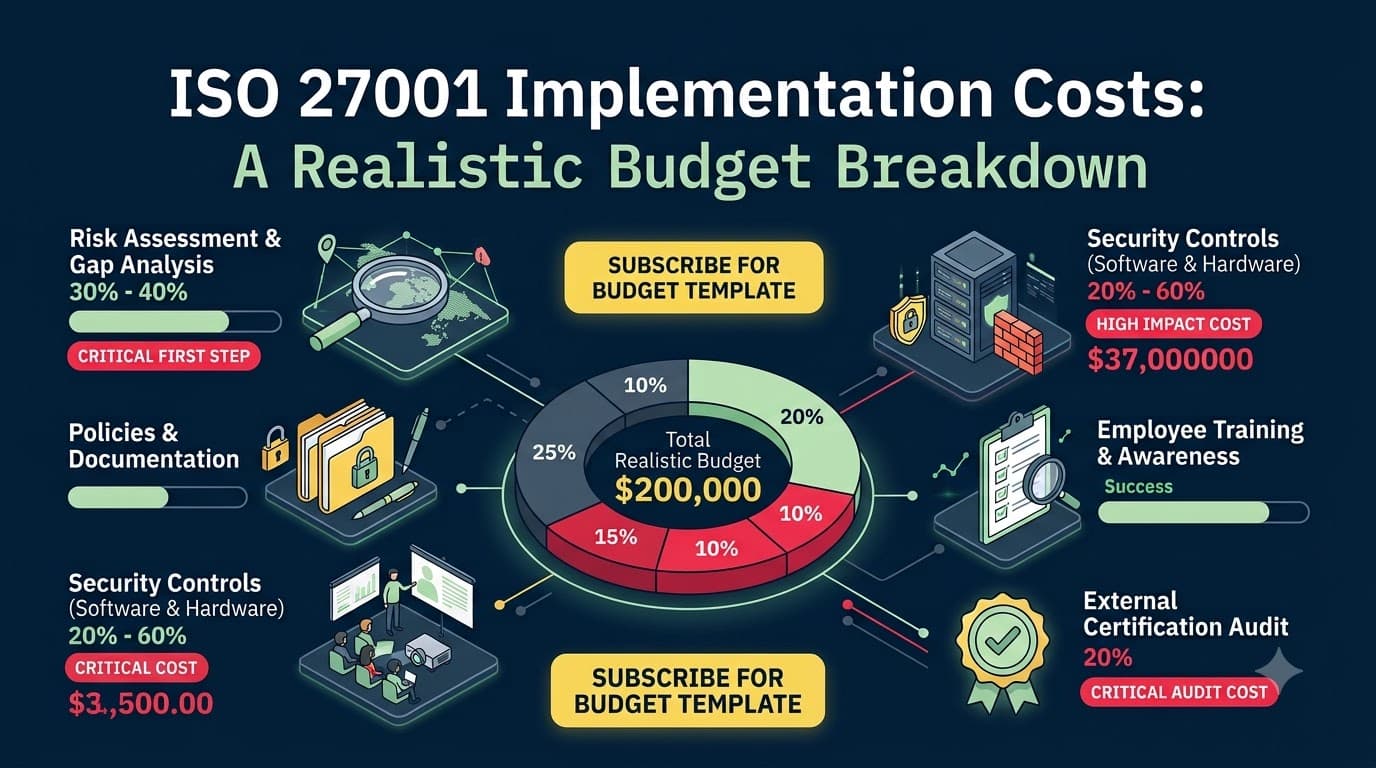
Dana Whitfield did the math twice before she took it to her board.
Dana was the co-founder and CEO of Coastal Ledger, a 40-person payments-infrastructure startup processing transaction data for regional credit unions. Two of her largest prospective customers had made ISO 27001 certification a condition of moving forward, and a third had quietly stopped returning calls after a security questionnaire asked, in plain language, whether Coastal Ledger held the certification. So Dana called three certification bodies, got quotes for a combined Stage 1 and Stage 2 audit, and came back with a number: $18,000. She built that into the annual budget as "Compliance — ISO 27001," got board sign-off, and told her head of engineering to "get it certified this year."
Eleven months later, Coastal Ledger was certified. It had also spent just under $210,000 getting there — roughly twelve times what Dana had budgeted. The certification body invoice was almost exactly what she'd quoted, $19,400 in the end. Everything else was cost she hadn't priced at all: about 1,400 hours of internal staff time pulled off product roadmaps to write policies, build a risk register, and chase evidence; a part-time consultant brought in at month four for $34,000 after the internal team stalled; a SIEM and log-management tool purchased to close a monitoring gap the gap assessment surfaced, at $28,000 for the first year; a privileged access management rollout to fix an access-control finding, another $22,000; and a scramble of smaller remediation items — encryption key management, a formal vendor risk process, an updated business continuity plan — that added up to more than either of those two line items individually. Dana got her certificate. She also had an uncomfortable conversation with her board about why "the ISO 27001 line" had overrun by 1,067%.
Dana's mistake is the single most common budgeting error I've seen across two hundred-plus ISO 27001 engagements: pricing the certificate and forgetting the certification. The certification body invoice is the easiest number to get — it's a quote, it arrives in an email, it looks like "the cost of ISO 27001." It is also, in almost every organization I've worked with, the smallest line in the total spend. This article exists so you don't find that out the way Dana did — with a certificate on the wall, a board that trusted your number, and a much longer explanation than "we're certified" waiting for your next finance meeting.
Who This Is For (and What You'll Walk Away With)
This is for founders, CISOs, compliance leads, and finance partners who need to build — or defend — an ISO 27001 budget, whether you're scoping your first certification or justifying next year's renewal spend. You'll walk away with a full breakdown of every cost category (not just the certification body invoice), illustrative ranges by organization size so you can sanity-check a quote or an internal estimate, a three-year total-cost-of-certification view that accounts for surveillance and recertification, and a set of tools — a budget template structure, a business-case framework, and a list of the mistakes that blow projects up — you can use immediately. Every dollar figure in this article is a rounded, illustrative practitioner range drawn from patterns across many engagements, not a cited industry benchmark; treat them as a sanity-check starting point, not a quote. If any of the terminology below — ISMS, Statement of Applicability, risk treatment plan — is unfamiliar, our ISO 27001 glossary is worth a five-minute detour before you keep reading.
Why ISO 27001 Budgets Blow Up
Every inflated ISO 27001 budget I've reviewed has the same root cause: someone priced the parts of the project that show up as an external invoice and left everything else as an assumption. Certification body fees are easy to price because a certification body will quote them in writing before you sign anything. Consultant fees are almost as easy, because a consultant will also send a proposal. Internal staff time, remediation spend, and tooling costs are harder, because nobody sends you an invoice for "312 hours of your IT manager's time" or "the firewall rule review nobody scheduled" — those costs surface gradually, as work, and get absorbed into "things the team is doing" until someone adds it up at the end and realizes it was the majority of the spend.
The second reason budgets blow up is scope creep dressed up as thoroughness. A 40-person company with one product and one cloud environment has a genuinely different cost profile than a 400-person company with three business units, two data centers, and a recent acquisition still running on its own domain. Certification bodies price largely off employee count and site count; consultants price off the number of interviews, workshops, and documents; but the single biggest cost driver — the one nobody quotes up front — is how far your current security posture sits from what the ISO 27001 gap analysis reveals you need. An organization with mature access controls, existing logging, and a functioning vulnerability management program will spend a fraction of what an organization starting from spreadsheets and shared admin passwords will spend, even at identical headcount. Cost scales with maturity at least as much as it scales with size — and maturity is the variable almost nobody prices before they start.
Budget Terms at a Glance
A few terms recur constantly in ISO 27001 budgeting conversations, and mixing them up is a common source of confusion when a certification body sends its first quote. The table below is a quick reference; the full ISO 27001 glossary covers the rest of the standard's vocabulary in depth.
Term | What It Means for Your Budget |
|---|---|
Stage 1 audit | Documentation and readiness review by the certification body; usually the smaller of the two initial audit fees |
Stage 2 audit | The full certification audit, testing whether controls actually operate; usually the larger initial audit fee |
Surveillance audit | Annual check-in audit in years two and three of the three-year cycle; smaller fee than Stage 1/2 but recurring |
Recertification audit | Full audit at the end of the three-year cycle to renew the certificate; comparable in scope to the original Stage 2 |
Loaded hourly rate | Salary plus benefits and overhead, typically 1.25–1.4x base salary divided by working hours — the multiplier that turns internal time into a real cost figure |
Total cost of certification (TCO) | The full three-year sum of certification body fees, internal effort, tooling, and remediation — not just the initial audit fee |
The Seven Cost Categories, Explained
Every ISO 27001 budget breaks into seven components. Some are fixed and easy to quote; some are variable and depend entirely on where you're starting from. Understanding what each one actually covers — and which ones are optional — is the difference between a budget that survives contact with the project and one that needs a mid-year rescue. Read through all seven before you price any single one of them; the categories interact enough that pricing them in isolation is exactly how organizations like Coastal Ledger end up budgeting for a fraction of what the project actually needs.
1. Internal Effort: The Cost Everyone Underestimates
This is the biggest line item in almost every ISO 27001 project I've run, and it is the one that appears in zero vendor quotes. Internal effort covers the hours your own staff spend: writing and reviewing policies, building and maintaining the risk register, running risk assessments, coordinating the Statement of Applicability, gathering evidence for each Annex A control, running internal audits, sitting in management review meetings, and — closer to the audit — answering auditor questions and producing documentation on demand. It touches far more roles than people expect: not just a compliance lead, but IT administrators pulling configuration evidence, engineering managers documenting the secure development lifecycle, HR staff updating onboarding and offboarding procedures for controls 6.1 and 6.2, and department heads sitting through risk workshops.
The reason this cost is chronically underbudgeted is that it doesn't look like spending — it looks like "Priya's already on the team, this is just part of her job now." But time is not free just because it doesn't generate an invoice. If your compliance lead spends 20 hours a week on ISMS work for eight months, that's roughly 700 hours — real, loaded cost, real opportunity cost, and real risk that other work slips. I ask every client to convert internal hours into a dollar figure using a fully loaded hourly rate (salary plus benefits plus overhead, typically 1.25–1.4x base salary divided by working hours) specifically so this cost stops hiding inside "existing headcount." A realistic implementation roadmap will tell you roughly how many months the project takes; multiply the expected weekly hours by role by the project length, and you'll usually find internal effort is 40–60% of total first-year spend.
2. Consultant and Advisory Fees (Optional)
Consultant fees are the one category on this list you can genuinely choose not to spend. Plenty of organizations — particularly smaller ones with a technically strong internal lead — implement ISO 27001 entirely in-house. But most mid-size and larger organizations bring in outside help for at least part of the project, and it's worth being precise about what you're actually paying for, because "consultant" covers several very different engagement models with very different price tags.
At the light end, you can hire a consultant for a gap assessment and roadmap only — a few days of work that tells you where you stand and what to prioritize, often the cheapest and highest-leverage consulting spend available. In the middle, consultants run a fractional or part-time engagement: a few days a month for the life of the project, reviewing documents, running workshops, and coaching your internal team without doing the underlying work themselves. At the heavy end, a consultant runs the project end-to-end — writing the policies, building the risk register, managing evidence collection — with your team providing input and approvals rather than doing the labor. The heavy-end model is faster and lower-risk for teams with no compliance experience, but it doesn't reduce internal effort to zero; someone on your side still has to answer questions, approve documents, and eventually own the ISMS once the consultant leaves. Consultants who quote a flat "ISO 27001 project fee" with no separate accounting for your own team's hours are quietly shifting cost into your "free" internal-effort column — ask them to be explicit about what they expect from your side.
3. Certification Body Fees
This is the cost everyone prices correctly and the cost that is, almost without exception, the smallest line in the total budget. Certification body fees cover the audit itself: Stage 1 (a documentation and readiness review), Stage 2 (the full certification audit, evaluating whether controls actually operate as documented), then annual surveillance audits in years one and two after certification, and a more thorough recertification audit at the end of the three-year cycle. Certification bodies typically price audit days based on employee count, number of sites, scope complexity, and the standards they're auditing against, and most will send a written quote before you commit — which is exactly why it's the easiest number to get and the one everyone anchors on. Choosing the right certification body matters for accreditation, auditor quality, and scheduling flexibility, but it will not meaningfully change your total project cost the way your internal readiness will.
One nuance worth budgeting for explicitly: certification body fees don't stop at Stage 2. You're paying for surveillance every year you hold the certificate and a larger recertification fee at year three — treat the Stage 1/Stage 2 quote as the deposit on a recurring cost, not the total price of the certificate.
4. Tooling: GRC Platform or Spreadsheets
Every ISMS needs somewhere to live: a risk register, a document repository, an Annex A control-to-evidence mapping, an audit trail of management reviews and corrective actions. You have two real options, and the right one depends heavily on organization size and appetite for manual work. Spreadsheets and shared drives cost nothing beyond staff time and work fine for smaller, simpler scopes — I've supported first-time certifications for organizations under 60 people run entirely on a well-organized spreadsheet risk register and a shared document folder. Dedicated GRC or ISMS platforms automate control-to-evidence mapping, evidence collection (often via direct integrations with cloud providers and identity systems), audit trail generation, and continuous monitoring, at a subscription cost that scales with headcount and integration count.
The trade-off isn't just convenience — it's ongoing labor. A GRC platform's subscription fee often pays for itself in reduced internal-effort hours during surveillance audits and recertification, because evidence that would otherwise require someone to manually pull screenshots and export logs is already mapped and current. Whether that trade-off is worth it depends on your certification cycle: a one-and-done certification with no plan to maintain rigorous continual improvement gets less value from a platform than an organization planning to hold the certificate — and prove it every year — indefinitely. If you've decided a platform is worth the line item, our review of the best ISO 27001 compliance software compares pricing and evidence-automation depth across the leading options so you can budget against a real quote rather than a vendor's list price.
5. Training and Competence
ISO 27001's Clause 7 requirements around competence, and Annex A control 6.3 on security awareness, education, and training, mean training spend isn't optional, but it's rarely large relative to other categories. This covers general security awareness training for all staff, role-specific training for people with security responsibilities (the ISMS manager, internal auditors, incident responders), and — frequently — a lead implementer or internal auditor course for whoever will run your internal audit program under Clause 9 performance evaluation. Formal certification courses (Lead Implementer, Lead Auditor) for one or two staff are a worthwhile one-time investment for organizations planning to run the ISMS in-house long-term; they're a lower priority for organizations leaning heavily on a consultant or planning to outsource internal audit.
6. Remediation and Technology Investments
This is the category with the widest range, and the one most likely to make or break your budget. Remediation covers whatever technology, process, or control gaps your gap analysis surfaces that need to be closed before you can credibly claim the control is operating — and it is entirely a function of your starting maturity, not your size. A well-run 300-person company with strong existing IT hygiene might spend very little here. A 60-person company that's never had a formal vulnerability management program (control 8.8), never centralized logging (controls 8.15–8.16), and manages access with shared credentials (controls 5.15–5.18) can spend more on remediation than on every other category combined.
Common remediation spend includes: multi-factor authentication and identity management rollouts, a vulnerability scanning tool and a formal patching cadence, a SIEM or centralized log-management platform, endpoint detection and response tooling to satisfy control 8.7 (protection against malware), encryption and key management for control 8.24, backup and disaster-recovery improvements tied to control 8.13 and control 5.30 (ICT readiness for business continuity), and formal supplier risk assessment processes for controls 5.19–5.22. None of this is ISO 27001 inventing new requirements — it's the standard requiring that the risk treatment plan actually close identified risks, and closing real risks costs real money regardless of which framework asked you to look.
7. Ongoing Costs: Maintenance and Continual Improvement
Certification is not a finish line — Clause 10's improvement requirements and the surveillance audit cycle mean the ISMS has to keep running, which means the cost doesn't stop the day you get the certificate. Ongoing costs include the fractional time of whoever owns the ISMS day-to-day, annual internal audits, management reviews, risk register updates, continued tooling subscriptions, refresher training, and — periodically — remediation of new gaps as the environment changes (new vendors, new systems, new regulatory obligations). Organizations that budget only through Stage 2 and treat year two as "handled" are the ones who show up to their first surveillance audit with a stale risk register and a scramble that costs more, in a rush, than steady maintenance would have cost all year.
"The number that gets budgeted is always the certification body's quote. The number that actually breaks the project is always internal hours nobody tracked. I tell every client the same thing before they sign anything: if your budget doesn't have a line for your own team's time, it isn't a budget, it's a hope." — Elena Marsh, Principal Consultant, Bastion GRC Advisory
The Full Cost Breakdown Table
The table below puts illustrative first-year ranges next to each cost category, split by rough organization size. Treat these as sanity-check bands built from patterns across many engagements — not quotes, and not a substitute for your own gap analysis. "Small" assumes roughly 20–75 employees and a single, contained scope; "mid-size" assumes roughly 100–750 employees, often multiple departments or a moderately complex cloud environment; "large" assumes 1,000+ employees, multiple sites or business units, and a broader scope.
Cost Category | What It Covers | Small Org (Illustrative) | Mid-Size Org (Illustrative) | Large Org (Illustrative) |
|---|---|---|---|---|
Internal effort (staff time) | Policy writing, risk register, evidence collection, internal audit, management review, audit-day support | $35,000–$90,000 | $150,000–$320,000 | $400,000–$1,000,000+ |
Consultant/advisory fees | Gap assessment, fractional guidance, or full project management (optional) | $0–$40,000 | $40,000–$120,000 | $150,000–$500,000+ |
Certification body fees (Stage 1 + Stage 2) | Documentation review + full certification audit | $7,000–$15,000 | $18,000–$35,000 | $40,000–$100,000+ |
Tooling (GRC/ISMS platform or spreadsheets) | Risk register, evidence mapping, audit trail, continuous monitoring | $0–$10,000/yr | $15,000–$50,000/yr | $75,000–$250,000+/yr |
Training and competence | Awareness training, role-based training, lead implementer/auditor courses | $2,000–$8,000 | $10,000–$30,000 | $30,000–$100,000+ |
Remediation and technology | MFA/IAM, logging/SIEM, vulnerability management, encryption, backup/DR, supplier risk process | $5,000–$60,000 | $50,000–$300,000+ | $200,000–$2,000,000+ |
Illustrative first-year total | $80,000–$220,000 | $300,000–$800,000+ | $1,000,000–$3,000,000+ |
The single biggest lever inside every one of these ranges is maturity, not headcount. A small org with genuinely mature IT practices can land near the bottom of its band; a large org migrating off legacy infrastructure with no prior security program can blow past the top of its band on remediation alone. Use the gap analysis findings, not the headcount, to decide where in the range you'll actually fall.
What Actually Drives the Certification Body Quote
Certification bodies calculate their fee primarily from audit days, and audit days are driven by a formula most certification bodies apply consistently: employee count within scope, number of physical sites, and complexity factors like multiple business units, extensive cloud environments, or 24/7 operations. Understanding this formula helps you sanity-check a quote before you sign it, and it explains why two companies of similar headcount can receive noticeably different quotes — the one running three data centers across two countries will always cost more to audit than the one running a single cloud environment, regardless of employee count.
Org Size (Illustrative) | Typical Stage 1 + Stage 2 Audit Days | Illustrative Stage 1 + Stage 2 Fee | Illustrative Annual Surveillance Fee | Illustrative Recertification Fee (Year 4) |
|---|---|---|---|---|
Small (20–75 employees, single site) | 4–7 days | $7,000–$15,000 | $3,000–$6,000 | $6,000–$13,000 |
Mid-size (100–750 employees, 1–2 sites) | 8–14 days | $18,000–$35,000 | $8,000–$15,000 | $16,000–$32,000 |
Large (1,000+ employees, multi-site) | 16–30+ days | $40,000–$100,000+ | $20,000–$50,000+ | $35,000–$90,000+ |
Two practical takeaways follow from this table. First, a tightly and accurately scoped ISMS — one that doesn't include systems or locations irrelevant to the information you're actually protecting — directly reduces audit days and therefore fee, without reducing rigor where it matters. Second, when comparing quotes across certification bodies, ask each one to itemize audit days by activity (Stage 1, Stage 2, and travel if applicable) rather than accepting a single bundled number; it's the only way to tell whether one quote is cheaper because it's genuinely more efficient or because it's proposing fewer audit days than your scope actually requires.
One-Time vs Ongoing: The Three-Year Total Cost of Certification
ISO 27001 certification runs on a three-year cycle: Stage 1 and Stage 2 in year one, annual surveillance audits in years two and three, and a full recertification audit at the start of year four. Budgeting only for "getting certified" and ignoring years two and three is the second most common way I've seen ISO 27001 budgets go wrong — surveillance and ongoing maintenance are real, recurring costs, not an afterthought.
Year | Certification Body Activity | Illustrative CB Fee (Mid-Size Org) | Internal Effort (Mid-Size Org) | Tooling/Remediation (Mid-Size Org) |
|---|---|---|---|---|
Year 1 | Stage 1 + Stage 2 audits | $18,000–$35,000 | $150,000–$320,000 (heaviest year) | $65,000–$350,000+ (bulk of remediation) |
Year 2 | First surveillance audit | $8,000–$15,000 | $30,000–$70,000 (maintenance mode) | $15,000–$50,000/yr (tooling only) |
Year 3 | Second surveillance audit | $8,000–$16,000 | $30,000–$70,000 (maintenance mode) | $15,000–$50,000/yr (tooling only) |
Year 4 (start of new cycle) | Recertification audit | $20,000–$35,000 | $50,000–$100,000 (recert push) | $20,000–$60,000 (refresh remediation) |
Illustrative 3-year total (Years 1–3) | $34,000–$66,000 | $210,000–$460,000 | $95,000–$450,000+ |
Add the three columns for a mid-size organization and the illustrative three-year total cost of certification lands somewhere in the $340,000–$975,000 range — with certification body fees consistently the smallest of the three components, usually under 10% of the total. That ratio holds directionally across small and large organizations too: the certificate itself is cheap relative to the program that earns it.
flowchart TB
    subgraph Y1["Year 1 — Certify"]
        A1["Internal Effort<br/>(heaviest)"]
        A2["Remediation & Tech<br/>(bulk of spend)"]
        A3["Consultant Fees<br/>(if used)"]
        A4["Stage 1 + Stage 2<br/>CB Fees"]
        A5["Tooling Setup"]
        A6["Training"]
    end
    subgraph Y2["Year 2 — Maintain"]
        B1["Internal Effort<br/>(maintenance mode)"]
        B2["Surveillance<br/>Audit Fee"]
        B3["Tooling Subscription"]
        B4["Incremental Remediation"]
    end
    subgraph Y3["Year 3 — Maintain"]
        C1["Internal Effort<br/>(maintenance mode)"]
        C2["Surveillance<br/>Audit Fee"]
        C3["Tooling Subscription"]
        C4["Incremental Remediation"]
    end
    subgraph Y4["Year 4 — Recertify"]
        D1["Recert Push<br/>(Internal Effort)"]
        D2["Recertification<br/>Audit Fee"]
        D3["Refresh Remediation"]
    end
    Y1 --> Y2 --> Y3 --> Y4
The Hidden Costs Nobody Budgets For
Two categories account for almost every ISO 27001 budget overrun I've been called in to help fix after the fact: internal time and remediation. Both are variable, both are easy to underestimate systematically, and both deserve their own line-by-line breakdown rather than a single lump figure.
Internal Time: The Real Line Item
Internal time isn't one job — it's dozens of smaller time commitments spread across roles that rarely think of themselves as "part of the ISO 27001 project." Budgeting it well means naming the roles and estimating hours by phase, not guessing a single lump number.
Role | Typical Involvement | Illustrative Hours (Mid-Size Org, Full Cycle) |
|---|---|---|
ISMS manager / compliance lead | Owns the project: policies, risk register, SoA, evidence coordination, audit liaison | 800–1,400 hours |
IT/security engineering staff | Implements remediation, pulls technical evidence, supports audits | 400–900 hours |
Department managers | Risk workshops, control ownership, evidence review and sign-off | 15–40 hours each |
Executive sponsor(s) | Management review meetings, resourcing decisions, Stage 2 opening/closing meetings | 20–50 hours |
HR | Screening/onboarding process updates (controls 6.1–6.2), training rollout | 20–60 hours |
Internal audit lead | Plans and executes the internal audit program under Clause 9 | 60–150 hours annually |
Multiply hours by a fully loaded hourly rate for each role, and the total almost always dwarfs whatever the certification body quoted. This is also why timeline and budget are the same conversation: a realistic certification timeline that assumes six months but only staffs the project at 10% of one person's time is really an eighteen-month project wearing a six-month budget.
Remediation: The Largest Variable
Remediation cost is a direct function of the gap between where you are and where the Statement of Applicability says you need to be. It's impossible to quote accurately before a gap analysis, but the categories below recur often enough to be worth pricing in advance as planning placeholders.
Common Gap | Related Control(s) | Illustrative Remediation Cost |
|---|---|---|
No centralized logging or alerting | 8.15 Logging, 8.16 Monitoring activities | $10,000–$150,000 (tool + setup) |
Weak or absent MFA/identity management | 5.16 Identity management, 8.5 Secure authentication | $5,000–$80,000 |
No formal vulnerability management program | 8.8 Management of technical vulnerabilities | $8,000–$60,000/yr (scanner + process) |
Ad hoc or missing backup/DR testing | 8.13 Information backup, 5.30 ICT readiness for business continuity | $10,000–$120,000 |
No formal supplier risk assessment process | 5.19–5.22 Supplier relationship security | $5,000–$40,000 (process + tooling) |
Missing or inconsistent encryption | 8.24 Use of cryptography | $5,000–$70,000 |
No privileged access management | 8.2 Privileged access rights | $10,000–$90,000 |
"Everyone budgets for the audit. Almost nobody budgets for the SIEM. We had a client whose Stage 1 readiness review flagged monitoring as a real gap, and the tooling and integration work to close it cost more than the Stage 1 and Stage 2 audits combined. That's not unusual — that's the median outcome for a company that's never centralized its logs." — Grace Okafor, Lead Auditor, Meridian Certification Body
Cost by Organization Size and Maturity
Size and maturity are two different variables, and they don't always move together — I've seen 60-person startups with better security hygiene than 600-person companies twenty years older. Still, size sets the floor for certification body fees and rough internal-effort scale, so it's a reasonable starting axis. The table below layers maturity on top of size, because "small and mature" and "small and immature" can land in genuinely different bands.
Organization Profile | Headcount (Illustrative) | Starting Maturity | Illustrative First-Year Total | Primary Cost Driver |
|---|---|---|---|---|
Startup, low maturity | 20–75 | No formal security program, spreadsheets and shared logins | $140,000–$220,000 | Remediation + internal time (founder/lead wearing multiple hats) |
Startup, moderate maturity | 20–75 | Cloud-native, existing IAM and logging, no formal ISMS | $80,000–$140,000 | Internal time (documentation, not technology) |
Mid-size, low maturity | 100–750 | Fragmented tooling, inconsistent access control, no vulnerability program | $500,000–$800,000+ | Remediation (multiple simultaneous gaps) |
Mid-size, moderate-to-high maturity | 100–750 | Existing security team, mature IT operations | $300,000–$450,000 | Internal time + consultant (documentation and evidence discipline) |
Large enterprise, low maturity | 1,000+ | Multiple sites/business units, legacy systems, recent M&A | $1,800,000–$3,000,000+ | Remediation + multi-site internal coordination |
Large enterprise, high maturity | 1,000+ | Existing security operations center, prior framework certifications (e.g., SOC 2) | $1,000,000–$1,600,000 | Internal time + certification body fees (scope and site count) |
"I've run this twice at two very different companies. At the 45-person startup, the fight was entirely about internal hours — we had one person trying to be the whole ISMS team. At the 1,200-person manufacturer, the fight was entirely about remediation across three plants that had never talked to each other's IT teams. Same standard, completely different budget conversation." — Tomás Rivera, VP Engineering, Northfall Robotics
DIY vs Consultant vs Automation: What Actually Changes the Cost
There is no universally "cheapest" way to get certified — the right mix of do-it-yourself effort, consultant support, and GRC automation depends on your team's existing compliance experience, how fast you need to certify, and how much your internal team's time is worth relative to buying it back. The table below compares the three approaches directly.
Approach | Illustrative Cost Profile | Speed | Best Fit | Main Risk |
|---|---|---|---|---|
Fully DIY (internal team, spreadsheets) | Lowest cash outlay, highest internal hours | Slowest (learning curve built in) | Small orgs with a technically strong, available internal lead | Rework from misunderstanding requirements; auditor findings from documentation gaps |
DIY + fractional consultant guidance | Moderate cash outlay, moderate internal hours | Moderate | Orgs with capable staff but no prior ISO experience | Underestimating how much internal time is still required |
Consultant-led, full project management | Highest cash outlay, lowest internal hours (but not zero) | Fastest | Orgs under deadline pressure or with limited internal bandwidth | Cost if scope isn't tightly defined; weaker internal ownership post-certification |
GRC/automation platform (any of the above + tooling) | Moderate-to-high recurring cost, meaningfully lower ongoing internal hours | Faster for evidence collection specifically | Orgs planning to hold certification long-term across multiple audit cycles | Platform cost without matching process discipline just becomes an expensive spreadsheet |
In practice, most mid-size and larger organizations land on a blend: consultant support for the parts requiring outside expertise (risk methodology design, SoA construction, mock audits), internal ownership of day-to-day evidence and control operation, and a GRC platform to keep evidence current between audits rather than reconstructing it from scratch every year. The mix that minimizes total three-year cost is rarely the mix that minimizes any single year's spend. Startups weighing this trade-off with limited headcount and no dedicated compliance role often do best leaning DIY for longer than feels comfortable — our lean implementation approach for ISO 27001 startups lays out where that logic holds and where it breaks down.
"Automation doesn't replace the ISMS owner — it replaces the person manually screenshotting IAM configurations every quarter. We saw internal-effort hours drop by roughly a third in year two once evidence collection was automated, but year one barely changed, because you still have to build the program before you can automate around it." — Priya Anand, CISO, Vantage Health Analytics
Questions to Ask Before You Sign a Consultant or Platform Contract
Every inflated ISO 27001 budget I've been asked to untangle after the fact has at least one vendor contract in it that nobody interrogated closely enough before signing. Whether you're evaluating a consultant proposal or a GRC platform quote, the questions below surface the assumptions that determine whether the number on the page is the number you'll actually pay.
Question | Why It Matters |
|---|---|
What exactly is included in the flat fee, and what's billed separately? | "Full ISO 27001 project" proposals sometimes exclude remediation implementation, mock audits, or post-certification support |
How many hours of my team's time does this proposal assume? | A cheaper consultant quote can simply mean more of the work has been shifted onto your internal team |
What happens if the certification body identifies a major nonconformity? | Some proposals price only through Stage 2 submission, not through resolution of findings |
Is the platform subscription priced per user, per integration, or per employee in scope? | Pricing models vary widely and can scale unexpectedly as your organization grows |
What's included after year one — is ongoing surveillance support part of the fee? | A quote that only covers certification, not maintenance, understates your real three-year cost |
Can you provide references from an organization of similar size and scope? | Consultants and platforms optimized for enterprise clients may be priced and paced wrong for a smaller scope, and vice versa |
Getting clear, specific answers to these questions before signing does more to control total project cost than almost any negotiation on the headline price.
How to Reduce Cost Without Cutting Corners
Every one of the levers below reduces spend without weakening the ISMS — the distinction that matters, because the fastest way to blow up your recertification budget is to save money in year one by skipping work that resurfaces as a nonconformity in year two.
Scope tightly and honestly. A broad, loosely defined scope multiplies certification body fees, audit days, and remediation surface area. Defining your ISMS scope around the systems and processes that actually handle the information your customers care about — rather than the whole company by default — is the single highest-leverage cost decision you'll make, and it's free.
Do the gap analysis before you price anything else. Every quote you get before you understand your real gaps is a guess. A structured gap analysis turns remediation from a mystery number into a prioritized, costable list.
Reuse what you already have. Organizations with an existing SOC 2 report, a prior risk assessment, or documented IT policies aren't starting from zero — map existing artifacts to Annex A controls before writing anything new.
Sequence remediation by risk, not by control number. Fix what actually reduces risk and would concern an auditor first; defer lower-impact gaps to year two if the risk treatment plan can defensibly justify the timeline.
Right-size your tooling. A GRC platform priced for a 2,000-person enterprise is a wasted subscription for a 40-person startup with a single cloud environment — spreadsheets, done well, are a legitimate long-term choice for small scopes.
Negotiate certification body scope, not just price. Audit days (and therefore fees) are driven by declared scope and site count; an accurate, tightly worded scope statement can reduce quoted audit days without reducing rigor.
Train internally rather than buying every hour of expertise. A lead implementer or internal auditor course for one or two staff is a one-time cost that reduces reliance on paid consulting in every subsequent audit cycle.
Where ISO 27001 Spend Overlaps With Other Compliance Costs
ISO 27001 doesn't exist in a vacuum, and neither does its budget. Most organizations pursuing certification are already spending money to support obligations like GDPR, HIPAA, or DORA — and it's important to be precise here: ISO 27001 certification supports and evidences good practice toward those regulatory goals, it does not itself make an organization legally compliant with any of them. What it does provide, from a budgeting standpoint, is a single structured program that a lot of that existing spend can be mapped into, rather than duplicated. Control 5.34 (privacy and protection of personally identifiable information) formalizes work many organizations are already funding for GDPR or similar privacy laws. Control 5.29 and control 5.30 (information security during disruption and ICT readiness for business continuity) often overlap directly with business continuity spend already justified for other regulatory or contractual reasons. Control 5.31 (legal, statutory, regulatory and contractual requirements) is explicitly the control that requires you to track and evidence exactly this kind of overlap.
The budgeting implication is straightforward: before pricing remediation as if every gap is a new cost, check whether the underlying control is already partially funded by an existing compliance program. Organizations that map ISO 27001 controls to existing GDPR, HIPAA, or SOC 2 work before starting their gap analysis routinely find 10–25% of their apparent remediation list is already substantially addressed, just not yet documented in ISMS terms — which is a documentation and evidence-mapping cost, not a net-new technology cost.
Existing Compliance Spend | Related ISO 27001 Control(s) | Budget Implication |
|---|---|---|
GDPR data protection program | 5.34 Privacy and protection of PII | Map existing privacy program to control evidence rather than rebuilding it |
HIPAA security rule safeguards | 8.2 Privileged access rights, 8.24 Use of cryptography, 5.34 Privacy | Existing access and encryption controls often satisfy much of the technical gap |
Business continuity/DR program (any driver) | 5.29 Information security during disruption, 5.30 ICT readiness for business continuity | Existing BC/DR plans usually need updating for ISMS format, not rebuilding from scratch |
SOC 2 Type II report | Broad overlap across access control, monitoring, and change management controls | Significant evidence reuse; primary net-new cost is ISMS-specific documentation (risk register, SoA, management review) |
ISO 27001 Cost vs. SOC 2 Cost: A Quick Contrast
Many of the organizations I've helped budget for ISO 27001 are simultaneously fielding customer requests for a SOC 2 report, and the two conversations get confused constantly because the cost categories look almost identical on paper — internal time, advisory fees, an external assessment fee, remediation — while the underlying mechanics differ enough to change how you plan for them. ISO 27001 is a certification issued by an accredited certification body against an international management-system standard, renewed on a three-year cycle with annual surveillance. SOC 2 is an attestation report issued by a licensed CPA firm under AICPA attestation standards, and a SOC 2 Type II report specifically requires an observation period — commonly three to twelve months — during which the auditor tests whether controls operated effectively over time, not just whether they exist on audit day. That observation-period mechanic changes the shape of SOC 2 cost: less of a single "big audit day" spend and more of a sustained monitoring cost throughout the window, whereas ISO 27001's Stage 1 and Stage 2 audits are more front-loaded.
Dimension | ISO 27001 | SOC 2 (Type II) |
|---|---|---|
Issuing body | Accredited certification body | Licensed CPA firm |
Renewal cycle | 3-year certification cycle with annual surveillance | Typically annual re-issuance of the report |
Assessment structure | Stage 1 (readiness) + Stage 2 (certification audit) | Observation period (often 3–12 months) + final report |
Where cost concentrates | Front-loaded in year one (remediation + Stage 1/2) | Spread across the observation period (continuous monitoring evidence) |
Typical illustrative external fee (mid-size org) | $18,000–$35,000 (Stage 1+2) | $20,000–$60,000 (audit fee, varies by trust criteria scope) |
The practical budgeting takeaway for organizations pursuing both: don't price them as two separate, unrelated projects. Both frameworks lean heavily on the same underlying evidence — access reviews, change management records, incident response documentation, vendor risk assessments — so a shared GRC platform and a single internal evidence-collection cadence can meaningfully reduce the combined internal-effort cost of running both programs versus treating them as isolated initiatives.
Signs Your Budget Is Already Too Low
Before you present a budget to your board or finance partner, run it against the checklist below. Any single "yes" is a signal the number is understated, not a guarantee — but two or more "yes" answers together are a strong sign the budget needs another pass before it goes out the door.
Warning Sign | What It Usually Means |
|---|---|
The budget has one line item, not six or more | Internal time, remediation, tooling, and training have likely been folded into "miscellaneous" or omitted entirely |
The number came from a certification body quote alone | The quote covers audit fees only — see the full cost breakdown table above for everything else it's missing |
No gap analysis has been completed yet | Remediation cost is a guess, not an estimate, until the gap analysis identifies real gaps |
The budget covers only 12 months | Years two and three (surveillance) and year four (recertification) aren't optional — they need to be pre-approved |
No named executive sponsor owns unplanned remediation spend | Mid-project findings will stall without someone authorized to approve new spend quickly |
Internal staff time isn't converted to a dollar figure anywhere | The largest cost category in most projects is being tracked as "free," which understates the true total |
Timing the Spend Across the Fiscal Year
Beyond getting the total right, when the money is spent matters for how the budget lands with finance. Remediation and tooling costs typically front-load into the first two to four months, once the gap analysis identifies what needs fixing — this is usually the single largest cash outflow window in the whole project. Internal effort cost is more evenly distributed across the implementation phase, then drops sharply after certification into a lighter, ongoing maintenance run rate. Certification body fees cluster around two discrete events (Stage 1, then Stage 2 roughly two to three months later), followed by a full-year gap before the first surveillance fee. Presenting the budget as a phased cash-flow view — not just an annual total — tends to land better with finance partners, because it shows you've thought about when the organization needs cash on hand, not just how much over the full year.
What Happens When Scope Changes Mid-Project
Almost every ISO 27001 project I've run has had at least one moment where scope shifted after the budget was already approved — a new product launch, an acquisition, a customer contract requiring a new data center region, or simply the discovery, mid-risk-assessment, that a system everyone assumed was out of scope actually needs to be in it. Scope changes are the single most common reason an otherwise well-built budget still runs over, and they're worth planning for explicitly rather than treating as a surprise each time.
Mid-Project Scope Trigger | Typical Cost Impact | How to Plan For It |
|---|---|---|
New product or business unit launches during implementation | Additional risk assessment, control implementation, and evidence collection for the new scope | Build a contingency line (10–15% of total budget) explicitly for scope additions |
Acquisition or merger brings new systems into scope | Often the single largest driver of remediation cost overrun (see the Ferrous Systems case study) | Assess acquired environments against the SoA before finalizing scope, not after |
Certification body requires wider scope than expected during Stage 1 | Additional audit days and, potentially, additional remediation to cover systems you hadn't planned for | Get scope explicitly confirmed in writing before Stage 1, not assumed from the initial quote |
A risk assessment finding reveals a previously unknown dependency (e.g., a shared network segment) | Unplanned remediation, often requiring engineering time not in the original resourcing plan | Treat the risk assessment as a discovery phase and hold contingency budget until it's complete |
The organizations that handle scope changes well aren't the ones who avoid them entirely — that's rarely possible — they're the ones who built a contingency line into the original budget and gave an executive sponsor standing authority to approve reasonable additions without re-running the entire approval process each time.
Building the Budget and the Business Case
A defensible ISO 27001 budget has three parts, and skipping any one of them is what leads to a Dana Whitfield moment in front of your board. First, a bottom-up cost estimate built from an actual gap analysis — not a certification body quote treated as the whole number. Second, a phased view across the three-year cycle, so year two and year three surveillance costs are pre-approved rather than a surprise. Third, a business case that ties the spend to revenue and risk, not just compliance for its own sake — deals unblocked by the certificate, sales cycles shortened because a security questionnaire gets a one-line answer instead of a three-week back-and-forth, and reduced likelihood and cost of an incident because the ISMS is genuinely running, not just documented.
Business Case Element | What to Quantify | Where the Number Comes From |
|---|---|---|
Revenue unblocked or accelerated | Deals with ISO 27001 as a stated or implied requirement; average sales-cycle reduction from a completed questionnaire | Sales/CRM data on lost or stalled deals citing security requirements |
Cost avoidance | Reduced incident likelihood/impact from closed gaps (MFA, logging, vulnerability management) | Internal incident history or industry-typical remediation costs for comparable gaps |
Efficiency gains | Reduced duplicate effort across multiple compliance frameworks (SOC 2, customer security questionnaires) | Time currently spent per questionnaire or audit request, multiplied by frequency |
Total 3-year cost of certification | Full illustrative range from the breakdown and TCO tables above | This article's cost breakdown and TCO tables, adjusted to your gap analysis |
For a fuller framework on quantifying the upside side of this equation, the ISO 27001 certification benefits and ROI guide walks through how to build the revenue and risk-reduction case in more depth than the budget conversation alone can carry.
One ownership question is worth settling before the budget goes anywhere near a board: who signs off on spend once the project is underway? Compliance or security teams rarely have the authority to approve six-figure remediation purchases on their own, and finance partners rarely have the technical context to judge whether a given remediation item is genuinely required or merely nice-to-have. The projects that stay on budget are consistently the ones with a named executive sponsor — often a CTO, CISO, or COO — who has both the authority to approve spend within the agreed contingency and enough technical fluency to push back on scope that isn't actually necessary.
Presenting the Budget to Your Board: A Practical Structure
How you present the number matters almost as much as the number itself. Boards and finance committees approve compliance spend more readily when they can see the reasoning, not just a total — and a five-part structure covers the ground most boards will ask about without turning the meeting into a line-by-line audit.
Presentation Element | What to Include |
|---|---|
The business driver | Which deals, customers, or regulatory pressures are actually requiring this — named, where possible, not generic |
The full three-year number | Year one plus years two and three of surveillance, not just the certification body's initial quote |
The breakdown by category | Internal effort, consultant fees, certification body fees, tooling, training, and remediation, shown separately |
The confidence level per line | Which numbers are firm quotes (certification body, consultant proposal) versus estimates pending the gap analysis |
The ask | Specific approval requested: total budget, contingency authority, and who owns spend decisions during the project |
Boards that see this structure tend to ask sharper, more useful questions — about which deals are actually at stake, or how confident the remediation estimate is — rather than fixating on why the number is bigger than the certification body's quote. That's a better conversation to have before the money is spent than after.
A Sample Line-Item Budget You Can Adapt
Boards and finance partners approve budgets faster when they can see the structure, not just a total. The line-item template below is built for a mid-size organization in year one; adjust the ranges against the size and maturity tables earlier in this article for your own profile, and replace every range with a real number as soon as your gap analysis gives you one.
Line Item | Illustrative Low | Illustrative High | Owner | Notes |
|---|---|---|---|---|
ISMS manager / compliance lead (internal time) | $70,000 | $140,000 | Compliance/executive sponsor | Based on loaded rate x expected hours across project length |
Supporting IT/engineering time (internal) | $40,000 | $90,000 | IT/Engineering lead | Evidence gathering, remediation implementation support |
Consultant (gap assessment or fractional guidance) | $0 | $60,000 | Executive sponsor | Optional; scale up for full project management |
Certification body — Stage 1 + Stage 2 | $18,000 | $35,000 | Compliance lead | Get a written, itemized quote before budgeting |
GRC/ISMS platform (year 1) | $0 | $50,000 | IT/Compliance | Spreadsheets are a valid $0 option for smaller scopes |
Training (awareness + lead auditor/implementer course) | $10,000 | $30,000 | HR/Compliance | Scale to headcount and internal audit ambitions |
Remediation (placeholder pending gap analysis) | $50,000 | $300,000+ | Executive sponsor | Replace with real figures once gap analysis is complete |
Year 1 subtotal | $188,000 | $705,000+ | ||
Years 2–3 surveillance + maintenance (combined) | $76,000 | $170,000 | Compliance lead | Annual surveillance fee + reduced internal effort + tooling renewal |
Quick Sanity-Check Ratios
If a full bottom-up estimate isn't available yet, these rough ratios — drawn from patterns across many engagements, not a formal study — are useful for a first-pass sanity check on a budget someone else has proposed to you.
Ratio | Illustrative Rule of Thumb |
|---|---|
Certification body fees as a share of year-1 total spend | Typically under 10% |
Internal effort as a share of year-1 total spend | Typically 35–55% |
Remediation as a share of year-1 total spend | Typically 20–50%, and the widest-swinging category |
Year 2–3 spend relative to year 1 | Typically 25–40% of year-1 total, per year |
Consultant fees relative to internal effort (when consultant is used) | Typically 0.3x–0.8x of internal-effort spend |
If a proposed budget shows certification body fees as more than 20–25% of the total, it's very likely missing internal effort, remediation, or both — go back and ask what isn't in the number yet.
Common Budgeting Mistakes
Mistake | Why It Happens | The Fix |
|---|---|---|
Budgeting only the certification body quote | It's the easiest number to get — a real quote arrives in writing | Build a bottom-up estimate from a gap analysis before pricing anything |
Ignoring internal staff time | Existing headcount "already on payroll" doesn't feel like new spend | Convert expected hours by role into a loaded dollar figure and put it in the budget explicitly |
Treating remediation as a rounding error | Remediation can't be quoted until the gap analysis is done, so it gets guessed low | Price remediation as a range with a placeholder until the gap analysis lands, then update the budget |
Scoping too broadly "to be safe" | Fear of an auditor finding something out of scope later | Define scope deliberately around what actually needs protecting; a narrow, accurate scope is defensible |
Forgetting years two and three | Year one absorbs all the attention; surveillance feels far away during the project | Build the three-year total cost of certification into the initial approval, not a future ask |
Assuming a GRC platform is required | Vendor marketing implies tooling is mandatory for certification | Spreadsheets are a legitimate choice for small scopes; buy tooling when it saves more than it costs |
No executive sponsor accountable for the budget | Compliance is treated as a side project rather than a resourced initiative | Assign an executive sponsor with authority to approve remediation spend as it's identified |
"The mistake I see most is a budget with one number in it. A real ISO 27001 budget has at least six line items and a three-year view. If someone hands me a single figure and calls it the ISO 27001 budget, I already know it's wrong — I just don't know by how much yet." — Sam Okonjo, Head of Compliance, Ferrous Systems
Case Studies: Three Budgets, Three Very Different Stories
Coastal Ledger — The Startup That Learned the Hard Way
Dana Whitfield's 40-person payments-infrastructure startup budgeted $18,000 (the certification body quote) and spent just under $210,000 over eleven months. The breakdown, in hindsight: $19,400 in certification body fees, roughly $58,000 in internal staff time (mostly her head of engineering and two senior developers pulled part-time off the roadmap), $34,000 for a fractional consultant brought in at month four to unstick a stalled risk assessment, $28,000 for a SIEM/log-management tool to close a monitoring gap, $22,000 for a privileged access management rollout, and roughly $47,000 in smaller remediation across encryption key management, a formal vendor risk process, and business continuity documentation. The lesson Coastal Ledger's board took away wasn't "ISO 27001 is too expensive" — it was "next year's surveillance and recertification costs are in the budget from day one," which they were, at roughly $14,000 a year in years two and three.
Northfall Robotics — The Mid-Size Manufacturer That Budgeted Right
Northfall Robotics, a 480-person industrial manufacturer, ran its gap analysis before pricing anything else — a decision that shaped everything downstream. The gap analysis found moderate maturity: existing IT operations and identity management, but no formal risk register, no internal audit program, and inconsistent vendor risk assessment across two plants. Their approved budget was $410,000 for year one: $130,000 in certification body fees plus a consultant retained for fractional guidance (not full project management), $210,000 in internal staff time across a newly appointed ISMS manager, IT staff, and department leads, $45,000 in remediation (mostly formalizing the supplier risk process and centralizing evidence in a GRC platform), and $25,000 in training, including a lead auditor course for the newly appointed ISMS manager. Actual spend came in at $432,000 — a 5% overrun, driven almost entirely by an unplanned firewall segmentation project the risk assessment flagged mid-project. Compared to Coastal Ledger's twelvefold overrun, Northfall's experience is what a gap-analysis-first budget looks like in practice.
Ferrous Systems — The Enterprise Managing Multi-Site Complexity
Ferrous Systems, a 1,400-person industrial group with three manufacturing sites and a recent acquisition still running separate IT infrastructure, budgeted for the complexity from the outset rather than treating it as a single project. Year-one spend: $210,000 in certification body fees (driven by site count and audit days across three locations), a consultant engaged for $280,000 to manage cross-site coordination and harmonize the acquired business's documentation, $650,000 in internal effort spread across a dedicated two-person ISMS team plus significant IT and plant-manager time at each site, $310,000 in remediation (primarily network segmentation between the acquired company's environment and the parent network, plus a group-wide SIEM rollout), and $60,000 in training across three sites. Total year-one spend: approximately $1.51 million, within the illustrative large-enterprise range, with the acquisition's un-harmonized IT environment — not headcount — as the single largest driver of remediation cost.
Case Study | Org Size | Approach | Illustrative Year-1 Spend | Largest Cost Driver |
|---|---|---|---|---|
Coastal Ledger | 40 employees (startup) | Budgeted CB fee only, added consultant reactively | ~$210,000 (vs. $18,000 budgeted) | Unbudgeted internal time and reactive remediation |
Northfall Robotics | 480 employees (mid-size) | Gap analysis first, fractional consultant, planned budget | ~$432,000 (vs. $410,000 budgeted) | Internal effort, with a small remediation surprise |
Ferrous Systems | 1,400 employees (enterprise, multi-site) | Full consultant-led project, budgeted for complexity upfront | ~$1.51 million (within budgeted range) | Remediation to harmonize an acquired business's IT environment |
The Strategic Close: Budget It Like an Investment, Not a Line Item
Every founder and finance leader I've watched get burned on ISO 27001 cost made the same category error: they treated it as a compliance expense to be minimized, rather than an operational investment to be sized correctly. Dana Whitfield's board didn't get angry that Coastal Ledger spent $210,000 on ISO 27001 — the certificate unblocked two deals worth more than that in the first year alone. They got angry that nobody told them it would cost $210,000 before they'd already spent it. The fix isn't spending less. The fix is pricing the whole project — internal time, consultant fees, certification body fees, tooling, training, remediation, and three years of ongoing maintenance — before you commit, so the number you bring to your board is the number you actually spend.
Get that number right and ISO 27001 stops being "the compliance line" and becomes what it actually is: a resourced program that unblocks revenue, reduces real risk, and gives you a credible, externally verified answer the next time a prospect's security questionnaire asks whether you take this seriously. Build the gap analysis first, size the implementation roadmap against real hours and real remediation, and bring your board a three-year number, not a certification body quote wearing a bigger project's name.
"The founders who do well on this are the ones who come to me before they've promised a customer a certification date. The ones who struggle already told a customer 'Q3' before they knew what Q3 would cost. Price it before you promise it." — Dana Whitfield, CEO, Coastal Ledger
If you're building this budget for the first time, PentesterWorld's ISO 27001 Certification Cost Calculator turns the ranges in this article into a working estimate for your own headcount and scope, and the ISO 27001 Gap Analysis Tool will give you the remediation inputs that make the biggest variable in your budget a known number instead of a guess. Pair both with our Certification Readiness Checklist before you approach a certification body for a quote, and if you're not yet sure whether your organization is ready to start pricing this at all, our "Is Your Organization ISO 27001 Ready?" quiz is a five-minute gut check. For a deeper walkthrough of every phase this budget funds, download The Complete ISO 27001 Implementation Guide — and if you'd rather have a second set of eyes stress-test your budget and scope before you bring it to your board, PentesterWorld's advisory team has built more of these budgets than we can count, and we're glad to review yours.