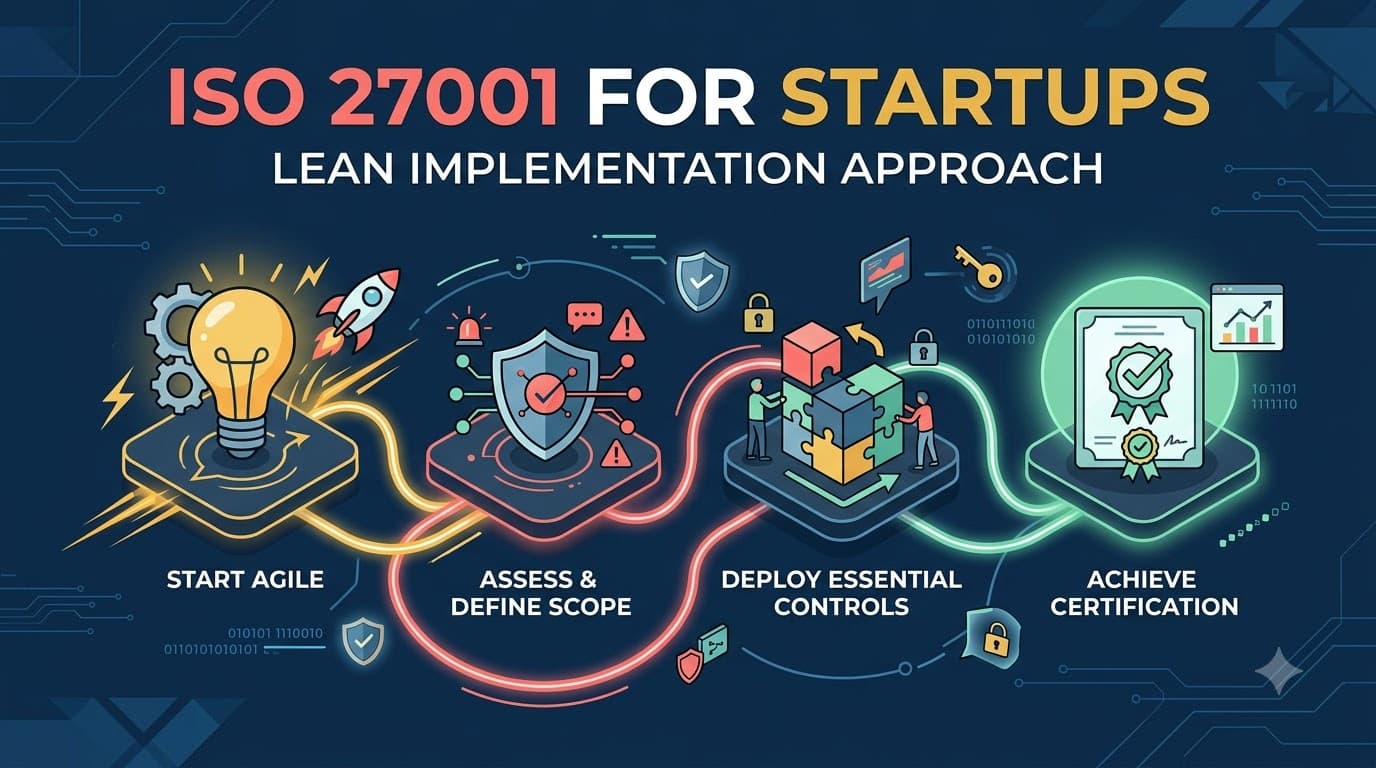
Priya Nair had eleven days to save a deal.
Priya was the co-founder and CEO of Ledgerly, a 22-person SaaS startup selling automated expense-reconciliation software to mid-market finance teams. Eighteen months in, Ledgerly had decent traction — $1.4M in ARR, a product finance teams genuinely liked, and a sales pipeline finally starting to include names bigger than the seed-stage logos that got them started. The biggest name in that pipeline was a national retail chain's finance organization: a $340,000 annual contract, three times the size of anything Ledgerly had closed before, and a reference customer that would open doors to a dozen similar accounts.
Then procurement sent the vendor security questionnaire. Buried in section four, next to a checkbox for "SOC 2 Type II report," was a second checkbox: "ISO/IEC 27001:2022 certification (required for vendors processing financial transaction data above $X volume)." Ledgerly had neither. Priya's head of sales called the buyer directly and got a straight answer: the SOC 2 report alone wasn't going to clear their vendor risk committee for a contract this size. ISO 27001 certification was a hard requirement, not a preference, and the committee met again in six weeks. If Ledgerly didn't have at least a credible certification timeline by then, procurement would move to the next vendor on the shortlist.
Priya did what most founders do first: she called three consulting firms. The quotes came back at $140,000 to $210,000 and 12 to 16 months — built around templates and timelines designed for a 500-person bank, not a 22-person startup with one part-time IT contractor and no dedicated security hire. At that price and that timeline, the deal would be long gone before the certificate existed. One consultant, more honest than the others, told her plainly: "You're buying an enterprise ISMS. You don't need one. You need a startup-sized ISMS that says the same true things about a much smaller, much simpler environment." That reframing is what got Ledgerly to a certificate in five months for just under $34,000 in hard costs — and it's the same reframing this article walks you through.
Who This Is for and What You'll Walk Away With
This is for founders, engineering leads, and the first security or compliance hire at an early-stage company — typically 5 to 75 employees, usually SaaS or a technology vendor, usually running entirely on a public cloud, and usually pursuing certification because a customer, investor, or regulator is asking for it. You will not walk away with a shortcut around the ISO/IEC 27001:2022 requirements — there isn't one, and anyone who sells you one is selling you a nonconformity waiting to happen. What you will walk away with is a concrete method for scoping tightly, inheriting controls you're already paying your cloud provider for, automating the evidence trail instead of hand-building it, and making disciplined trade-offs about where a five-person team spends its limited hours — so that the ISMS you build is small, true, and defensible in an audit, rather than large, aspirational, and full of gaps nobody has time to close.
Why Startups Actually Pursue ISO 27001
I've sat through this conversation with startup founders more times than I can count, and the honest answer is almost never "we woke up caring deeply about information security governance." It's revenue. Ledgerly's story is the norm, not the exception: a deal stalls in procurement, a security questionnaire references a certification instead of a self-attestation, and the founder discovers that "trust us, we're careful" doesn't clear an enterprise vendor risk committee. Who Needs ISO 27001? covers the broader picture of which organizations benefit most, but for startups specifically, the trigger is almost always one of three things: an enterprise customer's procurement requirement, an investor or acquirer's due-diligence checklist, or a regulated-industry partner (a bank, a healthcare system, a payment processor) that will only integrate with certified vendors.
There's a second, quieter reason smart founders pursue it earlier than they're forced to: certification compounds. The certification benefits and ROI case for an established enterprise is about avoiding breach costs and satisfying auditors. For a startup, the ROI case is sharper and more immediate — it's the difference between a sales cycle that stalls for months while a customer's security team improvises a workaround, and a sales cycle that closes on schedule because the certificate answers the question before it's asked. I've watched startups shave four to six weeks off enterprise sales cycles purely by having the certificate (or a credible "certification in progress, Stage 2 scheduled for [date]" answer) ready before the questionnaire arrives, rather than after.
What founders get wrong is assuming the standard itself scales down. It doesn't — and that's actually good news, because it means "lean" isn't a euphemism for "less rigorous." ISO/IEC 27001:2022 requires the same Clauses 4 through 10 and the same 93 Annex A controls under consideration whether you're a 10-person startup or a 10,000-person bank. What changes is proportionality: the size of your risk register, the number of people in scope, the complexity of your supplier list, and how much of the control set you inherit versus build. That's the lever this article pulls on, and it's the only legitimate lever there is.
The Lean Philosophy: Right-Size, Don't Gold-Plate
"Lean" in this context means something precise, and I want to be blunt about what it does not mean, because I've seen too many startups get this backwards in both directions. Lean does not mean skipping the risk assessment, skimping on the Statement of Applicability, running a rubber-stamp internal audit, or treating the management review as a fifteen-minute calendar filler. Every one of those is a mandatory element of the standard regardless of company size, and an auditor who's seen a hundred startups will spot a hollow one in the first ten minutes of Stage 1.
What lean does mean is refusing to build machinery you don't need. It means a scope statement that covers your actual product and its actual data flows instead of every corner of the company. It means an Annex A control set where "not applicable" is used honestly and often — because you don't have a physical data center, you don't run your own network hardware, and you don't have four layers of management between engineers and the CEO. It means a risk register with forty entries instead of four hundred, because a forty-person company genuinely has fewer distinct assets, processes, and threat scenarios than a multinational. It means policies that are two pages of things your team actually does, not twenty pages of things a template author imagined a company might do.
"The single biggest mistake I see startups make isn't cutting corners — it's the opposite. They buy a 200-page policy template library built for a bank, adopt it wholesale, and then can't produce evidence for half of what it claims they do. An auditor doesn't penalize you for being small. They penalize you for documentation that describes a company that doesn't exist." — Sofia Reyes, virtual CISO and founder, Anchor Point Security Advisory
The test I give clients is simple: for every document, every control, and every process you're about to build, ask whether a five-person company genuinely needs it to manage its actual risks, or whether you're building it because a template said so. If it's the latter, cut it — or shrink it until it fits.
The Same Clauses, Applied Proportionally
Clauses 4 through 10 of ISO/IEC 27001:2022 are not optional and not negotiable by company size — every certified organization, from a three-person fintech to a global bank, has to satisfy every one of them. What changes for a startup is the volume of evidence and the complexity of the process behind each clause, not whether the clause applies. Table 1 shows how each clause looks in practice at startup scale versus how it's often (over-)built in larger organizations.
Table 1: Clauses 4–10 — Enterprise Default vs. Lean Startup Application
Clause | Requirement | Typical Enterprise Build | Lean Startup Build |
|---|---|---|---|
4 — Context of the organization | Determine internal/external issues, interested parties, ISMS scope | Multi-department context workshops, 20+ page context document | One-page context summary: product, customers, cloud provider, key regulators |
5 — Leadership | Top management commitment, policy, roles | Dedicated CISO, security steering committee | Founder/CEO as visible sponsor; security roles assigned to existing staff |
6 — Planning | Risk assessment, risk treatment, objectives | 300+ line risk register, dedicated risk committee | 30–60 line risk register scoped to actual assets and processes |
7 — Support | Resources, competence, awareness, communication, documented information | Learning management system, formal competence matrices | Lightweight onboarding training + a shared drive with version-controlled docs |
8 — Operation | Operational planning and control, risk treatment execution | Change advisory boards, formal ops runbooks | Existing engineering workflows (CI/CD, ticketing) mapped to ISMS requirements |
9 — Performance evaluation | Monitoring, internal audit, management review | Dedicated internal audit team, quarterly reviews | Founder-led or outsourced internal audit; one thorough annual management review |
10 — Improvement | Nonconformity handling, corrective action, continual improvement | Formal CAPA system with SLAs | Simple issue tracker (can be the same one engineering already uses) |
The point isn't that the startup column is "less ISO 27001." It's the same standard, satisfied with tools and cadences appropriate to a team where the CEO can still name every employee. An auditor certifying a 20-person company expects a 20-person-scale ISMS — what they're testing is whether it's real, not whether it's big.
Annex A: The Same 93 Controls, a Very Different Applicability Mix
The four Annex A themes — Organizational (5.1–5.37, 37 controls), People (6.1–6.8, 8 controls), Physical (7.1–7.14, 14 controls), and Technological (8.1–8.34, 34 controls) — are the same 93 controls under consideration for every certified organization. A startup doesn't get to delete controls from Annex A. What it gets to do, through the Statement of Applicability, is document — honestly and with justification — that a meaningful chunk of them are not applicable to its environment, or that they're satisfied by inheriting a cloud provider's controls rather than building its own.
Table 2: Annex A Themes — Where Lean Startups Typically Land
Theme | Controls | Common Startup Pattern |
|---|---|---|
Organizational (5.1–5.37) | 37 | Nearly all applicable — policies, roles, supplier management, incident handling apply regardless of size; this is where most startup documentation effort goes |
People (6.1–6.8) | 8 | Fully applicable but lightweight — screening, training, and remote-working controls scaled to a small, often fully remote headcount |
Physical (7.1–7.14) | 14 | Frequently reduced to a small applicable subset — most are marked not applicable or inherited when the startup has no owned data center or office server room |
Technological (8.1–8.34) | 34 | Largely applicable but heavily inherited from cloud provider native services (identity, logging, encryption, network segmentation) rather than built from scratch |
This is exactly where the "lean" lever does the most legitimate work, and it's the subject of the next few sections: tight scoping, cloud inheritance, and automation.
Tight Scoping: The Single Highest-Leverage Decision
If I could get a startup founder to do exactly one thing well, it would be scoping — because every downstream cost, from consultant hours to audit days to internal-team burden, scales with how big the ISMS boundary is. Defining the scope of your ISMS walks through the general method, but for a startup the practical answer is almost always: scope to the product, the environment that runs it, and the people who touch customer data — and explicitly exclude everything that doesn't.
That usually means the ISMS boundary is the SaaS application, its production and staging cloud environments, the engineering and operations teams who build and run it, and the customer support function that accesses customer data to do their jobs. It usually does not need to include a marketing website hosted separately with no customer data, a sales CRM if it holds only prospect contact details rather than in-scope customer data, or a satellite office that exists purely for in-person meetings and holds no infrastructure. I've seen founders instinctively want to scope the whole company "to be safe" — and instead make their own certification three times more expensive and four months slower, because now HR systems, marketing tooling, and unrelated internal apps are all pulled into the risk assessment, the SoA, and the audit sample.
Table 3: Startup Scope Boundary — What's Typically In vs. Out
Component | Typically In Scope | Typically Out of Scope | Notes |
|---|---|---|---|
Core SaaS product (prod + staging) | Yes | — | The reason customers are asking in the first place |
Cloud infrastructure account(s) hosting the product | Yes | — | Includes the accounts, not the cloud provider's own data centers |
Engineering, DevOps/platform teams | Yes | — | People who can affect the product's security |
Customer support / success (if they touch customer data) | Yes | — | Scope in if they access production data or tickets containing it |
Sales & marketing tooling (no customer data) | — | Often out | Justify exclusion in the scope statement, don't just omit silently |
Corporate HR/finance systems | — | Often out | Unless they process in-scope customer or personnel data relevant to the ISMS |
Physical office space (fully remote startups) | — | Often out or minimal | If no owned facility, most of Theme 7 becomes not applicable or inherited from co-working/office provider |
Dev/test environments with synthetic data only | Sometimes | Sometimes | Depends on whether they can reach production credentials or data |
The discipline here isn't about hiding risk — a narrow scope statement has to be honest about what it excludes and why, and the exclusion rationale becomes part of your context and scope documentation that the auditor will read closely in Stage 1. A scope that quietly excludes the thing your enterprise customer actually cares about (say, the production database) will get flagged immediately and will not do what you need it to do commercially, since the certificate won't cover what the customer is buying. The goal is precise, not small for its own sake.
"I ask every startup founder the same question in the first scoping call: if your biggest prospect asked exactly what this certificate covers, could you answer in one sentence and have it match what they're buying? If the answer is no, we haven't scoped it right yet." — Marcus Webb, Head of Security, Streamline Analytics
Leveraging Cloud Providers: Inheriting Controls You're Already Paying For
Here's the single largest efficiency most startups leave on the table: nearly every early-stage SaaS company already runs entirely on AWS, Azure, or Google Cloud, and every one of those providers maintains its own ISO 27001 certification (among others) covering the physical data centers, hypervisor layer, and core infrastructure services. That means a meaningful slice of Annex A — most of Theme 7 (Physical), and chunks of Theme 8 (Technological) around infrastructure resilience — is already satisfied by controls your cloud provider operates and gets independently audited on. You don't rebuild them. You inherit them, under the shared responsibility model, and you document that inheritance properly rather than either ignoring it or pretending you built it yourself.
This is not a shortcut or a loophole — it's exactly how the standard expects supplier relationships to work, and it's precisely why Supplier Relationship Security controls 5.19–5.23 exist, including 5.23 (Information security for use of cloud services), added specifically in the 2022 revision because cloud dependency has become universal. The obligation on you isn't to replicate the data center's physical controls; it's to (a) select a provider with appropriate certifications, (b) understand and document exactly where the responsibility line falls, (c) obtain and periodically review the provider's compliance evidence (their SOC 2 report, ISO 27001 certificate, and shared responsibility documentation), and (d) build the controls that remain squarely on your side of the line — identity, application security, data classification, and configuration of the services you consume.
Table 4: Shared Responsibility — What You Inherit vs. What You Still Own
Control Area | Typically Inherited from Cloud Provider | Typically Owned by the Startup | Evidence to Collect |
|---|---|---|---|
Physical security perimeters & entry (7.1–7.2) | Yes — data center physical access, badges, guards | — | Provider's ISO 27001 certificate, SOC 2 report |
Environmental protections, power, fire suppression (7.5, 7.11) | Yes | — | Provider's data center compliance attestations |
Equipment maintenance, secure disposal (7.13–7.14) | Yes | — | Provider's certifications; contractual assurance |
Underlying network & hypervisor security | Largely yes | Your virtual network configuration, security groups | Provider attestations + your own config exports |
Identity and access management | Platform provides the mechanism (IAM, SSO) | You configure roles, MFA, least privilege (5.15–5.18, 8.2–8.5) | IAM policy exports, access review logs |
Encryption at rest / in transit | Platform provides the capability | You enable and configure it correctly (8.24) | Configuration screenshots, key management policy |
Logging & monitoring infrastructure | Platform provides the logging service | You configure retention, alerting, review (8.15–8.16) | Log configuration exports, alert runbooks |
Application-layer security | — | Fully yours — code, SDLC, dependency management (8.25–8.29) | SAST/DAST scan results, code review records |
Vulnerability management of your workloads | — | Fully yours (8.8) | Scan reports, patch cadence records |
Business continuity of the cloud platform itself | Largely yes | Your application-level backup/recovery design (5.29–5.30) | Provider SLA/uptime commitments + your DR test records |
The mistake I see most often isn't failing to use this table — it's using it and then never writing it down. An auditor will not simply take your word that "AWS handles the data center." They'll expect to see the provider's current ISO 27001 certificate or SOC 2 report on file, a documented shared responsibility matrix like the one above tailored to your actual services, and evidence that someone reviews the provider's compliance status at least annually. That documentation is your control for 5.22 (monitoring, review and change management of supplier services) — it's not extra work layered on top of inheritance, it's the mechanism that makes inheritance legitimate in an auditor's eyes.
"The startups that get this right treat their cloud provider's certificate as evidence they have to actively manage, not a thing they mention once in the kickoff call and never look at again. The ones that get it wrong show up to Stage 2 with a shared responsibility diagram that's never been updated since a slide deck from eighteen months ago." — Dana Ostrowski, Lead Auditor, Meridian Certification Body
Documenting Inheritance Properly in the SoA
The place all of this gets formalized is the Statement of Applicability. For each of the roughly two dozen Annex A controls where cloud inheritance is relevant, your SoA entry should state clearly whether the control is applicable, and if so, whether it's satisfied through inheritance, through your own implementation, or through a combination of both — plus a one-line justification a stranger could follow. "7.11 Supporting utilities — Applicable, inherited via AWS data center certification (ISO 27001, SOC 2 Type II on file, reviewed annually)" is a complete, defensible SoA entry. "N/A — cloud" is not; it's the kind of shorthand that generates a Stage 1 minor nonconformity because it doesn't demonstrate the organization actually understood the control or verified the inheritance claim.
This same discipline extends to your supplier list more broadly — not just your cloud provider, but the SaaS tools that touch customer data (your support desk, your analytics platform, your payment processor). Controls 5.19 through 5.21 require you to assess these relationships and address security in the agreements; for a ten-tool startup stack, this is realistically a supplier register with risk tiering (critical, moderate, low) and a lighter review cadence for the low-risk tools, not a forty-page due-diligence questionnaire sent to your email marketing vendor. Lean here means matching the depth of supplier due diligence to the sensitivity of what that supplier actually touches — heavy diligence on your database host and your payment processor, light-touch diligence on your project management tool.
Automation and GRC Tooling: Buying Back Founder Hours
The second-biggest lean lever, after scope, is automation. A decade ago, a startup pursuing ISO 27001 manually screenshotted access review spreadsheets, chased down engineers for change tickets, and rebuilt evidence folders by hand every quarter. That's still possible, and I've done it with clients who preferred it, but it's rarely the efficient path for a five-person team where every hour spent on manual evidence collection is an hour not spent shipping product. A mature market of compliance automation and GRC platforms now exists specifically to pull evidence continuously from the systems startups already run — cloud provider APIs, identity providers, HR systems, ticketing tools, code repositories — and map that evidence directly to Annex A controls and clause requirements.
The realistic value of these platforms for a startup is threefold: continuous evidence collection instead of a frantic pre-audit scramble, automated alerting when a control drifts out of compliance (an offboarded employee whose access wasn't revoked, an unencrypted storage bucket, an expired vulnerability scan), and a pre-built control-to-evidence mapping that saves weeks of manually deciding what evidence satisfies which control. What they do not do is replace the risk assessment, write your Statement of Applicability justifications for you, or substitute for a human internal auditor's judgment — all of which remain squarely your team's responsibility no matter how good the tooling is.
Table 5: Manual vs. Automated Evidence Collection for Common Controls
Function | Manual Approach | Automated/GRC-Assisted Approach | Typical Time Saved |
|---|---|---|---|
Access reviews (5.18, 8.2) | Quarterly spreadsheet export, manual sign-off | Continuous sync from IdP/SSO, automated review reminders and sign-off workflow | Several hours per quarter |
Vulnerability scan evidence (8.8) | Manual export and filing of scanner reports | Direct API pull from scanning tool into evidence repository with control mapping | Hours per audit cycle |
Employee onboarding/offboarding (6.1–6.5, 8.1) | HR emails IT, manual checklist, manual proof-of-completion filing | HRIS-triggered workflow with automatic ticket creation and evidence capture | Ongoing, per hire/departure |
Policy acknowledgment tracking (5.1, 6.3) | Spreadsheet of who's read what, manual chasing | Automated distribution, reminders, and signed acknowledgment logging | Hours per training cycle |
Cloud configuration checks (8.9, 8.20–8.24) | Manual console review against a checklist | Continuous configuration monitoring against control benchmarks with drift alerts | Ongoing, prevents last-minute fire drills |
Risk register maintenance (Clause 6) | Manually updated spreadsheet, easy to let go stale | Templated risk register with reminders tied to review cadence | Moderate, mainly reduces staleness risk |
None of this is free, and the licensing cost of a GRC platform has to be weighed against consultant hours it displaces — for most seed-to-Series-B startups the math favors the platform, because the alternative is a founder or engineer manually chasing the same evidence every quarter for the life of the certification, not just once. The ISO 27001 Implementation Costs guide breaks down where automation tooling typically lands in a startup budget relative to consulting and audit fees, and if you're ready to shortlist vendors, our review of the best compliance automation platforms for startups is built specifically around this budget-and-headcount profile rather than enterprise buying criteria.
"I tell founders: the audit doesn't care whether your evidence came from a screenshot you took at 11pm the night before, or from a platform that's been quietly collecting it for six months. It cares that the evidence is complete, accurate, and covers the whole audit period. Automation is just the more humane way to get there." — Alex Kim, Founder and CEO, Pactly
Small-Team Realities: Everyone Wears Three Hats
Enterprise ISO 27001 guidance assumes a certain organizational depth — a CISO who doesn't write code, a dedicated risk manager, an IT operations team distinct from software engineering, an HR department separate from the founders. A 15-person startup has none of that. The engineer who deploys to production is often the same person who reviews the pull request, manages the AWS account, and might even process the payroll run in a pinch. This isn't a failure of governance; it's just what a small company looks like, and the standard doesn't require you to invent org-chart depth that doesn't exist. Control 5.2 (information security roles and responsibilities) requires that roles be assigned and understood, not that they be held by different departments.
Where this gets genuinely tricky is control 5.3, segregation of duties — the requirement that conflicting duties and areas of responsibility be separated to reduce the risk of unauthorized or unintentional modification or misuse of the organization's assets. In a large organization, this is solved organizationally: the person who requests an access change isn't the person who approves it. In a ten-person startup, the person who requests, approves, and implements a production change might genuinely be the same two or three people, full stop — there often isn't a fourth person to hand the task to.
The standard's own answer to this, and it's the correct one, is compensating controls: where duties cannot be practically separated because the organization is too small, other controls have to reduce the risk instead — mandatory peer review even when reviewer and requester overlap across a small pool, audit logging of privileged actions so any single person's changes are visible after the fact, dual approval workflows built into tooling (a second engineer must approve any production deploy, even asynchronously), and a founder or external advisor who periodically reviews privileged activity logs as an independent check. None of this eliminates the underlying constraint of team size — it acknowledges the constraint and manages the residual risk transparently, which is exactly what a competent auditor wants to see documented rather than glossed over.
Table 6: Segregation of Duties in a 12-Person Startup — Compensating Controls
Conflicting Duty Pair | Who Typically Holds Both in a Tiny Team | SoD Risk | Compensating Control |
|---|---|---|---|
Requesting and approving access changes | Founder/CTO | Self-approved elevated access | Quarterly access review by a second leader (e.g., CEO or external vCISO) |
Writing code and deploying to production | Individual engineers in a small team | Unreviewed changes reaching production | Mandatory peer code review + CI/CD approval gate before deploy |
Managing cloud infrastructure and reviewing its logs | DevOps/platform lead | Self-reviewed activity | Automated, tamper-evident logging shipped to a separate system the admin can't quietly edit |
Employee offboarding initiation and access revocation | HR/ops generalist | Missed or delayed revocation | Automated deprovisioning triggered by HRIS status change, verified monthly |
Financial system administration and expense approval | Founder/finance lead | Fraud or error risk (broader than ISMS scope but often flagged) | Card limits, dual-approval thresholds, monthly reconciliation by an external bookkeeper |
An honest SoD narrative in your risk treatment plan — "duties X and Y cannot be fully separated given current headcount; compensating control Z reduces residual risk to an acceptable level, reviewed quarterly" — is a completely normal, auditable statement for a startup. What auditors flag is either pretending the conflict doesn't exist, or documenting a compensating control that's never actually performed.
What You Still Cannot Skip
I want to be as direct about this as the style of this whole series demands: lean is not a euphemism for incomplete, and every startup that has tried to treat it that way has either failed its audit or received certification with nonconformities that had to be remediated within a fixed clock before the certificate would actually issue. There is a fixed set of things ISO/IEC 27001:2022 requires regardless of your headcount, and shrinking them past a certain point stops being "lean" and starts being "not actually implementing the standard."
You cannot skip a real risk assessment. A risk register with four generic entries copied from a template ("cyberattack," "data breach," "insider threat," "natural disaster") does not satisfy Clause 6 — the assessment has to reflect your actual assets, your actual threat landscape, and produce risk levels an auditor can trace back to a defined methodology. You cannot skip the Statement of Applicability, and it has to justify every inclusion and exclusion, not just list "N/A" forty times. You cannot skip a functioning internal audit — even if it's a single person, or an outsourced auditor, reviewing the ISMS against the standard's requirements at least once before the certification audit and periodically afterward. You cannot skip management review — top management (which, for a startup, is genuinely the founder or CEO) has to formally review the ISMS's performance at planned intervals, and that review has to produce documented decisions, not just happen informally over Slack. You cannot skip corrective action when something goes wrong — an incident, a missed control, an audit finding all have to trigger a documented response under Clause 10, even if that response is proportionate and quick for a small organization.
Table 7: Mandatory ISMS Elements — No Startup Exception
Requirement | Clause | Why It Can't Be Skipped | Lean-Appropriate Version |
|---|---|---|---|
Scope of the ISMS | 4.3 | Defines what's certified — a certificate without a real scope is meaningless | One-page, precise scope statement (see Table 3) |
Information security policy | 5.2 (Clause) / 5.1 (Annex A) | Top-level commitment auditors verify first | Two-to-four page policy reflecting actual practice |
Risk assessment & treatment methodology | 6.1.2–6.1.3 | Core mechanism the entire ISMS is built on | Documented method applied to a right-sized register (30–80 entries typical) |
Statement of Applicability | 6.1.3(d) | Demonstrates deliberate control selection, not guesswork | Honest inherit/build/N-A per control with one-line justification each |
Risk treatment plan | 6.1.3(e) | Shows risks are actually being addressed, not just recorded | Action items with owners and target dates, tracked to closure |
Competence & awareness records | 7.2–7.3 | Evidence people know their security responsibilities | Onboarding training + periodic refreshers, logged completion |
Internal audit | 9.2 | Independent check the ISMS actually works before the certification body checks | Founder-led or outsourced audit against the full standard, at least annually |
Management review | 9.3 | Confirms leadership is actually steering the ISMS | One thorough annual (or more frequent) review with documented inputs/outputs |
Nonconformity & corrective action process | 10.1 (formerly 10.2) | Shows the organization learns from failures | Lightweight tracker, but every finding gets a documented root cause and fix |
ISO 27001 Mandatory Documents covers the complete document-level checklist in depth; the point to internalize here is that "lean" only ever operates on scope, depth, and tooling — never on whether a requirement exists.
A Lean Implementation Plan, Phase by Phase
The general shape of any ISO 27001 project is the same and is covered thoroughly in the Implementation Roadmap from gap analysis to certification. For a startup applying the lean levers above — tight scope, cloud inheritance, automation — that same roadmap compresses meaningfully, mostly because there's simply less to build and less to review. Table 8 shows a realistic phase-by-phase plan for a 20-to-40-person SaaS startup running on a single major cloud provider.
Table 8: Lean Implementation Plan for a 20–40 Person Startup
Phase | Typical Duration | Key Deliverables | Primary Owner |
|---|---|---|---|
1. Gap analysis & scoping | 2–3 weeks | Draft scope statement, initial gap assessment against Clauses 4–10 and Annex A | Founder/CTO + external consultant or vCISO |
2. Risk assessment & SoA | 3–4 weeks | Risk register (30–80 entries), draft Statement of Applicability, risk treatment plan | Security lead / vCISO, reviewed by leadership |
3. Policy & documentation build | 3–4 weeks (parallel with Phase 2) | Core policies (2–4 pages each), mandatory document set, cloud shared-responsibility matrix | Security lead, engineering input on technical controls |
4. Technical control implementation | 4–8 weeks (parallel where possible) | MFA/SSO rollout, logging & monitoring configuration, vulnerability scanning cadence, GRC platform onboarding | Engineering/DevOps lead |
5. Training & operational embedding | 2–3 weeks | Security awareness training delivered, evidence collection running continuously | Security lead / People Ops |
6. Internal audit & management review | 2–3 weeks | Internal audit report, documented management review with corrective actions closed | External auditor or trained internal reviewer + founder |
7. Stage 1 audit | 1 day on-site/remote + prep | Documentation review, readiness confirmation | Certification body |
8. Remediation window | 2–6 weeks (depends on Stage 1 findings) | Closure of any Stage 1 findings | Security lead |
9. Stage 2 audit | 2–4 days | Certification audit — evidence of operation over time | Certification body |
10. Certificate issuance | 1–2 weeks after Stage 2 | Certificate issued, surveillance schedule set | Certification body |
Run end-to-end with reasonable parallelization, this realistically lands a focused startup at four to seven months from kickoff to certificate — consistent with the ranges discussed in How Long Does ISO 27001 Certification Take?, and dramatically faster than the twelve-to-sixteen-month timelines quoted by consultancies building an enterprise-scale program for a startup-scale company.
The Lean ISMS, Visualized
The three levers this article has walked through — tight scope, inherited cloud controls, and automation — aren't independent tactics; they compound into a single, coherent path to certification that a small team can actually execute without burning out or burning cash. The diagram below shows how they converge.
flowchart LR
    A[Tight ISMS Scope<br/>core product + prod/staging environment<br/>+ engineering & support teams] --> D[Right-Sized, Certification-Ready ISMS]
    B[Inherited Cloud Controls<br/>shared responsibility with AWS/Azure/GCP<br/>documented in the SoA] --> D
    C[Automation & GRC Tooling<br/>continuous evidence collection<br/>+ compensating controls for SoD] --> D
    D --> E[Internal Audit &<br/>Management Review]
    E --> F[Stage 1 Audit]
    F --> G[Stage 2 Audit]
    G --> H[ISO/IEC 27001:2022<br/>Certificate]
Every arrow into the center box represents hours you're not spending — narrower scope means fewer assets in the risk register and a smaller audit sample; inherited controls mean you're not rebuilding physical and infrastructure security your cloud provider already operates; automation means evidence accumulates continuously instead of being reconstructed under deadline pressure. None of the three lowers the bar the standard sets. All three lower the cost of clearing it.
Cost and Timeline Realities for Startups
Founders deserve a straight number, and the honest answer is "it depends on scope and how much you do in-house" — but that's not useful on its own, so here are the ranges I've actually seen hold up across dozens of lean startup implementations, discussed in full in ISO 27001 Implementation Costs: A Realistic Budget Breakdown. These are illustrative figures based on typical lean engagements, not a quote for your specific company.
Table 9: Illustrative Lean Startup Cost Breakdown (20–40 Employees, Single Cloud, Tight Scope)
Cost Category | Typical Range | Notes |
|---|---|---|
Gap analysis & advisory (vCISO/consultant, part-time) | $8,000–$20,000 | Scales with how much internal expertise already exists |
GRC/automation platform (annual) | $6,000–$18,000 | Often the single highest-leverage line item for a small team |
Internal effort (opportunity cost, not cash) | 0.25–0.5 FTE for 4–6 months | The real cost most founders underestimate |
Certification body audit fees (Stage 1 + Stage 2) | $8,000–$16,000 | Scales with headcount and number of sites in scope |
Remediation tooling (MFA/SSO, scanning, logging upgrades) | $2,000–$10,000 | Often partially already owned if using modern cloud-native tooling |
Total cash outlay (excluding opportunity cost) | $24,000–$60,000 | Compares to $140,000–$210,000 quoted for enterprise-template approaches at the same company size |
Table 10: Realistic Timeline — Lean Startup vs. Enterprise-Template Approach
Stage | Lean Startup Timeline | Enterprise-Template Timeline (same headcount, over-scoped) |
|---|---|---|
Gap analysis to Stage 1 readiness | 3–5 months | 8–12 months |
Stage 1 to Stage 2 | 1–2 months | 2–4 months |
Total to certificate | 4–7 months | 12–18 months |
Primary driver of the difference | Narrow scope, cloud inheritance, automation | Overbuilt scope, manual evidence collection, template bloat |
The gap between these two paths isn't cutting corners — it's the difference between building an ISMS sized for the company you actually are versus one sized for the company a generic template assumes you might someday become. ISO 27001 for Small Businesses covers the adjacent case of an established small business (not venture-funded, slower growth) applying similar simplification principles, if that profile fits your organization better than the fast-growth startup case this article focuses on.
Common Startup Mistakes: Over-Doing It
Ironically, the most expensive mistakes I see startups make are the ones that come from over-engineering, usually out of anxiety that "startup-sized" will look unserious to an auditor. It won't — auditors certify small companies constantly, and a right-sized ISMS reads as more credible, not less, than an obviously borrowed one.
Table 11: Startup Mistakes — Over-Doing It
Mistake | Consequence | Fix |
|---|---|---|
Adopting a 40-policy enterprise template library wholesale | Can't produce evidence for half the policies; audit flags contradictions between policy and practice | Write 8–12 policies that describe what the team actually does |
Scoping the entire company "to be safe" | Triples risk register size, audit sample, and consultant hours | Scope to the product, its environment, and the people who touch customer data |
Hiring a full-time compliance manager before certification | Burns runway on a role that a fractional vCISO or automation platform can cover pre-certification | Use fractional/outsourced expertise until headcount and complexity justify full-time |
Building a risk register with hundreds of generic entries | Impossible to keep current; buries the handful of risks that actually matter | Scope the register to real assets and real threat scenarios (30–80 entries typical) |
Standing up a formal change advisory board for a 4-person engineering team | Slows deployment without meaningfully reducing risk at that scale | Use existing PR review + deploy approval gates as the documented control |
Buying every point security tool "just in case" | Sprawling toolset with unused licenses, weaker actual coverage | Prioritize identity (SSO/MFA), logging, and vulnerability scanning first — the highest-yield controls at startup scale |
Common Startup Mistakes: Under-Doing It
The opposite failure mode is just as common and considerably more damaging, because it produces certificates that don't survive surveillance audits, or worse, an ISMS that fails to catch a real incident.
Table 12: Startup Mistakes — Under-Doing It
Mistake | Consequence | Fix |
|---|---|---|
Copy-pasting a risk register from a template without adapting it to the actual environment | Auditor finds the risk assessment doesn't reflect the real business; often a major nonconformity | Build the register from an actual asset inventory and actual threat brainstorm |
Treating the SoA as a checkbox exercise ("all applicable") | No evidence of deliberate control selection; signals a rubber-stamp process | Genuinely evaluate each of the 93 controls against real risk and document the reasoning |
Skipping internal audit because "we're too small to need it" | Clause 9.2 nonconformity; often surfaces during Stage 1 | Run a lightweight but real internal audit, even self-performed with a checklist |
Letting the SoD conversation go undocumented ("we just trust each other") | No compensating controls on file; flagged the moment an auditor asks about access reviews | Document the compensating controls from Table 6, and actually run them |
Assuming cloud provider inheritance covers everything, including your own application | Application-layer vulnerabilities go unmanaged; a breach at that layer isn't excused by AWS's certificate | Own 8.25–8.29 (secure development) and 8.8 (vulnerability management) fully yourselves |
No plan for what happens as headcount doubles | ISMS scope and controls silently become stale within two quarters of hiring | Build a lightweight annual (or trigger-based) scope and risk review into the calendar from day one |
"The nonconformities I write up most often at startups aren't exotic. They're a SoA that says every control is applicable with no reasoning, or an access review that's supposed to happen quarterly and hasn't happened once. Small companies don't get graded on a curve for those — the requirement is the same size regardless of headcount." — Dana Ostrowski, Lead Auditor, Meridian Certification Body
ISO 27001 or SOC 2 First? The Question Every Startup Asks
I get this question in nearly every startup engagement, usually right after "how much will this cost": should we do SOC 2 first, ISO 27001 first, or both at once? There's no universal right answer, but there is a right framework for deciding, and it comes down to who's asking and where you sell. A SOC 2 Type II report is the default expectation for North American B2B SaaS buyers and moves faster on a first pass (a Type I report can exist quickly, though Type II requires an observation period). ISO 27001 is the default expectation for international buyers, larger enterprises with formal vendor risk committees, and regulated-industry partners, and it carries more weight with government and multinational buyers because it's an internationally recognized management-system certification rather than an attestation report. A deeper comparison, "ISO 27001 vs SOC 2: Which One Do You Need?", is exactly the resource I'd point you to for this decision point; for now, Table 13 gives the practical shorthand I use with founders in the room.
Table 13: ISO 27001 vs. SOC 2 — Quick Startup Decision Guide
Factor | Leans ISO 27001 | Leans SOC 2 |
|---|---|---|
Primary buyer geography | International, especially EU/UK/APAC enterprise buyers | North American B2B SaaS buyers |
Buyer's procurement maturity | Formal vendor risk committee requiring a certification | Security questionnaire accepting an attestation report |
Regulatory/partner context | Government, multinational, or ISO-mandating industries | US-centric SaaS ecosystem, VC-backed buyer base |
What it demonstrates | A certified management system (ISMS) covering governance, risk, and controls | Effectiveness of specific controls against defined trust service criteria over a period |
Startup effort profile | Front-loaded (build the ISMS), then steady surveillance cycle | Type I is fast; Type II requires an observation period (commonly ~3–12 months) before the report is meaningful |
Many startups selling into both US and international enterprise markets eventually pursue both, and the good news is that the underlying control work overlaps heavily — a well-built ISMS with cloud inheritance, automation, and lightweight governance does most of the heavy lifting for a SOC 2 report too. The lean approach in this article isn't ISO-specific; it's a startup-appropriate compliance philosophy that pays off across whichever certification or attestation your buyers actually ask for.
Case Study: Ledgerly Closes the Deal
Back to Priya. Once she reframed the project as "lean, not enterprise," the plan changed shape entirely. Ledgerly scoped the ISMS to its core reconciliation product, its single AWS environment, and the 14 engineering and support staff who touched customer data — explicitly excluding a separate marketing site and an unrelated internal tools codebase. A fractional vCISO ran the gap analysis and risk assessment in three weeks, producing a 52-line risk register instead of the 300-line monster a previous consultant had proposed. The team documented AWS's ISO 27001 and SOC 2 certifications as the basis for inheriting most of the Physical theme and a chunk of the Technological theme, and adopted a GRC automation platform to pull evidence continuously from their identity provider, their vulnerability scanner, and their HRIS instead of building spreadsheets by hand.
Segregation of duties was a real conversation, not a formality — with only two people capable of touching production infrastructure, Ledgerly implemented mandatory dual approval on production deploys and quarterly access reviews performed by Priya herself as an independent check, documented explicitly as a compensating control in the risk treatment plan. Internal audit was outsourced to a two-day engagement by an independent practitioner three weeks before Stage 1.
Total elapsed time from kickoff to certificate: five months. Total hard cost: just under $34,000, including the vCISO engagement, the GRC platform's first-year license, and certification body fees for both audit stages. Stage 1 surfaced two minor findings (an incomplete supplier risk tiering document and a training record gap for one new hire) — both closed within eleven days. Ledgerly's certificate came through nine days before the retail chain's procurement committee met again. The $340,000 deal closed, and within the following two quarters, the certificate helped shorten three subsequent enterprise sales cycles by an average of five weeks each, based on Priya's own pipeline tracking.
Case Study: An Eight-Person Dev-Tools Startup
A developer-tools startup I advised — eight people total, fully remote, selling an API-monitoring product to engineering teams — took the lean approach to its logical extreme. With no office, no physical assets beyond employee laptops, and a single cloud provider hosting everything, nearly the entirety of the Physical controls theme was either not applicable or fully inherited, and their Statement of Applicability reflected that plainly, with justification for each entry. Roles overlapped heavily: the CEO acted as management representative, the sole DevOps engineer owned most technical controls, and a part-time operations contractor managed HR-adjacent people controls like screening and offboarding.
Because the company had already adopted a GRC automation platform for unrelated reasons (an early customer had asked about SOC 2), roughly 60% of the evidence-collection work for ISO 27001 was already flowing in by the time the gap analysis started. The team spent most of its actual effort on the risk assessment, the SoA, and writing genuinely accurate — rather than templated — policies. Certification took four months from kickoff, at a total cash cost of approximately $28,000, and the internal audit was performed by the CEO personally, using a checklist built by the external vCISO and reviewed for adequacy before being accepted as evidence.
Case Study: When Lean Still Means More Rigor
Not every startup gets the easiest version of this story, and it's worth being honest about that too. A payments-adjacent fintech startup I worked with — 35 employees, handling cardholder-adjacent transaction metadata and personally identifiable information for both PCI DSS and privacy reasons — initially wanted the same lean playbook Ledgerly used. It didn't fully apply. Because the data being processed was more sensitive and the regulatory overlap (PCI DSS obligations, state privacy law) was real, the risk assessment legitimately needed to be deeper, the supplier due diligence on their payment processor and a subprocessor handling PII needed to be more rigorous, and several Technological controls — particularly around data masking (8.11), access restriction (8.3), and cryptography (8.24) — needed more substantial build-out rather than simple cloud inheritance, because the sensitivity of the data meant the residual risk from a thin implementation was genuinely too high.
The lesson their case teaches is the one that matters most for this whole article: lean is calibrated to actual risk, not to headcount alone. This startup's risk register ended up at 95 entries, nearly double Ledgerly's, and its certification took six and a half months and roughly $52,000 — still dramatically leaner than an enterprise-template approach, but not as lean as a lower-sensitivity SaaS company doing the same size of business. The team that reflexively applies the thinnest possible version of "lean" to a business handling regulated financial or health data is setting itself up for either a failed audit or, worse, an incident the ISMS should have caught.
Table 14: Case Study Outcomes Summary
Company Profile | Headcount | Time to Certificate | Cash Cost | Key Lean Levers Used |
|---|---|---|---|---|
Ledgerly (expense-reconciliation SaaS) | 22 | 5 months | ~$34,000 | Tight scope, cloud inheritance, GRC automation, documented SoD compensating controls |
Dev-tools API monitoring startup | 8 | 4 months | ~$28,000 | Near-total physical control inheritance, pre-existing GRC platform, CEO-led internal audit |
Payments-adjacent fintech startup | 35 | 6.5 months | ~$52,000 | Lean scoping and automation, but deeper risk assessment and technical controls due to data sensitivity |
Is Your Startup Ready to Start? A Quick Readiness Check
Before you kick off a lean implementation, it's worth a candid self-assessment. Table 15 is the checklist I actually use on a first call with a startup founder — not a formal readiness audit, but a fast filter for whether the organization has the minimum foundation a lean project needs to succeed on the timelines in Table 10.
Table 15: Startup ISO 27001 Readiness Quick-Check
Readiness Signal | Why It Matters |
|---|---|
A named executive sponsor (usually the founder/CEO) who will show up to the management review | Clause 5 leadership commitment can't be delegated away entirely |
Single (or small number of) cloud provider(s) with published ISO 27001/SOC 2 certifications | Enables the inheritance strategy in Table 4 |
Existing identity provider with SSO/MFA capability | Foundation for a large share of Technological controls |
Someone (even part-time or fractional) who can own the ISMS day-to-day | Lean doesn't mean ownerless — someone has to drive it |
Willingness to say "not applicable" honestly in the SoA rather than defaulting to "applicable" for everything | Signals the team understands proportionality rather than checkbox compliance |
A real (even if short) list of customers/data types the business handles | Needed for an accurate risk assessment and scope statement |
Budget in the $25,000–$60,000 range set aside, even if final cost lands lower | Prevents a mid-project funding stall that resets audit-readiness timelines |
If most of these are true today, a four-to-seven-month lean timeline is realistic. If several are missing — no executive engagement, no single source of identity truth, no budget set aside — expect the project to run closer to the enterprise-template timeline by default, not because the standard changed, but because the foundation the lean approach depends on isn't there yet.
"The startups that move fastest aren't the ones with the most money. They're the ones where the founder shows up to the first risk workshop and stays engaged through the management review six months later. Everything else — the tooling, the consultant, the auditor — moves at the speed leadership sets." — Tom Radcliffe, VP of Sales, Nimbus Data
The Strategic Close: Certification as a Growth Lever, Not a Tax
I understand why compliance feels, from the founder's seat, like a tax on growth — hours diverted from product, cash diverted from runway, at the exact moment a startup can least afford either. But the startups that get lean ISO 27001 right stop treating it as a tax and start treating it as sales infrastructure, in the same category as a CRM or a pricing page: an asset that removes friction from every deal after the first one. Priya's team didn't just close the $340,000 deal that started this article — they turned a defensive scramble into a repeatable answer that shortened every subsequent enterprise sales cycle, because "yes, we're certified, here's the scope statement" closes a security review in a single email instead of a six-week back-and-forth.
The certification benefits and ROI case holds for startups just as it does for enterprises — reduced breach risk, better vendor and customer trust, a structured way to make security decisions as the company scales past the point where "we're careful" is a credible answer. What's different for a startup is the compression: the same investment that takes an enterprise eighteen months and seven figures to build can take a lean, well-scoped early-stage company four to seven months and a fraction of the cost, precisely because there's less organizational complexity to document and more of the heavy infrastructure lifting can be legitimately inherited from a cloud provider you're already paying. Lean isn't a compromise version of ISO 27001. For a company at this stage, it's the correct version — the one an experienced auditor will recognize as fit for purpose the moment they open your scope statement.
Where to Go From Here
If you're weighing whether to start this project now or wait for "a better time" — there rarely is one, and the deals that trigger the requirement tend to arrive on their own schedule, not yours. Start with an honest gap analysis against your actual environment (not a template), get a scope statement drafted in the first two weeks, and make the cloud inheritance and automation decisions early, since they shape almost everything downstream. PentesterWorld's Certification Readiness Checklist is a fast way to sanity-check where your startup stands today, and the ISO 27001 Gap Analysis Tool turns that check into a structured starting point you can hand directly to a vCISO or consultant. If you're still deciding whether the investment is worth it at your current stage, the "Is Your Organization ISO 27001 Ready?" quiz and the ISO 27001 Certification Cost Calculator will give you a realistic, personalized read on timeline and budget before you commit a single consulting hour. And if you want the full method laid out end to end — scoping, risk assessment, SoA, audit preparation — The Complete ISO 27001 Implementation Guide eBook walks through every phase in the depth a single article can only summarize. The ISO 27001 Glossary of Terms is worth bookmarking too — startup teams new to the standard hit unfamiliar vocabulary constantly in the first few weeks, and having a fast reference on hand keeps momentum from stalling on terminology alone.
Priya's advice to other founders, six months after her certificate came through, is the best closing note I can offer: "We spent less time and less money getting certified than we would have spent in one more quarter of losing enterprise deals to a checkbox we hadn't checked. Do it lean, do it honestly, and do it before the deal that forces your hand shows up on a six-week clock."
Keeping It Lean as You Scale
A lean ISMS built for a 20-person company doesn't stay accurate on its own once that company hires 40 more people in the next funding round — and this is the part of the lean approach founders most often forget to plan for. Certification isn't a one-time event; certification bodies conduct surveillance audits (typically annually) for the three years between full recertification cycles, and a scope statement, risk register, or SoA that quietly stopped matching reality six months after the certificate was issued is exactly what those audits are designed to catch.
The practical discipline is to build a trigger-based review habit into the calendar from day one rather than waiting for the surveillance audit to force it: a new product line that touches customer data differently, a new cloud region or provider added to the infrastructure, a headcount jump that changes whether segregation-of-duties compensating controls are still necessary, or a new regulated market entered (the company that starts selling into the EU and picks up fresh GDPR compliance obligations, or moves into healthcare, six months after certifying probably needs to revisit its risk assessment, not just its marketing copy). None of this means re-running the full lean implementation plan from Table 8 every time something changes — it means a lightweight quarterly or event-triggered check: does the scope statement still describe what we actually run, does the SoA still reflect our actual control set, and has anything in the risk register materially changed.
The startups that struggle at surveillance audit time are almost always the ones that treated Stage 2 as the finish line rather than the start of an operating rhythm. The ones that sail through are the ones where the automation and evidence-collection habits built during initial certification — continuous access reviews, ongoing vulnerability scanning, automated onboarding/offboarding workflows — simply kept running afterward, because they were built into normal operations rather than staged as a one-time audit-prep exercise. That's the real payoff of the lean, automation-first approach this article has walked through: it isn't just cheaper to get certified this way, it's cheaper to stay certified, which is where most of the long-run value of the certificate actually accrues.
DIY, Fractional vCISO, or Full Consultancy: Choosing Your Support Model
One decision founders agonize over more than almost any other is how much outside help to bring in, and the honest answer is that it depends less on principle and more on what expertise already exists inside the company. A startup with a technically strong CTO who has run compliance programs before can do more in-house than one where nobody on the team has ever seen a Statement of Applicability. What I steer founders away from, consistently, is either extreme: fully DIY with zero outside expertise (which tends to produce a documentation set that looks right but doesn't survive an experienced auditor's questions, because nobody on the team has seen a real Stage 1 before), or a full-service consultancy engagement billed at enterprise rates for a problem that's genuinely startup-sized.
The middle path that works for most lean startup engagements is a fractional or part-time vCISO relationship: someone who has run several ISO 27001 certifications before, engaged for a bounded number of hours across the gap analysis, risk assessment, SoA, and audit-prep phases, while the internal team owns day-to-day execution and evidence collection (often via the automation platform discussed earlier). This keeps the expensive, judgment-heavy work — deciding what's genuinely applicable, writing a defensible risk methodology, preparing the team for auditor questions — in experienced hands, while keeping the ongoing operational load internal, where it belongs long-term anyway since the ISMS has to keep running after the consultant's engagement ends.
Table 16: Support Model Comparison for Startup ISO 27001 Projects
Model | Best Fit | Typical Cost Profile | Risk If Chosen Poorly |
|---|---|---|---|
Full DIY (no outside help) | Team already includes someone with prior ISO 27001 implementation experience | Lowest cash cost, highest internal time cost | Blind spots on what auditors actually expect; risk of a failed Stage 1 |
Fractional vCISO / part-time advisor | Most lean startups — technical team, no in-house compliance background | Moderate cash cost, bounded hours, internal team executes | Choosing an advisor without recent hands-on certification experience |
Full-service consultancy | Complex, multi-entity, or heavily regulated startups (e.g., handling PCI or health data at scale) | Highest cash cost, fastest handoff of effort, but often built on enterprise templates | Over-scoped, over-documented ISMS sized for a company far bigger than yours |
GRC platform + self-serve support | Very small, technically sophisticated teams comfortable owning the audit narrative themselves | Low-to-moderate cash cost, concentrated in software licensing | Platform doesn't replace judgment on risk assessment or SoA justification |
Whichever model you choose, the one constant across every successful lean engagement I've run is that the founder or a designated internal owner stays engaged throughout — not delegated entirely to an outside party. Auditors interview your people, not your consultant, and an ISMS that only your vCISO understands is not an ISMS your organization actually owns.