Marisol Vega found out the hard way that "we're too small for that" is an expensive assumption.
Marisol is the general manager of Sequoia Precision Parts, a 28-employee CNC machining shop outside Dayton, Ohio. Sequoia doesn't write software. It doesn't have a data center. It cuts titanium and aluminum components to tolerances measured in ten-thousandths of an inch, and it had held ISO 9001 quality certification for eleven years without incident. When Sequoia's largest customer — a Tier 1 aerospace subcontractor — sent out its annual approved-vendor renewal packet, it included a new requirement: suppliers handling controlled technical data needed to show either ISO 27001 certification or a documented, audited equivalent information security program. Marisol read the requirement, decided it was clearly written for the subcontractor's software vendors and cloud providers, filled in "not applicable — small manufacturer" on the questionnaire, and moved on.
Six weeks later, Sequoia's account manager got a call. The contract — worth $680,000 a year, roughly a third of Sequoia's revenue — was going out for rebid, and the security questionnaire was now a scored, weighted section worth 20% of the total evaluation. Sequoia scored close to zero on it. Talon Metalworks, a competitor with 31 employees and a nearly identical service offering, had completed ISO 27001 certification fourteen months earlier using a lean, outsourced approach that cost them under $40,000 all-in. Talon won the renewal. Marisol's team kept the smaller residual work but lost the flagship account.
The mistake wasn't that Sequoia lacked the resources to get certified — plenty of 28-person companies do it. The mistake was assuming ISO 27001 was scaled for organizations that look nothing like a machine shop, and therefore never scaling it down to see what it would actually require. That assumption is the single most common and most costly misconception I encounter among small business owners, and this article exists to correct it.
Who This Is For
This guide is written for owners, operations leaders, and office managers at established small businesses — typically 10 to 100 employees — who need ISO 27001 certification for a customer contract, a regulatory expectation, an insurance requirement, or a genuine desire to reduce risk, and who do not have a dedicated security team, a compliance department, or six figures of discretionary budget. You may run a manufacturer, a professional services firm, a logistics broker, a healthcare billing office, or a regional financial services shop — established, "boring," and profitable, not a fast-scaling tech startup. You'll walk away with a proportionate way to size your Information Security Management System (ISMS), a phased roadmap that fits a small team's bandwidth, a clear picture of what outsourcing can and can't do for you, and an honest list of what you're allowed to simplify versus what remains mandatory no matter your size.
Is ISO 27001 Realistic for a Small Business? Yes — Because It's Built to Scale
ISO/IEC 27001:2022 does not have a "small business edition" and a "large enterprise edition." Every certified organization — a two-person consultancy or a 40,000-employee bank — implements the same management-system Clauses 4 through 10 and evaluates the same 93 Annex A controls for applicability. That single fact is what makes small business certification realistic rather than aspirational: the standard is explicitly designed around proportionality. Clause 4.3, which defines the scope of your ISMS, and Annex A itself, which you filter through your own risk assessment and Statement of Applicability, both assume that applicability and depth of implementation will vary enormously by organization size, complexity, and risk exposure. A control isn't "harder" for a small business — it's just implemented with fewer moving parts, less formal documentation, and often a single person wearing multiple hats.
Where small businesses go wrong isn't the standard — it's translation. Consultants, templates, and generic guidance are frequently written with a 500-person enterprise in mind: multiple approval layers, dedicated security committees, quarterly steering meetings, and documentation sets that run to hundreds of pages. A small business that tries to copy that model wholesale will either give up halfway through or spend money on process it doesn't need. The skill this article teaches is right-sizing — building an ISMS that satisfies every mandatory clause and every applicable control, expressed at a scale that a five-person leadership team can actually operate and sustain.
"I tell every small business client the same thing in the first meeting: ISO 27001 doesn't care how big your org chart is. It cares whether you know what you're protecting, whether you've thought about what could go wrong, and whether you can show an auditor you're actually doing what your policy says. A 20-person company can demonstrate all three in a fraction of the paperwork a 2,000-person company needs." — Sarah Lindqvist, Senior Consultant, Pinegate Compliance Group
The proportionality principle also shows up directly in the standard's language. Annex A controls are prefaced by guidance that organizations should apply controls "as appropriate" to their context, and ISO 27002:2022 — the companion implementation guidance standard — repeatedly frames controls in terms of the risk and resources of the implementing organization. None of this is a loophole; it's the intended design. A small business that treats "proportionate" as license to skip the risk assessment or leadership review is misreading the standard. A small business that treats "proportionate" as license to write a two-page policy instead of a 40-page one, when a two-page policy fully addresses its actual risk, is reading it correctly.
Small Business Reality | Common Misconception | What the Standard Actually Requires |
|---|---|---|
28 employees, one IT contractor | "We need a full-time CISO before we can start" | Clause 5.3 requires assigned roles and responsibilities — not a specific headcount or title |
No in-house software development | "Annex A is mostly for tech companies" | You assess all 93 controls for applicability; many (e.g., 8.25–8.31 secure development) will be marked not applicable and justified in the SoA |
Shared IT/finance/operations staff | "Segregation of duties is impossible for us" | Control 5.3 explicitly allows compensating controls (monitoring, independent review, management oversight) where duties can't be split |
Limited budget for consultants | "Certification requires a six-figure program" | Cost scales with scope, complexity, and chosen support model — many SMBs certify for well under $50,000 all-in |
Owner also handles HR, IT, and operations | "We can't do the mandatory management review" | Clause 9.3 requires a documented review at planned intervals — it can be a 90-minute meeting with an agenda and minutes, not a formal board session |
Right-Sizing the ISMS: Documentation That Fits a Small Team
The biggest lever a small business has for simplification is documentation volume, not documentation existence. Every mandatory document the standard requires still has to exist — a scope statement, an information security policy, risk assessment and treatment methodology, the Statement of Applicability, risk treatment plan, competence records, monitoring results, internal audit program, management review records, and nonconformity/corrective action records. What changes is length, formality, and the number of subordinate documents layered underneath each one.
A mid-size enterprise might have a 25-page access control policy with cross-references to a dozen supporting standards, regional variances, and a change-control workflow spanning four departments. A 30-person professional services firm can often satisfy the same control (5.15, Access control) with a two-page policy: who can request access, who approves it, how it's reviewed, and how it's revoked when someone leaves. Both documents are compliant. Only one of them is proportionate to the organization that wrote it.
I generally advise small business clients to consolidate wherever the standard doesn't force separation. Instead of eleven standalone Annex A topic-specific policies, most SMBs can operate a single "Information Security Policy" document with clearly labeled sections addressing each required topic — access control, acceptable use, classification, supplier security, incident management — cross-referenced from the Statement of Applicability. One document is easier to keep current, easier to train staff on, and easier to present to an auditor than fifteen scattered PDFs that inevitably drift out of sync with each other.
The same consolidation logic applies to the risk register, the asset inventory, and the supplier register — each can live as a single well-maintained spreadsheet or lightweight tool rather than a dedicated GRC platform. Auditors do not award extra credit for tooling sophistication; they look for evidence that the organization actually uses what it built. A messy but current spreadsheet updated by the office manager every month beats an expensive platform nobody logs into after the Stage 1 audit. If a lightweight tool genuinely does earn its cost at your scale, our review of the best compliance automation platforms for startups and small teams is built around exactly this budget-conscious, lean-team profile rather than enterprise buying criteria.
Documentation Element | Enterprise-Scale Version | Small Business Right-Sized Version |
|---|---|---|
Information security policy set | 12–20 separate topic policies, formal version control board | One consolidated policy document with labeled sections, reviewed annually by leadership |
Risk register | Dedicated GRC platform, hundreds of risk lines, quarterly working groups | Shared spreadsheet or lightweight tool, 20–60 risk lines tied to real assets, reviewed at each management review |
Statement of Applicability | 90+ rows with multi-paragraph justifications and cross-team sign-off | 93 rows with 1–3 sentence justifications per control, signed by the owner/leadership team |
Internal audit program | Dedicated internal audit function, annual audit calendar across 15+ areas | One person (internal or outsourced) auditing the full ISMS scope once a year, documented findings and actions |
Training records | LMS platform with automated tracking and role-based curricula | Signed attendance log or completion spreadsheet for a short annual session plus onboarding briefing |
Supplier due diligence | Formal supplier security assessment team, tiered questionnaires, SLAs | A short standard questionnaire for critical suppliers, filed with the contract, reviewed at renewal |
Documentation length is also where I most often see over-correction in the wrong direction: small businesses either copy a 200-page enterprise template wholesale (creating unmaintainable bloat and evidence they can't actually follow), or they under-document to the point that a policy exists only "in someone's head." Both fail an audit. The right-sized middle ground is a document short enough that the person responsible for it can read it in five minutes and long enough that a new hire, or an auditor, can understand what's actually supposed to happen.
Right-Sizing Annex A: The Same 93 Controls, a Different Footprint
Every organization, regardless of size, works through all four Annex A themes — Organizational (5.1–5.37, 37 controls), People (6.1–6.8, 8 controls), Physical (7.1–7.14, 14 controls), and Technological (8.1–8.34, 34 controls) — during risk treatment and the Statement of Applicability. What differs for a small business is which controls turn out to be genuinely applicable, and how much infrastructure sits behind the ones that are.
A small business without in-house software development can, with proper justification, mark most of the secure development life cycle controls (8.25 through 8.31) as not applicable — a defensible SoA entry if you don't write code. A business that runs entirely on Microsoft 365 or Google Workspace with a single outsourced IT provider will implement network security controls (8.20–8.23) largely through that provider's configuration rather than an in-house network operations function. This isn't corner-cutting; it's accurate scoping. The failure mode is marking a control not applicable because it's inconvenient rather than because it's genuinely outside your risk picture — auditors test SoA justifications specifically for this pattern, and a thin justification for a control that clearly does apply is one of the fastest ways to generate a Stage 2 nonconformity.
Annex A Theme | Enterprise Footprint | Small Business Right-Sized Footprint |
|---|---|---|
Organizational (5.1–5.37) | Dedicated security governance function, formal committees, layered policy sets | Owner/manager holds policy ownership directly; fewer, consolidated documents; supplier and incident controls scaled to actual vendor count |
People (6.1–6.8) | HR security team, formal onboarding/offboarding workflows across systems | HR or office manager runs a documented checklist for hiring, screening, and termination; short annual awareness session |
Physical (7.1–7.14) | Badge systems, security operations center, multiple monitored sites | Locked office/server closet, visitor sign-in, clean desk practice; several controls often not applicable for fully remote or coworking-based SMBs |
Technological (8.1–8.34) | In-house SOC, dedicated vulnerability management team, custom tooling | Managed IT provider or a single IT admin handles patching, backup, endpoint protection, and logging using off-the-shelf tools |
A practical starting point for most small businesses is to run the full applicability exercise against the Annex A organizational controls first, since governance, supplier management, and incident response tend to anchor the rest of the ISMS, then work through people, physical, and technological themes in turn — resisting the urge to mark anything not applicable until you've actually traced it against a real risk in your risk register.
Small-Team Challenges and Compensating Controls
The single most common structural obstacle small businesses raise is segregation of duties. Control 5.3 asks organizations to separate conflicting duties and areas of responsibility to reduce the risk of unauthorized or unintentional misuse. In a 400-person company, the person who requests a system change is never the person who approves it, who is never the person who deploys it. In a 20-person company, all three of those people might be the same IT contractor, working alone, on a Tuesday afternoon.
This is exactly the scenario the standard anticipates and explicitly accommodates. Where genuine separation of duties isn't organizationally possible, ISO 27002 guidance directs organizations toward compensating controls: independent monitoring of activities, supervisory review, audit trails, and management oversight that catch and correct problems after the fact even when they couldn't be structurally prevented in advance. An auditor evaluating a 20-person company does not expect four different people signing off on a firewall change. They expect the company to have recognized the conflict, documented why it exists, and put something in place — logging, a peer review from an outsourced IT partner, a monthly access review by the owner — that reduces the residual risk to an acceptable level.
The roles and responsibilities guidance for controls 5.2–5.4 is the right reference point for defining who owns what before you start looking for compensating controls — you can't compensate for a conflict you haven't first identified and assigned.
Small-Team Conflict | Why It's Hard to Avoid | Practical Compensating Control |
|---|---|---|
One IT contractor requests, approves, and deploys system changes | Only one technical resource on staff or retainer | Written change log reviewed monthly by the owner/GM; outsourced IT partner performs quarterly independent configuration review |
The office manager processes payroll and also has admin rights to the HR system | Small headcount means overlapping administrative roles | Quarterly access review by the owner; payroll changes require a second-person email confirmation before processing |
The same person manages user account creation and account deletion | No separate identity/access management function | Termination checklist requires sign-off from a second manager; access list reconciled against HR headcount quarterly |
Owner both approves the risk treatment plan and executes remediation | Flat organizational structure, owner is the de facto risk owner | External vCISO or auditor performs an independent annual review of risk decisions and evidence |
One person manages both backups and backup restoration testing | No dedicated backup administrator | Restoration test results reviewed and signed off by a second staff member or the outsourced IT provider |
"Small businesses get scared off by the phrase 'segregation of duties' because they picture a org chart with twelve boxes. What auditors actually want to see is that you recognized the single point of failure and put a second set of eyes somewhere in the process. A monthly access review by the owner, documented, is a completely legitimate compensating control for a 15-person company." — Marcus Chen, vCISO, Sentry Advisory Partners
Beyond segregation of duties, small teams also struggle with competence and continuity — what happens to the ISMS when the one person who understands it goes on vacation, or leaves? The practical fix is cross-training two people minimally on ISMS administration (even if only one holds day-to-day ownership) and keeping the procedures documentation clear enough that a competent outsider — an auditor, a new hire, or a vCISO — could pick it up without a briefing.
A Phased Implementation Approach for Small Teams
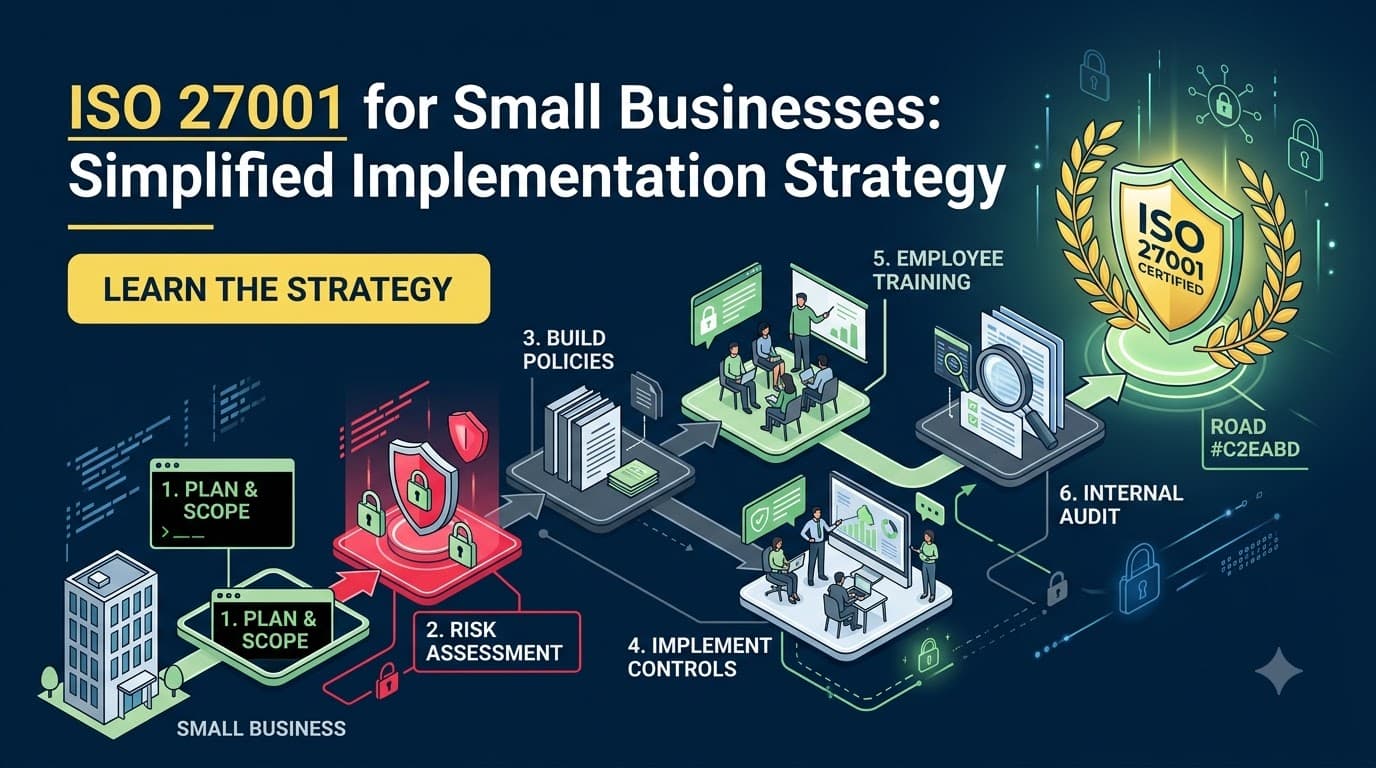
Small businesses rarely have the luxury of pulling three people off their regular jobs for six months to run an ISO 27001 project full time. What works instead is a phased approach that spreads the workload across a longer calendar timeline but keeps the weekly time commitment inside what a lean team can realistically absorb alongside their day jobs. The implementation roadmap that applies to organizations of any size still holds — gap analysis, scoping, risk assessment, control implementation, internal audit, management review, certification audit — but a small business typically needs to stretch each phase over more calendar weeks with fewer concurrent workstreams, rather than compress it with more people.
flowchart TD
    A["Phase 0: Decide & Commit\nLeadership buy-in, budget, scope boundary"] --> B["Phase 1: Gap Analysis & Scoping\nCompare current state to Clauses 4-10 and Annex A"]
    B --> C["Phase 2: Risk Assessment & SoA\nIdentify assets, assess risk, build Statement of Applicability"]
    C --> D["Phase 3: Control Implementation\nClose gaps in priority order, write core documentation"]
    D --> E["Phase 4: Operate & Evidence\nRun the ISMS for a full cycle, generate real records"]
    E --> F["Phase 5: Internal Audit & Management Review\nSelf-check, correct findings, formal leadership sign-off"]
    F --> G["Phase 6: Certification Audit\nStage 1 documentation review, then Stage 2 certification audit"]
    G --> H["Certified — Phase 7: Surveillance Cycle\nAnnual surveillance audits, 3-year recertification"]
For a typical 20–75 employee organization with one internal project owner and a part-time outsourced advisor, a realistic phased timeline runs nine to fourteen months from decision to certificate, materially longer than a well-resourced enterprise project but well within the range covered in how long ISO 27001 certification realistically takes. Trying to compress that into three or four months with a small team is the single most common cause of stalled projects — the standard doesn't reward speed, and a rushed Statement of Applicability or thin evidence trail simply resurfaces as Stage 2 nonconformities later.
Phase | Core Activities | Typical Duration (Small Business) | Primary Owner |
|---|---|---|---|
0. Decide & commit | Leadership agreement, budget approval, high-level scope decision | 2–4 weeks | Owner/GM |
1. Gap analysis & scoping | Compare current practices to Clauses 4–10 and Annex A; finalize ISMS scope | 3–5 weeks | Internal owner + advisor |
2. Risk assessment & SoA | Build asset inventory, assess risks, draft Statement of Applicability | 4–8 weeks | Internal owner + advisor |
3. Control implementation | Close prioritized gaps, write consolidated policies and procedures | 8–16 weeks | Internal owner, IT partner, department leads |
4. Operate & generate evidence | Run the ISMS in production for at least one full monitoring cycle | 6–10 weeks (minimum) | Whole team |
5. Internal audit & management review | Conduct internal audit, hold documented management review, close findings | 3–4 weeks | Internal auditor (or outsourced) + leadership |
6. Certification audit | Stage 1 documentation review, remediate, Stage 2 certification audit | 4–8 weeks | Certification body + internal owner |
Phasing this way also spreads cost. Instead of one large invoice for a compressed project, a small business can budget consulting and tooling spend across several quarters, matching cash flow rather than requiring a lump-sum outlay before a single control is implemented.
Outsourcing Options: Where Small Businesses Get the Most Leverage
Very few small businesses have the in-house expertise to run an ISO 27001 project from a standing start, and trying to build that expertise from scratch is usually the most expensive path available. The more efficient move is selective outsourcing: buy expert judgment for the parts of the project that require it (risk methodology, control design, internal audit independence) while keeping day-to-day ownership and evidence-generation in house, where it belongs and where it's cheapest.
Three outsourcing models show up repeatedly in small business projects, and they aren't mutually exclusive — most SMBs blend two of them.
Virtual CISO (vCISO) retainer. A part-time, fractional security leader who joins for a set number of hours per month, guides risk assessment and control decisions, and often signs off as the person accountable for the ISMS on paper without being a full-time employee. This is the closest analog to hiring a security leader, at a fraction of the cost, and works well for businesses that want an ongoing advisory relationship past certification.
Project-based consultant. An advisor or small firm engaged specifically to take you from gap analysis through certification, usually on a fixed-fee or milestone basis, then stepping back once you're certified (sometimes returning for surveillance audit prep). This model suits businesses that want a defined project cost and don't need ongoing security leadership afterward.
Managed security / managed IT services. Your existing outsourced IT provider (or a new managed security services provider) absorbs the operational controls — patching, backup, monitoring, endpoint protection, logging — as part of their existing managed service contract, closing a large share of the Technological theme controls without a separate line item.
Outsourcing Option | Typical Cost Range (SMB) | Best Fit | Watch-Outs |
|---|---|---|---|
Fully DIY (no outside help) | $0 direct spend, high internal time cost | Businesses with an internal owner who has prior ISO 27001 or audit experience | Risk of blind spots in scoping and SoA justification; steepest learning curve; internal audit independence is harder to satisfy |
vCISO retainer | $1,500–$5,000/month, often 6–12 month engagement | Businesses wanting ongoing security leadership and post-certification support | Retainer cost continues after certification unless scoped down; verify vCISO has actual ISO 27001 lead implementer experience |
Project-based consultant | $15,000–$45,000 fixed fee for a full first-time certification project | Businesses wanting a defined budget and a project that ends at the certificate | Fixed fee can incentivize speed over quality; confirm what's included (internal audit, SoA drafting, audit-day support) |
Managed IT/security services provider | Often absorbed into existing managed IT contract, or a modest uplift | Businesses that already outsource IT and want operational controls covered without a new vendor | Confirm the provider will produce ISO 27001-usable evidence (logs, patch reports), not just "we handle it" |
Templates + self-guided implementation only | $200–$2,000 for template packs | Very small, low-complexity businesses with strong internal ownership | Templates still need real customization; unmodified templates are a common Stage 2 nonconformity trigger |
"The businesses that do this efficiently almost never pick one model exclusively. They'll bring in a consultant for the first pass at risk assessment and the Statement of Applicability, lean on their existing managed IT provider for the technical controls, and keep the policy ownership and evidence-gathering in house. Paying for expertise only where you actually lack it is the whole game." — Dave Whitfield, Operations Director, Castlebridge Freight Brokers
One backlog item worth naming directly, because I get asked about it in nearly every small business engagement: how do you actually decide, control by control, whether to keep something in house or hand it to an outside party? That decision framework deserves its own dedicated treatment — it's a distinct enough question from "should we get certified" that we're tracking it as a future article, choosing between DIY and outsourced ISO 27001 support, rather than trying to compress it into a paragraph here.
Cost and Effort Realities for Small Businesses
Small business owners deserve a straight answer on cost, and the honest answer is: it depends far more on scope and outsourcing choices than on headcount alone. A 40-person company with one office and a single cloud-based application stack will spend meaningfully less than a 40-person company with three physical sites, a legacy on-premises data center, and five critical suppliers. That said, illustrative figures help set expectations, and they map onto the general cost drivers covered in the realistic budget breakdown for ISO 27001 implementation costs.
Cost Line Item | Illustrative Range for a 20–75 Employee Business | Notes |
|---|---|---|
Gap analysis / initial assessment | $2,000–$6,000 | Often bundled into a consultant's project fee rather than billed separately |
Consulting / vCISO support through certification | $12,000–$35,000 | Widest variance; depends on chosen outsourcing model and scope complexity |
Documentation templates and tooling | $500–$3,000 | Templates, a lightweight risk register tool, policy management |
Internal staff time (opportunity cost) | 150–400 hours across the project | Rarely budgeted as a hard cost but the largest true resource commitment |
Technical remediation (MFA, backup, logging, endpoint tools) | $2,000–$15,000 | Highly variable; many SMBs already have much of this from existing IT spend |
Certification body audit fees (Stage 1 + Stage 2) | $6,000–$14,000 | Scales with employee count and number of sites in scope; see certification body selection below |
Annual surveillance audits (Years 1 and 2) | $3,000–$7,000/year | Ongoing cost after initial certification |
Effort, not just money, is the resource small businesses underestimate most. A realistic small-team commitment during the active implementation phases looks like 4–8 hours a week from the internal project owner, 1–3 hours a week from department leads reviewing and approving their sections, and a handful of concentrated multi-hour sessions (risk assessment workshops, policy review sessions, internal audit) rather than a constant daily load. Owners who budget cost but not calendar time are the ones who stall out in Phase 3, because control implementation is where the actual work — not just meetings about the work — happens.
"The number one budgeting mistake I see isn't underestimating the invoice from the consultant. It's assuming the internal team can absorb this on top of a normal workload with zero adjustment. Somebody's regular job has to get 15–20% lighter for four to six months, or the project timeline doubles." — Priya Anand, Founder, LedgerPoint Bookkeeping
It also helps to look at cost over a longer horizon than just the first certificate. The initial certification project is always the most expensive year because it includes one-time setup work — building the ISMS from nothing — that surveillance years don't repeat. Small businesses that budget only for Year 1 and get surprised by Years 2 and 3 usually made the mistake of treating the consultant's initial fee as the entire lifetime cost rather than the up-front piece of an ongoing commitment.
Cost Category | Year 1 (Initial Certification) | Year 2 (Surveillance) | Year 3 (Surveillance + Recertification Prep) |
|---|---|---|---|
Outsourced advisory support | $15,000–$35,000 | $2,000–$6,000 | $4,000–$10,000 |
Certification body audit fees | $6,000–$14,000 (Stage 1 + Stage 2) | $2,500–$5,000 (surveillance) | $2,500–$5,000 (surveillance) + recertification audit in year 3 for a 3-year cycle |
Internal staff time | 150–400 hours | 40–80 hours | 60–100 hours |
Technical/tooling costs | $2,000–$15,000 (one-time remediation) | $500–$2,000 (maintenance) | $500–$2,000 (maintenance) |
Approximate total | $25,000–$60,000 | $5,000–$13,000 | $7,000–$17,000 |
Viewed this way, the "scary" number small business owners fixate on is almost always the Year 1 figure — which is real, but front-loaded. Years 2 and 3 cost a fraction of the initial investment, which is worth stating plainly to a leadership team weighing whether the ongoing commitment is sustainable.
What You Can Simplify vs. What You Can't
This is the table I hand almost every small business client in the first working session, because it's the fastest way to stop the "can we skip this?" conversation before it wastes weeks.
Element | Can You Simplify It? | What "Simplified" Looks Like |
|---|---|---|
ISMS scope (Clause 4.3) | Yes | Narrow the scope to the business unit, location, or service line that actually needs certification, rather than certifying the entire company if part of it is irrelevant to the driving requirement |
Documentation volume | Yes | Consolidated policies, shorter procedures, spreadsheet-based registers instead of platforms |
Risk assessment depth | Yes, in method — not in existence | A practical asset-based approach with 20–60 risks is legitimate; skipping the risk assessment methodology entirely is not |
Segregation of duties (5.3) | Yes, via compensating controls | Documented compensating controls (independent review, monitoring) where true separation isn't feasible |
Internal audit function | Yes, in structure | Can be outsourced or performed by one trained person; cannot be skipped or replaced by "we're too small to need one" |
Management review (Clause 9.3) | Yes, in formality | A short, documented leadership meeting with the required inputs/outputs; cannot be omitted or left unrecorded |
Statement of Applicability | Yes, in narrative length | Concise justifications per control; cannot mark controls not applicable without genuine rationale |
Mandatory Clauses 4–10 | No | Every certified organization, regardless of size, must meet every mandatory clause requirement |
Existence of a risk treatment plan | No | Required regardless of how simple the risk register is |
Evidence of operation | No | You must run the ISMS for real and generate genuine records — auditors test for operating evidence, not just document existence |
Competence and awareness | No, but delivery format is flexible | Staff must be aware of their security responsibilities; delivery can be a short session rather than an LMS program |
Corrective action process (Clause 10) | No | Nonconformities must be tracked and addressed regardless of company size |
Simplifying Risk Assessment Without Cutting Corners
Risk assessment is where I see the most anxiety and the most unnecessary complexity in small business projects. Enterprise risk assessments often run scenario modeling across dozens of threat actors, quantitative loss modeling, and Monte Carlo-style analysis. None of that is required by the standard, and almost none of it is proportionate to a 30-person company. What is required is a documented, repeatable methodology that identifies assets (or scenarios), assesses likelihood and impact against defined criteria, and produces defensible risk treatment decisions — the same expectation covered in the step-by-step risk assessment methodology guide.
For most small businesses, a simple asset-based approach works well: list your genuinely significant information assets (customer database, financial systems, email, key supplier data feeds, physical files if still relevant), assess a small number of realistic threats against each on a simple scale (say, 1–5 for likelihood and impact), and treat anything above your defined risk acceptance threshold. A 20–60 line risk register, reviewed and updated at each management review, is entirely sufficient for most organizations in this size range — more granularity adds maintenance burden without improving decision quality. What can't be simplified away is the discipline behind it: documented criteria, a named risk owner for each significant risk (see the guidance on risk owners and accountability), and a genuine link between identified risks and the controls selected in your Statement of Applicability.
Common Mistakes Small Businesses Make
Having run this playbook across dozens of small organizations, the failure patterns repeat with remarkable consistency. Most of them aren't about lacking resources — they're about misjudging where the effort actually needs to go.
Mistake | Why It Happens | Consequence |
|---|---|---|
Assuming "we're too small to need this" and delaying until a contract deadline forces action | Genuine belief the standard targets larger organizations | Compressed timeline, rushed implementation, higher consulting cost under time pressure |
Buying an oversized template pack designed for enterprises | Templates are marketed as universal, and buyers don't know what to trim | Unmaintainable documentation nobody actually follows; evidence trail doesn't match reality |
Marking Annex A controls not applicable without real justification | Desire to reduce scope of work quickly | SoA justifications collapse under Stage 2 audit questioning; nonconformities |
Skipping the internal audit because "we don't have anyone qualified" | No dedicated audit function exists in-house | Mandatory Clause 9.2 requirement unmet; Stage 2 audit blocked until resolved |
Treating the vCISO or consultant as fully responsible for the ISMS | Outsourcing is mistaken for abdication of ownership | Auditors expect internal accountability; a consultant answering every question raises independence concerns |
Underbudgeting internal staff time while overbudgeting consulting fees | Cost planning focuses on invoices, not calendar hours | Project stalls in control implementation; timeline doubles |
Certifying scope broader than the business actually needs | Assumption that "more coverage looks better" | Unnecessary audit cost and complexity across sites/functions that don't need to be in scope |
Choosing a certification body based on price alone | Budget pressure in a resource-constrained organization | Mismatched auditor experience with the business's sector, friction during Stage 1/Stage 2 |
Building Internal Buy-In in a Small, Informal Culture
Enterprises typically drive ISO 27001 adoption top-down through a formal governance structure with executive sponsorship already assumed. Small businesses often run on a much more informal culture — decisions made in hallway conversations, a founder who still personally approves every purchase order, employees who have worked together for a decade and have their own established, unwritten ways of doing things. Introducing formal policies, access reviews, and documented procedures into that kind of culture can generate real friction if it isn't handled deliberately.
The businesses that navigate this well tend to do three things early. First, they frame the initiative around the business outcome — the contract, the client trust, the risk reduction — rather than around compliance for its own sake, because "we have to do this for an audit" lands very differently with a long-tenured team than "this is how we win bigger customers." Second, they involve a couple of respected long-tenured staff members directly in drafting procedures rather than handing down policy from the top, which both improves the policy's accuracy and builds internal advocates who can explain it to peers informally. Third, they treat the first internal audit as a learning exercise rather than a compliance trap — findings get framed as "things we caught before a customer or a real incident did," not as blame assigned to individuals.
"The technical controls were never our hard part. Getting a team that had worked together for twelve years to start following a documented change process, after years of just doing it from memory, was the actual project. Once two of our senior technicians helped write the procedure themselves, the rest of the team followed without pushback." — Marcus Chen, vCISO, Sentry Advisory Partners
Scope, Certification Bodies, and Related SMB Decisions
Two decisions carry outsized weight for a small business and deserve deliberate attention rather than default assumptions. The first is scope. Before touching a single Annex A control, work through defining the scope of your ISMS with real discipline — a small business that certifies only the service line or location a customer actually cares about will spend meaningfully less time and money than one that certifies the entire company by default. A regional insurance agency with three locations, for example, might reasonably scope its ISMS to the location and systems handling client data, excluding an unrelated side business under the same corporate umbrella, provided the scope boundary is genuinely defensible and doesn't quietly exclude in-scope risk.
The second is certification body selection. Small businesses sometimes default to the cheapest quote, which can backfire if the auditor has no experience with organizations your size or in your sector — a lead auditor accustomed to auditing multinational manufacturers may apply enterprise-scale expectations to your 25-person shop, generating friction and findings that a sector-experienced auditor wouldn't raise. The guidance on how to choose an ISO 27001 certification body applies just as much to small organizations as large ones — ask prospective certification bodies directly about their experience auditing companies your size, and be wary of any auditor who seems unfamiliar with proportionate implementation.
It's also worth being clear about how this guide differs from a related one in this series: ISO 27001 for startups covers a genuinely different profile — young, fast-scaling, often cloud-native technology companies with modern infrastructure and no legacy processes to unwind. A small business, by contrast, is frequently an established, slower-growth organization — a manufacturer, a professional services firm, a healthcare billing office — that may be running legacy on-premises systems, paper-based processes inherited from decades of operation, and an IT environment that wasn't built with security in mind from day one. The simplification levers are similar in spirit, but a startup's challenge is usually "we're moving too fast to document anything," while a small business's challenge is usually "we've been doing it this way for fifteen years and no one wrote it down." If you're unsure whether ISO 27001 applies to your situation at all, the overview of who needs ISO 27001 and which industries benefit most is a useful gut check before committing budget.
Finally, keep an ISO 27001 glossary close at hand through the project. Small business teams without a compliance background lose real time re-explaining terms like "residual risk," "risk owner," or "corrective action" to each other in every meeting — a shared reference eliminates that friction cheaply.
Case Study: Sequoia Precision Parts — The Redemption
After losing the $680,000 aerospace subcontract, Marisol Vega didn't give up on the customer relationship — she asked the account manager what it would take to be reconsidered at the next annual review. The answer was blunt: get certified, or stay a secondary supplier indefinitely. Sequoia ran a formal gap analysis to assess its current state against Clauses 4–10 and the full Annex A control set, engaged a project-based consultant for a fixed $28,000 fee covering scoping through Stage 2 support, and leaned on its existing outsourced IT provider to close the technical controls (endpoint protection, backup, logging, network segmentation) as an uplift to the existing managed services contract rather than a new vendor relationship.
The project ran nine months, phased exactly as outlined above, with Marisol personally owning roughly six hours a week of project time and her plant supervisor cross-trained as a backup ISMS contact. Sequoia scoped its ISMS specifically to the machining operations and quoting/design-file handling processes that touched controlled technical data, explicitly excluding an unrelated small parts-brokering side business under the same corporate entity — a scope decision that kept the certification audit focused and proportionate. Sequoia achieved certification thirteen months after the original contract loss, used the mandatory documents checklist to verify completeness before Stage 1, and was reinstated as a primary-tier approved vendor the following review cycle — winning a new contract worth $740,000 annually, larger than the one it had lost.
"Losing that contract was the worst week of my career running this company. Getting it back — bigger — because we finally took the security requirement as seriously as we took our quality certification, was the best. I wish I'd started three years earlier instead of assuming it didn't apply to us." — Marisol Vega, General Manager, Sequoia Precision Parts
Case Study: LedgerPoint Bookkeeping — Certifying Lean From the Start
LedgerPoint Bookkeeping, a 14-employee outsourced bookkeeping and payroll processing firm serving small and mid-size clients, pursued ISO 27001 proactively rather than reactively — its founder, Priya Anand, saw certification as a competitive differentiator against larger bookkeeping firms bidding for the same regional accounts. With no in-house IT function and a fully cloud-based operation (QuickBooks Online, Microsoft 365, a payroll processing platform), LedgerPoint used a hybrid model: a vCISO retainer at roughly $2,200/month for eight months to guide risk assessment and the Statement of Applicability, combined with template-based documentation the vCISO customized rather than built from scratch.
Because LedgerPoint's technology footprint was almost entirely SaaS-based, a large share of Annex A physical controls were marked not applicable with straightforward justification (no server room, no dedicated facility beyond a small shared office), while access control, supplier security, and data handling controls carried nearly all the implementation weight. Total project cost, including the vCISO retainer, template licensing, and certification body fees, came in just under $31,000. LedgerPoint achieved certification in eight months and reported a 40% increase in qualified RFP responses within the following year, directly attributing several new mid-size clients to the certification appearing on their vendor qualification materials.
"Bookkeeping is a trust business before it's anything else. Being able to point to an actual certificate instead of just saying 'we take security seriously' changed how prospects talked to us in the very first sales call." — Priya Anand, Founder, LedgerPoint Bookkeeping
Case Study: Castlebridge Freight Brokers — Solving the Segregation of Duties Problem
Castlebridge Freight Brokers, a 45-employee logistics brokerage, ran into the segregation of duties challenge harder than most: a three-person IT team handled everything from help desk tickets to firewall changes to user provisioning, with no realistic way to split those duties across more people without hiring — which the budget didn't support. Rather than treat this as a blocker, operations director Dave Whitfield worked with an outsourced auditor to build a compensating-control framework: every system change went through a written change log reviewed monthly by Dave personally, quarterly independent configuration reviews were performed by a separate managed security provider engaged specifically for that oversight function, and access lists were reconciled against HR headcount every quarter with sign-off from a second manager.
Castlebridge ran a full internal audit cycle before Stage 1, using guidance similar to internal audit planning, execution, and reporting to structure the review, which surfaced two minor findings related to stale user accounts — both corrected before the certification audit. Castlebridge achieved certification in ten months at a total cost of approximately $34,000, and the compensating-control framework became one of the auditor's specifically noted strengths during Stage 2, rather than the liability Dave had feared going in.
"I was convinced segregation of duties was going to be the control that sank us. It ended up being the section of the audit where the assessor spent the least time, because we'd clearly thought it through and could show him exactly how we caught problems after the fact." — Dave Whitfield, Operations Director, Castlebridge Freight Brokers
Case Study | Employees | Approach | Total Cost | Time to Certification | Outcome |
|---|---|---|---|---|---|
Sequoia Precision Parts | 28 | Project consultant + existing IT provider uplift | ~$28,000 (consulting) + technical remediation | 9 months | Regained lost contract; new contract 9% larger than the one lost |
LedgerPoint Bookkeeping | 14 | vCISO retainer + customized templates | ~$31,000 all-in | 8 months | 40% increase in qualified RFP responses within a year |
Castlebridge Freight Brokers | 45 | Outsourced auditor + compensating controls for SoD | ~$34,000 all-in | 10 months | Segregation of duties became an audit strength, not a weakness |
Leveraging Suppliers and Cloud Providers to Shrink Your Own Control Burden
One of the most underused simplification levers for small businesses is deliberately choosing suppliers and cloud platforms that absorb a meaningful share of the control burden on your behalf. If your business runs on Microsoft 365, Google Workspace, a cloud-hosted practice management system, or a payroll SaaS platform rather than self-hosted infrastructure, a large portion of controls like physical security, redundancy, and much of network security become the provider's responsibility under a shared-responsibility model rather than yours. You still have to manage the controls that remain in your hands — access configuration, authentication settings, data classification, acceptable use — and you still have to document the relationship through supplier due diligence, but you are not building and maintaining a data center's worth of physical and technical controls from scratch.
This is where supplier assurance becomes genuinely strategic rather than a box-ticking exercise. A small business's supplier questionnaire should specifically ask whether a critical cloud provider holds its own relevant certifications — ISO 27001 itself, or a SOC 2 attestation covering the services you rely on — because a well-certified upstream provider gives you a legitimate basis to rely on their controls rather than duplicating them internally. That reliance still has to be documented and periodically reviewed, but it is dramatically cheaper than building equivalent assurance yourself.
Small businesses also sometimes ask whether a lighter framework might satisfy their need entirely, particularly when the driving requirement comes from a domestic customer or a smaller-scale contract rather than an enterprise procurement process. In some markets, Cyber Essentials or a similar baseline certification is a legitimate lighter-weight alternative for organizations whose customer or regulatory requirement doesn't specifically demand ISO 27001 — it's worth checking what your actual contractual or regulatory driver requires before committing to the larger standard, since ISO 27001 is a management system commitment, not just a control checklist, and that commitment is worth making deliberately rather than by default.
"The mistake I see most with small businesses running entirely on SaaS platforms is either assuming the cloud provider's certification covers them completely, or assuming it covers them not at all. Neither is right. You inherit some assurance from a well-certified provider, but you still own your configuration, your access decisions, and your data handling on top of it — and an auditor will test exactly that boundary." — Renee Oyelaran, ISO 27001 Lead Auditor, Cascade Certification Body
Sustaining Certification Without an Enterprise Compliance Function
Certification is a milestone, not a finish line, and small businesses sometimes underestimate the ongoing commitment that follows the certificate. Annual surveillance audits, continued internal audits, management reviews, and evidence generation don't stop once the certificate is issued — they become the routine operating rhythm of the business for as long as certification matters to it. The good news is that the steady-state workload is materially lighter than the initial implementation project. Once policies exist, risk assessments are current, and staff understand their responsibilities, sustaining the ISMS is mostly a matter of discipline: keeping the risk register current, running the annual internal audit, holding the management review, and closing out any findings promptly.
Small businesses that struggle after certification are almost always the ones that treated the ISMS as a project with an end date rather than an operating discipline. The fix is building the recurring activities into the same calendar rhythm as other business-critical routines — the annual internal audit scheduled next to the annual insurance renewal, the management review folded into an existing quarterly leadership meeting rather than invented as a new standalone commitment. Businesses that outsourced heavily during initial implementation often scale that support down significantly for the surveillance years, retaining only light-touch advisory access rather than the intensive engagement needed to get certified the first time.
A Quick Readiness Self-Check Before You Commit Budget
Before engaging a consultant or signing a certification body contract, it's worth running a short internal gut-check to confirm the organization is genuinely ready to start, not just under pressure to start. The businesses that stall out mid-project are frequently the ones that skipped this step and discovered the real gaps only after money was already committed.
Readiness Question | If "No," What It Means for Your Project |
|---|---|
Does at least one leader (owner, GM, operations director) genuinely support this, not just tolerate it? | Without real leadership commitment, Clause 5 requirements become paperwork exercises rather than lived practice — budget the extra time to build buy-in first |
Can you name the specific driver — a contract clause, a regulator, an insurer, a genuine risk concern? | Without a clear driver, scope decisions drift and the project loses focus; clarify the driver before engaging outside help |
Do you have at least one internal person who can dedicate 4–8 hours a week for 9–14 months? | Without dedicated internal bandwidth, even the best consultant can't move the project forward — outsourcing implementation entirely is rarely realistic |
Do you know roughly which systems and data are actually in scope? | Vague boundaries inflate cost estimates and audit complexity — a rough asset list before you talk to a consultant saves real money |
Is there budget flexibility for at least the low end of the ranges in this guide? | Underfunded projects tend to cut corners exactly where auditors look hardest — documentation depth and evidence of operation |
Running through this list honestly, ideally with the ISO 27001 Gap Analysis Tool, before signing any contract turns "we think we're ready" into a defensible, budgeted decision rather than a leap of faith.
The Strategic Close: Certification as a Small Business Growth Lever
It's worth stepping back from the mechanics of clauses and controls to name what's actually at stake for a small business considering this path. Marisol Vega's $680,000 lesson wasn't really about information security in the abstract — it was about market access. Larger customers, insurers, and increasingly even regulators are pushing security assurance requirements down their supply chains, and small businesses sit at the end of that chain more often than they realize. A 25-person supplier without a security certification isn't competing on price and quality alone anymore in many sectors; it's being screened out of the bidding pool before price and quality ever get evaluated.
Framed that way, ISO 27001 stops looking like a compliance tax and starts looking like what it actually is for a well-run small business: a way to compete for contracts that would otherwise be unreachable, a way to charge a premium in categories (bookkeeping, IT services, professional services, logistics, manufacturing supply chains) where trust is the product, and a way to reduce the very real operational risk of a breach or ransomware event that could be genuinely existential for a company without an enterprise balance sheet to absorb it. The businesses in this article that treated certification as strategic rather than reactive — LedgerPoint pursuing it proactively, Castlebridge turning a structural weakness into an audit strength — came out ahead of businesses that waited for a crisis to force the decision.
The path is genuinely achievable at your scale. The standard was built to flex to your size, not to force you into an enterprise's shape. What it asks for — real leadership commitment, an honest risk assessment, proportionate controls, and evidence that you actually do what you say — is well within reach of a lean team that plans its phases sensibly and buys expertise only where it's genuinely missing.
If you're ready to move from "should we do this" to "how do we start," PentesterWorld's Complete ISO 27001 Implementation Guide eBook walks through the full process end to end, and the ISO 27001 Gap Analysis Tool is a fast way to see exactly where your small business stands today against Clauses 4–10 and Annex A before you commit budget. Once you have a rough sense of scope, the ISO 27001 Certification Cost Calculator helps translate that scope into a realistic, right-sized budget rather than a generic enterprise estimate. As you get closer to audit, the Certification Readiness Checklist and the ISO 27001 Mandatory Documents Checklist will tell you plainly what's still missing before you schedule Stage 1 — cheaper to find out from a checklist than from an auditor's findings report.