Elena Kowalski found out how expensive a documentation gap could be on a Tuesday afternoon in March, three weeks before her company's Series C was supposed to close.
Elena was CISO at Meridian Pay, a 140-person payments fintech that routed card-not-present transactions for mid-market retailers across the EU and UK. Meridian had spent two years building a reputation as the reliable rail behind a dozen well-known e-commerce brands, and it was in the final stretch of a $60 million banking-as-a-service partnership with a mid-size regional bank — a deal that would have tripled Meridian's transaction volume overnight. The commercial terms were agreed. Legal had redlined the contract twice. Then the bank's third-party risk team sent over its annual vendor due-diligence questionnaire, and Meridian's answers triggered an escalation.
The bank wasn't worried about Meridian's product. It was worried about evidence. Meridian could point to a PCI DSS Attestation of Compliance for its card-data environment, a SOC 2 Type II report scoped to its core processing platform, and a pile of internal policies — but nothing that demonstrated a single, governed information security management system covering the whole business, its risk treatment decisions, its supplier oversight, and its incident response commitments in a form an examiner could audit. The bank's own regulator expected it to assess the ICT risk posture of critical third parties under emerging EU DORA expectations, and Meridian's patchwork of point-in-time attestations didn't give the bank's risk committee what it needed to sign off. The partnership stalled for eleven weeks while Meridian scrambled to produce a risk register, a Statement of Applicability, and evidence of ongoing supplier oversight — all under deadline pressure, all reviewed by outside counsel at $650 an hour. By the time the deal closed, Meridian had spent roughly $410,000 in legal fees, contractor time, and delayed revenue recognition, and had accepted materially tighter monitoring rights in the final contract than it would have needed to concede with a certified ISMS already in place.
Elena's mistake wasn't a security failure. Her controls were, by most measures, reasonably strong. Her mistake was treating "regulatory compliance" as a set of separate boxes to check — PCI here, SOC 2 there, a privacy policy over there — instead of building the one thing every regulator, examiner, and counterparty due-diligence team is actually looking for: a documented, risk-based, continuously operating management system that ties governance, risk treatment, supplier oversight, incident response, and resilience together in a way a third party can verify without having to take her word for it. That is exactly what ISO/IEC 27001 is built to provide, and it's why financial services organizations — banks, fintechs, insurers, payment processors, asset managers — have become one of the fastest-growing groups of ISO 27001 adopters over the last five years, not because ISO 27001 replaces their regulatory obligations, but because it gives them a single, auditable backbone that makes meeting all of those obligations dramatically less chaotic.
This article is about that backbone: what it does, what it doesn't do, and how to build it without pretending ISO 27001 is a substitute for the regulations your firm actually has to answer to.
Who This Is For
You're a CISO, head of information security, compliance officer, or risk manager at a bank, credit union, fintech, payments company, insurer, or asset manager, and you're either building an ISMS from scratch or trying to make an existing one earn its keep against DORA, PCI DSS, GLBA, SOX, FFIEC guidance, NYDFS 23 NYCRR 500, or some combination of the above. You're tired of running parallel audits that ask for the same evidence in five different formats. You'll walk away from this article with a clear map of how ISO 27001's clauses and Annex A controls correspond to the themes regulators actually care about, an honest list of what ISO 27001 does not cover for each regulation, and a practical model for running one integrated GRC program instead of five disconnected ones.
The Financial Services Regulatory Landscape: An Overview
Financial services firms don't answer to one regulator or one standard — they typically answer to several at once, layered by jurisdiction, license type, and the products they offer. Before mapping ISO 27001 onto that landscape, it's worth laying out what each major regime actually asks for, at a high level, because the mapping only makes sense once you can see what's being mapped.
Regulation / Framework | Who It Applies To | What It Broadly Requires | How ISO 27001 Helps |
|---|---|---|---|
EU DORA (Digital Operational Resilience Act) | Banks, insurers, investment firms, payment institutions, crypto-asset service providers, and critical ICT third parties operating in the EU (applies from January 2025) | ICT risk management, incident classification and reporting, digital operational resilience testing, third-party ICT risk oversight, information-sharing arrangements | An ISMS provides the risk management framework, supplier oversight process, and incident management process DORA expects — but DORA's specific reporting timelines, resilience testing regime, and register-of-information requirements go beyond ISO 27001's scope |
PCI DSS | Any organization that stores, processes, or transmits payment card data | Twelve requirement areas covering network security, cardholder data protection, vulnerability management, access control, monitoring, and testing, validated via QSA assessment or self-assessment | ISO 27001's asset management, access control, cryptography, and logging controls overlap heavily with PCI DSS technical requirements, but PCI DSS demands its own formal validation (AOC/ROC) — ISO 27001 certification does not satisfy PCI DSS on its own |
GLBA (Gramm-Leach-Bliley Act) Safeguards Rule | US financial institutions handling nonpublic personal information | A written information security program, risk assessment, access controls, encryption, vendor oversight, incident response, and board reporting | ISO 27001's Clause 6 risk assessment and Annex A controls map closely to GLBA's Safeguards Rule elements, giving firms a ready-made program structure — but GLBA has specific US regulatory reporting obligations ISO 27001 doesn't cover |
SOX (Sarbanes-Oxley Act) | US public companies, including financial institutions | Internal controls over financial reporting, including IT general controls (access, change management, operations) supporting financial systems | ISO 27001's change management (8.32), access control (5.15–5.18), and logging controls support ITGC evidence, but SOX compliance requires its own control testing and auditor attestation process distinct from ISO certification |
FFIEC guidance (US) | US banks, thrifts, and credit unions examined under the FFIEC member agencies | Risk-based supervisory expectations across IT governance, cybersecurity, business continuity, and third-party risk (via the FFIEC IT Examination Handbook) | ISO 27001's governance and risk structure aligns well with FFIEC's risk-based examination themes, but FFIEC guidance is examiner-driven and interpreted case by case — certification doesn't guarantee a clean exam |
NYDFS 23 NYCRR 500 | Financial services entities licensed or regulated by the New York Department of Financial Services | A CISO, written cybersecurity program, risk assessment, access controls, encryption, incident response plan, annual certification of compliance, and specific breach notification timelines | ISO 27001 supports most of the substantive program requirements, but NYDFS requires a specific annual certification filed by a named senior officer — a distinct regulatory act ISO 27001 doesn't perform |
Basel operational risk framework | Internationally active banks (via national regulators) | Capital treatment and governance expectations for operational risk, including ICT and third-party risk as a recognized risk category | ISO 27001 provides evidence of a functioning operational risk control environment that feeds into a bank's broader operational risk framework, though Basel's capital calculations sit outside ISO 27001's scope entirely |
That table is the single most important thing to internalize before you build anything: in every row, ISO 27001 helps. In no row does it equal. Anyone who tells you a certificate on the wall satisfies DORA, PCI DSS, or NYDFS in full is selling you something — usually a shortcut you'll regret at your next exam.
Why Financial Services Is a Different Kind of Regulatory Environment
I've helped organizations across manufacturing, healthcare, SaaS, and government contracting get certified to ISO 27001, and financial services is the only sector where I routinely see clients arrive with three or four overlapping compliance programs already running before we've had our first scoping call. That's not because finance firms are disorganized — it's because the regulatory density is genuinely higher than almost anywhere else.
A mid-size regional bank might simultaneously be subject to FFIEC examination, state banking department review, NYDFS if it does business in New York, GLBA's Safeguards Rule as a baseline federal requirement, PCI DSS if it issues or acquires cards, and increasingly DORA-equivalent expectations flowing down from EU banking counterparties even when the bank itself isn't EU-domiciled, because DORA's third-party risk provisions reach into the ICT supply chains of in-scope entities. A fintech that partners with a bank, as Meridian did, inherits a slice of the bank's regulatory obligations by contract even though the fintech itself may not be directly supervised. Insurers answer to state insurance commissioners and their own sector-specific cyber rules, which frequently mirror NYDFS almost verbatim. None of these regimes were designed with the others in mind, and none of them defer to ISO 27001 as a substitute — they defer to it, at best, as evidence of a functioning control environment.
The other thing that makes financial services different is who's reading your evidence. In most industries, your ISO 27001 certificate satisfies a procurement team or a due-diligence checklist. In financial services, the same evidence often ends up in front of a bank examiner, a state regulator, or a board risk committee that has statutory authority over your counterparty — and if that evidence doesn't map cleanly to the specific regulatory language they're trained to look for, it doesn't matter how good your actual security program is. This is precisely the gap Elena hit at Meridian: good controls, badly mapped evidence.
Tailoring the Approach: Banks, Fintechs, and Insurers
The mapping principles in this article apply across financial services, but the practical starting point differs meaningfully by sub-sector, and I've found it worth naming those differences explicitly rather than pretending one playbook fits a 200-year-old regional bank and an 18-month-old fintech identically.
Organization Type | Typical Starting Point | Where ISO 27001 Adds the Most Value | Watch-Out |
|---|---|---|---|
Traditional bank / credit union | Mature but siloed compliance functions (BSA/AML, FFIEC exam prep, physical security) already exist | Consolidating fragmented governance into one risk framework; reducing duplicate exam-prep effort across departments | Political resistance to a "new" framework when existing programs already feel adequate to internal stakeholders |
Fintech / payments company | Security program built fast, often PCI DSS-first, limited formal governance documentation | Providing the management-system layer — risk assessment, SoA, documented governance — that bank and enterprise counterparties demand in due diligence | Underestimating how much documentation discipline (not just technical controls) counterparties and regulators expect |
Insurer | Sector-specific state cyber rules already resembling NYDFS; actuarial risk culture strong on financial risk, less so on ICT/cyber risk | Extending existing risk culture into a formal ICT/information security risk register regulators recognize | Treating cyber risk as an actuarial afterthought rather than integrating it into the same governance cadence as other operational risk |
Asset manager / broker-dealer | Client data protection and business continuity already emphasized informally | Formalizing supplier oversight and incident response documentation regulators increasingly expect during exams | Assuming client asset custody controls alone cover information security risk more broadly |
The fintech pattern is the one this article opened with, and it's worth naming directly: fast-growing fintechs frequently have better technical controls than the traditional institutions they partner with, but weaker formal governance documentation — which is precisely the mismatch that stalls due diligence, because a bank's risk committee is trained to evaluate documented process maturity, not raw technical capability.
The "One ISMS, Many Regulators" Thesis
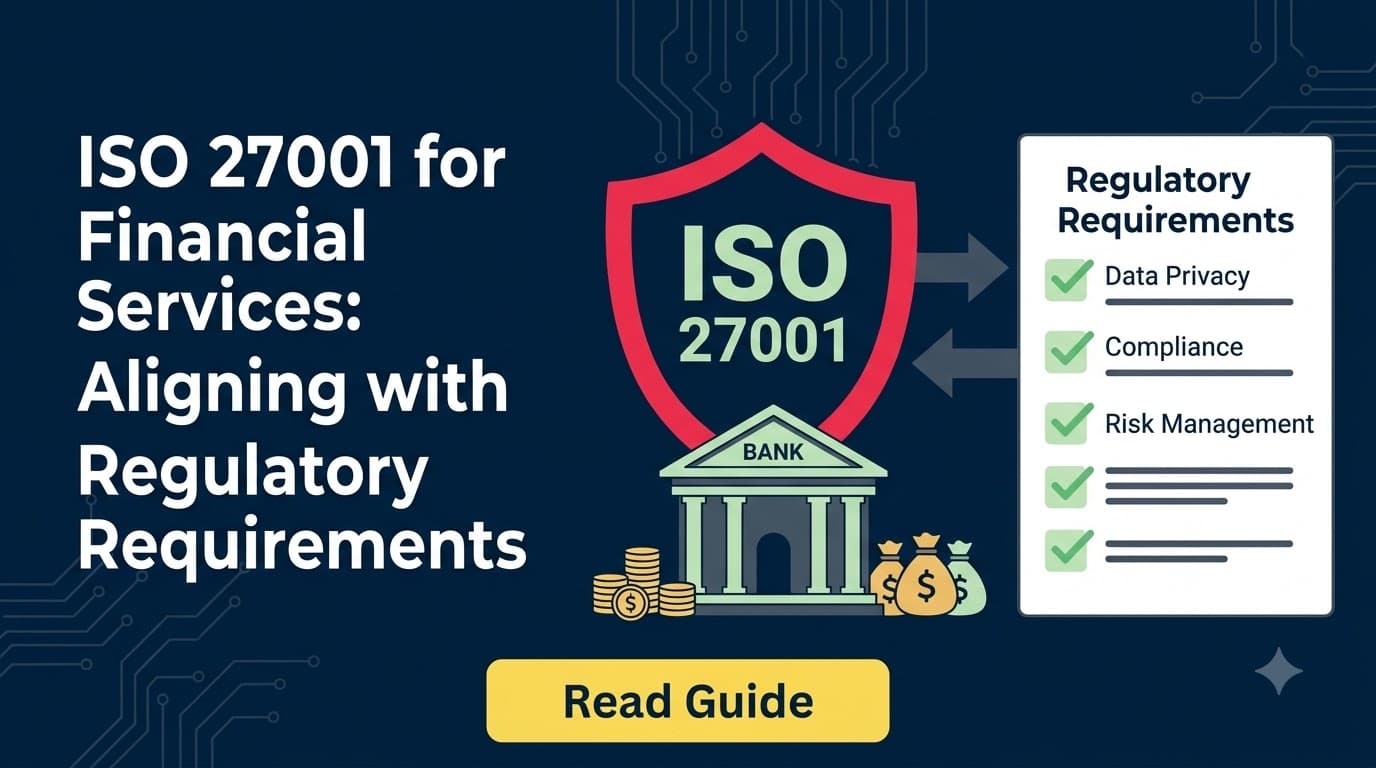
Here's the idea this entire article is built around: you do not need five compliance programs to satisfy five regulatory regimes. You need one well-governed information security management system, built on ISO 27001's Clauses 4–10 and the 93 Annex A controls, with a documented crosswalk showing how each control and clause maps to the specific requirements of every regulation you're subject to. The ISMS becomes the hub. Each regulation becomes a spoke that draws on the same underlying risk assessments, policies, control implementations, and audit evidence — supplemented, where necessary, by the regulation-specific artifacts ISO 27001 doesn't produce on its own (a PCI DSS Attestation of Compliance, a NYDFS annual certification, a SOX ITGC test of controls, a DORA register of information).
This isn't a theoretical nicety. It's the difference between an internal audit function that runs one integrated program of evidence collection per year and one that runs five, each demanding overlapping proof from the same exhausted control owners. I've watched compliance teams cut their annual audit-support workload by 30–40% simply by building the crosswalk once and reusing it, instead of re-deriving "what evidence satisfies access control" every time a new regulator or counterparty questionnaire lands on their desk.
flowchart TD
    ISMS["ISO 27001 ISMS<br/>Clauses 4-10 + Annex A (93 controls)<br/>Risk assessment, policies, controls, internal audit, management review"]
    ISMS --> DORA["EU DORA<br/>ICT risk mgmt, incident reporting,<br/>resilience testing, third-party oversight"]
    ISMS --> PCI["PCI DSS<br/>Cardholder data protection,<br/>network security, monitoring"]
    ISMS --> GLBA["GLBA Safeguards Rule<br/>Written security program,<br/>vendor oversight, encryption"]
    ISMS --> SOX["SOX ITGC<br/>Access, change management,<br/>operations controls"]
    ISMS --> FFIEC["FFIEC Guidance<br/>Governance, cybersecurity,<br/>business continuity"]
    ISMS --> NYDFS["NYDFS 23 NYCRR 500<br/>CISO, risk assessment,<br/>incident response, certification"]
    ISMS --> BASEL["Basel Operational Risk<br/>Control environment evidence<br/>feeding risk framework"]

    style ISMS fill:#2c5282,color:#fff,stroke:#1a365d,stroke-width:2px
The diagram is deliberately hub-and-spoke rather than a flat list, because that's the operating model that actually works: one set of risk assessments and controls feeding outward into regulation-specific evidence packages, rather than five parallel risk assessments that quietly drift apart from each other within eighteen months. Financial services firms considering this approach for the first time often start by reviewing how ISO 27001 compares to other security frameworks like NIST, SOC 2, and PCI DSS, since understanding where these frameworks overlap and diverge is the first step toward building an honest crosswalk instead of an aspirational one.
"The board didn't want to hear about ninety-three controls. They wanted to know if we'd survive an exam without a scramble. Once we reframed the ISMS as the thing that makes every other regulatory conversation easier, not harder, the budget conversation got a lot shorter." — Daniel Osei, Chief Risk Officer, Harbourline Trust Bank
Mapping Governance Controls to Regulatory Governance Expectations
Every regulation in the table above starts from the same premise: security is a governance responsibility, not just a technical one. Regulators want to see documented accountability — who owns risk decisions, who's accountable when something goes wrong, and how leadership actually exercises oversight rather than delegating it and forgetting about it. ISO 27001's governance controls, primarily 5.1 through 5.4 in Annex A alongside Clause 5 (Leadership), map directly onto this expectation across every regime.
ISO 27001 Control/Clause | What It Establishes | Regulatory Theme It Supports |
|---|---|---|
Clause 5 (Leadership and management commitment) | Top management accountability for the ISMS, resourcing, and policy | Board/senior officer accountability (NYDFS named CISO, FFIEC board oversight, DORA management body responsibility) |
5.1 Policies for information security | A documented, approved, communicated information security policy set | Written information security program (GLBA Safeguards Rule, NYDFS written cybersecurity program) |
5.2 Information security roles and responsibilities | Clear assignment of security responsibilities across the organization | Designated accountable officer requirements (NYDFS CISO, DORA ICT risk management function) |
5.3 Segregation of duties | Separation of conflicting duties to reduce fraud and error risk | SOX ITGC segregation-of-duties testing, Basel operational risk controls |
5.4 Management responsibilities | Managers ensuring staff apply security policy in daily operations | Ongoing supervisory expectation that policy translates into practice (FFIEC, DORA) |
None of this is a coincidence. Governance is the one theme every financial regulator converges on, because governance failures are what turn a technical incident into a systemic one. An ISMS that can show a documented management review cadence, clear ownership of the Statement of Applicability, and evidence that leadership actually reviewed and acted on risk assessment output gives you a governance narrative you can reuse — with different framing — for an NYDFS filing, a DORA management-body attestation, and a SOX control walkthrough.
Mapping Risk Assessment to Regulatory Risk-Based Expectations
Nearly every financial regulation is explicitly risk-based: none of them mandate a fixed control list applied identically to every firm. They mandate a process — assess your risk, treat it proportionately, document your reasoning, and revisit it periodically. That's precisely what ISO 27001's Clause 6 (Planning) requires, and it's the single strongest point of overlap between ISO 27001 and financial regulation generally.
ISO 27001 Element | Requirement | Regulatory Alignment |
|---|---|---|
Clause 6.1.2 Information security risk assessment | Systematic identification and analysis of risks to confidentiality, integrity, and availability | GLBA Safeguards Rule risk assessment requirement; DORA ICT risk management framework; FFIEC risk-based examination approach |
Clause 6.1.3 Risk treatment | Selection and justification of controls to treat identified risks (feeding the SoA) | NYDFS risk assessment informing minimum cybersecurity program; Basel operational risk control selection |
Clause 6.2 Information security objectives | Measurable objectives tied to risk treatment priorities | Board-level reporting on risk posture and remediation progress (NYDFS, FFIEC) |
5.7 Threat intelligence | Structured collection and analysis of threat information | DORA threat-led resilience testing inputs; sector information-sharing expectations |
A well-run ISO 27001 risk assessment methodology becomes the single source of truth that a GLBA-driven risk assessment, a DORA ICT risk register, and an FFIEC exam risk narrative can all draw from — provided you tag each risk with the regulatory themes it touches, which is a five-minute addition to a risk register template that saves days of re-work later. Firms that haven't formalized this yet often start from a structured ISO 27001 risk register so the regulatory tagging has somewhere consistent to live from day one.
Mapping Third-Party and ICT Supply Chain Controls to Regulatory Vendor Risk Expectations
If there's one theme where financial regulation has converged hardest over the last five years, it's third-party and ICT supply chain risk. DORA made this explicit for EU financial entities and their critical ICT providers; NYDFS has required third-party service provider policies for years; FFIEC guidance treats vendor management as a standing examination topic; GLBA's Safeguards Rule requires oversight of service providers handling customer information. ISO 27001's supplier controls, 5.19 through 5.23, were substantially expanded in the 2022 revision precisely because supply chain risk had become impossible to treat as a footnote.
ISO 27001 Control | What It Requires | Regulatory Theme |
|---|---|---|
5.19 Information security in supplier relationships | A documented approach to managing risk from suppliers before engagement begins | Vendor risk management program (NYDFS, GLBA, FFIEC) |
5.20 Addressing information security within supplier agreements | Contractual security requirements, right-to-audit clauses, breach notification terms | DORA contractual provisions for ICT third-party arrangements; NYDFS third-party service provider policy |
5.21 Managing information security in the ICT supply chain | Assessing risk introduced by subcontractors and the broader supply chain, not just direct vendors | DORA's extended focus on subcontracting chains and concentration risk |
5.22 Monitoring, review and change management of supplier services | Ongoing oversight of vendor performance and security posture, not just a point-in-time assessment | DORA continuous monitoring expectations; FFIEC ongoing vendor due diligence |
5.23 Information security for use of cloud services | Specific risk considerations for cloud service adoption, shared responsibility, and exit planning | DORA cloud/critical ICT third-party provisions; NYDFS cloud risk assessment expectations |
This is exactly the gap that stalled Meridian's deal. The bank wasn't questioning Meridian's technical controls; it was questioning whether Meridian could demonstrate an ongoing, documented process for managing its own vendors and subcontractors — because under DORA-influenced third-party risk frameworks, a bank has to look through its direct vendor to that vendor's critical dependencies. A firm that has implemented supplier relationship security controls properly can hand a counterparty a mature vendor risk register, evidence of periodic reassessment, and documented exit and concentration-risk considerations — turning a due-diligence roadblock into a two-week formality instead of an eleven-week ordeal.
"We stopped treating vendor questionnaires as a fire drill the day we mapped our supplier register straight out of our ISO 27001 SoA. Now when a bank partner asks about subcontractor risk, we're pulling from a document that already exists instead of writing one from scratch under deadline pressure." — Priya Ramanathan, Head of Information Security, Nexbridge Payments
Mapping Incident Management to Regulatory Incident Reporting Requirements
Every financial regulator wants two things when something goes wrong: proof you detected and handled it competently, and proof you told the right people fast enough. ISO 27001's incident controls, 5.24 through 5.28, build the operational machinery; the regulations layer their own reporting clocks and thresholds on top of it.
ISO 27001 Control | What It Establishes | Regulatory Reporting Theme |
|---|---|---|
5.24 Incident management planning and preparation | A documented incident response plan with defined roles and escalation paths | Baseline requirement across NYDFS, GLBA, DORA, FFIEC |
5.25 Assessment and decision on information security events | Criteria for classifying events by severity and triggering formal incident status | DORA major-incident classification criteria |
5.26 Response to information security incidents | Structured containment, eradication, and recovery activity | Operational resilience expectations across all frameworks |
5.27 Learning from information security incidents | Post-incident review feeding back into risk treatment | Continuous improvement expectations examiners look for in repeat findings |
5.28 Collection of evidence | Forensically sound evidence handling | Support for regulatory reporting, law enforcement referral, and litigation readiness |
Here's the honest caveat, and it matters: ISO 27001 gives you the process for detecting, classifying, and responding to incidents. It does not give you DORA's specific major-incident reporting timelines, NYDFS's 72-hour notification requirement to the Superintendent, or GLBA's notification obligations to federal functional regulators and affected consumers. Those clocks are regulation-specific, and they need to be built as an explicit overlay on top of your incident management process — typically as a decision tree bolted onto your 5.25 severity assessment step, so that classifying an incident as "major" automatically triggers the right regulatory notification workflow rather than leaving someone to remember it under pressure at 2 a.m.
Mapping Logging, Monitoring, and Cryptography to Technical Regulatory Expectations
Beneath the governance and process layer, every one of these regulations eventually gets specific about technical evidence: can you show what happened, when, to whom, and whether sensitive data was protected in transit and at rest. This is where ISO 27001's technological controls do their most direct regulatory work.
ISO 27001 Control | What It Requires | Regulatory Technical Theme |
|---|---|---|
8.15 Logging | Comprehensive, tamper-resistant logs of system and user activity | PCI DSS logging requirements; SOX ITGC audit trail evidence; FFIEC examiner expectations for forensic readiness |
8.16 Monitoring activities | Active monitoring of systems and networks for anomalous behavior | DORA detection capability requirements; NYDFS continuous monitoring |
8.24 Use of cryptography | Policy-driven encryption of data at rest and in transit, key management | PCI DSS cardholder data encryption; GLBA Safeguards Rule encryption requirement; NYDFS nonpublic information encryption |
8.9 Configuration management | Baseline, hardened configurations consistently applied | PCI DSS secure configuration standards; SOX change management evidence |
8.32 Change management | Controlled, auditable change processes | SOX ITGC change management testing |
A well-implemented logging and monitoring program under controls 8.15–8.16 is one of the highest-leverage investments a financial services ISMS can make, because the same log architecture that satisfies your ISO 27001 auditor also produces the audit trail a SOX ITGC tester wants and the forensic evidence an FFIEC examiner expects to see referenced after an incident. Similarly, a documented cryptography control under 8.24 — covering algorithm standards, key rotation, and key custody — does double duty across PCI DSS, GLBA, and NYDFS without requiring three separate encryption policies that inevitably drift out of sync.
Deep Dive: DORA and Operational Resilience
DORA deserves its own section because it's the most consequential regulatory development for financial services information security in the last decade, and because it leans harder on operational resilience concepts than almost any prior regime. DORA applies from January 2025 and covers banks, insurers, investment firms, payment institutions, crypto-asset service providers, and — critically — designates certain ICT third-party providers as subject to direct oversight when they're deemed "critical." Its five pillars are, at a high level: ICT risk management, ICT-related incident management and reporting, digital operational resilience testing, ICT third-party risk management, and information-sharing arrangements.
ISO 27001's business continuity controls, 5.29 (information security during disruption) and 5.30 (ICT readiness for business continuity), map onto DORA's resilience pillar more directly than almost any other control pair in Annex A maps onto almost any other regulatory requirement. Control 5.30 was added in the 2022 revision specifically to address ICT continuity as distinct from general business continuity, and it asks organizations to plan, implement, maintain, and test ICT readiness so that the organization can continue or promptly resume operations after disruption. That's close to a textbook description of what DORA's resilience testing pillar wants to see evidenced.
DORA Pillar | ISO 27001 Support | What DORA Adds Beyond ISO 27001 |
|---|---|---|
ICT risk management | Clause 6 risk assessment; Annex A control set broadly | DORA-specific risk management framework documentation and governance body sign-off requirements |
ICT-related incident management and reporting | 5.24–5.28 incident controls | DORA's major-incident classification thresholds and defined regulatory reporting timelines |
Digital operational resilience testing | 5.29–5.30 continuity and ICT readiness controls; 8.29 security testing | DORA's specific testing regime, including threat-led penetration testing for certain entities |
ICT third-party risk management | 5.19–5.23 supplier controls | DORA's register of information on ICT third-party arrangements and critical-provider oversight regime |
Information-sharing arrangements | 5.6 contact with special interest groups; 5.7 threat intelligence | DORA's specific sector information-sharing arrangements and supervisory reporting channels |
The practical takeaway: if your organization is in scope for DORA, don't build a separate "DORA program." Build out your business continuity and ICT readiness controls under 5.29–5.30 properly, with real testing evidence and recovery time objectives tied to business impact analysis, and you'll have the operational backbone DORA's resilience testing pillar expects. Then layer the DORA-specific artifacts on top: the register of information, the specific incident classification criteria, and the governance body attestations DORA names explicitly, none of which ISO 27001 produces natively.
"DORA forced us to formalize things we'd been doing informally for years. What made the transition manageable was that our ISO 27001 ICT readiness controls were already 70% of the way to what DORA's resilience testing pillar wanted. We weren't starting from zero — we were extending an existing structure." — Marcus Feldman, Group CISO, Alderbrook Insurance Group
Deep Dive: Third-Party and ICT Supply Chain Risk in Practice
The mapping table above shows which controls apply, but financial services firms consistently underestimate how much operational discipline third-party risk actually requires once you go beyond the mapping exercise. Three practices separate firms that pass counterparty due diligence smoothly from firms that get stuck the way Meridian did.
First, maintain a live supplier register, not a static spreadsheet updated once a year before the audit. Regulators and sophisticated counterparties increasingly expect to see when a vendor was last reassessed, not just that it was assessed once at onboarding. Second, extend your due diligence one tier down: DORA's subcontracting provisions and NYDFS's growing expectations both push firms to understand who their critical vendors depend on, because concentration risk in a shared cloud or payment-rail dependency doesn't disappear just because it's two contracts removed from you. Third, build exit planning into supplier agreements from day one — a documented transition plan for critical ICT services is now an explicit expectation under DORA and a practical necessity everywhere else, because "we'll figure it out if they fail" is not an answer a risk committee will accept.
Supplier Risk Practice | Annex A Control | Regulatory Driver |
|---|---|---|
Tiering suppliers by criticality and data sensitivity | 5.19, 5.9 (asset inventory) | DORA critical ICT third-party designation logic |
Contractual security and audit-rights clauses | 5.20 | NYDFS, GLBA, DORA contractual provisions |
Subcontractor/fourth-party visibility | 5.21 | DORA ICT supply chain and concentration risk |
Periodic reassessment and performance review | 5.22 | FFIEC ongoing due diligence expectations |
Cloud-specific risk and exit planning | 5.23 | DORA cloud provisions; NYDFS cloud risk assessment |
Deep Dive: PCI DSS — Where ISO 27001 Overlaps and Where It Doesn't
PCI DSS is the regulation-adjacent framework I get asked about most, because it's mandated contractually by the card brands rather than by a government regulator, and because so much of its technical requirement language sounds like it was lifted straight from Annex A. It largely was — both frameworks draw from the same body of accepted security practice. Requirements around network segmentation, access control, encryption of cardholder data, vulnerability management, and logging all have close cousins in ISO 27001's Annex A controls.
But PCI DSS is not a management-system standard, and ISO 27001 is not a card-data-specific standard. PCI DSS demands formal validation — a Report on Compliance from a Qualified Security Assessor for higher transaction volumes, or a Self-Assessment Questionnaire for smaller merchants — validated against a fixed, card-industry-specific requirement set that applies regardless of your risk assessment's conclusions. ISO 27001, by contrast, lets you scope and justify controls based on actual risk, documented in your Statement of Applicability. A firm cannot use ISO 27001 certification in place of a PCI DSS AOC or ROC, full stop — the card brands require the PCI-specific validation regardless of what other certifications you hold. What ISO 27001 does provide is a broader governance and risk context that makes maintaining PCI DSS compliance easier to sustain year over year, because the underlying asset inventory, access control, and monitoring discipline your ISMS requires directly reduces the annual PCI reassessment lift. Firms weighing how these frameworks fit together often benefit from a structured comparison of ISO 27001 against PCI DSS, SOC 2, and NIST before deciding which to pursue first.
Deep Dive: GLBA Safeguards Rule and SOX
GLBA's Safeguards Rule, as amended, requires covered financial institutions to maintain a written information security program with a designated qualified individual accountable for it, a risk assessment, access controls, encryption, multi-factor authentication, vendor oversight, incident response planning, and periodic reporting to the board or governing body. Read that list again and you'll recognize most of it as a description of an ISO 27001 ISMS with different vocabulary. That's not an accident — the Safeguards Rule was written broadly enough to accommodate recognized security frameworks, and ISO 27001 maps onto nearly all of its substantive elements. What it doesn't do is satisfy GLBA's specific requirement for a "qualified individual" designation and the Safeguards Rule's particular reporting cadence to the board — those are administrative acts a firm has to perform regardless of certification status.
SOX sits in a different category entirely: it's a financial reporting control regime, not a security regime, but its IT general controls scope — access provisioning and deprovisioning, change management, computer operations, and program development controls over systems that feed financial statements — overlaps meaningfully with ISO 27001's access control and change management controls. Internal audit teams at public financial institutions frequently reuse ISO 27001 control evidence as a starting point for SOX ITGC testing, particularly around user access reviews and segregation of duties, cutting duplicate evidence requests significantly. But SOX compliance is validated through its own external auditor attestation process under PCAOB standards, and no ISO 27001 certificate substitutes for that attestation.
Deep Dive: FFIEC Guidance and NYDFS 23 NYCRR 500
FFIEC guidance operates differently from the other regimes in this article: it isn't a single certifiable regulation but a body of examiner handbooks and interagency guidance that federal and state examiners use to assess bank and credit union IT risk during regular examinations. There's no FFIEC certificate to earn. What examiners look for is evidence of a risk-based, governed security program — exactly the kind of evidence an ISO 27001 ISMS produces as a byproduct of normal operation: risk assessments, board-level reporting, incident response testing, and vendor management documentation. Banks I've worked with that maintain ISO 27001 certification consistently report smoother IT examinations, not because examiners recognize the certificate specifically, but because the underlying documentation discipline answers examiner questions faster and more completely than an ad hoc program would.
NYDFS 23 NYCRR 500 is more prescriptive and, unusually among these regimes, requires an annual certification of compliance filed by a named senior officer or the board directly with the Department. ISO 27001 supports nearly every substantive control requirement in Part 500 — risk assessment, access controls (including privileged access, covered under control 8.2), encryption, incident response, and third-party service provider policies. It does not perform the certification filing itself; that remains a distinct regulatory act your general counsel or compliance officer has to execute, informed by — but not replaced by — your ISMS evidence.
Basel and the Operational Risk Context
Internationally active banks operate under Basel's capital framework, which since Basel II has recognized operational risk — including ICT and third-party risk — as a distinct risk category requiring capital treatment. Basel itself doesn't prescribe specific security controls; it prescribes a governance and quantification framework that national regulators build supervisory expectations around. ISO 27001 doesn't touch capital calculations, but a certified ISMS provides exactly the kind of documented, tested operational risk control environment that feeds a bank's broader operational risk management framework and supports the qualitative evidence increasingly expected alongside quantitative loss-event data. It's a background contributor here rather than a direct compliance driver, but it's worth banks' risk teams understanding the connection when justifying ISMS investment to a board focused primarily on capital efficiency.
What ISO 27001 Does NOT Satisfy: An Honest Gap Table
I want to be blunt here because so much marketing in this space blurs the line between "supports" and "satisfies." If you take one table away from this entire article, take this one. It's a direct answer to the question every financial services security leader eventually has to answer for a board, an auditor, or a regulator: exactly where does our ISMS stop, and what still has to be done separately?
Regulation | What ISO 27001 Genuinely Supports | What It Does NOT Satisfy — Must Be Done Separately |
|---|---|---|
EU DORA | ICT risk management framework, incident process, supplier oversight, resilience/continuity controls | DORA's register of information on ICT third-party arrangements; specific major-incident classification and regulatory reporting timelines; threat-led penetration testing regime for designated entities; direct oversight framework for critical ICT providers |
PCI DSS | Underlying access control, encryption, logging, and vulnerability management discipline | Formal PCI DSS validation (AOC or ROC) via QSA or SAQ; card-brand-specific requirement checklist; quarterly ASV scans and specific PCI reporting |
GLBA Safeguards Rule | Written program structure, risk assessment, access control, encryption, vendor oversight | Designation of a specific "qualified individual"; the Safeguards Rule's specific board reporting cadence and content requirements |
SOX | Access control and change management evidence supporting ITGC | External auditor attestation under PCAOB standards; SOX-specific control testing scope tied to financial statement assertions |
FFIEC guidance | Risk-based governance, incident response, vendor management documentation examiners look for | There is no FFIEC "certificate" — examiner judgment during a live exam is not something any certification pre-empts |
NYDFS 23 NYCRR 500 | Nearly all substantive control requirements: risk assessment, access controls, encryption, incident response, third-party policy | The annual certification of compliance filed with the Department by a named senior officer or board; specific 72-hour breach notification to the Superintendent |
Basel operational risk | Documented, tested control environment feeding qualitative risk inputs | Capital calculation methodology and quantitative loss-event data requirements |
The honest framing to give your board or your next counterparty due-diligence team is this: "Our ISO 27001 certification demonstrates a mature, independently audited security management system that supports our obligations under [name the applicable regulations]. It does not, by itself, constitute compliance with any of them — we maintain the following regulation-specific processes and filings in addition." That sentence, almost verbatim, has gotten more of my financial services clients through skeptical due-diligence conversations than any glossy compliance matrix ever has, because it signals you understand the difference rather than trying to paper over it.
"The worst conversations I've had with examiners started with a vendor overselling their certificate. The best ones started with someone saying plainly, 'here's what this covers, and here's what we handle separately.' Examiners trust people who know where their own evidence stops." — Renata Alves, Former State Banking Examiner, now Director of Regulatory Affairs, Solvent Point Bank
Running an Integrated GRC Program: From Crosswalk to Operating Model
Knowing the mapping is one thing; operating it day to day is another. The firms that get real efficiency out of this approach build four specific pieces of infrastructure, and they build them in roughly this order.
First, a control crosswalk document — a living spreadsheet or GRC-tool artifact that maps every Annex A control and management-system clause to every applicable regulatory requirement, with a column for "regulation-specific artifact still required." This is the single source of truth that turns "we have an ISMS" into "here's proof our ISMS covers 80% of what DORA/NYDFS/GLBA asks, and here's the remaining 20% we handle through these specific processes."
Second, a unified evidence repository, so that a control owner uploads one piece of evidence — say, a quarterly access review — once, and it's tagged as satisfying ISO 27001 control 5.18, GLBA's access control requirement, and SOX ITGC access testing simultaneously, rather than being requested and re-collected three separate times by three separate audit teams.
Third, an integrated audit calendar. Internal audit, external ISO 27001 surveillance audits, PCI DSS assessments, and regulatory exams don't need to happen in isolation — sequencing them so evidence gathered for one feeds the next (with appropriate scoping caveats) cuts the total organizational disruption dramatically. I've seen banks go from six disruptive audit cycles a year to two consolidated ones using this approach alone.
Fourth, a regulatory change monitoring function tied back into the ISMS's risk assessment cadence — so that when DORA's technical standards get finalized, or NYDFS amends Part 500, or a new state privacy law lands, someone is explicitly responsible for updating the crosswalk and flagging new gaps, rather than discovering the gap during the next audit.
Many firms formalize this by building on top of ISO 27001 GRC software and tooling rather than a spreadsheet, once the number of regulations and business units involved makes manual tracking unreliable.
A Sample Crosswalk: One Control, Five Regulatory Lenses
Abstract mapping tables are useful for orientation, but the real test of the "one ISMS, many regulators" thesis is whether a single control, implemented once, can genuinely stand up evidence-wise across every regime that touches it. Here's a worked example using control 8.16 (monitoring activities), which is one of the highest-traffic controls in a financial services ISMS because so many regulators independently converge on "can you detect and evidence anomalous activity."
Regulatory Lens | What This Regulator Wants From Monitoring Evidence | What the Same 8.16 Implementation Provides |
|---|---|---|
EU DORA | Continuous ICT monitoring supporting incident detection and classification timelines | SIEM alerting rules, escalation thresholds, and time-stamped detection logs feeding the incident process |
PCI DSS | Monitoring of access to cardholder data environments and file integrity monitoring | Scoped monitoring rules over the CDE, reviewed alert logs, documented monitoring exceptions |
NYDFS 23 NYCRR 500 | Continuous monitoring or periodic penetration testing and vulnerability assessment | Monitoring coverage evidence cited directly in the annual certification supporting documentation |
FFIEC guidance | Evidence of ongoing detection capability examiners can review during IT exams | Monitoring policy, alert-tuning history, and a sample of investigated alerts with disposition notes |
SOX ITGC | Monitoring supporting detective controls over systems feeding financial reporting | Access and change monitoring logs scoped to in-scope financial systems, reviewed on a defined cadence |
Notice what doesn't change across the five rows: the underlying control implementation, the log architecture, and the review cadence. What changes is the framing — which subset of evidence gets pulled forward, and which regulatory vocabulary gets used to describe it. That's the entire operating model in miniature: build the control once to a standard high enough to satisfy the strictest regulatory lens it touches, then maintain a thin framing layer on top that translates the same evidence into each regulator's or counterparty's expected language. Firms that try to build monitoring separately for "the ISO 27001 version" and "the PCI version" and "the SOX version" end up with three under-resourced half-implementations instead of one well-resourced control that easily clears all three bars.
Interested Parties: Why Regulators Belong in Your ISMS Scope From Day One
One structural mistake I see constantly in financial services ISMS builds is treating regulators as an afterthought bolted onto the risk register late in the project, rather than as a formally identified interested party from the start. ISO 27001's Clause 4.2 requires organizations to determine interested parties and their relevant requirements as an input to scoping the entire management system — and for a regulated financial firm, your primary regulator, your card brand acquiring bank, your key institutional counterparties, and your cyber insurer are all interested parties whose requirements should shape your risk criteria and Statement of Applicability from the outset, not get reverse-engineered into it during a due-diligence crisis. Firms that treat interested parties and stakeholder requirements as a living input — reviewed at least annually as regulations like DORA and NYDFS evolve — consistently avoid the scramble Meridian went through, because the regulatory requirement was already sitting in their context-of-the-organization documentation before a counterparty ever asked about it.
Common Mistakes Financial Services Firms Make With ISO 27001
I've reviewed enough failed or struggling financial services ISMS implementations to see the same handful of mistakes recur, almost regardless of firm size or sub-sector.
Mistake | Why It Happens | Consequence |
|---|---|---|
Treating ISO 27001 as a substitute for PCI DSS, NYDFS, or DORA compliance | Marketing language blurs "supports" and "satisfies"; leadership wants one project, not five | Contractual or regulatory exposure discovered during an audit, examination, or breach, when it's most expensive to fix |
Scoping the ISMS too narrowly (e.g., only the card-data environment) | Reusing an existing PCI DSS scope out of convenience | Regulators and counterparties asking about business units or data flows the certificate never covered |
Building parallel risk registers for each regulation | No one owns the crosswalk; teams work in silos | Risk assessments drift apart, contradictory risk ratings surface during joint reviews |
Under-investing in supplier/subcontractor visibility | Vendor management historically treated as procurement's job, not security's | DORA- or NYDFS-driven due diligence stalls exactly as it did for Meridian |
No regulatory-specific overlay on incident response | Incident plan built generically, without notification-timeline decision trees | Missed or late regulatory notification deadlines during a live incident |
Assuming certification alone satisfies board reporting obligations | Confusing "we have a certificate" with "we have an ongoing governance process" | NYDFS, GLBA, and FFIEC all expect continuous evidence, not a point-in-time credential |
Ignoring cross-pillar frameworks already in place | Security and compliance teams don't coordinate on overlapping frameworks like PCI DSS, SOC 2, or GDPR | Duplicate audit evidence requests, inconsistent control descriptions across frameworks |
The most expensive mistake on that list, in dollar terms, is almost always the supplier visibility gap — because it surfaces during a live deal or a live exam, when your negotiating leverage is at its lowest and your legal spend is at its highest.
Case Study: Meridian Pay Closes the Loop
Elena's story doesn't end with the eleven-week stall. Meridian used the deal delay as the forcing function to build a proper ISMS: they formally scoped the entire payments platform (not just the card-data environment), ran a structured gap analysis against Annex A, built a risk register that tagged every risk against the specific regulations their bank partners cared about, and pursued certification over a nine-month program. Fourteen months after the original deal finally closed, Meridian was approached by a second regional bank for a similar banking-as-a-service partnership, this time worth $85 million in projected annual volume. The due-diligence process took nineteen days from questionnaire to signed monitoring addendum — the bank's risk committee cited the ISO 27001 certificate, the mapped supplier register, and the documented incident notification workflow as the reason they could move directly to contract negotiation rather than an extended security review. Elena estimates the faster close was worth approximately $290,000 in avoided legal and delay costs compared to the first deal, and the tighter monitoring terms the bank had originally required were replaced with a standard annual reassessment cycle.
Case Study: A Regional Bank's DORA Readiness Program
A regional bank with EU subsidiary operations (details altered for confidentiality) faced a DORA applicability assessment that revealed its ICT third-party register was incomplete and its incident classification criteria didn't distinguish "major" incidents in a way that matched DORA's expectations. Rather than building a standalone DORA project, the bank's CISO extended its existing ISO 27001 ISMS: the supplier controls under 5.19–5.22 were expanded into a formal register of information, the incident management process under 5.24–5.28 got a DORA-specific severity overlay with defined regulatory notification timelines, and the business continuity and ICT readiness controls were tested against a realistic ICT disruption scenario for the first time in three years. The DORA readiness program took seven months and cost roughly $340,000 in consulting and internal effort — the bank's own estimate put a from-scratch DORA program, without the existing ISMS as a foundation, at closer to $900,000 and twelve to fourteen months.
Case Study: An Insurer Consolidates Five Audits Into Two
Alderbrook Insurance Group was running five largely separate audit and assessment cycles a year: an ISO 27001 surveillance audit, an internal SOC 2 readiness review for a subsidiary, an annual NYDFS-driven internal risk assessment, a PCI DSS SAQ for a payment portal, and an ad hoc board cybersecurity briefing assembled from whatever evidence happened to be current. Marcus Feldman's team built a single control crosswalk mapping all 93 Annex A controls to the specific requirements of NYDFS Part 500, PCI DSS, and their SOC 2 trust services criteria, then restructured the internal audit calendar around two consolidated cycles instead of five. Total external audit and internal-audit-support hours dropped by roughly 35% in the first year, and the board cybersecurity briefing became a standing quarterly output of the ISMS's management review process rather than a special assembly project each time.
Case Study | Regulatory Driver | Key Actions | Quantified Outcome |
|---|---|---|---|
Meridian Pay | Bank counterparty due diligence, DORA-influenced third-party expectations | Full ISMS scoping, supplier register, certification | Second deal closed in 19 days vs. 11 weeks; ~$290K avoided cost |
Regional Bank DORA Program | EU DORA applicability | Extended existing ISMS supplier and incident controls into DORA artifacts | 7-month program at ~$340K vs. estimated 12–14 months / ~$900K from scratch |
Alderbrook Insurance Group | NYDFS, PCI DSS, SOC 2 overlap | Single control crosswalk, consolidated audit calendar | ~35% reduction in audit-support hours; quarterly board reporting institutionalized |
Cost and Timeline Considerations for a Regulated ISMS
Financial services ISMS programs cost more and take longer than a comparable program in a lighter-regulated industry, mainly because of the added crosswalk and evidence work, not because Annex A itself changes. Budget and timeline expectations below are illustrative, drawn from programs I've advised on across banks, fintechs, and insurers of varying size — treat them as planning ranges, not quotes.
Organization Profile | Typical ISMS + Certification Timeline | Illustrative Budget Range | Added Regulatory Overlay Work |
|---|---|---|---|
Fintech / payments startup, single jurisdiction | 6–9 months | $60,000–$150,000 | PCI DSS AOC alignment, bank-partner due-diligence packaging |
Regional bank, US-only | 9–14 months | $200,000–$450,000 | FFIEC/NYDFS crosswalk, GLBA program mapping |
Bank or insurer with EU operations | 10–16 months | $350,000–$750,000 | DORA register of information, resilience testing program |
Multinational financial group | 14–24 months | $750,000+ | Multi-jurisdiction crosswalk, harmonized global control set |
These figures assume the organization is starting close to zero on formal ISMS documentation; firms that already run a mature security program can often compress both timeline and cost substantially. Organizations early in this process typically benefit from starting with a structured gap analysis against the full Annex A control set before committing to a budget, since the gap analysis output — not a generic industry average — is what should actually drive the numbers a board approves. It's also worth reviewing which industries and organization types tend to see the fastest ROI from certification, covered in our overview of who needs ISO 27001, since financial services consistently ranks among the sectors where the business case is strongest.
Roles, Responsibilities, and the Three Lines of Defense
Financial services firms already operate, formally or informally, a three-lines-of-defense model: business units own risk, a second-line risk/compliance function oversees it, and internal audit independently tests it. ISO 27001's roles and responsibilities controls under 5.2–5.4 map cleanly onto this structure rather than competing with it — control owners in the business sit in the first line, the information security function overseeing the ISMS sits in the second line alongside compliance and risk, and internal audit's ISO 27001 internal audit program becomes one of several assurance activities the third line runs. Firms that try to run the ISMS as a fourth, disconnected function alongside the existing three lines consistently create confusion about who's accountable when a control fails — better to formally position the ISMS management representative and the second-line risk function as the same reporting chain, or at minimum tightly coordinated, from the start. A broader look at how organizational controls fit together is available in our Annex A organizational controls overview, which is a useful reference when assigning control ownership across the three lines.
"The three-lines model only works if the ISMS reports into it instead of running beside it. The day we made our information security function formally part of the second line, our audit findings started closing faster because everyone finally agreed on who owned what." — Sofia Marchetti, Head of Compliance Technology, Bridgeway Asset Management
"Our biggest win wasn't passing our ISO 27001 audit. It was the moment our GLBA risk assessment, our NYDFS filing prep, and our ISMS risk register all started referencing the same document instead of three that quietly disagreed with each other." — Yuki Tanaka, VP of Information Security, Cascade Federal Credit Union
Preparing for a Regulatory Examination or Counterparty Review Using ISMS Evidence
The last practical piece worth covering is how to actually present ISMS evidence when an examiner, auditor, or counterparty risk team shows up asking questions — because a well-built ISMS still needs to be packaged correctly to land as regulatory evidence rather than generic security documentation.
Start with the crosswalk itself: don't make an examiner or a bank's third-party risk analyst hunt through your Statement of Applicability trying to figure out which of your 93 controls answers their specific question. Hand them a one-page summary keyed to their framework's language — if you're facing an NYDFS-driven review, present your evidence organized by Part 500's section numbers with your Annex A controls cited underneath, not the other way around. Second, bring recency: a risk assessment from fourteen months ago reads as stale to an examiner trained to expect an annual cadence; make sure your evidence package reflects your most recent review cycle, not the one that happened to be current when the ISMS was first built. Third, bring outcomes, not just processes — an examiner wants to see that your incident response plan has actually been tested (a tabletop exercise, a technical failover test) and that findings from that test fed back into a documented improvement, not just that a plan exists on paper.
Evidence Package Element | What to Include | Common Failure Mode |
|---|---|---|
Framework-specific control summary | One-page crosswalk keyed to the examiner's or counterparty's own section numbers | Making the reviewer translate your Annex A numbering themselves |
Current-cycle risk assessment | Most recent version, with visible review/approval dates | Presenting an outdated assessment that predates known changes to the environment |
Tested incident response evidence | Tabletop or technical test results, with lessons-learned documentation | Only showing the written plan, with no evidence it's ever been exercised |
Supplier register with reassessment dates | Live register showing last-reviewed dates per critical vendor | A supplier list that hasn't been updated since onboarding |
Board/governance reporting trail | Minutes or reports showing leadership reviewed and acted on ISMS output | No visible link between risk assessment findings and leadership decisions |
Get this packaging right and the same underlying ISMS evidence can support a DORA-influenced counterparty review on Monday and an NYDFS-focused internal audit on Friday, without rebuilding anything — it's simply presented through a different lens each time.
The Strategic Opportunity: Compliance as a Competitive Advantage
It's tempting to read all of this as a burden — one more layer of documentation on top of an already crowded regulatory calendar. I'd push back on that framing, because in every financial services engagement I've run, the firms that treated their ISMS as pure overhead got a compliance artifact, and the firms that treated it as commercial infrastructure got a sales asset. Elena's second deal with Meridian closed in nineteen days specifically because the bank's risk committee could move straight to contract negotiation instead of an extended review — that speed is a competitive differentiator in a market where every fintech is chasing the same handful of bank-partnership opportunities. An insurer that can hand a reinsurance counterparty a mapped crosswalk instead of a pile of disconnected attestations closes underwriting reviews faster. A payments processor that can demonstrate DORA-aligned ICT readiness before a prospective EU banking client even asks about it gets invited to the shortlist competitors don't make.
The regulatory landscape in financial services isn't getting simpler — DORA is still maturing its technical standards, more US states are drafting NYDFS-adjacent cybersecurity rules, and card-brand requirements evolve on their own cycle. An ISMS built as the hub in the model this article describes doesn't just survive that complexity; it turns each new regulatory requirement into an extension of an existing crosswalk rather than a new project from zero. That's the difference between a security program that reacts to regulation and one that's built to absorb it.
If you're building or maturing an ISMS inside a regulated financial services environment, start with an honest gap analysis against the full Annex A control set, tagged against every regulation your firm actually answers to — not a generic template. Pair it with a risk register that tracks regulatory themes alongside business risk from day one. Our Complete ISO 27001 Implementation Guide walks through the full build process end to end, and if you're still deciding how ISO 27001 fits alongside PCI DSS, SOC 2, and NIST CSF specifically, our ISO 27001 vs SOC 2 vs NIST CSF Comparison Guide lays out the overlaps in detail. When you're ready to scope the certification project itself, our Certification Readiness Checklist is a practical way to confirm you're not walking into Stage 1 with the same evidence gaps that stalled Meridian's first bank deal. And if any of the terminology in this article — ISMS, SoA, ICT readiness, risk treatment — needs a quick refresher for a stakeholder outside the security team, point them to our ISO 27001 glossary of terms before your next board conversation.
PentesterWorld works with financial services security and compliance teams to build exactly this kind of integrated program — one ISMS, mapped honestly against every regulation you answer to, backed by the technical assessment work (penetration testing, vulnerability management, control validation) that gives your crosswalk real evidence behind it rather than paperwork alone. If you're ready to stop running parallel compliance programs and start running one, reach out to our team to scope a gap analysis built around your specific regulatory footprint.