Elena Cho had been VP of Engineering at Northfield Payments for eleven months when the call came in from the fraud team at 6:40 on a Tuesday morning. Card-network monitoring had flagged an unusual spike in tokenization requests hitting Northfield's API from IP ranges nobody recognized. By the time Elena got a laptop open, the pattern was obvious to anyone who knew what they were looking at: someone had valid production database credentials and was using them methodically, not smashing around like a script kiddie.
The credentials traced back to a config file. The config file traced back to a personal GitHub repository belonging to a contractor at the offshore development shop Northfield had hired eight months earlier to rebuild its merchant-facing customer portal. The contractor — competent, well-meaning, and completely unaware he'd done anything wrong — had been in the habit of pushing his work-in-progress branches to a personal repo at the end of each day as an informal backup. One of those pushes, made from a "staging" environment that Northfield's own engineers had quietly pointed at the production database six weeks earlier because the synthetic test data "wasn't realistic enough," included a .env file with live production database credentials and two API keys with write access to the tokenization service. The repo was public. A credential-scanning bot indexed it in eleven minutes.
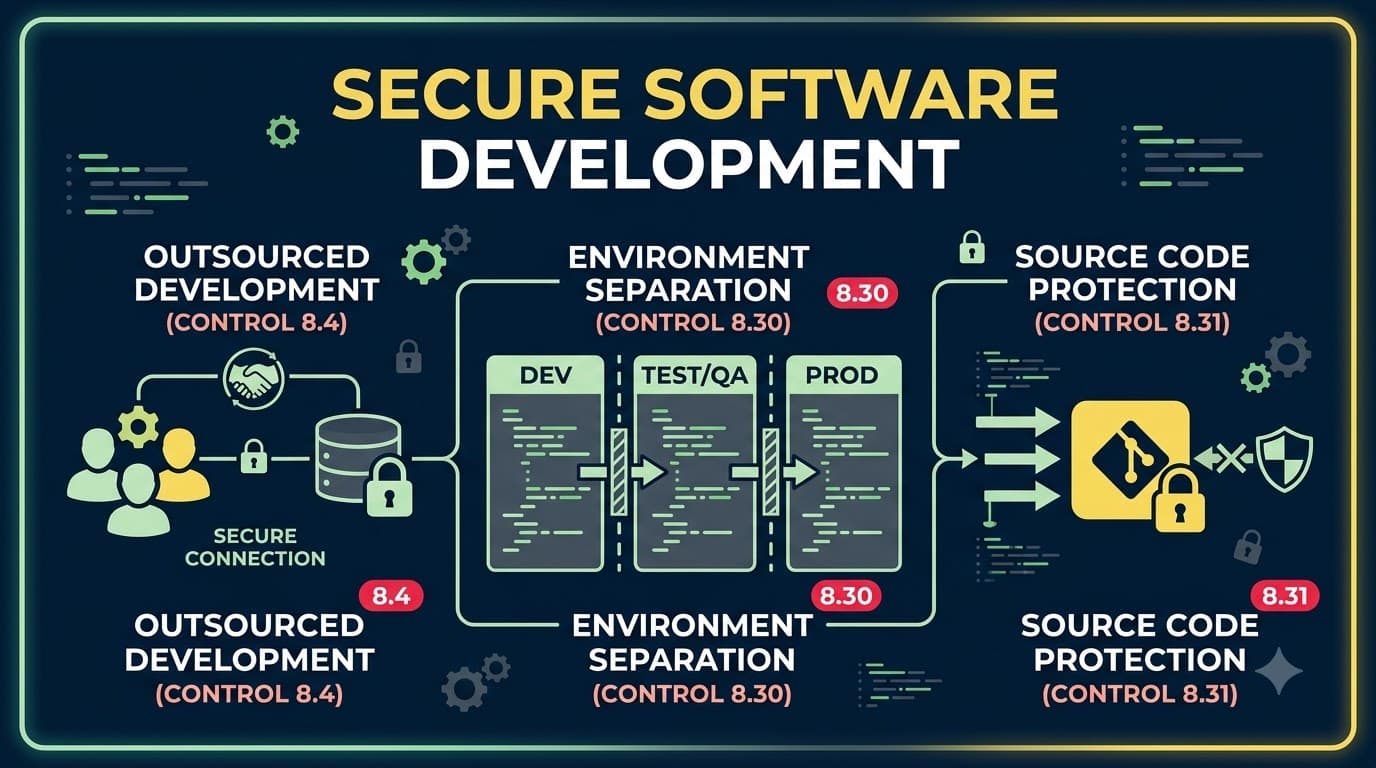
By the time Northfield's incident response team, outside counsel, a card-network forensic investigator, and a breach-notification vendor had finished their work, the bill came to just over $2.3 million — forensics and legal fees, card-network non-compliance assessments, notification and credit-monitoring costs for around 40,000 affected cardholders, and the loss of two enterprise merchant contracts whose security teams asked, reasonably, how a payments company had let this happen. The technical root cause fit on one slide: no governance over who could read or write source code and where it could live (control 8.4), no contractual or operational discipline over what the outsourced development team was allowed to touch (control 8.30), and no actual separation between the environment where code was tested and the environment where real cardholder data lived (control 8.31). Three controls, each unremarkable on its own, whose simultaneous absence turned a normal outsourcing arrangement into a $2.3 million incident.
Who This Is For
This article is for security leaders, engineering managers, and ISMS implementers who have already read about secure coding practices and now need to close the three gaps that sit around the edges of the development process rather than inside it: who can touch the code, who you let write it on your behalf, and where it actually runs. You should already have a handle on your organization's secure development life cycle — this piece assumes that foundation and builds the access, oversight, and isolation layer on top of it. By the end, you'll have a source-code access model you can show an auditor, a template for directing and monitoring outsourced developers, a defensible environment-separation architecture, and the evidence trail that ties all three together. If terms like code escrow, branch protection, or software bill of materials are unfamiliar, our ISO 27001 Glossary of Terms is worth keeping open in a second tab as you read.
How These Three Controls Complete the Secure Development Picture
If you've implemented secure development life cycle controls 8.25 through 8.29, you already have security requirements baked into your SDLC, secure coding standards, security testing gates, and architecture principles. Those controls answer "is the code we write secure?" Controls 8.4, 8.30, and 8.31 answer a different, equally important question: "who can touch the code and the systems it runs on, and can we trust what they do with that access?"
The three controls form a tight cluster because they each address a different failure mode around the same asset — your codebase and the environments it moves through. Control 8.4 governs who can read or write source code, development tools, and libraries, regardless of whether they're an employee or a contractor. Control 8.30 governs how much you can trust a third party you've asked to write code on your behalf, and what oversight mechanisms keep that trust honest. Control 8.31 governs where code and data live at each stage of their life, so that a mistake in a low-trust environment (a test server, a contractor's laptop, a staging database) can't cascade into a high-trust one (your production systems and live customer data).
Auditors treat these three as a natural group during Stage 2 assessments and surveillance audits, and for good reason: a weakness in one nearly always implicates the others. An organization with sloppy source-code access control usually also lacks environment separation, because both stem from the same underlying discipline gap — nobody drew a hard line around what "production" means and who's allowed near it. If you're building your Statement of Applicability and wondering whether all three controls apply, the honest answer for any organization that develops or commissions custom software — even a handful of internal scripts or a customer-facing web app — is almost always yes.
"I can tell within the first hour of a Stage 2 interview whether an organization understands 8.4, 8.30, and 8.31, because I just ask one question: 'Walk me through what happens between a developer opening a pull request and that code running in front of a customer.' If they can answer cleanly, the rest of the audit tends to go smoothly. If they can't, I already know where the nonconformities are going to cluster." — Tom Reyes, Lead Auditor, Meridian Assurance Group
These controls also sit inside a broader web of Annex A requirements worth knowing before you dive in. Source code access ties directly into the privileged access rights discipline you've presumably already applied to production infrastructure — a repository with write access to your core product is every bit as sensitive as a domain admin account. Outsourced development is a specific, high-stakes instance of the broader supplier relationship security controls 5.19 through 5.23, so if you haven't built a supplier risk program yet, you'll want that scaffolding in place before you can meaningfully direct and monitor a development vendor. And environment separation connects to data protection controls 8.10 through 8.12, because the question of whether production data is allowed into a test environment — and if so, in what masked or de-identified form — is really a data-protection question wearing an infrastructure hat.
Who Owns What: A RACI View Across the Three Controls
Before diving into each control individually, it's worth being explicit about ownership, because these three controls tend to get orphaned between teams — security assumes engineering owns access reviews, engineering assumes procurement owns vendor oversight, and platform teams assume everyone else has environment separation covered.
Activity | Security/GRC | Engineering Leadership | Procurement/Legal | Individual Developers |
|---|---|---|---|---|
Source code access reviews (8.4) | Accountable — defines policy, audits results | Responsible — executes the review | Informed | Consulted on their own access needs |
Branch protection & secret scanning config (8.4) | Consulted — sets minimum standards | Accountable — implements and maintains | Not involved | Responsible — follows the workflow |
Outsourced development contract terms (8.30) | Responsible — defines security clauses | Consulted on technical requirements | Accountable — negotiates and signs | Not involved |
Ongoing vendor monitoring (8.30) | Consulted — sets monitoring cadence by risk tier | Accountable — executes day-to-day oversight | Informed | Not directly involved |
Environment architecture & separation (8.31) | Consulted — validates against policy | Accountable — designs and maintains | Not involved | Responsible — respects environment boundaries |
Test data masking/synthetic data (8.31, 8.11) | Accountable — sets data protection requirements | Responsible — implements the masking pipeline | Not involved | Responsible — uses only approved test data |
Control 8.4: Access to Source Code — Read and Write Access, Managed Like the Crown Jewels
ISO 27001 Annex A control 8.4 requires that "appropriate access to source code, development tools and software libraries shall be appropriately managed." It's a short requirement with a wide blast radius. Source code isn't just intellectual property — it's frequently the single richest source of exploitable information about your organization's attack surface. A copy of your codebase tells an attacker your authentication logic, your data model, your third-party dependencies, and very often, if hygiene has slipped, your secrets: API keys, database passwords, signing certificates, and internal hostnames sitting in commit history or configuration files that nobody thought to scrub.
Most organizations I've assessed treat source-code access as a binary: you're either "an engineer" with access to everything in the monorepo, or you're not an engineer and you have no access at all. That model fails the appropriateness test embedded in the control's wording. Appropriate access means least privilege applied to code the same way you'd apply it to a production database — by repository, by branch, by role, and with write access treated as meaningfully more sensitive than read access.
Building a Defensible Repository Access Model
A source-code access model that will satisfy an auditor — and, more importantly, actually reduce risk — needs to answer four questions for every repository your organization maintains: who can read it, who can write to it, who can approve merges into protected branches, and who can administer the repository itself (change branch protection rules, add integrations, rotate secrets). Those four permission tiers rarely map to the same group of people, and conflating them is the single most common finding I write up during source-code-access reviews.
Access Tier | Typical Holder | Review Cadence | Common Failure Mode |
|---|---|---|---|
Read (clone/pull) | All engineers on the product team; select QA and support engineers | Quarterly | Read access left open org-wide "for convenience" |
Write (push to non-protected branches) | Active contributors, including approved contractors | Quarterly, plus on contract end | Contractor write access surviving contract termination by weeks or months |
Merge approval (protected branches) | Senior engineers, tech leads, designated reviewers | Semi-annually | Approval rights granted to whoever asked first, not tied to a role |
Repository admin | Engineering managers, platform/DevOps leads only | Semi-annually | Admin rights held by long-departed staff whose accounts were never fully offboarded |
The review cadence matters as much as the tiering. Source-code access reviews are exactly the kind of control that looks fine on the day you design it and rots quietly over the following eighteen months as people change teams, contractors roll off, and "just give them access, we'll clean it up later" becomes permanent. I recommend tying source-code access reviews to the same quarterly cycle you likely already use for endpoint and authentication reviews under controls 8.1 through 8.5, so it isn't a separate process someone has to remember to run.
Secrets in Code: The Recurring Failure
If there's one finding that shows up in nearly every source-code access review I've run, it's secrets committed to version control — API keys, database connection strings, signing keys, cloud provider credentials, sometimes literal customer data pasted into a test fixture and never removed. This is precisely the failure that took down Northfield Payments in the cold open, and it's rarely malicious; it's almost always a developer or contractor taking the path of least resistance under a deadline.
Managing this risk under control 8.4 means treating "no secrets in source code" as a technical control, not a policy statement nobody reads. That means pre-commit secret scanning at the developer's own machine, server-side scanning on every push that blocks or flags matches, and a rotation runbook for the inevitable day a secret does leak, because it will happen at least once no matter how good your tooling is.
Practice | Purpose | Typical Tooling Approach |
|---|---|---|
Pre-commit secret scanning | Catch secrets before they ever leave the developer's machine | Git hook running a pattern-matching scanner locally |
Server-side push scanning | Catch what pre-commit missed, block or alert on merge | Repository-native secret scanning or a CI pipeline gate |
Centralized secrets management | Remove the incentive to hardcode credentials at all | Vault, cloud-native secrets manager, or equivalent, injected at runtime |
Historical repo scanning | Find secrets already committed in old commits or branches | Periodic full-history scan, especially after onboarding a new repo or acquiring code from a supplier |
Leaked-secret rotation runbook | Contain damage fast when a secret does leak | Documented, tested, with named owners and a target time-to-rotate |
"The finding I write up more than any other single item in this control area is a hardcoded credential sitting in commit history from eighteen months ago, in a repo everyone insists is 'private.' Private doesn't mean safe — it means one misconfigured setting away from public, and I've seen that setting flip by accident during a repo migration more than once." — Simone Aldrich, Head of AppSec, Quill & Compass Media
Branch Protection and Code Review as an Access Control
Branch protection rules are, functionally, an access control mechanism, and treating them that way changes how seriously teams configure them. At minimum, protected branches feeding production deployments should require at least one independent code review approval, passing status checks (including any automated security testing gates you've built under secure development life cycle controls), a linear or squashed history that preserves an audit trail, and a prohibition on force-pushes that could rewrite history to hide a change.
Control | Why It Matters for 8.4 | Minimum Bar | Stronger Bar |
|---|---|---|---|
Require pull request before merge | Prevents direct pushes to production-facing branches | Enabled on | Enabled on all shared branches |
Require approving review | Ensures no single individual can unilaterally change production code | 1 independent reviewer | 2 reviewers for high-risk repos (payments, auth, crypto) |
Require status checks to pass | Ties code review to automated security and quality gates | Build + unit tests | Build, tests, SAST, dependency scan, secret scan |
Restrict who can push to protected branches | Removes ambiguity about who has production-code authority | Named list or role-based group | Enforced via CI service account, no human direct push |
Disallow force-push and branch deletion | Preserves an immutable audit trail for the repository | Enabled on protected branches | Enabled org-wide by default policy |
Require signed commits | Confirms authorship, useful in disputes or investigations | Optional for internal repos | Required for repos touched by outsourced or contract developers |
One nuance worth flagging: development tools and libraries are explicitly named in control 8.4's wording alongside source code, and it's easy to forget them. Your CI/CD pipeline configuration, your infrastructure-as-code templates, and the internal package registry your teams pull shared libraries from all deserve the same access discipline as the application code itself — a compromised CI pipeline config is arguably more dangerous than a compromised feature branch, because it runs with elevated deployment permissions by design.
Control 8.30: Outsourced Development — Directing, Monitoring, and Reviewing Work You Don't Watch Get Written
Control 8.30 requires that "the organization shall direct, monitor and review the activities related to outsourced system development." Notice the three verbs: direct, monitor, review. This isn't a control that's satisfied by signing a contract and checking back in six months at delivery. It requires an active, ongoing relationship where you set expectations up front, watch how the work is actually being done, and formally review what comes out the other end before it touches anything that matters.
Outsourced development is common for good reasons — specialized skills, faster time-to-market, cost efficiency on non-core systems — and I'm not going to tell you to bring everything in-house. What I will tell you, after watching this go wrong at close to a dozen client organizations over the years, is that the risk in outsourced development almost never comes from the vendor being malicious. It comes from the vendor operating under different assumptions than you do about who should have access to what, how sensitive your data is, and what "done" and "tested" mean. Northfield's offshore contractor wasn't a bad actor — he was operating under the entirely reasonable (if catastrophic) assumption that a "staging" environment his client company pointed him at was safe to treat casually.
Building Security Requirements Into the Contract Before Work Starts
Everything in this control gets dramatically easier if the security requirements are in the contract before the first line of outsourced code is written, rather than negotiated after a problem surfaces. This is where control 8.30 overlaps directly with supplier relationship security controls 5.19 through 5.23 — an outsourced development shop is a supplier, and everything you've built for supplier security due diligence, contractual clauses, and ongoing monitoring applies here, with development-specific additions layered on top.
Contract Clause Area | What It Should Specify | Why It Matters |
|---|---|---|
Security requirements & standards | Secure coding standards to follow, mapped to your own SDLC requirements | Prevents "we didn't know you wanted that" disputes at delivery |
Access provisioning | Least-privilege access to only the repos, environments, and data needed | Bounds the blast radius of any compromise on the vendor's side |
Right to audit / test | Your right to conduct security reviews, code audits, or penetration tests on delivered code | Gives you leverage beyond trusting the vendor's word |
Acceptance criteria | Defined security testing the code must pass before go-live | Converts security testing from optional to contractually required |
Confidentiality & IP assignment | Ownership of code, non-disclosure terms, restrictions on subcontracting | Protects intellectual property and controls fourth-party risk |
Incident notification | Timeframe and process for the vendor to notify you of a security incident on their side | Closes the gap where a vendor breach goes undisclosed for weeks |
Offboarding & access revocation | Access removal timeline at contract end or when individual contractors roll off | Prevents the exact failure that hit Northfield's contractor access |
Code escrow (where applicable) | Deposit of source code with a neutral third party in case the vendor ceases operations | Protects business continuity for business-critical outsourced systems |
A full treatment of intellectual property rights and code escrow in supplier agreements is really a topic of its own — it touches contract law, the IP-assignment provisions tied to control 5.32, and the mechanics of setting up and testing an escrow arrangement — and deserves more room than a single row in a contract-clause table can give it.
"The contracts I see fail aren't the ones missing a security clause entirely — they're the ones with a security clause so generic it could apply to a catering vendor. 'The supplier shall maintain appropriate security' means nothing in an acceptance dispute. I want named standards, named testing, and named consequences." — Marcus Webb, VP Engineering, Ferrovia Logistics
Directing and Monitoring the Relationship in Practice
"Direct" means the outsourced team is working against requirements you defined, not requirements they inferred. That includes your secure coding standards (tie this explicitly to whatever you've documented under secure development life cycle controls 8.25 through 8.29), your data classification rules for anything the vendor will touch, and clear escalation paths when the vendor hits an ambiguous decision.
"Monitor" is where most organizations under-invest. Monitoring an outsourced development engagement well looks less like a single milestone check-in and more like ongoing visibility: repository activity logs showing what the vendor's developers are actually doing, tied into the same logging and monitoring activities discipline you'd apply to any privileged access, periodic security check-ins that aren't just status updates, and — for higher-risk engagements — the contractual right to run your own independent security testing against code in progress, not just the finished product.
Risk Tier (based on data sensitivity & system criticality) | Monitoring Cadence | Typical Activities |
|---|---|---|
Low (internal tools, no sensitive data) | Milestone-based | Delivery review, basic code review at handoff |
Medium (customer-facing, limited PII) | Monthly | Repository activity review, standards compliance check-ins, sprint-level code review sampling |
High (payment data, health data, core platform) | Continuous | Real-time repo activity monitoring, embedded security reviewer, independent penetration testing before each major release, quarterly on-site or virtual security audit |
"Review" is the formal close-out: acceptance testing before anything the vendor built goes anywhere near production. This should include the same security testing gates — static analysis, dependency scanning, dynamic testing, and for higher-risk work, manual penetration testing — that you'd apply to internally written code under your secure development life cycle, plus a specific check for exactly the failure that hit Northfield: search the delivered codebase and its full commit history for hardcoded credentials before you ever merge it.
Supply Chain Risk and Fourth-Party Exposure
Outsourced development rarely stops at one layer. The shop you hired may use open-source libraries with their own vulnerabilities, subcontract specialized work to a fourth party without telling you, or run their own infrastructure with security practices you've never assessed. This is where control 8.30 connects most tightly to the ICT supply chain provisions inside supplier relationship security controls 5.19 through 5.23 — specifically the requirement to manage risk that extends beyond your direct supplier into their own supply chain.
Supply Chain Risk | Mitigation |
|---|---|
Undisclosed subcontracting (fourth parties) | Contract clause requiring disclosure and approval of any subcontracted development work |
Vulnerable open-source dependencies introduced by the vendor | Contractually require dependency scanning and a software bill of materials (SBOM) at delivery |
Vendor's own development environment compromised | Right-to-audit clause; require evidence of the vendor's own access controls and environment separation |
Vendor ceases operations mid-project | Code escrow arrangement and contractual IP assignment covering work-in-progress |
Vendor uses your data outside agreed scope (e.g., AI model training) | Explicit contractual prohibition and audit rights over data usage |
I've started asking every client with an active outsourced development relationship to request a software bill of materials at each delivery milestone, not just at final handoff. It's a small ask that surfaces a surprising amount — outdated frameworks, abandoned packages, and occasionally a dependency that shouldn't be anywhere near a codebase handling regulated data.
Control 8.31: Separation of Development, Test, and Production Environments
Control 8.31 requires that "development, testing and production environments should be separated and secured." It sounds almost too simple to need an entire control — of course you shouldn't develop code directly against your live database — yet it's one of the most commonly violated controls I encounter in assessments, and it's exactly what turned a contractor's convenience shortcut into a $2.3 million incident at Northfield. Separation isn't a nice-to-have architectural preference; it's a containment boundary. When it holds, a mistake or compromise in a lower-trust environment stays contained there. When it doesn't, every environment inherits the risk profile of your least-secured one.
Why "We Have Separate Servers" Isn't Separation
The most common failure I see isn't the absence of separate environments — nearly every organization I assess has a dev server, a test/staging server, and a production server, at minimum logically distinct. The failure is that separation stops at the network diagram and doesn't extend to access, data, or change control. Developers with standing admin credentials to production "because it's faster." A staging database refreshed weekly with an unmasked copy of the live customer table. A single set of cloud credentials used across all three environments because someone set up the CI pipeline in a hurry two years ago and nobody's revisited it since.
Genuine separation under control 8.31 needs to hold across four dimensions simultaneously: network/infrastructure isolation, access control (different people or different permission levels per environment), data (production data doesn't flow downstream unprotected), and change control (nothing moves from a lower environment to a higher one without a defined, auditable process).
Dimension | Development | Test / Staging | Production |
|---|---|---|---|
Network isolation | Isolated dev network/VPC, no direct route to prod | Isolated staging network/VPC, no direct route to prod data stores | Isolated, tightly firewalled, monitored |
Access model | Broad developer access, low formality | Restricted to QA, release engineers, select developers | Least privilege, break-glass procedures, MFA enforced, all access logged |
Data | Synthetic or minimal test fixtures only | Masked/de-identified data at most (see data protection controls 8.10–8.12) | Live production data, full protection controls applied |
Change control | Freeform commits, feature branches | Controlled deploys tied to a release candidate | Formal change management, tied to control 8.32 |
Credentials | Environment-specific, never shared with higher environments | Environment-specific, no production credentials present | Production-only credentials, rotated, vaulted, never present in lower environments |
Monitoring | Basic logging | Functional and security test logging | Full logging and monitoring per controls 8.15–8.16 |
"I ask one question in every audit that trips up more organizations than any technical probe could: 'Show me the account your developers use to log into staging, and now show me it's a different account, with different permissions, than the one used in production.' About a third of the time, it's the same account. That's not separation — that's the same environment with two different hostnames." — Dana Okafor, Director of Platform Engineering, BrightLedger Financial
Controlled Promotion: Moving Code Forward Without Moving Risk Backward
Separation only works if you also control how code and configuration move between environments. A promotion pipeline — the defined, automated path code takes from a developer's branch through test and staging to production — is where 8.31 and change management control 8.32 meet directly. The pipeline itself becomes a control point: it enforces that nothing reaches production without passing through the gates you've defined, and it removes the human temptation to "just push this one hotfix straight to prod."
flowchart LR
    subgraph DEV["Development Environment"]
        D1[Developer writes code]
        D2[Local/dev testing]
        D3[Synthetic test data only]
    end
    subgraph CI["CI/CD Pipeline — Controlled Gates"]
        G1[Automated build]
        G2[SAST / secret scan]
        G3[Dependency & SBOM check]
        G4[Peer code review approval]
        G5[Change management approval]
    end
    subgraph TEST["Test / Staging Environment"]
        T1[Functional & security testing]
        T2[Masked/de-identified data only]
        T3[Restricted access: QA & release engineers]
    end
    subgraph PROD["Production Environment"]
        P1[Live customer data]
        P2[Least-privilege access, MFA, logging]
        P3[Monitoring & incident detection]
    end

    D1 --> D2 --> D3 --> G1
    G1 --> G2 --> G3 --> G4 --> G5
    G5 -->|Promotion gate passed| T1
    T1 --> T2 --> T3
    T3 -->|Acceptance sign-off + change record| PROD
    PROD --> P1 --> P2 --> P3
    P3 -.->|Incident/rollback path only, no direct write-back| CI
This article focuses on the environment-separation and promotion-gate principles rather than the deep mechanics of pipeline tooling itself — SAST engine selection, artifact signing, build-runner isolation, and the like are substantial enough to warrant their own dedicated treatment of DevSecOps and CI/CD pipeline security, separate from the architectural boundaries covered here.
The diagram's key feature isn't the forward path — it's the absence of a shortcut. There is no arrow running directly from a developer's machine or the CI pipeline into production, and no arrow running backward from production into a lower environment except through a controlled rollback or incident process. Every organization I've helped remediate a 8.31 nonconformity has, at some point, found an undocumented shortcut like this: a break-glass SSH key that never expired, a database replication job set up "temporarily" for a migration eighteen months ago, or a shared service account with access spanning all three environments.
Test Data: Where Production Leaks Back In
The single most common way environment separation quietly fails isn't a network misconfiguration — it's data. Teams separate infrastructure carefully and then undermine it by copying production data into test or staging "to make testing realistic," exactly as happened at Northfield. This is precisely the seam between control 8.31 and both data masking under control 8.11 and control 8.33's requirements for test information — the two controls that exist specifically to answer "what do we do when we need realistic-looking data for testing?"
Approach | Realism | Risk Level | Best For |
|---|---|---|---|
Fully synthetic data (generated, no real records) | Low–Medium | Lowest | Unit and functional testing, early-stage QA |
Masked/de-identified production data (irreversible transformation) | High | Low, if masking is properly validated | Performance testing, UAT, staging environments |
Subsetted production data with masking applied | High | Low–Medium, depends on subset scope | Complex integration testing needing realistic relationships |
Unmasked production data copied to test | Highest | Unacceptable outside tightly controlled, time-boxed, documented exceptions | Should not be default practice; requires documented risk acceptance if ever used |
If your organization genuinely needs unmasked production data in a lower environment for a specific, bounded reason — some legacy systems make full masking difficult in the short term — that should be a documented, time-boxed exception with compensating controls (equivalent access restriction and monitoring to production, explicit risk acceptance, a remediation deadline), not a standing practice nobody questioned.
Access Differences Across Environments
The access model has to change as data sensitivity rises through the pipeline, and it should never converge. Developers who can read and write freely in a dev environment should not carry that same standing access into production; production access should look like the privileged access rights model you apply everywhere else — narrow, time-bound where possible, and logged. I've found the cleanest way to communicate this to engineering teams isn't a policy document, it's a simple table like the one above showing exactly which credentials work where, because ambiguity is what erodes separation over time far more often than a deliberate decision to weaken it.
Tying It Together: Secure SDLC, Change Management, and This Cluster of Controls
It's worth being explicit about how 8.4, 8.30, and 8.31 relate to the two adjacent control areas an auditor will expect you to have connected. Secure development life cycle controls 8.25 through 8.29 define how your organization writes secure code — requirements gathering, secure coding standards, architecture principles, and security testing. This article's three controls define the guardrails around that process: who can touch the result (8.4), whether you can trust a third party doing the writing (8.30), and where the code and its data are allowed to live at each stage (8.31).
Change management under control 8.32 is the connective tissue that makes environment separation meaningful in practice. Separation without change management just means you have three environments with no defined, auditable way for anything to move between them — which either freezes development entirely or, more realistically, pushes engineers toward informal workarounds that quietly erode the boundary. A mature promotion pipeline like the one diagrammed above is really change management control 8.32 implemented specifically for code deployments, with 8.31's environment boundaries as its structural backbone.
The practical takeaway for anyone building or refreshing their ISO 27001 Statement of Applicability: don't document 8.4, 8.30, 8.31, 8.25–8.29, and 8.32 as isolated line items with separate, disconnected justifications. An auditor reading a SoA where these controls clearly reference each other's implementation evidence reads it as a sign of a genuinely integrated ISMS rather than a checklist exercise. I've sat in closing meetings where an auditor specifically called out cross-referenced control documentation as a maturity indicator — it signals the organization understands why the controls exist, not just that they exist.
Evidence Auditors Will Expect to See
Every control in this cluster needs to produce evidence that exists independent of the audit itself — generated as a byproduct of doing the work correctly, not assembled the week before the assessor arrives. Here's what I ask clients to have ready, organized by control.
Control | Evidence Auditors Will Ask For |
|---|---|
8.4 Access to source code | Repository access list with role justification; quarterly access review records; branch protection configuration exports; secret-scanning tool configuration and recent scan results; evidence of prompt access revocation on role change or termination |
8.30 Outsourced development | Vendor contracts with security clauses highlighted; vendor risk assessment records; monitoring logs or check-in records for the engagement; acceptance testing reports for delivered code; evidence of access revocation at contract end; SBOM or dependency disclosure from the vendor |
8.31 Environment separation | Environment architecture diagram; access control lists per environment showing distinct permissions; data masking/synthetic data policy and evidence of application; CI/CD pipeline configuration showing promotion gates; change records tying production deployments to approved changes |
Cross-cutting | Incident records (if any) showing whether these controls performed as intended; internal audit findings and corrective actions for this control cluster; training records showing developers and contractors were briefed on these policies |
"The evidence I actually trust isn't the policy document — anyone can write a policy. I trust the access review spreadsheet with a date stamp from last quarter, the pipeline configuration file I can read myself, and the Slack thread where someone got their repo access revoked the same day their contract ended. Systems that were built to be audited produce that evidence automatically. Systems that weren't produce a scramble." — Tom Reyes, Lead Auditor, Meridian Assurance Group
If you haven't yet built out the broader documentation set this evidence lives alongside, it's worth checking your organization's status against the full ISO 27001 mandatory documents checklist — source-code access policy and environment separation standards typically sit as supporting documents referenced from your broader access control and secure development policies rather than as standalone mandatory documents, but auditors expect to trace a clear line from policy to procedure to evidence.
Common Mistakes I See Across These Three Controls
Mistake | Which Control | Why It Happens | Fix |
|---|---|---|---|
Treating all engineers as equally trusted with source code | 8.4 | No tiered access model was ever designed | Build the four-tier model (read/write/approve/admin) and review quarterly |
Letting contractor access outlive the contract by weeks | 8.4, 8.30 | Offboarding isn't triggered automatically from HR/procurement systems | Tie repository access revocation to the same offboarding workflow as system access |
Signing outsourced development contracts with generic security language | 8.30 | Legal and security teams don't collaborate on vendor contracts | Maintain a standard security clause library legal can pull from, reviewed by security |
"Monitoring" an outsourced vendor only at final delivery | 8.30 | Monitoring is seen as a compliance checkbox, not an ongoing practice | Define a risk-tiered monitoring cadence before the engagement starts |
Refreshing test/staging with unmasked production data | 8.31 | Synthetic data "isn't realistic enough" and masking wasn't invested in | Build a validated masking or synthetic data pipeline as a first-class engineering deliverable |
Using the same cloud credentials across dev, test, and prod | 8.31 | Pipeline was built quickly and never revisited | Rotate to environment-specific credentials, vaulted and scoped separately |
Allowing a direct path from developer laptop to production | 8.31 | "Just this once" hotfixes become permanent shortcuts | Remove standing production access; enforce all changes through the pipeline |
Documenting these controls as isolated SoA line items | All three | Controls were assigned to different owners who never compared notes | Cross-reference implementation evidence across 8.4, 8.30, 8.31, 8.25–8.29, and 8.32 |
No secret-scanning on repositories, relying on developer discipline alone | 8.4 | Assumed policy alone would prevent hardcoded credentials | Deploy automated pre-commit and server-side scanning as a non-negotiable gate |
No SBOM or dependency visibility into vendor-delivered code | 8.30 | Never asked; assumed the vendor's dependencies were "their problem" | Require SBOM delivery as a contractual acceptance criterion |
A Maturity Model for This Control Cluster
Clients often ask where they should aim to be in year one versus what's realistic to defer. I use a simple three-stage maturity model across all three controls to set that expectation honestly rather than promising a fully mature program on day one.
Maturity Stage | Control 8.4 (Source Code Access) | Control 8.30 (Outsourced Development) | Control 8.31 (Environment Separation) |
|---|---|---|---|
Basic (certification-ready minimum) | Documented access tiers; manual quarterly review; branch protection on production-facing branches | Security clauses in new contracts; milestone-based review for all engagements | Logically separate dev/test/prod; no shared credentials across environments |
Developing (typical 12–18 months post-certification) | Automated secret scanning on push; access tied to offboarding workflow; signed commits for contractors | Risk-tiered monitoring cadence; SBOM required at delivery; right-to-audit clause enforced at least once per engagement | Validated data masking pipeline; automated promotion pipeline with defined gates |
Advanced (mature security program) | Just-in-time/time-bound access for sensitive repos; continuous automated access certification; historical repo scanning on a schedule | Continuous monitoring for high-risk engagements; embedded security reviewer for critical outsourced work; fourth-party visibility built into contracts | Fully synthetic or masked data everywhere outside production; break-glass production access with automatic expiry and full session recording |
Most organizations pursuing initial certification only need to reach "Basic" convincingly and demonstrate a credible plan toward "Developing." Auditors are far more concerned with whether your controls are consistently applied and evidenced than with whether you've reached the most sophisticated tooling available — a manually run but consistently executed quarterly access review beats an automated system nobody trusts or checks.
What It Costs and How Long It Takes to Close These Gaps
For organizations discovering they have real gaps in this control cluster during a gap analysis, the natural next question is budget and timeline. These figures are illustrative, drawn from typical remediation projects of this kind, and will vary with your existing tooling and team size.
Remediation Item | Typical Effort | Typical Timeline |
|---|---|---|
Design and document tiered source-code access model | 1–2 weeks of security/engineering leadership time | 2–4 weeks |
Deploy automated secret scanning (pre-commit + server-side) | Tooling selection plus rollout across repositories | 3–6 weeks |
Rewrite outsourced development contract template with security clauses | Legal + security collaboration | 2–4 weeks |
Build risk-tiered vendor monitoring program | Process design plus initial vendor risk-tiering exercise | 4–8 weeks |
Build validated data masking pipeline for test environments | Engineering build plus validation testing | 6–12 weeks, longer for complex legacy data models |
Redesign CI/CD promotion pipeline with enforced gates | Platform engineering effort, phased rollout | 8–16 weeks |
Full access review and remediation of legacy sprawl | One-time cleanup effort, then ongoing quarterly cadence | 4–6 weeks for initial cleanup |
Case Studies: Three Ways This Cluster of Controls Gets Tested
Case Study 1: The Contractor Who Never Lost Access
Solstice Health Analytics, a mid-size healthcare data platform, engaged an outsourced development shop to build a clinical-reporting module over a four-month contract. The engagement went well; the module shipped on time and the contract closed. Nineteen months later, during a routine access review triggered by preparation for their first ISO 27001 certification, Solstice's security lead, Priya Nandakumar, discovered that three of the four contractors from that engagement still had active write access to two production-adjacent repositories — including one containing configuration templates with placeholder credentials that, on closer inspection, were not placeholders at all but real, unrotated service-account credentials for a legacy internal system.
Nothing had been exploited. No breach occurred. But the finding became the centerpiece of Solstice's gap analysis: offboarding for outsourced developers had never been formalized as a process distinct from employee offboarding, because procurement, not HR, managed the vendor relationship, and nobody owned the handoff. Solstice built a joint procurement-security offboarding checklist, rotated every credential the departed contractors could have touched, and brought its Stage 1 auditor evidence of the remediation as a strength rather than hiding the finding. Total remediation cost: roughly $40,000 in credential rotation, legacy system reconfiguration, and process redesign — a fraction of what a Northfield-style incident would have cost, caught because they looked before an auditor or an attacker did.
"What stuck with me wasn't that the access existed — access sprawl happens everywhere. It was that nobody in the organization actually owned the question 'when a contractor's engagement ends, who revokes what.' Procurement thought security handled it. Security thought procurement handled it. That gap is where the risk actually lives." — Priya Nandakumar, CISO, Solstice Health Analytics
Case Study 2: The Outsourced Shop With a Subcontractor Nobody Approved
Verdant Grid Robotics, an industrial IoT startup, contracted a development firm to build the firmware update service for its fleet-monitoring hardware — a system with direct write access to devices deployed at customer sites. Eight months into the relationship, Verdant's founder and CTO, Rajiv Kapoor, requested a routine security review ahead of a Series B due-diligence process. The review surfaced that the contracted firm had quietly subcontracted roughly 40% of the firmware work to a second, unvetted development shop overseas — a relationship never disclosed and explicitly prohibited by a clause in the original contract that nobody had actually enforced.
Independent code review of the subcontracted portions found no active backdoor, but did find inconsistent secure-coding practices, no evidence of the security testing Verdant's contract required, and two dependencies with known, unpatched vulnerabilities. Verdant paused the firmware rollout, required the primary vendor to bring the work back in-house or replace the subcontracted code entirely, and rewrote its outsourced development contract template to require named-individual disclosure for anyone touching the codebase, not just named-firm disclosure. The due-diligence process flagged the incident, but because Verdant caught and remediated it proactively rather than after deployment, it became a documented example of supplier oversight working rather than a disqualifying red flag — investors specifically cited the incident response as a point in the company's favor.
"We had a right-to-audit clause and a no-subcontracting clause in that contract. Having the clause meant nothing until we actually exercised it. The lesson wasn't 'write better contracts' — it was 'contracts you never enforce are just documents.'" — Rajiv Kapoor, Founder & CTO, Verdant Grid Robotics
Case Study 3: The Staging Environment That Wasn't
A regional logistics company (details altered at the client's request) ran a customer-facing shipment-tracking portal with what its engineering team described, in good faith, as "fully separated" development, staging, and production environments. During a pre-certification gap assessment, we found that the staging environment's database was refreshed weekly via an automated job pulling directly from production, with no masking applied — a shortcut set up two years earlier during a performance-testing push and never revisited. Staging access was granted to roughly 30 people, including two active outsourced QA contractors, none of whom had been vetted to the same standard as staff with direct production access.
No breach occurred, but the exposure — unmasked customer names, addresses, and partial shipment manifests accessible to a wide, loosely-controlled group including external contractors — represented exactly the kind of finding that would have produced a major nonconformity in a Stage 2 audit, and arguably a reportable incident under the company's data protection obligations if discovered by a regulator rather than an assessor. Remediation took six weeks: building a validated data-masking pipeline, cutting staging access to twelve named individuals, and moving outsourced QA to a fully synthetic dataset. The company's Director of Platform Engineering estimated the fix at around $65,000 in engineering time — money that would have looked trivial next to the regulatory and reputational cost of the exposure being discovered externally.
Case Study | Root Cause | Control(s) Implicated | Estimated Remediation Cost | Outcome |
|---|---|---|---|---|
Solstice Health Analytics | Contractor offboarding not formalized | 8.4, 8.30 | ~$40,000 | Caught pre-certification; became audit strength |
Verdant Grid Robotics | Undisclosed subcontracting, unenforced contract clause | 8.30 | Contract rework + code remediation (undisclosed) | Caught pre-deployment; cited positively in due diligence |
Regional logistics (anonymized) | Unmasked production data refreshed into staging | 8.31, 8.11 | ~$65,000 | Remediated pre-audit; avoided likely major nonconformity |
Northfield Payments (cold open) | Combined failure across all three controls | 8.4, 8.30, 8.31 | ~$2,300,000 | Full breach, notification, and lost enterprise contracts |
The pattern across all four is consistent: the cost of finding and fixing these gaps proactively is a rounding error compared to the cost of an external party — an attacker, a regulator, or a lost customer — finding them first.
The Strategic Case: Turning Development Governance Into a Competitive Advantage
It's tempting to treat controls 8.4, 8.30, and 8.31 as pure risk-reduction plumbing — necessary, invisible, and unlikely to earn anyone credit. I'd push back on that framing after fifteen years of watching organizations sell against this exact capability. Enterprise procurement teams and security questionnaires increasingly ask pointed questions about exactly this cluster: how do you control access to your codebase, how do you oversee any outsourced development, and how are your environments separated. A confident, evidence-backed answer shortens sales cycles with security-conscious buyers, and a fumbled answer stalls them — I've watched both happen in real deals.
There's also a quieter internal benefit. Organizations that get this cluster right tend to move faster, not slower, once the initial investment is made. A clean, tiered access model removes the ambiguity that causes engineers to either over-ask for access "just in case" or get blocked waiting on approvals. A well-monitored outsourced development relationship catches problems at the sprint level instead of the go-live date. A genuinely separated environment pipeline with automated promotion gates lets teams ship with confidence instead of manually double-checking whether this deploy is the one that accidentally points at production.
If you're mapping this cluster into your broader ISMS documentation, our Annex A — All 93 Controls at a Glance cheat sheet is a fast way to see exactly where 8.4, 8.30, and 8.31 sit relative to everything else you're implementing, and our Complete ISO 27001 Implementation Guide eBook walks through sequencing decisions like this one in more depth. If you're still assembling your core documentation set, the ISO 27001 Mandatory Documents Checklist will show you where source-code access and environment separation standards typically plug into your policy hierarchy, and our ISO 27001 Risk Register Template gives you a ready-made place to log the outsourced-development and environment-separation risks this article walks through. If you haven't yet benchmarked where these three controls stand today, our ISO 27001 Gap Analysis Tool will help you scope the remediation work before you commit a budget to it.
None of this is complicated in principle. It's disciplined in practice — the kind of discipline that shows up in a clean access review, a contract clause that actually gets enforced, and a staging environment that really is separate from the system a customer trusts with their data. Get that discipline in place, and this control cluster stops being an audit-week scramble and starts being a genuine operational advantage.