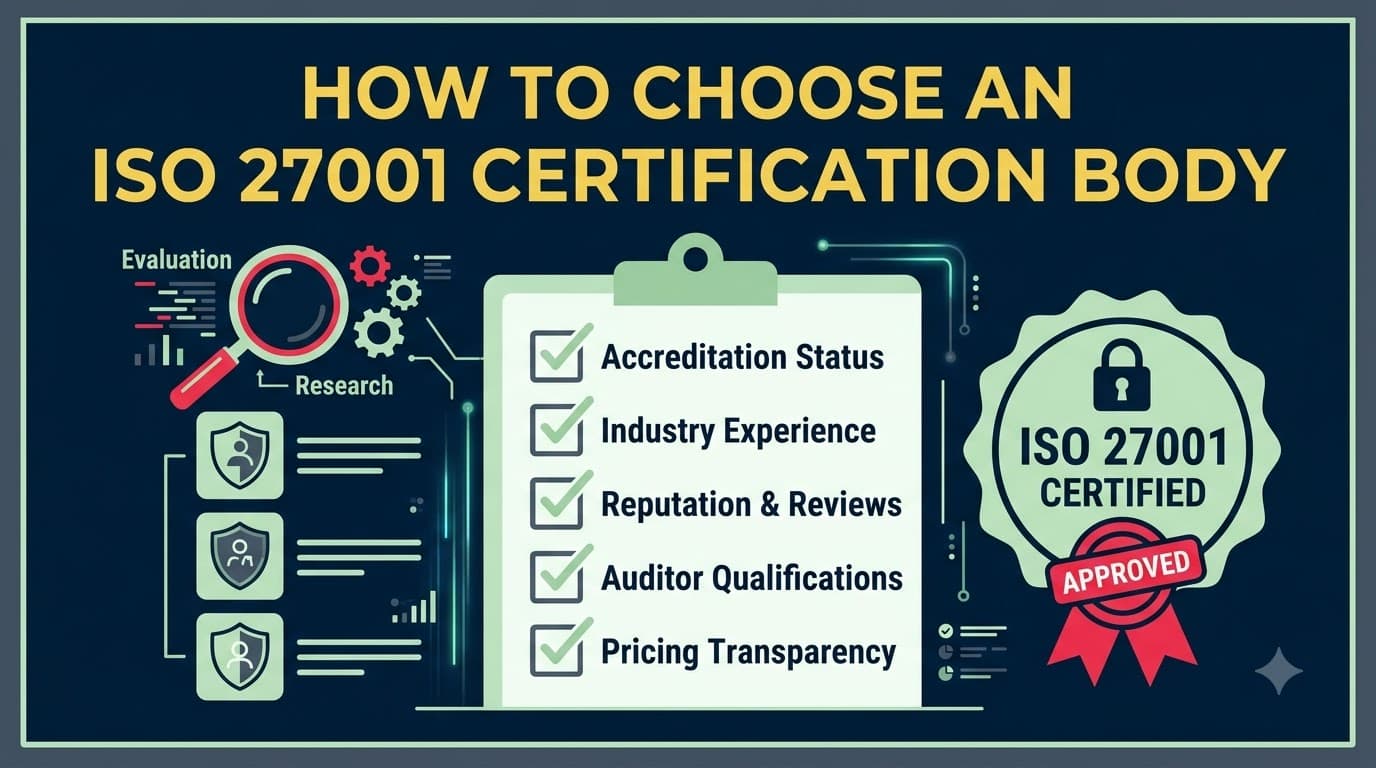
Priya Nandakumar found out the difference between "certified" and "recognized" on a Tuesday afternoon call she'd been looking forward to for three months.
Priya was Director of IT at Vantasoft Solutions, a 140-person SaaS company that processed claims data for regional insurance carriers. Eight months earlier, her CEO had greenlit an ISO 27001 project after their two largest prospects both asked for it during procurement. Priya, moving fast and watching a tight budget, ran a Google search, collected five quotes, and picked the cheapest one: $4,200 for a "fast-track" certification audit from a firm operating out of a virtual office, promising a certificate in three weeks with "no disruptive on-site visits required." Compare that to the $18,000–$26,000 quotes she'd gotten from better-known firms, and the choice felt obvious. Vantasoft got its certificate. Priya put the badge on the website footer and moved on.
Then Meridian Trust Bank — a $30M-a-year prospective customer whose vendor risk team took security seriously — sent their third-party risk questionnaire. Buried in section 4 was a single line: "Please confirm the certification body issuing your ISO/IEC 27001 certificate holds current accreditation from an IAF-member accreditation body, and provide the accreditation certificate number." Priya's certifier had no such accreditation. It wasn't listed with any recognized national accreditation body, and when Meridian's team looked it up, they couldn't verify it against any IAF member's public register. Meridian's risk committee didn't debate it long: the certificate was rejected as "not able to be relied upon for assurance purposes," and the deal — worth an estimated $1.8 million in first-year revenue — was placed on hold pending "a valid, accredited certification."
Vantasoft spent the next five months and roughly $38,000 in consulting and audit fees redoing the entire certification with an accredited body, running a fresh Stage 1 and Stage 2 audit because the original certificate carried no weight anywhere it mattered. The deal survived, barely, after Priya's CEO personally called Meridian's procurement lead to ask for an extension. Not every company gets that grace period. Priya still keeps the rejection email pinned to a folder titled, only half-jokingly, "Never Again."
This article exists so you don't have to learn this lesson the way Priya did. Choosing a certification body (CB) is not a procurement afterthought you handle after the real work of building your ISMS is done — it's a decision that determines whether all of that real work translates into a certificate anyone will trust.
Who This Article Is For
This is for the person who has to actually pick the certification body — the compliance lead, CISO, IT director, or founder who's staring at three or four quotes that look wildly different in price and wondering what's actually driving the gap. You should already understand roughly what ISO 27001 certification involves; if you need the full picture first, our ISO 27001 certification process roadmap walks through the entire path from readiness to certificate. By the end of this piece, you'll have a concrete evaluation framework, a question list you can turn into an RFP, and — most importantly — the ability to spot the difference between a certificate that opens doors and one that gets rejected in a vendor risk review.
What Is a Certification Body, Exactly?
A certification body (CB) — sometimes called a registrar, especially in North American usage — is an independent organization that audits your information security management system (ISMS) against the requirements of ISO/IEC 27001:2022 and, if you meet them, issues the certificate that says so. The CB does not help you build your ISMS, write your policies, or fix your gaps. That work is done by you, internally, or by a consultant you hire separately. The CB's entire job is to show up, examine evidence independently, and render a judgment.
If some of the terminology in this article is new to you — impartiality, surveillance audit, scheme code — our ISO 27001 glossary of terms is a useful companion reference to keep open while you read.
That separation is not incidental — it is the whole point. A certificate only has value to a third party (a customer, a regulator, an investor, an insurer) because it represents an independent, arms-length assessment. If the same organization that helped you write your risk register also decided whether that risk register passed muster, the certificate would tell a reader nothing they could rely on. Every credible CB structures its business, and its ethics rules, around never blurring that line.
The Accreditation Chain: Who's Watching the Watchers?
Here's the question that Priya's original certifier hoped she'd never ask: who checks that the certification body itself is competent, independent, and playing by the rules?
The answer is a layered system called accreditation, and understanding it is the single most important piece of context in this entire article.
At the top sits the International Accreditation Forum (IAF), a worldwide association of accreditation bodies and other interested parties that maintains a Multilateral Recognition Arrangement (MLA). The IAF MLA is essentially a global handshake: if a national accreditation body is a signatory in good standing, its accredited certifications are supposed to be recognized as equivalent, wherever in the world the customer reading your certificate happens to sit.
Below the IAF sit the national accreditation bodies — one or more per country, each responsible for evaluating and accrediting certification bodies operating in (or from) that jurisdiction. Examples you'll encounter in the wild include UKAS (United Kingdom), ANAB (United States), DAkkS (Germany), JAS-ANZ (Australia/New Zealand), and dozens of others recognized as IAF members. This is an illustrative, non-exhaustive list — there are national accreditation bodies for most major economies, and a legitimate CB will be accredited by one of them, not merely "a member of" some private association with an official-sounding name.
Below the national accreditation body sits the certification body — the organization your auditors work for, the one whose logo goes on your certificate. To earn and keep its accreditation, a CB must be assessed by its national accreditation body against ISO/IEC 17021-1 (the general requirements for bodies providing audit and certification of management systems) and, specifically for information security management systems, ISO/IEC 27006 (which adds ISMS-specific requirements — auditor competence in information security, audit time calculation, sampling for multi-site certifications, and more). Both of those assessments are themselves periodically re-verified; accreditation is not a one-time badge, it's a maintained status subject to surveillance, just like your own certificate will be.
At the bottom of the chain is your certificate — the artifact that only has the weight the three layers above it lend it.
flowchart TD
    A["IAF — International Accreditation Forum<br/>(global MLA / mutual recognition)"] --> B["National Accreditation Body<br/>e.g., UKAS, ANAB, DAkkS, JAS-ANZ<br/>(examples only — not exhaustive)"]
    B -->|"assesses against"| S["ISO/IEC 17021-1 (general)<br/>+ ISO/IEC 27006 (ISMS-specific)"]
    B --> C["Certification Body (CB)<br/>your registrar / auditor of record"]
    C -->|"issues, under accreditation scope"| D["Your ISO/IEC 27001 Certificate"]
    D -->|"read and verified by"| E["Customers, regulators,<br/>insurers, investors, auditors"]
Every link in that chain matters. A CB that skips accreditation entirely, or lets its accreditation lapse quietly, or gets accredited for a scope that doesn't actually cover information security management systems, breaks the chain at the point where trust is supposed to flow through it. Your certificate can look identical on the page either way — same logo placement, same clause references, same fancy seal — and still mean nothing to the reader who checks.
Why Accreditation Matters More Than Anything Else on This List
If you remember one thing from this article, make it this: an unaccredited ISO 27001 certificate is often not recognized by the customers, regulators, or partners you're trying to reassure — and that single fact is the biggest pitfall in the entire certification body selection process.
It's worth being precise about why. ISO 27001 certification is a voluntary, market-driven credential — there's no single global police force that stops an organization from calling itself a "certification body" and issuing certificates that look the part. What creates trust in the system is the accreditation infrastructure described above: a chain of independent verification that lets a stranger, anywhere in the world, look at your certificate, trace it back through an accredited CB to a recognized national accreditation body to the IAF MLA, and conclude "I don't have to just take their word for it."
Strip out accreditation and you're left with a private company's opinion that your ISMS meets a standard — an opinion nobody outside your organization has any obligation to trust, and increasingly, one that sophisticated buyers actively check for and reject when it's missing. Enterprise vendor risk teams, banks, healthcare payers, and government contracting offices have all gotten more literate about this over the past several years; unaccredited certificates that would have sailed through a light-touch vendor review five years ago now get flagged in the first pass.
None of this means accreditation guarantees a good audit experience — it doesn't, and we'll get to auditor competence and service quality later in this piece. But accreditation is the floor, not the ceiling. It's the minimum condition that makes the rest of your evaluation worth doing at all.
Accredited vs. Unaccredited: A Side-by-Side Comparison
Quotes for unaccredited certification are almost always lower, and the sales pitch is almost always some version of "same standard, same clauses, faster and cheaper." Technically, an unaccredited CB can indeed audit you against the same ISO/IEC 27001:2022 text. What it cannot do is lend your certificate the independent verification chain a reader is looking for. Here's the practical difference.
Dimension | Accredited Certification Body | Unaccredited "Certification" Provider |
|---|---|---|
Oversight | Assessed by a national accreditation body against ISO/IEC 17021-1 and ISO/IEC 27006 | Self-declared competence; no external assessment of the CB itself |
Recognition under IAF MLA | Yes — certificate can be traced through the accreditation chain | No — nothing to trace; certificate stands alone |
Typical customer/vendor-risk acceptance | Broadly accepted, often explicitly required in RFPs and questionnaires | Frequently rejected once checked; sometimes accepted only because nobody looked closely |
Auditor competence requirements | Minimum experience, training, and sector-specific competence mandated by ISO/IEC 27006 | Set entirely at the provider's discretion |
Surveillance and re-certification rigor | Structured 3-year cycle with annual surveillance audits, itself subject to accreditation-body oversight | Often minimal or absent; some providers issue a certificate and never return |
Complaints and impartiality mechanism | Required impartiality safeguards, complaints/appeals process, periodic witnessed audits by the accreditation body | Usually none; no external body to escalate a dispute to |
Typical price for a mid-size company (illustrative) | $12,000–$30,000+ across Stage 1 and Stage 2, depending on scope and headcount | $2,000–$6,000, often marketed as "fast-track" or "no on-site audit required" |
Insurability / contractual reliance | Commonly accepted as evidence for cyber-insurance underwriting and contractual security clauses | Frequently insufficient; underwriters and legal teams may disregard it entirely |
Reputational risk if discovered | Low — this is the expected, defensible path | High — discovery during a customer audit (as Priya experienced) can look worse than having no certificate at all |
The uncomfortable truth in that last row is one buyers rarely think about upfront: showing up to a vendor risk review with an unaccredited certificate doesn't just fail to help you — it can actively damage trust, because it signals that either you didn't know the difference or you did and hoped nobody would check. Neither reading is good for the relationship you're trying to build.
The Standards Behind the Scenes: ISO/IEC 17021-1 and ISO/IEC 27006
You'll rarely need to quote these standards to anyone, but knowing what they require of your CB helps you ask sharper questions during evaluation.
Standard | What It Governs | Why It Matters to You |
|---|---|---|
ISO/IEC 17021-1 | General requirements for bodies providing audit and certification of any management system (quality, environmental, information security, etc.) — impartiality, competence, confidentiality, complaints handling, decision-making structure | Sets the baseline rules that keep your CB independent and its certification decisions defensible |
ISO/IEC 27006 | ISMS-specific requirements layered on top of 17021-1 — auditor competence in information security specifically, audit time (person-days) calculation methodology, rules for multi-site and sampling-based certification, transition requirements between standard versions | Determines whether the auditor sitting across from you actually has the technical grounding to evaluate an ISMS, not just a generic quality management background |
A CB's accreditation certificate should specify the scope it's accredited for — and for ISO 27001 work, you want to see ISO/IEC 27006 named explicitly, alongside the accreditation body's own scheme reference (often expressed using European Accreditation, or "EA," sector codes, or an equivalent regional classification system used to describe which industries a CB is approved to certify). If a CB can't produce a current accreditation certificate naming its ISMS scope on request, that's not a paperwork gap — that's the whole conversation ending early.
Building Your Evaluation Framework
Once you've confirmed accreditation — which should function as a pass/fail gate, not one factor among many — the real evaluation work begins. In my experience running this process alongside clients across financial services, healthcare technology, SaaS, and manufacturing, the organizations that end up satisfied with their CB three years later evaluated across seven consistent dimensions. The ones who end up frustrated almost always skipped straight to comparing price.
"I tell every client the same thing: accreditation gets a certification body onto your shortlist. It doesn't get them the contract. I've seen two fully accredited CBs deliver wildly different experiences to the same type of client, because accreditation tells you the floor is safe — it doesn't tell you who's actually good to work with for three years." — Helena Cruz, Principal Consultant, Cruz Infosec Partners
1. Accreditation Scope and Scheme Codes
Confirm not just that a CB is accredited, but that its accreditation scope actually covers ISO/IEC 27001 and, ideally, your specific sector classification. Accreditation bodies frequently define scope using sector/scheme codes (commonly based on the EA — European Accreditation — sector classification system or an equivalent regional scheme) that indicate which industries a CB has demonstrated competence to certify. A CB might be fully accredited for ISO 27001 generally but not yet extended into, say, telecommunications or healthcare-specific scopes. Ask for the accreditation certificate and the underlying scope schedule, not just a logo on their website.
The table below illustrates the kind of sector granularity these scheme codes typically describe — treat the specific codes as illustrative examples of the concept, not a definitive or complete reference, since exact numbering and categories vary by accreditation body.
Illustrative Sector Grouping | Example Industries Covered | Why Scope Precision Matters |
|---|---|---|
Information technology / software | SaaS, cloud hosting, managed services | Most generalist accreditation scopes cover this broadly |
Financial services | Banking, insurance, payment processing | Often requires demonstrated auditor familiarity with financial regulatory overlay |
Healthcare and life sciences | Health SaaS, medical devices, payers | May require auditors versed in patient-data handling context |
Telecommunications | Network operators, hosting providers | A narrower scope some CBs haven't yet extended into |
Manufacturing / industrial | Discrete and process manufacturing, OT-adjacent environments | Increasingly relevant given supply-chain security expectations |
Public sector / government contractors | Agencies, contractors handling government data | Sometimes requires additional CB-level clearance or registration |
If your organization sits in a specialized sector, ask each candidate CB directly whether their current accreditation scope names that sector, rather than assuming a generic "information security management systems" scope automatically covers it.
2. Sector and Industry Experience
A generalist auditor can technically assess any ISMS against the clause structure, but an auditor who has spent years in your sector will ask sharper questions, spot different risks, and — practically speaking — move through the audit faster because they're not learning your business model from scratch on your dime. A fintech company benefits from auditors fluent in payment flows and regulatory overlay; a healthcare SaaS vendor benefits from auditors who've seen how PHI actually moves through claims systems. Ask each CB for anonymized examples of similarly sized clients in your sector, and ask who specifically would be assigned as lead auditor.
3. Auditor Competence and Qualifications
Under ISO/IEC 27006, auditors must meet defined competence criteria specific to information security, not just generic management-systems auditing. In practice, look for lead auditors holding recognized credentials (for example, IRCA or CQI-certified ISMS lead auditor qualifications are common industry markers, presented here as examples rather than a required checklist) plus real-world information security experience — not auditors who transitioned straight from a quality-management background with a short conversion course. Ask how many ISO 27001 audits your assigned lead auditor has personally conducted, and for how many years.
"Clients rarely ask me directly how many audits I've personally led before they sign the contract, and I always wish they would. I'd rather answer that question honestly upfront than have a client discover mid-audit that I'm learning their sector alongside them." — Elena Marsh, Lead ISMS Auditor, Northstar Certification International
4. Geographic Coverage and Multi-Site Capability
If you operate across multiple offices, countries, or a hybrid/remote workforce, confirm the CB can actually staff and schedule audits across your footprint without excessive travel surcharges or scheduling delays. Multi-site sampling rules under ISO/IEC 27006 allow a CB to sample a subset of sites rather than audit every location every year — but only certain CBs have the auditor bench and process maturity to run that well. Ask directly how they've handled multi-site or multi-country ISMS scopes before.
Geographic Consideration | Question to Ask the CB |
|---|---|
Auditor location and travel | Do you have auditors based near our sites, or will every visit involve significant travel cost/time? |
Language and local regulatory context | Can assigned auditors work fluently in the local language and context of each site? |
Multi-site sampling methodology | How do you determine which sites to sample each cycle, and how is that documented? |
Remote/hybrid audit capability | Which portions of the audit, if any, can be conducted remotely versus requiring on-site presence? |
IAF MLA recognition across regions | Is your accreditation recognized under the IAF MLA in every country where we need the certificate to carry weight? |
Time zone and scheduling logistics | How do you coordinate audit scheduling across our time zones without excessive delay? |
A CB that hesitates on any of these questions, or gives vague answers about "figuring out logistics closer to the date," is signaling an operational gap that will surface as scheduling friction once you're contractually committed.
5. Cost and Value — Not Just the Lowest Line Item
Price matters, obviously — but the goal is understanding what's driving the number, not just picking the smallest one. A quote materially below the market range for your size and scope is a signal to ask harder questions, not a reason to celebrate. We'll dig into cost drivers in detail later in this article.
6. Service, Communication, and Responsiveness
You'll interact with this organization every year for at least three years — through scheduling, evidence requests, findings discussions, and (if you're unlucky) a nonconformity dispute. Ask about typical response times to scheduling requests, whether you get a named account contact or a rotating pool, and how they handle scope changes or scheduling conflicts. This is unglamorous, but it's the difference between a smooth annual surveillance audit and a yearly headache.
7. Continuity Across the Full 3-Year Certification Cycle
ISO 27001 certification isn't a single event — it's a 3-year cycle: initial certification (Stage 1 and Stage 2), then two annual surveillance audits, then recertification in year three. Ask whether the CB commits to auditor continuity (the same lead auditor, or at least the same team, across the cycle) or reassigns you to whoever's available each year. Continuity matters because a returning auditor already understands your ISMS context; a new auditor every year means re-explaining your business from scratch, which costs you time and audit days.
Cycle Year | Typical Activity | Continuity Question to Ask |
|---|---|---|
Year 0 | Stage 1 (documentation review) and Stage 2 (certification audit) | Who is the assigned lead auditor, and will they return for surveillance? |
Year 1 | First annual surveillance audit (reduced scope, sampling of controls) | Is this the same auditor/team from the certification audit? |
Year 2 | Second annual surveillance audit | Has scope or headcount changed enough to require re-quoting? |
Year 3 | Recertification audit (comparable depth to original Stage 2) | Does the CB offer any continuity discount or streamlined process for existing clients? |
Treat this table as a planning tool as much as an evaluation one — mapping out what each year of the cycle actually involves helps you budget both cost and internal effort well before each audit is due, rather than being surprised by a surveillance visit that sneaks up on your team.
Criterion | What "Good" Looks Like | Red Flag |
|---|---|---|
Accreditation scope | Current certificate naming ISO/IEC 27001 and your sector scheme code | Vague claim of "internationally recognized" with no verifiable certificate |
Sector experience | Named, checkable examples of similar clients | "We can certify anyone" with no specifics |
Auditor competence | Named lead auditor with credentials and years of ISMS audit experience | Auditor identity withheld until the week of the audit |
Geographic coverage | Confirmed ability to staff your actual site footprint | "We'll figure out logistics later" |
Cost and value | Transparent audit-day calculation tied to headcount/scope | Flat low fee with no explanation of audit-day methodology |
Service and communication | Named account contact, clear SLA on response times | Communication routed through a generic inbox |
3-year continuity | Named team committed across the cycle | No commitment; "whoever is available" |
A Weighted Scoring Model You Can Reuse
Qualitative impressions ("they seemed nice on the call") are a bad way to choose a partner you'll work with for three years. Instead, score each shortlisted CB numerically across the seven criteria above, weighted by what matters most to your organization. Below is a template I've used with clients evaluating three to five CBs in parallel — copy it into a spreadsheet, adjust the weights, and score each candidate from 1 (poor) to 5 (excellent).
Criterion | Suggested Weight | CB A Score (1–5) | CB B Score (1–5) | CB C Score (1–5) |
|---|---|---|---|---|
Accreditation confirmed & in-scope (gate — must pass) | Pass/Fail | |||
Sector/industry experience | 20% | |||
Auditor competence & named lead auditor | 20% | |||
Geographic/multi-site capability | 10% | |||
Cost transparency & value | 20% | |||
Service & communication quality | 15% | |||
3-year continuity commitment | 15% | |||
Weighted total | 100% |
Two notes on using this responsibly. First, accreditation is a gate, not a weighted line item — a CB that fails it should be removed from the comparison entirely, regardless of how well it scores elsewhere. Second, resist the temptation to let cost carry more than its stated weight just because it's the easiest number to compare; the criteria that are harder to quantify (auditor competence, continuity, service quality) are usually the ones that determine whether your three-year relationship with this CB is smooth or miserable.
The RFP: Questions Every Certification Body Should Answer in Writing
Turn your evaluation into a short, structured request for proposal (RFP) or at minimum a written question list sent to every CB on your shortlist. Insist on written answers — a CB that's cagey about putting these details in writing is telling you something.
# | Question | Why It Matters |
|---|---|---|
1 | Please provide your current accreditation certificate(s), the issuing accreditation body, and the specific scope/scheme codes covered. | Confirms the pass/fail gate before anything else is discussed |
2 | How many ISO/IEC 27001 audits has your organization conducted in our industry sector in the past 24 months? | Establishes real sector experience, not marketing claims |
3 | Who would be assigned as our lead auditor, what are their qualifications, and how many years of ISMS audit experience do they have? | Auditor quality drives audit quality more than almost any other factor |
4 | Can you commit to auditor/team continuity across our 3-year certification cycle? | Continuity reduces re-explanation overhead and improves audit efficiency year over year |
5 | How do you calculate audit days (person-days) for our organization's headcount and scope? | Reveals whether pricing follows recognized methodology or is an arbitrary discount |
6 | What is your process for handling a nonconformity dispute or disagreement with an audit finding? | Shows whether there's a fair appeals mechanism before you're contractually committed |
7 | What is your typical scheduling lead time for Stage 1, Stage 2, and annual surveillance audits? | Sets realistic expectations for your certification timeline |
8 | Do you offer combined or integrated audits if we later pursue additional standards (e.g., ISO 9001, ISO 22301)? | Relevant if multi-standard certification is on your roadmap |
9 | Can you provide (anonymized, with permission) references from clients of similar size and sector? | Lets you verify claims independently |
10 | What is your policy on independence — do you, or any affiliated entity, provide ISMS consulting, gap analysis, or implementation services to clients you certify? | Directly tests for the consult-and-certify conflict of interest discussed below |
11 | What is your full quoted price, broken down by Stage 1, Stage 2, travel/logistics, and annual surveillance fees across the 3-year cycle? | Prevents surprise costs appearing in year two or three |
12 | What happens if we fail Stage 2 — what is the re-audit process and cost? | Clarifies the financial and timeline exposure of a failed first attempt |
Running a CB "Bake-Off": A Practical Timeline
Most organizations underestimate how long a proper CB selection takes and end up rushing it in the final weeks before they want to start Stage 1. Build the selection process into your certification timeline from day one — ideally starting three to four months before you intend to schedule Stage 1.
Week | Activity |
|---|---|
1–2 | Define scope, headcount, and sites to be certified; draft RFP/question list from this article |
2–3 | Identify 4–6 candidate CBs; confirm accreditation status independently before sending RFPs |
3–5 | Send RFP; hold 45–60 minute calls with each CB's proposed lead auditor, not just a sales rep |
5–6 | Request and check references from comparable clients |
6–7 | Score candidates using the weighted model; narrow to 2 finalists |
7–8 | Negotiate final scope, pricing, and 3-year commitment terms; check contract for cancellation/transfer clauses |
8 | Sign certification agreement; begin scheduling Stage 1 |
Insist on speaking directly with the person who would actually lead your audit, not only an account manager. A CB's sales process can be polished while its audit delivery is inconsistent — the only way to catch that gap before signing is to talk to the auditor themselves about how they approach scoping, evidence sampling, and findings.
Red Flags: Spotting a Certificate Mill
The phrase "certificate mill" describes an organization that issues ISO 27001 certificates with minimal or no genuine independent assessment — prioritizing speed and low price over rigor, often without valid accreditation. This section stays deliberately generic: the point isn't to name specific providers, it's to equip you to recognize the pattern wherever you encounter it.
Red Flag | Why It Matters |
|---|---|
No accreditation certificate available on request, or a vague claim like "internationally recognized" with nothing verifiable | The single biggest warning sign — see the accreditation section above |
Guaranteed certification ("you will pass") before any audit has taken place | A legitimate CB cannot promise an outcome before assessing evidence — that's not independence, it's a sales pitch |
Certification issued with no on-site or live remote evidence review at all | Stage 2 requires actual evidence sampling; a certificate issued from a document upload alone is not a genuine audit |
Price dramatically below the market range for your size with no explanation of audit-day methodology | Legitimate audit-day calculations under ISO/IEC 27006 scale with headcount and scope — a flat low fee usually means the audit itself is being cut, not just the margin |
The same company (or closely affiliated entity) offers to write your policies, build your ISMS, and then certify it | This is the independence violation covered in detail below — treat it as disqualifying |
Certificate has no defined 3-year cycle, surveillance schedule, or expiration date | Legitimate certificates are time-bound and require ongoing surveillance; an open-ended "certificate for life" is not how the standard works |
Pressure to sign quickly, "limited time" pricing, or reluctance to put audit-day calculations in writing | Common sales tactics used to short-circuit due diligence |
No verifiable client references, or references that can't be independently confirmed | Legitimate CBs have real, checkable client histories |
"The saddest calls I get aren't from companies that failed an audit — they're from companies that 'passed' an audit that wasn't real, and found out only when a customer's procurement team asked to verify it. By then they've already told their board, their customers, maybe their investors, that they're certified. Unwinding that is much harder than just doing it right the first time." — Dana Okafor, CISO, Loom & Ledger Financial
The Independence Rule: Your Consultant Cannot Be Your Certifier
This is worth its own section because it's the single most common conflict-of-interest question I get asked, and the answer is unambiguous: the organization that helps you build, write, or implement your ISMS cannot be the same organization that certifies it.
ISO/IEC 17021-1 requires certification bodies to manage impartiality as a core condition of operating at all — they must identify, analyze, and address any relationship, including commercial ones, that could compromise the objectivity of a certification decision. A CB (or a closely affiliated consulting arm operating under the same ownership or brand) that also sells ISMS consulting, gap analysis, policy-writing, or implementation services to a client it then certifies is operating in direct conflict with that requirement. Reputable CBs enforce internal firewalls precisely to avoid this — and reputable accreditation bodies audit for it.
Why does this rule exist, practically speaking? Because certification is only valuable if the reader can assume the auditor had no financial incentive to find you compliant. If your consultant becomes your certifier, every finding — or lack of one — becomes suspect, because the CB is effectively grading its own homework. This doesn't mean you can't use a consultant at all; using outside help to design and implement your ISMS is common and often smart, and weighing DIY versus outsourced ISO 27001 implementation approaches is a worthwhile exercise before you start. It means the entity that helped you build the ISMS and the entity that certifies it must be organizationally and financially separate.
Some CBs do offer adjacent, lower-risk services — training courses, generic templates, or gap-assessment tools that stop short of hands-on implementation — while maintaining that these don't compromise their ability to certify the same client. Regulators and accreditation bodies scrutinize this boundary closely, and it varies by jurisdiction and accreditation body policy, so ask directly: "If we use your training or template materials, does that create any conflict with you also certifying us?" A CB that can't answer that question clearly and confidently is one to avoid.
"Ask the awkward question in the first call: 'Would you ever certify a client whose ISMS your own consulting team helped write?' If the answer is anything other than an immediate, unqualified no, that's the end of the conversation for me." — Marcus Webb, Founder, Alderney Risk Advisory
Cost Considerations: What Actually Drives Certification Body Pricing
Price comparisons across CB quotes are only useful once you understand what's supposed to be driving the number. ISO/IEC 27006 ties audit duration to a calculated number of person-days based primarily on headcount within the ISMS scope, plus complexity factors like number of sites, IT environment complexity, and whether the organization handles particularly sensitive data categories. A legitimate quote should be traceable back to that calculation — not simply a round number picked to win the deal.
Cost Driver | How It Affects Pricing |
|---|---|
Headcount within ISMS scope | Primary driver of audit-day calculation under ISO/IEC 27006 methodology |
Number of physical sites / locations | Additional sites typically add audit days, though multi-site sampling can reduce the total when justified |
IT environment complexity | Complex, distributed, or highly customized environments generally require more audit time to sample adequately |
Data sensitivity / regulatory overlay | Sectors with heightened risk (financial services, healthcare, critical infrastructure) may warrant deeper sampling |
Travel and logistics | On-site audits at multiple locations add travel costs; remote/hybrid audit models can reduce this where appropriate |
Stage 1 + Stage 2 + 2 surveillance audits + recertification | The full 3-year cycle, not just the initial certificate, is the real cost to budget for |
Non-conformity re-audits | Failing Stage 2 or a surveillance audit and requiring a follow-up visit adds unbudgeted cost |
The following figures are illustrative only, intended to show relative scale rather than serve as a quote — always request a written, itemized proposal.
Organization Size (illustrative) | Approximate Stage 1 + Stage 2 (Year 1) | Approximate Annual Surveillance (Years 2–3) | Approximate 3-Year Total |
|---|---|---|---|
Small (under 50 employees, single site) | $9,000–$15,000 | $3,000–$5,500 per year | $15,000–$26,000 |
Mid-size (50–250 employees, 1–2 sites) | $15,000–$28,000 | $5,000–$9,000 per year | $25,000–$46,000 |
Larger / multi-site (250+ employees, 3+ sites) | $28,000–$55,000+ | $9,000–$18,000+ per year | $46,000–$91,000+ |
For a fuller breakdown of what shapes ISO 27001 certification cost beyond the CB's own fees — internal labor, tooling, consulting, and remediation — see our dedicated ISO 27001 certification cost breakdown (in development). In the meantime, PentesterWorld's ISO 27001 Certification Cost Calculator can help you model a realistic budget range before you start collecting quotes, so you can spot an unusually low bid for what it is.
Common Mistakes Organizations Make When Choosing a CB
I've watched clients make some version of these mistakes often enough that they're worth naming directly, so you can avoid repeating them.
Mistake | Consequence | Better Approach |
|---|---|---|
Choosing on price alone without verifying accreditation | Risk of certificate rejection by customers or regulators, exactly as happened to Vantasoft | Treat accreditation verification as a non-negotiable first gate |
Never speaking to the actual assigned lead auditor before signing | Discovering post-contract that auditor competence or communication style is a poor fit | Insist on a call with the proposed lead auditor during evaluation |
Ignoring the 3-year total cost and evaluating only the Stage 1/Stage 2 quote | Budget surprises in years two and three, or unplanned re-audit costs | Request an itemized 3-year proposal covering surveillance and recertification |
Not checking for consulting/certification conflicts of interest | Certificate credibility questioned if the relationship is later discovered | Ask the independence question directly and get it in writing |
Waiting until weeks before the desired Stage 1 date to start CB selection | Rushed decision, reduced negotiating leverage, limited scheduling options | Start the CB selection process 3–4 months ahead of your target Stage 1 date |
Assuming any accredited CB is interchangeable regardless of sector fit | Slower, less insightful audits; more clarification cycles | Weight sector experience meaningfully in your scoring model |
Failing to plan for scope changes (mergers, new offices, new products) mid-cycle | Confusion or delay when the ISMS scope needs to expand between surveillance audits | Ask upfront how the CB handles scope changes and re-quoting |
Treating CB selection as purely a procurement task with no input from the ISMS owner | Mismatch between what the CB expects and what the organization is actually ready for | Involve whoever owns Clause 9 internal audit and the ISO 27001 internal audit process in CB selection, since they'll be the primary point of contact |
Case Studies
Case Study 1: The Rejected Certificate (Vantasoft Solutions)
As described in the opening of this article, Priya Nandakumar's team at Vantasoft Solutions certified through an unaccredited provider for $4,200, only to have the certificate rejected outright by a prospective customer's vendor risk team. The company spent approximately $38,000 and five months completing a full re-certification through an accredited CB, and nearly lost a $1.8 million contract in the process. The lesson Priya now shares with peers: verifying accreditation status takes fifteen minutes and costs nothing; skipping that step cost her company roughly nine times the original certification fee to fix.
"I wasn't being reckless — I was being cheap, and I didn't know enough to know the difference mattered. Now it's the first question on every vendor questionnaire I review, and it's the first thing I tell other IT directors to check before they sign anything." — Priya Nandakumar, Director of IT, Vantasoft Solutions
Case Study 2: The Consult-and-Certify Near-Miss (Solstice Manufacturing Group)
Tom Ariyoshi, VP of Compliance at Solstice Manufacturing Group, a mid-size industrial equipment manufacturer, was three weeks from signing with a certification body when a colleague on his team flagged that the same firm's "advisory division" had, under a different but related brand name, been the one recommending which policy templates Solstice should adopt. Tom paused the process, asked the independence question directly in writing, and confirmed that the two divisions shared ownership and, more importantly, shared incentive to keep the client relationship — a structure that would have compromised the certificate's credibility even if no rule was technically broken on paper. Solstice switched to a fully independent CB, adding roughly six weeks to the timeline but avoiding a conflict-of-interest question that, in Tom's words, "would have come up eventually, probably during exactly the customer audit where we couldn't afford it to."
Case Study 3: Getting It Right the First Time (a mid-market healthcare SaaS company)
A 90-person healthcare SaaS company (details anonymized at the client's request) ran a structured CB selection process using a version of the weighted scoring model in this article, evaluating four accredited candidates over six weeks. They selected a mid-priced CB (roughly $19,500 for Stage 1 and Stage 2 combined) specifically because its lead auditor had direct healthcare-sector audit experience and the CB committed in writing to auditor continuity across the full 3-year cycle. The Stage 2 audit surfaced two minor nonconformities, both closed within the standard 90-day correction window, and the certificate was accepted without question by every enterprise healthcare customer that subsequently reviewed it. The company's compliance lead later estimated that the sector-experienced auditor shaved roughly two full audit days off what a generalist auditor would have needed, translating to real savings even though the quote itself wasn't the cheapest on the table.
Case Study | Root Cause | Financial/Time Impact | Outcome |
|---|---|---|---|
Vantasoft Solutions | Chose unaccredited CB on price alone | ~$38,000 and 5 months to re-certify; $1.8M deal at risk | Recovered after emergency re-certification with an accredited CB |
Solstice Manufacturing Group | Nearly signed with a CB whose affiliated arm provided consulting to the same client base | ~6-week delay to switch to an independent CB | Avoided a conflict-of-interest exposure before it became contractual |
Mid-market healthcare SaaS company | Ran a structured, weighted CB evaluation from the start | Selected mid-priced, sector-experienced CB; ~2 fewer audit days needed | Certificate accepted without question by all reviewing customers |
The pattern across all three is consistent: the cost of getting CB selection wrong is almost always larger than the cost of doing the evaluation properly in the first place.
What Happens After You Choose: Setting Up for Success
Signing with the right CB is the beginning of the certification relationship, not the end of your due diligence. Once you've selected and contracted with an accredited certification body, the practical next steps are:
Confirm your ISMS scope statement matches exactly what the CB will quote and audit against — mismatches here cause delays later.
Schedule your Stage 1 documentation review with enough lead time to remediate any gaps it surfaces; our guide to the ISO 27001 Stage 1 audit walks through exactly what to expect and how to prepare.
Use the gap between Stage 1 and Stage 2 deliberately — this is your last structured opportunity to close findings before the certification decision is on the line. Our walkthrough of the ISO 27001 Stage 2 certification audit explains how evidence sampling actually works during that visit.
Make sure your internal audit program (see ISO 27001 internal audit planning, execution, and reporting) is functioning before Stage 2 — a CB will want to see it operating, not just documented.
Calendar your annual surveillance audits and recertification date the moment your certificate is issued; missing a surveillance window can put your certification status at risk regardless of how well your ISMS is actually performing.
None of this work is CB-specific — it's the same certification journey outlined in our ISO 27001 certification process roadmap — but choosing the right partner up front makes every subsequent step faster, cheaper, and less stressful.
The Strategic Close: Your Certification Body Is a Market-Access Decision, Not a Line-Item Cost
It's easy to file "choose a certification body" under procurement and move on to the parts of ISO 27001 that feel more like real security work — the risk assessments, the control implementation, the policy writing. But the CB decision is arguably the moment where all of that internal work either converts into external, verifiable trust or doesn't. A brilliant ISMS certified by the wrong body can still get rejected in a vendor risk review, exactly the way Priya's did — not because the security work was weak, but because the credential attached to it couldn't be trusted by the reader on the other end.
Reframe the decision this way: you're not buying an audit, you're buying market access — the ability to walk into procurement conversations, regulatory reviews, and insurance underwriting discussions with a credential that does the trust-building work for you instead of raising more questions than it answers. Organizations that treat CB selection with the same rigor they'd apply to choosing an auditor for financial statements, or a bank for a credit facility, consistently get more value out of their certificate — faster deal cycles, fewer follow-up questions from customers, cleaner insurance renewals — than organizations that treat it as a bottom-line procurement exercise.
"Every year I ask new clients the same opening question: 'What do you want your certificate to actually do for you?' The ones who can answer specifically — unlock this segment of customers, satisfy this regulator, support this insurance renewal — almost always end up choosing the right certification body, because they're evaluating against a real business outcome instead of just a price tag." — Raj Bhatt, Certification Program Manager, Meridian Assurance Group
If you're still building the case internally for why certification matters at all, our piece on ISO 27001 certification benefits and the business case for ROI lays out the commercial argument in full, and our overview of who needs ISO 27001 and which industries benefit most can help you calibrate how much weight to put on sector-specific CB experience for your situation. And if your organization is weighing ISO 27001 against, or alongside, other frameworks, our comparison of ISO 27001 against NIST, SOC 2, and PCI DSS is worth reading before you finalize scope with any CB — scope decisions and CB selection are closely linked.
It's also worth noting that the CB-selection discipline described in this article isn't unique to ISO 27001. Organizations pursuing SOC 2 face an analogous decision when selecting a SOC 2 audit firm — except there the credential is issued by a licensed CPA firm rather than an accredited certification body, a structural difference worth understanding if you're weighing both frameworks or explaining the distinction to a customer who's more familiar with one than the other. Similarly, if part of your motivation for certification is supporting a broader regulatory posture — for example around GDPR compliance and vendor assurance — remember that ISO 27001 certification supports, but never substitutes for, formal legal compliance with any specific regulation.
Ready to Choose the Right Certification Body?
Getting this decision right starts with knowing exactly where your ISMS stands before you ever pick up the phone with a certification body. PentesterWorld's Certification Readiness Checklist helps you confirm your mandatory documentation and control implementation are audit-ready before you schedule Stage 1, and our ISO 27001 Gap Analysis Tool can identify weak spots while you still have time to fix them rather than discovering them mid-audit. If you're still building your budget picture, run your numbers through the ISO 27001 Certification Cost Calculator so you can spot an unrealistically low CB quote for what it is. Not sure how close your organization actually is to being certification-ready? Take our short quiz, "Is Your Organization ISO 27001 Ready?", and for a full walkthrough of the entire implementation journey from first gap analysis to final certificate, download The Complete ISO 27001 Implementation Guide. Whatever stage you're at, get the certification body decision right the first time — your customers, and your budget, will thank you.