Priya Nair had been on call for eleven months without a single Saturday-morning page. Then, on a quiet Tuesday afternoon, a database administrator at her company — a 340-person claims-processing platform called Ferrow Health Systems — pushed what he described in the incident retro as "a one-line index change" directly to the production database. No ticket. No peer review. No maintenance window. He was trying to fix a slow report before a client demo at 3 p.m.
The index change locked a core claims table for forty minutes. Claims intake froze. The client demo went ahead anyway, on a laptop hotspot, because the DBA hadn't told anyone what he'd done and nobody could explain why the platform had gone dark. By the time the team rolled the change back — by hand, from memory, because there was no documented rollback plan — Ferrow had missed a contractual claims-processing SLA with its three largest customers, triggered $180,000 in service-credit penalties, and spent a further $65,000 on the incident review, customer calls, and the emergency after-action audit its board demanded. Total cost of a "one-line" change: roughly $245,000, plus a dent in trust that took two renewal cycles to repair.
Nothing about that story involves a hacker. No malware, no phishing email, no zero-day. It's the kind of loss that ISO 27001 auditors see constantly and that penetration testers almost never get asked to test for, because it isn't a vulnerability in the technical sense — it's a process gap. Ferrow had firewalls, MFA, and a halfway-decent vulnerability management program. What it didn't have was a change management procedure with teeth. That gap is precisely what Annex A Control 8.32 exists to close.
Who this is for, and what you'll walk away with
This article is for the IT manager, DevOps lead, or ISMS implementer who has been told "we need a change management process for the audit" and isn't sure whether that means a Jira workflow, a formal Change Advisory Board, or something in between. You'll walk away with a complete change lifecycle you can adapt (request, assess, approve, test, implement, review, and close, with a defined rollback and an emergency-change lane), a working definition of standard, normal, and emergency changes, and the specific evidence auditors expect to see at Stage 2 and in surveillance audits. We'll also draw a hard line between Control 8.32 — which governs technical changes to systems and infrastructure — and Clause 6.3, which governs changes to the management system itself, because auditors ask about both and conflating them is one of the most common nonconformities I see. If any of the practitioner shorthand in this article is unfamiliar, our ISO 27001 Glossary of Terms is a good companion reference to keep open alongside it.
What Control 8.32 actually requires
ISO/IEC 27001:2022 Annex A Control 8.32, Change management, states that changes to information processing facilities and information systems shall be subject to change management procedures. That's the full text of the control — deliberately short, because the standard leaves the mechanics to you. ISO/IEC 27002:2022 fleshes it out with implementation guidance, and in fifteen years of ISMS audits, I've learned that guidance boils down to five non-negotiable elements an auditor is trained to look for:
A documented procedure that defines how changes are requested, evaluated, and authorized before they touch production.
Impact and security risk assessment of every change of any consequence — not just "will this break something" but "does this change alter our attack surface, our data flows, or our control environment."
Testing and formal approval before implementation, proportionate to the risk of the change.
A rollback or back-out plan, defined and — for anything non-trivial — tested, before the change goes live.
Records that prove the above happened: who requested it, who assessed it, who approved it, what was tested, and what the outcome was.
Control 8.32 sits in the Technological Controls theme (8.1–8.34) of Annex A, and it is deliberately control-agnostic about what kind of change it covers. It applies to a firewall rule change, a code deployment, an operating system patch, a change to an Active Directory group policy, a cloud IAM policy edit, a change to a third-party SaaS configuration that touches regulated data, and — yes — a "one-line" database index change made under deadline pressure. If the change touches an information processing facility or an information system within your ISMS scope, it's in scope for 8.32.
"The auditors don't care whether you call it a Change Advisory Board or a Tuesday stand-up. They care whether you can show me, for any production change in the last twelve months, who approved it and what the rollback plan was. If you can't produce that in under five minutes, you don't have a process — you have a habit." — Derek Osei, ISMS Lead Auditor, Cascade Certification Partners
Control 8.32 vs Clause 6.3: two different "change managements"
This is the single most common point of confusion I clear up in ISO 27001 workshops, and it's worth stopping on before we go any further, because getting it wrong produces sloppy documentation that fails audit.
Clause 6.3, "Planning of changes," is a management-system clause. It's part of the mandatory Clause 4–10 structure that governs how the ISMS itself is run, and it requires that when the organization determines a need for change to the ISMS — a new scope boundary, a restructured risk methodology, a new business unit brought into certification scope, a merger that changes the asset inventory — that change is planned in a structured way rather than happening in an ad hoc fashion. Clause 6.3 changes are strategic and organizational: they change how you manage information security, not what a specific system does.
Annex A Control 8.32, "Change management," is an operational and technical control. It governs changes to information processing facilities and information systems — the servers, applications, network devices, and cloud configurations that actually process, store, and transmit information. An 8.32 change is a patch, a code deployment, a firewall rule, a new server build, a configuration change on a load balancer.
The overlap is real but narrow: a Clause 6.3 management-system change can trigger a wave of 8.32 technical changes. If you acquire a company and bring its infrastructure into ISMS scope (a Clause 6.3 planning event), every subsequent technical change you make to integrate that infrastructure — new firewall rules, new access provisioning, new monitoring agents — runs through your Control 8.32 change management procedure. Keep the two separate in your documentation: your ISMS Change Log (satisfying 6.3) should track things like "expanded ISMS scope to include the Austin data center — approved by the ISMS Steering Committee, March 2026." Your Change Management Register (satisfying 8.32) should track things like "CHG-2026-0447: applied firmware update to Austin core switch — approved by Network CAB, tested in staging, implemented during maintenance window." An auditor who asks "show me your change management process" is usually asking about 8.32; an auditor who asks "how do you handle changes to your ISMS scope or risk methodology" is asking about 6.3. If you want the fuller treatment of Clause 6.3 and how it fits the planning phase of the management system, see our companion piece on ISO 27001 Clause 6: Planning — Risk Assessment and Objectives, and for how change management fits into the broader operational Clause 8 machinery, our guide to ISO 27001 Clause 8: Operation — Implementing Risk Treatment.
Dimension | Clause 6.3 (Planning of changes) | Annex A Control 8.32 (Change management) |
|---|---|---|
Type of requirement | Mandatory management-system clause | Annex A control, applicable per SoA |
Scope of change | The ISMS itself — scope, policy, risk methodology, structure | Information processing facilities and systems |
Typical trigger | Merger, new business unit, regulatory shift, scope expansion | Patch, deployment, configuration change, infrastructure change |
Owner | ISMS Steering Committee / Management Review | IT operations, engineering, change manager, CAB |
Evidence artifact | ISMS change log, updated Statement of Applicability, revised risk register | Change tickets, RFC records, test evidence, CAB minutes |
Audit question that targets it | "How do you plan and control changes to your ISMS?" | "Walk me through your last production change end to end." |
The change management lifecycle
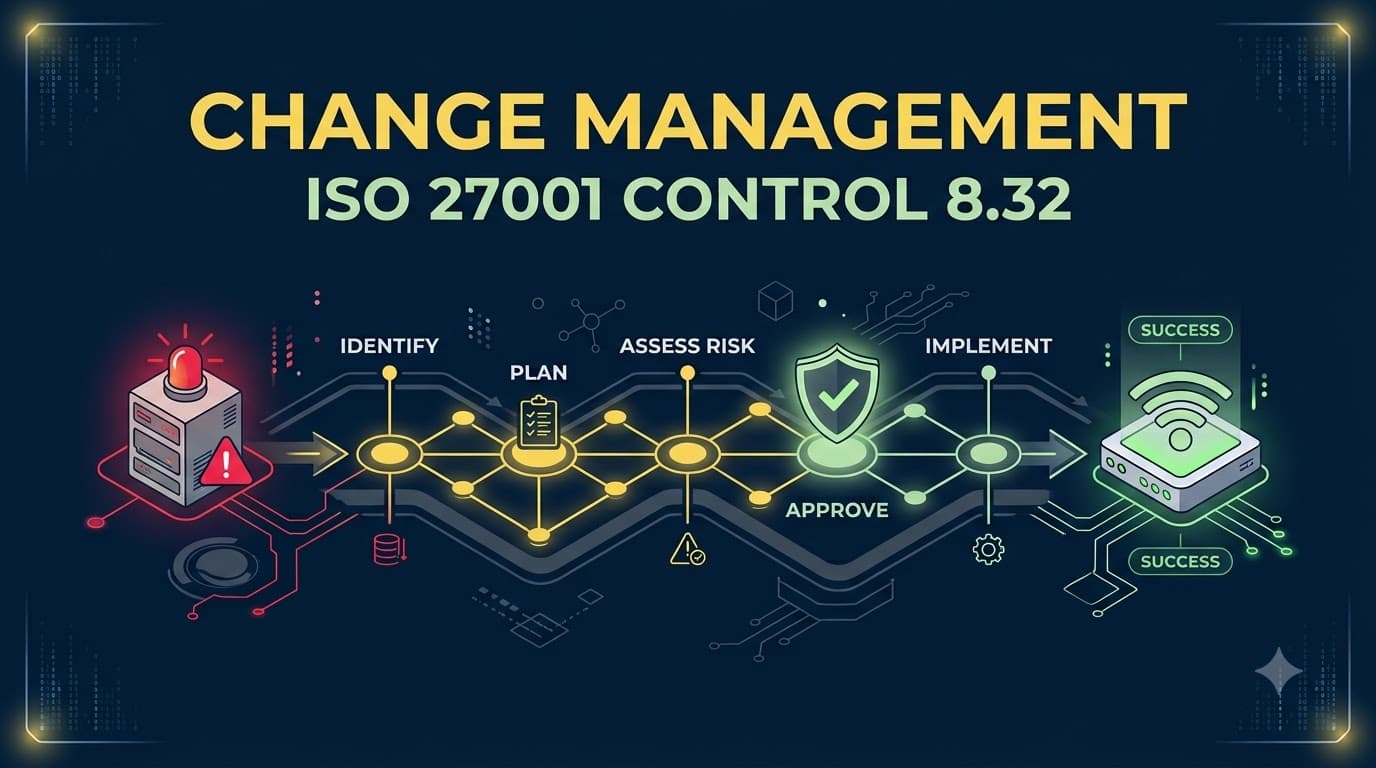
Every mature 8.32 implementation I've helped build — regardless of industry or company size — follows the same seven-stage skeleton. Smaller organizations compress stages; larger ones add layers of approval, but the shape stays constant: request, assess, approve, test, implement, review, and close, with a defined rollback capability threaded through the whole thing and a separate, faster lane for emergencies.
flowchart TD
    A[1. Change Request<br/>RFC logged] --> B[2. Impact & Risk<br/>Assessment]
    B --> C{Change Type?}
    C -->|Standard - pre-approved| G[Implement]
    C -->|Normal| D[3. Review & Approval<br/>CAB / Change Manager]
    D -->|Rejected| Z[Return to Requester<br/>with reasons]
    D -->|Approved| E[4. Test in<br/>Non-Production]
    E -->|Fails| Z
    E -->|Passes| F[5. Schedule &<br/>Rollback Plan Confirmed]
    F --> G[6. Implement<br/>in Production]
    G --> H[7. Post-Implementation<br/>Review]
    H -->|Successful| I[Close Change Record]
    H -->|Failed / Issues| J[Execute Rollback /<br/>Back-out Plan]
    J --> K[Incident Review<br/>if applicable]

    L[Emergency Trigger:<br/>Active incident /<br/>critical vulnerability] -.-> M[Expedited Assessment<br/>+ Verbal/Async Approval]
    M -.-> N[Implement Immediately]
    N -.-> O[Retrospective CAB Review<br/>within 24-48 hrs]
    O -.-> I
Below, we'll walk each stage in the detail an auditor and a practitioner both need.
Stage 1: Change request (the RFC)
Every change starts as a Request for Change (RFC) — a practitioner term borrowed from ITIL that doesn't appear in the ISO text but is the near-universal vehicle for satisfying 8.32 in practice. At minimum, an RFC should capture: what is changing, why, which systems and data are affected, who is requesting it, the proposed implementation window, and a first-pass estimate of risk. I tell clients to resist the urge to make this form exhaustive on day one — a ten-field ticket that people actually fill out beats a forty-field form that people route around. The RFC is also where you establish the paper trail an auditor will later pull at random: if a change touched production and there's no RFC, that's a finding, full stop.
Stage 2: Impact and security risk assessment
This is the stage most organizations shortchange, and it's the one Control 8.32 cares about most, because it's where "change management" and "information security" actually intersect. A risk assessment for a change should ask: does this alter the attack surface (new open port, new external integration, new privileged account)? Does it affect confidentiality, integrity, or availability of in-scope information? Does it touch a system in the Statement of Applicability's scope? Does it require updates to other control documentation — network diagrams, the asset inventory, the risk register? We cover the deeper mechanics of this in the dedicated section below, but the short version is: no change should reach an approver without someone having explicitly asked "what's the worst that happens if this goes wrong, and how would we know?"
Stage 3: Review and approval
Standard, pre-approved changes can skip a formal review (more on that in the change-types table below). Everything else goes to a named approval authority — a change manager, a technical lead, or a Change Advisory Board — who evaluates the risk assessment, checks for conflicts with other scheduled changes, and either approves, rejects, or sends the change back for more information. The critical control-design point here is segregation of duties: the person who approves a change should not be the same person who built and is about to implement it. For small teams where the same three engineers do everything, segregation gets satisfied through peer review and a second sign-off rather than an organizational firewall — auditors accept this as long as it's documented and consistently applied.
Stage 4: Testing
Nothing goes to production without evidence it was tested somewhere that isn't production — a lab, a staging environment, a UAT tenant, a sandboxed cloud account. This is where 8.32 leans directly on Environment Separation & Source Code control 8.31: if your test environment is really just "prod with a different DNS name," your testing evidence won't hold up to audit scrutiny, and worse, it won't actually protect you. Testing should validate both that the change does what it's supposed to (functional testing) and that it doesn't introduce new risk (regression and, where relevant, security testing).
Stage 5: Scheduling and rollback confirmation
Before implementation, the approver confirms two things: an implementation window (ideally a defined maintenance window for anything with user-facing impact) and a rollback or back-out plan that's specific enough to execute under pressure. "Revert if there's an issue" is not a rollback plan. "Run the ansible-playbook rollback-fw-rules.yml tag=CHG-2026-0447, verify connectivity via the synthetic monitor within 5 minutes, and page the network on-call if the check fails twice" is a rollback plan. I ask clients to imagine the rollback being executed at 2 a.m. by the most junior person on the team — if the written plan wouldn't be enough for that person to succeed, it's not done.
Stage 6: Implementation
The change is executed by the person or automated pipeline named in the RFC, during the approved window, following the tested procedure. Anything that deviates from the tested and approved plan mid-implementation — a different command, a different sequence, an unplanned dependency — should trigger a pause and a re-assessment rather than improvisation. This is precisely where Ferrow's DBA went wrong: the "one-line fix" he actually ran in production differed from what he'd tested locally, because production had a different index structure than his dev copy.
Stage 7: Post-implementation review and closure
After implementation, someone (ideally not the implementer alone) confirms the change achieved its intended outcome, checks for unexpected side effects, and formally closes the change record. This is also the point where supporting documentation gets updated — the asset inventory, network diagrams, the configuration baseline under Configuration Management and Backup controls 8.9 and 8.13. A change that works but never gets reflected in your documentation creates configuration drift, which is its own audit finding six months later when nobody can explain why the live environment doesn't match the diagram.
Change types: standard, normal, and emergency
Not every change carries the same risk, and treating a font-color update on a marketing page the same as a firewall rule change is how change processes collapse under their own weight — teams start routing around them because they're too slow for routine work. The practitioner convention borrowed from ITIL (illustrative, not part of the ISO text itself) sorts changes into three tiers, and it's the single most useful practical concept I bring into every 8.32 implementation.
Change Type | Definition | Approval Path | Typical Examples | Documentation Burden |
|---|---|---|---|---|
Standard | Low-risk, well-understood, repeatable, pre-approved by policy | Pre-authorized; no case-by-case CAB review | Routine OS patching per approved schedule, adding a user to an existing security group per access policy, rotating a certificate before expiry | Logged automatically; periodic sampling review |
Normal | Higher risk or non-routine; requires individual assessment | Change manager or CAB review and approval | New firewall rule, application deployment, infrastructure resizing, new third-party integration | Full RFC, risk assessment, test evidence, approval record |
Emergency | Urgent change needed to resolve an active incident or imminent risk | Expedited approval (verbal/async), retrospective review mandatory | Emergency patch for actively exploited vulnerability, blocking a malicious IP mid-attack, restoring service during an outage | Abbreviated RFC at time of change; full retrospective record within 24–48 hours |
The mistake I see most often is organizations defining only two tiers — "big changes" and "everything else" — which either buries routine work in bureaucracy or, more dangerously, lets genuinely risky changes ride through on the "it's routine" excuse. A defined standard-change catalog, reviewed and re-approved periodically (I recommend at least annually, or whenever the underlying system changes materially), is one of the highest-leverage documents you can build: it lets your team move fast on the 80% of changes that are genuinely low-risk while reserving real scrutiny for the 20% that matter.
"We had a 'normal' change process so heavy that engineers started calling every deployment an emergency just to skip the queue. That's not a change management program — that's a workaround culture with extra paperwork. Fixing it meant building a real standard-change catalog, not adding more approval steps." — Marcus Webb, Director of Platform Engineering, Solstice Freight Technologies
Risk and security assessment of changes
The security risk assessment embedded in Stage 2 of the lifecycle is what separates a genuine 8.32 implementation from a generic IT change-ticket system. ITIL-style change management has existed for decades and plenty of organizations run one without ever asking the ISO 27001-specific question: does this change affect information security? A practical assessment should walk through a short, consistent set of questions for every normal or higher-risk change:
Confidentiality impact: Does the change expose data to new parties, new networks, or new geographies? Does it alter encryption at rest or in transit?
Integrity impact: Could the change corrupt, duplicate, or silently alter data? Does it change validation logic, database schemas, or reconciliation processes?
Availability impact: What's the blast radius if this fails? Single service, single customer, or platform-wide? Is there a dependency chain that isn't obvious from the change description alone?
Access and privilege impact: Does the change create new accounts, elevate privileges, or open new administrative interfaces? Every privileged access change should also be checked against Privileged Access Rights Management Control 8.2.
Attack surface impact: New open ports, new public endpoints, new third-party integrations, or new software installed on operational systems all warrant a fresh look — the last of which is directly governed by Installation of Software on Operational Systems, Control 8.19, covered alongside its neighboring controls in Operational Hygiene: ISO 27001 Controls 8.17–8.19.
Compliance and contractual impact: Does the change affect systems in scope for the Statement of Applicability, or systems subject to specific customer contractual security commitments?
I use a simple scoring approach with most clients: likelihood and impact scored 1–5 each, multiplied to give a risk score, with anything above a defined threshold automatically routed to full CAB review regardless of how the requester classified it. This keeps the classification honest — a requester can't quietly mark a risky change "standard" to avoid scrutiny, because the scoring catches it downstream.
Risk Factor | Low (1) | Medium (3) | High (5) |
|---|---|---|---|
Systems affected | Single non-critical system | Multiple systems, one business function | Platform-wide or multiple business functions |
Data sensitivity touched | Public/internal, non-regulated | Internal confidential | Regulated (PII, PHI, cardholder data) |
Reversibility | Instant, automated rollback | Rollback requires manual steps, <30 min | Difficult/slow rollback, data migration involved |
Change window | Scheduled maintenance window | Business hours, low-traffic period | Peak hours or no window available |
Prior testing | Fully tested in prod-like staging | Partially tested | Untested or "tested" only in dev |
Testing, approval, and rollback: making the three pillars real
Auditors probe these three elements more than any others in an 8.32 sample, because they're the parts of the process most likely to get skipped under deadline pressure — exactly what happened at Ferrow. Each deserves its own operating discipline.
Testing. The depth of testing should scale with the risk score, not with how much time is left before the deadline. For normal changes, I expect to see functional test evidence (does it do what it's supposed to) and regression evidence (did it break anything nearby) at minimum. For changes touching authentication, access control, or externally facing systems, I push clients toward including a security-focused test pass — even a lightweight one, like confirming a firewall rule change didn't inadvertently open a broader range than intended, or that a new API endpoint enforces the same authorization checks as its siblings. Where changes originate from custom development, this testing should already be baked into your software development lifecycle; see Secure Development Life Cycle Controls 8.25–8.29 for how security testing gates fit before code ever reaches the change queue.
Approval. Approval authority should be explicit, named, and proportionate. A useful heuristic: the higher the risk score, the more senior or the more independent the approver needs to be. Low-risk standard changes can be pre-approved by policy. Normal changes need a change manager or peer technical lead who wasn't involved in building the change. High-risk changes — anything touching regulated data, external-facing infrastructure, or core availability — should go to a cross-functional body (the CAB, discussed next) rather than a single individual, both for better risk coverage and because auditors specifically look for segregation of duties in the approval chain, tying back to the organizational control on segregation of duties (Control 5.3).
Rollback. I ask every client the same blunt question during implementation reviews: "If this change breaks something at 2 a.m., does the on-call engineer know exactly what to do without waking anyone else up?" If the answer is no, the rollback plan isn't finished. A good rollback plan specifies the exact reversal steps or script, the verification check that confirms the rollback worked, a maximum time-to-rollback target, and an escalation path if the rollback itself fails. For database schema changes or anything involving data migration, rollback deserves special attention — "just restore from backup" is rarely painless in practice, and testing the restore itself (which loops back to Configuration Management and Backup Controls 8.9, 8.13) is often the missing piece.
"I ask candidates in every SOC and platform interview: walk me through how you'd roll back a bad deployment at three in the morning. If they've never actually had to answer that question for real, I know I need to pair them with someone who has before I put them on-call solo." — Renata Silva, VP of Infrastructure, Northgate Payments Group
The Change Advisory Board (CAB) and approval authority
The CAB is a practitioner concept — it doesn't appear anywhere in the ISO 27001 or 27002 text, but it's the near-universal mechanism organizations use to satisfy the "review and approval" requirement of 8.32 for anything beyond the smallest teams. A CAB is a standing or convened group with the authority to approve, reject, or defer changes, typically drawing representation from the teams a change might affect: the implementing engineering team, operations/infrastructure, security, and — for changes with customer or business impact — a business stakeholder.
For organizations of Ferrow's size (a few hundred employees, a handful of production systems), a lightweight weekly CAB of three to five people covering normal changes, plus a documented on-call escalation path for emergencies, is usually sufficient and proportionate. Larger, more complex environments — multiple product lines, regulated data across jurisdictions, high change velocity — typically need a tiered CAB structure: a fast, largely automated path for standard changes; a weekly or twice-weekly CAB for normal changes; and a smaller, always-available emergency change authority (often two named individuals with authority to approve outside the regular cadence) for genuine emergencies.
CAB Model | Best Fit | Typical Cadence | Strengths | Weaknesses |
|---|---|---|---|---|
Single change manager | Small teams (<50 staff), few systems | Continuous / as-needed | Fast, low overhead | Single point of failure; weaker segregation of duties |
Lightweight cross-functional CAB | Mid-size orgs, moderate change volume | Weekly | Balances speed and scrutiny; easy to staff | Can become a bottleneck if change volume spikes |
Tiered CAB (standard/normal/emergency lanes) | Larger or regulated organizations | Standard: automated; Normal: weekly; Emergency: on-call | Scales with risk; strong audit trail | Requires mature classification discipline to avoid misuse |
Fully automated policy-as-code gate | High-velocity engineering orgs (CI/CD-heavy) | Continuous, gated by pipeline checks | Enables high deployment frequency without sacrificing control | Requires significant upfront investment; harder for auditors unfamiliar with the model to assess |
Whichever model you choose, document it in your change management procedure, name the roles (not just "the CAB" — who actually sits on it), and be consistent. An auditor who samples five changes and finds three different informal approval patterns across them will write that up as an inconsistent process, even if each individual change was, in isolation, reasonably handled.
Emergency changes: speed without abandoning control
Emergency changes are where 8.32 implementations either prove their maturity or fall apart entirely, and they're exactly the scenario that took down Ferrow. The instinct under incident pressure is to skip process because process feels like the thing standing between you and fixing the problem. A well-designed emergency change path solves this by making the fast path also the right path — so nobody is ever tempted to go around it.
The core design principle: an emergency change should be fast to initiate but never skip accountability entirely — it just moves the rigor from before the change to immediately after. A workable emergency change procedure typically includes:
A clear trigger definition. What actually qualifies as an emergency? "An active incident degrading service" or "a critical vulnerability under active exploitation with a published patch" are defensible triggers. "The requester feels like it's urgent" is not — and I've seen that informal definition used to bypass review for months until an audit caught the pattern.
A named emergency approval authority, available around the clock — typically two or three senior engineers or managers with standing authority to approve emergency changes verbally or via a fast async channel (a Slack approval with a required acknowledgment, for instance), rather than waiting for a scheduled CAB.
A minimum viable record captured at the time of change — even under pressure, someone notes what's being changed, why, and by whom, even if it's a one-line entry in an incident channel. This becomes the seed of the full record.
Mandatory retrospective review, typically within 24–48 hours, where the emergency change goes through the same risk assessment and documentation the normal path would have required, plus an explicit question: was this genuinely an emergency, or could it have gone through normal process? Patterns of "emergency" changes that turn out not to have been urgent are a red flag both for auditors and for your own risk posture — they usually mean either the emergency criteria are too loose or the normal-change process is too slow.
Had Ferrow had this in place, the DBA's fix could still have happened quickly — but it would have required a documented ten-minute conversation with a second engineer, a five-minute look at whether the index change had been tested anywhere, and a rollback note. That's not bureaucracy; it's the difference between a $245,000 incident and a footnote in a change log.
"Emergency change isn't 'no process.' It's process compressed into minutes instead of days, with the paperwork following the fix instead of preceding it. The moment people believe 'emergency' means 'no record at all,' you've lost control of your environment." — Tomás Reyes, Head of IT Security, Kestrel Underwriting Group
Linking change management to configuration and software installation
Control 8.32 does not operate in isolation — it's one leg of a three-legged stool that also includes Configuration Management and Backup, Controls 8.9 and 8.13 and Installation of Software on Operational Systems, Control 8.19. Understanding how these connect is what separates a change process that merely produces paperwork from one that actually reduces risk.
Configuration management (8.9) defines and maintains secure baseline configurations for your systems. Change management is the mechanism by which those baselines are deliberately and traceably altered. Every approved change that touches a configured system should result in an update to the configuration record — otherwise your documented baseline silently diverges from reality, and configuration drift becomes its own audit finding. I tell clients to think of it this way: 8.9 answers "what should this system look like right now," and 8.32 answers "how did it get to look that way, and who said it was okay." A change record without a corresponding configuration update is half a control.
Software installation on operational systems (8.19) governs who can install what on production systems, and it's frequently where informal, unmanaged change slips in — someone installs a monitoring agent, a browser extension, or a "quick utility" without realizing that's a change to a production system requiring the same scrutiny as a code deployment. Bringing software installation explicitly under your change management procedure (rather than treating it as a separate, looser process) closes a gap I find in roughly a third of the mid-market organizations I assess.
The practical takeaway: your change management procedure document should explicitly cross-reference these controls, and your change ticket template should include a field asking whether the change affects the configuration baseline or involves new software installation, routing the answer to the right downstream process automatically rather than relying on the requester to remember.
Evidence auditors expect for Control 8.32
By the time you reach Stage 2 certification audit or your first surveillance visit, auditors sampling Control 8.32 aren't asking you to describe your process in the abstract — they're pulling specific change tickets and following the paper trail end to end. Here's what I coach clients to have ready, organized the way an auditor will actually ask for it.
Evidence Type | What It Proves | Where It Typically Lives |
|---|---|---|
Documented change management procedure | A defined, approved process exists | ISMS document repository |
Change request / RFC records (sample of tickets) | Requests are logged before implementation | ITSM tool (Jira, ServiceNow, ticketing system) |
Risk/impact assessment on sampled changes | Security risk is evaluated pre-approval | Change ticket fields or linked risk assessment doc |
Approval records with named approver and timestamp | Segregation of duties and formal authorization | Ticket approval log, CAB minutes, e-signature tool |
Test evidence (test plan, results, environment used) | Changes are validated before production | Test management tool, CI/CD pipeline logs, attached test reports |
Rollback/back-out plan documentation | Reversibility is planned, not improvised | Change ticket, runbooks |
Post-implementation review notes | Outcomes are verified and closed out | Ticket closure notes, incident/problem records if applicable |
Emergency change log with retrospective reviews | Urgent changes still receive accountability | Separate emergency change register or tagged tickets |
CAB meeting minutes / attendance | Governance body is real and meets regularly | Meeting notes, calendar records |
Change management KPIs/metrics (volume, failure rate, emergency %) | Process is monitored and improved over time | Management review packs, dashboards |
Links to updated configuration baseline and asset inventory | Change management is integrated with 8.9/asset controls | CMDB, configuration management tool |
Auditors typically sample somewhere between five and fifteen change records depending on your change volume and the audit time budgeted, and they'll deliberately ask for a mix: a routine standard change, at least one normal change of moderate complexity, and — if you've had any — an emergency change. If your emergency change log is suspiciously empty across a full year of operation, that's not automatically a good sign; auditors have seen enough environments to know that "we've never had an emergency" often really means "we don't classify emergencies as emergencies, we just quietly bypass process." Track your change metrics honestly (change volume, percentage classified as emergency, percentage requiring rollback, average time to close) and bring them to management review — it demonstrates the kind of continual improvement Clause 10 expects, and it gives you an early warning system for process erosion. Documenting change volume and outcomes also strengthens your ISO 27001 Statement of Applicability justification for Control 8.32 and feeds naturally into your ISO 27001 Internal Audit: Planning, Execution, and Reporting cycle, where change management is one of the higher-value areas to sample internally before the external auditor ever does.
Common mistakes I see in change management implementations
Treating the process as a rubber stamp. The single most common failure pattern: a change management tool exists, tickets get created, but approval is automatic or perfunctory — nobody actually reads the risk assessment before clicking approve. Auditors catch this by asking approvers detailed questions about specific changes they supposedly reviewed; if the approver can't explain their reasoning, the control is decorative.
No distinction between change types. Organizations that force every change — from a DNS TTL tweak to a database migration — through the same heavyweight review either slow engineering to a crawl (which breeds shadow processes) or, more commonly, everyone starts marking everything "low risk" to get through faster, defeating the purpose entirely.
Rollback plans that were never tested. A rollback plan that exists only on paper and has never actually been exercised is a hope, not a plan. I've watched teams discover during a real incident that their "rollback script" referenced infrastructure that had since been decommissioned.
Emergency change as a permanent loophole. Once a team discovers the emergency lane is faster, emergency-change volume creeps upward every quarter until it becomes the default path for anything inconvenient. Track the emergency percentage of total changes and investigate anything trending above roughly 10–15% of total change volume.
Segregation of duties ignored in small teams. Small organizations often let the same person write, test, approve, and implement a change — because there's genuinely nobody else available. This isn't automatically a nonconformity, but it needs a compensating control (a documented peer review, even an informal one, logged in the ticket) rather than silence.
Change management divorced from configuration management. Changes get implemented and closed, but the asset inventory, network diagrams, and configuration baselines never get updated. Six months later, nobody trusts the documentation, and every audit or incident starts with "let's first figure out what's actually running."
No linkage between development-stage changes and operational change management. Code that passes through a secure development lifecycle still needs to go through operational change management when it's deployed — I regularly find organizations where engineering treats CI/CD deployment as exempt from 8.32 simply because it's automated. Automation doesn't remove the requirement for risk assessment and approval; it should be built into the pipeline as gated checks instead.
"Automation is not the same thing as exemption. If your deployment pipeline pushes to production without a human or a policy gate ever asking 'is this change authorized,' you've automated your way around Control 8.32, not through it." — Aisha Khan, Principal Security Engineer, Vantage Cloud Systems
Case studies: what changes when change management works
Case study 1: Ferrow Health Systems, twelve months later
After the $245,000 index-change incident that opened this article, Ferrow rebuilt its change process from scratch as part of its ISO 27001 implementation. It stood up a lightweight three-person CAB for normal changes, defined a standard-change catalog covering routine patching and access requests (roughly 60% of total change volume), and built a genuine emergency-change lane with two named on-call approvers and a mandatory 24-hour retrospective. In the twelve months following implementation, Ferrow logged 412 changes, of which 9% were classified emergency — down from an estimated (undocumented, pre-program) rate the team believed was closer to 25–30% of "urgent" fixes going through informal channels. Two emergency changes required rollback; both rollbacks completed within the target window because, for the first time, rollback plans were written and reviewed before implementation rather than improvised afterward. Ferrow passed its Stage 2 audit with zero nonconformities against Control 8.32 and cited the change management program specifically in its renewal conversation with its three largest claims-processing clients.
Case study 2: Solstice Freight Technologies — fixing a change process people were avoiding
Solstice, a logistics SaaS provider with roughly 90 engineers, came to ISO 27001 implementation with a change process that technically existed but that engineers actively routed around — the "workaround culture" Marcus Webb described earlier in this article. Every change, regardless of risk, went through the same two-day CAB review cycle, so engineers either batched unrelated changes into a single ticket to reduce review overhead (masking real risk) or labeled deployments "hotfixes" to skip review entirely. During gap analysis, the team found that roughly 40% of production deployments in the prior quarter had bypassed the documented process altogether. The fix wasn't more enforcement — it was a genuine standard-change catalog covering the routine 70% of deployments (config flag toggles, dependency version bumps below major versions, scaling operations within pre-approved thresholds), paired with an automated policy-as-code gate in the CI/CD pipeline that enforced risk classification at commit time rather than relying on engineers to self-report it. Within two quarters, documented process adherence rose from an estimated 60% to 97%, and the average time-to-deploy for standard changes dropped from two days to under two hours, because low-risk work no longer waited in the same queue as high-risk work.
Case study 3: Northgate Payments Group — surviving an emergency change without an incident
Northgate, a payments processor, detected a critical remote-code-execution vulnerability under active exploitation in a third-party library used by its transaction-authorization service on a Friday evening. Under its documented emergency change procedure, the on-call security engineer and the named emergency-approval authority (a VP of Infrastructure, per the earlier pull quote from Renata Silva) approved a patch within 40 minutes of the vulnerability being confirmed exploitable in the wild. The patch was applied to a canary instance first — a step the emergency procedure required even under time pressure — validated against the synthetic transaction monitor, and rolled out fleet-wide within two hours. A full retrospective review, including a formal risk reassessment and documentation update, was completed the following Monday. No customer-facing incident occurred, no rollback was needed, and the retrospective became a reference case Northgate later used in its own internal audit training on what "emergency, but controlled" looks like in practice.
Case Study | Change Volume Sampled | Key Metric Before | Key Metric After | Outcome |
|---|---|---|---|---|
Ferrow Health Systems | 412 changes / 12 months | ~25–30% informal "urgent" bypasses (est.) | 9% formally classified emergency, all logged | Zero 8.32 nonconformities at Stage 2 |
Solstice Freight Technologies | ~40 deployments/month | ~40% of deployments bypassed process | 97% documented adherence; standard-change deploy time cut from 2 days to <2 hrs | Restored trust in the process; audit-ready CI/CD gate |
Northgate Payments Group | 1 emergency change (critical RCE) | No prior emergency-change drill | 40-min approval, 2-hr full rollout, zero customer impact | No incident; case used in internal audit training |
Roles and responsibilities: a RACI for change management
Ambiguity about who does what is one of the fastest ways to erode a change process, particularly around segregation of duties. I build a simple RACI (Responsible, Accountable, Consulted, Informed) with every client during implementation, and it's a document auditors respond well to because it makes segregation of duties explicit rather than implied.
Activity | Requester | Change Manager / CAB | Implementer | Security/Risk Reviewer | Business Owner |
|---|---|---|---|---|---|
Submit change request | R | I | I | — | I |
Impact & risk assessment | C | A | C | R | C |
Approve/reject change | I | A/R | I | C | C (for high-risk) |
Test change | I | I | R | C | — |
Approve emergency change | I | R (named authority) | I | C | I |
Implement in production | I | I | R | — | — |
Post-implementation review | I | A | R | C | I |
Close change record | I | A | R | — | I |
R = Responsible (does the work), A = Accountable (owns the outcome), C = Consulted (input sought), I = Informed (kept in the loop). Note that the implementer is never the sole approver for anything beyond standard, pre-approved changes — that single design rule resolves most of the segregation-of-duties findings I see in audits.
Change management maturity: where does your organization sit?
I use a simple four-stage maturity model with clients to set realistic expectations and a realistic roadmap — very few organizations start at "advanced," and that's fine, as long as you can show the auditor a credible trajectory and, at minimum, that Stage 2 (Defined) baseline in place at certification.
Maturity Stage | Characteristics | Typical Organization |
|---|---|---|
1. Ad hoc | Changes happen informally; no consistent ticketing, approval, or rollback planning | Pre-ISO 27001 startups, small teams before formal ISMS work begins |
2. Defined | Documented procedure exists; RFCs logged; approval required for normal changes; rollback plans exist for major changes | Typical Stage 2 certification baseline |
3. Managed | Risk-based classification (standard/normal/emergency) fully operational; metrics tracked; CAB meets on a defined cadence; emergency changes reviewed retrospectively without exception | Organizations 1–2 years post-certification with active continual improvement |
4. Optimized | Policy-as-code gates in CI/CD; automated risk scoring; change data feeds directly into risk register and management review; near-zero unauthorized changes | Mature, high-velocity engineering organizations, often multi-year certified |
Most organizations I work with target Stage 2 (Defined) for their first certification and set Stage 3 (Managed) as an explicit 12–18 month improvement objective in their management review — which, notably, is itself a good way to demonstrate the continual improvement Clause 10 requires without inventing busywork.
Measuring change management: KPIs worth tracking
What gets measured gets managed, and change management is one of the easier ISMS processes to instrument because most organizations already run their changes through a ticketing system that can produce these numbers with minimal extra effort.
KPI | What It Tells You | Healthy Signal |
|---|---|---|
Total change volume (by type) | Overall change activity and classification usage | Standard changes should be the majority (commonly 50–70%) |
Emergency change percentage | Whether "emergency" is being used appropriately | Generally under 10–15% of total volume; sustained spikes warrant investigation |
Change failure rate (required rollback or caused an incident) | Quality of risk assessment and testing | Low and trending down; occasional failures are normal, not zero-tolerance |
Average time from request to approval | Process efficiency / bottleneck detection | Consistent with defined SLA per change type |
Unauthorized/undocumented change count | Bypass rate — the single most important integrity metric | As close to zero as achievable; any detected bypass should trigger a review |
Percentage of changes with tested rollback plan | Rollback discipline | Should approach 100% for normal and higher-risk changes |
CAB attendance / quorum rate | Governance health | Consistent attendance from all required functions |
Bring these into your management review pack rather than letting them live only in an engineering dashboard — auditors specifically look for evidence that change management performance is reviewed by leadership, not just operated by the team on the ground.
The cost math: building the process vs. not having one
Clients occasionally push back on the effort involved in standing up a formal change management program — the tooling configuration, the training, the discipline of writing rollback plans for changes that "probably won't need them." It's a fair question, and the honest answer is that a lightweight program costs far less than a single bad change, which is worth putting in concrete, if illustrative, terms.
Cost Category | Building the Program (one-time + ongoing) | Not Having One (illustrative, per incident) |
|---|---|---|
Tooling/process setup | Ticketing fields, approval workflow config: modest, often existing tools reconfigured | N/A |
Training and rollout | A few hours per team, one awareness session | N/A |
Ongoing overhead | Marginal time per change for classification, risk assessment, and approval (minutes for standard changes, an hour or two for normal changes) | N/A |
Direct incident cost | N/A | Service credits, SLA penalties, emergency response hours (Ferrow: ~$245,000 for a single unmanaged change) |
Audit/certification risk | Reduces likelihood of an 8.32 nonconformity delaying certification | A major nonconformity can delay certification by weeks to months, with direct cost to the renewal or sales cycle depending on customer commitments |
Reputational/trust cost | Program becomes a sales asset (see strategic close below) | Customer trust erosion, harder renewal conversations, potential contractual penalties |
This isn't a claim that every organization will suffer a six-figure incident without a formal process — most changes go fine even in loosely governed environments, most of the time. The argument is about tail risk: change management is cheap insurance against the specific, recurring failure mode — an unreviewed, untested, unplanned change to a production system — that shows up again and again in post-incident reviews across every industry I've worked in. The one-time cost of building the program is almost always smaller than the cost of a single serious incident, and unlike most security investments, this one also makes your engineering organization measurably faster on routine work once the standard-change catalog is in place, as Solstice's case study showed.
Building the procedure: a practical checklist
If you're starting from nothing, here's the sequence I use with clients to get a defensible Control 8.32 procedure in place without over-engineering it on the first pass.
Step | Deliverable | Typical Owner |
|---|---|---|
1. Define scope | List of systems/facilities subject to change management (should mirror ISMS scope) | ISMS lead / IT manager |
2. Define change types | Standard-change catalog; criteria for normal vs emergency | Change manager, engineering leads |
3. Draft the procedure document | Written change management procedure covering request → close | ISMS lead |
4. Define approval authorities | Named roles/individuals for each change tier, including emergency authority | IT/engineering management |
5. Select or configure the tooling | Ticketing/ITSM system configured with required fields (risk, rollback plan, approver) | IT operations |
6. Build the risk assessment template | Standardized questions covering CIA impact, attack surface, compliance scope | Security/risk lead |
7. Pilot with a real change | Run 2–4 weeks of real changes through the new process; refine friction points | Change manager |
8. Train the organization | Awareness session on the new process, especially the emergency lane | ISMS lead, People/HR |
9. Start tracking KPIs | Baseline metrics captured from month one | Change manager |
10. Internal audit sample | Internal audit tests a sample of change records before external audit does | Internal auditor |
Most organizations I work with can stand up a Stage 2-ready version of this in four to eight weeks, assuming a ticketing tool is already in place; if you're also standing up the tool itself, budget closer to twelve weeks. For a broader view of how this slots into your overall control build-out, see our overview of ISO 27001 Technological Controls: Controls 8.1–8.34 Explained, and cross-check your procedure document against the ISO 27001 Mandatory Documents: The Complete Checklist — while a change management procedure isn't itself one of the handful of explicitly mandatory ISMS documents, the records it generates absolutely are evidence auditors expect to sample.
How 8.32 maps to other frameworks
If your organization is pursuing ISO 27001 alongside other frameworks or contractual obligations, change management is one of the more consistently required controls across all of them — which makes it a strong candidate for a single unified process rather than parallel, framework-specific paperwork. Organizations handling cardholder data will recognize this territory from PCI DSS change control requirements under Requirement 6, and SaaS vendors selling into enterprise accounts will recognize it from SOC 2 change management control activities, both of which sample almost exactly the same evidence an ISO 27001 auditor does.
Framework | Change Management Requirement | Relationship to ISO 27001 8.32 |
|---|---|---|
PCI DSS | Requirement 6 mandates formal change control procedures for changes to systems in the cardholder data environment, including documented impact assessment, testing, and back-out procedures | Substantially overlapping intent; a well-built 8.32 process can satisfy most of PCI's change-control expectations with CDE-specific tailoring |
SOC 2 | Change management is a common control activity assessed under the Security (and often Availability) Trust Services Criteria, typically examined via sampled change tickets | Nearly identical evidence expectations — approval, testing, and segregation of duties are exactly what SOC 2 auditors sample too |
NIST | Configuration and change management appear across NIST guidance as a distinct control family, emphasizing documented procedures, impact analysis, and testing prior to implementation | Conceptually aligned; NIST tends to be more prescriptive about configuration baselines feeding directly into change decisions |
We cover the broader alignment across these frameworks in ISO 27001 vs Other Security Frameworks: NIST, SOC 2, and PCI DSS Compared — worth reading if you're building one control environment to satisfy multiple certifications rather than maintaining separate, duplicative processes for each.
"The clients who suffer the most audit fatigue are the ones running three different change processes for ISO 27001, SOC 2, and PCI DSS because three different consultants built them at three different times. Build one good change management process aligned to the strictest of the three, and you've effectively satisfied all of them." — Derek Osei, ISMS Lead Auditor, Cascade Certification Partners
A sample change record template
If you need a starting point for your own RFC or change ticket template, here's the field set I use as a baseline with most clients — adapt it to your ticketing tool's structure, but resist stripping out the risk and rollback fields, since those are exactly what auditors sample for.
Field | Purpose |
|---|---|
Change ID | Unique reference for traceability |
Requested by / date | Accountability and timestamp |
Change type | Standard / Normal / Emergency |
Description of change | What is being changed, in plain language |
Systems/assets affected | Links to CMDB/asset inventory entries |
Business justification | Why the change is needed |
Risk assessment score and notes | Result of the CIA/attack-surface review |
Test plan and results | Evidence testing occurred pre-implementation |
Rollback/back-out plan | Specific reversal steps and verification check |
Proposed implementation window | Scheduled date/time or maintenance window |
Approver(s) and approval timestamp | Segregation-of-duties evidence |
Implementer | Who executed the change |
Post-implementation outcome | Success/failure, issues encountered |
Closure date and reviewer | Final sign-off |
Change management vs. incident and problem management
One clarification worth making explicit, because the three processes are closely related and frequently confused in smaller organizations building their first ISMS: change, incident, and problem management are distinct disciplines that feed each other, not interchangeable names for the same activity.
Process | Primary Question | Relationship to 8.32 |
|---|---|---|
Change management (8.32) | "How do we make a planned modification safely?" | The control itself — governs planned, deliberate modifications |
Incident management (5.24–5.28) | "How do we respond to something that's gone wrong right now?" | An emergency change may originate from an active incident; the incident process and emergency change process should hand off cleanly |
Problem management (practitioner concept, not a discrete Annex A control) | "What's the underlying root cause, and how do we stop it recurring?" | Root cause analysis after an incident often produces a change request — closing the loop back into 8.32 |
If a botched change caused an incident, both processes should be triggered: the incident gets handled and reviewed under your Incident Management Controls 5.24–5.28, while the change itself gets a post-implementation review under 8.32 that feeds lessons learned back into your risk assessment criteria and, where relevant, your training program.
The strategic case: change management as a competitive advantage, not a compliance tax
It's tempting to treat Control 8.32 as one more form to fill out on the way to a certificate, but I'd push back on that framing hard. Every organization I've worked with that built a genuine change management discipline saw benefits well beyond the audit: fewer 2 a.m. pages, faster mean-time-to-recovery when something does go wrong, and — increasingly — a real answer to the procurement question that's become almost universal in enterprise sales cycles: "Walk us through how you manage changes to the systems that touch our data." Ferrow didn't just pass its audit after rebuilding its process; it turned "we have a documented, tested change management program with a 91% standard-change rate and zero unauthorized changes in the last audit period" into a genuine differentiator against competitors who could only gesture vaguely at "we're careful."
That's the deeper opportunity in Control 8.32: it's one of the few controls in Annex A where doing it well produces a number — fewer incidents, faster deployment of low-risk work, measurable reduction in change-related downtime — that a CFO or a sales team can use directly, not just an auditor. Treat it as engineering discipline with a compliance byproduct, not compliance paperwork with an engineering cost, and you'll get both the certificate and the operational benefit that actually justifies the investment.
If you're building or refining your ISMS documentation set and want a structured way to see how Control 8.32 fits alongside every other Annex A control, our Annex A — All 93 Controls at a Glance cheat sheet is a fast reference for mapping dependencies like the ones we walked through here (8.9, 8.19, 8.25–8.29, 8.31). And if you're earlier in the process and still assembling your core ISMS documentation, the ISO 27001 Mandatory Documents Checklist and our Complete ISO 27001 Implementation Guide eBook both walk through where a change management procedure fits in your broader documentation architecture. For teams preparing to test their process before an external auditor does, our Internal Audit Checklist includes the specific sampling questions auditors use for 8.32, and the ISO 27001 Gap Analysis Tool can help you benchmark your current change process maturity against the stages outlined earlier in this article before you commit to a certification timeline.
Whatever stage you're at — writing the procedure for the first time, fixing a process people have learned to route around, or trying to close the gap between what your documentation says and what your tickets show — a structured, risk-based change management program is one of the fastest ways to turn a genuine engineering weak point into audit-ready, board-ready proof that you're in control of your own environment. If you'd rather have a second set of eyes stress-test your change process, gap-check your evidence trail, and prep your team for exactly the questions an ISO 27001 auditor will ask about Control 8.32, PentesterWorld's consulting team has walked dozens of organizations through this exact build-out — reach out and let's make your next production change the boring, well-documented, uneventful kind.