Maria Chen found out about the breach from a Slack message at 6:14 on a Sunday morning, sent by an intern who couldn't sleep and happened to be checking the network monitoring dashboard for fun. By the time Maria had coffee in hand and a laptop open, the ransomware note was already sitting on forty-one file servers across Solstice Health Network's three hospital campuses.
Solstice was a 900-bed regional health system in the Midwest — not a household name, but big enough to run its own data center, its own VPN concentrators, and its own patch cycle. The forensics report, delivered six weeks later by an incident response firm that billed by the hour and never once looked happy, traced the intrusion to a remote-access appliance running firmware with a known, publicly disclosed vulnerability. The vendor had shipped a patch. The patch had been sitting in a ticket queue, tagged "scheduled — low priority," for ninety-seven days.
Ninety-seven days doesn't sound like much until you multiply it by everything that can go wrong. A criminal group known for opportunistic exploitation of exposed VPN appliances had scanned the internet, found Solstice's untouched device, and walked in through a door the organization had known was unlocked for over three months. The total cost — incident response, breach notification to 340,000 patients, credit monitoring, regulatory fines, a class-action settlement, and eleven weeks of disrupted clinical operations — landed at $4.7 million. Solstice's cyber insurance covered less than half of it, because the policy had a clause about "known, unremediated vulnerabilities" that the insurer's lawyers were only too happy to invoke.
Here is the uncomfortable truth Maria had to explain to her board: Solstice didn't lack a vulnerability scanner. It had one. It ran weekly. The vulnerability had been sitting in a report for over three months, correctly flagged as critical, completely unactioned. The organization had visibility. It had no functioning process for turning that visibility into remediation. That gap — between "we scan" and "we fix, on time, in proportion to risk" — is exactly what ISO/IEC 27001:2022 Annex A control 8.8, Management of technical vulnerabilities, exists to close.
This is not a story about a missing tool. It's a story about a missing operating discipline, and that is the story of nearly every organization I've walked into during vulnerability management gap assessments over fifteen years of consulting. The scanner is rarely the problem. The problem is nobody owns the ticket, nobody times the clock, and nobody in leadership sees the exposure until it's already a headline.
Solstice's story isn't unusual, and that's the part that should worry every reader more than the dollar figure does. In the incident debriefs I've sat through over the years, the same three warning signs show up again and again before the breach: a critical finding sitting in a queue with no due date, a ticket reassigned twice with no owner ever actually closing it, and a monthly scan report that gets emailed to a distribution list and read by nobody past the subject line. None of those three things require a bigger security budget to fix. They require the process this article is about to walk through.
Who This Is For
This guide is for the person who owns — or is about to own — vulnerability management inside an ISMS: a CISO, IT security manager, vulnerability management lead, or ISO 27001 project owner preparing for Stage 1 or Stage 2 certification audit. You should already have (or be building) an asset inventory, because control 8.8 cannot function without one. By the end, you'll have a documented approach to vulnerability discovery, a risk-based prioritization model that goes beyond a raw CVSS score, patch SLA tables by severity, a remediation and mitigation workflow, an exceptions process auditors respect, and the metrics and audit evidence that turn "we have a scanner" into "we have a control."
What Control 8.8 Actually Requires
ISO/IEC 27001:2022 Annex A control 8.8, Management of technical vulnerabilities, states the requirement in three clauses that are deceptively simple: information about technical vulnerabilities of information systems in use shall be obtained, the organization's exposure to such vulnerabilities shall be evaluated, and appropriate measures shall be taken to address the associated risk.
Read that again slowly, because each of the three clauses is a distinct capability an auditor will test separately.
"Information about technical vulnerabilities... shall be obtained" means you need active, systematic sources of vulnerability intelligence — not "we read the news when something big happens." That means scanning tools, vendor advisories, CVE feeds, and a defined process for how that information reaches the people who can act on it.
"The organization's exposure... shall be evaluated" means raw vulnerability data is not enough. A CVSS 9.8 on an isolated test server in an air-gapped lab is not the same exposure as a CVSS 7.2 on an internet-facing authentication service holding customer records. Evaluation means asking: do we run the affected version, is it exposed, is it exploitable in our environment, and what would happen if it were exploited?
"Appropriate measures shall be taken" means you need a documented, timed, risk-proportionate response — patch, compensating control, or a formally accepted and reviewed risk exception. ISO 27002:2022's implementation guidance for this control adds operational expectations worth internalizing even though they aren't independently numbered controls: define roles and responsibilities for vulnerability management, establish timelines for reacting to different vulnerability classifications, test patches before deployment, coordinate remediation with change management, and log every action taken. None of that is optional in practice, even though the Annex A control text itself is three sentences long.
Control 8.8 sits inside the Technological Controls theme, alongside the other 8.1–8.34 controls covered in our technological controls overview, and it shares DNA with control 8.7 — our companion piece on protection against malware covers the other half of the "keep bad things off your systems" mandate. Where 8.7 stops known-bad code from executing, 8.8 stops known-bad configurations and code weaknesses from being exploitable in the first place. They are frequently assessed together, and a mature program treats them as two threads of the same fabric.
"Auditors don't fail organizations for having vulnerabilities. Every organization has vulnerabilities — that's not news to anyone who's been doing this a decade or more. What auditors fail organizations for is not knowing they have them, or knowing and doing nothing measurable about it within a stated timeframe." — Elena Vasquez, Lead Auditor, Meridian Certification Body
The Prerequisite Nobody Wants to Talk About: Asset Inventory
I have never once run a vulnerability management gap assessment where the client's first instinct was "we need a better inventory." Everyone wants to talk about scanners, threat feeds, and patch automation. Almost nobody wants to talk about the unglamorous spreadsheet — or, if you're lucky, the CMDB — that lists every server, container, network device, SaaS integration, and forgotten test environment the organization actually runs.
Here's why it matters more than any tool you'll buy: you cannot evaluate exposure to a vulnerability in an asset you don't know you have. Solstice Health Network's compromised VPN appliance, as it turned out, wasn't even in the primary asset register — it had been provisioned by a regional IT team two years earlier as a "temporary" remote-access solution during a systems migration and never formally onboarded. The scanning tool found it because it was internet-facing and got swept up in an external scan. But nobody owned it, nobody was accountable for its patch cadence, and it fell into exactly the gap where control 8.8 cannot function.
This is why ISO 27002's guidance on 8.8 explicitly assumes a maintained inventory of information and other associated assets as a working input. That inventory is governed by control 5.9 and its companion controls, covered in depth in our guide to asset management under ISO 27001. If your organization is still building that inventory, treat it as a blocking dependency, not a parallel workstream — a vulnerability scanner pointed at an incomplete asset list is a false sense of security dressed up as a control.
In practice, the inventory that feeds vulnerability management needs more than a hostname and an IP address. For each asset, you want: owner (a named person or team, not "IT"), business criticality, data classification, network exposure (internet-facing, internal, isolated/air-gapped), operating system and version, and key installed software with version numbers. That last field is what lets you match a CVE advisory to "yes, this affects twelve of our systems" instead of "we think it might affect something."
Inventory Field | Why Control 8.8 Needs It | Typical Source |
|---|---|---|
Asset owner | Someone must be accountable for patching or accepting risk | CMDB, asset register |
Business criticality | Drives prioritization when multiple vulnerabilities compete for attention | Risk assessment, BIA |
Network exposure | Internet-facing assets carry materially higher exploitation likelihood | Network diagrams, firewall rules |
OS / software version | Matches CVE and vendor advisories to actual affected systems | Scanning tools, CMDB, patch management platform |
Data classification | Determines impact if the asset is compromised | Data classification register (5.12) |
Environment (prod/test/dev) | Production carries different SLA and change-control weight | CMDB, environment tagging |
Discovery: Where Vulnerability Information Comes From
Obtaining "information about technical vulnerabilities" — the first clause of control 8.8 — is not a single feed. It's a layered set of sources, each catching things the others miss. Relying on just one, typically an internal scanner, is the single most common gap I find in Stage 1 readiness reviews.
Automated vulnerability scanning is the backbone: authenticated internal scans that log in and inspect actual configuration and patch levels, unauthenticated external scans that show what an attacker sees from the internet, and increasingly, cloud configuration scanning and container image scanning for organizations running modern infrastructure. Each answers a different question, and auditors will ask whether you run all three or just the easy one.
Vendor and CVE advisories are the second layer — subscriptions to security bulletins from your OS vendors, application vendors, and cloud providers, plus a feed from the National Vulnerability Database or an equivalent aggregator. The point isn't to read every CVE published (there are tens of thousands a year); it's to have an automated match between "CVEs published this week" and "software we actually run," which is where your asset inventory pays for itself again.
Threat intelligence is the third layer, and it's where control 8.8 connects directly to threat intelligence practices under control 5.7. A vulnerability's CVSS score tells you theoretical severity; threat intelligence tells you whether it's being actively exploited right now, whether it's in a known exploited vulnerabilities catalog, and whether ransomware affiliates are using it this month. A 7.5-severity vulnerability under active mass exploitation is a more urgent problem than a 9.1 with no known exploit code in the wild — and a mature 8.8 program treats that distinction as central, not as a footnote.
Penetration testing and internal security testing round out discovery by finding what scanners cannot: logic flaws, chained weaknesses, and misconfigurations that only manifest under active human testing. We cover that overlap later in this article and in more depth in a dedicated piece on penetration testing for ISO 27001 programs.
Discovery Source | What It Finds | Typical Cadence | Owned By |
|---|---|---|---|
Authenticated internal scanning | Missing patches, config weaknesses, outdated software | Weekly to monthly | Security/IT operations |
External/unauthenticated scanning | Internet-facing exposure, attacker's-eye view | Weekly to monthly | Security team |
Cloud configuration scanning | Misconfigured cloud resources, exposed storage, IAM issues | Continuous | Cloud/DevOps + security |
Container/image scanning | Vulnerable base images, outdated libraries in CI/CD | Every build | DevOps/AppSec |
Vendor security advisories | Vendor-disclosed CVEs for in-use products | As published | IT operations, product owners |
Threat intelligence feeds | Active exploitation status, KEV listings, exploit availability | Continuous | Security operations |
Penetration testing / red teaming | Chained and logic-based vulnerabilities, exploitability in context | Annually or per major change | Security team + external testers |
Bug bounty / responsible disclosure | Externally reported application-layer flaws | Ongoing | AppSec/product security |
"The organizations that get burned aren't the ones without a scanner. They're the ones with three scanners, none of which are cross-referenced against a threat intel feed, so a critical, actively-exploited vulnerability sits in the same queue, at the same priority, as a theoretical one nobody will ever touch." — Derek Osei, Lead Penetration Tester, Ironclad Offensive Security
Scoping Challenges: Cloud, Shadow IT, and Third-Party Software
Every vulnerability management program I've helped build in the last five years has run into the same scoping problem, and it's gotten worse, not better, as infrastructure has spread across cloud providers, SaaS platforms, and developer-provisioned resources that never touch a formal procurement process. You cannot obtain information about vulnerabilities in systems you don't know exist, and modern environments make "systems you don't know exist" a much bigger category than it used to be.
Shadow IT is the obvious culprit: a marketing team spins up a cloud-hosted form builder, an engineering team stands up a test Kubernetes cluster that quietly becomes semi-permanent, a contractor deploys a quick proof-of-concept on a personal cloud account "just for the demo." None of these show up in a traditional scanning sweep because nobody told the security team they existed. The practical countermeasure isn't heroic detective work after the fact — it's cloud account discovery (querying your cloud provider's organization-level APIs for every account and resource, not just the ones you already know about), DNS and certificate transparency monitoring to catch internet-facing assets provisioned outside normal channels, and a lightweight intake process that makes it easier to register a new system than to hide it.
Third-party and embedded software is the second scoping headache, and it's the one that catches even mature programs off guard. Your vulnerability scanner sees the operating system and the obviously installed applications; it often does not see every library bundled inside a container image, every open-source dependency compiled into an internally built application, or every component embedded in a vendor appliance you didn't build yourself. This is precisely the gap that software composition analysis and container image scanning close, and it's why a modern 8.8 program increasingly needs application-layer visibility, not just infrastructure-layer visibility, to make good on the "obtain information about technical vulnerabilities" clause in any meaningful sense.
Cloud-native environments add a wrinkle the traditional patch-and-scan model doesn't anticipate well: in a well-run cloud environment using immutable infrastructure, you may never patch a running instance at all — you rebuild and redeploy from an updated base image instead. That's a legitimate and often superior remediation pattern, but it changes what "remediated" and "verified" mean in your evidence trail. An auditor asking "show me the patch" needs a different answer in this model: show me the updated base image, the pipeline that rebuilt affected instances, and the confirmation that no instance running the old image remains in production.
Risk-Based Prioritization: Beyond the Raw CVSS Score
Every organization I've assessed has a vulnerability backlog too large to remediate everything at once — that's simply the reality of modern IT estates. The question control 8.8 forces you to answer isn't "how do we fix everything," it's "how do we defensibly decide what gets fixed first." A raw CVSS base score is a reasonable starting filter, but treating it as the whole answer is the second most common finding I write up in audit prep engagements, right behind missing asset inventory.
CVSS base scores describe theoretical severity in a vacuum — they say nothing about whether the affected asset is internet-facing, whether it processes regulated data, whether compensating controls already exist, or whether the vulnerability is being exploited anywhere in the world today. A defensible prioritization model layers business and threat context on top of the base score, and documents that layering so an auditor — or a board member after an incident — can see the logic.
The illustrative model below is one I've implemented, in variations, across financial services, healthcare, and SaaS clients. It isn't an ISO requirement to use this exact scheme, but ISO 27002 does expect you to have some documented, risk-based method, rather than "we patch in CVSS order."
Priority Tier | CVSS Range (illustrative) | Additional Context That Escalates Tier | Typical Trigger |
|---|---|---|---|
Critical | 9.0–10.0, or lower with active exploitation | Internet-facing, known exploited (KEV-listed), holds regulated data, no compensating control | Immediate incident-style response |
High | 7.0–8.9 | Exposed to untrusted networks, privileged access implications, exploit code publicly available | Expedited patch cycle |
Medium | 4.0–6.9 | Internal-only exposure, requires authenticated access, partial compensating controls present | Standard patch cycle |
Low | 0.1–3.9 | Isolated/air-gapped, requires local access, no known exploitation, low business impact | Scheduled maintenance window |
Informational | N/A | Best-practice hardening findings, no direct exploit path | Backlog / continuous improvement |
Two additional dimensions consistently change my tier assignment regardless of raw score. First, exploit maturity: is there public proof-of-concept code, is it in a known exploited vulnerabilities catalog, is it being used in active ransomware campaigns? Second, compensating controls: a critical vulnerability behind a web application firewall with virtual patching, tight network segmentation, and no direct exposure is a materially different risk than the same vulnerability on a flat, unsegmented network. Document both, because "we downgraded this because of compensating control X" is exactly the kind of judgment an auditor wants to see evidenced, not assumed.
This is also where control 8.8 explicitly leans on your Clause 6 risk methodology — the same risk criteria, likelihood/impact scales, and acceptance thresholds you defined for Clause 6 planning and risk assessment should govern how a technical vulnerability finding gets translated into a risk rating and, ultimately, a treatment decision. Vulnerability management isn't a separate risk universe from the rest of your ISMS; it's a continuously refreshed input into it.
If you're building this weighting model from scratch, it's worth running a handful of representative findings through a structured scoring exercise before you commit to a final tier structure — our Risk Scoring Calculator is built for exactly this kind of quick, consistent likelihood/impact scoring and translates cleanly into the tier table below.
Patch Management SLAs by Severity
Once you've assigned a priority tier, control 8.8 expects a documented, timed reaction. "We'll get to it" is not a control; a dated SLA with defined escalation is. The table below reflects patch/remediation SLA benchmarks I've helped clients set — treat these as a credible, defensible starting point to calibrate against your own risk appetite and regulatory obligations, not as an ISO-mandated figure (the standard itself does not prescribe specific timeframes).
Severity Tier | Internet-Facing / Critical Asset SLA | Internal Asset SLA | Escalation Trigger |
|---|---|---|---|
Critical (incl. actively exploited/KEV) | 24–72 hours | 7 days | CISO notified immediately; emergency change process invoked |
High | 7–14 days | 30 days | Manager notified if SLA missed by 5 business days |
Medium | 30 days | 60–90 days | Included in monthly vulnerability review |
Low | 90 days | Next scheduled patch cycle | Tracked in backlog, reviewed quarterly |
Informational | Best effort | Best effort | Reviewed at architecture/hardening review |
A few operating notes that matter more than the numbers themselves. First, the clock should start when the vulnerability is confirmed applicable to your environment, not when it's merely published — but "confirmed applicable" needs to happen fast, ideally within 24–48 hours of an advisory for anything rated critical or high, or the SLA clock becomes meaningless. Second, SLAs need an explicit owner for tracking — if nobody dashboards "days since discovery" against the SLA table, the table is decoration. Third, missed SLAs are not automatically findings if they're logged, explained, and escalated through your exceptions process (covered below); undocumented misses are what turn into nonconformities.
"I ask for one thing in every audit: show me the vulnerability that's been open longest, and walk me through why. If the answer is a shrug, that's a finding. If the answer is a dated risk acceptance signed by an asset owner, that's a control working exactly as designed." — Elena Vasquez, Lead Auditor, Meridian Certification Body
The Remediation Workflow, End to End
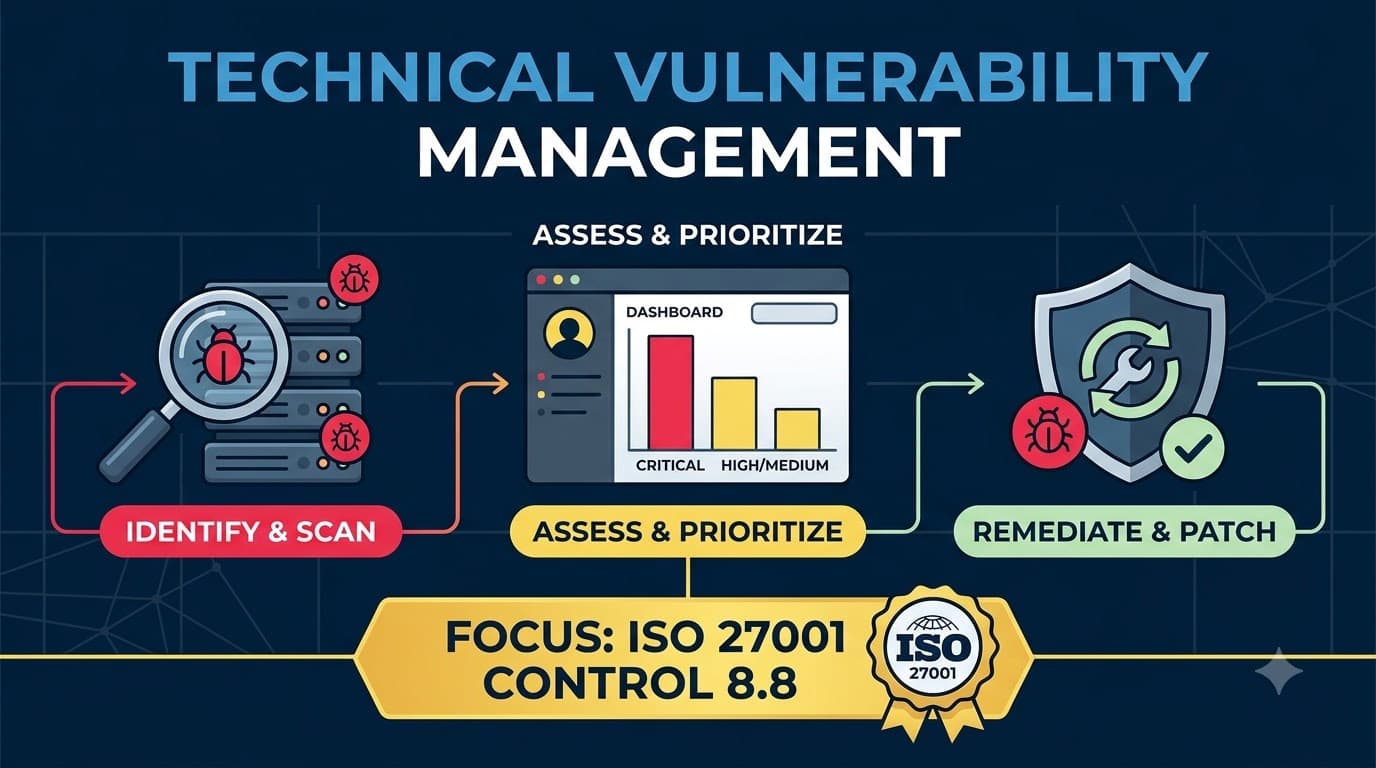
A functioning control 8.8 program is a closed loop, not a one-way feed from scanner to spreadsheet. The lifecycle below is the shape I use when designing vulnerability management programs from scratch, and it maps directly to what an auditor will trace during a Stage 2 evidence walkthrough.
flowchart LR
    A[Discover] --> B[Assess & Prioritize]
    B --> C[Remediate or Mitigate]
    C --> D[Verify]
    D --> E[Report & Improve]
    E -.feedback.-> A
    B -->|cannot remediate now| F[Exception / Risk Acceptance]
    F --> D
Discovery feeds assessment, which routes to one of two paths: remediation (patch, upgrade, or configuration fix) or, when remediation isn't immediately possible, a documented exception with compensating mitigation. Both paths converge on verification — confirming the fix actually closed the gap, typically via a rescan or targeted retest, not just a closed ticket. Verification feeds reporting, which surfaces metrics to leadership and closes the loop by refining what gets discovered and prioritized next cycle.
The step teams skip most often is verification. I have reviewed more vulnerability management programs than I can count where "remediated" meant "a patch was pushed" with no confirmation the patch actually applied cleanly, restarted the affected service, or resolved the underlying weakness. A rescan — even a lightweight, targeted one against just the previously-flagged host — is the difference between a closed ticket and a closed vulnerability, and auditors increasingly ask to see rescan evidence specifically, not just change tickets.
When You Can't Patch: Mitigation and Compensating Controls
Patching is the default answer, but it isn't always available on the timeline the SLA demands. Vendor patches lag behind disclosure, legacy systems can't be touched without breaking a production line, and some fixes require a maintenance window that's still weeks away. Control 8.8's third clause — "appropriate measures shall be taken" — deliberately doesn't say "patched." It allows for mitigation, and a mature program has a menu of compensating controls ready rather than inventing one under pressure.
Constraint | Compensating Control Option | Notes |
|---|---|---|
Vendor patch not yet available | Virtual patching via WAF/IPS signature | Buys time; must be tracked and removed once real patch applies |
Legacy/unsupported system can't be patched | Network segmentation / isolation | Reduces exposure surface; verify segmentation with testing, not assumption |
Production system requires extended change window | Increased monitoring/logging on affected asset | Detects exploitation attempts while patch is pending |
OT/ICS equipment with vendor certification constraints | Compensating access controls, jump-host restriction | Common in manufacturing; document vendor constraint explicitly |
Third-party/SaaS vulnerability outside direct control | Vendor escalation, contractual SLA enforcement | Ties to supplier security obligations |
Business-critical app breaks under patch | Application-layer input validation / temporary feature disablement | Short-term only; must have a remediation date, not indefinite |
Every compensating control on this list shares one property: it's temporary by design and needs an expiry date tied back to when the actual fix lands. A virtual patch that's been "temporary" for eighteen months is not a compensating control anymore — it's an undocumented risk acceptance wearing a disguise, and it's exactly the kind of thing an experienced auditor will pull on until it unravels.
Exceptions and Risk Acceptance
Some vulnerabilities will not be remediated within SLA, and pretending otherwise just pushes the honesty problem downstream. The exceptions process is where control 8.8 earns its keep as a genuine risk management control rather than a ticket-closing exercise — and it's the single artifact auditors ask for most often after the vulnerability register itself.
A defensible exception record needs, at minimum: the specific vulnerability and affected asset(s), the business or technical reason remediation isn't happening on schedule, the compensating control (if any) in place during the exception period, a named risk owner who has formally accepted the residual risk, an expiry or review date, and a record in — or explicit linkage to — your risk register. That last point matters: a technical vulnerability that won't be patched on time is a risk like any other and belongs in the same risk treatment and acceptance process governed under Clause 6, not in a side channel only the security team sees. A well-run Risk Register keeps these accepted vulnerability risks visible to the same governance forum that reviews every other risk in the ISMS, rather than letting them live only in a ticketing system nobody outside IT ever opens.
Exceptions need a ceiling, too. I advise clients to cap standing exceptions at a defined interval — 90 days is common — after which the exception must be re-justified and re-approved, not silently rolled over. An exception that auto-renews forever is, functionally, an unmanaged acceptance of unlimited risk, and it is one of the fastest ways to turn a minor audit observation into a major nonconformity when a reviewer notices the same vulnerability has had the same "temporary" exception for two years running.
"The exceptions log is the most honest document in a security program. It tells you exactly where the organization's stated risk appetite meets its actual operational reality — and it tells an auditor whether that gap is being managed or just tolerated." — Priya Raman, ISMS Manager, Ashford Trust Bank
Coordinating with Change Management (Control 8.32)
Patching is a change, and every patch that touches a production system should flow through the same governance as any other change — this is one of the most consistent implementation gaps I find, because security teams and change teams often operate as if vulnerability remediation is somehow exempt from the rules everyone else follows. It isn't, and pretending it is invites exactly the kind of unplanned outage that makes the next patch cycle politically harder to push through.
Change management, covered by control 8.32, exists to make sure a patch doesn't break something worse than the vulnerability it fixes. The practical integration point is an emergency change category specifically for critical and high-severity security patches — a lighter-weight approval path than a standard change request, but still a path, with a named approver, a rollback plan, and a record. Without that fast lane, security teams either bypass change management entirely under pressure (creating a different kind of audit finding) or wait for the next scheduled change advisory board meeting while a critical vulnerability sits open (blowing the SLA). Neither is acceptable, and both are avoidable with a pre-agreed emergency change process defined before you need it, not improvised during an incident.
The document trail matters as much as the process. When an auditor asks to see how a critical patch got deployed, the ideal answer links three things together: the vulnerability ticket, the change record showing what was approved and by whom, and the verification evidence showing the patch actually applied. If those three artifacts live in three disconnected systems that don't cross-reference each other, you can usually still assemble the story — but it takes an uncomfortable amount of manual reconstruction during the audit, which is its own kind of red flag.
Coordinating with Configuration Management (Control 8.9)
Configuration management, control 8.9, is the quieter partner in this relationship, but it's just as load-bearing. A meaningful share of "vulnerabilities" a scanner reports aren't missing patches at all — they're configuration drift: a hardening baseline that was applied at deployment and has since eroded through ad hoc changes, a default credential that was supposed to be disabled, a service that was supposed to be turned off and got quietly re-enabled during troubleshooting six months ago.
Configuration management gives you the baseline to compare against and the mechanism to detect and correct drift — which means a mature 8.8 program doesn't just ask "is this patched," it asks "does this system still match its approved secure configuration baseline." When those two controls are integrated, a configuration scan and a vulnerability scan often run against the same asset inventory, feed the same remediation queue, and get prioritized by the same risk criteria, rather than existing as two disconnected reports nobody reconciles.
I've seen the absence of this integration cause real damage: a client patched a critical vulnerability on schedule, closed the ticket, and had the exact same weakness reappear four months later because the underlying golden image used to provision new servers had never been updated. The patch was applied to running instances but the configuration baseline — the actual source of truth for how new systems get built — was never touched. Every new server provisioned from that image reintroduced the vulnerability from day one. That's a control 8.9 failure masquerading as a control 8.8 success, and it's exactly the kind of systemic gap a thorough auditor, or a second breach, will eventually surface.
Build vs. Buy: Choosing Vulnerability Management Tooling
Clients frequently ask me whether they need an enterprise vulnerability management platform, a lighter open-source stack, or a managed detection and response provider that includes scanning as part of a broader service. There's no universally correct answer, but there is a useful way to frame the decision: tooling should match the complexity of your environment and the maturity of your internal process, not the other way around. PentesterWorld's best vulnerability scanners comparison is a useful starting point for narrowing that shortlist before you get deep into vendor demos.
A commercial vulnerability management platform earns its cost when you have a large, heterogeneous estate — mixed cloud providers, on-premises infrastructure, containers, and enough assets that manual reconciliation between "what we scanned" and "what we own" becomes impractical. These platforms typically bundle asset discovery, prioritization scoring, ticketing integration, and reporting dashboards that map reasonably well to the metrics discussed later in this article. The tradeoff is cost and, often, a lengthy tuning period before the tool's built-in risk scoring reflects your actual environment rather than a generic vendor model.
Open-source and cloud-native tooling makes sense for smaller organizations, or for teams supplementing a commercial platform with specialized coverage — container image scanning integrated directly into a CI/CD pipeline, for instance, is frequently open-source even in organizations that run commercial infrastructure scanning elsewhere. The tradeoff here is integration effort: open-source tools rarely come with the ticketing and reporting glue that makes a program auditable without additional engineering work.
Managed services — where a third party runs scanning and delivers findings, sometimes with basic triage included — suit organizations without a dedicated security team, but they introduce a critical caveat worth stating plainly: outsourcing the scan does not outsource the accountability. Control 8.8 still requires your organization to evaluate exposure and take appropriate measures; a managed provider that hands you a monthly PDF report is not, by itself, a functioning control. I've seen this misunderstanding cause real audit trouble — an organization assumed its managed security provider "handled vulnerability management" contractually, only to discover during Stage 2 that nobody internally owned triage, prioritization, or remediation tracking at all. Whatever tooling model you choose, the roles and responsibilities table earlier in this article still needs a named owner inside your organization, not just a vendor relationship.
Testing Patches Before Deployment
"Deploy fast" and "deploy safely" are in tension every single patch cycle, and control 8.8's implementation guidance explicitly expects patches to be tested before they reach production — not skipped in the name of speed. This doesn't mean every patch needs a weeks-long regression cycle; it means you need a proportionate testing gate calibrated to system criticality and patch risk.
For most organizations, that looks like a tiered approach: low-risk patches to non-critical systems can go through an automated deployment ring with monitoring and fast rollback; patches to business-critical systems get deployed to a staging or canary environment first, with defined acceptance criteria, before touching production; and emergency patches for actively-exploited critical vulnerabilities get an abbreviated but still-real sanity check — does the service start, does authentication still work, is there an obvious breakage — even when the full test suite can't run in the available window.
The environments used for this testing should themselves be properly separated from production, which is a distinct expectation the standard addresses elsewhere in the technological controls set covering environment separation. Testing patches in an environment that isn't representative of production, or testing in production itself because "there was no time," defeats the purpose and tends to surface as a finding when an auditor asks how you validate patches don't break things before they ship broadly.
Continuous Monitoring Versus Periodic Scanning
A question I get in nearly every workshop: is monthly or weekly scanning still good enough, or does control 8.8 effectively require continuous, always-on vulnerability monitoring? The honest answer is that ISO 27001 doesn't dictate a cadence, but the practical risk calculus has shifted meaningfully over the years I've been doing this work, and periodic scanning alone is a weaker position than it used to be.
The gap between "vulnerability disclosed" and "vulnerability actively exploited at scale" has compressed dramatically for internet-facing software — it is not unusual for mass exploitation attempts to begin within days, sometimes hours, of a significant disclosure. A monthly scan cycle means, in the worst case, an internet-facing critical vulnerability could sit undetected for weeks after both disclosure and the start of active exploitation. That's the exact mechanism that put Solstice Health Network's VPN appliance at risk, except in that case the vulnerability had already been found — it simply hadn't been acted on. Continuous or near-continuous scanning of internet-facing assets closes the detection half of that gap; the discipline described throughout this article closes the action half.
My practical recommendation, calibrated by asset criticality rather than a blanket policy: internet-facing and business-critical assets warrant continuous or daily automated scanning plus real-time threat intelligence correlation; internal, lower-criticality assets can reasonably run on a weekly-to-monthly authenticated scan cycle without materially increasing risk. This tiered cadence, layered on top of the priority tiers already defined for remediation SLAs, keeps scanning effort proportionate rather than either wastefully continuous everywhere or dangerously infrequent where it matters most.
Penetration Testing and Security Testing: The Complement to Scanning
Vulnerability scanning and penetration testing are frequently confused, and that confusion causes real gaps in coverage. A scanner checks systems against a known database of signatures and configurations — it's fast, broad, and automatable, but it can only find what it already knows to look for. Penetration testing puts a skilled human (or team) in an attacker's seat to find what the scanner can't: chained vulnerabilities that are individually low-severity but combine into a critical path, business-logic flaws with no signature at all, and the kind of lateral-movement opportunity that only becomes visible once someone is actually inside the network trying to get somewhere they shouldn't.
Control 8.8 and control 8.29, security testing in development and acceptance, work together at different points in the lifecycle: 8.29 is about testing security into systems before and during deployment as part of the development pipeline, while 8.8 is about continuously managing vulnerabilities in systems that are already live. A well-run program treats penetration test findings as another discovery source feeding the same vulnerability management workflow described earlier — a finding from an annual penetration test gets the same risk-based prioritization, the same SLA clock, and the same exception process as a finding from an automated scan. Too many organizations instead treat penetration test reports as a one-time compliance artifact, filed away after the audit and never fed back into the operational remediation queue, which defeats much of the value of commissioning the test in the first place.
"A penetration test that produces a PDF nobody actions is worse than not testing at all, because now the organization has documented proof it knew about a weakness and did nothing. I tell every client: the test isn't the deliverable. What you do with the findings in the following ninety days is the deliverable." — Derek Osei, Lead Penetration Tester, Ironclad Offensive Security
Zero-Days Versus Known Vulnerabilities: Different Playbooks
Most of this article has focused on the steady-state work of managing known, cataloged vulnerabilities — the ones with a published CVE, a CVSS score, and a vendor patch on a predictable timeline. Zero-day vulnerabilities, disclosed with no patch available and sometimes with active exploitation already underway, need a distinct playbook layered on top of everything described so far, because the normal SLA-and-ticket rhythm assumes a patch exists to work toward.
When a zero-day affecting software in your environment breaks publicly, the first move is rapid applicability assessment: do we run the affected version, is the vulnerable component exposed, and is there any indication of active exploitation against organizations like ours. This is where the threat intelligence integration described earlier in this article stops being a nice-to-have and becomes the thing that tells you whether you have hours or weeks to respond. Second, because no patch exists yet, the response is mitigation-first by definition: temporary network controls, disabling an affected feature, virtual patching signatures from your intrusion prevention vendor, or, in severe cases, taking an exposed service offline until a fix ships. Third, zero-day response needs an accelerated version of the exceptions process — not a 90-day standing exception, but a daily-reviewed interim risk acceptance that gets re-examined every single day until a real patch lands and closes the gap.
The organizations that handle zero-days well are, without exception, the ones that already run a disciplined known-vulnerability program. The muscle memory of rapid applicability assessment, documented mitigation, and formal interim risk acceptance is exactly the same muscle memory built by managing routine CVEs on a normal cadence — zero-day response is not a separate program, it's the known-vulnerability program running at maximum speed with the patch step temporarily missing.
Dimension | Known Vulnerability (Patch Available) | Zero-Day (No Patch Yet) |
|---|---|---|
Primary response | Patch on SLA-defined timeline | Mitigation-first; patch when vendor releases one |
Prioritization input | CVSS + exposure + exploit maturity | Threat intelligence and active-exploitation signals dominate |
Exception review cadence | Periodic (e.g., every 90 days) | Daily until resolved |
Verification method | Rescan confirming patch applied | Confirm mitigating control is active and effective |
Typical owner of the decision | Vulnerability management lead | CISO or incident response lead, given urgency |
Roles and Responsibilities
Vulnerability management fails as often from ambiguous ownership as from missing tools. Every organization I've assessed that struggled with control 8.8 had, on closer inspection, a scanning tool with nobody clearly accountable for what happened to its output. The table below is a starting allocation, not a mandate — smaller organizations will consolidate several of these into one or two people, and that's fine, as long as the accountability is explicit rather than assumed.
Role | Core Responsibility |
|---|---|
CISO / Security Leader | Owns the program, approves risk acceptances above a defined threshold, reports metrics to leadership/board |
Vulnerability Management Lead | Runs scanning cadence, triages and prioritizes findings, tracks SLA compliance |
Asset/System Owners | Accountable for remediation on their systems, approve or escalate exceptions |
IT Operations / Patch Team | Executes patches and configuration changes within change management |
Change Advisory Board | Approves production changes, including emergency security patches |
Internal Audit / Compliance | Independently verifies SLA adherence and exception governance |
Risk Owner (per accepted exception) | Formally accepts residual risk and reviews it at the agreed interval |
A Maturity Model: Where Does Your Program Actually Stand
When I'm brought in for a gap assessment, one of the first things I do is place the organization on a maturity curve, because "do you have a vulnerability management program" is rarely a yes-or-no question — it's a question of how far along a fairly predictable path the organization has traveled. Naming the stage honestly tends to defuse a lot of defensiveness in the room, because almost nobody starts at the top, and almost everybody I've worked with has moved up at least one level within a year of sustained effort.
Maturity Stage | Characteristics | Typical Gap to Close Next |
|---|---|---|
Ad hoc | Scanning is inconsistent or absent; no prioritization method; patching is reactive | Establish baseline scanning cadence and asset inventory |
Reactive | Regular scanning exists; findings pile up faster than they're closed; no SLA | Define priority tiers and SLA table; assign ownership |
Managed | SLAs exist and are mostly tracked; exceptions are documented but inconsistently reviewed | Automate SLA tracking; integrate threat intelligence into prioritization |
Integrated | Vulnerability management is tied into change and configuration management; metrics reported to leadership | Formalize verification/rescan step; refine metrics beyond raw counts |
Optimized | Continuous discovery across cloud/containers/third-party code; metrics drive proactive architecture decisions | Sustain and refine; use data to inform investment and risk appetite discussions |
Solstice Health Network, before its breach, was arguably sitting at "Reactive" — scanning existed, findings were flagged, but nothing forced them through to closure on a timeline. Ashford Trust Bank moved from "Reactive" to "Integrated" in about five months through the changes described in its case study later in this article. Most organizations preparing for their first ISO 27001 certification need to reach "Managed" at minimum to pass a Stage 2 audit comfortably on control 8.8; "Integrated" is where the control starts genuinely reducing risk rather than just satisfying an auditor.
Metrics and KPIs That Prove the Control Is Working
A vulnerability management program that can't produce numbers is a program that can't prove it's working — to leadership, to auditors, or honestly to itself. The metrics below are the set I recommend clients track monthly at minimum, with the mean-time figures reported to leadership as the headline indicators of program health.
Metric | What It Tells You | Illustrative Healthy Benchmark |
|---|---|---|
Mean time to remediate (MTTR) — critical | Speed of response to the highest-risk findings | Under 7 days |
Mean time to remediate — high | Speed of response to high-severity findings | Under 21 days |
SLA compliance rate | Percentage of vulnerabilities closed within defined SLA | 90%+ for critical/high |
Scan coverage | Percentage of known assets included in regular scanning | 95%+ |
Open critical vulnerability count (aging) | Backlog health; how many critical findings exceed SLA | Trending toward zero, tracked weekly |
Exception rate | Percentage of findings resolved via risk acceptance vs. remediation | Under 10% for critical/high tiers |
Rescan/verification rate | Percentage of "remediated" findings confirmed via retest | 100% for critical/high |
Repeat vulnerability rate | Same weakness reappearing after prior remediation (often a config baseline signal) | Trending down |
Vulnerabilities discovered via pen test vs. scan | Balance of discovery sources; over-reliance on one method is a coverage gap | Diversified across sources |
Boards and executive committees rarely want the full vulnerability count — that number is almost always alarmingly large and not very informative on its own. What they want, and what I've found actually drives better decisions, is the trend on MTTR for critical findings, the aging backlog of anything past SLA, and the exception rate. Those three numbers, tracked over six to twelve months, tell a story leadership can act on: are we getting faster, is the backlog growing or shrinking, and are we fixing things or just excusing them.
Evidence Auditors Expect to See
When an ISO 27001 auditor tests control 8.8, they are not looking for a perfect zero-vulnerability environment — that doesn't exist anywhere, and any auditor who expects it hasn't done this job very long. They're looking for a defensible, evidenced, operating process. The table below is drawn directly from the evidence requests I prepare clients for ahead of Stage 2 audits and surveillance visits.
Evidence Type | What It Demonstrates | Where It Typically Lives |
|---|---|---|
Vulnerability scan reports (internal + external) | Discovery is occurring on a defined cadence | Scanning platform, ticketing system |
Asset inventory with scan coverage mapping | Scanning covers the actual estate, not a subset | CMDB/asset register |
Vulnerability register/ticketing log with dates | Tracks discovery-to-closure timeline against SLA | Vulnerability management platform |
SLA policy document | Defines the timelines the organization commits to | ISMS document set |
Sample of closed tickets with rescan/verification | Confirms remediation was actually verified, not assumed | Ticketing system, scan re-reports |
Risk acceptance/exception records | Shows undocumented risk is not silently tolerated | Risk register, exception log |
Change records for patch deployments | Confirms coordination with change management (8.32) | Change management system |
Threat intelligence integration evidence | Shows exposure evaluation accounts for real-world exploitation | SOC/threat intel platform logs |
Metrics/KPI reports to management | Demonstrates management review and oversight | Management review minutes, dashboards |
Roles and responsibilities documentation | Confirms accountability is assigned, not assumed | ISMS policy/procedure documents |
The single most persuasive piece of evidence, in my experience, isn't any one document — it's the ability to pick a random vulnerability from the register, live, during the audit, and walk the auditor through its entire lifecycle: when it was found, how it was scored, who owned it, what SLA applied, what happened, and how closure was verified. If you can do that smoothly for a vulnerability the auditor picked rather than one you prepared in advance, you've demonstrated the control is a living process rather than an audit performance.
Common Mistakes I See Again and Again
After more gap assessments and audit preparation engagements than I can count, the failure patterns repeat with remarkable consistency. None of these are exotic; all of them are avoidable.
Mistake | Why It Happens | Fix |
|---|---|---|
Scanning without an accurate asset inventory | Inventory work is unglamorous and perpetually deprioritized | Treat inventory as a blocking dependency, not a parallel task |
Prioritizing on raw CVSS score alone | It's the easiest number to sort by | Layer exposure, exploitability, and business context on top |
No SLA clock, or an SLA nobody tracks | SLA exists on paper but isn't dashboarded | Automate SLA tracking inside the ticketing/scanning platform |
Treating "patch deployed" as "vulnerability closed" | Verification step is skipped under time pressure | Require rescan or targeted retest before closure |
Exceptions that silently roll over indefinitely | No expiry date or re-approval requirement | Cap exception duration; require periodic re-justification |
Vulnerability management disconnected from change management | Different teams, different tools, no integration point | Define an emergency change lane for security patches |
One-time penetration test report, never operationalized | Test treated as compliance checkbox, not input to remediation | Feed pen test findings into the same VM workflow and SLA |
No metrics reported to leadership | Program exists at operational level only | Report MTTR, SLA compliance, and aging backlog monthly |
Golden images/baselines never updated after patching live systems | Config management (8.9) not integrated with patching | Update baselines/images as part of the patch process, not after |
OT/legacy systems excluded from scope entirely | "We can't patch it so we don't track it" | Include in inventory; manage via compensating controls, not exclusion |
Communicating Vulnerability Risk to the Board
Technical teams routinely underinvest in translating vulnerability data into language a board or executive committee can act on, and I understand why — the raw numbers are technical, the backlog is embarrassing, and nobody wants to be the person explaining why there are 4,000 open findings. But a board that never sees an honest picture of vulnerability exposure cannot make informed decisions about budget, staffing, or risk appetite, and it certainly cannot sign off on the risk acceptances the exceptions process requires.
The reporting format that has worked best across my client base is short and trend-focused rather than exhaustive: a single slide or page showing the MTTR trend for critical and high findings over the past six to twelve months, the current count of SLA-breaching critical vulnerabilities with a one-line reason for each, the exception rate and whether it's rising or falling, and — critically — a plain-language statement of what would happen if the top two or three open risks were exploited. That last element is what turns a status update into a decision-forcing document. Boards fund things they understand the consequence of not funding.
It's also worth normalizing the idea that a rising vulnerability count is not automatically bad news. An organization that just expanded cloud scanning coverage, or just onboarded a new business unit's infrastructure into scope, will see its numbers climb even as its actual security posture improves, because it can now see problems it couldn't see before. I coach clients to report coverage expansion alongside the raw count specifically to prevent a board from misreading improved visibility as regression — a mistake that, if made once, tends to make security leaders reluctant to expand scope again for fear of how the numbers will look.
"The board doesn't want a spreadsheet. They want to know: are we getting faster, are we exposed right now, and if something bad happens next week, did we know about it and choose not to act, or did we genuinely not see it coming. Answer those three questions honestly and the budget conversation gets a lot easier." — Tom Whitfield, Director of Vulnerability Management, Nimbus Cloud Works
Case Study: Ashford Trust Bank Cuts Remediation Time by 87%
Ashford Trust Bank, a mid-sized regional bank preparing for its first ISO 27001 certification, came to its gap assessment with a vulnerability scanner that had been running faithfully for three years and a mean time to remediate critical findings of 82 days. Priya Raman, the ISMS manager tasked with closing the gap before Stage 1, described the existing state candidly: "We had beautiful reports. Nobody read past the executive summary."
The fix wasn't a new tool — it was operational discipline layered onto the existing scanner. Ashford built a risk-based prioritization model that combined CVSS with internet-facing exposure and data classification, set explicit SLAs by tier, stood up an emergency change lane with its change advisory board for critical patches, and started reporting three metrics to the risk committee every month: MTTR for critical findings, SLA compliance rate, and aging backlog count.
Within five months, mean time to remediate critical vulnerabilities dropped from 82 days to 11 days — an 87% improvement — and SLA compliance for critical and high findings reached 94%. Ashford passed its Stage 2 audit with zero major nonconformities related to control 8.8, and the auditor specifically cited the linked evidence chain — vulnerability ticket, change record, rescan confirmation — as "exemplary" in the closing meeting.
Case Study: Nimbus Cloud Works Learns Threat Context the Hard Way
Nimbus Cloud Works, a SaaS provider serving enterprise clients under contractual security requirements referencing ISO 27001, had a scanning program that dutifully patched vulnerabilities in strict CVSS order, highest score first, no exceptions. Tom Whitfield, the company's director of vulnerability management, explained the blind spot this created: "We were treating a 9.8 on an internal staging server with no data as more urgent than a 7.4 on our public API gateway that was actively being probed by automated bots. The math was backwards."
The correction came after a near-miss: an actively exploited vulnerability affecting the API gateway sat in the queue behind three higher-CVSS but lower-exposure findings for eleven days before a threat intelligence alert flagged mass scanning activity targeting that specific CVE. Nimbus rebuilt its prioritization model to weight internet exposure and active exploitation status alongside base severity, integrated a threat intelligence feed directly into the ticketing workflow, and restructured its SLA tiers around the model described earlier in this article.
Eighteen months later, Nimbus's exception rate for critical findings had dropped from 22% to 6%, and the company used its improved vulnerability metrics as a selling point in enterprise procurement conversations — turning a former audit risk into a competitive differentiator during vendor security reviews.
Case Study: Delta Forge Industries and the OT Patching Problem
Delta Forge Industries, a mid-size manufacturer with both corporate IT and an operational technology (OT) environment running production line controllers, faced a problem common to manufacturing and critical infrastructure: a meaningful share of its vulnerabilities existed on systems that simply could not be patched on a normal cadence without risking a production line stoppage that would cost more per hour than most breaches.
Marcus Webb, Delta Forge's CISO, had inherited a program where OT systems were effectively excluded from the vulnerability register — "if we can't fix it, why track it" was the informal logic. That approach collapsed during a pre-certification gap assessment, when it became clear the exclusion itself was the nonconformity: control 8.8 doesn't exempt systems that are hard to patch, it requires a documented, risk-based response, which can absolutely include compensating controls rather than patching.
Delta Forge rebuilt its approach around network segmentation between IT and OT environments, jump-host-only access to controllers, enhanced monitoring on OT network segments, and a formal, board-reviewed risk acceptance for each unpatched OT vulnerability with an annual re-review cycle rather than an indefinite exception. The vulnerability count on paper didn't shrink much — but every one of them now had an owner, a documented rationale, a compensating control, and a review date. That was the difference between a major nonconformity and a clean certification.
"I used to think 'we can't patch OT equipment' was a valid excuse. An auditor politely explained to me that it's not an excuse, it's the exact scenario the exceptions process exists for. That reframing changed how I run the whole program." — Marcus Webb, CISO, Delta Forge Industries
How Control 8.8 Aligns Across Frameworks
Organizations rarely need to satisfy only ISO 27001. If you're pursuing multiple attestations or your customers demand cross-framework assurance, a control 8.8 program built well does most of the heavy lifting elsewhere too, though ISO 27001 certification itself should be understood as supporting these other obligations rather than substituting for direct compliance with them. A single well-evidenced vulnerability management program is frequently the shared foundation behind a PCI DSS vulnerability management and penetration testing program, a SOC 2 vulnerability and risk mitigation control, and evidence mapped to the NIST Cybersecurity Framework's Identify and Protect functions.
Framework | Relevant Requirement | Overlap With Control 8.8 |
|---|---|---|
PCI DSS | Requirement 6 (vulnerability management, patching) and Requirement 11 (vulnerability scanning, penetration testing) | Near-total overlap in scanning cadence, patch timelines, and testing expectations |
SOC 2 | Common Criteria around risk mitigation and monitoring activities | Vulnerability scanning and remediation evidence commonly requested by SOC 2 auditors |
NIST CSF | Identify (asset and vulnerability awareness) and Protect (protective technology, maintenance) functions | Vulnerability management directly supports both functions' expected outcomes |
HIPAA Security Rule | Risk analysis and risk management implementation specifications | Technical vulnerability findings feed the required ongoing risk analysis |
GDPR / DORA | Security of processing / ICT risk management expectations | Documented vulnerability handling supports "appropriate technical measures" obligations |
If you're weighing which framework to prioritize, or how the underlying control language compares across them, our comparison of ISO 27001 against NIST, SOC 2, and PCI DSS is a useful companion read before you start mapping evidence across multiple audits.
A 90-Day Roadmap for Standing Up (or Fixing) Control 8.8
For teams starting from a scanner-with-no-process state — which, honestly, describes the majority of organizations I walk into pre-certification — the roadmap below is realistic without being slow. If you're not yet sure how big the gap is, running your current state through a structured ISO 27001 Gap Analysis Tool before day one will tell you which of the four phases below you actually get to skip.
Phase | Timeframe | Key Activities |
|---|---|---|
Foundation | Days 1–30 | Validate/complete asset inventory; confirm scan coverage; define priority tiers and SLA table; assign roles |
Process | Days 31–60 | Stand up exception/risk acceptance workflow; build emergency change lane with CAB; integrate threat intel feed |
Proof | Days 61–90 | Run first full metrics cycle; conduct internal audit dry-run on 8.8 evidence; remediate backlog of aged critical findings |
Ongoing | Quarterly+ | Management review of metrics; re-test compensating controls; refresh risk criteria alongside Clause 6 review cycle |
The Strategic Case: Vulnerability Management as a Business Advantage
It's tempting to frame control 8.8 purely as an audit obligation — a box on a certification checklist that costs money and produces reports nobody reads until something goes wrong. I'd push back on that framing, because it undersells what's actually at stake and what's actually available to the organizations that get this right.
Every one of the case studies in this article represents an organization that turned a compliance requirement into an operational and, in Nimbus Cloud Works' case, a commercial advantage. Faster remediation times mean shorter windows of exposure, which means fewer incidents like the one that cost Solstice Health Network $4.7 million and eleven weeks of disrupted patient care. Defensible, evidenced risk acceptance means the organization isn't guessing about its exposure — it knows, in writing, exactly what risk it's carrying and why. And in an increasingly common pattern, mature vulnerability management metrics are becoming a differentiator in enterprise procurement and vendor security questionnaires, well beyond the ISO 27001 audit itself.
The organizations I've watched get the most value from control 8.8 didn't treat it as a standalone project. They built it as connective tissue between asset management, risk assessment, change control, configuration management, and incident response — the same connective tissue this article has traced from asset inventory through discovery, prioritization, remediation, exceptions, and metrics. Get that connective tissue right, and control 8.8 stops being a line item you scramble to evidence before an audit and becomes one of the more reliable early-warning systems your security program has.
If you're mapping where control 8.8 fits alongside every other Annex A requirement, our Annex A — All 93 Controls at a Glance cheat sheet is a fast way to see the full picture, and if you're building or refreshing your Statement of Applicability, the way you justify inclusion, applicability, and implementation status for control 8.8 should be documented the same way described in our guide to the ISO 27001 Statement of Applicability. For a full walkthrough of building the program end to end — inventory, risk methodology, controls, and audit readiness together — our Complete ISO 27001 Implementation Guide eBook covers the sequencing in more depth than any single article can, and if terms like CVSS, KEV, or risk acceptance still need a plain-English anchor for your team, our ISO 27001 terminology and glossary of key terms is worth bookmarking alongside this article.
Maria Chen's board, in the end, didn't ask her to eliminate vulnerabilities — that was never a realistic ask. They asked her to prove the organization would know about the next one fast, evaluate it honestly, and act on a clock. That's the whole of control 8.8, and it's entirely achievable with the structure laid out in this guide. If you want a second set of eyes on where your own program stands before an auditor finds the gaps for you, PentesterWorld's assessment and advisory team works with organizations at every stage of that journey, from first gap analysis through certification and beyond.