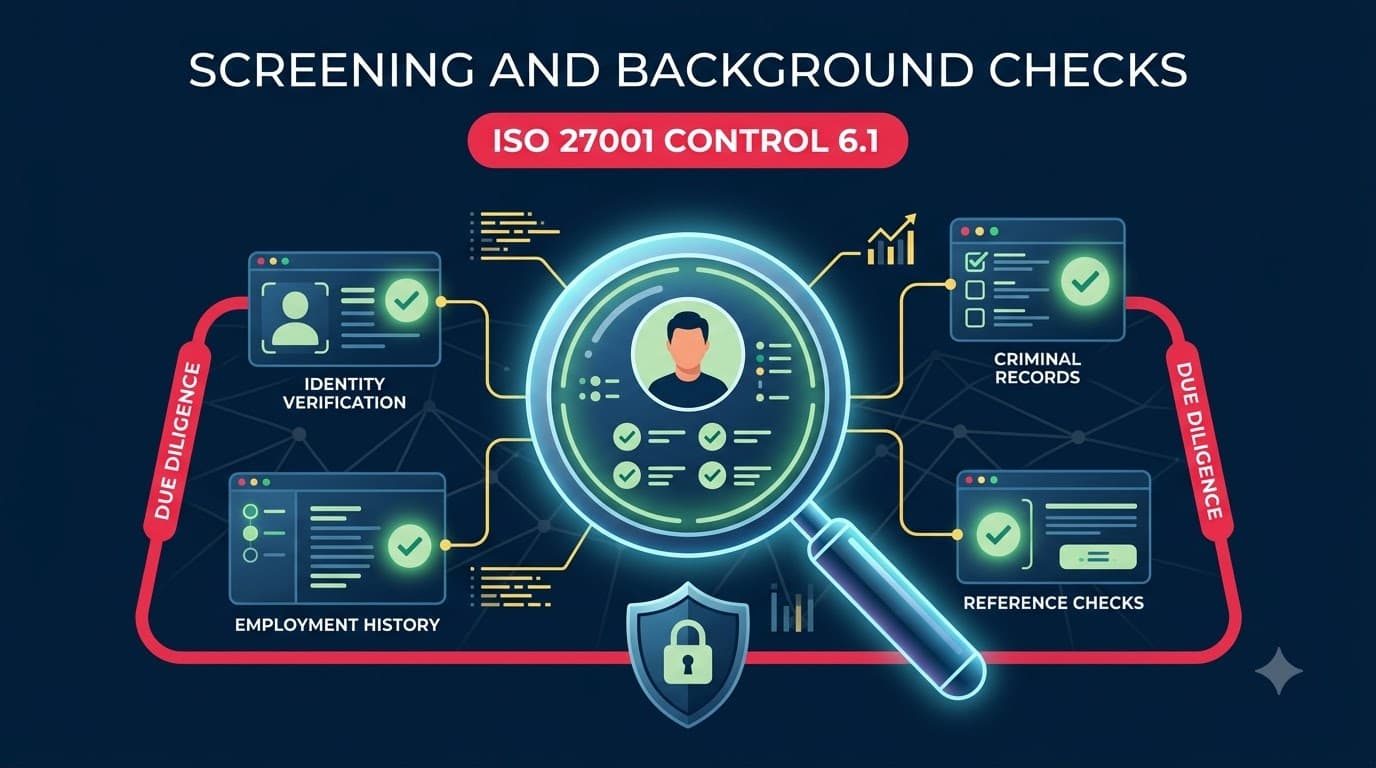
Marcus Webb had been CISO at Northfield Data Solutions for eleven weeks when the call came in from the incident response retainer he'd inherited but never expected to use. Northfield processed medical claims for six regional insurers — roughly 1.4 million policyholder records touching diagnosis codes, social security numbers, and payment details. Three months earlier, in a scramble to clear a backlog before a client audit, the operations director had brought on a contract database administrator named Dale Renner through a staffing agency. Renner had strong references from his agency profile, a plausible resume, and — because the agency's placement fee already felt like enough due diligence to the operations director — no independent identity verification, no criminal history check, and no confirmation that "Dale Renner" was in fact the legal identity behind the Social Security number on his onboarding paperwork.
It wasn't. Nine weeks into the contract, Renner — operating under a name that didn't match a prior wire fraud conviction in a neighboring state — used his elevated database credentials to export 40,000 policyholder records to a personal cloud storage account and sell subsets of that data on two separate forums before Northfield's DLP tooling finally flagged the exfiltration pattern. By the time Marcus finished the post-incident accounting six weeks later, the number attached to the file was $2.3 million: forensic investigation, breach notification to 40,000 individuals across three states with different notification-timing statutes, two years of credit monitoring, outside counsel, a state attorney general inquiry, and the loss of one of Northfield's two anchor insurance clients, who terminated the contract during their own vendor risk re-review. A basic identity check and a criminal background screen — the kind that costs $40 to $120 and takes two to five business days — would very likely have kept Renner out of the building entirely, or at minimum kept him away from a role with unsupervised access to unmasked policyholder data.
Northfield wasn't reckless. It was a company that treated hiring speed as a virtue and treated "the staffing agency probably checked" as due diligence. That gap — between what organizations assume happens during hiring and what actually happens — is exactly what ISO 27001 Annex A control 6.1, Screening, exists to close. It is one of the shortest controls in the standard, and one of the most consistently under-implemented, because it sits at the intersection of two departments (HR and security) that rarely share a control owner, and because "how much screening is enough" is a judgment call the standard deliberately declines to answer for you.
Who This Is For
This guide is for HR directors and talent acquisition leads who own the requisition-to-offer pipeline and need a defensible, auditable screening process; for CISOs and ISMS managers who need control 6.1 evidence that will survive a certification audit; for procurement and vendor managers who place contractors and staffing-agency personnel into roles with access to in-scope systems; and for founders at smaller organizations building their first screening policy from scratch. You'll walk away with a risk-tiering model that maps job roles to screening depth, a checks matrix covering the seven most common verification types, a region-aware legal constraints table, a re-screening cadence you can defend to an auditor, and a documented-evidence checklist that turns a scattered HR practice into a control an assessor will sign off on the first time. If any of the terminology in this guide is unfamiliar, PentesterWorld's ISO 27001 terminology and glossary defines the core vocabulary used consistently across this content pillar.
What ISO 27001 Control 6.1 Actually Requires
Control 6.1, Screening, sits in the eight-control People theme of Annex A (6.1–6.8) alongside terms of employment, security awareness training, and the disciplinary process. Its purpose statement in ISO 27002:2022 is to ensure that personnel are suitable and remain suitable for the roles they are considered for and hold. The control text itself is short but dense, and every clause of it matters:
Background verification checks on all candidates to become personnel shall be carried out prior to joining the organization and on an ongoing basis, taking into consideration applicable laws, regulations, and ethics, and shall be proportional to the business requirements, the classification of the information to be accessed, and the perceived risks.
Control 6.1 at a glance:
Attribute | Detail |
|---|---|
Control number | 6.1 |
Theme | People (6.1–6.8) |
Purpose | Ensure personnel are suitable, and remain suitable, for the roles they hold |
Applies to | Employees, contractors, and third-party personnel with access to in-scope information/systems |
Timing | Prior to joining and on an ongoing basis |
Key constraint | Proportional to business requirements, information classification, and perceived risk; subject to applicable law |
Unpack that sentence and you get five distinct obligations, not one:
"All candidates to become personnel" — this is broader than "employees." ISO 27002's guidance explicitly extends screening expectations to contractors and third-party personnel who will have access to the organization's information or information processing facilities, not just people on the payroll.
"Prior to joining ... and on an ongoing basis" — a single pre-hire check that's never repeated does not satisfy the control as written. Screening is a lifecycle activity, not a gate you pass once.
"Taking into consideration applicable laws, regulations, and ethics" — this is the control explicitly telling you it does not override local employment and privacy law. More on this below, because it is the single most misunderstood clause in 6.1.
"Proportional to the business requirements" — a receptionist and a database administrator with production access do not need identical screening. Over-screening low-risk roles wastes money and creates legal exposure of its own; under-screening high-risk roles is what happened to Northfield.
"The classification of the information to be accessed, and the perceived risks" — screening depth should be driven directly by what a role can touch, referencing the same classification scheme your organization uses under asset classification and handling and access control decisions.
A critical accuracy point that auditors will probe and that this guide will not blur: ISO 27001 does not make your screening program legally compliant with GDPR, the U.S. Fair Credit Reporting Act, "ban the box" ordinances, or any other jurisdiction's background-check or employment law. The standard requires that you have a proportionate, risk-based, documented screening process and that you take applicable law into account when you design it. Compliance with those underlying laws is your organization's responsibility as an interested party requirement — the kind of external obligation you should already be capturing in your interested parties and stakeholder requirements register — not something an ISO certificate confers on you.
"I've had clients ask me point-blank: 'If we're ISO 27001 certified, are we automatically GDPR-compliant on background checks?' The answer is no, and saying otherwise is the fastest way to get a company sued. ISO 27001 tells you to screen proportionately and take the law into account. It does not tell you what the law says. That's a separate legal review, every time, in every country you hire in." — Priya Anand, Director of HR Compliance, Chapelgate Financial Group (fictional)
Screening Is Proportional, Not Universal: The Three Legal Anchors
Before you build a checks matrix, it helps to internalize why control 6.1 is worded the way it is. ISO 27002's guidance gives three variables that should independently scale your screening depth up or down: business requirements (what does the role actually need to be trusted with), information classification (what's the sensitivity ceiling of what the role can access), and perceived risk (what's the realistic harm if this specific person turns out to be untrustworthy, given the role's authority). None of these variables is "years of experience" or "how much we like the candidate" — and none of them is "screen everyone the same way because it's simpler for HR."
That proportionality requirement cuts both directions. Organizations that run a full criminal history, credit check, and reference-triangulation process on every hire — including the warehouse picker who never touches a company laptop — are not more secure for it. They're slower to hire, more expensive per requisition, and in several jurisdictions are creating unnecessary legal exposure by collecting data they have no proportionate need for. I've reviewed screening programs at three different companies where the blanket "screen everyone the same" policy was itself flagged during a data protection impact assessment as excessive processing of personal data relative to purpose — the opposite problem from Northfield, but a real audit and legal finding all the same.
Pull-out: The proportionality test I use in every gap assessment
Before finalizing screening depth for any role, ask three questions and let the answers set the tier:
Does this role have standing access to information classified above "Internal" (confidential, restricted, or regulated data)?
Does this role have privileged, administrative, or financial-transaction authority that a single dishonest actor could abuse without a second person's involvement?
Would a background issue in this candidate's history (undisclosed conviction, falsified credential, sanctions hit) create a materially different risk in this role than it would in a low-access role?
If the answer to any one of those is yes, the role belongs in a higher screening tier. If all three are no, a lighter-touch baseline check is proportionate and defensible.
Risk-Tiering Roles: The Foundation of Proportionate Screening
The practical starting point for implementing 6.1 is a role-tiering exercise, usually run jointly by HR, the ISMS manager, and department heads, cross-referenced against your roles and responsibilities framework and your information classification scheme. I typically land clients on a four-tier model. Adjust the boundaries to your own risk appetite, but keep the structure — auditors respond well to a documented, criteria-based tiering model and respond badly to "we decide screening depth case by case," which reads as inconsistent and unauditable.
Tier 1 — Baseline (Low Sensitivity)
Roles with no standing access to confidential, restricted, or regulated information, and no financial or administrative authority. Think facilities staff, general warehouse roles, front-of-house hospitality staff, or interns with sandboxed, read-only access to non-sensitive systems. Baseline screening: identity verification and right-to-work confirmation only, plus employment gap explanation.
Tier 2 — Standard (Moderate Sensitivity)
The largest tier in most organizations: general office staff, customer support agents, junior developers on non-production systems, sales and marketing personnel with CRM access to customer contact data. Standard screening adds employment history verification (typically two most recent employers) and at least one professional reference, on top of Tier 1 checks.
Tier 3 — Elevated (High Sensitivity)
Roles with standing access to confidential or regulated data at scale, financial transaction authority, HR/payroll system access, or customer PII/PHI in volume — think finance team members, HR business partners, senior developers with production data access, and account managers handling regulated client data. Elevated screening adds criminal record checks (where lawful), qualification/certification verification, and in finance-adjacent roles, credit history checks where lawful and job-relevant.
Tier 4 — Critical/Privileged (Highest Sensitivity)
Roles with privileged administrative access to production systems, security infrastructure, or executive/board-level information; anyone in a position to approve large financial transactions alone; anyone with domain admin, database admin, or cloud root-account privileges; and personnel in regulated industries subject to statutory fit-and-proper requirements (many financial services and critical infrastructure roles). Critical screening adds sanctions and PEP (politically exposed person) screening, enhanced reference triangulation (verifying references independently rather than only calling numbers the candidate supplied), and — where the role is genuinely security-critical — more frequent re-screening.
Tier | Example Roles | Data/Access Profile | Screening Depth |
|---|---|---|---|
1 – Baseline | Facilities, warehouse, interns (sandboxed) | No confidential/regulated access | Identity + right-to-work |
2 – Standard | Office staff, support agents, junior developers, sales/marketing | Internal data, limited customer contact data | Tier 1 + employment history + 1 reference |
3 – Elevated | Finance staff, HR business partners, senior developers, account managers | Confidential/regulated data at scale, transaction authority | Tier 2 + criminal record (where lawful) + qualifications + credit (finance roles, where lawful) |
4 – Critical/Privileged | Sysadmins, DBAs, security team, executives, board | Privileged system access, executive data, regulatory fit-and-proper | Tier 3 + sanctions/PEP + enhanced reference verification + shorter re-screen cycle |
Dale Renner, the contractor in Northfield's breach, should unambiguously have been screened as Tier 4. He was hired through a staffing agency into Tier 2-equivalent process rigor because nobody had mapped "contract database administrator" onto the organization's access reality before the requisition went out. That mapping failure — not a failure of the checks themselves — is the single most common root cause I find when I trace a screening-related incident back to its origin.
Screening only works as a control when accountability for each step is unambiguous. I use a simple RACI to close that gap during implementation:
Activity | HR / Talent Acquisition | Hiring Manager | ISMS Manager / CISO | Legal | Background Check Vendor |
|---|---|---|---|---|---|
Role tiering | Consulted | Consulted | Accountable | Informed | Not involved |
Running checks | Responsible | Informed | Consulted | Informed | Responsible |
Adverse-finding review | Responsible | Consulted | Consulted | Accountable | Not involved |
Evidence retention | Accountable | Not involved | Consulted | Informed | Responsible (raw reports) |
Re-screening schedule | Responsible | Informed | Accountable | Informed | Responsible |
The Screening Decision Flow
The diagram below is the decision logic I build into screening policies: every requisition gets tiered before the checks are chosen, every check result routes to a documented decision (not a silent pass), and every adverse finding gets a proportionality review rather than an automatic rejection — which matters both for fairness and, in many jurisdictions, for legal compliance.
flowchart TD
    A[New requisition or contractor placement] --> B{Role tiering exercise}
    B -->|Tier 1: Baseline| C[Identity + right-to-work check]
    B -->|Tier 2: Standard| D[Tier 1 + employment history + 1 reference]
    B -->|Tier 3: Elevated| E[Tier 2 + criminal record where lawful + qualifications + credit if finance-relevant]
    B -->|Tier 4: Critical/Privileged| F[Tier 3 + sanctions/PEP screening + enhanced reference verification]
    C --> G{All checks clear?}
    D --> G
    E --> G
    F --> G
    G -->|Yes| H[Proceed to offer / onboarding]
    G -->|No - adverse finding| I[Proportionality and relevance review]
    I --> J{Finding job-relevant and material?}
    J -->|No| H
    J -->|Yes| K[Escalate to HR + legal for lawful adverse-action process]
    K --> L[Documented decision: rescind offer, restrict role, or proceed with mitigation]
    H --> M[Screening evidence filed in personnel record]
    M --> N[Ongoing re-screening per role tier cadence]
    N --> B
The Checks Matrix: What to Verify, By Role Tier
Seven verification types cover the vast majority of screening programs I've built. Not every check applies to every role, and — critically — not every check is lawful in every jurisdiction, which is why the matrix below is a starting menu, not a mandate. Cross-check every "where lawful" item against local law before you operationalize it.
Check Type | What It Verifies | Tier 1 | Tier 2 | Tier 3 | Tier 4 | Typical Cost/Turnaround |
|---|---|---|---|---|---|---|
Identity verification | Candidate is who they claim to be (government ID, biometric match) | Required | Required | Required | Required | $10–$30 / same day |
Right-to-work / eligibility | Legal authorization to work in the jurisdiction | Required | Required | Required | Required | $0–$25 / same day |
Employment history | Prior roles, dates, titles match resume claims | Not required | Required (2 most recent) | Required (full 5–7 yr) | Required (full, independently verified) | $20–$60 / 2–5 days |
References | Character and performance corroboration from prior supervisors | Optional | Required (1) | Required (2, independently sourced) | Required (2+, independently sourced) | $0–$40 / 2–4 days |
Criminal record | Convictions relevant to role trust/authority, where lawful to check | Not required | Not required (unless role-specific) | Required where lawful | Required where lawful | $30–$80 / 2–7 days |
Credit / financial history | Financial reliability, relevant to fiduciary or financial-transaction roles | Not required | Not required | Required for finance roles, where lawful | Required where lawful | $15–$40 / 1–3 days |
Qualifications / certifications | Degrees, professional licenses, security certifications claimed | Not required | Spot-check | Required | Required | $10–$50 / 3–10 days |
Sanctions / PEP / watchlist | OFAC, UN, EU sanctions lists; politically exposed person status | Not required | Not required | Recommended | Required | $5–$25 / same day |
"The matrix isn't the hard part. Getting hiring managers to stop treating 'we're in a hurry to fill the seat' as a reason to skip Tier 3 checks on a role that clearly needs them — that's the hard part. I built an escalation rule: no offer letter goes out for a Tier 3 or Tier 4 role until screening is either complete or a documented, time-boxed exception is signed by the department head and me. That single rule fixed 90% of our shortcuts." — Devon Achebe, Head of Talent Acquisition, Brackenfield Logistics (fictional)
Identity Verification: The Non-Negotiable Baseline
Identity verification is the one check I never let a client skip, at any tier, for any role, including a two-week seasonal contractor. It is the foundation every other check depends on — a criminal record check, a qualification verification, or a reference call is worthless if you never confirmed the name and date of birth you're checking against actually belong to the person sitting across from you. Northfield's failure traces directly back here: "Dale Renner" was a name variant, and no document-based identity check with photo comparison was ever run against government-issued ID.
Practical identity verification combines a government-issued photo ID (passport, national ID card, or driver's license depending on jurisdiction), a live photo comparison (in-person or via a video identity verification vendor for remote hires), and — where the role and jurisdiction support it — a database cross-check against government identity records. For fully remote hiring, which has become the norm rather than the exception since 2020, identity fraud in the hiring pipeline has become materially more common; several of my clients now use dedicated remote identity verification vendors with liveness detection specifically because static document uploads are too easy to forge or reuse.
Method | Strength | Weakness | Best For |
|---|---|---|---|
In-person document check | High confidence, hard to fake at scale | Requires physical presence | On-site roles, Tier 3–4 |
Remote video verification with liveness detection | Scales for distributed hiring, catches static-document fraud | Requires a specialized vendor | Fully remote hires, all tiers |
Government database cross-check | Strong authoritative match | Not available in every jurisdiction | Where legally available, Tier 3–4 |
Static document upload only | Fast, cheap | Easiest to forge or reuse | Not recommended above Tier 1 |
Right-to-Work Verification
Right-to-work (or work authorization/eligibility) checks confirm the candidate is legally permitted to work in the role's jurisdiction — Form I-9 verification in the United States, right-to-work checks under the UK's Immigration, Asylum and Nationality Act, or equivalent processes elsewhere. This check is usually a legal employment requirement independent of ISO 27001 entirely, but it belongs in your 6.1 evidence file because it is, in practice, always run alongside identity verification and because auditors will expect to see it as part of a complete pre-employment package. Document the specific document type checked, the check date, and the verifying employee's name — not just a checkbox that says "verified."
Employment History and Reference Checks
Employment history verification confirms that the roles, dates, titles, and (where relevant) reasons for leaving on a candidate's resume are accurate. Discrepancies here are more common than most hiring managers assume — inflated titles, extended or shortened tenure to hide gaps, and outright fabricated employers all show up regularly in verification results. For Tier 2 roles, verifying the two most recent employers is usually proportionate; for Tier 3 and Tier 4 roles, I push clients toward a full five-to-seven-year history, because a pattern of short tenures or unexplained gaps across multiple employers is exactly the kind of signal that a two-employer check would miss.
References deserve a specific caution: a reference the candidate hand-picked and provided contact details for is weak corroboration on its own, because there's no barrier to a candidate coordinating an answer with a friend. For Tier 3 and Tier 4 roles, "independently sourced" means calling the HR department or a publicly listed number at the named employer to confirm the referee's role and reach them through a channel the candidate didn't control — not calling only the mobile number supplied in the application. This single change catches fabricated references at a noticeably higher rate than candidate-supplied contact details alone.
Criminal Record and Credit Checks: Where Lawful
This is the check type most tightly bound by local law, and where "where lawful" is not a throwaway qualifier — it's the operative constraint. Criminal history screening is heavily regulated in most developed jurisdictions: many U.S. states and cities restrict when in the hiring process a criminal history question can be asked ("ban the box" laws), the UK's Rehabilitation of Offenders Act limits disclosure of "spent" convictions except for specified sensitive roles, the EU's GDPR treats criminal conviction data as a special category requiring a specific legal basis and often government authorization to process, and several countries prohibit criminal background checks for most private-sector roles entirely.
The control-6.1-compliant approach is not "check everyone's criminal record because security" — it's "determine, role by role, whether a criminal record check is (a) legally permitted in this jurisdiction for this role and (b) proportionate to the access and risk the role carries, then only run it where both conditions hold, using a provider and disclosure process compliant with local law." Credit and financial history checks follow a similar logic and are most often justified — and most often legally restricted — for roles with direct financial transaction authority, treasury access, or fiduciary responsibility; running a credit check on a marketing coordinator is very hard to justify under a proportionality test and is exactly the kind of practice a regulator or plaintiff's employment attorney will flag.
Qualification and Certification Verification
Degree and certification fraud is more common than most hiring teams assume, particularly for technical and security roles where a candidate claims a specific certification (a CISSP, a cloud security certification, a relevant degree) that materially informed the hiring decision. Verification means contacting the issuing institution or certification body directly — or using a recognized verification service — rather than accepting a scanned certificate at face value, which is trivially editable. For Tier 3 and Tier 4 roles where a specific credential was a stated hiring requirement, unverified credentials should be treated as an open item that blocks final offer confirmation, not a formality to clean up after start date.
Sanctions, PEP, and Watchlist Screening
Sanctions and politically exposed person (PEP) screening checks a candidate's name against government and international sanctions lists (OFAC in the U.S., UN and EU consolidated sanctions lists, and equivalents) and PEP databases that flag individuals holding or closely connected to prominent public positions, who carry elevated bribery and corruption risk in certain roles. This check is standard practice in regulated financial services hiring and is increasingly relevant for any Tier 4 role with access to payment systems, executive data, or the ability to approve large transactions, because it surfaces both legal prohibition-on-hire scenarios (a sanctioned individual) and elevated-risk scenarios (a PEP connection) that a criminal record check alone would never catch, since sanctions and PEP status are not criminal convictions.
Legal and Privacy Constraints by Region
Control 6.1 explicitly subordinates itself to "applicable laws, regulations, and ethics." The table below is a high-level orientation, not legal advice — background-check and employment law changes frequently and varies by state, province, and municipality within the countries listed, so every screening program needs sign-off from local employment counsel before go-live. Treat this as the starting checklist for that legal review, not a substitute for it.
Region | Key Constraints on Screening | Practical Implication |
|---|---|---|
European Union / EEA | GDPR treats criminal conviction data as a special category (Art. 10); requires a specific legal basis, often government authorization; national labor law adds further limits | Criminal checks typically restricted to specific role categories; document lawful basis and retention limits explicitly |
United Kingdom | Rehabilitation of Offenders Act 1974 limits disclosure of "spent" convictions except for exempted (often DBS-eligible) roles; UK GDPR governs data handling | Use the correct DBS check level (Basic/Standard/Enhanced) matched to role; don't over-request Enhanced checks for non-exempt roles |
United States | FCRA governs consumer-report-based checks (consent, disclosure, adverse-action process); many states/cities have "ban the box" and salary-history-style restrictions on timing | Written disclosure and authorization required before ordering a check; adverse-action letters and waiting periods required before rescinding an offer |
Canada | PIPEDA and provincial privacy law; provincial human rights codes restrict use of criminal record in hiring unless job-related | Criminal record checks must be job-relevant and proportionate; provincial variation (e.g., Quebec's Bill 25) affects consent requirements |
Australia | Privacy Act 1988 (APPs) governs personal information handling; state-based spent convictions schemes limit disclosure | Criminal history checks via accredited providers; align with state-specific spent-conviction rules |
Singapore / broader APAC | PDPA (Singapore) and equivalent regional data protection laws generally require consent and purpose limitation; criminal record availability varies widely by country | Confirm per-country legality of criminal checks before extending a regional policy; do not assume home-country rules travel |
"The mistake I see most often isn't skipping screening — it's copy-pasting a US-style criminal-check-for-everyone policy onto a European or APAC workforce without a legal review. That's not a minor paperwork gap. In the EU it can mean processing special-category data without a lawful basis, which is its own regulatory exposure completely separate from anything ISO 27001 cares about." — Léa Fontaine, Data Protection Officer, Meridian Cloud Systems (fictional)
Screening also intersects directly with your organization's GDPR obligations wherever you process EU candidate data — the lawful basis, retention period, and data minimization principles that govern any personal data processing apply in full to background-check data, which is precisely why control 6.1's "taking into consideration applicable laws" clause exists. In the U.S., many organizations align their screening evidence trail with SOC 2 HR control expectations, since SOC 2's Common Criteria (particularly CC1) look for many of the same personnel-suitability artifacts an ISO 27001 auditor expects under 6.1.
Contractors, Temps, and Third-Party Personnel
The single costliest gap in the screening programs I audit is the assumption that "we don't employ them, so it's not our problem" applies to contractors, staffing-agency placements, and third-party personnel with access to in-scope systems. Control 6.1's guidance is explicit that background verification expectations extend to contractors and third-party personnel, and Northfield's incident is the textbook illustration of what happens when that expectation is ignored: Renner was never a W-2 employee, and the operations director genuinely believed the staffing agency's own vetting process covered Northfield's obligation.
It usually doesn't, or at least not to the standard your own policy requires, and you cannot verify what you never asked to see. The fix has three parts, and it connects directly to your supplier relationship security controls:
Contractual requirement. Every staffing agency, managed service provider, or contractor agreement covering personnel with access to in-scope systems should contain an explicit clause requiring background screening equivalent to your internal policy for the role tier in question, with the right to audit or request evidence of that screening.
Evidence, not assurance. "We background-check all our placements" from a staffing agency's sales deck is not evidence. Require the agency to either share redacted screening confirmation (pass/fail plus check types completed, not raw personal data) or allow you to run your own checks directly for Tier 3 and Tier 4 placements.
Tier the placement, not the employment type. A contractor filling a Tier 4 database administrator role needs Tier 4 screening regardless of whether they're W-2, 1099, agency-placed, or subcontracted through a second-tier vendor. Employment classification and screening tier are two separate questions.
For personnel supplied by a third party where you cannot obtain direct evidence of adequate screening, document the residual risk explicitly in your risk register and consider compensating controls — restricted access scopes, mandatory supervision, or time-limited credentials — rather than simply accepting the gap silently, which is what happened at Northfield.
"We now put screening-evidence rights into every staffing agency MSA before a single contractor sets foot on a project with data access. It added maybe a week to procurement the first time we negotiated it. It's non-negotiable on every contract since." — Marcus Webb, CISO, Northfield Data Solutions (fictional)
Re-Screening: Ongoing Verification, Not a One-Time Gate
The phrase "on an ongoing basis" in control 6.1 is easy to write into a policy and easy to quietly ignore in practice, because there's no natural trigger for it the way there is for pre-hire screening. People's circumstances change after they join: a clean-record hire can acquire a conviction years into their tenure, a financially stable employee can develop the kind of acute financial pressure that correlates with insider fraud risk, and a role can be reclassified into a higher tier through promotion or reorganization without anyone revisiting the personnel file.
I set re-screening cadence by the same tiering model used for pre-hire depth, with three trigger types layered on top of a calendar cadence: time-based (a fixed interval), event-based (promotion, role change, or access-tier increase), and for-cause (a specific red flag — a behavioral concern, an unexplained financial-hardship signal, or an external tip). A pure calendar-only approach misses the promotion case; a pure trigger-only approach misses the "nothing happened, but it's been five years" case. Use both.
Role Tier | Time-Based Cadence | Event-Based Trigger | For-Cause Trigger |
|---|---|---|---|
1 – Baseline | Not routinely re-screened | Promotion into Tier 2+ | Documented misconduct concern |
2 – Standard | Every 5 years (or per local law) | Promotion into Tier 3+ | Documented misconduct concern |
3 – Elevated | Every 2–3 years | Promotion into Tier 4, role scope expansion | HR/manager escalation, financial-hardship signal, security incident nexus |
4 – Critical/Privileged | Every 1–2 years (align to regulatory fit-and-proper cycle where applicable) | Any material access expansion | Any credible red flag, without exception |
Re-screening also needs the same legal discipline as pre-hire checks: re-running a criminal record or credit check on an existing employee triggers the same consent, disclosure, and proportionality obligations as the original check, and in several jurisdictions requires renewed authorization rather than reliance on the original hiring-stage consent. Build the renewal consent step into your HR calendar workflow, not into the auditor's to-do list six months after the cadence lapses.
Evidence and Records Auditors Expect
Control 6.1 evidence gaps are one of the most common minor nonconformities I see raised in Stage 2 and surveillance audits — not because organizations skip screening, but because they run the checks and then fail to retain proof in a form an auditor can sample against. An assessor doesn't want to hear "yes, we background-check everyone." They want to open three or four personnel files, chosen by role tier, and see a specific, dated, retrievable evidence trail.
Evidence Item | What It Should Show | Where It Lives |
|---|---|---|
Screening policy | Role tiering criteria, check types per tier, legal basis statement, exception process | ISMS document register |
Per-candidate check log | Which checks were run, provider used, date completed, pass/fail outcome | HR personnel file (access-restricted) |
Consent and disclosure records | Candidate's signed authorization for each check type, matched to local law requirements | HR personnel file |
Adverse-finding decisions | Documented proportionality review and final decision for any adverse result | HR personnel file, redacted for audit sampling |
Third-party/contractor screening evidence | Confirmation from staffing agency or direct check results for contractor placements | Vendor management file, cross-referenced to the supplier relationship security controls |
Re-screening schedule and completion log | Cadence per tier, due dates, completion dates, any lapses with remediation notes | HR compliance tracker |
Exception/waiver records | Any case where screening was deferred or waived, with sign-off and time-bound remediation plan | ISMS document register, cross-referenced to the risk register |
Two practical habits close most of the gaps I find. First, keep raw background-check reports (which often contain sensitive personal data) in a restricted-access HR system, but keep a redacted completion log — check type, date, pass/fail — in a location your internal auditor and ISMS manager can sample without triggering a separate data-access approval every time. Second, log exceptions the moment they happen, not retroactively when an auditor asks; a documented, time-boxed exception signed by an accountable owner is defensible, while an undocumented gap discovered during audit sampling reads as a systemic control failure even if it was a one-off judgment call.
Common Mistakes
Mistake | Why It Happens | Consequence | Fix |
|---|---|---|---|
Treating contractors as out of scope | "We don't employ them" mindset | Northfield-style incident: privileged access with zero verification | Contractual screening clauses + evidence rights in every staffing/MSA agreement |
One-size-fits-all screening | Simpler for HR to run one process | Over-screening low-risk roles (legal exposure, cost, delay); under-screening high-risk roles | Formal role-tiering exercise tied to access and classification |
No re-screening after hire | No natural trigger; policy focuses only on pre-hire | Insider risk drifts undetected for years | Time-based + event-based + for-cause cadence, calendared |
Accepting candidate-supplied references only | Faster, no extra legwork | Fabricated references go undetected | Independently source contact details for Tier 3/4 references |
No documented legal basis per jurisdiction | Screening policy written once, applied globally | GDPR/FCRA/local law violations; regulatory exposure | Region-specific legal review before rollout; document lawful basis per check type |
Screening evidence not retained in auditable form | "We did it" without a retrievable log | Nonconformity at audit; can't demonstrate the control operated | Structured, access-controlled evidence log per candidate, per tier |
Skipping checks under hiring-speed pressure | Business pressure to fill the seat fast | Exactly the Northfield failure mode | No-offer-without-completed-screening rule, with a documented, time-boxed exception process only |
Confusing ISO 27001 conformance with legal compliance | Assuming certification "covers" background-check law | False sense of legal security; real regulatory/litigation risk | Separate, ongoing legal review; ISO 27001 governs the process, not the law underneath it |
Case Study 1: The Contractor Gap That Cost Northfield $2.3 Million
Northfield Data Solutions, the medical claims processor introduced at the start of this guide, is the case that most cleanly illustrates a single-point screening failure cascading into a major breach. The root cause wasn't a missing policy — Northfield had a screening policy for direct employees that was reasonably solid, requiring identity verification, employment history checks, and criminal record checks (where lawful) for anyone touching production claims data. The gap was scope: the policy never explicitly addressed contractors placed through staffing agencies, and nobody had mapped the "contract database administrator" role against the organization's own information classification scheme, which would have immediately flagged it as Tier 4.
After the breach, Marcus Webb's remediation plan — built with input from outside counsel and a screening vendor — added three permanent controls: a mandatory role-tiering step in every requisition workflow before a posting goes live, a contractual screening-evidence clause retrofitted into all seventeen active staffing and MSA agreements, and a "no offer without completed Tier 3/4 screening" hard gate enforced by the applicant tracking system itself rather than relying on a hiring manager's judgment call. Eighteen months later, at Northfield's first ISO 27001 surveillance audit, the assessor sampled six personnel files across contractor and employee categories and found complete, dated evidence for every one — a direct contrast to the gap that caused the original incident, and the finding that ultimately helped Northfield win back a version of the insurance contract it had lost.
Case Study 2: The Over-Screening Problem at a Fast-Growing SaaS Company
Not every 6.1 failure looks like Northfield's. Solden Analytics, a 340-person SaaS company selling marketing attribution software, ran full criminal record and credit checks on every single hire — including warehouse-adjacent shipping staff for a small hardware add-on product line and part-time customer support contractors with no system access beyond a read-only ticketing queue. The rationale, when I asked, was "we wanted to be thorough for the audit." It backfired in two directions: the six-to-ten-day turnaround on credit checks was adding real delay to an already-competitive hiring market, costing Solden candidates who accepted competing offers during the wait, and — more seriously — a data protection impact assessment conducted ahead of Solden's EU expansion flagged the blanket credit-check practice as excessive processing of financial data disproportionate to the purpose for roles with no financial access whatsoever, a finding that put the practice itself at legal risk under GDPR's data minimization principle.
The fix was the tiering exercise this guide describes: mapping every role against actual data access and financial authority, and finding that roughly 60% of Solden's hires belonged in Tier 1 or Tier 2, where credit and criminal checks were neither required nor, in the EU context, legally defensible. Average time-to-hire for those roles dropped by four calendar days once the unnecessary checks were removed, and the DPIA finding closed without further action. The audit evidence that used to be "we check everyone the same way" became a defensible, documented proportionality rationale — which is precisely what an ISO 27001 assessor and a data protection regulator are each independently looking for, for different reasons.
Case Study 3: Catching a Fabricated Credential Before It Became a Production Incident
A mid-size fintech client, Halcyon Payments, was hiring a senior backend engineer for a role with direct access to payment-processing infrastructure — an unambiguous Tier 4 role under their tiering model. The candidate's resume listed a specific cloud security certification as a stated requirement for the role, plus a computer science degree from a named university. Standard qualification verification, run as a matter of course for every Tier 4 hire, found that the certification had lapsed two years prior and was never renewed, and — more seriously — the university had no record of the candidate completing the degree program, only two semesters of enrollment before withdrawal.
Confronted with the discrepancy during a follow-up conversation (handled by HR, with the finding documented per the adverse-action process required under the applicable state's employment law), the candidate admitted to fabricating the degree completion and the credential's current status. Halcyon rescinded the offer before start date. The Head of Engineering later told me the qualification check — a $35, five-day turnaround verification — was the single highest-value line item in the entire hiring budget that quarter, given what a fabricated-credential hire with unsupervised access to payment infrastructure could plausibly have cost if the gap surfaced only after an incident rather than before day one.
"People ask why we still verify degrees when the interview process already tested the candidate's actual skills. The skills test tells you if they can do the job. The credential check tells you if they'll lie to get it. Those are different signals, and for a Tier 4 role I want both." — Renata Silva, Head of Engineering, Halcyon Payments (fictional)
The three cases together illustrate that screening failure isn't one-directional — it shows up as under-screening, over-screening, and as the quieter save that never becomes an incident at all:
Case | Root Cause | Fix Applied | Outcome |
|---|---|---|---|
Northfield Data Solutions | Contractors excluded from screening scope; role never tiered | Mandatory tiering step, contractual screening-evidence clauses, no-offer hard gate | Clean evidence trail at next surveillance audit; partial client contract recovered |
Solden Analytics | Uniform maximal screening applied regardless of role risk | Role-tiering exercise; checks scaled down for Tier 1/2 roles | 4-day faster time-to-hire; DPIA finding closed |
Halcyon Payments | N/A — control operated as designed | Standard Tier 4 qualification verification | Fabricated-credential hire avoided before start date |
Building Your Screening Policy: A Practical Template Outline
A standalone screening policy — separate from, but cross-referenced by, your broader people controls overview — is the document most auditors expect to see as the anchor artifact for control 6.1. At minimum, it should include: a statement of purpose and scope (who the policy covers, including contractors and third parties); the role-tiering criteria and how tiers map to the organization's information classification scheme; the specific check types required per tier, with named or categorized providers; the legal-basis and consent process per check type and jurisdiction; the adverse-finding review and proportionality process; the re-screening cadence and triggers; the record-retention and access-restriction rules for screening evidence; and the exception/waiver process with named approval authority. Version-control the policy in your ISMS document register the same way you would your information security policy, and review it at least annually or whenever local background-check law changes materially — which, in the U.S. state and municipal patchwork especially, happens more often than most HR teams track without a dedicated legal-update process.
Screening doesn't end at the offer letter. What a candidate agrees to as a condition of employment — confidentiality obligations, acceptable use, security responsibilities — is formalized in the next control in this theme, terms and conditions of employment, and the two controls should be designed together: a Tier 4 hire who cleared enhanced screening should also be signing a Tier 4-appropriate set of employment terms, not a generic boilerplate offer letter. When you document 6.1 in your Statement of Applicability, note the applicability justification explicitly by role tier — "applicable to all personnel and contractors, screening depth proportional to role tier per the screening policy" is a stronger SoA entry than a bare "applicable," because it shows the assessor you've already internalized the proportionality requirement rather than treating it as a checkbox.
Selecting and Managing a Background Check Provider
Most organizations outsource the mechanics of screening to a third-party provider rather than running checks in-house, which means your screening program's quality is partly a vendor-selection problem, not just a policy-design problem. A provider that returns results fast but skips proper identity-matching, or that doesn't maintain accreditation for the specific check types and jurisdictions you operate in, will quietly degrade the reliability of every check you run through them regardless of how well-designed your tiering model is. When I run vendor selection for a client, I evaluate providers against five criteria: jurisdictional coverage (can they legally and accurately run the specific check types you need in every country you hire in, not just your headquarters country); accreditation and compliance posture (FCRA compliance in the U.S., appropriate data protection registrations in the EU/UK, and relevant national accreditation bodies elsewhere); turnaround time by check type; data handling practices (encryption at rest and in transit, retention limits, breach notification commitments — the provider is processing sensitive personal data on your behalf, which makes them a supplier under your own supplier relationship security controls, not just a convenience tool); and dispute/correction process (how a candidate challenges an inaccurate result, which several jurisdictions require you to support as a matter of law).
Evaluation Criterion | What to Ask the Vendor | Red Flag |
|---|---|---|
Jurisdictional coverage | Which countries/states can you legally run checks in, and how do results vary by jurisdiction? | Vague "we cover most of the world" without naming specific limitations |
Accreditation | FCRA compliance (U.S.), relevant data protection registration (EU/UK/other) | No documented compliance certifications, or certifications that don't match your hiring geography |
Turnaround SLA | Committed turnaround by check type, and what happens when it's missed | No documented SLA, or SLA only quoted for the fastest check type |
Data handling | Encryption standards, retention limits, sub-processor list, breach notification terms | Reluctance to share a data processing agreement or sub-processor list |
Dispute/correction process | How does a candidate contest an inaccurate finding, and how fast is it resolved? | No formal dispute process, or resolution timelines measured in months |
One additional point worth flagging: using multiple providers across regions is common and often necessary given jurisdictional specialization, but it fragments your evidence trail unless you standardize the output format and file location across vendors. Build a normalized internal record (the per-candidate check log described earlier) that abstracts away which vendor ran which check, so an auditor sampling files sees a consistent evidence structure regardless of which provider was used for a given hire.
Communicating Screening Requirements to Candidates
Fairness and transparency aren't just good hiring practice — in most jurisdictions with meaningful background-check regulation, disclosure to the candidate before a check is run is a legal precondition, not a courtesy. Candidates should know, before any check is initiated, which check types will be run, why (tied to the role's tier and access requirements), how the results will be used, and how to contest an inaccurate finding. I recommend building this into the offer process at three points: a general statement in the job posting that screening proportional to the role is a condition of employment (setting expectations before application, without over-disclosing specific check types that could invite candidates to prepare fraudulent workarounds); a specific, itemized disclosure and consent form once a conditional offer is extended, listing every check type that will be run for that specific role tier; and a clear, written adverse-action process description for any candidate whose offer is affected by a screening finding, including how to request a copy of the report and dispute inaccuracies.
"The candidates who push back hardest on screening are usually the ones with something to explain, and a good disclosure process gives them the chance to explain it before it becomes an adverse finding instead of after. I've seen candidates disclose a decade-old conviction proactively during the consent conversation, and because it had zero relevance to the role, it changed nothing about the outcome — except that the process felt fair to them instead of like a trap." — Priya Anand, Director of HR Compliance, Chapelgate Financial Group (fictional)
Getting this stage wrong creates two distinct risks: legal risk (many jurisdictions require specific disclosure language, timing, and standalone consent forms — bundling screening consent into a dense multi-page offer packet without a standalone acknowledgment is a common compliance failure I find during gap assessments) and candidate-experience risk (a screening process that feels invasive or opaque measurably increases offer decline rates for competitive roles, based on the exit-survey data several of my clients track). Treat the disclosure and consent stage as part of your employer brand, not just your legal department's checklist.
Data Retention and Protection of Screening Records
Background-check data is some of the most sensitive personal data your organization will ever process — it can include criminal history, financial records, and government identity numbers, often for people who were never hired and therefore never became your legal responsibility as an employer in any other sense. That combination (highly sensitive data, potentially large volume of non-hired candidates, weak natural retention discipline because "it's not really our data" is an easy assumption to make) is exactly the profile that draws regulatory attention.
Build explicit retention limits into your screening policy, tied to purpose: for candidates who are not hired, most jurisdictions expect deletion or anonymization within a defined window after the hiring decision (commonly six months to two years, though this varies significantly by jurisdiction and check type — verify locally); for hired personnel, retain screening records for the duration of employment plus a defined post-termination window tied to statutory limitation periods for employment claims in the relevant jurisdiction. Access to raw screening reports should be restricted to a named, minimal set of roles (typically HR and, for adverse-finding reviews, legal), which is the same access-restriction discipline your organization already applies to other regulated data categories under your broader information access control framework. Where screening data crosses borders — a common scenario when a global staffing agency or check provider processes data outside the candidate's home jurisdiction — confirm the transfer mechanism (standard contractual clauses, adequacy decision, or equivalent) satisfies the relevant data protection law before the check is run, not after.
The Strategic Case: Screening as Trust Infrastructure
It's tempting to treat control 6.1 as a compliance chore — a box HR ticks so the audit doesn't flag a gap. That framing undersells what a well-built screening program actually buys an organization. Every access grant, every privileged credential, every piece of trust your organization extends to a new hire or contractor rests on an assumption about who that person is and what they're likely to do with that trust. Screening is the evidence base for that assumption. Get it right and you're not just satisfying an auditor — you're reducing insider risk, reducing the odds of a Northfield-scale incident, and building a hiring process candidates and clients alike can point to as a genuine differentiator, particularly in regulated industries where clients now routinely ask vendors for evidence of exactly this kind of control during due diligence.
The organizations that get the most value out of 6.1 are the ones that resist two opposite temptations: treating screening as a uniform, maximal check-the-box exercise that slows hiring and creates its own legal exposure, and treating it as a minimal, one-time gate that quietly stops mattering the day someone's badge is issued. The proportional, tiered, ongoing model this guide walks through is more work to design once. It is measurably less work — and less risk — to run for the life of the program, because every decision is criteria-based rather than case-by-case, which is exactly what both your auditor and your legal counsel want to see.
Most screening programs mature through recognizable stages, and knowing which stage you're in tells you what to fix next:
Maturity Level | Characteristics | Typical Risk |
|---|---|---|
Ad hoc | Screening depth varies by hiring manager preference; no documented tiering | Northfield-style gaps; inconsistent, unauditable |
Defined | Written policy exists; tiering criteria documented but inconsistently applied | Policy-practice gap surfaces at audit |
Managed | Tiering enforced via hiring workflow; evidence retained systematically; contractors in scope | Minor nonconformities only, usually evidence formatting |
Optimized | Re-screening automated on cadence; vendor performance tracked; policy reviewed against legal changes annually | Residual risk actively managed, not eliminated |
The dollar math behind that maturity curve is straightforward once you've seen a few incidents up close: a full Tier 4 screening package rarely exceeds a few hundred dollars and a week of turnaround, against breach, fraud, and reputational costs that reliably run into six or seven figures once they materialize.
Scenario | Illustrative Cost | Timeframe |
|---|---|---|
Full Tier 4 screening package (identity, employment history, criminal record where lawful, sanctions/PEP) | $150–$400 per candidate | 3–10 business days |
Northfield breach response (forensics, notification, legal, lost contract) | $2.3 million | 6 weeks post-discovery |
Halcyon Payments fabricated-credential catch (screening cost vs. avoided incident) | $35 spent vs. six-figure+ avoided exposure | 5 business days |
Solden Analytics unnecessary blanket screening (delay cost across low-risk hires) | ~4 days added time-to-hire per role, before tiering fix | Ongoing until remediated |
If you're building or tightening your screening program, PentesterWorld's ISO 27001 Mandatory Documents Checklist will show you exactly where a screening policy fits among your required ISMS documentation, and the Certification Readiness Checklist walks through the evidence auditors sample for people controls specifically. For teams building their full People theme documentation from scratch, The Complete ISO 27001 Implementation Guide covers how 6.1 fits into your broader Annex A rollout, and the ISO 27001 Glossary of Terms is a useful reference to keep HR and security using the same vocabulary — "screening," "vetting," and "background check" get used inconsistently enough across departments that a shared glossary genuinely prevents miscommunication during policy review.
Get in touch with PentesterWorld's ISO 27001 advisory team if you want a second set of eyes on your role-tiering model or a gap assessment against your current screening practice — the fastest way to find out whether your organization has a Dale Renner-shaped hole in its hiring process is to have someone whose job is finding exactly that kind of hole go looking for it before an incident does.