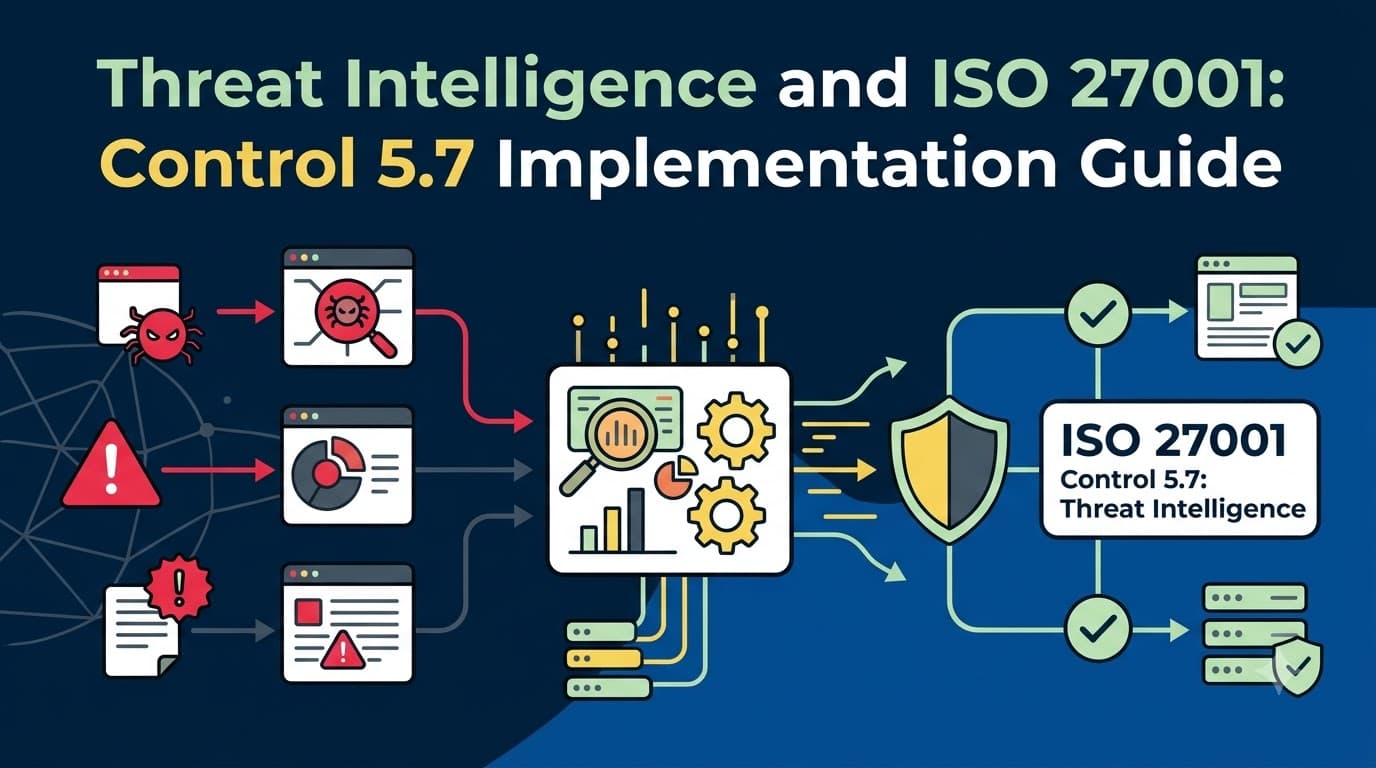
The breach the internet already knew about
In March of a recent year, a mid-sized payment processor I'll call Halyard Financial Services — a composite drawn from patterns I've seen across a dozen similar engagements — took a ransomware hit that cost it an estimated $4.2 million in incident response, downtime, customer notification, and one very uncomfortable regulator call. The forensics timeline that came out afterward was the part that stuck with me.
Eleven weeks before the encryption event, a known threat actor group had published — openly, on a forum indexed by at least two commercial threat intelligence feeds and referenced in a widely circulated ISAC bulletin — a claim of initial access to a VPN appliance matching Halyard's exact make, model, and unpatched firmware version. Four weeks before the event, the same group's tooling and command-and-control infrastructure showed up in a public IoC list that Halyard's own EDR vendor had already mapped to detection rules. Nobody at Halyard was looking. There was no one reading the ISAC bulletins, no process to check the vendor's published indicators against the environment, and no line item in anyone's job description that said "watch for this."
Halyard wasn't undefended. It had firewalls, EDR, a patch management cadence, and a SOC contract with a managed provider. What it didn't have was Annex A control 5.7: a deliberate, resourced practice of collecting information about threats, analyzing it, and turning it into something that changed a decision — patch this appliance now, block this IP range, brief the incident response team on this actor's playbook. The intelligence existed. The organization never metabolized it.
That gap — plenty of threat data, zero threat intelligence — is exactly what control 5.7 exists to close. It's one of eleven controls new to ISO/IEC 27001:2022, and in my audits it's consistently one of the controls organizations understand least, because "collect and analyze information about threats" sounds vague enough to satisfy almost any interpretation. Auditors have a much narrower idea of what satisfies it than most implementers assume, and that mismatch is where this guide starts.
When I walked Halyard's leadership through the timeline during a post-incident advisory engagement, the reaction wasn't denial — it was closer to disbelief that the information had been sitting in plain sight the entire time, unread by anyone whose job it was to read it. That reaction is common. Most organizations I work with don't lack access to threat information; they lack a deliberate practice of turning it into something someone acts on. Fixing that gap doesn't require a large budget or a dedicated team. It requires an owner, a short list of sources, and a habit of asking "does this change what we do" every time something relevant crosses the desk.
"5.7 is the control people either ignore completely or wildly over-engineer. I've seen a fifteen-person software company build a SOC-style intel program with three paid feeds and a dedicated analyst, and I've seen a 4,000-employee bank point at their antivirus vendor's blog and call it done. Neither one understood what the control actually asks for." — Priya Ramaswamy, ISMS Lead Auditor, Kestrel Assurance Partners
Who this is for and what you'll walk away with
This guide is written for ISMS managers, security operations leads, GRC analysts, and internal auditors who need to stand up — or defend in an external audit — a threat intelligence practice that satisfies control 5.7 without turning into a full-time intelligence shop the organization can't sustain. You'll leave with the three intelligence tiers defined in practitioner terms, a source-selection framework covering open, commercial, community, and internal inputs, a repeatable collect-process-analyze-disseminate-feedback lifecycle, a mapping of where intelligence plugs into risk assessment, vulnerability management, monitoring, and incident response, and the specific evidence auditors ask for when they test this control. Whether you're a five-person IT team or a security operations center with dedicated analysts, the goal is the same: intelligence that changes a decision, not a subscription that sits unread.
What control 5.7 actually requires — and why it's new
Control 5.7 sits in the Organizational controls theme of Annex A — covered in full in our Annex A Organizational controls overview — alongside contact with authorities (5.5) and contact with special interest groups (5.6), both of which, not coincidentally, are common sources of the threat information 5.7 asks you to collect. The control text in ISO/IEC 27001:2022 is short: information relating to information security threats shall be collected and analyzed to produce threat intelligence. ISO/IEC 27002:2022's guidance fleshes this out considerably, and three ideas from that guidance matter more than the rest.
First, threat intelligence has to be relevant, insightful, contextual, and actionable. That's a deliberate contrast with threat data — a raw indicator feed, a vendor blog post, a CVE list — which is none of those things until someone has evaluated it against your environment and decided what to do about it. A feed of ten thousand IP addresses is data. "Block these four IP ranges because they're associated with a group actively targeting our industry's remote-access infrastructure" is intelligence. If terms like TTP, IoC, or threat actor are new to your team, our ISO 27001 terminology and glossary guide is a useful companion reference while you build out this control.
Second, ISO 27002 organizes intelligence into three levels — strategic, tactical, and operational — each with a different audience, cadence, and use. This isn't academic taxonomy for its own sake; auditors use it as a checklist, and organizations that only operate at one level (usually operational, because IoC feeds are easy to buy) tend to fail the "have you considered all three" question in an audit interview.
Third, and this is the part organizations miss most often, intelligence on its own satisfies nothing. The control's value is entirely in what it feeds: risk assessment, vulnerability management, monitoring, and incident response. An organization that collects intelligence but can't show a single instance of it changing a risk rating, a patch priority, a detection rule, or an incident response decision has a subscription, not a control.
Why is this new in 2022? The 2013 version of ISO 27001 had no dedicated control for external threat awareness — the closest analogues were the general risk assessment requirements in Clause 6 and loose references to "monitoring developments" scattered across other controls. The 2022 revision, alongside new controls like monitoring activities and cloud security, reflects a broader shift toward proactive, externally informed defense rather than purely internal control hygiene. For a fuller picture of what changed between versions, see our guide to ISO 27001:2013 vs ISO 27001:2022, which covers all eleven new controls and why the standard added them.
"The 2013 standard assumed you'd figure out your threat landscape as part of risk assessment and left it at that. The 2022 revision says no — show me the deliberate practice of gathering outside information, not just your internal assumptions about what might go wrong." — Marcus Ohene, Principal Consultant, Ohene Cyber Risk Advisory
The three intelligence tiers
ISO 27002's guidance on 5.7 describes three levels of threat intelligence, and understanding the difference is the single fastest way to stop confusing "we read security news" with a working intelligence program. Each tier answers a different question, serves a different audience, and operates on a different cadence.
Strategic intelligence answers "where is the threat landscape heading, and does our risk posture still make sense?" It's high-level — industry targeting trends, geopolitical developments, regulatory shifts, sector-wide campaign patterns — and its audience is leadership, the risk committee, and whoever owns the risk register. Tactical intelligence answers "how do attackers who might target us actually operate?" It covers adversary tactics, techniques, and procedures (TTPs), commonly organized using frameworks like MITRE ATT&CK, and its audience is the security architecture and detection engineering teams who need to know what to build defenses against. Operational intelligence answers "what does a specific, current attack look like in technical terms?" It's indicators of compromise (IoCs) — malicious IPs, file hashes, domains, phishing infrastructure — consumed directly by SOC analysts and automated detection tooling.
Tier | Core Question | Typical Content | Primary Audience | Typical Cadence | Example Output |
|---|---|---|---|---|---|
Strategic | Where is the threat landscape heading? | Sector targeting trends, geopolitical risk, ransomware economics, regulatory shifts | Executive leadership, risk committee, board | Quarterly / semi-annual | A one-page brief informing the annual risk assessment |
Tactical | How do relevant adversaries operate? | Attacker TTPs, tooling, campaign patterns, MITRE ATT&CK mappings | Security architects, detection engineers, IR planners | Monthly / per major campaign | An updated detection-rule backlog or control gap list |
Operational | What does a live attack look like right now? | IoCs — IPs, hashes, domains, phishing kits, vulnerable software versions | SOC analysts, IT operations, automated tooling | Continuous / daily | A blocklist update or an emergency patch ticket |
A mature program runs all three simultaneously but doesn't treat them identically. Strategic intelligence moves slowly and deliberately into the risk register; operational intelligence needs to move in minutes or hours, ideally through automation. Organizations that only build the operational tier — an IoC feed piped into a SIEM — pass the "do you have threat intelligence" question on a checklist but fail the deeper audit conversation about whether intelligence informs risk decisions and control design, not just blocklists.
"When I ask a client to show me their threat intelligence and they show me a firewall block list, I know we're only looking at one-third of the control. Strategic and tactical intelligence are where the real risk conversation happens — the IoC feed is just the fastest-moving, easiest-to-buy piece." — Diane Kessler, Fractional CISO, Northline Advisory Group
Sources: open, commercial, community, and internal
Where the intelligence comes from matters as much as what tier it feeds. I group sources into four categories, and a defensible 5.7 program almost always draws from at least three of them — relying on a single source type, however good, leaves systematic blind spots.
Open sources are free and public: vendor security blogs, national CERT advisories, CVE and NVD listings, security researcher publications, and reputable news reporting on active campaigns. They're a reasonable foundation for a small organization but require real curation effort, since volume and noise are high and there's no one filtering for relevance to your environment. Commercial sources are paid feeds and platforms — threat intelligence platforms, EDR and SIEM vendor intelligence add-ons, industry-specific paid reporting — that typically offer better signal-to-noise, structured formats such as STIX/TAXII for automated ingestion, and analyst-curated context. Community sources are shared, trust-based groups: Information Sharing and Analysis Centers (ISACs) for regulated sectors like finance and healthcare, regional CERTs, and informal peer groups of security practitioners in similar industries who share observed indicators. Internal sources are the most underused: your own incident history, SOC alert patterns, penetration test and red team findings, vulnerability scan results, and help desk phishing reports all constitute threat intelligence about the threats that have actually reached your organization, as opposed to threats that could reach anyone.
Source Category | Examples (illustrative) | Cost | Strength | Limitation |
|---|---|---|---|---|
Open | Vendor blogs, national CERT/CISA-style advisories, CVE/NVD, public researcher write-ups | Free | Broad coverage, no vendor lock-in | High noise, requires curation, no environment context |
Commercial | Threat intelligence platforms, EDR/SIEM vendor feeds, paid sector reporting | Subscription (often significant at enterprise scale) | Curated, structured (e.g., STIX/TAXII), faster turnaround | Ongoing cost, coverage varies by vendor focus |
Community | Sector ISACs, regional CERTs, informal peer-sharing groups | Free or membership fee | Sector-specific relevance, trusted peer validation | Requires active participation, not passive consumption |
Internal | Incident history, SOC alerts, pentest/red team results, phishing reports | Cost of existing operations | Directly reflects your actual threat exposure | Reactive by nature — reflects what already happened |
A frequent gap I flag in audits: organizations that pay for a commercial feed but never join their sector's ISAC, even when membership is free or low-cost and directly relevant. Community sources are often the highest-value, lowest-cost input available, and their absence is conspicuous to an auditor who asks "how do you know what's targeting organizations like yours specifically?"
Source quality matters as much as source category. Not every open-source blog post or forum claim deserves equal weight, and a practical evaluation habit — checking whether a claim is corroborated across at least two independent sources, whether the source has a track record of accuracy, and whether the finding is specific enough to act on rather than merely alarming — prevents two failure modes at once: chasing false alarms that waste analyst time, and dismissing a genuinely important warning because it arrived through an unfamiliar channel. Smaller organizations without the bandwidth for formal source-credibility scoring can apply a simpler rule of thumb: treat a single, uncorroborated claim as worth a light look, and treat corroboration across two or more categories — say, an open-source report matched by a commercial feed or an ISAC bulletin — as worth an actual response.
Setting priority intelligence requirements before you collect anything
The single fastest way to drown a small team in irrelevant threat data is to start collecting before deciding what you actually need to know. Practitioners borrow a concept from traditional intelligence work called priority intelligence requirements (PIRs) — a short, specific list of the questions your program exists to answer, reviewed and updated at least annually alongside your risk assessment. Without PIRs, a source review session tends to drift into reading whatever's most recently published rather than what's most relevant to your environment, and that drift is exactly what auditors notice when they ask "why did you choose these sources?" and get a shrug in response.
A workable PIR set is short — five to eight questions, not fifty — and ties directly to your actual technology stack, industry, and threat exposure. A healthcare provider's PIRs will look nothing like a manufacturing firm's, and that's the point: a good PIR list is evidence that your intelligence program was designed around your risk profile rather than copied from a generic template.
Example PIR | Why It Matters for This Organization | Primary Tier Addressed |
|---|---|---|
Are threat actors actively targeting our specific VPN/remote-access vendor and product version? | Directly exploitable if unpatched; high operational relevance | Operational |
What ransomware groups are currently targeting our sector, and what's their typical initial access method? | Informs risk register scoring and control prioritization | Strategic |
Are there new phishing or social engineering campaigns impersonating our brand, our software vendors, or our payment processor? | Directly affects employee and customer risk | Tactical / Operational |
What CVEs affecting our core application stack are being actively exploited in the wild? | Reprioritizes patch management ahead of CVSS score alone | Tactical |
Are any of our suppliers or ICT supply chain partners named in recent breach disclosures? | Feeds supplier risk review and contractual requirements | Strategic |
PIRs should be reviewed formally when your risk assessment is refreshed and informally whenever your technology stack changes materially — a new core banking platform, a new cloud provider, a merger bringing in new systems. Treating the PIR list as a living document, rather than a one-time exercise, is itself evidence of the feedback discipline auditors look for. Programs that struggle with this control are almost always the ones that never wrote down what they were trying to find out in the first place — asked why a particular feed was chosen, the honest answer is often "it seemed useful," which is not a defensible position in an audit interview or a good use of anyone's limited time.
The threat intelligence lifecycle
Collecting information isn't the control — turning it into a repeatable, evidenced process is. I teach clients a five-stage lifecycle that mirrors the classic intelligence cycle used across the security industry, adapted to what an ISO 27001 auditor will actually want to see documented.
Collection is the intake stage: pulling from the open, commercial, community, and internal sources defined above, against a documented set of priorities (what threats matter to this organization, in this sector, with this technology stack). Processing normalizes raw input into a usable form — deduplicating indicators, tagging by tier, filtering out anything irrelevant to your environment. Analysis is where data becomes intelligence: evaluating relevance, corroborating across sources, and drawing a conclusion an audience can act on. Dissemination delivers the right tier to the right audience on the right cadence — strategic briefs to leadership, tactical updates to architecture and detection teams, operational indicators straight into monitoring tooling. Feedback closes the loop: did the intelligence change a decision, and did that decision turn out to be correct? Feedback both improves future collection priorities and — critically for audit purposes — is the evidence that the control is functioning rather than merely existing.
flowchart LR
    A[Collect<br/>Open, commercial,<br/>community, internal sources] --> B[Process<br/>Normalize, dedupe,<br/>tag by tier]
    B --> C[Analyze<br/>Evaluate relevance,<br/>corroborate, conclude]
    C --> D[Disseminate<br/>Strategic / tactical /<br/>operational audiences]
    D --> E[Feedback<br/>Did it change a decision?<br/>Was the decision right?]
    E -.-> A
    D --> F[Risk Assessment]
    D --> G[Vulnerability Management]
    D --> H[Monitoring]
    D --> I[Incident Response]
The loop-back arrow from feedback to collection is the part most programs skip, and it's the part auditors probe hardest, because it's the difference between a static subscription and a living process. A feedback record doesn't need to be elaborate — a quarterly ten-minute review noting "this intelligence changed X, this intelligence turned out to be a false alarm, adjust collection priorities accordingly" is enough to demonstrate the loop is closed.
"I look for the feedback arrow specifically. Any organization can show me a feed. Very few can show me a single documented case where that feed changed a patch priority, a firewall rule, or a risk score. That's the evidence that separates a real control from a checkbox." — Tomasz Wieczorek, Threat Intelligence Lead, Corvane Financial Group
Right-sizing 5.7: SMB versus enterprise
The most common implementation failure I see with control 5.7 is scale mismatch — a 20-person company trying to run a threat intel program built for a bank, or a 3,000-employee enterprise treating it as a part-time task bolted onto an already overloaded IT manager. ISO 27001 doesn't prescribe headcount or tooling; it asks for a process proportionate to your risk exposure, and the auditor's job is to test whether what you've built is proportionate and functioning, not whether it matches a specific template.
For a small or mid-sized organization, a realistic 5.7 program looks like: a named individual (often the IT manager or a fractional CISO) with an explicit quarterly calendar reminder to review free and community sources, membership in a relevant ISAC or sector sharing group where one exists, subscription to the software and cloud vendors' own security bulletins for the specific products in use, and a simple log — even a shared spreadsheet — recording what was reviewed and what action, if any, resulted. This costs little beyond time and produces auditable evidence.
For an enterprise or a regulated organization with a dedicated security operations function, the expectation rises accordingly: a named threat intelligence function or analyst role, one or more commercial feeds integrated into the SIEM or a dedicated threat intelligence platform, structured indicator ingestion (commonly via STIX/TAXII), documented intelligence requirements reviewed and updated at least annually, and demonstrable links from intelligence products into risk register updates, detection engineering backlogs, and incident response playbooks.
Dimension | Small / Mid-Size Organization | Enterprise / Regulated Organization |
|---|---|---|
Ownership | IT manager or fractional CISO, part-time responsibility | Dedicated threat intelligence analyst or small team |
Sources | Open + one relevant community group (ISAC/CERT) | Open + community + one or more commercial platforms |
Tooling | Spreadsheet log, vendor bulletin subscriptions | Threat intelligence platform, SIEM integration, STIX/TAXII feeds |
Cadence | Quarterly review, ad hoc on major advisories | Continuous operational feed, monthly tactical review, quarterly strategic brief |
Evidence | Review log with dates and actions taken | Intelligence requirements doc, dissemination records, feedback log, KPI reporting |
Illustrative annual cost | Low — largely staff time | Moderate to high — platform licensing plus analyst time |
The bar an auditor applies is consistency with your own risk assessment, not a universal minimum. A five-person consultancy with no regulated data and low attacker interest can defensibly run a lighter program than a hospital network or a payments company — provided that lighter scope is a documented, risk-based decision rather than an oversight. Our Clause 6 Planning and risk assessment guide covers how to make and record that proportionality judgment formally.
Roles and responsibilities: who actually does the work
Control 5.7 fails more often from unclear ownership than from any technical gap. "Someone probably reads that feed" is not an answer that survives an audit interview, and it usually means nobody actually does. A simple RACI-style breakdown, even for a five-person security function, closes this gap and doubles as evidence of deliberate process design.
Activity | Responsible | Accountable | Consulted | Informed |
|---|---|---|---|---|
Defining priority intelligence requirements | Security/IT manager | CISO or risk owner | Risk committee, department heads | Executive leadership |
Collecting from open/commercial/community sources | Security analyst or IT lead | Security/IT manager | Vendor account contacts, ISAC liaison | SOC team |
Analyzing and tiering intelligence | Security analyst | Security/IT manager | Detection engineering, architecture | Risk owner |
Disseminating strategic briefs | Security/IT manager | CISO or risk owner | — | Executive leadership, board |
Disseminating tactical updates | Security analyst | Security/IT manager | Architecture, detection engineering | SOC team |
Pushing operational IoCs into tooling | SOC analyst or automation | Security/IT manager | — | SOC team |
Feedback review and source evaluation | Security/IT manager | CISO or risk owner | Analysts, SOC lead | Risk committee |
In smaller organizations several of these roles collapse into one or two people, which is entirely acceptable — what matters to an auditor is that the responsibility is explicit and named somewhere (a job description, a procedure document, a RACI table like this one) rather than assumed. In larger organizations, the temptation is to over-specify roles that never get filled; a documented RACI with vacant "Consulted" columns is a minor issue, but an "Accountable" column with no name in it is a real gap. A useful test to run internally: if your commercial feed or ISAC membership lapsed tomorrow, whose job is it to notice? If nobody can answer immediately, the control isn't operating — it's decorative.
Where intelligence has to plug in: risk, vulnerability management, monitoring, incident response
Control 5.7 is deliberately a supporting control — its entire purpose is to feed other parts of the ISMS, and an auditor testing it will spend at least as much time tracing those downstream connections as they will reviewing your source list. Four destinations matter most.
Risk assessment is the highest-leverage destination. Strategic intelligence — a new class of attack targeting your sector, a shift in ransomware group tactics, a geopolitical development affecting a supplier region — should directly inform the likelihood and impact ratings in your risk register during the periodic risk assessment described under Clause 6 Planning and reassessed as part of Clause 8 Operation. If a threat intelligence brief concludes that credential-stuffing attacks against your industry's customer portals have tripled in the last two quarters, that's a direct input to re-scoring the relevant risk and potentially triggering new treatment. Vulnerability management, governed by Annex A control 8.8 (management of technical vulnerabilities), is where tactical and operational intelligence earn their keep fastest: intelligence that a specific CVE is being actively exploited in the wild should re-prioritize patch timelines regardless of the CVSS base score alone. Monitoring, under Annex A control 8.16 (monitoring activities), is the natural home for operational intelligence — IoCs translate directly into detection rules, blocklists, and SIEM correlation logic. Incident response, spanning Annex A controls 5.24 through 5.27 (incident management planning, assessment and decision, response, and learning from incidents), benefits from all three tiers: strategic context helps leadership understand an incident's significance, tactical intelligence on the suspected actor's playbook speeds containment decisions, and operational IoCs help scope the blast radius quickly.
Intelligence Tier | Feeds Into | Related Control(s) | Concrete Example |
|---|---|---|---|
Strategic | Risk assessment and treatment planning | Clause 6 Planning / Clause 8.2 risk assessment | Sector targeting trend re-scores a risk from Medium to High |
Tactical | Vulnerability prioritization, security architecture, detection engineering | 8.8 Management of technical vulnerabilities | Known exploited CVE jumps to top of patch queue ahead of higher-CVSS items |
Tactical | Monitoring and detection rule design | 8.16 Monitoring activities | New TTP mapped to a MITRE ATT&CK technique triggers a new SIEM correlation rule |
Operational | Real-time blocking and alerting | 8.16 Monitoring activities | IoC feed auto-updates firewall and EDR blocklists |
Operational / Tactical | Incident response planning and execution | 5.24–5.27 Incident management | Actor's known TTPs shape containment steps in an active incident |
This is also where the case for 5.7 as a business function, not a compliance exercise, is easiest to make to a skeptical budget owner: every one of these downstream uses either prevents a cost (an avoided breach, an avoided fine) or reduces the cost of something that was going to happen anyway (faster containment, fewer wasted patch cycles on low-risk vulnerabilities).
"The auditors who really understand 5.7 don't ask me for my feed list. They ask me to show them one risk register entry, one patch ticket, and one incident timeline where intelligence changed the outcome. If I can't produce those three things, the feed list doesn't matter." — Rafael Nunes, Head of Security Operations, Vantree Logistics Group
Threat intelligence and third-party risk
One destination for intelligence that gets overlooked even by otherwise mature programs is supplier and ICT supply chain risk. Threat intelligence about a breach at a widely used software vendor, a compromised managed service provider, or a supply-chain attack technique affecting a class of products your suppliers rely on should feed directly into your ongoing management of supplier relationships and the associated controls covering supplier agreements, ICT supply chain risk, and monitoring of supplier services. A strategic-tier intelligence brief noting that a category of vendor — say, remote monitoring and management tools used by managed service providers — has become a preferred initial-access vector for a ransomware affiliate is exactly the kind of finding that should trigger a review of your own vendor contracts and access scopes, not just an internal patch cycle.
In practice, this means your supplier risk review process and your threat intelligence process shouldn't operate in separate silos. A simple addition — asking, during any periodic supplier risk review, whether recent threat intelligence has flagged anything specific to that supplier, that supplier's product category, or that supplier's own reported incidents — closes a gap I see in a large share of otherwise well-run ISMS implementations. Some of the more damaging incidents I've reviewed in consulting engagements originated not in the organization's own environment but in a supplier's, and in several of those cases relevant public intelligence about the supplier or the attack technique had circulated well before the incident reached the client.
Trigger | Example Intelligence Finding | Supplier Risk Action |
|---|---|---|
Vendor-specific breach disclosure | A widely used software vendor discloses a supply-chain compromise affecting update mechanisms | Review contractual notification obligations and validate patch/update provenance |
Product-category targeting trend | A class of remote access tools is identified as a preferred ransomware entry point | Re-review access scope and monitoring for all suppliers using that product category |
Supplier's own reported incident | A managed service provider used by your organization reports a security incident | Trigger an ad hoc review under supplier monitoring rather than waiting for the scheduled cycle |
This connection is worth making explicit in your documented 5.7 process, since auditors reviewing supplier-related controls frequently ask where supplier risk reviews get their external threat inputs from — and "our own threat intelligence process" is a stronger answer than "we wait for the supplier to tell us."
What auditors look for and the evidence that satisfies them
Because 5.7 is new, many organizations preparing for their first ISO 27001:2022 audit — or transitioning from the 2013 revision — genuinely don't know what "good" looks like. Having sat through dozens of these audit conversations, the evidence auditors ask for clusters around five things.
A documented threat intelligence process, even a short one, that names who is responsible, which sources are used, how often collection and review happen, and how the three tiers are addressed. This doesn't need to be a standalone fifteen-page procedure — a section within your risk management procedure or a dedicated one-to-two-page process document both work, provided it's referenced in your Statement of Applicability with a clear justification. A source list or register naming the specific feeds, advisories, ISACs, or vendor bulletins in use, with enough detail to show deliberate selection rather than incidental awareness. Dissemination records — evidence that intelligence actually reached the audiences who needed it, whether that's meeting minutes from a quarterly strategic brief, a tactical update shared with the architecture team, or an operational alert routed to the SOC. Downstream linkage — the single most commonly missing item — showing at least one traceable instance where intelligence changed a risk rating, a patch priority, a monitoring rule, or an incident response decision. And a review or feedback record demonstrating the lifecycle loop closes, even briefly, on a periodic basis.
Evidence Item | What It Demonstrates | Common Format | Audit Risk If Missing |
|---|---|---|---|
Threat intelligence process/procedure | Deliberate, repeatable practice exists | Section in risk procedure or standalone doc | Minor nonconformity — control described as "informal" |
Source register | Sources are deliberately chosen, not incidental | Spreadsheet or table listing feeds, cadence, owner | Auditor questions coverage of all three tiers |
Dissemination records | Intelligence reaches the right audience | Meeting minutes, ticket references, distribution log | Cannot demonstrate control is "operating" vs. "designed" |
Downstream linkage examples | Intelligence changes a real decision | Risk register entry, patch ticket, detection rule change log | Highest-risk gap — often drives a major nonconformity |
Feedback/review log | Lifecycle loop closes and improves over time | Quarterly review notes, KPI tracking | Control looks static, not continuously improving |
A frequent surprise for first-time auditees: the auditor usually isn't testing whether your threat intelligence is sophisticated. They're testing whether it's real — whether the process on paper matches what people in the organization actually do, and whether you can point to at least one concrete outcome. A modest program with clear evidence of all five items above will pass more comfortably than an expensive commercial platform with no documented linkage to a single decision.
"I'd rather see a spreadsheet and three real examples of intelligence changing something than a six-figure platform with a dashboard nobody in the room can explain. The standard doesn't grade you on tooling spend." — Angela Byrne, ISO 27001 Program Manager, Bramwell Health Systems
A threat intelligence maturity model
Because 5.7 is new, most organizations are somewhere between "nothing" and "fully integrated," and it helps to have a rough maturity model to plot your current state and plan the next step rather than jumping straight to an enterprise-grade build you can't sustain. I use a simple four-level model with clients, borrowed loosely from how maturity models work across other ISO 27001 controls.
Level | Description | Typical Organization | Primary Gap to Close Next |
|---|---|---|---|
1 — Ad hoc | Individuals occasionally read security news; no defined sources, owner, or process | Very small businesses, early-stage startups | Name an owner and define two or three sources |
2 — Defined | Named owner, documented source list, regular review cadence, but limited downstream linkage | Small/mid-size organizations early in ISO 27001 prep | Start logging concrete downstream actions |
3 — Integrated | Clear links from intelligence to risk register, vulnerability prioritization, and monitoring rules | Established mid-market and larger organizations | Formalize feedback loop and PIRs |
4 — Optimized | Feedback loop drives continuous improvement of sources and PIRs; metrics tracked and reported to leadership | Enterprises and regulated organizations with dedicated function | Sustain and periodically benchmark against sector peers |
Certification does not require Level 4 — it requires a level appropriate to your risk profile, operating consistently, and evidenced. Most organizations I help through their first ISO 27001 audit target Level 2 moving toward Level 3, which is achievable without a dedicated headcount and satisfies auditors comfortably when the evidence trail is solid.
Tooling categories (vendor-neutral)
I deliberately avoid recommending specific products in client engagements, because the right tool depends entirely on existing infrastructure, budget, and team maturity — but it helps to know the categories of tooling available so you can evaluate vendors against your actual requirement rather than a sales pitch. None of the following is an ISO mandate; the standard is tool-agnostic and cares only about outcomes.
Threat intelligence platforms (TIPs) aggregate multiple feeds, deduplicate and enrich indicators, and typically support structured exchange formats such as STIX/TAXII for automated ingestion into other security tooling — useful once you have more than one or two commercial or community sources to manage. SIEM and EDR-native intelligence add-ons come bundled with tools many organizations already own, pushing vendor-curated indicators directly into existing detection and alerting pipelines — often the lowest-friction starting point for a smaller team. Dedicated open-source and community tooling supports organizations building a program on open and community sources without commercial spend, ranging from simple indicator-sharing platforms to MITRE ATT&CK navigator-style mapping tools used to visualize tactical coverage. Ticketing and GRC platform integrations matter less for collection and more for the evidence trail — the ability to log a source review, tag a resulting action, and produce that history at audit time is often more valuable than another feed.
Tooling Category | Best Fit | Illustrative Examples of Function | Key Consideration |
|---|---|---|---|
Threat intelligence platform (TIP) | Organizations managing 2+ external feeds | Aggregation, deduplication, STIX/TAXII ingestion | Adds cost and complexity — justify against actual feed volume |
SIEM/EDR-native intelligence | Teams with existing SIEM or EDR investment | Vendor-curated IoCs pushed into existing alerting | Lowest friction, but coverage limited to that vendor's visibility |
Open-source/community tooling | Smaller teams, open/community-source-driven programs | Indicator sharing, ATT&CK mapping/navigation | No license cost, but requires more manual curation |
GRC/ticketing integration | Any organization needing audit-ready evidence | Logging reviews, linking intelligence to resulting actions | Often the missing piece — evidence, not more raw data |
The tool that most improves audit outcomes in my experience isn't a feed at all — it's a simple, consistently used log connecting "we saw this" to "we did that." A world-class commercial platform with no such log leaves an auditor with nothing to test.
Frameworks practitioners lean on (illustrative, not ISO mandates)
None of the following are required by ISO 27001 or ISO 27002 — the standard is deliberately framework-agnostic — but they're common enough in practitioner use that understanding them helps when evaluating sources, tools, or vendor claims about 5.7 support.
MITRE ATT&CK is a widely used, publicly maintained knowledge base of adversary tactics and techniques, commonly used to structure tactical intelligence and to check detection coverage against known attacker behavior. STIX (Structured Threat Information Expression) and TAXII (Trusted Automated Exchange of Intelligence Information) are technical standards for structuring and exchanging threat intelligence in machine-readable form, commonly used to feed indicators automatically between platforms, feeds, and SIEMs. ISACs (Information Sharing and Analysis Centers) are sector-specific, often membership-based organizations — financial services, healthcare, and other regulated sectors typically have one — that share intelligence among trusted peers facing similar threats. National and regional CERTs (Computer Emergency Response Teams) publish public advisories and, in many jurisdictions, offer direct engagement channels for organizations experiencing or reporting incidents.
Framework/Tool Category | What It Standardizes | Where It Fits in 5.7 | Illustrative Practitioner Use |
|---|---|---|---|
MITRE ATT&CK | Adversary tactics and techniques taxonomy | Tactical tier — structuring TTP analysis | Mapping detection rule coverage against known techniques |
STIX/TAXII | Machine-readable format and exchange protocol for threat data | Operational/tactical — automated ingestion | Feeding IoCs from a commercial platform directly into a SIEM |
ISACs | Sector-specific trusted information sharing | Community source across all three tiers | Financial or healthcare sector bulletin on active campaigns |
National/regional CERTs | Public advisories and incident coordination | Open/community source, strategic and tactical | Advisory on a newly disclosed, actively exploited vulnerability |
Referencing these by name in your documentation is common practice and generally viewed favorably by auditors as a sign of practitioner-level maturity, but using them is never itself sufficient — the control still tests whether the information reaching you through these channels changed something in your environment.
Common mistakes
Across the implementations I've reviewed, the same handful of mistakes account for most of the nonconformities and near-misses on this control.
Treating it as a subscription, not a process. Buying a commercial feed and calling the control satisfied, with no one assigned to review, analyze, or act on what it produces. Collecting only operational intelligence. Building an IoC blocklist pipeline while ignoring strategic and tactical intelligence entirely, which leaves the risk register and security architecture uninformed by anything happening outside the SOC's immediate view. No documented linkage to other controls. Running an active-looking intelligence function that never demonstrably changes a risk score, a patch priority, or a detection rule — the single most common driver of audit findings on this control. Ignoring free, high-value community sources. Paying for a commercial platform while skipping a relevant, often free, sector ISAC or CERT that would provide more targeted relevance. No feedback loop. Never reviewing whether past intelligence actually proved useful, so collection priorities never improve and stale sources persist indefinitely. Over-engineering for the organization's size. A small business standing up a full intelligence function it can't sustain past the certification audit, producing a program that looks impressive on day one and is abandoned by month six. Confusing internal vulnerability scanning with threat intelligence. Vulnerability scan output describes your own weaknesses; it only becomes threat intelligence once correlated with external information about which of those weaknesses are actively being exploited.
Mistake | Why It Happens | Fix |
|---|---|---|
Treating 5.7 as a subscription | Easiest interpretation of a vague-sounding control | Assign explicit ownership and a review cadence, not just a vendor contract |
Operational-only coverage | IoC feeds are the easiest tier to buy | Deliberately build strategic and tactical inputs, even lightly |
No downstream linkage | Analysis stops at "interesting," never reaches "actionable" | Require every intelligence review to note a decision made or explicitly note none needed |
Skipping free community sources | Commercial spend feels more "official" | Join the relevant ISAC/CERT before or alongside any paid feed |
No feedback loop | Feels like extra work with no immediate payoff | Add a 15-minute quarterly review to an existing risk or security meeting |
Over-engineering for size | Templates from larger organizations get copied wholesale | Right-size using the SMB/enterprise comparison and document the rationale |
Confusing vuln scans with threat intel | Both involve "vulnerabilities," so they get conflated | Correlate internal scan results against external exploitation data before calling it intelligence |
"The nonconformity I write most often on this control isn't 'you have no threat intelligence.' It's 'you have threat intelligence and I can't find a single thing it changed.' Fix that one gap and most of the rest falls into place." — Marcus Ohene, Principal Consultant, Ohene Cyber Risk Advisory
Building the program in 90 days: an illustrative rollout
Organizations preparing for a first ISO 27001 audit often ask how quickly a defensible 5.7 program can realistically stand up. The honest answer is that a Level 2 program — named owner, defined sources, regular review, early downstream linkage — can be built in about ninety days if someone is given clear ownership and a modest, protected time allocation.
Phase | Weeks | Key Activities | Output |
|---|---|---|---|
Foundation | 1–2 | Assign owner, draft PIRs, review existing free sources already available (vendor bulletins, CVE feeds) | Named owner, draft PIR list |
Source selection | 3–4 | Join relevant ISAC/CERT, confirm vendor bulletin subscriptions, evaluate one commercial option if budget allows | Documented source register |
Process design | 5–6 | Draft lightweight process/procedure, define review cadence per tier, set up a simple tracking log | Approved process document |
First cycle | 7–10 | Run first collection/analysis/dissemination cycle, brief leadership once, log at least one downstream action | First dissemination and linkage record |
Review and adjust | 11–13 | Hold first feedback review, adjust PIRs and sources based on what proved useful | Feedback log entry, refined source list |
This timeline assumes no dedicated headcount — just an existing IT or security role with two to four hours a week protected for this work. Enterprises building a Level 3 or 4 program with SIEM integration and dedicated analysts should expect a longer runway, often six to twelve months, primarily due to tooling procurement and integration work rather than the underlying process design.
Case study: the community source that paid for itself in a week
Sorrelfield Credit Union, a composite drawn from several similar engagements, had a 40-person IT and security function and no dedicated threat intelligence budget when it began ISO 27001 certification prep. Rather than buying a commercial platform, the team joined the relevant financial-sector ISAC — a low-cost membership decision — and assigned its security analyst two hours a week to review bulletins and cross-reference them against the credit union's own technology stack. Within the first month, an ISAC bulletin flagged a phishing campaign specifically impersonating core banking software used by several member institutions, including a technical detail about a spoofed login domain pattern. Sorrelfield's analyst checked the pattern against inbound email logs, found three matching messages that had bypassed the existing spam filter, and pushed an emergency detection rule and staff alert before any credentials were entered. The estimated avoided cost, based on the credit union's own prior incident history with account takeover fraud, was in the range of $180,000 to $250,000. Total cost of the intelligence input: an ISAC membership fee and roughly eight analyst-hours. At the certification audit, this single incident — with dated bulletin, email log extract, and remediation ticket all preserved — became the organization's answer to "show me downstream linkage," and the auditor closed the control with no findings.
Case study: the enterprise that had everything except the loop
Delacroix Manufacturing Group, a 6,000-employee industrial firm, entered its ISO 27001 recertification audit with what looked like a mature program: a commercial threat intelligence platform, two analysts, STIX/TAXII feeds integrated into the SIEM, and monthly tactical briefings to the architecture team. The stage 2 auditor still issued a minor nonconformity. The reason: nobody could produce evidence that any of the intelligence had changed a decision in the prior twelve months, and there was no review process checking whether past intelligence had been useful. The program was busy but not demonstrably effective. Delacroix's corrective action was almost entirely process, not technology — a quarterly "intelligence effectiveness" review was added to the existing risk committee agenda, requiring the team to name at least one instance where intelligence had informed a risk, patch, or detection decision, and to note where it hadn't. Within two audit cycles, this same review had also identified that one of the two commercial feeds was providing largely redundant coverage with the SIEM vendor's native intelligence, and Delacroix declined to renew it — turning a compliance fix into a five-figure annual cost saving.
Case study: right-sizing a SaaS startup's first program
Ferrow Analytics, a 35-person SaaS company preparing for its first ISO 27001 certification to satisfy enterprise customer due diligence, initially planned to buy a commercial threat intelligence platform on the recommendation of a consultant who had previously worked only with large enterprises. A more proportionate approach — reviewed against the company's actual risk profile of a single cloud-hosted product with no regulated data — settled on cloud provider security bulletins, the CVE feed for the specific open-source components in its stack, and membership in an informal peer-sharing Slack group of SaaS security practitioners in its region, entirely at no license cost. The company documented its rationale for this lighter scope directly in its risk assessment, referencing the Statement of Applicability as the place that justification lived. The certification auditor accepted the scope without challenge, specifically because the proportionality decision was documented and traceable rather than simply an unstated gap — a distinction that made the difference between a lightweight program passing cleanly and the same program being flagged as inadequate.
Measuring whether it's working: metrics that matter
A handful of simple metrics, tracked quarterly, do more to demonstrate a functioning control than any narrative description. None of these need sophisticated tooling — a spreadsheet updated during the quarterly feedback review is enough for most organizations, and the discipline of tracking them tends to surface gaps in coverage or ownership before an auditor does.
Metric | What It Tells You | Illustrative Target for a Small/Mid-Size Program |
|---|---|---|
Number of sources actively reviewed per quarter | Whether collection is happening at all, and across which tiers | At least one source per tier, reviewed on its defined cadence |
Downstream actions logged per quarter | Whether intelligence is actually changing decisions | At least one to two documented linkage examples per quarter |
Time from disclosure to internal dissemination (for high-severity items) | Speed of your operational response chain | Same day to 48 hours for actively exploited vulnerabilities |
Feedback reviews completed on schedule | Whether the lifecycle loop is actually closing | 100% of scheduled quarterly reviews held |
PIRs reviewed/updated in the last 12 months | Whether requirements stay aligned with a changing risk profile | At least one formal review per year, tied to the risk assessment cycle |
Enterprises with dedicated functions often add more granular metrics — mean time to detect based on operational intelligence, percentage of high-severity CVEs patched within a defined SLA once flagged as actively exploited, or coverage of MITRE ATT&CK techniques mapped to existing detections — but the five above are sufficient to demonstrate a functioning control at any scale, and they map directly onto the evidence auditors ask for. Metrics don't need to be sophisticated to be useful: a plain statement that four sources were reviewed and three produced a documented action this quarter tells an auditor more about whether the control works than an elaborate dashboard with no underlying discipline behind it.
Control 5.7 at a glance
Before moving into the FAQ, it's worth pulling the whole control into one reference view — useful as a briefing aid for leadership or as a quick-check before an audit.
Element | Summary |
|---|---|
Control number and name | 5.7 Threat intelligence (Organizational controls, new in ISO/IEC 27001:2022) |
Core requirement | Collect and analyze information about information security threats to produce actionable intelligence |
Three tiers | Strategic (trends and risk posture), tactical (adversary TTPs), operational (specific IoCs) |
Minimum viable evidence | Named owner, source register, at least one dissemination record, at least one downstream linkage example, a feedback record |
Primary downstream destinations | Risk assessment, vulnerability management (8.8), monitoring (8.16), incident response (5.24–5.27) |
Common first-time gap | Operational-only coverage with no traceable link to a risk, patch, or detection decision |
Realistic build time (SMB, Level 2) | Approximately 90 days with 2–4 protected hours per week |
Keeping this table alongside your Statement of Applicability entry for 5.7 gives anyone new to the control — a new hire, a board member, an auditor early in an interview — a fast, accurate orientation without needing to read the full procedure.
What a lightweight 5.7 procedure actually looks like on paper
Organizations facing their first ISO 27001 audit often overestimate how much documentation this control needs. A one-to-two-page procedure, referenced from your Statement of Applicability and your risk management procedure, is sufficient for the large majority of small and mid-size organizations. In practice, the document that satisfies auditors most reliably contains six short sections: a purpose statement tying the procedure to control 5.7 and to the organization's risk management process; a named owner and any backup or delegate; the source register itself, listing each source, its tier, and its review cadence; the review and dissemination process, describing how findings reach the risk register, patch queue, monitoring configuration, or incident response plan; the feedback mechanism, describing how often the whole process is reviewed for effectiveness and how PIRs get updated; and a short log or reference to where dated evidence — dissemination records, linkage examples — is kept.
None of this needs specialized software. A shared document for the procedure and a simple spreadsheet or ticketing reference for the log satisfy the control at small and mid-size scale, and expanding into a dedicated platform or GRC tool as the organization and its risk profile grow is a natural, defensible progression rather than something that needs to be built on day one. Auditors consistently tell me they'd rather see this simple structure followed consistently than an elaborate procedure that doesn't match what people in the organization actually do.
From compliance checkbox to competitive advantage
It's tempting to treat control 5.7 as one more box on a 93-item Annex A list — a source subscription, a review log, done. Organizations that get real value from it treat it differently: as the mechanism that lets a security program stop reacting to whatever alert fires next and start anticipating what's coming based on what's already happening to organizations like theirs. Halyard Financial Services, from the opening of this guide, didn't lack security spend. It lacked a deliberate practice of listening to information that was already public, already relevant, and already actionable. That's a cheap gap to close relative to what it costs to leave open.
The business case extends past the audit. A functioning threat intelligence practice shortens incident response times because responders already understand likely adversary behavior before an incident starts. It sharpens vulnerability management by replacing "patch everything eventually" with "patch what's actually being exploited, first." It gives risk committees a defensible, externally grounded basis for risk ratings instead of internal guesswork. And increasingly, it's a differentiator in vendor due diligence conversations — enterprise customers and cyber insurers alike are starting to ask not just "do you patch," but "how do you know what to watch for." Frameworks outside ISO 27001 reinforce the same expectation: the NIST Cybersecurity Framework's Detect and Respond functions build threat awareness directly into their structure, and SOC 2 audits increasingly expect evidence of proactive threat monitoring within the Security trust services criteria — meaning a well-built 5.7 program pays down compliance debt across more than one framework at once.
If you're building or defending this control for the first time, start small and honest: name an owner, pick two or three real sources across the open, commercial, community, and internal categories, log what you review and what you do about it, and make sure at least one of those log entries this quarter shows intelligence changing an actual decision. That's a program an auditor can test, a program leadership can trust, and — as Halyard's story shows — a program that might be the only thing standing between a published warning and a multimillion-dollar incident.
To build this out properly, pair this guide with our Annex A — All 93 Controls at a Glance cheat sheet for how 5.7 sits alongside the rest of the Organizational controls, use our ISO 27001 Risk Register Template to capture the risk-side impact of your intelligence findings, and run likelihood and impact changes through our Risk Scoring Calculator so strategic intelligence translates cleanly into updated risk ratings. If you're building your threat intelligence practice as part of a broader first-time certification effort, our Complete ISO 27001 Implementation Guide eBook and our Gap Analysis Tool will help you sequence 5.7 alongside the rest of your Annex A control build-out rather than treating it in isolation.