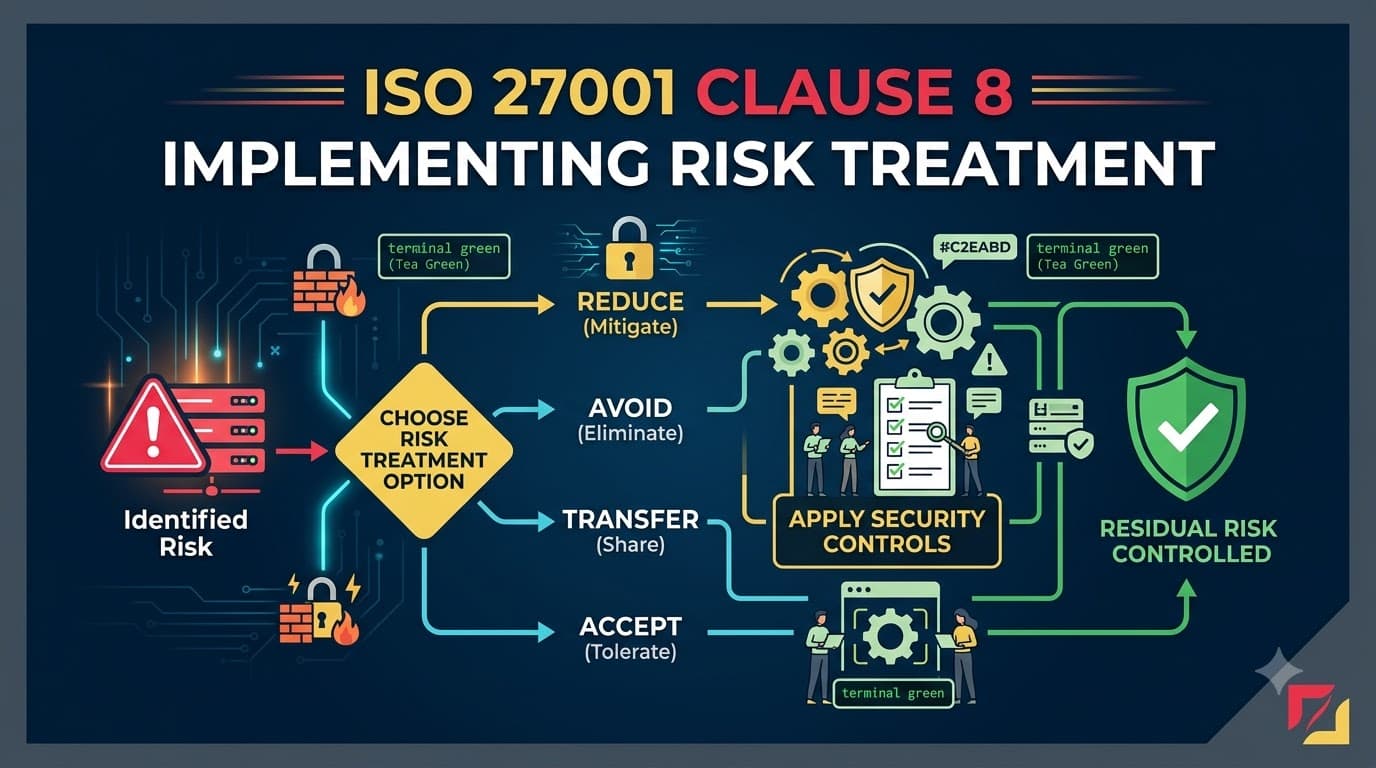
Clause 8 is where planning becomes reality. This is the clause that separates organizations that can talk about their ISMS from organizations that can prove it runs — where the risk treatment plan stops being a spreadsheet and starts being firewalls, access reviews, encrypted backups, and a paper trail an auditor can follow from decision to deployment.
I still have the PDF. Sixty-one pages, a beautifully formatted risk treatment plan, produced by a Fortune 500 subsidiary's compliance team eleven months before their Stage 2 audit. Every risk had an owner. Every control had a target date. Every column in the table was full. I remember flipping through it in a conference room in Reading, nodding, thinking: this is one of the cleanest Clause 6 outputs I've seen all year.
Then I asked the question I always ask: "Show me the control." Not the plan — the control. The actual configuration, the actual log, the actual person doing the actual work.
Silence. Then a junior analyst, to her credit, said what everyone else was thinking: "Some of these... I think some of these are still just on the plan."
That subsidiary — I'll call the company Halworth Logistics, because the real name doesn't matter and the pattern repeats everywhere — had done Clause 6 well. They'd identified a credential-stuffing risk against their customer portal, scored it appropriately, and written a treatment decision: implement multi-factor authentication (mapped to Annex A control 8.5, secure authentication) within Q2. The plan said "implemented." The screenshot in the evidence folder was a Jira ticket marked "Done." Nobody had gone back to check whether "Done" in Jira meant "Done" in production.
Four months after certification, a credential-stuffing campaign hit 40,000 customer accounts. MFA had been rolled out to internal staff. It had never been extended to the customer-facing portal — the ticket closed when the internal rollout finished, and nobody reopened it for the second phase. The incident cost Halworth an estimated £340,000 in remediation, notification, and one canceled enterprise contract. Their certificate survived a very uncomfortable surveillance audit. Their reputation with that one client did not.
This is what Clause 8 exists to prevent. Clause 6 asks "what should we do about risk?" Clause 8 asks a harder, less glamorous question: "did we actually do it, and can we prove it?" If you've read our guide to Clause 6: Planning, you already have the risk assessment and the treatment plan. This article is about turning that plan into operating controls, into evidence, and into a repeatable rhythm — because a risk treatment plan that never gets operationalized is not a control. It's a liability with a due date.
Who This Is For / What You'll Walk Away With
This article is for ISMS managers, security leads, and internal auditors who have a Clause 6 risk assessment and treatment plan in hand — or are close to one — and need to know exactly what "operation" means under ISO 27001:2022. It's for CISOs who need to brief a board on why "we have a plan" is not the same as "we are compliant." It's for consultants preparing clients for Stage 1 and Stage 2 audits who keep seeing beautiful plans and empty control rooms.
By the end, you will know:
Exactly what 8.1, 8.2, and 8.3 require, word for word, and how they differ from each other in practice.
How to set operational criteria for a process so "controlled" has a testable meaning instead of being a feeling.
How to run change control and outsourced-process control so unmanaged changes don't quietly reopen risks you already treated.
How to schedule and trigger risk reassessments — on a calendar and on an event — so 8.2 isn't a once-a-year fire drill.
How to convert a risk treatment plan line item into a deployed, evidenced Annex A control, with a mapping table you can adapt immediately.
What evidence auditors actually pull during Stage 2 for Clause 8, and how to have it ready before they ask.
We'll use a mermaid diagram to show the full operational lifecycle, fifteen-plus tables you can lift directly into your own ISMS documentation, and three case studies — including Halworth's — showing what happens when operation is done well and done badly.
Clause 8 in Plain English: Where the Plan Meets Production
Clause 8 of ISO/IEC 27001:2022 has exactly three sub-clauses: 8.1 Operational planning and control, 8.2 Information security risk assessment, and 8.3 Information security risk treatment. That brevity is deceptive. In terms of page count in the standard, Clause 8 is short. In terms of effort, evidence, and auditor attention, it is often the single largest workstream in an ISMS implementation, because it is where every other clause's promises get cashed in.
Clause 4 told you your context. Clause 5 told you leadership owns this. Clause 6 told you what the risks are and what you decided to do about them. Clause 7 gave you the people, competence, and documented information to do the work. Clause 8 is the doing. It is the only clause in the standard whose entire content is: plan it, run it, control it, change it carefully, watch your suppliers, reassess the risk, and implement what you said you'd implement.
Auditors know this. In my experience auditing and preparing organizations across financial services, SaaS, healthcare, and manufacturing, Clause 8 nonconformities cluster around one root cause: organizations treat Clause 6 as the finish line. They celebrate a signed-off risk treatment plan the way some teams celebrate a merged pull request — as if the work is done rather than just scoped. Clause 8 is the reminder that a risk treatment plan is an instruction set, not an accomplishment.
"I can tell within ten minutes of a Stage 2 whether operation is real. I ask for the risk treatment plan, pick the third line item at random, and ask to see the control live. If the answer is a screenshot of a ticket instead of a screenshot of a system, we have a problem." — Priya Nandakumar, lead auditor, fictional certification body Veritrust Assurance
Table 1: Clause 8 Sub-Clauses at a Glance
Sub-clause | Core Requirement | Primary Output | Feeds Into |
|---|---|---|---|
8.1 Operational planning and control | Plan, implement, and control processes needed to meet ISMS requirements and Clause 6 actions; set criteria; control change; control outsourced processes | Documented operational criteria, change records, supplier control evidence | 9.1 monitoring, 9.2 internal audit |
8.2 Information security risk assessment | Perform risk assessments at planned intervals and when significant changes occur, using 6.1.2 criteria | Updated risk assessment records | 8.3 treatment updates, 6.1.3 treatment plan revisions |
8.3 Information security risk treatment | Implement the risk treatment plan | Deployed controls, implementation evidence, updated SoA status | 9.1 monitoring, 9.3 management review |
8.1 Operational Planning and Control: Turning Decisions Into Criteria
The text of 8.1 asks the organization to plan, implement, and control the processes needed to meet information security requirements and to implement the actions determined in Clause 6. That's the easy part to read and the hard part to do, because the standard immediately raises the bar: you must establish criteria for these processes, and then control the processes in accordance with those criteria.
Criteria is the operative word, and it's the word most ISMS programs skip. A criterion is a testable line, not a sentiment. "We patch critical vulnerabilities quickly" is not a criterion. "Critical and high-severity vulnerabilities on internet-facing assets are remediated within 15 calendar days of confirmed detection, verified via the vulnerability management platform" is a criterion — it can be measured, it can be missed, and missing it can be evidenced and escalated.
When I run operational-control workshops, I ask teams to write criteria for every process that touches an Annex A control before they touch a single tool. For access provisioning (tied to control 5.18, access rights), the criterion might be: access requests are approved by the resource owner within two business days, access is provisioned within one business day of approval, and quarterly access reviews confirm least privilege. For backup operations (control 8.13, information backup), the criterion might be: full backups complete nightly, restore tests run monthly, and backup integrity failures trigger a same-day alert to the infrastructure on-call rotation.
Once criteria exist, "controlling the process in accordance with the criteria" becomes concrete: you monitor against the criterion, you record deviations, and you have a corrective path when the criterion isn't met. Without the criterion, there's nothing to control against — just a process running on vibes.
Table 2: Sample Operational Criteria Mapped to Annex A Controls
Operational Process | Related Annex A Control | Example Criterion | Evidence Artifact |
|---|---|---|---|
Access provisioning/deprovisioning | 5.18 Access rights | Access granted within 1 business day of approval; revoked within 4 hours of termination notice | IAM system logs, HR-to-IT termination tickets |
Vulnerability remediation | 8.8 Management of technical vulnerabilities | Critical/high vulns on internet-facing assets remediated within 15 days | Vulnerability scan reports, patch tickets |
Backup and restore | 8.13 Information backup | Nightly full backups; monthly restore test with documented pass/fail | Backup job logs, restore test reports |
Security monitoring | 8.16 Monitoring activities | SIEM alerts triaged within 30 minutes during business hours | SOC triage logs, alert dashboards |
Threat intelligence intake | 5.7 Threat intelligence | Weekly review of relevant threat feeds; actionable items logged within 48 hours | Threat intel review log |
Configuration baselining | 8.9 Configuration management | New server builds validated against hardened baseline before go-live | Configuration scan reports, build checklists |
Supplier onboarding review | 5.19 Information security in supplier relationships | Security questionnaire completed and reviewed before contract signature | Supplier assessment records |
Change approval | 8.32 Change management | All production changes reviewed by CAB or delegated approver before deployment | Change tickets, CAB minutes |
Documented information is not optional decoration here — the standard explicitly requires it "to the extent necessary to have confidence that the processes have been carried out as planned." That phrase, "have confidence," is doing real work. It means the documentation has to be sufficient for someone who wasn't in the room — an auditor, a new hire, your own future self during an incident post-mortem — to verify the process ran as intended. A criterion without a record is just an aspiration. A record without a criterion is just noise. You need both, paired, for every operational process that carries a Clause 6 risk decision behind it.
I keep a simple test for teams building this out: if your regulator, your auditor, or your own board asked "prove this control ran last Tuesday," could you produce the artifact in under five minutes? If the answer is "let me check with the team and get back to you," the documented-information requirement of 8.1 isn't met yet, no matter how good the underlying control actually is.
Controlling Planned Changes: The Clause Everyone Underestimates
Clause 8.1 requires the organization to "control planned changes and review the consequences of unintended changes, taking action to mitigate any adverse effects, as necessary." This single sentence is where I see the widest gap between paper ISMS and operating ISMS. Organizations write a change management policy, point to their ITIL-flavored change advisory board, and assume the box is ticked. But the ISMS-relevant question isn't "do you have change management?" It's "does your change management process specifically consider information security consequences before the change goes live?"
A planned change — a new cloud region, a database migration, a vendor swap for your ticketing system, a firewall rule update — has to pass through a security lens before it's approved, not after an incident reveals it should have. This connects directly to Annex A control 8.32, change management, but 8.1's requirement is broader: it's about the operational discipline of controlling change across every process that touches the ISMS, not just IT changes.
"The riskiest changes in any environment are never the ones on the change calendar. They're the ones somebody makes at 6 p.m. on a Friday because a client is annoyed and 'it's just a quick config tweak.' Clause 8.1 exists because quick config tweaks are how breaches start." — Damian Osei, head of IT operations, fictional mid-market insurer Northfield Mutual
Table 3: Change Control Evaluation Criteria for Security-Relevant Changes
Change Category | Security Review Required? | Typical Reviewer | Rollback Plan Required? | Example |
|---|---|---|---|---|
Production infrastructure change | Yes — mandatory | Security architect + CAB | Yes | New load balancer, VPC peering |
Application code deployment (major) | Yes — mandatory | Security champion / AppSec | Yes | New authentication module |
Application code deployment (minor/patch) | Risk-based (triaged) | On-call security reviewer | Recommended | Bug fix, UI text change |
Third-party/SaaS tool onboarding | Yes — mandatory | Vendor risk + security | N/A (contractual exit clause) | New CRM, new analytics tool |
Firewall/network ACL change | Yes — mandatory | Network security lead | Yes | New inbound rule, VPN change |
Emergency change (incident-driven) | Yes — expedited, post-hoc review within 24h | Incident commander + security lead | Yes, documented retroactively | Emergency patch during active exploit |
Organizational change (restructuring, M&A) | Yes — mandatory | ISMS manager + leadership | N/A | Merging two business units' access models |
Unintended changes are the harder half of this requirement, and they're where most organizations have nothing at all. An unintended change is a drift — a cloud auto-scaling policy that silently changed a security group, a default setting reintroduced by a vendor patch, a misconfigured Terraform apply that reverted a hardening setting. The standard doesn't expect you to prevent every unintended change; it expects you to review the consequences and mitigate adverse effects. In practice, this means configuration drift detection (tying back to control 8.9, configuration management) and periodic reconciliation between your intended-state baseline and your actual-state environment. Teams that treat drift detection as a security control, not just a DevOps convenience, are the ones who catch these before an auditor — or an attacker — does.
Case Study 1: Halworth Logistics — When "Closed" Isn't "Done"
I opened this article with Halworth Logistics, and it's worth returning to with the full operational picture, because the failure wasn't in Clause 6 — it was entirely a Clause 8.1 and 8.3 failure. Their risk assessment correctly identified credential stuffing against the customer portal as a high risk. Their treatment decision was correct: implement MFA. The control they selected, mapped to Annex A 8.5, was appropriate.
What broke down was operational control. There was no documented criterion for "MFA implementation complete" that distinguished internal staff rollout from customer-facing rollout. There was no verification step — no screenshot of the actual authentication flow, no test account demonstrating the second factor being enforced — before the Jira ticket was marked "Done" and the risk treatment plan status flipped to "Implemented." There was no periodic control testing between plan sign-off and the next audit cycle that would have caught the gap.
Post-incident, Halworth rebuilt their operational control model around three changes: every risk treatment plan line item now requires an "evidence of implementation" artifact attached before status can change to Implemented, not just a ticket reference; a quarterly control-testing calendar independently verifies a sample of implemented controls (their internal audit function samples 20% of the SoA each quarter); and MFA-specific rollout scope is now tracked as a discrete sub-task per user population, not a single ticket. Eighteen months later, their next external audit found zero major nonconformities in Clause 8, and their internal metrics showed control-verification cycle time dropped from "unmeasured" to a median of 11 days from implementation to independent evidence sign-off. The incident cost them £340,000. The fix cost roughly £28,000 in internal audit hours and tooling. That ratio is the entire business case for treating Clause 8 seriously.
Controlling Externally Provided Processes, Products, and Services
The final requirement of 8.1 is easy to underestimate because it sounds like procurement's problem: "the organization shall ensure that externally provided processes, products, or services that are relevant to the information security management system are controlled." In a modern technology stack, this is almost never a small scope. Your cloud provider, your payroll processor, your customer support platform, your penetration testing vendor, your managed detection and response provider, your outsourced helpdesk — all of them touch your ISMS boundary, and 8.1 says you don't get to treat them as somebody else's problem once the contract is signed.
This requirement works hand-in-hand with Annex A's supplier relationship controls (5.19 through 5.23), but 8.1 is specifically about the operational control — the ongoing mechanism, not just the point-in-time due diligence questionnaire. I've seen organizations do an excellent supplier security assessment at onboarding and then never look at that vendor again for three years. That satisfies a due-diligence control; it does not satisfy operational control under 8.1.
"We had a vendor with SOC 2 Type II at onboarding, glowing report, no exceptions. Eighteen months later they'd quietly outsourced their own support function to a subcontractor in a jurisdiction we'd never approved. Nobody told us. Nobody asked us. We only found out because their subcontractor had a breach and it made the trade press." — Elena Torres, third-party risk manager, fictional healthcare payer CoastalCare Health
Table 4: Outsourced/Externally Provided Process Control Framework
Control Point | Frequency | Owner | What's Verified | Escalation Trigger |
|---|---|---|---|---|
Pre-contract security assessment | Once, before signature | Vendor risk team | Certifications, security questionnaire, data flow mapping | Missing certification for critical data access |
Contractual security clauses | Once, reviewed at renewal | Legal + security | Right-to-audit, breach notification SLA, subprocessor approval | SLA below internal minimum threshold |
Ongoing certification monitoring | Annually or on renewal | Vendor risk team | Current ISO 27001/SOC 2 certificate validity | Certificate lapsed or scope reduced |
Subprocessor change notification | Continuous (vendor-driven) | Third-party risk manager | New subprocessors disclosed and approved | Undisclosed subprocessor discovered |
Access review for vendor accounts | Quarterly | IAM team | Vendor accounts still required, least privilege maintained | Orphaned vendor account found |
Incident/breach notification test | Annually | Security operations | Vendor's breach notification process actually works | Vendor fails to notify within contracted window |
Service level and security KPI review | Quarterly | Vendor manager + security | Uptime, patch cadence, incident response times | Repeated SLA breaches |
Exit/offboarding readiness | Reviewed annually | Vendor risk team | Data return/destruction process documented and testable | No documented exit plan |
The mechanism matters more than the paperwork here. A control point without a scheduled recurrence is a one-time check, not operational control. This is the same principle Halworth Logistics missed with their MFA rollout — a plan that "closes" without an operational recheck. For suppliers, the fix is a standing calendar: quarterly access reviews, annual certificate checks, contractual triggers for subprocessor changes. If you don't already have this cadence formalized, a dedicated guide on Supplier Security & Third-Party Risk Management walks through building this control framework from scratch — for now, the table above is a workable starting template.
8.2 Information Security Risk Assessment: Reassessment Isn't Optional
If Clause 6 is where you first assess risk, 8.2 is where you keep assessing it — on a schedule, and whenever the ground shifts under you. The exact requirement is that the organization performs information security risk assessments at planned intervals, and when significant changes are proposed or occur, taking account of the criteria established in 6.1.2, and retains documented information of the results.
Two triggers, not one. "Planned intervals" is the calendar-driven trigger — most organizations I work with land on an annual full reassessment, sometimes semi-annual for higher-risk sectors like financial services or healthcare, occasionally quarterly for organizations in genuinely volatile threat environments. "Significant changes" is the event-driven trigger, and this is where I see the most Clause 8.2 nonconformities, because "significant" is left for the organization to define — and if you haven't defined it, you have no way of knowing when you've missed a trigger.
I push every client to write down, explicitly, what counts as a significant change in their context. Vague definitions produce vague compliance. A concrete list produces a control you can actually audit against.
Table 5: Risk Reassessment Trigger Framework
Trigger Category | Example Event | Reassessment Scope | Typical Timeframe |
|---|---|---|---|
Scheduled/calendar | Annual ISMS review cycle | Full risk register review | Within 12 months of prior full assessment |
New system or service | Launch of new customer-facing application | Targeted assessment of new asset and its data flows | Before go-live |
Merger, acquisition, or divestiture | Acquiring a company with its own IT estate | Full reassessment of combined risk landscape | Within 90 days of close |
Significant organizational change | Restructuring, new business unit, new office/region | Targeted assessment of affected scope | Within 60 days of change |
Major incident or near-miss | Ransomware attempt, data exposure, failed control test | Targeted assessment of root-cause area | Within 30 days of incident closure |
New or changed regulatory requirement | New data protection law in an operating jurisdiction | Targeted assessment of compliance-related risks | Before enforcement date |
Significant threat intelligence signal | New TTP targeting the organization's sector | Targeted assessment of exposure to that TTP | Within 15 days of credible signal |
Vendor/supplier change | Critical supplier breach or subprocessor change | Targeted assessment of third-party risk exposure | Within 30 days of notification |
Technology deprecation | End-of-life of a critical platform or dependency | Targeted assessment of continuity/security exposure | Before end-of-life date |
"The mistake I see most is organizations defining 'significant change' so loosely that almost nothing qualifies, and then being genuinely surprised when an auditor asks why a merger eight months ago never triggered a risk reassessment. If your trigger list wouldn't have caught your last three actual changes, it's not a real trigger list — it's decoration." — Faisal Rahman, ISMS program lead, fictional fintech Ledgerway Financial
Documented information of the results is the other half of 8.2, and it means more than an updated spreadsheet cell. Auditors expect to see the assessment methodology applied consistently with 6.1.2 criteria, dated, versioned, and traceable — who assessed, when, against what criteria, with what likelihood and impact scoring, and what changed compared to the prior version. If your risk register has no version history, you cannot demonstrate that reassessment happened at all; you can only demonstrate that a risk register currently exists.
8.3 Information Security Risk Treatment: Implementing the Plan
This is the shortest sub-clause in the entire standard and arguably the one with the highest stakes: "The organization shall implement the information security risk treatment plan. The organization shall retain documented information of the results of the information security risk treatment." Two sentences. Everything else in this article exists in service of making those two sentences true.
Implementation means the risk treatment plan you built in Clause 6: Planning — the one mapping each treated risk to a decision (modify, retain, avoid, or share) and, for modified risks, to specific Annex A or supplementary controls — stops being a document and becomes a deployed, operating, evidenced set of controls. If Clause 6 produced a Statement of Applicability marking control 8.16 (monitoring activities) as applicable and planned, Clause 8.3 is where a SIEM gets configured, alert rules get tuned, an escalation path gets tested, and someone can show a dashboard with real alerts flowing through a real triage process.
The retained documented information isn't just "we did it" — it's evidence sufficiently detailed that a third party could reconstruct the implementation timeline and verify the control operates as intended. This is the exact gap that sank Halworth: their retained information was a ticket status, not implementation evidence.
Table 6: Risk Treatment Plan to Control Implementation Mapping (Sample)
Risk ID | Risk Description | Treatment Decision | Annex A Control(s) | Implementation Owner | Target Date | Status | Evidence Artifact |
|---|---|---|---|---|---|---|---|
R-014 | Credential stuffing against customer portal | Modify | 8.5 Secure authentication | Head of Application Security | 2026-03-31 | Implemented — verified | MFA enforcement config export, test login recording |
R-027 | Loss of unencrypted laptop | Modify | 7.9 Security of assets off-premises, 8.24 Use of cryptography | IT Operations Manager | 2026-01-15 | Implemented — verified | MDM encryption compliance report |
R-033 | Insider misuse of privileged access | Modify | 8.2 Privileged access rights, 8.15 Logging | IAM Lead | 2026-04-30 | In progress | PAM tool deployment plan, interim manual log review |
R-041 | Undetected supply-chain compromise | Modify | 5.7 Threat intelligence, 8.9 Configuration management | Security Architecture Lead | 2026-06-30 | Planned | N/A — target date not reached |
R-052 | Physical intrusion at data center | Modify | 7.2 Physical entry, 7.4 Physical security monitoring | Facilities Security Manager | 2025-11-30 | Implemented — verified | Badge access logs, CCTV retention confirmation |
R-058 | Regulatory fine for cross-border data transfer | Avoid | N/A (process change — data localization) | Data Protection Officer | 2025-09-30 | Implemented — verified | Updated data flow diagram, contractual amendments |
R-063 | Minor residual risk from legacy printer fleet | Retain | N/A | Risk Owner (CFO) | N/A | Accepted — documented | Risk acceptance sign-off |
This table is the connective tissue between Clause 6 and Clause 8, and it should be a living document, not a one-time export. Every status change needs a date and a name attached, because "who changed this to Implemented, and on what basis" is one of the first questions I ask when reviewing a client's evidence pack before an audit.
Visualizing the Operational Lifecycle
The diagram below shows how a risk treatment plan decision flows through operation and back into monitoring. Notice that the loop doesn't end at "control deployed" — it continues into evidence generation and directly feeds Clause 9 performance evaluation, which is what keeps Clause 8 from becoming a one-time project rather than a living operational discipline.
flowchart TD
    A[Clause 6: Risk Treatment Plan] --> B[8.1 Establish Operational Criteria]
    B --> C[8.3 Deploy Annex A / Supplementary Controls]
    C --> D[Control Operating in Production]
    D --> E[8.1 Control Planned Changes]
    D --> F[8.1 Control Outsourced Processes]
    D --> G[Generate Operational Records]
    G --> H[8.2 Risk Reassessment - Scheduled or Triggered]
    H -->|Risk level changed| A
    H -->|No significant change| I[9.1 Monitoring, Measurement, Analysis]
    G --> I
    I --> J[9.2 Internal Audit]
    J --> K[9.3 Management Review]
    K -->|New/updated risk decision| A
    K --> L[10.1/10.2 Improvement Actions]
    L --> C
The important thing this diagram makes visible is that Clause 8 has two feedback loops, not one straight line. The first loop is internal to Clause 8: implement a control, monitor for change (planned or unintended), and route significant findings back into 8.2 reassessment. The second loop runs through Clause 9 and 10: operational records become the raw material for monitoring and internal audit, which surface findings that management review turns into new or revised treatment decisions, which land back in Clause 8 for implementation. An ISMS that only has the first loop is running Clause 8 in isolation. An ISMS with both loops is the one that actually improves year over year.
Deploying Annex A Controls: What "Implementation" Actually Looks Like
Annex A's 93 controls, across the four themes of organizational (5.1–5.37), people (6.1–6.8), physical (7.1–7.14), and technological (8.1–8.34) controls, are the toolbox Clause 6 draws from when deciding how to modify a risk. Clause 8.3 is where those tools actually get picked up and used. It's worth walking through a handful of controls as concrete examples of what "implementation" means in practice, because the word means something different for each control family.
Take 8.16, monitoring activities. Implementation isn't "we bought a SIEM." It's defined log sources feeding the platform, correlation rules tuned to the organization's actual risk profile, a documented escalation path, a named on-call rotation, and a measurable time-to-triage. I've reviewed environments where a SIEM ingested terabytes of logs and nobody had looked at an alert dashboard in six weeks. That's a purchased tool, not an implemented control.
Take 5.7, threat intelligence. Implementation means a defined process for intake (which feeds, which sources), a named owner, a cadence for review, and — critically — a documented path from "we read something relevant" to "we changed something in our environment because of it." A threat intel subscription that nobody reads is a line item on an invoice, not a control.
Take 8.9, configuration management. Implementation means an approved baseline configuration for each asset class, a mechanism (automated, ideally) to detect drift from that baseline, and a remediation process when drift is found. This is the control most directly responsible for catching the "unintended changes" that 8.1 requires you to review.
One pattern worth naming explicitly: implementation maturity isn't binary. A control can be partially implemented — say, MFA enforced for 80% of a user population while a legacy application blocks the remaining 20% — and that's a legitimate operational state, provided it's documented as such rather than rounded up to "Implemented" in the risk treatment plan. Auditors are far more comfortable with an honest "85% complete, remaining 15% blocked by legacy dependency X, remediation planned for Q3" than with a plan that claims 100% and can't survive a sample check. Precision about partial implementation is a sign of program maturity, not a confession of failure.
Table 7: Annex A Control Implementation Evidence Reference
Annex A Control | Theme | What "Implemented" Looks Like | Common Evidence Pulled by Auditors |
|---|---|---|---|
5.7 Threat intelligence | Organizational | Documented intake process, named owner, review cadence, action log | Threat intel review log, action tickets referencing intel source |
5.19 Supplier relationships | Organizational | Security requirements in contracts, ongoing monitoring cadence | Contract clauses, supplier review records |
6.3 Awareness, education, training | People | Role-based training assigned, completion tracked, phishing simulation results | LMS completion reports, simulation pass/fail rates |
7.2 Physical entry | Physical | Access control system enforcing role-based entry, visitor logging | Badge system logs, visitor sign-in records |
8.5 Secure authentication | Technological | MFA enforced across relevant systems and user populations | Authentication system configuration, login flow test evidence |
8.8 Management of technical vulnerabilities | Technological | Scheduled scanning, defined remediation SLAs, tracked closure | Scan reports, patch tickets, SLA compliance dashboard |
8.9 Configuration management | Technological | Baseline defined, drift detection active, remediation tracked | Configuration scan reports, drift alerts, remediation tickets |
8.13 Information backup | Technological | Scheduled backups, tested restores, offsite/immutable copy | Backup job logs, restore test reports |
8.16 Monitoring activities | Technological | Log sources onboarded, correlation rules active, triage SLA met | SIEM dashboard exports, triage time metrics |
8.24 Use of cryptography | Technological | Encryption applied per policy, key management process operating | Encryption configuration exports, key rotation logs |
Each row in this table represents the same underlying discipline: a criterion (from 8.1), an operating process, and retained documented information (from 8.3). Once you've built this muscle for one control, replicating it across the remaining 80-plus applicable controls in your Statement of Applicability is a matter of volume, not novelty.
Ownership: Who Actually Runs Clause 8
One of the most common structural mistakes I see is treating Clause 8 as a security team responsibility end to end. It isn't, and it can't be — the security or ISMS team can own the framework (criteria, tracking, evidence collection standards), but the execution of most controls sits with whoever runs the underlying process: IT operations runs backups, HR runs onboarding/offboarding, facilities runs physical access, engineering runs change management. Clause 8 fails when the ISMS team tries to do all the doing themselves, and it also fails when the ISMS team has no visibility into whether the doing is happening at all.
Table 8: Sample RACI for Clause 8 Operational Activities
Activity | ISMS Manager | Control Owner (Functional) | Internal Audit | Executive Sponsor |
|---|---|---|---|---|
Define operational criteria (8.1) | Accountable | Responsible | Consulted | Informed |
Execute daily/weekly operational process | Informed | Responsible/Accountable | — | — |
Control planned changes (CAB review) | Consulted | Responsible | — | Informed |
Monitor for unintended changes | Consulted | Responsible | Consulted | — |
Control outsourced processes | Accountable | Responsible | Consulted | Informed |
Schedule/trigger risk reassessment (8.2) | Accountable | Consulted | Responsible (sampling) | Informed |
Implement risk treatment plan items (8.3) | Accountable | Responsible | — | Informed |
Collect and retain implementation evidence | Accountable | Responsible | Consulted | — |
Independently verify control operation | Informed | — | Responsible | Informed |
Report status to management review | Responsible | Consulted | Consulted | Accountable |
The internal audit column matters more than most ISMS teams give it credit for. Internal audit — covered under Clause 9.2, and something we go deeper on in Clause 7: Support with respect to competence and resourcing — is your built-in check that "Implemented — verified" in Table 6 actually means verified by someone other than the person who did the implementing. Self-attested evidence is a starting point; independently sampled evidence is what survives a Stage 2 challenge.
Tooling and Automation for Operational Control
You do not need an enterprise GRC platform to satisfy Clause 8, but you do need something that turns "we should check this quarterly" into "this gets checked quarterly, automatically, with a record." I've seen five-person startups pass certification with disciplined use of shared trackers and calendar-triggered review tickets, and I've seen twelve-figure enterprises fail Clause 8 audits despite owning every GRC platform on the market, because the platform was configured and never operated.
Table 9: Operational Control Tooling Categories
Category | Purpose in Clause 8 | Examples of Function (Not Endorsements) | Minimum Viable Alternative |
|---|---|---|---|
GRC / ISMS platform | Central risk register, SoA tracking, evidence repository | Integrated risk + control tracking with audit trail | Structured spreadsheet with version control and access logging |
SIEM / log management | 8.16 monitoring evidence, alert triage records | Centralized log correlation and alerting | Cloud-native logging with scheduled manual review |
Configuration management / CSPM | 8.9 drift detection, baseline enforcement | Automated baseline comparison and alerting | Scheduled manual configuration audits |
Vulnerability management | 8.8 scan scheduling, remediation SLA tracking | Automated scanning with ticketing integration | Manual scan cadence with tracked remediation spreadsheet |
Vendor/third-party risk platform | Supplier control point tracking (Table 4) | Automated certificate expiry alerts, questionnaire workflows | Calendar reminders tied to a supplier register |
Change management / ITSM | 8.32 change records, CAB tracking | Ticketing with mandatory security review field | Structured change log reviewed at fixed intervals |
Backup and recovery monitoring | 8.13 backup/restore evidence | Automated job success/failure alerting, restore test scheduling | Manual restore test log on a fixed calendar |
The pattern across every row: automation reduces the labor cost of evidence, but a disciplined manual process with a real calendar and a real record satisfies the standard too. What fails, every time, is a tool bought and never configured to the organization's actual criteria — the Halworth pattern again, just with more expensive software involved.
Case Study 2: Ledgerway Financial — Building the Reassessment Muscle
Ledgerway Financial, a fictional fintech processing merchant payments, had a technically sound risk assessment methodology inherited from a well-run Clause 6 process, but their 8.2 practice was purely calendar-driven: one full reassessment, every January, no exceptions. In the September before their first surveillance audit, they acquired a smaller payments processor — a genuinely significant change by any reasonable definition — and continued operating on the January cycle without a triggered reassessment.
The acquired company's infrastructure included a legacy API gateway with a known, unpatched vulnerability class. It sat unassessed for four months until January's scheduled review caught it — by which point it had been reachable from the internet the entire time. No breach occurred, but the surveillance auditor flagged it as a major nonconformity: a significant change had occurred, and 8.2's "when significant changes are proposed or occur" trigger had not fired.
Ledgerway's corrective action, which held up in the following year's audit, was to formalize exactly the kind of significant-change trigger list shown in Table 5, tie it explicitly to their change management and corporate development processes (so M&A activity automatically notifies the ISMS manager), and add a lightweight "triggered assessment" template that could be completed in days rather than the multi-week full-cycle methodology. Their mean time from trigger event to completed targeted reassessment dropped from an unmeasured four-plus months to a documented 12 days for the two acquisitions they completed the following year. The lesson: a risk assessment methodology is only as good as the triggers that invoke it between scheduled cycles.
Case Study 3: Northfield Mutual — Outsourced Process Control Done Right
Not every story here is a failure. Northfield Mutual, a fictional mid-market insurer, gave me one of the cleanest examples of 8.1's externally-provided-process requirement I've encountered. They outsourced claims document processing to a third-party BPO handling policyholder personal and financial data — a genuinely high-risk relationship for an insurer.
Rather than treating the vendor security questionnaire as the end of due diligence, Northfield's third-party risk function built exactly the standing-calendar model in Table 4: quarterly access reviews of the BPO's staff accounts into Northfield's claims system, an annual on-site (later hybrid) control walkthrough, and a contractual requirement that any subprocessor change be disclosed within five business days. When the BPO restructured its own operations eighteen months into the relationship and moved a support function to a new subcontractor, Northfield was notified within the contractual window, ran an expedited risk reassessment (triggered per their Table 5-equivalent framework), and required the BPO to complete a fresh security assessment of the new subcontractor before any data access was extended.
The reassessment identified that the new subcontractor operated in a jurisdiction with materially different data protection enforcement, which triggered a renegotiation of the data processing terms before go-live. No incident occurred — which is, of course, the entire point. Northfield's auditor specifically cited their outsourced-process control program as an example of good practice in the Stage 2 report, one of the few times I've seen an auditor volunteer praise rather than just noting the absence of a finding. The internal cost of running this program was roughly 15 person-days a year across third-party risk and IAM; the counterfactual cost — an uncontrolled subprocessor handling policyholder data in a weaker regulatory environment — was, by Northfield's own risk quantification, in the seven-figure range if it had gone wrong.
A 30-Day Playbook for Operationalizing One Risk Treatment Line Item
Theory is easy to agree with in a workshop and hard to apply on a Tuesday with three other deadlines competing for attention. So here is the playbook I actually hand clients when they ask, "fine, but how do we start turning one line of the risk treatment plan into an operating control by next month?" I use the R-014 example from Table 6 — credential stuffing against a customer portal, treated by implementing MFA mapped to control 8.5 — because it's realistic and because it's the exact scenario that sank Halworth Logistics.
The mistake most teams make is jumping straight to configuration on day one. The playbook below deliberately front-loads criteria and ownership before a single system gets touched, because that sequencing is what prevents the "internal rollout closed the ticket" trap.
Table 10: Sample 30-Day Operationalization Timeline
Week | Activity | Output | Owner |
|---|---|---|---|
Week 1 | Write the operational criterion: define exactly what "MFA implemented" means, including scope (which user populations), enforcement method, and exception handling | Documented criterion added to control record | Head of Application Security |
Week 1 | Identify and document the evidence artifact that will prove implementation (e.g., authentication config export plus a recorded test login) | Evidence specification agreed with internal audit | ISMS Manager + Internal Audit |
Week 2 | Configure MFA enforcement in a staging/test environment; validate against the criterion | Test evidence — passing and failing login attempts | Application Security Engineer |
Week 2–3 | Roll out to first production user population (e.g., internal staff), monitor for support tickets and lockouts | Rollout log, support ticket volume trend | IT Operations |
Week 3 | Roll out to remaining populations explicitly named in the criterion (e.g., customer-facing portal users) as a distinct, separately tracked sub-task | Separate rollout log per population | Application Security Engineer |
Week 4 | Independent verification: internal audit or a peer reviewer confirms the evidence artifact matches the criterion for every named population | Verification sign-off, dated and attributed | Internal Audit |
Week 4 | Update risk treatment plan status to "Implemented — verified" only after sign-off; update SoA and risk register accordingly | Updated RTP, SoA, and risk register entries | ISMS Manager |
Two details in this table do the heavy lifting. First, the rollout is explicitly split by user population rather than tracked as one ticket — this is the single change that would have caught Halworth's gap before certification rather than four months after. Second, the status change to "Implemented — verified" is gated behind an independent sign-off in week four, not self-declared by the engineer who did the configuration. Neither change costs meaningful money. Both require only that someone insist on the sequencing before work starts, not after an audit finding forces it.
Sample Audit Interview Questions for Clause 8
Part of preparing a client for Stage 2 is rehearsing the actual questions an auditor is likely to ask control owners face to face — not the ISMS manager who wrote the documentation, but the person who runs the process day to day. Auditors deliberately interview process owners rather than relying solely on the ISMS manager's narrative, because a coached answer from the person who wrote the policy tells you less than an unrehearsed answer from the person who runs the backup job.
Table 11: Sample Clause 8 Audit Interview Questions by Role
Interviewee | Sample Question | What a Strong Answer Demonstrates |
|---|---|---|
IT Operations Manager | "Walk me through what happens when a backup job fails overnight." | A defined criterion, an alerting mechanism, and a documented escalation path (8.1, 8.13) |
Application Security Engineer | "Show me the last time a production change to this application was reviewed for security impact before deployment." | Real, dated change records with a security review field completed (8.1 change control) |
Third-Party Risk Manager | "How would you know if this supplier changed subprocessors without telling you?" | A contractual notification clause plus an active monitoring mechanism, not just a policy statement (8.1 external processes) |
ISMS Manager | "When was your risk register last updated, and what triggered that update?" | A dated, triggered reassessment tied to an explicit trigger definition, not just an annual formality (8.2) |
Control Owner for a Sampled Risk | "This risk treatment plan says this control is implemented — show me the evidence." | An artifact independent of a ticket status, ideally with an independent verification sign-off (8.3) |
Internal Auditor | "How do you decide which controls to sample each cycle, and what did you find last time?" | A risk-based sampling rationale and a real trail of findings and corrective actions, not a clean report every single time |
If your control owners would stumble on any of these questions today, that's the gap to close before your next audit — not the language in your policy documents, which auditors read but rarely find as revealing as a live conversation with the person actually running the process.
"I stopped accepting 'yes, it's done' as an answer years ago. Now I ask control owners to show me, on their own screen, in real time. Nine times out of ten they can. The tenth time is exactly the finding I'm there to write up." — Sarah Kwan, internal audit lead, fictional manufacturing group Ashcombe Industrial
Common Failure Modes: Where Clause 8 Breaks Down
Across the audits and gap assessments I've run, the same handful of failure patterns account for the overwhelming majority of Clause 8 nonconformities. None of them are exotic. All of them are avoidable with the operational discipline described above.
Table 12: Common Clause 8 Failure Patterns and Fixes
Failure Pattern | Root Cause | Typical Audit Finding | Practical Fix |
|---|---|---|---|
"Implemented" means "ticket closed" | No verification step before status change | Nonconformity: no evidence control operates as intended | Require independent evidence artifact before status change (Table 6 model) |
No defined operational criteria | Process exists but nothing to measure it against | Observation/minor NC: cannot demonstrate control effectiveness | Write testable criteria per process (Table 2 model) |
Change control ignores security review | Change process inherited from ITSM, security bolted on late | Minor NC: security-relevant changes deployed without review | Add mandatory security review field/gate (Table 3 model) |
Vendor assessed once, never again | Due diligence treated as one-time gate | Major NC (for critical vendors): no ongoing control | Standing calendar of control points (Table 4 model) |
Reassessment only on fixed calendar | No defined significant-change triggers | Major NC: known significant change never assessed | Explicit trigger list tied to other business processes (Table 5 model) |
Risk register has no version history | Spreadsheet overwritten in place each cycle | Minor NC: cannot evidence reassessment occurred | Version-controlled register with dated entries |
Drift goes undetected between audits | No configuration baseline or monitoring | Major NC (if drift caused incident): 8.1 unintended change not reviewed | Automated drift detection tied to 8.9 |
Evidence exists but is scattered/undiscoverable | No central evidence repository | Delays during audit; auditor fatigue, more sampling | Central evidence repository indexed to SoA/RTP line items |
Evidence Auditors Expect: A Clause-by-Clause Reference
When I prepare a client for Stage 2, I build an evidence checklist mapped directly to each Clause 8 sub-clause, because the auditor's sampling plan will almost certainly do the same thing. Having the artifact ready before it's requested is the difference between a smooth audit day and a defensive one.
Table 13: Clause 8 Evidence Reference for Audit Readiness
Sub-clause | What the Auditor Asks For | Where It Should Live | Red Flag If Missing |
|---|---|---|---|
8.1 | Documented operational criteria for key processes | Process documentation, control descriptions | Criteria described only verbally by process owner |
8.1 (change) | Sample of change records with security review evidence | Change management/ITSM system | Changes approved with no security field completed |
8.1 (external) | Supplier control point records (Table 4) | Vendor risk register, contract repository | No evidence of review since onboarding |
8.2 | Risk assessment records showing planned-interval and triggered reassessments | Risk register with version history | Single static risk register, no dated iterations |
8.2 | Defined significant-change trigger list | ISMS documentation / risk methodology | No documented definition of "significant change" |
8.3 | Risk treatment plan with current implementation status per line item | RTP tracker linked to SoA | Status marked "Implemented" with no linked evidence |
8.3 | Sample of implementation evidence for specific controls | Control-specific evidence repository | Evidence is a ticket reference only, no artifact |
8.3 (cross-clause) | Link between operational records and 9.1 monitoring inputs | Monitoring dashboards, KPI reports | Operational records exist but never reviewed by anyone |
An Operational Maturity Model for Clause 8
Not every organization needs to reach the same level of sophistication on day one of certification, but knowing where you sit on a maturity curve helps set realistic expectations for internal stakeholders and helps auditors understand your trajectory during surveillance audits. I use a four-level model in workshops, adapted loosely from capability maturity thinking but scoped specifically to Clause 8 behaviors.
Table 14: Clause 8 Operational Maturity Levels
Level | Description | Characteristic Behavior | Typical Audit Outcome |
|---|---|---|---|
Level 1 — Documented | Plan and controls exist on paper only | RTP and SoA exist; little to no operational evidence | High risk of major nonconformities at Stage 2 |
Level 2 — Implemented | Controls deployed but verification is inconsistent | Controls operate; evidence collection ad hoc, self-attested | Minor nonconformities, "prove it" findings |
Level 3 — Verified | Controls deployed with independent evidence and testing cadence | Internal audit samples controls; evidence indexed and current | Clean certification, few observations |
Level 4 — Adaptive | Controls continuously tuned based on monitoring and reassessment triggers | Reassessment triggers fire automatically; metrics drive control tuning | Auditor cites program as good practice |
Most organizations I meet at the start of an ISO 27001 project sit at Level 1, occasionally Level 2. The jump from Level 2 to Level 3 is almost entirely about building the evidence and verification habits described throughout this article — not about buying new security tools. The jump from Level 3 to Level 4, exemplified by Northfield Mutual's outsourced-process program, is where Clause 8 stops being a compliance obligation and starts being genuinely useful risk management.
Integration With Clause 9 and Clause 10: Why Operation Never Really Stops
It's tempting to think of Clause 8 as a project with an end date — implement the treatment plan, get certified, move on. The standard doesn't allow that framing, and neither does reality. Every operational record generated under 8.1 and every implementation artifact generated under 8.3 is raw material for Clause 9's monitoring, measurement, analysis, and evaluation, and for the internal audit program that tests whether your controls hold up under scrutiny. Every reassessment under 8.2 that surfaces a changed risk level flows into management review and, from there, into Clause 10's corrective action and improvement process.
This is why I tell clients that a mature ISMS doesn't really have a Clause 8 "phase." It has a Clause 8 rhythm — a continuous cycle of operating, evidencing, reassessing, and adjusting that runs indefinitely, punctuated by scheduled reassessments and audits rather than bookended by them. Organizations that internalize this rhythm stop dreading surveillance audits, because the evidence a surveillance auditor wants is simply what the operational rhythm already produces. Organizations that treat Clause 8 as a one-time project inevitably scramble in the weeks before every audit cycle, rebuilding evidence retroactively — which is itself a signal to auditors that the control isn't really operating, just being reconstructed for the occasion.
Table 15: Clause 8 Outputs Feeding Downstream Clauses
Clause 8 Output | Feeds Into | Downstream Use |
|---|---|---|
Operational criteria and control records (8.1) | 9.1 Monitoring, measurement, analysis, evaluation | KPI/metric baselines for control performance |
Change and outsourced-process records (8.1) | 9.2 Internal audit | Audit sampling universe for change and supplier controls |
Updated risk assessments (8.2) | 6.1.3 Risk treatment plan revisions | Re-scoped or new treatment decisions |
Updated risk assessments (8.2) | 9.3 Management review inputs | Board/leadership visibility into risk trend |
Implementation evidence (8.3) | 9.2 Internal audit, external certification audit | Direct audit evidence for SoA control claims |
Implementation evidence (8.3) | 10.1/10.2 Improvement actions | Root-cause input when controls underperform |
How Clause 8 Fits the Rest of Your ISMS
If you've followed our clause-by-clause series, you'll recognize Clause 8 as the pivot point. Clause 4: Context of the Organization and Clause 5: Leadership set the boundaries and the mandate. Clause 6: Planning produced the risk assessment, the treatment decisions, and the Statement of Applicability that Clause 8 now has to execute — if you haven't nailed down that plan yet, it's worth going back to get the treatment decisions right before you invest in operationalizing them. Clause 7: Support gave you the competence, awareness, and documented-information discipline that makes the evidence trails in this article possible in the first place.
If you're unsure how deep to go on any single Annex A control referenced here, our guide to ISO 27001 vs ISO 27002 explains why 27002's implementation guidance is the natural companion document once you're in the Clause 8 weeding — 27001 tells you a control is required; 27002 tells you how organizations typically implement it. If any of the terminology in this article felt unfamiliar — SoA, risk treatment, residual risk — our ISO 27001 Terminology and Glossary is worth bookmarking, and if you want the conceptual foundation underneath all of Clause 8's mechanics, ISMS Core Concepts covers the plan-do-check-act structure this entire clause sits inside.
For teams weighing whether this investment is worth it, our piece on Certification Benefits and ROI makes the business case using the exact kind of avoided-incident math from the Halworth and Northfield case studies above.
Two topics deserve their own dedicated treatment beyond what this article can cover: a full walkthrough of building a risk treatment plan from a blank risk register (a companion piece, Implementing a Risk Treatment Plan, is in our editorial pipeline), and a complete field guide to Annex A's 93 controls across all four themes (Annex A Controls Explained: All 93 is also planned). Once you're operating Clause 8, the next stop in the clause sequence is measuring whether it's working — that's the subject of ISO 27001 Clause 9: Performance Evaluation — and then closing the loop on what to do when it isn't, covered in Clause 10: Improvement.
Organizations benchmarking their Clause 8 program against other frameworks often ask how this compares to control operation under SOC 2's trust services criteria (cross-pillar – verify), particularly around change management and monitoring — the underlying operational discipline is remarkably similar even though the audit mechanics differ. Organizations in regulated sectors also frequently map Clause 8's operational controls against the NIST Cybersecurity Framework's "Protect" and "Detect" functions (cross-pillar – verify) to demonstrate coverage across multiple frameworks with a single evidence set — a common ask from organizations juggling both ISO 27001 and US federal or critical-infrastructure requirements. If your risk treatment plan involves personal data processing, it's also worth cross-referencing your controls against GDPR's Article 32 security-of-processing requirements (cross-pillar – verify), since several Annex A technological controls — encryption, access control, monitoring — map almost directly onto GDPR's expectations.
Templates and Tools to Accelerate Operationalization
You don't need to build every tracker in this article from a blank page. A handful of PentesterWorld resources map directly onto the tables above and can shortcut the initial build:
Our Risk Register Template gives you the version-controlled structure that Table 5's reassessment triggers and Table 6's risk-to-control mapping both depend on.
The Build a Sample Risk Treatment Plan hands-on lab is the fastest way to practice turning a Clause 6 decision into the kind of evidenced line item shown in Table 6, before you do it for real against your own risk register.
Annex A — All 93 Controls at a Glance is a handy one-page reference while you're mapping treatment decisions to specific controls, as in Table 7.
The SoA Template keeps your Statement of Applicability status fields consistent with the Implemented/In Progress/Planned language used throughout this article.
Our Internal Audit Checklist is built around exactly the evidence-sampling approach described in Table 13 and the RACI in Table 8 — useful for internal audit teams testing whether Clause 8 evidence actually holds up before the external auditor asks.
Table 16: Recommended Resources by Operational Task
Operational Task | Recommended Resource | Maps to |
|---|---|---|
Track and version risk decisions | Risk Register Template | Table 5, Table 6 |
Practice building a treatment plan | Build a Sample Risk Treatment Plan (lab) | Table 6 |
Map risks to specific Annex A controls | Annex A — All 93 Controls at a Glance | Table 7 |
Track SoA implementation status | SoA Template | Table 6, Table 13 |
Independently verify control operation | Internal Audit Checklist | Table 8, Table 13 |
The Strategic Takeaway
Every risk treatment plan I've ever reviewed looked good on the page. The ones that mattered were the ones that stopped being a page and became a Tuesday-morning routine — a criterion someone checks, a record someone files, a control someone can point to on a screen rather than describe from memory. Clause 8 is not a bureaucratic hurdle between your risk assessment and your certificate. It is the actual security program. Everything upstream — context, leadership, planning, support — exists to make this clause possible. Everything downstream — monitoring, audit, improvement — exists to keep it honest.
If there's one habit worth adopting from everything in this article, it's the discipline Halworth Logistics only learned the expensive way: never let a status change to "Implemented" without an artifact that proves it, generated by a process independent of the person who did the implementing. That single habit — cheap, unglamorous, and almost universally skipped — is what separates organizations that pass Stage 2 comfortably from organizations that discover the gap during an incident instead.
"Certification tells you an auditor believed your evidence on the day they looked. Operation is what tells you whether that evidence is still true the day you actually need it — during an incident, not during an audit." — Priya Nandakumar, lead auditor, Veritrust Assurance
If you're building or hardening your organization's Clause 8 operational program — from writing testable criteria, to designing evidence workflows, to pressure-testing whether your "implemented" controls would survive an adversarial review — PentesterWorld's assessment and advisory teams work with organizations at every maturity level shown in Table 14. Whether you need an independent control-verification exercise ahead of a Stage 2 audit, a technical penetration test to validate that a control like MFA or network segmentation genuinely holds under attack, or hands-on help operationalizing a risk treatment plan that's currently still living in a spreadsheet, get in touch with PentesterWorld to turn your risk treatment plan into evidence an auditor — and an attacker — can't argue with.