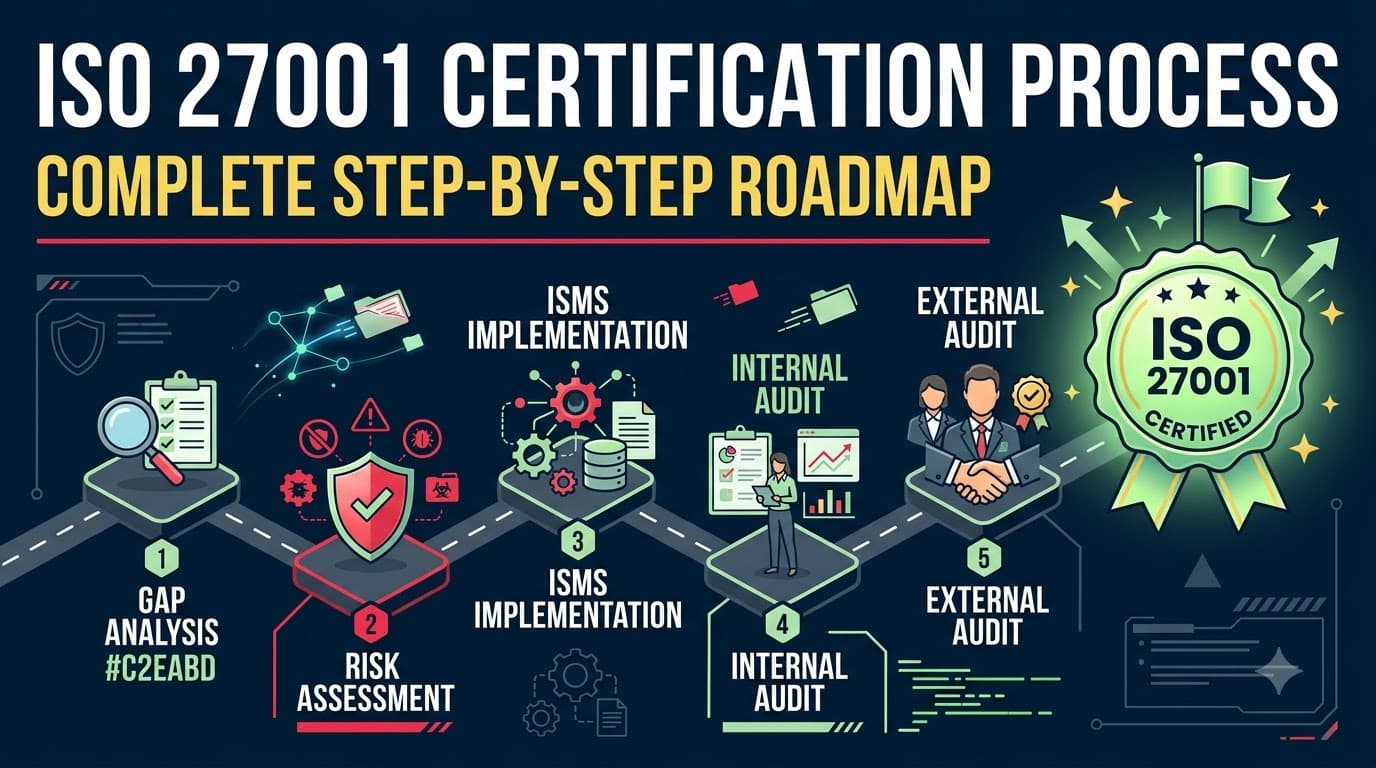
Priya Anand took the call in a parking garage stairwell because it was the only place with decent signal. On the other end was the VP of Procurement at Kestrel Freight Group, a logistics conglomerate that had just agreed, in principle, to a $3.4 million, three-year contract for Meridian Cloud Systems' supply-chain visibility platform. There was one condition in the term sheet Priya hadn't fully priced when she'd accepted the Director of Security and Compliance role five months earlier: "Contingent on ISO/IEC 27001 certification, effective no later than March 31."
It was late October. Meridian had never had an ISMS. It had a security page on its marketing website, a patchwork of Confluence pages nobody had updated since a 2021 acquisition, and an antivirus policy dated 2019. Priya did the math out loud in that stairwell: five months to build an information security management system from nothing, run it long enough to generate real evidence, audit it internally, review it with leadership, hire a certification body, pass two separate audit stages, and walk away with a certificate — the kind of program that, done properly, most organizations budget six months to a year for even when they're starting from a reasonable baseline.
She did what a lot of first-time ISMS owners do under a hard deadline: she compressed everything that looked compressible. A boutique consultancy delivered a 40-page policy set in three weeks. The risk register got populated in a single all-day workshop with department heads who mostly listed risks they'd heard about in other companies' breach headlines. The Statement of Applicability marked nearly every one of the 93 Annex A controls as "implemented," because functionally, most organizations do something related to each control — the SoA just doesn't distinguish between "we do something" and "we can prove, with dated evidence, that we do this consistently, and someone owns it." Priya booked Stage 1 and Stage 2 audits with an accredited certification body six weeks apart, in February, reasoning that back-to-back dates would force momentum.
The Stage 1 auditor, a methodical assessor named Marcus Webb, spent two days reading. He wasn't there to test controls yet — that's not what Stage 1 is for — but he did ask the one question that breaks rushed programs every time: "Can you show me evidence this has been operating, not just documented?" The ISMS, on paper, had existed for three weeks. There was no internal audit. There were no management review minutes. The risk treatment plan referenced controls with no named owner, no target date, and no completion evidence. Half the "implemented" Annex A controls in the SoA had no artifact behind them at all.
Marcus's Stage 1 report didn't "fail" Meridian in a formal sense — Stage 1 doesn't really work as a pass/fail gate — but it recommended, in writing, that Stage 2 not proceed on the scheduled date. The gaps weren't cosmetic; they were structural. You cannot audit the effectiveness of a management system that hasn't had time to be a management system yet.
The Kestrel contract didn't collapse, but it got renegotiated under pressure: a reduced first-year price, a penalty clause invoked, and roughly $150,000 conceded off a deal Meridian had been counting on to hit its board's growth targets. Priya got her certificate — in July, four months later than promised, after the ISMS had actually been allowed to run, get internally audited, get reviewed by leadership, and produce the kind of evidence Stage 2 auditors are trained to look for.
Nothing in Priya's story involved a scam, a bad consultant, or an incompetent auditor. It was a timeline problem: she'd priced the documentation of an ISMS but not the maturation of one. That gap — between having policies and having a functioning, evidenced management system — is where most certification timelines actually break down, and it's the single biggest thing this roadmap is built to help you avoid.
Who This Is For, and What You'll Walk Away With
This roadmap is for the person who just got told "we need ISO 27001" — a newly appointed CISO, a compliance lead, an operations director, a founder chasing an enterprise deal — and needs the whole journey laid out before committing to a date. It's equally useful for a steering committee sponsor who needs to defend a budget and timeline to the board.
By the end, you'll have a phase-by-phase map from initial decision through three-year recertification; realistic timeline ranges by organization size (not a marketing promise of "certified in six weeks"); a breakdown of what drives cost at each stage; a clear picture of who needs to be involved and when; and a list of the delay patterns that derail programs like Meridian's, with practical ways to avoid them. If you're still deciding whether certification is worth pursuing at all, start with the business case and ROI before committing resources to the journey below.
The Journey at a Glance
Thirteen phases, from first decision to a certificate on the wall, and then the cycle that keeps it valid. Treat the durations as illustrative ranges shaped by scope, resourcing, and starting maturity — not fixed promises.
# | Phase | What Happens | Typical Duration | Primary Owner | Key Output |
|---|---|---|---|---|---|
1 | Decision & Scoping | Leadership commits; ISMS boundary defined | 2–4 weeks | Executive sponsor + ISMS owner | Scope statement, project charter |
2 | Gap Analysis | Current state compared to Clauses 4–10 and Annex A | 2–6 weeks | ISMS owner / consultant | Prioritized gap register |
3 | Build the ISMS | Policies, risk assessment, SoA, controls stood up | 2–5 months | ISMS owner + control owners | Mandatory documents, SoA, treatment plan |
4 | Operate & Gather Records | Controls run in production long enough to leave evidence | 1–3 months (concurrent) | All control owners | Logs, tickets, training records, reviews |
5 | Internal Audit (9.2) | Independent check of the whole ISMS | 1–2 weeks | Internal auditor (in-house or outsourced) | Internal audit report, findings |
6 | Management Review (9.3) | Top management reviews performance, decides actions | 1 day + prep | Top management | Documented minutes, decisions |
7 | Select a Certification Body | Vet and contract an accredited CB | 2–6 weeks (can run in parallel) | Procurement + ISMS owner | Signed audit agreement |
8 | Stage 1 Audit | CB reviews documentation and readiness | 1–2 days on-site/remote | CB auditor + ISMS owner | Stage 1 report, findings list |
9 | Remediation | Gaps from Stage 1 closed | 2–8 weeks | ISMS owner + control owners | Corrective action evidence |
10 | Stage 2 Audit | CB tests implementation and effectiveness | 2–5 days on-site | CB audit team | Stage 2 report, nonconformities (if any) |
11 | Certification Decision | Independent CB reviewer approves; certificate issued | 1–3 weeks | CB certification decision maker | Certificate, public registry entry |
12 | Surveillance Audits | Confirms continued operation, at least annually | 1–2 days, yearly | CB auditor | Surveillance reports (Years 1 & 2) |
13 | Recertification | Full reassessment before the 3-year certificate expires | 2–4 days, at month ~34–36 | CB audit team + ISMS owner | Renewed 3-year certificate |
Phase 1: Decision and Scoping — Committing and Drawing the Boundary
Every certification journey starts with a decision that's more political than technical: does leadership actually want this, and are they willing to fund it as an ongoing management system rather than a one-time project? The trigger is usually external — a customer contract clause like Kestrel's, a competitive RFP requirement, a board directive after a near-miss, or a strategic move to shorten enterprise sales cycles. Occasionally it's proactive, driven by a CISO who wants a structured way to demonstrate that security spending maps to actual risk.
Once the decision is made, the next task is scoping: which business units, product lines, physical locations, and systems will sit inside the ISMS boundary, and which will explicitly sit outside it. Scope isn't a formality — it drives everything downstream, including audit duration and cost, because certification bodies calculate auditor time partly based on the number of employees, sites, and systems inside the boundary. A narrow, well-justified scope (say, "the SaaS platform and the engineering, DevOps, and customer-support functions that operate it," excluding an unrelated hardware division) is often more defensible and faster to certify than an org-wide scope claimed for marketing reasons but never actually resourced. Defining the scope of your ISMS properly at this stage prevents a redefinition fight later, which is one of the most common causes of Stage 1 friction.
This phase also assigns the people who'll carry the program: an executive sponsor (ideally a genuine member of top management, since Clause 5 leadership commitment is tested throughout the audit), a day-to-day ISMS owner, and, in larger organizations, a steering committee spanning IT, HR, legal, and facilities. A rough budget gets approved — not a final number, since costs firm up after the gap analysis, but enough of a placeholder that Phase 2 doesn't stall waiting for finance sign-off.
"The single biggest predictor of a smooth certification isn't the industry or the company size — it's whether the executive sponsor actually shows up to the management review meetings. I can tell in the first month which programs are going to need rescuing." — Renata Kolbe, Founder, Kolbe Risk Advisory
Phase 2: Gap Analysis — Finding Out How Far You Really Are
A gap analysis compares your current state — policies that exist, controls that operate, evidence that's actually being generated — against what Clauses 4 through 10 and the Annex A controls relevant to your scope actually require. Done honestly, it produces a prioritized list: what's missing entirely, what exists but isn't documented, what's documented but not evidenced, and what's genuinely already in good shape. This is also the point where a realistic budget and timeline get locked in, because "we need to write eleven policies and stand up a vulnerability management program" is a very different project than "we need to formalize three procedures we're already following."
Organizations run gap analyses three ways: fully in-house using a structured checklist, consultant-led with a fixed-fee engagement, or a hybrid where a consultant runs the assessment but internal staff own remediation. There's no universally "right" answer — it depends on whether you have anyone on staff who has been through a certification cycle before. What matters more is honesty in the scoring. The temptation, especially under deadline pressure like Meridian's, is to mark ambiguous items as "partially in place" when they're really "not in place, but adjacent work exists somewhere." That optimism bias is exactly what produced Priya's Stage 1 surprise.
A properly run gap analysis is a discrete, well-scoped deliverable — enough that it deserves its own dedicated methodology rather than a paragraph here (see ISO 27001 Gap Analysis: How to Conduct One, in development). In the meantime, structured tools shorten the exercise considerably; PentesterWorld's ISO 27001 Gap Analysis Tool walks you control-by-control and outputs a prioritized remediation list you can hand straight to a project plan.
Phase 3: Building the ISMS — Clauses 4–10 and Annex A via the Statement of Applicability
This is where most of the elapsed calendar time and budget goes. "Building the ISMS" means two parallel workstreams: satisfying the management-system Clauses (4 Context, 5 Leadership, 6 Planning, 7 Support, 8 Operation, 9 Performance Evaluation, 10 Improvement) and selecting, implementing, and documenting the relevant Annex A controls across all four themes — Organizational (5.1–5.37), People (6.1–6.8), Physical (7.1–7.14), and Technological (8.1–8.34) — through the Statement of Applicability.
Clause 6 planning is where the risk assessment happens: identifying information assets and the risks to their confidentiality, integrity, and availability, scoring likelihood and impact against criteria the organization has defined and documented, and deciding how each risk will be treated (accept, avoid, transfer, or mitigate through a control). A structured risk assessment methodology applied consistently across the whole scope is worth far more at audit time than a clever one-off exercise, because auditors sample the register and expect to see the same logic applied everywhere.
The output of that risk work feeds directly into the Statement of Applicability — the document that states, for each of the 93 controls, whether it's applicable to your scope, why, and what the implementation status actually is. This is precisely the document that undid Meridian: an SoA is not a checklist to be marked "yes" across the board; it's a justified, evidenced position on each control that a Stage 2 auditor will sample and test. Alongside the SoA, a defined set of mandatory documents needs to exist — the complete mandatory documents checklist covers exactly what the standard requires versus what's merely good practice.
Because this phase spans nearly every department, PentesterWorld's Complete ISO 27001 Implementation Guide is worth having on hand as a working reference rather than trying to reconstruct clause requirements from memory during a busy build.
It helps to know, going in, which documents auditors actually go looking for at each stage, and why. The table below maps the core artifacts to the moment they get scrutinized.
Document | What It Shows the Auditor | Primarily Reviewed At |
|---|---|---|
ISMS scope statement | The boundary the whole certification applies to | Stage 1 |
Information security policy set | Leadership commitment and documented intent | Stage 1 |
Risk assessment methodology and results | A consistent, repeatable approach to identifying and scoring risk | Stage 1 and Stage 2 |
Statement of Applicability | Justified inclusion/exclusion and status for all 93 controls | Stage 1 (existence) and Stage 2 (evidence) |
Risk treatment plan | Named owners, target dates, and progress against treatment decisions | Stage 2 |
Internal audit program and reports | Proof the organization checks itself independently | Stage 1 (existence) and Stage 2 (depth) |
Management review minutes | Visible, documented top management engagement | Stage 1 and Stage 2 |
Corrective action records | Evidence that nonconformities get tracked to closure | Stage 2 and surveillance |
Training and competence records | Evidence people were actually trained on their roles | Stage 2 |
Incident log (or documented absence of incidents) | Evidence monitoring and detection were active, not assumed | Stage 2 and surveillance |
Phase 4: Operating the ISMS — Generating the Evidence Trail
Here's the phase Priya skipped, and it's arguably the most misunderstood step in the entire journey: an ISMS has to actually run for a while before an internal audit, a management review, or a Stage 2 audit means anything. Auditors aren't testing whether you wrote a good access control policy — they're testing whether access reviews actually happened on schedule, whether the incident log has real entries (or a documented zero-incidents period with evidence monitoring was active), whether security awareness training records show completions with dates, and whether vendor risk assessments exist for the suppliers actually in scope.
There's no official minimum operating period written into the standard, but in practice, most experienced auditors want to see at least one full cycle of the ISMS's core mechanisms — one internal audit, one management review, at least a couple of months of logging and monitoring data, and evidence that a nonconformity, if one arose, was actually tracked to closure. Illustratively, many programs run for six to twelve weeks between "policies are finished" and "we're ready for Stage 1," purely to accumulate this evidence. Compressing that window is exactly what produces the Meridian scenario: a paper ISMS that looks complete and an operational ISMS that's three weeks old.
This is also the phase where control owners outside the security team start feeling the program directly — HR pulling background-check and training records, IT running the first formal vulnerability scan cycle and patch cadence report, facilities logging physical access reviews. If those owners weren't identified clearly back in Phase 1, this is where the program stalls waiting for someone to realize a record needs to exist and nobody's been asked to produce it.
Phase 5: Internal Audit (Clause 9.2)
Clause 9.2 requires a planned program of internal audits that objectively checks whether the ISMS conforms to the organization's own requirements and to ISO/IEC 27001, and whether it's effectively implemented and maintained. Internal audit is not a rehearsal for Stage 2 in the sense of "practice the same questions" — it's a genuine, independent check, and the auditor (in-house, provided they're not auditing their own work, or an outsourced practitioner) needs enough competence to actually find problems rather than confirm what management wants to hear.
A well-run internal audit produces a report with real findings — nonconformities, observations, and opportunities for improvement — plus a corrective action process that tracks each finding to closure with evidence and a responsible owner. Certification bodies read this report closely at Stage 1, and its absence, or the presence of a suspiciously clean "zero findings" report on a first-time ISMS, is itself a red flag experienced auditors notice. For the mechanics of planning, executing, and reporting this properly, see ISO 27001 internal audit: planning, execution, and reporting, which also maps back to the Clause 9 performance evaluation requirements this audit exists to satisfy.
"New ISMS owners are always surprised that we want to find things. A clean internal audit report on a program that's three months old doesn't read as maturity — it reads as an audit that wasn't looking hard enough." — Grace Liu, Internal Audit Lead, Fenwick Pay
It's worth being explicit about how internal audit and the certification body's audits differ, since first-time ISMS owners often conflate the two or treat internal audit as a lightweight rehearsal.
Dimension | Internal Audit (Clause 9.2) | Certification Body Audit (Stage 1 / Stage 2 / Surveillance) |
|---|---|---|
Who performs it | In-house staff (not auditing their own work) or an outsourced practitioner | Auditors employed or contracted by the accredited CB |
Primary purpose | Confirm the ISMS conforms to its own requirements and to the standard, before external scrutiny | Independently verify conformance and effectiveness for certification purposes |
Frequency | Set by the organization's own audit program, at least once before Stage 1 and then ongoing | Stage 1 and Stage 2 once initially; surveillance at least annually; full reassessment every 3 years |
Independence required | Objective relative to the area audited; doesn't need to be a separate department | Full independence from the certified organization, governed by accreditation rules |
Typical outcome | Internal findings feeding the organization's own corrective action process | Formal nonconformities that can affect the certification decision |
Phase 6: Management Review (Clause 9.3)
Clause 9.3 requires top management — not delegated entirely to the ISMS owner — to formally review the management system at planned intervals, using a defined set of inputs: status of actions from previous reviews, changes in external and internal issues relevant to the ISMS, performance trends (nonconformities, monitoring results, audit results, achievement of objectives), feedback from interested parties, risk assessment results and treatment plan status, and opportunities for continual improvement. The output is a set of decisions — on resourcing, on objective changes, on any need for ISMS changes — documented as retained information.
This is not a rubber-stamp meeting, and CB auditors treat thin or generic management review minutes as a leadership-commitment red flag, since Clause 5 requires visible top management involvement throughout. A useful discipline: treat the first management review as the moment leadership formally "owns" the program's trajectory going into certification, not a pre-audit formality squeezed in the week before Stage 1.
"Our management review used to be a fifteen-minute agenda item bolted onto a Monday staff meeting. Once we treated it as a real decision-making forum — with the risk register and the internal audit findings actually on the table — it became the meeting where problems got resourced instead of just noted." — Daniel Voss, CISO, Ironclad Fabrication Co.
Phase 7: Selecting an Accredited Certification Body
A certificate only carries market weight if it's issued by a certification body (CB) that is itself accredited by a recognized national accreditation body — such as UKAS, ANAB, or JAS-ANZ — operating within the International Accreditation Forum's (IAF) multilateral recognition arrangement. That accreditation means the CB itself is periodically assessed against ISO/IEC 17021-1 (the general requirements for bodies certifying management systems) and ISO/IEC 27006 (the ISO 27001-specific competence and process requirements for those CBs). An "ISO 27001 certificate" issued by a firm without accredited status may look identical on the wall, but many enterprise customers, auditors, and regulators will not recognize it as equivalent — so verifying accreditation scope is the first and non-negotiable filter.
National accreditation bodies vary by country but operate under the same IAF mutual recognition arrangement, which is why a certificate accredited in one IAF member country is generally recognized as equivalent elsewhere.
Region | Example Accreditation Body | Notes |
|---|---|---|
United Kingdom | UKAS (United Kingdom Accreditation Service) | One of the most widely recognized internationally |
United States | ANAB (ANSI National Accreditation Board) | Accredits CBs operating across North America and globally |
Australia / New Zealand | JAS-ANZ | Common reference point for Asia-Pacific certifications |
Germany | DAkkS (Deutsche Akkreditierungsstelle) | Common for CBs serving EU-based organizations |
Multiple IAF member countries | Mutual recognition via the IAF MLA | Confirms a CB's certificate is honored across signatory countries |
Beyond accreditation, selection criteria include: whether the CB's accreditation scope actually covers your industry and technology stack, whether their auditor day calculation and quote are transparent and match IAF-recognized audit-time guidance for your organization's size and complexity, their track record and references in comparable organizations, contract terms around the three-year cycle (are Stage 1, Stage 2, and both surveillance years priced up front or subject to later increases?), and practical logistics for multi-site or multi-country scopes. This is enough of a decision that it deserves a dedicated comparison process — see how to choose an ISO 27001 certification body for a full evaluation framework. PentesterWorld's Certification Readiness Checklist is also useful at this stage to confirm you're actually ready to engage a CB before signing a contract with a fixed Stage 1 date.
"I've seen quotes for the exact same scope vary by 40% between CBs, and the cheapest one wasn't cheap — it just spread the same auditor-day total across a longer contract with add-on fees for surveillance travel. Read the full three-year cost before you sign anything." — Tomasz Nowak, Finance Director, Meridian Cloud Systems
Organizations that have also gone through a SOC 2 examination sometimes assume the CB relationship works the same way — it doesn't. SOC 2 uses a single licensed CPA firm performing an attestation engagement against the AICPA's Trust Services Criteria, with no accreditation body overseeing the firm the way IAF-recognized accreditation oversees an ISO 27001 CB. Readers weighing both should see how the SOC 2 audit process compares before assuming the two run on parallel tracks.
Whatever shortlist you build, run each candidate CB through the same set of questions before signing anything.
Question to Ask a Prospective CB | Why It Matters |
|---|---|
Is your accreditation current and does its scope cover our industry and technology? | Confirms the certificate will actually be recognized by your customers |
How do you calculate auditor days for our size, sites, and complexity? | Prevents a lowball quote that balloons once true scope is disclosed |
What are all fees across the full three-year cycle, including both surveillance years? | Avoids budgeting only for Stage 1 and Stage 2 and being surprised later |
Can you provide references from organizations of comparable size and industry? | Tests whether the CB's auditors understand your operating context |
What's your process if a major nonconformity surfaces at Stage 2? | Clarifies timelines and costs for follow-up visits before you're in that situation |
How do you handle multi-site, remote, or multi-country audits? | Directly affects cost and scheduling for distributed organizations |
What is your typical scheduling lead time for Stage 1 and Stage 2? | Lets you build a realistic project plan instead of guessing at CB availability |
Before engaging a CB at all, it's worth running through PentesterWorld's Certification Readiness Checklist with your steering committee — treat it as the honest, internal version of the Stage 1 review, done on your own schedule rather than the auditor's.
Phase 8: Stage 1 Audit — The Documentation and Readiness Review
Stage 1 is a documentation and readiness review, typically conducted over one to two days, either remotely or on-site depending on the CB and scope. The auditor examines the mandatory documents, the defined ISMS scope, the risk assessment methodology and its outputs, the Statement of Applicability, evidence of at least one internal audit and one management review, and the general state of readiness for a deeper Stage 2 examination. Stage 1 is not, in most cases, a deep test of whether every control is operating effectively — that's Stage 2's job — but it absolutely does check whether the foundational structure and evidence exist for that deeper test to be meaningful.
This is exactly the audit that caught Meridian short: Marcus Webb wasn't testing firewall configurations or access logs in detail during Stage 1; he was checking whether an internal audit had happened, whether management review minutes existed, and whether the SoA's claims were remotely proportionate to a three-week-old program. A Stage 1 report typically lists findings by severity and gives a recommendation on whether to proceed to Stage 2 as scheduled, reschedule, or proceed with named conditions. For a full walkthrough of what auditors actually check and how to prepare, see the ISO 27001 Stage 1 audit guide. Running a dry run beforehand pays for itself — PentesterWorld's Mock Stage 1 Documentation Review lab simulates the exact document walkthrough a real Stage 1 auditor performs.
"The number one thing I look for on day one of Stage 1 isn't a specific document — it's whether the internal audit and management review actually happened in that order, with enough time between them and the ISMS going live for the organization to have learned something. If everything is dated the same week, that tells its own story." — Marcus Webb, Lead Auditor, Sterling Assurance Ltd.
Because Stage 1 and Stage 2 get conflated so often in planning conversations, it's worth setting them side by side.
Dimension | Stage 1 | Stage 2 |
|---|---|---|
Purpose | Documentation and readiness review | Test implementation and effectiveness of controls |
Typical duration | 1–2 days | 2–5 days, scaled to scope |
Depth of testing | Reviews existence and coherence of documents and evidence | Samples records, walks through controls, interviews control owners |
Common outcome | Findings list and a recommendation on Stage 2 timing | Nonconformities (if any) and a certification recommendation |
What it doesn't do | Doesn't deeply test day-to-day control operation | Doesn't re-litigate whether the scope or policies are appropriate — that's Stage 1's job |
Phase 9: Remediation — Closing Gaps Before Stage 2
Very few organizations sail through Stage 1 with zero findings, and that's not necessarily a bad sign — a Stage 1 report with a handful of well-scoped observations, closed methodically before Stage 2, demonstrates exactly the kind of corrective-action discipline Clause 10 expects. Remediation work at this stage usually falls into three buckets: documentation gaps (a missing procedure, an SoA justification that needs tightening), evidence gaps (a control that's operating but under-documented), and genuine implementation gaps (a control that isn't actually operating yet and needs real technical or process work).
Illustratively, minor documentation and evidence gaps close in two to four weeks; genuine implementation gaps — standing up a vulnerability management cadence that didn't exist, for instance — can take six to eight weeks or longer, and may justify pushing the Stage 2 date rather than rushing it. Pushing the date is almost always cheaper than a failed or heavily-qualified Stage 2 outcome, both in direct re-audit fees and in the credibility cost of nonconformities that a customer or partner later asks about.
Phase 10: Stage 2 Audit — Testing Whether the ISMS Actually Works
Stage 2 is the certification audit proper: a deeper, evidence-based examination of whether the ISMS conforms to ISO/IEC 27001 and whether the controls in the Statement of Applicability are actually implemented and operating effectively. This typically runs two to five days on-site (scaled to organization size and scope complexity) and involves control walkthroughs, sampling of records (access review logs, incident tickets, training completions, vendor assessments, change management records), and interviews with control owners — not just the ISMS manager, but the people actually doing the work day to day.
Findings are classified, generally as major nonconformities (a fundamental failure that blocks certification until corrected and verified), minor nonconformities (an isolated lapse that requires a corrective action plan but doesn't block the decision), and observations or opportunities for improvement (non-mandatory notes). A Stage 2 audit with only minor nonconformities and a credible corrective action plan is a normal, even common, outcome — it is not a failure. Major nonconformities typically require a follow-up visit or additional evidence before a certification recommendation can be made. For the full walkthrough of how the days are structured and what evidence gets sampled, see the ISO 27001 Stage 2 audit certification walkthrough.
Classification | Definition | Example | Typical Response | Blocks Certification? |
|---|---|---|---|---|
Major nonconformity | A systemic failure, or absence, of a required element | No internal audit was ever conducted before Stage 2 | Corrected and verified, often via a follow-up visit, before certification | Yes, until resolved |
Minor nonconformity | An isolated lapse in an otherwise functioning control or process | One employee's security awareness training record is missing | Corrective action plan with a committed closure date | No, if the plan is accepted |
Observation / opportunity for improvement | A non-mandatory note on something that could be stronger | Risk register could better document the rationale behind a risk score | Optional to act on | No |
Phase 11: The Certification Decision and Certificate Issuance
After the Stage 2 field work, the audit team's findings go to a certification decision maker within the CB — a reviewer who was not part of the audit itself, a separation required to preserve impartiality under ISO/IEC 17021-1. That reviewer confirms the audit was conducted properly and the evidence supports certification (with any minor nonconformities tied to an accepted corrective action plan), then approves issuance. The certificate states the certified scope explicitly — the boundary defined all the way back in Phase 1 — along with its issue date and expiry, typically three years from the certification decision. Many CBs also list certified organizations on a public registry, which is worth checking as part of due diligence when a vendor claims certification.
It's worth being precise with customers and partners about what the certificate actually covers: a certificate scoped to "the SaaS platform's engineering and operations functions" does not certify an entire parent company, and overstating scope in a sales conversation is a common and avoidable credibility problem post-certification.
Phase 12: Surveillance Audits — Years 1 and 2
Certification isn't a one-time event; it's the start of an ongoing audit relationship. CBs conduct surveillance audits at least annually across the three-year certificate cycle — typically once in year one and once in year two — to confirm the ISMS is still operating, that corrective actions from Stage 2 were actually closed, that the scope hasn't materially changed without review, and that continual improvement per Clause 10 is genuinely happening rather than the program going dormant the day the certificate arrived. Surveillance audits are shorter than Stage 2 — often one to two days — and typically sample a subset of controls rather than the full set, rotating emphasis year to year.
Organizations that treat surveillance as a light-touch afterthought are frequently the ones surprised by findings; those that keep the internal audit and management review cadence running as routine business tend to find surveillance visits confirm what they already knew.
"Surveillance is where we see who actually kept the management system alive versus who put it in a drawer after the certificate arrived. The organizations with the fewest findings are, almost without exception, the ones still running their internal audit program on schedule." — Amara Osei, Senior Assessor, Bureau Cornerstone Certification
Phase 13: Recertification — The Three-Year Cycle Renews
Before the three-year certificate expires, a recertification audit — comparable in depth to Stage 2, sometimes incorporating elements of a Stage 1 documentation refresh — reassesses the ISMS against the full standard, this time against three years of operating history rather than a few months. Organizations that let the certificate lapse without completing recertification in time generally cannot simply "extend" it; a lapsed certificate typically means restarting something closer to the full Stage 1/Stage 2 sequence, which is exactly the outcome a functioning surveillance and internal audit cadence is designed to prevent. Scheduling the recertification audit with enough lead time before expiry — illustratively, several months — avoids a last-minute scramble that echoes the same pressure Priya faced the first time around.
It's easy to conflate surveillance and recertification since both happen after the initial certificate is issued; they differ meaningfully in depth and stakes.
Dimension | Surveillance Audit (Years 1 & 2) | Recertification Audit (~Year 3) |
|---|---|---|
Depth | Samples a subset of controls | Comparable to a full Stage 2, sometimes with Stage 1 elements |
Duration | Typically 1–2 days | Typically 2–4+ days, scaled to scope |
Stakes if findings arise | Corrective action plan; certificate can be suspended for serious issues | Certificate renewal itself is at stake |
What it reviews | Continued operation, prior corrective actions, scope changes | Three years of operating history and continual improvement evidence |
Consequence of missing it | Possible certificate suspension | Certificate lapses; often requires restarting close to initial certification |
The Realistic Timeline: How Long Does Certification Actually Take?
There is no single honest answer to "how long does ISO 27001 take" — it depends on starting maturity, scope, and how much of the work runs in parallel versus sequentially. The ranges below are illustrative, drawn from typical patterns across organizations of different sizes, not fixed commitments any CB or consultant can guarantee.
Organization Profile | Gap Analysis Through ISMS Build | Operating Period Before Stage 1 | Stage 1 to Certificate | Total First-Time Journey (illustrative) | Typical Bottleneck |
|---|---|---|---|---|---|
Micro/startup, <50 employees, single site | 4–8 weeks | 4–8 weeks | 6–10 weeks | ~4–6 months | Founders wearing too many roles; thin evidence trail |
Mid-size, 50–500 employees, 1–2 sites | 2–4 months | 6–10 weeks | 8–12 weeks | ~6–9 months | Cross-department evidence collection; SoA rigor |
Enterprise, 500–5,000 employees, multi-site | 3–6 months | 2–3 months | 10–16 weeks | ~9–14 months | Scope negotiation; consistent control operation across sites |
Complex/regulated, multi-country, outsourced ops | 4–8 months | 3–4 months | 12–20 weeks | ~12–18 months | Vendor/third-party evidence; local regulatory overlays |
What Drives the Cost of Certification
Budgets vary enormously by scope, region, and how much is done in-house versus outsourced. Treat the figures below as directional cost drivers to plan against, not quoted prices — every organization's mix is different, and a full breakdown deserves its own dedicated treatment (see ISO 27001 Certification Cost: A Complete Breakdown, in development).
Cost Driver | What It Covers | What Moves the Number | Notes |
|---|---|---|---|
Internal labor | Staff time across security, IT, HR, legal, facilities | Headcount involved, scope breadth | Often the largest hidden cost — rarely tracked as a line item |
Consultant/advisory fees | Gap analysis, document drafting, project management | Fixed-fee vs. time-and-materials, maturity gap | Optional but common for first-time certifications |
GRC tooling/platform | Risk register, policy management, evidence collection | Manual spreadsheets vs. licensed platform | Pays off most at internal audit and Stage 2 |
CB audit fees (Stage 1 + Stage 2) | Auditor day rates for initial certification | Org size, number of sites, scope complexity | Calculated using auditor-day guidance tied to headcount |
Annual surveillance fees | Years 1 and 2 audits | Same variables as above, usually a fraction of Stage 2 cost | Budget as a recurring, not one-time, cost |
Recertification fees | Year 3 full reassessment | Comparable to original Stage 2 scope | Plan for this at the three-year mark, not as a surprise |
Technical remediation | Closing genuine control gaps (tooling, process, staffing) | How mature security was before the project started | The most variable and hardest to estimate up front |
Training and awareness | Security awareness program, role-based training | Headcount, existing training infrastructure | Often underbudgeted relative to actual effort |
Multi-site/travel | Auditor travel, remote vs. on-site day mix | Number and geographic spread of locations | Can be negotiated into the CB contract terms |
Because so many of these variables are organization-specific, running your numbers through PentesterWorld's ISO 27001 Certification Cost Calculator before finalizing a budget gives a far more defensible estimate than a generic industry average.
To make the timeline table above more concrete, here's what a disciplined nine-month program looks like month by month for a mid-size organization — roughly the pace Ironclad Fabrication followed in Case Study 2 below.
Month | Milestone |
|---|---|
1 | Decision made, scope defined, ISMS owner and steering committee named |
2 | Gap analysis completed, prioritized remediation plan approved |
3–4 | Mandatory documents drafted, risk assessment and SoA built, controls begin implementation |
5 | Controls operating; evidence starts accumulating; CB shortlisted and contracted |
6 | Internal audit conducted; findings logged and triaged |
6.5 | Management review held; resourcing decisions documented |
7 | Stage 1 audit conducted |
7–8 | Remediation of Stage 1 findings |
9 | Stage 2 audit conducted; certification decision follows within weeks |
Who's Involved: Roles Across the Certification Journey
Role | Primary Responsibility | Most Active During |
|---|---|---|
Executive sponsor / top management | Funding, visible commitment, chairing management review | Phases 1, 6, 11–13 |
ISMS manager / CISO | Day-to-day program ownership, documentation, liaison with the CB | Every phase |
Internal audit function (in-house or outsourced) | Independent conformance and effectiveness checks | Phase 5, ongoing |
Risk and control owners | Operating assigned controls, producing evidence | Phases 3–4, ongoing |
IT/security engineering | Technical control implementation (logging, access, vulnerability management) | Phases 3–4, 9–10 |
HR | Screening, training records, termination procedures | Phases 3–4, 10 |
Legal/procurement | Supplier agreements, contractual security clauses, CB contract | Phases 3, 7 |
External consultant (optional) | Gap analysis, documentation acceleration, audit prep coaching | Phases 2–3, 9 |
Certification body auditors | Stage 1, Stage 2, surveillance, recertification audits | Phases 8, 10, 12–13 |
CB certification decision maker | Independent review and approval of the certification decision | Phase 11 |
Accreditation body | Oversees the CB's own competence (background function, not client-facing) | Ongoing, indirect |
The Three-Year Certification Cycle, Visualized
flowchart TD
    A[Decision & Scoping] --> B[Gap Analysis]
    B --> C[Build the ISMS<br/>Clauses 4-10 + Annex A/SoA]
    C --> D[Operate ISMS<br/>Gather Evidence]
    D --> E[Internal Audit — 9.2]
    E --> F[Management Review — 9.3]
    F --> G[Select Accredited<br/>Certification Body]
    G --> H[Stage 1 Audit<br/>Documentation Review]
    H -->|Findings| I[Remediation]
    I --> J[Stage 2 Audit<br/>Implementation & Effectiveness]
    J --> K[Certification Decision<br/>Certificate Issued]
    K --> L[Surveillance Audit<br/>Year 1]
    L --> M[Surveillance Audit<br/>Year 2]
    M --> N[Recertification Audit<br/>~Year 3]
    N -->|Renewed 3-Year Certificate| K
    N -->|Continual Improvement Feeds Back| E
The loop at the bottom is the point most first-time programs miss emotionally, even when they understand it intellectually: certification isn't the finish line, it's the entry point to a recurring three-year cycle where internal audit, management review, and surveillance keep running indefinitely. Programs that plan for the loop from day one — rather than treating the certificate as a project deliverable to be filed away — are consistently the ones with the least disruptive surveillance and recertification experiences.
Common Delays and How to Avoid Them
Delay Pattern | Root Cause | How to Avoid It |
|---|---|---|
Stage 2 booked before the ISMS has actually operated | Treating documentation completion as "done," Meridian's original mistake | Build in a real operating period with a full internal audit and management review before booking Stage 2 |
SoA claims copied without evidence | Marking controls "implemented" based on intent rather than proof | Require a named evidence artifact for every "implemented" line in the SoA |
No named risk or control owners | Risk register built in a workshop without individual accountability | Assign an owner and a review date to every risk and every control at creation |
Internal audit treated as a formality | Auditor (internal or outsourced) not given independence or time to actually test | Give internal audit a real mandate, a schedule, and authority to report findings unfiltered |
Management review skipped or undocumented | Squeezed in the week before Stage 1 as a box-check | Schedule management review on a recurring cadence tied to the audit calendar, not the audit date |
Scope creep mid-program | New product lines or acquisitions added to scope without replanning | Freeze scope for the current certification cycle; handle additions in the next surveillance or recertification cycle |
Single point of failure | One person (often the ISMS manager) owns every artifact and evidence chain | Distribute evidence ownership across control owners from the start, not just at audit time |
CB underestimates multi-site complexity | Scope and site count not disclosed accurately during CB selection | Disclose full site and system inventory during CB scoping calls, before contracting auditor days |
Case Study 1: Meridian Cloud Systems — Recovering From a Rushed Timeline
The rest of Priya Anand's story is as instructive as the setup. After the Stage 1 report landed, Meridian's leadership made the call that most rushed programs never get to make in time: they stopped treating the certificate date as fixed and started treating the ISMS as the actual deliverable. Priya restructured the program around evidence, not paperwork — she assigned named owners to every control in the SoA, ran a genuine internal audit five weeks later that logged eleven findings (four of them substantive), held a documented management review that actually debated resourcing tradeoffs, and let the ISMS operate for ten weeks before requesting a new Stage 2 date.
Stage 2 in June found two minor nonconformities — an access review that had lapsed for one system and a supplier risk assessment that hadn't been refreshed on schedule — both closed with corrective evidence within three weeks. The certificate was issued in July, four months later than the original March 31 target. Kestrel Freight Group kept the contract, at a reduced first-year rate, and Meridian used the extra evidence discipline it built under pressure to sail through its first surveillance audit the following year with zero findings. Priya's own retrospective: the four-month delay cost real money, but a Stage 2 failure or a certificate obtained on paper thin evidence would have cost far more the first time a Kestrel security questionnaire asked for specific artifacts.
Case Study 2: Ironclad Fabrication Co. — A Disciplined Eight-Month Run
Ironclad Fabrication, a 340-person precision manufacturing firm pursuing a defense-adjacent supply contract, took a different approach from the start. CISO Daniel Voss insisted on completing the gap analysis before setting any external date, then built a project plan that sequenced the operating period deliberately: policies finished by month two, controls operating by month four, internal audit at month five, management review at month five and a half, Stage 1 at month six, an eight-week remediation window for the handful of findings that surfaced, and Stage 2 at month eight.
The discipline paid off directly at Stage 2: the audit team found zero major nonconformities and only one minor finding, related to a documented-but-inconsistently-followed change management step in one production line. Ironclad's certificate arrived within the eight-month plan, and the company closed a $1.8 million contract that had been contingent on certification within ninety days of the certificate's issue date. Daniel's own assessment afterward was that the eight-month timeline wasn't fast by industry chatter standards, but it was predictable — which mattered more to the customer's own procurement deadline than shaving another month off the schedule would have.
Case Study 3: Fenwick Pay — Turning Recertification Into a Non-Event
Fenwick Pay, a payments fintech, achieved initial certification in year one without particular drama, but the more interesting story is what happened at the three-year mark. Rather than treating surveillance audits as light-touch compliance checkpoints, Internal Audit Lead Grace Liu kept the internal audit program running on its original cadence throughout the full cycle, fed every surveillance finding into the same corrective-action tracker used for internal audits, and made sure management review continued discussing risk register changes even in quarters with no external audit scheduled.
By the time recertification came due at month 34, the audit team was reviewing three years of consistent, unbroken evidence rather than reconstructing a dormant program. The recertification audit surfaced two minor findings, both closed within two weeks, and Fenwick's certificate renewed without a gap. A competitor in the same payments space, by contrast, let its internal audit cadence lapse after certification and had to restart much of its evidence-gathering discipline in the final quarter before recertification — a scramble that delayed the renewed certificate by several weeks and briefly put an enterprise banking partnership's compliance requirement at risk.
Strategic Close: The Certificate Is the Checkpoint, Not the Destination
Priya Anand's stairwell phone call is a story about timeline pressure, but the deeper lesson is about what certification actually represents. The certificate itself is a checkpoint — a recognized, third-party-verified snapshot confirming that an information security management system exists, operates, and is continually improved. The real business value isn't the framed document; it's everything that had to become true for a competent, independent auditor to sign off on it: named risk owners, evidenced controls, a leadership team that reviews security posture on a real cadence, and an organization that can answer a customer's security questionnaire with artifacts instead of assurances.
Framed that way, the roadmap in this article isn't a compliance obligation to survive — it's a sequence that, done honestly, builds the operational muscle memory that makes the next enterprise deal, the next security questionnaire, and the next audit cycle measurably easier. Organizations that rush the front half of the journey, as Meridian did, end up paying for that muscle memory later anyway, under worse conditions and tighter deadlines. Organizations that build it deliberately, as Ironclad and Fenwick did, turn each subsequent audit — surveillance, recertification, even an unrelated customer audit — into confirmation of something they already know to be true.
If you're at the start of this journey and want a structured, expert gut-check before committing to dates with a certification body, PentesterWorld's advisory team runs readiness assessments that map directly to the phases above — pinpointing exactly where your organization sits on this roadmap and what it will realistically take to move to the next phase. Reach out to start that conversation before you set a date you might not be able to keep.