Derek Voss's Active Directory account should have died in June 2023. It didn't die until an incident response retainer forced the question in November.
I got the call from Solander Freight & Logistics about ten days after that November weekend, and by the time I sat down with their leadership team the shape of the story was already painfully clear. Solander is a mid-market third-party logistics provider outside Columbus, Ohio — about 340 employees, contracts with a dozen regional retail chains to run warehousing and last-mile delivery. In early 2023 they brought on a contractor, Derek Voss, through a staffing firm called Ridgeline Technical Partners, for a fourteen-week engagement to help migrate their warehouse management system (WMS) onto a new cloud platform. Because the migration touched billing feeds, Voss was given a domain account with sweeping rights — effectively domain-admin-equivalent — nicknamed internally "WMS-Migration-Admin," plus a persistent VPN certificate and standing access to the financial reporting tool so he could validate invoice reconciliation during cutover.
The engagement wrapped in June. The project sponsor thanked Voss, Ridgeline invoiced final hours, and everyone moved on. Nobody told IT to turn anything off — because nobody in IT had been told to turn anything on in the first place through a formal process. Voss had never appeared in an HR onboarding feed because he wasn't an employee; the account had been created ad hoc by a systems administrator doing a favor for the project sponsor, outside the normal identity workflow. There was no leaver ticket because there was no joiner ticket. The account, the VPN certificate, and the financial-tool credentials sat there, fully privileged, for a hundred and fifty-two days.
In November, Voss's personal email was swept up in an unrelated credential-stuffing breach — one of those mass password dumps that circulates on criminal forums. He'd reused a close variant of that password for the VPN certificate passphrase he'd set up back in the spring, the kind of shortcut almost everyone takes under deadline pressure. An attacker who bought the credential list didn't even need to be sophisticated. They logged into Solander's VPN on a Saturday night, found a domain account with standing elevated rights and no multi-factor prompt in front of it, and moved laterally with almost no resistance. They pulled shipment manifests and billing records for forty retail clients out of the financial reporting system over about eighteen hours, then — seemingly as a parting message — dropped ransomware on two file shares before they left.
Solander didn't pay the ransom. They rebuilt from backups. But the total bill still came to roughly $1.85 million once you added it up: about $240,000 in digital forensics and incident response, six-figure legal and breach-notification costs, a state attorney general inquiry that dragged on for months, and — the part that actually got the board's attention — three retail clients who declined to renew, worth close to $700,000 in annual revenue, citing "access governance concerns" directly in their non-renewal letters.
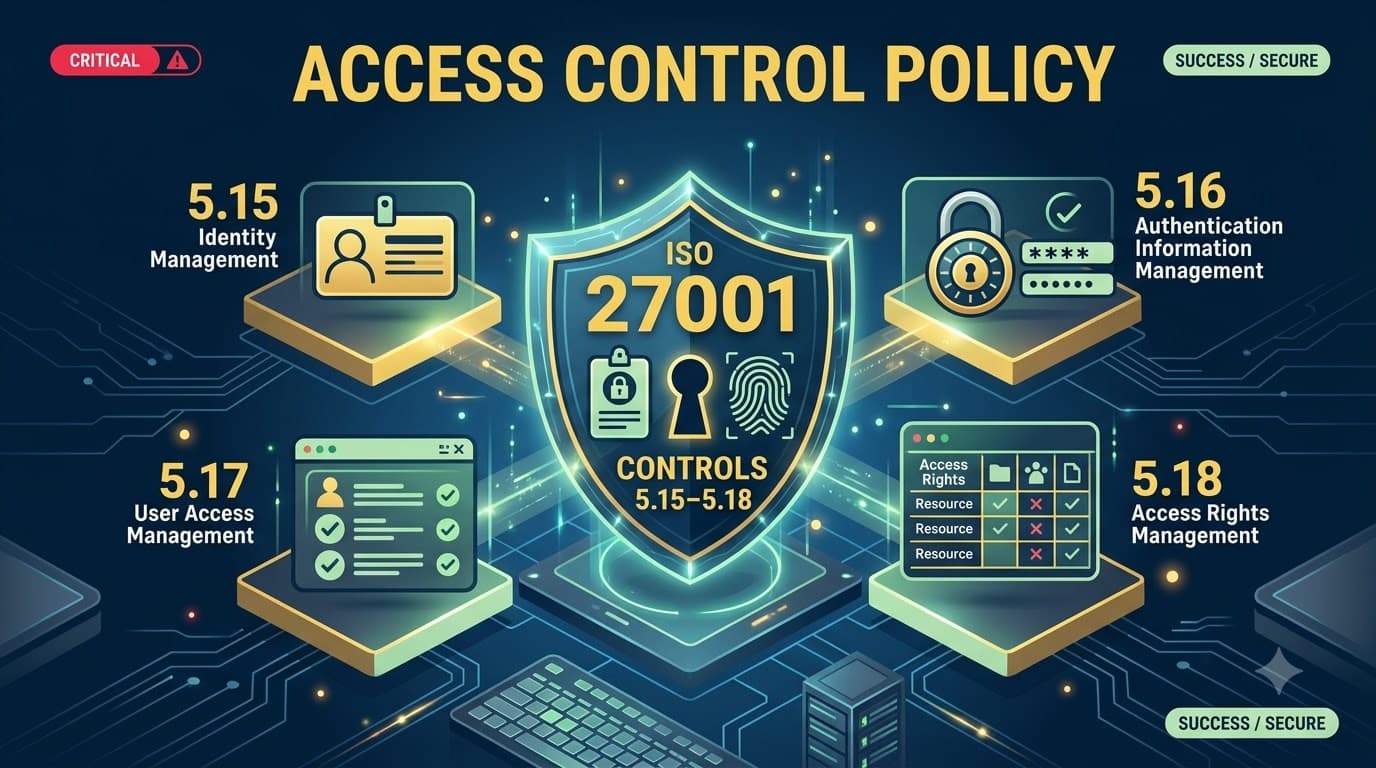
I wasn't brought in to fix the breach; a specialist IR firm had already done that work by the time I arrived. I was brought in because the board's post-incident resolution instructed the CISO to pursue ISO 27001 certification, and the incident review report — in language almost identical to Annex A — had already named the failure: no access control policy, no identity lifecycle process, no authentication information standard, and no access rights review. In other words, Solander's breach was a controls 5.15 through 5.18 case study before I ever opened a laptop. This article is built around what fixing that actually looks like, because an orphaned privileged account is one of the most common — and most expensive — findings I see across every industry I audit.
Cost Category | Illustrative Amount | Driver |
|---|---|---|
Digital forensics and incident response | ~$240,000 | Specialist IR retainer, log analysis, root-cause investigation |
Legal and breach notification | ~$310,000 | State attorney general inquiry, customer notification, outside counsel |
Operational downtime and recovery | ~$260,000 | File share restoration from backup, WMS validation, lost productivity |
Lost client revenue (non-renewals) | ~$700,000 annualized | Three retail clients citing "access governance concerns" in non-renewal letters |
Remediation and ISMS build-out | ~$340,000 | Policy development, JML tooling, MFA rollout, consulting engagement |
Total illustrative impact | ~$1.85 million | Combined direct and revenue-impact costs over 18 months |
The revenue-loss line is the one that changed how Solander's board talked about the incident internally. Nobody on that board could get worked up about a password policy in the abstract, but three client contracts walking out the door over "access governance concerns" turned an IT problem into a board-level one overnight.
Who This Is For
This guide is for the person who owns access governance inside an ISO 27001 project — a CISO, IT director, or IAM lead who needs to turn four dense-sounding Annex A controls into a policy people actually follow, a provisioning process that survives contact with HR turnover, and a review cycle an external auditor will sign off on without a laundry list of findings. You should already have a rough handle on your ISO 27001 Annex A organizational controls and ideally have finished (or be finishing) asset inventory work, since access control decisions are meaningless without a defined set of assets to control access to. By the end, you'll walk away with a documented access control policy, a joiner-mover-leaver (JML) workflow diagram you can hand to HR and IT, and an access-review evidence package that turns "we think we revoked that" into "here's the ticket, the approver, and the timestamp."
Control 5.15 — Access Control: The Policy That Everything Else Hangs On
Control 5.15 requires the organization to establish and implement rules to control physical and logical access to information and other associated assets, based on business and security requirements. It's the parent control — the topic-specific policy that 5.16, 5.17, and 5.18 exist to operationalize. ISO 27002:2022's guidance on 5.15 is explicit that the policy must account for two disciplines that get lip service everywhere and genuine enforcement almost nowhere: need-to-know (you get access to the specific information required for your role, not the whole system) and least privilege (you get the minimum permission level — read, not write; single-record, not bulk export — required to do the job).
At Solander, this control didn't exist in any documented form. There was an informal understanding that "IT handles access," but nothing written down about who approves what, what business justification is required, or how access decisions map back to data classification (which ties directly to the asset management work in controls 5.9–5.14 — you can't set access rules around assets you haven't classified). An auditor assessing 5.15 wants to see a topic-specific access control policy that names the rules, not just the aspiration.
5.15 Requirement | What the Policy Must State | Evidence an Auditor Expects |
|---|---|---|
Access rules based on business/security requirements | Which asset classes require which access tiers, tied to classification from 5.12 | Documented policy referencing classification levels |
Least privilege | Default-deny posture; permissions scoped to task, not role convenience | Sample permission sets vs. job descriptions |
Need-to-know | Segmentation of sensitive data (financial, customer, HR) from general access | Access matrices showing restricted data sets |
Segregation of duties consideration | Reference to conflicting-duty combinations that require compensating controls | Cross-reference to Controls 5.2–5.4 roles and responsibilities |
Physical and logical scope | Policy covers both system access and physical access to areas housing assets | Combined logical/physical access rule set |
Legal, regulatory, contractual drivers | Policy cites relevant obligations (contracts, privacy law, sector regulation) | Mapped requirements register |
Policy ownership and review cycle | Named owner, annual review date, version history | Policy document metadata, change log |
"The single biggest gap I find in access control policies isn't the writing — it's that nobody can point to the moment a specific access decision was actually tested against the policy. A policy that's never been used to say no to a request isn't a control, it's a poster." — Elena Vasquez, Information Security Manager, Harlow & Finch Insurance
Control 5.16 — Identity Management: Owning the Full Lifecycle
Control 5.16 requires managing the full lifecycle of identities — the unique digital representation of a person, system, or service that access rights get attached to. This is broader than "user accounts." It covers employees, contractors, third-party users, service accounts, and non-human identities like API keys and automated integrations, from the moment an identity is created through every change in status until it's retired.
Solander's failure traced directly back here. Derek Voss never had a properly managed identity in the first place — he had an account that a well-meaning administrator created outside the identity system of record, with no linkage to an HR or vendor-management record that could ever trigger deactivation. ISO 27002's guidance on 5.16 is specific that identities should be uniquely attributable to one person (no shared logins), verified before issuance, and — critically — that the process for creating an identity must be the same process capable of destroying it. If your onboarding workflow doesn't have a corresponding offboarding trigger built into the same system, you have exactly the gap that cost Solander $1.85 million.
5.16 Requirement | Implementation Detail | Evidence an Auditor Expects |
|---|---|---|
Unique identifier per identity | No shared or generic accounts (e.g., "warehouse1") without documented exception and compensating control | Account naming standard, exception register |
Identity verification before issuance | ID/employment/contract verification prior to account creation | Verification records, HR/vendor onboarding checklist |
Single system of record | Identity source feeds HR system, contractor/vendor management, and IT provisioning consistently | System-of-record diagram, integration documentation |
Non-human identity coverage | Service accounts, API keys, and automation identities inventoried and owned | Service account register with named owners |
Status change tracking | Role changes, name changes, employment status changes reflected promptly | Change log tied to HR event timestamps |
Deactivation on identity end | Identity disabled/archived (not deleted outright, for audit trail) at end of relationship | Deactivation tickets with timestamps |
Periodic identity reconciliation | Regular comparison of active identities against HR/vendor records of record | Reconciliation report, discrepancy resolution log |
A practical note from the field: identity management often gets confused with access rights management (5.18), and auditors will probe the distinction. 5.16 is about the existence and state of the identity itself — does Derek Voss have a valid, current, uniquely attributable account. 5.18 is about what that identity is permitted to do — should Derek Voss's account (if it should exist at all) have rights to the financial reporting system. You need both disciplines working together, because a beautifully governed identity with runaway permissions is still a breach waiting to happen, and a tightly scoped permission set attached to an identity nobody remembers to disable is just as dangerous.
"We used to think of identity management as an HR handoff problem. It's not — it's an architecture problem. The moment you let a second system create identities outside your system of record, you've built a second front door nobody's watching." — Tomasz Nowak, Head of Infrastructure, Corvex Logistics Group
Control 5.17 — Authentication Information: Passwords, Secrets, and the MFA Question
Control 5.17 covers the allocation and management of authentication information — passwords, passphrases, cryptographic keys, tokens, and other secrets used to verify an identity. This is an organizational control: it's about the process for issuing, managing, and protecting authentication information, not the technical mechanism itself. The technical mechanism — how systems actually verify identity, including multi-factor authentication design — falls under the Technological control 8.5 Secure authentication, and the two controls are meant to be read together. Think of 5.17 as the policy and process layer (how we issue a password, how long it lives, what happens on suspected compromise) and 8.5 as the engineering layer (what authentication protocol enforces that policy).
ISO 27002's guidance on 5.17 calls out several specific practices: users must acknowledge confidentiality obligations for authentication information they hold (don't write your password on a sticky note); initial or reset credentials must be communicated through a secure channel, not plaintext email; users should be required to change any temporary or default credential at first use; and — importantly for anyone running legacy systems — default vendor passwords must be changed on all systems before they go into production. At Solander, the VPN certificate passphrase Voss set up himself, with no organizational password quality requirement enforced and no rotation trigger tied to contract end, was exactly the kind of authentication-information gap 5.17 exists to close.
5.17 Requirement | Implementation Detail | Evidence an Auditor Expects |
|---|---|---|
Secure allocation process | Credentials issued via secure, verified channel; never plaintext email or shared chat | Provisioning workflow documentation |
Confidentiality acknowledgment | Users formally acknowledge responsibility for protecting their credentials | Signed acceptable-use / access agreement |
Forced change of temporary credentials | First-login password change enforced technically, not just by policy statement | System configuration screenshots, policy enforcement logs |
Password/secret quality standard | Minimum complexity, length, and reuse rules defined and enforced | Password policy document, technical enforcement config |
Secure storage of secrets | Credential vaulting for shared/service secrets; no secrets in code or spreadsheets | Secrets management tool configuration, code-scan results |
Change on suspected compromise | Documented process to force credential reset on suspected exposure | Incident-triggered reset tickets |
MFA as compensating/complementary control | Multi-factor enforced for remote access, privileged access, and sensitive systems | MFA enrollment reports, cross-reference to Control 8.5 |
"Password policy debates always turn into arguments about complexity rules. The more important question is simpler: if this credential leaked today, would anything stop an attacker from using it? If the answer is 'no, and there's no MFA either,' the complexity rules were never the point." — Anthony Reyes, Identity and Access Management Lead, Brightfield Health Systems
Control 5.18 — Access Rights: Provision, Review, Modify, Remove
Control 5.18 is where policy meets action. It requires that access rights be provisioned, reviewed, modified, and removed in accordance with the organization's access control policy (5.15) and topic-specific rules for access control. This is the control that failed most directly at Solander — Voss's rights were provisioned outside any approval workflow, never reviewed once during the entire engagement, and never removed when the engagement ended. If 5.15 is the rulebook and 5.16 is the roster, 5.18 is the referee actually enforcing the rules on the field, continuously, for as long as the identity exists.
ISO 27002's guidance on 5.18 lays out the full cycle: rights are granted based on documented approval consistent with the access control policy; rights are modified when a person's role changes (a "mover" event, which is where I see the most silent privilege creep — nobody actively grants excess access, it just never gets removed as someone moves department to department); rights are reviewed at planned intervals and after any relevant change; and rights are removed immediately upon termination of the employment, contract, or agreement, or when access is no longer required for the role. That word "immediately" is doing a lot of work in an ISO 27002 sentence, and auditors will ask you to define what immediate means in hours, not adjectives.
5.18 Requirement | Implementation Detail | Evidence an Auditor Expects |
|---|---|---|
Documented approval for provisioning | Access request includes business justification, approver, and role mapping | Access request tickets with approval trail |
Alignment to policy and identity | Rights granted match the access control policy and a verified identity from 5.16 | Cross-referenced request-to-identity records |
Modification on role change | Access adjusted (added and removed) when a person moves roles | Mover tickets, before/after permission snapshots |
Scheduled reviews | Periodic review of rights against current role, by system owner or manager | Signed-off review reports, sampling evidence |
Review after significant change | Reviews triggered by reorganizations, mergers, system changes, incidents | Ad hoc review records tied to trigger events |
Prompt removal on termination | Access revoked within a defined SLA of the termination or contract end date | Revocation tickets timestamped against HR/vendor exit date |
Removal of unused/dormant access | Process to detect and remove access unused for a defined period | Dormant account reports, remediation tickets |
Mapping Access Tiers to Data Classification
Least privilege and need-to-know are only meaningful once you can point to a classification scheme that says which data is sensitive enough to restrict in the first place. This is where controls 5.15–5.18 lean directly on the asset management work in controls 5.9–5.14 — specifically classification of information — because an access control policy that treats all data as equally sensitive either over-restricts routine work or, far more dangerously, under-restricts the records that matter most. At Solander, the financial reporting tool Voss retained access to held customer billing and shipment data that should have been classified as confidential, restricted to a named list of finance and operations staff. Instead it inherited the same access tier as general operational dashboards, because nobody had mapped classification to access tier at all.
A workable mapping doesn't need to be complicated — most organizations I work with land on three to four tiers that scale cleanly from public to restricted, with access rules and review frequency escalating at each level.
Classification Tier | Example Data | Default Access Rule | Review Frequency |
|---|---|---|---|
Public | Marketing materials, published policies | Broad internal access, no special approval required | Annual |
Internal | Operational dashboards, general project documentation | Access scoped to department or team, manager-approved | Semi-annual |
Confidential | Customer records, financial reports, HR data | Named-individual access list, documented business justification required | Quarterly |
Restricted | Authentication secrets, cryptographic keys, regulated PII | Named-individual access, MFA-enforced, logged and monitored | Monthly |
Once this mapping exists, the rest of 5.15–5.18 gets significantly easier to write and to audit — your access control policy can simply state "access to Confidential and Restricted data requires named-individual approval and quarterly-or-tighter review," rather than trying to describe every system individually.
Access Control Models: RBAC, ABAC, and the Principle Underneath Both
ISO 27001 doesn't mandate a specific technical model for enforcing access control — it mandates outcomes (least privilege, need-to-know, documented approval, timely review). But almost every organization I work with ends up choosing between two practitioner models, or a hybrid, to operationalize those outcomes at scale. Understanding both helps you write a 5.15 policy that's actually implementable rather than aspirational.
Role-Based Access Control (RBAC) assigns permissions to defined roles (e.g., "Warehouse Supervisor," "AP Clerk," "Regional Sales Manager"), and users inherit permissions by being assigned to a role. It's the dominant model for mid-sized organizations because it's auditable — you can hand a reviewer a role-to-permission matrix and a user-to-role list, and the review largely writes itself. Attribute-Based Access Control (ABAC) grants or denies access dynamically based on attributes of the user, the resource, and the context (department, data classification, device posture, time of day, location) evaluated against policy rules at the moment of the access request. It's more flexible and more precise, but harder to audit by inspection because the "why" of a decision lives in a policy engine rather than a static table. Least privilege isn't a competing model — it's the design principle both RBAC and ABAC are supposed to serve; neither model automatically produces least privilege if roles are defined too broadly or attribute rules are too permissive.
Model / Principle | How Access Is Determined | Best Fit | Audit Evidence Style | Common Pitfall |
|---|---|---|---|---|
Role-Based Access Control (RBAC) | Permissions bundled into roles; users assigned to roles | Organizations with stable job functions and moderate system complexity | Role-to-permission matrix, user-to-role assignment list | "Role sprawl" — hundreds of near-duplicate roles that defeat the simplicity RBAC promises |
Attribute-Based Access Control (ABAC) | Policy engine evaluates user/resource/context attributes at request time | Complex, dynamic environments (multi-tenant SaaS, regulated data with contextual rules) | Policy rule sets, decision logs from the policy engine | Policy rules become so numerous that nobody can reason about combined effect |
Discretionary Access Control (DAC) | Resource owner grants access directly (e.g., shared drive permissions set by the owner) | Small teams, low-sensitivity resources | Owner-granted permission lists | No central oversight; access sprawls invisibly as owners grant favors |
Least privilege / need-to-know (principle) | Cross-cutting design constraint applied within any model above | Every organization, regardless of model chosen | Justification tied to task, periodic right-sizing reviews | Treated as a slogan rather than a default-deny starting position |
"Don't let a vendor sell you ABAC as a maturity upgrade from RBAC. Most mid-market companies I audit haven't even gotten RBAC role definitions clean yet — adding a policy engine on top of messy roles just gives you a more sophisticated way to be wrong." — Sana Kural, IT Director, Vantage Precision Manufacturing
The Joiner-Mover-Leaver (JML) Process: Where 5.16 and 5.18 Actually Live
Joiner-Mover-Leaver, or JML, is the practitioner shorthand for the identity lifecycle process that operationalizes controls 5.16 and 5.18 together. It isn't an ISO 27001 control name — it's the industry term for the workflow that turns an HR event (hire, transfer, promotion, termination) into an access event (provision, modify, revoke) without a human having to remember to do it manually. Solander's breach is, in one sentence, a JML failure: there was a joiner event with no formal trigger, no mover event because there was no formal role to move from, and no leaver event at all.
A mature JML process treats every access change as downstream of an authoritative event, not as a standalone IT ticket. That means your HR system (or vendor/contractor management system, for non-employees) needs to be the system of record that starts the workflow, and IT provisioning needs to be structurally incapable of skipping the chain — no side-door account creation, ever, without an equivalent, auditable exception process.
flowchart TD
    A[Joiner: HR/vendor system creates record] --> B[Manager defines role & business justification]
    B --> C[Access request approved against 5.15 policy]
    C --> D[Identity created per Control 5.16]
    D --> E[Access provisioned per role - RBAC/ABAC per Control 5.18]
    E --> F[Periodic Access Review]
    F -->|Role change detected| G[Mover: rights added and removed]
    G --> F
    F -->|No change required| E
    F -->|Termination/contract end detected| H[Leaver: access revocation triggered]
    H --> I[Access revoked within SLA]
    I --> J[Identity disabled/archived - audit trail retained]
    J --> K[Revocation evidence logged for audit]
JML Phase | Trigger Event | Required Access Actions | Control Tie-In | Evidence Artifact | Target SLA |
|---|---|---|---|---|---|
Joiner | New hire, new contractor/vendor engagement | Verify identity, create unique account, provision role-based access | 5.16, 5.18, 5.15 | Onboarding ticket, approval, role mapping | Access live no earlier than start date, no later than day 1 |
Mover | Promotion, transfer, department change | Add new-role access, remove prior-role access no longer needed | 5.18, 5.3 (segregation of duties) | Mover ticket with before/after permission diff | Within 5 business days of effective date |
Leaver (planned) | Resignation, contract completion, retirement | Revoke all access, disable identity, retrieve assets (5.11 return of assets) | 5.16, 5.18 | Offboarding checklist, revocation timestamp | Access disabled same day as last working day |
Leaver (involuntary) | Termination for cause, immediate dismissal | Immediate access revocation, session termination, password/token invalidation | 5.18, 8.2 | Revocation log time-stamped against dismissal time | Within the hour, ideally before the conversation ends |
Dormant/orphaned cleanup | No HR/vendor trigger exists (contractor gap, forgotten account) | Periodic reconciliation against system of record to catch what JML missed | 5.16, 5.18 | Reconciliation report, remediation tickets | Monthly or quarterly sweep, minimum |
The last row of that table is Solander's exact failure mode, and it's the one JML diagrams almost never show explicitly — the safety net for identities that never entered the formal workflow at all. If your JML process only reacts to HR events, you need a separate, scheduled reconciliation sweep that compares every active identity and credential against your systems of record and flags anything that can't be traced to a current employee or active contract. That sweep is what would have caught Derek Voss in July, not November.
Authentication Hardening: Passwords, MFA, and Secrets Management
Control 5.17 sets the policy expectations; making those expectations real requires specific technical and procedural hardening across every category of authentication information in your environment — human passwords, machine secrets, and privileged credentials each need distinct handling. For human passwords specifically, standardising the organisation on one of the best business password managers does more to enforce genuine uniqueness and length than a written policy ever will on its own.
Authentication Element | Requirement | ISO Control Tie-In | Practitioner Tip |
|---|---|---|---|
User passwords | Minimum length (12+ characters recommended), no forced frequent rotation absent compromise, blocklist against known-breached passwords | 5.17, 8.5 | Rotation-on-a-schedule with no other trigger just trains users to increment a number; ban known-breached passwords instead |
Multi-factor authentication | Required for remote access, privileged access, and any system holding sensitive/regulated data | 5.17 (policy), 8.5 (mechanism), 6.7 (remote working) | Prioritize MFA rollout by exposure — VPN and admin portals first, not the office printer login |
Service account secrets | Stored in a dedicated secrets vault, never in source code, config files, or spreadsheets | 5.17, 8.24 (cryptography) | Run automated secret-scanning against repositories before trusting "we don't hardcode secrets" as a fact |
Privileged/admin credentials | Separate accounts from standard user identity, vaulted, checked in/out, rotated after use | 5.17, 8.2 | Never let a single identity carry both daily-use and admin-tier credentials under one login |
Shared/generic accounts | Eliminated wherever technically possible; documented exception and compensating control where unavoidable | 5.16, 5.17 | If a shared account must exist (e.g., legacy system), assign an accountable owner and log every checkout |
Third-party/contractor credentials | Time-bound by default, tied to contract end date, no standing access beyond engagement window | 5.17, 5.18, 5.19 (supplier relationships) | Set an automatic expiry date on contractor accounts at creation — don't rely on someone remembering to remove it later |
Password/secret transmission | Never sent via plaintext email or chat; delivered through a secure, verified channel | 5.17 | Test your own reset workflow occasionally — you'll often find a plaintext fallback nobody remembered existed |
"MFA gets treated like a checkbox for the certification audit. It's not a checkbox — it's the one control that would have stopped Solander's entire incident cold, because the attacker had a valid password and nothing else. Every access control policy I write now has one non-negotiable line: no privileged or remote session without a second factor, full stop." — Maria Ostrowski, CISO, Solander Freight & Logistics
Access Review Cadence and the Evidence Auditors Actually Accept
Access reviews are the single most-cited nonconformity I see in Stage 2 audits and surveillance audits alike, and it's almost never because organizations skip reviews entirely — it's because the review happened, but nobody kept evidence that would satisfy an auditor asking "prove it." A verbal confirmation from a manager that "access looks fine" is not evidence. A signed report naming the system, the reviewer, the date, the accounts examined, and the remediation actions taken on any discrepancy — that's evidence.
Different access tiers warrant different review frequency. Standard user access can reasonably be reviewed quarterly or semi-annually depending on your risk appetite. Privileged and administrative access — the tier that turned Voss's account into a $1.85 million incident — needs tighter cycles, often monthly, precisely because the blast radius of an unnoticed error is so much larger. Third-party and vendor access deserves its own cadence tied to contract milestones, not just calendar dates, because a contract renewal or scope change is exactly the kind of event that should re-trigger a rights review under 5.18.
Access Type | Review Frequency | Reviewer | Evidence Retained |
|---|---|---|---|
Standard employee access | Quarterly to semi-annual | Line manager or system owner | Signed review report, sample of accounts checked, exceptions logged |
Privileged/administrative access | Monthly | IT security lead or designated privileged-access owner | Privileged account inventory reconciled against current role holders |
Third-party/vendor/contractor access | At contract milestones plus quarterly minimum | Vendor relationship owner + IT security | Contract-to-access cross-reference, expiry date verification |
Application/service account access | Quarterly | Application owner | Service account register, ownership confirmation, secret rotation status |
Dormant account sweep | Monthly or quarterly | IT security operations | Dormant account report, disablement or justification log |
Segregation-of-duties conflict check | Semi-annual, and after org changes | Internal audit or compliance | Conflict matrix results, compensating control confirmation |
A well-run review doesn't just confirm access is correct — it produces a documented trail an internal auditor can pick up cold and follow from request to approval to provisioning to review to (eventually) revocation. That trail is also what turns your access governance from a defensive compliance obligation into something your sales team can point to when a prospective enterprise client asks about your security posture during procurement.
Privileged Access Rights: The Technological Control That Backs Up 5.18
Control 5.18 sets the organizational policy for provisioning, reviewing, modifying, and removing access rights. Control 8.2 Privileged access rights, a Technological control, is where that policy gets enforced with teeth for the accounts that matter most — the ones that, if compromised, can do the most damage in the least time. Voss's WMS-Migration-Admin account is the textbook case: a privileged account that was never segregated from his day-to-day access, never time-boxed, never subject to just-in-time elevation, and never monitored with session recording.
Mature privileged access management treats admin-tier credentials as fundamentally different from standard user access, not just a higher permission tier on the same account. That means separate privileged accounts (never the same login used for email and for domain administration), just-in-time elevation instead of standing access, session recording or command logging for anything touching production systems, and a "break-glass" emergency access procedure that's itself logged and reviewed after use rather than left as an unaudited backdoor.
Privileged Access Safeguard | Purpose | Evidence an Auditor Expects |
|---|---|---|
Separate privileged accounts | Prevents everyday phishing/compromise from granting admin rights automatically | Privileged account inventory distinct from standard identities |
Just-in-time (JIT) elevation | Grants elevated rights only for the duration of a specific task | PAM tool logs showing time-boxed elevation requests |
Session recording/command logging | Creates an audit trail for privileged actions after the fact | Sample session recordings or command logs reviewed |
Privileged access management (PAM) tooling | Centralizes vaulting, checkout, rotation, and monitoring of admin credentials | PAM platform configuration and access logs |
Break-glass emergency access procedure | Provides controlled emergency access without leaving a permanent standing account | Break-glass usage log with post-use review |
Time-boxed contractor/vendor privileged access | Prevents exactly the Solander failure mode — privileged rights outliving the engagement | Expiry dates enforced at account creation, verified at contract end |
"If I had to pick one control that determines whether an incident stays a nuisance or becomes a headline, it's 8.2. Standard user compromise is a bad day. Privileged account compromise with no session logging and no time-boxing is a bad year." — Tomasz Nowak, Head of Infrastructure, Corvex Logistics Group
Tying Access Control to Segregation of Duties and Remote Working
Access control decisions don't happen in a vacuum — two adjacent controls shape how you should design 5.15–5.18 in practice. Control 5.3 Segregation of duties, covered alongside role definition in Controls 5.2–5.4 roles and responsibilities, requires that conflicting duties and responsibilities be separated to reduce the risk of unauthorized or unintentional modification or misuse of assets. Your access control policy should explicitly name conflicting-duty combinations — the same person shouldn't be able to create a vendor record and approve payment to that vendor, or provision their own privileged access and approve their own access request.
Control 6.7 Remote working, a People control, intersects with access control wherever employees or contractors connect from outside the office — which, for most organizations in 2026, means nearly everyone, nearly always. Remote access is exactly the pathway Solander's attacker used, and it's the pathway most organizations harden least, because VPN access often gets provisioned once and never revisited with the same rigor as an on-premises badge.
None of this lives in an ISO 27001 vacuum, either. If your organization is also pursuing or maintaining a SOC 2 report, the logical access controls criteria under the Common Criteria series ask examiners nearly the identical question Annex A 5.15–5.18 asks — who has access, why, and how do you prove it's reviewed — so a well-built JML process and access review cadence do double duty across both frameworks rather than requiring a separate build. The same is true if your board or a customer contract references the NIST Cybersecurity Framework's Protect function and PR.AC category, which covers identity management, credentials, and access permissions in language that maps almost one-to-one onto 5.16 through 5.18. I've found that framing access governance as a shared control set across frameworks, rather than three separate compliance projects, is what actually gets budget approved. Practitioners increasingly describe this whole discipline — spanning 5.15–5.18 plus the technological controls that enforce them — as Identity and Access Management for ISO 27001, and treating it as one coherent program rather than four isolated checkboxes is what separates organizations that pass audits from organizations that also stay breach-resistant between them.
Governance Area | Conflict/Risk Example | Compensating Control | Control Tie-In |
|---|---|---|---|
Vendor management vs. payment approval | Same person creates vendor master record and approves invoice payment | Split creation and approval across two roles; require dual authorization | 5.3, 5.18 |
Access provisioning vs. access approval | IT administrator can grant themselves access without independent approval | Require manager or system-owner sign-off separate from the provisioning technician | 5.3, 5.18 |
Code deployment vs. production access | Developer can write and deploy code directly to production without review | Separate development, test, and production environments and access tiers | 5.3, 8.31 |
Remote VPN access | Standing VPN access with no device posture check or session timeout | MFA-enforced VPN, device compliance check, automatic session timeout | 5.17, 6.7, 8.5 |
Remote privileged access | Admin-tier work performed from unmanaged personal devices | Privileged access restricted to managed devices with PAM session recording | 8.2, 6.7 |
Contractor remote access | Contractor VPN certificate outlives the engagement (Solander's exact failure) | Time-boxed remote access tied to contract end date, auto-expiry | 5.18, 6.7, 5.19 |
Common Mistakes in Implementing Controls 5.15–5.18
Across the ISO 27001 implementations and post-incident reviews I've run, the same handful of mistakes show up in organization after organization. None of them are exotic — which is exactly why they're so common, and why auditors find them so reliably.
Mistake | Why It Happens | The Fix |
|---|---|---|
Access created outside the identity system of record | A "quick favor" account setup for a contractor or vendor, bypassing formal onboarding | Structurally block account creation outside the approved workflow; require an exception ticket for any deviation |
No leaver trigger for non-employees | HR systems track employees; contractors and vendors often have no equivalent trigger | Extend JML triggers to vendor/contractor management systems, not just HR |
Role sprawl in RBAC | Roles created ad hoc for one-off needs instead of reusing or refining existing roles | Periodic role rationalization; require justification before creating a new role |
Reviews that produce no evidence | "We checked, it's fine" with no documentation of what was checked or by whom | Standardize a review template capturing system, reviewer, date, sample, and exceptions found |
Privileged accounts treated like standard accounts | Convenience — using one login for everything is simpler day-to-day | Enforce separate privileged identities with PAM tooling and JIT elevation |
Password policy without MFA | Complexity rules feel like "doing something" without the harder work of MFA rollout | Prioritize MFA on remote access and privileged systems before tightening password rules further |
Access review treated as a once-a-year audit-prep exercise | Reviews only happen because the certification audit is coming | Build reviews into a recurring operational calendar independent of audit timing |
Contractor access with no expiry date | Access provisioned to match project scope, not project end date | Set automatic expiry at account creation tied to contract end date |
Handling Special Cases: Mergers, Reorganizations, and Emergency Access
Most access control failures I see happen during routine operations — the slow drip of role changes and contractor turnover that JML is built to handle. But a smaller number of severe failures happen during exceptional events, precisely because exceptional events tempt people to bypass the normal process "just this once." Mergers and acquisitions are a classic example: two organizations' identity systems get merged under deadline pressure, and duplicate or conflicting accounts often persist for months because nobody owns the reconciliation. Reorganizations create a wave of mover events all at once, which overwhelms a review process built for steady-state volume. And genuine emergencies — a production outage at 2 a.m., a ransomware response in progress — create legitimate pressure to grant access outside the normal approval chain.
ISO 27001 doesn't ask you to eliminate these exceptions; it asks you to control them. A documented emergency access (break-glass) procedure, reviewed after every use, is the difference between an exception and a permanent gap. The same discipline applies to M&A integration and reorganization waves: treat them as a defined, time-boxed project with its own reconciliation deadline, not an open-ended cleanup that quietly never finishes.
Special Case | Typical Risk | Control Response | Evidence |
|---|---|---|---|
Merger/acquisition identity integration | Duplicate accounts, conflicting permission models, orphaned legacy access | Time-boxed reconciliation project with a named owner and completion deadline | Reconciliation project plan, closure report |
Large-scale reorganization | Mover-event backlog overwhelms normal review cadence | Temporary increased review frequency during transition period | Transition-period review logs |
Emergency/break-glass access | Legitimate urgency bypasses normal approval chain | Documented break-glass procedure with mandatory post-use review | Break-glass usage log, post-incident review sign-off |
Divestiture/carve-out | Departing business unit retains access to parent systems | Access revocation tied to legal separation date, not project completion date | Divestiture access-removal checklist |
Case Studies: What Fixing 5.15–5.18 Actually Looks Like
Solander Freight & Logistics. In the six months following the incident, we rebuilt access governance from the ground up: a documented access control policy mapped to data classification, a JML workflow that made vendor and contractor management systems authoritative triggers alongside HR, mandatory MFA on all remote and privileged sessions, and a monthly privileged-access review chaired by the CISO. The first full access review under the new process found eleven dormant accounts across the environment — none as severe as Voss's, but the kind of finding that, left alone for another eighteen months, could have produced a second incident. Solander achieved ISO 27001 certification fourteen months after the breach and used the certificate directly in retention conversations with the three clients who had walked away, winning back two of them.
Brightfield Health Systems. A regional healthcare network with a sprawling mix of clinical and administrative systems came to their ISO 27001 project with over 40 loosely defined access roles and no formal review cadence. We consolidated roles to 16 well-documented RBAC definitions mapped to actual job functions, implemented quarterly access reviews for standard staff and monthly reviews for privileged clinical-systems access, and cut the average access review cycle time from roughly three weeks of manual spreadsheet reconciliation to four days using an identity governance tool integrated with their HR system. Their Stage 2 audit produced zero major nonconformities against 5.16 and 5.18 — a first for the organization after two prior failed attempts at a different framework's access control equivalent.
Harlow & Finch Insurance. This mid-size insurer had a recurring internal audit finding: access reviews were happening, but evidence was inconsistent across departments, with some managers emailing a one-line confirmation and others producing nothing at all. We standardized a single review template tied to the access rights register required under 5.18, automated distribution and reminder tracking, and required signed sign-off with named exceptions. Internal audit findings related to access review evidence dropped from seven in the prior cycle to zero in the following cycle, and the standardized evidence became a selling point in due-diligence questionnaires from reinsurance partners.
Organization | Starting Gap | Intervention | Quantified Outcome |
|---|---|---|---|
Solander Freight & Logistics | No JML process, orphaned privileged contractor account | Documented policy, JML workflow, mandatory MFA, monthly privileged reviews | Certified in 14 months; won back 2 of 3 lost client contracts |
Brightfield Health Systems | 40+ undocumented roles, no review cadence | RBAC consolidation to 16 roles, tiered review cadence, IAM tooling | Review cycle cut from ~3 weeks to 4 days; zero major nonconformities |
Harlow & Finch Insurance | Inconsistent access review evidence across departments | Standardized review template, automated tracking, signed sign-off | Internal audit findings on access review dropped from 7 to 0 |
"The certification itself wasn't the win for our board. The win was being able to say, in writing, exactly how long it takes us to remove someone's access after their last day — and having a report that proves it." — Maria Ostrowski, CISO, Solander Freight & Logistics
Who Owns What: A RACI for Access Governance
One reason access control programs stall is that ownership is assumed rather than assigned. HR assumes IT handles deprovisioning; IT assumes managers report departures; managers assume HR's exit paperwork triggers everything automatically. Solander had exactly this triangle of assumptions, and Voss's account fell through the middle of it. A documented RACI (Responsible, Accountable, Consulted, Informed) closes that gap before it becomes a finding — or a headline.
Activity | Responsible | Accountable | Consulted | Informed |
|---|---|---|---|---|
Access control policy (5.15) authorship and maintenance | CISO / Information Security Manager | Executive management / Top management | Legal, HR, IT operations | All employees |
Identity creation and verification (5.16) | IT operations / Identity team | IT Director | HR, vendor management | Requesting manager |
Authentication information standards (5.17) | Information Security team | CISO | IT operations, application owners | All identity holders |
Access provisioning (5.18) | System/application owners | IT Director | Requesting manager | Requestor |
Access reviews (5.18) | Line managers, system owners | CISO | Internal audit | Executive management |
Privileged access management (8.2) | Infrastructure/security engineering | CISO | IT operations | IT Director |
Leaver revocation | IT operations | HR (trigger) / IT Director (execution) | Line manager | CISO |
This table itself doubles as evidence for an auditor asking how you satisfy Controls 5.2–5.4 roles and responsibilities in the specific context of access governance — role clarity isn't just good practice, it's a documented requirement the assessor will cross-check against what actually happens during your review cycle.
Building Your Access Control Policy Document: What to Include
I've reviewed enough access control policies to know that most fail not because the ideas are wrong, but because the document is too vague to act on. A policy that says "access will be granted based on business need" gives an auditor nothing to test and gives your own staff nothing to follow when a request lands in their queue at 4:45 on a Friday. The version that survives an audit — and, more importantly, actually gets used — reads like an operating manual, not a mission statement.
At minimum, your 5.15 access control policy document should state: the scope of assets and systems it covers; the access control model in use (RBAC, ABAC, or hybrid) and why; the approval chain for new access requests, including who can approve what tier of access; the standard for least privilege and need-to-know translated into concrete permission defaults (e.g., "new hires default to read-only on shared drives outside their department"); the review cadence by access tier; the JML triggers and owning systems; the authentication information standard (referencing 5.17 and 8.5); and the revocation SLA for leavers, both planned and involuntary. Solander's rebuilt policy runs eleven pages, which sounds long until you realize each page answers a question an auditor — or a new hire's manager — would otherwise have to guess at.
Policy Section | Purpose | Common Gap |
|---|---|---|
Scope statement | Defines which systems, assets, and user populations the policy governs | Scope silently excludes contractors, service accounts, or legacy systems |
Access control model | States RBAC/ABAC/hybrid approach and rationale | No stated model; access decisions made case-by-case with no consistency |
Approval authority matrix | Names who can approve which access tiers | Approval authority undocumented, defaults to "whoever IT asks" |
Least privilege defaults | Translates the principle into concrete default permission levels | Principle stated abstractly with no enforceable default |
Review cadence by tier | States frequency and owner for each access type, matching the table earlier in this guide | Cadence stated once generically, not tiered by risk |
JML integration | Names the systems of record that trigger joiner/mover/leaver actions | Policy assumes HR triggers everything; contractors fall through |
Authentication standard reference | Cross-references 5.17 and 8.5 requirements | Password/MFA rules live in a separate, unlinked document |
Revocation SLA | States a concrete time window for access removal by leaver type | "Promptly" or "as soon as possible" with no measurable SLA |
Exception process | Defines how deviations from policy get approved and time-boxed | No formal exception path, so deviations become permanent by default |
Access Governance Tooling: IAM, IGA, and PAM Platforms
ISO 27001 doesn't require you to buy software to satisfy 5.15–5.18 — plenty of small organizations run a disciplined manual process on well-structured tickets and spreadsheets and pass their audits cleanly. But as headcount, system count, and contractor turnover grow, the manual approach hits a ceiling, and most organizations I work with eventually invest in some combination of identity and access management (IAM), identity governance and administration (IGA), and privileged access management (PAM) tooling. Understanding what each category actually does helps you avoid buying the wrong layer for the problem you have.
IAM platforms handle the plumbing — authentication, single sign-on, and the technical provisioning/deprovisioning of accounts across connected systems. IGA platforms sit a layer above IAM and focus on governance: access certification campaigns, review workflows, segregation-of-duties conflict detection, and reporting that turns a review cycle into evidence rather than an email thread. PAM platforms specialize in the privileged tier specifically — vaulting admin credentials, enforcing just-in-time elevation, and recording sessions, which is exactly the gap that let Voss's account persist unnoticed. None of these categories is a substitute for the policy work in 5.15; a poorly configured IGA tool will happily automate a bad process just as efficiently as a good one.
Tooling Category | Primary Function | Maps To | Buy Signal |
|---|---|---|---|
Identity and Access Management (IAM) | Authentication, SSO, automated provisioning/deprovisioning | 5.16, 5.17, 8.5 | Manual account creation across more than a handful of systems is error-prone |
Identity Governance and Administration (IGA) | Access certification campaigns, review workflows, SoD conflict detection | 5.18, 5.3 | Access reviews take days of manual spreadsheet reconciliation each cycle |
Privileged Access Management (PAM) | Credential vaulting, just-in-time elevation, session recording | 8.2, 5.17 | Any standing admin-tier account exists without session logging |
HR-to-IT provisioning connectors | Automates JML triggers from HR system into identity platform | 5.16, 5.18 | Joiner/leaver actions currently rely on someone remembering to file a ticket |
"Buy the tool that fixes the process you've already documented. I've watched companies buy an expensive IGA platform to paper over an access control policy that didn't exist yet, and six months later they had a very well-automated version of chaos." — Anthony Reyes, Identity and Access Management Lead, Brightfield Health Systems
What Certification Reviewers Actually Test on 5.15–5.18
Stage 1 and Stage 2 audits treat these four controls differently, and knowing the difference saves you from over- or under-preparing. Stage 1 is largely a documentation check — does an access control policy exist, does it name an access control model, does it reference identity management and authentication information handling, and is a review cadence defined. Stage 2 is where the sampling happens: the auditor will pick specific joiners, movers, and leavers from your records over the audit period and ask you to walk the full trail for each one, from request to approval to provisioning to (if applicable) revocation. Surveillance audits in later years focus heavily on whether the review cadence you documented in year one is actually still happening in year three, because control fatigue is real and access reviews are one of the first things to slip once the certification is achieved.
Audit Stage | What Gets Tested | Typical Preparation Time | Common Finding If Unprepared |
|---|---|---|---|
Stage 1 (documentation review) | Existence and completeness of 5.15 policy, JML process description, review cadence definitions | 2–4 weeks to finalize documentation | Policy exists but doesn't reference least privilege/need-to-know explicitly |
Stage 2 (certification audit) | Sampled joiner/mover/leaver trails, access review evidence, privileged access controls | 6–10 weeks of evidence-gathering and gap remediation | Revocation happened but with no documented SLA or timestamp trail |
Surveillance audit (year 1, year 2) | Continuity of review cadence, currency of role definitions, dormant account cleanup | Ongoing — no separate prep if the process runs continuously | Review cadence documented in policy has quietly lapsed since certification |
Recertification audit (year 3) | Full re-assessment against current risk environment and any organizational changes | 8–12 weeks, similar to initial Stage 2 | Access control policy never updated despite significant org restructuring |
Metrics That Matter: Measuring Your Access Governance Program
An access control program that can't produce a number is a program that's guessing. Beyond the pass/fail of an audit, a handful of operational metrics tell you — long before an assessor shows up — whether your JML process, your reviews, and your privileged access controls are actually working day to day. I ask every client I work with to start tracking these within the first quarter of building out 5.15–5.18, because the trend line matters more than any single snapshot.
Metric | What It Reveals | Healthy Target (Illustrative) |
|---|---|---|
Average time from termination to access revocation | Whether the leaver process is actually immediate, not aspirational | Under 4 hours for involuntary, same-day for planned departures |
Percentage of access reviews completed on schedule | Whether the review cadence is real or slipping | 95%+ completed within the stated window |
Number of dormant/orphaned accounts found per sweep | Whether accounts are accumulating outside JML triggers | Trending toward zero over consecutive sweeps |
Percentage of privileged accounts under PAM/JIT control | Maturity of privileged access management | 100% of identified privileged accounts |
Percentage of remote/privileged sessions with MFA enforced | Authentication hardening coverage | 100% |
Access review exceptions requiring remediation | Whether reviews are finding and fixing real issues, not rubber-stamping | Declining trend over time, with all exceptions closed within SLA |
Solander now reviews these six metrics monthly at the same meeting where the CISO reports to the executive team on other security KPIs. That single change — putting access governance metrics on a recurring leadership agenda rather than leaving them buried in an IT dashboard — did more to sustain the improvement than any policy document could have on its own.
Access Control as a Business Advantage, Not Just an Audit Line Item
It's tempting to treat 5.15 through 5.18 as paperwork you produce once for a certification body and then quietly let drift. I'd push back on that framing hard. Every enterprise procurement questionnaire I've seen in the last several years asks some version of "how do you provision and revoke access, and how do you know it worked" — and a company that can answer with a documented policy, a working JML diagram, and a signed review report closes deals faster than one answering from memory. Solander's board didn't fund an ISMS because they suddenly loved documentation; they funded it because the incident proved that weak access governance is a revenue problem, not just a security problem. The clients who declined to renew didn't cite the ransomware headline — they cited "access governance concerns," which is a procurement team's polite way of saying they no longer trusted the company's controls.
The organizations that get the most value out of controls 5.15–5.18 treat the work as building operational muscle memory rather than assembling an audit binder. A JML process that runs quietly every week, an access review that produces the same clean evidence every quarter, and a privileged access program that nobody has to think twice about — that's the difference between passing a Stage 2 audit and actually being harder to breach than the competitor down the street who's still doing this on sticky notes and institutional memory.
If you're building this program from scratch, start with the Statement of Applicability to confirm 5.15–5.18 are properly scoped and justified for your risk environment, and ground the underlying risk decisions in the work you did for Clause 6 planning and risk assessment — access control priorities should trace back to the risks you've already identified, not be bolted on separately. For shared terminology across your project team, PentesterWorld's ISO 27001 glossary of key terms is worth bookmarking so "identity," "access rights," and "authentication information" mean the same thing in every meeting.
To move from this article to a working program, PentesterWorld's Information Security Policy Template gives you a structured starting point for documenting your 5.15 access control policy rather than drafting from a blank page, and the Annex A — All 93 Controls at a Glance cheat sheet helps you see exactly how 5.15–5.18 sit alongside the adjacent controls referenced throughout this guide. If you're not yet sure which mandatory artifacts your auditor will expect, run through the ISO 27001 Mandatory Documents Checklist before your next internal review, and lean on the Complete ISO 27001 Implementation Guide eBook for a fuller build sequence across all four Annex A themes. When you're ready to test whether your access review evidence would actually survive scrutiny, PentesterWorld's Internal Audit Checklist is built to stress-test exactly the kind of gaps that took down Solander's first attempt at a clean audit.
Access control isn't glamorous work. It's also, control for control, one of the highest-leverage places to invest in an ISO 27001 program — because unlike a lot of Annex A, a failure here doesn't just cost you a nonconformity. It costs you the account, the contract, and sometimes the client relationship that took years to build.