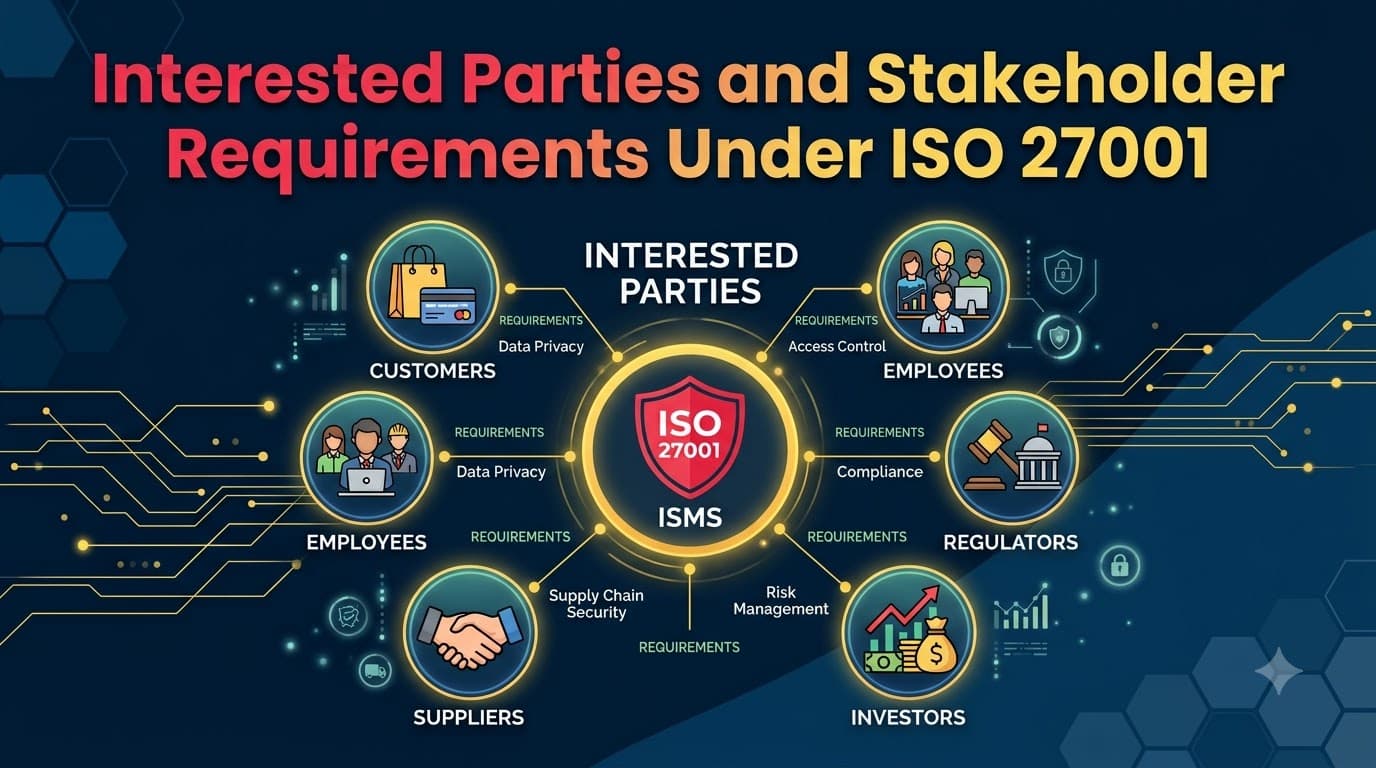
If you're working through Clause 4.2 right now, you need to identify every interested party who has a stake in your ISMS, capture what each one actually requires of you — legally, contractually, or by plain expectation — decide which of those requirements your ISMS will actually address, and keep all of it in a register that your scope and risk assessment can draw on without guesswork.
I've built that register more than 200 times now, in industries ranging from payment processing to pediatric telehealth, and I can tell you the failure mode is always the same: it's never the interested party you forgot entirely. It's the one you wrote down, shrugged at, and never asked a follow-up question.
Who This Is For / What You'll Walk Away With
This article is for the person who owns Clause 4.2 in a live ISO 27001 project — usually an information security manager, a GRC lead, or a consultant standing up the ISMS from scratch — and who has already skimmed the clause text and realized it's three short sentences hiding a very large amount of work.
What you'll walk away with:
A working definition of "interested party" that goes beyond the standard's language and actually helps you find the ones you'd otherwise miss.
A repeatable method for eliciting legal, regulatory, contractual, and expectation-based requirements from each party — including the interview questions that surface the requirements nobody wrote down anywhere.
A full interested-parties register template plus a worked example you can adapt directly.
A defensible method for deciding, and documenting, which requirements the ISMS will address (the 2022 addition to Clause 4.2 that trips up more organizations than any other single line in the revision).
A review cadence and ownership model so the register doesn't go stale the week after certification.
Cold Open: The Clause That Nobody Reads Twice
Marcus Webb ran information security for a mid-sized claims-processing outsourcer called Ferrovia Health Solutions — 340 employees, three delivery centers, and a client roster that included two Fortune 500 insurers. Ferrovia had sailed through its ISO 27001 Stage 1 audit eighteen months earlier. The Statement of Applicability was tight, the risk register was current, and Marcus had genuinely enjoyed building the thing.
Then came the renewal conversation with Meridian Underwriting, Ferrovia's second-largest client at just under $4.1 million in annual contract value. Meridian's procurement team had quietly updated their vendor security addendum fourteen months prior, adding a clause requiring all claims data touched by subcontracted processors to remain within specified national borders, with named-country attestations refreshed annually. Ferrovia had opened a low-cost secondary processing site in a neighboring country nine months before that update landed — a decision made entirely inside operations, with no security or compliance visibility into the contract renewal.
Nobody at Ferrovia had reread the Meridian contract since the original signature. Nobody had a register that said "Meridian Underwriting — contractual requirement — data residency — last reviewed." The interested-parties analysis Marcus had built for certification listed "customers" as a single generic line with "confidentiality expectations" as the requirement. It wasn't wrong. It also wasn't remotely enough.
Meridian's audit team found the residency breach during their own vendor reassessment, three weeks before the ISO 27001 recertification surveillance visit. The renewal was frozen pending remediation. Marcus spent the next six weeks doing what should have been a standing quarterly task: rereading every material customer contract, cross-referencing it against actual data flows, and rebuilding the interested-parties register as a living document rather than a certification artifact. Ferrovia kept the contract, eventually, at the cost of a compensating-control commitment and a client relationship that took a full year to fully repair.
The ISMS hadn't failed. Clause 4.2 had never really been performed at the depth the clause requires. That gap is the subject of this article.
What Clause 4.2 Actually Requires
ISO/IEC 27001:2022 Clause 4.2, "Understanding the needs and expectations of interested parties," asks the organization to determine three things:
The interested parties that are relevant to the information security management system.
The relevant requirements of these interested parties.
Which of these requirements will be addressed through the information security management system.
That third point is new to the 2022 revision. The 2013 version of the standard stopped at identifying requirements; it never asked you to decide, explicitly, which ones the ISMS would actually take on. That distinction matters more than it looks. Not every requirement an interested party holds belongs inside your ISMS — some are handled by other management systems (quality, environmental, safety), some are handled by legal or HR outside any formal system, and some simply aren't going to be addressed at all, a decision that itself needs to be conscious and documented rather than accidental.
Clause 4.2 doesn't sit alone. It's the second of four sub-clauses under Clause 4, Context of the Organization, and it exists in a direct dependency chain: Clause 4.1 establishes the internal and external issues your organization faces; Clause 4.2 identifies who has a stake in how you manage information security and what they require; Clause 4.3 uses both of those inputs to draw the boundary of the ISMS — see our companion piece on defining the scope of your ISMS; and Clause 6 planning, covered in our Clause 6 deep dive, uses the requirements register to shape risk criteria and information security objectives. Get 4.2 wrong, or thin, and every downstream clause inherits the gap.
Why This Clause Is Deceptively Hard
On paper, Clause 4.2 is three sentences. In practice, it's an information-gathering exercise that spans legal, sales, procurement, HR, IT operations, and the executive team — and most of the people who hold the relevant knowledge don't know they hold it.
The legal team knows about the data protection authority's expectations but may not know your sales team just signed a contract with a security exhibit nobody in security has read. Sales knows the contract exists but doesn't parse "recovery time objective of four hours" as an ISMS requirement. Procurement knows which regulators apply to specific supplier relationships but doesn't loop in the ISMS owner when a new clause gets negotiated. Each function holds a piece of the picture, and Clause 4.2 is the only place in the standard that forces someone to assemble the whole thing.
The other reason this clause bites organizations is that requirements change continuously, quietly, and usually without anyone flagging "this affects your ISMS." A contract amendment. A new state privacy law taking effect. A customer's own security team updating their vendor questionnaire. A shareholder resolution on cybersecurity disclosure. None of these arrive with a label. That's precisely why a register with an owner and a review cadence — not a one-time exercise performed for Stage 1 — is the only version of Clause 4.2 that survives contact with year two.
"I tell every client the same thing: if your interested-parties register hasn't changed since your certification audit, it's not a register anymore, it's a fossil. The business moved. Did your document move with it?" — Priya Ramachandran, ISMS Lead Auditor, Ashgrove Certification Partners
Interested Party vs. Stakeholder: Same Concept, One Precise Definition
The standard uses "interested party" rather than the more casual "stakeholder," and the distinction is worth holding onto because the formal definition is broader than most people's intuition. ISO/IEC 27000 defines an interested party as a "person or organization that can affect, be affected by, or perceive itself to be affected by a decision or activity." That third clause — perceive itself to be affected — is the one people forget, and it's the one that pulls in parties like advocacy groups, the press, or a nervous board member who has no formal authority over the ISMS but absolutely shapes how leadership prioritizes it.
For a working glossary of this and other ISO 27001 terms you'll need throughout implementation, see our ISO 27001 terminology and glossary. For this article, treat "interested party" and "stakeholder" as interchangeable in everyday conversation — auditors won't penalize you for saying "stakeholder register" — but when you write the formal register, use the standard's own three-part test as your inclusion criterion, not a gut feeling about who seems important.
The Three-Part Test: Affect, Be Affected, Perceive Itself Affected
Use this test as a literal checklist when you're deciding whether someone belongs in the register. A party qualifies if any one of the three is true:
Can affect the ISMS. A regulator who can impose fines, a key customer who can cancel a contract, a cloud provider whose outage takes down your control environment.
Can be affected by the ISMS. Employees subject to new access-control policies, customers whose data is protected (or exposed) by your controls, contractors bound by new onboarding requirements.
Perceives itself to be affected, whether or not that perception aligns with technical reality. A customer's security team that believes your ISO 27001 certification implies GDPR compliance (it doesn't — more on that below) still holds an expectation your organization needs to manage, even if the expectation itself needs correcting rather than fulfilling.
That third category is where most gaps live. It's easy to list "customers" and "regulators." It's much harder to remember that the industry analyst who publishes a vendor risk scorecard, the cyber-insurance underwriter renewing your policy, or the works council representing your EU employees all belong on the same list, for the same structural reason: each one holds a view of what your ISMS should do, and that view carries consequences if you ignore it.
How Clause 4.2 Feeds Scope, Risk, and Objectives
Clause 4.2 doesn't exist to produce a document that sits in a folder. Its output — the list of interested parties and their relevant requirements — is a direct input to at least three other parts of the management system, and auditors will trace that thread deliberately during both certification and surveillance audits.
First, it feeds Clause 4.3, scope. A requirement from a major customer that certain business units process their data means those units, and the systems supporting them, likely need to sit inside the ISMS boundary. Our companion article on defining the scope of your ISMS walks through that boundary-setting exercise in detail — but the raw material for that exercise is the requirements register you build here.
Second, it feeds Clause 6 risk assessment and treatment. A legal requirement to notify a regulator within 72 hours of a breach becomes a risk criterion and, eventually, a control objective. See Clause 6: Planning for how requirements translate into risk criteria and treatment decisions.
Third, it feeds the Statement of Applicability. When you justify including or excluding an Annex A control, "required by interested party X" is one of the standard, defensible justifications auditors expect to see. Our guide to building a Statement of Applicability covers that link from the SoA side.
The diagram below shows the flow as I present it to clients: interested parties surface requirements, the organization makes an explicit decision about which requirements the ISMS will address, and that decision — not the raw requirement list — becomes the input to scope and risk.
flowchart LR
    A[Identify Interested Parties] --> B[Capture Relevant Requirements]
    B --> C{Legal / Regulatory}
    B --> D{Contractual}
    B --> E{Expectation-Based}
    C --> F[Decide: Addressed by ISMS?]
    D --> F
    E --> F
    F -->|Yes| G[Feeds Clause 4.3 Scope]
    F -->|Yes| H[Feeds Clause 6 Risk & Objectives]
    F -->|No / Elsewhere| I[Handled Outside ISMS - Documented Rationale]
    G --> J[Statement of Applicability]
    H --> J
"Auditors don't ask to see your interested-parties list. They ask you to trace one requirement from the register all the way to a control in your SoA. If you can't do that in under two minutes, the register was built for the binder, not for the business." — Devon Okafor, Principal Consultant, Northfield Risk Advisory
Internal Interested Parties: The Ones You Already Employ
Internal parties are the easiest to overlook precisely because they're close — familiarity breeds a false assumption that you already know what they need. Walk this list deliberately rather than trusting memory.
Internal Interested Party | Typical Requirement Type | Example Requirement |
|---|---|---|
Executive leadership / Board | Expectation, governance | Visibility into top information security risks each quarter |
Employees (general workforce) | Expectation, legal | Fair, lawful handling of personal HR data; clear acceptable-use rules |
IT operations | Expectation, contractual | Realistic patching windows and change-control timelines |
Internal audit function | Governance | Independent access to ISMS records and evidence |
Works council / employee representatives (EU) | Legal | Consultation before monitoring or access-control changes affecting staff |
Legal / compliance department | Legal, regulatory | Early visibility into new contracts and regulatory filings |
Shareholders / owners | Expectation | Reasonable assurance that cyber risk won't produce material loss |
Finance / procurement | Contractual | Supplier due-diligence requirements tied to spend thresholds |
Even in a 40-person startup, most of these rows apply. The board might be two investors on a call once a quarter, but their expectation of visibility into cyber risk is still a real requirement your ISMS needs to satisfy, and it still belongs in the register.
External Interested Parties: Where the Real Complexity Lives
External parties are where organizations under-invest, because gathering their requirements means picking up the phone rather than reading an internal policy.
External Interested Party | Typical Requirement Type | Example Requirement |
|---|---|---|
Customers / clients | Contractual, expectation | Security exhibits, SLAs, breach notification timelines, audit rights |
Regulators / supervisory authorities | Legal, regulatory | Sector-specific security and reporting obligations |
Suppliers / subprocessors | Contractual | Flow-down security clauses your organization must also honor |
Certification body | Contractual, standard-based | Ongoing conformance to ISO/IEC 27001 requirements |
Cyber-insurance underwriter | Contractual | Minimum control baseline as a condition of coverage |
Industry / trade bodies | Expectation | Adherence to sector codes of practice |
Law enforcement | Legal | Preservation and disclosure obligations during investigations |
Local community / press | Perceived expectation | Reasonable stewardship of data affecting the public |
Competitors (indirectly) | Expectation, market pressure | Comparable security posture as a market entry condition |
The insurer row deserves a specific callout: cyber-insurance renewal questionnaires increasingly function as an unofficial parallel control framework, and I've seen underwriter-driven requirements (mandatory MFA on all remote access, specific backup immutability standards) get missed by ISMS teams who treat the insurance relationship as purely a finance function rather than an interested party with binding technical requirements.
Sector-Specific Interested Parties: A Comparative View
Different industries carry structurally different interested-party profiles. Use this table as a sanity check against your own list — if your sector isn't represented and you're missing an equivalent row, that's a signal.
Sector | Distinctive Interested Party | Distinctive Requirement |
|---|---|---|
Healthcare / health tech | Health regulators, patients | Protected health information handling and breach notification timelines |
Financial services | Prudential regulators, payment networks | Operational resilience testing and incident reporting windows |
SaaS / technology | Enterprise customers, cloud providers | Shared-responsibility clarity and subprocessor transparency |
Manufacturing / OT | Safety regulators, plant operators | Segregation of IT and operational technology networks |
Public sector / government | Oversight bodies, citizens | Statutory records retention and freedom-of-information obligations |
Legal services | Clients, bar associations | Confidentiality and privilege-preserving data handling |
Higher education | Students, research funders, accreditors | Research data integrity and student record confidentiality |
For financial services organizations specifically, EU operational-resilience obligations under DORA and equivalent frameworks are increasingly showing up as named interested-party requirements rather than generic "regulatory compliance" lines — worth flagging explicitly in the register rather than folding into a catch-all category.
Multinational Organizations: When One Interested Party Becomes Twelve
Everything above gets harder once an organization operates across borders, because a single category like "regulator" or "employees" can fragment into a dozen distinct interested parties with conflicting requirements. A data protection authority in one country may require breach notification within 72 hours; an equivalent body in another jurisdiction may require notification within a much shorter window, or may define "personal data" differently. Employees in one country may have works-council consultation rights that don't exist elsewhere in the same organization.
The mistake I see most often in multinational ISMS builds is a single register row labeled "regulators" or "employees" that silently averages these differences away, producing a requirement that satisfies none of the actual jurisdictions precisely. The fix is granularity: list each material jurisdiction as its own row, even if the underlying requirement category is similar, and let the "addressed by ISMS" decision reflect the strictest applicable standard where operationally feasible, or a documented per-jurisdiction variance where it isn't.
This is also where the scope boundary conversation becomes unavoidable. If a subsidiary in a particular country introduces a materially different set of interested-party requirements, that's a direct input to the scope discussion in defining the scope of your ISMS — sometimes the cleanest answer is a scope boundary that excludes an entity with a fundamentally different regulatory profile and manages it under a parallel arrangement, rather than forcing one ISMS to satisfy incompatible requirements simultaneously.
"Multinational clients love to hand me a single 'legal requirements' row that says 'GDPR and equivalent.' There's no such thing as 'and equivalent' in an audit. Name the jurisdiction, name the regulator, name the specific obligation." — Priya Ramachandran, ISMS Lead Auditor, Ashgrove Certification Partners
The Certification Body as Its Own Interested Party
It's easy to forget that your certification body itself is an interested party under the standard's own definition — it can affect your ISMS (through findings, suspension, or withdrawal of certification) and is affected by it (its own accreditation depends on the rigor of the certifications it issues). The requirement here is straightforward but frequently undocumented: maintained conformance to ISO/IEC 27001 itself, timely notification of significant changes to your ISMS scope or management structure, and cooperation with surveillance and recertification audits.
Some organizations also carry a secondary requirement from their certification body's own accreditation rules — for example, restrictions on using the certification mark in marketing, or requirements to report major nonconformities from internal audits during surveillance visits. These are easy to overlook because they feel procedural rather than substantive, but a register that omits the certification body entirely reads, to an experienced auditor, as a sign the exercise wasn't done with real rigor.
The Four Requirement Sources: Legal, Regulatory, Contractual, Expectation
Clause 4.2 asks for "relevant requirements," and in practice those requirements always trace back to one of four sources. Treating them as distinct categories — rather than one undifferentiated pile — makes the register far easier to audit and far easier to keep current, because each source has a different owner and a different trigger for change.
Requirement Source | Who Typically Owns Tracking It | How It Changes |
|---|---|---|
Legal | Legal / compliance team | New legislation, amendments, court rulings |
Regulatory | Compliance, sector-specific risk function | Regulator guidance updates, supervisory expectations |
Contractual | Sales, procurement, legal | Contract renewals, addenda, security exhibit updates |
Expectation-based | ISMS owner, customer success, marketing | Market shifts, incidents at peer organizations, published scorecards |
A word of caution on framing, because it's the single most common inaccuracy I see in ISMS documentation: laws like GDPR and HIPAA, or frameworks like DORA, are sources of interested-party requirements — they are not things ISO 27001 makes you "compliant" with. Certification demonstrates that you operate a management system capable of identifying, addressing, and evidencing information security requirements, including legal ones. It is not, by itself, a legal compliance certificate for any specific regulation. Auditors will check that you've identified the applicable law and decided how the ISMS addresses it; they will not (and cannot) certify GDPR or HIPAA compliance as such. Keep that distinction explicit in the register itself, not just in your own head — it protects you the day a customer's legal team asks the question directly.
Legal Requirements: Worked Examples
Legal requirements are typically jurisdiction-driven and apply regardless of what any single customer or contract says. Below is an illustrative — not exhaustive — set of examples as they might appear in a register.
Interested Party | Legal Requirement (Illustrative) | Relevant ISMS Area | Addressed by ISMS? |
|---|---|---|---|
Data protection authority (EU) | Lawful basis and breach notification obligations under GDPR | Incident management, data processing records | Yes |
Health regulator (US) | Safeguards for protected health information under HIPAA | Access control, encryption, audit logging | Yes |
National employment law | Lawful monitoring and consent for workplace surveillance | HR data handling, acceptable use policy | Partially — HR-owned, ISMS provides technical controls |
Export control authority | Restrictions on cryptography or technology transfer | Asset management, supplier due diligence | Yes |
Consumer protection law | Truthful representation of security claims | Communications, marketing sign-off | No — owned by legal/marketing, not ISMS |
Note the "Partially" and "No" rows deliberately. Not every legal requirement belongs inside the ISMS boundary, and the 2022 wording of Clause 4.2 explicitly wants you to make and record that call rather than assume every legal obligation is automatically an ISMS matter.
Regulatory Requirements: Sector Examples
Regulatory requirements often layer on top of general legal obligations and are frequently sector- or license-specific.
Sector Regulator (Illustrative) | Requirement Type | Relevant ISMS Area |
|---|---|---|
Financial prudential regulator | Operational resilience, incident reporting windows (e.g., under DORA) | Business continuity, incident management |
Payment card scheme oversight | Cardholder data protection consistent with PCI DSS | Network segmentation, encryption, access control |
Telecommunications regulator | Critical infrastructure resilience obligations | Business continuity, supply chain security |
Health data regulator | Breach notification and patient consent requirements | Incident management, data classification |
Securities regulator | Material cybersecurity incident disclosure | Incident management, executive reporting |
Contractual Requirements: Where Customer Expectations Become Binding
Contractual requirements are the category most likely to be missed by a security team, because contracts are negotiated by sales and legal, signed without security sign-off on the security exhibit, and rarely re-reviewed after execution — exactly the failure that cost Ferrovia its Meridian renewal in the opening story.
Contract Clause Type | Example Requirement | Owner Who Should Flag It | Typical ISMS Control Area |
|---|---|---|---|
Data residency | Data must remain within named countries | Legal, sales operations | Asset management, cloud configuration |
Right to audit | Customer or its agent may audit security controls annually | Contracts/legal | Internal audit, evidence management |
Breach notification SLA | Notify customer within 24–72 hours of confirmed incident | Legal, incident response lead | Incident management |
Subprocessor approval | Written approval required before adding subprocessors | Procurement, legal | Supplier relationships |
Security certification maintenance | Maintain ISO 27001 (or SOC 2) certification for contract duration | Sales, ISMS owner | Management review, internal audit |
Encryption standard | Data encrypted at rest and in transit to a named standard | Legal, security architecture | Cryptography |
Insurance minimums | Maintain cyber-insurance coverage above a stated threshold | Finance, legal | Risk treatment |
The practical fix I recommend to every client: security should have standing read access to the contract repository, or at minimum a quarterly digest of newly signed or amended security exhibits. Waiting for a contract dispute to discover a clause is the Ferrovia pattern, and it is entirely avoidable.
Expectation-Based Requirements: The Softest, Most Overlooked Category
Not every requirement is written down. Expectations are real requirements that live in perception, market norms, or unstated assumptions — and the 2022 revision's "perceive itself to be affected" language exists specifically to capture them.
Interested Party | Expectation (Unwritten) | Why It Matters | Addressed by ISMS? |
|---|---|---|---|
Prospective enterprise customers | Assume ISO 27001 certification implies broad regulatory compliance | Misunderstanding needs active correction in sales conversations | No — clarified, not addressed, by ISMS |
General public / press | Assume "reasonable" data protection regardless of contract terms | Reputational risk following any breach disclosure | Partially — via incident communication process |
Employees | Assume monitoring is proportionate and disclosed | Trust and retention risk if violated | Yes — via HR and acceptable-use policy |
Industry analysts | Assume alignment with common frameworks like NIST CSF | Influences market perception and deal scoring | Partially — mapped for reference, not formally adopted |
Job candidates | Assume background-check and data-handling practices are lawful | Talent acquisition risk | Yes — via HR security procedures |
"The requirement nobody writes down is usually the one that burns you in a sales call, not an audit. A prospect's security team assumes your ISO 27001 certificate means something it doesn't, and if you don't correct that gently and early, you inherit an expectation you never agreed to." — Elena Voss, VP Customer Trust, Kestrel Data Systems
Deciding Which Requirements the ISMS Will Address
This is the step the 2022 revision added, and it's the step that gives your ISMS teeth instead of just an inventory. For every requirement you've captured, you need a documented, defensible answer to one question: will this be addressed through the ISMS, and if not, where is it addressed instead?
Three honest answers exist, and all three are acceptable to an auditor provided you can show the reasoning:
Yes, fully addressed. The requirement maps directly to one or more ISMS controls, is reflected in the Statement of Applicability, and is monitored through normal ISMS performance evaluation.
Partially addressed. Part of the requirement sits inside the ISMS (technical controls); part sits outside it (legal drafting, HR policy, contract negotiation). Document the split so nobody assumes the ISMS owns the whole thing.
Not addressed through the ISMS. The requirement is real but is managed through a different mechanism entirely — a separate quality system, a legal process, or a business decision not to pursue that market/contract. This answer is legitimate as long as it's a conscious decision, not a silent gap.
What auditors will not accept is silence — a requirement sitting in the register with no decision recorded at all. That's the exact gap the 2022 wording was written to close.
The "Addressed by ISMS" Decision Table
Here's how I structure this decision for clients, using a real (anonymized and adjusted) set of requirements from a mid-market logistics company's ISMS build.
Requirement | Source | Addressed by ISMS? | Rationale | Linked Control Area |
|---|---|---|---|---|
72-hour breach notification to data protection authority | Legal (GDPR) | Yes | Core incident management obligation | Incident management, legal liaison |
Annual customer security audit rights | Contractual (top 5 customers) | Yes | Recurring, material to revenue retention | Internal audit, evidence management |
Cyber-insurance MFA mandate | Contractual (insurer) | Yes | Condition of coverage; technical control | Access control |
Fair employment monitoring disclosure | Legal (labor law) | Partially | HR owns policy language; ISMS owns technical logging controls | Access control, HR liaison |
Marketing claims accuracy | Legal (consumer protection) | No | Owned entirely by legal/marketing review process | Not applicable |
Community expectation of "responsible AI use" | Perceived expectation (public/press) | Not yet — flagged for next review | Emerging; no current contractual or legal trigger | Pending — Clause 6 risk assessment |
That last row matters as much as the "Yes" rows. Recording "not yet, flagged for review" is a legitimate, auditable answer — and it's exactly the kind of forward-looking entry that signals a mature ISMS rather than a box-ticking exercise.
Building the Register: A Repeatable Method
I use a five-step method with clients, and it works whether the organization is 30 people or 3,000:
Brainstorm broadly first, filter second. Get every plausible interested party on a whiteboard before applying the three-part test. Filtering too early is how regulators and quiet-but-critical suppliers get dropped.
Assign an owner per party, not per row. Legal owns the data protection authority relationship; sales owns key customer contracts; procurement owns supplier and insurer relationships. The register aggregates their input; it doesn't originate it.
Interview, don't assume. For every party marked "high relevance," conduct a short structured conversation (see the interview guide below) rather than inferring requirements from memory or old documentation.
Cross-reference against source documents. Contracts, regulatory guidance, board minutes, insurance policies — pull the actual document rather than trusting a paraphrase.
Record the addressed-by-ISMS decision explicitly, with a named approver and date, before the register is considered complete for a given cycle.
"The brainstorm-then-filter order matters more than people think. Teams that filter first always converge on the same six obvious parties and miss the works council, the insurer, and the regulator that only applies to one product line." — Tomasz Nowicki, Head of GRC, Alderbrook Financial Group
Interested Parties Register Template
Use the following columns as your baseline structure. Every column exists because I've seen an audit finding trace back to its absence.
Column | Purpose |
|---|---|
Interested Party | Named party, not a vague category ("Meridian Underwriting," not just "customers") |
Category | Internal / External |
Relevance (High/Med/Low) | Filters review effort and frequency |
Requirement(s) | The specific, sourced requirement(s) held by this party |
Requirement Source | Legal / Regulatory / Contractual / Expectation |
Source Document/Reference | Contract name, regulation citation, policy reference |
Addressed by ISMS? | Yes / Partially / No / Pending |
Rationale | Short justification for the decision |
Linked Control / Clause | Cross-reference to Annex A control or ISMS process |
Owner | Named individual accountable for monitoring this party |
Last Reviewed | Date of last confirmed review |
Next Review Due | Date triggering re-validation |
Worked Example: A Populated Register Extract
Below is an illustrative extract as it might appear for a mid-sized SaaS company, populated with realistic but fictional detail.
Interested Party | Category | Relevance | Requirement | Source | Addressed by ISMS? | Owner | Next Review |
|---|---|---|---|---|---|---|---|
Northgate Retail Group (top customer) | External | High | Annual on-site audit right; 24-hour breach notice | Contractual | Yes | Head of Customer Success | Quarterly |
State Data Protection Authority | External | High | Breach notification, lawful processing basis | Legal/Regulatory | Yes | General Counsel | Annually / on law change |
Cloud Infrastructure Provider | External | High | Shared-responsibility boundary compliance | Contractual | Yes | Cloud Architecture Lead | Semi-annually |
Employees (EU entity) | Internal | Medium | Proportionate monitoring, works council consultation | Legal | Partially | HR Director | Annually |
Cyber-Insurance Underwriter | External | High | MFA, immutable backups, incident reporting within 48 hours | Contractual | Yes | CISO | At renewal |
Board of Directors | Internal | High | Quarterly risk visibility | Expectation | Yes | CISO | Quarterly |
Regional Trade Association | External | Low | Voluntary code-of-practice alignment | Expectation | No | Marketing Lead | Annually |
Notice the register names an actual customer, an actual internal function, and an actual named owner — this is what separates a register that survives an audit interview from one that reads as generic filler.
Interviewing Stakeholders: The Questions That Surface Hidden Requirements
A register built from documents alone will always be thinner than one built from conversations. When I run stakeholder interviews for Clause 4.2, I use a short, consistent set of questions regardless of who's in the room:
"What has this party asked of us in writing in the last 12 months, even informally — an email, a questionnaire, a clause?"
"What would this party do if we failed to meet an expectation they hold, even one we've never explicitly agreed to?"
"Has anything changed in this relationship — a renewal, a new regulation, a leadership change — that we haven't reflected anywhere yet?"
"Is there a requirement you're aware of that you've assumed 'security already knows about'?"
"Who else, inside or outside this relationship, might hold a requirement we haven't captured?"
That fourth question routinely produces the most value. It's the one that surfaced Meridian's data-residency clause in a proper retrospective of the Ferrovia case — eighteen months late, but not fatally so, because the relationship recovered.
Case Study: The Retailer That Found Its Missing Regulator
A regional payment-services provider I'll call Larchmere Pay ran its Clause 4.2 exercise focused almost entirely on its direct merchant customers and the card networks. During a stakeholder interview with the finance team — added late, almost as an afterthought — a controller mentioned in passing that Larchmere had recently begun processing transactions for merchants in a neighboring country, triggering oversight from that country's financial conduct regulator, a body nobody on the security team had ever heard of.
The gap was caught eleven months before the Stage 2 audit, not eleven months after a regulatory inquiry. Larchmere added the regulator to its register, mapped its specific incident-reporting and data-localization requirements against the existing control set, found two genuine gaps (a reporting timeline and a data-localization control), and closed both before certification. The fix cost roughly six weeks of focused work. Estimated cost of catching the same gap through a regulatory inquiry instead: the team put it conservatively at $150,000–$300,000 in remediation, legal fees, and reputational cleanup, based on comparable cases they'd tracked in the sector. The lesson Larchmere's CISO repeated afterward: finance and operations, not just legal and sales, need a seat in the interested-parties exercise, because they're often the first to know a business has expanded into a new regulatory footprint.
Case Study: The SaaS Vendor That Turned a Customer Expectation Into a Competitive Edge
A workforce-management SaaS company I advised — call it Ellery Systems — kept surfacing the same soft requirement during customer renewal calls: enterprise prospects wanted proof of a fast, tested incident-response capability, not just a policy document. It wasn't in any contract. It was a repeated, informal expectation that showed up in nearly every security questionnaire's free-text comments.
Rather than treat it as noise, Ellery's ISMS owner logged it in the interested-parties register as an expectation-based requirement from "prospective enterprise customers," marked it "addressed by ISMS — partially, upgrading to fully," and used it to justify budget for a tabletop incident-response exercise program plus a published (non-sensitive) incident-response summary shared during sales cycles. Win-rate on deals above $75,000 annual contract value improved measurably over the following two sales quarters, and the sales team began citing the incident-response summary unprompted in win/loss reviews as a differentiator against two named competitors who could only point to a certificate. The requirement was never written into a contract until several renewals later — but treating an unwritten expectation as a first-class register entry is what let Ellery act on it before it became a lost-deal pattern.
Case Study: The Manufacturer That Documented a "No"
Not every case study needs a near-miss. A precision-parts manufacturer I worked with identified a genuine expectation from a regional environmental advocacy group regarding data transparency around its supply chain emissions reporting. After discussion with legal and the executive team, they made a documented decision: this expectation, while real, would be addressed through the company's separate sustainability reporting program, not through the ISMS. The register entry recorded the decision, the rationale, and the owner of the alternate program. When the certification auditor asked about it during the Stage 2 review — precisely the kind of question a thorough auditor will ask when a register mentions a party without a clear disposition — the team produced the rationale in under a minute. No finding, no follow-up. The value here wasn't in closing a gap; it was in proving the "No" decision had actually been made, not defaulted into by omission.
Review Cadence: How Often to Revisit Each Category
A register frozen at certification is a register that quietly expires. Match review frequency to how fast each category actually changes rather than reviewing everything on the same annual clock.
Requirement Category | Recommended Review Trigger | Minimum Cadence |
|---|---|---|
Key customer contracts (top-tier revenue) | Renewal, amendment, or security exhibit update | Quarterly |
Regulatory obligations | New legislation, guidance updates | Semi-annually, plus ad hoc on law change |
Supplier/subprocessor requirements | Onboarding, contract renewal | At each onboarding + annually |
Cyber-insurance requirements | Policy renewal | At renewal (typically annual) |
Internal stakeholder expectations (board, employees) | Leadership change, org restructuring | Annually |
Expectation-based/market requirements | Sales cycle feedback, industry incidents | Semi-annually |
Full register re-validation | Management review cycle | Annually, minimum |
Tie the full re-validation explicitly to your management review meeting under Clause 9, so the register isn't an orphaned artifact but a standing agenda item with minutes to prove it happened.
Common Pitfalls in Interested-Parties Analysis
Pitfall | Why It Happens | Fix |
|---|---|---|
Generic categories instead of named parties | Faster to write "customers" than list them | Name the top-tier parties individually; group only genuinely homogeneous long-tail parties |
No addressed-by-ISMS decision recorded | Teams stop at identifying requirements, the pre-2022 habit | Add the decision column and make it mandatory before sign-off |
Register owned by no one | Built once for certification, then orphaned | Assign a named accountable owner in the ISMS RACI |
Contracts never re-read after signature | Security has no visibility into contract lifecycle | Quarterly digest of new/amended security exhibits to the ISMS owner |
Expectations dismissed as "not real requirements" | Only written obligations are taken seriously | Apply the three-part test consistently, including "perceives itself affected" |
Confusing ISO 27001 certification with legal compliance | Marketing shorthand becomes internal belief | State the distinction explicitly in the register and in customer-facing materials |
One-time exercise mentality | Treated as a certification checkbox | Tie review cadence to management review and contract lifecycle events |
Strong vs. Weak Rationale: What Auditors Actually Want to Read
The "Rationale" column in your register is where most organizations either build credibility or lose it. A vague rationale invites follow-up questions; a specific one closes the topic in one exchange. Compare the two side by side.
Requirement | Weak Rationale (Avoid) | Strong Rationale (Use) |
|---|---|---|
Customer audit rights clause | "Customer requires audits." | "Section 7.2 of the Northgate Retail Group MSA (executed March 2025) grants an annual on-site or remote audit right; addressed via the internal audit program and evidence repository, owner: Head of Internal Audit." |
Regulatory breach notification | "Follows applicable law." | "Under [jurisdiction]'s data protection statute Section [X], notification is required within 72 hours of confirmed breach; addressed via the incident response plan's Step 4 notification trigger, tested annually." |
Employee monitoring expectation | "HR handles this." | "Works council consultation completed Q1 2026 per local labor code Article [X]; ISMS provides technical logging controls (Annex A access control and logging controls); HR owns policy language and consent mechanism." |
Insurer MFA mandate | "Insurance wants MFA." | "Policy renewal terms (binder dated Jan 2026) condition coverage on MFA for all remote administrative access; implemented via access control policy, verified in Q2 internal audit." |
Notice the strong column always names a source document, a date, an owner, and a specific control or process. That's the level of specificity that turns a two-minute audit interview question into a non-issue rather than a finding.
Change Triggers: Events That Should Force an Off-Cycle Review
Scheduled reviews catch most changes, but some events are significant enough to warrant an immediate, off-cycle look at the register rather than waiting for the next quarterly or annual checkpoint.
Trigger Event | Why It Matters | Who Should Initiate the Review |
|---|---|---|
New material customer contract signed | May introduce new contractual requirements immediately | Sales/legal notifies ISMS owner within 5 business days |
Entry into a new jurisdiction or market | New regulators and legal requirements may apply | Executive leadership, legal |
Merger, acquisition, or divestiture | Interested-party landscape changes structurally | Executive leadership |
Significant security incident | Customer, regulator, and insurer expectations often shift after an incident | ISMS owner / incident response lead |
New or amended legislation in an operating jurisdiction | Legal requirement changes may create new obligations | Legal/compliance |
Cyber-insurance non-renewal or major term change | Coverage conditions may introduce new technical requirements | Finance, ISMS owner |
Leadership change (CISO, General Counsel, CEO) | Risk appetite and stakeholder priorities can shift | Executive leadership |
Building these triggers into your change-management or incident-response procedures — rather than relying on someone remembering to update a spreadsheet — is what keeps the register synchronized with reality between formal review cycles.
Roles and Responsibilities: A RACI for the Register
Activity | ISMS Owner / CISO | Legal / Compliance | Sales / Customer Success | HR | Executive Leadership |
|---|---|---|---|---|---|
Maintain master register | A/R | C | C | C | I |
Track legal/regulatory changes | C | A/R | I | I | I |
Flag new/amended contract clauses | C | C | A/R | I | I |
Flag internal workforce requirements | C | C | I | A/R | I |
Approve "addressed by ISMS" decisions | R | C | I | I | A |
Present register at management review | A/R | C | I | I | I |
(A = Accountable, R = Responsible, C = Consulted, I = Informed)
This structure matters because Clause 4.2 is one of the few places in the standard where the ISMS owner is explicitly dependent on functions outside their direct control. A RACI that names accountable owners outside security prevents the register from silently becoming "one person's best guess," which is exactly the state Marcus inherited at Ferrovia before the Meridian renewal exposed it.
How This Connects to Your Statement of Applicability
Every Annex A control you select — or exclude — in your Statement of Applicability should be traceable to a justification, and "required by an identified interested party" is one of the standard's own accepted justifications alongside risk treatment and legal obligation. Across the 93 controls in Annex A (organized into 37 organizational, 8 people, 14 physical, and 34 technological controls across four themes), a well-built interested-parties register will typically justify a meaningful share of your inclusions directly — supplier relationship controls justified by customer flow-down clauses, cryptography controls justified by a regulator's minimum standard, incident management controls justified by a contractual notification SLA. Our detailed walkthrough of building a Statement of Applicability shows exactly how to write that traceability into the document itself rather than leaving it implicit. If you want a structured method for turning each register entry into a control justification, a dedicated how to map requirements to controls walkthrough is the natural next reference — worth building into your internal playbook even before it exists as a published guide.
From Requirement to Risk: A Worked Traceability Example
To make the Clause 4.2 to Clause 6 connection concrete, walk through one requirement end to end the way an auditor would expect to see it traced. Take the Meridian data-residency clause from the opening story, rebuilt properly the second time around at Ferrovia.
Step | Detail |
|---|---|
Interested party | Meridian Underwriting (customer) |
Requirement | Claims data touched by subcontracted processors must remain within named countries, attested annually |
Source document | Vendor Security Addendum, Section 4.3, effective date recorded |
Addressed by ISMS? | Yes |
Risk register entry | "Unauthorized or non-compliant cross-border data transfer of claims data" |
Risk treatment | Data residency control added to cloud configuration standards; subcontractor due-diligence checklist updated |
Annex A control(s) referenced | Supplier relationship and cloud service controls; information transfer controls |
Monitoring mechanism | Quarterly attestation from processing sites; annual contract re-read |
Owner | Head of Customer Success (contract), Cloud Architecture Lead (technical control) |
This is the level of granularity that turns a register entry into something a risk assessment can actually use — a named risk, a named treatment, a named control, and a named owner, all traceable back to the single contractual sentence that generated the requirement in the first place. Our Clause 6 planning guide covers how these risk entries get scored and prioritized once they're captured this way.
Common Objections From Leadership (and How to Answer Them)
Getting the time and budget to do Clause 4.2 properly — interviews, contract re-reads, a maintained register — sometimes meets resistance from leadership who see it as paperwork. A few objections come up repeatedly, and having a ready answer helps.
"We already know what our customers want." Maybe informally, but "informally" is exactly what failed at Ferrovia. The cost of formalizing what you already believe you know is small compared to the cost of discovering you were wrong during a customer's own vendor audit.
"Legal already tracks regulatory requirements." Legal tracks legal obligations for the business broadly; Clause 4.2 asks specifically which of those the ISMS will address and how. Without that translation, legal's tracking and the ISMS's control set can drift apart silently.
"This feels like busywork for the audit." A register built only to satisfy an auditor reads as exactly that in an interview — thin, generic, undated. A register built to actually manage the business's real obligations happens to also satisfy the audit, as a byproduct rather than the goal.
"We don't have time to interview every department." You don't need to interview everyone at once. Start with the highest-relevance parties — top-tier customers, primary regulators, key suppliers — and expand the interview cycle over subsequent quarters rather than treating this as a single all-hands exercise.
"Every objection to doing this properly comes down to the same underlying belief: that the requirement landscape is static. It isn't. The moment you accept that, the objections mostly answer themselves." — Tomasz Nowicki, Head of GRC, Alderbrook Financial Group
What Certification Auditors Actually Test Here
In more than 200 implementations, the audit questions on Clause 4.2 cluster around a small, predictable set of probes. Expect an auditor to:
Ask you to name three interested parties not listed in your scope statement, and explain why they're excluded or included.
Pick one contractual requirement and trace it forward to a specific control and backward to the customer relationship that generated it.
Ask how you learned about a specific external requirement's most recent change — testing whether the register is actively maintained or was built once and left alone.
Probe the "addressed by ISMS" decision on at least one entry marked "No" or "Partially," checking for a documented rationale rather than an ad hoc answer given in the room.
Cross-check your register against your risk register and Statement of Applicability, looking for requirements that appear in one document but not the others.
None of these are trick questions. They're testing whether Clause 4.2 was performed as a living analytical process or produced as a document to satisfy an auditor's checklist — and experienced auditors can tell the difference within the first two questions.
Legal and Contractual Requirements Registers: A Related but Distinct Artifact
Some organizations choose to maintain their legal and regulatory requirements in a dedicated legal & regulatory requirements register, separate from the broader interested-parties register, particularly once the legal obligation count grows into the dozens across multiple jurisdictions. That's a legitimate structural choice — the standard doesn't mandate a single-document format — as long as the two documents are explicitly cross-referenced and both feed the same Clause 6 risk process. A dedicated contractual security requirements log, tracking security exhibits and SLAs specifically, is equally common in organizations with large enterprise customer bases. Whichever structure you choose, resist the temptation to let format decisions fragment ownership: one accountable owner should be able to explain how all the pieces fit together in a single conversation.
Practical Starting Checklist
If you're beginning this exercise today, run it in this order rather than trying to boil the ocean in a single workshop:
List every current customer contract above a materiality threshold you define (revenue, data sensitivity, or both) and confirm a named owner will re-read each one within 30 days.
Pull a current list of applicable regulators and legislation from legal/compliance — don't rely on your own assumption of what applies.
Inventory suppliers and subprocessors with access to in-scope data or systems, and identify flow-down requirements from your own customer contracts.
Schedule structured interviews with HR, sales, procurement, finance, and executive leadership using the five questions outlined earlier.
Draft the register using the template above, populate the addressed-by-ISMS column deliberately, and get named sign-off — not just a review — from the ISMS owner.
Add the register as a standing input to your next management review meeting and set the review cadences from the table above.
Organizations that follow this order tend to reach a defensible first-draft register in two to four weeks of part-time effort. Organizations that skip the interviews and build the register solely from documents in their possession usually finish faster and fail an audit question later — the Ferrovia pattern again, just with a different name on the contract.
Interested Parties and the Wider ISMS Core Concepts
If you're newer to the standard generally, it's worth stepping back to our ISMS core concepts explainer to see how Clause 4.2 sits inside the plan-do-check-act structure that runs through the whole management system, and our beginner's guide to ISO 27001 if you're building context before diving into individual clauses. For readers deciding whether ISO 27001 is the right framework at all relative to alternatives, our comparison of ISO 27001 against NIST, SOC 2, and PCI DSS is a useful companion, since several of those frameworks are themselves common sources of interested-party requirements rather than competitors to the standard.
Tools and Templates to Accelerate the Work
You don't need to build every artifact from a blank page. PentesterWorld's Mandatory Documents Checklist confirms where an interested-parties register fits among the documentation the standard actually requires, and the ISO 27001 Terminology and Glossary is worth keeping open while you draft entries so your language stays consistent with how auditors read the standard. Once your register is populated, the Statement of Applicability Template gives you a structured place to carry the "addressed by ISMS" decisions through to control justifications, and the Complete ISO 27001 Implementation Guide eBook walks the full Clause 4 through Clause 10 sequence if Clause 4.2 is your entry point into a larger build. Teams heading toward certification should also run the Certification Readiness Checklist once the register, scope, and SoA are aligned, specifically to catch the traceability gaps auditors probe for first.
The Strategic Close
Clause 4.2 is easy to underrate because it produces a document, not a control, and documents don't feel like security work. But every scope decision, every risk criterion, and every control justification in your ISMS traces back to a requirement someone outside your security function is holding you to — a regulator, a customer, an insurer, an employee, or simply the market's expectation of what "certified" ought to mean. Marcus Webb's team at Ferrovia didn't fail because their controls were weak. They failed because the register that was supposed to catch a changing customer requirement had gone stale the moment certification was granted, and nobody owned the job of reading it again.
Build the register as a living input, not a certification artifact. Name the parties specifically. Source the requirements from conversations, not assumptions. Make — and record — a real decision about what the ISMS will address. Then put it back in front of the business on a cadence that matches how fast your contracts, your regulators, and your market actually move.
If you want a second set of eyes on your interested-parties register, or a full readiness assessment before your next surveillance or certification audit, PentesterWorld's ISO 27001 advisory team can review your register, trace it against your Statement of Applicability, and pressure-test it the way an experienced lead auditor would — before the finding shows up on someone else's report. Talk to our ISO 27001 team to get started.