Priya Nandakumar didn't think of herself as running a "technology project." She was the operations PM at Cascade Freight Systems, a regional logistics company with 340 employees, and her mandate for Q3 was simple: replace the warehouse's aging barcode scanners with a new fleet of IoT-connected pallet trackers supplied by a vendor called RouteSense. The business case was airtight — 22% faster load-out times, real-time inventory visibility, a projected $410,000 in annual labor savings. The steering committee approved it in eleven minutes. Nobody flagged it for security review, because on the project intake form, under "project type," Priya had checked "Operations / Facilities," not "IT" or "Security." The intake form didn't ask any information security questions for that category. Neither did anyone else, for the next four months.
The RouteSense trackers shipped with a remote diagnostics feature that phoned home over a persistent VPN tunnel to the vendor's support network — a tunnel that, once installed, also had a route into Cascade's warehouse management system and, from there, into the corporate network segment that hosted payroll and customer contract data. Nobody assessed that risk, because nobody ran a risk assessment. Nobody asked RouteSense for its security architecture before signing, because procurement's standard contract didn't get triggered — the purchase order was under the threshold that required security sign-off, split across two POs to fit both warehouses' budgets. Nobody tested the integration in an isolated environment, because the project timeline had no environment separation step; it went from pilot to full production in six weeks.
In November, a penetration tester Cascade had hired for an unrelated client audit — RouteSense's, not Cascade's — found the vulnerable VPN configuration and reported it up the chain. Cascade never got that report. Three weeks later, a threat actor found it independently. They pivoted from the RouteSense tunnel into Cascade's file servers, staged 340 GB of customer shipment and pricing data, and detonated ransomware across four warehouse sites. The all-in cost — incident response, forensics, ransom negotiation, customer notification, six weeks of partial warehouse downtime, and a regulatory inquiry from two states' data breach laws — came to just under $2.3 million. The post-incident review found exactly one root cause line that mattered: information security was never part of the project. Not because anyone decided to skip it. Because the project management process had no place for it to enter.
That's the failure mode Control 5.8 exists to close. It doesn't ask you to run more penetration tests or buy another security tool. It asks you to make information security a structural, undodgeable part of how your organization runs any project — the warehouse automation project, the office relocation, the new HR platform, the acquisition integration, the marketing campaign that touches customer data — not just the ones your security team happens to hear about.
Who this is for, and what you'll walk away with
This guide is for project managers, PMO directors, ISO 27001 implementation leads, and CISOs who need Control 5.8 to be more than a policy paragraph nobody reads. If you're building or refreshing your ISMS ahead of a Stage 1 or Stage 2 audit, or if your last internal audit flagged "no evidence of security integration in non-IT projects," this is written for you. You'll walk away with a stage-gate model you can drop into your existing PMO governance regardless of methodology, comparison tables for Agile, Waterfall, and hybrid delivery, a security requirements checklist your intake process can actually use, a RACI model for project security roles, and the exact evidence auditors expect to see in a project file. Nothing here requires you to invent a parallel project process — it requires you to instrument the one you already have.
What Control 5.8 actually requires
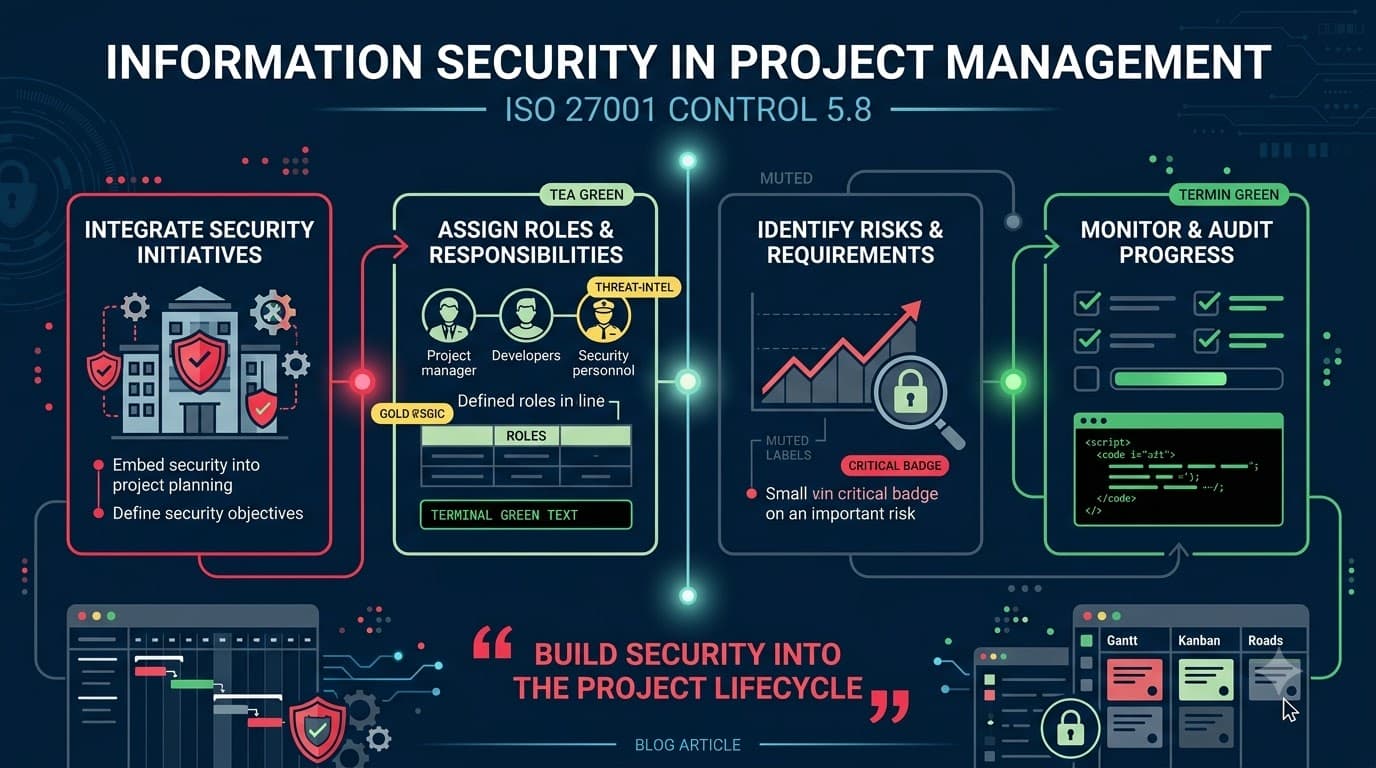
Annex A Control 5.8, "Information security in project management," sits in the organizational controls theme alongside the other governance-level controls covered in our complete overview of ISO 27001's organizational controls. The control text itself is short: information security shall be integrated into project management. The weight is in the ISO/IEC 27002:2022 implementation guidance, which is more specific than the one-line control statement suggests. It asks organizations to do four things, consistently, across every project:
Address information security regardless of the type of project. The guidance is explicit that this applies to organizational change projects, new product or service development, facilities and infrastructure projects, mergers and acquisitions, and supplier onboarding — not only software development or IT infrastructure projects.
Assess information security risk early, and again at intervals. Not once, at kickoff, and never again. The guidance calls for risk identification early in the project (so it can shape scope and budget) and re-assessment as the project evolves, because risk profiles shift as requirements, suppliers, and architecture decisions change.
Define and allocate information security responsibilities within the project. Someone with a name and a role — not "the security team" as an abstraction — needs to own security decisions inside the project structure, with clear escalation paths back to the ISMS.
Include information security requirements in the project, including requirements for any product, system, or service being developed, procured, or changed as part of the project's deliverables.
None of this is optional based on project size or project owner. A $40,000 facilities refresh and a $4 million core banking platform replacement are both "projects" under this control's scope, and both need a security touchpoint proportionate to their risk — not a touchpoint proportionate to whether the requester remembered to loop in security.
Why "all projects" is the phrase auditors actually test
Most organizations that fail a 5.8 audit finding don't fail because they lack a security process for IT projects. They fail because their security process has an implicit gate — "if it touches a system I already know about" — that quietly excludes everything else. Auditors have learned to test this specifically. A competent ISO 27001 auditor will not just ask to see your software development security checklist. They will pull the project register or PMO tracker, pick three or four projects that look nothing like IT projects — an office move, a new supplier onboarding, a marketing campaign, a reorg — and ask you to produce the security risk assessment for each one.
If the honest answer is "we didn't do one because it wasn't a tech project," that's a nonconformity, and it's a common one. In my consulting practice, across roughly 200 ISMS implementations, non-IT project blind spots are among the top five recurring findings at Stage 2 audit — right up there with incomplete supplier risk assessments and stale risk registers. The pattern repeats: the org has genuinely good secure development practices for its flagship product, and genuinely nothing for the HR system migration, the new office lease with an access-control vendor, or the M&A due diligence project that just handed a third party a data room full of customer records.
The fix isn't a heavier process. It's a project intake gate that asks the same triage question regardless of project category: does this project touch information, information systems, physical facilities holding information assets, personnel data, or a third party who will handle any of the above? If yes — and it almost always is — a proportionate security review kicks in automatically. That single triage question, embedded in whatever intake form or PPM tool your organization already uses, closes most of the gap.
Embedding security into the project lifecycle: the stage-gate model
The clearest way to operationalize 5.8 is to attach specific, minimal security activities to the stage gates your PMO already runs, rather than inventing a separate "security project process" that competes for attention. The table below maps a standard four-phase lifecycle (the same shape whether you call your phases initiation/planning/execution/closure or something else) to the security activity that should occur at each gate, who owns it, and the artifact it produces for audit purposes.
Project Phase | Security Activity | Primary Owner | Evidence Artifact |
|---|---|---|---|
Initiation | Security triage question answered on intake form; project classified by information security relevance (low/medium/high) | Project sponsor + PM | Completed intake form with triage classification |
Initiation | Preliminary information security risk assessment for medium/high-relevance projects | PM with security liaison | Initial risk register entry, scored per organizational risk methodology |
Planning | Security requirements defined and added to project scope/requirements document | Security liaison + business analyst | Security requirements checklist (signed off) |
Planning | Security roles assigned within project team (RACI) | PM | Project charter RACI section |
Planning | Budget line item for security activities (testing, review, tooling) confirmed | PM + sponsor | Approved project budget with security line item |
Execution | Risk re-assessment at defined intervals (e.g., each major milestone or sprint boundary) | Security liaison | Updated risk register with revision dates |
Execution | Security control implementation tracked against requirements | Delivery team | Traceability matrix (requirement to control to test) |
Execution | Change requests screened for security impact | Change manager | Change log with security impact field completed |
Closure | Final security sign-off before go-live/production release | Security liaison + CISO delegate | Go-live security sign-off record |
Closure | Lessons-learned capture, including security findings | PM | Post-project review with security section |
Closure | Residual risk transferred to operational risk register/ISMS if not fully closed | Security liaison | Risk transfer record referencing ISMS risk register |
This table is the backbone of your 5.8 evidence trail. An auditor who sees this pattern repeated consistently across a sample of projects — IT and non-IT alike — will typically close the control quickly. An auditor who sees it only on projects labeled "IT" will not.
Note the two most commonly skipped rows: the preliminary risk assessment at initiation and the re-assessment at intervals during execution. Organizations that do the first but skip the second usually get caught out when a project's scope changes mid-flight — a new integration is added, a supplier substitution happens, or a data flow is expanded — without anyone re-running the risk lens. ISO 27002's guidance explicitly calls for risk assessment "early in the project and periodically," which is guidance, not decoration; it's there because project risk profiles genuinely do drift, often in the direction of more risk, not less, as scope creep sets in.
This gate model works whether the "project" runs for six weeks or eighteen months. What changes with project size and risk classification isn't whether the gates exist — it's how much effort each gate takes. A low-risk facilities project might clear Gate 1 with a two-question checklist completed in ten minutes. A high-risk platform migration might need a formal risk workshop, a threat model, and a CISO-level sign-off at the same gate. The structure stays constant; the depth scales with risk.
"The mistake I see most often isn't a missing security policy — it's a security policy that was written for Waterfall projects and quietly ignored by every Agile team in the building because nobody translated it into their world." — Marcus Odell, Director of PMO Transformation, Ferrow & Vance Consulting
Agile vs Waterfall vs hybrid: making 5.8 fit your actual delivery model
Control 5.8 is methodology-agnostic by design — ISO 27002's guidance doesn't prescribe Waterfall-style phase gates or Agile ceremonies, because it can't assume which one you use. That neutrality is often where implementations go wrong: teams write a single security procedure modeled on Waterfall phase gates, hand it to Agile delivery teams who work in two-week sprints with no formal "planning phase" document, and then wonder why compliance is inconsistent. The control's four requirements — address security regardless of project type, assess risk early and periodically, assign responsibilities, and define requirements — have a natural home in every methodology. The trick is translating the language of the control into the rhythm of the delivery model you actually run.
Dimension | Waterfall | Agile (Scrum/Kanban) | Hybrid |
|---|---|---|---|
Risk assessment timing | Once at project initiation, revisited at each phase gate | At program/release increment planning, then re-checked at sprint boundaries when scope changes | At stage-gate (macro) level and at iteration (micro) level |
Security requirements capture | Defined in requirements/design documents before build begins | Captured as security-tagged user stories or acceptance criteria in the backlog | Security epics defined upfront; refined into stories per sprint |
Responsibility model | Named security reviewer assigned per phase, reporting to project board | Security champion embedded in the squad, supported by a central security liaison | Security lead at program level; embedded champion at team level |
Evidence produced | Signed-off requirements doc, phase-gate risk assessment, UAT security test results | Definition-of-done includes security acceptance criteria; sprint review notes; backlog tagging | Stage-gate risk register plus sprint-level DoD evidence |
Change screening | Formal change request reviewed against original risk assessment | Product owner and security champion assess new stories for security impact during backlog refinement | Change control board for major scope; lightweight review for sprint-level change |
Go-live control | Formal sign-off gate before deployment | Security acceptance criteria must be met before a story is marked "done"; release gate for production deploys | Release gate combines both: story-level done criteria plus a release-level sign-off |
Typical failure mode | Security review becomes a rubber-stamp because it happens too late to change design | Security gets treated as "tech debt" and perpetually deprioritized in the backlog | Governance overhead duplicates work at both levels if not deliberately scoped |
Making it work in Waterfall
Waterfall's natural strength for 5.8 is that it already has discrete phases with sign-off gates — you're adding a security lane to a structure that exists, not inventing one. The risk is that the security review becomes a single event, deep in the design phase, that arrives too late to meaningfully change anything without blowing the schedule. The fix is to move the first security touchpoint earlier than teams instinctively place it — into the business case and requirements-gathering stage, before architecture decisions are locked, and to make the risk assessment a living document updated at each subsequent gate rather than a one-time report.
Making it work in Agile
Agile teams often resist 5.8-style governance because it sounds like ceremony bloat. The way to make it land is to stop trying to bolt a phase-gate model onto a sprint cadence and instead express security requirements as backlog items with the same discipline as any other story: a security-tagged epic at release-planning time, security acceptance criteria written into the definition of done for every story that touches data, authentication, or external interfaces, and a lightweight security champion role embedded in the squad who can flag risk during backlog refinement rather than waiting for a stage gate that doesn't exist. Risk re-assessment happens naturally at each sprint or program-increment boundary if the security champion has five minutes in planning to ask "did anything change that affects our risk picture?" This is also where secure development practices — covered under control 8.29 Security testing in development and acceptance and control 8.28 Secure coding — become the operational proof that 5.8's "security requirements" line item is actually being executed, not just documented.
Making it work in hybrid delivery
Most mid-size and large organizations I've worked with run hybrid delivery in practice even if they don't label it that way: a Waterfall-style governance layer (steering committees, budget gates, vendor contracts) wrapped around Agile delivery teams doing the actual build. For 5.8, this means running the stage-gate model at the program level — initiation, planning, execution, closure — while the sprint-level security acceptance criteria handle the day-to-day discipline. The risk in hybrid models is duplicated governance: a security review at the program gate and a separate, disconnected review at the team level that don't reference each other. The evidence should tie together — the program-level risk register should reference the sprint-level security champion's findings, not exist as two unconnected paper trails.
"We stopped asking, 'is this an Agile project or a Waterfall project?' and started asking, 'where does risk actually get decided in this delivery model?' Once you can answer that, you know exactly where to attach the security gate." — Renata Achebe, Head of Information Security Governance, Solace Health Systems
Security requirements: what to actually ask for at project intake
The most reusable artifact you can build for 5.8 compliance is a security requirements checklist that gets attached to every project charter, regardless of project type. It shouldn't be a security team's internal document — it needs to be something a project manager with no security background can walk through in fifteen minutes and know when to escalate. The table below is a starting checklist; tailor the specifics to your risk appetite, but keep the structure: a plain question, why it matters, and what triggers escalation.
Requirement Area | Intake Question | Escalation Trigger |
|---|---|---|
Data classification | Will this project create, move, or store information classified above "internal use"? | Any "yes" involving confidential, restricted, or regulated data |
Third parties | Does this project involve a new supplier, vendor, or contractor with system or data access? | Any new supplier — triggers supplier security assessment |
System changes | Does this project introduce a new system, integration, or change to an existing production system? | Any new integration or production change |
Personal data | Will this project process personal data of employees, customers, or other individuals? | Any "yes" — triggers privacy impact considerations |
Physical access | Does this project change physical access to facilities that house information assets? | Any change to physical security controls or perimeters |
Regulatory scope | Is this project in scope for any regulatory or contractual security obligation (e.g., a customer security addendum)? | Any "yes" — triggers legal/compliance review |
Availability dependency | Would a disruption to this project's outcome affect business continuity? | Any critical-process dependency |
Development/custom build | Does this project involve custom software development or significant configuration of a purchased system? | Any "yes" — triggers secure development lifecycle controls |
Every "yes" doesn't require the same weight of response — a new supplier providing office plants is not the same risk class as a new supplier hosting customer financial data. What matters for audit purposes is that the question was asked and answered, with a documented rationale for the resulting risk classification, for every project without exception. That documentation trail is exactly what closes the "regardless of project type" requirement.
Risk assessment cadence inside a project
Control 5.8 doesn't operate in isolation from the ISMS's core risk process — it's the mechanism by which project-level risks get identified and fed into (or reconciled against) the risk assessment methodology your organization already runs under Clause 6's planning and risk assessment requirements. A common and reasonable model is to run risk assessment at three points minimum, then again whenever a material scope or supplier change occurs:
Risk Assessment Point | Purpose | Who Participates |
|---|---|---|
At initiation (before approval) | Establish whether the project is proceeding with known, acceptable risk; shape budget and requirements | PM, security liaison, project sponsor |
At each major milestone or phase gate | Confirm risk profile hasn't materially changed; catch scope creep | PM, security liaison, delivery leads |
At any significant change (new supplier, new integration, architecture change) | Re-assess specific new risk introduced by the change | Change manager, security liaison |
Before go-live/closure | Confirm all identified risks are treated, accepted, or transferred with sign-off | CISO delegate, project sponsor |
Every risk identified during a project should land somewhere permanent — either treated and closed within the project, or transferred to the organization's operational risk register if it persists past project closure. Projects that quietly disappear without a documented risk disposition are the single most common gap I find during internal audit prep: the project team moves on, the temporary risk acceptance was never formalized, and eighteen months later nobody remembers that the "temporary" workaround was never actually temporary.
Roles and responsibilities: who owns security inside a project
Control 5.8's requirement to "define and allocate responsibilities" only works if it's specific enough to survive a staff turnover. Naming "the security team" as an owner is not sufficient — a project needs a named individual with defined authority, escalation paths, and accountability for security decisions, structured the same way your organization already assigns information security roles and responsibilities at the ISMS level. The RACI model below is a practical starting template.
Activity | Project Sponsor | Project Manager | Security Liaison / Champion | CISO or Delegate | Delivery Team |
|---|---|---|---|---|---|
Approve project security classification | A | R | C | I | I |
Conduct initial risk assessment | I | R | R | C | I |
Define security requirements | I | A | R | C | C |
Implement security controls | I | A | C | I | R |
Re-assess risk at milestones | I | R | R | I | C |
Screen change requests for security impact | I | R | R | I | C |
Approve go-live security sign-off | A | R | C | R | I |
Transfer residual risk to ISMS register | I | R | R | A | I |
(R = Responsible, A = Accountable, C = Consulted, I = Informed)
Two roles deserve special attention. The security liaison (sometimes called a security champion in Agile shops) doesn't need to be a full-time security professional embedded in every project — for smaller or lower-risk projects, this can be a rotating responsibility held by a trained member of the PMO who knows when to escalate to the CISO's team. What matters is that the role exists, is named in the project charter, and has a documented line of escalation. The CISO or delegate role should not be interpreted as "final approver of every project" — that doesn't scale past a handful of concurrent projects — but as the accountable owner for the methodology (the checklist, the risk thresholds, the escalation criteria) and the required sign-off only for projects that cross a defined risk threshold.
"The single change that fixed our audit findings wasn't a new tool. It was putting one line in every project charter template: 'Security Liaison: [name].' That line alone forced every PM to think about who owned this before the project even started." — Devon Okafor, PMO Lead, Bellcastle Financial Group
Mapping 5.8 to the secure development controls it depends on
Control 5.8 is the governance wrapper; a cluster of technological controls in Annex A theme 8 does the actual technical work whenever a project involves building or acquiring software or systems. Auditors expect to see these connect — a project security requirement that says "secure coding standards will be applied" is only credible if you can point to where that's actually controlled. The table below maps the project-management-level requirement to the specific technical control that delivers it.
Project-Level Requirement (5.8) | Delivered By Control | What It Covers |
|---|---|---|
Security built into the development approach from the start | 8.25 Secure development life cycle | Defines rules for secure development applied across the entire life cycle: design, coding, testing, deployment |
Security and functional requirements defined for a system being built or bought | 8.26 Application security requirements | Ensures security requirements are identified and agreed before development or acquisition |
Systems designed with security principles from the ground up | 8.27 Secure system architecture and engineering principles | Establishes secure engineering principles applied consistently to new and re-engineered systems |
Code written to reduce vulnerabilities | 8.28 Secure coding | Secure coding principles applied to in-house and outsourced development |
Security verified before release | 8.29 Security testing in development and acceptance | Defines testing processes (including security testing) during development and prior to acceptance |
Development, test, and production kept isolated | 8.31 Separation of development, test and production environments | Prevents unauthorized access or changes propagating between environments |
Vendor-developed code meets the same bar | 8.30 Outsourced development | Requires outsourced development to be directed, monitored, and reviewed |
Changes made during and after the project are controlled | 8.32 Change management | Governs how changes to information processing facilities and systems are managed |
New suppliers brought in through the project are risk-assessed | 5.19 Information security in supplier relationships / 5.20 Addressing information security within supplier agreements / 5.21 Managing information security in the ICT supply chain | Ensures supplier-side risk introduced through the project is identified and contractually addressed |
This mapping is why 5.8 shows up so often as a "parent" finding in audits — if the auditor finds that secure coding practices (8.28) or environment separation (8.31) weren't applied on a given project, the root-cause finding is frequently written against 5.8, because the project management process failed to require or verify them, not because the technical control itself doesn't exist somewhere in your control set. A deeper walkthrough of how these development-specific controls operate is worth a dedicated look — we'll cover Secure Development Life Cycle: Control 8.25 and Change Management: Control 8.32 in upcoming guides in this series, and if your projects regularly bring in new vendors, Supplier Security & Third-Party Risk Management is worth reading alongside this one.
Budgeting and resourcing information security within project plans
One of the quietest ways 5.8 fails in practice has nothing to do with process design — it's that security activities never make it into the project budget or resource plan, so when the time comes to actually run a risk workshop, commission a security test, or pay for an architecture review, there's no line item to draw against and no schedule slack to absorb the work. A security requirement that isn't costed and scheduled is, in practice, a wish. Building a small, standard set of budget line items into your project financial template — even if some are zero-cost for a given project — forces the conversation to happen at approval time rather than as a surprise mid-project change request.
Budget Line Item | When It Applies | Typical Driver |
|---|---|---|
Security risk assessment facilitation time | Medium/high-risk projects | Internal security team time or external consultant hours |
Security testing (penetration test, code review, configuration review) | Projects involving new or materially changed systems | Scope and criticality of the system being built or acquired |
Supplier security due diligence | Projects introducing a new supplier or sub-processor | Number and criticality of new third parties |
Security tooling or licensing | Projects requiring new monitoring, logging, or access control tooling | Architecture decisions made during planning |
Security training for project team | Projects with unfamiliar technology or elevated risk classification | Team's existing security awareness baseline |
Contingency for remediation of findings | All medium/high-risk projects | Historical remediation cost data from prior projects |
Treat this table as a prompt, not a mandate — a low-risk internal project may reasonably show zero cost against every line, and that's a legitimate, auditable answer. What's not acceptable is a project budget that never considered the question at all, because that's indistinguishable, at audit time, from a project that skipped security entirely.
Vendor and procurement integration: security before the contract is signed
Cascade Freight Systems' breach traces to a single procurement decision: a purchase order split to stay under a security-review threshold, for a vendor whose remote access model was never evaluated before the contract was signed. This is one of the most common and most preventable gaps in 5.8 implementation, because it sits at the seam between two processes — project management and procurement — that often report to different leaders and run on different systems. The fix is to make the project's security classification (established at the intake gate described earlier) a mandatory field that procurement checks before issuing any purchase order tied to the project, regardless of the order's dollar value. A $9,000 IoT sensor contract that grants a vendor persistent network access is a materially different risk than a $90,000 contract for a stand-alone service with no data access — and dollar value alone, as Cascade Freight Systems learned, is a poor proxy for risk.
This is also where 5.8 hands off directly to the supplier-focused controls in the organizational theme: information security roles and responsibilities should make explicit who in the project is accountable for triggering supplier due diligence, and the due diligence itself follows the same supplier risk assessment and contractual security requirements that govern every other vendor relationship in your ISMS, addressed under information security in supplier relationships, supplier agreements, and ICT supply chain management. A project that onboards a new supplier without that assessment has effectively bypassed both 5.8 and the supplier control set in a single step — which is exactly why auditors who find one gap often go looking for the other.
Procurement Trigger | Required Action Before Signature | Owner |
|---|---|---|
New supplier with any system or network access | Supplier security risk assessment completed | Security liaison + procurement |
New supplier handling personal or confidential data | Data processing terms and security requirements added to contract | Legal + security liaison |
Existing supplier, expanded scope of access | Re-assessment of supplier risk against new scope | Security liaison |
Any supplier contract, regardless of value, tied to a medium/high-risk project | Procurement confirms project security classification before PO issuance | Procurement + PM |
"We used to think of procurement and security as two separate checklists that occasionally overlapped. Now the project's risk classification travels with the purchase requisition automatically — procurement can't issue a PO without seeing it." — Wayne Bristow, VP of Procurement, Halvorsen Retail Group
Training project teams to actually use the process
A stage-gate model and a checklist are only as good as the project managers who apply them, and most PMs are not security specialists — nor should they need to be. The training investment that pays off fastest isn't a deep technical security course; it's a short, role-specific session that teaches project managers three things: how to answer the intake triage question honestly, when a "no" answer actually deserves a second look, and who to call when something in the checklist trips an escalation trigger. This ties directly to the broader awareness obligations most organizations already run under their people controls, and it's worth budgeting for annually rather than treating as a one-time onboarding item, since PMO staff turn over and new joiners otherwise inherit the checklist with none of the context for why it exists.
Audience | Training Focus | Suggested Frequency |
|---|---|---|
New project managers | How to complete the intake triage and escalate appropriately | At onboarding, then annually |
Security liaisons / champions | Risk assessment methodology, escalation thresholds, evidence expectations | Annually, plus refresh after major process changes |
Project sponsors | Why security classification affects budget and timeline approval | Annually, condensed briefing |
Procurement staff tied to projects | How project risk classification interacts with vendor onboarding | Annually |
Tooling and PMO integration: where 5.8 lives day to day
Most organizations don't need a dedicated GRC platform to run 5.8 well — the control fits naturally into whatever project and work-tracking tools the PMO and delivery teams already use daily. The goal is to make the security triage question, the risk register entry, and the sign-off step visible inside the tool people actually open every morning, rather than a separate system nobody remembers to check.
Tool Type | How 5.8 Typically Gets Embedded |
|---|---|
PPM platforms (e.g., project portfolio management suites) | Security classification field added to project intake form; reporting dashboard flags projects missing a risk assessment |
Agile work trackers (e.g., Jira, Azure DevOps) | Security-tagged epics/labels; security acceptance criteria templated into story definition-of-done |
Change management / ITSM tools | Security impact field required on change tickets tied to project-driven changes |
Document management systems | Version-controlled repository for risk assessments, requirements sign-offs, and closure records, linked from the project record |
GRC or risk register tools | Central register receiving residual risk transfers from closed projects |
The specific tools matter less than the principle: the evidence an auditor will ask for should be retrievable from the same systems your project teams already populate as part of normal delivery work, not reconstructed after the fact from memory and email threads.
The non-IT project problem: worked examples
Because "all projects" is the phrase auditors test hardest, it's worth walking through what 5.8 actually looks like on three non-IT project types that routinely get missed.
Office relocation or facilities project. A move to a new office involves a new physical security perimeter, new access control systems, potentially a new managed service provider for building security, and physical relocation of information assets (servers, archived paper records, workstations). The security requirements checklist flags "physical access" and likely "third parties" (the facilities vendor, the access control installer). The risk assessment covers things like: is there a period where old and new access control systems overlap, creating a gap? Who has physical access to server rooms during the move? Are decommissioned access badges revoked on schedule? None of this requires a security engineer — it requires the same checklist applied consistently.
Mergers, acquisitions, and organizational change. An acquisition project is arguably the highest-risk non-IT project type an organization runs, because it typically involves a data room full of confidential information shared with external parties during due diligence, followed by a system and network integration phase with an entirely unknown security posture on the acquired side. 5.8 requires that information security risk assessment happen early — ideally before due diligence data starts flowing — and that responsibilities be assigned for evaluating the acquired company's security posture as a defined project workstream, not an afterthought discovered six months post-close when the two networks get bridged.
HR system or organizational change project. Migrating to a new HR platform, restructuring teams, or outsourcing payroll all involve personal data of employees at scale, a new supplier relationship, and often a live cutover period where two systems hold overlapping personal data. The checklist flags "personal data" and "third parties" immediately, triggering both a security review and coordination with privacy obligations under control 5.34, Privacy and protection of personally identifiable information.
In all three cases, the actual mechanics are the same four-gate model described earlier. What changes is the substance of what gets assessed at each gate — which is exactly why a generic, methodology-agnostic checklist works better than a security procedure written with only software projects in mind.
"I ask for the project register first, not the security policy. The policy tells me what you intend to do. The register tells me what you actually did — and whether the office move got the same treatment as the platform rebuild." — Ingrid Vasquez, Lead Auditor, Northfield Certification Body
What auditors look for: evidence that actually closes the finding
Auditors testing Control 5.8 are not looking for a beautifully written procedure document — most organizations have one of those. They're looking for a consistent, sampled trail of evidence across a range of project types proving the procedure is actually followed. The table below lists what a well-prepared organization has ready before the audit sample request even arrives.
Evidence Type | What the Auditor Wants to See | Where It Usually Lives |
|---|---|---|
Project register / PMO tracker | A complete list of projects (IT and non-IT) run in the audit period, with security classification recorded | PPM tool export or PMO spreadsheet |
Sampled project charters | Security liaison named, security classification recorded, risk assessment referenced | Project management tool / SharePoint |
Risk assessments per project | Dated, scored risk entries showing initial and follow-up assessments | ISMS risk register or project-level risk log, cross-referenced |
Security requirements documentation | Signed-off requirements checklist or backlog items tagged as security requirements | Requirements doc / Jira or Azure DevOps backlog |
Go-live/closure sign-off | Documented approval before production release or project closure, with named approver | Change management ticket or project closure report |
Non-IT project sample | At least one facilities, HR, or organizational-change project showing the same process applied | PMO tracker, cross-referenced to procedure |
Residual risk transfer record | Evidence unresolved risks were formally transferred to the operational risk register, not dropped | ISMS risk register entry referencing source project |
Policy and procedure document | The written 5.8 procedure itself, version-controlled and approved | Document management system |
The single fastest way to fail this test is to hand the auditor a beautiful procedure and then be unable to produce more than one or two matching project examples — or to produce examples that are all software projects. Auditors sample deliberately across project types specifically because this is where organizations cut corners; showing up with a genuinely mixed sample of evidence, unprompted, tends to shorten this line of questioning considerably.
Common mistakes organizations make with Control 5.8
Mistake | Why It Happens | Consequence |
|---|---|---|
Treating 5.8 as an IT-only control | Security team only gets pulled into projects they're told about | Non-IT projects run with zero security oversight, and it's invisible until an audit sample or an incident |
One-time risk assessment at kickoff, never revisited | No process trigger for re-assessment when scope changes | Scope creep introduces new risk that's never evaluated |
Security requirements written once, never linked to test evidence | Requirements and testing owned by different teams with no traceability | Can't prove requirements were actually met; audit finding on 8.29 traceability |
No named security role in the project charter | Charter template doesn't include a security field | Responsibility diffuses to "everyone," which means no one |
Security procedure written only for Waterfall, ignored by Agile teams | Procedure predates the org's shift to Agile delivery | Inconsistent compliance; Agile teams treat security as optional overhead |
Residual risk quietly dropped at project closure | No formal transfer step to the ISMS risk register | Known risks resurface later as "surprises" |
Supplier risk assessed only for the primary vendor, not sub-processors | Procurement process stops at the first-tier contract | Fourth-party/sub-processor risk (like Cascade Freight's VPN tunnel) goes undetected |
Security review added so late it can't change anything | Review scheduled at the phase gate closest to go-live | Rubber-stamp reviews; security becomes theater, not control |
Case studies
Case study 1: Cascade Freight Systems — the cost of an invisible project
Returning to the cold open: Cascade Freight Systems' post-incident remediation, driven by its ISO 27001 certification push the following year, rebuilt its project intake process around a single triage question applied to every project regardless of category. The PMO added a mandatory "information security relevance" field to its project charter template, with three answer tiers (low/medium/high) driving proportionate review. Within the first year of running the new process, 61 projects were logged; 38 were non-IT projects (facilities, HR, supplier, marketing), and 14 of those 38 triggered a medium or high security review that would never have happened under the old process — including a new alarm-monitoring vendor for two warehouses that, on review, wanted VPN access nearly identical in shape to the one that caused the original breach. That access request was redesigned before contract signature, at a one-time cost of about $6,000 in additional vendor negotiation and a two-week schedule slip — against a breach that had cost $2.3 million the year before.
Case study 2: Halvorsen Retail Group — closing an audit nonconformity in one certification cycle
Halvorsen Retail Group, a 900-employee retail chain pursuing its first ISO 27001 certification, received a Stage 2 minor nonconformity against Control 5.8 when the auditor sampled a store-refresh project (new point-of-sale hardware and a store layout change) and found no documented security involvement, alongside a well-run software project that had a full security review. The corrective action plan, executed over 90 days, retrofitted the stage-gate model into the existing PMO governance framework already used for capital projects, added a security liaison field to the project charter, and ran a lightweight retrospective risk assessment on the store-refresh project already underway. At the follow-up audit six weeks later, the auditor sampled two further non-IT projects — a new supplier for in-store Wi-Fi and an office consolidation — and found the security triage question completed and appropriately scaled on both. The nonconformity was closed without a repeat visit, and Halvorsen's total corrective-action cost, including project manager training time, was estimated internally at under $18,000.
Case study 3: Ferrow Analytics — Agile teams that stopped fighting the process
Ferrow Analytics, a 140-person SaaS company running Scrum across six product squads, had a security review process modeled entirely on Waterfall phase gates — a security sign-off document that had to be completed before "the design phase" ended. Agile teams that didn't have a formally named design phase either skipped the step or filled it out retroactively, weeks after the relevant code had already shipped, turning it into pure paperwork. The company restructured its 5.8 compliance around backlog-level security acceptance criteria: every epic touching authentication, data storage, or third-party integration required a security-tagged story with defined acceptance criteria before it could be pulled into a sprint, and risk re-assessment became a two-minute standing item in program-increment planning every ten weeks. Time-to-close for security-related backlog items dropped by roughly 40% because issues were caught during backlog refinement instead of in a pre-release review, and the following year's audit found matching, sprint-level evidence across all six squads rather than the previous year's mix of two compliant teams and four retroactive ones.
"Once security requirements looked exactly like every other story in the backlog, engineers stopped treating them as an outside imposition. They just became part of 'done.'" — Tobias Lindqvist, VP of Engineering, Ferrow Analytics
Templates and where 5.8 connects to the rest of your ISMS
Control 5.8 doesn't operate as an island. Every risk your project teams identify feeds the same risk methodology you established under Clause 6's planning and risk assessment requirements, and every control your projects implement to treat that risk needs to trace back to your Statement of Applicability — if a project introduces a new control that isn't already reflected in your SoA, that's a gap worth catching before the auditor does. The operational discipline of actually carrying out risk treatment inside a live project is the same discipline covered under Clause 8's operation and risk treatment implementation — 5.8 is, in effect, where Clause 8's operational requirements meet the day-to-day reality of a project schedule. And because project-level risk assessments are only as good as the threat picture they're built on, mature PMOs increasingly pull a lightweight feed from the same sources that inform threat intelligence practices under Control 5.7 — knowing, for example, that a class of IoT vendor VPN misconfiguration is trending in incident reports is exactly the kind of input that should shape a warehouse automation project's risk assessment before signature, not after a breach.
If your team is still building these artifacts from scratch, don't start with a blank page. A structured ISO 27001 Risk Register Template gives project teams a consistent format for logging and tracking project-level risk that rolls up cleanly into the organizational register. The ISO 27001 Mandatory Documents Checklist will show you exactly where a documented 5.8 procedure fits among the certification's required documentation, so you're not guessing what an auditor expects to see on file. And if you're building the stage-gate model described in this guide for the first time, The Complete ISO 27001 Implementation Guide walks through sequencing project-management integration alongside the rest of your ISMS build so you're not retrofitting it after certification, the way Halvorsen Retail Group had to.
Terminology in this space gets used loosely — "security requirement," "risk treatment," "residual risk" mean specific things in an ISO 27001 context, and it's worth keeping your project teams aligned to the same definitions your auditors use; the ISO 27001 glossary of key terms is a useful reference to circulate to PMs who aren't security specialists. It's also worth noting how this control shows up outside the ISO world: organizations running a dual SOC 2 program will recognize the overlap with SOC 2's change management and risk assessment criteria, and teams benchmarking against the NIST Cybersecurity Framework will find 5.8's "assess early, assess often" logic mirrors the Identify and Govern functions' emphasis on risk-informed decision-making before systems go live.
Metrics that show 5.8 is actually working
A procedure with no metric behind it tends to decay after the first audit cycle. Track a small number of leading and lagging indicators to keep the process honest:
Metric | What It Tells You | Healthy Target (illustrative) |
|---|---|---|
% of projects with completed security triage at intake | Whether the "all projects" requirement is being met in practice | 100% — this is a compliance floor, not an aspiration |
% of medium/high-risk projects with a named security liaison | Whether responsibility allocation is real, not nominal | 100% for medium/high; proportionate for low |
Average time from risk identification to treatment decision | Whether risks are being acted on promptly rather than parked | Trending downward over successive quarters |
# of projects with residual risk formally transferred to ISMS register at closure | Whether risk disposition is complete, not abandoned | 100% of projects with any residual risk at closure |
# of non-IT projects reviewed vs. total non-IT projects run | Direct measure of the "regardless of project type" gap | Trending toward 100% |
# of go-live security sign-offs completed before production release (not after) | Whether the gate is real or retroactive paperwork | 100% before, 0% retroactive |
The strategic case: security integration as a competitive advantage, not a compliance tax
It's tempting to frame Control 5.8 purely as an audit-avoidance exercise, but the organizations that get the most value from it treat it as a delivery quality improvement, not a compliance tax. Projects that catch security requirements at initiation, rather than discovering them during a pre-release scramble, ship with fewer late-stage change requests, fewer emergency post-launch patches, and — as Cascade Freight Systems and Ferrow Analytics both found — measurably fewer expensive surprises. A PMO that can show customers and prospects a mature, auditable project security process is also a PMO that can close enterprise sales cycles faster, because "how do you handle security in your project delivery?" is now a standard question in vendor security questionnaires, and "we have a documented, ISO 27001-certified process for that" is a materially better answer than a shrug.
The organizations I've watched implement this well didn't treat it as a one-time documentation exercise ahead of a certification audit. They treated it as a permanent, lightweight instrument bolted onto a process they already ran, with metrics tracked over time and refined based on what actually broke. That's the difference between a control that survives one audit cycle and one that becomes durable operating practice.
If you're building or refreshing your ISMS and want a structured way to see where Control 5.8 fits against the other 92 Annex A controls, the Annex A — All 93 Controls at a Glance cheat sheet gives you the full control set on one reference page, and the ISO 27001 Gap Analysis Tool will help you quickly identify where your current project management process has gaps against this control — and every other control your certification depends on — before an external auditor finds them for you.