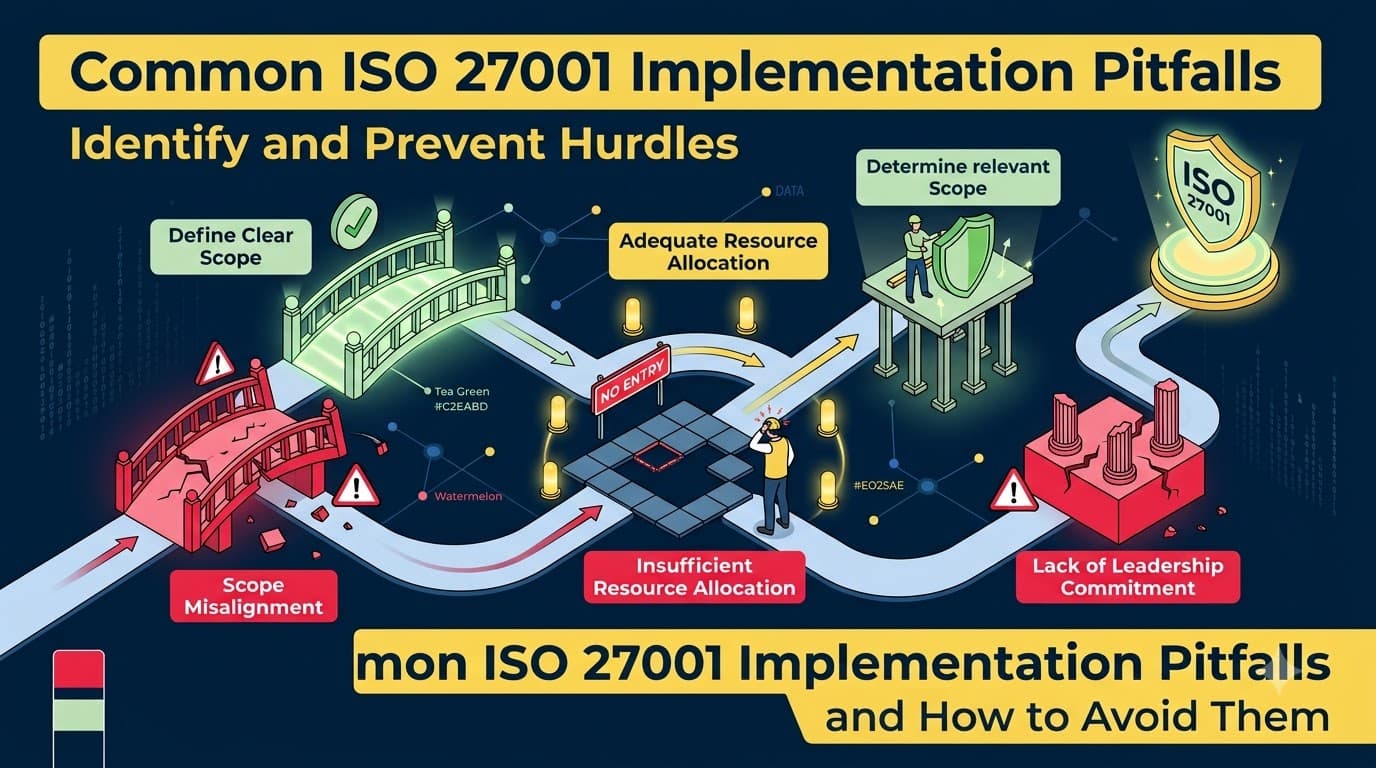
The $2.1 Million Lesson at Castellan Precision Parts
Derek Voss had been VP of IT at Castellan Precision Parts for six years when the board told him to "get ISO 27001 done" in nine months. A new automotive OEM customer had made certification a condition of a $2.1 million multi-year supply contract, and the sales team had already promised a certificate date to the customer's procurement office. Derek did what a lot of capable, overworked IT leaders do: he treated it as an IT project, gave it to his most senior sysadmin as a 20%-time side assignment, bought a GRC tool because a LinkedIn ad promised it would "automate 80% of compliance," and downloaded a bundle of policy templates from a forum.
Four months in, the sysadmin had produced forty-one polished-looking documents, none of which anyone outside IT had read, let alone followed. Manufacturing supervisors didn't know an ISMS existed. HR had never heard of the screening control. The risk register listed "server room flooding" as the top risk for a company whose real exposure was a decade-old ERP system with no patch management and three ex-employees who still had VPN credentials. Six weeks before the promised certificate date, Derek's consultant (hired in a panic) ran a readiness assessment and delivered the news: zero months of operating evidence existed for controls that require ongoing records, the scope statement excluded the contract manufacturing site where the OEM's parts were actually made, and nobody had told the board that Clause 5 leadership commitment is a certification requirement, not a courtesy.
Castellan didn't lose the contract — but only because Derek's team spent the next five months re-scoping the ISMS to include the plant that mattered, building three months of genuine operating evidence, running a proper management review, and delaying the Stage 2 audit by 20 weeks. The OEM accepted a revised date after a tense conversation, but the original $2.1 million contract carried a penalty clause for missed certification milestones, and Castellan ate roughly $310,000 in penalty exposure, rework, and a second round of consulting fees it wouldn't have needed with a properly run project from day one. Every mistake in that story is avoidable, and none of them were about risk methodology or a failed audit — they were project-management and leadership failures, and they are the most common reason ISO 27001 implementations run over budget, miss dates, or collapse outright.
This article is about those failures specifically. If you want the risk-assessment side of things — how organizations get likelihood, impact, and risk acceptance criteria wrong — that's covered in common ISO 27001 risk assessment mistakes. If you want to know what auditors write up once you're already certified or mid-audit, that's common ISO 27001 nonconformities and how to address them. This article sits earlier and wider than both: it's about how the project itself goes wrong — the scoping decisions, the governance gaps, the documentation sprawl, the people who never got brought along — long before an auditor ever shows up. If any of the terminology in this article is unfamiliar, keep the ISO 27001 glossary of terms open in another tab as you read.
Who This Is For
This is for the project sponsor, program manager, CISO, or founder who has been handed (or has taken on) responsibility for getting an organization certified and wants to avoid the mistakes that turn a 6–12 month project into an 18-month, over-budget scramble. You'll walk away with fourteen named pitfalls organized into five themes — scope and leadership, project management, documentation and tooling, people and culture, and post-certification sustainability — each with why it happens, what it actually costs in time and money, and a concrete way to avoid it. You'll also get a pre-flight self-check, a look at how unaddressed pitfalls resurface as audit findings, and real patterns drawn from implementations that went sideways and the ones that didn't.
Theme One: Scope and Leadership Pitfalls
Nearly every derailed implementation I've reviewed traces back to one of two root causes, and both happen in the first thirty days, long before anyone writes a policy. The first is scope — getting the boundary of the ISMS wrong. The second is leadership — treating certification as an IT deliverable instead of a business commitment. Get these two right and the rest of the project has a fighting chance. Get them wrong and no amount of good documentation later will save you.
Pitfall 1: Wrong or Oversized Scope, and Scope Creep
Why it happens. Scoping decisions get made too early, by too few people, with too little information. A project sponsor either scopes too broadly ("let's certify the whole company, it's simpler to explain") to avoid a hard conversation about which business units matter, or too narrowly, excluding a system, site, or product line that customers actually care about because it's inconvenient or embarrassing to include. Scope creep compounds this mid-project: a new acquisition gets folded in without re-planning, or a well-meaning committee decides "while we're at it" to add a business unit that was never part of the original business case.
What it costs. Oversized scope multiplies the number of assets, processes, and control implementations you must document and evidence — often by 3–5x — without adding anything the customer driving the certification decision actually asked for. I've seen 40-person companies try to scope in five subsidiaries and two dormant product lines because "consistency," burning four extra months and tens of thousands of dollars in consulting hours for zero commercial benefit. Undersized scope is worse in a different way: it produces a certificate that doesn't cover what customers care about, which surfaces later as a sales-cycle problem or, worse, a contractual breach.
How to avoid it. Scope should be a business decision made once, deliberately, with the sales and customer-success functions in the room, not just IT. Map scope to what your customers, contracts, and regulators actually require, document the boundary in a formal scope statement, and treat any proposed change to it as a change-controlled decision requiring sponsor sign-off — not an afterthought. For the mechanics of doing this well, see defining the scope of your ISMS.
Pitfall 2: No Genuine Leadership Buy-In — Treating It as an IT-Only Project
Why it happens. Certification gets initiated by IT or security because that's who first heard "customers want this," and it never gets reframed as an organizational commitment. Executives sign a kickoff email and then vanish. Clause 5 of ISO 27001 explicitly requires top management to demonstrate leadership and commitment — not delegate it — but in practice this is the single most under-resourced requirement I encounter, because it's the one that costs executives their own time rather than budget.
What it costs. Without visible sponsorship, every cross-departmental ask — HR screening changes, finance approving new tooling, facilities updating badge processes — becomes a negotiation IT has no authority to win. Projects stall for months waiting on decisions only an executive can make. I've watched a 60-person SaaS company lose eleven weeks because the person "running" the ISMS had no authority to require engineering to follow a change-management process, and engineering simply didn't, until the CEO personally stepped in after the second missed internal deadline.
How to avoid it. Leadership buy-in has to be structural, not ceremonial: a named executive sponsor with actual budget and org authority, a recurring (not one-off) management review cadence from month one, and information security objectives that show up in the same planning cycle as revenue and hiring targets. For the full requirement set, see ISO 27001 Clause 5: Leadership and Management Commitment Requirements.
"The projects that finish on time are the ones where the CEO can tell me, unprompted, what the ISMS scope is and why. The projects that stall are the ones where the CEO thinks 'the IT guy is handling that.'" — Elena Rojas, CISO, BrightPath Financial
Pitfall 3: Certifying a Scope That Doesn't Match What Customers Actually Care About
Why it happens. This is scope's evil twin, and it deserves its own entry because it's a different failure mode: the scope statement is technically defensible but commercially useless. A company scopes in its corporate headquarters and excludes the product the customer actually buys, or certifies "the information security management system supporting cloud operations" while the customer's due-diligence questionnaire asks specifically about the on-prem data center where their records are hosted.
What it costs. The certificate exists, the audit passed, and the sales team still can't use it — because the first thing a sophisticated buyer's security team does is check the Statement of Applicability and scope statement against what they're actually buying. I've seen renewal conversations stall for eight weeks while a vendor scrambled to explain why their certificate didn't cover the product line in the contract.
How to avoid it. Before finalizing scope, get the customer-facing team (sales engineering, customer success, or a designated account team) to list the top five questions enterprise customers ask in security questionnaires, and make sure the scope statement answers them directly. Revisit this any time the product portfolio changes materially.
Theme 1 pitfall summary
Pitfall | Why It Happens | Typical Cost | How to Avoid |
|---|---|---|---|
Wrong/oversized scope & scope creep | Early, narrow decision-making; uncontrolled additions mid-project | 3–5x documentation and evidence effort; months of delay | Business-driven scope statement, sponsor sign-off, formal change control on scope |
No genuine leadership buy-in | Certification initiated by IT, executives delegate and disengage | Cross-departmental stalls of 6–12 weeks per blocked decision | Named executive sponsor with authority; recurring management review from month one |
Scope mismatched to customer expectations | Scope decided without sales/customer input | Certificate that can't be used commercially; renewal-cycle scrambles | Validate scope against real customer questionnaires before finalizing |
Theme Two: Project Management Pitfalls
Assuming scope and leadership are right, the next failure zone is how the project is actually run day to day. ISO 27001 implementations fail for the same reasons any cross-functional, multi-quarter initiative fails: no plan, no realistic budget, an all-or-nothing rollout strategy, and a governance model that quietly outsources thinking to a third party.
Pitfall 4: Poor Project Management — No Plan, No Owner, No Milestones
Why it happens. Because ISO 27001 doesn't look like a normal software or infrastructure project, organizations sometimes skip normal project discipline for it — no project charter, no named owner accountable for the calendar, no milestone dates tied to specific deliverables. It becomes a rolling list of "things we should get to."
What it costs. Projects without milestones don't fail dramatically; they just never finish. I've inherited implementations that had been "80% done" for fourteen months, because nobody could say what the remaining 20% actually was. The soft cost is worse than the obvious one: momentum and executive patience are finite, and a project with no visible progress loses its budget line before it loses its deadline.
How to avoid it. Run it like any other cross-functional program: a named project owner (not necessarily the ISMS owner long-term), a RACI across departments, dated milestones tied to the roadmap phases — gap analysis, risk assessment, control implementation, internal audit, management review, Stage 1, Stage 2 — and a steering committee that meets on a fixed cadence. The phase structure is laid out in the ISO 27001 implementation roadmap, and role design is covered in building an ISO 27001 project team.
Pitfall 5: Underestimating Effort and Cost
Why it happens. Early budget estimates get anchored to whatever number made the business case sound easy to approve, usually pulled from a vendor's marketing page rather than a realistic accounting of internal labor, consulting fees, tooling, and — critically — the opportunity cost of pulling skilled staff off other work for months.
What it costs. Underestimating effort doesn't just blow the budget; it creates a credibility problem that makes every subsequent budget ask harder. I've seen initial estimates of "$15,000 and three months" balloon to $95,000 and eleven months for a 70-person company, not because the standard demanded more, but because nobody had budgeted for internal labor hours, a second consulting engagement after the first one under-delivered, or the GRC tool's implementation and training costs.
How to avoid it. Build the budget from the roadmap phases outward, include internal labor at a realistic hourly cost, add a 20–30% contingency, and separate one-time certification costs from ongoing annual costs (surveillance audits, tool subscriptions, recertification). A realistic breakdown is in ISO 27001 implementation costs: a realistic budget breakdown, and current market timelines are in how long does ISO 27001 certification take.
"Every client who tells me they budgeted six figures under what I'd expect has done the same thing: priced the certificate, not the program. The certificate is a formality. The program is a year of behavior change across every department." — Marcus Webb, Founder, Webb Compliance Partners
Pitfall 6: Big-Bang Instead of Phased Rollout
Why it happens. Under deadline pressure, teams try to implement all 93 Annex A controls, write every mandatory document, and roll changes out to every department simultaneously, on the theory that parallel work saves time.
What it costs. Big-bang rollouts create simultaneous change fatigue across every team at once, overwhelm the small group actually capable of reviewing and approving documents, and — most damagingly — compress the operating-evidence period to nearly zero, because controls that were only implemented last week can't yet produce three months of logs, tickets, or review records. I watched a 45-person fintech attempt to implement everything in six weeks flat; the internal audit two months later found nine of fourteen sampled controls had no evidence trail because they'd been "turned on" too recently to have produced any.
How to avoid it. Phase the rollout: foundational governance and policy first, then high-risk technical controls, then lower-priority organizational controls, staggered so that operating evidence starts accumulating on early-phase controls while later phases are still being built. This is the same phasing logic behind the roadmap referenced above, and it's especially important for ISO 27001 for startups and ISO 27001 for small businesses, where headcount makes parallel work physically impossible.
Pitfall 7: No Internal Ownership — Over-Reliance on a Consultant
Why it happens. A consultant is hired to "get us certified," and because they're capable and fast, the internal team lets them make every decision, write every document, and hold every piece of institutional knowledge. It feels efficient in the moment.
What it costs. The certificate gets issued, the consultant's engagement ends, and the organization discovers it doesn't actually understand its own ISMS. Internal audits get skipped because nobody internal knows how to run one. Management reviews become a formality because nobody internal can speak to risk status. At the first surveillance audit, twelve months later, the auditor asks a control owner a basic question about their own control and gets a blank stare, because the consultant answered those questions the first time and then left.
How to avoid it. A consultant should build capability, not dependency: pair every consultant deliverable with an internal owner who reviews and eventually maintains it, require internal staff to run at least the second half of internal audits solo, and negotiate the consulting contract around a defined handoff, not just a certificate date. The trade-offs of each model are covered in outsourcing ISO 27001 implementation: consultant vs in-house approach.
Theme 2 pitfall summary
Pitfall | Why It Happens | Typical Cost | How to Avoid |
|---|---|---|---|
Poor project management | No charter, owner, or milestones | Projects stall indefinitely at "80% done" | Named owner, RACI, dated phase milestones, steering committee |
Underestimating effort & cost | Budget anchored to marketing numbers, not internal labor | 2–4x initial budget; credibility damage on re-asks | Phase-based budget with internal labor + 20–30% contingency |
Big-bang rollout | Deadline pressure, belief parallel work saves time | Near-zero operating evidence at audit time | Phased rollout: governance first, high-risk controls next, evidence accrues in parallel |
Over-reliance on consultant | Consultant is fast and capable; feels efficient | Blank-stare surveillance audits; no internal capability post-cert | Pair every deliverable with an internal owner; define handoff in the contract |
Theme Three: Documentation and Tooling Pitfalls
Once scope and governance are sound, the next place implementations go wrong is in how documentation and tools get produced and used. This theme covers four related traps: copying generic templates without adapting them, drowning the organization in unnecessary paperwork, mistaking a software purchase for a finished ISMS, and — the single most common cause of failed audits I encounter — starting the clock on evidence far too late.
Pitfall 8: Copy-Paste Generic Documents
Why it happens. Under time pressure, teams download a policy pack, change the logo and company name, and call it done. It's the fastest way to produce forty documents in a week, and it looks complete on a document-management dashboard.
What it costs. Generic documents describe a fictional organization. A password policy references a directory service the company doesn't use; an incident response plan lists a severity matrix nobody has ever tested; a supplier security policy describes a vendor risk process that doesn't match how procurement actually works. Auditors notice within minutes, because the language doesn't match how staff describe their own jobs in interviews — and staff can't follow a document that doesn't reflect reality, so it gets ignored, which produces exactly the compliance-vs-reality gap that internal audits and certification audits exist to catch.
How to avoid it. Use templates as a starting structure, not a finished product — every document needs a genuine review pass by the person who will actually operate the process it describes, with organization-specific system names, role titles, thresholds, and tools. Templates are a legitimate accelerator; unedited templates are a liability. See ISO 27001 documentation templates: what to include and how to customize and writing an effective information security policy.
Pitfall 9: Over-Documentation and Bureaucracy
Why it happens. This is copy-paste's opposite failure mode, and it's just as damaging: a well-meaning team, worried about missing something, documents everything to an exhausting level of granularity — forty-page policies, five-level approval workflows for routine changes, and procedures nobody can realistically follow day to day. It often comes from over-interpreting "documented information" as "document everything," or from a consultant billing by the deliverable.
What it costs. Bureaucratic ISMSs get abandoned by the people who are supposed to run them. I've seen a change-management procedure so heavy that engineers routed around it entirely within two months of go-live, which is a far worse audit finding than having a leaner process that's actually followed. Over-documentation also multiplies the maintenance burden: every process change now requires updating a dozen cross-referenced documents instead of one.
How to avoid it. Match documentation depth to actual organizational complexity and risk, not to a template's page count. ISO 27001 requires documented information appropriate to the size and complexity of the organization — a 20-person company does not need the same procedural depth as a 2,000-person one. Favor short, usable documents that people actually read over comprehensive ones that get filed and forgotten. Reference the real mandatory list rather than guessing: ISO 27001 mandatory documents: the complete checklist.
"I ask every new client the same question in week one: 'Could a new hire follow this document without asking anyone for help?' If the answer is no, it's too long, too vague, or both — and it's not going to be followed, template or not." — Sana Idris, Head of GRC, Northfield Biotech
Pitfall 10: Treating the Tool as the Solution
Why it happens. GRC platforms are sold with language that implies the software itself produces compliance — dashboards, automated evidence collection, pre-built control libraries. Buyers reasonably infer that purchasing the tool gets most of the work done, especially when the sales demo shows a fully populated instance.
What it costs. A GRC tool with default control templates and no organizational customization behind it produces exactly the same generic-document problem as pitfall 8, just inside software instead of on paper. Worse, teams sometimes stop doing the underlying work — real risk assessment, real control implementation, real evidence generation — because the tool's dashboard shows green checkmarks that reflect configuration, not operating reality. I've seen a company present a beautifully organized GRC instance to an auditor, full of unanswered evidence-upload prompts and controls marked "implemented" with zero attached files.
How to avoid it. Choose and configure a tool to support a real ISMS, not to replace one — it should make evidence collection, control ownership tracking, and audit prep easier, not automate away the actual work of risk treatment and control operation. Decide deliberately whether you need one at all before buying; plenty of organizations, especially early-stage ones, certify successfully on well-organized spreadsheets and shared drives. See ISO 27001 software and GRC tools: do you need one?
Pitfall 11: Underestimating the Operating-Evidence Period — Rushing to Audit With No Records
Why it happens. Teams treat "writing the documents" and "implementing the controls" as the finish line, not realizing that Stage 2 auditors are sampling for evidence that controls have actually been operating — access reviews performed, logs monitored, incidents logged, training completed — over a meaningful stretch of time, not merely that a policy exists describing what should happen.
What it costs. This is, in my experience, the single most common reason a Stage 2 audit gets delayed or fails outright. A company can have perfect documentation and still fail because a control that went live three weeks before the audit can't produce quarterly access review records, or a training program that launched last month can't show completion evidence for the required population. I've had to tell more than one client, six weeks out from a scheduled Stage 2 date, that the date has to move — not because anything is broken, but because three months of records simply don't exist yet and cannot be manufactured retroactively with any integrity.
How to avoid it. Build the operating-evidence period into the project timeline as its own phase, not an afterthought — plan for a minimum of two to three months (many certification bodies and experienced consultants prefer three) of controls actually running, generating logs, tickets, meeting minutes, and review records, before scheduling Stage 2. Start the clock the moment a control goes live, and track evidence accumulation the same way you'd track any other project milestone. This dovetails directly with the phased-rollout discipline in pitfall 6: the earlier a control is implemented, the earlier its evidence clock starts.
Theme 3 pitfall summary
Pitfall | Why It Happens | Typical Cost | How to Avoid |
|---|---|---|---|
Copy-paste generic documents | Speed pressure; templates look complete | Documents ignored by staff; obvious mismatch in audit interviews | Genuine review and customization by the actual process owner |
Over-documentation / bureaucracy | Over-interpreting "documented information"; deliverable-billed consulting | Processes abandoned or routed around within weeks | Match depth to real complexity; favor short, usable documents |
Treating the tool as the solution | Marketing implies software = compliance | Green dashboards with no real evidence behind them | Configure tool to support real work, not replace it; decide if you need one at all |
Underestimating the operating-evidence period | Documentation mistaken for the finish line | Stage 2 delay or failure; unusable retroactive "evidence" | Plan a dedicated 2–3 month evidence-accrual phase before scheduling Stage 2 |
Theme Four: People and Culture Pitfalls
Documents and tools don't run an ISMS — people do. This theme covers the two pitfalls that show up when project teams optimize for paperwork and forget that controls are operated by employees who were never consulted, and that a management system is, at its core, an exercise in changing how people behave.
Pitfall 12: Not Involving the People Who Do the Work
Why it happens. Documentation and control design often get delegated to a small central team — IT, security, or a consultant — working in isolation, because it's faster to write a procedure than to interview the six departments who'll actually have to follow it. Nobody asks the warehouse supervisor how equipment actually gets decommissioned, or asks the support team how they actually handle a customer's data deletion request.
What it costs. Controls designed without the people who do the work describe a process that doesn't match reality, which produces two failure modes at once: the control isn't followed (because it's impractical), and morale takes a hit (because staff experience the ISMS as something imposed on them rather than built with them). I've seen a clear-desk policy written by IT that conflicted with how a regulated document-review team actually needed physical files on desks during audits — a completely avoidable conflict if anyone had asked the team first.
How to avoid it. Interview the actual process owners before finalizing any control or procedure that affects their work, pilot new procedures with the affected team before rolling them out organization-wide, and treat frontline pushback as a signal to redesign, not a compliance problem to override. This is especially important for controls with heavy day-to-day interaction, like access management and asset handling — see asset management under ISO 27001 and access control policy.
Pitfall 13: Ignoring Culture and Change Management
Why it happens. ISO 27001 gets treated as a paperwork and technical-control exercise, with no explicit plan for how behavior across the organization needs to change — new approval steps, new reporting obligations, new restrictions on tools and data handling. Change management is assumed to happen automatically once a policy is published.
What it costs. Policies without a change-management plan behind them generate silent non-compliance: people keep doing things the old way because nobody explained why the new way matters or made it easy to adopt. This is where security-awareness fatigue sets in — staff perceive the ISMS as a compliance tax rather than something that protects the business and, indirectly, their own jobs. I've seen a well-designed incident-reporting control fail for months simply because employees were never told, in plain language, that reporting a mistake would not get them in trouble — so mistakes went unreported, which is a training and culture gap, not a documentation gap.
How to avoid it. Treat the rollout of every significant control as a change-management exercise: explain the "why" before the "what," give people practice time before enforcement, identify and support departmental champions, and build psychological safety around incident reporting explicitly into training. This connects directly to a properly resourced awareness program — see ISO 27001 employee training program: building security awareness.
"You can mandate a policy. You cannot mandate a habit. The organizations that struggle post-certification are always the ones that skipped the six months of habit-building and went straight from 'policy published' to 'audit scheduled.'" — Tom Achebe, Internal Auditor, Meridian Freight Group
Theme 4 pitfall summary
Pitfall | Why It Happens | Typical Cost | How to Avoid |
|---|---|---|---|
Not involving the people who do the work | Central team designs controls in isolation for speed | Impractical procedures ignored in practice; morale damage | Interview process owners, pilot before rollout, treat pushback as design signal |
Ignoring culture & change management | Policy publication mistaken for behavior change | Silent non-compliance; under-reported incidents | Explain the "why," build habit time before enforcement, support champions |
Theme Five: Sustaining the ISMS After Certification
The final and most quietly expensive pitfall on this list doesn't happen during implementation at all — it happens the week after the certificate arrives.
Pitfall 14: Letting the ISMS Decay Right After Certification
Why it happens. Certification feels like the finish line, especially to the people who spent a year pushing toward it. The project team disbands, the steering committee stops meeting, the risk register stops getting updated, and internal audits get deprioritized because "we just proved we're fine." Nobody explicitly owns the ISMS once the project structure that built it goes away.
What it costs. ISO 27001 certification is maintained through annual surveillance audits and a three-year recertification cycle, and both assume the management system keeps operating, not that it merely existed for one audit window. Certificates get suspended or withdrawn when surveillance audits find an ISMS that's visibly stopped functioning — stale risk registers, skipped management reviews, no internal audit conducted in the intervening year. I've seen a certified company's surveillance audit turn into a major nonconformity investigation because the risk register hadn't been touched in eleven months and three of the "assigned" risk owners had left the company without replacement.
How to avoid it. Build sustainment into the original project plan, not as a future problem: a permanent (even if smaller) ISMS owner role, a fixed annual cadence for internal audits, management review, and risk register refresh, and an explicit transition plan from "project team" to "steady-state operations" before the certificate is even issued. What surveillance audits actually check is covered in ISO 27001 surveillance audits: what happens after certification, and the renewal cycle in ISO 27001 recertification: the 3-year renewal cycle explained.
Theme 5 pitfall summary
Pitfall | Why It Happens | Typical Cost | How to Avoid |
|---|---|---|---|
ISMS decay after certification | Project team disbands; certificate treated as finish line | Suspended certificates; major nonconformities at surveillance | Permanent ISMS owner, fixed annual cadence, transition plan built in before cert |
The Danger Map: Healthy Project vs. Derailed Project
The fourteen pitfalls above tend to cluster along two diverging paths from the same starting point. The diagram below traces both: the derailed path an under-resourced project typically follows, and the healthy path that avoids the same forks.
flowchart TD
    Start([Project Kickoff]) --> ScopeDecision{Who decides scope?}
    ScopeDecision -->|IT alone, fast decision| BadScope[Oversized or mismatched scope]
    ScopeDecision -->|Sponsor + sales + customer input| GoodScope[Business-aligned scope statement]

    BadScope --> NoSponsor[No real executive sponsor]
    GoodScope --> RealSponsor[Named sponsor, recurring mgmt review]

    NoSponsor --> BigBang[Big-bang rollout under deadline pressure]
    RealSponsor --> Phased[Phased rollout with milestone plan]

    BigBang --> GenericDocs[Copy-paste docs, no process-owner review]
    Phased --> CustomDocs[Customized docs reviewed by process owners]

    GenericDocs --> NoEvidence[Rushed to audit: no operating evidence]
    CustomDocs --> EvidenceBuilds[2-3 month evidence-accrual phase]

    NoEvidence --> StagedFail[Stage 2 delay, failed audit, or major nonconformity]
    EvidenceBuilds --> AuditReady[Audit-ready with genuine records]

    StagedFail --> Scramble[Panic remediation, budget overrun]
    AuditReady --> Certified[Certification achieved]

    Scramble -.->|Eventually, at higher cost| Certified
    Certified --> Decay{ISMS owner after cert?}
    Decay -->|Project team disbands| Neglect[Stale risk register, skipped reviews]
    Decay -->|Steady-state owner assigned| Sustained[Surveillance audits pass cleanly]

    Neglect --> Suspended[Certificate suspended or major NC]
    Sustained --> Renewed[Clean 3-year recertification]
Pre-Flight Self-Check: Before You Kick Off
Run this checklist with your steering committee before you commit to a certification date. Every "no" is a pitfall waiting to happen.
# | Question | Yes/No | Related Pitfall |
|---|---|---|---|
1 | Has scope been validated against actual customer/contractual requirements, not just internal convenience? | Wrong/oversized scope | |
2 | Does a named executive sponsor attend steering meetings and have budget authority? | No leadership buy-in | |
3 | Would the sales/customer-success team recognize the scope statement as matching what customers ask about? | Scope mismatch | |
4 | Is there a written project plan with phase milestones and a named owner? | Poor project management | |
5 | Does the budget include internal labor hours and a 20–30% contingency? | Underestimating cost | |
6 | Is the rollout phased, with early controls going live months before Stage 2? | Big-bang rollout | |
7 | Does every consultant deliverable have a named internal owner reviewing it? | Over-reliance on consultant | |
8 | Has every template document been edited to reflect actual systems, roles, and thresholds? | Copy-paste documents | |
9 | Could a new hire follow each key procedure without asking for help? | Over-documentation | |
10 | Is the GRC tool (if any) configured with real evidence, not just default checklists? | Tool as solution | |
11 | Is a 2–3 month operating-evidence period built into the schedule before Stage 2? | No operating evidence | |
12 | Were frontline process owners interviewed before controls affecting their work were finalized? | People not involved | |
13 | Is there an explicit change-management/communication plan for each major new control? | Ignoring culture | |
14 | Is there a named steady-state ISMS owner and annual cadence planned before the certificate is issued? | Post-cert decay |
How These Project Pitfalls Show Up Later as Audit Findings
None of these fourteen pitfalls are audit findings in themselves — they're upstream project failures. But left unaddressed, every one of them eventually surfaces as a documented nonconformity, because auditors are, in effect, testing whether the project was run well. The table below maps the connection, so you can see why fixing the project prevents the finding rather than just reacting to it later.
Project Pitfall | How It Typically Surfaces at Audit |
|---|---|
Oversized/mismatched scope | Auditor questions why scope excludes a system central to the business, or SoA doesn't match actual operations |
No leadership buy-in | Clause 5 nonconformity: management review lacks substance, or leadership can't articulate objectives in interview |
Big-bang rollout | Insufficient evidence for recently implemented controls; sampling reveals gaps in records |
Copy-paste documents | Interview answers contradict documented procedures; staff describe a different process than what's written |
Over-documentation | Evidence of non-adherence to the organization's own overly complex procedures |
No operating evidence | Major nonconformity or Stage 2 delay for lack of records demonstrating the control is operating |
Not involving frontline staff | Interview sampling reveals staff unaware of procedures that affect their own roles |
Post-cert decay | Surveillance audit finds stale risk register, skipped management reviews, lapsed internal audit program |
For the full catalog of what auditors actually write up and how severity is classified, see common ISO 27001 nonconformities and how to address them, and for a clause-by-clause and control-by-control preparation resource, see ISO 27001 audit checklist: preparing for every clause and control.
Case Studies
Case Study 1: Castellan Precision Parts — Recovering From a Near-Miss
As described in the opening, Castellan Precision Parts initially treated certification as an IT side project with no executive sponsor, a scope that excluded the plant the customer actually cared about, and zero operating evidence six weeks before the promised Stage 2 date. The recovery plan, once Derek Voss escalated to the board, followed the exact corrective path this article recommends: the CEO became named sponsor and attended biweekly steering meetings; scope was revised to include the contract manufacturing site; the rollout was re-sequenced so foundational controls (access management, asset inventory, incident reporting) went live first and accrued evidence for 14 weeks before Stage 2 was rescheduled. Total delay: 20 weeks. Total additional cost: approximately $310,000 in penalty exposure, rework, and a second consulting engagement. Castellan passed Stage 2 on the revised date with zero major nonconformities and two minor ones related to supplier agreement documentation — both closed within 30 days.
Case Study 2: Loopline Analytics — From Big-Bang Failure to Phased Success
Loopline Analytics, a 55-person SaaS analytics company, attempted to implement all Annex A controls in a single six-week sprint ahead of a self-imposed Series B due-diligence deadline. The internal audit, conducted eight weeks later, found nine of fourteen sampled controls had no usable evidence trail — access reviews had been "started" but never completed, and the incident-management process had zero logged incidents despite three known production issues that were handled informally over Slack instead. Rather than push forward to Stage 2 on the original schedule, Loopline's new VP of Engineering (who took over ISMS ownership from the founder) restructured the remaining work into three phases over four months: governance and access controls first, technical controls second, supplier and physical controls third, with a dedicated 10-week evidence-accrual window built in before scheduling Stage 2. Loopline passed Stage 2 with one minor nonconformity (a supplier risk assessment template not yet applied to two newer vendors) — a dramatically better outcome than the near-certain major nonconformities the original six-week plan was heading toward.
Case Study 3: Solvex Health Analytics — The Cost of Post-Certification Decay
Solvex Health Analytics certified successfully in its first attempt, with a well-run project and genuine leadership involvement. The failure came fourteen months later. The project steering committee had disbanded at certification, the risk register owner left the company in month three post-cert and was never replaced, and no internal audit was conducted in the following year because "the certificate was still valid." The first surveillance audit found a risk register last updated ten months prior, two of five documented risk owners no longer employed there, and no evidence of a management review having occurred since certification. The certification body issued a major nonconformity with a 90-day corrective action window and a follow-up audit requirement, adding an estimated $22,000 in unplanned audit and consulting fees and creating real risk of certificate suspension had the corrective actions not been completed on time. Solvex now maintains a permanent 0.25 FTE ISMS coordinator role specifically to prevent recurrence.
"The surveillance audit isn't a formality — it's the moment we find out whether the ISMS you built a year ago is still alive. I've suspended certificates over exactly this: a risk register nobody touched in ten months." — Callum Reyes, Lead Auditor, TrustMark Assurance
"The best-run implementations I've been part of had one thing in common that has nothing to do with security expertise: a program manager who treated milestones as sacred, the way they would on any other cross-functional launch." — Priya Nandakumar, ISMS Program Director, Solvex Health Analytics
What It Costs to Ignore These Pitfalls vs. What It Costs to Prevent Them
Every pitfall in this article is cheaper to prevent than to fix after the fact — often by a wide margin. The figures below are illustrative, drawn from patterns across the mid-market implementations I've been part of, not a formal industry study, but the ratio holds up consistently: prevention runs a fraction of the cost of remediation, and remediation almost always includes a schedule delay that prevention avoids entirely.
Pitfall | Illustrative Prevention Cost | Illustrative Cost If Uncaught | Typical Delay If Uncaught |
|---|---|---|---|
Oversized/mismatched scope | A half-day scoping workshop with sponsor + sales | Months of extra documentation, or a certificate customers can't use | 8–16 weeks |
No leadership buy-in | Executive time: 2–3 hours/month in steering meetings | Cross-departmental stalls, re-negotiated deadlines | 6–12 weeks per stall |
Big-bang rollout | Phased project plan (planning time only) | Failed Stage 2 due to missing evidence | 8–20 weeks |
Copy-paste documents | Process-owner review pass on each document | Interview contradictions, non-conformities, re-work | 4–8 weeks |
No operating evidence | Building a 2–3 month evidence phase into the schedule | Stage 2 postponement or major nonconformity | 12–20 weeks |
Post-cert decay | 0.1–0.25 FTE steady-state ISMS owner | Major nonconformity, certificate suspension risk | 8–12 weeks plus follow-up audit |
Putting It Together: A Phased Defense Against All Fourteen Pitfalls
No single fix addresses all fourteen pitfalls, but a well-sequenced project plan closes off most of them by design, simply because the sequence forces the right conversations at the right time. In practice, that looks like: a scoping workshop in week one that includes sales and an executive sponsor (closing pitfalls 1, 2, and 3 simultaneously); a written project charter with phased milestones before any control work begins (closing pitfalls 4 and 6); a realistic, contingency-padded budget presented alongside the charter (closing pitfall 5); a documentation review gate that requires the actual process owner's sign-off before any policy is considered final (closing pitfalls 8, 9, and 12); a deliberate decision on tooling made after the control framework is understood, not before (closing pitfall 10); a built-in evidence-accrual phase with a hard floor of two to three months before Stage 2 is scheduled (closing pitfall 11); a communication and training plan attached to every major control rollout (closing pitfall 13); and a named steady-state owner and annual calendar agreed before the certificate is even issued (closing pitfall 14). None of this is exotic project management — it's the same discipline any competent program manager would bring to a comparable cross-functional initiative. The implementation roadmap lays out this sequence phase by phase, and the gap analysis that should kick it off tells you honestly where you're starting from before you commit to a date.
When You're Also Pursuing SOC 2
Organizations chasing enterprise deals in North America frequently pursue ISO 27001 and SOC 2 around the same time, and the project pitfalls in this article don't discriminate by framework — a scope that's wrong for ISO 27001 is usually wrong for a SOC 2 Type II audit period too, and an ISMS that decays after ISO 27001 certification tends to let SOC 2 evidence collection lapse in parallel, since both frameworks lean on the same underlying control operation and evidence trail. If you're running both simultaneously, resist the temptation to build two separate evidence-collection processes; a shared control-and-evidence structure, mapped once to both frameworks' requirements, avoids duplicating the exact project-management failures — no owner, no plan, no realistic timeline — that this article is about. Teams evaluating SOC 2 readiness alongside ISO 27001 generally find the scoping and evidence-period lessons transfer directly.
Governance That Prevents Most of These Pitfalls at Once
A surprising number of the fourteen pitfalls above trace back to a single missing ingredient: a governance structure that makes someone clearly, unambiguously accountable for each decision. Projects that drift into scope creep, big-bang rollouts, or documentation sprawl almost always have a governance gap underneath — a RACI that was never written down, or was written down and then ignored once deadline pressure hit. Building this structure is cheap relative to everything downstream of getting it wrong, and it does double duty: it prevents pitfalls during implementation and it's exactly the structure a steady-state ISMS needs after certification, which means you're not building it twice.
Decision or Activity | Recommended Owner | Recommended Approver | Common Failure Pattern When Skipped |
|---|---|---|---|
ISMS scope statement | Project owner, drafted with sales/customer input | Executive sponsor | Scope decided by IT alone, excludes what customers care about |
Overall project plan and milestones | Project owner / program manager | Steering committee | No dated milestones; project drifts indefinitely |
Budget and contingency | Project owner, with finance | Executive sponsor | Budget anchored to vendor marketing, no internal labor costed |
Policy and procedure content | Actual process owner (not IT alone) | ISMS owner / project owner | Copy-paste templates never reviewed by the people who use them |
Risk register and risk owners | Risk owners (department leads) | ISMS owner | Risk owners never assigned, or assigned and never told |
Control implementation sequencing | Project owner, technical leads | Steering committee | Big-bang rollout under deadline pressure |
GRC tool selection and configuration | ISMS owner / project owner | Executive sponsor (budget) | Tool purchased before control framework is understood |
Internal audit program | Internal auditor (independent of what's audited) | ISMS owner | Skipped or superficial internal audits pre- and post-cert |
Management review | Executive sponsor / top management | N/A (top management is the approver) | Treated as a formality; no real decisions made |
Steady-state ISMS ownership post-cert | Named permanent owner (0.1–0.5 FTE depending on size) | Executive sponsor | Project team disbands, nobody owns the ISMS |
This maps directly onto the role design covered in building an ISO 27001 project team: roles and governance — that article goes deeper on how to staff each of these roles depending on organization size, and how the same governance structure should evolve from project mode into steady-state operation rather than being rebuilt from scratch after certification.
Red Flags by Project Phase
Because most of these pitfalls are visible well before they cause damage, it helps to know what to watch for at each stage of the project rather than discovering the problem in a failed audit. The table below is a practical early-warning system — if you recognize two or more red flags in your current phase, stop and address them before moving to the next one.
Project Phase | Red Flag | Pitfall It Signals |
|---|---|---|
Kickoff (weeks 1–4) | Scope decided in a single meeting with no sales/customer input | Wrong/oversized scope |
Kickoff (weeks 1–4) | Executive sponsor doesn't attend the kickoff meeting in person | No leadership buy-in |
Planning (weeks 4–8) | No written project plan exists beyond a vague target date | Poor project management |
Planning (weeks 4–8) | Budget was set before any gap analysis was performed | Underestimating cost |
Early implementation (months 2–4) | Policies are being finalized faster than department leads can review them | Copy-paste documents |
Early implementation (months 2–4) | All 93 controls are "in progress" simultaneously with no sequencing | Big-bang rollout |
Mid-implementation (months 4–7) | Frontline staff say they've never heard of the ISMS | Not involving the people who do the work |
Mid-implementation (months 4–7) | Consultant is making decisions no internal staff member could explain afterward | Over-reliance on consultant |
Pre-audit (months 6–9) | Stage 2 date was set before checking how long controls have been live | Underestimating operating-evidence period |
Pre-audit (months 6–9) | Internal audit finds documented procedures nobody follows in practice | Over-documentation or copy-paste documents |
Post-certification (month 12+) | Steering committee stopped meeting the month the certificate arrived | ISMS decay after certification |
Post-certification (month 12+) | Risk register hasn't been updated since the Stage 2 audit | ISMS decay after certification |
Pitfalls by Organization Size
Not every pitfall carries the same weight at every headcount. A 15-person startup and a 2,000-person enterprise both face all fourteen pitfalls in principle, but the ones most likely to actually bite — and the resourcing needed to prevent them — differ enough to be worth calling out separately when you're planning your own project.
Organization Size | Pitfalls Most Likely to Bite | Pitfalls Least Likely to Bite | Resourcing Note |
|---|---|---|---|
Under 25 employees | Underestimating cost/effort; over-reliance on a consultant (little internal bandwidth to build capability in parallel) | Over-documentation (small teams rarely over-build bureaucracy); big-bang rollout (fewer systems to sequence) | Executive sponsor is often also the ISMS owner — fine, as long as the role is explicit |
25–150 employees | Big-bang rollout; not involving frontline staff; scope creep as departments lobby to be included or excluded | Post-cert decay is less common here if the same small team stays engaged, but ownership must still be named explicitly | This is the range where a dedicated (even part-time) project owner matters most |
150–750 employees | Poor project management (too many moving parts for informal coordination); over-documentation; ignoring culture/change management across multiple departments | Underestimating cost is less common; budgets are usually formally reviewed | Needs a real steering committee, not just a sponsor and an owner |
750+ employees | Post-cert decay (large organizations lose track of ownership as reorganizations happen); scope mismatch across business units; copy-paste documents at subsidiary/regional level | Underestimating cost (typically over-budgeted, if anything) | Governance structure needs to survive personnel turnover and org changes; document ownership transitions explicitly |
For organization-specific playbooks at the smaller end of this spectrum, see ISO 27001 for startups: a lean implementation approach and ISO 27001 for small businesses: simplified implementation strategy.
The Recovery Playbook: What to Do If You Recognize These Patterns Already
If you're reading this mid-project and recognizing two or three of these pitfalls already in motion, the good news from both the Castellan and Loopline case studies above is that recovery is possible without abandoning the project — but it requires the same discipline the original plan should have had, applied now under more time pressure. The playbook that worked in both cases follows a consistent sequence.
Step | Action | Why It Comes in This Order |
|---|---|---|
1 | Escalate honestly to the executive sponsor (or find one if none exists) | Nothing else below is possible without real authority behind it |
2 | Freeze the certification date; do not let a bad date drive further bad decisions | A fixed audit date under a broken project just compounds the original pitfalls |
3 | Re-validate scope against actual customer/contract requirements | Cheapest fix to make early; expensive to discover after Stage 2 |
4 | Sequence remaining control work into phases, prioritizing controls that need the longest evidence-accrual runway | Evidence lag is usually the single biggest constraint on a revised timeline |
5 | Assign a realistic re-audit date only after confirming 2–3 months of evidence will exist for sampled controls | This is the date that actually holds, unlike the original one |
6 | Name a permanent steady-state owner as part of the recovery plan, not after re-certification | Prevents the same recovery cycle from repeating after the next audit |
Both Castellan and Loopline recovered within a single fiscal quarter of extra runway once this sequence was applied honestly — the expensive part in both cases wasn't the fix itself, it was the delay in admitting the original plan wasn't working. The earlier that admission happens, the cheaper the recovery.
The Strategic Reframe: A Well-Run Project Is a Sales Asset, Not Just a Compliance Cost
Every pitfall in this article shares a common thread: they all treat certification as a box to check rather than a capability to build. That framing is exactly backwards, and it's the reason so many projects run over budget and past deadline. The organizations that get the most commercial value out of ISO 27001 — shorter security-questionnaire cycles, faster procurement approval from enterprise customers, a genuine reduction in the frequency and severity of security incidents — are, without exception, the ones that ran the implementation as a real cross-functional program with a real sponsor, a real budget, and a real plan for what happens after the certificate arrives. Derek Voss at Castellan Precision Parts learned this the expensive way, but the lesson held: the second phase of that project, run with proper governance, cost less and moved faster than the first phase, run without it, despite covering more ground.
Avoiding these fourteen pitfalls isn't about lowering the bar or cutting corners on security — it's about applying the same program-management discipline to an ISMS that any competent leader would apply to a product launch, a system migration, or a market expansion. Scope it deliberately. Sponsor it visibly. Budget it honestly. Sequence it sensibly. Document it usably. Involve the people who do the work. Build the habit before the audit. Sustain it after the certificate. None of that is exotic, and none of it requires reinventing how your organization runs projects — it requires applying the same rigor to this one that you'd apply to any initiative the board actually cares about, because this is one the board actually cares about.
If you're at the point of deciding whether to start, or you've started and are now recognizing a few of these fourteen patterns in your own project, the fastest way to get unstuck is an honest, structured assessment of where you actually stand — not another generic template pack. PentesterWorld's ISO 27001 Gap Analysis Tool walks you through exactly that, control by control and clause by clause, and pairs naturally with a scoping conversation before you commit to a certification date. If you're earlier in the decision process and want to know whether your organization is genuinely ready to start, our "Is Your Organization ISO 27001 Ready?" quiz gives a fast, honest read in ten minutes. And if you want the full sequencing this article references throughout — phase by phase, from gap analysis through Stage 2 and into steady-state operation — The Complete ISO 27001 Implementation Guide eBook lays out the roadmap in the depth a single article can't. Before you set a Stage 2 date, run your project against our Certification Readiness Checklist and the Mandatory Documents Checklist — both catch several of the pitfalls above before an auditor ever does.
Recommended Resources by Pitfall Category
Pitfall Theme | Recommended PentesterWorld Resource | Why It Helps |
|---|---|---|
Scope & leadership | Gap Analysis Tool | Establishes an honest baseline before scope or budget commitments are made |
Scope & leadership | "Is Your Organization ISO 27001 Ready?" quiz | Fast readiness check before committing to a certification date |
Project management | The Complete ISO 27001 Implementation Guide eBook | Full phase-by-phase roadmap with milestone structure |
Documentation & tooling | ISO 27001 Mandatory Documents Checklist | Confirms document set matches actual requirement, not template bloat |
Documentation & tooling | Information Security Policy Template | Starting structure to customize rather than copy-paste wholesale |
Pre-audit readiness | Certification Readiness Checklist | Confirms operating-evidence period and audit prep before scheduling Stage 2 |