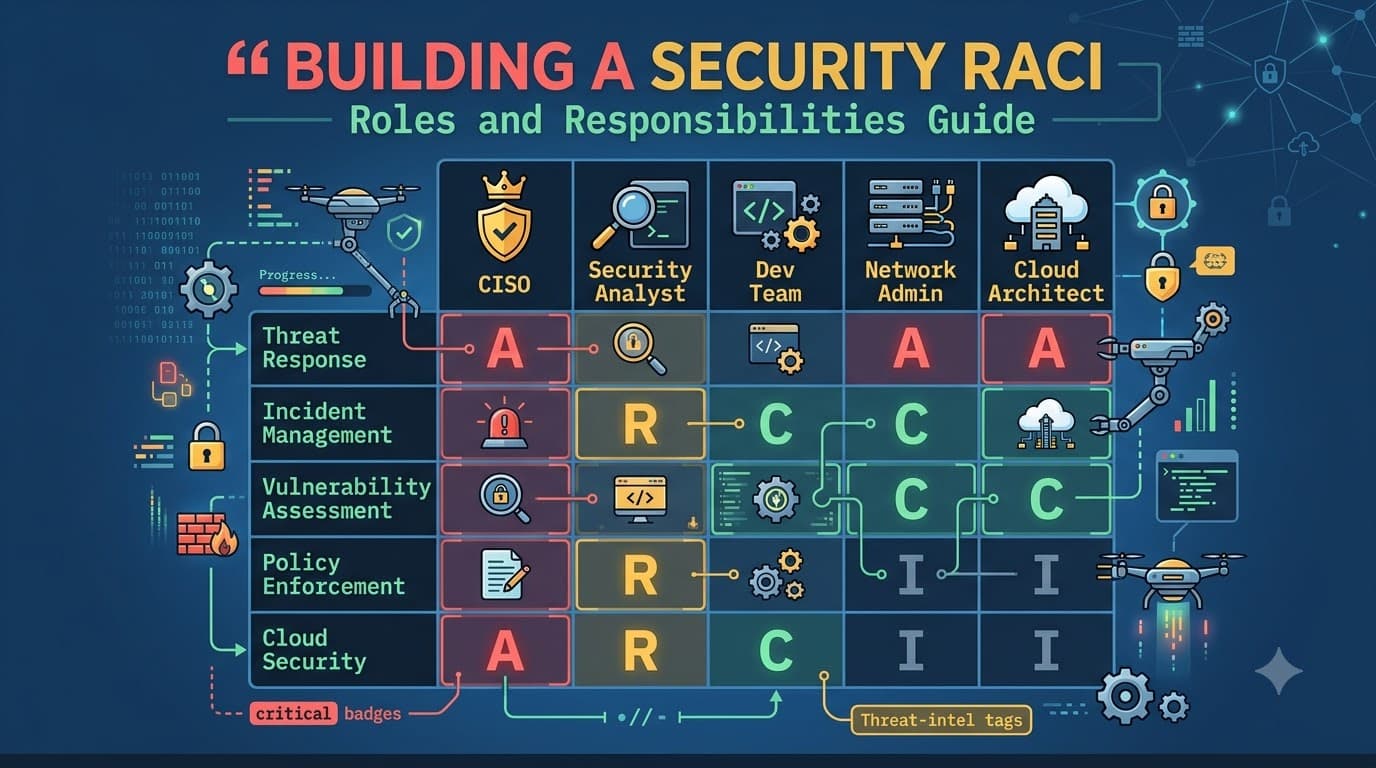
Dana Ferreira found out about the gap the way most ISMS managers do: after the invoice for the incident response retainer landed on her desk.
Dana ran the ISMS at Cartwell Maritime Systems, a 340-person software company that builds port-scheduling and cargo-tracking platforms for mid-size shipping operators. In February, a critical remote-code-execution vulnerability was disclosed in a logging library used across three of Cartwell's customer-facing services. The CVE had a 9.8 severity score. It sat unpatched for 97 days.
When the post-incident review finally happened — after an external actor had used that exact vulnerability to pivot into a staging environment that, against policy, contained a snapshot of production customer data — the timeline was almost comedic in its dysfunction. Cartwell's security team said patch prioritization was engineering's job once a ticket was filed; they'd filed the ticket on day two. Engineering said they were waiting on security to confirm the CVE actually applied to their specific library version and configuration, since two prior "critical" alerts had turned out to be false positives; that confirmation never came. Vendor management, meanwhile, believed the exposure was covered by a maned-detection clause in the SaaS security tooling contract and that the vendor would have flagged exploitation attempts automatically — which it did, 97 days later, the same day the exploit succeeded.
Three teams. Three people who each believed, sincerely, that someone else had the ball. Zero people who were accountable for making sure it got caught.
The final bill: $410,000. That figure covered digital forensics and incident response contractor fees, mandatory breach notification to 1,200 affected customer contacts across two states with differing notification-timeline requirements, six weeks of engineering time diverted from the roadmap, and — the part that actually got the board's attention — the loss of a $180,000-a-year enterprise renewal from a customer whose security team asked a very reasonable question during the post-incident call: "Who was supposed to catch this?" Cartwell didn't have a good answer.
Dana's ISMS had a policy that said vulnerabilities would be "assessed and remediated in a timely manner based on risk." It did not say who was accountable for that assessment happening, who was responsible for doing the patching, who needed to be consulted before a fix shipped to production, and who simply needed to be told once it was done. The policy was compliant with ISO 27001 in the sense that a document existed. It was useless in the sense that mattered: nobody could point to a name.
Six weeks after the incident, Dana built Cartwell's first real security RACI. It took her and two colleagues about eleven working hours spread over three weeks, mostly in facilitated workshops rather than solo drafting. The next technical vulnerability with a comparable severity score was remediated in six days, not ninety-seven — because for the first time, exactly one person was accountable for the decision to act, and exactly one team was responsible for the fix, and everyone else in the chain knew whether they were there to advise or just to be kept informed.
That's what this guide walks you through: not a theory of RACI, but a set of worked matrices you can adapt directly — for the ISMS lifecycle, for Clauses 4 through 10, for risk management, for the Annex A controls that most often suffer from ownership fog, for incident response, and for audit and management review — plus the design discipline that keeps a RACI from becoming yet another document nobody reads.
Who This Guide Is For (and What You'll Walk Away With)
This is for ISMS managers, CISOs, project sponsors, and anyone building or fixing role clarity ahead of an ISO 27001 certification or surveillance audit — especially if a recent incident, audit finding, or "I thought you had that" conversation exposed a gap. You'll walk away with ready-to-adapt RACI matrices covering the ISMS lifecycle, each management-system clause, risk management, key Annex A control operations, incident response, and audit activities; a working definition of the RACI variants and when each earns its complexity; and a list of the failure patterns that turn a RACI into shelfware. This pairs directly with the articles on roles and responsibilities under Controls 5.2–5.4, risk owners and accountability, and building an ISO 27001 project team — read together, the three give you the full roles-and-governance picture.
What Is a Security RACI? Responsible, Accountable, Consulted, Informed
RACI is not an ISO 27001 requirement. It won't appear as a clause number, and no auditor will ask to see a document literally titled "RACI." It's a project-management and operations tool — originated in the 1950s–70s management-consulting world and popularized widely since — that organizations use to answer a question ISO 27001 does require them to answer: who, specifically, does what.
The acronym assigns exactly one of four relationships between a role and an activity:
Letter | Meaning | What It Signals |
|---|---|---|
R | Responsible | Does the work. Executes the task or activity. Can be shared among multiple roles. |
A | Accountable | Owns the outcome. Answerable if the activity fails or isn't done. Exactly one per activity — no exceptions. |
C | Consulted | Two-way input sought before or during the activity. Their view is considered, not just noted. |
I | Informed | One-way notification after (or during) the activity. No input expected, no approval required. |
The discipline in RACI isn't the four letters — it's the constraint that comes with them. Every activity gets exactly one A. Not zero (nobody's accountable when it breaks), not two (nobody's accountable when it breaks, because each assumes the other is). The R can be one role or several, but "everyone is responsible" is functionally identical to "no one is responsible," and Dana's vulnerability-management gap is the textbook illustration of why.
A RACI matrix is simply a grid: activities down the rows, roles across the columns, one letter (or a short combination) in each cell. The output looks unglamorous — a table — which is exactly why it works. It's legible in five seconds, arguable in a meeting, and auditable six months later when someone asks "who approved this." If any of the ISO-specific terms in this guide — risk owner, control owner, Statement of Applicability — are unfamiliar, the ISO 27001 Terminology and Glossary is a useful companion reference to keep open alongside it.
"The single best predictor of whether a security program will survive its first real incident isn't the size of the budget — it's whether anyone can answer 'who's accountable for this' in under ten seconds. A RACI is how you make that answer fast and boring instead of slow and political." — Dana Ferreira, ISMS Manager, Cartwell Maritime Systems
RACI Variants: RASCI, RACI-VS, and When to Use Them
Plain RACI covers most ISMS needs, but a few variants show up often enough in security programs that it's worth knowing when to reach for them instead of forcing everything into four letters.
Variant | Adds | Best Fit | Trade-off |
|---|---|---|---|
RACI | Responsible, Accountable, Consulted, Informed | Most ISMS activities, clause-level ownership, small-to-mid programs | Simple; doesn't distinguish "must sign off" from "must be consulted" |
RASCI | Adds Support (S) — provides resources or assistance to the Responsible party without owning the task | Activities needing dedicated technical or admin support distinct from the doer (e.g., a control owner "R" supported by a platform team "S") | One more letter to explain in onboarding; easy to conflate S with C |
RACI-VS | Adds Verifier (V) and Signer/Approver (S) — separates "checks the work" from "gives final sign-off" | Regulated or audit-heavy activities (e.g., risk acceptance, SoA sign-off, DPA execution) where accountability and formal approval are legally or contractually distinct | Heaviest variant; overkill for routine operational tasks |
DACI | Driver, Approver, Contributor, Informed — a decision-focused cousin of RACI | One-off decisions (choosing a certification body, approving a risk treatment option) rather than recurring activities | Not built for repeating operational work; don't use it for your master ISMS matrix |
My practical rule after building these for organizations of every size: start with plain RACI for the whole ISMS. Only escalate to RASCI or RACI-VS for the specific handful of activities where "accountable" and "the person who literally signs the approval" are genuinely different people — risk acceptance above a threshold, for instance, where a risk owner is accountable for the risk but a steering committee formally approves acceptance in the risk register. Applying RACI-VS everywhere just because one activity needs it is how organizations end up with a 40-column spreadsheet nobody opens twice.
Why RACI Matters for ISO 27001 (Even Though It's Not a Requirement)
Here's the accuracy line worth being precise about: ISO/IEC 27001:2022 never says "build a RACI." It says something more specific and, frankly, harder to satisfy without a tool like one.
ISO 27001 Requirement | What It Actually Requires | How a RACI Operationalizes It |
|---|---|---|
Clause 5.3 — Organizational roles, responsibilities and authorities | Top management shall ensure responsibilities and authorities for ISMS-relevant roles are assigned and communicated | RACI assigns and documents exactly this — in a format that's communicable and auditable, not buried in prose |
Annex A 5.2 — Information security roles and responsibilities | Information security roles and responsibilities shall be defined and allocated according to organizational needs | A control-by-control or activity-by-activity RACI is the allocation the control describes |
Annex A 5.4 — Management responsibilities | Management shall require all personnel to apply information security in accordance with policies and procedures | RACI clarifies which management role is Accountable for enforcing that expectation on which activity |
Clause 6.1.2 — Risk owners | Risk assessment shall identify risk owners for each risk | A risk-management RACI turns "identify risk owners" into a maintained, reviewable list rather than a one-time naming exercise |
Clause 9.3 / Annex A 5.35 — Management review and independent review | Reviews shall be conducted at planned intervals with defined inputs and participants | RACI clarifies who prepares inputs, who chairs, who's consulted, and who's simply informed of outputs |
An auditor evaluating Clause 5.3 conformity isn't going to ask for a RACI by name. They're going to ask, in one form or another, "how do you know who's responsible for this?" — and pull threads on two or three activities to see if the answer is consistent between what the policy says, what the org chart implies, and what the person sitting in front of them actually believes. A live RACI is the fastest way to pass that test, because it's the same answer no matter which of those three places the auditor looks. Programs that skip this step tend to have technically-compliant policy documents and a workforce that, individually interviewed, gives three different answers to "who owns vulnerability management here" — which is precisely the nonconformity Cartwell earned the expensive way. For the deeper walkthrough of how Controls 5.2 through 5.4 define roles, authorities, and management responsibilities at the control level, see the companion article on information security roles and responsibilities under Controls 5.2–5.4.
RACI also plugs a specific documentation gap that the ISO 27001 Mandatory Documents Checklist makes visible: role-and-responsibility documentation is required, but the standard doesn't prescribe its format. Most organizations that fumble it either write responsibilities into narrative policy prose (unsearchable, easy to contradict across documents) or leave them implicit in job titles (unverifiable, and the first thing to break when someone changes teams). A RACI matrix — maintained as a living artifact, not a one-time deliverable — solves both problems at once.
Accountable vs Responsible: The Distinction That Makes or Breaks Your RACI
If you only take one idea from this article, take this one: accountable and responsible are not synonyms, and collapsing them is the single most common reason security RACIs fail.
Responsible is about hands on keyboard. The person or team with an R actually performs the activity — writes the policy draft, runs the vulnerability scan, patches the server, conducts the interview, files the risk in the register. Responsibility can be shared: a control might have three responsible parties who each do a piece of the work.
Accountable is about the buck stopping. The person with an A doesn't necessarily do the work themselves, but they own whether it gets done, gets done correctly, and gets done on time — and they're the one who answers for it if it doesn't. Accountability cannot be shared. The moment two people are accountable for the same activity, you've recreated Cartwell's exact failure mode: each assumes the other has it covered, and in the gap between those two assumptions, a critical vulnerability sits for 97 days.
In practice, the same person is often both R and A for smaller activities — a control owner who both writes and owns the acceptable-use policy, say. That's fine; RA in one cell isn't a violation of the model. The danger case is the opposite: an activity where everyone is an R (because it feels inclusive to name everyone) and nobody is the A (because naming one person to be answerable feels uncomfortable in a matrixed organization). That discomfort is exactly the friction the RACI exercise is supposed to surface and resolve — in a workshop, not during an incident post-mortem.
A second common confusion: consulted is not the same as approving. If a role is marked C, their input is sought and genuinely weighed, but they don't hold veto power unless the activity is also explicitly designed with a sign-off gate (which is where RACI-VS's separate Signer/Approver role earns its complexity, described above). Treating every C as an implicit approval gate is how a simple patch-deployment activity ends up needing eleven people's sign-off before a critical fix can ship — which is its own, quieter way of recreating the 97-day gap.
"I ask every risk owner I onboard the same question: if this risk turns into an incident next week, whose name is in the accountable cell? If they can't answer immediately, the RACI isn't done yet — it's aspirational." — Priya Raghavan, Virtual CISO, Larkspur Security Advisors
RACI Design Principles: Rules That Keep the Matrix Honest
A RACI matrix is easy to build badly. These are the design rules I hold every client to, in every workshop, without exception:
Principle | Why It Matters | What Breaks Without It |
|---|---|---|
Exactly one A per activity | Accountability that's shared is accountability that doesn't exist | Diffusion of responsibility; nobody notices the gap until it's an incident |
Every activity has at least one R | An activity with no responsible party is a task with no doer | Work quietly stops happening; nobody notices until an audit or an outage |
Minimize C's; every C should be able to justify why they're there | Consultation has a real coordination cost — every C is a person the R has to wait on | "Consultation fatigue" slows delivery; RACIs with 6+ C's per row get bypassed informally |
I's should be genuinely one-way | If an "Informed" party keeps pushing back, they were mis-classified as I when they should be C | Silent resentment, shadow approval processes, informed parties who start blocking anyway |
Roles, not names, in the matrix header | Matrices built on named individuals go stale the day someone changes teams | A RACI that's technically wrong the moment of the first reorg or resignation |
Review the matrix at defined intervals, not just at build time | Org structures, tooling, and outsourcing arrangements change continuously | A RACI accurate at ISO certification and wrong by the first surveillance audit |
Validate with the people actually doing the work, not just their managers | Managers often believe responsibility sits one level higher or lower than it does in practice | A matrix that looks authoritative and is quietly fictional |
One more rule that doesn't fit neatly into a table: build the RACI with the people in it, not for them. A matrix drafted solely by the ISMS manager and then emailed out for "review" gets rubber-stamped and ignored. A matrix built in a 90-minute facilitated workshop, where the control owner for vulnerability management and the head of engineering argue in the room about who's actually accountable, produces disagreement you can resolve on the spot — instead of disagreement that surfaces for the first time during an incident, the way it did at Cartwell.
Mapping RACI to the ISMS Lifecycle
Before drilling into individual clauses and controls, it helps to see RACI applied at the highest level: the recurring Plan-Do-Check-Act rhythm that ISO 27001's management-system structure runs on. This is the matrix I build first with almost every client, because it forces agreement on the handful of roles everything else will hang off of.
ISMS Lifecycle Activity | Executive Sponsor | ISMS Manager | Control/Risk Owners | Internal Audit | All Staff |
|---|---|---|---|---|---|
Set ISMS scope and objectives (Clause 4, 6.2) | A | R | C | I | I |
Approve information security policy (Annex A 5.1) | A | R | C | I | I |
Conduct risk assessment (Clause 6.1.2) | I | A | R | C | — |
Approve Statement of Applicability | A | R | C | I | — |
Implement risk treatment plan | I | A | R | C | I |
Deliver security awareness training | I | A | C | I | R |
Monitor and measure ISMS performance (Clause 9.1) | I | A | R | C | — |
Conduct internal audit (Clause 9.2) | I | C | I | A/R | — |
Conduct management review (Clause 9.3) | A | R | C | I | I |
Manage nonconformities and corrective action (Clause 10.2) | I | A | R | C | I |
Notice the pattern: the Executive Sponsor is Accountable for the ISMS's strategic commitments (scope, policy, management review) but Informed on day-to-day operational activity — that's appropriate delegation, not disengagement. The ISMS Manager carries the operational accountability load. Control and risk owners are the workhorse R's. Internal audit is deliberately isolated to C/I everywhere except its own activity, where it holds both A and R — a segregation-of-duties point (Annex A 5.3) worth remembering: the function that audits the ISMS shouldn't also be accountable for running it.
flowchart LR
    subgraph Roles
        ES[Executive Sponsor]
        IM[ISMS Manager]
        CO[Control / Risk Owners]
        IA[Internal Audit]
        ST[All Staff]
    end
    subgraph "ISMS Lifecycle (PDCA)"
        P1[Plan: Scope, Policy, Risk Assessment]
        D1[Do: Risk Treatment, Control Operation]
        C1[Check: Monitoring, Internal Audit, Management Review]
        A1[Act: Corrective Action, Improvement]
    end
    ES -->|A| P1
    IM -->|R/A| P1
    CO -->|C| P1
    P1 --> D1
    IM -->|A| D1
    CO -->|R| D1
    ST -->|R/I| D1
    D1 --> C1
    IA -->|A/R| C1
    IM -->|R| C1
    ES -->|A| C1
    C1 --> A1
    IM -->|A| A1
    CO -->|R| A1
    A1 -.feeds back into.-> P1
That diagram is the shape every matrix in this article is built from: roles on one axis, activities on the other, and — critically — the loop closing back to Plan. A RACI that only covers Plan and Do (scope, policy, risk treatment) and stops there is missing exactly the Check and Act activities where most certified organizations quietly lose control clarity after year one.
RACI for Clause 4: Context of the Organization
Clause 4 activities happen early and infrequently — which is exactly why they're prone to ownership drift. Nobody remembers who owned the interested-parties analysis eighteen months later when the scope needs revisiting for a new product line.
Clause 4 Activity | Executive Sponsor | ISMS Manager | Legal/Compliance | Business Unit Leads |
|---|---|---|---|---|
Determine internal and external issues (4.1) | C | A/R | C | C |
Identify interested parties and their requirements (4.2) | I | A/R | C | C |
Determine ISMS scope (4.3) | A | R | C | C |
Document scope statement | I | A/R | I | I |
Review scope on significant business change (e.g., M&A, new product line) | A | R | C | C |
The recurring failure here isn't a missing owner at build time — it's a stale one. Clause 4 outputs get written once during initial certification and then never revisited, even when the business changes materially. Tying scope review to a defined trigger (new product line, new data center region, acquisition) in the RACI, rather than leaving it to "whenever someone remembers," is what keeps this section alive. For the full walkthrough of scoping mechanics, see the guide on defining the scope of your ISMS and the deeper treatment of interested parties and stakeholder requirements.
RACI for Clause 5: Leadership
Clause 5 is where accountability for the entire ISMS legally and organizationally lands on top management — but "top management" is a role, not a task list, and the RACI needs to translate that commitment into specific activities.
Clause 5 Activity | Top Management / Executive Sponsor | ISMS Manager | HR | All Managers |
|---|---|---|---|---|
Demonstrate leadership and commitment (5.1) | A/R | C | I | I |
Establish and approve information security policy (5.2 / Annex A 5.1) | A | R | C | I |
Ensure ISMS resource adequacy | A | R | I | C |
Communicate importance of ISMS conformance | A | R | C | R |
Assign and communicate roles, responsibilities, authorities (5.3) | A | R | C | I |
Enforce role-based expectations (Annex A 5.4) | A | C | C | R |
The most instructive cell in this table is "communicate importance of ISMS conformance," where All Managers hold an R alongside the ISMS Manager. Leadership commitment that stays at the executive level and never gets restated by line managers to their own teams is a common Clause 5 finding — auditors interview staff, and staff quote their direct manager's framing of security far more often than they quote a CEO memo. For the full requirements, see Clause 5: Leadership and Management Commitment.
"Clause 5.3 doesn't ask you to write an org chart. It asks you to prove that when you point at a control, a real human being will say 'yes, that's mine' without checking with three other people first. That's the whole test." — Tom Okonkwo, Head of GRC, Bellhaven Health Systems
RACI for Clause 6: Planning and Risk
Clause 6 is where risk assessment, risk treatment, and objective-setting live — and it's the clause most likely to have a dedicated RACI of its own, because risk activities recur constantly rather than once a year.
Clause 6 Activity | ISMS Manager | Risk Owners | Control Owners | Executive Sponsor |
|---|---|---|---|---|
Design risk assessment methodology (6.1.2) | A/R | C | C | I |
Conduct risk assessment | A | R | C | I |
Identify and assign risk owners | A/R | I | I | C |
Select risk treatment options | C | A | R | I |
Draft risk treatment plan | R | A | C | I |
Approve risk treatment plan | I | C | I | A |
Set information security objectives (6.2) | A/R | C | C | C |
Plan changes to the ISMS (6.3) | A/R | C | C | C |
Note the split at "select risk treatment options" versus "approve risk treatment plan": risk owners are accountable for the treatment decision itself, but final plan approval — where budget and resourcing get committed — sits with the executive sponsor. That's a deliberate two-step accountability chain, not a duplication; conflating the two is a common design mistake covered later in this guide. The full risk-owner mechanics are covered in the companion article on risk owners and accountability, and the ISO 27001 Risk Register Template is a practical starting point for tracking who owns what once this RACI is agreed.
RACI for Clause 7: Support
Clause 7 covers resources, competence, awareness, communication, and documented information — the enabling infrastructure the rest of the ISMS depends on.
Clause 7 Activity | ISMS Manager | HR / L&D | IT/Records | All Staff |
|---|---|---|---|---|
Determine and provide ISMS resources (7.1) | A | I | C | I |
Determine required competencies (7.2) | A/R | C | I | I |
Deliver security awareness training (7.3) | A | R | I | R |
Manage internal/external communication (7.4) | A/R | C | C | I |
Control documented information (7.5) | A | I | R | I |
Maintain document version control and access | C | I | A/R | I |
The Clause 7 matrix is a good illustration of shared responsibility done right: awareness training has both HR/L&D and All Staff marked R, because delivering the training and completing it are genuinely two different activities performed by two different populations, not the same task double-counted. See Clause 7: Support for the full requirement breakdown.
RACI for Clause 8: Operation
Clause 8 is where risk treatment actually gets executed — which means this is the clause with the highest density of R's across the entire ISMS, and correspondingly the highest risk of R's without a clear A.
Clause 8 Activity | ISMS Manager | Control Owners | Risk Owners | IT/Engineering |
|---|---|---|---|---|
Plan operational activities and controls (8.1) | A | C | C | R |
Conduct operational risk assessment (8.2) | A | C | R | I |
Execute risk treatment plan (8.3) | A | R | C | R |
Operate individual Annex A controls | C | A/R | I | R |
Manage changes to systems and services (Annex A 8.32) | A | C | C | R |
Clause 8 is where the Cartwell scenario lived: a "control owner" existed on paper for vulnerability management, but the RACI cell that should have said who's accountable for the operational execution — patch prioritization and deployment specifically, not the policy that describes it — was blank. Every Annex A control operation deserves its own row once you get past this clause-level view; the control-specific matrix later in this guide picks that thread back up.
RACI for Clause 9: Performance Evaluation
Clause 9 covers monitoring, measurement, internal audit, and management review — the "Check" phase of the ISMS lifecycle, and the phase most likely to reveal whether earlier RACI cells were accurate.
Clause 9 Activity | ISMS Manager | Internal Audit | Control Owners | Executive Sponsor |
|---|---|---|---|---|
Monitor and measure ISMS performance (9.1) | A/R | C | R | I |
Plan internal audit program (9.2.1) | C | A/R | I | I |
Conduct internal audits | I | A/R | C | I |
Report audit findings | I | A/R | I | C |
Remediate audit findings | A | C | R | I |
Conduct management review (9.3) | R | C | C | A |
The segregation-of-duties principle shows up sharply here: internal audit holds A/R for planning, conducting, and reporting audits — but is deliberately Consulted, not Responsible, when it comes to remediating the findings it raises. An internal auditor who both writes the finding and fixes it has compromised the independence the function exists to provide. The full mechanics of running this cycle are in ISO 27001 Internal Audit: Planning, Execution, and Reporting, and the Internal Audit Interview Question Script is a useful companion when internal audit interviews control owners against exactly this kind of matrix.
RACI for Clause 10: Improvement
Clause 10 closes the loop: nonconformities get identified, root-caused, and corrected, and the ISMS improves as a result.
Clause 10 Activity | ISMS Manager | Control/Risk Owners | Internal Audit | Executive Sponsor |
|---|---|---|---|---|
Identify nonconformity (10.2) | C | C | A/R | I |
Determine root cause (10.2) | A | R | C | I |
Define and implement corrective action (10.2) | A | R | C | I |
Verify corrective action effectiveness (10.2) | C | I | A/R | I |
Drive continual improvement (10.1) | A/R | C | C | A |
Note the shared A between ISMS Manager and Executive Sponsor on "continual improvement" — this is one of the rare, deliberate exceptions where a strategic-level activity genuinely has dual ownership at different altitudes (operational continual improvement vs. strategic direction-setting), and it should be spelled out in a footnote rather than left ambiguous in the matrix itself. Everywhere else in this guide, treat a double-A as a design flaw to fix, not a pattern to repeat. See Clause 10: Improvement and the companion piece on root cause analysis for corrective action for the operational detail behind this table.
RACI for the Operational Risk Management Cycle
The Clause 6 table above shows where risk activities sit inside the management-system structure. This one zooms into the operational cycle risk teams actually run week to week — because "conduct risk assessment" as a single row hides at least six distinct hand-offs that each deserve their own accountable party.
Risk Activity | ISMS Manager | Risk Owner | Asset/Data Owner | Risk Committee/Sponsor |
|---|---|---|---|---|
Identify risks against the asset inventory | R | C | R | I |
Analyze likelihood and impact | A/R | C | C | I |
Evaluate against risk acceptance criteria | A | C | I | C |
Assign or confirm risk owner | A/R | I | I | I |
Select treatment option (mitigate/transfer/avoid/accept) | C | A | C | I |
Implement treatment (control deployment) | C | A | R | I |
Formally accept residual risk above threshold | C | R | I | A |
Maintain and update the risk register | A/R | C | I | I |
Review risk register at defined intervals | A | R | C | C |
Escalate overdue or newly critical risks | R | A | I | C |
The row worth studying is "formally accept residual risk above threshold": the risk owner is Responsible for making the case, but Accountability sits with a risk committee or sponsor — this is the RACI-VS logic from earlier in practice, without needing the extra letter, because the accountable party (governance) and the responsible party (the risk owner building the justification) are cleanly different roles by design, not by drift. Below a defined threshold, most organizations collapse this back to a single risk-owner A/R for speed; only material risk needs the extra governance layer. This distinction — and how to define the threshold — is covered in risk owners and accountability in ISO 27001 and ISO 27001 risk acceptance criteria.
"The risk register isn't the risk management program. The RACI behind it is. I've seen beautifully formatted registers with fifty risks and a single generic 'IT' owner on forty of them — that's not risk ownership, that's a filing exercise." — Elena Vasquez, Internal Audit Lead, NorthPeak Financial
RACI for Key Annex A Control Operations
This is usually the matrix organizations need most and build last. Clause-level RACIs establish governance; this one gets down to who actually operates specific, frequently-audited controls day to day. I've selected a representative cross-section from all four Annex A themes — adapt the pattern to your full Statement of Applicability rather than treating this as exhaustive.
Annex A Control | Control Owner | Security Team | IT/Engineering | Business Unit |
|---|---|---|---|---|
5.7 Threat intelligence | A | R | C | I |
5.9–5.14 Asset management | A | C | R | R |
5.15–5.18 Access control | A | R | R | C |
5.19–5.23 Supplier relationship security | A | C | I | R |
6.3 Security awareness and training | A/R | C | I | I |
7.1–7.3 Physical entry and perimeter security | A | C | I | R |
8.2 Privileged access rights | A | R | R | I |
8.7 Protection against malware | A | R | R | I |
8.8 Technical vulnerability management | A | R | R | C |
8.13 Information backup | A | C | R | I |
8.15–8.16 Logging and monitoring | A | A/R | R | I |
8.24 Use of cryptography | A | C | R | I |
8.32 Change management | A | C | R | R |
Two things stand out when you build this table honestly instead of aspirationally. First, "Control Owner" carries the A on almost every row — which is correct in principle but only works if control owners are named individuals with actual authority over the teams doing the R work, not a title assigned to satisfy the SoA and otherwise disconnected from operations. Second, notice how often IT/Engineering and Security Team share an R (access control, privileged access, malware protection, vulnerability management) — this is normal and healthy, but only if the RACI also specifies what each R is responsible for; "both teams do access control" without a task-level split is how Cartwell's vulnerability sat for 97 days. Every control-owner assignment should also be reflected back in your Statement of Applicability, which formally documents which controls apply and, implicitly, who's accountable for them applying correctly. The Annex A — All 93 Controls at a Glance cheat sheet is a useful companion for extending this table to your full control set.
RACI for Incident Response
Incident response is the activity where a fuzzy RACI does the most expensive damage, because the cost of ambiguity compounds by the hour. This is the matrix I insist every client build before their first tabletop exercise, not after.
Incident Response Activity | ISMS Manager / CISO | Incident Commander | Security/SOC | Legal/Comms | Affected Business Unit |
|---|---|---|---|---|---|
Detect and log security event (5.25) | C | I | R | I | I |
Triage and assess severity (5.25) | C | A | R | I | C |
Declare formal incident | A | R | C | I | I |
Contain and eradicate (5.26) | C | A | R | I | I |
Collect and preserve evidence (5.28) | I | A | R | C | I |
Notify affected parties/regulators | C | C | I | A/R | C |
Communicate with customers/media | I | C | I | A/R | C |
Restore normal operations | C | A | R | I | R |
Conduct post-incident review (5.27) | A | R | R | C | C |
Update risk register and controls from lessons learned | A/R | C | C | I | I |
The role that trips people up is Incident Commander — it's often a rotating, activity-specific role rather than a fixed job title, and that's fine as long as the RACI names the role and your incident response plan names who fills it on a given shift or escalation. What shouldn't rotate is the A on evidence collection and containment: whoever holds operational command during the incident needs unambiguous accountability for those two activities specifically, because both have legal and forensic consequences that outlive the incident itself. The control-level detail behind this table lives in Incident Management Under ISO 27001: Controls 5.24–5.28, and Cartwell's incident is the case study this whole guide opened with, precisely because the RACI gap sat upstream of detection, not inside the response itself.
RACI for Audit and Management Review
The final worked matrix covers the activities that verify everything above actually happened — internal audit, management review, and the run-up to external certification and surveillance audits.
Audit/Review Activity | ISMS Manager | Internal Audit | Executive Sponsor | Control Owners |
|---|---|---|---|---|
Build annual internal audit program | C | A/R | I | I |
Conduct internal audit interviews and evidence review | I | A/R | I | C |
Report internal audit findings | I | A/R | C | I |
Track corrective actions to closure | A | C | I | R |
Prepare management review inputs (9.3) | A/R | C | I | C |
Chair management review meeting | R | I | A | I |
Approve management review outputs/decisions | C | I | A | I |
Coordinate external certification/surveillance audit | A/R | C | I | C |
Respond to external auditor findings | A | C | I | R |
Management review is worth a second look because it's the one recurring ISMS activity where the Executive Sponsor holds the A for the decisions made in the meeting while the ISMS Manager is Responsible for running it — the meeting doesn't count as governance if the sponsor is merely Informed of what was decided after the fact. The full agenda structure, required inputs, and expected outputs are covered in ISO 27001 Management Review Meetings.
Common Roles in a Security RACI, Defined
Every matrix in this guide references a small set of recurring roles. Before you adapt these tables to your own organization, it's worth pinning down what each role actually means — because the same job title means different things at different companies, and the RACI only works if everyone agrees on the definition, not just the label.
Role | Typical Definition | Common Job Titles | Usually Accountable For |
|---|---|---|---|
Executive Sponsor / Top Management | Ultimate authority and budget owner for the ISMS | CEO, COO, CISO (in larger orgs) | Policy approval, resourcing, management review decisions, risk acceptance above threshold |
ISMS Manager | Operational owner of the management system itself | ISMS Manager, Information Security Manager, GRC Lead | Day-to-day ISMS operation, documentation currency, coordinating audits |
Control Owner | Accountable for a specific Annex A control or control group operating correctly | Varies by control — IT Manager, HR Director, Facilities Lead, Engineering Lead | The control's ongoing operation, evidence, and effectiveness |
Risk Owner | Accountable for a specific risk's treatment and residual exposure | Varies by risk — often a business or system owner, not always in security | Risk treatment decisions and residual risk acceptance |
Internal Audit | Independent function verifying ISMS conformance | Internal Auditor, Internal Audit Lead (may be outsourced) | Audit planning, execution, and reporting — never remediation |
Incident Commander | Operational lead during a declared security incident | Rotates by shift/escalation; often Security Team Lead | Containment, evidence handling, incident-time decisions |
Legal/Compliance | Advises on and owns regulatory and contractual obligations | General Counsel, Compliance Officer, DPO | Breach notification timing/content, regulatory interpretation |
All Staff | Every individual with ISMS-relevant obligations | — | Personal compliance: reporting events, completing training, following acceptable use |
Two of these roles deserve extra care because they're the ones most often filled informally. Risk owners are frequently assigned by whoever built the risk register, without confirming the assignee actually has the authority to accept or reject risk in that domain — a risk "owned" by someone two levels below the budget authority for its treatment isn't really owned. And control owners are often assigned by control number rather than by activity, which produces exactly the ambiguity this guide keeps returning to: naming someone "owner of 8.8 Vulnerability Management" means nothing until the RACI specifies whether they own the policy, the scanning cadence, the patch decision, or all three. For the fuller discussion of how these roles get established and staffed in the first place, see Building an ISO 27001 Project Team: Roles and Governance.
"New clients almost always have a risk owner column filled in. What they don't have is a risk owner who's ever been told, in those words, that they're the one who accepts the risk if it goes wrong. Naming someone and briefing them on what the name means are two completely different steps, and most programs only do the first one." — Marcus Webb, VP Engineering, Fenwick Cloud Systems
Small-Org vs Large-Org RACI: What Changes
The structure of a RACI doesn't change between a 15-person startup and a 3,000-person enterprise. The staffing behind it changes dramatically, and building a large-org matrix for a small org (or vice versa) is one of the fastest ways to make the tool feel bureaucratic and get abandoned.
Dimension | Small Org (under ~75 employees) | Large Org (500+ employees, multi-site) |
|---|---|---|
Typical role count in the matrix | 4–6 roles, several held by the same person | 10–20+ distinct roles, rarely overlapping |
Common role consolidation | ISMS Manager often also holds control-owner and risk-owner roles across most domains | Control ownership distributed by department, site, or system; separate risk committee |
RACI granularity | Clause-level or lifecycle-level matrix is often sufficient | Control-level and even sub-activity-level matrices needed per business unit or site |
Governance layer | Executive Sponsor often chairs management review directly, no separate committee | Risk committee, security steering committee, or governance board sits between control owners and the board |
Review cadence | Informal, tied to the annual ISMS cycle | Formalized quarterly review, often owned by GRC tooling with automated staleness alerts |
Biggest risk | Single points of failure — one person leaves, several A's go vacant simultaneously | Diffusion — so many named roles that no one individual feels the weight of the A |
Recommended fix | Document a backup/deputy for every A, even informally | Enforce the "exactly one A" rule aggressively in workshops; resist adding committees as a substitute for a named accountable individual |
The mistake I see most often in small organizations is treating role consolidation as a temporary state to apologize for in the RACI ("ISMS Manager is A on everything because we're small") rather than documenting it deliberately with a named deputy. The mistake in large organizations is closer to the opposite: so much specialization that the matrix balloons into a document nobody can hold in their head, and the org quietly starts making decisions in Slack threads instead of consulting the matrix at all. Both extremes are solvable with the same fix — keep the matrix as small as the organization can honestly sustain, and resist growing it faster than the org's actual structural complexity.
Keeping the RACI Live: Governance and Review Cadence
A RACI built once during a certification push and never touched again is worse than no RACI at all, because it creates false confidence. Staff assume the matrix reflects reality; auditors assume the same; and the gap between the document and the org chart widens invisibly until an incident, a reorg, or an audit interview exposes it.
Trigger | Review Action | Owner |
|---|---|---|
Quarterly scheduled review | Walk every A cell; confirm the named role is still filled by the expected function | ISMS Manager |
New hire/departure in an A or R role | Update matrix same week; assign interim owner if role is vacant | ISMS Manager + HR |
Organizational restructuring | Full matrix re-validation workshop with affected role holders | ISMS Manager + Executive Sponsor |
New system, product line, or acquisition in scope | Extend matrix to cover new activities/controls before go-live | ISMS Manager + Control Owners |
Internal or external audit finding referencing ownership | Root-cause the specific gap; correct matrix and verify against similar activities | ISMS Manager + Internal Audit |
Incident post-mortem identifies ownership ambiguity | Immediate matrix correction; treat as a corrective action under Clause 10 | ISMS Manager + Incident Commander |
Annual management review | Formal sign-off on current matrix as part of management review inputs | Executive Sponsor |
The single highest-leverage habit here is the quarterly walk-through, and it doesn't need to be elaborate: fifteen minutes in an existing leadership sync, going cell by cell through the A column only, asking "is this still true?" Most drift is caught in that fifteen minutes, long before it becomes an audit finding or an incident. Organizations that skip this and rely solely on the annual management-review sign-off are, in effect, checking their RACI's accuracy once a year — which is roughly the cadence at which Cartwell's gap had time to form, go unnoticed, and get exploited.
Common RACI Mistakes (and How to Fix Them)
I've now built or repaired security RACIs for well over a hundred organizations. The failure modes repeat with remarkable consistency.
Mistake | What It Looks Like | Fix |
|---|---|---|
Multiple A's on one activity | "Security and IT are both accountable for vulnerability management" | Force a single choice in the workshop; document the other party's role as R or C instead |
Zero A's on one activity | Activity exists in a policy but no row exists in the matrix at all | Audit every named policy/procedure against the matrix; add missing rows |
Everyone is an R | Five roles listed as Responsible "to be safe" | Ask "who would actually do this work tomorrow morning?" — usually narrows to one or two |
RACI built in isolation | ISMS Manager drafts the whole matrix alone and circulates for "sign-off" | Run a facilitated workshop with the actual role holders present; disagreement in the room beats disagreement in an incident |
Names instead of roles | Cells say "Priya" instead of "Risk Owner – Payments Platform" | Rebuild headers around roles; maintain a separate, simple roster mapping current names to roles |
No review cadence | Matrix hasn't been opened since the certification audit | Add the quarterly A-column walk-through described above; assign it to a real calendar recurrence |
Confusing Consulted with Approver | A "C" role starts blocking work waiting for their sign-off | Reclassify as an explicit Approver using RACI-VS for that specific activity, or clarify that C input is advisory only |
Matrix lives in someone's personal drive | Only the ISMS manager has the current version | Store in the same controlled-document system as your other mandatory ISMS documentation |
RACI copied from a template without adaptation | Roles in the matrix don't match any actual job title in the organization | Validate every role name against the current org chart before publishing |
Treating the RACI as done once ISO certified | No update triggers defined; matrix frozen at certification-day accuracy | Bake review triggers (reorg, new hire/departure, new system) into ISMS procedures, not just intentions |
The through-line across all ten: a RACI fails the same way documentation fails everywhere else in an ISMS — it's created under deadline pressure to satisfy an audit, and then nobody owns keeping it true. The fix isn't a better initial draft. It's assigning an A for maintaining the RACI itself — which, if you've been paying attention, is the one meta-activity every organization in this guide should add to its own lifecycle matrix.
Case Study: The Fintech That Found Fourteen Orphaned Activities
A 140-person payments-adjacent fintech engaged my team six weeks before their Stage 1 audit, after their gap analysis surfaced a vague but persistent concern: nobody was confident who owned what. We built a full ISMS-lifecycle and Annex A control RACI across four facilitated workshops. The exercise found 14 ISMS activities with no accountable party at all — including, notably, "review and approve exceptions to the access control policy," which had been happening informally over Slack for over a year with no consistent decision-maker. It also found six activities with three or more people simultaneously claiming an A, most concentrated around vendor security reviews, where security, procurement, and legal each believed they held final sign-off.
Resolving the overlaps took longer than filling the gaps — overlapping accountability requires someone to formally give up a claim to ownership, which is a harder conversation than simply agreeing to take on an unowned task. The organization passed Stage 1 with two minor observations, neither related to roles or responsibilities, and passed Stage 2 four months later with zero major nonconformities. Their internal auditor credited the RACI specifically: "every interview question about ownership had one consistent answer, because there was only one correct answer to give."
Case Study: The Manufacturer That Needed RASCI, Not RACI
A mid-market industrial manufacturer with six production sites and a shared-services IT function tried to run a single-site-style RACI across all locations and hit friction almost immediately: site-level facilities and physical-security controls (Annex A 7.1–7.14) needed local operational ownership, but corporate security wanted a consistent accountable party across all sites for audit purposes. Plain RACI forced an uncomfortable choice between the two.
The fix was adopting RASCI for the physical-controls domain specifically: corporate security held the A for each physical control category company-wide (consistent audit accountability), each site facilities lead held the R for that site's operation of the control, and a shared-services security engineering team held the S — providing badge-system administration, camera monitoring platform support, and incident escalation tooling without owning day-to-day execution at any individual site. The rest of the ISMS stayed on plain RACI; only physical controls needed the extra letter. Six months after rollout, the company's internal audit program — previously finding inconsistent physical-security evidence at roughly half of sites during any given cycle — found consistent, comparable evidence across all six sites in the same audit window.
Case Study: The Startup That Mistook One Person for a RACI
A 22-person SaaS startup pursuing ISO 27001 to unblock enterprise sales had, understandably, one person — the founding engineer turned part-time ISMS manager — filling nearly every accountable role in the organization. That's a legitimate starting structure for a company that size. The mistake wasn't the concentration; it was that nothing was written down, so "accountable" existed only in one person's head, and the moment that person went on a planned two-week leave before their Stage 1 audit, three separate control owners each made a different call on an access-review exception because none of them could reach the one person who'd normally decide.
We spent one working session — about four hours — documenting the existing concentration honestly rather than pretending it was more distributed than it was, and assigning a single named deputy with explicit interim-A authority for the two-week gap, formalized in the RACI itself as a footnote against each relevant row. Nothing about the underlying org structure changed. What changed was that the next time the ISMS manager was unreachable — during the actual audit week, coincidentally, for an unrelated reason — the deputy's authority was documented, uncontested, and produced a single consistent decision instead of three conflicting ones. The company certified on schedule.
"The smallest teams are the ones who most need this written down, not least. When there's only one accountable person in the building, an afternoon spent naming a deputy is the cheapest insurance policy I've ever recommended a client buy." — Sofia Lindqvist, ISO 27001 Lead Auditor, Certus Registrar
RACI as a Business Opportunity, Not Just an Audit Artifact
It's tempting to file RACI-building under "compliance overhead" — something you do because Clause 5.3 requires role clarity and an auditor will ask about it. That undersells what a well-built RACI actually does for the business.
Every one of the failure stories in this guide has a mirror-image cost that never shows up in a compliance budget line. Cartwell's $410,000 incident wasn't a compliance failure so much as an operational one — the same ambiguity that would have concerned an ISO 27001 auditor is exactly the ambiguity that let a critical vulnerability sit for 97 days regardless of whether the company was pursuing certification at all. The fintech that found fourteen orphaned activities wasn't just fixing an audit gap; they were fixing the actual mechanism by which security decisions got made, or failed to get made, across their organization. A RACI pays for the hours it takes to build many times over the first time it prevents a duplicated effort, a dropped ball, or a three-way disagreement from turning into a five-figure — or six-figure — incident.
It also compounds as a sales asset. Enterprise customers, cyber insurers, and increasingly regulators under frameworks like the NIST CSF Govern function and DORA are asking more specific questions about accountability than they were five years ago — not just "do you have a security policy" but "who, specifically, is accountable for this control, and how do you know they know it." Organizations comparing ISO 27001 against SOC 2 as their next trust signal find the same underlying question in both frameworks' access-control and monitoring criteria: a live RACI answers it once and reuses the answer across every framework and every customer security questionnaire that asks.
The strategic reframe is simple: build the RACI because it's the fastest route to passing your Clause 5.3 and Annex A 5.2 evidence requirements, yes — but keep it live because it's one of the highest-leverage, lowest-cost tools available for making sure your security program actually does what your policies say it does, audit season or not.
Where to Go From Here
If you're building your first security RACI, don't start with all seventeen matrices in this guide simultaneously. Start with the ISMS-lifecycle table, get executive and control-owner buy-in on the roles it names, then extend clause by clause and control by control as your certification timeline (or your next incident post-mortem) demands. If you're inheriting a RACI someone else built, run the quarterly A-column walk-through described earlier before you trust a single cell in it.
For the surrounding pieces of the roles-and-governance picture, pair this guide with Roles and Responsibilities in Information Security: Controls 5.2–5.4, Risk Owners and Accountability in ISO 27001, and Building an ISO 27001 Project Team. If your organization is still early in its certification journey, the ISO 27001 Implementation Roadmap shows where role assignment fits into the broader sequence — and PentesterWorld's Information Security Policy Template and The Complete ISO 27001 Implementation Guide are practical starting points for turning the matrices in this guide into your organization's own documented, defensible answer to "who's accountable for this."
Cartwell Maritime Systems rebuilt its RACI in eleven hours across three weeks. It's a fraction of the time the company spent on the incident it was built to prevent, and a fraction of what it will save the next time a critical vulnerability, a supplier review, or an access-control exception shows up without an obvious owner. If your ISMS has activities that only one anxious person can currently explain — or activities three confident people would each explain differently — that gap is exactly what a facilitated RACI workshop closes, and PentesterWorld's implementation specialists run that workshop as a standalone engagement or as part of a broader certification-readiness program. Reach out to scope a RACI-building session against your specific ISMS scope, Annex A control set, and org structure — before an auditor, an insurer, or an incident forces the conversation.