When the Wrong Report Almost Cost Ledgerly a $2.4 Million Renewal
Priya Chandrasekaran had done everything right, or so she thought. As VP of Compliance at Ledgerly, a mid-market expense-reimbursement and corporate-card platform, she'd spent the better part of a year getting the company through its first SOC 2 Type II examination. The report landed on her desk in March: unqualified opinion, zero exceptions, twelve months of testing across Security and Availability. She forwarded it proudly to Meridian National, a regional bank whose $2.4 million, three-year renewal was sitting in legal review, gated on "satisfactory completion of vendor security diligence."
Four days later, Meridian's controller emailed back with a question that stopped Priya cold: "This is helpful for the security review, but our audit team needs your SOC 1 to support our ICFR testing. Do you have one?"
Priya didn't. She'd never heard the term used in anger before — she knew SOC 2 cold, she'd seen the SOC 3 seal on a dozen vendor websites, but SOC 1 had always felt like someone else's problem, a report for payroll processors and fund administrators, not a SaaS expense platform. Except Ledgerly's system posted transactions directly into customers' general ledgers. Its calculations determined what appeared on Meridian's own financial statements. That made Ledgerly's controls relevant to Meridian's internal control over financial reporting — squarely SOC 1 territory — and no amount of SOC 2 paperwork was going to substitute for it.
The deal didn't die, but it stalled for six weeks while Priya scrambled to understand a framework family she'd assumed she already knew. She learned, the hard way, that "SOC" is not one report with three names — it's a family of related but legally and functionally distinct attestation products, each answering a different question for a different audience, and getting the wrong one in front of the wrong reader can cost you a renewal, a sales cycle, or a board's confidence in your compliance program.
This is the article Priya wishes she'd read first.
Who This Is for and What You'll Walk Away With
This is for compliance leaders, founders, GRC managers, procurement and vendor-risk teams, and auditors-in-training who keep hearing "SOC 1," "SOC 2," and "SOC 3" used loosely — sometimes interchangeably — and need to know precisely what separates them. You'll walk away able to explain, in one sentence each, what problem SOC 1, SOC 2, and SOC 3 solve; understand how the Type I/Type II dimension and the restricted-use/general-use dimension cut across the family; and use a decision matrix to determine which report (or combination) your organization or your vendor actually needs — instead of guessing, over-scoping, or discovering the gap during a stalled renewal like Priya did.
The SOC Alphabet Soup: Why This Confusion Is So Common
The confusion is structural, not accidental. All three reports share a parent brand — the AICPA's System and Organization Controls suite — and all three are produced by the same profession (licensed CPA firms), under overlapping standards, often for the same underlying company. A single service organization can commission a SOC 1, a SOC 2, and a SOC 3 in the same audit cycle, sometimes from the same audit firm, sometimes even drawing on the same underlying control testing. It's no surprise that sales teams, marketing pages, and even some auditors use "SOC report" as a catch-all.
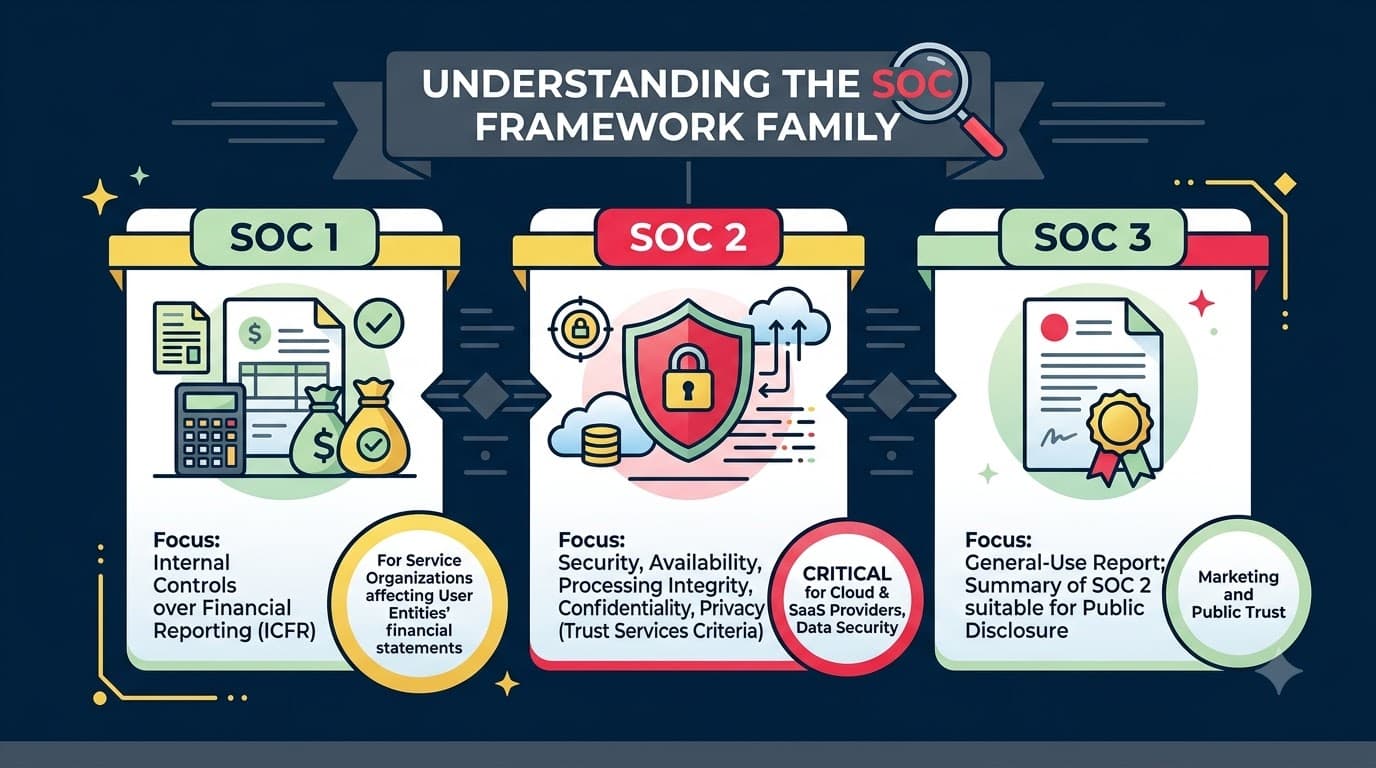
But the reports are not interchangeable, and the differences aren't cosmetic. SOC 1 exists because financial statement auditors need assurance about controls at outsourced service providers that touch their clients' books. SOC 2 exists because customers need assurance about the security, availability, and privacy practices of the technology vendors they trust with data and uptime. SOC 3 exists because companies want a shareable, public proof point without disclosing the sensitive detail inside a full report. Different regulators, different readers, different risk questions — one shared brand.
In fifteen-plus years doing this work, I've watched the mislabeling go both directions: startups that publish a SOC 3 badge and assume it satisfies every enterprise security questionnaire (it usually doesn't — those questionnaires want the underlying SOC 2), and finance-adjacent vendors that build a beautiful SOC 2 program while a customer's external auditor is quietly waiting on a SOC 1 that was never scoped. Getting the family tree straight up front saves months of rework later.
"I've had CFOs tell me, with total confidence, that their SOC 2 report satisfies their financial statement auditor's SOC 1 request. It doesn't, and finding that out during year-end close is the worst possible time to learn it." — Marcus Webb, CPA, Partner, Hallstrom & Reyes LLP
Attestation, Not Certification: The Ground Rule for Every SOC Report
Before going further into the differences between SOC 1, SOC 2, and SOC 3, one rule applies to all three equally, and it's worth stating plainly because it's the single most common error in how these reports get described: none of them is a certification. There is no pass/fail badge, no accredited certification body, no logo you earn by hitting a score. Every report in the SOC family is an attestation — an independent CPA firm examines management's description of its systems and controls, tests them (for Type II reports) or reviews their design (for Type I reports), and issues a professional opinion on what it found.
That distinction matters practically. A certification body like an ISO 27001 accreditation body issues a certificate that says "this organization conforms to the standard." A SOC report says something more nuanced: "here is management's description of its system, here is what it asserts about its controls, and here is our independent opinion on whether that assertion is fairly stated." The CPA firm isn't blessing the company — it's opining on a specific, bounded set of claims. Governing all of this is SSAE 18 (Statement on Standards for Attestation Engagements No. 18), the AICPA's attestation standard, expressed through its AT-C sections. SOC 1 sits under AT-C 320 specifically; SOC 2 and SOC 3 sit under the broader attestation guidance built on the Trust Services Criteria.
Keep that word — attestation — in your vocabulary every time you talk about any SOC report. Vendors that call their SOC 2 a "certification" on their marketing site are technically wrong, and a sharp-eyed enterprise security reviewer will notice.
SOC 1: Controls Over Financial Reporting
SOC 1 answers one narrow, specific question: if a company outsources part of a process that affects its own financial statements, are the outsourced provider's controls over that process suitably designed and operating effectively? The formal scope is controls relevant to user entities' internal control over financial reporting, commonly abbreviated ICFR. SOC 1 exists because the Sarbanes-Oxley era pushed public companies (and increasingly private ones with sophisticated boards and lenders) to demonstrate strong ICFR, and ICFR doesn't stop at the company's own walls — it extends into every payroll processor, fund administrator, claims processor, or billing platform the company relies on.
Think about who actually needs a SOC 1: payroll and benefits administrators, loan servicers, transfer agents, fund administrators, medical claims processors, billing and revenue-recognition platforms, and — as Priya at Ledgerly discovered — any SaaS company whose outputs post directly into a customer's general ledger or otherwise materially affect what shows up on that customer's balance sheet or income statement. If your product calculates numbers that a customer's external auditor will later test as part of that customer's own financial statement audit, you are a SOC 1 candidate, regardless of how much "security" work you've already done.
A service organization undergoing a SOC 1 examination provides management's assertion and a system description; the CPA firm tests (or reviews the design of) the control objectives relevant to ICFR and issues an opinion. The report is intended for a narrow, informed audience: the user entity's own management and, critically, that user entity's financial statement auditors, who rely on the SOC 1 as audit evidence rather than re-performing their own fieldwork at every vendor.
SOC 1 Dimension | Type I | Type II |
|---|---|---|
What's examined | Suitability of control design | Design and operating effectiveness |
Time frame | A single "as of" date | A period, typically 6–12 months |
Evidence gathered | Documentation, walkthroughs | Documentation, walkthroughs, plus sampled testing of operation over the period |
Typical use | New service orgs, fast initial proof point | Ongoing vendor reliance by financial statement auditors |
Relative cost/effort | Lower | Higher (requires sustained evidence collection) |
What a financial auditor typically wants | Rarely sufficient alone | Standard expectation for recurring reliance |
SOC 2: The Trust Services Criteria Report
SOC 2 answers a different question entirely: how well does a service organization protect the data and systems it operates on behalf of its customers? Instead of ICFR, SOC 2 is built on the Trust Services Criteria — five categories developed by the AICPA specifically for evaluating the controls that matter to technology and data-handling risk. Every SOC 2 must include Security, also called the Common Criteria (the CC-series), because security is the non-negotiable foundation every other criterion depends on. Beyond that, the organization scopes in whichever additional categories match its actual commitments to customers.
Trust Services Criteria | Required? | What It Covers |
|---|---|---|
Security (Common Criteria) | Always required | Protection against unauthorized access, both physical and logical; the CC1–CC9 series |
Availability | Optional | Systems are available for operation and use as committed or agreed |
Processing Integrity | Optional | System processing is complete, valid, accurate, timely, and authorized |
Confidentiality | Optional | Information designated as confidential is protected as committed |
Privacy | Optional | Personal information is collected, used, retained, disclosed, and disposed of in conformity with commitments |
The Common Criteria themselves are built on the COSO internal control framework's structure — organized into nine families (CC1 control environment through CC9 risk mitigation) that map back to COSO's seventeen principles. A SOC 2 report includes an auditor's opinion, management's assertion, a detailed system description, and — for a Type II — a full description of the tests performed and their results. That level of operational detail is exactly why SOC 2 is a restricted-use report: it's intended for the service organization's existing and prospective customers and their auditors, people who already have context and, usually, a non-disclosure agreement in place, not the general public. Our companion piece, SOC 2 Complete Guide: Understanding AICPA Trust Services Criteria, walks through the full anatomy of a SOC 2 report section by section, and SOC 2 Trust Services Criteria: Security, Availability, Processing Integrity, Confidentiality, Privacy goes deep on each criterion individually.
"SOC 2 is the report I want to see the detail of. SOC 3 tells me a vendor passed; SOC 2 tells me how, and how is what my risk register actually needs." — Dana Okafor, Director of Vendor Risk, Meridian Capital
SOC 3: The Public-Facing Seal
SOC 3 is best understood not as a separate audit but as a distribution format for a SOC 2. The underlying examination — the testing, the criteria, the CPA firm's work — is identical to what produces a SOC 2 Type II (SOC 3 is nearly always paired with Type II testing in practice, since a point-in-time design opinion offers little standalone marketing value). What changes is the output: a SOC 3 report strips out the detailed system description, the itemized control objectives, and the granular tests-of-controls-and-results section, leaving a short, plain-language summary and the auditor's opinion. Because it discloses nothing sensitive about the service organization's internal architecture, a SOC 3 is general-use — it can be posted publicly on a website, attached to a marketing deck, or handed to a prospect with zero NDA friction.
Think of SOC 3 as the trust badge version of a SOC 2: useful for signaling, useless for due diligence. A serious enterprise security reviewer, a bank's third-party risk team, or an insurer underwriting a cyber policy will accept a SOC 3 as a first impression but will almost always ask for the full, restricted-use SOC 2 before finalizing an assessment — because the SOC 3 simply doesn't contain the control detail they need to do their job. Fenwick Cloud Storage learned this distinction expensively, and we'll walk through exactly what happened later in this article.
SOC 3 Characteristic | Detail |
|---|---|
Derived from | A SOC 2 examination (typically Type II) |
Contains detailed system description | No |
Contains tests of controls and results | No |
Distribution | Freely distributable — general use |
Typical placement | Public website "trust" or "security" page, sales collateral |
Replaces the need for a full SOC 2 in vendor due diligence | Rarely — most serious buyers still request the SOC 2 |
Side-by-Side: SOC 1 vs SOC 2 vs SOC 3
Here is the comparison I sketch on a whiteboard for every client the first time this comes up.
Dimension | SOC 1 | SOC 2 | SOC 3 |
|---|---|---|---|
Purpose | Assurance over controls relevant to user entities' ICFR | Assurance over security, availability, processing integrity, confidentiality, and/or privacy | Public summary proving a SOC 2 examination was performed |
Governing standard | SSAE 18 (AT-C 320) | SSAE 18 / Trust Services Criteria | Same underlying examination as the SOC 2 |
Criteria basis | Control objectives defined by management, relevant to financial reporting | AICPA Trust Services Criteria (Security required; others optional) | Same TSC as the source SOC 2 |
Primary audience | User entities' management and their financial statement auditors | Existing/prospective customers, their auditors, regulators, partners | General public, prospects, marketing use |
Report detail | Full system description, control objectives, (Type II) tests and results | Full system description, control objectives, (Type II) tests and results | High-level summary only, no detailed testing disclosed |
Distribution | Restricted use | Restricted use | General use |
Report length (typical) | 20–60 pages | 40–100+ pages | 2–5 pages |
Comes in Type I and Type II | Yes | Yes | No (it's a summary format, not a separate type) |
Who commissions it | Any service org affecting a customer's financial statements | Any service org handling customer data/systems under a trust commitment | Any org that already has a qualifying SOC 2 |
Type I vs Type II: A Dimension That Cuts Across SOC 1 and SOC 2
It's worth being explicit about something that trips people up constantly: Type I and Type II aren't SOC 2-specific concepts. Both SOC 1 and SOC 2 come in Type I and Type II flavors; SOC 3 does not, because it's a summary of an underlying SOC 2 rather than an independently typed report.
Type I reports answer "were the controls suitably designed as of a specific date?" — a single snapshot. Type II reports answer the harder question: "did those controls actually operate effectively across a defined audit period?" — typically three to twelve months, most commonly six or twelve. Type II requires the auditor to sample evidence throughout the period — access reviews from March, change tickets from July, incident logs from November — rather than reviewing a policy binder once. That's why Type II costs more, takes longer to first-issue, and carries far more weight with sophisticated readers.
Attribute | Type I (SOC 1 or SOC 2) | Type II (SOC 1 or SOC 2) |
|---|---|---|
Question answered | Are controls designed appropriately? | Did controls operate effectively over time? |
Time dimension | Point in time | Period (commonly 3–12 months) |
Evidence style | Walkthroughs, documentation review | Sampled operational testing across the period |
First-time issuance speed | Faster | Slower — requires the full observation window to elapse |
Enterprise buyer expectation | Acceptable as an interim/first step | Generally required for ongoing vendor reliance |
Relative assurance level | Lower | Higher |
Most organizations run a Type I as a bridge — proof that the program exists and is designed correctly — while the clock runs on their first Type II observation period. If you only ever do one, do the Type II; it's what most customers, auditors, and underwriters actually want. Our companion article, SOC 2 Type I vs Type II: Choosing the Right Audit Type, covers the sequencing decision in far more depth for SOC 2 specifically.
Restricted-Use vs General-Use Reports
The second cross-cutting dimension, alongside Type I/Type II, is who is allowed to see the report at all. SOC 1 and SOC 2 are both restricted-use — the AICPA's professional standards limit distribution to a defined audience (management, user entities, their auditors, and other specified parties like regulators, under NDA). SOC 3 is general-use by design, meaning it can be shared with literally anyone, no restriction, no NDA.
SOC 1 | SOC 2 | SOC 3 | |
|---|---|---|---|
Use classification | Restricted use | Restricted use | General use |
Can be posted publicly on a website | No | No | Yes |
Requires NDA before sharing | Typically yes | Typically yes | No |
Audience defined by | AICPA professional standards, engagement letter | AICPA professional standards, engagement letter | Anyone |
Contains sensitive control detail | Yes | Yes | No |
This is precisely the gap that trips up companies that publish only a SOC 3 and assume it's "the SOC 2." It isn't a lesser SOC 2 — it's a different distribution product entirely, deliberately stripped of the detail that a restricted-use report is allowed to contain because it's meant for a wide, uncontrolled audience.
Mapping the Family Tree
Sometimes the fastest way to make this stick is a picture. Here's how I draw the SOC family on a whiteboard.
flowchart TD
    A["AICPA SOC Framework<br/>SSAE 18 Attestation Standard"] --> B["SOC 1<br/>Controls Relevant to ICFR"]
    A --> C["SOC 2<br/>Trust Services Criteria"]
    A --> D["SOC 3<br/>General-Use Summary"]
    A --> E["SOC for Cybersecurity<br/>Entity-Wide Risk Program"]
    A --> F["SOC for Supply Chain<br/>Production/Manufacturing Controls"]

    B --> B1["Type I — Design at a Point in Time"]
    B --> B2["Type II — Operating Effectiveness Over a Period"]

    C --> C1["Type I — Design at a Point in Time"]
    C --> C2["Type II — Operating Effectiveness Over a Period"]
    C --> C3["Security / Common Criteria — Always Required"]
    C --> C4["Availability, Processing Integrity,<br/>Confidentiality, Privacy — Optional"]

    D --> D1["Derived From a SOC 2 Type II Examination"]
    D --> D2["Public Seal — No Detailed Test Results"]

    style A fill:#1a2942,color:#fff
    style B fill:#2d4a6d,color:#fff
    style C fill:#2d4a6d,color:#fff
    style D fill:#2d4a6d,color:#fff
    style E fill:#3d5a75,color:#fff
    style F fill:#3d5a75,color:#fff
Everything under the AICPA umbrella traces back to the same attestation standard and the same professional discipline. What diverges is the criteria being tested (ICFR vs. Trust Services Criteria) and the distribution rules (restricted vs. general use) — those two forks are the entire decision tree.
Which SOC Report Do You Actually Need? A Decision Matrix
Strip away the acronyms and every buyer or vendor is really asking one of a handful of questions. Match your situation to the row below.
Your Situation | Report You Likely Need | Why |
|---|---|---|
Your product's output feeds directly into customers' financial statements (payroll, billing, claims, fund NAV calculations) | SOC 1 (Type II preferred) | Customers' financial statement auditors need ICFR assurance, not TSC assurance |
Customers ask about your security posture, uptime, or data handling in vendor questionnaires | SOC 2 (Type II preferred) | TSC directly addresses security/availability/confidentiality/privacy concerns |
You want a public trust signal for your website and sales collateral | SOC 3 | General-use, safe to publish, no NDA required |
You handle payment card data specifically | SOC 2 plus PCI DSS considerations (SOC alone does not replace PCI obligations) | SOC 2 addresses broader TSC; PCI DSS has its own dedicated card-data requirements |
You process EU personal data at scale and need external assurance beyond contractual language | SOC 2 with the Privacy criterion scoped in | Privacy TSC specifically addresses collection/use/retention/disclosure practices |
Your board or acquirer wants entity-wide cybersecurity risk assurance, not just one system | SOC for Cybersecurity | Broader scope than SOC 2, covering the whole cybersecurity risk management program |
You manufacture or assemble physical products and supply-chain partners want assurance over production controls | SOC for Supply Chain | Purpose-built for production, manufacturing, and distribution system controls |
A customer's external auditor explicitly cites "ICFR" or "internal control over financial reporting" in their request | SOC 1 | This phrase is the clearest possible signal you're being asked for SOC 1, not SOC 2 |
You're early-stage and need to show something fast while your Type II observation period runs | SOC 2 Type I as an interim step | Faster to issue; signals program maturity while the Type II clock runs |
You need both financial-reporting assurance and security assurance for the same system | SOC 1 and SOC 2, run concurrently where scope overlaps | Different criteria, different report; many companies need both |
If you take away one rule from this whole article, take this one: the moment a customer's own financial statement auditor is in the room, you're in SOC 1 territory; the moment a customer's security, IT, or vendor-risk team is in the room, you're in SOC 2 territory. SOC 3 only enters the picture once a SOC 2 already exists and you want a shareable public version of it.
Real-World Use Cases by Industry
Different industries gravitate toward different points in the SOC family, driven by what their customers actually need to see.
Industry / Business Model | Most Relevant SOC Report(s) | Typical Driver |
|---|---|---|
Payroll and HR outsourcing | SOC 1 Type II | Payroll figures flow directly into customer ICFR |
SaaS expense/billing/AP automation | SOC 1 Type II (plus SOC 2 for security) | Outputs post to customer general ledgers |
Cloud infrastructure / hosting providers | SOC 2 Type II (Security + Availability) | Customers need uptime and security assurance |
B2B SaaS handling customer PII | SOC 2 Type II (Security + Privacy or Confidentiality) | Data handling and privacy commitments |
Fund administrators / transfer agents | SOC 1 Type II | NAV calculations and shareholder records affect ICFR |
Health-tech platforms processing claims | SOC 1 Type II (claims affect payer/provider ICFR) and SOC 2 (PHI security) | Dual exposure: financial and data-sensitivity |
Marketing and analytics SaaS (no financial data) | SOC 2 Type II (Security + Confidentiality) | No ICFR relevance; security/confidentiality is the concern |
Publicly marketed consumer-facing platforms | SOC 3 (in addition to a restricted SOC 2) | Public trust signal without disclosing sensitive detail |
Manufacturing / hardware supply chains | SOC for Supply Chain | Production and distribution control assurance |
Enterprises building an internal cyber risk narrative for the board | SOC for Cybersecurity | Entity-wide risk management reporting, not single-system |
The Extended Family: SOC for Cybersecurity and SOC for Supply Chain
Two additional AICPA attestation products sit adjacent to the core SOC 1/2/3 trio, and they're worth knowing exist even if most readers of this article won't need them immediately.
SOC for Cybersecurity is a general-use report, but it's structurally different from SOC 2 in an important way: instead of examining a specific system against the Trust Services Criteria, it examines an organization's entity-wide cybersecurity risk management program against a description criteria framework the organization itself selects (commonly a framework like NIST CSF). It's aimed at boards, senior executives, investors, and business partners who want assurance about how a company manages cyber risk across the whole enterprise — not customers relying on one particular product. Because it's broader and more strategic in framing, it tends to show up more in M&A diligence, board reporting, and cyber-insurance conversations than in day-to-day vendor questionnaires.
SOC for Supply Chain applies the same attestation discipline to production, manufacturing, and distribution systems. As supply-chain risk has become a board-level concern — think semiconductor shortages, ransomware hitting logistics providers, and quality failures cascading through multi-tier supplier networks — this report gives manufacturers and their upstream/downstream partners a way to demonstrate that the controls over their production systems (not their IT security controls specifically, though those matter too) are suitably designed and operating effectively.
SOC 2 | SOC for Cybersecurity | SOC for Supply Chain | |
|---|---|---|---|
Scope | A specific system or service | Entity-wide cybersecurity risk management program | Production, manufacturing, distribution systems |
Criteria | AICPA Trust Services Criteria | Organization-selected framework + AICPA description criteria | AICPA description criteria for supply chain |
Use classification | Restricted use | General use | General use |
Primary audience | Existing/prospective customers and their auditors | Boards, investors, business partners, insurers | Supply-chain partners, customers, regulators |
Typical requester | Vendor-risk / procurement teams | Board committees, M&A diligence teams | Supply-chain and quality partners |
Neither of these replaces SOC 2 for a typical SaaS vendor relationship — they solve different, less common problems. But if you're fielding a request that mentions "entity-wide" cyber risk or "supply chain" assurance specifically, now you know which report family it belongs to.
Case Study: Brightloop Payments Runs a Dual-Report Program
Brightloop Payments processes payroll and contractor payments for roughly 600 mid-market companies. Its CISO, Tomás Rivera, inherited a compliance program with a single SOC 2 Type II covering Security and Availability — solid, but incomplete for a company whose core function is moving money and posting payroll entries into customers' accounting systems.
"We kept getting the same objection from bigger prospects' controllers," Tomás told me. "Their auditors wanted a SOC 1 because our numbers land in their trial balance. Our security team had built a great SOC 2 program, but it was answering the wrong question for that specific stakeholder."
Rather than starting from zero, Brightloop's team mapped the control overlap between its existing SOC 2 evidence (access control, change management, logging) and the ICFR-relevant control objectives a SOC 1 would need (transaction processing accuracy, segregation of duties in the payment approval workflow, reconciliation controls). Roughly 60% of the evidence-collection infrastructure — ticketing, access review cadence, change logs — could serve both engagements with different testing lenses applied. Brightloop scoped a SOC 1 Type II running on a parallel but offset testing window from its existing SOC 2 Type II, using the same underlying GRC platform to avoid duplicating evidence requests to the same control owners twice.
The results, eighteen months later: Brightloop closed $4.1 million in enterprise contracts that had been explicitly gated on the missing SOC 1, cut the average vendor-security-review cycle from eleven weeks to four, and — a secondary but real benefit — its finance team reported that the ICFR-focused testing surfaced two reconciliation control gaps that hadn't shown up under the security-focused SOC 2 lens at all, because nobody had been looking for them from that angle.
"Running SOC 1 and SOC 2 together isn't double the audit — it's roughly a third more work on top of one, if you plan the evidence collection jointly from day one. Plan them separately and you'll pay for it twice, in fees and in your team's patience." — Tomás Rivera, CISO, Brightloop Payments
Case Study: Fenwick Cloud Storage Learns the Hard Way About Restricted Use
Fenwick Cloud Storage, a document-storage and e-signature platform, took a different path — and a costlier detour. Under pressure to show "SOC 2 compliance" quickly ahead of a funding round, Fenwick's head of GRC, Sarah Lindqvist, greenlit a SOC 2 Type II examination and, on her auditor's suggestion, added a SOC 3 to get a shareable badge for the website. The SOC 3 went up proudly on Fenwick's homepage within days of the report's issuance.
For three quarters, that seemed sufficient — smaller prospects were satisfied seeing the public seal. Then Fenwick entered procurement with a $780,000 enterprise legal-services client whose security team sent back the SOC 3 with a one-line response: "This confirms an examination occurred. We need the underlying report with the system description and test results to complete our assessment." Sarah had assumed the SOC 3 was effectively the SOC 2 in shareable form — which is true in the sense that it's derived from the same engagement, but false in the sense that it deliberately omits everything a serious reviewer needs.
The fix was fast once understood — Fenwick already had the full SOC 2 sitting in the drawer, restricted-use, ready to share under NDA — but the confusion cost nearly three weeks of back-and-forth and, more damagingly, made the security team question whether Fenwick's own compliance staff understood their own reports. "It planted a seed of doubt that took real relationship-building to undo," Sarah said. "We closed the deal, but I don't want to relearn that lesson."
"A SOC 3 badge on your homepage is a conversation starter, not a closer. The moment a real security team gets involved, have the SOC 2 ready to send under NDA — don't make them ask twice." — Sarah Lindqvist, Head of GRC, Fenwick Cloud Storage
Fenwick's Mistake | What Should Have Happened | Lesson |
|---|---|---|
Treated SOC 3 as a substitute for SOC 2 in enterprise sales | Use SOC 3 for public trust signaling only; keep SOC 2 ready under NDA | Match the report to the sophistication of the reader |
Assumed all prospects would accept the public seal | Segment prospects by deal size/sensitivity and pre-empt SOC 2 requests for enterprise deals | Larger buyers almost always need the restricted-use report |
No internal process for who could authorize sharing the full SOC 2 | Build an NDA-gated report-sharing workflow before the report is even issued | Speed matters once a deal is in motion |
Back to Ledgerly: Resolving Priya's $2.4 Million Question
Priya's resolution, once she understood the family tree, was straightforward in hindsight. Ledgerly's expense-reimbursement engine posted directly into customer general ledgers, which meant a SOC 1 was unavoidable — not a replacement for the existing SOC 2, but an addition to it. She engaged the same audit firm that had performed Ledgerly's SOC 2 Type II, scoped a SOC 1 Type II around the specific control objectives relevant to transaction accuracy, approval workflows, and reconciliation, and — because roughly half of the underlying infrastructure controls (access provisioning, change management, encryption) were already documented and tested for the SOC 2 — the incremental SOC 1 fieldwork took eleven weeks rather than a full audit cycle from scratch.
Meridian National's controller got the SOC 1 Type II report six weeks after Priya's original scramble began. The $2.4 million renewal closed, with an expanded scope that added another 40% in projected multi-year value once Meridian's procurement team saw that Ledgerly now carried both reports. Priya's own postmortem, delivered to her board, became the template her company now uses to screen every new enterprise deal: does this prospect's own financial statement auditor need to rely on us? If yes, SOC 1 is now checked before the contract is even drafted, not after a controller's email throws the deal into limbo.
"The lesson I took away wasn't 'get every SOC report that exists.' It was 'understand your product's blast radius into a customer's own financial statements before you ever get asked.' That one question would have saved me six weeks." — Priya Chandrasekaran, VP of Compliance, Ledgerly
What's Inside Each Report: Sections and Structure
Once you know which report you need, it helps to know what you're actually going to receive. SOC 1 and SOC 2 share the same broad anatomy; SOC 3 is the deliberately abbreviated cousin.
Report Section | SOC 1 (Type I/II) | SOC 2 (Type I/II) | SOC 3 |
|---|---|---|---|
Independent auditor's report / opinion | Yes | Yes | Yes (summarized) |
Management's assertion | Yes | Yes | Yes (summarized) |
System description | Yes, detailed | Yes, detailed | No — high-level narrative only |
Control objectives / criteria addressed | Control objectives defined by management | AICPA Trust Services Criteria | Named but not itemized |
Description of tests of controls (Type II only) | Yes, itemized with results | Yes, itemized with results | No |
Complementary user entity controls (CUECs) | Yes | Yes | Not itemized |
Subservice organization disclosures | Yes | Yes | Summarized, if at all |
Suitable for public distribution | No | No | Yes |
A CUEC list deserves a special callout because it's the section most commonly skipped by report readers, and it shouldn't be. Every SOC 1 and SOC 2 report lists the controls the customer is expected to operate for the whole control environment to function as designed — things like "user entity is responsible for promptly disabling terminated employees' access on their side of an SSO integration." A vendor's clean opinion doesn't mean the customer gets to ignore its own half of the shared responsibility.
If you're handed a 70-page report for the first time and aren't sure where to start, our SOC 2 Report Reader's Guide walks through each section in the order a practiced reviewer actually reads them, rather than the order they appear on the page.
Cost and Timeline Expectations Across the Family
Budgeting conversations are where the SOC family confusion turns expensive fast. These figures are illustrative ranges drawn from typical mid-market engagements I've observed — actual quotes vary by company size, system complexity, and number of trust criteria or control objectives in scope.
Report | Typical First-Year Audit Fee Range | Typical Timeline to First Report | Ongoing Annual Cost | Notes |
|---|---|---|---|---|
SOC 1 Type I | $15,000–$35,000 | 6–10 weeks | N/A (one-time or bridge) | Faster path to an initial proof point |
SOC 1 Type II | $25,000–$60,000 | 4–8 months (includes observation period) | $20,000–$45,000/year | Most commonly requested by financial statement auditors |
SOC 2 Type I | $15,000–$40,000 | 6–10 weeks | N/A (one-time or bridge) | Common for early-stage companies |
SOC 2 Type II | $30,000–$80,000+ | 6–13 months (includes observation period) | $25,000–$60,000+/year | Scales with number of TSC categories and system complexity |
SOC 3 | $2,000–$8,000 incremental | Add-on once SOC 2 is complete | Small incremental fee | Priced as a derivative of the SOC 2 engagement |
Combined SOC 1 + SOC 2 program | 60–75% of the sum of both run separately | Parallel observation windows recommended | Materially less than running fully separately | Shared evidence collection is the efficiency lever |
The efficiency argument for running SOC 1 and SOC 2 together, as Brightloop discovered, is real: much of the underlying IT general control evidence (access provisioning, change management, backup and recovery, logging) is relevant to both engagements. A well-run GRC program collects it once and maps it to both sets of criteria, rather than fielding duplicate evidence requests from two audit teams on two different timelines. Our SOC 2 Cost Calculator can help rough out budget for a single-report versus combined-report program before you go out for audit-firm quotes.
Common Mistakes Buyers and Vendors Make
After walking dozens of companies through this exact confusion, the same handful of mistakes recur.
Mistake | Who Makes It | The Fix |
|---|---|---|
Assuming SOC 2 satisfies a financial statement auditor's SOC 1 request | Vendors, sometimes their own sales teams | Ask early: "does your outsourced provider's output affect our ICFR?" |
Treating a SOC 3 as a full substitute for SOC 2 in enterprise diligence | Vendors publishing only a SOC 3 badge | Keep the full SOC 2 ready to share under NDA the moment a serious buyer asks |
Calling any SOC report a "certification" in marketing copy | Marketing and sales teams | Use "attestation" or "report"; reserve "certification" for standards like ISO 27001 |
Requesting a SOC 2 when what's actually needed is a SOC 1 | Procurement/vendor-risk teams unfamiliar with the distinction | Loop in the internal financial-statement audit team before sending vendor requests |
Skipping the CUEC section entirely | Both sides | Read CUECs as a checklist of the customer's own required controls |
Accepting a Type I report as sufficient for ongoing reliance | Procurement teams under deal-timeline pressure | Accept Type I only as an interim bridge; require Type II for renewal cycles |
Not knowing whether a subservice organization is carved out or included | Risk teams reading a report at face value | Always check the subservice organization treatment before relying on the opinion |
Assuming one SOC 2 covers every product line a vendor sells | Buyers who don't check the system description's boundaries | Confirm the specific system/product named in the report matches what you're buying |
How Auditors Scope a SOC Engagement: Subservice Organizations
No modern service organization operates in isolation. Ledgerly runs on a cloud infrastructure provider; Brightloop's payment rails touch a banking partner; Fenwick's storage layer depends on a third-party data center operator. Every one of those is a subservice organization — a vendor the service organization itself relies on to deliver its service — and every SOC 1 or SOC 2 report has to decide how to treat them.
Two methods exist, and the choice materially changes what a reader can conclude from the report:
Treatment Method | What It Means | What the Reader Must Do |
|---|---|---|
The subservice organization's controls are excluded from the report's scope and testing; only their existence is disclosed | Separately obtain and review the subservice organization's own SOC report to get full assurance | |
The subservice organization's relevant controls are included and tested as part of the primary report | No separate report needed — assurance is already built in, though the subservice org's own personnel are typically interviewed/tested directly |
Carve-out is far more common in practice — cloud infrastructure providers like the major hyperscalers issue their own SOC reports precisely so that thousands of downstream customers can carve them out rather than trying to audit a hyperscaler's data centers directly. The catch: if you're relying on a carved-out report, you (or your auditor) are on the hook for separately requesting and reviewing that subservice organization's own SOC report to close the assurance loop. A report that carves out its cloud provider and stops there — without the reader chasing the second report — leaves a real gap in the assurance chain.
"The number one thing I check first when I open any SOC report is the subservice organization treatment. If it's carved out, my very next email asks for their SOC report too. Skipping that step means you've only got half the picture." — James Okonkwo-Hale, Senior Manager, Attestation Services, Vantage Assurance LLP
Bridge Letters and Report Gaps
Type II reports cover a fixed historical window — say, January 1 through December 31. But renewal decisions, financial statement audits, and vendor reviews don't politely wait for the next report to land on the exact right date. The gap between a report's period-end date and the date a reader actually needs assurance is bridged with a bridge letter (sometimes called a gap letter): a short statement from the service organization's management confirming that no material changes to the control environment have occurred since the report period ended.
Bridge letters are not a substitute for the underlying report and they're not independently audited — they're a management representation, not a CPA opinion. Sophisticated readers accept them for a few months' gap; they should never become a permanent replacement for keeping the annual Type II cadence current. If your bridge letters are stretching past three or four months routinely, that's usually a sign the audit engagement itself needs to be rescheduled earlier in the year.
Building a Multi-Report Program Without Duplicating Work
Once an organization needs more than one SOC report — which, as Brightloop's story shows, is common for any company touching both financial data and general security concerns — the operational question becomes how to avoid running two (or three) parallel evidence-collection treadmills.
Control Domain | Relevant to SOC 1 | Relevant to SOC 2 | Shared Evidence Opportunity |
|---|---|---|---|
Logical access provisioning/deprovisioning | Yes | Yes | High — same access review evidence serves both |
Change management | Yes | Yes | High — same change tickets and approvals |
Backup and recovery | Sometimes | Yes | Moderate |
Transaction processing accuracy | Yes | No (unless Processing Integrity is scoped) | Low — SOC 1-specific |
Segregation of duties in approval workflows | Yes | Sometimes | Moderate |
Encryption at rest/in transit | Sometimes | Yes | Moderate |
Physical/environmental controls at data centers | Sometimes | Yes | High if same facilities |
Incident response and monitoring | Rarely | Yes | Low — SOC 2-specific |
Vendor/subservice organization oversight | Yes | Yes | High |
The practical move: build your control matrix once, tag each control with every report/criteria it supports, and collect evidence on a single calendar rather than answering the same auditor request twice with two different labels. Companies that run mature multi-report programs typically use a dedicated readiness assessment each year to identify where the two engagements' evidence windows and sampling requirements diverge before the actual fieldwork starts, rather than discovering the gap mid-audit.
Vendor Risk Teams: How to Ask for the Right Report
If you sit on the buying side — procurement, vendor risk, third-party risk management — the fastest way to get the right report from a vendor the first time is to ask a more precise question than "do you have a SOC report?"
Question to Ask the Vendor | What It Tells You |
|---|---|
"Does your service materially affect our internal control over financial reporting?" | Determines whether SOC 1 is relevant at all |
"What Trust Services Criteria are in scope for your SOC 2?" | Confirms Availability/Privacy/etc. match your actual risk concerns |
"Is this a Type I or Type II report, and what period does it cover?" | Confirms depth of assurance and currency |
"Are any subservice organizations carved out, and can we get their reports too?" | Closes gaps in the assurance chain |
"Can you share the full SOC 2 under NDA, not just the SOC 3?" | Ensures you get the detail, not just the marketing seal |
"What are the complementary user entity controls we're responsible for?" | Surfaces your own compliance obligations under the shared-responsibility model |
"How recent is the report, and is a bridge letter needed?" | Confirms the assurance window actually covers your reliance period |
This is the exact checklist I hand to vendor-risk teams as a standard part of a vendor risk management intake process — it turns a vague "send us your compliance docs" request into a targeted ask that gets the right document back the first time, instead of three rounds of email like Meridian and Priya went through.
SOC Reports and ISO 27001: Where They Overlap and Diverge
The other question I get constantly from readers who've made it this far: "we already have (or are pursuing) ISO 27001 — do we still need a SOC report too?" Often, yes, and it's worth understanding why the two aren't substitutes even though they overlap heavily on the security-control substance.
ISO 27001 is an international, certifiable management-system standard — an accredited certification body audits your information security management system against a fixed set of clauses and Annex A controls and issues a certificate. SOC 2, by contrast, is a US-originated attestation on a specific system against the Trust Services Criteria, issued by a CPA firm, with no accreditation body and no certificate — just a report and an opinion. Many enterprise buyers, especially in the US, ask for SOC 2 specifically because their own vendor-risk tooling and audit teams are built around reading SOC reports; European and APAC buyers more often default to asking for ISO 27001 certification. Global vendors increasingly carry both rather than picking one.
If you're weighing which to pursue first, or how to run both without duplicating your control environment twice, our ISO 27001 pillar has two articles worth reading directly: ISO 27001 vs SOC 2: which one do you need walks through the decision from the ISO side, and Running ISO 27001 and SOC 2 Together covers the operational playbook for maintaining both without duplicating evidence collection. For teams mapping controls across even more frameworks, ISO 27001, SOC 2 & NIST CSF Crosswalk is the control-mapping reference.
Dimension | ISO 27001 | SOC 2 |
|---|---|---|
Output type | Certificate (via accredited certification body) | Attestation report (via licensed CPA firm) |
Scope defined by | Organization's own ISMS scope statement | The specific system named in the engagement |
Standard/criteria | ISO/IEC 27001:2022 clauses 4–10 + Annex A controls | AICPA Trust Services Criteria |
Geographic bias | Stronger default expectation in EU/APAC | Stronger default expectation in North America |
Public proof point available | Certificate is typically shareable | SOC 3 (derived from SOC 2) is shareable; SOC 2 itself is restricted |
Renewal cadence | 3-year cycle with annual surveillance audits | Annual re-issuance (each Type II covers a new period) |
None of this touches SOC 1 directly — ISO 27001 has no ICFR-specific counterpart, since financial-reporting control assurance sits outside its scope entirely. If your product affects customer financial statements, SOC 1 remains the only report in this article that addresses it, regardless of what security certifications or attestations you also hold. For a full side-by-side breakdown of effort, cost, and maintenance across both paths, our SOC 2 vs ISO 27001 Comparison Guide is a useful next read before committing budget to either.
Choosing Your CPA Firm and Auditor
Not every CPA firm that offers SOC examinations is equally suited to every service organization. A firm's AICPA peer review status is table stakes — confirm it's current. Beyond that, look for sector experience: a firm that's issued dozens of SOC 1 reports for fintech and payments companies will scope transaction-processing control objectives faster and with fewer surprises than a generalist firm doing its first payments engagement. Ask prospective auditors directly how many SOC 1 versus SOC 2 engagements they run annually, whether they've handled combined SOC 1+SOC 2 programs, and how they price incremental SOC 3 add-ons.
Fee structure matters too. Some firms price SOC 1 and SOC 2 as fully independent engagements even when the underlying control environment is shared; others build genuinely integrated engagement plans that reuse evidence and interview time. Ask for a sample engagement plan before signing, not after.
Timing and Sequencing: When to Pursue SOC 1, SOC 2, and SOC 3
Order of operations matters more than most first-time compliance leads expect. Get the sequencing wrong and you either burn budget on a report nobody's asking for yet, or you scramble reactively the way Priya did. A rough sequencing framework, based on the pattern I see across most service organizations:
Start with SOC 2 unless you already know your product touches customer ICFR — for the majority of SaaS companies, security and availability assurance is the first thing prospects ask about, and it's the foundation the other reports build on. Run a Type I first only if you need a fast proof point for an active deal and can't wait out a full observation period; otherwise, go straight for Type II if your timeline allows, since that's what most serious buyers ultimately want anyway and running Type I first just adds a redundant engagement fee.
Add SOC 1 the moment you identify — through a product review, a sales-engineering conversation, or, ideally, before either — that your system materially affects customer financial statements. Don't wait for a customer's controller to surface it, as Ledgerly did. Build the ICFR-relevance question into your own product and sales qualification process instead.
Add SOC 3 only after your SOC 2 Type II is issued and stable, purely as a distribution convenience. There's no reason to rush a SOC 3; it adds minimal incremental value until you have an actual SOC 2 worth summarizing, and issuing one before your control environment has matured just puts a public seal on a program still finding its footing.
Company Stage | Recommended First Move | Recommended Second Move |
|---|---|---|
Pre-revenue / early pilot customers | SOC 2 Type I (fast proof point) | SOC 2 Type II once a stable customer base justifies the observation period |
Growth-stage SaaS, no ICFR exposure | SOC 2 Type II | SOC 3 for public trust signaling once SOC 2 is stable |
Growth-stage SaaS, product touches customer financials | SOC 2 Type II | SOC 1 Type II, scoped concurrently where evidence overlaps |
Enterprise-focused fintech/payroll/billing platform | SOC 1 and SOC 2 Type II run together from the start | SOC 3 as a later add-on for marketing use |
Manufacturing or supply-chain-heavy business | SOC 2 Type II for IT/security-facing customers | SOC for Supply Chain if production-partner assurance is separately requested |
Preparing Your Team: What a Readiness Assessment Uncovers
Whichever report you're heading toward, skipping straight to the formal examination without a readiness assessment first is the single most common way engagements run over budget and over timeline. A readiness assessment — typically run by the same audit firm or an independent advisory practice — walks the control environment against the target criteria before the clock starts on official testing, and it reliably surfaces the same handful of gap categories.
Common Readiness Gap | Why It Surfaces So Often | Typical Fix Before Formal Testing |
|---|---|---|
Access reviews performed inconsistently or undocumented | Teams do the review but don't retain evidence of it | Formalize a quarterly access review with signed-off documentation |
No formal change management ticketing for infrastructure changes | Engineering teams move fast and skip process under deadline pressure | Enforce ticket-linked approvals for all production changes |
Missing or informal risk assessment process | Risk assessment treated as a one-time exercise rather than ongoing | Stand up an annual (at minimum) documented risk assessment cycle |
Incomplete vendor/subservice organization inventory | No single source of truth for third-party dependencies | Build and maintain a subservice organization register |
Policies exist but aren't demonstrably followed | Policy documents were written for the audit, not lived day to day | Align actual practice to policy before testing begins, not after |
No designated control owners | Controls exist informally without a named accountable person | Assign and document a control owner for every control in scope |
Budget six to ten weeks for a proper readiness assessment ahead of a first Type II engagement — it's the difference between walking into formal testing with confidence and discovering a qualified opinion is on the table with no time left to fix it.
Reading the Opinion: What "Unqualified" Actually Means
Every SOC 1 and SOC 2 report — and by extension the SOC 3 that summarizes it — ends with the auditor's opinion, and that opinion is the single most important sentence in the whole document. Readers who skip straight to it (understandably, given report length) still need to know what the four possible outcomes mean.
Opinion Type | What It Means | What You Should Do |
|---|---|---|
Unqualified opinion | Clean opinion — controls were suitably designed (and, for Type II, operating effectively) with no material exceptions | Standard, expected outcome; proceed with normal reliance |
Qualified opinion | One or more specific exceptions noted, but the rest of the system is fairly presented | Read the exception detail closely; assess whether it affects your specific reliance |
Adverse opinion | Controls were not suitably designed or did not operate effectively in a pervasive way | Treat as a red flag; this is rare and normally addressed before a report is even issued |
Disclaimer of opinion | The auditor was unable to obtain sufficient evidence to form an opinion at all | Extremely rare; ask directly what caused the scope limitation |
In practice, the overwhelming majority of issued reports carry an unqualified opinion — auditors work with clients throughout the engagement to remediate issues before the report is finalized, precisely so a qualified or adverse opinion doesn't surprise anyone at the finish line. A well-run readiness assessment months ahead of the actual examination is what keeps most qualified opinions from ever happening in the first place. If you do see a qualified opinion on a vendor's report, don't panic and don't ignore it either — read the specific exception, ask the vendor for their remediation timeline, and decide whether it's material to what you're relying on them for.
Storing and Sharing Reports Responsibly
One operational detail that trips up even well-run compliance programs: restricted-use reports need a distribution process, not just a PDF sitting in a shared drive. Because SOC 1 and SOC 2 reports are restricted-use by definition, handing one out without an NDA in place isn't just sloppy — it's technically outside the terms most engagement letters and report cover pages specify.
Report | Recommended Storage/Sharing Approach |
|---|---|
SOC 1 (restricted use) | Store in a access-controlled repository; require signed NDA before external release; log every external share |
SOC 2 (restricted use) | Same NDA-gated process; many companies use a trust-center portal that auto-generates NDAs for prospects |
SOC 3 (general use) | Publish freely on a public trust/security page; no NDA or access control needed |
Bridge letters | Treat with the same restricted-use discipline as the report they're bridging |
A lightweight trust-center tool that auto-NDAs prospects before releasing the SOC 2 solves the exact problem Fenwick Cloud Storage ran into — it collapses the gap between "we have the report" and "the prospect actually has it in hand," which is often measured in days of internal email routing rather than the substance of the report itself. Sales engineering, not just compliance, should have a documented process for this; deals stall on distribution friction far more often than on the report's actual content.
The Business Case: Report Selection as a Competitive Advantage
Every founder and compliance leader I've worked with eventually asks some version of the same question: "which of these reports is the minimum we can get away with?" It's the wrong framing, and it's worth explaining why. Priya at Ledgerly didn't lose six weeks because she under-invested in compliance — she'd already built a strong SOC 2 program. She lost six weeks because nobody had mapped her product's actual financial-reporting footprint against the SOC family before a deal depended on it. Brightloop didn't win $4.1 million in new contracts because it did "more compliance" — it won because it correctly diagnosed which report answered which stakeholder's question, and built a program efficient enough to deliver both without doubling headcount.
The companies that treat SOC report selection strategically, rather than reactively, share a pattern: they map their product's actual risk surface — does it touch customer financials? does it hold sensitive data? does uptime matter contractually? — against the SOC family before a customer ever asks, and they budget for the right report (or combination) as part of their go-to-market plan rather than their legal team's fire drill. A vendor that can hand a prospect the exact report their audit team, security team, or procurement team needs — on the first ask, not the third — closes faster and builds the kind of trust that compounds into renewals, expansions, and referenceable customers.
Getting this right is a differentiator precisely because so many competitors get it wrong. If you're evaluating where to start, our companion article on the business case for why service organizations need SOC 2 goes deeper on execution once you've confirmed which report(s) belong on your roadmap.
Ready to Map Your Own SOC Report Strategy?
If reading Priya's, Tomás's, and Sarah's stories surfaced a nagging question about which report your own organization actually needs, that's the right instinct — this is exactly the kind of gap that's cheap to close before a deal is on the line and expensive to close during one. PentesterWorld's compliance advisory team helps service organizations map their product's financial-reporting and data-handling footprint against the full SOC family, scope the right combination of SOC 1, SOC 2, and SOC 3 (plus ISO 27001 where it makes sense), and build an audit-ready control environment before your next enterprise deal hinges on a report you don't have yet.
Not sure where your organization currently stands? Take the "Are You SOC 2 Ready?" quiz for a five-minute gut check, then work through the SOC 2 Readiness Checklist to see exactly which control gaps to close before you brief an auditor. Either one is a faster, cheaper first step than opening a scoping call with a CPA firm cold.