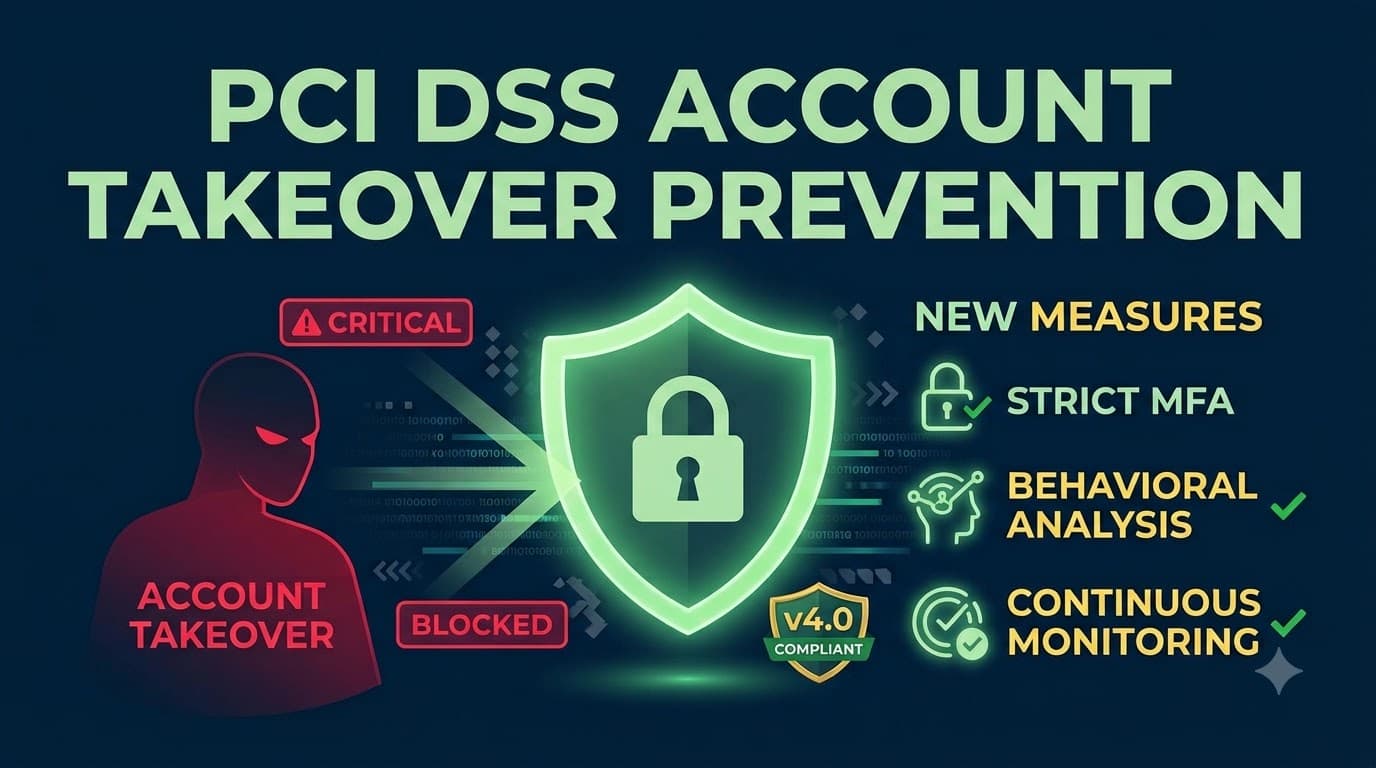
Marcus Feldman had been VP of Payments Security at Solstice Outfitters, a mid-market outdoor apparel e-commerce retailer doing roughly $340 million a year in online sales, for just under two years when the Friday-night alert came in. Between 11:40 PM and 2:15 AM, Solstice's login endpoint absorbed 214,000 authentication attempts from close to 9,000 distinct IP addresses — a textbook credential-stuffing run built on a breached-password list bought on a criminal forum. By the time the on-call engineer throttled the traffic, attackers had successfully logged into 3,140 customer accounts, changed the saved shipping address on roughly 1,900 of them, and pushed through $1.8 million in fraudulent orders using stored card-on-file tokens before Solstice's fraud-scoring engine caught the pattern and froze new checkouts. The chargebacks alone would exceed the entire security budget for the year, and Solstice's acquirer put the merchant on a 90-day improvement plan with an explicit threat of higher per-transaction fees if the pattern repeated.
Marcus's post-incident review turned up something uncomfortable: Solstice had been PCI DSS compliant for three straight years under v3.2.1. Every requirement had passed. Nothing in that certification would have stopped this specific attack, because v3.2.1's authentication controls were written mainly for internal Cardholder Data Environment access, not for the public-facing login page attackers actually used. PCI DSS v4.0 — which had gone fully into force the previous year once its future-dated requirements became mandatory — changed that calculus meaningfully, even though, as Marcus's QSA reminded him, there is no single line item in the standard literally called "account takeover prevention." What v4.0 delivers instead is a tightened, overlapping set of authentication, session, account-management, anti-automation, and monitoring controls that, taken together, make a campaign like the one that hit Solstice measurably harder to pull off and far faster to catch. This article walks through exactly which controls do that work, how they map to specific attack techniques, and how to assemble them into a program instead of a checklist.
Who This Is For and What You'll Walk Away With
This guide is written for CISOs, application security leads, fraud and payments operations teams, and QSAs who need a working map from "account takeover" as a business problem to the specific PCI DSS v4.0 requirements that mitigate it. You'll get a vector-by-control mapping you can hand to an engineering team, the exact lockout, password, session, and privileged-account parameters v4.0 mandates, a breakdown of the genuinely new Requirement 8.6 controls for application and system accounts, guidance on anti-automation for payment pages, and a detection framework built on Requirements 10.4 and 10.7. Read it end to end if you're building an ATO program from scratch; skim the tables if you already have one and need to stress-test it against the current standard.
What Account Takeover Actually Is — and Why Payment Fraud Teams Treat It as Existential
Account takeover (ATO) is the unauthorized acquisition and use of a legitimate user's account credentials or session to impersonate that user, typically for financial gain. In a payments context that means an attacker logging into a customer's e-commerce account to drain stored payment methods, or logging into an internal administrative account to reach systems that store, process, or transmit cardholder data. It is distinct from card-present fraud and from pure data-breach exfiltration in one important respect: ATO abuses a trusted, authenticated session rather than forging one, which is exactly why it defeats controls built solely around perimeter defense or encryption. If the attacker holds valid credentials, TLS, tokenization, and network segmentation are all working exactly as designed while the fraud happens in full view of them.
For merchants, account takeover (ATO) is a direct payment-fraud vector: attackers use compromised accounts to place orders against stored cards, redeem loyalty balances, or harvest personal and payment data for resale. For service providers and processors, ATO of an internal or partner account can be a foothold into the Cardholder Data Environment (CDE) itself — the scenario PCI DSS Requirement 8 is built to prevent. Both variants matter to a PCI assessment, but they trigger different requirements, which is a point we'll return to throughout this article.
The Business Impact — Payment Fraud, Chargebacks, and Acquirer Risk
Account takeover is expensive in ways that compound. There's the immediate fraud loss (goods shipped or services rendered against a stolen identity), the chargeback costs and network fees that follow, the customer-support burden of restoring locked-out legitimate users, and — for merchants who trip an acquirer's fraud thresholds — increased transaction fees, reserve requirements, or in severe cases placement on the MATCH list that makes it difficult to obtain merchant accounts elsewhere. Illustrative numbers from engagements like Solstice's are useful for budgeting conversations even though every environment differs.
Cost Category | Illustrative Range (Mid-Market E-Commerce Merchant) | Notes |
|---|---|---|
Direct fraud loss per major ATO event | $250K – $2.5M | Driven by average order value and detection speed |
Chargeback + network fees | 1.5–3x the fraud loss | Includes representment labor and per-chargeback fees |
Customer support / account recovery | $15–$40 per affected account | Password resets, identity verification, goodwill credits |
Acquirer remediation program costs | $50K – $300K | QSA engagement, tooling, monitoring uplift |
Brand/trust impact (illustrative) | 2–8% short-term conversion dip | Post-incident checkout abandonment |
Regulatory/contractual exposure | Varies | State breach-notification triggers if PII exposed alongside payment data |
"The chargeback number is never the real cost. The real cost is the six weeks my fraud team spent doing manual reviews on every order over $75 because we'd lost trust in our own login funnel." — Marcus Feldman, VP of Payments Security, Solstice Outfitters
The ATO Attack Chain: From Stolen Credentials to Fraudulent Charge
Most successful account takeovers follow a recognizable chain rather than a single clever exploit: acquisition of credentials (via breach dumps, phishing, malware, or SIM-swap-enabled resets), automated validation of those credentials at scale against a target login endpoint, exploitation of the small percentage that succeed, and monetization through stored payment instruments, loyalty points, or resold account access. Each link in that chain is a place PCI DSS v4.0 inserts friction, and understanding the chain is what lets a security team stop treating "MFA" or "lockout" as isolated checkbox items and start treating them as chain-breakers.
Credential acquisition happens largely outside the merchant's control — it's a function of password reuse across the internet and the sheer volume of breach data in circulation. Validation is where merchants have the most leverage, because it requires the attacker to interact directly with the target's authentication surface, generating a distinct and detectable traffic pattern. Exploitation and monetization are where session, account, and transaction-level controls do the remaining work. The table below maps the major ATO vectors to the v4.0 controls designed to interrupt them.
ATO Attack Vector | Stage in Chain | Primary PCI DSS v4.0 Control(s) | What the Control Does |
|---|---|---|---|
Credential stuffing (breached password lists) | Validation | Req 8.3.4 (lockout), anti-automation on login/payment pages, Req 6.4.1/6.4.2 | Throttles/blocks mass automated login attempts |
Brute force / password spraying | Validation | Req 8.3.4 (lockout), Req 8.3.6 (12+ char passwords) | Raises attempt cost, caps guesses before lockout |
Phishing for credentials or OTPs | Acquisition | Req 8.4.2 (MFA), user awareness (Req 12), phishing-resistant factors | MFA blocks reuse of phished password alone; resistant factors block real-time relay |
Session/cookie theft (malware, MITM) | Exploitation | Req 8.2.8 (idle re-auth), Req 4 (encryption in transit) | Limits session lifetime and value of a stolen token |
Compromised default/hard-coded service credentials | Acquisition | Req 8.6.1–8.6.3 (new) | Eliminates shared/default credentials on app & system accounts |
Bot-driven card testing / carding on payment pages | Exploitation/Monetization | Anti-automation, rate limiting, Req 6.4.2 (WAF) | Detects and blocks automated card-validation traffic |
Social-engineered account-recovery abuse | Acquisition | Req 8.3.4 lockout logic extended to recovery flows, identity verification | Prevents recovery-flow bypass of lockout protections |
Insider or third-party credential misuse | Exploitation | Req 7 (need-to-know), Req 8.6 (interactive-use accounts), Req 10.4/10.7 (monitoring) | Limits blast radius and flags anomalous use |
Why PCI DSS Doesn't Have One "ATO Requirement" — It's a Control Stack
It's worth saying plainly, because it trips up a lot of teams building a business case for budget: PCI DSS v4.0 does not contain a requirement titled "prevent account takeover." Account takeover is a fraud outcome, not a technical control category, and the PCI Security Standards Council writes requirements around control categories — authentication, session management, account governance, application security, and logging — that happen to collectively close most of the paths an ATO campaign relies on. That's actually a strength once you see it clearly: it means ATO defense isn't a bolt-on project, it's what you get automatically from doing Requirements 6, 8, and 10 well. The gap is that most organizations implement each requirement in isolation to pass an assessment, rather than deliberately as a layered defense against a specific fraud pattern — which is precisely the gap that let the credential-stuffing run through Solstice's front door despite a clean ROC.
v4.0 Requirement | Control Area | ATO Function |
|---|---|---|
8.3.4 | Invalid-attempt lockout | Brute-force / credential-stuffing throttle |
8.3.6 | Password strength (12+ characters) | Raises cost of password guessing |
8.4.2 | MFA for all access into the CDE | Neutralizes password-only compromise |
8.2.8 | Idle session re-authentication (15 min) | Limits value of hijacked/stale sessions |
8.6.1–8.6.3 | Application, system, and interactive-use accounts | Closes shared-credential and service-account paths |
6.4.1 / 6.4.2 | Public-facing web application protection | Blocks automated exploitation of the payment page |
10.4 | Automated log review | Surfaces anomalous login/access patterns fast |
10.7 | Detection of security control failures | Catches when a lockout, MFA, or WAF control silently breaks |
12.x (awareness) | Phishing/social-engineering training | Reduces successful credential acquisition |
Requirement 8.3.4: Lockout After Invalid Attempts — Brute-Force Protection
Requirement 8.3.4 is the closest thing PCI DSS has to a headline anti-ATO control, and it's not new to v4.0 in concept — v3.2.1 had similar lockout language — but v4.0 tightens and clarifies it in ways that matter operationally. The requirement: user accounts must be locked out after no more than 10 invalid authentication attempts, and the lockout duration must be a minimum of 30 minutes, or until an administrator resets the account, or until the user's identity is confirmed through another mechanism. The intent is straightforward — make it computationally and time-expensive for an attacker to grind through password guesses or credential-stuffing lists against any single account.
Where this control actually earns its keep against ATO is in combination with rate limiting and anti-automation at the network/application layer, because a naive per-account lockout alone is trivially defeated by an attacker who simply spreads guesses across thousands of accounts (one guess per account) rather than many guesses against one account — exactly the credential-stuffing pattern that hit Solstice. Requirement 8.3.4 stops the "hammer one account" attack; it does almost nothing against the "one guess, many accounts" attack unless it's paired with the anti-automation and monitoring controls covered later in this article. QSAs increasingly test whether an assessed entity understands this distinction rather than treating 8.3.4 as satisfied purely because a lockout counter exists in the identity provider's config screen.
"I've stopped accepting '8.3.4 is configured' as an answer in interviews. I ask what happens when 50,000 accounts each get nine failed logins in ten minutes from nine different countries. If the answer is 'nothing, because no single account hit ten,' the control isn't doing its job against the attack that actually matters." — Dana Whitfield, QSA, Meridian Assurance Partners
Parameter | PCI DSS v3.2.1 | PCI DSS v4.0 | Practical Implication |
|---|---|---|---|
Max invalid attempts before lockout | 6 | 10 | Slightly more permissive per-account; must be offset by anti-automation |
Minimum lockout duration | 30 minutes | 30 minutes (or until identity confirmed / admin reset) | v4.0 adds explicit identity-confirmation alternative |
Applies to | Users with access to the CDE | Users with access to the CDE (same scope; clarified testing procedures) | Consumer-facing accounts outside CDE scope need equivalent controls as a best practice, not a mandate |
Recovery-flow coverage | Ambiguous | Expected to extend to account-recovery/reset flows | Prevents lockout bypass via "forgot password" |
Distributed/low-and-slow attempts | Not addressed | Addressed via 6.4.1/6.4.2 anti-automation expectations | Requires layering, not a single control |
Requirement 8.3.6: Stronger Passwords (12+ Characters)
PCI DSS v4.0 raised the minimum password length from eight characters to twelve characters (or, for systems that cannot support twelve, the maximum the system supports combined with additional controls), and requires that passwords contain both numeric and alphabetic characters at minimum. This single change has an outsized effect on brute-force economics: a well-implemented 12-character policy with a reasonable character set pushes exhaustive guessing timeframes from "plausible with commodity hardware" to "impractical without specialized infrastructure," and it meaningfully increases the cost of offline cracking if a password hash database is ever exfiltrated.
The nuance security teams often miss is that Requirement 8.3.6 works hand-in-hand with the customized approach — an entity can propose an alternative to the defined 12-character minimum (for example, a shorter password combined with mandatory MFA and continuous risk scoring) provided it documents a targeted risk analysis (TRA) demonstrating equivalent or better protection, per the v4.0 customized approach. Most organizations should not go down that road for consumer-facing accounts; the operational and audit overhead of maintaining a TRA rarely beats simply enforcing 12+ characters and a password strength meter at signup.
Attribute | v3.2.1 Baseline | v4.0 Baseline | ATO Relevance |
|---|---|---|---|
Minimum length | 8 characters | 12 characters (or system max + compensating controls) | Exponentially raises brute-force search space |
Character composition | Numeric + alphabetic | Numeric + alphabetic (same); complexity add-ons encouraged | Baseline unchanged, length does the heavy lifting |
Password history | Last 4 passwords disallowed | Last 4 passwords disallowed (unchanged) | Prevents rapid password cycling to defeat rotation |
Forced rotation | Every 90 days OR risk-based | Every 90 days OR dynamic/risk-based analysis | v4.0 explicitly endorses risk-based rotation over calendar rotation |
Applicability | CDE access accounts | CDE access accounts; consumer-facing recommended as best practice | Gap merchants must close voluntarily for customer accounts |
Requirement 8.4.2: MFA Expansion Into the CDE
If Requirement 8.3.4 is the headline anti-brute-force control, Multi-Factor Authentication (MFA) under Requirement 8.4.2 is the headline anti-credential-theft control, because it's the one mechanism that remains effective even when a password is fully compromised. PCI DSS v4.0's most consequential authentication change is expanding mandatory MFA from "remote access into the CDE" (the v3.2.1 scope) to all access into the CDE, including access originating from within the entity's own trusted network. That closes a gap attackers exploited for years: compromise a workstation or VPN-adjacent account that was already "inside," and password-only authentication to CDE systems from that point was often all that stood between the attacker and cardholder data.
We've covered the mechanics of this expansion in depth in our dedicated piece on the PCI DSS 4.0 MFA expansion requirements, and the broader authentication landscape in PCI DSS Requirement 8: User Identity Management and Authentication, so we won't re-derive the full requirement text here — but for ATO purposes, the operative point is that MFA breaks the "stolen password equals account access" equation that credential stuffing, phishing, and brute force all depend on. It doesn't make those attacks impossible (MFA fatigue attacks and real-time phishing relays exist, which is why phishing-resistant factors like FIDO2/WebAuthn are increasingly recommended over SMS/OTP for privileged accounts) but it removes the single point of failure that made password-only ATO so lucrative. Merchants should also review our broader PCI DSS Multi-Factor Authentication: Strengthening Access Controls piece for implementation patterns beyond the bare compliance minimum.
Access Path | MFA Required Under v4.0? | Notes |
|---|---|---|
Remote access into the CDE | Yes (carried over from v3.2.1) | Unchanged core requirement |
All non-console administrative access to CDE systems | Yes (v3.2.1 carryover, reinforced) | Console/local physical access has narrower carve-outs |
Any access into the CDE from the entity's internal network | Yes — new in v4.0 | Closes the "already inside" gap |
Cloud console / IaaS management-plane access touching CDE | Yes | Treated as CDE access regardless of network location |
Consumer-facing customer login (not CDE access) | Not mandated by 8.4.2 | Strongly recommended as ATO best practice; separate risk decision |
Application-to-application (non-interactive) authentication | Not applicable to MFA | Governed instead by Req 8.6 (below) |
Requirement 8.2.8: Idle Session Reauthentication
A stolen credential or a hijacked session is only as valuable as the window an attacker has to use it. Requirement 8.2.8 requires that if a session has been idle for more than 15 minutes, the user must re-authenticate to resume activity — re-entering credentials (and, where MFA applies, re-satisfying MFA) rather than simply clicking back into an already-open session. This is a deliberately unglamorous control, but it directly limits the blast radius of session-token theft, unattended-workstation abuse, and the "logged in and walked away" scenario that shows up constantly in internal ATO incidents.
The 15-minute idle threshold applies to system components in the CDE, and it should be read together with broader session-hardening practices: secure, random session identifiers; session invalidation on logout; regeneration of session tokens after authentication; and transport encryption for session cookies. None of those extras are unique to Requirement 8.2.8, but skipping them undermines the value of the idle timeout, because a copied session token doesn't care that the legitimate user would have been prompted to re-authenticate.
Session Control | v4.0 Requirement | ATO Relevance |
|---|---|---|
Idle timeout before re-authentication | 15 minutes maximum (Req 8.2.8) | Shrinks the exploitation window for a hijacked session |
Session re-auth after timeout | Full credential (and MFA where applicable) re-entry | Prevents "resume session" bypass |
Session token regeneration on auth | Best practice, supports Req 8 intent | Defeats session fixation attacks |
Absolute session lifetime | Not separately mandated; entity-defined | Should be set via policy even without explicit clause |
Concurrent session limits | Not mandated; recommended for high-risk roles | Detects/limits simultaneous attacker + legitimate sessions |
Logout invalidation | Expected under secure session management practice | Prevents token reuse after explicit logout |
Requirement 8.6: New Controls for Application, System, and Interactive-Use Accounts
This is the genuinely new territory in v4.0's ATO story, and it's the piece most legacy compliance programs are least prepared for. Requirements 8.6.1 through 8.6.3 create dedicated controls for accounts that were historically under-governed: application and system accounts (used by software processes rather than humans), and any such account that can also be used interactively (logged into directly by a person). These accounts are attractive ATO targets precisely because they were built for convenience — often with static, shared, or default credentials that never rotate and get embedded directly in configuration files, scripts, or source code.
Requirement 8.6.1 requires that interactive use of application and system accounts be managed — access must be granted only when needed and disabled otherwise, monitored, and limited to the minimum privilege necessary. Requirement 8.6.2 prohibits hard-coding passwords or passphrases for these accounts into scripts, configuration files, or source code — a direct response to the years of breach post-mortems where a credential sat in plaintext in a repository or config file. Requirement 8.6.3 requires that passwords/passphrases for these accounts be protected against misuse, changed periodically based on the account's risk (and immediately upon suspected or confirmed compromise), and constructed with sufficient complexity for the risk associated with the account's access.
"Every internal ATO incident I've worked in the last five years touched a service account somewhere in the chain — either the initial foothold or the lateral-movement step. Req 8.6 is the Council finally writing down what we've been telling clients informally for a decade: treat non-human accounts like the powerful, poorly-audited things they are." — Priya Chandrasekaran, Head of Application Security, Solstice Outfitters
Sub-Requirement | What It Covers | Typical Pre-v4.0 Gap It Closes |
|---|---|---|
8.6.1 | Interactive use of app/system accounts managed, granted only when needed, monitored | "Shared admin service account, everyone on the team knows the password" |
8.6.2 | No hard-coded credentials in scripts, config files, or source code | Credentials committed to repos, embedded in CI/CD pipelines, or baked into images |
8.6.3 | Password/passphrase protection, risk-based rotation, immediate change on compromise | Service-account passwords set once at provisioning and never touched again |
Cross-cutting | Alignment with secrets management tooling (vaults, dynamic credentials) | Static secrets replacing rotation with automated issuance |
Cross-cutting | Least privilege and role-based access control (RBAC) scoping for service identities | Over-privileged accounts used far beyond their original purpose |
Requirement 6.4.1 / 6.4.2: Protecting Web Applications and Payment Pages
Requirements 6.4.1 and 6.4.2 govern how public-facing web applications — including the login and checkout pages attackers target for ATO — must be protected against known and automated attacks. Under v4.0, entities must either maintain an ongoing application-layer vulnerability detection/prevention process reviewed at least annually and after significant changes, or deploy an automated technical solution — in practice a Web Application Firewall (WAF) or equivalent — that continually detects and prevents web-based attacks, generates audit trails, and is kept current. Requirement 6.4.2, new as a mandatory control rather than a "best practice until" note, effectively makes the automated WAF path the default expectation for public-facing payment applications going forward.
For ATO specifically, this matters because the login and checkout endpoints are exactly the surfaces that credential-stuffing and carding bots hit hardest, and a properly tuned WAF/bot-management layer is often the single highest-leverage control a merchant can add, because it operates upstream of every other authentication control — blocking the bulk of automated traffic before it ever reaches the lockout counter, the password check, or the MFA prompt. We go deeper on this whole domain in PCI DSS Web Application Security: Preventing Common Vulnerabilities, which is worth pairing with this article if your payment pages haven't had a dedicated WAF/bot-management review in the last twelve months.
Anti-Automation and Bot Management on Payment Pages
Credential stuffing, carding (automated testing of stolen card numbers), and account-recovery abuse are all, fundamentally, automation problems — a human attacker isn't typing 214,000 login attempts by hand. PCI DSS v4.0 doesn't mandate a specific bot-management product, but the combination of Requirements 6.4.1/6.4.2, 8.3.4, and the monitoring requirements in Requirement 10 create a strong expectation that public payment and authentication pages have anti-automation controls layered in. In practice that means a mix of the techniques below, chosen based on the entity's risk profile and traffic patterns.
Anti-Automation Technique | What It Targets | Where It Sits Relative to PCI Controls |
|---|---|---|
Web Application Firewall / bot management platform | Mass automated requests, known bot signatures | Satisfies/supports Req 6.4.2 |
Rate limiting on login, password-reset, and payment endpoints | High-velocity credential or card-testing attempts | Complements Req 8.3.4 (stops the "spread across accounts" gap) |
CAPTCHA / proof-of-work challenges | Scripted, non-human traffic | Supplemental; use sparingly to avoid harming legitimate conversion |
Device fingerprinting / behavioral biometrics | Automation tooling and headless browsers | Fraud-ops layer, feeds risk scoring, not a PCI-mandated control |
IP/ASN reputation and velocity checks | Known bad infrastructure, proxy/VPN abuse | Reduces noise reaching authentication logic |
Card-testing detection (declined-auth pattern analysis) | Carding bots validating stolen PANs | Works with acquirer/gateway fraud tools, not the merchant's CDE directly |
Leaked-credential screening at login | Reuse of known-breached password/email pairs | Proactively forces resets before an account is stuffed |
Requirement 10.7: Detecting Security Control Failures
New in v4.0, Requirement 10.7 requires that failures of critical security control systems be detected, alerted, and responded to promptly — explicitly listing controls like firewalls, IDS/IPS, anti-malware, physical access controls, and authentication mechanisms among the systems whose failure must itself generate an alert. For ATO defense, this closes a subtle but dangerous gap: an attacker doesn't always need to defeat a lockout policy or a WAF rule — sometimes they just need it to silently fail (a misconfiguration push, a certificate expiry, an over-permissive rule change) and go unnoticed. Requirement 10.7 turns "our MFA provider had an outage for six hours and nobody noticed" from an invisible risk into a monitored, alertable event.
This is a meaningful mindset shift for a lot of security teams: it asks you to monitor the health of your controls, not just the events those controls generate. A lockout policy that's technically configured but silently disabled by a recent identity-provider change is worse than no lockout policy at all, because it creates false confidence. Building Requirement 10.7 coverage typically means instrumenting the control plane itself — WAF rule-deployment status, MFA provider uptime and enrollment rates, lockout-policy configuration drift — rather than only the security events those systems produce.
Requirement 10.4: Automated Log Review
Requirement 10.4 requires automated mechanisms to review logs and security events daily (or more frequently for higher-risk systems), replacing what was, for many organizations under earlier versions, a manual and inconsistently executed process. Automated log review is what turns the raw evidence of an ATO attempt — a spike in failed logins, logins from geographically improbable locations, a burst of password-reset requests — into an actionable alert rather than a forensic artifact discovered three weeks later during an incident review. For a deeper treatment of logging architecture, see PCI DSS Requirement 10: Network Resource and Cardholder Data Access Tracking.
Automated review typically runs through a SIEM or equivalent log-analytics platform tuned with correlation rules specific to authentication abuse. The table below lists the detection signals worth building into that tuning specifically for ATO — most are not explicitly named in the standard's text, but they operationalize what Requirements 10.4 and 10.7 are asking for.
Detection Signal | What It Indicates | Typical Response |
|---|---|---|
Spike in failed logins across many distinct accounts, few attempts each | Distributed credential stuffing | Trigger anti-automation controls, force password reset on affected accounts |
Spike in failed logins concentrated on few accounts | Targeted brute force / password spraying | Confirm lockout engaged; investigate targeting |
Logins from new/unusual geography or ASN immediately followed by profile changes | Post-compromise account takeover | Auto-flag transaction for manual review, notify customer |
MFA push-notification "fatigue" (many prompts, one accepted) | MFA fatigue/phishing attack in progress | Force session termination, require phishing-resistant re-enrollment |
Elevated password-reset request volume | Recovery-flow abuse or targeted phishing campaign | Rate-limit reset flow, add identity verification step |
Authentication attempts against disabled/dormant accounts | Credential list includes stale accounts; possible insider testing | Alert immediately — near-zero false-positive signal |
Security-control configuration change outside change window | Possible control tampering (Req 10.7 trigger) | Immediate escalation, rollback and root-cause review |
Service/application account authenticating interactively outside expected pattern | Misuse of Req 8.6-governed account | Investigate as potential lateral-movement indicator |
Customer-Side ATO vs Internal/Admin ATO
It's easy to conflate two very different problems under the single "account takeover" label, and doing so leads to mismatched controls. Customer-side ATO targets consumer or cardholder accounts on an e-commerce platform — the Solstice scenario — where the business impact is direct payment fraud, chargebacks, and customer trust damage, and where the relevant PCI DSS levers are largely the anti-automation, lockout, and monitoring controls covering public-facing systems (many of which sit outside strict CDE scope but are strongly advised as best practice). Internal or admin ATO targets employee, contractor, or third-party accounts with access to systems inside or connected to the CDE, where the business impact is potential cardholder data compromise, and where MFA (Req 8.4.2), session controls (8.2.8), and the new account-governance controls (8.6) are squarely and mandatorily in scope. Our related piece on PCI DSS for E-commerce: Online Payment Processing Compliance covers the customer-facing side of this in more depth.
Dimension | Customer-Side ATO | Internal/Admin ATO |
|---|---|---|
Typical target | Consumer/cardholder e-commerce accounts | Employee, contractor, or vendor accounts with CDE access |
Primary business impact | Direct payment fraud, chargebacks, customer trust | Cardholder data compromise, breach notification, contractual liability |
PCI DSS scope status | Often outside strict CDE scope (best practice, not mandate) | Squarely inside mandated Req 8/10 scope |
Core defenses | Anti-automation, rate limiting, leaked-credential screening, fraud scoring | MFA (8.4.2), lockout (8.3.4), session re-auth (8.2.8), account governance (8.6) |
Detection owner | Fraud operations / e-commerce security team | Security operations / IT security team |
Typical attack volume | High-volume, low-value-per-attempt (mass credential stuffing) | Low-volume, high-value-per-attempt (targeted phishing/spear phishing) |
Regulatory overlay | State breach-notification laws if PII exposed | PCI DSS incident-response obligations, card-brand notification |
Credential Stuffing: Mechanics and the v4.0 Countermeasures
Credential stuffing is the workhorse of modern ATO because it's cheap, automated, and preys on password reuse rather than any specific vulnerability in the target system. Attackers acquire breach dumps (often for a few dollars per million records on criminal marketplaces), load them into commodity credential-stuffing tools, and fire login attempts across thousands of target sites, harvesting whichever accounts happen to reuse a breached password. Solstice's attack was a near-textbook version of this pattern: no vulnerability was exploited, no data was stolen from Solstice directly — the attackers simply found the subset of Solstice customers who'd reused a password exposed in an unrelated breach months earlier.
Defending against credential stuffing requires attacking the pattern, not the payload, because there's no way to prevent customers from reusing passwords elsewhere. The most effective v4.0-aligned defenses operate at the traffic layer (anti-automation, rate limiting) before authentication logic ever runs, with lockout (8.3.4) and MFA (8.4.2) as the backstop for whatever automated traffic gets through.
Countermeasure | PCI DSS Linkage | Effectiveness Against Credential Stuffing |
|---|---|---|
WAF / bot management on login endpoint | Req 6.4.1/6.4.2 | High — blocks bulk of scripted traffic before auth logic runs |
Per-account lockout after 10 attempts | Req 8.3.4 | Moderate alone — attackers spread attempts across accounts to avoid it |
Velocity/IP-based rate limiting | Anti-automation best practice | High — catches the distributed pattern lockout alone misses |
MFA on customer accounts | Beyond CDE mandate; strong best practice | High — renders a correct password insufficient |
Leaked-credential screening at login/signup | Fraud-ops best practice | High — proactively forces resets before stuffing succeeds |
CAPTCHA on repeated failures | Supplemental | Moderate — sophisticated bots increasingly solve CAPTCHAs |
Brute Force and Password Spraying: Mechanics and Countermeasures
Classic brute force — exhaustively guessing a single account's password — is largely a solved problem for compliant organizations, because Requirement 8.3.4's ten-attempt lockout combined with 8.3.6's twelve-character minimum makes exhaustive guessing computationally impractical within any useful timeframe. Password spraying is the more dangerous cousin: instead of many guesses against one account, the attacker tries one or two common passwords (Summer2025!, Company123) against thousands of accounts, staying under each account's lockout threshold while still catching the inevitable subset of users on predictable passwords.
Password spraying defeats naive lockout implementations for the same reason distributed credential stuffing does, and the countermeasures overlap heavily: rate limiting by source IP/ASN rather than purely by target account, monitoring for the "many accounts, few attempts each" signature described in the detection table above, and — critically — banning known-weak and commonly-sprayed passwords at the point of creation rather than relying on length alone. A twelve-character minimum doesn't stop Password123456 from being set; a breached/common-password blocklist does.
Phishing-Enabled ATO: MFA Fatigue, Session Hijacking, and Countermeasures
MFA is the single strongest defense against password-based ATO, which is exactly why attackers have shifted toward defeating MFA directly rather than working around it. Two patterns dominate: MFA fatigue (also called push-bombing), where an attacker who already has a valid password triggers repeated MFA push notifications until an annoyed or confused user approves one; and real-time phishing relay, where a fake login page captures the password and OTP simultaneously and replays them to the real site within the OTP's validity window, or — more dangerously — steals the resulting session token/cookie outright, sidestepping MFA entirely for the remainder of that session's life.
PCI DSS v4.0's expanded MFA mandate under Requirement 8.4.2 handles the simple case, but it does not fully neutralize either of these more sophisticated variants — which is why phishing-resistant authentication factors (FIDO2/WebAuthn, hardware security keys) are increasingly recommended for administrative and CDE-adjacent accounts even though the standard doesn't yet mandate a specific factor type. Session controls close the remaining gap: Requirement 8.2.8's fifteen-minute idle re-authentication limits how long a hijacked session remains useful, and monitoring for the MFA-fatigue signature (many prompts, one acceptance) under Requirement 10.4 catches the attack in progress rather than after the fact.
Phishing-Enabled Technique | How It Defeats Basic MFA | v4.0-Aligned Countermeasure |
|---|---|---|
Standard credential phishing (no MFA capture) | Doesn't — MFA still blocks login | Req 8.4.2 MFA (already effective) |
MFA push-bombing / fatigue | User approves prompt out of habit or confusion | Number-matching MFA, rate-limit push attempts, Req 10.4 pattern detection |
Real-time OTP relay (adversary-in-the-middle) | Captures and replays OTP within validity window | Phishing-resistant factors (FIDO2/WebAuthn), short OTP validity windows |
Session/cookie theft post-authentication | Bypasses MFA entirely — token already validated | Req 8.2.8 idle re-auth, TLS everywhere, endpoint controls |
Help-desk social engineering for MFA reset | Convinces support staff to reset/disable MFA | Strong identity-verification procedures for account recovery |
Building a Defense-in-Depth ATO Program
No single PCI DSS requirement stops account takeover; the protection comes from layering controls so that an attacker who defeats one layer runs into the next. A useful mental model borrowed from network defense-in-depth: perimeter/anti-automation controls reduce the volume of attack traffic that ever reaches your authentication logic; authentication controls (lockout, password strength, MFA) raise the cost of defeating any individual account; session and account-governance controls (idle re-auth, Req 8.6) limit the value of a compromise that does succeed; and detection controls (10.4, 10.7) catch what gets through and shrink the time between compromise and response. The diagram below maps the major attack techniques against this layered structure.
flowchart LR
    subgraph Attackers["ATO Attack Techniques"]
        A1[Credential Stuffing]
        A2[Brute Force / Password Spraying]
        A3[Phishing for Credentials/MFA]
        A4[Stolen Session Tokens]
        A5[Hard-Coded/Default Service Credentials]
    end
    subgraph Layer1["Layer 1: Perimeter & Anti-Automation"]
        L1[WAF + Bot Management<br/>Req 6.4.1 / 6.4.2]
        L2[Rate Limiting on Login/Payment Pages]
    end
    subgraph Layer2["Layer 2: Authentication"]
        L3[Lockout after 10 attempts<br/>Req 8.3.4]
        L4[12+ char Passwords<br/>Req 8.3.6]
        L5[MFA into the CDE<br/>Req 8.4.2]
    end
    subgraph Layer3["Layer 3: Session & Account Hygiene"]
        L6[15-min Idle Re-auth<br/>Req 8.2.8]
        L7[App/System Account Controls<br/>Req 8.6.1-8.6.3]
    end
    subgraph Layer4["Layer 4: Detection & Response"]
        L8[Automated Log Review<br/>Req 10.4]
        L9[Security Control Failure Alerts<br/>Req 10.7]
    end
    A1 --> L2 --> L3 --> L8
    A2 --> L1 --> L4 --> L8
    A3 --> L5 --> L6 --> L9
    A4 --> L6 --> L9
    A5 --> L7 --> L9
    L3 --> L5
    L8 --> Response[Fraud Ops / Incident Response Team]
    L9 --> Response
Programs fail most often not from missing a layer entirely but from treating each layer as an independent compliance checkbox owned by a different team with no shared incident picture — the WAF team doesn't talk to the identity team, and neither talks to fraud operations. The single highest-leverage organizational fix is a shared ATO detection dashboard and a defined escalation path spanning all four layers, reviewed jointly rather than siloed by requirement number.
Case Study 1: Solstice Outfitters — Closing the Loop on Credential Stuffing
Returning to the opening scenario: Solstice's remediation plan, built jointly with their QSA and a bot-management vendor, took ninety days and mapped directly onto the layered model above. They deployed a bot-management layer in front of the login and checkout endpoints (satisfying Requirement 6.4.2 with an automated technical solution), added IP/ASN velocity-based rate limiting independent of per-account lockout, rolled out mandatory MFA for customer accounts with stored payment methods (beyond the CDE-only mandate, as a fraud-reduction decision), and instrumented their SIEM with the distributed-failed-login detection signature described earlier in this article, tied to an automated Slack/PagerDuty alert for the fraud operations team.
Ninety days after the incident, a second, smaller credential-stuffing attempt hit Solstice's login endpoint — roughly 40,000 attempts over three hours. The bot-management layer blocked 91% of the traffic before it reached the authentication service; the remaining attempts triggered rate-limiting after a few hundred requests per source; and the fraud team received an automated alert nineteen minutes into the attempt, well before any account was compromised. Zero successful account takeovers resulted. Marcus's team now uses that second incident, not the first, as the internal case study in new-hire fraud-operations training.
"The first attack cost us $1.8 million and three months of manual review queues. The second attack cost us a Slack notification and a coffee break. That's the entire ROI case for this program in one sentence." — Marcus Feldman, VP of Payments Security, Solstice Outfitters
Case Study 2: Internal Admin ATO at a Payment Processor
A Level 1 service provider — call it NorthGate Payments, a mid-size payment processor handling settlement for regional merchants — experienced a different flavor of ATO entirely. A spear-phishing email targeting a database administrator with standing access to systems adjacent to the CDE successfully captured the admin's password through a convincing fake single sign-on portal. Because NorthGate had implemented Requirement 8.4.2's expanded MFA mandate for all CDE-adjacent access — not just remote access, as the older standard required — the stolen password alone was insufficient. The attacker attempted an MFA push-bombing follow-up, sending eleven approval prompts to the admin's phone within four minutes.
NorthGate's security operations center had tuned its SIEM specifically for the "many prompts, one acceptance" MFA-fatigue signature discussed earlier, and flagged the anomaly on the ninth prompt — before the admin (who had, by that point, grown suspicious and stopped responding) approved anything. The account was suspended, the admin's credentials rotated, and a forensic review confirmed no CDE access occurred. NorthGate's incident report, later shared anonymized at an industry roundtable, credited the layered combination of mandatory internal-network MFA and MFA-fatigue detection tuning — neither of which existed under their pre-v4.0 control set — with preventing what internal modeling estimated could have been a seven-figure processor-side breach.
"Under the old standard, that admin's VPN wasn't in play, so MFA wasn't required for that particular access path. Under v4.0, every path into anything CDE-adjacent needs it. That one scope change is the reason we're not doing breach notification for forty regional merchants right now." — Tomas Alvarez, Director of Fraud Operations, NorthGate Payments
Case Study 3: Retrofitting Requirement 8.6 for Legacy Service Accounts
A third engagement, run by QSA firm Bastion Compliance Group for a mid-market hospitality merchant transitioning from v3.2.1 to v4.0, illustrates the operational lift of the new Requirement 8.6 controls. A pre-assessment discovery exercise found 47 application and system accounts with static, never-rotated passwords, 12 of which had credentials hard-coded directly into deployment scripts and one CI/CD configuration file dating back six years. None of these had triggered a finding under the prior standard, because 8.6-equivalent language simply didn't exist.
Remediation required migrating the accounts to a centralized secrets-management vault with automated credential rotation, removing every hard-coded credential from source control (including a full git-history scrub, not just a forward-looking fix), and implementing interactive-use logging and approval workflows for the small subset of accounts legitimately needing occasional human login. The engagement took four months and involved uncomfortable conversations with two long-tenured engineering teams who'd built automation around the very shared credentials being retired — a common and underestimated cost of Requirement 8.6 compliance that budget owners should plan for explicitly rather than treating as a quick configuration change.
"Req 8.6 sounds like a paperwork requirement until you actually inventory your service accounts. Every client we've run through this finds at least a handful of credentials that have been sitting in a script since before half the current team was hired." — Liam O'Connell, Senior QSA, Bastion Compliance Group
Common Pitfalls in ATO Prevention Programs
Most ATO programs don't fail from a missing control — they fail from a misapplied or half-finished one. The pattern that shows up most often across assessments: a team implements the letter of a requirement (lockout is configured, MFA is enrolled) without validating it against the actual attack pattern it's meant to stop, and discovers the gap only after an incident. The table below captures the mistakes we see repeated across engagements.
Pitfall | Why It Happens | Fix |
|---|---|---|
Treating 8.3.4 lockout as sufficient on its own | Assumes attackers hammer single accounts, ignores distributed credential stuffing | Pair lockout with velocity/IP-based rate limiting and anti-automation |
MFA scoped only to "remote access" (pre-v4.0 mental model) | Legacy control mapping never updated for the internal-network expansion | Re-scope MFA to all CDE access per Req 8.4.2, including internal network paths |
SMS/OTP treated as equivalent to phishing-resistant MFA | Convenience prioritized over resistance to real-time relay attacks | Move privileged/admin accounts to FIDO2/WebAuthn or hardware keys |
Req 8.6 treated as a one-time inventory exercise | Service accounts proliferate continuously via new deployments/integrations | Bake account discovery into CI/CD and cloud provisioning pipelines |
Alert fatigue drowning genuine ATO signals | Detection rules tuned too broadly, generating high false-positive volume | Tune correlation rules to the specific signatures in this article's detection table |
Customer-facing accounts left without MFA or anti-automation | Mistaken belief that only in-scope CDE systems need these controls | Apply equivalent protections to consumer accounts as a fraud-reduction decision, not just a compliance one |
Session idle-timeout set but session tokens never invalidated on logout | Partial implementation of session hardening | Implement full session lifecycle controls, not just the timeout clock |
No shared incident picture across WAF, identity, and fraud teams | Controls owned and monitored in silos | Build a joint ATO detection dashboard and escalation runbook |
Assuming a clean PCI assessment equals ATO-proof | Confusing point-in-time compliance validation with continuous fraud resilience | Run ATO-specific tabletop exercises independent of the annual assessment cycle |
Metrics and KPIs for an ATO Prevention Program
A program without metrics is a program nobody can defend at budget time. The metrics that matter for ATO specifically track detection speed, attack volume absorbed before reaching a human account, and the downstream fraud outcomes those controls are meant to prevent — not just "MFA enrollment rate," which measures adoption, not effectiveness.
Metric | What It Measures | Target Direction |
|---|---|---|
Mean time to detect (MTTD) an ATO campaign | Speed from first anomalous signal to alert | Minutes, not hours |
Percentage of automated login traffic blocked pre-authentication | Effectiveness of WAF/anti-automation layer | Trending toward 90%+ of identified bot traffic |
Successful account compromises per 100,000 login attempts | Real-world effectiveness of the full control stack | Trending down quarter over quarter |
MFA enrollment rate (privileged accounts) | Coverage of the strongest available control | 100% for CDE-adjacent accounts |
Percentage of MFA on phishing-resistant factors (privileged accounts) | Resistance to relay/fatigue attacks | Increasing over time for high-risk roles |
Service accounts under centralized secrets management | Req 8.6 maturity | 100% of discovered application/system accounts |
Fraud loss per ATO incident | Financial impact trend | Trending down as detection speed improves |
False-positive rate on ATO detection alerts | Alert quality / analyst trust in the system | Low enough to sustain analyst response discipline |
Roles and Responsibilities Across the ATO Program
Account takeover prevention spans security engineering, identity/IAM, fraud operations, and application development, and unclear ownership is one of the most common reasons layered controls end up siloed rather than coordinated. A simple responsibility matrix, adapted for each organization's structure, keeps the layers from Requirement 6, 8, and 10 pointed at the same outcome.
Function | Primary Owner | Supporting Roles | Key Requirement(s) |
|---|---|---|---|
WAF / bot management tuning | Application security team | Web/platform engineering | 6.4.1, 6.4.2 |
Lockout and password policy configuration | Identity and access management (IAM) | Security engineering | 8.3.4, 8.3.6 |
MFA rollout and phishing-resistant factor adoption | IAM / security engineering | IT helpdesk (enrollment support) | 8.4.2 |
Session management implementation | Application development | Security architecture review | 8.2.8 |
Service/application account governance | DevOps / platform engineering | Security engineering (audits secrets vault) | 8.6.1–8.6.3 |
SIEM tuning and alert triage | Security operations center (SOC) | Fraud operations (payment-specific signals) | 10.4 |
Security-control health monitoring | Security engineering | SOC | 10.7 |
Customer-account fraud response | Fraud operations | Customer support | Best practice (beyond CDE scope) |
Program governance and metrics reporting | CISO / Head of Payments Security | All above | Cross-cutting |
Vendor and Tooling Categories
No single product delivers ATO prevention end to end; the layered model in this article maps naturally onto distinct tooling categories, and most mature programs run at least one product from each. Procurement teams evaluating vendors should map each candidate explicitly to the requirement(s) it supports rather than accepting generic "fraud prevention" marketing claims at face value.
Tooling Category | Primary Function | Maps to Requirement(s) |
|---|---|---|
Web Application Firewall / bot management | Blocks automated login and card-testing traffic | 6.4.1, 6.4.2 |
Identity provider with MFA (phishing-resistant options) | Enforces expanded MFA, supports Single Sign-On (SSO) | 8.4.2 |
Secrets management / vault platform | Eliminates hard-coded, static service-account credentials | 8.6.2, 8.6.3 |
Privileged access management (PAM) | Governs interactive use of app/system accounts | 8.6.1, PAM discipline broadly |
SIEM / security analytics platform | Automated daily log review, correlation, alerting | 10.4 |
Control-health / configuration monitoring | Detects security-control failures and drift | 10.7 |
Fraud scoring / device fingerprinting engine | Customer-side risk scoring, post-login monitoring | Best practice, beyond CDE scope |
Leaked-credential screening service | Proactive detection of reused breached passwords | Best practice, supports 8.3.6 intent |
Implementation Roadmap
Organizations rarely need to build every layer simultaneously; sequencing matters both for budget approval and for closing the highest-risk gaps first. A typical roadmap for an organization moving from a v3.2.1-era control set to a fully layered v4.0 ATO program looks roughly like the phases below, though timelines compress considerably for organizations that already have strong identity infrastructure.
Phase | Focus | Typical Duration | Key Deliverables |
|---|---|---|---|
Phase 1: Assess | Inventory current lockout, password, MFA, and session controls against v4.0 text | 2–4 weeks | Gap analysis, service-account discovery |
Phase 2: Authentication hardening | Deploy 8.3.4 lockout, 8.3.6 password policy, expand 8.4.2 MFA to internal CDE access | 4–8 weeks | Updated IAM policy, MFA rollout to remaining accounts |
Phase 3: Session and account governance | Implement 8.2.8 idle re-auth, migrate service accounts to secrets management (8.6) | 8–16 weeks | Session controls live, credential vault adoption, hard-coded credential removal |
Phase 4: Perimeter and anti-automation | Deploy/tune WAF and bot management on login and payment pages | 4–8 weeks | 6.4.2 automated technical solution live, rate limiting tuned |
Phase 5: Detection and response | Build 10.4 automated log review rules, 10.7 control-health monitoring, escalation runbook | 6–10 weeks | SIEM correlation rules, joint ATO dashboard, tabletop exercise completed |
Phase 6: Continuous improvement | Metrics review cadence, phishing-resistant factor rollout for privileged accounts | Ongoing | Quarterly metrics review, annual tabletop refresh |
ATO Prevention as a Business Opportunity, Not Just a Compliance Line Item
It's tempting to file account takeover prevention under "cost of doing business" — money spent to avoid fines, chargebacks, and acquirer scrutiny. That framing undersells what a mature program actually buys. Merchants who can point to layered, monitored ATO defenses reduce loss-provision reserves held against fraud, negotiate better processing rates with acquirers who price risk into every transaction, and — increasingly — use demonstrable fraud resilience as a trust signal in RFPs and partner due-diligence reviews, the same way SOC 2 reports and ISO 27001 certificates function for B2B buyers. Payment processors and gateways evaluating new merchant relationships routinely ask about ATO controls specifically, separate from the general PCI DSS attestation, because a clean AOC doesn't guarantee credential-stuffing resilience the way this article has shown.
For organizations building out a broader security assurance story, ATO controls sit naturally alongside the identity and access management practices already under scrutiny in other frameworks — see our related coverage in ISO 27001 vs NIST vs SOC 2 vs PCI DSS Compared for how these programs overlap, and our payments-focused pieces on SOC 2 for Payment Processors and SOC 2 for FinTech Companies if your organization is pursuing both attestations in parallel. The controls in this article — MFA, session management, account governance, anti-automation, and detection — are largely the same controls a SOC 2 Type II examination tests under the Security criterion, which means investment here compounds across every framework an organization needs to satisfy.
"I stopped pitching this internally as 'PCI compliance work' two years ago. I pitch it as fraud-loss avoidance with a compliance side effect. The budget conversation gets a lot easier when the CFO sees the chargeback trend line instead of a requirement number." — Rina Okonkwo-Bell, CISO, Solstice Outfitters
Get Started on Your ATO Prevention Program
If your organization is still mapping its Requirement 8 controls to a checklist rather than a threat model, start with an honest gap assessment against the layered structure in this article — perimeter/anti-automation, authentication, session/account governance, and detection — rather than requirement-by-requirement in isolation. PentesterWorld's PCI DSS 12-Requirements Checklist is a useful starting inventory, and our PCI DSS Gap Analysis Tool can help prioritize which of the controls covered here — lockout, MFA expansion, Requirement 8.6 account governance, or anti-automation — will close your biggest exposure first. Teams building out policy language for the newer Requirement 8.6 controls can also lean on our PCI DSS Policy Pack rather than drafting from scratch, and if you're still building institutional literacy around the terminology in this piece, bookmark the PCI DSS Glossary for your team. Not sure how exposed your current program is? Run through our "Are You PCI DSS Ready?" Quiz for a fast baseline before committing budget to a full assessment.
Account takeover isn't going away — credential-stuffing tooling gets cheaper and phishing kits get more convincing every year. But PCI DSS v4.0's layered authentication, account-governance, and detection controls give defenders a real, standards-backed structure to build against it, and the organizations that treat that structure as a fraud-prevention program rather than an audit exercise are the ones that turn Marcus Feldman's second, boring incident into the norm instead of the exception.