Priya Anand had eleven months to fix a problem that shouldn't have existed. As VP of Information Security at Solstice Commerce — a mid-market online marketplace clearing roughly 8 million card transactions a year, squarely a Level 1 merchant — she'd just gotten the news from her Qualified Security Assessor (QSA): the authentication platform underpinning checkout, admin consoles, and the merchant-support portal could not be reconfigured to enforce the defined approach's literal password-length and complexity rules in Requirement 8.3.6 without a full replatform. Engineering's estimate for that replatform: $2.1 million and fourteen months, most of it spent untangling a decade of integrations nobody wanted to touch during a live payment system.
Priya's board wanted an answer in one fiscal quarter, not two fiscal years. What she found, buried in PCI DSS v4.0's restructured text, was a second path nobody on her team had taken seriously: the customized approach. Instead of ripping out the authentication stack to hit a specific password-length number, Solstice could design its own control — a risk-scored, phishing-resistant authentication scheme layered with continuous session-risk monitoring — and prove, through a documented risk analysis and a rigorous assessor-derived test, that it met the underlying security objective at least as well as the defined rule would have. Twelve weeks, one risk analysis, one controls matrix, and roughly $180,000 in consulting and assessment time later, Solstice passed its Report on Compliance with the customized approach fully validated for that requirement — no replatform required.
This article is the guide I wish Priya's team had on day one.
Who this is for, and what you'll walk away with
This is written for compliance leaders, security architects, and QSAs/ISAs evaluating whether the customized approach fits a specific PCI DSS requirement — not for organizations still deciding whether they need PCI DSS at all. You should already understand your validation path (SAQ vs. ROC) and have a working cardholder data environment (CDE) definition. By the end, you'll know exactly what distinguishes the defined approach, the customized approach, and the older compensating-controls mechanism; what a targeted risk analysis and controls matrix must contain; how assessors validate a customized control; and where this option realistically makes sense — and where it doesn't.
Two roads through the same standard
PCI DSS v4.0 was the first version of the standard to formally split every applicable requirement into two possible implementation routes. The defined approach is the traditional method: you implement the requirement exactly as PCI DSS states it, using the specific technology, configuration, or process the requirement describes, and your assessor tests it against the standard's pre-written testing procedures. This is how every organization validated PCI DSS from version 1.0 through 3.2.1, and it remains the default — and, for the overwhelming majority of entities, the only realistic — path.
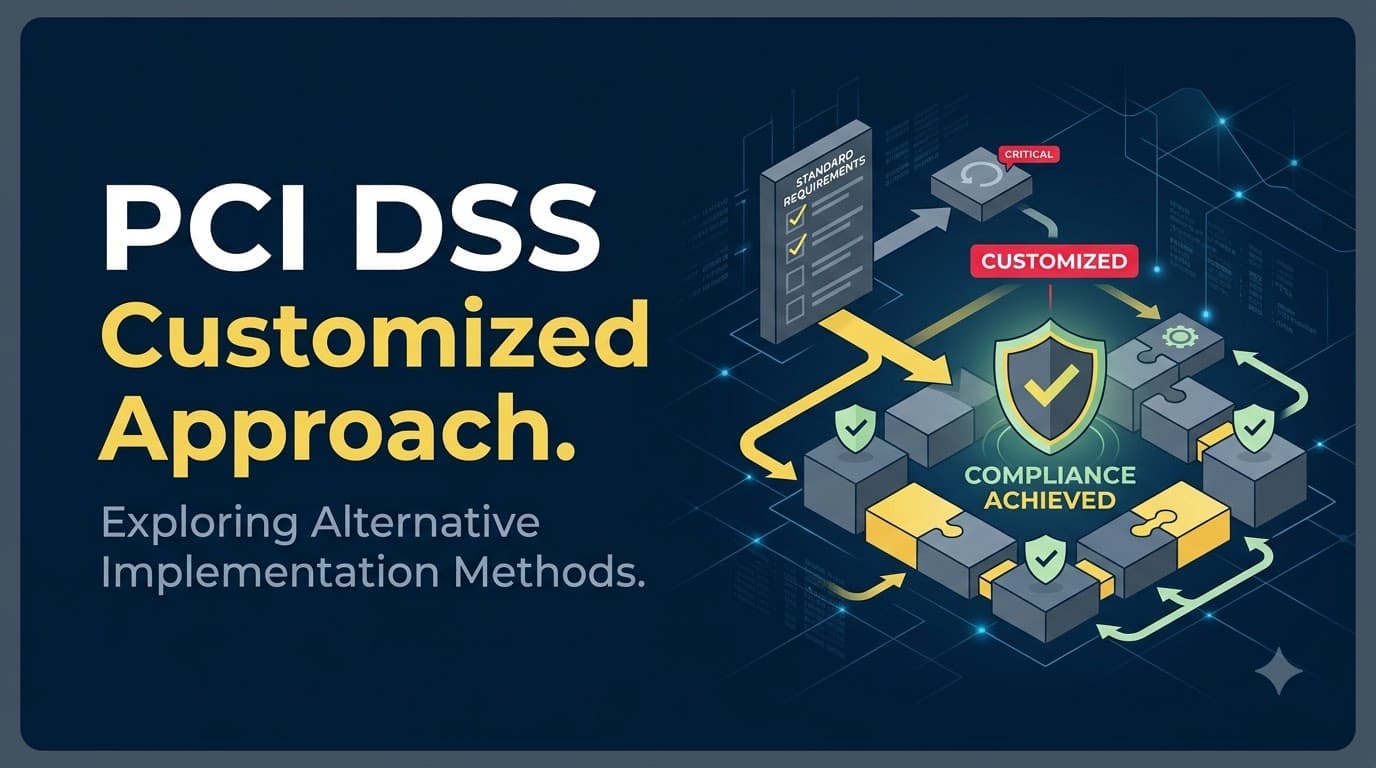
The customized approach is new to v4.0. Instead of implementing the letter of the requirement, an entity designs and implements its own control (or set of controls) that meets the requirement's stated Customized Approach Objective — a plain-language statement of the security outcome the requirement is trying to achieve, which the PCI Security Standards Council added to nearly every testable requirement in the v4.0 text specifically to make this option workable. If your control satisfies that objective, you have met the requirement, even though your control doesn't look anything like the defined method.
This is not a loophole and it is not a shortcut. It exists because the Council recognized that some organizations — particularly those with mature, well-resourced security programs — have already built controls that exceed the intent of a defined requirement using architecture the defined text never anticipated. The customized approach gives those organizations a formal, auditable way to get credit for that work instead of forcing them to bolt on a redundant, box-checking control alongside the one they already trust.
"The customized approach isn't 'do whatever you want and call it compliant.' It's 'prove, with the same rigor as a scientific hypothesis, that your alternative achieves the same result.' Most organizations that try it underestimate how much proof that actually takes." — Marcus Chen, Lead QSA, Ferrous Assurance Partners
Defined vs. customized vs. compensating controls
Before going further, it's worth nailing down all three mechanisms side by side, because they get conflated constantly — including by assessors who cut their teeth on pre-v4.0 versions of the standard.
Dimension | Defined approach | Customized approach | Compensating controls |
|---|---|---|---|
Introduced | Original standard (all versions) | PCI DSS v4.0 (2022) | PCI DSS v1.0–v3.2.1 legacy mechanism, still referenced |
What you implement | The requirement exactly as written | Your own control(s) meeting the stated objective | An alternative control offsetting an inability to meet the defined requirement literally |
Applies to | Any requirement | Most requirements (Appendix D identifies exceptions) | Only requirements where a legitimate technical/business constraint prevents literal compliance |
Testing basis | Standard's pre-written testing procedures | Assessor-derived procedures specific to your control | Compensating Controls Worksheet + assessor judgment |
Documentation burden | Standard evidence per requirement | Targeted risk analysis + controls matrix + assessor test documentation | Compensating Controls Worksheet (per requirement) |
Available via SAQ? | Yes | No — requires QSA/ISA-led assessment (ROC) | Yes, in principle, though rare in self-assessments |
Typical user | Any merchant/service provider | Mature, well-resourced entities with strong risk management | Any entity with a specific constraint (e.g., legacy system, third-party limitation) |
Assessor effort | Lower — checklist-style testing | Higher — assessor must design and validate testing | Moderate — worksheet-based justification |
Annual re-validation | Standard annual assessment | Full customized control re-tested + TRA refreshed at least annually | Worksheet reassessed annually |
Risk analysis required? | Only where the requirement itself calls for one | Always — a documented targeted risk analysis is mandatory | Not formally required, though good practice |
The single most important row in that table, for anyone weighing this decision, is validation path: the customized approach is not available to organizations validating via SAQ. If your business qualifies for a Self-Assessment Questionnaire, you are not eligible to use the customized approach for any requirement — full stop. It only exists within a QSA-led or ISA-led assessment that produces a Report on Compliance (ROC). That single constraint eliminates the customized approach as an option for the vast majority of small and mid-size merchants, which is one reason it hasn't seen wide adoption outside Level 1 merchants and large service providers.
What "meeting the objective" actually means
Every requirement in PCI DSS v4.0 that supports the customized approach carries a Customized Approach Objective statement directly under its defined requirement text. This is not marketing language or a restatement of the requirement — it's a precise, testable statement of intent. Take password/passphrase strength as an illustrative example: the defined approach specifies a minimum length and complexity combination. The corresponding objective is something like "ensuring that authentication credentials cannot be practically guessed or brute-forced within an operationally relevant time frame." An entity pursuing the customized approach doesn't have to hit the specific character-count threshold — it has to prove, empirically, that whatever mechanism it uses (adaptive authentication, phishing-resistant hardware tokens, continuous risk scoring, shortened credential lifetimes paired with anomaly detection) achieves that same resistance-to-guessing outcome.
This distinction — requirement vs. objective — is the entire hinge of the customized approach. Get it wrong, and everything downstream (risk analysis, controls matrix, assessor testing) falls apart, because you'll be trying to justify a control against the wrong target.
Concept | What it is | Where to find it | Common mistake |
|---|---|---|---|
Defined requirement text | The literal technical/procedural instruction | Requirement body (e.g., "8.3.6") | Treating it as optional once you go customized |
Customized Approach Objective | The underlying security outcome the requirement protects | Directly beneath the defined requirement in the v4.0 standard | Paraphrasing loosely instead of using the Council's exact objective language |
Applicability Notes | Council guidance on constraints, exceptions, or additional context | Adjacent to the requirement | Skipping these and missing an eligibility exclusion |
Customized Approach guidance (Appendix D) | High-level Council commentary on using the mechanism for that requirement | Appendix D of the standard | Assuming every requirement is eligible without checking |
Why the Council built this in
For twenty years, PCI DSS was famous — and occasionally infamous — for being prescriptive to the letter. That prescriptiveness was a feature: it gave assessors a bright line and gave smaller merchants a checklist they could follow without a security architecture team. But it also meant that organizations with genuinely superior, more adaptive security architectures got no credit for exceeding the intent of a rule if their implementation didn't match the letter. A bank running continuous behavioral risk scoring across every authentication event might, in effect, be far harder to compromise than one hitting a minimum password length — but under the old all-defined model, both were graded identically against the same static checklist.
v4.0's stated design goals were flexibility and a "business-as-usual" security posture, not a one-time audit exercise. The customized approach operationalizes that flexibility for a specific population: mature organizations that already run structured risk management, already produce evidence-grade documentation as part of normal operations, and already have the internal expertise (or budget for external expertise) to defend a bespoke control under assessor scrutiny.
"We built our fraud and authentication stack around real-time risk signals years before v4.0 existed. The customized approach was the first time PCI DSS actually let us show our assessor what we'd built instead of forcing us to bolt on something redundant just to check a box." — Devika Rao, Director of PCI Compliance, Meridian Processing
Not every requirement is eligible
A common and costly misconception is that the customized approach is a universal escape hatch available anywhere the defined text feels inconvenient. It isn't. The standard's Appendix D identifies which requirements support the customized approach and flags where it does not apply — generally requirements that are inherently procedural, governance-oriented, or already risk-analysis-driven by design, where there's no meaningful "alternative control" to substitute.
Requirement category | Customized approach generally available? | Why |
|---|---|---|
Technical/configuration controls (e.g., authentication strength, encryption implementation, malware protection mechanics) | Yes, for most | These have a clear technical objective a substitute control can target |
Logging and monitoring mechanics (what to capture, how to review) | Yes, for many | Objective-driven; alternative tooling/architecture can achieve the same detection outcome |
Purely administrative/documentation requirements (e.g., maintaining a policy, assigning a responsible owner) | Rarely applicable | There's no "alternative control" to a policy existing — you either have it or you don't |
Requirements that are themselves risk-analysis-based (e.g., certain frequency-setting requirements already tied to Requirement 12.3.1's targeted risk analysis) | Not applicable / redundant | Already flexible by design; a second layer of customization adds no value |
Requirements explicitly excluded by the Council in Appendix D | No | Council judgment that no reasonable alternative preserves the control intent |
Before your organization spends a single hour on a risk analysis, confirm eligibility directly against Appendix D and the specific requirement's Applicability Notes for the PCI DSS version in force. Guessing here wastes real money — I've seen assessment budgets burned on customized-approach documentation for a requirement that turned out to be defined-approach-only, discovered only after the QSA reviewed the package.
The targeted risk analysis: the load-bearing document
Requirement 12.3.2 is where the customized approach becomes concrete. It requires that for every requirement where an entity is using the customized approach, the entity performs and documents a targeted risk analysis (TRA) specific to that control. This is not the same as your organization-wide annual risk assessment — it's a narrow, purpose-built analysis of exactly one thing: does this specific customized control, in this specific environment, actually meet the stated objective?
A defensible TRA generally needs to address, at minimum, the following elements — and an assessor who can't find these elements documented will not be able to sign off on the customized control, no matter how good the control itself is.
TRA element | What it must establish | Typical evidence |
|---|---|---|
Asset/process/data in scope | Precisely what the control is protecting (systems, data flows, user populations) | CDE data-flow diagrams, asset inventory extract |
Threat(s) addressed | The specific threat(s) the customized control is designed to counter | Threat model, prior incident history, threat-intel references |
Likelihood and impact factors | What drives the probability and severity of the threat being realized | Historical incident data, control-maturity scoring, exposure analysis |
Resulting risk ranking | A documented risk rating reached through a defined, repeatable methodology | Risk scoring matrix, methodology document |
Rationale that the objective is met | The explicit logical/technical argument tying the control to the stated Customized Approach Objective | Control design documentation, architecture diagrams, test results |
Frequency of reassessment | How often the TRA itself will be refreshed | Governance calendar, policy reference |
Senior management review and sign-off | Documented accountability at an appropriate leadership level | Signed approval record, meeting minutes |
Notice that this table is a checklist an entity can build against directly — and I strongly recommend building it that way rather than starting from a blank page. Every TRA I've reviewed that got waved through cleanly by an assessor on the first pass had each of these seven elements as a distinct, labeled section. Every TRA that generated a round of assessor follow-up questions was missing at least one.
"I can tell within the first two pages whether a targeted risk analysis was written to actually inform a decision or written after the fact to justify one. The good ones read like they were used to build the control. The bad ones read like a term paper." — Elena Petrov, Lead QSA, Cascade Risk Advisory
The controls matrix: proving the mechanics
Alongside the TRA, the standard's Appendix E provides a template structure for a controls matrix — the document that maps your customized control directly to the requirement's objective and lays out, mechanically, how the control operates. Where the TRA argues why the control is sufficient, the controls matrix documents what the control actually is and does, in enough operational detail that an assessor can design a test for it.
Controls matrix field | Purpose | Example content (illustrative) |
|---|---|---|
Requirement number & Customized Approach Objective | Anchors the matrix to the exact requirement being addressed | "8.3.6 — Customized Approach Objective: authentication factors resist guessing/brute-force within an operationally relevant window" |
Description of the customized control | Plain description of what was built | "Adaptive risk-scoring authentication combining device fingerprinting, geo-velocity checks, and step-up FIDO2 challenge on anomaly" |
Identified risk(s) addressed | Direct link back to the TRA's threat findings | "Credential stuffing, brute-force login attempts against admin console" |
How the control meets the objective | The logical/technical bridge between control and objective | "Anomalous sessions trigger step-up authentication before any privileged action; static credential strength is de-emphasized in favor of continuous verification" |
Evidence to be examined | What the assessor will inspect to validate operation | Risk-engine configuration exports, step-up challenge logs, false-positive/negative rates |
Roles and responsibilities | Who builds, operates, and maintains the control | Identity engineering team; security operations for tuning |
Frequency of operation/review | How often the control runs and is reassessed | Continuous (real-time scoring); quarterly tuning review |
The controls matrix is the document your assessor will use to derive their own testing procedures — which is the single biggest practical difference between the customized and defined approaches from the assessor's chair, and worth its own section.
Documentation evidence you need in hand
Beyond the TRA and controls matrix themselves, expect your assessor to request a broader evidence package before they'll sign off on a customized control. Missing any of these is the single most common cause of delayed ROC timelines on customized-approach requirements.
Evidence item | Why the assessor needs it | Who typically owns it |
|---|---|---|
Targeted risk analysis (current version) | Core justification document required by 12.3.2 | Risk/compliance team |
Controls matrix (current version) | Maps control to objective; basis for test design | Control owner + compliance |
Architecture/design documentation for the control | Confirms the control operates as described | Security engineering |
Sample output/logs demonstrating operation | Confirms the control is actually running, not just designed | Control owner |
Senior management approval record | Confirms accountability per TRA requirements | Executive sponsor |
Prior period's customized-approach assessment results (if applicable) | Confirms continuity and tracks control drift over time | Compliance/QSA liaison |
Change history for the control | Shows the control hasn't materially changed without re-analysis | Change management / engineering |
Mapping of in-scope systems to the control | Confirms coverage completeness across the CDE | CDE/asset owner |
The assessor's job just got harder — and that's the point
Under the defined approach, an assessor works from testing procedures the Council already wrote. Under the customized approach, no such procedures exist — because your control doesn't exist in the standard's text. The assessor must derive their own testing procedures from your controls matrix and TRA, then execute that bespoke testing, then document their reasoning for why the procedures they designed are sufficient to validate the objective. This is materially more assessor work, and it shows up in both timeline and fee.
Activity | Defined approach | Customized approach |
|---|---|---|
Testing procedure source | Pre-written in the standard | Assessor must design from scratch per control |
Assessor documentation | Standard ROC reporting template answers | Standard ROC entries + custom test-derivation rationale + results |
Assessor expertise required | General PCI DSS assessor competency | Deep technical competency in the specific control's domain (e.g., risk-scoring engines, cryptographic architecture) |
Typical assessor hours per requirement | Baseline | 2–5x baseline, depending on control complexity |
Assessor sign-off risk | Lower — procedures are objective and standardized | Higher — assessor personally accountable for the sufficiency of a bespoke test |
QSA firm review/QA | Standard peer review | Often escalated to senior QSA or firm's technical review board |
This is exactly why customized-approach assessments cost more and take longer, and why not every QSA firm is equally comfortable taking them on. Ask a prospective QSA firm directly, before you commit to the customized approach for a given requirement, how many customized-approach assessments they've completed and in what technical domains. A firm with strong retail/hospitality PCI experience but no track record assessing adaptive-authentication architectures is not the right firm for Priya Anand's Requirement 8.3.6 problem, even if they're excellent generalists.
"Assessors don't get a shortcut just because the entity built something clever. If anything, we have to do more homework — we're the ones who have to explain, in writing, exactly why our test proves the objective was met. That accountability sits with us, not the client." — Tom Bramwell, Internal Security Assessor (ISA), Northgate Retail Group
SAQ vs. ROC: why this is a full-assessment-only mechanism
I flagged this earlier and it deserves its own dedicated treatment, because it's the fact that eliminates the customized approach for most organizations before any other analysis even starts. The customized approach requires assessor-derived testing and formal sign-off in a Report on Compliance. A Self-assessment questionnaire (SAQ) is, by design, a self-administered checklist without an independent assessor deriving bespoke test procedures — there is no mechanism within any SAQ type for an entity to self-attest that a customized control meets an objective, because nobody with the Council-recognized authority to validate that judgment is in the loop.
Validation path | Customized approach available? | Why |
|---|---|---|
SAQ A, A-EP, B, B-IP, C, C-VT (merchant) | No | Self-administered; no independent assessor to derive/validate bespoke testing |
SAQ D (merchant or service provider) | No | Still self-administered, even though it's the most extensive SAQ |
ROC via QSA (Level 1 merchants, most service providers) | Yes | Independent, credentialed assessor performs and documents bespoke testing |
ROC via ISA (internal assessor, where permitted) | Yes | ISA holds Council-recognized assessor status within their own organization |
P2PE Qualified Personnel-led validation | No (P2PE has its own defined structure) | Separate program with its own solution requirements |
Practically, this means: if your organization currently validates via any SAQ, the customized approach is not on the table today — full stop — unless and until you move to a QSA/ISA-led assessment producing a ROC. For some organizations sitting at the top of Merchant Level 2 or bottom of Level 1, that reality alone can tip the cost-benefit calculation against pursuing customized approach eligibility, because the cost of moving to a ROC-based assessment dwarfs whatever the customized control would have saved on a single requirement.
Compensating controls: the old mechanism, still with us
It's worth being precise about how compensating controls differ from the customized approach, because the two get mixed up constantly, including by people who've worked with PCI DSS for years under earlier versions. Compensating controls predate v4.0 by nearly two decades. They exist for a narrower, more defensive purpose: an entity has a legitimate technical or documented business constraint that prevents it from meeting a defined requirement literally, and it puts an alternative control in place specifically to offset that inability, with the burden of proof falling on demonstrating the constraint is real and the alternative sufficiently mitigates the associated risk.
Attribute | Compensating controls | Customized approach |
|---|---|---|
Starting premise | "We can't meet the defined requirement due to a constraint" | "We choose to meet the objective a different way, by design" |
Framing | Defensive/remedial — justifying a gap | Proactive/architectural — an intentional design decision |
Documentation instrument | Compensating Controls Worksheet | Targeted risk analysis + controls matrix |
Available via SAQ | Yes, in principle | No |
Typical trigger | Legacy system, vendor limitation, transitional state | Mature security architecture exceeding the requirement's intent |
Assessor posture | Evaluates whether the constraint is genuine and the alternative sufficient | Derives original testing to validate the objective is independently met |
Expected duration | Often intended as temporary/until the constraint is resolved | Can be a stable, long-term architectural choice |
Council's framing | Exception-handling mechanism | A first-class, permanent alternative implementation path |
The practical rule of thumb I give clients: if you're reaching for a compensating control because something is broken, outdated, or blocked by a third party, you're in compensating-control territory. If you're reaching for the customized approach because you've built something genuinely better than the defined method and want formal recognition for it, that's a fundamentally different conversation — and a much bigger documentation lift.
Deciding whether the customized approach is right for you
None of this is worth pursuing reflexively. The customized approach carries real cost — TRA development, controls matrix authorship, increased assessor fees, and ongoing annual re-validation — and it only pays off under specific conditions.
Signal | Favors customized approach | Favors defined approach |
|---|---|---|
Validation path | Already validating via QSA/ISA-led ROC | Validating via SAQ |
Security program maturity | Established risk management function, documented methodologies, senior sign-off processes already in place | Risk management is ad hoc or nonexistent |
Existing control sophistication | Already operating a control that exceeds the defined requirement's intent but doesn't match its literal form | No existing alternative control; defined requirement is straightforward to implement |
Cost of literal compliance | Very high (legacy replatform, vendor incompatibility, major architecture change) | Low-to-moderate; implementing the defined control is routine |
Internal documentation capability | Team can produce assessor-grade TRA and controls-matrix documentation | Limited internal capacity for bespoke risk-analysis documentation |
Assessor relationship | QSA/ISA firm has demonstrated customized-approach experience | No assessor relationship with relevant technical depth |
Time horizon | Control is intended as a durable, multi-year architectural choice | Requirement change is one-time or short-term |
Number of in-scope requirements affected | One or a small handful of specific, high-value requirements | Broad — customization across many requirements multiplies documentation burden disproportionately |
A useful gut check: the customized approach almost always makes more sense for a small number of specific, high-friction requirements (often authentication strength, certain monitoring/detection mechanics, or specific cryptographic implementation details) than as a blanket strategy applied broadly across the standard. I have never seen an organization successfully — or sensibly — customize its way through more than a handful of requirements in a single cycle; the documentation and assessor-derivation overhead scales in a way that erodes the cost savings fast.
flowchart TD
    A[Requirement under review] --> B{Does Appendix D permit\ncustomized approach here?}
    B -- No --> C[Use defined approach]
    B -- Yes --> D{Do you validate via SAQ?}
    D -- Yes --> C
    D -- No, QSA/ISA-led ROC --> E{Do you already have an\nalternative control exceeding\nthe stated objective?}
    E -- No --> C
    E -- Yes --> F{Can you produce a\ndefensible targeted risk\nanalysis + controls matrix?}
    F -- No --> G[Build capability first,\nor use compensating controls\nif a genuine constraint exists]
    F -- Yes --> H{Is the cost/effort of literal\ndefined-approach compliance\nsignificantly higher than\ncustomized documentation + assessor fees?}
    H -- No --> C
    H -- Yes --> I[Pursue customized approach:\nengage QSA/ISA early,\nfinalize TRA + controls matrix,\nassessor derives testing]
Case study: Solstice Commerce and the authentication rebuild that wasn't
Returning to Priya Anand's story with the full mechanics now on the table: Solstice's authentication platform for its checkout, admin console, and merchant-support portal ran on infrastructure that could technically be configured for longer static passwords, but doing so broke session-handling logic used by a critical third-party fraud-scoring integration the company depended on for chargeback mitigation. Rebuilding that integration was the $2.1 million, fourteen-month estimate.
Instead, Priya's team documented that Solstice already operated a risk-adaptive authentication layer — device fingerprinting, geo-velocity anomaly detection, and mandatory FIDO2 step-up challenges triggered on any anomalous session signal — across all in-scope systems. Working with Ferrous Assurance Partners as QSA, the team built a targeted risk analysis identifying credential-stuffing and brute-force login as the specific threats in scope, documented the likelihood/impact factors (drawing on eighteen months of internal fraud-engine telemetry), and produced a controls matrix mapping the adaptive-authentication architecture directly to Requirement 8.3.6's Customized Approach Objective. Marcus Chen's team derived testing procedures examining step-up challenge logs, false-negative rates on the anomaly engine, and a sample of high-risk login events to confirm the control fired as designed.
Metric | Defined-approach path (rejected) | Customized-approach path (taken) |
|---|---|---|
Estimated cost | $2.1 million | ~$180,000 (TRA, controls matrix, assessor fees) |
Estimated timeline | 14 months | 12 weeks |
Fraud-scoring integration | Would have required full rebuild | Untouched |
Requirement 8.3.6 outcome | N/A (not pursued) | Customized approach validated, documented in ROC |
Ongoing annual cost | N/A | TRA refresh + assessor re-test each cycle |
The customized approach didn't make Solstice's security posture "cheaper compliance theater" — if anything, the adaptive-authentication control it already had in place was arguably stronger than the static password rule it replaced on paper. What the customized approach gave Priya was a legitimate, auditable way to get PCI DSS credit for the control her team had already built, instead of forcing a redundant and expensive rebuild solely to satisfy a literal text match.
Case study: Meridian Processing and the segmentation-testing frequency question
Devika Rao's team at Meridian Processing — a mid-size payment processor — faced a different kind of decision. Meridian had historically used a compensating control to justify a reduced frequency of internal penetration testing against a legacy segment of its network that a third-party platform vendor controlled and refused to open for more frequent third-party testing windows. That compensating control had been renewed, somewhat uncomfortably, for three assessment cycles running.
Rather than continue renewing a compensating control built on a vendor constraint that showed no sign of resolving, Meridian's team evaluated whether a customized approach made more sense for the underlying monitoring objective. They built continuous, automated segmentation-validation tooling — verifying, in near-real-time rather than via periodic manual testing, that the segmentation controls between the vendor-controlled segment and the CDE remained intact. Working with an ISA-led internal assessment (Tom Bramwell's team), Meridian produced a TRA showing that continuous automated validation reduced the actual window of undetected segmentation failure well below what the defined periodic-testing schedule would have caught, and a controls matrix mapping the automated tooling to the requirement's monitoring objective.
Metric | Compensating control (prior state) | Customized approach (current state) |
|---|---|---|
Basis | Vendor won't permit frequent third-party testing | Continuous automated validation replaces periodic manual testing |
Assessor confidence | Renewed with reservations each cycle | Positively validated against explicit objective |
Detection window for segmentation failure | Bounded by periodic testing interval | Near-real-time |
Long-term sustainability | Fragile — dependent on vendor's ongoing refusal | Durable — architecture-based, not constraint-based |
Assessor documentation effort | Worksheet-based justification, annually | TRA + controls matrix + derived testing, refreshed annually |
This case illustrates something important: sometimes the right move isn't choosing customized approach over defined approach from a blank slate — it's recognizing that a long-running compensating control built on a constraint that isn't actually resolving is a candidate for conversion into a durable customized-approach control, if the underlying capability genuinely exceeds the requirement's objective.
Common pitfalls
I've now reviewed customized-approach packages that sailed through review and ones that generated months of back-and-forth with assessors before either passing or getting abandoned in favor of the defined approach. The failure patterns repeat.
Pitfall | Why it happens | How to avoid it |
|---|---|---|
Treating the objective as optional guidance rather than the actual target | Teams draft the TRA around the defined requirement instead of the stated objective | Anchor every TRA section explicitly to the Council's Customized Approach Objective language |
Skipping the Appendix D eligibility check | Assumption that customized approach is universally available | Verify eligibility for every specific requirement before starting documentation |
Writing the TRA after the control was already built and approved internally | Retrofitted risk analyses read as justification, not analysis | Build the TRA as part of the control's original design process, not after the fact |
No senior management sign-off on the TRA | Overlooked because it feels like a formality | Route every TRA through a named executive approval step, documented |
Underestimating assessor hours/fees | Teams budget as if customized = defined-approach effort | Get a specific customized-approach fee quote from the QSA/ISA before committing |
Pursuing customized approach while validating via SAQ | Misunderstanding of eligibility rules | Confirm validation path first — this alone rules most entities out immediately |
Customizing too many requirements at once | Underestimating how documentation burden compounds | Limit customization to a small number of genuinely high-value requirements per cycle |
Confusing compensating controls with the customized approach | Legacy familiarity with the older mechanism | Use the comparison table above; ask "are we justifying a gap or proving a better design?" |
Letting the customized control drift without re-analysis | TRA and controls matrix go stale as the control evolves | Tie control-change management to mandatory TRA refresh triggers |
Assuming one QSA's sign-off transfers automatically to next year's assessor | Bespoke testing isn't standardized across firms | Maintain thorough documentation so any qualified assessor can independently re-derive testing |
Pros and cons, honestly
Pros | Cons |
|---|---|
Gets formal PCI DSS credit for genuinely superior existing controls | Requires QSA/ISA-led ROC — unavailable to SAQ-validating entities |
Can avoid extremely expensive literal-compliance rebuilds (legacy system replacement) | Significantly higher documentation burden (TRA + controls matrix) than defined approach |
Encourages architecture-driven, adaptive security rather than static checklist compliance | Higher assessor fees and hours, since procedures must be derived from scratch |
Can convert a fragile, constraint-based compensating control into a durable, design-based control | Ongoing annual re-validation and TRA refresh add recurring cost |
Signals security program maturity to acquirers, card brands, and enterprise customers | Assessor sign-off risk is higher; not every QSA firm is equally equipped |
Flexible enough to accommodate genuinely novel security architecture | Easy to misuse if teams treat it as a shortcut rather than a rigorous alternative |
Reinforces v4.0's "business-as-usual" security philosophy | Overuse across many requirements can make an assessment slower and more expensive than the defined path |
Cost and timeline considerations
Cost/timeline driver | Defined approach | Customized approach |
|---|---|---|
Initial documentation effort | Standard evidence collection | TRA authorship + controls matrix + supporting evidence package |
Assessor scoping call | Standard | Extended — assessor must understand the bespoke control before quoting |
Assessor fee premium (typical range, illustrative) | Baseline | +20%–60% for affected requirements, depending on complexity |
Internal team time | Moderate | Substantial — often requires security engineering, risk, and legal/compliance input jointly |
First-cycle timeline impact | None beyond standard scheduling | Add 4–12 weeks for TRA/controls matrix development before assessment fieldwork |
Ongoing annual cost | Standard annual reassessment | Standard reassessment + TRA refresh + control re-testing each year |
Break-even point (illustrative) | N/A | Typically favorable only when literal defined-approach compliance costs exceed customized documentation/assessment premium by a wide margin |
Governance: who should actually own this decision
Because the customized approach touches architecture, risk management, legal exposure, and assessor relationships simultaneously, it shouldn't be a unilateral call by any single function. I recommend a lightweight, explicit RACI before any TRA drafting begins.
Role | Responsibility |
|---|---|
CISO / Head of Security | Accountable for the overall decision to pursue customized approach for a given requirement |
Security architecture/engineering | Responsible for designing and documenting the customized control itself |
Risk/compliance team | Responsible for authoring the targeted risk analysis and controls matrix |
Senior executive sponsor (e.g., CIO, CFO for cost-justification cases) | Accountable for formal sign-off on the TRA, per Requirement 12.3.2 |
QSA/ISA | Consulted early on feasibility; ultimately responsible for deriving and executing testing |
Legal/contracts | Consulted where third-party or vendor constraints intersect with the decision |
Internal audit (where applicable) | Informed, periodically validates that TRA refresh cadence is being honored |
Skipping the executive-sponsor sign-off step is the single most common governance gap I see — teams treat it as paperwork rather than as the accountability mechanism the standard actually intends it to be.
Requirements where the customized approach shows up most in practice
While eligibility should always be confirmed against the current standard text and Appendix D rather than assumed from prior cycles, certain categories of requirements are where I've most often seen organizations seriously evaluate — and sometimes pursue — the customized approach, because the underlying objective lends itself well to architectural substitution.
Requirement area (illustrative category) | Typical defined-approach mechanism | Typical customized-approach substitute organizations explore |
|---|---|---|
Authentication strength (e.g., 8.3.x family) | Fixed minimum password length/complexity | Adaptive/risk-based authentication, phishing-resistant factors, continuous session verification |
Account lockout / brute-force resistance (e.g., 8.4.x family) | Fixed lockout threshold and duration | Behavioral anomaly detection with dynamic response |
Cryptographic key rotation cadence (e.g., 3.6.x/3.7.x family) | Fixed rotation schedule | Risk-based rotation tied to key-usage telemetry and exposure monitoring |
Malware protection mechanics (Requirement 5 family) | Traditional signature-based AV on a defined schedule | Modern Endpoint detection and response (EDR)/behavioral detection architectures |
Log review frequency/mechanics (Requirement 10 family) | Fixed daily review cadence | Automated, continuous SIEM-driven correlation and alerting |
File integrity monitoring specifics (file integrity monitoring (FIM)) | Defined baseline-comparison mechanics | Behavioral/AI-assisted change-detection tooling |
None of these should be read as "pre-approved" substitutions — every one still requires its own TRA, controls matrix, and assessor-derived testing. They're listed to give a sense of where the conversation tends to start, not a menu to pick from without analysis.
"The requirements where customized approach gets used successfully are almost always ones where the technology landscape has genuinely moved past what the defined text envisioned. Authentication is the clearest example — risk-based auth wasn't mainstream when a lot of the defined language was drafted." — Sana Farooqi, Risk Manager, Solstice Commerce
Readiness checklist before you commit
Readiness item | Status needed before proceeding |
|---|---|
Validation path confirmed as QSA/ISA-led ROC | Confirmed, not assumed |
Appendix D eligibility confirmed for the specific requirement | Confirmed in writing |
Existing alternative control already operating (not hypothetical) | In production, with operational history/telemetry |
Internal capability to author TRA + controls matrix | Staffed and scoped |
Executive sponsor identified for TRA sign-off | Named individual, not "leadership" generically |
QSA/ISA firm with relevant technical depth engaged | Scoping call completed, fee quote received |
Annual refresh cadence and ownership defined | Documented in governance calendar |
Fallback plan if customized approach isn't validated | Defined-approach implementation timeline held in reserve |
That last row matters more than it might seem. Every serious customized-approach initiative I've advised on kept a defined-approach fallback plan alive in parallel until the assessor's testing was actually complete — because an assessor's inability to validate a bespoke control at the eleventh hour is not the moment you want to discover you have no Plan B before your assessment deadline.
The strategic opportunity, not just the compliance mechanics
It's easy to treat the customized approach purely as a technical compliance decision, but for organizations with the maturity to use it well, it's also a genuine differentiator. Being able to walk into a QSA engagement with a documented targeted risk analysis, a controls matrix mapping bespoke architecture to stated security objectives, and an assessor-validated result signals something to acquirers, enterprise customers, and card-brand relationship managers that a checklist-driven defined-approach ROC alone doesn't: that security decisions inside the organization are being made deliberately, with accountability and evidence, rather than reactively, to satisfy an auditor. For organizations selling into enterprise or regulated verticals where prospective customers scrutinize security posture as part of procurement, that signal has real commercial value well beyond the PCI DSS assessment itself.
The organizations that get the most out of this aren't the ones chasing every possible requirement for customization — they're the ones that identify the two or three requirements where their existing architecture is genuinely ahead of the defined text, invest properly in the TRA and controls matrix, and let the rest of their program run on the defined approach without complicating it unnecessarily. Treat the customized approach as a scalpel for specific, high-value friction points, not as a wholesale compliance strategy, and it earns its cost every time.
If your organization is weighing this decision right now, start where Priya Anand's team started: confirm your validation path, pull Appendix D for the specific requirement in question, and have an honest conversation with your QSA about whether what you've already built can actually be proven to meet the objective — before you assume a costly rebuild is your only option.
Ready to map out whether the customized approach fits your environment? PentesterWorld's PCI DSS Gap Analysis Tool can help identify which requirements are candidates for an alternative implementation path, and our PCI DSS Policy Pack includes documentation scaffolding for targeted risk analyses and controls matrices to get your team started without building from a blank page.
For the broader context this article builds on, see our PCI DSS Complete Guide for the full standard overview, our breakdown of PCI DSS 4.0's new requirements and implementation timeline for how the customized approach fits into the broader v4.0 transition, and our guide to PCI DSS testing procedures and validation methods for how assessors approach testing under both the defined and customized approaches.