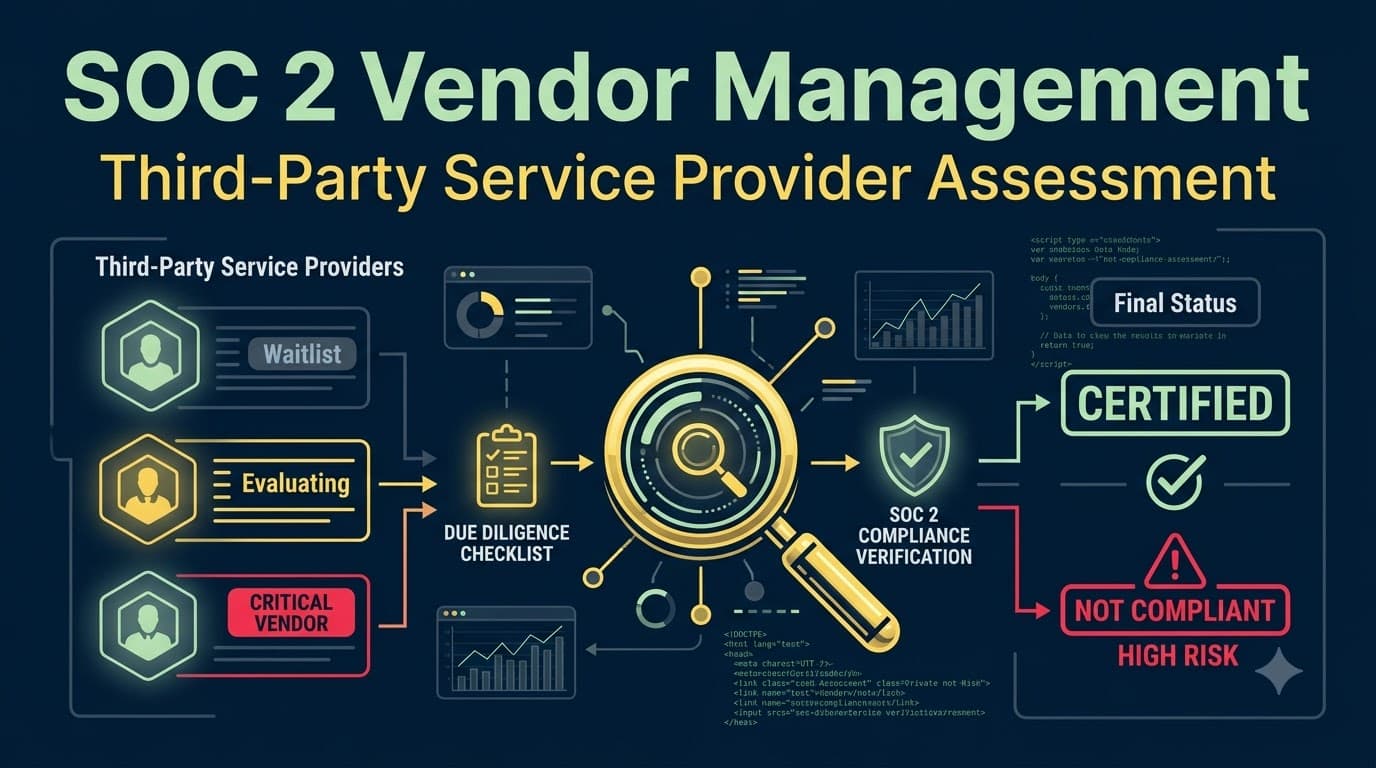
Maria Delgado had eleven days to save a $3.1 million contract.
She was VP of Compliance at Northwind Payroll, a mid-market payroll and benefits platform serving about 900 employers. Northwind was three weeks from closing its largest deal ever — a regional bank that wanted to white-label Northwind's payroll engine for its small-business customers. The bank's own vendor risk team had sent over a due-diligence packet, and buried in section four was a request Maria hadn't fully prepared for: "Provide evidence of your organization's third-party risk management program, including review of subservice organizations' SOC 2 reports and any identified complementary user entity controls (CUECs) or complementary subservice organization controls (CSOCs)."
Northwind had a SOC 2 Type II report of its own — clean, unqualified, two years running. What it didn't have was a documented answer to a simple question: who are our vendors, how risky is each one, and what have we actually verified about them? Northwind used a KYC/identity-verification vendor called Veridex to screen new employer accounts, a cloud infrastructure provider, a document-generation API for W-2s and 1099s, and about thirty smaller tools nobody had ever formally assessed. When Maria pulled Veridex's file, she found a SOC 2 report that had expired fourteen months earlier and no record that anyone had ever read the CUEC section. Her own auditor, during the most recent Type II examination, had noted vendor management as an area to "watch" under CC9.2 — a soft flag Maria had filed away and never acted on. Now a bank's procurement team was asking the same question with $3.1 million attached to the answer.
This article is the program Maria built over the following ten weeks — and the one I've helped roughly forty service organizations of every size stand up over fifteen years of SOC 2 readiness and audit-support work. Vendor management is one of the most commonly under-built parts of a SOC 2 program because it sits at the intersection of security, procurement, and legal, and none of those three groups feel fully responsible for it. Auditors have gotten sharper about testing it. Customers — especially regulated ones — have gotten far more aggressive about asking for it. And the honest truth is that most of your actual data-handling risk doesn't live inside your own walls anymore; it lives inside the twenty, fifty, or two hundred vendors your system quietly depends on.
Who This Is For / What You'll Walk Away With
This is written for compliance leads, GRC managers, security engineers, and founders who are building or rebuilding a vendor risk program ahead of a SOC 2 audit — whether this is your first Type I or your fifth Type II renewal. You'll walk away with a concrete method for inventorying vendors, a defensible tiering model auditors recognize, a due-diligence checklist that includes how to actually read a subservice organization's SOC 2 report (including the CUEC and CSOC sections most people skim past), contract clause language, a reassessment cadence by tier, and templates you can adapt the same week you read this. We'll also flip the lens: your organization is somebody else's vendor too, and the same discipline applies in reverse.
Why Vendor Management Lives Inside CC9.2
The Trust Services Criteria don't have a standalone "vendor management" criterion — they fold it into CC9: Risk Mitigation, specifically CC9.2, which addresses risk assessment and mitigation activities related to vendors and business partners. CC9.2 sits alongside CC9.1 (business disruption risk mitigation) inside the broader Common Criteria that map back to the COSO framework's internal-control principles. In plain language, CC9.2 asks: does the organization identify, assess, and manage the risk that its vendors and business partners introduce, and does it do so on an ongoing basis rather than once at signing?
Auditors testing CC9.2 typically want to see four things: a current inventory of vendors with access to in-scope systems or data, a documented method for assessing vendor risk, evidence that higher-risk vendors received deeper diligence, and evidence of periodic reassessment. None of this requires exotic tooling — a well-maintained spreadsheet with a documented process beats an expensive platform nobody updates. What auditors are actually testing is whether vendor risk is a managed process or an afterthought.
CC9.2 Point of Focus (Illustrative) | What It Means in Practice | Typical Evidence Auditors Request |
|---|---|---|
Establishes requirements for vendor and business partner engagements | Vendor risk criteria exist before contracts are signed | Vendor onboarding policy, procurement checklist |
Assesses vendors and business partners against requirements | Risk is scored, not assumed | Risk tiering worksheet, due-diligence records |
Establishes procedures for terminating vendor relationships | Offboarding is planned, not improvised | Offboarding checklist, data-return confirmations |
Implements procedures for addressing issues identified | Findings from vendor reviews get tracked to closure | Vendor issue log, corrective action plans |
Periodically evaluates vendor and business partner performance | Assessments aren't one-time | Reassessment calendar, renewed SOC 2 report tracking |
"The single most common CC9.2 exception I write is 'inventory exists but is incomplete or unmaintained.' Not 'no program.' A program that half-covers your vendor landscape is often riskier than having none, because it gives everyone false confidence." — Tom Reyes, Audit Partner, Kessler & Vance CPAs
Vendor, Subservice Organization, or Subprocessor — Know the Difference
Before you can build an inventory, you need shared language, because these three terms get used interchangeably and shouldn't be. A vendor is any third party you pay for goods or services. A subservice organization is a specific SOC 2 concept: a vendor whose controls are relevant to the criteria in your SOC 2 report because it performs functions that are part of the system you're describing to your auditor — think a cloud hosting provider, a payment processor, or an identity-verification service embedded in your product. A subprocessor is a privacy/data-protection term (most familiar from GDPR) for any vendor that processes personal data on your behalf. The three categories overlap heavily but aren't identical — your payroll provider for internal HR is a vendor but almost never a subservice organization; your cloud database provider is usually both a subservice organization and a subprocessor.
Category | Definition | SOC 2 Relevance | Example |
|---|---|---|---|
Vendor (general) | Any third party providing goods/services | Only relevant if it touches in-scope systems/data | Office supplies vendor — usually out of scope |
A vendor performing functions relevant to your Trust Services Criteria | Directly in scope for CC9.2 and system description | Cloud infrastructure provider, payment processor | |
Subprocessor | A vendor processing personal data on your behalf | Relevant to privacy/confidentiality criteria and data protection addenda | Email delivery service, analytics vendor |
Critical infrastructure vendor | A subservice organization your system cannot function without | Highest tier — often carved into the system description | Primary cloud provider, DNS/CDN provider |
Fourth party | A vendor's own vendor | Indirect exposure — rarely visible without asking | Your cloud provider's subcontracted data center operator |
Getting this distinction right matters because it determines how deep your due diligence needs to go. Every subservice organization is a vendor, but not every vendor is a subservice organization — and your auditor cares most about the ones that are.
Building the Vendor Inventory
You cannot tier, assess, or monitor what you haven't inventoried. The single highest-leverage thing Maria did in week one at Northwind was pull every vendor with a signed contract, every SaaS tool with an admin login, every API integration in the codebase, and every line item on the finance team's accounts-payable export — then reconcile all four lists into one. She found sixty-one distinct vendors; finance's contract list alone had missed nineteen of them, mostly free-tier or credit-card-expensed tools engineering had signed up for directly.
A usable inventory needs more than a vendor name. At minimum, capture what the vendor does, what data or systems it touches, whether it's a subservice organization, its risk tier, its last assessment date, and an owner — a specific human accountable for that vendor relationship, not "IT" or "the security team" as an abstraction.
Field | Purpose | Example Entry |
|---|---|---|
Vendor name & website | Identification | Veridex, Inc. |
Business owner | Accountable human, not a department | Maria Delgado, VP Compliance |
Function/service provided | What it actually does | Employer identity verification (KYC) |
Data/systems accessed | Scopes the risk | PII, employer tax IDs, API access to onboarding flow |
Subservice organization? (Y/N) | Determines SOC 2 relevance | Yes — carve-out method |
Risk tier | Drives diligence depth | Critical |
Contract start/renewal date | Ties diligence to lifecycle events | Renews annually, March 1 |
Last assessment date | Reassessment tracking | 14 months overdue at discovery |
Assurance artifact on file | What you actually reviewed | SOC 2 Type II (expired), CUEC list |
Data residency | Cross-border and regulatory relevance | US-East, US-West |
Termination/offboarding notes | Exit planning | 90-day data retention post-termination |
Once the inventory exists, treat it as a living document with an owner and a review cadence of its own — quarterly at minimum, tied to procurement and engineering change processes so new vendors don't slip in unassessed.
Vendor Risk Tiering: A Method That Holds Up to Audit
Not every vendor deserves the same scrutiny, and pretending otherwise is how vendor management programs collapse under their own weight — teams either over-invest in reviewing the office-plant delivery service or, more dangerously, under-invest in the vendor holding customer PII. A defensible tiering model scores vendors on a small number of consistent factors and produces a tier that drives diligence depth, contract requirements, and reassessment frequency.
Most mature programs land on three or four tiers. I recommend four, because collapsing "critical" and "high" into one bucket tends to under-resource your true crown-jewel vendors.
Tier | Definition | Example Vendor Types | Diligence Depth | Reassessment Cadence |
|---|---|---|---|---|
Critical | Subservice org; direct access to customer data or in-scope production systems; business-stopping if it fails | Cloud infrastructure, payment processor, identity verification | Full — SOC 2 report review, questionnaire, contract audit, security call | Annual, plus event-triggered |
High | Access to sensitive internal or customer data, but not core infrastructure | HR platform, CRM, support-ticketing tool with PII | SOC 2 report review or equivalent, questionnaire | Annual |
Medium | Limited data access, non-critical function | Marketing analytics, internal wiki, expense software | Lightweight questionnaire, public trust page review | Every 18–24 months |
Low | No sensitive data access, easily replaced | Office supplies, catering, non-integrated SaaS | Self-attestation or none | Ad hoc / on renewal |
"We used to tier vendors by contract value, which is backwards — a $200-a-month tool holding customer PII is a bigger risk than a $50,000-a-year vendor that never touches our data. Once we tiered by data access and system criticality instead, our whole due-diligence backlog reorganized itself in an afternoon." — Priya Chandrasekaran, Director of Third-Party Risk, Solstice Cloud
Scoring Inherent Risk Before You Tier
Tiers are the output; inherent risk scoring is the input. Inherent risk is the risk a vendor relationship presents before you account for the controls that vendor has in place — it's a function of what could go wrong given the nature of the relationship, not what safeguards exist. Score it first, then let due diligence and contract terms drive down residual risk.
A simple, defensible scoring model uses five to seven weighted factors, each scored low/medium/high, rolled into a composite that maps to your tiers.
Risk Factor | Low | Medium | High |
|---|---|---|---|
Data sensitivity accessed | Public/non-sensitive | Internal business data | Customer PII, PHI, financial/payment data |
Access to production systems | None | Read-only, limited scope | Administrative or write access |
System criticality | Nice-to-have tool | Supports a business process | System fails if vendor fails |
Data volume/scale | Small subset of records | Moderate customer subset | Entire customer base |
Regulatory exposure | None | Indirect | Direct (HIPAA, GLBA, PCI-adjacent) |
Subcontracting/fourth-party depth | None disclosed | One layer, disclosed | Multiple undisclosed layers |
Geographic/data residency factors | Same jurisdiction | Allied jurisdiction | Jurisdictions with weak data protection regimes |
Weight data sensitivity and system criticality most heavily — in practice, those two factors predict tier outcomes better than any others. Document the scoring rationale for each vendor, even briefly; "why is this vendor Critical and not High" is a question auditors and enterprise customers both ask, and "because I said so" doesn't survive a sample test.
Due Diligence Depth by Tier
Tiering only pays off if diligence effort actually scales with tier. I've reviewed vendor programs where every vendor — critical or not — got the identical six-question email, and others where a $30/month scheduling tool went through the same three-week review as the core cloud provider. Neither extreme is defensible; both waste the scarce time of whoever owns vendor risk.
Activity | Critical | High | Medium | Low |
|---|---|---|---|---|
Vendor security questionnaire | Full (60–100 questions) | Standard (30–50 questions) | Short (10–15 questions) | Not required |
SOC 2 / ISO 27001 report review | Required, full read including CUECs/CSOCs | Required if available | Reviewed if offered | Not required |
Contract security addendum | Mandatory, negotiated | Mandatory, standard terms | Standard terms, minimal negotiation | Standard terms only |
Penetration test summary request | Requested annually | Requested at onboarding | Not typically requested | Not requested |
Live security review call | Required at onboarding + annually | Required at onboarding | Optional | Not required |
Right-to-audit clause | Negotiated into contract | Preferred, not always obtained | Rarely pursued | Not applicable |
Insurance verification (cyber liability) | Required, coverage minimum specified | Required | Optional | Not required |
The point isn't bureaucratic completeness — it's proportionality your auditor and your customers can both follow. When a bank's procurement team asks Northwind "how do you assess your critical vendors," the answer needs to be more specific than "we send a form."
What "Due Diligence" Actually Means Beyond the Checklist
Due diligence in vendor risk isn't a single document — it's a defensible trail showing you looked before you leaned. For critical and high-tier vendors, that trail typically includes four layers: documentary evidence (the vendor's own attestations — SOC 2 report, ISO 27001 certificate, pen test summary), a structured questionnaire mapped to your own control framework, a conversation with someone at the vendor who can answer questions the documents don't (not just sales), and a documented risk decision — accept, require remediation, or decline — signed off by someone with the authority to make that call.
The mistake I see most often isn't skipping diligence; it's doing diligence and then not deciding anything. A questionnaire response sits in a folder, nobody reviews it against risk appetite, and six months later nobody could tell you whether the vendor passed, passed with conditions, or was never actually evaluated. Build the decision step into your workflow explicitly — a required sign-off field, a status of Approved / Approved with Conditions / Rejected / Pending Remediation — so due diligence produces an auditable outcome, not just an auditable pile of PDFs.
Reviewing a Vendor's SOC 2 Report — What to Actually Check
Here's where most vendor management programs go shallow. Someone requests the vendor's SOC 2 report, receives a fifty-page PDF, confirms it exists, files it, and moves on. That's not a review — that's a filing exercise. When Maria finally opened Veridex's report at Northwind, she found it wasn't just expired; even during its valid period, nobody had read past the cover letter.
A real SOC 2 report review works through the document in a specific order and asks specific questions at each stage. Start with the auditor's opinion: is it unqualified (clean), or qualified — and if qualified, does the exception touch a criterion that matters to your relationship with this vendor? Then check the report type: is this a Type I report (design only, a point-in-time snapshot) or a Type II report (operating effectiveness over a period, typically six to twelve months)? A Type I on a critical vendor is a yellow flag worth asking about. Then check the audit period dates — a report covering January through June of two years ago tells you nothing about the vendor's controls today; look for a current report or a bridge letter covering the gap.
Review Step | What You're Checking | Red Flag |
|---|---|---|
Auditor's opinion | Unqualified vs. qualified/adverse/disclaimer | Qualified opinion on a criterion relevant to your data |
Report type | Type I vs Type II | Type I only, on a Critical-tier vendor, with no Type II planned |
Audit period | How recent, how long | Period ended 12+ months ago with no bridge letter |
Scope / system description | What systems, locations, and services are covered | Your specific service isn't actually in scope |
Trust Services Criteria included | Security only, or Security + Availability/Confidentiality/Privacy | Criteria relevant to your use case (e.g., Privacy) excluded |
Exceptions/deviations noted | Any control that didn't operate as designed | Exceptions in access control or change management, unremediated |
Subservice organizations disclosed | Carve-out or inclusive method used | Critical fourth parties carved out with no further visibility |
CUEC section | What YOU must do for their controls to work | CUECs your organization isn't currently performing |
CSOC section (if carve-out) | What the vendor assumes ITS vendors are doing | Assumptions about a fourth party you've never heard of |
A report scope mismatch is one of the most common and most overlooked issues: a vendor may hand you a SOC 2 report that covers their platform broadly, while the specific product or environment you actually use isn't in the defined system boundary at all. Always confirm the report's system description names the service you're actually consuming.
Understanding CUECs When You're the User Entity
Every SOC 2 report — yours and your vendors' — includes a section of complementary user entity controls: controls the report explicitly assumes the customer (the user entity) is responsible for operating, because the service organization's own controls can't fully achieve the criteria without them. When you're reading a vendor's SOC 2 report, you are the user entity, and the CUEC list is a checklist of things you must be doing for that vendor's control environment to function as designed.
This is the step Northwind had never performed. Veridex's SOC 2 report — even before it expired — listed CUECs including "user entities are responsible for promptly notifying Veridex of terminated employee accounts requiring access revocation" and "user entities are responsible for configuring appropriate role-based permissions within the Veridex admin console." Nobody at Northwind had ever mapped those obligations to an internal owner or verified they were happening. That gap alone — regardless of Veridex's own control health — was a finding waiting to happen, because an auditor testing Northwind's own CC9.2 controls would reasonably ask, "you rely on this vendor's report; have you implemented the CUECs it assumes you're performing?"
Example CUEC From a Vendor's SOC 2 Report | Internal Owner Who Must Confirm This Happens | How You'd Evidence It |
|---|---|---|
Customer promptly revokes terminated employees' access to the vendor system | IT/Identity team | Offboarding checklist, access-removal tickets |
Customer configures role-based permissions appropriately within the vendor's console | System/application owner | Periodic access review records |
Customer reviews and approves data exports before they leave the vendor environment | Data owner | Export approval log |
Customer maintains its own encryption key management for data at rest in the vendor's environment | Security engineering | Key rotation and access logs |
Customer notifies the vendor of changes to authorized users or integrations | Vendor relationship owner | Change notification records |
Building a CUEC tracking sheet — one row per subservice organization, one column per CUEC, one column for internal owner and evidence — turns this from an abstract audit concept into an operational control you can actually test yourself before your auditor does. This is the mirror image of the discipline covered in SOC 2 Complementary Controls: Client Implementation Requirements, which addresses the CUECs your own customers must operate for your report.
CSOCs: What Your Vendor Assumes About Its Own Vendors
Complementary subservice organization controls are the mirror concept, one layer further down the chain. When a service organization uses the carve-out method to exclude its own subservice organizations from its SOC 2 report — the far more common approach — its system description will typically state which controls it assumes those subservice organizations are performing, even though they weren't tested as part of the report you're holding.
If Veridex's report notes it uses a third-party cloud data center and carves that provider out, the CSOC section might read something like "it is assumed the subservice organization maintains physical and environmental security controls over the data center facility, and network-layer security controls over the underlying infrastructure." That's a real gap in your visibility — you're trusting a control that was never independently tested in the document you're relying on. Well-run vendor programs push further at this layer for Critical-tier vendors: ask which subservice organizations are carved out, request evidence of their SOC 2 reports where feasible, and treat unverifiable fourth-party assumptions as a residual risk to document rather than ignore.
Concept | Who Performs the Control | Tested in the Report? | Your Action |
|---|---|---|---|
CUEC | You (the user entity) | No — assumed, not tested | Implement and evidence internally |
CSOC (carve-out) | The subservice organization (your vendor's vendor) | No — assumed, not tested by this auditor | Request the subservice org's own report if Critical-tier |
Inclusive-method testing | The subservice organization | Yes — tested as part of this report | Review directly, same as any in-scope control |
Carve-Out vs. Inclusive Method — Why It Changes Your Review
SOC 2 reports handle subservice organizations one of two ways. Under the carve-out method, the subservice organization's controls are excluded from the scope of testing, and the report only describes the complementary controls (CSOCs) assumed to be in place. Under the inclusive method, the subservice organization's controls are tested directly as part of the same examination and appear in the report's control testing results, usually because the service organization negotiated that level of access and cooperation with its subservice organization's auditor.
Carve-out is far more common — most cloud infrastructure providers, for instance, are carved out of their customers' SOC 2 reports because they undergo their own separate SOC 2 examinations and publish those independently. That's not a weakness in itself; it's the standard pattern. But it does mean your due diligence has two possible paths depending on the method used.
Factor | Carve-Out Method | Inclusive Method |
|---|---|---|
Subservice org controls tested in this report? | No | Yes |
What you review | The subservice org's own separate SOC 2 report | The controls as tested within the vendor's report itself |
Additional diligence needed | Yes — request and review the subservice org's own report | Generally no additional report needed |
Common use case | Cloud/infrastructure providers with many customers | Smaller or more tightly integrated subservice relationships |
Your CSOC obligation | Document and, where possible, verify the assumed controls | Minimal — already independently tested |
Practically: when you see a carve-out, your due diligence isn't done — it has just identified a second vendor (the subservice organization) that may also warrant its own tier and its own report review, particularly if it's Critical to your operations.
When a Vendor Won't Share Their SOC 2 Report
Not every vendor has a SOC 2 report, and not every vendor that has one will hand it over without friction — many treat it as confidential and require an NDA before release, or gate it behind a trust portal with watermarking and access logging. Smaller or earlier-stage vendors sometimes have no formal attestation at all. None of that should stop your diligence — it should redirect it.
Alternative Assurance Mechanism | What It Tells You | Limitations |
|---|---|---|
ISO 27001 certificate | Independently audited ISMS covering the same general domain | Different control set than SOC 2; verify the Statement of Applicability scope |
Signed under NDA via a trust portal | Full report access, gated | Requires legal turnaround time; log the NDA |
SOC 3 report | Public summary, no detailed test results | Far less detail than a SOC 2 — treat as a starting point only |
Penetration test executive summary | Point-in-time technical assurance | Not a substitute for ongoing control evidence |
Vendor security questionnaire (self-attested) | Vendor's own claims about its program | Unverified — weight accordingly, especially at Critical tier |
Public security/trust page | Marketing-level assurance | Lowest confidence; useful only for Low/Medium tier vendors |
Right-to-audit clause exercised directly | Your own team's direct findings | Resource-intensive; reserve for the highest-risk relationships |
For a vendor with zero formal assurance sitting at Critical or High tier, the honest options are: require them to complete a full questionnaire plus a live technical review call, negotiate a right-to-audit clause into the contract, or — if the risk genuinely can't be brought down to an acceptable level — decline the relationship or require them to pursue a formal attestation before go-live. I've walked clients through all three outcomes; which one is right depends entirely on how replaceable the vendor is and how sensitive the data at stake actually is.
Building a Vendor Security Questionnaire That Works
A good vendor questionnaire is short enough that vendors actually complete it and structured enough that answers map directly to your risk factors. The worst questionnaires I've reviewed are either fifteen generic yes/no questions that tell you nothing, or three-hundred-question monsters copied from a template that nobody — vendor or reviewer — reads in full. Build yours around eight to ten domains, scaled by tier, with room for the vendor to attach evidence rather than just check a box.
Questionnaire Domain | Sample Question | Why It Matters |
|---|---|---|
Governance & attestations | Do you hold a current SOC 2, ISO 27001, or equivalent attestation? | Establishes baseline assurance level |
Access control | Is multi-factor authentication enforced for all administrative access? | Directly relevant to CC6-series controls |
Data handling | Where is customer data stored, and is it encrypted at rest and in transit? | Data sensitivity and residency risk |
Subprocessors/subservice orgs | Do you use subcontractors with access to our data, and are they disclosed? | Fourth-party visibility |
Incident response | Do you have a documented incident response plan, and what are your breach notification timelines? | Determines contract SLA requirements |
Business continuity | What are your recovery time objective (RTO) and recovery point objective (RPO)? | Availability risk to your own operations |
Personnel security | Are background checks and security training required for staff with data access? | People-layer risk |
Change management | Is there a documented change management process for production systems? | Stability and control discipline |
Insurance | Do you carry cyber liability insurance, and at what coverage level? | Financial risk transfer |
Termination/offboarding | What is your data deletion and return process upon contract termination? | Exit and residual-data risk |
Score responses, don't just collect them. A simple weighted scorecard — even a basic 1–3 rating per domain — turns forty free-text answers into a number you can compare across vendors and defend to an auditor asking how you prioritize follow-up.
Contract Security Clauses That Actually Matter
Due diligence tells you what a vendor's controls look like today. Contract language is what gives you recourse when they change tomorrow. Legal teams often default to generic confidentiality boilerplate; security and compliance need a seat at that table specifically for vendors handling in-scope data, because the clauses that matter for SOC 2 purposes are more specific than "the vendor shall maintain reasonable security."
Clause | What It Should Cover | Why Auditors and Customers Look for It |
|---|---|---|
Data protection/security addendum | Specific control expectations (encryption, access control, retention) | Shows security requirements are contractually binding, not just aspirational |
Breach notification timeline | A defined number of hours/days to notify you of a confirmed incident | Feeds your own incident response obligations and customer commitments |
Right to audit / assessment | Your ability to request evidence or conduct a review | Backstops due diligence when self-attestation isn't enough |
Subcontractor/subprocessor flow-down | Vendor must impose equivalent obligations on its own subcontractors | Extends your control expectations down the chain |
Data return/destruction on termination | Defined process and timeline for returning or deleting your data | Closes the offboarding gap most programs miss |
Liability and indemnification | Allocates financial responsibility for a vendor-caused incident | Risk transfer, relevant to insurance planning |
Compliance certification maintenance | Vendor commits to maintaining its SOC 2/ISO 27001 status | Prevents silent lapses like the one Northwind found with Veridex |
Data residency/localization | Where data may and may not be stored or processed | Regulatory and contractual alignment |
"Security teams write beautiful questionnaires and then let procurement sign a contract with none of it in writing. A questionnaire answer isn't enforceable. A contract clause is." — Jake Whitfield, General Counsel, Northwind Payroll
None of this requires every vendor to accept every clause — smaller vendors and platform providers with take-it-or-leave-it terms of service will push back, especially on right-to-audit. Negotiate hardest on Critical-tier relationships, and know in advance which clauses are non-negotiable for your organization versus which ones you'll accept a compensating control for (like more frequent questionnaire refreshes in place of a right-to-audit clause you couldn't obtain).
The Vendor Onboarding Workflow, End to End
A vendor risk program only works if it's wired into the moment a new vendor actually enters the organization — not bolted on months later when someone remembers to ask. The workflow below is the version Northwind adopted, and it's close to what I recommend to most clients: a gate before contract signature, not after.
flowchart TD
    A[New vendor requested by any team] --> B{Touches in-scope<br/>data or systems?}
    B -- No --> C[Log as Low tier / no formal review]
    B -- Yes --> D[Inherent risk scoring]
    D --> E[Assign risk tier]
    E --> F{Critical or High tier?}
    F -- Yes --> G[Full due diligence:<br/>SOC 2/ISO report review,<br/>questionnaire, security call]
    F -- No --> H[Lightweight questionnaire<br/>or self-attestation]
    G --> I[Risk decision:<br/>Approve / Conditions / Reject]
    H --> I
    I -- Approve/Conditions --> J[Contract with security clauses]
    I -- Reject --> K[Vendor declined or remediation required]
    J --> L[Add to vendor inventory]
    L --> M[Ongoing monitoring +<br/>scheduled reassessment]
    M --> N{Contract ends or<br/>risk changes?}
    N -- Renewal --> D
    N -- Termination --> O[Offboarding: data return/destruction]
The gate that matters most is between the request and the contract signature. Once a vendor has production access and a signed contract, your leverage to negotiate security terms or walk away drops sharply — which is exactly why procurement, not just security, needs to know this gate exists.
Ongoing Monitoring and Reassessment Cadence
A due-diligence review performed once, at onboarding, has a shelf life. Vendors get acquired, change subprocessors, let certifications lapse, suffer breaches, or quietly change their architecture. Continuous monitoring of your vendor population — even lightweight monitoring — is what separates a program that catches a Veridex-style lapse in month two from one that catches it in month fourteen, during a customer's due-diligence review, the way Northwind did.
Reassessment cadence should track tier, not be uniform across the vendor population — reviewing your catering vendor with the same frequency as your cloud provider wastes effort that Critical-tier vendors need more of.
Tier | Reassessment Trigger | Typical Cadence | Minimum Activity |
|---|---|---|---|
Critical | Calendar-based + event-triggered | Every 12 months | Full report review, questionnaire refresh, contract review |
High | Calendar-based + event-triggered | Every 12 months | Report review (if available), questionnaire refresh |
Medium | Calendar-based | Every 18–24 months | Lightweight questionnaire, public trust page check |
Low | Contract renewal only | Ad hoc | Confirm no material change in data access |
Any tier | Event-triggered (breach, acquisition, cert lapse) | Immediate | Out-of-cycle review, risk re-scoring |
Event triggers matter as much as the calendar. Build a short list of events that force an out-of-cycle review regardless of tier: a publicly disclosed breach at the vendor, an acquisition or change of ownership, expiration of a SOC 2 or ISO 27001 certificate without a renewed one on file, a material change in the service (new subprocessor, new data flow, new hosting region), or a significant change in the volume or sensitivity of data you're sending them.
Signals and Sources for Continuous Monitoring
You don't need an expensive platform to build a monitoring habit, though platforms help at scale. A calendar of certificate expiration dates, a shared inbox subscribed to vendor status-page and trust-center updates, and a recurring reminder to check breach-notification and security-news feeds for vendor names will catch a meaningful share of the events that matter.
Monitoring Signal | Source | What It Catches |
|---|---|---|
SOC 2/ISO certificate expiration tracking | Internal calendar, GRC tool, or TPRM platform | Lapsed attestations before you rely on them |
Vendor trust portal / status page subscriptions | Vendor-provided | Incidents, downtime, policy changes |
Security ratings services | Third-party attack-surface scoring tools | External posture changes (open ports, expired certs, leaked credentials) |
Breach notification monitoring | News feeds, breach databases, vendor direct notification | Confirmed incidents affecting the vendor |
Financial/ownership change alerts | Procurement, public filings, news | Acquisitions that change data handling or jurisdiction |
Internal usage/access review | IAM/access control logs | Scope creep — a vendor gaining more access than originally approved |
Contract renewal calendar | Legal/procurement systems | Forces reassessment before auto-renewal |
The single cheapest control here is tying certificate and report expiration dates directly to your vendor inventory with an automated reminder sixty days out. Nearly every lapsed-attestation story I've seen in fifteen years of this work — including Veridex's — was preventable with nothing more sophisticated than a calendar reminder someone actually acted on.
Offboarding: The Step Most Programs Skip
Vendor risk doesn't end when a contract ends — it ends when the vendor no longer has your data or access, and you have evidence of that. Offboarding gets far less attention than onboarding because it isn't gated by anything; nobody blocks a business function from proceeding just because a vendor relationship quietly lapsed. That makes it the stage most likely to leave orphaned access and unreturned data sitting around indefinitely.
Offboarding Step | Owner | Evidence to Retain |
|---|---|---|
Revoke all vendor access to internal systems/accounts | IT/Security | Access-removal ticket or log |
Confirm data return or destruction per contract terms | Vendor relationship owner | Written confirmation from vendor |
Verify cryptographic erasure or deletion where applicable | Security engineering | Deletion certificate or attestation |
Remove vendor from active monitoring/reassessment calendar | Vendor risk owner | Updated inventory status |
Update system description / SOC 2 scope documentation if applicable | Compliance | Revised system description, auditor notification |
Archive due-diligence records for audit trail purposes | Compliance | Retained file, not deleted |
Close out any outstanding CUEC/contract obligations tied to that vendor | Compliance/Legal | Closure documentation |
Retain, don't delete, the historical record — a terminated vendor relationship still needs to be explainable to an auditor testing a period during which that vendor was active. Deleting the file the day the contract ends is a common and easily avoided mistake.
Fourth-Party Risk: Your Vendors' Vendors
Every vendor relationship you manage has its own shadow inventory underneath it — the subcontractors, subprocessors, and infrastructure providers your vendor relies on that you never directly contracted with. This is fourth-party risk, and it's the layer carve-out reports partially obscure through CSOCs. You can't run the same full due-diligence program two layers deep for every vendor — that's not realistic — but you can and should prioritize fourth-party visibility for your Critical-tier relationships.
Ask Critical-tier vendors directly, as part of onboarding and annual review, to disclose their own subprocessors and subservice organizations. Most vendors with a mature security program maintain a public subprocessor list for exactly this reason (a practice increasingly common thanks to GDPR-driven subprocessor disclosure requirements). Where a Critical-tier vendor's fourth party is itself effectively critical to your operations — say, the single cloud region your identity-verification vendor depends on — treat that fourth party as a named risk in your register, even without a direct contractual relationship, and factor its own public incident history and certification status into your risk view of the vendor sitting above it.
Governance: Who Owns What in a Vendor Risk Program
Vendor risk fails when it's "everyone's job," because everyone's job quietly becomes no one's job. A RACI model that names specific functions — not just "security" — keeps the program running when the person who built it changes roles.
Activity | Responsible | Accountable | Consulted | Informed |
|---|---|---|---|---|
Maintain vendor inventory | Vendor risk analyst/GRC | VP Compliance | Procurement, IT | Executive leadership |
Risk tiering and scoring | Vendor risk analyst/GRC | VP Compliance | Business owner of vendor | Security team |
SOC 2/ISO report review | Compliance/security analyst | VP Compliance | Auditor (as needed) | Vendor relationship owner |
Questionnaire distribution and scoring | Vendor risk analyst | VP Compliance | Vendor relationship owner | — |
Contract security clause negotiation | Legal | General Counsel | Security/Compliance | Procurement |
Risk acceptance decisions | VP Compliance / CISO | CEO or designated risk owner | Legal, business owner | Board (Critical-tier only) |
Ongoing monitoring | Vendor risk analyst | VP Compliance | IT/Security | Business owner |
Offboarding execution | IT/Security | Vendor relationship owner | Legal | Compliance |
Naming a single accountable role — even in a five-person company where that role wears four other hats — is the difference between a program and a folder of good intentions. Auditors ask "who owns this," and "the team" is not an answer that holds up.
You Are a Vendor Too: The Mirror Side of CC9.2
Every section above describes what you owe your own vendors. Flip the frame: to your customers, you are the subservice organization, and your own SOC 2 report is what they're supposed to be reviewing with the same rigor you just applied to Veridex. That symmetry is worth internalizing, because it reshapes how you write your own system description and CUEC section — and because it's frequently the actual origin of the pressure that gets a vendor management program funded in the first place, exactly as it was for Maria.
Your own report needs a clear, accurate CUEC list — not a boilerplate one copied from a template — describing precisely what your customers must do for your controls to function as designed. It needs an honest disclosure of your own subservice organizations, whether carved out or included. And increasingly, your enterprise customers will run you through the same questionnaire-and-report-review process described in this article, expecting the same evidentiary depth you'd expect from your own vendors. The organizations that handle this best treat their trust portal, their SOC 2 report, and their vendor-facing due-diligence packet as a coordinated product, not three disconnected artifacts assembled under deadline pressure. For the deeper mechanics of what belongs in your own system description and shared-responsibility boundary, see SOC 2 Common Controls: Shared Responsibility in Service Organizations.
Your Role | What You Owe | What You Should Expect From Customers |
|---|---|---|
As a customer of your vendors | Diligence, tiering, monitoring (this article) | — |
As a vendor to your customers | Accurate CUEC/CSOC disclosure, current SOC 2 report, responsive questionnaire process | Reasonable, risk-proportionate diligence — not every customer needs full report access for a Low-tier use case |
Common Auditor Findings in CC9.2 Testing
Across dozens of Type II examinations I've supported or reviewed, the same handful of CC9.2 exceptions recur. Knowing them in advance is the fastest way to self-audit before your actual auditor does.
Common Finding | Root Cause | Fix |
|---|---|---|
Vendor inventory incomplete or inconsistent with actual vendor population | No reconciliation against finance/procurement/IT records | Quarterly cross-check against accounts-payable and SSO-connected app lists |
No documented risk-tiering methodology | Tiering done informally or inconsistently | Written policy with scoring criteria, reviewed annually |
SOC 2 reports on file are expired | No expiration tracking | Automated reminders tied to inventory |
CUECs never mapped to internal owners | CUEC section read but not operationalized | CUEC tracking sheet with owner and evidence per subservice org |
No evidence of periodic reassessment | Review happened once, at onboarding only | Reassessment calendar tied to tier |
Contracts lack security clauses | Legal and security processes disconnected | Standard security addendum template, mandatory for Critical/High tier |
No documented risk-acceptance decision | Diligence performed but no formal sign-off | Required approval workflow with named decision-maker |
Offboarding not evidenced | No process triggers offboarding at contract end | Offboarding checklist tied to contract-termination workflow |
"By the time I'm sampling vendor files in fieldwork, I'm not looking for perfection — I'm looking for a consistent process I can trust extends to the vendors I didn't sample. One well-documented file and forty gaps tells me the program exists on paper only." — Tom Reyes, Audit Partner, Kessler & Vance CPAs
What Auditors Actually Sample and Ask For
When your own SOC 2 examination reaches fieldwork, your auditor will pull a sample of vendor files — not all sixty-one at Northwind, but enough to draw a defensible conclusion about the whole population, following the same audit sampling logic they apply to any other control. Knowing what a sampled file needs to contain lets you self-test before the request lands in your inbox, a discipline covered in more depth in SOC 2 Evidence Collection: Documentation and Testing Requirements.
Auditor Sample Item | What Should Be in the File |
|---|---|
Vendor risk tier assignment | Score/rationale, date assigned |
Due-diligence artifacts | Questionnaire, SOC 2/ISO report reviewed, reviewer notes |
Contract | Security addendum, signature, effective date |
Risk acceptance decision | Approver, date, conditions if any |
Reassessment history | Dates, outcomes |
CUEC mapping (if subservice org) | Owner, evidence |
Offboarding record (if terminated) | Access removal, data-return confirmation |
If your auditor pulls a vendor file and any row in that table is blank, expect a question — and if the answer is "we didn't document that one," expect a finding under the same SOC 2 Exception Management: Handling Control Deficiencies process that governs any other control gap.
Case Study: Northwind Payroll's 90-Day Turnaround
Maria's ten-week sprint became a permanent program. Within ninety days, Northwind had reconciled its vendor list to sixty-one confirmed vendors, tiered them (eight Critical, fourteen High, twenty-two Medium, seventeen Low), and completed full due diligence on every Critical and High-tier relationship. Veridex's Type II report was renewed, its CUEC list mapped to five internal owners with documented evidence, and a security addendum was negotiated into twelve contracts that previously had none. The bank's procurement team received a complete due-diligence packet nine days before the deadline; the $3.1 million contract closed on schedule. At Northwind's next SOC 2 Type II examination, CC9.2 testing produced zero exceptions — down from the "watch" note the prior year — and the average vendor review cycle time, previously untracked and effectively unbounded, settled at nine business days for Critical-tier vendors.
Case Study: Parcel Grid Logistics — What Skipping This Costs
Not every organization catches the gap in time. Parcel Grid Logistics, a mid-market shipping and fulfillment SaaS platform, relied on a mapping and geocoding API for customer address data. That vendor, in turn, relied on its own fourth-party data-enrichment provider — a relationship Parcel Grid had never asked about, because the mapping vendor's SOC 2 report used the carve-out method and nobody at Parcel Grid had read the CSOC section closely enough to notice what was being assumed rather than tested. When the fourth-party provider suffered a breach, some Parcel Grid customer shipping data was exposed. Parcel Grid learned about it from a customer complaint, not from vendor notification — because no contract in the chain actually obligated timely disclosure that far downstream. The fallout: roughly $600,000 in incident response, legal fees, and customer remediation; three enterprise clients worth about $900,000 in combined annual revenue chose not to renew; and Parcel Grid's next SOC 2 Type II examination ran four months longer than planned while the team built the vendor management program it should have had from the start.
"We had a SOC 2 report on file for that vendor. We just never got past page one. That's the part that still bothers me — we weren't unassessed, we were under-assessed, and I couldn't tell the difference until it cost us." — Elena Marsh, Head of Vendor Risk, Fortuna Health Tech
Case Study: Solstice Cloud — Scaling Vendor Risk With Tooling
Not every program stays small. Solstice Cloud, a cloud infrastructure reseller, manages roughly 340 vendor relationships across its business units. Priya Chandrasekaran's team ran the program on spreadsheets until the Critical- and High-tier vendor count crossed roughly forty, at which point manual tracking started producing missed reassessment dates — at one point, about thirty-five percent of Critical/High vendors were overdue for reassessment without anyone noticing until a quarterly audit. Moving to a dedicated third-party risk management platform with automated expiration tracking and security-ratings integration brought that overdue rate under five percent within two quarters, and cut the analyst hours spent per vendor review by roughly sixty percent — time redirected into deeper review of the handful of relationships that actually warranted it.
Tooling: Spreadsheet, GRC Module, or Dedicated Platform?
The right tool depends on vendor count and complexity, not company size alone — a fifteen-person startup with three Critical-tier vendors touching regulated health data may need more rigor than a two-hundred-person company whose vendor population is mostly low-risk internal tools.
Approach | Best For | Illustrative Annual Cost | Strengths | Limitations |
|---|---|---|---|---|
Spreadsheet + manual tracking | Fewer than ~30 vendors, early-stage programs | Analyst time only | Cheap, flexible, fast to start | Doesn't scale; reassessment dates get missed |
GRC platform vendor module | Teams already using a GRC tool for SOC 2 evidence | Incremental add-on cost | Ties vendor risk to existing control evidence | Vendor-specific features often secondary to core use case |
Dedicated TPRM platform | 50+ vendors, multiple frameworks, fourth-party visibility needs | Meaningful annual license cost, scaling with vendor count | Automated monitoring, security-ratings integration, workflow | Implementation time, ongoing tool ownership |
Outsourced vendor risk review service | Lean teams needing periodic deep review of Critical vendors | Per-engagement fee | Expert review without added headcount | Point-in-time, not continuous — pair with internal monitoring |
Fourth-Party and Beyond: Where to Draw the Line
Nobody has the resourcing to chase risk five layers deep for every vendor, and trying to is how vendor risk programs burn out their owners in year one. Draw the line deliberately: full fourth-party inquiry for Critical-tier vendors, a lighter disclosure ask ("do you use subprocessors with access to our data — yes/no, and who") for High-tier, and no formal fourth-party inquiry below that. Document the line itself as a policy decision, not an accident of what got done before the deadline — auditors and enterprise customers both respond better to "we scope fourth-party review to Critical-tier vendors, here's why" than to silence on the topic.
The Business Case: Vendor Management as Competitive Advantage
It's tempting to treat vendor management as pure audit overhead — a box to check for CC9.2 and nothing more. That framing undersells what a mature program actually buys you. Enterprise and regulated customers increasingly run vendor due diligence on you as a condition of the sale, exactly as Northwind's bank customer did; a documented, response-ready vendor risk program shortens that sales cycle instead of stalling it in legal review. It also reduces the single most expensive failure mode in this space — a breach that originates two or three vendors deep, discovered by a customer complaint rather than your own monitoring, the way Parcel Grid Logistics found out the hard way. A well-run vendor risk management program is simultaneously an audit control, a sales enabler, and genuine loss prevention — which is a rare combination in compliance work, and worth pitching to leadership in exactly those terms when you're asking for headcount or tooling budget.
This program also doesn't live in isolation from the rest of your SOC 2 posture. It draws directly on the risk-scoring discipline covered in SOC 2 Risk Assessment Process: Identifying and Managing Risks, depends on the shared-responsibility boundary explained in SOC 2 Common Controls: Shared Responsibility in Service Organizations, and mirrors the client-side discipline described in SOC 2 Complementary Controls: Client Implementation Requirements. If you're newer to the framework overall, SOC 2 Complete Guide: Understanding AICPA Trust Services Criteria is the right starting point, and SOC 2 Continuous Monitoring: Maintaining Controls Year-Round extends the monitoring cadence described here across your whole control environment, not just vendors.
Organizations running both frameworks side by side will recognize the same discipline under a different name: ISO/IEC 27001's Annex A supplier relationship controls (A.5.19–5.23) require an equivalent supplier inventory, risk-based due diligence, and contractual security terms, and the two programs share evidence more than most teams realize. If ISO 27001 is on your roadmap alongside SOC 2, Running ISO 27001 and SOC 2 Together and ISO 27001 vs SOC 2: Which One Do You Need are worth reading before you build two parallel vendor programs that could have been one.
Getting Started This Week
You don't need a finished program before you start — you need a starting point that's honest about where you are. Pull your vendor list from finance, IT, and procurement and reconcile it into one inventory, even a rough one. Score inherent risk and assign tiers, even provisionally. Pull the SOC 2 or ISO 27001 report for your single most critical vendor and actually read the CUEC section, not just the cover letter. That's the same first step Maria took at Northwind, and it's the one that turns "we don't really have a vendor program" into a documented, defensible answer the next time a customer, or an auditor, asks the question.
If you want a structured starting point rather than building the inventory and scoring model from a blank sheet, PentesterWorld's SOC 2 Control Matrix / RACI Template maps directly onto the governance model in this article, the SOC 2 Trust Services Criteria Mapping Template helps tie vendor controls back to the specific criteria your report covers, and the SOC 2 Report Reader's Guide walks through exactly how to read a subservice organization's report section by section, including the CUEC and CSOC language most reviewers skim past. Our SOC 2 Glossary is a fast reference the next time a term like CSOC or carve-out method needs a plain-language definition mid-review, and the SOC 2 Gap Analysis Tool will flag vendor management as a gap area if your current program doesn't yet cover the basics in this article.
Maria's story ends the way most good compliance stories should: quietly. The bank deal closed, the next audit came back clean, and vendor management stopped being a fire drill and became a Tuesday-afternoon spreadsheet review. That's the goal — not a heroic ten-week sprint every time a customer asks a hard question, but a program boring enough to trust.