Maria Santos had read the email three times before she called anyone.
Maria is the CISO at Lumen Ledger, a mid-market payroll and expense-management SaaS platform pushing $40 million in annual recurring revenue. The email was from procurement at Meridian Retail Group, a 900-store retail chain that had spent four months evaluating Lumen Ledger to replace its legacy payroll processor — a deal worth $2.4 million over three years. Meridian's vendor risk team had finished reading Lumen Ledger's SOC 2 Type II report and had one blocking finding, and it wasn't a control exception in the auditor's testing results. It was the complementary user entity controls section.
"Your CUEC list says, and I'm quoting your own report here," the risk analyst had written, "'Customers are responsible for maintaining appropriate access controls.' That's it. One sentence. We can't take that to our audit committee. We don't know what 'appropriate' means to you, we don't know which system it applies to, and we don't know what evidence you'd expect us to produce if we get audited on this relationship ourselves. Either you tell us specifically what you need us to do, or we have to treat this control as unimplemented on our side by default — which fails our third-party risk policy."
Eleven weeks. That's how long it took Lumen Ledger to unstick that deal — not because the underlying security was bad, but because nobody on Maria's team had ever treated the CUEC section of the SOC 2 report as a real deliverable. It had been copied from a template two audit cycles earlier, massaged lightly by the auditor, and never looked at again. Meanwhile the actual access-review process Lumen Ledger expected customers to run, the actual MFA enforcement customers needed to configure on their side, the actual deprovisioning notification window customers needed to honor — none of it existed anywhere a customer could act on it. It existed in Maria's head, in a Slack thread from eighteen months prior, and nowhere else.
By the time Lumen Ledger closed the Meridian deal, the CUEC section of their SOC 2 report had gone from one vague sentence to fourteen specific, testable control statements, backed by a customer-facing shared-responsibility guide, a trust portal page, and an onboarding checklist that sales engineering now hands to every enterprise prospect in week one. The deal closed. More importantly, the next eight enterprise deals closed faster, because the CUEC documentation stopped being a red flag and started being a reason customers trusted the report.
This article is about that gap — the space between "the auditor accepted our CUEC wording" and "our customers actually know what to do with it." It is a companion to, and deliberately narrower than, our broader piece on SOC 2 Complementary Controls: Client Implementation Requirements, which covers the concept of complementary controls broadly — including complementary subservice organization controls (CSOCs) and how carve-out reporting works. This article does not re-litigate that ground. It picks up where the concept ends and the practice begins: how a service organization actually identifies its CUECs, writes them so a customer — the user entity — can act on them, places them correctly in the report, and communicates them through channels beyond the PDF itself — and how that user entity, sitting on the receiving end of a SOC 2 report, turns the CUEC list into an internal control program instead of filing the report away unread.
Who this is for and what you'll walk away with
This is written for two audiences at once, because CUECs only work when both sides do their part. If you're a service organization's compliance, security, or engineering leader, you'll walk away with a repeatable process for identifying CUECs during control design, a framework for writing them so they survive both audit scrutiny and customer scrutiny, and a communication plan that gets CUECs in front of the people who need to act on them — not just buried on page 40 of a restricted-use report. If you're on the customer side — vendor risk, procurement, or security — you'll walk away with a checklist for extracting your obligations from a vendor's SOC 2 report, mapping them to your own control environment, and documenting that you actually did what the vendor assumed you'd do. Fifteen tables, a lifecycle diagram, three case studies, and a shared vocabulary for a conversation that too many vendor-customer pairs are currently having badly, or not having at all.
What a CUEC actually is, in practice
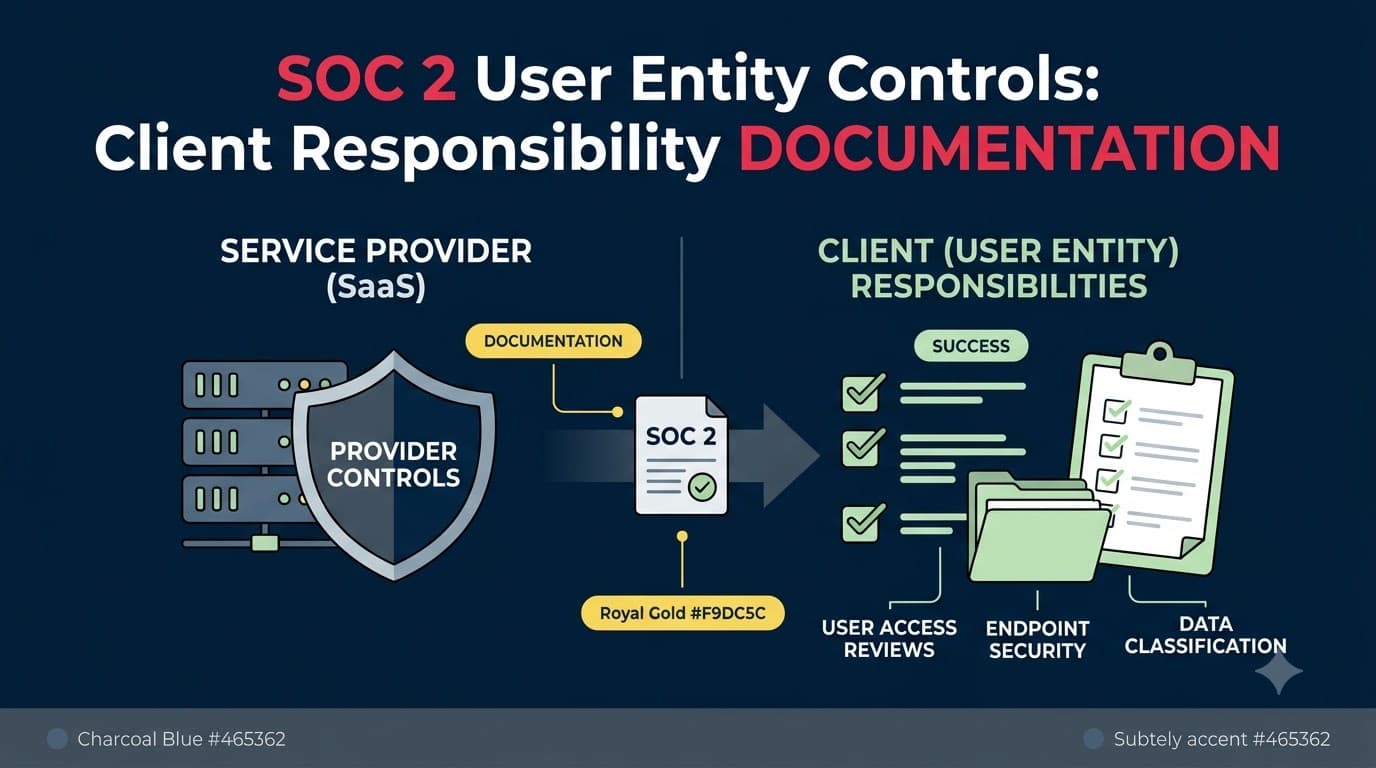
A complementary user entity control, or CUEC, is a control that the service organization's system description explicitly assumes the customer will implement, because without it, one or more of the applicable Trust Services Criteria cannot be met by the service organization's controls alone. It is not a suggestion. It is not a best practice the vendor would like you to follow. It is a documented dependency: "our control X only achieves criterion Y if you, the customer, also do Z." If Z doesn't happen, the criterion is not met, full stop, regardless of how well the vendor's own controls perform.
This matters because a lot of service organizations — and a lot of customers — treat the CUEC section as boilerplate. It reads like boilerplate in most reports because it's usually written like boilerplate: recycled language, generic phrasing, no ownership. But the underlying concept is a genuine control gap that someone, somewhere, is accountable for closing. If the service organization doesn't document it precisely, the customer can't close it. If the customer doesn't read it, the gap stays open regardless of what either party's engineers actually built.
How this differs from our article on complementary controls generally
If you've read our piece on SOC 2 Complementary Controls: Client Implementation Requirements, you already know the taxonomy: complementary controls split into CUECs (the customer's responsibilities) and complementary subservice organization controls, or CSOCs (a subservice organization's responsibilities, relevant when the report uses the carve-out method rather than the inclusive method for a vendor like a cloud hosting provider). That article answers "what is a complementary control and why does the framework split responsibility this way." This article answers a narrower, more operational question: once you know you have CUECs, how do you find all of them, write them in a way a customer can actually implement, place them correctly across the report, and get them into the hands of the people responsible for acting on them? Think of the other article as the concept and this one as the production process — the difference between understanding why shared responsibility exists and knowing how to run the documentation and communication workflow that makes it functional in practice.
Why CUEC documentation quality is a business problem, not just an audit checkbox
Every SOC 2 report engages the same underlying premise as our piece on SOC 2 Common Controls: Shared Responsibility in Service Organizations — the service organization and the customer both hold pieces of the control environment, and the report only tells the truth about security posture when both pieces are visible and both parties execute their share. Common controls describes the shape of that shared-responsibility relationship in general. CUECs are the specific, named, written-down instance of it: the exact list of things the customer has to do.
When CUEC documentation is vague, three things go wrong, roughly in this order. First, sales cycles slow down, exactly as happened to Lumen Ledger — sophisticated enterprise buyers now run vendor risk management reviews that specifically probe CUEC clarity, because a vague CUEC section is a signal that the vendor hasn't thought rigorously about where its control boundary sits. Second, customers implement the wrong thing, or nothing, because "appropriate access controls" doesn't tell an IT administrator whether to run quarterly or annual access reviews, whether service accounts are in scope, or who needs to sign off. Third — and this is the one that actually creates incident risk — when something goes wrong (a terminated employee's access wasn't revoked, an admin account wasn't protected by MFA), both sides end up in a finger-pointing exercise about whose control gap caused the breach, at the exact moment when clarity matters most. Well-written CUECs prevent all three, and they cost nothing to produce beyond the discipline to actually do it.
"I used to think of the CUEC section as the part of the report auditors made us include because the framework requires it. Now I think of it as the most-read page of the report by our actual buyers. Vendor risk analysts skip straight to it because it tells them, in plain language, what they're signing up to operate. If it's vague, they assume we haven't thought it through. If it's specific, they assume the rest of the report is just as rigorous." — Elena Vasquez, GRC Manager, Lumen Ledger
Where CUECs appear in the SOC 2 report
CUECs aren't confined to a single appendix, even though most people picture them that way. They surface in at least three distinct places in a Type II report, and service organizations that only maintain them in one place tend to end up with inconsistent language between sections — which is itself a finding an experienced auditor or vendor risk reviewer will catch.
Report Location | What Appears There | Why It Matters |
|---|---|---|
Management's assertion (Section II) | A general statement that the description includes CUECs necessary, along with other controls, to provide reasonable assurance criteria were met | Signals up front that responsibility is shared — sets reader expectations before they reach detail |
System description narrative (Section III) | Contextual mentions of CUECs woven into the description of relevant subsystems (e.g., access provisioning narrative referencing the customer's role) | Gives CUECs business context — why the dependency exists, not just that it exists |
Dedicated CUEC section/appendix (usually end of Section III) | The consolidated, itemized list of CUECs, typically numbered and grouped by criteria or process area | This is the list customers actually work from — must be complete and self-contained |
Description of criteria, controls, and tests of controls (Section IV, Type II only) | Occasionally, a control's test procedure notes that the control's operation depends on a related CUEC | Clarifies to the reader exactly which vendor control is contingent on which customer action |
Trust Services Criteria mapping tables (if included) | Cross-reference showing which criteria a given CUEC helps satisfy | Helps customers connect a CUEC to the specific assurance objective it supports |
Most auditors will insist on the consolidated appendix regardless of how CUECs are also woven through the narrative, because a scattered list is close to unusable for a reader trying to build an internal control program off it. If your current report only has CUECs mentioned inline and no consolidated list, that's worth raising with your auditor before your next cycle — it's a presentation issue, not a criteria issue, and it's fixable without re-testing anything.
How the service organization identifies its CUECs
CUEC identification is not a brainstorming exercise you run the week before fieldwork starts. Done well, it's a byproduct of honest control design — every time your team designs a control, someone should ask, "does this control fully achieve the relevant criterion on its own, or does it depend on the customer doing something too?" That question, asked consistently during control design rather than retrofitted at audit time, is where most legitimate CUECs surface.
In practice, at Lumen Ledger and most service organizations I've worked with, CUEC identification draws on four sources simultaneously, because no single source catches everything.
Identification Source | What It Surfaces | Who Should Run It |
|---|---|---|
Control walkthroughs during readiness assessment | Gaps where a control's stated objective can't be met without a customer action (e.g., logical access control assumes customer provisions/deprovisions its own users) | Internal compliance lead + control owners, often with an external readiness assessor |
Trust Services Criteria mapping review | Criteria with no fully-owned internal control mapped to them, revealing an implicit dependency on the customer | GRC/compliance team, cross-checked against the TSC point-of-focus list |
Auditor's control design review | Auditor flags controls where the description implies but doesn't state a customer dependency | External auditor, during interim or planning fieldwork |
Customer support and incident retrospectives | Real-world incidents or support tickets that trace back to a customer not doing something the vendor assumed (e.g., an ex-employee's SSO access wasn't revoked because the customer never told the vendor) | Security/incident response team, fed back into compliance |
That fourth source is the one service organizations chronically underuse, and it's often the richest. If your incident retrospectives keep surfacing "the customer didn't tell us to disable this account" or "the customer's admin never rotated a shared credential," that's not just an operational lesson — it's evidence a CUEC needs to exist, or that an existing CUEC needs to be written more clearly.
A useful test during identification: for every control in your matrix, ask "if every customer, everywhere, did the exact opposite of what we assume, would this control still achieve its criterion?" If the answer is no, you've found a CUEC. Write it down before you forget where it came from — the context (which control, which criterion, which real-world trigger) is what makes the eventual wording precise instead of generic.
"The mistake I see most often in readiness work is teams treating CUEC identification as a wording exercise at the end, when it's really a design exercise at the beginning. If you design your access control assuming the customer manages their own user lifecycle, that assumption needs to become a CUEC the day you design the control — not six weeks later when the auditor asks why your access review doesn't cover customer-side terminations." — David Okonkwo, Partner, Okonkwo & Reyes CPAs
The anatomy of a well-written CUEC
A CUEC that actually gets implemented has four properties, and most of them boil down to writing the customer's access control responsibility with the same precision you'd expect from your own internal control library. It names the specific system or process it applies to — not "our platform" generically, but "the Lumen Ledger admin console" or "API keys issued for the payroll integration." It states the action in verb-first, testable language — something a customer's own internal auditor could later check off as done or not done, the same way you'd write an internal control statement, not marketing copy. It states the frequency or trigger — continuous, quarterly, within 24 hours of an event — because "regularly" and "promptly" mean different things to different organizations and that ambiguity is exactly what caused Meridian's procurement team to stall the Lumen Ledger deal. And it states why it matters — which criterion or which of the vendor's own controls depends on it, so the customer's security team can prioritize it against their own competing work instead of guessing whether it's optional.
Compare that standard against what actually ships in most SOC 2 reports, and the gap becomes obvious fast.
Poor CUEC Wording (Avoid) | Why It Fails | Good CUEC Wording (Use) |
|---|---|---|
"Customers are responsible for maintaining appropriate access controls." | No system named, no action verb, no frequency, no criterion tie-back | "Customer administrators must conduct a documented review of all user accounts with access to the Lumen Ledger platform at least quarterly, removing or disabling access for any account no longer requiring it." |
"Users should use strong passwords." | "Strong" is undefined; no enforcement mechanism specified; not testable | "Customers must enforce multi-factor authentication for all users accessing the platform via single sign-on, consistent with the authentication policy configured in their identity provider." |
"Customer is responsible for data classification." | Vague scope — classification of what, against what scheme, by whom | "Customers must classify data uploaded to the platform according to their own data classification policy prior to upload, and must not upload data classified above the 'Confidential' tier without written confirmation from Lumen Ledger that the relevant environment supports that classification." |
"Timely notification of personnel changes is expected." | "Timely" undefined; no channel specified; passive voice obscures who is accountable | "Customer administrators must notify Lumen Ledger support, via the designated offboarding webhook or support ticket, within one business day of any user's termination or role change affecting system access." |
"Customers should monitor their own environment." | No specificity on what to monitor, no connection to a shared control | "Customers are responsible for reviewing the security event logs made available via the platform's audit log export feature and investigating anomalous access patterns within their own environment, consistent with their internal incident response process." |
Notice that every "good" example is long enough to be unambiguous but short enough to fit in a checklist item. That's the target length — a CUEC that needs a paragraph of explanation to be understood by the person implementing it is still not finished.
Common CUEC categories and what they actually require
Across the SaaS and platform companies I've worked with, the same handful of control domains generate the overwhelming majority of legitimate CUECs. Knowing these categories in advance speeds up your identification workshop, because you can check your control matrix against a known list rather than starting from a blank page.
Domain | Typical CUEC | Criterion It Supports | Common Customer Failure Mode |
|---|---|---|---|
User access management | Customer conducts periodic access reviews and removes unneeded access | CC6.1, CC6.2, CC6.3 | Reviews scheduled but never actually performed; owner turnover drops the task |
Authentication (MFA) | Customer enforces MFA for all users, especially privileged/admin roles | CC6.1, CC6.6 | MFA enabled for standard users but exempted for "convenience" on admin/service accounts |
Deprovisioning / offboarding | Customer notifies vendor of terminations within a defined window and disables local credentials | CC6.2, CC6.3 | HR terminates the employee but IT is never notified; access lingers for weeks |
Data classification and handling | Customer classifies data before upload and restricts sensitive data to appropriate environments | CC6.1, Confidentiality criteria (if in scope) | No formal classification scheme exists internally, so nothing is classified before upload |
Configuration management | Customer maintains secure configuration of any customer-managed components (e.g., API keys, webhooks, SSO settings) | CC6.6, CC8.1 | API keys hardcoded in scripts, never rotated, shared across teams |
Network and endpoint security | Customer secures the endpoints and networks used to access the platform | CC6.6, CC6.7 | Users access admin functions from unmanaged personal devices |
Monitoring and log review | Customer reviews available audit logs and investigates anomalies in their own tenant | CC7.2 | Logs are exported but nobody is assigned to review them |
Incident notification | Customer notifies the vendor promptly of suspected compromise involving their credentials or tenant | CC7.3, CC7.4 | Customer investigates internally for weeks before ever contacting the vendor |
Business continuity coordination | Customer maintains its own continuity/backup plan for data it controls outside the platform | Availability criteria (if in scope) | Customer assumes the vendor's backup covers data the customer exported and stores locally |
Employee security awareness | Customer trains its own personnel on phishing and credential hygiene relevant to platform use | CC1.4, CC2.2 | Training exists for general IT use but never mentions the vendor platform specifically |
Physical security of customer premises | Customer secures devices and premises from which the platform is accessed, where relevant | CC6.4 | Rarely relevant for pure SaaS; more common where customer hardware integrates with the service |
Privileged/service account management | Customer restricts and monitors non-human accounts (API/service accounts) with elevated platform access | CC6.1, CC6.3 | Service accounts created once, never reviewed, credentials never rotated |
Not every domain applies to every service organization — a pure API product may have no physical-security CUEC at all, while a platform with heavy customer-side configuration will have several under configuration management. The discipline is running your own control matrix against this list category by category rather than assuming a category doesn't apply without checking.
The CUEC responsibility matrix
Once CUECs are identified, the single most useful artifact a service organization can build — beyond the report language itself — is a responsibility matrix that makes explicit which party owns which piece of a shared control. This is the document that ends the finger-pointing before it starts, and it's the document Meridian's vendor risk team specifically asked Lumen Ledger to produce once the report itself proved insufficient on its own.
Control Area | Service Organization Responsibility | Customer (User Entity) Responsibility | Shared/Coordination Point |
|---|---|---|---|
User provisioning | Provide role-based access control provisioning tooling and enforce least-privilege defaults in the platform | Determine which employees receive access, at what role level, and request provisioning/deprovisioning | Provisioning API/interface and its documentation |
Authentication | Support MFA and SSO integration; log authentication events | Enforce MFA policy for its own users; configure SSO with its identity provider | SSO/MFA configuration handoff during onboarding |
Access reviews | Provide exportable access/role reports on demand | Perform periodic review of who has access and remove unneeded access | Frequency and format of the access report |
Data handling | Encrypt data at rest and in transit; enforce environment-level access controls | Classify data before upload; avoid uploading data outside agreed classification tiers | Data classification tiers documented in the shared-responsibility guide |
Deprovisioning | Disable access within a defined SLA once notified | Notify the vendor of terminations/role changes within a defined window | Offboarding notification channel (webhook, ticket, or admin console action) |
Monitoring | Generate and retain security event logs; alert on platform-level anomalies | Review exported/available logs for their own tenant and investigate anomalies | Log export cadence and retention period |
Incident response | Investigate and respond to platform-level incidents; notify affected customers per contract | Investigate credential/tenant-level suspected compromise and notify the vendor promptly | Joint incident communication protocol |
Business continuity | Maintain platform-level backup, redundancy, and recovery per its own DR plan | Maintain its own backup/continuity plan for data exported or held outside the platform | Recovery point/time objectives documented for each side |
This table, or a version of it tailored to your own control environment, belongs in your customer-facing shared-responsibility documentation — not just in an internal working file. Customers consistently tell me this single artifact does more to build confidence in a vendor's security posture than the raw SOC 2 report does, because it translates "responsibility" from audit language into operational language their own teams recognize.
"When a vendor hands us a responsibility matrix alongside the SOC 2 report, it tells our audit committee something the report alone can't: that the vendor has actually thought about the boundary between their controls and ours, and isn't just hoping we'll figure it out. That's the difference between a vendor we renew without a second look and a vendor we put on a watch list." — Marcus Webb, Director of Vendor Risk, Meridian Retail Group
The CUEC writing process, step by step
Writing defensible CUECs is a workshop exercise, not a solo drafting task, and skipping the workshop is exactly how Lumen Ledger ended up with one vague sentence surviving two audit cycles. The process that actually works runs in five steps.
Pull the raw list. Compile every candidate CUEC surfaced through the identification sources covered earlier — control walkthroughs, TSC mapping gaps, auditor observations, incident retrospectives. Don't filter yet; over-collect at this stage.
Workshop with control owners. Bring the engineering, security, and support leads who actually own the underlying vendor-side control into a room with the compliance lead. For each candidate CUEC, ask: what system does this apply to, what's the specific customer action, what's the frequency or trigger, and what breaks if the customer doesn't do it? If the group can't answer all four, the CUEC isn't ready to write yet — send it back for more investigation.
Draft against the good/poor pattern. Use the wording standard covered above — named system, verb-first action, explicit frequency, criterion tie-back — for every item. Resist the urge to combine multiple customer actions into one CUEC; if a customer could do half of it and not the other half, split it into two.
Route through your auditor before fieldwork, not during it. Your auditor needs to agree the CUEC is both accurate (it genuinely reflects a dependency in the control design) and complete (nothing critical is missing). Doing this before fieldwork avoids last-minute rewrites under time pressure, which is exactly when vague language creeps back in.
Translate for the customer-facing layer. The report language, written for an audit audience, often still needs a plain-language companion version for the shared-responsibility guide and trust portal — same meaning, friendlier phrasing, sometimes with a worked example. This is the step most service organizations skip, and it's the one that determines whether customers actually act on the CUEC or just nod past it.
"We treat CUEC drafting exactly like we treat writing our own internal controls — same rigor, same sign-off process, same review cadence. The day we started doing that instead of leaving it to whoever happened to be finishing the report that quarter, our customer escalations about 'what do you actually need from us' dropped to almost zero." — Tom Bracewell, Director of Security, Vantage Cloud Storage
The CUEC lifecycle, end to end
The full lifecycle — from a control gap someone notices during design, to a customer producing evidence an auditor could later test — has five stages, and the handoffs between them are where most CUEC programs quietly fail. A CUEC that's identified but never documented helps no one; one that's documented but never communicated outside the report sits unread; one that's communicated but the customer never implements leaves the control gap open regardless of how well it was written.
flowchart LR
    A[Identify<br/>control design review,<br/>TSC gap analysis,<br/>incident retrospectives] --> B[Document<br/>named system, verb-first action,<br/>frequency, criterion tie-back]
    B --> C[Communicate<br/>report appendix, shared-responsibility guide,<br/>trust portal, onboarding, contract]
    C --> D[Customer Implements<br/>configures control,<br/>assigns owner, sets cadence]
    D --> E[Evidence<br/>customer retains proof of operation;<br/>vendor may request confirmation]
    E -.feedback loop.-> A
That feedback loop at the end matters as much as the forward path. When a customer's implementation reveals a CUEC was ambiguous — support tickets asking "what exactly counts as an access review?" — that ambiguity should flow back into stage one for the next drafting cycle, not just get patched informally in a support reply that nobody documents.
Communicating CUECs beyond the report itself
Here is the uncomfortable truth most service organizations eventually confront: the SOC 2 report is a restricted-use document, often gated behind an NDA, frequently read once by a vendor risk analyst during procurement and never again by the people who actually operate the customer's day-to-day environment. If the CUEC list lives only inside that PDF, it will not reach the IT administrator running quarterly access reviews eighteen months later. Communicating CUECs is therefore a separate, deliberate program — not a byproduct of having written them well.
Communication Method | Audience Reached | Timing | Strengths | Limitations |
|---|---|---|---|---|
SOC 2 report CUEC appendix | Vendor risk/procurement, once, during evaluation | Point of report delivery | Authoritative, audit-tested wording | Rarely revisited after initial review; gated by NDA |
Shared-responsibility guide (standalone document) | Security, IT, and compliance staff who operate the relationship day to day | Onboarding and ongoing | Plain-language, can be updated between audit cycles, distributable without NDA friction | Requires separate maintenance discipline to stay aligned with the report |
Trust portal page | Prospects, existing customers, self-service researchers | Always available | Always current if maintained; supports self-service due diligence | Often just restates the report unless deliberately written for a broader audience |
Onboarding checklist / kickoff call | New customer's implementation team | Contract signature through go-live | Puts CUECs in front of the people actually configuring the system | One-time touchpoint; doesn't help staff who join later |
Contract or DPA reference | Legal/procurement | Contract execution | Creates a contractual hook, useful for enforcement | Legal language is rarely operational enough to implement from directly |
In-app prompts or admin console guidance | Day-to-day platform administrators | Continuous, contextual | Reaches the actual operator at the moment of relevant action | Engineering investment required; not all CUECs map to an in-app moment |
Customer success / account management check-ins | Ongoing relationship owners on the customer side | Periodic (quarterly/annual) | Reinforces CUECs as the relationship matures, catches drift | Depends on CSM knowledge of CUEC content; inconsistent without training |
The highest-leverage move for most service organizations is building the shared-responsibility guide as a standalone artifact, because it's the only channel on this list that reaches operational staff continuously, doesn't require an NDA to distribute, and can be updated the moment a CUEC's wording improves without waiting for the next audit cycle to republish. Lumen Ledger's version — built directly from the responsibility matrix above — became a permanent link in every enterprise onboarding email, and sales engineering now walks prospects through it during the security review call, well before the SOC 2 report itself ever changes hands.
What belongs in a customer-facing shared-responsibility guide
A good shared-responsibility guide is not a copy-paste of the report's CUEC appendix with a nicer font. It should stand alone for a reader who has never opened the SOC 2 report at all — a new IT admin at a customer three years into the relationship, for instance, who was never in the room for the original vendor evaluation. At minimum, it should include: a one-paragraph plain-language explanation of why responsibility is shared at all (most technical staff have never heard the term CUEC and don't need to); the responsibility matrix, organized by control area rather than by audit criterion; a "getting started" section mapping each customer responsibility to the specific admin console screen, API, or process where it's actioned; contact information for the vendor team who can answer implementation questions; and a changelog noting when responsibilities were added, removed, or reworded, so a returning reader can see what changed since they last checked.
Service organizations building this artifact from scratch can shortcut the drafting work with our SOC 2 Policy Pack, which includes a shared-responsibility guide template alongside the underlying policy documents it should stay consistent with.
That changelog detail is easy to skip and shouldn't be. CUECs change — new features shift the control boundary, incident retrospectives sharpen wording, TSC scope expansions (adding Availability or Confidentiality, for example) introduce new customer dependencies. A customer who implemented last year's CUEC list in good faith and never learns it changed is functionally in the same position as a customer who never read it at all.
The customer's side: reading a vendor's SOC 2 report for your own obligations
Flip the relationship around. If you're the one receiving a vendor's SOC 2 report — as part of a new vendor evaluation or an annual reassessment — the CUEC section is arguably the most actionable part of the entire document, because unlike the auditor's testing results, it tells you exactly what your own team needs to go do. Too many vendor risk programs file the report as "reviewed, no exceptions noted" without ever extracting the CUEC list into an internal tracking system, which means the vendor's assumptions about what you're doing quietly go unmet.
A disciplined review process pulls every CUEC out of the report, maps it to an internal control or process you already have (or flags a gap where you don't), assigns an owner, and sets a review cadence — the same rigor you'd apply to any of your own internal controls, because functionally, that's what these are once you accept the vendor relationship. If your team is new to reading these reports end to end, our SOC 2 Report Reader's Guide walks through every section, including where CUECs typically hide outside the dedicated appendix.
Step | Action | Output |
|---|---|---|
1. Extract | Pull every CUEC from the report's dedicated appendix (and cross-check the narrative sections for anything not captured there) | A flat list of vendor-assumed customer responsibilities |
2. Map | For each CUEC, identify whether an existing internal control already satisfies it, partially satisfies it, or doesn't exist yet | Gap list with current-state status per CUEC |
3. Assign | Name a specific internal owner for each CUEC — not "IT" generically, but a role or person | Ownership matrix |
4. Implement or remediate | Configure the control (enable MFA, schedule the access review, set up the notification workflow) where gaps exist | Working control, not just a policy statement |
5. Evidence | Retain proof the control operated — review sign-offs, ticket logs, configuration screenshots — on the same cadence your own audit or SOC 2 program requires | Evidence artifact ready for your own internal or external audit |
6. Reassess on renewal | Re-pull the CUEC list at each new report cycle and diff against the prior version | Updated gap list reflecting any CUEC changes |
Step 6 is the one customers skip most often, because vendor risk teams tend to treat SOC 2 review as a one-time gate at procurement rather than a recurring obligation. But CUECs change between report cycles just as often as a vendor's own controls do, and a customer who implemented CUECs correctly at signing but never re-checked them against a newer report can drift out of alignment without any single event marking the moment it happened.
Customer action checklist for CUEC implementation
Use this as a working checklist during vendor onboarding or annual reassessment — it's the practical, condensed version of the extract-map-assign-implement-evidence process above.
# | Action | Done? |
|---|---|---|
1 | Obtain the current SOC 2 report and confirm the report period is still active (not expired) | ☐ |
2 | Extract the full CUEC list, including any embedded in narrative sections outside the dedicated appendix | ☐ |
3 | Request the vendor's shared-responsibility guide or trust portal page if a standalone version exists | ☐ |
4 | Map each CUEC to an internal control, policy, or process; flag any with no current owner | ☐ |
5 | Assign a named internal owner to every CUEC, including ones already "covered" by existing controls | ☐ |
6 | Configure or schedule any control not yet operating (e.g., turn on MFA enforcement, schedule the access review) | ☐ |
7 | Document the internal control in your own policy or procedure library, referencing the vendor relationship | ☐ |
8 | Set an evidence retention practice matching your own audit cadence | ☐ |
9 | Calendar a reassessment trigger tied to the vendor's next report cycle | ☐ |
10 | Escalate to the vendor, in writing, any CUEC that is ambiguous, untestable, or contradicts a control you can't operate as described | ☐ |
Item 10 deserves emphasis: customers are not obligated to silently accept a badly written CUEC. If a vendor's wording is too vague to implement, the correct move is the one Meridian took with Lumen Ledger — push back and ask for specificity. A vendor with a mature CUEC program will welcome that feedback, because it's the same feedback loop that improves the next report cycle.
When CUEC implementation fails — and what it costs
Most CUEC failures don't look dramatic in the moment. They look like a skipped quarterly review, a service account nobody rotated, an offboarding notification that got lost in an inbox. The consequences show up later, and they show up on both sides of the relationship.
Failure Scenario | Root Cause | Typical Consequence |
|---|---|---|
Ex-employee retains platform access for weeks after termination | Customer's HR-to-IT offboarding handoff has no step for vendor notification | Unauthorized access window; potential data breach if account is compromised |
Admin accounts exempted from MFA "for convenience" | CUEC didn't specify that privileged roles are explicitly in scope, or customer chose to interpret it narrowly | Credential-based compromise of the most sensitive accounts in the tenant |
Sensitive data uploaded without classification | No internal classification scheme exists, so the CUEC has nothing to attach to | Confidential data stored in an environment not designed or contracted for that sensitivity tier |
Access review "completed" but not actually performed | CUEC states frequency but not evidence requirements, so the task is checked off without real review | Stale access accumulates undetected; discovered only during an incident or a later audit |
Vendor and customer disagree over incident accountability | Neither party has a documented, agreed CUEC covering the specific failure point | Delayed incident response while responsibility is negotiated; contractual/legal exposure |
Customer implements a CUEC inconsistently across business units | No named internal owner; guidance distributed once and never reinforced | Some teams compliant, others not — creates uneven risk posture the customer itself struggles to explain internally |
Every row in that table is preventable, and none of them require new technology — they require documentation clear enough to act on and a named owner on both sides who treats the CUEC as a real control rather than fine print.
Case study 1: Lumen Ledger turns a stalled deal into a sales asset
Returning to Maria Santos's story with the full picture: the eleven-week delay on the Meridian Retail Group deal forced Lumen Ledger to do, under deadline pressure, what should have been routine control-design work two audit cycles earlier. Elena Vasquez's GRC team ran the five-step writing process above against Lumen Ledger's full control matrix, surfacing fourteen distinct CUECs where the old report had listed four vague statements. Each was routed through the workshop-with-control-owners step, drafted against the good/poor wording standard, and reviewed with their auditor before the next Type II cycle — but Lumen Ledger didn't wait for the next report to fix the communication gap. They built the shared-responsibility guide immediately, using the interim period's existing report as the source, and published it to a gated section of their trust portal within three weeks.
The Meridian deal closed at $2.4 million over three years, eleven weeks later than the original target close date — a real cost, but a recoverable one. The more durable outcome showed up over the following two quarters: Lumen Ledger's sales engineering team began proactively sharing the shared-responsibility guide during security review calls, before prospects ever asked for the SOC 2 report. Of the next eight enterprise opportunities that included a formal vendor risk review, the average time from report request to vendor-risk sign-off dropped from 19 days to 6 days, and zero deals stalled specifically on CUEC clarity — down from three stalls in the prior four quarters. Elena's team now treats the CUEC section as a living document reviewed every quarter, not just refreshed once a year at audit time.
Case study 2: A customer's skipped CUEC becomes an incident
Northbridge Health Systems, a regional healthcare administrator, had been a Vantage Cloud Storage customer for two years, using the platform to store de-identified claims processing data. Vantage's SOC 2 report included a clear CUEC requiring customer enforcement of MFA for all users with administrative access to the platform, including service accounts used for automated data transfers. Northbridge's IT team had implemented MFA for its human administrator accounts at onboarding — but the service account used by an internal ETL job had been created afterward, outside the original onboarding checklist, and nobody re-checked it against the CUEC list.
Eighteen months later, a credential-stuffing attack against a reused password compromised that service account. Because it lacked MFA, the attacker gained access to the automated transfer pipeline and exfiltrated a batch of claims data before Northbridge's monitoring caught the anomaly — roughly 40 hours after initial compromise. The resulting incident required Northbridge to notify affected individuals under its own regulatory obligations, engage outside forensics, and rebuild trust with its own downstream customers, at an estimated total cost north of $600,000 once notification, forensics, and remediation were tallied. The root-cause review traced the gap directly to a CUEC that existed, was correctly written, and was simply never re-checked when a new account was created outside the original implementation window — precisely the "implemented once, never revisited" failure mode the checklist above is built to prevent.
"The control existed in Vantage's report exactly as it should have. Our failure wasn't reading comprehension — it was governance. We had no process that re-checked new accounts against our CUEC obligations after go-live. That's on us, and it's the single change we made that I'd tell any peer organization to make first: someone has to own the CUEC list as a living document, not a onboarding-week checklist you finish once." — Priya Chandrasekaran, VP of Compliance, Northbridge Health Systems
Case study 3: A joint CUEC workshop prevents the problem before it starts
Falcon Insurance Group, evaluating Vantage Cloud Storage for a new claims archive project after the Northbridge incident became public knowledge in their industry circle, took a different approach from the outset. Rather than treating the SOC 2 report's CUEC appendix as a one-way document to accept or reject, Falcon's vendor risk lead requested a joint 90-minute workshop with Vantage's security team before contract signature — walking through every CUEC line by line, confirming which internal Falcon control satisfied it, and explicitly assigning an internal owner in the room, live, for each one.
The workshop surfaced two ambiguities in Vantage's own CUEC wording that Tom Bracewell's team hadn't caught internally — one around whether the deprovisioning notification window applied to contractor accounts as well as employees (it hadn't been specified either way), and one around log retention expectations for the customer-side review CUEC. Both were fixed in Vantage's next report cycle, benefiting every subsequent customer, not just Falcon. On Falcon's side, the workshop produced a fully populated ownership matrix on day one of the relationship rather than reconstructed after an incident, and Falcon's internal audit team confirmed 100% of applicable CUECs had a named owner and a documented evidence process before the system went live — a first for any vendor relationship in Falcon's vendor risk program's three-year history at that point.
"We used to treat CUEC review as reading a document. Now we treat it as a working session with the vendor, because half the value isn't in what we learn about our own obligations — it's in the ambiguities we find together that the vendor didn't know were there. It costs us ninety minutes. It's saved us from at least one incident we can point to directly." — Rachel Kim, VP of Vendor Risk, Falcon Insurance Group
How auditors evaluate CUECs
It's worth being precise about what an auditor is and isn't doing when they review your CUEC section, because misunderstanding this is a common source of false confidence on the service organization side. The auditor tests the operating effectiveness of the service organization's own controls during a Type II audit period. The auditor does not test whether your customers actually implemented their CUECs — that's outside the service organization's boundary and outside the engagement. What the auditor does evaluate is whether the CUEC is described accurately and completely: does it genuinely reflect a dependency baked into the control design, is the wording consistent with how the related vendor-side control actually operates, and is anything material missing.
That distinction matters for how you should think about CUEC review meetings with your auditor. They're not going to tell you your CUEC wording is too vague for a customer to act on — that's a customer-experience and sales-enablement concern, not a criteria-conformance concern, and it sits outside what SSAE 18 asks the auditor to opine on. A CUEC can be perfectly acceptable to your auditor and still be nearly useless to your customers. Getting both right — auditor-acceptable and customer-actionable — is a deliberate double standard you have to hold yourself to, because no one in the audit process is going to hold you to the second one for you.
"I can sign off on a CUEC that says 'customer maintains appropriate access controls' if it accurately reflects the design and nothing material is omitted. My engagement doesn't require me to tell you that sentence is useless to the person reading it at your customer's help desk. That's a service quality bar you have to set for yourself — the audit is a floor, not a ceiling." — David Okonkwo, Partner, Okonkwo & Reyes CPAs
CUEC vs. related concepts: a quick comparison
Because CUECs sit next to several adjacent terms that get conflated in practice, a short comparison table earns its place here — full detail on complementary controls generally, including CSOCs, lives in our complementary controls article.
Concept | Who Operates It | Where It Appears | Who's Accountable for Documenting It |
|---|---|---|---|
CUEC (complementary user entity control) | The customer/user entity | Service organization's system description | Service organization identifies and documents it; customer implements it |
CSOC (complementary subservice organization control) | A subservice organization the service org relies on | Service organization's system description, when using the carve-out method | Service organization documents the assumption; subservice organization operates the control |
Standard/common control | The service organization itself | Description of criteria, controls, and tests | Service organization fully owns identification, documentation, and operation |
Contractual security requirement | Either party, per the contract/DPA/MSA | Legal agreement, separate from the SOC 2 report | Legal/procurement teams on both sides; may reference but doesn't replace CUEC documentation |
The practical distinction that trips people up most is CUEC vs. contractual requirement. A CUEC lives in the audit report because it's tied to a specific criterion the report attests to. A contractual security clause lives in the MSA or DPA because the parties negotiated it. The two often overlap in substance — "customer will enforce MFA" might appear in both places — but they're governed differently, updated on different schedules, and enforced through different mechanisms (audit exception vs. breach of contract). Referencing the CUEC list in the contract, rather than duplicating and potentially diverging language, is the cleaner pattern.
Legal and contractual considerations
Legal teams on both sides tend to discover CUECs late, usually during a DPA negotiation when someone asks "does the SOC 2 report cover this obligation already?" Building the connection deliberately, rather than leaving it to be discovered mid-negotiation, saves real time on both sides.
Consideration | Service Organization Angle | Customer Angle |
|---|---|---|
Contract reference to CUECs | Reference the shared-responsibility guide or CUEC list by version/date rather than pasting static language that will drift from the report | Confirm the referenced version is current at signature; request update notification rights |
DPA alignment | Ensure data-handling CUECs (classification, retention) don't contradict DPA processing terms | Cross-check DPA obligations against CUECs to avoid duplicated or conflicting requirements |
Liability allocation | Be cautious about CUEC language implying liability shifts — CUECs describe control responsibility, not legal liability, which is a contract matter | Don't assume implementing a CUEC fully discharges liability under the contract — read both documents together |
Update notification | Commit to notifying customers of material CUEC changes between report cycles, ideally via the shared-responsibility guide's changelog | Negotiate a right to be notified of CUEC changes, especially for regulated industries with their own audit obligations |
Subprocessor/subservice alignment | Ensure CSOC assumptions (where carve-out method is used) don't create a CUEC that secretly depends on a fourth party the customer never agreed to | Ask whether any CUEC actually depends on a subservice organization's behavior rather than purely the customer's own actions |
None of this requires a service organization to turn its compliance team into a law firm. It requires compliance and legal to talk to each other before a customer's legal team forces the conversation during a contract redline — which is, in my experience, still the more common way this connection gets made. Organizations pursuing both frameworks should note that ISO/IEC 27001 has no direct equivalent of a CUEC — its Annex A controls and the organization's Statement of Applicability describe the certified entity's own controls, not a customer's — which is one of several practical differences worth understanding if you're running ISO 27001 and SOC 2 together.
Tools and platforms for tracking CUECs
Spreadsheets are where most CUEC tracking starts, and for a service organization with a handful of CUECs and a handful of enterprise customers, a well-maintained spreadsheet is genuinely fine. The failure mode isn't the tool — it's letting the tracking artifact and the report language drift apart because they live in different places maintained by different people on different schedules.
Tool Type | Best Fit | What to Watch For |
|---|---|---|
Shared spreadsheet (versioned) | Early-stage service orgs with a small CUEC list and limited customer base | Version control discipline — a spreadsheet with no changelog becomes a liability, not an asset |
GRC platform (compliance automation tooling) | Service orgs already using a GRC platform for control mapping and evidence collection | Confirm the platform can export customer-facing language, not just internal audit-ready language — the two audiences need different phrasing |
Trust portal / security page platform | Service orgs prioritizing self-service customer and prospect access | Keep CUEC content synchronized with the actual report cycle; stale trust portal content undermines credibility fast |
Customer-facing knowledge base / help center | Service orgs with a large self-serve customer base needing searchable, per-topic CUEC guidance | Break CUECs into individual articles rather than one giant page if the audience skews toward self-service support |
Contract lifecycle management (CLM) tooling | Legal teams needing to track CUEC references across many customer contracts | Ensure CLM references point to the current CUEC version, not a static snapshot embedded at signature |
Whatever tool you pick, the non-negotiable is a single source of truth for current CUEC wording, with every customer-facing surface (report, guide, portal, contract reference) pulling from — or at minimum, checked against — that source at each update. Our SOC 2 Control Matrix / RACI Template includes a starter tab for exactly this purpose if you're building your first tracker from scratch.
Maintaining CUECs over time
CUECs are not a set-once artifact any more than your own controls are. New features change the control boundary — an in-app admin console review feature might turn a CUEC ("customer performs its own access review externally") into a standard control ("the platform provides a built-in review workflow"), shrinking the customer's burden. Scope expansions do the reverse — adding the Availability or Confidentiality criteria to your SOC 2 scope, as covered in our piece on the Trust Services Criteria, routinely introduces new CUECs around customer-side continuity planning or data handling that weren't relevant when Security was the only criterion in scope.
Trigger | Why It Forces a CUEC Review | Typical Action |
|---|---|---|
New feature shifts control ownership | A capability the customer used to have to do manually is now handled by the platform, or vice versa | Retire or add CUECs; update the shared-responsibility guide's changelog |
TSC scope expansion (adding Availability, Confidentiality, Privacy) | New criteria bring new points of focus that may depend on customer action | Run the full identification process again against the newly in-scope criteria |
Incident retrospective reveals an undocumented dependency | A real-world failure shows the control design assumed something no CUEC captured | Draft and route a new CUEC through the standard workshop process |
Auditor observation during planning or interim fieldwork | Auditor flags a description gap or inconsistency between narrative and appendix | Revise wording before fieldwork concludes |
Customer feedback/escalation about ambiguous wording | Support tickets or account management flags repeated confusion over a specific CUEC | Rewrite for clarity; test the new wording with the flagging customer before publishing broadly |
Annual report renewal cycle | Standing checkpoint regardless of whether other triggers fired | Full review of every CUEC against current control design, even if no changes are expected |
Treat that last row as a floor, not a substitute for the others. An annual review catches drift that accumulated quietly; the other five triggers catch problems the moment they're visible, which is almost always cheaper than waiting for the annual cycle to find them.
Common mistakes service organizations make documenting CUECs
Having reviewed CUEC sections across dozens of SOC 2 reports, the same handful of mistakes recur often enough to be worth naming directly, alongside the fix.
Mistake | Why It Happens | Fix |
|---|---|---|
Recycling CUEC language from a template or a previous auditor engagement without revalidating it against current control design | Fastest path to a "done" report section under deadline pressure | Run the identification process fresh each cycle; treat old wording as a draft, not a final answer |
Writing CUECs for the auditor's comfort, not the customer's clarity | Compliance teams optimize for passing the audit, not for customer usability, because that's the immediate pressure | Add the customer-facing translation step explicitly to the drafting workflow, not as an afterthought |
No consolidated appendix — CUECs scattered across narrative only | Auditor or writer assumed inline mentions were sufficient | Request a dedicated, numbered CUEC appendix from your auditor/report writer |
CUECs never updated between audit cycles even as the product changes | No owner assigned to CUEC maintenance outside the audit process itself | Assign a named internal owner for the CUEC list, reviewed on the trigger cadence above, not just annually |
No communication beyond the report itself | Compliance treats the report as the deliverable, not the starting point | Build the shared-responsibility guide and trust portal presence as standing deliverables, not one-time projects |
Combining multiple customer actions into a single CUEC | Drafting efficiency at the expense of clarity | Split multi-action CUECs into separate items during the drafting workshop |
Treating CUEC identification as a compliance-team-only exercise, without control owners in the room | Compliance doesn't always have full visibility into every control's real-world assumptions | Mandate control-owner participation in the identification and drafting workshop |
The through-line across all seven is ownership. Every mistake on this list traces back to nobody being specifically accountable for CUEC quality as an ongoing responsibility, separate from "did we pass the audit."
Multi-tenant and subservice complexity
CUEC documentation gets meaningfully harder once a service organization itself relies on subservice organizations — cloud infrastructure, a managed database provider, a third-party authentication service. Where the report uses the carve-out method, the subservice organization's own controls sit outside the report, represented instead by CSOCs, and it's easy for a CUEC to accidentally depend on a fourth party's behavior without saying so plainly. A customer reading "customer must configure appropriate network access controls" has no way of knowing, unless the report tells them, that "appropriate" is partly defined by security group defaults set by the underlying cloud provider rather than purely by the customer's own choices.
The discipline here is tracing each CUEC back to its full dependency chain during the identification workshop: does this customer action stand alone, or does its effectiveness also depend on a CSOC operating correctly? If it depends on both, the CUEC wording should reference the relevant subservice dependency explicitly enough that a customer reading the report — not just the internal team who knows the architecture — understands the full picture. Multi-tenant platforms add a second layer: a CUEC written generically enough to apply across very different customer segments (a five-person startup and a 10,000-employee enterprise using the same core platform) often ends up too vague for either. Where customer segments differ enough in scale or regulatory context, some mature service organizations maintain segment-specific implementation guidance layered on top of a single, auditor-approved CUEC — same underlying control, different depth of customer-facing instruction.
Building a CUEC-ready onboarding sequence
CUEC communication works best when it's embedded into an event that's already happening — new customer onboarding — rather than added as a separate compliance touchpoint nobody schedules. The sequence below is close to what Lumen Ledger built after the Meridian deal, and it's become the template sales engineering now hands off to implementation.
Onboarding Stage | CUEC-Related Activity | Owner |
|---|---|---|
Pre-sale security review | Share the shared-responsibility guide alongside (or ahead of) the SOC 2 report itself | Sales engineering |
Contract execution | Reference the current CUEC/responsibility guide version in the DPA or MSA | Legal |
Kickoff call | Walk the customer's implementation lead through the responsibility matrix live, confirming ownership on their side for each item | Customer success / implementation |
Technical configuration | Guide the customer through SSO/MFA setup, notification webhook configuration, and any admin console settings tied to CUECs | Solutions engineering |
30-day check-in | Confirm the customer has scheduled its first access review and assigned internal owners for ongoing CUECs | Customer success |
Annual relationship review | Re-walk the responsibility matrix, flag any CUEC changes since the prior report cycle | Account management + compliance |
Embedding CUEC communication into stages the customer relationship already passes through — rather than hoping someone reads the report cover to cover — is what turns "we documented it" into "the customer actually did it." The 30-day check-in row is the one most programs skip, and it's the one that catches the exact failure mode that hit Northbridge Health Systems: a control implemented at kickoff, then quietly abandoned as new accounts and new team members entered the picture without anyone re-checking against the original CUEC list.
Measuring whether your CUEC program is actually working
Most compliance teams can tell you whether their CUEC section passed the audit. Few can tell you whether customers are actually implementing what it asks. A small set of leading and lagging indicators closes that gap.
Metric | What It Tells You | How to Collect It |
|---|---|---|
Time from report request to vendor-risk sign-off (customer-reported, where visible) | Whether CUEC clarity is speeding up or slowing down deals | Sales/sales engineering tracking during procurement cycles |
Number of support tickets referencing CUEC confusion | Where wording is failing in practice | Tag and track in the support system; review quarterly |
Percentage of enterprise customers with a completed responsibility matrix sign-off | Adoption of the communication artifact, not just its existence | Customer success tracking at kickoff and annual review |
Number of CUECs revised per report cycle | Whether the identification/maintenance process is actually running, or the list is static | Compliance team's internal change log |
Incidents or near-misses traced to a CUEC gap (either side) | Real-world validation of whether documentation translated into operation | Incident retrospective tagging |
Customer escalations requesting CUEC clarification | Early warning that wording needs revision before the next cycle | Account management / support intake |
None of these need to be perfect or automated on day one — even a quarterly manual pull from support tickets and sales notes gives a compliance team enough signal to know whether the CUEC program is a living practice or a document nobody has revisited since the last audit.
Industry-specific CUEC considerations
CUEC content shifts meaningfully by the industry a service organization serves, because the customer's own regulatory context shapes what "reasonable implementation" looks like on their side.
Customer Industry | Typical Additional CUEC Emphasis | Why |
|---|---|---|
Healthcare | Stricter access review frequency; explicit PII/PHI handling and classification CUECs; breach notification timing alignment | Downstream regulatory obligations (e.g., HIPAA-adjacent breach notification rules) place tight timing pressure on the customer, which the CUEC's own notification-window wording needs to support rather than conflict with |
Financial services | Privileged/service account CUECs get more granular; segregation-of-duties expectations referenced explicitly | Financial customers often run their own SOC 1/ICFR-adjacent programs and need CUEC wording precise enough to map into their own control testing |
Government/public sector | Formal, numbered CUEC references expected in procurement documentation; less tolerance for informal shared-responsibility guides as a substitute | Procurement processes in this sector often require citing report language directly, not paraphrased guidance |
Early-stage SaaS/startups | Simpler CUEC set, but customers frequently lack a formal internal control program to map CUECs into at all | Vendor-provided templates (a starter access-review checklist, for instance) meaningfully increase actual implementation rates for under-resourced customer teams |
A one-size CUEC set can technically satisfy the audit across all these customer types, but service organizations serving a mix of regulated and early-stage customers get real adoption gains from layering industry-aware guidance on top of the single, auditor-approved CUEC list — same underlying control, different depth of supporting material depending on who's reading it.
CUEC documentation as a business opportunity, not a compliance chore
It's worth stepping back from the mechanics and naming the strategic reality plainly: in a market where every serious enterprise buyer runs some form of vendor risk review, the CUEC section of your SOC 2 report has quietly become a competitive differentiator, not just an audit requirement you tolerate. Maria Santos's experience at Lumen Ledger — an eleven-week delay that became, within two quarters, a measurably faster average sales cycle — is not an unusual outcome once a service organization treats CUEC clarity as a deliverable with an owner, rather than boilerplate inherited from a prior audit cycle.
The organizations that get this right share a pattern: compliance and sales engineering stop operating in separate lanes on this specific artifact. The CUEC list and its customer-facing translation become something sales actively uses to shorten security review cycles, something customer success uses to reduce churn-driving incidents caused by unimplemented customer-side controls, and something product and engineering treat as a running input — every feature that shifts a responsibility from the customer to the platform is a CUEC that gets retired, and that's a genuine, demonstrable product improvement worth telling customers about directly. Framed that way, CUEC maintenance stops competing for budget against "real" security work and starts looking like what it actually is: a durable, compounding advantage in every enterprise deal where a vendor risk analyst reads your report before your prospect ever gets on a call with your sales team.
The customers who get this right share a mirror-image pattern: they stop treating a vendor's SOC 2 report as a one-time gate to clear before signing, and start treating the CUEC list as a standing input to their own internal control program — reviewed, owned, and re-checked on every renewal, the same rigor they'd apply to a control they built themselves. That's the state both sides of this relationship are working toward: a shared-responsibility model that's actually shared, documented well enough that neither side is guessing, and revisited often enough that it stays true.
If you're still weighing which framework to pursue at all, our comparison of ISO 27001 vs SOC 2 and which one you need is a useful starting point before you invest in CUEC documentation for either.
If your organization needs help getting from "one vague sentence" to a CUEC program that survives both audit scrutiny and real customer implementation, PentesterWorld's compliance advisory team works directly with service organizations on CUEC identification workshops, shared-responsibility documentation, and trust portal build-outs — and with customer vendor risk teams building out their own CUEC review and implementation programs. Start with our SOC 2 Readiness Checklist to see where your current control documentation stands, or explore the SOC 2 Control Matrix / RACI Template to build your first responsibility matrix without starting from a blank page.