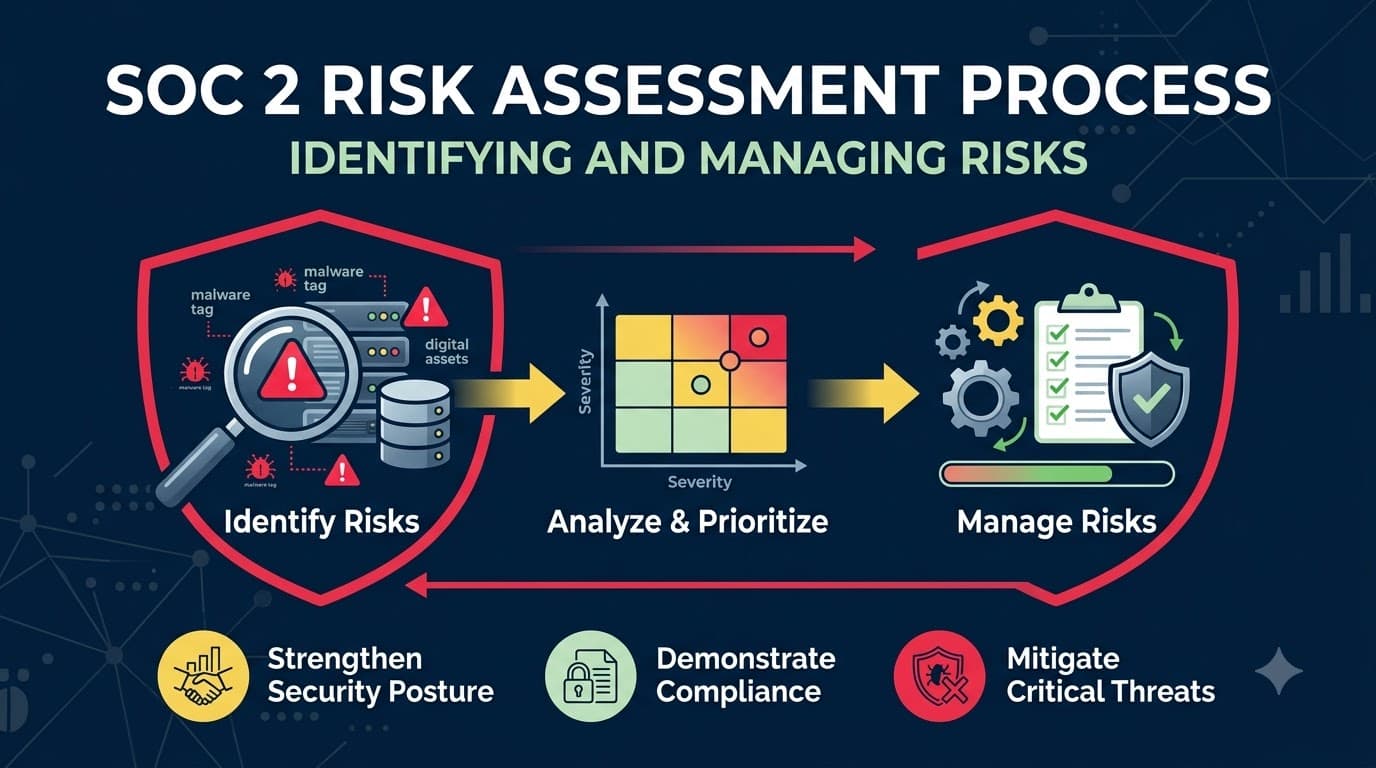
Marcus Ilankovan had eleven days to fix a problem he didn't think he had.
Marcus is the Director of Security & Compliance at Ridgeline Payroll, a 140-person payroll and benefits platform in Denver that processes payroll for about 900 small and mid-sized employers. Eighteen months earlier, Ridgeline had landed its first SOC 2 Type II report with only two minor exceptions, both cosmetic — a missing signature on a quarterly access review, a stale ticket in the change log. Marcus had assumed the second-year audit would be a formality. It wasn't.
The reason Ridgeline was even in the room was a $2.4 million contract with National Union Credit Alliance, a regional bank that wanted to white-label Ridgeline's payroll engine inside its small-business banking product. National Union's vendor risk team had a non-negotiable requirement: a clean SOC 2 Type II report, no qualified opinions, before they'd sign. The deal was sitting in Ridgeline's pipeline as the single largest contract in company history, and the CFO had already built it into the next fiscal year's revenue plan.
Then the fieldwork started. Ridgeline's auditor, a mid-sized regional CPA firm, sent a documentation request list that opened with a line Marcus had never seen an auditor emphasize before: "Provide the entity's risk assessment documentation demonstrating identification and analysis of risks to the achievement of objectives, including consideration of fraud risk and the risk of significant change, for the audit period." Marcus pulled together what Ridgeline had — a spreadsheet of "top risks" last updated fourteen months earlier by a security engineer who had since left the company, with no evidence anyone had scored the risks, no fraud scenario had ever been documented, and the entity's Q2 migration from a legacy data center to AWS wasn't reflected anywhere. The auditor flagged it as a likely exception under CC3 before testing had even finished. Marcus had eleven business days before the draft report was due to National Union's procurement deadline, and a governance gap that had nothing to do with firewalls, encryption, or access reviews — it was about whether Ridgeline could prove it had a process for thinking about risk at all.
This is the story of what Marcus built, why "we have a risk list" is not the same thing as "we have a risk assessment process," and how CC3 — the risk assessment criteria inside the Common Criteria — actually gets tested. It's also the story of two other companies that learned the same lesson from different angles: one through a fraud scenario nobody had written down, one through a cloud migration nobody had risk-assessed before go-live.
Who This Is For / What You'll Walk Away With
This article is written for the person who owns SOC 2 readiness at a service organization — a compliance manager, a security engineer wearing a GRC hat, a fractional CISO, or a founder doing double duty before the company can afford a dedicated hire. You should already have a working knowledge of the Trust Services Criteria and the Common Criteria structure; if you don't, start with our SOC 2 Complete Guide to the AICPA Trust Services Criteria before this one. By the end, you'll be able to specify entity-level and process-level objectives that make risk identification possible, run an identify-analyze-score-treat cycle that produces defensible outputs, build a fraud risk consideration that auditors actually credit, treat significant change as a formal risk trigger rather than an afterthought, and assemble the evidence package — risk register, scoring rationale, meeting minutes, remediation tracking — that CC3 testing requires.
What CC3 Actually Requires: Risk Assessment as a COSO Component
Risk assessment is the third of the five Common Criteria components in a SOC 2 examination, and it maps directly to Component 3 of the COSO Internal Control – Integrated Framework: Risk Assessment. Where CC1 — the control environment establishes the tone, structure, and accountability that make good controls possible, CC3 asks a narrower and more testable question: does the organization have a process for identifying and analyzing the risks to achieving its objectives, and does that process actually run?
CC3 is built from four COSO principles, numbered 6 through 9 in the COSO framework's 17-principle structure:
Principle 6 — the entity specifies objectives with sufficient clarity to enable the identification and assessment of risks relating to objectives.
Principle 7 — the entity identifies risks to the achievement of its objectives across the entity and analyzes risks as a basis for determining how the risks should be managed.
Principle 8 — the entity considers the potential for fraud in assessing risks to the achievement of objectives.
Principle 9 — the entity identifies and assesses changes that could significantly impact the system of internal control.
Two things trip people up here. First, CC3 is not "vulnerability management" or "risk scoring in a spreadsheet" — those are downstream artifacts, not the criteria itself. The criteria is about the existence and operation of a governance process: objectives are set, risks to those objectives are identified and analyzed on a defined basis, fraud is explicitly considered, and change is explicitly assessed. Second, CC3 is deliberately entity-wide. Auditors are not only looking at your vulnerability scanner output; they're looking for evidence that leadership thought about strategic, operational, compliance, and reporting risk — not just technical risk — and that the thinking is documented, dated, owned, and repeatable.
Table 1: CC3 Principles 6–9 — Points of Focus, Example Controls, and Evidence Auditors Request
Principle | COSO Point of Focus (summarized) | Example Control | Evidence an Auditor Typically Requests |
|---|---|---|---|
P6 — Specifies Suitable Objectives | Objectives reflect management's choices; operations, reporting, and compliance objectives are defined | Documented annual business objectives tied to risk categories (strategic, operational, compliance, reporting) | Board/leadership meeting minutes, strategic plan, objective-setting documentation |
P6 — Considers Tolerances for Risk | Acceptable levels of variation in performance are established | Formal risk appetite/tolerance statement approved by leadership | Risk appetite statement, sign-off record, revision history |
P7 — Identifies Risk | Risk identification occurs at entity and process/sub-process levels | Structured risk identification workshops with functional leads (Eng, HR, Finance, Ops) | Workshop agendas, attendee lists, raw risk inputs, brainstorm artifacts |
P7 — Analyzes Risk | Likelihood and impact are estimated; risk response basis is determined | Documented risk register with likelihood/impact scores and risk owners | Completed risk register, scoring methodology document, risk owner assignments |
P7 — Determines Risk Responses | Avoid, accept, reduce, or share is selected for each risk | Risk treatment decisions logged per risk with rationale | Risk register "treatment" column, approval records, linked remediation tickets |
P8 — Considers Fraud in Risk Assessment | Fraudulent reporting, possible loss of assets, corruption are assessed; incentive/pressure, opportunity, and rationalization are considered | Dedicated fraud risk assessment session, at least annually | Fraud risk assessment documentation, scenario list, mitigating control mapping |
P8 — Assesses Incentives and Pressures | Considers factors that create incentive or pressure to commit fraud | Segregation-of-duties review; compensation/incentive structure review for fraud triggers | SoD matrix, review notes, exception list |
P9 — Assesses Changes in External Environment | Regulatory, economic, and physical environment changes are considered | Quarterly regulatory/market scan tied to risk register updates | Scan documentation, risk register update log, dated change entries |
P9 — Assesses Changes in Business Model / Leadership | New lines of business, M&A, leadership turnover are risk-assessed | Change-triggered risk review procedure (e.g., new product launch, new executive) | Change management tickets linked to risk assessments, review sign-off |
P9 — Assesses Changes in Systems | Significant system changes (new infrastructure, major vendor, architecture shift) trigger risk reassessment | Pre-implementation risk assessment for infrastructure/architecture changes | Change tickets, pre-implementation risk memo, post-implementation review |
"The single biggest misconception I run into is that a risk register is the deliverable. It isn't — it's evidence of a process. If I can't trace a risk from identification, through analysis, to a documented response, to a linked control, the register is just a spreadsheet with opinions in it." — Dana Whitfield, CPA, Partner, Kessler Vance & Bloom LLP
Principle 6: Specifying Objectives Clearly Enough to Identify Risk
You cannot assess risk to an objective you haven't written down. That sounds obvious, and it's the single most common gap I see in first- and second-year SOC 2 programs: companies jump straight to "what could go wrong" without first documenting "what are we trying to achieve." COSO Principle 6 requires the entity to specify objectives across three categories relevant to internal control — operations objectives (effectiveness and efficiency of operations, including performance and financial goals), reporting objectives (internal and external, financial and non-financial), and compliance objectives (adherence to laws and regulations the entity is subject to).
For a SOC 2 examination specifically, this gets translated down to system-level objectives: what does the in-scope system need to reliably do? For Ridgeline Payroll, operations objectives included "process payroll runs with zero missed pay dates" and "maintain platform uptime consistent with customer SLAs." Reporting objectives included "produce accurate payroll tax filings" and, since the SOC 2 report itself is a reporting objective, "maintain evidence sufficient to support an unqualified Type II opinion." Compliance objectives included state wage-and-hour law adherence and, because Ridgeline touches cardholder data for a subset of customers who fund payroll via card, baseline PCI awareness.
The practical output of Principle 6 work is a short, dated document — often one to two pages — that leadership has reviewed and approved, stating the entity's objectives by category, and a companion risk tolerance statement that says, in plain language, how much variation from those objectives the organization will accept before it acts. Without that tolerance statement, your later likelihood/impact scoring has no anchor: a "high" risk score means nothing if nobody has defined what "acceptable" looks like. Auditors will ask, directly, "show me where these objectives were set and by whom." A verbal answer does not satisfy the criteria — there needs to be a dated artifact, ideally tied to an annual planning cycle or a board/leadership meeting.
Principle 7: Identifying and Analyzing Risk — Building a Real Methodology
Principle 7 is where most of the operational weight of CC3 sits, and it breaks into three distinct activities that auditors test separately: identification, analysis, and response determination. Treating these as one blurry step is where programs fall apart.
Identification means systematically surfacing risks to your stated objectives — not just the risks that are top of mind for the security team. A mature identification process pulls from multiple sources: structured workshops with functional leaders (engineering, HR, finance, customer support, operations), incident and near-miss history, vendor and subservice organization risk, audit findings from prior periods, threat intelligence relevant to your industry, and regulatory or contractual change. Ridgeline's original "risk list" failed here specifically — it was written entirely by one security engineer working from a generic template, with no input from finance (which handles the actual money movement) or HR (which handles insider risk during onboarding/offboarding of an all-remote workforce).
Analysis means each identified risk gets evaluated for likelihood and impact against the objectives it threatens, using a consistent, documented methodology (we cover scoring mechanics in the next section). Analysis also means considering how risks interact — a vendor outage risk and a business continuity objective are linked; a fraud risk and a segregation-of-duties control are linked. The output isn't just a score; it's a rationale someone could defend eighteen months later without recalling the meeting.
Response determination means deciding, for each analyzed risk, whether the organization will avoid it, reduce it (via a control), accept it (with documented rationale and sign-off from someone with the authority to accept it), or share/transfer it (insurance, contractual risk transfer to a vendor). This decision must be logged, not just implied by the fact that a control happens to exist.
Table 2: Risk Assessment Methodology — Step-by-Step
Step | Activity | Primary Owner | Typical Frequency | Output/Artifact |
|---|---|---|---|---|
1 | Confirm/update entity and system objectives | Leadership team | Annually, or on major change | Objectives document, risk tolerance statement |
2 | Identify risks via workshops, incident history, vendor review, threat intel | Risk/compliance lead + functional leads | Annually + ad hoc | Raw risk list, workshop notes |
3 | Consolidate and de-duplicate raw risks into risk register entries | Risk/compliance lead | Post-workshop | Draft risk register |
4 | Score each risk for likelihood and impact using defined scales | Risk owners + risk/compliance lead | Per identification cycle | Scored risk register |
5 | Determine risk response (avoid/reduce/accept/transfer) per risk | Risk owner, with leadership sign-off on "accept" | Per identification cycle | Documented response + approver |
6 | Link each risk to existing or new controls | Risk/compliance lead + control owners | Per identification cycle | Risk-to-control mapping |
7 | Assign remediation actions and owners for gaps | Risk/compliance lead | Ongoing | Tracked remediation tickets |
8 | Conduct fraud risk assessment | Risk/compliance lead + finance + HR | At least annually | Fraud risk assessment document |
9 | Monitor for significant change triggers | Risk/compliance lead | Continuous, reviewed quarterly | Change log tied to risk register |
10 | Review and re-approve risk register | Leadership team | At least annually | Signed/dated approval record |
"I tell every client the same thing in kickoff: your risk register is going to get read by someone who has never met you, six months from now, possibly during litigation. Write it like that person is your audience, not like it's a to-do list for yourself." — Elena Vukovic, Founder, Northlight Risk Advisory
Building a Risk Register That Survives an Audit
The risk register is the single artifact auditors spend the most time with under CC3, and it needs to do more than list bad things that could happen. A register that survives testing has consistent structure across every row, a visible scoring rationale, a named owner for every risk (not "the security team" — a person), a documented response decision, and a link to the control(s) that address it. It also needs a version history: auditors want to see that the register was live and evolving across the audit period, not created the week before fieldwork started.
Ridgeline's fourteen-month-old spreadsheet failed almost every one of these tests. It had risk descriptions but no likelihood or impact scores. It had no owners — just a column labeled "team" that said "Security" for eleven of fourteen rows. It had no linkage to controls, no evidence of leadership review, and — critically — no entries added or modified in the fourteen months preceding the audit, despite the company having migrated its production environment to AWS in that window. A register with no change history covering a period with a major infrastructure migration is, to an auditor, itself an exception waiting to be written.
Table 3: Risk Register Template — Core Columns
Column | Purpose | Example Entry |
|---|---|---|
Risk ID | Unique, stable identifier for traceability | RSK-014 |
Risk Description | Clear statement of what could go wrong and to which objective | "Unauthorized changes to payroll calculation logic could result in inaccurate pay runs" |
Risk Category | Strategic / operational / compliance / reporting / fraud / technology | Operational |
Related Objective | The specific objective(s) at risk | "Zero missed/incorrect pay dates" |
Inherent Likelihood | Score before controls (see scale) | 4 (Likely) |
Inherent Impact | Score before controls (see scale) | 5 (Severe) |
Existing Controls | Controls currently mitigating the risk | Peer-reviewed code changes, staged deployment, automated calculation testing |
Residual Likelihood | Score after controls applied | 2 (Unlikely) |
Residual Impact | Score after controls applied | 4 (Major) |
Risk Owner | Named individual accountable | VP Engineering |
Risk Response | Avoid / Reduce / Accept / Transfer | Reduce |
Response Rationale | Why this response was chosen | "Residual risk within tolerance given existing SDLC controls; further automation planned" |
Linked Control ID(s) | Cross-reference to control matrix | CTRL-042, CTRL-051 |
Remediation Action (if gap) | What's being done to close any gap | "Add automated regression suite for tax calc module" |
Target Date | Deadline for remediation | Q3 2026 |
Last Reviewed | Date of most recent review | 2026-04-15 |
Reviewer | Person who reviewed/approved | Director of Security & Compliance |
A note on inherent vs. residual risk, since it's a distinction auditors probe directly: inherent risk is the level of risk that would exist with no controls in place at all; residual risk is what remains after existing controls are applied. Scoring both, not just one, is what lets you demonstrate that your controls are doing something measurable — and it's what lets you defend an "accept" decision on a risk that still shows up as "medium" after mitigation.
Scoring Risk: Likelihood and Impact
Every credible risk assessment methodology needs a consistent, pre-defined way to score likelihood and impact — not because the numbers are scientifically precise (they aren't; they're structured judgment), but because consistency is what lets an auditor, and your own team, trust that a "9" this quarter means roughly the same thing as a "9" next quarter. I generally recommend a 5x5 matrix for mid-market service organizations — granular enough to be useful, simple enough that a non-security stakeholder in finance or HR can participate in scoring without a security background.
Table 4: Likelihood Scale (1–5)
Score | Rating | Definition | Illustrative Frequency |
|---|---|---|---|
1 | Rare | Would only occur in exceptional circumstances | Less than once in 5+ years |
2 | Unlikely | Could occur but not expected | Once every 2–5 years |
3 | Possible | Might occur at some point | Roughly annual |
4 | Likely | Will probably occur in most circumstances | Multiple times per year |
5 | Almost Certain | Expected to occur, possibly already occurring | Ongoing / monthly or more |
Table 5: Impact Scale (1–5)
Score | Rating | Definition (Operational/Financial) | Definition (Customer/Reputational) |
|---|---|---|---|
1 | Negligible | No measurable disruption; cost within routine budget | No customer awareness |
2 | Minor | Brief, contained disruption; small unplanned cost | Isolated customer complaint, no churn risk |
3 | Moderate | Noticeable disruption requiring management attention | Customer escalation; possible SLA credit |
4 | Major | Significant disruption; material unplanned cost or SLA breach | Multiple customer escalations; churn risk; press possible |
5 | Severe | Threatens objective achievement or going-concern; regulatory exposure | Contract termination risk; regulatory notification; public disclosure |
Table 6: Likelihood × Impact Risk Matrix
Likelihood \ Impact | 1 – Negligible | 2 – Minor | 3 – Moderate | 4 – Major | 5 – Severe |
|---|---|---|---|---|---|
5 – Almost Certain | Medium | High | High | Critical | Critical |
4 – Likely | Medium | Medium | High | High | Critical |
3 – Possible | Low | Medium | Medium | High | High |
2 – Unlikely | Low | Low | Medium | Medium | High |
1 – Rare | Low | Low | Low | Medium | Medium |
Once you have a consistent matrix, tie it to action: Critical and High risks should have documented, actively-tracked remediation with executive visibility; Medium risks should have a response decision and periodic review; Low risks can typically be accepted with lighter documentation, but "accepted" still needs to be an explicit, dated decision — not silence.
Risk Treatment: Choosing and Justifying a Response
Scoring a risk tells you how big it is. Treatment tells the auditor what you did about it — and this is where the response-determination piece of Principle 7 gets tested most directly. There are four standard risk treatment categories, and every entry in your risk register needs to land in one of them with a documented rationale.
Table 7: Risk Treatment Options
Treatment | Definition | When Appropriate | SOC 2 Documentation Expectation |
|---|---|---|---|
Reduce (Mitigate) | Implement or strengthen a control to lower likelihood and/or impact | Most common response for medium/high risks with a feasible control | Control linked in register; evidence the control operates |
Avoid | Eliminate the activity or exposure creating the risk | Risk/reward doesn't justify the exposure (e.g., discontinue a risky data-sharing practice) | Decision record; evidence the activity ceased |
Accept | Consciously take no further action; risk is within tolerance | Residual risk is low, or cost of further mitigation exceeds benefit | Written rationale + sign-off from someone with authority to accept |
Transfer (Share) | Shift some financial or operational consequence to a third party | Cyber insurance, contractual indemnification, outsourcing to a vendor with stronger controls | Policy/contract reference; residual risk still tracked, not "solved" |
A treatment decision without a named approver is one of the more common exceptions I see auditors write up — someone marked a Critical risk "Accept" in a spreadsheet cell with no evidence that a person with the authority to accept that level of risk (typically a VP or above) actually signed off. Build sign-off into your workflow, not just your template.
Risk Appetite and Risk Tolerance: The Missing Anchor
Most first-time SOC 2 programs skip this entirely, and it shows up as a subtle but real gap during testing: without a documented risk appetite and risk tolerance, your scoring matrix has no anchor. "Medium risk, accepted" means nothing if nobody has said what level of risk the organization is actually willing to carry.
Risk appetite is the broad, qualitative statement of how much risk the organization is willing to pursue or retain in aggregate, usually set by the board or executive team. Risk tolerance is the more specific, often quantitative boundary around a given objective or risk category — the acceptable range of variation. Both should be documented, dated, and revisited at least annually, and both should be referenced when you're deciding whether a residual risk score is acceptable or requires further action.
Table 8: Risk Appetite vs. Risk Tolerance — Illustrative Examples
Category | Risk Appetite Statement (qualitative) | Risk Tolerance Statement (quantitative) |
|---|---|---|
Availability | "We will not compromise platform availability to accelerate feature delivery." | "Unplanned downtime not to exceed 43 minutes/month (99.9% uptime)." |
Data Security | "We have low appetite for risk involving customer PII exposure." | "Zero tolerance for unencrypted PII at rest; any incident triggers executive notification within 4 hours." |
Vendor Risk | "We accept moderate risk from vendors with compensating controls; low appetite for uncontrolled fourth-party risk." | "No production vendor onboarded without a completed security questionnaire and, for critical vendors, a current SOC 2 or equivalent report." |
Financial/Fraud | "We have very low appetite for fraud risk in payment processing workflows." | "Any payment-related control failure over $10,000 in exposure escalates to CFO same-day." |
Change Velocity | "We accept moderate risk from rapid iteration in non-regulated product areas." | "All production infrastructure changes require peer review and rollback plan regardless of size." |
Principle 8: Fraud Risk — SOC 2's Distinctive Requirement
This is the piece of CC3 that most differentiates SOC 2 from a general IT risk assessment, and it's where I've seen the most first-time exceptions. COSO Principle 8 requires the entity to explicitly consider the potential for fraud when assessing risk — not fraud in the abstract, but fraud specifically in the context of fraudulent financial or non-financial reporting, possible loss of assets, and corruption, evaluated against incentives and pressures, opportunities, and attitudes/rationalizations — the classic fraud triangle model applied to fraud risk assessment.
For a service organization, this doesn't mean you need a forensic accounting function. It means your risk assessment process needs a dedicated, documented exercise — at least annually — where you deliberately ask: who has the access and opportunity to commit fraud against us or our customers, what incentives or pressures might drive that, and where do segregation-of-duties gaps or unmonitored privileged access create opportunity? This should involve finance and HR, not just security, because insider fraud risk (payroll manipulation, unauthorized vendor payments, credential misuse by a departing employee) sits squarely in their domain.
Ridgeline's original risk documentation had zero fraud risk content — not a missing detail, a complete absence. When Marcus rebuilt the program, the fraud risk assessment surfaced something the security team had genuinely never considered: a single engineer had standing production database access sufficient to alter payroll calculation values directly, bypassing the application layer entirely, with no secondary review of direct database writes. Likelihood was low (no history of misuse, background-checked employee, strong culture) but impact was severe (direct financial harm to customers' employees, existential reputational risk). It became a Critical-rated fraud risk with a 60-day remediation: database write access was revoked for engineers outside a break-glass emergency procedure requiring dual approval and full audit logging.
Table 9: Fraud Risk Scenarios — Illustrative Examples for a SaaS Service Organization
Scenario | Fraud Triangle Element Present | Potential Impact | Example Mitigating Control |
|---|---|---|---|
Engineer with direct database write access alters financial/payroll data undetected | Opportunity (excess privilege) | Direct financial harm, loss of customer trust | Remove standing write access; require dual-approval break-glass process with logging |
Departing employee retains access during notice period and exfiltrates customer data | Opportunity, Rationalization ("I built this") | Data breach, contractual/regulatory exposure | Same-day offboarding procedure; access review tied to HR termination workflow |
Finance staff under quarter-end pressure manipulates revenue recognition entries | Incentive/Pressure (targets, bonus structure) | Misstated financials, investor/auditor exposure | Segregation of duties between entry and approval; independent reconciliation |
Support engineer uses privileged access to view/export customer data outside a ticket | Opportunity, Rationalization | Privacy breach, contractual breach | Just-in-time access tied to ticket ID; access logging and periodic sampling review |
Vendor invoice approver also manages the vendor relationship and approves inflated invoices | Opportunity (no segregation) | Financial loss, potential kickback exposure | Segregate vendor management from payment approval; require secondary approval above threshold |
Sales rep manipulates contract terms post-signature to hit quota | Incentive/Pressure, Opportunity | Revenue misstatement, customer disputes | Contract system with immutable audit trail; independent legal/finance review of amendments |
"Fraud risk is the section of the risk assessment that separates people who read the COSO framework from people who actually built a process against it. I can tell within five minutes of an interview whether fraud was genuinely considered or bolted on the week before fieldwork." — Tomas Reyes, Fraud & Risk Lead, National Union Credit Alliance
The fraud risk assessment doesn't need to live in a separate system from your main risk register — in fact, I recommend it doesn't, because auditors want to see fraud risks integrated into the same identification-analysis-response-control lifecycle as every other risk, tagged with a "Fraud" category rather than segregated into an ignorable side document. What does need to be separate is the process: a specific, minuted session, ideally with finance and HR leadership present, where fraud scenarios are deliberately brainstormed rather than left to emerge incidentally from a general risk workshop.
Principle 9: Identifying and Assessing Significant Change
The fourth COSO principle underlying CC3 requires the entity to identify and assess changes that could significantly impact its system of internal control — changes in the external environment (regulatory, economic, competitive), changes in the business model (new products, M&A, new markets), changes in leadership, and changes in systems and technology. This is the principle Ridgeline violated most visibly: a full production infrastructure migration from a legacy data center to AWS, spanning the entire audit period, with zero documented risk reassessment tied to it.
Significant change matters to CC3 because your existing risk register and control set were built against a specific operating reality — a specific architecture, a specific vendor footprint, a specific org chart. When that reality shifts materially, risks that were previously low-likelihood or well-controlled can become high-likelihood or uncontrolled overnight, and new risks can appear that were never assessed at all. A cloud migration changes your attack surface, your shared-responsibility boundary with a subservice organization, and potentially your data residency posture, all at once. An auditor testing Principle 9 wants to see a defined trigger list — what counts as "significant" for your organization — and evidence that when a trigger fired, a risk reassessment actually happened before or during the change, not retroactively during audit prep.
Table 10: Change Risk Triggers — What Should Force a Risk Reassessment
Trigger Category | Example Event | Why It Matters for CC3 | Recommended Action |
|---|---|---|---|
Infrastructure/Architecture | Migration to new cloud provider or major re-architecture | Changes attack surface, shared-responsibility boundary, control applicability | Pre-migration risk assessment; post-migration control validation |
New/Changed Subservice Organization | Switching payment processor, adding a new critical SaaS vendor | New subservice organization risk; changes carve-out/inclusive scoping | Vendor risk assessment; update subservice organization inventory and CUEC mapping |
New Product or Service Line | Launching a new module handling a new data type (e.g., health data) | May introduce new regulatory obligations, new TSC applicability | Scope reassessment; regulatory applicability review |
Mergers, Acquisitions, Divestitures | Acquiring a company with its own tech stack and controls | Introduces unassessed systems, people, and control gaps into scope | Due-diligence risk assessment; integration risk plan |
Leadership/Org Changes | New CTO, CFO, or departure of a key control owner | Tone-at-the-top shift; loss of institutional control knowledge | Reassign risk/control ownership; brief new leadership on risk posture |
Regulatory/Legal Environment | New state privacy law, new industry regulation applicable to customers | New compliance objectives and associated risks | Regulatory scan; update compliance objectives and risk register |
Rapid Headcount Growth/Reduction | Doubling engineering headcount in two quarters; layoffs | Onboarding/offboarding risk, SoD strain, insider risk during reductions | Access review cadence increase; targeted fraud/insider risk review |
Significant Customer or Revenue Concentration Shift | Single customer becomes >30% of revenue | Business continuity and reputational risk concentration | Reassess business continuity and vendor/customer dependency risk |
"We had a rule after the AWS migration: no infrastructure change above a defined blast-radius threshold ships without a one-page risk memo first. It's not bureaucracy — it's twenty minutes that would have saved us three weeks of audit remediation the first time around." — Marcus Ilankovan, Director of Security & Compliance, Ridgeline Payroll
Linking Risks to Controls: Closing the Loop
A risk register that doesn't connect to your control matrix is, from an audit perspective, an island. CC3 testing doesn't stop at "did you identify the risk" — auditors trace forward to "what control addresses it" and then, separately, controls testers trace backward from "here's a control" to "what risk does this control exist to mitigate." If a control can't be traced to a documented risk, its purpose looks arbitrary. If a risk can't be traced to a control, it looks unmanaged. This bidirectional traceability is what turns your risk register from a compliance artifact into an actual management tool — and it's frequently the single fastest fix available to a struggling program, because most companies already have most of the controls; they just never wrote down which risk each control exists to address.
Table 11: Risk-to-Control Mapping — Illustrative Excerpt
Risk ID | Risk Description | Residual Risk Rating | Linked Control ID | Control Description | Control Type |
|---|---|---|---|---|---|
RSK-003 | Unauthorized production access due to excessive standing privileges | High | CTRL-011 | Quarterly access review with manager attestation | Detective |
RSK-003 | (same risk, layered control) | High | CTRL-012 | Just-in-time privileged access with time-bound elevation | Preventive |
RSK-007 | Undetected data exfiltration by insider | Medium | CTRL-019 | DLP monitoring on egress channels with alerting | Detective |
RSK-014 | Unauthorized changes to payroll calculation logic | Medium | CTRL-042 | Mandatory peer code review before merge to main | Preventive |
RSK-014 | (same risk, layered control) | Medium | CTRL-051 | Automated regression test suite on calculation modules | Detective |
RSK-022 | Loss of service due to subservice organization outage | Medium | CTRL-033 | Documented business continuity plan with failover vendor | Corrective/Preventive |
RSK-029 | Fraudulent vendor payment via lack of segregation of duties | High | CTRL-058 | Dual-approval workflow for payments above $5,000 | Preventive |
The Risk Assessment Cycle
CC3 is not a once-a-year event that happens during audit prep — it's a running cycle with defined entry points (annual review, significant change, incident-triggered) and a consistent flow from objective-setting through to control validation and monitoring feedback.
flowchart TD
    A[Specify/Confirm Objectives<br/>Principle 6] --> B[Identify Risks<br/>Workshops, incidents, vendor review, threat intel]
    B --> C[Analyze Risks<br/>Score likelihood & impact]
    C --> D{Fraud Risk<br/>Considered?<br/>Principle 8}
    D -->|Yes, documented| E[Determine Risk Response<br/>Avoid / Reduce / Accept / Transfer]
    D -->|Gap found| B
    E --> F[Link Risks to Controls]
    F --> G[Track Remediation for Gaps]
    G --> H[Leadership Review & Sign-off]
    H --> I[Monitor for Significant Change<br/>Principle 9]
    I -->|Trigger fires| B
    I -->|No trigger| J[Continue Monitoring<br/>CC4 activities]
    J --> H
This cycle is also the story arc CC4 monitoring activities depend on — risk assessment output feeds directly into what your monitoring activities program watches for, and monitoring findings (an incident, a control failure, an anomaly) should feed back into risk identification. Treating CC3 and CC4 as disconnected exercises is a common and avoidable design flaw.
Who Owns Risk Assessment: Roles and Responsibilities
CC3 fails audits almost as often on ownership as on methodology. A risk register with no named individual accountable for each risk, and no named executive accountable for the process as a whole, reads to an auditor as a document nobody is actually managing. Ownership doesn't need to sit entirely with security — in fact, it shouldn't, since CC3 is explicitly entity-wide. A well-run program spreads risk ownership across the functions that actually control the relevant risk, with a single coordinating owner (often a compliance manager, GRC lead, or fractional CISO) who keeps the overall process moving and the register consistent.
Table 12: Risk Assessment RACI
Activity | Risk/Compliance Lead | Functional Risk Owners (Eng, Finance, HR, Ops) | Executive Leadership / Board | External Auditor |
|---|---|---|---|---|
Set entity objectives | Consulted | Consulted | Accountable/Responsible | Informed |
Facilitate risk identification workshops | Responsible | Consulted | Informed | Informed |
Score individual risks | Consulted | Responsible | Informed | Informed |
Approve risk tolerance statement | Consulted | Consulted | Accountable | Informed |
Determine risk response | Consulted | Responsible | Accountable (for Critical/High "Accept") | Informed |
Conduct fraud risk assessment | Responsible | Responsible (Finance, HR) | Accountable | Informed |
Assess significant change triggers | Responsible | Responsible | Consulted | Informed |
Maintain risk register | Accountable/Responsible | Consulted | Informed | Informed |
Annual review and sign-off | Responsible | Consulted | Accountable | Informed |
Test operating effectiveness of the process | Informed | Informed | Informed | Accountable/Responsible |
Cadence: How Often Risk Assessment Should Actually Happen
A once-a-year fire drill is the most common reason CC3 draws exceptions in Type II reports, because Type II tests operating effectiveness across the audit period, not readiness at a single point in time. If your only evidence of risk assessment activity is a single workshop dated two weeks before fieldwork, the auditor has no basis to conclude the process operated continuously across a six- or twelve-month window. Cadence needs to be defined, documented, and followed — with event-driven reviews layered on top of the calendar baseline, including a recurring vendor risk management review for critical subservice organizations.
Table 13: Risk Assessment Cadence
Activity | Minimum Frequency | Trigger-Based Addition |
|---|---|---|
Full risk identification workshop | Annually | New product launch, M&A |
Risk register review and re-scoring | Quarterly | Significant change event, major incident |
Fraud risk assessment | Annually | Whistleblower report, control failure involving privileged access |
Change trigger review | Quarterly | Any event matching Table 10 triggers |
Risk appetite/tolerance re-approval | Annually | Leadership change, major strategic shift |
Vendor/subservice organization risk review | Annually per vendor; more often for critical vendors | Vendor security incident, contract renewal |
Leadership sign-off on register | Annually, minimum | Following any material update |
Risk-to-control mapping validation | Semi-annually | New control implementation, control retirement |
What Auditors Actually Test Under CC3
Understanding what evidence an auditor will request lets you build your process backward from the test, rather than scrambling to reconstruct evidence after the fact. For a Type II examination, the auditor is sampling across the entire audit period, so evidence needs to show the process operating at multiple points in time, not just once.
Table 14: CC3 Evidence Request List — What to Have Ready
Evidence Item | Demonstrates | Common Format |
|---|---|---|
Documented entity/system objectives with approval date | Principle 6 | Leadership-approved document, board minutes |
Risk tolerance/appetite statement | Principle 6 | Signed policy document |
Risk identification workshop agendas, attendee lists, notes | Principle 7 | Calendar invites, meeting minutes, workshop artifacts |
Completed, scored risk register with version history | Principle 7 | Register export with revision log or version-controlled file |
Risk response decisions with named approvers | Principle 7 | Register "response" and "approver" columns; email/ticket sign-off |
Fraud risk assessment documentation | Principle 8 | Dedicated fraud risk memo or register section, dated, with attendees |
Segregation-of-duties analysis | Principle 8 | SoD matrix, exception list with compensating controls |
Change management tickets linked to risk reassessment | Principle 9 | Change tickets referencing risk ID; pre/post-implementation risk memos |
Evidence of quarterly/periodic register review | P7/P9 | Meeting minutes, updated "last reviewed" fields |
Risk-to-control traceability mapping | Cross-principle | Control matrix with risk ID cross-reference |
Remediation tracking for open risk items | Cross-principle | Ticketing system export (Jira, Linear, etc.) with status/dates |
Interview evidence corroborating documentation | All | Auditor interview notes (not something you produce, but something you prepare staff for) |
"I always tell clients: the register tells me what you concluded. The interviews tell me whether you actually did the thinking. If the person I interview can't explain why a risk is scored the way it is, the document isn't worth much to me no matter how polished it looks." — Dana Whitfield, CPA, Partner, Kessler Vance & Bloom LLP
Common CC3 Exceptions and How to Avoid Them
Across the CC3 findings I've seen written up in draft management letters, a small number of root causes account for the overwhelming majority of them. Knowing the pattern in advance is the cheapest remediation available to you.
Table 15: Common CC3 Exceptions
Exception Pattern | Root Cause | How to Prevent It |
|---|---|---|
Risk register exists but shows no updates during the audit period | Treated as an annual artifact, not a living process | Enforce quarterly review cadence with dated sign-off |
No documented fraud risk consideration | Fraud risk conflated with general security risk, never addressed separately | Run a dedicated, minuted fraud risk session at least annually with Finance/HR |
Significant change (e.g., cloud migration, new vendor) not reflected in risk assessment | No defined change-trigger process; risk assessment and change management operate in silos | Formalize the trigger list (Table 10) and require a risk memo before major changes ship |
Risks have no assigned individual owner | Ownership defaulted to "Security team" as a catch-all | Assign every risk to a named person with functional authority over it |
Scoring is inconsistent or unexplainable on interview | No documented scoring methodology; scores set ad hoc | Publish and train staff on the likelihood/impact scale (Tables 4–6) before scoring sessions |
Risks not linked to any control | Register and control matrix built and maintained separately, never reconciled | Require a linked Control ID on every risk register row; reconcile quarterly |
"Accepted" risks have no documented rationale or approver | Acceptance treated as default/passive rather than active decision | Require named sign-off and written rationale for every "Accept," especially High/Critical |
No evidence of leadership review or sign-off | Risk assessment treated as a security-team-only exercise | Put risk register review on a recurring leadership/board agenda item with minuted approval |
Objectives never explicitly documented | Jumped straight to risk identification without Principle 6 groundwork | Document objectives and tolerance annually before running identification workshops |
Vendor/subservice organization risk absent from register | Vendor risk managed only in procurement, not integrated into CC3 process | Fold vendor risk assessments into the same register and cadence as internal risks |
Case Study: Ridgeline Payroll — Rebuilding CC3 in Eleven Days
Marcus's eleven-day window wasn't enough to fabricate twelve months of history, and I told him directly not to try — backdated documentation is one of the fastest ways to turn a Medium exception into an integrity finding. Instead, he and I focused on two things: fixing the process going forward with real dates, and building the strongest possible narrative for the gap that already existed.
In the first three days, Ridgeline documented its objectives and risk tolerance statement (Principle 6, previously nonexistent), ran a compressed but genuine two-session risk identification workshop with engineering, finance, HR, and customer support leads (Principle 7), and built a scored risk register from scratch using the 5x5 matrix in Table 6. By day six, Ridgeline had run its first-ever dedicated fraud risk assessment, which surfaced the direct database-write-access gap described earlier — remediated within the audit window with dual-approval break-glass access and full logging, not just documented as a future plan (Principle 8). By day nine, Marcus had built a change-trigger procedure retroactively documenting the AWS migration's risk implications, with a forward-looking policy requiring pre-implementation risk memos for future infrastructure changes (Principle 9).
The final report was not clean. The auditor issued a qualified opinion noting that risk assessment activities under CC3 were not operating effectively for approximately the first ten months of the twelve-month audit period, with effective operation demonstrated for the remaining window. It was not the unqualified opinion National Union's vendor risk team had originally required — but Marcus got ahead of it. He proactively briefed National Union's risk team on the finding, the remediation timeline, and the strengthened process before they read the report cold, framing it as evidence the organization takes governance seriously rather than something to hide. National Union's team, after review, accepted a bridge letter commitment and a contractual clause requiring an unqualified CC3 finding in the following year's report as a condition of contract renewal, rather than walking away. The $2.4 million contract closed 90 days later than originally planned, with the risk clause attached — and Ridgeline's following-year Type II report came back with zero exceptions under CC3, the fastest single-category turnaround the audit firm's partner said she'd seen in a repeat client.
"The thing that saved this deal wasn't the eleven days of scrambling — it was Marcus calling us before we found the qualified opinion ourselves. That's a governance signal in its own right." — Tomas Reyes, Fraud & Risk Lead, National Union Credit Alliance
Case Study: Solvane Health — When Fraud Risk Was the Whole Finding
Solvane Health, a 60-person telehealth scheduling and billing platform, entered its first SOC 2 Type II examination with what its CISO, Priya Chandrasekaran, believed was a strong program: solid access controls, encrypted data at rest and in transit, mature change management, and a genuinely thorough general risk register covering infrastructure, availability, and vendor risk. What it didn't have was any documented consideration of fraud risk — Principle 8 had simply never been treated as its own exercise, on the (common) assumption that "we do risk assessment" already covered it.
During interviews, the auditor asked Priya's team directly how the organization considered the risk of fraudulent billing entries, given that Solvane's platform touched insurance claims data and had staff with the ability to modify claim amounts before submission. Nobody on the interview panel could point to a documented answer. The finding wasn't about a missing control — Solvane actually had reasonable segregation of duties in its billing workflow — it was that the risk assessment process itself had never explicitly evaluated fraud, so there was no evidence the segregation of duties existed because of a deliberate risk-based decision rather than accidental good luck. The auditor issued the exception narrowly, against Principle 8 specifically, while the rest of CC3 passed cleanly.
Solvane's remediation, completed in the six weeks before the report was finalized, was comparatively light: a documented fraud risk assessment session covering billing manipulation, insider claims fraud, and credential misuse, explicitly mapping each scenario to the segregation-of-duties and audit-logging controls that already existed. The following quarter's internal review — treated as evidence for the next audit period — added one net-new control: a monthly independent sample review of modified claims above a dollar threshold, owned by the finance controller rather than the billing team itself, closing the one genuine opportunity gap the fraud session had surfaced. Priya's assessment, eight months later: the fix cost roughly 40 hours of combined finance, security, and audit-support time — a fraction of what the eleven-day Ridgeline-style scramble would have cost had the gap been broader.
"We had the controls. What we didn't have was proof we'd ever asked the fraud question on purpose. That distinction cost us one exception and forty hours — I'd rather learn that lesson on a narrow finding than a broad one." — Priya Chandrasekaran, CISO, Solvane Health
Case Study: Backline Freight Analytics — Change Risk Nobody Assessed
Backline Freight Analytics, a logistics data platform serving mid-market freight brokers, ran a six-month infrastructure consolidation project mid-way through its second SOC 2 Type II audit period, moving from three regional data centers to a single primary cloud region with a new database architecture. The project was executed well from a pure engineering standpoint — zero unplanned downtime, on-budget, ahead of schedule. From a CC3 standpoint, it was a near-miss: the head of internal audit, Sam Okonkwo-Reyes, only realized during a routine quarterly compliance check-in, two months before the migration's cutover, that nobody had run a risk assessment against it.
Sam's team built a compressed pre-implementation risk memo covering the specific things Principle 9 asks about: new subservice organization exposure from the cloud provider, changed data residency implications for two EU-based customers, new attack surface from the consolidated database architecture, and continuity risk during the cutover window itself. The exercise surfaced one genuine gap — the new architecture's backup and recovery procedure had never been tested end-to-end, only assumed to work based on the vendor's documentation — and the team ran a full recovery drill three weeks before cutover, which uncovered a misconfigured retention policy that would have resulted in a 9-day backup gap. It was fixed before go-live, not discovered during an actual incident.
Because the risk memo, the trigger determination, and the remediation were all dated and documented before the migration's cutover date, the auditor treated Principle 9 as operating effectively for the period — a very different outcome from Ridgeline's after-the-fact scramble. Sam's team estimated the pre-migration risk assessment took about 25 person-hours total, against a migration project that ran into the thousands of hours; the marginal cost of doing it right, versus doing it late, was negligible in comparison to what a real backup failure during a customer-facing migration would have cost in remediation, notification, and reputational damage.
Table 16: Case Study Outcomes at a Glance
Organization | CC3 Gap | Time to Remediate | Audit Outcome | Estimated Effort |
|---|---|---|---|---|
Ridgeline Payroll | No objectives, register, fraud consideration, or change linkage across most of the audit period | 11 days (crisis) + 12 months (rebuild to clean) | Qualified opinion (Yr 1), unqualified (Yr 2) | ~120 hours crisis remediation; contract closed with 90-day delay |
Solvane Health | Fraud risk (Principle 8) never explicitly assessed despite adequate controls | 6 weeks | Narrow exception on P8 only; rest of CC3 passed | ~40 hours |
Backline Freight Analytics | Significant change (cloud migration) not risk-assessed in advance | Addressed proactively pre-cutover | No exception; P9 operating effectively | ~25 hours |
SOC 2 CC3 vs. ISO 27001 Risk Assessment: What's the Same, What's Different
If your organization is pursuing both frameworks — increasingly common for B2B SaaS companies selling into enterprise and regulated customers — it's worth understanding where SOC 2's risk assessment criteria and ISO 27001's risk assessment methodology overlap and diverge, because a well-built process can largely serve both. We cover the ISO side in full in our ISO 27001 risk assessment methodology step-by-step guide; the comparison below focuses on structural differences that matter when you're trying to run one unified program rather than two parallel ones.
Table 17: SOC 2 CC3 vs. ISO 27001 Risk Assessment
Dimension | SOC 2 (CC3 / COSO Principles 6–9) | ISO 27001 (Clause 6.1.2, Clause 8.2) |
|---|---|---|
Governing framework | COSO Internal Control – Integrated Framework | ISO/IEC 27001:2022 Information Security Risk Management |
Scope of risk considered | Entity-wide: strategic, operational, compliance, reporting, fraud | Primarily information security risk (confidentiality, integrity, availability) |
Fraud risk requirement | Explicit, mandatory (Principle 8) | Not explicitly required as a distinct category, though it can be included |
Certifiable output | No — SOC 2 is an attestation, not a certification | Yes — a certified ISMS requires a documented risk treatment plan and Statement of Applicability |
Methodology prescription | Not prescribed; auditor evaluates suitability of the entity's own methodology | Requires a documented, repeatable methodology producing consistent, comparable results |
Change risk | Explicit principle (P9) | Addressed via management review and continual improvement (Clause 10) |
Asset-based risk identification | Not required, though good practice | Traditionally asset/threat/vulnerability-based (still common, though ISO 27001:2022 allows other approaches) |
Testing approach | Auditor tests operating effectiveness over a period (Type II) | Certification body audits the ISMS against the standard's requirements at defined intervals |
Practical takeaway | Build one risk register/methodology broad enough to cover COSO's entity-wide categories, then map ISO 27001's information-security-specific requirements onto the same register rather than duplicating it | Same register can serve both if scoring, ownership, and documentation meet the stricter of the two standards' expectations |
Companies that treat these as two separate exercises tend to burn twice the effort for a marginally different output. I generally recommend building the risk register to the more rigorous of the two standards' documentation expectations (usually ISO 27001's, given its certification requirement) and then tagging entries relevant to each framework's specific principles or clauses — this is the same approach we describe in Running ISO 27001 and SOC 2 Together and in our ISO 27001, SOC 2 & NIST CSF Crosswalk.
How CC3 Connects to the Rest of the Common Criteria
Risk assessment doesn't operate in isolation — it's the hinge between the tone your organization sets and the controls it actually runs. The control environment established under CC1 determines whether risk assessment gets real executive attention or gets treated as a security-team chore; a weak control environment is the single strongest predictor of a weak CC3 program I've seen across client engagements. Risk assessment output also feeds directly into how your organization documents and communicates risk internally — the subject of SOC 2 Information and Communication (CC2) — because a risk nobody communicates to the people who need to act on it is functionally the same as a risk nobody identified. Downstream, monitoring activities (CC4) test whether your controls continue operating as designed, generating findings that should loop back into risk identification, and control activities (CC5) are, in a very real sense, simply the operational expression of the risk responses your CC3 process decided on. If you're building your Security criteria program from scratch, our guide to SOC 2 Security Criteria implementation walks through how CC1 through CC9 fit together as a complete Common Criteria implementation, with CC3 sitting at the analytical center of that structure.
Risk Assessment as a Business Opportunity, Not Just an Audit Checkbox
It's easy to treat CC3 as a compliance tax — one more artifact to produce before an auditor shows up. I'd push back on that framing, because the companies I've watched get the most value out of SOC 2 are the ones that used the risk assessment requirement as an excuse to build a management discipline they should have had anyway. Ridgeline's post-crisis risk register didn't just satisfy an auditor — it became the tool the executive team used to decide where to invest security headcount the following year. Solvane's fraud risk session didn't just close a narrow exception — it surfaced a genuine control gap in claims handling that, left unaddressed, was a real financial exposure regardless of what any auditor thought. Backline's pre-migration risk memo didn't just satisfy Principle 9 — it caught a nine-day backup gap before it became a customer-facing outage.
A credible, well-documented risk assessment process is also a sales asset. Enterprise procurement and vendor risk teams — like National Union's in the opening story — increasingly ask pointed questions about how you assess risk, not just whether your SOC 2 report is clean. Being able to describe a real methodology, with real cadence, real ownership, and a real fraud risk consideration, differentiates you from competitors who can only point to a report cover page. Treat CC3 as the operating system for how your company thinks about risk, and the audit becomes a byproduct of good management rather than the reason the process exists.
If you're building or rebuilding this process now, don't start from a blank page. Our SOC 2 Control Matrix / RACI Template gives you a working structure to map risks to controls and owners, and our SOC 2 Gap Analysis Tool helps you benchmark your current CC3 maturity against what auditors actually test before you're in the room with them. If you're earlier in the journey and not sure how ready you are across all nine Common Criteria, our SOC 2 Readiness Checklist and the "Are You SOC 2 Ready?" quiz are both good starting points — and if terminology across this article was new to you, bookmark the SOC 2 Glossary for quick reference as you build out your own program. PentesterWorld's advisory team also works directly with compliance leads to design and pressure-test CC3 programs before an auditor does it for you — reach out if you'd rather build this with a second set of experienced eyes in the room.