Marcus Webb, VP of Vendor Risk at a 900-person insurance carrier called Fairbridge Mutual, had eleven vendor SOC 2 reports sitting in his review queue on a Tuesday morning, and a board deadline for a $3.1 million claims-processing platform renewal on Friday. The vendor was Cascadia Cloud Storage, a document-management provider Fairbridge had used for four years without incident. The report was 61 pages. Marcus had read maybe a dozen SOC 2 reports in his career, closely enough to have opinions about them, and he'd learned the hard way that most people who are supposed to review these documents skim the cover letter, check that a CPA firm's logo is on it, and file it away.
He didn't have that luxury this time. Fairbridge's new procurement policy — written after a different vendor's breach the previous year — required a named risk owner to sign off that they had personally read and understood each critical vendor's report, section by section, before a contract renewal over $1 million could proceed. Marcus opened Cascadia's report at 8:40 a.m. planning to spend twenty minutes on it. He found the auditor's opinion on page 3, read the second paragraph twice because something in the wording didn't match every other clean report he'd seen, and by 9:15 he was on the phone with Fairbridge's general counsel asking a question nobody else on the renewal team had thought to ask: what, exactly, does "except for" mean in an audit opinion, and why is Cascadia's opinion the only one in his stack that uses that phrase?
That single sentence — buried in dense, formal audit language on page 3 of a report most people never open past the cover page — is the entire reason this article exists. A SOC 2 report is not a marketing document, and it is not a certificate. It is a structured, five-part legal and professional document, built to a standard (SSAE 18) that has existed for exactly this purpose: to let a stranger, with no direct access to a vendor's systems, form a reliable judgment about whether that vendor's controls can be trusted. Almost nobody outside the audit profession is taught how to actually read one. This article fixes that.
Who This Is For / What You'll Walk Away With
This is for anyone who has to make a decision based on a SOC 2 report — a vendor risk analyst reviewing a supplier's report before a renewal, a security leader whose own company is about to receive its first report and needs to know what will be in it, a founder trying to explain to a board what an auditor actually tested, or a salesperson fielding the inevitable "can we see your SOC 2?" question from a prospect's security team. You'll walk away able to locate and interpret each of the five report sections, tell the four opinion types apart and know what each one means for a business relationship, read a Type II control matrix without a glossary open in another tab, and run a structured review of any report you receive — catching the details, like Cascadia's, that most reviewers miss entirely.
One vocabulary note before anything else, because it shapes how you should read everything that follows: a SOC 2 report documents an attestation — an independent CPA firm's examination of a company's controls, resulting in a professional opinion. It is not a certification, which implies a pass/fail badge issued against a fixed standard (the way ISO 27001 works, for instance). Nobody "passes" a SOC 2 audit in a binary sense; an auditor forms and documents an opinion, and that opinion can range from clean to deeply unflattering while the report still gets issued either way. Understanding that distinction is the difference between treating a SOC 2 report as a checkbox and treating it as the evidence-based document it actually is.
Why These Reports Are So Hard to Read
Part of the problem is structural, and it's worth naming before we go section by section. SOC 2 reports are written by auditors, for auditors and sophisticated risk reviewers, under a professional standard — SSAE 18 (Statement on Standards for Attestation Engagements No. 18), issued by the AICPA (American Institute of Certified Public Accountants) — that prioritizes precision and legal defensibility over readability. The language is dense on purpose: phrases like "in our opinion" and "except for" are not stylistic choices, they're load-bearing legal terms with specific, defined meanings that change what the report is actually telling you. A report can run anywhere from 25 pages for a small, single-criteria Type I to well over 150 pages for a large Type II covering multiple products and all five Trust Services Criteria.
The other part of the problem is that most readers never learn the report has a fixed anatomy — five distinct sections, each with a distinct author, a distinct purpose, and a distinct level of assurance behind it. Skim a report cover to cover without knowing this and everything blurs into one long document. Understand the anatomy and a 90-page report becomes five short, purposeful documents stapled together, three of which you genuinely need to read closely and two of which you can scan.
"I tell every new analyst on my team the same thing on day one: a SOC 2 report is not one document, it's five documents wearing a trench coat. The moment you stop reading it front to back like a novel and start reading it section by section like a contract, review time drops by half and you stop missing the parts that actually matter." — Marcus Webb, VP of Vendor Risk, Fairbridge Mutual
The Five Sections of a SOC 2 Report
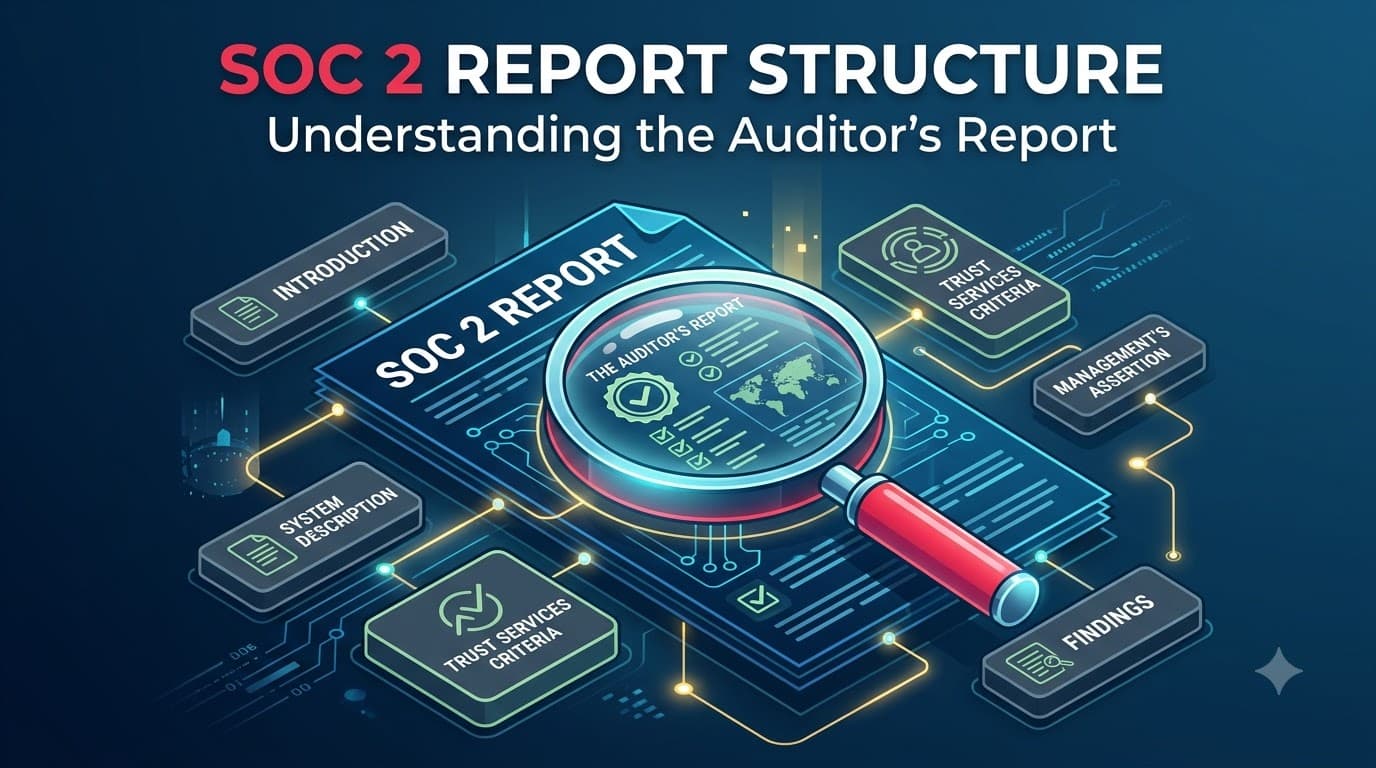
Every SOC 2 report — Type I or Type II, Security-only or all five Trust Services Criteria — is built from the same five-part skeleton. The AICPA's attestation standards define this structure, and while individual audit firms vary the formatting, page order, and cover design, the five substantive sections and their authorship never change. Learn this table and you have a map for every SOC 2 report you'll ever open.
Table 1: The Five Sections of a SOC 2 Report
# | Section Name | Who Writes It | What It Answers | Present in Type I? | Present in Type II? |
|---|---|---|---|---|---|
I | Independent Service Auditor's Report (the opinion) | The CPA firm / auditor | Did the auditor find the controls suitably designed (and, for Type II, operating effectively)? | Yes | Yes |
II | Management's Assertion | The service organization's management | What does management claim about its own system and controls? | Yes | Yes |
III | Management's Description of the System | The service organization's management (auditor reviews for fairness) | What is the system — infrastructure, software, people, procedures, data — and its boundaries? | Yes | Yes |
IV | Description of Criteria, Controls, Tests of Controls, and Results | The auditor (based on management's control matrix) | Which controls were tested, how, and with what results? | No — Type I omits this entirely | Yes — this is the section that defines a Type II |
V | Other Information Provided by Management (optional) | The service organization's management | Anything management wants to add that falls outside the audit's scope | Optional, unaudited | Optional, unaudited |
Two things jump out once you see the sections laid out this way. First, only Section IV is audited testing detail — sections II, III, and V are written by the company being examined, not by the auditor, which changes how skeptically you should read them (more on this shortly). Second, the difference between a Type I report and a Type II report isn't a different report — it's the same five-part skeleton with Section IV either present in full or absent entirely. That single missing section is, functionally, the entire distinction between the two report types. Our companion piece on choosing between a Type I and Type II audit covers the decision of which one to pursue; this article covers what to do with whichever one lands on your desk.
The Report Anatomy, Visually
The diagram below shows how the five sections relate to each other and where Type I and Type II diverge — useful as a mental map before you open an actual PDF.
flowchart TD
    A[Cover Page & Table of Contents] --> B["Section I: Independent Service Auditor's Report (the opinion)"]
    B --> C["Section II: Management's Assertion"]
    C --> D["Section III: Management's Description of the System"]
    D --> E{Type I or Type II?}
    E -->|Type I| F[Report ends here — design only, no testing section]
    E -->|Type II| G["Section IV: Trust Services Criteria, Controls, Tests of Controls, and Results"]
    G --> H["Section V: Other Information (optional, unaudited)"]
    F --> H
    H --> I[End of Report]
Notice that Section V sits at the end regardless of report type, and that it's the only section explicitly marked as unaudited in the diagram — a distinction the report itself will also state plainly, usually in a disclaimer paragraph introducing that section. We'll come back to why that matters more than most readers assume.
Section I: The Independent Service Auditor's Report — The Opinion
This is the section Marcus Webb found on page 3 of Cascadia's report, and it's the single most important page in any SOC 2 report you'll ever read. Section I is written entirely by the audit firm, not the company being examined, and it's the only section that carries the auditor's independent, professional opinion. Everything else in the report — the system description, the assertion, even the detailed control-testing narrative in Section IV — exists to support and be evaluated against this one section.
A standard auditor's opinion follows a predictable structure, and knowing the shape of it lets you scan for deviations fast. It opens by identifying what was examined (the service organization, the system, the period or point in time, the applicable Trust Services Criteria). It states the respective responsibilities of management (to design and maintain the system and controls, and to prepare a fair description of them) and the auditor (to express an opinion based on the examination, performed in accordance with SSAE 18 attestation standards). It describes, briefly, what an examination involves — obtaining reasonable assurance through inspecting evidence, evaluating the description, and testing controls. And then it delivers the opinion itself, usually in a short, deliberately unembellished paragraph that begins with some variation of "In our opinion" or, when there's a problem, "In our opinion, except for..."
Table 2: Anatomy of the Auditor's Opinion Paragraph
Component | What It Covers | Why It Matters to a Reader |
|---|---|---|
Addressee | Who the report is issued to (often "to management of [Service Organization] and user entities") | Confirms this is a restricted-use report, not a public document |
Scope statement | The system, the period or as-of date, and which Trust Services Criteria were examined | Tells you exactly what was and wasn't covered — never assume "SOC 2" means everything |
Management's responsibilities | Management prepared the assertion and system description and is responsible for the controls | Clarifies that most of the report's narrative content isn't independently authored |
Auditor's responsibilities | The CPA firm performed the examination per SSAE 18 and expresses an independent opinion | This is the section actually backed by independent testing |
Inherent limitations paragraph | A standard caveat that controls may not prevent all errors/fraud and that projecting results to future periods carries risk | Standard boilerplate — don't mistake it for a red flag on its own |
The opinion sentence itself | Unqualified, qualified, adverse, or disclaimer | The single most important sentence in the entire report |
Signature, city, and date | The audit firm's name, location, and report issuance date | Confirms who is professionally accountable and when the opinion was formed |
The opinion sentence is short by design — usually one or two sentences — and that brevity is exactly why it's so easy to skim past. Marcus caught Cascadia's problem because he read that sentence twice, not once. Every SOC 2 report review should start and end at this paragraph; everything else in the report exists to help you evaluate whether you trust the sentence you just read.
The Four Opinion Types
An auditor's opinion isn't binary. There are four recognized opinion types under attestation standards, and the difference between them changes what a report is actually telling you — sometimes dramatically. Most reports you'll ever see are unqualified, which is exactly why the exceptions stand out so sharply once you know to look for them.
Table 3: The Four SOC 2 Opinion Types
Opinion Type | Plain-Language Meaning | Typical Language Cue | What It Means for a Business Relationship |
|---|---|---|---|
Unqualified opinion (clean) | Controls were suitably designed (and, for Type II, operated effectively) throughout the period, with no material exceptions the auditor believes undermine the opinion as a whole | "In our opinion, in all material respects..." | The standard, expected outcome — proceed with normal vendor risk review |
One or more specific exceptions exist that are material but not pervasive — the rest of the system is fine | "In our opinion, except for the matter described in the preceding paragraph..." | Read the specific exception closely; it may or may not matter for your use case — don't reject reflexively, don't ignore reflexively | |
Adverse opinion | Exceptions are so pervasive or severe that the auditor concludes the controls, taken as a whole, are NOT suitably designed or operating effectively | "In our opinion, because of the significance of the matter(s) described above, the controls... are not suitably designed and operating effectively" | Serious red flag — this is rare in practice because most vendors remediate before a report reaches this point |
Disclaimer of opinion | The auditor was unable to obtain sufficient evidence to form any opinion at all — often due to major scope limitations | "We do not express an opinion on the description or the suitability of the design and operating effectiveness of controls..." | Treat as equivalent to having no report at all; ask why the auditor couldn't complete the work |
Adverse opinions and disclaimers are genuinely uncommon in circulated SOC 2 reports, for a practical reason: an auditor typically flags material problems well before fieldwork concludes, giving the service organization a chance to remediate or, in some cases, narrow the scope rather than proceed to an issued report that would embarrass everyone involved. When you do see one, it's worth treating as a serious signal rather than a technicality — either because a genuinely severe issue existed, or because the engagement itself broke down in a way worth understanding before you rely on anything else in the document.
"People hear 'qualified opinion' and panic, or worse, they hear it and shrug because it sounds like a synonym for 'qualified to do the job.' Neither reaction is right. A qualified opinion means the auditor found something specific and material enough to call out by name, and your job as the reader is to go find that specific thing and decide for yourself whether it's a dealbreaker for how you're using the vendor." — Elena Kovalenko, CPA, Partner, Highline Assurance Partners
Section II: Management's Assertion
Flip past the opinion and you land on Section II: Management's Assertion — a short, formal, signed statement from the service organization's own leadership (typically the CEO, CTO, or Chief Compliance Officer) rather than the auditor. This is the point where a lot of first-time readers get confused, because the assertion often uses language that echoes the auditor's opinion almost word for word — "we assert that, in all material respects..." — and it's easy to mistake it for a second, redundant copy of the opinion. It isn't. It's the opposite direction of accountability.
The assertion is management's own claim, made before the auditor tests anything, that (1) the system description fairly presents the system, (2) the controls were suitably designed to meet the applicable Trust Services Criteria, and (3) — for a Type II — the controls operated effectively throughout the period. The auditor's job in Section I is to independently evaluate whether that claim holds up. Think of the assertion as the defendant's sworn statement and the opinion as the judge's verdict on it — related, sequential, and definitely not interchangeable. A report with a strong system description and a weak or vague assertion is itself a minor signal worth noticing, because it can suggest management hasn't fully internalized ownership of what they're claiming. Our piece on taking ownership of your controls through the management assertion goes deeper on how service organizations should approach writing this section well.
For a user entity reading a vendor's report, the assertion matters for one practical reason: it's your first evidence of whether the vendor's own leadership is speaking specifically and confidently about their control environment, or hedging in generic language borrowed from a template. Specific, concrete assertions ("management is responsible for the design, implementation, and operation of controls...as described in Section III") are the norm and expected. Vague, evasive language in an assertion — while rare, since auditors typically push back on this before finalizing a report — is worth flagging for follow-up.
Section III: Management's Description of the System
This is usually the longest section in the report, and it's the one that does the most actual explanatory work: Management's Description of the System, commonly just called the system description. It answers a deceptively large question — what, exactly, is "the system" this report covers? — and it does so across five defined categories the AICPA calls the description criteria (DC criteria). A fair, complete system description is what lets a reader with zero direct access to a vendor's environment understand what they're actually trusting.
Table 4: The Five Categories of the System Description
Category | What It Covers | Example Content |
|---|---|---|
Infrastructure | The physical and hardware components supporting the system | Cloud provider(s) and regions, data centers, network architecture, redundancy design |
Software | The applications and system software that support the service | The production application stack, databases, security tooling, monitoring platforms |
People | The organizational structure and personnel operating the system | Org chart summary, key roles (security, engineering, operations), reporting lines |
Procedures | The automated and manual processes involved in operating the system | Onboarding/offboarding, change management, incident response, backup procedures |
Data | The types of data processed, how it flows, and its classification | Data types handled, data flow through the system, retention and classification approach |
Beyond the five categories, a complete system description also has to define the audit scope — which products, services, locations, and legal entities are actually covered, and just as important, which are explicitly excluded. It has to identify the applicable Trust Services Criteria and map them to the relevant control activities. It must disclose relevant complementary controls the user entity is expected to run itself (covered in detail two sections from now), and it must disclose any subservice organizations the service organization relies on, along with how those are handled in scope (also covered shortly). Finally, for a Type II report specifically, it typically discloses any significant changes to the system during the audit period — new data centers, major architecture changes, leadership changes in security roles, and so on.
"Read the system description before you read anything else, including the opinion. It tells you what the auditor was even looking at. I've seen buyers get excited about a clean opinion on a report that, once you actually read the scope paragraph in Section III, covered a legacy product the vendor was migrating customers away from — not the product the buyer was actually about to sign for." — Dana Okafor, Director of Compliance, Cascadia Cloud Storage
What "Fair Presentation" Means — and Why Section III Isn't Independently Verified Prose
Here's the detail that trips up almost every first-time reader: Section III is written by management, not the auditor. The auditor's role with respect to the system description is to evaluate whether it is fairly presented — accurate, complete, and not misleading in the context it's given — and to report any exceptions to that fairness in Section I or IV. But the words themselves are the service organization's own, which is exactly why the auditor's opinion in Section I explicitly states an opinion on "whether the description is presented fairly." That phrase is doing real work.
Practically, this means you should read Section III with a slightly different posture than Section IV. Section IV — the control-testing narrative — is the auditor's independent account of what they tested and found. Section III is the vendor's own explanation of their system, checked by the auditor for fairness rather than independently authored. Both are trustworthy in the sense that a competent auditor has scrutinized them, but they carry different kinds of authorship, and an experienced reader holds that distinction in mind the entire time they're reading.
Section IV: Trust Services Criteria, Controls, Tests of Controls, and Results — The Type II Section
If Section I is the report's headline, Section IV is where the actual evidence lives — and it only exists in a Type II report. This is the single structural fact that separates the two report types, and it's worth restating plainly: a Type I report ends after Section III. There is no testing narrative, no control matrix, no results, because there's nothing to test across a period that doesn't exist for a point-in-time snapshot. If you're holding a Type I report and looking for a "results" table, stop looking — it isn't there by design, not by omission.
Section IV is organized around the applicable Trust Services Criteria — the required Common Criteria (Security), plus whichever of Availability, Processing Integrity, Confidentiality, or Privacy the service organization included in scope. The Common Criteria themselves map to nine categories (CC1 through CC9) built on the COSO internal-control framework's underlying principles — CC1 covers the control environment, CC2 covers communication and information, CC3 covers risk assessment, and so on through CC9's risk mitigation. Our deep dive on the five Trust Services Criteria walks through how each category is scoped and what it covers in detail; here, what matters is how the criteria show up structurally inside Section IV.
For each criterion in scope, the section lists the specific control activities the service organization has implemented, describes the test the auditor actually performed against each one, states (often implicitly, through sample sizing language) the extent of testing, and reports the result. This is typically laid out as a control matrix — sometimes a table, sometimes a criterion-by-criterion narrative — and it's the densest, most valuable part of the entire report for a technically literate reader.
Table 5: Sample Control Matrix Structure (Illustrative)
TSC Reference | Control Activity Description | Test Performed by Auditor | Test Result |
|---|---|---|---|
CC6.1 | Logical access to production systems requires unique user IDs and multi-factor authentication (MFA) | Inspected access control configuration; sampled 25 user accounts for MFA enrollment | No exceptions noted |
CC6.3 | User access is reviewed quarterly by system owners and removed within 5 business days of termination | Inspected quarterly access review records; sampled 15 terminations across the period | 1 exception — one termination removed 8 business days after separation, remediated |
CC7.2 | Security events are monitored continuously via SIEM with defined alert escalation | Inspected SIEM configuration; sampled 10 alerts and traced to resolution | No exceptions noted |
CC8.1 | Changes to production systems require documented approval prior to deployment | Sampled 30 production changes across the period; traced each to an approval record | No exceptions noted |
A1.2 (Availability) | System availability is monitored against a defined uptime commitment with automated failover | Inspected monitoring configuration; reviewed uptime records for the period | No exceptions noted |
Reading a table like this closely tells you far more than the opinion paragraph alone. A single "1 exception" row, remediated within days, sitting inside an overall unqualified opinion is normal, healthy audit behavior — it's evidence the testing was real rather than rubber-stamped. What changes the picture is pattern: several exceptions clustered on the same control, an exception the report doesn't say was remediated, or an exception on a control category that happens to matter most for your specific use of the vendor (say, access control exceptions for a vendor handling your customers' PII). Section IV is where that judgment call actually gets made — not in the opinion paragraph, which only tells you the auditor's overall conclusion, not the texture behind it.
Type I vs Type II: What Actually Differs, Section by Section
It's worth collecting the differences in one place, because "Type II has more testing" undersells how much of the report's actual value sits inside that one structural difference.
Table 6: Type I vs Type II — Section-by-Section Differences
Section | Type I Content | Type II Content |
|---|---|---|
I — Auditor's Opinion | Opinion on suitability of control design as of a single date | Opinion on suitability of design and operating effectiveness across a period |
II — Management's Assertion | Assertion about design only, as of a date | Assertion about design and operating effectiveness across the period |
III — System Description | Describes the system as of the "as of" date | Describes the system across the period, including significant changes during it |
IV — Criteria, Controls, Tests, Results | Not present — no testing narrative exists | Present — the defining section: control-by-control test descriptions and results |
V — Other Information | Optional, unaudited, as applicable | Optional, unaudited, as applicable |
Time dimension | A snapshot ("as of March 31, 2026") | A range ("October 1, 2025 through March 31, 2026") |
What a reader can conclude | Controls were reasonably designed at one moment | Controls were designed and demonstrably operated consistently over months |
This is also why most enterprise procurement policies specifically require a Type II report rather than accepting a Type I: a Type I tells you the blueprint looked right, but a Type II tells you the building actually stood up through a storm. Neither is a "fake" report — both follow the same rigorous standard — but they answer meaningfully different questions, and conflating them is one of the more consequential mistakes a report reader can make.
Section V: Other Information Provided by Management
The final section, present in many but not all reports, is Other Information Provided by Management — content the service organization chooses to include that falls outside the audit's actual scope. This is the one section of the report explicitly and unambiguously unaudited, and reputable reports say so directly, usually with an introductory sentence along the lines of: "The information in this section is presented by management... and has not been subjected to the procedures applied in the examination... and, accordingly, we express no opinion on it."
Common contents include management's response to any exceptions noted in Section IV (a short explanatory or remediation narrative), a description of planned future control enhancements, additional context about the business or its risk management program, or a summary of the subservice organizations and how they were evaluated. None of this is fabricated or dishonest by including it — it's a legitimate, standard part of many reports — but a careful reader treats it differently from everything preceding it. If a vendor's remediation story for a Section IV exception only appears in Section V, that's still useful context, but it's the vendor's own unaudited narrative about the fix, not the auditor's independently verified confirmation that the fix actually worked. That distinction typically gets closed out in the following year's report, when the auditor tests the remediated control directly.
Complementary User Entity Controls (CUECs): The Part of the Report That's Your Job
Buried inside the system description — and easy to skip past entirely — is a list that matters enormously to anyone relying on a vendor's SOC 2 report: Complementary User Entity Controls, almost universally abbreviated CUECs. These are controls the system description explicitly states the user entity (you, the customer) is responsible for operating, because the service organization's control design assumes you're doing them. A vendor's SOC 2 report does not certify your entire security posture — it certifies the piece the vendor controls, on the explicit assumption that you're holding up your end.
This is, in my experience, the single most consequential thing a buyer misses when reading a vendor's report. A clean, unqualified Type II opinion says nothing about whether you are actually operating the CUECs the report assumes you are. If a cloud storage vendor's report states that CUECs include "user entities are responsible for managing and reviewing access granted to their own personnel within the platform," and your team never actually runs quarterly access reviews on your side, the vendor's clean opinion doesn't protect you from the access-related incident that follows. The control gap is real; it's just not the vendor's gap.
Table 7: Common CUEC Examples and Why They Matter
Typical CUEC Language | What It Actually Requires of You | Risk If You Don't Do It |
|---|---|---|
"User entities are responsible for managing access granted to their own users within the system" | Provisioning, reviewing, and deprovisioning your own users' accounts on the vendor's platform | Terminated employees or over-privileged users retain access the vendor has no visibility into |
"User entities are responsible for maintaining their own environment's security configuration" | Configuring your tenant/instance securely (e.g., enabling available security features, setting policies) | Misconfigurations on your side create incidents the vendor's controls were never designed to prevent |
"User entities are responsible for notifying [vendor] of changes to authorized users or contacts" | Keeping your own contact and authorization records current with the vendor | Delayed incident notification or access changes due to stale records |
"User entities are responsible for reviewing reports and alerts provided by [vendor] in a timely manner" | Actually monitoring the dashboards, logs, or alerts the vendor exposes to you | Vendor-surfaced warnings go unread, and incidents that were detectable go unactioned |
"User entities are responsible for encrypting sensitive data prior to transmission where applicable" | Applying your own encryption controls on data you send to the vendor | Sensitive data transits or rests unprotected despite the vendor's platform-level controls being sound |
Our companion article on complementary controls and client implementation requirements goes deep on how to inventory and actually operate these obligations across a vendor portfolio. For now, the practical takeaway is simple: every time you read a vendor's SOC 2 report, read the CUEC list as carefully as the opinion. It's the part of the report that tells you what's still your job.
Subservice Organizations: Carve-Out vs. Inclusive Method
Almost no service organization runs its entire stack in-house anymore. A subservice organization is a vendor the service organization itself relies on — most commonly a cloud infrastructure provider (AWS, Azure, GCP), but also payment processors, data centers, or specialized SaaS tools that touch in-scope data or systems. The system description has to disclose these relationships, and it has to say, explicitly, which of two methods was used to handle them in the audit.
Under the carve-out method, the subservice organization's own controls are excluded from the service organization's audit entirely — the system description identifies the subservice organization and the functions it performs, and the CUEC-style logic extends one layer further: the report will state that the subservice organization's own controls were not tested as part of this examination, and a reader who needs assurance over those controls has to request the subservice organization's own report separately (commonly AWS's or Azure's own SOC 2 reports, in practice). Under the inclusive method, the subservice organization's controls ARE tested as part of the engagement — the auditor extends testing to cover them directly, and the report's control matrix in Section IV includes results for those controls alongside the service organization's own.
Table 8: Carve-Out vs. Inclusive Method
Dimension | Carve-Out Method | Inclusive Method |
|---|---|---|
Subservice org's controls tested in this report? | No — explicitly excluded from scope | Yes — tested directly as part of this engagement |
What the reader must do for full assurance | Independently obtain and review the subservice organization's own SOC 2 report | Nothing extra — coverage is already in this report |
Common for which relationships | Major cloud infrastructure providers (AWS, Azure, GCP) — too large to include directly | Smaller, more tightly integrated subservice providers where inclusion is practical |
Report language to look for | "The accompanying description excludes the controls of [subservice organization]. Our examination did not extend to controls of [subservice organization]." | "The accompanying description includes the controls of [subservice organization] relevant to..." |
Practical reader action | Request the subservice organization's own current report and check its opinion and period too | Confirm the subservice organization's testing results are actually reflected in Section IV |
The carve-out method is overwhelmingly more common in practice, especially for infrastructure providers, simply because it would be impractical for a mid-market SaaS vendor's auditor to independently re-test AWS's data center controls every year — AWS already produces its own extensive attestation reports for exactly that purpose. The practical consequence for a diligent reader is a small but real amount of extra homework: a genuinely thorough vendor review sometimes means requesting two reports, not one, and confirming the dates and scope of both actually line up with your risk window.
"I ask every vendor the same follow-up question after I've read their SOC 2: 'Is this carve-out or inclusive for your cloud provider, and can I get their report too?' Maybe one reviewer in five asks that question, and it's usually the one who's actually read Section III instead of skimming to the opinion page." — Tomás Rivera, CISO, Meridian Health Analytics
Exceptions and Deviations: How They Actually Appear in a Report
An "exception" (sometimes called a deviation) is any instance where testing found a control didn't operate exactly as designed — anything from a single late access review to a systemic gap affecting every instance of a control across the period. Exceptions are normal. A large, mature control environment tested rigorously over six or twelve months will almost always turn up something; the absence of any exceptions across a long Type II period, while not impossible, is uncommon enough that some experienced reviewers view a spotless report with mild extra scrutiny rather than automatic relief.
What actually matters is how an exception is scoped, disclosed, and — critically — whether it changed the auditor's overall opinion. Not every exception is severe enough to move the opinion from unqualified to qualified; auditors weigh materiality and pervasiveness. A single late offboarding, remediated within days and not repeated elsewhere in the sample, is typically disclosed in Section IV's results column but doesn't necessarily taint the overall opinion. A systemic pattern — the same control failing across a large share of the sample, or a control failure that touches a criterion central to the report's purpose — is far more likely to push the opinion toward qualified or, in severe cases, adverse.
Table 9: How Exceptions Are Handled and Disclosed
Exception Severity | Typical Disclosure Location | Effect on Opinion | Example |
|---|---|---|---|
Isolated, minor, remediated quickly | Results column in Section IV control matrix | None — opinion remains unqualified | One termination processed 3 days late out of a sample of 20 |
Isolated but unremediated by report date | Results column, sometimes with a management response in Section V | Usually none if isolated, but noted for reader awareness | A single missed quarterly access review, acknowledged, fix scheduled |
Repeated/systemic across a control | Explicitly called out, often referenced in the opinion paragraph | Frequently triggers a qualified opinion | MFA not enforced for a significant subset of accounts throughout the period |
Pervasive across multiple criteria or the whole control environment | Called out prominently, opinion paragraph itself | Can trigger an adverse opinion | Multiple core control categories failing consistently across the period |
Auditor unable to gather sufficient evidence at all | Explained in the opinion paragraph directly | Triggers a disclaimer of opinion | Evidence records destroyed or unavailable for a large portion of the sample |
Reading exceptions well means resisting two opposite instincts. The first is treating any exception as disqualifying — that overcorrects, and it would disqualify nearly every real Type II report ever issued, since a rigorous audit is supposed to find things. The second is skimming past exceptions because the headline opinion is unqualified — that undercorrects, because a qualified opinion can still be a perfectly acceptable report for your use case if the specific exception doesn't touch anything you actually rely on. The only way to know which situation you're in is to read the actual exception language in Section IV, not just the opinion's headline classification.
Restricted Use vs. General Use: Who Is Actually Allowed to Read This Report
One structural fact surprises almost every first-time reader: SOC 1 and SOC 2 reports are restricted-use documents. The cover page and opinion paragraph explicitly state who the report is intended for — typically the service organization's management, its user entities during the period covered, and (for a carve-out) the auditors of those user entities — and state that the report is not intended for, and should not be used by, anyone outside that defined group. This is why you generally can't find a company's SOC 2 report by Googling it or browsing their website; it's usually gated behind an NDA, a trust portal login, or a direct request to a sales or security contact.
SOC 3 exists specifically to solve the marketing problem this creates. It's a general-use report — built from the same underlying SOC 2 examination, using the same Trust Services Criteria — but stripped of the detailed system description and, critically, the entire Section IV control-testing narrative. What's left is a short summary and the auditor's opinion, suitable for public posting on a website as a trust signal. It answers "did this company get a clean opinion" without disclosing exactly how their controls work in enough detail to be useful to an attacker or a competitor.
Table 10: Restricted Use vs. General Use — SOC 1/SOC 2 vs. SOC 3
Attribute | SOC 1 / SOC 2 | SOC 3 |
|---|---|---|
Distribution | Restricted — named parties only (management, user entities, their auditors) | General use — freely distributable, publicly postable |
Contains full system description? | Yes, in detail | No — summarized only |
Contains Section IV control testing detail? | Yes (Type II) | No — omitted entirely |
Typical access method | NDA-gated, trust portal, or direct request | Publicly available, often linked from a company's trust or security page |
Best used for | Deep vendor risk review, procurement due diligence, contractual evidence | Marketing trust signal, quick public-facing proof a SOC 2 exists |
Should you rely on it alone for a critical vendor decision? | Yes, when combined with your own review process | No — request the underlying SOC 2 for anything beyond a first impression |
If you only ever see a vendor's SOC 3, you've seen the trailer, not the film. It's a legitimate and useful document for a first pass, but any vendor risk decision above a low materiality threshold should involve requesting the actual restricted-use SOC 2 report and reading it the way this article describes.
How to Read a SOC 2 Report: A Structured Checklist
Everything above adds up to a repeatable process. Here's the sequence I actually walk through — and teach vendor risk teams to walk through — every time a new report lands, whether it's a 30-page Type I or a 150-page multi-criteria Type II.
Table 11: How-to-Read Checklist
Step | What to Check | Where to Find It |
|---|---|---|
1. Confirm the report type | Type I (design only) or Type II (design + operating effectiveness)? | Cover page, opinion paragraph, presence/absence of Section IV |
2. Check the period or date | Is the "as of" date or audit period recent and relevant to your risk window? | Opinion paragraph, system description |
3. Read the opinion sentence closely | Unqualified, qualified, adverse, or disclaimer? | Section I, final paragraph |
4. Confirm the applicable criteria | Security only, or Security plus Availability/Processing Integrity/Confidentiality/Privacy? | Section I scope statement, Section III |
5. Check the scope | Which products, systems, and locations are actually covered — and excluded? | Section III |
6. Review the CUEC list | What is explicitly your responsibility to operate? | Section III, often near the end |
7. Check subservice organization treatment | Carve-out or inclusive — do you need a second report? | Section III |
8. Scan Section IV for exceptions | Any patterns, unremediated items, or clusters on controls you rely on? | Section IV control matrix (Type II only) |
9. Read Section V if present | Any management commentary on exceptions or planned changes? | Section V, clearly marked unaudited |
10. Check the audit firm | Is this a recognized, licensed CPA firm with relevant experience? | Signature block, Section I |
11. Note the report's age | How close is the report date to today — do you need a bridge letter? | Cover page, Section I date |
12. Decide and document | Record your conclusion and any follow-up requests, tied to this specific report | Your own vendor risk file |
That twelfth step is the one most reviewers skip, and it's the one that actually protects you later. A documented, dated review — noting the report period, the opinion, any exceptions you evaluated, and any follow-up you requested — is what turns "we read their SOC 2 once" into a defensible vendor risk process if anyone ever asks.
"Procurement teams love a green checkmark next to 'SOC 2 on file.' My job is to make sure that checkmark actually means something. I built our team's twelve-step review into a template years ago, and the two steps that catch the most real issues are always the CUEC list and the report date — not the opinion, which almost everyone already checks." — Sam Whitfield, Head of Procurement Risk, BrightPath Retail Group
Red Flags: What Should Make You Slow Down
Most reports you review will be unremarkable in the best sense — clean opinion, reasonable scope, well-organized. But a handful of specific signals should make you stop skimming and start reading closely.
Table 12: Red Flags in a SOC 2 Report
Red Flag | Why It Matters |
|---|---|
Opinion is qualified, adverse, or a disclaimer | Directly signals a control problem the auditor found material enough to name |
Report is more than 12–13 months old with no bridge letter offered | You may be relying on stale evidence with no coverage for the gap |
Vague or generic-sounding system description | May indicate a template-driven exercise rather than a fully understood control environment |
CUEC list is extremely short or absent for a complex system | Either unusually clean design, or the description may be incomplete |
Subservice organizations aren't disclosed despite an obvious dependency (e.g., no mention of any cloud provider) | Suggests an incomplete or non-fairly-presented system description |
Scope excludes the specific product or service you're actually buying | The "clean" report may not cover what you're relying on at all |
Auditor is unfamiliar, unlicensed, or has no discoverable track record | Raises questions about the rigor and independence of the examination |
Exceptions in Section IV with no remediation status noted | Leaves you unable to judge whether the gap is closed or still open |
Vendor refuses to provide the underlying SOC 2 after only sharing a SOC 3 | May indicate something in the full report they'd rather you not see closely |
Multiple consecutive reports show the same exception recurring | Signals a control that isn't actually being fixed, just re-disclosed each cycle |
None of these automatically disqualify a vendor — a qualified opinion with a well-explained, low-impact exception can still be perfectly acceptable, and a short CUEC list can genuinely reflect a well-designed system. What each flag earns is closer reading, not automatic rejection. The goal of this whole exercise isn't to find a reason to reject every vendor; it's to make an informed decision instead of a reflexive one.
Who Should Actually Be Reading Which Sections
Not every reader needs to read every section with the same depth, and knowing who owns what inside your own organization keeps the review from either falling entirely on one overloaded analyst or getting so diffused that nobody actually reads the thing closely.
Table 13: Report Review Responsibility by Role
Role | Primary Focus | Sections to Read Closely | Sections to Skim |
|---|---|---|---|
Vendor risk / procurement analyst | Overall risk decision, CUEC tracking, exception follow-up | I, III (CUECs and scope), IV (exceptions) | II, V |
Security engineering lead | Technical control alignment with your own environment | III (infrastructure, software), IV (control matrix) | II |
Legal / contracts | Restricted-use terms, subservice organization liability implications | I (addressee, scope), III (subservice organization treatment) | IV detail (unless disputed) |
Executive sponsor / board reporting | High-level assurance for renewal or new-vendor decisions | I (opinion only), summary of any exceptions | Full III and IV detail — rely on analyst's summary |
Internal compliance (if this is YOUR company's own report) | Accuracy of assertion and description, exception remediation planning | II, III, IV in full | — (all sections matter for your own report) |
This division of labor is exactly why the twelve-step checklist above ends in a documented conclusion: it gives the executive sponsor something concise and accurate to rely on without needing to personally read a 90-page document line by line, while ensuring someone on the team actually did.
Case Study 1: Fairbridge Mutual Catches a Qualified Opinion on Page 3
Return to Marcus Webb's Tuesday morning. Cascadia Cloud Storage's report opened, as expected, with an unremarkable cover page and table of contents. The opinion paragraph on page 3, though, didn't read like the other ten reports in his queue. Instead of "in our opinion, in all material respects, the controls were suitably designed and operating effectively," Cascadia's opinion read: "in our opinion, except for the matter described in the following paragraph, the controls were suitably designed and operating effectively throughout the period."
Marcus went looking for "the following paragraph" and found it: a qualified matter describing that logical access reviews for one of Cascadia's three data-processing environments — a legacy environment inherited through a 2024 acquisition — had not been performed on the required quarterly cadence for two of the four quarters in the audit period, affecting an unstated but "more than isolated" number of user accounts. Section IV's control matrix confirmed the same finding in more detail, with a management response in Section V stating the legacy environment had since been migrated onto Cascadia's primary access review tooling.
Here's what mattered for Fairbridge's decision, and it's the reason this case study earns its place in this article: the legacy environment described in the exception was not the environment Fairbridge's claims-processing platform actually used — a fact confirmed by reading the scope paragraph in Section III against Fairbridge's own contract and integration documentation. Marcus didn't reject Cascadia. He requested a written confirmation from Cascadia's compliance team (Dana Okafor, as it happened) specifying which environment Fairbridge's data lived in, cross-checked it against the system description's environment naming, and got a signed letter attaching that confirmation to the renewal file. The $3.1 million renewal proceeded on schedule, with one added contractual clause requiring Cascadia to disclose environment-specific exceptions in writing going forward.
The quantified outcome: a four-hour deep read, instead of a twenty-minute skim, turned a genuinely alarming-looking qualified opinion into a fully explainable, low-risk finding — without either rubber-stamping a real issue or needlessly blowing up a four-year vendor relationship over a problem that, on close reading, didn't touch Fairbridge's actual exposure.
Case Study 2: NimbusPay Prepares Its First Type II Report
NimbusPay, a fictional 85-person payroll-technology startup, had just completed its first-ever SOC 2 Type II audit — a nine-month observation period covering the Security and Availability criteria — and its board wanted to know, in plain language, what the resulting report would actually say before it went out to their three largest enterprise prospects. NimbusPay's VP of Engineering, Jordan Ellis, had never read a SOC 2 report end to end before being handed a draft.
Walking Jordan through the five-section structure changed how the team prepared for the report's release. Section II, the management assertion, needed the CEO's actual signature and a review to make sure the language was specific rather than templated — an early draft had generic boilerplate that Jordan's outside auditor flagged and asked to be tightened to reference NimbusPay's actual system by name. Section III's system description needed a genuinely accurate account of NimbusPay's subservice organization treatment: they used AWS (carve-out method, correctly disclosed) and a smaller payroll-tax-filing subservice provider (inclusive method, since NimbusPay's auditor was able to extend testing to that smaller vendor directly). Section IV came back with two disclosed exceptions — a handful of access reviews completed a few days past the internal SLA during the company's busiest onboarding month, both remediated and both reflected honestly in the results column — inside an overall unqualified opinion.
The quantified outcome: NimbusPay sent the report to all three prospects within a week of receiving it, with a one-page internal reader's guide (built directly from the checklist and section map in this article) attached for each prospect's security reviewer. Two of the three deals, worth a combined $540,000 in annual contract value, closed within six weeks — both procurement teams specifically cited the clarity of NimbusPay's system description and the visible, honestly disclosed exceptions as reasons they trusted the report rather than viewed it with suspicion.
"The two exceptions in our first Type II report worried me more than anything else in the whole process — until our auditor explained that a spotless report over nine months would have actually looked less credible to a sophisticated buyer than an honest one with two small, fixed issues. That reframing changed how our whole team felt about handing the report over." — Jordan Ellis, VP of Engineering, NimbusPay
Case Study 3: Meridian Health Analytics and the Carve-Out Gap
Tomás Rivera's team at Meridian Health Analytics was reviewing a new data-hosting vendor's SOC 2 Type II report as part of onboarding for a project touching de-identified patient analytics data. The report's opinion was unqualified, the system description was thorough, and the CUEC list was reasonable and specific. On a first pass, it looked like an easy approval.
Reading Section III closely, Tomás's team found the carve-out language: the vendor's infrastructure ran on a regional data center provider — not one of the major hyperscale cloud platforms, but a smaller, specialized colocation provider called (for this account) Vertex Data Centers — and the report explicitly excluded Vertex's own physical and environmental controls from the examination. Because Vertex wasn't a household name the way AWS or Azure would have been, nobody on the initial review had thought to ask whether Vertex had its own current SOC 2 report at all.
Tomás's team requested it directly from the vendor. It took eleven days to arrive, and when it did, it turned out to be a Type I report — design only, no operating-effectiveness testing — issued fourteen months earlier, well past the window Meridian's own vendor risk policy considered current. That gap became the actual finding of the review, not anything in the primary vendor's report itself: Meridian required the primary vendor to either obtain a current Type II report from Vertex within 90 days or provide compensating evidence of Vertex's physical security controls directly. The vendor complied, delivering a current bridge letter from Vertex within 60 days and a scheduled Type II report six months later.
The quantified outcome: a subservice-organization gap that a surface-level review would have missed entirely got closed before the contract was signed, rather than surfacing during a future incident investigation — the exact scenario carve-out disclosures exist to help a careful reader prevent.
Table 14: Case Study Outcomes at a Glance
Case Study | What the Deep Read Caught | Action Taken | Outcome |
|---|---|---|---|
Fairbridge Mutual / Cascadia Cloud Storage | A qualified opinion tied to a legacy environment outside Fairbridge's actual scope | Requested written scope confirmation; added a disclosure clause to the contract | $3.1M renewal proceeded on schedule with stronger contractual terms |
NimbusPay's first Type II report | Two minor, honestly disclosed exceptions inside an unqualified opinion | Built a reader's guide and shared proactively with prospects | Two deals worth $540,000 ACV closed within six weeks |
Meridian Health Analytics / subservice carve-out | A stale, Type-I-only report from an undisclosed-by-name subservice data center | Required a current report or compensating evidence before signing | Subservice gap closed pre-contract instead of post-incident |
Report Age and Bridge Letters
One dimension the checklist flags but deserves its own explanation: a SOC 2 report is only current for so long. A Type II report covering "October 1, 2025 through March 31, 2026" tells you nothing directly about what happened on April 15th — and yet contracts get signed, renewals get reviewed, and audits get scheduled on calendars that rarely line up neatly with a vendor's report period. The gap between a report's end date and the date you actually need coverage for is exactly what a bridge letter (sometimes called a gap letter) exists to address.
A bridge letter is a short, signed statement from the service organization — not a new audit, and not independently tested by the auditor in the same way as the underlying report — confirming that no material changes to the control environment have occurred since the report period ended, and that the organization is not aware of any control failures during the gap period. It's a stopgap, not a substitute: a bridge letter has real, if lesser, evidentiary value, but it should never be treated as equivalent to an actual tested report, and most vendor risk policies cap how long a bridge letter can be relied upon (commonly three to six months) before a fresh report becomes mandatory.
Table 15: When a Bridge Letter Is (and Isn't) Sufficient
Situation | Bridge Letter Appropriate? | Better Alternative |
|---|---|---|
Report ended 2 months ago, renewal decision needed now | Yes — standard practice, low risk | — |
Report ended 5 months ago, next report still 3+ months out | Marginal — check your own policy's cap | Request an updated timeline from the vendor for the next report |
Report ended 8+ months ago with no next report scheduled | No — this is a stale-report situation, not a bridge gap | Escalate; request status of the next audit cycle directly |
Report showed an unremediated exception at period-end | No — a bridge letter doesn't independently verify remediation | Request specific evidence the exception was closed, or wait for the next tested report |
Vendor underwent a significant system change since the report period | No — the bridge letter's "no material change" claim may not hold | Request an updated system description or interim disclosure |
Reading the report date isn't a formality — it's step eleven on the checklist for a reason. A beautifully clean opinion attached to a fourteen-month-old report, with no bridge letter and no next audit scheduled, tells you almost nothing about the vendor's controls today.
What a SOC 2 Report Does NOT Tell You
Everything above explains how to extract real signal from a SOC 2 report. It's just as important to be precise about the report's inherent limits — not because the document is untrustworthy, but because misunderstanding its boundaries is exactly what leads to the "we had a clean SOC 2 report" surprise when an incident happens anyway. A well-read report makes you more confident; it should never make you complacent.
First, testing is sampled, not exhaustive. When Section IV states an auditor "sampled 25 user accounts" or "sampled 15 terminations," that's a statistically reasoned subset, not every single instance during the period. A control can pass every sampled test and still have failed on an instance outside the sample — sampling risk is inherent to any audit methodology, financial or otherwise, and it's a known, accepted limitation of the standard, not a flaw unique to a given auditor. Second, the report is backward-looking by definition. A Type II report tells you what happened during a defined historical period; it says nothing directly about a control that changed, weakened, or broke the day after the period ended — which is exactly why report age and bridge letters matter as much as they do. Third, an unqualified opinion is not a guarantee against future incidents. Auditors test whether controls were designed and operated correctly against defined criteria — they do not predict or prevent a future zero-day, a sophisticated social-engineering attack, or a determined insider, all of which can defeat well-designed, well-operated controls. A clean SOC 2 report reduces risk; it does not eliminate it, and any vendor or salesperson who implies otherwise is overstating what the document actually says.
Table 16: What a SOC 2 Report Does and Doesn't Guarantee
A SOC 2 Report DOES Tell You | A SOC 2 Report Does NOT Tell You |
|---|---|
Whether controls were suitably designed as of a date (Type I) or a period (Type II) | Whether a control will hold up against every future attack technique |
Whether sampled evidence showed controls operating as described | Whether every single unsampled instance also operated correctly |
What the service organization itself is responsible for | What you (the user entity) still have to do under the CUECs |
Which subservice organizations are disclosed and how they're handled | Independent assurance over carved-out subservice organizations' own controls |
The auditor's independent, professional opinion on the above | A prediction, guarantee, or certification of future security outcomes |
A defined historical period's worth of evidence | Anything about control performance after the report period ends |
Reading a report with this table in mind is what separates a mature vendor risk program from a checkbox exercise. The goal was never to find a report that eliminates risk — no such document exists for any framework, SOC 2 included. The goal is to understand, precisely, what risk a given report actually addresses, what it explicitly leaves to you, and what remains simply unaddressed by any attestation — so you can make deliberate decisions about the gap rather than discovering it exists after something goes wrong.
Report Literacy as a Business Advantage, Not Just a Compliance Chore
Here's the strategic point worth sitting with after all the mechanics above: the ability to read a SOC 2 report accurately and confidently is a genuine competitive asset, on both sides of the transaction. For a buyer, a team that can actually parse Section III and IV instead of skimming to the opinion closes vendor reviews faster, catches real risk that a superficial review misses (as Tomás's team did with the carve-out gap), and builds a defensible, documented vendor risk process instead of a box-checking ritual. For a service organization, understanding exactly what your own report will say — and getting ahead of any exceptions with a clear, honest narrative — turns the report from a document you nervously hand over into a sales asset you proactively lead with, the way NimbusPay did.
This same literacy compounds across frameworks, not just within SOC 2. Many of the organizations I work with are running SOC 2 and ISO 27001 in parallel, and the report-reading discipline built here — separating independently tested claims from management-authored narrative, checking scope before trusting an opinion, tracking exceptions to resolution — transfers directly to reading an ISO 27001 certificate and its associated Statement of Applicability. If your organization is weighing whether to pursue both frameworks, our guide on running ISO 27001 and SOC 2 together covers how to avoid duplicating evidence collection across the two, and our ISO 27001 vs NIST/SOC 2/PCI DSS comparison is a useful map if you're juggling more than two frameworks against the same control environment.
The organizations that treat report literacy as a core competency — not a once-a-year fire drill delegated to whoever's calendar has room — consistently make faster, better-documented vendor decisions and produce cleaner, more sales-ready reports of their own. That's the compounding return on the four hours Marcus Webb spent reading Cascadia's report closely instead of twenty minutes skimming it.
Ready to Build Your Own Report-Reading Process?
If this article changed how you'll approach the next SOC 2 report that lands in your inbox — vendor's or your own — the next step is turning the checklist above into a repeatable process rather than a one-time read. PentesterWorld's SOC 2 Report Reader's Guide walks through annotated real-world report excerpts section by section, and our SOC 2 Control Matrix / RACI Template gives your team a standing structure for tracking exceptions, CUECs, and subservice organization dependencies across every vendor report you review — not just the one in front of you this quarter.
If your own organization is heading toward its first SOC 2 report and you want to understand exactly what auditors will expect from your system description and control narrative before fieldwork starts, our SOC 2 Readiness Checklist and the "Are You SOC 2 Ready?" quiz are the fastest ways to find your gaps before an auditor does. Either way, the report you're staring at — whether it's a vendor's or a draft of your own — stops being 90 pages of dense language and starts being exactly what it was designed to be: a structured, honest account of what a control environment actually does.