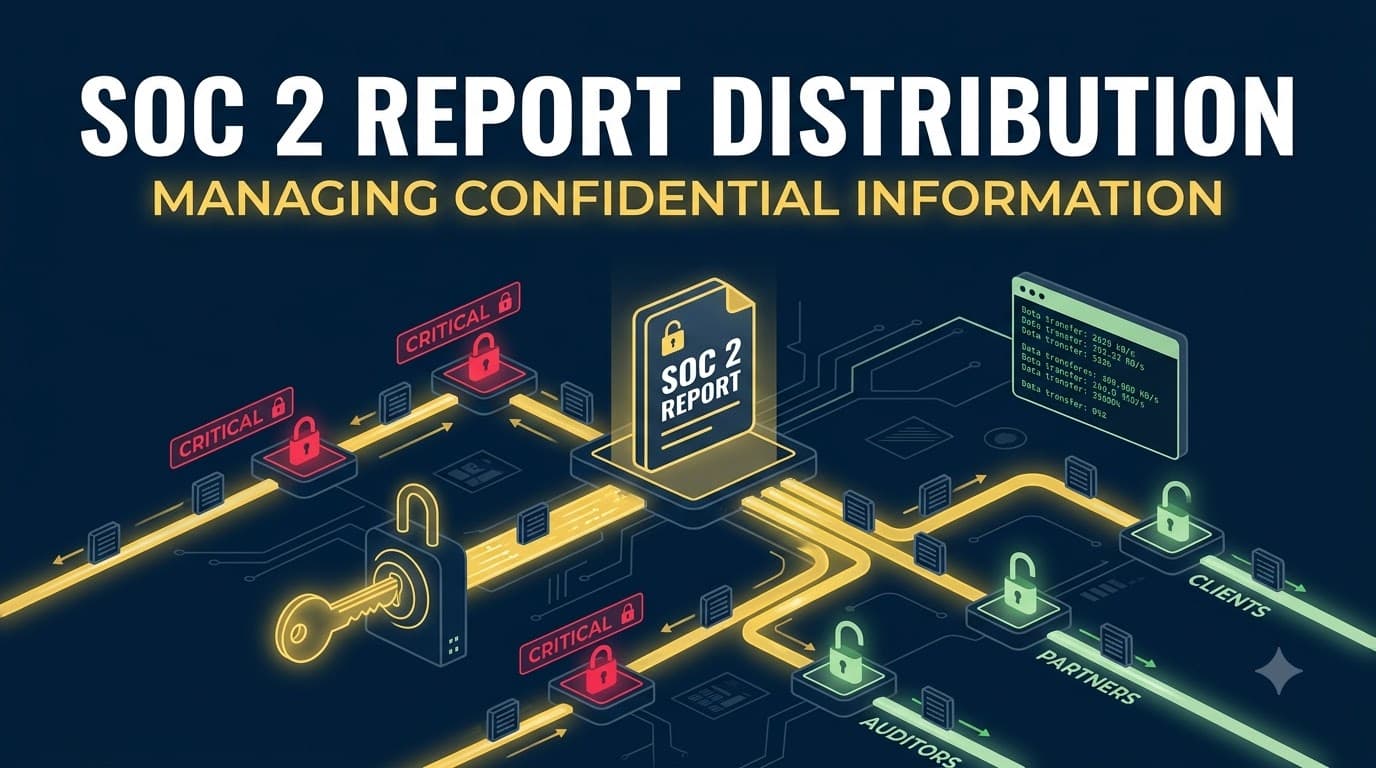
Dana Okafor had been VP of Compliance & Trust at Ferrovia Pay for fourteen months when the Slack message landed on a Tuesday morning: "Hey — did we mean to have our SOC 2 report sitting in a public vendor-risk marketplace? A recruiter just found it while googling us."
She hadn't. Nobody had. What had happened was mundane and, in a fast-growing payments SaaS company juggling a forty-two-person sales team, entirely predictable: a solutions engineer working a $3.2 million enterprise opportunity with a national retail chain, Halcyon Retail Group, had uploaded Ferrovia Pay's full Type II report — ninety-one pages of system description, control narratives, subservice organization detail, and two noted exceptions in a change-management control — directly into Halcyon's third-party procurement portal to "speed things along." That portal, it turned out, mirrored certain vendor documents into a searchable public directory as part of its own marketing. No NDA had been signed. No one in compliance had been looped in. The report — built to give one audience, informed and bound by confidentiality, a detailed look at how Ferrovia Pay protected customer payment data — was now indexed by search engines, sitting next to blog posts about the company's funding round.
The immediate damage was reputational: two existing customers who found the leaked report through a routine competitive scan asked pointed questions about the change-management exception. One, a logistics company called Northwind Logistics worth $850,000 in annual recurring revenue, opened a formal vendor-risk review and threatened to invoke a termination-for-convenience clause pending "assurance that Ferrovia Pay treats its own security documentation with the rigor it claims to apply to customer data." The Halcyon deal itself stalled for six weeks while legal determined whether the exposure constituted a breach of Ferrovia Pay's own confidentiality obligations to its auditor and to other customers named indirectly in the system description.
Nothing in that report described a technical vulnerability. No customer data was exposed. But a document explicitly marked "Restricted Use" by a licensed CPA firm had been treated like a marketing brochure, and the fallout looked a great deal like an incident even though no system had been breached. Dana spent the next quarter rebuilding not the controls — those were sound — but the process for deciding who gets to read about them, and how. That rebuild, and the distribution discipline it produced, is the subject of this article.
Who This Is For and What You'll Walk Away With
This is written for compliance leaders, security teams, and the sales and customer-success functions who field report requests every week — anyone caught between "prospects need proof before they'll sign" and "this document contains things we don't want indexed by Google." You'll leave with a clear model for why SOC 2 and SOC 1 reports are restricted-use by design, what specifically inside the report makes that restriction necessary, a working NDA-gated distribution workflow, and a clear-eyed view of where SOC 3 fits as the document you can hand out freely. Every table here is meant to be lifted into your own report-distribution policy with minimal editing.
The Restricted-Use Report: Why SOC 2 Isn't Meant for Public Consumption
Here's the distinction that trips up more marketing and sales teams than any other part of the SOC 2 lifecycle: a SOC 2 report is not a badge. It's not a press release. It is a detailed, professional attestation — produced under SSAE 18 by a licensed CPA firm — that describes your systems, your controls, and (for a Type II report) the specific tests the auditor ran and what they found, exceptions included. The AICPA classifies both SOC 1 and SOC 2 reports as restricted-use. That's not a suggestion or a best practice a cautious lawyer added — it's baked into the report's cover page, its introductory paragraph, and the auditor's own engagement letter.
"Restricted use" has a precise meaning in attestation standards: the report is intended only for parties who already understand the system in question well enough to interpret the results without a misleading conclusion. For a SOC 2 report, that's the service organization itself, its existing user entities (current customers who rely on the system described), and those user entities' own auditors, who might need the report as evidence when assessing controls that touch their own financial reporting or compliance obligations. It is explicitly not written for the general public, for casual prospects doing early-stage vendor comparisons, or for search engines.
This matters because a SOC 2 report doesn't just say "we're secure." It says, in granular detail, how you're secure — which is also a partial blueprint of where the seams are. A prospect evaluating you for the first time doesn't have the same context as a customer who has already reviewed your architecture, signed a master services agreement, and agreed to keep what they learn confidential. Handing the same ninety-page document to both audiences, through the same unprotected channel, is treating a scoped legal instrument like a spec sheet.
# | Attribute | SOC 2 Report | SOC 3 Report |
|---|---|---|---|
1 | Distribution classification | Restricted use | General use |
2 | Intended audience | Service organization, existing user entities, their auditors | Anyone — public, prospects, marketing channels |
3 | Contains detailed system description | Yes, full narrative | No — high-level summary only |
4 | Contains control-by-control test results | Yes (Type II) | No |
5 | Discloses exceptions/deviations | Yes, in detail | No — pass/fail summary only |
6 | Names subservice organizations | Often, by name or category | Rarely, if ever |
7 | Requires NDA before sharing | Typically yes, for non-customers | No |
8 | Can be posted on a public website | No | Yes |
9 | Can be used in marketing materials | No, not the full report | Yes — seal and summary language permitted |
10 | Issued by | Licensed CPA firm | Licensed CPA firm |
11 | Typical length | 40–120+ pages | 3–8 pages |
12 | Underlying examination | Same SSAE 18 engagement | Derived from the same SOC 2 engagement |
Table 1: SOC 2 vs. SOC 3 Distribution at a Glance
"I still get asked at least once a month whether we can 'just post the SOC 2 on the website like the SOC 2 badge everyone has.' The badge is the SOC 3. The report behind it is the thing we're all trying to keep out of Google's index." — Marcus Chen, CISO, Bright Ledger Financial
What's Actually Inside the Envelope: Anatomy of Report Sensitivity
Understanding why a SOC 2 report needs careful handling means understanding what's actually in one, section by section. Readers who've only seen the summary page ("unqualified opinion, no exceptions noted") often underestimate how much operational detail sits behind it. If you haven't yet read our companion piece on the SOC 2 report structure, it's worth pairing with this one — this article assumes you know roughly what's in Sections I through IV and focuses on why each part carries a different level of sensitivity.
The management assertion (Section II) is relatively low-risk on its own — it's a statement of intent and scope. The auditor's opinion (Section I) is the part most people actually want to see and is the least sensitive; it's often close to what a SOC 3 summarizes. But the system description (Section III) is where the real detail lives: network diagrams or architecture narratives, a list of subservice organizations and whether they're handled via the carve-out method or included directly, descriptions of data flows, named third-party infrastructure providers, and often specifics about encryption approach, access provisioning, and incident-response procedures. For a Type II report, Section IV adds the auditor's tests of controls and results — meaning a reader learns not just what your controls are supposed to do, but precisely how the auditor verified them and whether any test produced an exception.
None of this is inherently classified information in the way, say, source code or customer PII would be. But in aggregate, it is exactly the kind of operational and architectural detail a threat actor doing reconnaissance on your organization would want, and exactly the kind of competitive detail a rival vendor would enjoy having handed to them. It's also, frankly, the kind of nuance that gets misread by someone without the context to interpret it — a single control exception, stripped of the remediation narrative around it, reads very differently in a screenshot forwarded around Slack than it does inside ninety pages of otherwise-clean testing.
# | Report Section | Typical Content | Sensitivity Level | Why It Matters if Exposed |
|---|---|---|---|---|
1 | Auditor's opinion | Pass/fail conclusion, opinion type | Low | Close to what SOC 3 already discloses publicly |
2 | Management assertion | Management's claims about the system and controls | Low–Medium | Reveals scope and TSC categories in scope |
3 | System description — overview | Business description, services provided | Low–Medium | Competitive intelligence on offerings |
4 | System description — infrastructure | Data centers, cloud providers, network architecture | High | Reconnaissance value for attackers |
5 | System description — subservice organizations | Named vendors, carve-out vs. inclusive treatment | Medium–High | Reveals your supply chain and dependencies |
6 | System description — data flow | How data moves through the system | High | Maps attack surface and data handling |
7 | System description — access provisioning | How access is granted, reviewed, revoked | High | Details process an attacker could probe |
8 | Complementary user entity controls | What customers must do themselves | Low | Mostly procedural, low sensitivity |
9 | Description of tests of controls (Type II) | Exact test procedures the auditor ran | Medium–High | Shows testing depth and methodology |
10 | Results of tests / exceptions | Specific control failures or deviations found | Very High | Directly actionable if misused or misread |
11 | Time period covered | Audit period dates | Low | Minor competitive/timing detail |
Table 2: Sensitive-Content Inventory by Report Section
Notice the pattern: the parts of the report that are genuinely low-risk to share broadly are also the parts that overlap almost entirely with what a SOC 3 already discloses. The parts you actually need to protect — infrastructure detail, data flow, access provisioning, and test exceptions — are exactly the parts a curious but unauthorized reader has no legitimate need to see. That overlap is not a coincidence; it's the logic the AICPA built the restricted-use classification around.
Who Is Allowed to Read Your SOC 2 Report
"Restricted use" is often treated as a vague warning label, but the AICPA's guidance is more specific than most compliance teams realize. The report is intended for three categories of reader: the service organization's own management and personnel who need it for internal purposes, existing user entities of the service (customers who are already relying on the described system, during at least part of the period covered), and the auditors and regulators of those user entities, who might need it as audit evidence for their own engagements. Notice who's missing from that list: prospects who haven't signed anything yet, the general public, competitors, journalists, and — strictly read — even user entities who only plan to start using the service in the future.
In practice, every SOC 2 program on earth shares reports with prospects, because "sign the contract first, see the evidence never" isn't a workable sales motion in a market where buyers expect proof before commitment. The way the industry squares this circle is the NDA — a prospect isn't an "intended user" under AICPA guidance, but a prospect who has executed a mutual non-disclosure agreement and been vetted as a genuine, active buyer is a reasonable and widely accepted extension of the restricted circle. Your distribution process should treat that extension deliberately, not accidentally: someone should be making an active decision to share, not discovering after the fact that a report went out through an open portal.
# | Recipient Type | Default Access | Gate Required | Typical Delivery Method |
|---|---|---|---|---|
1 | Internal employees (compliance, security, sales leadership) | Yes | Role-based access only | Internal document repository |
2 | Existing customers (active contract) | Yes | Identity verification | Trust portal or direct secure link |
3 | Existing customers' auditors | Yes, on customer's request | Verification + customer sponsorship | Secure link, time-limited |
4 | Active sales prospects, later-stage | Conditional | Signed mutual NDA | Trust portal with watermark |
5 | Active sales prospects, early-stage | No (offer SOC 3 instead) | N/A | SOC 3 / summary only |
6 | Regulators of the service organization | Case-by-case | Legal review | Direct, formal transmittal |
7 | Subservice organizations (mutual reliance) | Case-by-case | Contractual basis | Direct, formal transmittal |
8 | General public / marketing channels | No | Not applicable — use SOC 3 | Public website (SOC 3 seal only) |
9 | Journalists / analysts | No | Legal + executive approval only | Rare, case-by-case with counsel |
10 | Competitors | No | Never | Not applicable |
Table 3: Who Can Receive a SOC 2 Report
"We built a simple rule into our sales playbook: if the prospect hasn't signed our mutual NDA, they get the SOC 2 Type II summary letter and the SOC 3, full stop. It sounds restrictive until you realize it actually speeds up deals — reps stop guessing and stop escalating every request to legal." — Priya Raman, VP of Sales Engineering, Ferrovia Pay
The NDA: Your First and Best Line of Defense
The mutual NDA is doing more work than most sales teams give it credit for. It's the mechanism that converts a prospect from "unauthorized third party" into something closer to the trusted-recipient category the AICPA had in mind — not a perfect legal substitute for "existing user entity," but a documented, deliberate, contractually enforceable commitment to confidentiality that gives you recourse if the report is misused. It also does something quieter but just as valuable: it slows the process down by exactly enough friction to make someone stop and think before forwarding a document externally, which is precisely the failure mode that put Ferrovia Pay's report on a public marketplace.
A workable NDA-gated distribution process has to be fast enough that it doesn't become the reason deals stall, though. If your legal team turns every NDA into a two-week redline exercise, sales will route around you — usually by sending a redacted summary, a screenshot, or, worse, the report itself through an unmanaged channel just to keep the deal moving. The fix isn't lowering the bar on confidentiality; it's pre-negotiating a mutual NDA template your legal team is comfortable executing in under 48 hours for standard cases, with clear escalation only for prospects who want to redline it.
Step | Action | Owner | Typical Turnaround |
|---|---|---|---|
1 | Prospect submits report request (via sales rep, RFP portal, or trust portal) | Sales / prospect | Immediate |
2 | Rep confirms deal stage and business justification | Sales | Same day |
3 | Standard mutual NDA sent for e-signature | Sales or Deal Desk | Same day |
4 | NDA countersigned by prospect | Prospect | 1–5 business days |
5 | NDA logged in contract management system, linked to requester | Legal / RevOps | Automatic on signature |
6 | Compliance notified; requester added to distribution tracker | Compliance | Same day |
7 | Watermarked, access-controlled report generated | Compliance / Trust Portal | Same day |
8 | Report delivered via secure, time-limited link | Compliance / Sales | Same day |
9 | Access logged; expiration set (typically 14–30 days) | Trust Portal system | Automatic |
10 | Post-cycle: link expired or revoked if deal doesn't close | Compliance | At expiration or deal-close |
Table 4: NDA-to-Report Distribution Workflow
Mapping the Flow: From Request to Controlled Share
The workflow above reads cleanly as a table, but the decision points are easier to internalize as a flow — especially the branch that determines whether someone needs a fresh NDA at all, or whether an existing contractual relationship already covers them.
flowchart TD
    A[Report requested by prospect or customer] --> B{Existing user entity under active contract with confidentiality terms?}
    B -- Yes --> F[Verify requester identity and business justification]
    B -- No, new prospect --> C[Send standard mutual NDA]
    C --> D{NDA executed within SLA?}
    D -- No --> E[Provide SOC 3 / executive summary instead; hold full report]
    D -- Yes --> F
    F --> G[Log requester in distribution tracker]
    G --> H[Generate watermarked, access-controlled copy]
    H --> I[Set expiration date and download/view limits]
    I --> J[Deliver via secure link or trust portal]
    J --> K[Monitor access and download logs]
    K --> L{Anomalous access, re-share, or scraping detected?}
    L -- Yes --> M[Revoke link, notify legal and compliance, investigate]
    L -- No --> N[Archive delivery record for audit trail]
This is the exact gap that failed at Ferrovia Pay: there was no Step B decision point at all. A solutions engineer had the report on his laptop from a prior deal, treated the new prospect as equivalent to an already-vetted one, and skipped straight to delivery through a channel nobody in compliance had approved. Every one of the boxes in this diagram exists because skipping it has, somewhere, caused exactly the kind of incident that started this article.
Distribution Channels: Email Attachments vs. Secure Portals vs. Data Rooms
Once the NDA is signed and someone has approved the share, the how matters almost as much as the who. Emailing a PDF as an attachment is still, anecdotally, the single most common way SOC 2 reports leave an organization — and it's the worst option available for anything but the smallest, most trusted programs. An email attachment has no access control once it leaves your outbox: it can be forwarded, printed, saved to a personal drive, or synced into a third-party tool with no visibility back to you. Compare that to a trust portal or secure data room, where the report never actually leaves your infrastructure — the recipient views it through an authenticated session you control, and you retain the ability to revoke access at any time.
The choice of channel should scale with the maturity of your program and the volume of requests you handle. An early-stage company fielding two or three report requests a month can reasonably manage this with a well-organized secure file-sharing tool and a rigorous manual process. A company fielding dozens of requests a week — which happens fast once SOC 2 becomes a standard line item in enterprise procurement — needs a dedicated trust portal to keep the process from becoming a full-time job for someone in compliance.
# | Distribution Method | Access Revocable After Send? | Watermarking Available | Access Logging | Best For | Risk Level |
|---|---|---|---|---|---|---|
1 | Email attachment (PDF) | No | Manual only | None | Never recommended for full report | Very High |
2 | Password-protected PDF via email | Partial (password rotation) | Manual | None | Small programs, low volume | High |
3 | Generic cloud file-share link (no expiry) | Yes, manually | No | Basic | Not recommended | High |
4 | Cloud file-share link with expiration + password | Yes | No | Basic | Small-to-mid programs | Medium |
5 | Dedicated trust portal (e.g., self-service evidence platform) | Yes, automatically | Yes, dynamic | Full (view, download, IP, time) | Mid-to-large programs, high request volume | Low |
6 | Virtual data room (deal-specific, e.g., M&A or major RFP) | Yes | Yes | Full, granular | Large enterprise deals, due diligence | Low |
7 | In-person / live screen-share review only | Yes (no copy leaves) | N/A | Session log | Highest-sensitivity exceptions/details | Very Low |
Table 5: Distribution Methods Compared
"The moment we moved from emailing PDFs to a trust portal, the conversation with prospects changed. It stopped being 'can you send us the report' and became 'let's get you access' — which, honestly, reads as more mature to an enterprise buyer's own security team anyway." — Renata Souza, Director of GRC, Kestrel Cloud
Watermarking, Access Logs, and Expiring Links: Technical Controls That Matter
Signing an NDA governs behavior after the fact — it gives you legal recourse if a recipient misuses the report. Technical controls at the point of distribution are what make misuse harder to do accidentally, and easier to trace when it happens deliberately. Dynamic watermarking — stamping each viewed or downloaded copy with the requester's name, company, email, and timestamp — sounds like a small thing, but it changes behavior. A prospect's procurement officer thinking about forwarding a report into an open portal behaves differently when their own name is printed across every page than when the document is anonymous.
Expiring links matter just as much. A report link that never expires is a report that's still "live" a year later, long after the prospect went dark or the deal closed and moved into a different phase. Pair expiration with download limits (view-only vs. one-time download) and IP or device-based access restrictions where practical, and you've built a distribution model where even a well-intentioned recipient can't easily create the kind of uncontrolled copy that ends up on a public marketplace.
# | Control | What It Does | Deters | Implementation Effort |
|---|---|---|---|---|
1 | Dynamic watermarking | Stamps viewer identity/timestamp on every page | Casual re-sharing, screenshots | Low (built into most trust portals) |
2 | Expiring access links | Link stops working after a set date | "Zombie" links used long after relevance | Low |
3 | View-only mode (no download) | Prevents saving a local copy | Uncontrolled distribution | Medium |
4 | Download limits (e.g., one-time) | Restricts number of downloads per link | Bulk redistribution | Low |
5 | Access logging (who, when, where) | Full audit trail of every view/download | Unauthorized access going unnoticed | Low (portal-native) |
6 | IP / geofencing restrictions | Restricts access to expected regions/networks | Credential sharing, external leaks | Medium |
7 | Automatic revocation on deal-stage change | Cuts access when a deal closes or goes dead | Stale access lingering post-engagement | Medium (requires CRM integration) |
8 | Requester re-verification on renewed access | Confirms identity before re-issuing an expired link | Impersonation, stale credentials | Low |
Table 6: Technical Controls for Shared Reports
Trust Portals: The Modern Front Door for Compliance Evidence
A trust portal (sometimes called a security or trust center) is a self-service hub, usually linked from your website's footer or security page, where prospects and customers can request access to your SOC 2 report, SOC 3 seal, penetration test summaries, and policy documentation without a manual email exchange for every request. The best ones combine three things that matter for distribution specifically: automated NDA execution (a prospect signs digitally at the point of request, no separate legal thread required for standard cases), automatic watermarking and expiration on anything issued, and a single system of record showing exactly who has requested and received what, which becomes invaluable the one time a year someone asks "wait, who did we send that to?"
The tradeoff is cost and setup time — a dedicated trust portal is a real line item, not a free feature — but for any organization fielding more than a handful of report requests a month, the math tends to work out fast. Compliance teams routinely report that a portal turns what used to be two or three hours of manual work per request (verify identity, chase an NDA signature, generate a watermarked copy, track the send) into a workflow the requester mostly self-serves, with compliance reviewing exceptions rather than processing every single request by hand.
# | Feature | Manual Process (Email/Drive) | Dedicated Trust Portal |
|---|---|---|---|
1 | Self-service request intake | No | Yes |
2 | Automated NDA e-signature | No | Yes, typically |
3 | Automatic watermarking | No | Yes |
4 | Access expiration by default | Rare | Yes |
5 | Centralized requester log | Manual spreadsheet | Native, automatic |
6 | Public SOC 3 / summary hosting | Separate webpage | Integrated |
7 | Integration with CRM/deal stage | No | Often available |
8 | Time to fulfill a standard request | Hours to days | Minutes |
9 | Setup effort | Low | Medium–High |
10 | Ongoing cost | Staff time only | Subscription + staff time |
Table 7: Manual Process vs. Trust Portal
"We resisted a trust portal for two years because it felt like an expense we could avoid with a good spreadsheet. Then we hit sixty report requests in a single month during a busy renewal season and the spreadsheet started missing things — including, once, an NDA that had actually expired. The portal paid for itself in the first quarter just in compliance hours saved." — Sam O'Connell, Founder, ClearPath Trust Ops
SOC 3: Your Public-Facing Marketing Asset
If SOC 2 is the detailed report you protect, SOC 3 is the document you're supposed to give away. It's derived from the same underlying SSAE 18 examination — same auditor, same audit period, same Trust Services Criteria in scope — but it strips out the system description detail, the named subservice organizations, and the granular test results, leaving a short summary and the auditor's opinion. There is no restricted-use language on a SOC 3, because there's nothing in it that requires an informed, contextualized reader to interpret safely. That's precisely why it's the right thing to put on your public website, attach to marketing collateral, and reference in press materials — while the full SOC 2 stays behind the NDA gate.
Too many companies either skip SOC 3 entirely (making every single prospect interaction require an NDA just to prove basic security posture, which slows the top of the sales funnel unnecessarily) or, worse, conflate the two documents in marketing copy — claiming "SOC 2 certified" language on a public page when what they can legitimately display is the SOC 3 seal and a general statement about undergoing an annual SOC 2 examination. Getting this distinction right in your public-facing language isn't just accuracy for its own sake; loose language here is exactly the kind of thing a rigorous enterprise security reviewer will flag as a red flag about how carefully you handle your own compliance claims.
# | Use Case | Appropriate Document | Where It Lives |
|---|---|---|---|
1 | Company website trust/security page | SOC 3 seal + summary | Public webpage |
2 | Sales deck, early-stage prospect meeting | SOC 3 seal + verbal summary | Sales collateral |
3 | RFP response, initial submission | SOC 3 + offer of full report post-NDA | RFP document |
4 | Press release / funding announcement | Reference to "undergoing annual SOC 2 examination" | Press materials |
5 | Enterprise security review, late-stage deal | Full SOC 2 Type II report | NDA-gated portal |
6 | Existing customer renewal / annual review | Full SOC 2 Type II report + bridge letter if applicable | Trust portal / direct |
7 | Cyber-insurance application | Full SOC 2 Type II report (insurer as authorized reader) | Direct, secure transmittal |
8 | Investor due diligence (M&A, funding round) | Full SOC 2 Type II report under data-room NDA | Virtual data room |
9 | Job listings / recruiting pages | SOC 3 seal only, if mentioned at all | Public webpage |
Table 8: SOC 3 and SOC 2 Use Cases by Channel
"The rule I give every marketing hire on day one: if it's going on a public page, it's the SOC 3 seal or nothing. If someone wants the real report, that request goes through compliance, not through the CMS." — Marcus Chen, CISO, Bright Ledger Financial
The "SOC 2 Summary" Gray Zone: What You Can and Can't Say Publicly
Between the fully restricted SOC 2 report and the fully public SOC 3 sits a gray zone that trips up more marketing teams than either extreme: the informal "SOC 2 summary," a one-pager some companies write themselves — not the auditor — to describe their compliance posture in plain language for a general audience. This isn't inherently improper. It becomes a problem when the language starts borrowing the auditor's opinion's authority without earning it: phrases like "certified SOC 2 compliant," "SOC 2 approved," or reproducing excerpts of the actual opinion language outside their original context all misrepresent what an attestation is and can expose you to real risk if a customer relies on that language and later feels misled.
The safe pattern is to keep self-authored summaries factual and clearly distinct from the auditor's own work product: state the Trust Services Criteria in scope, the report type (Type I or Type II), the audit firm's name, and the general period covered — all things also visible on the SOC 3 — without implying pass/fail detail you haven't disclosed. If in doubt, route any public-facing compliance language through whoever manages your SOC 2 program before it ships, the same way you'd route a claim about uptime SLAs through whoever owns that number.
# | Public Claim or Language | Status | Why |
|---|---|---|---|
1 | "We undergo an annual SOC 2 Type II examination" | Safe | Factual, doesn't overstate |
2 | "SOC 2 certified" | Risky | SOC 2 is an attestation, not a certification |
3 | Displaying the SOC 3 seal on the website | Safe | Explicitly designed for this |
4 | Quoting the exact unqualified opinion language out of context | Risky | Implies endorsement beyond scope |
5 | "We passed our SOC 2 audit with zero exceptions" | Risky (verify carefully) | "Audit" and "exceptions" language needs precision; confirm with auditor before publishing |
6 | Listing Trust Services Criteria in scope (e.g., Security, Availability) | Safe | Matches SOC 3 disclosure |
7 | Naming the CPA firm that performed the examination | Safe, if accurate | Common and verifiable |
8 | Sharing the full report link publicly, even "for transparency" | Risky | Violates restricted-use terms |
9 | "Our systems are fully secure per our SOC 2 report" | Risky | Overstates what any attestation can promise |
Table 9: Public Claims — Safe vs. Risky Language
Do's and Don'ts of SOC 2 Report Distribution
Most of what's above collapses into a short list your sales, compliance, and marketing teams can actually keep in their heads day to day. This is the version I hand to new sales hires in their first week — it's deliberately blunt.
# | Do | Don't |
|---|---|---|
1 | Route every non-customer report request through a defined process | Email the full PDF directly to an unverified prospect |
2 | Require a signed mutual NDA before sharing with new prospects | Assume a verbal or email "we'll keep this confidential" is sufficient |
3 | Use watermarking and expiring links for every external share | Post the full report, even briefly, on a public or semi-public portal |
4 | Offer the SOC 3 or a summary for early-stage prospects | Send the full Type II report to every inbound lead who asks |
5 | Keep a central log of every recipient and delivery date | Rely on individual reps' inboxes as the "system of record" |
6 | Review and update your NDA template annually with legal | Let sales teams negotiate ad hoc confidentiality terms per deal |
7 | Revoke access automatically when a deal closes or goes dead | Leave old report links active indefinitely |
8 | Train sales and CS teams on what's restricted vs. public | Assume "everyone knows" the report is confidential |
9 | Clearly label the report "Restricted Use" on cover pages and reminders | Strip or ignore the restricted-use language when forwarding |
10 | Escalate any suspected leak immediately to compliance and legal | Wait to see if anyone notices before raising an exposure internally |
Table 10: Do's and Don'ts of SOC 2 Report Distribution
Handling the Sales Team: Building a Prospect Request Workflow
Sales teams don't leak SOC 2 reports because they don't care about security — they leak them because, without a clear process, the fastest path to closing a deal wins, and the fastest path is usually "just send it." The fix isn't a lecture in a compliance training deck once a year; it's making the compliant path the easiest path. If requesting a report through the approved channel takes two clicks and a same-day turnaround, reps will use it. If it means finding the right Slack channel, waiting three days for legal, and hoping someone remembers to follow up, they'll find a workaround — usually the one that gets them in trouble.
Ownership matters as much as process design. Everyone touching a report request needs to know, without asking, whose job it is to send the NDA, whose job it is to generate the watermarked copy, and whose job it is to say no when a request doesn't meet the bar. Ambiguity here is exactly what let the Halcyon incident happen at Ferrovia Pay — the solutions engineer genuinely believed sending the report was within his authority, because no one had ever told him otherwise.
# | Task | Sales Rep | Deal Desk / RevOps | Compliance | Legal |
|---|---|---|---|---|---|
1 | Receive initial report request from prospect | Responsible | Informed | Informed | — |
2 | Confirm deal stage and legitimacy | Responsible | Consulted | Informed | — |
3 | Send mutual NDA | Consulted | Responsible | Informed | Accountable (template owner) |
4 | Track NDA signature status | Informed | Responsible | Informed | — |
5 | Generate watermarked, access-controlled report | Informed | Informed | Responsible | — |
6 | Deliver report via approved channel | Responsible | Consulted | Accountable | — |
7 | Log delivery in distribution tracker | Informed | Consulted | Responsible | — |
8 | Monitor for anomalous access | Informed | Informed | Responsible | Informed |
9 | Revoke access at deal close/expiration | Informed | Responsible | Accountable | — |
10 | Investigate a suspected leak | Informed | Informed | Responsible | Accountable |
Table 11: Report Distribution RACI
"I tell every AE the same thing during onboarding: the SOC 2 report is not a sales asset, it's a legal instrument with a business use. Once that framing lands, people stop treating the request process as red tape and start treating it as part of how we sell trust — because it is." — Aisha Bello, Head of Vendor Risk, Northwind Logistics
When Reports Leak: Real Consequences of Poor Distribution Hygiene
It's worth being precise about what actually goes wrong when a SOC 2 report escapes controlled distribution, because the consequences aren't the same as a data breach — and treating them identically either overstates or understates the real risk depending on the specifics. Nobody's payment card data is exposed when a report leaks. But the reputational, contractual, and competitive fallout is real, and it compounds in ways that are easy to underestimate until you've lived through one.
Contractually, many customer agreements include confidentiality clauses that cover compliance documentation shared during due diligence — meaning a leak can technically put you in breach of a customer contract even though the leak itself didn't touch customer data. Competitively, a detailed system description handed to the wrong reader is free reconnaissance for a rival sales team or, worse, an actual attacker mapping your infrastructure. And reputationally, the optics are almost always worse than the substance: a control exception that reads as routine inside ninety pages of otherwise-clean Type II testing reads as alarming in a forwarded screenshot stripped of context.
# | Scenario | Likely Trigger | Illustrative Consequence |
|---|---|---|---|
1 | Full report posted to a public vendor-risk marketplace by mistake | No NDA gate, sales bypassing process | Customer vendor-risk reviews reopened, deal delays |
2 | Report attached to an email later forwarded outside the organization | No watermarking, no access control | Unable to trace scope of exposure, reduced legal recourse |
3 | Report shared with a competitor posing as a prospect | No identity verification before delivery | Competitive intelligence loss, no way to detect until too late |
4 | Screenshot of an exception excerpt shared on social media by a disgruntled employee | Weak internal access controls, no DLP on compliance docs | Reputational headline risk, disproportionate to actual severity |
5 | Report retained by a prospect long after the deal died, later resurfaces in a data breach at the prospect's own company | No expiration on delivered copies | Report exposed via a third party's incident, out of your control |
6 | Auditor cites repeated improper distribution as a governance concern in future engagements | Pattern of ad hoc, undocumented sharing | Increased audit scrutiny, potential management-letter comment |
Table 12: Illustrative Distribution Incident Scenarios
The common thread across every row: none of these require a technical vulnerability to cause real damage. They require only a process gap, which is exactly why report distribution deserves the same structured rigor as any other control in your environment — it's arguably closer to a confidentiality control than a marketing workflow.
Building Your Internal Report Distribution Policy
Everything covered so far should live somewhere more durable than a blog post — a written, versioned internal policy that new hires read, auditors can reference, and disputes get resolved against. You don't need a fifty-page document; a tight, two-to-four page policy that spells out ownership, process, and exceptions handling covers almost every real-world scenario. What matters is that it exists, is actually followed, and gets reviewed at least annually alongside the rest of your compliance documentation — if your organization is also pursuing ISO 27001 certification, running ISO 27001 and SOC 2 together means this distribution policy can sit alongside your existing document-control procedures rather than duplicating a parallel process from scratch.
A policy without enforcement teeth is a suggestion, not a control — so the document should also say plainly what happens when it's violated: is an unauthorized share treated as a training gap the first time and a disciplinary matter on repeat, or always escalated to legal regardless of intent? Ambiguity here is exactly what makes root-cause conversations after an incident more painful than they need to be.
# | Policy Element | Purpose |
|---|---|---|
1 | Classification statement | States SOC 2 report is Restricted Use; SOC 3 is General Use |
2 | Authorized recipient categories | Defines who can receive the report and under what conditions |
3 | NDA requirement and template reference | Points to the approved mutual NDA and signature SLA |
4 | Approved distribution channels | Names the trust portal / secure methods; prohibits attachments |
5 | Roles and responsibilities (RACI) | Assigns ownership for each step of the request-to-delivery flow |
6 | Watermarking and expiration standards | Sets minimum technical controls for every external share |
7 | Distribution log / recordkeeping requirement | Requires a central, auditable record of every share |
8 | Revocation triggers | Defines when access must be cut (deal loss, contract end, personnel change) |
9 | Incident escalation path | Who to notify and how fast if a leak is suspected |
10 | Annual review cadence | Requires the policy itself to be reviewed and updated yearly |
11 | Training requirement | Requires sales, CS, and marketing to complete distribution training |
Table 13: Report Distribution Policy Elements Checklist
If you're assembling this from scratch, our SOC 2 Policy Pack includes a distribution-policy template built around this exact structure, which is faster to adapt than drafting one from a blank page.
Auditors, Regulators, and Subservice Organizations: Special Distribution Cases
Most report requests fall neatly into "existing customer" or "prospect under NDA." A handful of recurring cases deserve their own handling because the default NDA-gated flow doesn't quite fit. A customer's own external auditor, for instance, might need your SOC 2 report as audit evidence for their own engagement — a legitimate, AICPA-anticipated use case, but one that should still be verified (confirm the request actually comes from the customer's engagement, not an unsolicited email claiming to be their auditor) and logged like any other share.
Subservice organizations present a different wrinkle: if you're using the inclusive method and a vendor's controls are tested as part of your own report, that vendor may reasonably want visibility into how they're described. And if you use the carve-out method, your own customers' auditors may go directly to that subservice organization for a separate report covering their piece — meaning your distribution obligations end at the boundary of what you actually control. Cyber-insurance underwriters are an increasingly common fourth category: they're not intended users under the strict AICPA definition, but insurers routinely request the full report as part of underwriting, and most compliance teams treat them similarly to an auditor — verified, logged, and delivered directly rather than left to a generic prospect workflow.
# | Special Recipient | Legitimate Basis | Verification Needed | Recommended Handling |
|---|---|---|---|---|
1 | Customer's external auditor | AICPA-anticipated use (audit evidence) | Confirm engagement with the customer directly | Direct secure transmittal, logged |
2 | Subservice organization (inclusive method) | Contractual, operational relationship | Confirm role in scope | Direct transmittal per contract terms |
3 | Regulator of the service organization | Statutory or examination authority | Route through legal | Formal transmittal, counsel involved |
4 | Cyber-insurance underwriter | Underwriting due diligence | Confirm active policy/application | Direct secure transmittal, NDA if not already covered |
5 | Investor / acquirer (M&A due diligence) | Contractual diligence rights | Confirm via deal counsel | Virtual data room, deal-specific NDA |
6 | Downstream reseller or channel partner | Contractual pass-through obligation | Confirm partner agreement terms | Case-by-case, legal review recommended |
Table 14: Special Recipient Categories and Handling
Budgeting for Controlled Distribution: Trust Portal Costs and Timelines
Compliance leaders building a business case for a dedicated trust portal usually need to answer two questions from finance: what does it cost, and how fast can we stand it up. The honest answer is "it depends on request volume and how much of your evidence library you want centralized," but the ranges below reflect what a mid-market SaaS company (roughly 100–1,000 employees, an established SOC 2 Type II program) typically experiences, based on program build-outs I've been part of.
# | Investment Area | Typical Range (Illustrative) | Typical Timeline |
|---|---|---|---|
1 | Trust portal platform subscription (annual) | Mid four to low five figures, scales with request volume | N/A (recurring) |
2 | Initial setup and content migration | 20–40 hours of compliance/IT time | 2–4 weeks |
3 | NDA template legal review and automation setup | 5–10 hours of legal time | 1–2 weeks |
4 | Sales and CS training rollout | 2–4 hours per team, one-time plus refreshers | 1 week |
5 | Ongoing administration (steady state) | 2–5 hours/week for a mid-sized program | Ongoing |
6 | Manual process cost avoided (for comparison) | Often 8–15 hours/week once request volume grows | N/A |
Table 15: Illustrative Trust Portal Cost and Timeline Snapshot
"Finance asked me to justify the portal spend with a number, so I tracked how long each manual request actually took us over a quarter — verification, NDA chasing, watermarking by hand, follow-up. It came out to almost a full day of compliance time per week once we hit our growth stage. The portal wasn't a nice-to-have at that point; it was reclaiming a day a week." — Dana Okafor, VP of Compliance & Trust, Ferrovia Pay
Aligning Distribution with Contractual and Vendor Risk Obligations
Report distribution doesn't happen in a vacuum — it usually sits inside a broader web of contractual confidentiality obligations that predate the request itself. Master service agreements, data processing addenda, and even standalone confidentiality clauses often already define how "confidential information" must be handled between you and a customer, and a SOC 2 report generally falls squarely within that definition. That means your distribution process shouldn't be invented independently of legal — it should be built to satisfy the confidentiality standard your contracts already promise, which is usually at least as strict as, and sometimes stricter than, a standalone NDA would require.
This overlap becomes especially visible when a customer's own vendor risk management team requests updated evidence annually as part of their own third-party risk program — often the same relationship covered by complementary user entity controls the customer is responsible for operating on their end. If you haven't yet mapped how those obligations flow both directions, our companion article on SOC 2 user entity controls and client responsibility is a useful pairing with this one — a customer's vendor risk review and their CUEC obligations are often handled by the same team, and treating report delivery as part of that same relationship (rather than a one-off sales request) tends to produce a smoother annual cycle for both sides. Organizations juggling both ISO 27001 and SOC 2 programs face a similar question about which document satisfies which customer request, a topic our guide on ISO 27001 vs. SOC 2 and which one you need addresses directly — and worth knowing, because some enterprise customers will accept either as evidence, which changes how aggressively you need to gate the SOC 2 specifically for that account.
Training Your Sales and Customer Success Teams
Every control in this article assumes the people actually handling requests know the process exists and understand why it matters — an assumption that fails more often from silence than from malice. Ferrovia Pay's solutions engineer wasn't reckless; he simply had never been told the report he was holding carried different handling requirements than a product spec sheet. That's a training gap, not a character flaw, and it's a completely preventable one.
A workable training approach doesn't need to be a standalone compliance module nobody remembers six months later. The most effective version I've seen folded into onboarding: a fifteen-minute walkthrough during new-hire sales and customer-success onboarding covering what the SOC 2 report is, why it's restricted, and exactly which button to click to request one through the approved channel — paired with a laminated one-pager (physical or digital) that answers "a prospect just asked for our SOC 2 report, what do I do" in under thirty seconds of reading. Refresh it annually, mention it explicitly during security awareness training cycles, and make the escalation path for "I think I made a mistake" as blame-free and fast as possible — the Bramblewood incident got worse specifically because nobody flagged the exposure internally for several days after it happened, out of fear of the reaction.
Case Study 1: Ferrovia Pay — Closing the Gap That Caused the Leak
Return to where this article started. After the Halcyon marketplace exposure, Dana Okafor's team spent six weeks on remediation: a forensic review confirmed no customer data had been touched, but the system description detail and the noted change-management exception had been publicly indexed for roughly eleven days before discovery. Ferrovia Pay disclosed the exposure proactively to Northwind Logistics and its three other largest accounts, walked each through the specific detail that had been visible, and — critically — showed up with a finished remediation plan rather than a promise to build one.
That plan became the process described throughout this article: a mutual NDA template pre-approved by legal with a 48-hour signature SLA, a trust portal replacing ad hoc email sharing, dynamic watermarking on every external copy, and a RACI that made report delivery Deal Desk's job, not any individual rep's judgment call. Within one quarter, report request turnaround dropped from an average of twelve days (much of it spent chasing manual NDA signatures and generating watermarked copies by hand) to under thirty-six hours. The Halcyon deal, which had stalled for six weeks during the incident review, closed at $3.2 million once Halcyon's own security team saw the new controlled-access process in action — several of their reviewers noted the trust portal favorably as evidence of operational maturity. Northwind Logistics renewed its $850,000 contract the following quarter, citing the transparent disclosure and fast remediation as a factor in maintaining the relationship rather than exercising its termination option.
Case Study 2: Bramblewood Health Analytics — When "Just This Once" Becomes a Pattern
Bramblewood Health Analytics, a healthtech SaaS platform serving mid-sized clinics, had no formal report distribution process at all for its first two years of SOC 2 reporting — reports went out by email attachment whenever a prospect asked, because request volume was low enough that nobody thought it warranted more structure. That changed when a junior sales development representative, trying to resolve a stalled support ticket, pasted the full SOC 2 Type II report — including two noted exceptions in a logging control — into a public-facing support forum thread, believing it would "prove we take this seriously" to a frustrated prospect. The thread was indexed within days.
The consequences compounded quickly. Two prospects in active procurement paused their evaluations pending clarification. One existing customer, a regional clinic network representing roughly $410,000 in annual recurring revenue, formally raised the exposure as a contract compliance concern and ultimately did not renew, citing "insufficient control over its own sensitive documentation" as a factor alongside unrelated pricing pressure. Bramblewood's leadership estimated roughly $180,000 in combined legal review, incident communications, and expedited remediation work — including standing up, for the first time, an actual distribution policy and NDA-gated workflow modeled closely on the practices described in this article. The lesson their compliance lead now repeats to every new hire: the absence of a formal process isn't neutral — it's a standing invitation for exactly this kind of well-intentioned mistake.
Case Study 3: Solvent Robotics — Turning Distribution Discipline Into a Sales Advantage
Solvent Robotics, an industrial IoT platform selling into manufacturing enterprises, took a different starting point: rather than reacting to an incident, its compliance team built a trust portal and NDA-gated workflow proactively, alongside its first SOC 2 Type II report, specifically to shorten enterprise sales cycles rather than purely to reduce risk. Manufacturing procurement teams, the compliance lead noted, routinely asked for compliance evidence in the first two weeks of a deal — before champions were even fully bought in — and slow, manual fulfillment was quietly costing deals to competitors who could produce evidence faster.
The team published a clear SOC 3 seal and summary publicly, stood up a self-service trust portal with automated NDA execution for the full report, and trained the entire sales organization on a two-click request process. Over the following year, average time from initial evidence request to delivery dropped from four business days to under two hours for standard requests. Sales leadership tracked a measurable 22% reduction in the security-review phase of its enterprise sales cycle, and the win rate on inbound RFPs that explicitly required SOC 2 evidence rose alongside it — attributed, in post-deal win/loss interviews, largely to the speed and professionalism of the evidence-delivery experience compared to competitors still emailing PDFs on request.
Report Distribution as a Sales Enabler, Not a Roadblock
It's tempting to frame everything in this article purely as risk reduction — and the risk is real, as Ferrovia Pay and Bramblewood both learned the hard way. But the more useful framing, and the one that actually gets busy sales and compliance teams to adopt a process instead of quietly resenting it, is that disciplined distribution is a competitive advantage, not friction bolted onto a sales motion. Solvent Robotics didn't build its trust portal to avoid an incident; it built one to close deals faster than competitors still fumbling through email threads. Enterprise security reviewers notice the difference between a vendor who hands over a watermarked, professionally delivered report through a portal within hours and one who forwards an unprotected PDF three days late after someone remembers to check with legal — and that difference reads as a signal about how the vendor treats security operationally, not just how they wrote their policies.
The goal, ultimately, isn't to make your SOC 2 report harder to get. It's to make it easy to get the right way — fast enough that it never becomes the reason a deal stalls, and controlled enough that it never becomes the reason a customer relationship does. Get that balance right, and report distribution stops being a compliance chore and becomes one more piece of evidence, alongside the report itself, that your organization does what it says it does.
If you're still building out the rest of your SOC 2 program, our companion pieces on the SOC framework family and on reading the auditor's report structure are worth pairing with this one, and our SOC 2 Report Reader's Guide eBook walks prospects and internal stakeholders through interpreting what they're looking at once they've been granted access. When you're ready to formalize the process end to end, PentesterWorld's SOC 2 Control Matrix / RACI Template gives you a starting structure for exactly the ownership model outlined in Table 11 above.