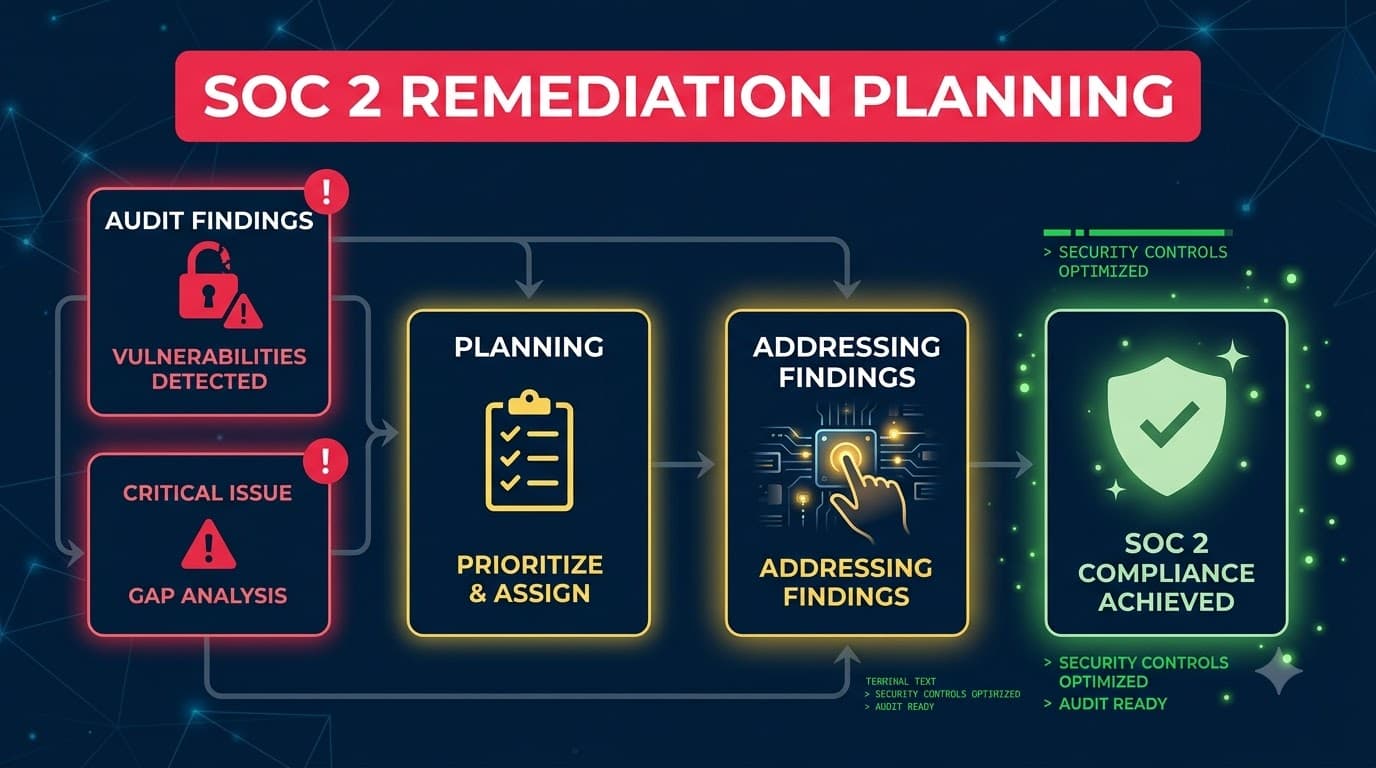
Priya Chandrasekaran read the readiness report twice before she called anyone. Twenty-two findings. Not twenty-two typos in a policy document — twenty-two places where Solstice Ledger's controls either didn't exist, didn't operate the way the documentation claimed, or hadn't left a trace anyone could point to. She was Director of Security & Compliance at Solstice Ledger, a 340-person expense-management platform that had just closed its Series C, and the company's single largest prospective customer — a regional bank looking to route $340 million a year in corporate card spend through Solstice's rails — had made a clean SOC 2 Type II report a contractual condition of a $950,000 annual contract. The observation period closed in eleven weeks. The auditor's fieldwork would start the week after that.
Priya had run gap analyses before. What she hadn't done, not at this scale and not with this much money watching, was turn a findings list into something a CFO, an engineering lead, and a part-time HR generalist could all execute against without her personally chasing every line item. That's the part almost nobody teaches: not finding the gaps, but building the plan that closes them, on a clock, with evidence an auditor will actually accept. This article is the playbook I've built with clients like Priya over fifteen years of compliance consulting — the one that turns a scary findings list into a boring, well-run project.
Who This Is For and What You'll Walk Away With
This is written for compliance leads, security managers, IT directors, and internal audit staff who have a list of findings in hand — from a readiness assessment, from a prior Type II report, or from ongoing control self-assessment — and need to convert it into an executable remediation program. You'll walk away with a repeatable method for triaging findings by risk and criteria impact, a remediation plan template with the fields auditors actually expect to see, a realistic view of how long different finding types take to fix, a framework for proving remediation happened (not just claiming it did), and a clear picture of how remediation timing interacts with the audit period so you're not accidentally invalidating your own fix.
From Finding to Fixed: Why Remediation Planning Is the Real Work
Finding gaps is the easy part. Any competent readiness assessment or internal audit will surface a list — that's what they're designed to do. The hard part, and the part that determines whether your next SOC 2 report is clean or qualified, is what happens in the weeks and months after the list lands on your desk. I have watched organizations with excellent gap-analysis skills and terrible remediation discipline walk into fieldwork with the exact same findings they identified four months earlier, just better documented. The auditor doesn't grade you on self-awareness. They grade you on whether the control operated.
A remediation plan is the bridge between "we know what's wrong" and "we can prove it's fixed." It assigns a name to every gap, a date to every name, and a form of proof to every date. Without that structure, findings sit in a spreadsheet, get discussed in a meeting, and quietly age past the point where fixing them still helps the current audit cycle. With it, a list of twenty-two scary bullet points becomes twenty-two tracked work items moving through a pipeline everyone can see.
"The findings list is never the problem. The problem is always the six weeks after the findings list, when everyone agrees something needs to happen and nobody owns making it happen." — Jordan Feld, CISO, Cascade Freight Analytics
Two Universes of Findings: Readiness Gaps vs. Audit Exceptions
Not all findings are the same animal, and treating them identically wastes remediation effort. Readiness gaps come from a pre-audit self-assessment or a firm's readiness assessment — they describe control design or operation problems discovered before the audit period closes or before fieldwork starts, while you still have time to fix them and generate enough operating history to prove it. Audit exceptions come from the CPA firm's actual testing — a control deficiency or audit exception they identified during fieldwork, which will appear in the report unless it's resolved before the report is finalized (rare) or addressed in a subsequent report.
Dimension | Readiness Gap | Audit Exception |
|---|---|---|
Discovered by | Internal team, consultant, or readiness assessor | External CPA firm during testing |
Timing | Before/during the observation period | During or after fieldwork |
Consequence if unresolved | Risk of becoming an audit exception later | Appears in the report (qualified opinion or exception note) |
Fix window | Can often be fully remediated with operating history to prove it | Limited — may only be fixable for the next report |
Auditor visibility | None, unless self-disclosed | Already documented in workpapers |
Primary goal of remediation | Prevent it from becoming a finding | Prevent recurrence and demonstrate control maturity |
The distinction matters because a readiness gap gives you room to fix the control and accumulate enough days or weeks of clean operation before the observation window closes to prove it in a Type II report. An audit exception, once it's in the auditor's workpapers, is largely a done deal for that report — your job shifts from prevention to disciplined corrective action plan execution so it doesn't show up again next cycle. Confusing the two leads teams to either panic-fix things that don't need it or, worse, treat a live exception as something they can quietly patch before anyone notices — which auditors notice immediately, because they retest.
Anatomy of a Finding: What a Usable Finding Record Contains
Half the remediation programs I've reviewed fail not because the fixes were hard, but because the finding itself was never written down in a form anyone could act on. "Access reviews aren't happening consistently" is an observation, not a finding. A usable finding record has enough structure that a new hire could pick it up and know exactly what to do.
Field | Purpose | Example |
|---|---|---|
Finding ID | Unique tracking reference | RF-2026-014 |
Criterion/control mapped | Which TSC and control it violates | CC6.2 — logical access provisioning |
Description | Specific, factual statement of the gap | Quarterly access review for the billing database was not performed in Q1 2026 |
Source | Readiness assessment, internal audit, prior report, auditor testing | Readiness assessment, February 2026 |
Severity | Risk/criteria impact rating | High |
Root cause | Underlying reason, not just symptom | No calendar reminder or owner assigned after platform migration |
Owner | Named individual accountable | Marcus Webb, IT Manager |
Due date | Target remediation completion | March 28, 2026 |
Remediation action | Specific steps to close the gap | Reassign review ownership, configure recurring calendar task, complete Q1 review retroactively |
Evidence required | What will prove it's fixed | Signed access review log, calendar recurrence screenshot, ticket closure |
Status | Open / In Progress / Remediated / Retested / Closed | In Progress |
Write findings this way from day one and the rest of the plan practically builds itself — the fields above map almost directly onto the columns of a remediation tracker.
Root Cause Analysis: Don't Patch the Symptom
The single most common mistake in remediation is fixing the instance instead of the cause. A missed access review gets performed retroactively, the finding gets marked closed, and six months later the same control fails again because nothing changed about why it failed the first time. Root cause analysis is the discipline of asking why until you hit something structural — a missing owner, a broken handoff, a tool that doesn't alert anyone, a policy that was never operationalized.
Good root cause analysis distinguishes between three failure layers: the control itself was never designed (a true gap), the control was designed correctly but nobody executed it (an operating failure), or the control operated but wasn't documented well enough to prove it (an evidence failure). Each layer calls for a different fix. A missing control needs to be built. A control that exists but isn't executed needs an owner, a reminder system, and often a consequence for missing it. A control that's executed but not documented needs a lightweight evidence-capture step bolted onto the existing process — not a whole new process.
"Ninety percent of the repeat findings I see in second-year audits trace back to teams who fixed the instance and never touched the cause. They close the ticket and reopen the risk." — Renee Okafor, Director of Internal Audit, BrightLedger Financial
The Five Whys and Fishbone, Applied to a Real Exception
Two lightweight techniques cover almost every SOC 2 finding: the five whys for a single, linear failure, and a simple fishbone (cause-category) breakdown for anything that seems to have multiple contributing factors — people, process, technology, and vendor. Neither needs a facilitator or a workshop; a fifteen-minute conversation with the control owner usually gets there.
Step | Question | Example Answer |
|---|---|---|
Why 1 | Why wasn't the Q1 access review performed? | The reviewer left the company in February |
Why 2 | Why didn't someone else pick it up? | No backup owner was assigned in the access review procedure |
Why 3 | Why was there no backup owner? | The procedure document was written for a single named person, not a role |
Why 4 | Why was it written that way? | It was drafted quickly before the first audit and never revisited |
Why 5 (root cause) | Why was it never revisited? | No control-owner review cadence exists for procedure documents |
The fix that comes out of Why 5 — a periodic procedure-document review cadence — is worth far more than simply reassigning the Q1 review to someone new, because it prevents the same failure mode across every other procedure with a single named owner, not just this one.
Scoring Severity: Risk and Trust Services Criteria Impact
Not every finding deserves the same urgency, and treating a missing signature on a low-risk policy the same as an unremediated privileged-access gap wastes your best remediation weeks on the wrong problems. Severity should combine two dimensions: the inherent risk of the underlying control failing (how bad is it if this goes wrong?) and how directly it maps to a Trust Services Criterion the report depends on.
Severity | Risk Description | Typical Examples | Report Impact if Unresolved |
|---|---|---|---|
Critical | Directly enables unauthorized access, data loss, or fraud | Terminated employee retained system access; encryption disabled on a sensitive datastore | High likelihood of qualified opinion or exception |
High | Weakens a key control with limited compensating coverage | Inconsistent quarterly access reviews; undocumented change approvals | Likely exception if unresolved through the audit period |
Medium | Control operates but evidence or consistency is weak | Access review performed but not signed/dated; policy not annually reviewed | Possible exception; often resolvable with process tightening |
Low | Administrative or documentation gap with minimal risk exposure | Typo in a policy; missing version number on a document | Rarely reportable; fix for hygiene |
Where a compensating control genuinely offsets a gap — say, a compensating control like enhanced monitoring standing in for a delayed access review — document it explicitly and get the auditor's read on it early. Auditors will consider a well-evidenced compensating control, but they will not accept "we assume this is fine" as a substitute for a tested one.
Building a Prioritization Model That Survives Contact With Reality
Severity alone doesn't tell you what to work on first — a critical finding that takes six weeks to fix and a high finding that takes two days both compete for the same engineering sprint. I use a simple weighted score that blends severity, remediation effort, and how close the finding sits to the edge of the observation window.
Factor | Weight | Scoring Guide (1–5) |
|---|---|---|
Severity / risk impact | 40% | 5 = critical, 1 = low |
Criteria/report exposure | 25% | 5 = directly tested this cycle, 1 = unlikely to be sampled |
Remediation effort | 20% | 5 = quick fix (days), 1 = major project (quarters) — inverted so quick wins score high |
Time sensitivity vs. audit period | 15% | 5 = must be fixed and operating before period close, 1 = no deadline pressure |
Multiply each factor's raw score by its weight, sum them, and rank the list. This isn't meant to replace judgment — it's meant to stop the loudest voice in the room from dictating the sequence. In practice, I've seen teams discover that three "medium" findings with a two-day fix and hard time sensitivity should be worked before a single "critical" finding that's already scheduled as a multi-quarter platform migration; the model surfaces that tension instead of hiding it.
The Remediation Plan Document: Fields That Actually Matter
Once findings are scored and sequenced, they need a home — a living document (spreadsheet, GRC tool, or ticketing system) that both your team and, eventually, your auditor can reference. This is your corrective action plan, and it should read less like a compliance artifact and more like a project plan with teeth.
Field | Why It's There |
|---|---|
Finding ID and description | Traceability back to the source assessment or exception |
Root cause | Prevents re-litigating "why" mid-remediation |
Severity/priority score | Drives sequencing and resourcing decisions |
Owner (named individual) | Removes ambiguity — teams don't fix things, people do |
Target due date | Creates accountability against the observation window |
Remediation action steps | Specific enough to execute without re-asking the analyst |
Interim/compensating measures | What covers the risk while the permanent fix is in progress |
Evidence to be produced | What "done" will look like before anyone marks it closed |
Retest date and retester | Who validates it, and when |
Status | Current stage in the pipeline |
Escalation trigger | The condition under which this gets raised to leadership |
Keep this document boring and structured. The moment it becomes a narrative status report instead of a tracked table, it stops being useful for prioritization and starts being useful only for storytelling — which auditors, to their credit, generally see through.
Assigning Ownership: A RACI That Doesn't Collect Dust
Every remediation program I've watched fail for non-technical reasons failed on ownership, not skill. Findings get assigned to a team ("Engineering will handle this") instead of a person, and diffuse ownership is functionally no ownership. A lightweight RACI — Responsible, Accountable, Consulted, Informed — applied at the finding level fixes this in about ten minutes per item.
Role | Definition | Example for an Access Review Finding |
|---|---|---|
Responsible | Does the remediation work | IT operations analyst who runs the access review |
Accountable | Owns the outcome and sign-off | IT Manager who confirms it's complete and evidence is captured |
Consulted | Provides input before/during remediation | Security team advising on access tiering |
Informed | Kept aware of status, not doing the work | Director of Compliance, tracking for the plan |
Accountable should always be a single named person, never a team distribution list, and never the compliance lead by default just because compliance is coordinating the overall plan. Compliance owns the program; control owners own the controls. Blurring that line is how a compliance team ends up personally executing forty remediation items instead of managing forty owners who each execute one or two.
Setting Realistic Due Dates by Finding Type
A due date that ignores how long a fix realistically takes is worse than no due date — it trains owners to treat deadlines as decorative. Different finding types have genuinely different remediation timelines, and pretending otherwise is how remediation plans slip in month two and stay slipped.
Finding Type | Typical Remediation Timeline | Why |
|---|---|---|
Missing/inconsistent evidence for an operating control | 1–2 weeks | Process exists; needs documentation discipline, not new tooling |
Policy gap or outdated document | 2–4 weeks | Drafting, review, and approval cycle |
Access control misconfiguration (single system) | 1–3 weeks | Technical fix plus verification |
Recurring process failure (e.g., inconsistent reviews) | 4–8 weeks | Needs a new owner, cadence, and one or two proof cycles before it's trusted |
Missing control requiring new tooling (e.g., centralized logging) | 8–16 weeks | Procurement, implementation, and initial operating history |
Organization-wide process redesign (e.g., offboarding workflow) | 12–20 weeks | Cross-functional coordination, training, and multiple operating cycles |
Vendor/subservice organization gap | Variable, often 8–16+ weeks | Outside your direct control; depends on the vendor's own timeline |
For anything landing in the last three rows, build the due date around the audit period deliberately: a fix implemented in week 10 of a 12-month observation window won't have enough operating history for a Type II auditor to sample meaningfully, even if the control itself is technically "fixed." That's a scheduling problem, not a remediation problem, and it needs to be flagged early — not discovered during fieldwork.
Evidence of Remediation: What "Done" Actually Looks Like
A finding isn't closed because someone says it's closed. It's closed when there's audit evidence — the kind an auditor would accept — showing the control now operates as designed. This is where remediation plans most often quietly fail: the fix happens, but nobody captures proof, and six weeks later no one can reconstruct exactly what changed or when.
Control Type | Weak "Evidence" | Acceptable Evidence |
|---|---|---|
Access review | Verbal confirmation it happened | Signed/dated review log with reviewer name, scope, and disposition of each account |
Access revocation | "We removed access" in a Slack message | Ticket showing revocation timestamp, system logs confirming deprovisioning |
Policy update | Updated document exists somewhere | Version-controlled document with approval date, owner, and distribution/acknowledgment record |
Change management approval | Change was made | Ticket showing requested change, approver, approval timestamp, and deployment record |
Training/awareness fix | Training was "scheduled" | Completion records with names, dates, and pass/fail or acknowledgment status |
Technical control (e.g., MFA enforcement) | Setting was toggled on | Configuration screenshot plus system-generated report showing enforcement across the population |
Build evidence capture into the remediation step itself, not as an afterthought. If the remediation action is "reassign access review ownership and configure recurring reminders," the evidence step should be "produce the first two completed, signed review logs under the new owner" — not just "confirm the reminder is set up." Auditors want to see the control operate, not just exist.
Timing Against the Observation Window: Before, During, and After
Remediation timing interacts with the audit period in ways that trip up even experienced teams. A control that's fixed on paper but only operated for two weeks before period close gives an auditor almost nothing to sample. A fix implemented after the observation window closes doesn't help the current report at all — it's a story for next year's report, not evidence for this one.
Phase | What Remediation Accomplishes | What It Doesn't Accomplish |
|---|---|---|
Before observation window opens | Full opportunity — the fix has the entire period to generate operating history | Nothing missed here; this is the ideal window |
Early-to-mid observation window | Partial operating history; auditor can sample post-fix period, may note the gap existed pre-fix | Doesn't erase the earlier gap period from the report narrative |
Late in observation window (final 4–6 weeks) | Technically operating by period close, but very thin sample size for testing | Rarely enough evidence to satisfy a Type II report sample; often still cited |
After observation window closes | Prevents recurrence in the next report | Does nothing for the current report — the exception stands |
This is exactly why readiness assessments exist as early as they do relative to fieldwork: the whole point is to surface gaps with enough runway left in the observation window that a fix implemented in month two or three has real operating history by the time the auditor samples. Learn more about structuring that timeline in our guide to the SOC 2 readiness assessment and pre-audit preparation process.
"I tell clients: every week you wait to start remediation is a week you're subtracting from the auditor's ability to see the fix actually working. Fixing something in week eleven of a twelve-month window is basically fixing it for next year." — Marcus Whitfield, Partner, Whitfield & Voss CPAs
Internal Retesting Before You Ever Show the Auditor
Before you mark a finding "remediated" and move on, someone other than the person who fixed it should verify it actually works — the same discipline an auditor will apply, just done internally and earlier. This internal retest is cheap insurance against the embarrassment of an auditor finding your "fixed" control still broken during fieldwork.
Retest Step | What to Check |
|---|---|
Independence | Retester is not the same person who performed the remediation |
Design check | Does the fixed control, as implemented, actually address the root cause identified? |
Operation check | Has the control operated at least once (ideally 2–3 times) since the fix? |
Evidence check | Is the evidence produced sufficient for an external auditor to accept without follow-up questions? |
Population check | If it's a population-based control (e.g., access reviews), was the full population reviewed, not just a sample? |
Documentation check | Is there a dated record of the retest itself, separate from the original remediation evidence? |
This internal step also gives you an early warning if a fix is only partially effective — a common outcome when a team addresses the specific instance in the finding but the underlying process still has edge cases. Better to discover that in your own retest than in the auditor's re-performance testing.
How Auditors Retest and Close Findings in the Report
When you tell your auditor a finding is remediated, they don't take your word for it — they retest, generally using the same audit sampling or walkthrough methods used in original fieldwork. Understanding this process helps you prepare evidence in the format they'll actually use.
Auditor Action | What They're Verifying | What You Should Have Ready |
|---|---|---|
Request updated remediation evidence | Documentation of the fix and its operation | Signed logs, tickets, configuration exports, dated screenshots |
Re-perform or resample the control | Whether the control now operates consistently | Enough operating cycles to sample from (not just one instance) |
Interview the control owner | Whether the new process is understood and sustainable | Owner who can explain the fix without reading from a script |
Assess the deviation rate | Whether the fix reduced failures to an acceptable rate, not just for the sampled instance | Full population data, not a cherry-picked subset |
Determine report disposition | Whether the finding is fully closed, noted as remediated-during-period, or remains an exception | Clear timeline showing when the fix was implemented relative to period close |
A finding that's genuinely fixed with strong operating history typically gets noted in the report as remediated during the period, sometimes with the exception still disclosed alongside the remediation narrative — this is where the distinction between an unqualified opinion and a qualified one often gets decided. If remediation happened too late in the period for adequate testing, the auditor will usually still cite the exception, with a note that management has since remediated. That's a materially better outcome than an unaddressed exception with no remediation narrative at all — but it's not the same as a clean pass. For a deeper look at how exceptions get evaluated and dispositioned in the first place, see our guide to SOC 2 exception management and handling control deficiencies.
Systemic Findings: When the Fix Is a Process, Not a Ticket
Some findings are isolated incidents. Others are symptoms of a systemic gap that will keep generating new findings until the underlying process is redesigned. Distinguishing between the two early prevents a lot of wasted remediation cycles chasing individual instances of the same root problem.
Signal | One-Off Finding | Systemic Finding |
|---|---|---|
Pattern | Single control failure, isolated cause | Same control type fails repeatedly across systems/periods |
Root cause | Specific, contained (e.g., one person's error) | Structural — no owner, no process, no tooling |
Segregation of duties impact | Rarely implicated | Often a contributing factor (one person can both create and approve) |
Appropriate fix | Correct the instance, add a check | Redesign the process, add automation or a second approver, retrain broadly |
Recurrence risk if only instance is fixed | Low | High — same failure mode resurfaces in 1–2 audit cycles |
A useful test: if you fixed this exact instance and changed nothing else, would you bet the same finding won't reappear next year in a different system or team? If the honest answer is no, you're looking at a systemic finding, and the remediation plan needs a process owner and a redesign timeline, not just a ticket. This is precisely the kind of pattern a well-run internal audit function is built to catch before the external auditor does — see our guide to building a SOC 2 internal audit program for ongoing self-assessment.
Case Study: Solstice Ledger's Eleven-Week Sprint
Back to Priya. Her twenty-two findings broke down as four critical, nine high, seven medium, and two low, using the severity model above. Rather than working the list top to bottom, she ran it through the prioritization score: severity, criteria exposure, effort, and time sensitivity. Three findings that looked minor on severity alone — inconsistent MFA enforcement logging, an out-of-date vendor risk questionnaire, and an unsigned access review from the prior quarter — jumped to the top because they were two-day fixes with hard exposure to the auditor's testing scope.
She assigned a named accountable owner to every finding within 48 hours, set due dates anchored to a hard internal deadline three weeks before fieldwork (to leave room for retesting), and required evidence artifacts specified in the finding record itself, not left to the owner's interpretation. The four critical findings — including a terminated contractor who'd retained VPN access for eleven days — got escalated to the executive team with weekly status in the Monday leadership meeting. By week nine, twenty of twenty-two findings were remediated and internally retested; the remaining two (a logging pipeline requiring a new tool) were reclassified with a documented compensating control and a remediation date in the following quarter, communicated proactively to the auditor before fieldwork began. The Type II report came back with zero exceptions related to the original twenty-two, one disclosed-and-remediated note, and the bank contract closed on schedule at $950,000 annually.
"The thing that saved us wasn't finding the gaps faster. It was refusing to let a finding exist without a name and a date attached to it within two days of discovery." — Priya Chandrasekaran, Director of Security & Compliance, Solstice Ledger
Case Study: CredoPay's Access Review Failure
CredoPay, a payments-adjacent fintech with roughly 180 employees, entered its second SOC 2 Type II cycle with a single prior-year exception: quarterly access reviews for its core ledger database had been performed only twice in four quarters. The root cause analysis found the real problem wasn't neglect — it was that the review owner had left the company mid-year and the task quietly fell off everyone's calendar, with no backup assigned. CredoPay's remediation plan assigned a new accountable owner, built the review into a recurring calendar task with an escalation trigger if it wasn't completed within five business days of the due date, and required the reviewer to produce a signed log covering the full account population, not a sample.
The team also added a compensating measure for the gap quarter itself: a retroactive access audit covering the missed period, with findings remediated and documented before fieldwork. By the time the auditor tested, there were three consecutive quarters of clean, fully evidenced reviews under the new owner and process. The finding did not recur, and CredoPay's second-year report carried no exceptions related to access review controls — a direct result of fixing the ownership structure, not just performing one make-up review.
Case Study: Anchorpoint Systems and the Repeat Finding
Anchorpoint Systems, a managed service provider serving healthcare and logistics clients, had the same offboarding finding show up in two consecutive audits: terminated employees' access to client systems wasn't consistently revoked within the required 24-hour window. The first year, the team treated it as an HR-to-IT handoff problem and added a checklist item. The finding reappeared the next year, worse — a terminated employee had retained access for nine days.
The second-time remediation went deeper. Root cause analysis showed the checklist depended on HR manually notifying IT, with no system-level trigger and no IT general controls tying termination in the HR platform to access revocation in the identity system. Anchorpoint's fix was structural: an automated integration that suspended access within one hour of a termination event being recorded in the HR system, with IT confirming full revocation within 24 hours as a secondary control layer. The remediation plan explicitly called out this as a systemic finding requiring process redesign, not a checklist patch, with the CTO as accountable owner rather than an HR coordinator. Eighteen months of clean operating history followed, and the finding has not resurfaced in two subsequent audit cycles.
Governance and Tracking: Where Remediation Plans Go to Die (and How to Stop It)
The most common failure mode I see isn't a bad remediation plan — it's a good remediation plan that nobody looks at after week two. Findings tracked in a spreadsheet that only the compliance lead opens will quietly slip, because nobody with the authority to unblock a stuck item ever sees that it's stuck.
Governance Practice | What It Prevents |
|---|---|
Weekly remediation stand-up (15–20 min) with all open-item owners | Findings silently stalling without anyone noticing |
Centralized tracker visible to owners, not just compliance | Owners forgetting what they committed to |
Status categories limited to Open / In Progress / Remediated / Retested / Closed | Ambiguous "kind of done" states that hide real progress |
Dashboard or report to leadership on a fixed cadence | Executive blind spots until a deadline is missed |
GRC tool or ticketing system integration | Evidence scattered across email/Slack with no audit trail |
A remediation program benefits enormously from living in the same system your team already uses for other work — a ticketing system, project tracker, or dedicated GRC platform — rather than a standalone document only compliance touches. If you're building this tracking discipline from scratch, our SOC 2 Control Matrix / RACI Template gives you a starting structure that maps directly onto the finding-record fields covered earlier in this article.
Escalation Paths: When to Involve Leadership and the Board
Not every finding needs executive visibility, but some absolutely do, and the mistake I see most often is compliance teams trying to handle everything quietly to avoid "bothering" leadership — right up until a finding blows past its due date with three weeks left before fieldwork.
Escalation Trigger | Who Gets Involved | Why |
|---|---|---|
Critical-severity finding past due date | Executive sponsor (CTO/CISO/COO) | Direct risk exposure with report consequences |
Finding requiring budget/headcount to fix | Finance and relevant VP | Remediation blocked without resource approval |
Systemic finding requiring cross-functional redesign | All affected department heads | Single-owner fixes won't resolve it |
Remediation timeline colliding with observation window close | CEO/board-level compliance sponsor | Report outcome and customer commitments at stake |
Vendor/subservice organization unresponsive on their own finding | Vendor management lead and legal | Contractual and vendor risk management leverage may be needed |
Set these triggers in the remediation plan itself, before anything is overdue — deciding escalation criteria in the moment, under deadline pressure, tends to either escalate everything (which trains leadership to ignore alerts) or escalate nothing (which is how a fixable finding becomes an unfixed exception). A board or executive sponsor who hears about a stalled critical finding four weeks before fieldwork can usually unblock it; one who hears about it four days before cannot.
Common Remediation Pitfalls
Across two hundred-plus client engagements, the same handful of mistakes account for most remediation programs that underdeliver. Naming them explicitly tends to prevent them.
Pitfall | Why It Happens | Fix |
|---|---|---|
Fixing the instance, not the cause | Feels faster; closes the ticket today | Require documented root cause before any fix is approved |
No named individual owner | Diffuses accountability to a team | Every finding gets exactly one accountable name |
Evidence captured as an afterthought | Fix is technical; documentation feels separate | Bake evidence capture into the remediation step itself |
Due dates set without checking effort/timeline | Optimism bias, pressure to show fast progress | Use the finding-type timeline table to set realistic dates |
Remediating too late in the observation window | Slow start, competing priorities | Anchor internal deadlines weeks before period close, not at it |
No internal retest before showing the auditor | Assumes "done" means "verified" | Require independent internal retest as a closing gate |
Treating vendor findings the same as internal ones | Underestimates loss of direct control | Build vendor-specific timelines with contractual leverage points |
Losing visibility after the initial findings meeting | No ongoing governance cadence | Weekly stand-up and a shared, visible tracker |
"Every remediation program I've watched fail, failed quietly. Nobody decided to ignore the finding — it just never had a name attached to it, so it drifted." — Dana Kowalski, GRC Program Manager, NovaStack Cloud
Connecting Remediation to Continuous Monitoring So Findings Don't Return
A remediation plan that closes a finding but doesn't change how you monitor that control going forward is setting up a repeat performance. The Anchorpoint case study above is the clearest illustration: the first fix addressed the symptom, and the finding came back worse a year later, because nothing about ongoing monitoring changed.
Remediation Output | Continuous Monitoring Hook |
|---|---|
New control owner assigned | Owner added to recurring monitoring/alerting distribution |
New process or cadence established | Automated reminder or dashboard tracking on-time completion |
Technical control implemented (e.g., automated deprovisioning) | Configuration drift monitoring to catch if it's later disabled |
Compensating control used as an interim measure | Tracked with its own expiration date, not left indefinite |
Systemic process redesign | Added to the internal audit test plan for the next cycle |
Every remediated finding should generate at least one line item in your ongoing monitoring program — a metric, an alert, or a recurring check that would catch the control failing again before it becomes next year's finding. This is the connective tissue between remediation (fixing what broke) and durable compliance (making sure it stays fixed). Our companion piece on SOC 2 continuous monitoring and maintaining controls year-round goes deeper on building that ongoing monitoring layer, and it's worth reading immediately after you've closed your current findings list — not months later, once the lesson has faded.
Budgeting and Resourcing the Remediation Sprint
Remediation isn't free, and pretending it is — squeezing it into existing workloads with no dedicated time or budget — is one of the fastest ways to blow a deadline. Some findings need nothing but attention; others need tooling spend, contractor hours, or headcount that has to be requested and approved before the clock on the observation window runs out.
Resource Type | When It's Needed | Planning Consideration |
|---|---|---|
Existing staff time (reallocated) | Documentation, process fixes, evidence capture | Protect capacity explicitly — don't assume it fits "around" other work |
Contractor/consultant hours | Root cause analysis, drafting policies, interim compliance support | Lead time to source and onboard; budget approval cycle |
New tooling (logging, IAM, GRC platform) | Findings requiring automation or centralized evidence | Procurement and implementation timelines can exceed the observation window |
Training/awareness spend | Findings tied to staff behavior or understanding | Scheduling across the organization takes longer than expected |
Executive/board time | Escalated or systemic findings | Calendar availability, not urgency, is often the bottleneck |
Build a rough remediation budget alongside the plan itself, even if it's just a T-shirt-size estimate per finding (small/medium/large). This gives finance and leadership a concrete number to approve early, rather than a series of surprise asks trickling in as each finding's true cost becomes apparent mid-sprint.
Communicating With Your Auditor During Remediation
Some compliance teams instinctively go quiet during remediation, worried that surfacing problems early makes the organization look worse. In my experience it's the opposite: auditors consistently respond better to proactive, well-documented remediation communication than to findings that appear fully formed at fieldwork with no context.
Communication Practice | Benefit |
|---|---|
Share the remediation plan structure (not necessarily every detail) early | Sets auditor expectations; avoids surprises at fieldwork |
Flag findings you won't fully remediate before period close | Allows the auditor to plan disclosure language and testing approach |
Ask clarifying questions about what evidence they'll expect for a retest | Prevents rework — you find out the format they need before you build it |
Notify them promptly if a compensating control is being used | They can assess it as part of testing rather than discovering it cold |
Provide a status update ahead of the PBC list request, not just in response to it | Builds credibility and often shortens fieldwork |
A CPA firm partner I've worked with for years put it simply: auditors aren't looking for perfection, they're looking for control maturity, and a well-run remediation program is itself evidence of maturity — even when a finding isn't fully closed by period close.
"A client who tells me in month three, 'here's the finding, here's the root cause, here's the plan, here's where we'll realistically land by period close' gets a very different conversation from me than a client who says nothing until I hand them the exception in fieldwork." — Sofia Marchetti, Head of Compliance, Ridgeline Payments
Subservice and Vendor Findings: A Different Remediation Playbook
Findings that trace back to a subservice organization — a cloud host, a payroll processor, a background-check vendor — can't be remediated with an internal ticket, because you don't control the fix. This requires a different playbook built around contractual leverage and, when necessary, scope decisions.
Situation | Remediation Approach |
|---|---|
Vendor has a known, in-progress fix | Obtain their remediation timeline and evidence commitment in writing; track as a dependency in your plan |
Vendor is unresponsive or non-committal | Escalate through vendor management/legal; reference contractual security obligations |
Vendor's own SOC 2/attestation covers the control | Request their updated report or bridge letter as evidence rather than remediating independently |
Fix is not forthcoming within your timeline | Consider a compensating control on your side, or evaluate carve-out vs. inclusive scoping for the next report |
Recurring vendor issue across audit cycles | Factor into vendor risk scoring and renewal/replacement decisions |
Document vendor-dependent findings distinctly in your remediation tracker, with the vendor's committed date as a separate field from your internal due date — and build in a buffer, because vendor timelines slip more often than internal ones and you'll have less visibility into why.
Remediation Plan Review Cadence and Metrics
A remediation program needs its own health metrics, tracked with the same discipline you'd apply to any other operational process. These numbers tell you, well before fieldwork, whether you're actually on pace or just feel like you are.
Metric | What It Tells You | Healthy Benchmark (Illustrative) |
|---|---|---|
Mean time to remediate (MTTR) by severity | Whether critical findings are actually moving fastest | Critical findings remediated meaningfully faster than low-severity ones |
% of findings past due date | Program discipline | Trending toward zero as fieldwork approaches |
% of findings with named owner assigned within 48 hours | Speed of accountability | Should approach 100% |
% of remediated findings with independent internal retest completed | Evidence rigor before auditor review | 100% for critical/high findings |
Recurrence rate (findings reopened in a later cycle) | Whether fixes address root cause | Trending down year over year |
Review these weekly during an active remediation sprint and quarterly as part of ongoing governance. A rising past-due percentage four weeks before fieldwork is the single clearest early-warning signal I know of that a report is heading toward exceptions — and it's visible weeks before anyone would otherwise notice.
The Remediation Lifecycle
The full path from finding to closed, retested control follows a consistent lifecycle regardless of finding type. Mapping it visually helps teams see where their current findings sit and what's still ahead.
flowchart LR
    A[Finding Identified] --> B[Root Cause Analysis]
    B --> C[Severity & Priority Scoring]
    C --> D[Remediation Plan: Owner + Due Date + Evidence Defined]
    D --> E[Remediation Action Executed]
    E --> F[Evidence Captured]
    F --> G[Internal Independent Retest]
    G -->|Pass| H[Marked Remediated]
    G -->|Fail| E
    H --> I[Auditor Retest / Re-performance]
    I -->|Confirmed| J[Closed in Report]
    I -->|Not Sufficient| K[Disclosed as Exception with Remediation Note]
    J --> L[Added to Continuous Monitoring]
    K --> L
Notice the loop back from internal retest failure to remediation execution — a finding that doesn't pass your own independent check shouldn't move forward to the auditor, no matter how close the deadline is. Sending an unverified fix to fieldwork just moves the failure from your own retest to the auditor's, at a much higher cost.
ISO 27001 Parity: Corrective Action and Root Cause
If your organization also holds, or is pursuing, ISO 27001 alongside SOC 2, this entire remediation discipline will feel familiar wearing different vocabulary. ISO 27001's Clause 10.1 requires a formal corrective action process for nonconformities: identify the nonconformity, evaluate the need for action to eliminate its cause (not just its symptom), implement the action, and review whether it actually worked. Where SOC 2 speaks of "exceptions" and a "corrective action plan," ISO 27001 speaks of "nonconformities" and "corrective action," but the method underneath — root cause before fix, a documented action, and verification that the fix held — is the same discipline in both frameworks. Organizations running both certifications and attestations are well served by building one unified remediation pipeline that feeds findings from either audit through the same triage, root cause, ownership, and evidence process described in this article, rather than maintaining two parallel tracking systems that inevitably drift out of sync with each other.
Dimension | SOC 2 remediation | ISO 27001 corrective action (Clause 10.1) |
|---|---|---|
Trigger | Audit exception or internal finding | Nonconformity, internal or external audit finding |
Root cause requirement | Best practice, strongly auditor-favored | Explicitly mandated by the clause |
Documentation artifact | Corrective action plan (CAP) | Corrective action record |
Verification of effectiveness | Internal retest, auditor re-performance | Management review, follow-up internal audit |
Consequence if unresolved | Recurs as an exception; may drive a qualified opinion | Can affect the certification decision at surveillance or recertification audit |
Two comparisons worth reading if you're navigating both frameworks at once: ISO 27001 vs SOC 2: which one you need, and, for teams actively running both in parallel, running ISO 27001 and SOC 2 together. A deeper, dedicated treatment of ISO 27001 corrective action and root cause analysis under Clause 10.1 is a natural companion piece to this one, even ahead of a direct link existing to it.
Remediation as a Competitive Advantage, Not a Compliance Chore
It's tempting to treat remediation as damage control — a scramble to make an embarrassing list disappear before an auditor or a customer sees it. I'd push back on that framing. A well-run remediation program is one of the clearest signals of organizational maturity a prospective customer's security team will ever see, and increasingly, sophisticated buyers ask about it directly: not just "do you have a clean report," but "what's your process when something isn't clean?" Priya's bank customer didn't just want a report with zero exceptions — during due diligence, they asked to see how Solstice Ledger had handled the twenty-two findings that did surface. A structured, evidenced, on-time remediation program answered that question better than a suspiciously spotless first-ever audit ever could have.
The organizations I've watched build durable compliance programs, the kind that stay clean year after year rather than lurching from crisis to crisis each audit cycle, all share the same trait: they treat remediation not as a one-time sprint before fieldwork but as a standing operational discipline, feeding continuous monitoring, feeding next year's internal audit scope, feeding the next readiness assessment. Findings stop being scary because the machinery for handling them is already built and already trusted.
If you're staring at your own findings list right now, start with the parts of this framework that are cheapest to implement today: name an accountable owner for every open item within 48 hours, and require a documented root cause before any fix gets approved. Everything else in this article — scoring, timelines, evidence, governance — compounds from those two habits.
To put this into practice quickly, our SOC 2 Gap Analysis Tool helps convert a raw findings list into a scored, prioritized backlog in a fraction of the time a manual spreadsheet takes, and our SOC 2 Readiness Checklist is built to surface exactly these kinds of findings early enough in the cycle that remediation has room to work. If your team needs standardized documentation to close policy and procedure gaps quickly, the SOC 2 Policy Pack gives you a vetted starting point rather than a blank page. And if remediation planning is new territory for your organization, PentesterWorld's compliance advisory team has walked dozens of companies exactly like Solstice Ledger from a scary findings list to a clean report — reach out and let's build your remediation plan before your observation window runs out.