I met Dana Okonkwo on a Tuesday afternoon call that she'd scheduled with the subject line "URGENT — need SOC 2 by Q3." Dana was Head of Security & IT at Parcel Metrics, a 65-person supply-chain analytics startup, and three weeks earlier her VP of Sales had come back from a customer visit with good news and bad news in the same sentence: a national retailer wanted to sign a $2.4M annual contract, but procurement wouldn't release the purchase order without a SOC 2 report on file. Dana had never scoped an audit in her life. She had a login to a project management tool, a half-finished password policy from 2022, and six months until the retailer's budget window closed.
I've spent more than fifteen years consulting on security and compliance programs — SOC 2, ISO 27001, PCI DSS, HIPAA — across more than 200 organizations, from three-person startups to public companies with distributed engineering teams. Dana's situation is close to the median case I see: a company that needs a report by a hard deadline, has some security hygiene in place but nothing documented or tested, and has heard "six months" thrown around without anyone explaining what actually happens inside those six months. This article is the plan I would have handed Dana on that first call — the month-by-month sequence, the owners, the deliverables, and the places where six months quietly becomes nine.
Who This Is For / What You'll Walk Away With
This is for founders, engineering leaders, and first security hires who have been told "we need SOC 2" and are staring at a blank calendar. You'll get a realistic six-month, month-by-month plan with named milestones, owners, and deliverables; the difference between what six months buys you for a Type I report versus a Type II report; a RACI breakdown of who does what; a monthly budget shape; and the specific things — in my experience across dozens of these engagements — that make timelines slip by six, ten, or sixteen weeks. What you won't get is a promise that six months works for every company; I'll show you exactly when it doesn't and what to do instead.
Why "Six Months" Is a Starting Point, Not a Promise
Six months is a workable, commonly cited target for a company that starts with reasonable technical hygiene — centralized identity, some form of change control, a cloud environment rather than a colocated data center — and commits real people-hours to the project every week. It is not a universal constant. I've run readiness programs that closed in ten weeks and others that took fourteen months, and the variable was almost never the framework itself; it was organizational readiness: how mature the environment already was, how much of the work was delegated to one overworked person versus a real cross-functional team, and how quickly leadership made scope decisions instead of relitigating them every month.
The table below reflects the ranges I actually see, illustratively, across company profiles. Treat "six months" as the number for a reasonably typical, moderately mature SaaS company with dedicated ownership — not as a guarantee.
Table: Illustrative Readiness Timelines by Company Profile
Company Profile | Typical Readiness Timeline | Why |
|---|---|---|
Early-stage startup (under 25 employees), cloud-native, single product | 3–4 months | Small surface area, few legacy systems, fast decision-making |
Growth-stage SaaS (25–150 employees), some technical debt | 5–7 months | More systems and vendors to inventory; policies often nonexistent |
Scale-up (150–500 employees), multiple products or business units | 7–10 months | Scope decisions get political; more stakeholders to align |
Enterprise or regulated industry (500+ employees) | 9–14 months | Legacy infrastructure, multiple TSCs, more rigorous change control |
Company redoing readiness after controls lapsed | 3–5 months | Documentation and muscle memory already partly exist |
Company with prior audit experience adding a new TSC | 2–4 months | Core control environment already tested; incremental scope only |
"The question I ask every prospective client isn't 'can you get SOC 2 in six months.' It's 'do you have someone whose job it is to make decisions every single week, or is this the fourth priority on someone's list?' That answer predicts the timeline better than company size does." — Sanjay Bhatt, Audit Partner, Bhatt & Cole CPAs
The Readiness Journey at a Glance
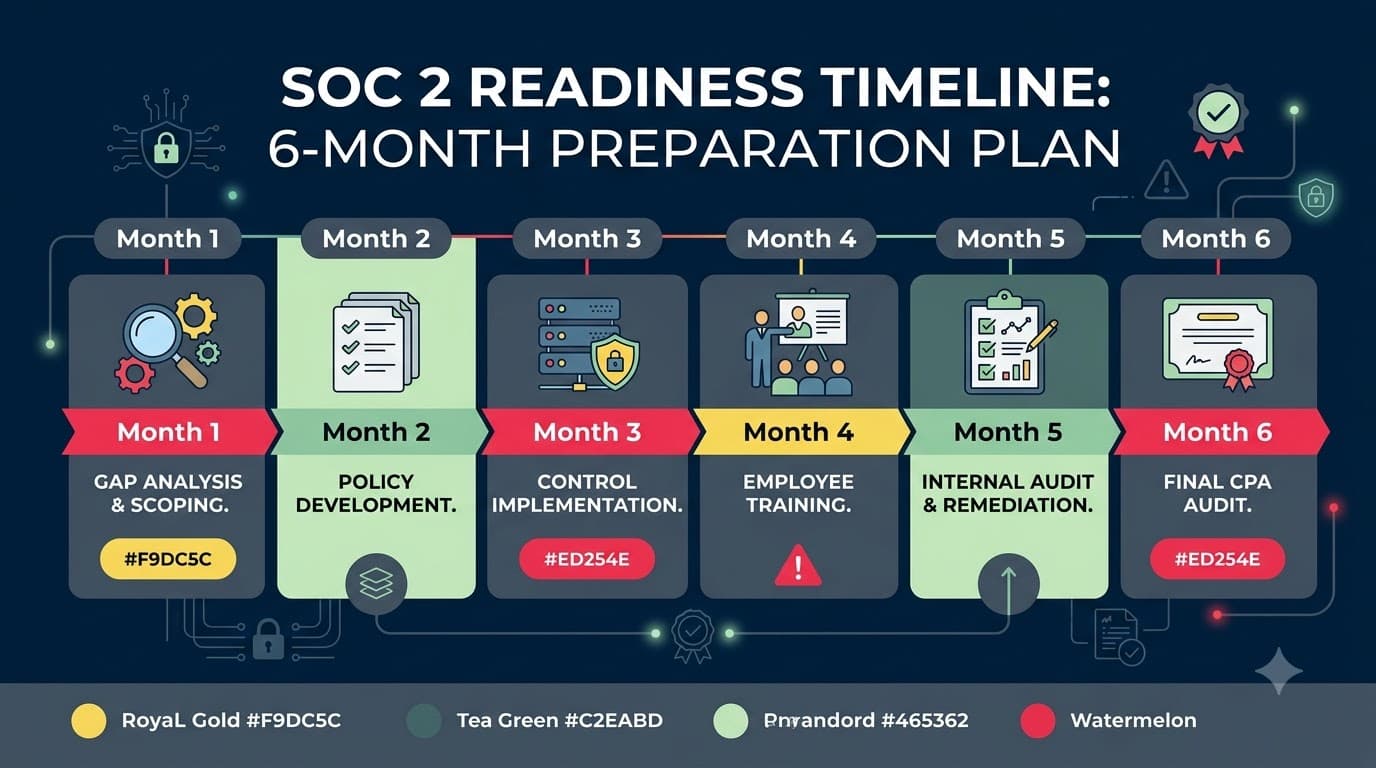
Before the month-by-month detail, here is the shape of the six months as a single picture. Each month builds on the one before it — you cannot skip gap analysis and go straight to evidence collection, and you cannot collect meaningful evidence before controls have actually been operating for a period of time.
gantt
    title SOC 2 Six-Month Readiness Journey
    dateFormat  YYYY-MM-DD
    axisFormat  %b
    section Month 1 — Scope & Gaps
    Scope & TSC selection        :a1, 2026-01-01, 20d
    Gap analysis                 :a2, after a1, 15d
    section Month 2 — Policy & Governance
    Policy drafting & approval   :b1, 2026-02-01, 20d
    Remediation kickoff          :b2, after b1, 10d
    section Month 3 — Controls & Tooling
    Control build-out            :c1, 2026-03-01, 30d
    section Month 4 — Evidence & Operations
    Controls run in production   :d1, 2026-04-01, 30d
    Evidence collection begins   :d2, after b1, 10d
    section Month 5 — Self-Assessment
    Internal audit / mock review :e1, 2026-05-01, 15d
    Remediate findings           :e2, after e1, 15d
    section Month 6 — Auditor Engagement
    Auditor selection & kickoff  :f1, 2026-06-01, 15d
    Type I fieldwork             :f2, after f1, 15d
Table: The Six-Month Plan at a Glance
Month | Theme | Primary Question Being Answered |
|---|---|---|
1 | Scope, TSC selection, gap analysis | What are we examining, and how far are we from ready? |
2 | Policies, governance, remediation start | What do we say we do, and who's fixing the biggest gaps? |
3 | Control build-out and tooling | Do we have the technical controls actually configured? |
4 | Evidence collection, controls in operation | Are the controls running, and can we prove it? |
5 | Internal self-assessment and fixes | Would we pass if the auditor showed up today? |
6 | Auditor engagement, Type I or observation start | Are we ready to be examined, and by whom? |
Before Month 1: Getting Executive Buy-In and a Budget
The clock I'm describing starts the day real work begins, not the day someone says "we should probably look into SOC 2." Before Month 1 can start, three things need to happen, usually in a single week: an executive sponsor needs to be named (ideally the CEO, CTO, or COO — someone who can unblock cross-team requests), a rough budget needs to be approved covering tooling, an auditor, and possibly outside advisory help, and the company needs to decide whether this is a Type I report first or a straight run at Type II. Skipping this step is the single most common reason I see six-month plans become nine-month plans — not because the technical work was hard, but because in Month 3 someone in Engineering asks "wait, who approved this project?" and momentum stalls for two weeks while that gets sorted out retroactively.
For Dana, this meant a 30-minute meeting with Parcel Metrics' CEO where she left with three things: a named executive sponsor (the CTO), a $45,000 budget line for the first year (tooling, auditor fees, and a part-time compliance consultant), and agreement that Parcel Metrics would target a Type I report at the six-month mark rather than promising the retailer a full Type II report, which — because Type II requires an observation window of operating effectiveness after the controls are in place, commonly three to twelve months — simply was not achievable in six months no matter how hard anyone worked. That distinction, made in week zero, is what kept the plan honest for the rest of the engagement. If you want the deeper case for treating this as a first-time program end to end, our complete first-time SOC 2 implementation guide walks through the full lifecycle beyond just the six-month window.
Month 1: Scope, Trust Services Criteria, and Gap Analysis
Month 1 answers two questions: what exactly is being examined, and how far away from ready is it. This is not a month for building anything — it's a month for decisions and honest measurement. The scope decision (which systems, which products, which locations, which subservice organizations) drives every downstream decision, so rushing it to "feel productive" is one of the most expensive mistakes I see. Our dedicated piece on defining what's in and out of scope goes deeper on the mechanics of this decision if your environment includes multiple products or business units.
Every SOC 2 report includes the Security criteria — the Common Criteria, aligned to the COSO framework's internal-control principles — because Security is mandatory in every SOC 2 examination. Availability, Processing Integrity, Confidentiality, and Privacy are added based on what your organization actually commits to its customers, not based on which ones sound impressive. Adding criteria you don't need adds real audit scope, evidence burden, and cost without adding sales value.
Once scope and TSCs are set, the gap analysis measures current-state controls against the criteria. This should be brutally honest — a consultant, internal auditor, or experienced hire walking through each criterion and marking it "exists and documented," "exists but undocumented," or "doesn't exist." I have never seen a first-time gap analysis come back clean, and a company that reports zero gaps in Month 1 usually just hasn't looked hard enough.
Table: Month 1 Milestones, Owners, and Deliverables
Week(s) | Milestone | Primary Owner | Deliverable |
|---|---|---|---|
1 | Executive sponsor and budget confirmed | CEO/COO | Signed project charter |
1–2 | System boundary and scope defined | Head of Security/Compliance | Draft system boundary document |
2 | Trust Services Criteria selected | Exec sponsor + Security lead | TSC selection memo |
2–3 | Subservice organizations inventoried | IT/Engineering lead | Vendor/subservice list with carve-out vs. inclusive decision |
3–4 | Gap analysis conducted against selected criteria | Security lead or outside consultant | Gap analysis report with severity ratings |
4 | Auditor "readiness" budget and remediation roadmap drafted | Security lead | Draft remediation roadmap (feeds Month 2) |
Table: Trust Services Criteria Selection Matrix
Criterion | Required? | Add It If... | Skip It If... |
|---|---|---|---|
Security (Common Criteria) | Always required | N/A — mandatory | Never optional |
Optional | You have uptime SLAs or customers ask about downtime | Your product isn't uptime-sensitive (e.g., batch processing tool) | |
Optional | You process transactions, payments, or calculations customers rely on for accuracy | You store data but don't transform or calculate on customers' behalf | |
Confidentiality | Optional | Customers hand you sensitive business data with an expectation of restricted access | Data handled is already public or low-sensitivity |
Optional | You collect personal information directly from individuals and make specific privacy commitments | Confidentiality criteria already cover your data-handling commitments adequately |
"Every prospect asks Dana's company the same question procurement always asks: what does your report actually cover? Companies that add every criterion 'to look thorough' usually regret it — more scope means more evidence, more cost, and a longer audit, for criteria nobody asked about." — Lena Forsythe, Director of GRC, Northfield Payments
Month 2: Policies, Governance, and the First Wave of Remediation
Month 2 turns the gap analysis into paper and into action. Policies are not busywork — auditors test whether your organization does what its policies say, so a policy that doesn't match reality is worse than no policy at all. This is also the month remediation actually starts on the highest-severity gaps identified in Month 1, because some fixes (rolling out multi-factor authentication organization-wide, for instance) take weeks to fully propagate and need runway before evidence collection begins in Month 4.
Our dedicated article on building the required policy documentation covers policy content in depth; here the point is sequencing — get policies drafted and formally approved by leadership early enough that the practice described in them has time to become routine before an auditor ever samples it.
Table: Month 2 Milestones, Owners, and Deliverables
Week(s) | Milestone | Primary Owner | Deliverable |
|---|---|---|---|
5 | Policy inventory built against gap analysis | Security/Compliance lead | List of required policies mapped to criteria |
5–6 | Core policies drafted | Security lead + department heads | Draft policy set (see table below) |
6–7 | Policies reviewed and formally approved | Executive sponsor / leadership team | Signed-off policy set with version control |
6–8 | High-severity remediation items assigned and started | Control owners (IT, Eng, HR) | Remediation tracker with owners and due dates |
7–8 | Risk assessment process formally documented | Security lead | Initial risk register and risk treatment decisions |
8 | Vendor/subservice organization risk review kicked off | Procurement/Security | Vendor risk questionnaire sent to critical vendors |
Table: Core Policy Set Mapped to the Common Criteria
Policy | Maps Primarily To | Typical Gap in Month 1 |
|---|---|---|
Information Security Policy | CC1 (control environment) | Doesn't exist or hasn't been reviewed in years |
Access Control Policy | CC6 (logical/physical access) | Exists informally, never documented |
Risk Assessment Policy | CC3 (risk assessment) | No formal process, decisions made ad hoc |
Change Management Policy | CC8 (change management) | Deployments happen without documented approval trail |
Incident Response Policy | CC7 (system operations) | No tested plan, no defined severity levels |
Vendor Management Policy | CC9 (risk mitigation) | Vendors never formally risk-assessed |
Data Classification Policy | CC6 / Confidentiality (if in scope) | No consistent labeling of sensitive data |
Business Continuity / Disaster Recovery Policy | CC7 / Availability (if in scope) | Exists as tribal knowledge, not written down |
Code of Conduct / Acceptable Use Policy | CC1 | Buried in an onboarding deck, not a standalone document |
"The policies aren't the hard part — writing eight documents in two weeks is achievable for any team. The hard part is that a policy written in Month 2 has to be true by Month 4, when evidence collection starts. That's why remediation can't wait until Month 3." — Dana Okonkwo, Head of Security & IT, Parcel Metrics
Month 3: Building and Configuring Controls
Month 3 is where technical remediation converts into operating controls. If Month 1 found that the company lacked centralized identity and access management, enforced least privilege, or had no vulnerability scanning program, Month 3 is when those tools get selected, procured, and configured — not perfectly, but functionally enough that they can start generating real operating history in Month 4.
This is also typically the most expensive month in the six-month plan, because tooling procurement and configuration work concentrates here. A GRC platform, if the company chooses to use one, is usually stood up in Month 3 as well, since it becomes the evidence repository for everything that follows.
Table: Month 3 Milestones, Owners, and Deliverables
Week(s) | Milestone | Primary Owner | Deliverable |
|---|---|---|---|
9 | Identity/access tooling selected and rollout started | IT/Engineering lead | SSO and MFA enforced across critical systems |
9–10 | Vulnerability scanning and endpoint protection deployed | Engineering/IT lead | Scan results baseline established |
10 | Logging and monitoring centralized | Engineering lead | SIEM or log aggregation tool operational |
10–11 | Change management workflow enforced in practice | Engineering lead | Pull request/approval trail for all production changes |
11 | Background check and onboarding/offboarding process formalized | HR lead | Documented, consistently applied HR security process |
11–12 | GRC or evidence-management tool selected | Compliance lead | Central evidence repository configured |
12 | Remediation tracker reviewed against Month 1 gap list | Security lead | Updated gap-closure status report |
Table: Tooling Categories Typically Stood Up in Month 3
Category | Purpose | Common Options (illustrative, not endorsements) |
|---|---|---|
Identity & access management | Centralize authentication, enforce MFA/SSO | Okta, Azure AD/Entra ID, Google Workspace |
Endpoint/MDM | Manage and secure laptops/mobile devices | Jamf, Kandji, Intune |
Vulnerability scanning | Detect known weaknesses in infrastructure and code | Qualys, Tenable, Snyk |
SIEM / log management | Centralize and alert on security events | Datadog, Splunk, Panther |
GRC / evidence automation | Continuously collect evidence, map to criteria | Vanta, Drata, Secureframe |
Secrets management | Securely store and rotate credentials/keys | HashiCorp Vault, AWS Secrets Manager |
Backup and disaster recovery | Ensure recoverability, test restoration | Cloud-native snapshotting, dedicated backup tools |
"Buying the GRC platform in Month 1 out of anxiety is a mistake I still see constantly. It just sits there empty because there's no evidence to feed it yet. Month 3, once controls exist to generate evidence, is when that tool earns its subscription fee." — Marco Delgado, CTO, Brightloop Analytics
Month 4: Operating the Controls and Collecting Evidence
Month 4 is the pivot from "building" to "operating and proving." Controls that were configured in Month 3 now need to run in production, generating the artifacts — access review logs, change approval records, vulnerability scan reports, training completion records — that an auditor will eventually sample. This is also, not coincidentally, roughly when the observation window for a future Type II report would need to start if the company intends to pursue one on a normal timeline, since Type II requires controls to have operated for a period before an auditor can test their effectiveness.
The discipline required in Month 4 is consistency, not heroics. A control that ran perfectly once, the week before the auditor showed up, is not what "operating effectiveness" means. A monthly access review that happened in April and then got skipped in May is a finding waiting to happen. Our detailed guide on what documentation and testing evidence collection actually requires is worth reading closely before this month starts, since retrofitting evidence after the fact is far more painful than capturing it as controls run.
Table: Month 4 Milestones, Owners, and Deliverables
Week(s) | Milestone | Primary Owner | Deliverable |
|---|---|---|---|
13 | First monthly access review completed and documented | IT/Security lead | Access review log with sign-off |
13–14 | Change management evidence trail confirmed operating | Engineering lead | Sample of approved, tested production changes |
14 | Incident response plan tabletop-tested | Security lead | Tabletop exercise report with lessons learned |
14–15 | Vendor risk assessments completed for critical vendors | Procurement/Security | Signed-off vendor risk assessments |
15–16 | Security awareness training rolled out to all staff | HR/Security lead | Training completion records |
16 | Evidence repository populated and mapped to criteria | Compliance lead | Evidence-to-criteria mapping in GRC tool |
Table: Evidence Types by Control Area
Control Area | Example Evidence | Collection Frequency |
|---|---|---|
Access management | User access review sign-offs, termination logs | Monthly / at termination |
Change management | Pull requests, approvals, deployment logs | Continuous / per change |
Vulnerability management | Scan reports, patch/remediation timelines | Monthly or per scan cadence |
Incident response | Incident tickets, post-incident reviews | Per incident + annual tabletop |
Vendor management | Vendor risk assessments, contracts, SOC reports on file | Annual + at onboarding |
Training | Completion certificates, phishing simulation results | Annual + at hire |
Backup and recovery | Backup success logs, restoration test results | Per backup cycle + periodic test |
Physical/environmental (if in scope) | Badge access logs, visitor logs | Continuous |
Month 5: Internal Self-Assessment and the Mock Audit
Month 5 exists so the real auditor is never the first person to find your gaps. This month is a structured internal audit — sometimes run by the same person who did the Month 1 gap analysis, sometimes by an independent internal function or outside firm — that walks through every control as if it were the actual examination: pulling samples, asking control owners to demonstrate the evidence, and checking whether the story matches the paper trail. Our piece on running a self-assessment and internal audit program covers how to structure this function on an ongoing basis, but for a first-time six-month plan, even a lightweight version of it here changes outcomes dramatically.
In my experience, the mock audit reliably finds three to eight issues even in well-run programs — inconsistent evidence retention, a policy that says quarterly but practice that happened twice, an offboarding step that got missed for one departing contractor. None of these are catastrophic if caught in Month 5. Caught by the actual auditor in Month 6, the same issues become findings in the report.
Table: Month 5 Milestones, Owners, and Deliverables
Week(s) | Milestone | Primary Owner | Deliverable |
|---|---|---|---|
17 | Mock audit / internal control testing plan finalized | Internal auditor or outside consultant | Test plan mirroring auditor sampling approach |
17–18 | Control walkthroughs conducted with each owner | Internal auditor | Walkthrough notes and initial findings |
18–19 | Findings triaged by severity | Compliance/Security lead | Findings register with severity and owner |
19–20 | High and medium findings remediated | Control owners | Closed-finding evidence, re-tested |
20 | Final pre-audit evidence package assembled | Compliance lead | Complete evidence package organized by criterion |
Table: Common Mock-Audit Findings and Fixes
Common Finding | Root Cause | Typical Fix |
|---|---|---|
Access review happened but wasn't documented | No standard template or sign-off step | Standardize a review checklist with required sign-off |
Terminated employee's access removed late | No automated offboarding trigger | Integrate HR system offboarding with IT deprovisioning |
Policy references a process that changed | Policy not updated after a tooling change | Add policy review to the change management checklist |
Vendor risk assessment missing for a "small" vendor | Informal threshold for what counts as critical | Formalize vendor tiering criteria in policy |
Training records incomplete for new hires | No enforcement mechanism, relies on memory | Automate via HRIS-triggered assignment and tracking |
Change without a documented approval | Emergency change bypassed normal process | Add a documented emergency-change exception process |
"The mock audit is the cheapest insurance policy in the whole six months. An hour of an internal reviewer's time in Month 5 can prevent a finding that costs weeks of back-and-forth with the actual auditor in Month 6." — Priya Ramaswami, Head of Internal Audit, Vantage Health
Month 6: Choosing and Engaging Your Auditor
Month 6 is when the internal work meets an external, independent party. SOC 2 examinations are performed exclusively by licensed CPA firms — this is an attestation, governed by SSAE 18 under AICPA standards, not a certification body audit, and choosing the right firm matters as much as the readiness work itself. Our dedicated guide on choosing the right CPA firm covers selection criteria in depth; the short version is that price is a poor primary filter — industry familiarity, communication style, and realistic scheduling matter more.
Ideally, auditor selection actually starts in parallel back in Month 3 or 4, not Month 6 — many firms book out eight to twelve weeks in advance, and waiting until Month 6 to start the conversation is one of the most common causes of an otherwise on-track plan slipping by four to six weeks. The kickoff meeting formally opens the examination: scope confirmation, the PBC list (the evidence and documentation the auditor will request), timeline agreement, and introductions between the audit team and control owners.
Table: Month 6 Milestones, Owners, and Deliverables
Week(s) | Milestone | Primary Owner | Deliverable |
|---|---|---|---|
21 | Auditor engagement letter signed | Executive sponsor | Signed engagement letter and fee agreement |
21 | Kickoff meeting held | Compliance lead + audit team | Agreed audit timeline and PBC list |
21–22 | Evidence package delivered against PBC list | Compliance lead | Complete, organized evidence submission |
22–23 | Auditor fieldwork — walkthroughs and testing | Auditor + control owners | Auditor testing notes, follow-up requests |
23–24 | Management responses to any preliminary findings | Compliance/Security lead | Written management responses |
24 | Draft report reviewed; Type I report issued or Type II observation window begins | Executive sponsor + auditor | Signed Type I report OR confirmed observation start date |
Table: What "Ready" Looks Like Going Into Auditor Fieldwork
Readiness Signal | Why It Matters |
|---|---|
Every control has a named, available owner | Auditor needs someone who can speak to the control, not just show a screenshot |
Evidence is dated and matches the audit period | Evidence from "sometime last quarter" without dates gets rejected |
Policies and practice match exactly | The single most common source of preliminary findings |
No open high-severity items from the Month 5 mock audit | Unresolved known issues almost always surface in fieldwork |
Management has reviewed and can speak to the system description | Auditor tests the description's accuracy, not just the controls |
Type I Now or Type II Later? What the Six-Month Mark Really Means
This is the distinction that trips up more companies than any other part of the plan, and it's the one I made sure Dana understood in week zero: six months of disciplined work gets you to the point where controls are designed appropriately and you can demonstrate that design to an auditor. That's a Type I report — suitability of design at a point in time. A Type II report requires demonstrating that controls operated effectively over a period, commonly three to twelve months, and that period cannot be compressed by working harder; it can only be shortened by starting the clock earlier. Our detailed comparison of choosing between Type I and Type II is worth reading in full before you commit to either path with a customer.
Practically, this means a six-month plan produces one of two outcomes: a completed Type I report in hand at month six, or — if the company skips Type I and commits straight to Type II — a confirmed start of the observation period at month six, with the actual Type II report landing three to twelve months later depending on the negotiated period length. Our piece on the observation period and review timeframe explains how that window is typically negotiated with the auditor.
Table: Two Paths Out of Month 6
Path | What Happens at Month 6 | Report in Hand | Best For |
|---|---|---|---|
Type I first, Type II later | Auditor tests control design; Type I report issued | Type I report (point-in-time) | Companies with a near-term sales deadline who need something on file now |
Straight to Type II | Auditor confirms controls are designed correctly; observation period begins | Nothing yet — observation period is just starting | Companies with more runway who don't need a report until 9–12+ months out |
Type I, then rolling into Type II | Type I issued at month 6; observation period begins immediately after | Type I now, Type II 6–15 months later | Most first-time programs — gives customers something immediately while the real target builds |
For Parcel Metrics, this meant Dana's retailer prospect received a signed Type I report at the six-month mark along with a written commitment and observation-period start date for a Type II report six months after that. It wasn't the full Type II the retailer originally asked for, but it was enough — combined with the observation-period commitment — to get procurement to release the purchase order.
RACI: Who Owns What Across Six Months
A six-month SOC 2 plan fails almost as often from unclear ownership as from technical gaps. The table below is the RACI structure I use as a starting template — Responsible, Accountable, Consulted, Informed — adjusted to each company's org chart, but the shape holds across most first-time programs.
Table: RACI Across the Six-Month Plan
Workstream | Responsible | Accountable | Consulted | Informed |
|---|---|---|---|---|
Scope & TSC selection | Security/Compliance lead | Executive sponsor | Sales/CS (customer commitments) | All staff |
Policy development | Security/Compliance lead | Executive sponsor | Department heads, Legal | All staff |
Technical control build-out | Engineering/IT lead | CTO | Security lead | Compliance lead |
Evidence collection | Compliance lead | Security lead | Control owners | Executive sponsor |
Vendor risk management | Procurement/Compliance | Security lead | Legal | Executive sponsor |
Internal self-assessment | Internal auditor/consultant | Security lead | Control owners | Executive sponsor |
Auditor engagement | Compliance lead | Executive sponsor | Auditor | All control owners |
Budgeting the Six Months
Budget conversations derail more plans than technical difficulty does, largely because companies budget for the audit fee and forget everything that comes before it. Our dedicated guide on budgeting for compliance and audits breaks this down in full detail; here is the shape specific to a six-month first-time program, illustratively.
Table: Illustrative Budget Shape Across Six Months
Month | Primary Cost Drivers | Approximate Share of Year-One Budget |
|---|---|---|
1 | Gap analysis (internal time or consultant), scoping | 5–10% |
2 | Policy development (internal or consultant), initial remediation labor | 10–15% |
3 | Tooling procurement (IAM, MDM, scanning, GRC platform) | 30–40% |
4 | Ongoing tooling subscriptions, training rollout, evidence labor | 10–15% |
5 | Internal audit / mock assessment (internal or outside firm) | 5–10% |
6 | Auditor fees, management time during fieldwork | 20–30% |
"The number that surprises founders isn't the audit fee — it's the tooling spend in Month 3. That's where the real money goes for a first-time program, and it's recurring, not one-time." — Tom Reyes, Founder, Coastal DevOps
Case Study: The Enterprise Deal Deadline
Parcel Metrics' six-month plan, described throughout this article, closed almost exactly as scoped. Dana's team defined scope to include only the core analytics platform and its supporting AWS infrastructure — deliberately excluding two side products that weren't part of the retailer deal, which kept audit scope (and cost) contained. The gap analysis in Month 1 surfaced eleven findings, four of them high-severity, including no centralized MFA enforcement and no documented incident response plan. By Month 3, MFA was enforced across all critical systems and a GRC platform was tracking evidence against all in-scope criteria. The Month 5 mock audit found six smaller issues — mostly inconsistent evidence retention — all closed within nine days. Parcel Metrics received a signed Type I report in week 24, exactly on the original timeline, and the retailer's procurement team released the purchase order eleven days later. The Type II observation period began the same week the Type I report was issued; the resulting Type II report was issued roughly seven months after that, once the negotiated six-month observation window closed and fieldwork concluded. Total elapsed time from Dana's first call to a completed Type II report: just over thirteen months — with a usable Type I report in hand at month six that unlocked the deal well before that.
Case Study: The Scale-Up With Messy IT
Brightloop Analytics, a 140-person fintech led by CTO Marco Delgado, is a useful contrast because it shows how prior maturity — not company size — compresses a timeline. Brightloop had let a previous SOC 2 program lapse eighteen months earlier after an acquisition shuffled priorities; policies existed but were stale, and tooling was partially configured but unmonitored. Because the documentation skeleton and institutional knowledge already existed, Brightloop's "Month 1" gap analysis took nine days instead of four weeks, and the company reached auditor engagement in seventeen weeks rather than twenty-four. The lesson Marco took from it, and one I repeat to every client who asks whether they can go faster than six months: the fastest timelines belong to companies redoing the work, not companies doing it cleanly the first time. First-time programs should plan for the full six months and treat anything faster as a pleasant surprise, not a target.
What Compresses or Stretches the Timeline
Table: Timeline Accelerators and Decelerators
Factor | Effect on Timeline | Notes |
|---|---|---|
Dedicated owner with 50%+ time allocation | Accelerates by 4–8 weeks | Single biggest lever in my experience |
Cloud-native infrastructure, no legacy on-prem systems | Accelerates by 2–6 weeks | Fewer manual, undocumented processes to formalize |
Prior audit experience (even a lapsed one) | Accelerates by 4–10 weeks | Documentation skeleton and muscle memory already exist |
GRC platform adopted early and used consistently | Accelerates by 2–4 weeks | Reduces manual evidence-gathering overhead |
Scope creep — adding TSCs or systems mid-project | Delays by 4–12 weeks | The most common cause of blown timelines I see |
Auditor booked late (Month 6 instead of Month 3–4) | Delays by 4–8 weeks | Firms often have 8–12 week lead times |
No executive sponsor / competing priorities | Delays by 8–16 weeks | Decisions stall, remediation deprioritized weekly |
Distributed or remote-first workforce with inconsistent device management | Delays by 2–6 weeks | Access and endpoint control harder to standardize |
Common Ways Six-Month Plans Slip
Table: Where Timelines Actually Break Down
Failure Pattern | Typical Delay | Prevention |
|---|---|---|
Scope decided in Month 1, quietly expanded in Month 3 | 4–8 weeks | Lock scope in writing with executive sign-off before Month 2 |
Policies written but never operationalized | 4–6 weeks | Assign policy owners accountable for practice, not just drafting |
Remediation tracked in someone's head, not a shared tracker | 3–5 weeks | Centralize remediation tracking from Month 1 with due dates |
Auditor search started in Month 6 | 4–8 weeks | Start auditor conversations by Month 3–4 |
Evidence collected retroactively instead of during operation | 3–6 weeks | Build evidence capture into the control itself (automated where possible) |
No mock audit before the real one | Findings surface mid-fieldwork instead of pre-empted | Budget Month 5 explicitly for internal testing |
Key control owner leaves mid-project | 2–6 weeks | Document controls so no single person is a single point of failure |
Tooling Stack for a Six-Month Sprint
Table: Illustrative Tooling Investment by Priority
Priority | Tooling Category | Why It's High-Priority Early |
|---|---|---|
1 | Identity/access management with MFA | Touches nearly every Common Criteria control |
2 | Centralized logging/monitoring | Foundational evidence source for CC7 |
3 | Vulnerability scanning | Required evidence, quick to stand up |
4 | GRC/evidence automation platform | Reduces manual evidence-gathering burden significantly |
5 | MDM/endpoint management | Needed if devices access production or customer data |
6 | Secrets management | Increasingly expected, especially for engineering-heavy orgs |
7 | Backup/disaster recovery tooling | Required if Availability is in scope |
Keeping Momentum After Month 6
Reaching Month 6 is not the finish line — it's the point where "readiness" becomes "operations." Whether the company received a Type I report or is now inside a Type II observation window, the controls built over the previous five months need to keep running, and the evidence needs to keep accumulating, without the same intensity of oversight that got the program here. This is where continuous monitoring becomes the operating model rather than a project — automated evidence collection, periodic internal reviews, and a standing cadence for policy review replace the sprint mentality of the six-month build. Companies that treat Month 6 as "done" instead of "operationalized" are the ones who show up eleven months later scrambling to reconstruct evidence for their Type II report the same way Dana scrambled in Month 1.
SOC 2 Readiness as a Growth Lever, Not Just a Deadline
It's easy to treat a six-month SOC 2 plan as a compliance chore — a box procurement is forcing you to check before releasing budget. I'd push back on that framing. Every control built during these six months — centralized identity, tested incident response, documented change management — is infrastructure the company needed anyway, deadline or not. The companies I've watched get the most value from this process are the ones that stop asking "what's the minimum to pass" and start asking "what would make our security program genuinely defensible," because that second question produces a program that survives past the first report, supports the next enterprise deal without another fire drill, and gives the executive team an honest picture of organizational risk. Dana's team didn't just unlock a $2.4M contract — they walked away from the six months with an access review process, an incident response plan, and a vendor risk program that didn't exist before, all of which made the next enterprise conversation shorter, not longer.
Where to Go From Here
If you're standing where Dana stood — a deadline, a blank calendar, and a vague sense that "SOC 2" means a lot of work — start with an honest readiness assessment before committing to a public timeline with a customer or investor. PentesterWorld's SOC 2 Readiness Checklist gives you a structured way to run that first gap analysis, and the SOC 2 Cost Calculator can turn the budget table above into numbers specific to your environment. If you want an outside, experienced set of eyes on your scope decisions, gap analysis, or mock audit before you engage a CPA firm, that's exactly the kind of engagement our team runs regularly — reach out and we'll help you build a plan as specific as the one Dana got, tailored to your actual environment instead of a generic six-month template.