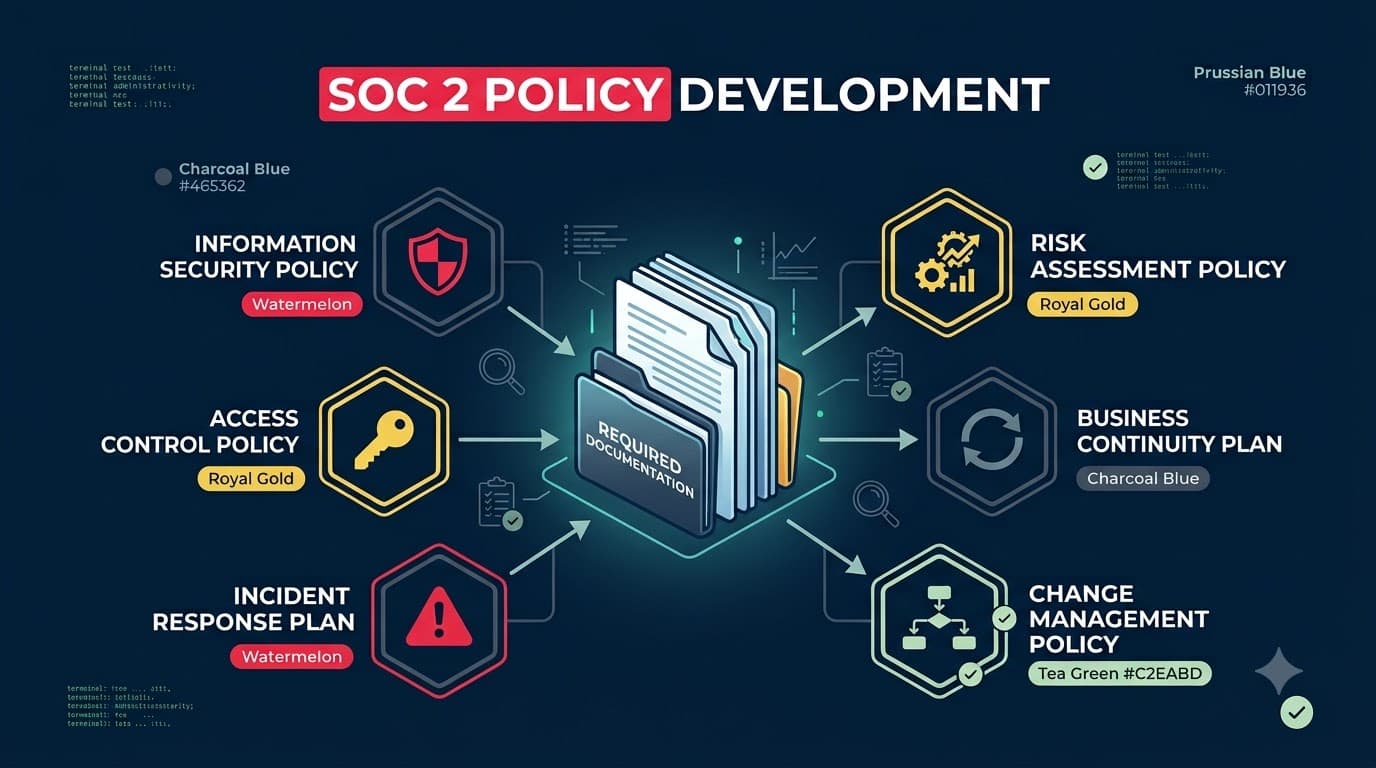
Priya Chandrasekaran had eleven weeks. As VP of Engineering at RouteForge, a 90-person freight-matching SaaS platform out of Charlotte, she'd spent the better part of a year courting a Fortune 500 retail chain that wanted to route $2.4 million a year in freight bookings through RouteForge's API. The retailer's procurement team had one non-negotiable gate before signature: a clean SOC 2 Type II report, or at minimum a bridge letter backed by a credible readiness position. Priya's CEO had already told the board the deal was "basically done." It was not basically done.
Three weeks earlier, RouteForge had bought a $49 policy template bundle off a compliance marketing site, swapped in the company logo, and handed the PDF stack to their newly hired compliance lead as "the SOC 2 documentation." When the readiness assessor opened the files, the access control policy still referenced role titles from a healthcare staffing company. The incident response policy pointed to an escalation contact who had never worked at RouteForge. Fourteen of twenty-four policies had no visible owner, no approval date, and — worse — no evidence anyone at RouteForge had ever read them. The assessor's blunt verdict: "This isn't documentation. It's a liability with a table of contents."
That's the trap this article exists to help you avoid. SOC 2 doesn't hand you a numbered list of mandatory documents the way ISO 27001 does — there's no Annex A, no "Document 6.1, Document 6.2" checklist to tick off. That absence of a fixed list feels like freedom right up until an auditor asks you to produce evidence that a policy was approved, communicated, read, and actually followed — and you can't. I've sat across the table from enough service organizations mid-audit to know the pattern: the companies that treat "no mandatory list" as "no real requirement" get exception after exception. The companies that build a policy set deliberately mapped to the criteria, owned by real people, reviewed on a cadence, and acknowledged by staff — those companies walk into their audit and walk out with a clean opinion.
Who This Is For
This is for the compliance lead, engineering manager, or founder who has been told "you need policies for SOC 2" and is now staring at a blank document with no idea where the boundary of "enough" sits. You'll walk away with the actual policy set auditors expect to see, how each one maps to the Common Criteria and any optional Trust Services Criteria in your scope, who should own and approve each document, how often to revisit it, and — critically — how to prove people actually read and follow it. This is not a legal-drafting tutorial; it's a field guide from someone who has watched policy sets pass and fail across roughly 200 audits.
Why SOC 2 Doesn't Hand You a Document Checklist — And Why That's Riskier
Here's the accuracy point I want to plant early, because it trips up almost every first-time service organization: SOC 2 has no statutory or standard-mandated list of required documents. There is no clause in SSAE 18 that says "thou shalt maintain these fourteen policies." That's a meaningful difference from ISO/IEC 27001, which requires a defined set of mandatory documented information — scope statement, risk assessment methodology, Statement of Applicability, and more — as a condition of certification. If you've spent any time in the ISO world, or you're reading our beginner's guide to what ISO 27001 actually requires, you'll notice the SOC 2 model feels looser. It is looser — on paper.
In practice, it's not looser at all. A SOC 2 examination tests whether your controls are suitably designed and, for a Type II report, operating effectively over the audit period. Controls don't exist independently of documentation — an auditor can't test "the way you actually do access reviews" without a policy that states what you committed to doing, and evidence that you did it. So while there's no numbered checklist, there is a de facto minimum policy set that every experienced service organization ends up building, because the Common Criteria simply can't be satisfied without it. I cover exactly how those criteria decompose into testable requirements in our piece on the Common Criteria that every SOC 2 report must address — read that alongside this one if you haven't yet.
Dimension | ISO 27001 | SOC 2 |
|---|---|---|
Document requirement | Explicit, numbered mandatory documented information | No fixed list; inferred from criteria and scope |
Governing standard | ISO/IEC 27001:2022 Clauses 4–10 | AICPA SSAE 18 (AT-C sections) |
Enforcement mechanism | Stage 1/Stage 2 certification audit against clause requirements | Auditor tests control design/operation against Trust Services Criteria |
Missing-document consequence | Nonconformity, blocks certification | Control deficiency or scope limitation, can drive a qualified opinion |
Flexibility | Low — structure is prescribed | High — organization decides structure, auditor decides sufficiency |
Risk of under-documenting | Lower (checklist forces completeness) | Higher (nothing stops you from skipping a policy until it's tested and missing) |
That last row is the whole point of this article. ISO 27001's rigidity is annoying but protective — it won't let you forget a document. SOC 2's flexibility is convenient but dangerous — it will absolutely let you forget one, and you won't find out until the auditor does.
"I've had clients tell me 'SOC 2 doesn't require an incident response policy, so we skipped it.' That's technically true and completely wrong at the same time. CC7.3 requires you to identify, respond to, and communicate about security incidents. Try demonstrating that consistently, under testing, with no policy defining what an incident even is." — Marcus Webb, Audit Partner, Ashcroft & Webb CPAs
The Policy Set Auditors Actually Expect
Strip away the marketing language from a dozen different "SOC 2 policy pack" vendors and you'll find the same core set, give or take a few names. I've organized it below by the Common Criteria family it primarily supports, though most policies touch more than one criterion — I'll get into the full crosswalk later in this article.
# | Policy | Primary CC Family | Required If |
|---|---|---|---|
1 | Information Security Policy | CC1, CC2 (umbrella) | Always |
2 | Access Control Policy | CC6 | Always |
3 | Change Management Policy | CC8 | Always |
4 | Incident Response Policy | CC7.3–CC7.5 | Always |
5 | Risk Assessment / Risk Management Policy | CC3, CC9.1 | Always |
6 | Vendor / Third-Party Risk Management Policy | CC9.2 | Always |
7 | Business Continuity & Disaster Recovery Policy | CC7, A1 (if Availability in scope) | Always (BC baseline); expanded if Availability in scope |
8 | Acceptable Use Policy | CC1, CC6 | Always |
9 | Data Classification & Handling Policy | CC6, C1 (if Confidentiality in scope) | Always (baseline); expanded if Confidentiality in scope |
10 | Code of Conduct / Ethics Policy | CC1.1 | Always |
11 | HR Security Policy (screening, onboarding, offboarding) | CC1.4 | Always |
12 | Physical & Environmental Security Policy | CC6.4 | Always |
13 | Logging & Monitoring Policy | CC7.1, CC7.2 | Always |
14 | Encryption & Key Management Policy | CC6.1, CC6.7 | Always |
15 | Password & Authentication Policy | CC6.1, CC6.2 | Always |
16 | Vulnerability & Patch Management Policy | CC7.1 | Always |
17 | Data Retention & Disposal Policy | CC6.5 | Always |
18 | Whistleblower / Ethics Reporting Policy | CC1.1, CC1.3 | Always |
19 | System Availability & Capacity Management Policy | A1.1–A1.3 | If Availability in scope |
20 | Processing Integrity / Data Quality Policy | PI1 series | If Processing Integrity in scope |
21 | Privacy Policy (internal, TSC-facing) | P1–P8 series | If Privacy in scope |
22 | Remote Work / Mobile Device Policy | CC6.1, CC6.7 | Always (given hybrid/remote norms) |
Twenty-two is the practical ceiling most mature service organizations land on; a lean first-year SOC 2 program can pass with a tighter set of twelve to fourteen if the optional criteria aren't in scope and some topics are folded together (for example, password and MFA requirements living inside the Access Control Policy rather than standing alone). What matters more than the count is that every item on your list traces back to a criterion — and every criterion in your scope traces forward to a policy. I'll show you that crosswalk in full later, and if you haven't yet built the underlying control matrix that maps each control to its criteria, do that first — your policy set should be downstream of it, not the other way around.
Policy, Standard, Procedure, Guideline: Getting the Hierarchy Right
One of the most common documentation failures I see isn't a missing policy — it's a policy trying to do a procedure's job, or vice versa. Auditors notice immediately when a document that calls itself a "policy" actually reads like a step-by-step runbook (too granular, breaks every time a tool changes) or when a document that should specify a concrete control instead stays so abstract it's untestable ("we take security seriously").
Document Type | Purpose | Audience | Change Frequency | Example |
|---|---|---|---|---|
Policy | States management intent and requirements — the "what" and "why" | All staff, auditors, customers | Annual or on material change | Access Control Policy |
Standard | Defines specific, measurable requirements that implement a policy | Technical/operational teams | Annual or as technology changes | Password Standard (length, complexity, rotation) |
Procedure | Step-by-step instructions for executing a task | Individual contributors performing the task | Whenever the process changes | Offboarding Procedure (deactivation steps, ticket, checklist) |
Guideline | Recommended, non-mandatory practices | Anyone seeking best-practice guidance | As needed | Secure Coding Guideline |
Keep policies stable and principle-based; push volatile detail (tool names, ticketing systems, specific thresholds) down into standards and procedures that can change without triggering a full policy re-approval cycle. This single structural decision is the difference between a policy set you update quarterly out of necessity and one that ages gracefully for a year between reviews.
The Information Security Policy: Your Umbrella Document
Every other policy in your set should nest under one governing Information Security Policy — the document that states your organization's overall commitment to protecting information, names the accountable executive, and establishes that subordinate policies exist and carry the same authority. Auditors read this document first because it tells them how seriously governance takes the rest of the stack. A thin, generic Information Security Policy is often the first signal that everything beneath it was assembled quickly and never internalized.
At minimum, your Information Security Policy should state: the scope of systems and data it governs (tightly aligned to your audit scope and system boundary); the executive owner accountable for the security program; a statement that security objectives are reviewed at least annually; a requirement that all subordinate policies be approved, communicated, and acknowledged; and consequences for noncompliance. This is also where you formally establish your risk appetite and reference your risk assessment methodology, closing the loop between governance intent and operational practice.
"The Information Security Policy is the one document I read cover-to-cover before I look at anything else. If it's two pages of boilerplate with no named owner, I already know what the rest of the evidence request is going to look like." — Marcus Webb, Audit Partner, Ashcroft & Webb CPAs
Access Control Policy
CC6 is the largest single family in the Common Criteria, and your Access Control Policy is the document that carries the most weight during testing. It needs to state, specifically, how access is granted, reviewed, and revoked — not in the abstract, but in a way an auditor can trace to a ticket, a system log, or an HR record. This is also the policy most often torpedoed by template-copy syndrome, because access models genuinely differ company to company; a policy written for a company with five systems and manual provisioning reads as fiction at a company running SSO with fifty SaaS integrations.
Element | What the Policy Must State | Common Evidence |
|---|---|---|
Provisioning | Who approves new access, on what basis (least privilege, role-based) | Access request tickets, approval trail |
Authentication | Multi-factor authentication requirements by system sensitivity | SSO/IdP configuration exports |
Periodic access review | Frequency (commonly quarterly), reviewer, and remediation SLA | Signed access review spreadsheets or IAM tool reports |
Privileged access | Additional controls for admin/root accounts | PAM tool logs, privileged session recordings |
Deprovisioning | Timeframe for revoking access after termination (commonly same-day to 24 hours) | HR termination tickets cross-referenced to deactivation logs |
Third-party access | How vendor/contractor access is granted, scoped, and time-boxed | Contractor access request forms with expiry dates |
"We rewrote our access control policy three times before an auditor stopped flagging it. The first version described the access model we wished we had. The second described half of what we actually did. The third one just told the truth — and suddenly it was defensible." — Tomás Reyes, CISO, Northfield Cloud Systems
Change Management Policy
CC8 exists because uncontrolled changes are one of the most common root causes of both security incidents and availability failures. Your Change Management Policy needs to define what qualifies as a change (code deploys, infrastructure modifications, configuration changes to production systems), the approval path before it ships, testing expectations, and rollback procedures. Organizations running CI/CD pipelines often assume automation exempts them from documentation — it doesn't. The policy still needs to state that automated pipelines enforce peer review, that production deploys require an approval gate (even if that gate is a required pull-request review rather than a change-advisory-board meeting), and how emergency changes are handled and retroactively documented.
Change Type | Approval Requirement | Documentation Expected |
|---|---|---|
Standard (planned) | Peer code review + one approver | Pull request with reviewer sign-off, linked ticket |
Emergency (production incident fix) | Post-hoc approval within defined window | Incident ticket, retroactive change record, root cause note |
Infrastructure-as-code | Automated policy checks + human review | IaC pull request history, pipeline logs |
Vendor/third-party system config | Named internal approver | Change ticket referencing vendor system |
Incident Response Policy
CC7.3 through CC7.5 require you to identify security events, evaluate whether they constitute an incident, respond, communicate, and — after the dust settles — learn from them. Your Incident Response Policy is the document that turns "we'll figure it out when something happens" into a repeatable, testable process. Auditors will ask for evidence that the policy was actually exercised: a tabletop exercise, a real incident ticket, or at minimum a documented annual test. A policy nobody has ever rehearsed reads, correctly, as theoretical.
Element | What the Policy Must Define | Evidence Auditors Request |
|---|---|---|
Incident definition | What qualifies as a reportable security incident | Incident classification criteria/severity matrix |
Roles | Who leads response, who approves customer/regulator notification | RACI or named IR team roster |
Notification timelines | Internal escalation SLA; customer/regulator notification commitments | Ticket timestamps against SLA |
Communication | How affected customers are notified, and by whom | Sample notification template, sent communications |
Post-incident review | Root cause analysis and lessons-learned requirement | Post-incident report, corrective action plan |
Testing | Annual tabletop or simulation requirement | Tabletop exercise records, attendee list, findings |
"The policy is only half the story. I've watched an auditor ask a client to walk through their last simulated incident and the room went silent — they'd never run one. That silence cost them a management response letter and six months of remediation before the next audit window." — Dana Okafor, Head of Compliance, Meridian Health Analytics
For a deeper walkthrough of building the response program itself rather than just the policy, our guide to the incident response program covers detection tooling, escalation design, and tabletop cadence in detail.
Risk Assessment and Risk Management Policy
CC3 requires you to identify risks to the achievement of your objectives, and CC9.1 requires a process for managing identified risks, including fraud risk. Your Risk Assessment Policy states the methodology (qualitative scoring, likelihood-times-impact matrices, or a quantified approach), the frequency of formal assessment (at least annually, plus triggered reassessment after material change), who's accountable for maintaining the risk register, and how identified risks flow into risk treatment decisions — mitigate, accept, transfer, or avoid.
Risk Management Element | Policy Requirement | Typical Cadence |
|---|---|---|
Formal risk assessment | Documented methodology and scoring criteria | Annual, plus ad hoc on material change |
Fraud risk consideration | Explicit assessment of fraud vectors (per COSO Principle 8) | Annual, part of main assessment |
Risk register maintenance | Owner, review cadence, status tracking | Quarterly review |
Risk treatment decisions | Documented rationale for accept/mitigate/transfer/avoid | At time of assessment and on change |
Escalation | Threshold for board/executive notification | Defined in policy, triggered as needed |
A risk assessment policy without a populated, living risk register behind it is one of the fastest ways to draw a finding — the document says you do risk management, but there's nothing to point to. Pair the policy with the practice covered in our piece on the formal risk assessment process.
Vendor and Third-Party Risk Management Policy
CC9.2 is explicit: you're expected to identify and manage risk from vendors and business partners, including subservice organizations. Your Vendor Risk Management Policy defines how vendors are tiered by risk (typically based on data access and system criticality), what due diligence is required before onboarding (security questionnaires, SOC 2 report review, insurance verification), ongoing monitoring cadence, and offboarding requirements when a vendor relationship ends.
Vendor Tier | Example | Due Diligence Required | Review Cadence |
|---|---|---|---|
Critical (subservice, handles customer data) | Cloud hosting provider, payment processor | SOC 2 report review, security questionnaire, contract review | Annual |
High (system access, no customer data) | HR platform, monitoring tool vendor | Security questionnaire, basic diligence | Annual |
Moderate (limited access) | Marketing SaaS tool | Lightweight questionnaire | Every 18–24 months |
Low (no data/system access) | Office supplies vendor | None required | N/A |
This policy is also where you formally document your approach to complementary user entity controls and how you handle subservice organizations under the carve-out method versus the inclusive method — a distinction your auditor will expect you to understand, not just recite. For the full build-out of a vendor program, not just the policy shell, see our guide to vendor management.
Business Continuity and Disaster Recovery Policy
Even organizations that haven't scoped in the Availability category need a baseline Business Continuity & Disaster Recovery Policy — CC7 expects you to demonstrate you can recover system operations following disruption, and most customer security questionnaires ask for it regardless of your TSC scope. If Availability is in scope, this policy expands significantly to cover the A1 series: capacity planning, environmental protections, and recovery testing commitments.
Element | Baseline (CC7 only) | Expanded (Availability in scope) |
|---|---|---|
Recovery time objective | Defined for critical systems | Defined per system tier, tested |
Recovery point objective | Defined for critical data | Defined per data tier, tested |
Backup requirements | Documented backup schedule | Documented schedule + immutable backup or equivalent protection |
Recovery testing | Annual tabletop | Annual full or partial failover test |
Capacity monitoring | Not required | Documented capacity thresholds and alerting |
Our deep dive on business continuity planning covers backup architecture and recovery testing design if you're building this program from scratch rather than just drafting the policy.
Acceptable Use Policy
The Acceptable Use Policy is often the most-read, least-respected document in a company's policy stack — every new hire signs it during onboarding and then never thinks about it again, which is exactly the acknowledgement gap auditors probe for. It should cover appropriate use of company systems and data, prohibited activities (unauthorized software installation, personal use boundaries, data exfiltration via personal accounts), clean desk policy expectations for anyone handling sensitive information, and consequences for violation. Keep it readable — this is the one policy every employee, not just technical staff, needs to genuinely understand, and a document written in audit language rather than plain English undermines the acknowledgement evidence you'll need later.
Data Classification and Handling Policy
CC6.1 and CC6.5 require you to protect information based on its sensitivity, which means you need a scheme before you can claim to apply one. Most service organizations land on a three- or four-tier model: Public, Internal, Confidential, and Restricted (sometimes merging the last two). The policy defines each tier, gives concrete examples so staff can self-classify accurately, and states the handling requirements — encryption, access restriction, retention, and disposal — attached to each level.
Classification Tier | Example Data | Encryption Requirement | Access Restriction | Retention/Disposal |
|---|---|---|---|---|
Public | Marketing materials, published pricing | None required | None | Per business need |
Internal | Internal wikis, non-sensitive process docs | Encryption in transit | All employees | Per business need |
Confidential | Customer contracts, source code | Encryption at rest and in transit | Role-based, need-to-know | Defined retention schedule |
Restricted | Customer PII, authentication secrets | Encryption at rest and in transit, key management controls | Named individuals only, logged access | Shortest viable retention, cryptographic erasure on disposal |
If Confidentiality is a scoped-in TSC, this policy needs explicit language addressing how confidential information is identified at collection, protected throughout its lifecycle, and disposed of at the end of its retention period — not just a general statement of intent. See our detailed treatment of data classification for the full scheme design.
HR Security: Code of Conduct, Background Screening, Onboarding and Offboarding
CC1.1 and CC1.4 sit at the foundation of the control environment — COSO's own framing is that the "tone at the top" and workforce integrity underpin everything else. This is usually not one document but a small family: a Code of Conduct establishing expected ethical behavior, a Background Check policy defining what's screened and at what role tier, onboarding procedures ensuring new hires receive security training and sign required acknowledgements before system access is granted, and offboarding procedures ensuring access is revoked promptly on departure.
Document | Core Requirement | Owner |
|---|---|---|
Code of Conduct | Ethical behavior standards, conflict-of-interest disclosure | HR / Legal |
Background Check Policy | Screening scope by role sensitivity, proportional and lawful | HR |
Onboarding Procedure | Security awareness training, policy acknowledgement, access provisioning sequence | HR + IT |
Offboarding Procedure | Access revocation timeline, asset return, exit interview | HR + IT |
Confidential reporting channel, non-retaliation commitment | HR / Legal |
This family also underpins your tone-at-the-top control environment — the CC1 principle that everything else in your policy set ultimately rests on.
Physical and Environmental Security Policy
Even fully remote or cloud-native companies need a Physical Security Policy — it just covers a narrower footprint: office access controls if you maintain any physical space, visitor management, and a statement addressing how you rely on your cloud provider's or subservice organization's physical controls for data centers you don't operate yourself (typically via the inclusive method or by referencing the provider's own SOC 2 report). For organizations with real office footprints, this policy expands to badge access, visitor logging, environmental monitoring (fire suppression, temperature, power redundancy), and secure destruction of physical media. Our guide to physical security controls covers the full scope for organizations that still maintain data center or office footprints.
Logging, Monitoring, and Log Retention Policy
CC7.1 and CC7.2 require you to monitor systems for anomalies and respond to identified events, which means a policy stating what's logged, where logs are centralized, how long they're retained, and who reviews them. A common finding: companies enable extensive logging in their SIEM but never write down the retention period or the review cadence, so an auditor can't confirm the practice matches a committed standard. Retention periods of 90 days to one year are typical baselines, with longer retention for security-relevant logs supporting incident investigation. See our detailed guide on the SIEM and log management program for the operational build-out.
Encryption and Key Management Policy
CC6.1 and CC6.7 expect data protection in transit and at rest, and a policy that simply says "we use encryption" won't survive testing. Specify algorithms and standards at a level that's stable enough not to require constant revision — reference AES-256 for data at rest and TLS 1.2 or higher for data in transit, rather than naming specific product versions that will change. Cover key management explicitly: key generation, rotation frequency, storage (ideally in a dedicated HSM or managed key service rather than embedded in code or config files), and revocation upon compromise or personnel change. Our encryption controls guide covers implementation patterns in more depth.
Password and Authentication Policy
Many organizations fold this into the Access Control Policy, and that's a defensible structural choice — but the requirements still need to be explicit somewhere: minimum password length and complexity (current guidance favors length over forced complexity and frequent rotation), mandatory MFA for all remote and administrative access, single sign-on requirements where feasible, and account lockout thresholds after failed attempts. Whichever document houses it, this is one of the most frequently sampled control areas in testing — auditors will pull configuration exports from your identity provider and compare them line by line against what the policy commits to.
Policies for the Optional Trust Services Categories
If your scope extends beyond the required Security category, each additional Trust Services Criterion brings its own policy expectations layered on top of the baseline set.
TSC Category | Additional Policy Needed | Core Content |
|---|---|---|
Availability | System Availability & Capacity Management Policy | Capacity thresholds, failover design, uptime commitments, recovery testing |
Processing Integrity | Data Processing Integrity Policy | Input validation standards, reconciliation procedures, error-handling and idempotency requirements |
Confidentiality | Confidentiality Policy (or expanded Data Classification Policy) | Non-disclosure requirements, confidential data identification, disposal commitments |
Privacy | Privacy Policy (internal, mapped to P1–P8) | Notice, choice/consent, collection limitation, use/retention, access, disclosure, quality, monitoring/enforcement |
Scoping in a category you don't need inflates your policy set and your audit cost for no customer benefit — I've seen companies scope in Processing Integrity because a template pack included it, then struggle to produce evidence for criteria that had nothing to do with their actual service commitments. Scope deliberately, and let the policy set follow the scope, not the other way around.
The Master Crosswalk: Mapping Every Policy to the Common Criteria
This is the table I'd pin to the wall of a compliance lead's office. Every policy in your set should be traceable to at least one CC family; every CC family should have at least one policy addressing it. If a cell in this table is empty for your organization, you have a gap — full stop.
CC Family | COSO Principle Focus | Primary Policies Addressing It |
|---|---|---|
CC1 — Control Environment | Integrity, ethics, board oversight, structure, competence, accountability | Information Security Policy, Code of Conduct, HR Security Policy, Whistleblower Policy |
CC2 — Communication & Information | Internal/external communication of objectives and responsibilities | Information Security Policy, Acceptable Use Policy, security awareness training program |
CC3 — Risk Assessment | Objective-setting, risk identification, fraud consideration, change impact | Risk Assessment / Risk Management Policy |
CC4 — Monitoring Activities | Ongoing/separate evaluations, deficiency communication | Internal audit program, control self-assessment procedures |
CC5 — Control Activities | Control selection/development, technology controls, policy/procedure deployment | All policies (structural — this criterion is about the existence and deployment of controls generally) |
CC6 — Logical & Physical Access | Access provisioning, authentication, boundary protection, data protection, physical access | Access Control Policy, Password & Authentication Policy, Encryption & Key Management Policy, Physical Security Policy, Data Classification Policy |
CC7 — System Operations | Detection, monitoring, incident response, recovery | Logging & Monitoring Policy, Incident Response Policy, Vulnerability & Patch Management Policy, Business Continuity & DR Policy |
CC8 — Change Management | Authorized, tested, approved system changes | Change Management Policy |
CC9 — Risk Mitigation | Business disruption risk, vendor/partner risk | Business Continuity & DR Policy, Vendor & Third-Party Risk Management Policy |
Every cell above should ultimately connect back to the control-level detail in your formal control matrix that maps each control to its criteria — that document is your control-level map; this crosswalk is the policy-level view of the same territory, one layer up.
Ownership: Who Should Actually Own Each Policy
A policy without a named, accountable owner is a policy nobody will update, defend, or enforce — and "IT owns everything" is a governance failure auditors have learned to spot immediately, because it usually means nobody actually owns anything. Ownership should sit with the role that has both the authority and the operational knowledge to keep the document accurate.
Policy | Recommended Owner | Approver |
|---|---|---|
Information Security Policy | CISO / Head of Security | CEO or board-delegated executive |
Access Control Policy | IT/Security Lead | CISO |
Change Management Policy | Engineering/DevOps Lead | CTO |
Incident Response Policy | Security/IR Lead | CISO |
Risk Assessment Policy | Compliance/Risk Lead | CEO or Audit Committee |
Vendor Risk Management Policy | Procurement/Compliance Lead | CFO or CISO |
Business Continuity & DR Policy | IT Operations Lead | CTO |
Acceptable Use Policy | HR + IT | CISO |
Data Classification Policy | Data/Compliance Lead | CISO |
Code of Conduct | HR/Legal | CEO |
HR Security Policies | HR Director | CHRO or CEO |
Physical Security Policy | Facilities/Office Lead | CISO |
Logging & Monitoring Policy | Security Engineering Lead | CISO |
Encryption & Key Management Policy | Security Engineering Lead | CISO |
"Ownership isn't a name on a cover page — it's the person who gets a calendar reminder in eleven months and actually opens the document instead of forwarding it to someone else. If you can't name that person right now, you don't have an owner, you have a placeholder." — Leon Vasquez, vCISO, Brightline Security Advisory
Approval Workflows and Version Control
Auditors will ask to see the approval trail behind every policy in scope, and "we discussed it in a meeting" is not evidence. Route every policy through a documented approval workflow — even a lightweight one — and preserve version history so you can show what changed and when.
Workflow Stage | What to Capture | Common Tooling |
|---|---|---|
Draft | Author, initial draft date | Document management system, Git-backed docs repo |
Review | Reviewer names, comments/redlines | Collaborative editing tool with tracked changes |
Approval | Named approver, approval date, signature or equivalent | E-signature tool, GRC platform workflow |
Publication | Distribution date, communication method | Intranet, policy management platform |
Version history | Prior versions retained, change log maintained | Version-controlled repository |
A GRC platform makes this trivial to demonstrate; a shared drive folder with files named "policy_FINAL_v3_reallyfinal.docx" does not. If you're still managing policy documents that way, fixing the tooling is often cheaper than the hours you'll spend manually reconstructing an approval trail during evidence collection.
Review Cadence: How Often Each Policy Needs a Fresh Look
Annual review is the default expectation for nearly every policy in a SOC 2 set, but "annual" isn't a uniform rule — some documents need more frequent attention because the underlying environment changes faster than a calendar year allows.
Policy | Minimum Review Cadence | Trigger for Off-Cycle Review |
|---|---|---|
Information Security Policy | Annual | Executive change, material scope change |
Access Control Policy | Annual | New system onboarding, IdP migration |
Change Management Policy | Annual | CI/CD pipeline overhaul |
Incident Response Policy | Annual | After any real incident (post-incident update) |
Risk Assessment Policy | Annual | New product line, M&A activity |
Vendor Risk Management Policy | Annual | New critical subservice organization |
Business Continuity & DR Policy | Annual | Infrastructure migration, failed DR test |
Data Classification Policy | Annual | New data type collected (e.g., new PII category) |
Encryption & Key Management Policy | Annual | Cryptographic standard deprecation |
HR Security Policies | Annual | Regulatory change (e.g., new background check law) |
Build the review cadence into a calendar with named owners and automated reminders — not into someone's memory. The audit trail of "reviewed, no changes needed, re-approved on this date" is itself evidence auditors want to see; a policy with a review date three years stale, even if its content still happens to be accurate, reads as an unmanaged program.
The Template-Copy Trap: Why Cloned Policies Fail Audits
I opened this article with RouteForge's near-miss because it's the single most common failure pattern I encounter, and it's almost always avoidable. Buying a template pack isn't the mistake — every experienced compliance program starts from some kind of template. The mistake is treating the template as the finish line instead of the starting line.
Failure Pattern | What the Auditor Sees | How to Avoid It |
|---|---|---|
Unedited placeholder text | "[Company Name]" or a different company's name still in the document | Full find-and-replace pass, then a second human review |
Mismatched org structure | Roles/titles referenced that don't exist at the company | Rewrite ownership sections against your actual org chart |
No approval evidence | No signature, date, or approval workflow trail | Route every policy through a real approval process before publication |
Generic, untestable language | "We take security seriously" with no specific commitment | Rewrite each requirement as a specific, testable statement |
No acknowledgement evidence | No record that staff read or agreed to the policy | Implement tracked acknowledgement (see next section) |
Policy describes aspirational state | Document describes controls that don't actually exist yet | Write the policy to match current reality, then formally plan the gap |
Stale review date | Last reviewed date older than 12 months with no update log | Put review cadence on a tracked calendar with reminders |
Inconsistent terminology across documents | Different documents use different names for the same control or system | Maintain a shared glossary/terminology reference across the policy set |
"The fastest way to spot a template-copy policy set isn't finding the leftover placeholder text — though that happens more than people think. It's asking someone to explain, in their own words, what the policy in front of them actually requires them to do. Silence is the tell." — Marcus Webb, Audit Partner, Ashcroft & Webb CPAs
Auditors have seen every template on the market. They know the phrasing, the section headers, even the typos that ship with certain vendor packs. A policy set that reads as generic doesn't just risk a finding on the document itself — it primes the auditor to scrutinize everything else you submit more closely, because it signals the whole program might be surface-level.
Evidence of Communication and Acknowledgement
A policy that exists but was never communicated to staff is, from an audit perspective, indistinguishable from a policy that doesn't exist. CC2.2 and CC2.3 specifically expect internal communication of information supporting the functioning of internal control, and testers will sample employee records looking for signed or system-logged acknowledgement.
Communication Method | Evidence It Produces | Strength |
|---|---|---|
E-signature/acknowledgement platform (e.g., embedded in onboarding software) | Timestamped signature record per employee | Strong — individually attributable, timestamped |
GRC platform policy attestation module | System-logged read-and-accept record | Strong — timestamped, auditable, scalable |
Annual all-hands presentation with sign-in sheet | Attendance record, presentation materials | Moderate — doesn't confirm individual comprehension |
Email distribution with read receipt | Read receipt or delivery confirmation | Weak — proves delivery, not comprehension or agreement |
Intranet posting only | None reliable | Very weak — auditors will flag this alone as insufficient |
New-hire onboarding checklist item | Checklist completion tied to employee record | Strong when tied to system access gating |
The strongest programs gate system access provisioning on policy acknowledgement — a new hire can't get their credentials until the HR platform shows signed acknowledgement of the relevant policies, which turns "we communicated the policy" into "we structurally cannot proceed without evidence of communication." That's the kind of control design auditors reward with fewer sampling questions, not more.
"We used to chase people down every January for a policy re-attestation. Now it's baked into the HR platform — if you haven't re-acknowledged the current policy set, your access review flags you automatically. It went from a two-week scramble to a non-event." — Renata Silva, VP People Operations, Anchorpoint Payments
The Policy Lifecycle, Visualized
flowchart LR
    A[Draft] --> B[Stakeholder Review]
    B --> C[Executive Approval]
    C --> D[Publish & Communicate]
    D --> E[Staff Acknowledgement Tracked]
    E --> F[Operational Use / Control Execution]
    F --> G[Annual Review or Trigger Event]
    G -->|No changes needed| E
    G -->|Changes required| A
Every policy in your set should be able to point to where it currently sits on this loop. A policy stuck at "Draft" for eight months, or one that skipped straight from "Draft" to "Operational Use" with no approval or acknowledgement stage, is exactly the kind of gap an auditor's sampling will surface.
Building the Policy Program: A Realistic Timeline
For a first-time SOC 2 program building a policy set from nothing, here's the pace I typically see work without burning out a small compliance team.
Phase | Duration | Key Activities |
|---|---|---|
Gap assessment | Week 1–2 | Inventory existing documents against the crosswalk, identify missing policies |
Drafting (batch 1: core CC6–CC8) | Week 3–5 | Access Control, Change Management, Incident Response, Encryption policies |
Drafting (batch 2: governance/risk) | Week 5–7 | Information Security, Risk Assessment, Vendor Risk, BC/DR policies |
Drafting (batch 3: HR/physical/misc) | Week 7–8 | Code of Conduct, HR Security, Physical Security, Acceptable Use, Data Classification |
Internal review & legal check | Week 8–9 | Stakeholder review, legal/HR sign-off on employment-adjacent policies |
Executive approval | Week 9–10 | Formal approval routing for all documents |
Publication & acknowledgement rollout | Week 10–11 | Distribute via GRC/HR platform, track acknowledgement completion |
Readiness spot-check | Week 11–12 | Sample-test acknowledgement records, confirm evidence trail is complete |
Twelve weeks is workable for a lean team with executive support and a clear owner per document; without a named owner per policy, this timeline routinely doubles as drafts stall in review limbo. If you're earlier in the process and haven't yet scoped your overall program, our first-time SOC 2 implementation guide walks the full sequence this policy sprint fits inside, and the readiness assessment process is where you'll validate the resulting policy set before your formal audit window opens.
Case Study: RouteForge's Eleven-Week Policy Sprint
Back to Priya. After the failed readiness assessment, RouteForge didn't start over from scratch — they kept the skeleton of the purchased template pack but rebuilt every document against their actual org chart, actual systems, and actual practices, following roughly the phased approach above. They named an owner for each of the eighteen policies in their set (they didn't need the full twenty-two; Processing Integrity and Privacy weren't in scope), routed every document through a real approval workflow in their HR platform, and gated new-system access on policy acknowledgement for all 90 employees within three weeks.
The second readiness assessment, five weeks later, found one minor exception — a stale review date on the Physical Security Policy, since fixed in under a day. RouteForge's Type II audit fieldwork ran clean, the report shipped nine days ahead of the retailer's deadline, and the $2.4 million contract closed on schedule. Priya's own postmortem note to her CEO: "The policies didn't cost us the deal. Almost buying fake policies nearly did."
Case Study: Meridian Health Analytics Rebuilds After a Qualified Opinion
Meridian Health Analytics, a healthcare data analytics platform serving hospital systems, went into their second-year SOC 2 Type II audit confident — their first-year report had been clean. What changed was scale: they'd onboarded four new subservice organizations for cloud infrastructure and data processing since the prior audit, but nobody had updated the Vendor Risk Management Policy's due diligence evidence to reflect them. The auditor sampled two of the four new vendors, found no documented risk tiering or due diligence review for either, and issued a qualified opinion on the relevant control.
Dana Okafor's compliance team spent six weeks rebuilding the vendor program: formal risk tiering for all eleven active vendors, documented due diligence for every tier, and a quarterly vendor review cadence written directly into the policy with calendar-enforced reminders. The following year's audit came back unqualified, and Meridian's largest hospital-system customer — who had flagged the qualified opinion during contract renewal — signed a renewed $1.8 million multi-year agreement contingent on seeing the clean report. Dana's summary of the lesson: "A qualified opinion isn't a failed audit. It's a very expensive way to find out your policy and your practice had quietly drifted apart."
Case Study: Anchorpoint Payments Turns Policies Into a Sales Asset
Anchorpoint Payments, a mid-market payments processor, took a different angle: rather than treating policy documentation purely as an audit-survival exercise, they published sanitized summaries of their core policy set — Information Security, Incident Response, Access Control, and BC/DR — to a customer-facing trust portal, alongside their SOC 2 report available under NDA. Renata Silva's team tied every policy directly to acknowledgement tracking in their HR platform as described earlier, which meant they could answer customer security-questionnaire questions about policy communication and enforcement with system-generated evidence rather than manual attestations.
The measured result over the following sales cycle: average time to complete inbound security questionnaires dropped by roughly 65%, from an average of twelve business days to just over four, because sales engineers could point directly to trust-portal content instead of drafting bespoke answers each time. Average enterprise deal cycle length shortened by an estimated three weeks. The policies didn't just survive the audit — they became a repeatable sales accelerant.
Common Auditor Red Flags in Policy Documentation
Beyond the template-copy pattern already covered, here are the specific red flags I've watched trigger extended sampling or a management response letter.
Red Flag | Why It Concerns Auditors | Fix |
|---|---|---|
Policy references a tool/system no longer in use | Suggests the document isn't maintained | Tie policy review to change management/tooling changes |
No version history available | Can't confirm when current requirements took effect | Adopt version-controlled document management |
Policy contradicts observed practice in a walkthrough | Suggests control design and operation are misaligned | Reconcile policy language with actual practice, or fix the practice |
Multiple documents define the same control differently | Confuses ownership and evidence collection | Consolidate or cross-reference explicitly |
No named executive sponsor | Suggests lack of governance backing | Name and document an accountable executive |
Policy exists only as a PDF with no acknowledgement trail | Can't demonstrate communication (CC2.2/2.3) | Move to a platform with attestation tracking |
Policy set was purchased and dated the same day, unedited | Strong signal of template-copy failure | Full rewrite against actual environment (see above) |
Policy Documentation as a Business Differentiator
It's tempting to treat this entire policy-building exercise as pure audit overhead — a cost center you tolerate because a customer's procurement team demands it. I'd push back on that framing. The companies I've watched get the most commercial mileage out of SOC 2 aren't the ones with the thickest binder; they're the ones who built a policy set precise enough to answer a prospect's security questionnaire in an afternoon instead of a week, and confident enough to publish summaries on a trust portal instead of guarding every document like a state secret.
"Our security questionnaire response time used to be a running joke in the sales org — 'ask compliance, wait two weeks.' Once our policies were actually current, specific, and backed by real acknowledgement data, we turned questionnaire response into same-day service. That's not compliance theater. That's a competitive advantage a competitor without the discipline can't easily copy." — Ingrid Bauer, Director of Security & Compliance, Vantage Robotics
A well-built policy set does three things simultaneously: it keeps you defensible in front of an auditor, it keeps your own operations more consistent and less dependent on institutional memory, and it becomes reusable content for every sales conversation where a prospect asks "how do you handle X." Treat it as an asset with an owner and a maintenance schedule, not a one-time deliverable you produce under deadline pressure and then forget until next year's audit notice arrives.
If you're building your policy set now, don't do it in isolation from the rest of your program. Start from your control matrix that maps each control to its criteria so every policy has a clear reason to exist, and validate the finished set against a readiness assessment before your auditor does it for you. PentesterWorld's SOC 2 Policy Pack gives you a structurally sound starting point mapped to the Common Criteria — the same crosswalk covered in this article, pre-built — so you're editing toward accuracy instead of drafting from a blank page. Pair it with our SOC 2 Control Matrix / RACI Template to keep ownership and approval clearly assigned from day one, and run our SOC 2 Readiness Checklist before you schedule fieldwork. If you want a fast gut-check on where your current documentation stands, try the "Are You SOC 2 Ready?" quiz — it takes ten minutes and tells you exactly which policy gaps to prioritize first.