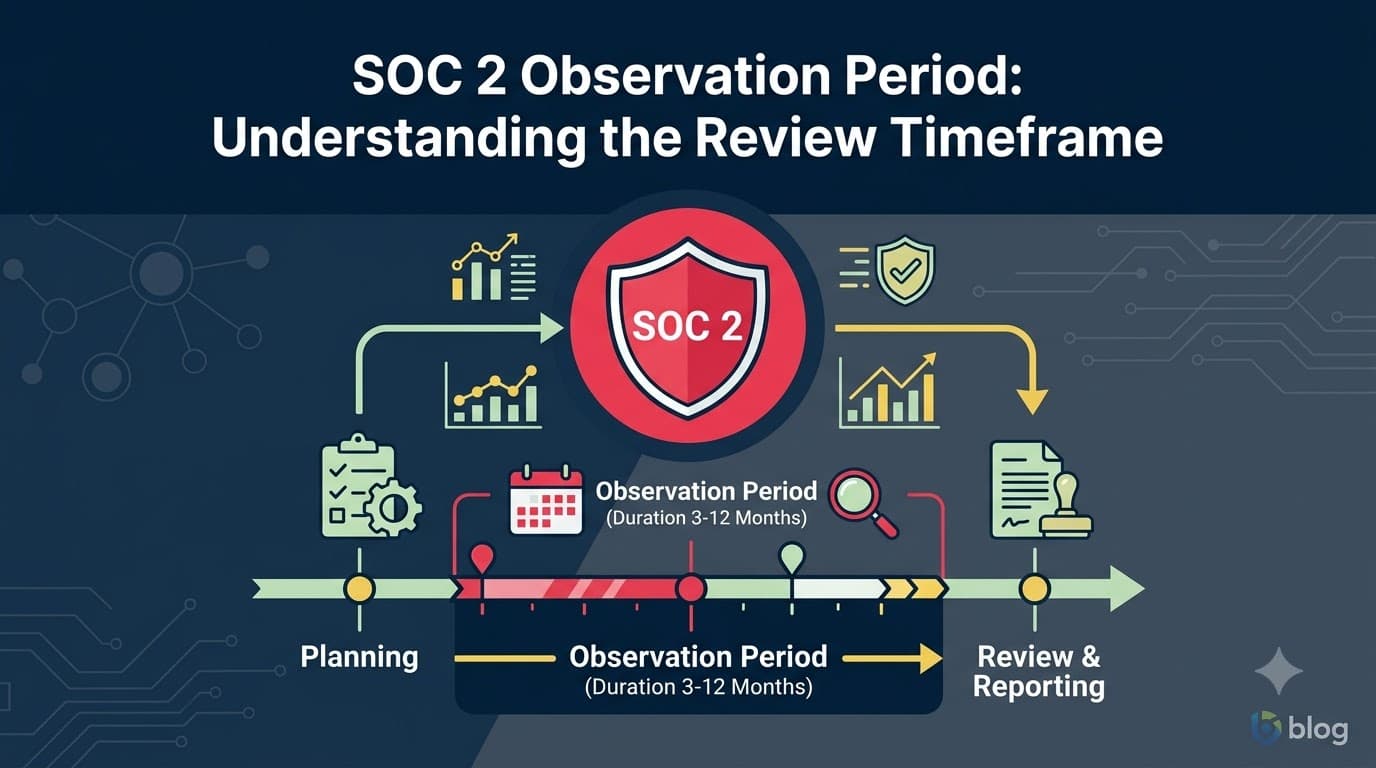
Priya Nandakumar had the signature page open in one tab and the audit statement of work open in the other, and the two documents were not agreeing with each other.
Priya was VP of Engineering at Larkspur Health Analytics, a 90-person SaaS company that sold a patient-risk-scoring platform to hospital systems. Six weeks earlier, her company had gotten shockingly close to closing a $2.4 million, three-year contract with a regional hospital network in the Midwest — the biggest deal in Larkspur's history, the one that would let her finally hire the two senior platform engineers she'd been begging the board for since January. The hospital network's vendor security team had sent over a two-page questionnaire, a few pointed questions about encryption, and one non-negotiable line item: "Please provide your current SOC 2 Type II report, covering a period of no less than six months, dated within the last twelve months."
Larkspur had a SOC 2 report. Priya had personally sat through the readiness project eight months earlier, watched the company write policies, configure logging, and lock down access controls. What Larkspur had, though, was a Type I report — a report that said, in the CPA firm's own words, that the controls were "suitably designed as of March 15." Not that they'd operated. Not for six months. Not for any period at all.
The hospital's procurement lead was polite but unmovable: a Type I report told them the seatbelt existed. It didn't tell them the seatbelt had actually been buckled every day for half a year. They needed a Type II report — and Type II reports don't exist without an observation period, the stretch of calendar time during which an independent CPA firm watches (via evidence, not literally watches) whether your controls keep working, day after day, sample after sample.
Priya's problem wasn't unique, and it wasn't really about audits. It was about time. She needed to understand exactly how long an observation period had to run, when it could safely start, what her team would be asked to produce during it, and whether there was any way to get a defensible Type II report into the hospital's hands before the deal window closed. That's the exact set of questions this article answers.
Who this is for: engineering leaders, compliance managers, founders, and GRC analysts who are choosing or living through a SOC 2 Type II observation period for the first time — or trying to plan a second or third one without repeating last year's evidence-collection scramble. What you'll walk away with: a clear model for how observation periods work, a framework for choosing the right length for your company's maturity and sales calendar, a practical evidence-collection cadence you can hand to your team, and an understanding of how consecutive periods link together into continuous coverage — including what a gap actually costs you and how it gets bridged.
Type I vs. Type II: Why the Observation Period Only Exists for One of Them
Before any of the planning questions make sense, it helps to be precise about what an observation period actually is — because the term only applies to one of the two SOC 2 report types, and conflating them is the single most common source of confusion I see in first-time audit conversations. If you're new to the framework entirely, SOC 2 Complete Guide: Understanding AICPA Trust Services Criteria is a useful starting point before diving into period mechanics.
A Type I report is a snapshot. The auditor's opinion addresses whether your controls were suitably designed as of a specific date — one day, stated explicitly on the cover of the report. There is no period to plan, no evidence cadence to build, no sampling window. The auditor reviews your policies, walks through your systems, confirms the controls exist and are logically sound, and issues an opinion as of that single point in time.
A Type II report is a motion picture. The opinion addresses whether your controls were suitably designed and operated effectively across a stated span of time — the observation period, sometimes called the "audit period" or "review period." This is the report almost every enterprise customer actually wants, because a control that existed on paper in March tells a customer nothing about whether it was still being followed in September. For a deeper comparison of when each type makes sense, see SOC 2 Type I vs Type II: Choosing the Right Audit Type.
"I tell every founder the same thing in the kickoff call: a Type I is a photograph of your control environment, and a Type II is a security camera recording. Enterprise procurement teams have learned to ask for the recording, because photographs can be staged." — Marcus Delgado, CPA, Partner, Hallmark Assurance Partners
Table 1: Type I vs. Type II — Timing at a Glance
Dimension | Type I Report | Type II Report |
|---|---|---|
What's tested | Design of controls only | Design AND operating effectiveness of controls |
Timeframe covered | A single point in time (one date) | A period of time (commonly 3–12 months) |
"Observation period" applies? | No — there is no period, only a date | Yes — this is the defining feature of Type II |
Evidence style | Control existence walkthroughs, policy review, one-time samples | Evidence gathered repeatedly across the period; auditor samples multiple instances |
Typical use case | First-ever SOC 2, urgent sales deadline, bridge to a future Type II | Renewal audits, mature programs, most enterprise procurement requirements |
Report statement example | "As of March 15, 2026, the controls were suitably designed..." | "For the period October 1, 2025 to March 31, 2026, the controls were suitably designed and operated effectively..." |
Customer perception | Useful as an interim signal; rarely satisfies a mature vendor security team alone | Generally the expected standard for recurring vendor relationships |
Relative audit cost | Lower — one review cycle, less evidence to sample | Higher — more evidence, more sampling, more auditor hours across the period |
Most companies that go through a Type I do so as a deliberate first step, not a destination. It buys credibility while the observation period for the first Type II is running in parallel or immediately afterward. Very few enterprise buyers will accept a standalone Type I as a long-term substitute for Type II coverage — Priya's hospital network certainly wouldn't.
What Actually Happens Inside an Observation Period
An observation period is not a passive waiting game where your team sits still and hopes nothing breaks. It's an active, evidence-generating stretch of operations during which every in-scope control needs to keep doing its job — and, critically, needs to keep leaving a trail proving that it did.
Think about what that means concretely. If one of your controls is "access reviews are performed quarterly," and your observation period is nine months long, the auditor expects to see roughly three review cycles completed and evidenced inside that window — not one review performed the week before the audit kicked off. If your control is "critical production changes require a documented approval before deployment," the auditor will pull a sample of changes from across the entire period, not just from the tidy sprint you remembered to document carefully. Controls that run continuously (like logging or encryption in transit) need continuous evidence; controls that run periodically (quarterly access reviews, annual security awareness training) need evidence from each occurrence that falls inside the window.
This is the part that trips up teams coming from an ISO 27001 background or a first-time Type I mindset: the audit evidence isn't a single folder you assemble at the end. It's produced continuously, by the people actually doing the work, throughout the entire span the report will cover. A ticket closed in November has to actually exist in November — auditors are trained to notice metadata that doesn't match the narrative, and backdating evidence is not just an audit failure, it's the kind of thing that turns into a much more serious finding.
The practical implication is that your observation period start date is also, functionally, the date your organization needs to be "audit-ready" in a live, ongoing sense — not the date you start preparing. Everything before that date is prep work; everything inside it is the performance itself.
Table 2: Observation Period — What Is Actually Happening, Week to Week
Period Phase | What's Happening Operationally | What the Compliance Team Should Be Doing |
|---|---|---|
Week 1 (period start) | Controls formally "go live" for audit purposes; baseline configurations locked | Confirm scope, notify control owners, start the evidence calendar |
Early period (Months 1–2) | Recurring controls execute for the first time inside the window | Spot-check that evidence is being captured correctly, not just performed |
Mid-period | Periodic controls (quarterly reviews, monthly patching) hit their natural cadence | Run an internal mid-period gap check against the evidence calendar |
Late period | Final recurring-control cycles complete; period nears its close date | Chase any lagging evidence owners; reconcile ticket/log completeness |
Period close | Observation window ends on the stated date | Freeze evidence collection scope; begin compiling the evidence package for fieldwork |
Post-period (fieldwork) | Auditor samples evidence from across the whole period | Respond to auditor evidence requests (PBC list) and follow-up questions |
How Long Should Your Observation Period Be?
There is no single correct answer here, and any auditor who gives you one number without asking about your situation first isn't doing their job. What's true across the industry is a range: Type II observation periods commonly run 3 to 12 months, with the choice driven by two questions — how mature is your control environment, and how urgently does the business need the report?
For a first-ever Type II, most companies land on a 3-to-6-month period. There's a straightforward reason: you have to actually run the controls for the length of the period before the auditor can test them, so a 12-month first period means waiting a full year before fieldwork can even start — and most first-time SOC 2 companies are chasing a sales deadline, not academic thoroughness. A 3-month period gets a real, defensible Type II report into a sales conversation roughly a quarter after the controls go live, which is often the difference between closing a deal this fiscal year or not.
For a mature program — meaning you've already produced at least one Type II report — the standard move is to shift to 12-month periods with no gap between them, so that a fresh report is always available and the coverage never lapses. Enterprise security teams increasingly expect this cadence; a vendor whose most recent report is 14 months old starts to look neglected, even if nothing has actually gone wrong.
"The mistake I see founders make is picking 12 months for a first audit because it 'sounds more thorough.' It's not more thorough — it's just slower. A well-run 3-month period tested rigorously beats a rushed 12-month period where half the evidence was backfilled in month eleven." — Renata Silva, Director of Security & Compliance, Fenwick Data Systems
Table 3: Period-Length Decision Matrix
Factor | Favors a Shorter Period (3–6 months) | Favors a Longer Period (9–12 months) |
|---|---|---|
Audit history | First-ever Type II report | Second or later Type II — mature program |
Sales urgency | Active deal blocked on a report; board-level pressure | No immediate deal deadline |
Control maturity | Controls just implemented; want faster proof point | Controls have run reliably for a year or more |
Customer expectations | Prospects will accept a shorter first report as a good-faith start | Prospects specifically request 12-month coverage |
Cost tolerance | Willing to pay for two audits in year one (a short one, then a full one) | Prefers one annual audit engagement per year |
Internal bandwidth | Team can sustain intense evidence discipline for a shorter burst | Team has embedded evidence collection into normal operations |
Renewal cadence goal | Building toward annual 12-month cycles going forward | Already on an annual 12-month cycle |
First Audit vs. Mature Program: Different Math
The math behind these choices is worth spelling out because it explains why almost nobody starts with 12 months. If Larkspur's controls went live on July 1 and the company needed a 12-month period, the earliest the report could even be issued would be roughly August of the following year, once fieldwork and report drafting were factored in. A 3-month period ending September 30, with fieldwork in October and a report in hand by November, moves that same company's evidence into a customer's hands nine or ten months sooner. For a company chasing its first few enterprise logos, that gap is existential. For a company that's already renewed twice, the calculus flips — the operational overhead of running back-to-back short audits every quarter isn't worth it when annual periods deliver the same continuous coverage with a fraction of the audit administration.
The Observation Period Timeline, Visualized
The diagram below shows a representative six-month observation period with evidence touchpoints layered on top — a mix of continuous controls (evidenced constantly) and periodic controls (evidenced at defined milestones), followed by fieldwork and report issuance.
gantt
    title Six-Month Observation Period with Evidence Points
    dateFormat  YYYY-MM-DD
    axisFormat  %b

    section Period Window
    Observation period (Apr 1 – Sep 30)      :active, period, 2026-04-01, 2026-09-30

    section Continuous Controls
    Access logging & monitoring evidence      :cont1, 2026-04-01, 2026-09-30
    Change management tickets                 :cont2, 2026-04-01, 2026-09-30

    section Periodic Control Evidence Points
    Month 1 access review                     :milestone, m1, 2026-04-15, 1d
    Vulnerability scan cycle (monthly)        :m2, 2026-04-01, 2026-09-30
    Quarterly access recertification (Q1)     :milestone, m3, 2026-06-15, 1d
    Mid-period internal gap check             :milestone, m4, 2026-07-01, 1d
    Quarterly access recertification (Q2)     :milestone, m5, 2026-09-15, 1d
    Annual security awareness training        :milestone, m6, 2026-08-01, 1d

    section Post-Period
    Evidence package compiled                 :post1, 2026-10-01, 2026-10-14
    Auditor fieldwork & sampling              :post2, 2026-10-15, 2026-11-15
    Report drafted & issued                   :post3, 2026-11-16, 2026-12-05
Notice that the controls don't wait for fieldwork to "activate" — they're running from day one of the period, and the evidence they generate accumulates the entire time. Fieldwork, which happens after the period closes, is when the auditor reaches back into that accumulated evidence and pulls a sample. A common misconception is that the auditor is present or watching in real time; in practice, the observation period is about what your systems and people actually did, and fieldwork is the retrospective verification of it.
Evidence Cadence: What Gets Collected, and How Often
Every control inside your audit scope — typically your control matrix mapped to the Trust Services Criteria — has an implied evidence frequency. Getting that frequency right — and building a calendar around it — is the single highest-leverage thing a compliance owner can do before a period starts.
Continuous controls generate evidence automatically, as a byproduct of the tools you already run: SIEM alerts, access logs, vulnerability scanning reports, uptime monitors. Periodic controls require someone to actually do something and then remember to capture proof they did it — this is where most evidence gaps come from, not from controls failing, but from controls executing quietly with nobody screenshotting the result.
Table 4: Evidence Cadence by Control Type
Control Type | Example Control | Evidence Frequency | Who Typically Owns Evidence Capture |
|---|---|---|---|
Continuous / automated | Access logging, intrusion detection alerts | Ongoing (system-generated) | Security/DevOps tooling, exported at period end |
Daily | Backup completion checks | Daily | Infrastructure/DevOps team |
Weekly | Critical vulnerability triage | Weekly | Security engineering |
Monthly | Patch management cycle, vendor risk management reviews for critical vendors | Monthly | IT operations, procurement/GRC |
Quarterly | User access reviews, firewall rule reviews | Quarterly (at least once per quarter inside the period) | System owners, IT security |
Semi-annual | Business continuity/DR tabletop exercise | Once or twice, depending on period length | Business continuity lead |
Annual | Security awareness training, penetration test, risk assessment refresh | Once per 12-month period (timing must fall inside the window) | Security/compliance team |
Ad hoc / event-driven | Incident response execution, change management approvals | Every time the triggering event occurs | Whoever owns the underlying process |
A practical rule I give every client: if a control's natural frequency is longer than your observation period (an annual control inside a 3-month period, for instance), you still need at least one occurrence to fall inside the window, and you need to be able to show it was performed on schedule relative to your policy — not conveniently timed to land inside the audit window for the first time ever.
First Audit vs. Recurring Audit: Two Different Timelines
The lived experience of a first Type II and a fifth Type II are different enough that treating them the same way in your planning almost guarantees friction. The first time through, everything is new: policies are being written concurrently with controls going live, evidence habits haven't calcified into muscle memory, and the readiness gap analysis often turns up items that need fixing before the period can even start cleanly. By the third or fourth cycle, evidence collection has usually been automated or delegated to a dedicated compliance platform, and the observation period barely disrupts day-to-day operations — it's simply the ongoing state of the business, formalized into a report once a year.
Table 5: First Audit vs. Recurring Audit Timeline
Stage | First-Time Type II (typical) | Recurring / Mature Type II (typical) |
|---|---|---|
Readiness assessment | 4–8 weeks, often surfaces multiple control gaps | 1–2 weeks, mostly a confirmation pass |
Control remediation before period start | Often significant — new tools, new policies, new processes | Minimal — incremental improvements only |
Observation period length | 3–6 months | 12 months |
Evidence collection maturity | Manual, ad hoc, heavily compliance-team-driven | Largely automated via continuous monitoring tooling |
Auditor selection | New relationship; scoping calls, proposal review | Existing auditor relationship; scope reconfirmed annually |
Fieldwork duration | 3–5 weeks (auditor learning the environment) | 2–3 weeks (auditor already familiar with systems) |
Report turnaround after period close | 4–6 weeks | 3–4 weeks |
Total elapsed time, kickoff to report | 5–8 months | 13–14 months (but overlapping with prior report's validity) |
Internal disruption | High — new processes, new ownership assignments | Low — business as usual with periodic evidence checks |
Continuous Coverage: Stitching Periods Together Year After Year
A single Type II report is a photo album of the past; what customers actually care about, especially in multi-year contracts, is that the album keeps getting new pages added without blank gaps in between. This is what practitioners mean by "continuous coverage" — each new observation period picking up exactly where the last one left off, so that at any given moment, a current or prospective customer can request a report and get one covering a period that ended recently.
The mechanics are straightforward in theory: if Period 1 runs January 1 to June 30, Period 2 should start July 1. No overlap, no gap. In practice, scheduling friction — auditor availability, internal bandwidth, a busy quarter — means gaps happen more often than anyone would like. A two-week gap is usually a non-event. A four-month gap, especially one that spans a customer's renewal date, becomes a real problem, because during that gap you technically have no report covering "now."
Table 6: Continuous Coverage Planning Model
Year | Period | Coverage Window | Report Delivered | Gap From Prior Period |
|---|---|---|---|---|
Year 1 | Period 1 (first Type II) | Apr 1 – Sep 30 | Late November | N/A (first report) |
Year 2 | Period 2 | Oct 1 – Sep 30 (12 months) | Mid-November | 1 day |
Year 3 | Period 3 | Oct 1 – Sep 30 (12 months) | Mid-November | 1 day |
Year 4 | Period 4 | Oct 1 – Sep 30 (12 months) | Delayed to January (auditor scheduling) | 3 months (bridge letter required) |
Year 5 | Period 5 | Feb 1 – Jan 31 (period shifted to close the gap) | Mid-March | 0 days (re-anchored) |
Notice Year 4 in the table above — this is the realistic case, not the exception. Auditor scheduling conflicts, staffing changes on the compliance team, or a busy product launch can all push a period's start date back. When that happens, the tool that keeps customer trust intact during the interim is the bridge letter, covered in detail in SOC 2 Bridge Letter: Maintaining Continuous Compliance.
Gaps Between Periods and the Role of the Bridge Letter
A bridge letter (sometimes called a "gap letter") is a short attestation from your organization — not the auditor — stating that no material changes have occurred to your control environment between the end date of your last observation period and either the current date or the start date of your next one. It doesn't test anything new, and it isn't a substitute for a report; it's a stopgap that lets a customer's due-diligence process continue without treating you as if you'd never been audited at all.
Bridge letters work well for short gaps and get progressively less credible the longer the gap stretches. A customer's security team reading a bridge letter covering a six-week gap will barely blink. A bridge letter covering a five-month gap invites the obvious question: why did it take that long to schedule the next audit, and what happened to your controls in the meantime that nobody's independently verified?
Table 7: Gap Length and Recommended Handling
Gap Length | Risk Level | Recommended Handling |
|---|---|---|
0–30 days | Low | Standard bridge letter; rarely questioned by customers |
31–90 days | Low–Moderate | Bridge letter, ideally with a brief note on why the next period was scheduled where it was |
91–180 days | Moderate | Bridge letter plus proactive communication to key accounts; consider accelerating the next audit |
181+ days | High | Bridge letters become hard to defend; some customers will require interim assurance beyond a letter (e.g., a call with your compliance lead, updated pen test results) |
Recurring gaps (pattern across years) | High | Signals a program management problem; customers may begin requiring shorter renewal cycles or additional assurance evidence |
The best fix for gap risk isn't a better bridge letter — it's a scheduling discipline that starts the next observation period the day after the current one ends, every time. Auditors that a company has worked with for multiple cycles are usually willing to pre-book the next period's fieldwork slot a year in advance specifically to avoid this problem.
What Counts as a Control Exception During the Period
An "exception" is auditor language for a sampled instance where a control didn't operate exactly as designed. It does not automatically mean the report is ruined, and it does not automatically mean you failed the audit — there's no pass/fail concept in SOC 2 the way there is in a certification. What it means is that the auditor found something specific to describe, and the report's "tests of controls and results" section — covered in depth in SOC 2 Report Structure: Understanding the Auditor's Report — will document it factually, since that section only exists in Type II reports.
The severity of an exception depends heavily on frequency and pervasiveness. If an auditor samples 25 access-review instances across your period and finds 1 where the review was completed four days late, that's a minor, isolated exception — it gets noted, but the overall opinion typically remains unqualified. If the same sample turns up 12 of 25 reviews either late or entirely missing, that pattern suggests the control isn't operating effectively at all, and the opinion may become qualified for that specific criterion.
Table 8: Exception Handling by Severity
Exception Type | Example | Typical Impact on Opinion | Recommended Response |
|---|---|---|---|
Isolated, low-impact | One access review completed 3 days after the deadline | Noted in report; opinion usually remains unqualified | Document root cause briefly; no major remediation required |
Isolated, higher-impact | One terminated employee's access not revoked within SLA | Noted; may prompt auditor to expand sample size | Show remediation and confirm no unauthorized access occurred |
Recurring, same control | Vulnerability patching consistently missing SLA across multiple months | Likely to affect opinion for that criterion | Requires documented remediation plan, possibly mid-period process fix |
Pervasive, multiple controls | Widespread evidence gaps across several unrelated control areas | High risk of qualified opinion | Signals readiness gap; consider shortening scope or delaying period |
Control failed to operate at all | A required control was never actually implemented during the period | Almost certainly affects opinion | Root-cause and redesign; likely needs a fresh, later period to re-test |
"An exception on the report isn't a scandal — it's the report doing its job. What worries me is a company that panics and tries to argue with the finding instead of fixing the underlying process before next period. Auditors remember which clients do which." — Marcus Delgado, CPA, Partner, Hallmark Assurance Partners
How Auditors Sample Evidence Across the Period
Auditors don't review every instance of every control — that would be impossibly expensive and slow for both sides. Instead, they use statistical sampling, and the sample size scales with how often a control runs and how long the period is. A control that executes once a year needs only that one instance reviewed. A control that executes daily, like backup verification across a six-month period, might generate roughly 180 opportunities — the auditor will pull a defensible subset, often 25–60 instances depending on firm methodology and risk assessment, spread across the whole window rather than clustered at one end.
This is exactly why evidence can't be gathered in a last-minute sprint. If your access logs for January and February are thin because logging was misconfigured, and the auditor's random sample happens to land three times in that window, you now have three exceptions from a single root cause — a preventable outcome that a one-time evidence review right before fieldwork would never have caught.
Table 9: Sampling Approach by Control Frequency
Control Frequency (per period) | Typical Population Size (6-month period) | Typical Sample Size | Sampling Logic |
|---|---|---|---|
Annual (once) | 1 | 1 (100%) | Only one occurrence exists — must be reviewed |
Quarterly | 2 | 2 (100%) | Small population; full review is efficient |
Monthly | 6 | 3–6 | High coverage given small population |
Weekly | ~26 | 10–15 | Statistically representative subset, spread across period |
Daily / continuous | ~180 | 25–45 | Random or systematic sampling across the full window |
Event-driven (e.g., terminations, incidents) | Varies | All occurrences, or a representative subset if volume is high | Auditor risk-assesses whether full population review is warranted |
Building an Evidence Collection Calendar
The single most effective operational habit I recommend to every compliance owner — first-timer or veteran — is converting the control matrix into a literal calendar with reminders, owners, and evidence-capture instructions attached to each entry. Waiting until fieldwork to discover that nobody actually ran the Q2 access review is a completely avoidable failure mode.
Table 10: Sample Evidence Collection Calendar (excerpt, 6-month period)
Month | Control Due | Owner | Evidence to Capture | Storage Location |
|---|---|---|---|---|
Month 1 | New-hire access provisioning review | IT Manager | Screenshot of access grant tickets matched to role | GRC platform, tagged "M1" |
Month 1 | Vendor risk review (critical vendors) | Procurement Lead | Updated vendor risk register export | Shared compliance drive |
Month 2 | Vulnerability scan + remediation tracking | Security Engineer | Scan report + remediation ticket export | GRC platform |
Month 3 | Quarterly access recertification | System Owners | Signed-off access review spreadsheet | GRC platform, tagged "Q1" |
Month 3 | Change management sample review | Engineering Lead | 10 sampled deployment approval records | Change management system export |
Month 4 | Business continuity tabletop exercise | BC/DR Lead | Exercise notes, attendee list, action items | Compliance drive |
Month 5 | Security awareness training completion | People Ops | Completion report by employee | LMS export |
Month 6 | Quarterly access recertification | System Owners | Signed-off access review spreadsheet | GRC platform, tagged "Q2" |
Month 6 | Final period gap check | Compliance Lead | Internal completeness checklist | Compliance drive |
Teams that build this calendar once and reuse it every period — updating dates but not structure — consistently report smoother, faster fieldwork than teams that reconstruct their evidence approach from scratch each cycle.
Documenting the Period in Your System Description
The system description — the narrative section of your SOC 2 report where you describe your systems, controls, and boundaries — has to explicitly state the observation period's start and end dates on its cover, and the management assertion accompanying it has to assert that the controls operated effectively throughout that exact window. This isn't boilerplate; it's the specific claim the auditor's opinion is testing against, and it needs to match reality precisely.
A mismatch here is more common than it sounds. I've reviewed draft reports where the system description referenced a product feature that didn't exist until month four of a six-month period, creating an obvious question: was that feature's controls actually operating for the full period, or only for two of the six months? The fix is straightforward but easy to overlook — treat the system description as a living draft throughout the period, not a document you write from scratch after the period closes. Note material changes as they happen (a new subprocessor added in month three, a control redesigned in month five) so the final description reflects an accurate, dated history rather than a retroactively smoothed-over narrative.
This is also where management's ownership of the process becomes visible in black and white. The assertion is signed by your organization, not the auditor — a point covered in more depth in SOC 2 Management Assertion: Taking Ownership of Your Controls — and a system description that's vague about period boundaries or scope changes reflects directly on how seriously that ownership was taken.
Case Study: Larkspur Health Analytics and the First Type II
Back to Priya. Once she understood that a Type II report needed real elapsed time, not just a bigger audit fee, she made the call that most first-timers in a deal-driven crunch eventually make: a 3-month observation period, starting as close to immediately as her controls could be considered "live." Larkspur's readiness work had actually put most of the required controls in place already from the earlier Type I engagement — the gap wasn't design, it was operating history.
Priya set the period from June 1 to August 31, built an evidence calendar in the first week (using a version of the same structure in Table 10), and assigned control owners across engineering, IT, and people ops. The compliance team ran a mid-period gap check in mid-July and caught one issue early: the quarterly vendor risk review for a critical subprocessor hadn't been evidenced properly — the review happened, but nobody exported the sign-off. They fixed the evidence capture process immediately rather than waiting for fieldwork to surface it.
Fieldwork ran through September, and the report was issued October 20 — unqualified, no exceptions of consequence. Priya had the report in the hospital network's procurement portal on October 22. The $2.4 million contract closed in November, roughly seven weeks after the observation period had ended, and Larkspur immediately began its Period 2, a 12-month window starting September 1, so future renewals wouldn't require another scramble.
Case Study: Solstice Cloud Payments and the Exception That Didn't Sink the Report
Solstice Cloud Payments, a payments infrastructure company on its third consecutive 12-month Type II, had a mature control environment and an experienced compliance team led by Dana Whitfield, its CISO. Even mature programs aren't immune to exceptions, though — during the period, a system owner covering for a colleague on leave missed two of twenty-five sampled quarterly access review deadlines by roughly a week each.
"We didn't try to explain it away. We told the auditor exactly what happened — a coverage gap during a leave, not a broken process — and showed the compensating step we'd already put in place: a backup reviewer assigned to every control owner going forward." — Dana Whitfield, CISO, Solstice Cloud Payments
The auditor documented both instances as isolated exceptions in the tests-of-controls section of the report. Because the pattern was limited (2 of 25 samples, tied to a specific, explainable cause, with a documented fix), the overall opinion remained unqualified. Solstice's enterprise customers — several of whom read the detailed report line by line as part of their own vendor risk process — asked about the exceptions in exactly one renewal conversation, and the documented remediation closed the question in under a day.
Case Study: Northbridge Teletherapy and the Coverage Gap
Northbridge Teletherapy, a behavioral telehealth startup led by founder Aisha Rahman, completed its first Type II period (4 months) and then hit a scheduling wall: its auditor's availability pushed the second period's kickoff back by eleven weeks, largely due to a staffing shortage at the audit firm during a busy season. That created a gap between the first report's end date and the second period's start date.
Rather than let the gap sit unaddressed, Aisha's compliance lead issued a bridge letter covering the eleven-week window, attesting that no material changes had occurred to the control environment, and proactively sent it to the three enterprise customers whose renewal dates fell inside the gap. Two customers accepted it without follow-up. One asked for a short call with the compliance lead to confirm nothing had changed operationally — a fifteen-minute conversation that resolved the concern. Northbridge's second period was deliberately set to 12 months specifically to avoid repeating the scramble, and the company now books its next period's fieldwork slot with its auditor as soon as the current report is issued.
Table 11: Case Study Comparison at a Glance
Company | Audit Stage | Period Length | Key Event | Outcome |
|---|---|---|---|---|
Larkspur Health Analytics | First Type II | 3 months | Mid-period gap check caught missing evidence early | Unqualified report; $2.4M contract closed 7 weeks after period end |
Solstice Cloud Payments | Third Type II (mature) | 12 months | 2 of 25 access reviews sampled as late (staff leave coverage gap) | Unqualified report with noted exceptions; customers satisfied by documented remediation |
Northbridge Teletherapy | Second Type II | 4 months (first), 12 months (second) | 11-week scheduling gap between periods | Bridge letter accepted by 2 of 3 affected customers; 1 resolved via short call |
Common Mistakes That Undermine an Observation Period
Most observation-period failures aren't dramatic security incidents — they're process and communication failures that compound quietly until fieldwork exposes them all at once. In fifteen-plus years of watching companies go through this, the same handful of mistakes show up again and again, across industries and company sizes.
Table 12: Common Observation Period Mistakes and Fixes
Mistake | Why It Happens | Consequence | Fix |
|---|---|---|---|
Starting the period before controls are actually stable | Sales pressure to start the clock immediately | Early-period evidence gaps, avoidable exceptions | Run a short internal dry run before the official start date |
Treating evidence collection as a pre-fieldwork task | Legacy Type I mindset carried into Type II | Backfilled or missing evidence; credibility risk with auditor | Build and follow an evidence calendar from day one |
Choosing 12 months for a first-ever audit | Assumption that longer = more rigorous | Delays report by many months, risking sales deadlines | Start with 3–6 months, extend to 12 in later cycles |
No mid-period gap check | Compliance team assumes evidence is "just happening" | Gaps discovered too late to fix inside the same period | Schedule one internal review at the period's midpoint |
Letting scope change mid-period without documentation | New product line or system added without updating audit scope | Evidence for the new component doesn't cover the full period | Formally document scope changes and discuss impact with the auditor immediately |
Ignoring control owner turnover | Employee leaves mid-period; control ownership silently lapses | Missed cycles, undocumented handoffs | Maintain a current control-owner roster tied to the evidence calendar |
Waiting too long to schedule the next period | No pre-booking discipline with the audit firm | Coverage gaps requiring bridge letters | Book next period's fieldwork slot as soon as the current report is issued |
Arguing with a minor exception instead of fixing root cause | Fear that any exception damages credibility | Wastes time; doesn't prevent recurrence | Document root cause and remediation; let the report reflect reality |
Roles and Responsibilities During the Period
An observation period fails or succeeds based on whether the right people know, in advance, that they own specific evidence. Compliance teams that try to carry this alone — chasing engineers for screenshots the week before fieldwork — burn goodwill and produce weaker evidence than teams that distribute ownership clearly from day one.
Table 13: Observation Period RACI
Activity | Compliance/GRC Lead | Control Owners (Eng, IT, HR, etc.) | Executive Sponsor | External Auditor |
|---|---|---|---|---|
Define period start/end dates | Responsible | Consulted | Accountable | Consulted |
Maintain evidence collection calendar | Accountable | Responsible (their own controls) | Informed | Informed |
Capture evidence for assigned controls | Consulted | Responsible | Informed | Informed |
Run mid-period gap check | Responsible | Consulted | Informed | — |
Compile evidence package for fieldwork | Accountable | Responsible (supply evidence) | Informed | Consulted |
Respond to auditor evidence requests | Responsible | Consulted (subject-matter input) | Informed | Requesting party |
Approve remediation of exceptions | Consulted | Responsible | Accountable | Informed |
Communicate report status to customers | Responsible | — | Accountable | — |
Choosing Your Period Start Date Strategically
The start date of an observation period is a decision, not a default, and treating it casually leaves value on the table. Two considerations dominate: alignment with your sales calendar, and alignment with your operational calendar.
On the sales side, work backward from your busiest renewal or new-logo season. If most enterprise deals close in Q4, a report that expires or goes stale right before Q4 is a self-inflicted wound; better to structure periods so a fresh report lands in customers' hands during Q3. On the operational side, avoid starting a period during a chaotic stretch — a major infrastructure migration, a big reorg, or the first month after a key compliance hire's start date — because early-period instability tends to generate exactly the kind of evidence gaps that turn into exceptions.
Table 14: Start-Date Selection Considerations
Consideration | Why It Matters | Practical Guidance |
|---|---|---|
Sales/renewal calendar | Report needs to be current when prospects request it | Time period end so report issuance lands 4–8 weeks before peak buying season |
System/infrastructure stability | New or migrating systems generate inconsistent early evidence | Avoid starting the clock during active migrations or major re-platforming |
Staffing stability | Control ownership gaps hurt evidence quality | Avoid starting right after key compliance/IT departures; wait for backfill |
Auditor availability | Popular audit firms book up around calendar year-end | Confirm fieldwork slot before locking the period end date |
Prior period continuity | Gaps require bridge letters and erode trust | Default to starting the day after the previous period ends |
Budget cycle | Multi-year customer contracts often renew on fixed dates | Align report freshness with contractual renewal dates where possible |
Continuous Monitoring Tools and the Modern Observation Period
A decade ago, evidence collection during an observation period was almost entirely manual — screenshots, spreadsheets, emailed sign-offs, and a compliance analyst chasing down proof in the final weeks before fieldwork. Today, a meaningful share of that evidence can be captured automatically by continuous monitoring platforms that connect directly to cloud infrastructure, identity providers, ticketing systems, and HR platforms, pulling evidence on a schedule instead of relying on someone to remember.
This doesn't eliminate the need for a defined observation period — the period still has a start date, an end date, and a story about operating effectiveness across it. What automation changes is the labor intensity and the error rate: automated evidence doesn't forget to run a review, doesn't lose a screenshot, and timestamps itself accurately by default, which removes a large share of the exceptions I've seen tied to human forgetfulness rather than actual control failures.
Table 15: Manual vs. Automated Evidence Collection
Dimension | Manual Evidence Collection | Automated / Continuous Monitoring |
|---|---|---|
Effort per period | High — dedicated compliance-team hours throughout | Lower — mostly configuration up front, then passive collection |
Risk of missed evidence | Higher — depends on individual follow-through | Lower — system-generated, scheduled |
Timestamp/metadata integrity | Depends on discipline (screenshots, manual logs) | Generally strong — system-native timestamps |
Best suited for | Small teams, early-stage programs, one-off controls | Recurring, high-frequency controls (access, config, logging) |
Typical tooling | Spreadsheets, shared drives, email | GRC/compliance automation platforms integrated with cloud and identity systems |
Impact on exception rate | Higher, mostly from process lapses | Lower, but still requires human review of periodic (non-system) controls |
Cost | Lower tooling cost, higher labor cost | Higher tooling cost, lower labor cost |
Even with strong automation, some controls will always require a human evidence trail — a signed policy acknowledgment, a documented tabletop exercise, a management decision on risk acceptance. The realistic target for most companies isn't 100% automation; it's automating the high-frequency, high-volume controls and reserving manual effort for the handful that genuinely need a person's judgment captured in writing.
What Happens If a Control Fails Mid-Period
Controls fail. Systems misconfigure, people miss deadlines, a critical patch slips past its SLA. What matters for the observation period isn't whether a failure happens — it's whether it's caught, documented, and remediated before it either recurs or gets discovered cold by the auditor during fieldwork.
If your team catches a control failure mid-period — say, a firewall rule review that should have happened in month three didn't — the right move is to perform it immediately, document why it slipped, and note the remediation. The auditor will still see that the control missed its designed cadence once during the period, and it may still surface as a minor exception, but a self-identified and promptly remediated gap reads very differently to an auditor (and to a customer reading the report) than a gap the auditor had to find. Self-identification signals a functioning monitoring process, which is itself evidence of control maturity — several of the Common Criteria (particularly CC4, monitoring activities) are specifically about whether you catch your own problems.
What you should never do is quietly extend, shorten, or otherwise redefine the period boundaries mid-stream to avoid a bad sample falling inside the window. Auditors reconcile stated period dates against system records, and a suspiciously convenient boundary shift is far more damaging to credibility than an honestly disclosed exception.
Talking to Customers and Prospects About Your Observation Period
Sales and customer-success teams often don't understand observation periods well enough to field questions about them accurately, which creates avoidable friction in procurement conversations. A prospect asking "why does your SOC 2 report only cover three months?" deserves a confident, accurate answer, not a shrug passed to the compliance team.
The short, accurate version: a first Type II commonly covers a shorter period because the report still demonstrates operating effectiveness — just over a newer program — and the company is already building toward 12-month continuous coverage. Framing it as a deliberate, disciplined choice (not an admission of immaturity) changes how the conversation lands. Sharing your continuous-coverage plan — "our next period starts the day this one ends, and we'll have a 12-month report available by [date]" — often reassures a skeptical buyer more than the report itself.
Aligning the Observation Period With Business Cycles
Beyond sales timing, a handful of other business rhythms interact with observation-period planning in ways that are easy to overlook until they cause a scramble. Fiscal year-end often brings finance-system changes; product launches bring new infrastructure that may or may not be in scope; open enrollment and other HR cycles can affect access-control evidence. None of these should block a period outright, but they're worth mapping against your calendar before locking dates.
Table 16: Business Cycle Alignment Considerations
Business Cycle | Interaction With Observation Period | Planning Guidance |
|---|---|---|
Fiscal year-end / budget close | Finance systems and access patterns change; new SOC 1-relevant controls may activate | Avoid starting a new period in the final weeks of fiscal year-end if finance systems are in scope |
Major product launch | New infrastructure/services may fall in or out of scope | Confirm scope treatment with the auditor before or immediately after launch |
Open enrollment / HR system changes | Access provisioning volume spikes | Ensure access-review evidence capture keeps pace with the volume increase |
Holiday/low-staffing periods | Control owners may be unavailable, risking missed cycles | Assign backup owners for controls due during low-staffing windows |
Renewal-heavy sales quarter | Report freshness is under the most scrutiny | Time period end so the report is issued well before this quarter begins |
M&A or major reorg | Control ownership and scope can shift abruptly | Reassess scope and ownership immediately; consider whether the period needs to restart |
Scope Changes Mid-Period
Sometimes the business changes faster than the audit calendar — a new product line launches, a company acquires another business, or a system that was out of scope suddenly becomes central to service delivery. When that happens mid-period, it needs to be addressed directly with the auditor rather than quietly absorbed into existing evidence, because the report's system description and control matrix are supposed to reflect what was actually true during the period.
In most cases, a scope addition mid-period means the new component simply won't have a full period's worth of evidence behind it — which is fine, as long as the report is honest about what was and wasn't covered, and the next period picks up full coverage of the new scope from day one. For a full treatment of how scope decisions get made and documented, see SOC 2 Scope Definition: Determining What's In and Out.
Readiness Work Before the Period Begins
Everything this article has covered assumes the observation period starts from a reasonably solid foundation — controls that are designed correctly and ready to be operated consistently. That foundation doesn't appear on day one of the period; it's the product of a readiness assessment completed beforehand, where gaps get identified and closed while there's still no clock running.
Skipping or rushing readiness work is the single most common reason first-time observation periods generate avoidable exceptions. A control that's still being redesigned in month two of the period is a control that can't produce clean evidence for month one, and that gap doesn't go away — it just becomes part of the permanent record. For a structured approach to this pre-period work, see SOC 2 Readiness Assessment: Pre-Audit Preparation Checklist.
Cost Implications of Period Length
Observation period length has a direct, often underestimated effect on audit cost — not because auditors bill by the calendar month, but because a longer period means a larger evidence population, which means more sampling, more fieldwork hours, and typically a higher audit fee.
Table 17: Illustrative Cost Impact by Period Length
Period Length | Relative Auditor Fieldwork Hours | Relative Report Cost (indexed to 3-month = 1.0x) | Typical Best Fit |
|---|---|---|---|
3 months | Lower — smaller evidence population | 1.0x | First-time Type II, urgent sales deadline |
6 months | Moderate | 1.3x–1.5x | First or second Type II with more runway |
9 months | Moderate–higher | 1.6x–1.8x | Transitional period, moving toward annual cycles |
12 months | Highest — largest evidence population, most sampling | 1.9x–2.2x | Mature program, standard annual renewal |
It's worth noting that a 12-month audit typically costs less than two separate 6-month audits would, because fixed costs (scoping, report drafting, auditor ramp-up) are incurred once rather than twice. This is a major part of why mature companies consolidate into a single annual period rather than continuing to run shorter cycles indefinitely — the per-period overhead adds up faster than most finance teams expect.
"Boards love to ask why the audit fee went up year over year. Half the time it's not the auditor's rates — it's that the company finally moved from a 6-month to a 12-month period, which is a good problem to have." — Tobias Kern, GRC Manager, Ironclad Freight Analytics
Subservice Organizations and the Observation Period
Most service organizations don't run their entire stack themselves — a SaaS company's infrastructure typically sits on a cloud provider, its payroll runs through an HR platform, its customer support tickets flow through a third-party helpdesk. Each of these is a subservice organization, and how you treat them in scope directly affects what evidence your observation period actually needs to produce.
Under the carve-out method, the subservice organization's own controls are excluded from your report; you instead rely on their independent report (often their own SOC 2) as indirect assurance, and your period only needs to evidence the controls you perform to monitor that relationship — reviewing their SOC 2 report annually, tracking their uptime commitments, confirming their own observation period actually covers the same window as yours. Under the inclusive method, the subservice organization's controls are tested directly as part of your audit, which means their operating evidence has to be collected across your observation period too, not just theirs — a heavier lift that most companies only take on for a subservice organization that's small enough, or critical enough, that no independent report exists to lean on.
Table 18: Carve-Out vs. Inclusive Method — Evidence Impact on the Observation Period
Dimension | Carve-Out Method | Inclusive Method |
|---|---|---|
Whose controls are tested | Only your own controls, plus your oversight of the vendor | Both your controls and the subservice organization's controls |
Evidence burden during the period | Lower — collect and review the vendor's own report | Higher — coordinate evidence collection with the vendor across your period |
Dependency risk | Vendor's own report must cover a compatible, current period | Vendor must cooperate fully with your auditor's fieldwork |
Typical use case | Major cloud providers, established SaaS vendors with their own SOC 2 | Small or niche vendors without independent attestation |
CUEC / CSOC relevance | You document CUECs for your customers; you rely on the vendor's own CSOC list | You test the equivalent controls directly rather than relying on a CSOC list |
A detail that catches first-timers off guard: if you carve out a critical subservice organization, their observation period needs to reasonably align with yours. A vendor whose most recent SOC 2 report expired eight months ago doesn't give your customers much comfort, even if your own report is pristine — your auditor will likely flag the mismatch, and your own customers' security teams will almost certainly ask about it directly.
Auditor Touchpoints During the Period
An observation period isn't a black box between kickoff and fieldwork — a well-run engagement includes a predictable rhythm of contact with the audit firm, and knowing that rhythm in advance helps a compliance team avoid the common trap of radio silence followed by a frantic scramble when the fieldwork request list finally lands.
Table 19: Typical Auditor Touchpoint Cadence Across a Period
Touchpoint | Timing | Purpose |
|---|---|---|
Scoping and planning call | Before period start | Confirm systems in scope, control matrix, period dates, and subservice organization treatment |
Kickoff confirmation | Period start | Auditor confirms the period has formally begun; evidence collection begins in earnest |
Mid-period check-in (optional but recommended) | Roughly the period's midpoint | Auditor answers scoping questions; compliance team flags any known control changes |
Interim evidence request (longer periods) | 60–75% through the period | Auditor may request early samples to reduce fieldwork crunch at period close |
Period-close confirmation | Period end date | Auditor confirms the observation window has closed; evidence collection scope freezes |
PBC (prepared-by-client) list delivery | Shortly after period close | Auditor sends the full evidence request list for fieldwork |
Fieldwork and follow-up questions | 2–5 weeks after period close | Auditor tests samples, raises clarifying questions, documents any exceptions |
Draft report review | Near the end of fieldwork | Compliance team reviews the draft system description and test results for factual accuracy |
Final report issuance | Shortly after draft sign-off | Signed report delivered, ready for distribution to customers |
Companies that treat the auditor relationship as a once-a-year event — silent for eleven months, then reactive for one — consistently have rougher fieldwork than companies that keep a light, regular cadence of contact. A five-minute mid-period email flagging "we changed access-review tooling in month four" costs almost nothing and prevents a surprised auditor from treating a legitimate process change as an unexplained control gap months later.
Observation Period Planning Checklist
Pulling the threads of this article together, here's the sequence I walk clients through when a new period is about to start — useful as a working checklist whether this is your first Type II or your sixth.
Table 20: Observation Period Planning Checklist
Step | Task | Owner |
|---|---|---|
1 | Complete a readiness assessment and close major control gaps | Compliance lead, with control owners |
2 | Confirm scope: systems, subservice organization treatment (carve-out vs. inclusive), applicable Trust Services Criteria | Compliance lead, with auditor |
3 | Select period length and lock start/end dates, checking auditor availability | Compliance lead, with executive sponsor |
4 | Build the evidence collection calendar mapped to every control's frequency | Compliance lead |
5 | Assign control owners and confirm they understand evidence expectations | Compliance lead, with control owners |
6 | Kick off the period; freeze baseline configurations where applicable | All control owners |
7 | Run a mid-period internal gap check | Compliance lead |
8 | Maintain light, regular contact with the auditor; flag material changes as they happen | Compliance lead |
9 | Close the period; compile and reconcile the evidence package | Compliance lead, with control owners |
10 | Support fieldwork; respond to evidence requests and clarifying questions promptly | Compliance lead, with control owners |
11 | Review the draft report for factual accuracy before sign-off | Compliance lead, with executive sponsor |
12 | Book the next period's start date and fieldwork slot immediately upon report issuance | Compliance lead |
That last step is the one most teams skip, and it's the single biggest predictor of whether next year's coverage stays continuous or turns into a bridge-letter conversation.
How Industry and Deal Size Shape Period Expectations
Not every customer asks for the same thing, and it's worth calibrating your period-length strategy against who's actually going to be reading the report. Priya's hospital network wanted a minimum of six months precisely because healthcare vendor risk teams tend to treat data-handling vendors with extra scrutiny — a pattern that shows up across regulated industries more broadly, even though SOC 2 itself, as a framework, doesn't set industry-specific minimums.
Smaller, self-serve SaaS customers often accept whatever Type II period a vendor currently has on hand, sometimes even a Type I if the deal size is modest enough to make the extra scrutiny not worth the buyer's time. Mid-market and enterprise buyers increasingly expect a minimum six-month window, often explicitly stated in security questionnaires. Highly regulated buyers — healthcare systems, financial institutions, government contractors — frequently push for a full 12-month period and a demonstrated multi-year history of continuous coverage before they'll consider a vendor for their most sensitive workflows.
Table 21: Illustrative Buyer Expectations by Segment
Buyer Segment | Typical Minimum Period Requested | Typical Report Age Tolerance | Notes |
|---|---|---|---|
Small business / self-serve SaaS customers | None specified, or Type I acceptable | 12+ months | Least scrutiny; price and features often outweigh audit depth |
Mid-market B2B buyers | 6 months | 9–12 months | Security questionnaires increasingly standard even at this tier |
Enterprise buyers | 6–12 months | 6–9 months | Dedicated vendor security review teams; multi-year history valued |
Healthcare / hospital systems | 6–12 months | 6 months | Extra scrutiny tied to sensitive data handling, though SOC 2 itself sets no industry-specific minimum |
Financial services / fintech partners | 12 months | 6 months | Frequently paired with additional questionnaires (e.g., financial-sector-specific due diligence) |
Government / public sector contractors | 12 months, multi-year history preferred | 6 months | Long procurement cycles reward established continuous-coverage track records |
Knowing where your buyer base sits on this spectrum before you lock in a period length prevents the awkward mid-deal discovery that your report doesn't meet a prospect's minimum bar — exactly the situation Priya found herself navigating at the start of this article.
The Business Case: Turning Your Observation Period Into a Sales Asset
It's easy to treat the observation period as a compliance obligation to survive rather than an asset to manage deliberately, but the companies that get the most commercial value out of SOC 2 are the ones that plan the period the way they'd plan a product release — with a calendar, a communications plan, and a clear-eyed view of who's counting on the output and when.
That reframe matters because the observation period is, functionally, the thing your sales team is selling against every time they tell a prospect "we're SOC 2 Type II." The length of the period, the freshness of the report, and the absence of coverage gaps all become part of your trust story, whether you manage them intentionally or not. A company with a disciplined, gap-free, 12-month continuous coverage history closes enterprise deals faster than one that produces a report only when a deal forces the issue — not because the underlying security is necessarily different, but because the operational discipline is visible and it removes a category of doubt from the buyer's mind.
"Founders ask me if it's worth the cost of running a shorter first period and then a full annual one right after. I tell them: compare that cost to the deals sitting in your pipeline waiting on a report. The math almost always favors moving faster." — Aisha Rahman, Founder & CEO, Northbridge Teletherapy
Treat the period-length decision, the evidence calendar, and the continuous-coverage plan as strategic tools, not audit logistics, and the observation period stops being a hurdle between you and a report — it becomes one of the more reliable go-to-market assets a growing service organization has.
Ready to plan your own observation period with confidence? PentesterWorld's SOC 2 Readiness Checklist walks you through the pre-period gap-closing work step by step, and our SOC 2 Control Matrix / RACI Template gives you a ready-made structure for assigning evidence ownership before the clock starts. If you're still estimating budget across different period lengths, run the numbers with our SOC 2 Cost Calculator, and if you want a gut check on where your program actually stands, take the "Are You SOC 2 Ready?" Quiz. For a deeper walkthrough of how to read the report your observation period produces, our SOC 2 Report Reader's Guide eBook breaks down every section line by line.