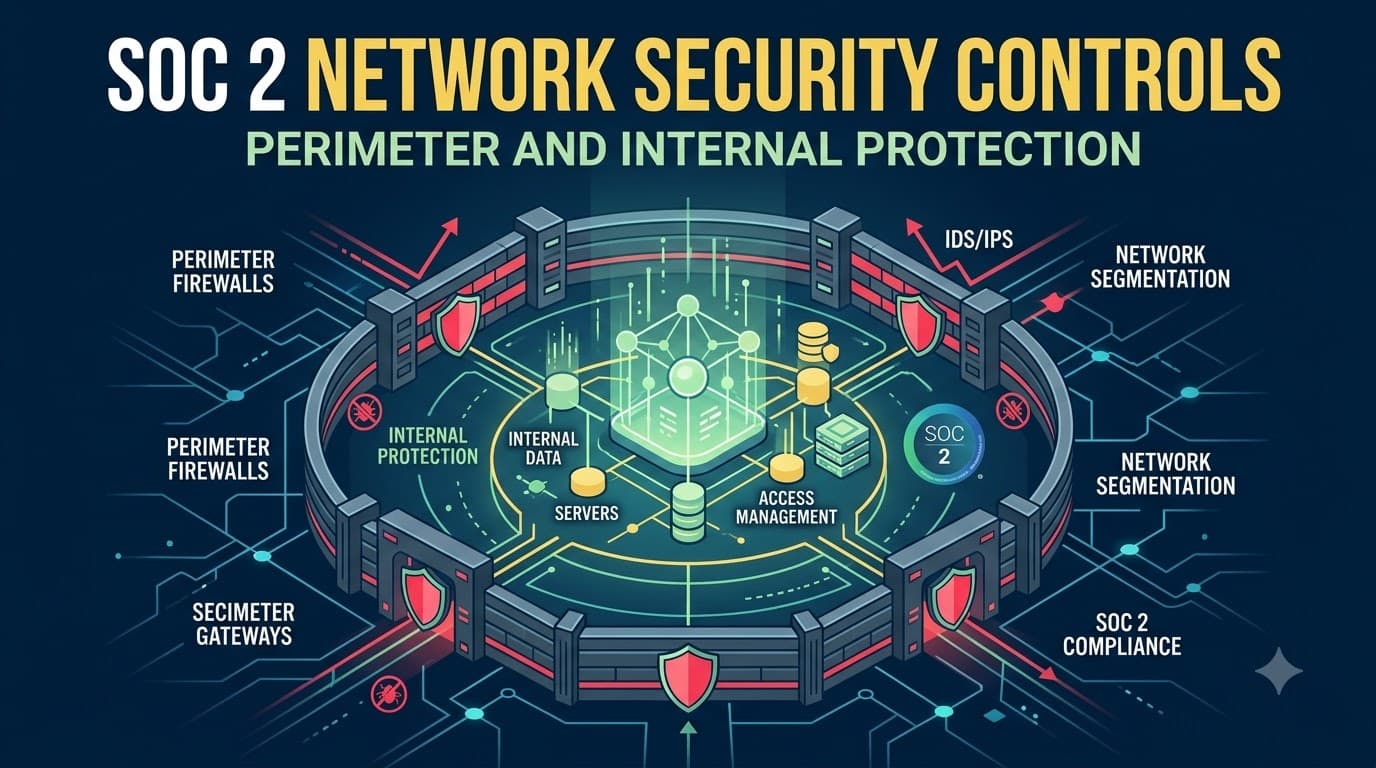
Priya Nandakumar had built her career on the assumption that a good network diagram could save almost any audit. Three weeks before fieldwork closed on Verdant Health Analytics' first SOC 2 Type II examination, she learned exactly how wrong that assumption could be.
Verdant processed eligibility and claims data for four regional health insurers, and the company's largest prospective customer — a national payer worth $2.4 million in first-year contract value — had made a clean SOC 2 report a contractual precondition of signature. Priya's team had spent eight months on access reviews, background checks, and encryption-at-rest projects. What nobody had scrutinized closely was the network itself: a single flat VPC with one production subnet, a handful of security groups that had accreted over four years of "just open port 443 for now" tickets, and a site-to-site VPN to a business partner that had never been re-scoped after that partnership ended. The auditor, a methodical field examiner named Tomas Reyes from Bellcrest Assurance Partners, spent one afternoon with the network diagram and came back with a list of nine questions Priya couldn't answer cleanly. Where was the boundary between the claims-processing environment and the corporate office network? What stopped a compromised marketing laptop from reaching the database tier? Was there any control that would detect — let alone block — a lateral movement attempt between application servers? Priya had answers for "is the perimeter firewalled." She had almost nothing for "what happens after someone gets past it."
That gap is the subject of this article, and it's one of the single most common reasons SOC 2 engagements stall in the last mile. Two Common Criteria carry almost the entire weight of network security in a SOC 2 report: CC6.6, which addresses how an organization protects its system boundaries against unauthorized access, and CC6.7, which addresses how it controls the transmission, movement, and removal of information. Together they require you to demonstrate two distinct disciplines — keeping unauthorized traffic out, and controlling what happens to traffic and data once they're inside your environment. Most organizations do reasonably well on the first and badly on the second, which is exactly why auditors probe it hardest.
Who this is for, and what you'll walk away with
This is written for infrastructure leads, cloud security architects, and compliance managers who are building or hardening the network controls behind a SOC 2 Security criterion examination — whether you're preparing for your first Type II or cleaning up exceptions from your last one. You'll walk away with a working map of what CC6.6 and CC6.7 actually require, concrete architecture patterns for perimeter and internal (east-west) protection, the evidence auditors sample for each control, and the exceptions that show up most often in real reports — so you can design the network, not just document it after the fact.
Why network security still anchors SOC 2, even in the cloud era
It's tempting to think network controls matter less now that most SOC 2 scope lives in AWS, Azure, or GCP rather than a data center with a physical perimeter. The opposite is true. Cloud-native environments replace physical firewalls with software-defined equivalents — security groups, network ACLs, virtual private clouds — but the underlying control objective is unchanged: unauthorized parties and unauthorized traffic should not be able to reach systems that process or store in-scope data. Auditors under SOC 2 examine network controls precisely because a weak network layer defeats every other control you've built. Strong access reviews mean little if an unauthenticated attacker can reach the database tier directly. Strong encryption at rest means little if data moves across the internal network in plaintext between services.
CC6.6 and CC6.7 sit inside the Common Criteria — the Security category required in every SOC 2 report regardless of which optional Trust Services Criteria you've added. They belong to the CC6 family, "Logical and Physical Access Controls," alongside the identity and authorization controls covered in SOC 2 Access Controls: User Management and Privilege Administration and SOC 2 Logical Security: System Access and Authorization. Where those articles focus on who can log in, this one focuses on what the network itself will and won't allow to pass — independent of identity.
Criterion | Focus Area | Plain-English Question It Answers |
|---|---|---|
CC6.6 | Boundary protection | Can unauthorized users or systems reach our network or systems from outside? |
CC6.7 | Transmission and movement of data | Is data protected as it moves — across the network, between systems, and off the network entirely? |
Decoding CC6.6: boundary protection requirements
CC6.6 asks whether the organization has implemented logical access security measures to protect against threats from sources outside its system boundaries. In practice, auditors are looking for a defensible answer to "how do you know what's allowed to talk to what, and how is that enforced technically rather than by policy alone?" The system boundary itself has to be defined before the control can be evaluated — you can't protect a perimeter you haven't drawn.
Boundary protection under CC6.6 typically includes: firewalls or cloud security groups that restrict inbound and outbound traffic by default-deny rule sets; documented and periodically reviewed firewall rule bases; network segmentation that separates production from non-production and corporate IT from customer-data environments; intrusion detection or prevention capability at the boundary; and DDoS mitigation for internet-facing services. None of these need to be exotic. What auditors consistently find missing isn't sophistication — it's evidence that the rules were designed deliberately, are reviewed on a cadence, and match what's actually deployed.
"The question I ask every service organization in the first walkthrough is simple: show me the rule that denies everything, then show me the exceptions and who approved each one. If nobody can produce that in under ten minutes, the network segment of the audit is going to be long." — Tomas Reyes, Lead SOC 2 Auditor, Bellcrest Assurance Partners
Decoding CC6.7: transmission and movement of data
CC6.7 is the criterion most teams underestimate because it sounds narrower than it is. It covers how the organization restricts the transmission, movement, and removal of information to authorized users and processes — which spans TLS-encrypted data in transit, controls over removable media, controls over file transfer and email egress, and, critically, controls over how data moves inside the network between services (the "east-west" traffic that boundary firewalls never see). A service organization can pass CC6.6 with a hardened perimeter and still fail CC6.7 if data moves unencrypted between microservices, if any authenticated user can query the production database directly, or if there's no control preventing a compromised internal host from exfiltrating data to an external destination.
Where CC6.6 is about the wall, CC6.7 is about what happens to the water once it's inside the building — is it routed only where it needs to go, encrypted while it moves, and monitored for unauthorized redirection. This is precisely the distinction Priya's team had missed: a wall (VPC boundary, security groups) with no internal plumbing discipline at all.
Perimeter vs. internal: the conceptual shift auditors expect
For a decade, "network security" mostly meant perimeter security — a strong outer shell around a trusted interior. SOC 2 auditors now expect the opposite assumption by default: that the interior is not inherently trustworthy, because credential theft, insider risk, and cloud misconfiguration make the inside just as exploitable as the outside. This is the practical meaning of zero trust in a SOC 2 context — not a specific product, but a design philosophy where every network segment, service, and connection is verified rather than implicitly trusted because it's "inside."
That shift is why this article treats perimeter and internal controls as two halves of one evaluation, not a checklist you complete once and move past. The table below is the mental model to carry through the rest of this piece — and the one worth pinning to your network runbook.
Table 1: Perimeter vs. Internal Network Controls
Dimension | Perimeter Controls (Boundary — CC6.6) | Internal Controls (East-West — CC6.7) |
|---|---|---|
Primary goal | Keep unauthorized external traffic out | Limit what authenticated/internal traffic can reach |
Typical mechanism | Firewalls, cloud security groups, edge ACLs | Micro-segmentation, internal firewalls, service mesh policy |
Trust assumption | Outside = untrusted by default | Inside = also untrusted by default (zero trust) |
Detection tooling | Perimeter IDS/IPS, DDoS scrubbing | Internal traffic monitoring, SIEM correlation, NDR |
Data protection focus | Inbound/outbound transmission (TLS) | Lateral movement, service-to-service auth |
Common failure mode | Overly broad inbound rules ("0.0.0.0/0") | Flat network, no internal segmentation |
Audit evidence type | Firewall rule exports, change tickets | Segmentation diagrams, internal traffic logs |
Who typically owns it | Network/security engineering | Platform/application engineering + security |
Firewalls and security groups: the first line of defense
Every SOC 2 network narrative starts here, and for good reason: a firewall — whether a physical appliance, a virtual firewall, or a cloud-native security group — is the most direct, auditable evidence of boundary protection. Auditors want three things from a firewall control: a default-deny posture (nothing is allowed unless explicitly permitted), a documented rule base with a business justification for each rule, and a periodic review process that removes stale or overly permissive entries.
The practical failure pattern I see most often isn't the absence of a firewall — nearly everyone has one. It's rule sprawl: years of "temporary" exceptions that were never revoked, rules with no named owner, and inbound access scoped to entire IP ranges instead of specific source addresses. A quarterly firewall rule review, with a ticket trail showing what was removed and why, is one of the cheapest controls to implement and one of the most convincing pieces of evidence you can hand an auditor.
Table 2: Firewall and Boundary Control Types Compared
Control Type | Where It Runs | Strengths | Limitations | SOC 2 Fit |
|---|---|---|---|---|
Stateless packet filter | Router/edge ACL | Fast, simple | No connection awareness, coarse rules | Baseline only, rarely sufficient alone |
Stateful firewall | Edge/on-prem appliance or virtual appliance | Tracks connection state, blocks unsolicited inbound | Limited application-layer visibility | Common core control |
Next-generation firewall (NGFW) | Edge, data center, cloud | App-aware filtering, integrated IDS/IPS, TLS inspection | Cost, tuning overhead | Strong evidence for CC6.6 |
Cloud security group | Instance/subnet level (AWS/Azure/GCP) | Native, granular, versioned via IaC | Provider-specific, easy to misconfigure at scale | Primary control in cloud-native scope |
Web application firewall (WAF) | In front of web/app tier | Blocks app-layer attacks (SQLi, XSS) | Doesn't replace network-layer controls | Complements CC6.6, supports CC6.7 for public endpoints |
Host-based firewall | Individual server/endpoint | Last line of defense, enforces east-west policy | Management overhead at scale | Strong internal (CC6.7) evidence |
Network segmentation fundamentals
Network segmentation is the single control most correlated with a clean CC6.6/CC6.7 finding in my experience across dozens of engagements, and it's also the one most commonly retrofitted under audit pressure rather than designed up front. The idea is straightforward: divide the network into zones based on data sensitivity and function, then restrict traffic between zones to only what's explicitly required. A flat network — one where any host can, in principle, reach any other host — is the pattern auditors flag hardest, because it means a single compromised endpoint anywhere in the environment has a path to everything.
Segmentation doesn't require a wholesale re-architecture to start paying off. The highest-leverage first cut is almost always separating production from non-production (dev/test/staging), separating the corporate office/user network from the environment that touches customer data, and isolating the data tier (databases, storage) so that only specific application-tier hosts can reach it — never end users, and never the corporate network directly.
"We didn't need a data center's worth of hardware to fix our segmentation gap. We needed three new subnets, updated security groups, and about six weeks of careful testing to make sure nothing broke. The auditor's tone changed completely once the diagram matched the rules." — Priya Nandakumar, VP of Infrastructure, Verdant Health Analytics
Zero trust and segmentation: complementary, not competing
Segmentation and zero trust get conflated constantly, and it's worth being precise for an audit context. Segmentation is a network-layer control — it defines zones and the traffic allowed between them. Zero trust is a broader authorization philosophy — it says that even within an allowed path, every request should be authenticated and authorized on its own merits, not trusted because it originated from a "trusted" zone. A well-segmented network with no access control enforcement inside each zone is still vulnerable to lateral movement by a compromised host within that zone. A zero-trust identity model with no network segmentation still leaves an attacker able to reach every service, even if they can't authenticate to most of them — increasing the attack surface unnecessarily.
For SOC 2 purposes, the strongest posture combines both: segmentation to shrink the blast radius of any single compromised zone, and least privilege service-to-service authentication within each zone so that reachability doesn't equal access. Auditors increasingly ask about this combination directly, particularly for organizations that have made "zero trust" a marketing claim without backing it with segmentation evidence.
Table 3: Segmentation Zones — A Reference Model
Zone | Typical Contents | Inbound Allowed From | Outbound Allowed To | Sensitivity |
|---|---|---|---|---|
Public/DMZ | Load balancers, WAF, public API gateway | Internet (restricted ports) | App tier only | Low (no data storage) |
Application tier | App servers, microservices, containers | DMZ, internal services (mTLS) | Data tier, approved external APIs | Medium |
Data tier | Databases, object storage, data warehouses | App tier only (specific hosts) | Backup/replication targets only | High |
Corporate/office network | Employee laptops, printers, internal tools | VPN/SSO-authenticated users | Internet, limited internal services | Medium |
Management/admin | Bastion hosts, admin consoles, CI/CD control plane | MFA-authenticated admins via jump host | All zones (scoped, logged) | Critical |
Third-party/partner | Vendor integration endpoints | Specific partner IP ranges, scoped ports | Specific internal API only | Variable — treat as untrusted |
Table 4: Segmentation Implementation Approaches
Approach | Description | Best Fit | Effort to Implement | Auditability |
|---|---|---|---|---|
VLAN segmentation | Layer 2 separation on physical/virtual switches | On-prem or hybrid data centers | Moderate | Good, if documented |
Subnetting (cloud) | Separate subnets per tier within a VPC | Cloud-native environments | Low–moderate | Strong with IaC |
Security group chaining | Layered security groups referencing each other | AWS/Azure/GCP native | Low | Strong, code-reviewable |
Micro-segmentation | Policy enforced per-workload, independent of network topology | Containerized/Kubernetes, high-density environments | High | Strong but requires tooling maturity |
Software-defined networking (SDN) | Centralized policy engine controls virtual network fabric | Large, multi-cloud or hybrid environments | High | Strong, centrally logged |
Air-gapped/physical isolation | No network path exists between zones | Highest-sensitivity legacy or regulated workloads | Very high | Strongest, but operationally rigid |
IDS/IPS: detecting and blocking intrusions
Firewalls and segmentation define what's allowed. Intrusion detection and prevention systems (IDS/IPS) watch what's actually happening on the traffic that's permitted, looking for patterns that indicate an attack in progress — a port scan, a known exploit signature, command-and-control beaconing, or anomalous volume from a single source. An IDS observes and alerts; an IPS observes and can actively block or reset the connection. Auditors treat IDS/IPS as a detective control layered on top of the preventive control that firewalls provide — and SOC 2 examiners specifically look for both categories to be represented, because a purely preventive control set leaves you blind to anything that gets past it.
Cloud-native environments increasingly implement this through managed services — AWS GuardDuty, Azure Network Watcher plus Microsoft Defender for Cloud, or GCP's Cloud IDS — rather than traditional inline appliances. That's a perfectly acceptable answer for CC6.6, provided you can show the service is enabled across all in-scope accounts/subscriptions, alerts route to a monitored channel, and there's a documented triage process rather than an unread inbox of findings. The most common gap here isn't the absence of the tool — it's the absence of anyone acting on what it reports.
"I've seen GuardDuty enabled in an account for two years with 40,000 unreviewed findings. Turning on a detection tool isn't the control. Someone triaging it on a defined cadence is the control." — Dana Whitcombe, Director of Cloud Security, Ledgerline Payments
Table 5: IDS vs. IPS Comparison
Attribute | IDS (Intrusion Detection System) | IPS (Intrusion Prevention System) |
|---|---|---|
Action on detection | Alerts only | Alerts and blocks/resets automatically |
Deployment mode | Out-of-band (monitors a copy of traffic) | Inline (traffic passes through it) |
Risk of false positives | Low operational risk (no traffic impact) | Can block legitimate traffic if misconfigured |
Typical use case | Broad visibility, forensic timeline building | High-confidence signatures at the perimeter |
Cloud equivalent | GuardDuty, Cloud IDS, NDR platforms | NGFW with IPS module, cloud-native traffic mirroring + auto-block |
SOC 2 evidence | Alert logs, triage tickets, escalation records | Blocked-connection logs, rule tuning history |
VPN and remote access controls
Remote access is where CC6.6 and CC6.7 meet identity controls most directly. A VPN or equivalent remote access mechanism extends your network boundary to wherever your employees are working — which means the boundary protection you built at the office is only as strong as the control over who can tunnel into it and from where. The audit-relevant questions are consistent: is remote access gated by multi-factor authentication, is split-tunneling restricted or logged, is access scoped to only the systems a given role needs rather than the entire internal network, and is there a current inventory of who has active remote access credentials.
Traditional site-to-site and client VPNs remain common, but the direction of travel — and increasingly the auditor's preferred answer — is toward zero trust network access (ZTNA), which grants access to specific applications rather than dropping a remote user onto the internal network as a whole. This matters for CC6.7 specifically: a traditional full-tunnel VPN that places a remote laptop "inside" the network defeats internal segmentation, because that laptop can now reach whatever the flat internal network allows. ZTNA preserves segmentation by design, since access is application-scoped rather than network-scoped.
Table 6: VPN and Remote Access Types Compared
Type | How It Works | Segmentation Impact | MFA Enforcement | Best Fit |
|---|---|---|---|---|
Site-to-site VPN | Encrypted tunnel between two networks/offices | Extends trust between full networks — high risk if unscoped | Device/certificate-based | Office-to-office, partner connectivity (tightly scoped) |
Client VPN (full tunnel) | Remote device joins internal network fully | High risk — bypasses internal segmentation | Should be mandatory | Legacy remote access, being phased out |
Client VPN (split tunnel) | Only internal traffic routes through tunnel | Moderate — still grants broad internal reach | Should be mandatory | Bandwidth-sensitive remote access |
Zero trust network access (ZTNA) | Per-application, identity-verified access broker | Low — preserves segmentation by design | Native to model | Preferred pattern for SOC 2-scoped remote access |
Bastion/jump host | Single hardened entry point to admin zone | Low — funnels all admin access through one logged path | Mandatory | Privileged/admin access specifically |
DDoS protection
Distributed denial-of-service protection sits squarely under CC6.6's boundary protection language, even though it addresses availability rather than confidentiality — a service organization that can be knocked offline by volumetric traffic has failed to protect its system boundary just as surely as one breached by an intruder. Most organizations today rely on their cloud provider's or CDN's built-in scrubbing capacity (AWS Shield, Azure DDoS Protection, Cloudflare, Akamai) rather than building dedicated on-premises mitigation, and that's an appropriate answer for an auditor provided the service tier is actually adequate for your risk profile — the free/basic tier of most providers offers only limited protection compared to the paid "advanced" tiers that include dedicated response teams and higher absorption capacity.
Table 7: DDoS Protection Layers
Layer | Mechanism | Example Providers/Services | What It Protects Against |
|---|---|---|---|
Network/volumetric | Traffic scrubbing at provider edge | AWS Shield, Azure DDoS Protection, Cloudflare Magic Transit | High-volume floods (UDP, SYN, amplification) |
DNS layer | Anycast DNS, rate limiting | Route 53, Cloudflare DNS, Akamai | DNS query floods, cache poisoning attempts |
Application layer (L7) | WAF-based rate limiting and bot mitigation | Cloudflare, AWS WAF, Akamai Kona | HTTP floods, credential stuffing, scraping |
CDN/edge caching | Absorbs traffic before it reaches origin | Cloudflare, Fastly, CloudFront | Reduces origin exposure to spikes |
Origin protection | Restrict direct access to origin IP | Security groups allowing only CDN IP ranges | Bypass attacks that target origin directly |
TLS and encryption in transit
CC6.7's transmission-protection language is most directly evidenced by encryption in transit — TLS on every network path that carries in-scope data, both external (customer-facing endpoints) and internal (service-to-service traffic). The gap auditors find most often isn't missing TLS on the public-facing website; it's missing or outdated TLS on internal API calls, database connections, and message queues, on the assumption that "it's inside the VPC, so it doesn't need it." Under a zero-trust posture — and under CC6.7's plain language — that assumption doesn't hold. Internal traffic still needs to be authenticated and encrypted, because the internal network is not treated as inherently trusted.
A mature TLS posture for a SOC 2 examination includes: enforced TLS 1.2 minimum (TLS 1.3 preferred) on all endpoints, automated certificate issuance and rotation rather than manually tracked expiry dates, disabled legacy protocols and weak cipher suites, and mutual TLS (mTLS) for service-to-service authentication in higher-sensitivity zones such as the data tier.
Table 8: TLS / Encryption-in-Transit Checklist
Control Point | What "Good" Looks Like | Common Gap Found in Audits |
|---|---|---|
External endpoints | TLS 1.2+ enforced, HSTS enabled | TLS 1.0/1.1 still accepted for backward compatibility |
Internal service-to-service | mTLS or service-mesh-enforced encryption | Assumed "safe because internal," sent in plaintext |
Database connections | TLS-enforced connection strings | Optional TLS, silently downgraded when unavailable |
Certificate management | Automated issuance/rotation (ACME, cert-manager) | Manually tracked certs, expiry surprises |
Cipher suite policy | Modern suites only, weak ciphers disabled | Legacy ciphers left enabled for old client compatibility |
Load balancer termination | Re-encrypted to backend, not plaintext after LB | TLS terminated at LB, plaintext to app servers |
Message queues/event streams | TLS-enforced broker connections | Default unencrypted broker configuration |
Cloud network controls: VPC, security groups, and NACLs
For the majority of SOC 2 examinations today, the "network" an auditor is evaluating is entirely software-defined. A VPC (Virtual Private Cloud, or its Azure/GCP equivalents — VNet, VPC network) is the logical boundary of your cloud environment, and everything discussed so far — segmentation, firewalls, boundary protection — is implemented through cloud-native constructs rather than physical hardware. Understanding the layered model cloud providers use is essential to answering audit questions precisely, because "we have a firewall" is not a sufficient answer when an auditor asks which layer actually enforces a given rule.
Security groups are stateful, instance- or resource-level firewalls — the most granular and most commonly referenced control in cloud SOC 2 evidence. Network ACLs (NACLs, in AWS terminology) are stateless, subnet-level filters that provide a second, coarser layer of defense. The combination matters: security groups alone, without subnet-level NACLs or VPC segmentation, still allow lateral movement within the VPC if an instance is compromised. Route tables control which subnets can reach which other subnets and the internet at all — an underused lever that auditors increasingly ask about directly, since restrictive routing is often a more durable segmentation control than security group rules that engineers can (and do) loosen under deadline pressure.
"Every misconfigured production breach I've reviewed in the last three years had the same root cause: a security group rule that was supposed to be temporary, attached to the wrong resource, and never audited again. Infrastructure as code with mandatory review didn't just fix that — it made the rule review itself part of the evidence trail." — Ravi Ostrander, Network Security Architect, Fenwick Data Systems
Table 9: Cloud Network Controls
Control | AWS | Azure | GCP | Enforcement Layer | Statefulness |
|---|---|---|---|---|---|
Virtual network boundary | VPC | Virtual Network (VNet) | VPC network | Account/subscription/project | N/A |
Instance-level firewall | Security Group | Network Security Group (NSG) | Firewall rules (per-network) | Instance/ENI | Stateful |
Subnet-level filter | Network ACL (NACL) | NSG (subnet-associated) | Hierarchical firewall policies | Subnet | Stateless |
Routing control | Route tables | User-defined routes (UDR) | Routes | Subnet/VPC | N/A |
Private connectivity | PrivateLink / VPC endpoints | Private Link / Service Endpoints | Private Service Connect | Service-to-service | N/A |
Traffic inspection | VPC Traffic Mirroring, GuardDuty | Network Watcher, Defender for Cloud | Packet Mirroring, Cloud IDS | VPC/subnet | N/A |
Infrastructure as code enforcement | Terraform/CloudFormation + policy-as-code (e.g., OPA, Sentinel) | Terraform/Bicep + Azure Policy | Terraform + Org Policy | Deployment pipeline | N/A |
East-west traffic and internal segmentation controls
The traffic that flows between services inside your environment — commonly called east-west traffic, as distinct from the north-south traffic crossing your perimeter — is where CC6.7 does most of its work, and where evidence is hardest to produce cleanly. Perimeter controls generate obvious artifacts: a firewall rule export, a WAF dashboard. East-west controls require you to demonstrate that internal traffic is also restricted and observed, which most organizations simply haven't instrumented, because it was never necessary for the system to function — only for the system to be defensible under audit.
Practical east-west controls include: security groups that reference other security groups rather than broad CIDR ranges (so that only tagged application-tier instances, not "anything in this subnet," can reach the database tier); internal traffic logging (VPC Flow Logs or equivalent) retained and reviewable; and a documented internal data flow diagram that an auditor can compare against actual configuration. The data flow diagram is worth emphasizing — it's frequently the single artifact that turns an abstract architecture conversation into a concrete, testable control, because the auditor can select a sample of flows shown on the diagram and confirm each is technically enforced.
Micro-segmentation in practice
Micro-segmentation takes the segmentation principle down to the individual workload level, enforcing policy per-service or per-container rather than per-subnet. In Kubernetes environments this is typically implemented through network policies (Calico, Cilium, or cloud-native equivalents) that define exactly which pods can communicate with which other pods — a considerably finer grain than the VPC-level segmentation described earlier. For organizations running dense multi-tenant or highly regulated workloads, micro-segmentation is increasingly the expectation rather than the exception, because it limits lateral movement even within a single "trusted" zone.
The tradeoff is operational complexity: micro-segmentation policies need to be maintained as services change, and a policy that's too restrictive breaks functionality in ways that create pressure to loosen it broadly rather than precisely. The organizations that succeed with it treat network policy as code, version-controlled and reviewed alongside application changes — which conveniently also produces exactly the kind of change history an auditor wants to see.
Network access control (NAC) and wireless security
Physical and wireless network access control is easy to overlook in a cloud-focused SOC 2 conversation, but it remains squarely in scope wherever a corporate office network can reach in-scope systems. Network access control (NAC) — commonly implemented via 802.1X port authentication — ensures that only authorized, often posture-checked devices can join the corporate network at all, rather than any device that can physically plug into a wall jack or associate with a wireless access point. Guest and corporate wireless networks should be segmented from each other and from any network segment with access to production systems, with guest access explicitly denied any path toward in-scope infrastructure.
This is a lower-cost, frequently underrated control. An auditor who finds an open or WPA2-PSK-shared guest wireless network with a routable path to internal resources will treat it as a live boundary gap regardless of how strong your cloud-side controls are — because it represents a physical-proximity attack path that bypasses every cloud control entirely.
Network monitoring, logging, and SIEM integration
Detective controls are only as good as the review process behind them, and network monitoring is the area where that gap shows up most visibly in Type II testing — a Type II examination tests operating effectiveness over a period, which means "we have logging enabled" is not sufficient; the auditor wants evidence that logs were reviewed, alerts were triaged, and anomalies were investigated throughout the audit window, not just configured at some point within it.
A functioning program routes firewall logs, VPC flow logs, IDS/IPS alerts, and DNS query logs into a central SIEM or log aggregation platform, with correlation rules tuned to the organization's actual traffic baseline and a documented escalation path for confirmed anomalies. Continuous monitoring — rather than point-in-time log review — is what increasingly separates organizations that sail through Type II testing from those that accumulate exceptions, because it produces a steady, dated evidence trail rather than a scramble to reconstruct history at audit time.
Change management for network configurations
Network configuration changes — a new firewall rule, a modified security group, a routing update — are exactly the kind of change that change management processes are meant to govern, yet network changes are frequently treated as "just infrastructure" and pushed outside the same review discipline applied to application code. That's a mistake auditors catch reliably, because CC8 (change management) and CC6.6/CC6.7 intersect directly here: a firewall rule opened without review, tested, and approved is both a change management gap and a boundary protection gap simultaneously.
The fix is straightforward in principle: manage network configuration as IT general controls-grade infrastructure as code, require peer review and approval before any rule change merges, and maintain a change log that ties each modification to a ticket, an approver, and a business justification. This single practice — treating firewall and security group changes with the same rigor as a production code deploy — is the highest-leverage process improvement most organizations can make ahead of a SOC 2 examination, and it directly supports SOC 2 Change Management: System and Application Updates.
Layered network defense: a visual reference
The diagram below shows how the controls covered in this article stack together, from the internet-facing edge through to the data tier — the mental model auditors expect you to be able to walk through in a live interview.
flowchart TB
    Internet["Internet / External Users"]
    DDoS["DDoS Scrubbing + CDN/WAF"]
    Perimeter["Perimeter Firewall / Security Groups\n(CC6.6 Boundary Protection)"]
    IDS["IDS/IPS Inspection"]
    DMZ["DMZ / Public Subnet\n(Load Balancers, API Gateway)"]
    AppTier["Application Tier\n(Segmented Subnet, mTLS Enforced)"]
    Internal["Internal Firewall / Micro-segmentation\n(CC6.7 East-West Control)"]
    DataTier["Data Tier\n(Databases, Storage — Most Restricted)"]
    VPN["VPN / ZTNA\n(Remote & Admin Access)"]
    SIEM["SIEM / Continuous Monitoring\n(Cross-Layer Visibility)"]

    Internet --> DDoS --> Perimeter --> IDS --> DMZ --> AppTier --> Internal --> DataTier
    VPN -.-> AppTier
    VPN -.-> Internal
    Perimeter -.-> SIEM
    IDS -.-> SIEM
    Internal -.-> SIEM
    DataTier -.-> SIEM
Every layer in that diagram needs to map to a specific technical control and a specific piece of evidence — which is the subject of the next section.
Evidence collection: what auditors actually sample
Design isn't enough for a Type II report — the auditor needs audit evidence that each network control operated throughout the review period, not just that it exists today. For network controls specifically, that means auditors typically request: exported firewall/security group rule sets from at least two points in the period (to test for drift), a sample of change tickets for rule modifications with approver sign-off, VPN/remote access user lists cross-referenced against HR termination records, IDS/IPS alert logs with evidence of triage, TLS configuration scan results (internal and external), and network diagrams that are dated and version-matched to the period under review — not a diagram that was updated the week before fieldwork started.
The single biggest evidence-readiness improvement I recommend to clients is dating everything and keeping history. A firewall rule review that happened but wasn't documented with a date and a ticket number is, from an audit perspective, indistinguishable from a review that never happened. Build your evidence trail as a byproduct of normal operations — ticket systems, IaC pull requests, SIEM dashboards with retained history — rather than as a special audit-season exercise, and Type II testing becomes dramatically less painful.
Table 10: Network Control-to-Evidence Mapping
Control | Criterion | Evidence Auditors Sample | Collection Frequency |
|---|---|---|---|
Firewall/security group rule review | CC6.6 | Rule export + review ticket + approver | Quarterly |
Network segmentation | CC6.6 / CC6.7 | Current network diagram, subnet/security group configuration export | Point-in-time + on change |
IDS/IPS monitoring | CC6.6 | Alert logs, triage tickets, escalation records | Continuous, sampled monthly |
VPN/remote access review | CC6.6 / CC6.7 | Active user list vs. HR roster, MFA enforcement config | Quarterly |
DDoS protection | CC6.6 | Service tier confirmation, incident/mitigation logs if triggered | Point-in-time + incident-driven |
TLS/encryption in transit | CC6.7 | External/internal TLS scan results, certificate inventory | Quarterly or automated continuous |
Internal traffic control (east-west) | CC6.7 | VPC flow logs, internal security group rules referencing tags | Continuous, sampled monthly |
Network configuration change management | CC6.6 / CC8 | IaC pull requests, approval records, deployment logs | Per change, reviewed monthly |
Wireless/NAC | CC6.6 | 802.1X authentication logs, guest network segmentation config | Quarterly |
Network monitoring/SIEM | CC6.7 | Log source inventory, alert-to-resolution records | Continuous |
Common exceptions auditors find
Most network-related exceptions I see in draft SOC 2 reports fall into a small, predictable set of patterns — which is good news, because it means the fix is usually well understood even when the initial finding is uncomfortable. The most damaging exceptions aren't sophisticated technical gaps; they're process gaps where a reasonable control exists on paper but the evidence shows it wasn't consistently followed during the period.
"Nine times out of ten, the exception isn't 'you have no firewall.' It's 'you have a firewall, but three rules opened during an incident six months ago were never closed, and nobody can tell me who approved them.' That's a control deficiency even though the architecture is sound." — Marcus Feld, Field CISO, Ashgrove Financial
Table 11: Common Network Security Exceptions in SOC 2 Audits
Exception Pattern | Root Cause | Typical Remediation | Prevents Recurrence |
|---|---|---|---|
Overly permissive inbound rule (0.0.0.0/0) | Convenience during initial setup, never scoped down | Restrict to specific source ranges/services | Quarterly rule review with named owner |
Stale firewall rules with no owner | Temporary exceptions never revoked | Rule audit and cleanup, ticket-linked justification required | Mandatory expiry date on temporary rules |
Flat internal network / no segmentation | Segmentation deferred as "not urgent" | Phased segmentation project (prod/non-prod first) | Segmentation reviewed in architecture design phase |
Unencrypted internal service traffic | Assumption that internal = safe | Enforce mTLS/TLS on internal service calls | TLS requirement in service deployment templates |
IDS/IPS alerts not triaged | Tool enabled, no owning process | Assign triage SLA, route to SIEM/ticketing | Alert-to-resolution metric tracked monthly |
VPN access not de-provisioned on termination | No integration between HR offboarding and network access | Automate access revocation via IAM/HR integration | Quarterly access recertification |
No current network diagram | Diagram not maintained as environment changed | Rebuild and version-control diagram, tie to IaC | Diagram review as part of change management |
DDoS protection at default/free tier only | Cost deferred, risk not reassessed | Upgrade to advanced tier for internet-facing critical services | Tier reviewed annually against risk profile |
Cost and timeline to build a SOC 2-ready network program
Clients ask me for a number early, and the honest answer is "it depends on how flat your network already is" — but the ranges below reflect what I've seen across mid-market service organizations building this out for the first time, illustrative to this practitioner's experience rather than a published benchmark.
Table 12: Illustrative Cost and Timeline to Build SOC 2-Ready Network Controls
Workstream | Typical Timeline | Illustrative Cost Range (Mid-Market) | Primary Driver of Variance |
|---|---|---|---|
Firewall/security group rule cleanup | 2–4 weeks | $8,000–$20,000 (internal effort or consultant) | Number of legacy rules, documentation quality |
Network segmentation (prod/non-prod/data tier) | 6–12 weeks | $25,000–$90,000 | Application dependency complexity |
IDS/IPS deployment and tuning | 3–6 weeks | $15,000–$60,000/year (tooling + tuning effort) | Cloud-native vs. dedicated appliance |
VPN/ZTNA migration | 4–10 weeks | $10,000–$50,000/year (licensing) | User count, legacy VPN dependencies |
DDoS protection tier upgrade | 1–2 weeks | $3,000–$40,000/year | Traffic volume, criticality of public endpoints |
TLS/certificate automation | 2–4 weeks | $5,000–$15,000 | Number of endpoints, manual cert sprawl |
SIEM/log aggregation for network sources | 4–8 weeks | $20,000–$100,000/year | Log volume, retention requirements |
Ongoing quarterly review cadence | Recurring | $10,000–$30,000/year (staff time) | Environment size, automation maturity |
Case study: Verdant Health Analytics — from flat network to clean report
Priya's team had six weeks before the Type II fieldwork window closed. Rather than attempt a full re-architecture, they prioritized ruthlessly: separate the data tier into its own subnet reachable only from tagged application instances, retire the dormant partner VPN entirely, enable VPC flow logs and route them into a lightweight SIEM, and convert every "temporary" firewall exception older than 90 days into either a permanent, justified rule or a closed ticket. They documented every change with a ticket number and an approver, specifically because Tomas Reyes had told them, in the first walkthrough, exactly what he'd be sampling.
The result: the segmentation and rule-cleanup work closed five of the nine original findings outright, and the remaining four were downgraded to observations with documented remediation plans rather than exceptions — enough for an unqualified opinion covering the observation period with appropriate disclosure. The $2.4 million contract closed six weeks after the report was issued. Total cost of the remediation effort: roughly $58,000 in consultant and internal engineering time, against a contract that would have been unrecoverable without it.
Case study: Ledgerline Payments — DDoS incident becomes a control upgrade
Ledgerline Payments, a payment-processing service organization I advised the year prior, experienced a six-hour partial outage from a volumetric DDoS attack against its public API gateway roughly four months before their Type II observation period began. The incident itself fell outside the audit window, but the auditor asked directly whether the organization's DDoS protection posture had changed as a result — a fair question, since an unaddressed known risk during the period would itself be a finding.
Ledgerline had been running the default/free tier of their cloud provider's DDoS protection. Following the incident, Dana Whitcombe's team upgraded to the advanced tier with dedicated response support, added rate limiting at the WAF layer, and moved static assets behind a CDN to reduce origin exposure. When the audit period began, this upgraded configuration had been in place and unchanged for the full duration — clean, continuous evidence rather than a last-minute scramble. The report noted no exceptions related to availability or boundary protection, and Ledgerline's leadership now cites the incident, somewhat wryly, as the best $34,000 DDoS-tier upgrade they never wanted to need.
Case study: Cascade Logistics — VPN sprawl and the move to ZTNA
Cascade Logistics had grown through two acquisitions, and each acquired company had brought its own VPN infrastructure with it. By the time of their SOC 2 readiness assessment, the combined organization had three separate VPN systems, inconsistent MFA enforcement across them, and no single source of truth for who currently had remote access to which systems. Naomi Ferris, Head of Platform Engineering, described the discovery process as "finding out we had more active VPN accounts than employees" — a mix of contractor accounts, former-employee accounts from the acquired companies, and duplicate accounts across systems.
The remediation consolidated all three VPN systems into a single ZTNA platform over a ten-week project, integrated directly with the HR system so that access provisioning and de-provisioning happened automatically on employment status changes, and enforced MFA universally as part of the migration. The consolidation also, as a side effect, improved CC6.7 posture significantly: because ZTNA grants per-application access rather than full network access, the newly unified remote workforce could no longer reach internal segments they didn't need — closing a lateral-movement risk that had existed, unnoticed, since the first acquisition closed.
Table 13: Case Study Outcomes Summary
Organization | Core Problem | Remediation | Timeline | Quantified Outcome |
|---|---|---|---|---|
Verdant Health Analytics | Flat network, no data-tier isolation, dormant partner VPN | Segmentation, VPN retirement, flow log monitoring | 6 weeks | 5 of 9 findings closed; $2.4M contract secured; ~$58,000 remediation cost |
Ledgerline Payments | Default-tier DDoS protection, prior outage | Advanced DDoS tier, WAF rate limiting, CDN adoption | 5 weeks (pre-audit period) | Zero availability/boundary exceptions in Type II report |
Cascade Logistics | Three fragmented VPN systems post-acquisition, orphaned accounts | Consolidated ZTNA platform, HR-integrated provisioning | 10 weeks | Eliminated orphaned remote access; closed east-west lateral movement gap |
Vendor and tool landscape
No single vendor covers every control discussed in this article, and auditors don't expect one — they expect a coherent stack where each layer's ownership and configuration is clear. The table below is a starting reference, not an endorsement list; evaluate against your own cloud footprint and existing tooling investment.
Table 14: Illustrative Vendor and Tool Landscape by Control Area
Control Area | Representative Options | Notes |
|---|---|---|
Cloud-native firewalling | AWS Security Groups/NACLs, Azure NSGs, GCP Firewall Rules | Free/included with cloud provider; primary control for cloud-native scope |
Next-gen firewall (hybrid/on-prem) | Palo Alto Networks, Fortinet, Cisco Firepower | Relevant where hybrid/data-center infrastructure remains |
IDS/IPS (cloud-native) | AWS GuardDuty, Azure Defender for Cloud, GCP Cloud IDS | Low operational overhead, needs triage process layered on top |
Network detection and response (NDR) | Corelight, Darktrace, ExtraHop | Deeper east-west visibility for larger/complex environments |
ZTNA / remote access | Zscaler, Cloudflare Access, Tailscale, Twingate | Increasingly preferred over traditional full-tunnel VPN |
DDoS/WAF/CDN | Cloudflare, Akamai, AWS Shield Advanced, Fastly | Tier selection matters more than provider choice |
Micro-segmentation | Illumio, Cilium, Calico | Highest value in containerized/Kubernetes environments |
SIEM / log aggregation | Splunk, Datadog, Microsoft Sentinel, Elastic | Central to continuous monitoring evidence |
Infrastructure as code / policy enforcement | Terraform + Open Policy Agent, AWS Config, Azure Policy | Ties change management directly to network configuration |
Audit readiness checklist
Before fieldwork begins, walk this list with your network and platform engineering leads — it mirrors the sequence auditors tend to follow in a network-focused walkthrough.
Table 15: SOC 2 Network Security Audit Readiness Checklist
# | Readiness Item | Status Check |
|---|---|---|
1 | Current, dated network diagram matching deployed configuration | Yes/No |
2 | Default-deny firewall/security group posture confirmed | Yes/No |
3 | Quarterly firewall/security group rule review with tickets | Yes/No |
4 | Production/non-production and data-tier segmentation in place | Yes/No |
5 | IDS/IPS enabled with documented triage process | Yes/No |
6 | VPN/remote access user list reconciled against HR roster | Yes/No |
7 | MFA enforced on all remote access | Yes/No |
8 | DDoS protection tier matches risk profile of public endpoints | Yes/No |
9 | TLS enforced on external and internal traffic paths | Yes/No |
10 | Certificate issuance/rotation automated | Yes/No |
11 | VPC flow logs (or equivalent) enabled and retained | Yes/No |
12 | Network configuration changes routed through change management | Yes/No |
13 | Wireless network segmented from production-access segments | Yes/No |
14 | SIEM/log aggregation covers all network control sources | Yes/No |
15 | Evidence retention covers the full observation period, not just current state | Yes/No |
Network security as a business opportunity, not just an audit line item
It's easy to treat CC6.6 and CC6.7 as a compliance tax — work you do because a customer's procurement team demands a clean report. I'd push back on that framing, because in every engagement I've run, the organizations that treated network segmentation and boundary protection as genuine risk reduction, not audit theater, ended up with measurably better security posture and an easier audit. Priya's team didn't just close nine findings at Verdant Health Analytics — they eliminated an actual lateral-movement path that had existed in production for years, unnoticed, because nobody had reason to look until an auditor asked the right question.
This matters more as buyers get more sophisticated about the frameworks they compare. Prospects increasingly ask how your SOC 2 controls map against ISO 27001, particularly in regulated or enterprise sales cycles where ISO 27001 vs SOC 2: which one do you need is a live procurement question rather than an academic one. Organizations pursuing both frameworks — a path covered in Running ISO 27001 and SOC 2 Together — find that the network segmentation and boundary protection work described here satisfies the bulk of ISO 27001's Annex A network security controls simultaneously, because the underlying engineering is the same even where the documentation format differs. The ISO 27001, SOC 2 & NIST CSF Crosswalk is worth reviewing if you're mapping this work against multiple frameworks at once, since a well-evidenced CC6.6/CC6.7 control set is largely reusable rather than framework-specific busywork.
The commercial case is straightforward: a network architecture that can be explained clearly, diagrammed accurately, and evidenced continuously closes enterprise deals faster, survives security questionnaires with fewer follow-up questions, and — not incidentally — actually reduces your breach exposure. Treat this as infrastructure investment with a compliance byproduct, not a compliance obligation with an infrastructure cost.
Get your network controls audit-ready
If you're heading into your first Type II examination, or cleaning up exceptions from your last one, don't try to reconstruct six months of evidence in the final sprint before fieldwork. Start with an honest gap assessment against CC6.6 and CC6.7 using PentesterWorld's SOC 2 Readiness Checklist, then map your current architecture against the SOC 2 Trust Services Criteria Mapping Template to identify where segmentation, monitoring, or evidence collection is thinnest. For teams building or refreshing their control ownership model, the SOC 2 Control Matrix / RACI Template assigns clear accountability for each network control before an auditor asks who owns it. And if a term in this article — or in your auditor's questions — isn't landing, the SOC 2 Glossary is a fast way to get the whole team speaking the same language before fieldwork starts.