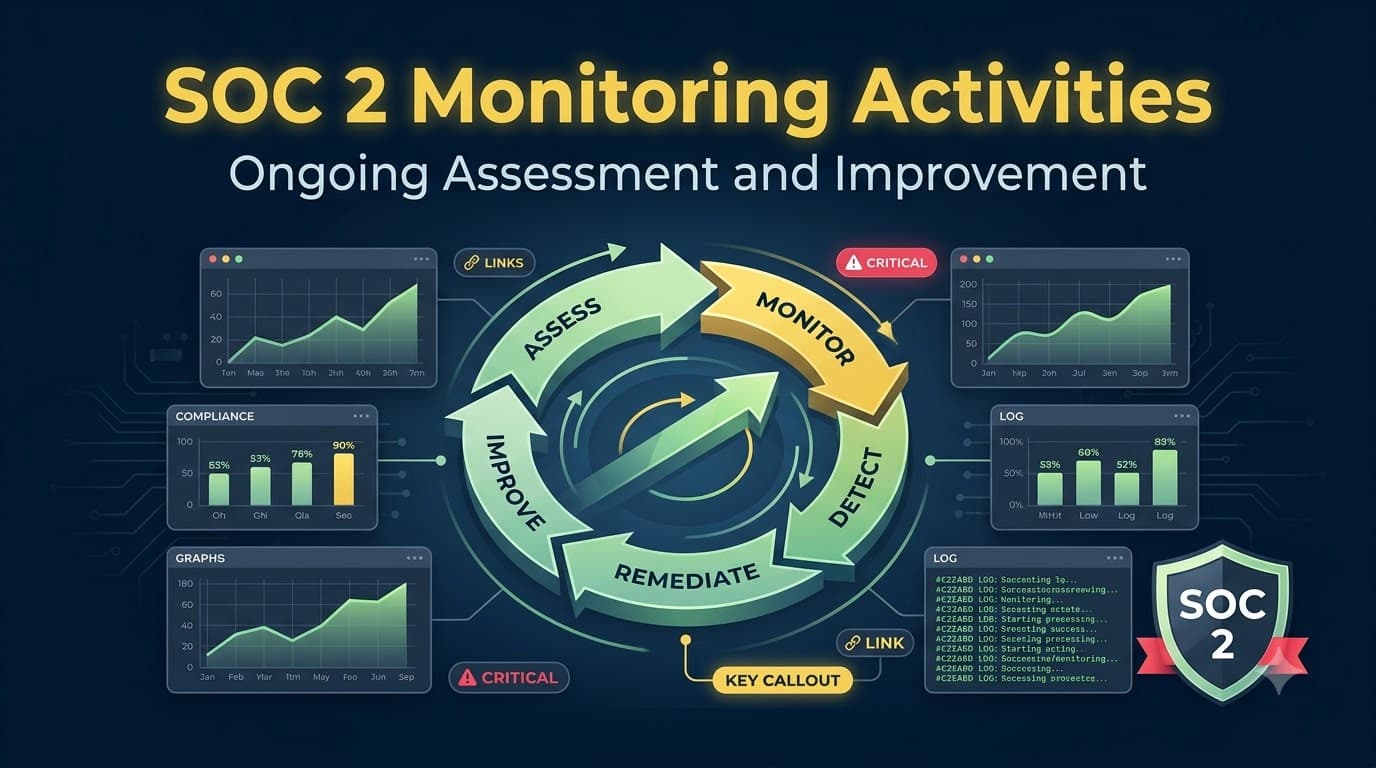
Renata Cho found the finding on a Tuesday afternoon, three weeks before fieldwork was scheduled to close on Harrow Point Payments' first SOC 2 Type II examination. The engagement partner, Tomás Rivera of Halloway & Vance CPAs, had pulled a sample of vulnerability scan results from the twelve-month observation period and traced one finding — a critical remote code execution flaw on an internet-facing API gateway — from discovery to resolution. The scanner had flagged it. Nobody had. The finding sat open for 97 days with no ticket, no owner, no escalation, and no record that anyone outside the security engineering team had ever been told it existed. Harrow Point's technical controls were otherwise strong: encryption at rest, tight access reviews, a mature change-management pipeline. But CC4 — monitoring activities — was the one area where the company had confused "we run scans" with "we monitor," and Tomás's draft management letter made the distinction painfully explicit. A $3.1 million, three-year processing agreement with a regional bank was contingent on an unqualified opinion. Renata had three weeks to prove that Harrow Point didn't just detect problems — it caught them, told the right people, and closed the loop.
What Renata's team rebuilt in those three weeks — and what they should have built a year earlier — is the subject of this article. Monitoring Activities is the criteria group most people assume is "just vulnerability scanning" until an auditor asks the harder question: not whether you found the problem, but whether your organization can prove it evaluated its own controls on an ongoing basis and got deficiencies in front of the people accountable for fixing them, on a documented timeline, every single time.
Tomás's fieldwork notes made a distinction Renata hadn't thought about carefully before that meeting: the scanner catching the vulnerability was evidence the technology worked. The 97-day silence afterward was evidence the organization hadn't built a monitoring program at all — just a monitoring tool sitting unmanaged inside a much larger system that nobody had assigned to watch it. That gap between "we have a tool that detects things" and "we have a program that ensures detected things get fixed" is where most first-time SOC 2 candidates lose ground on CC4, and it's rarely a technology problem. It's a process and ownership problem, and it's entirely fixable once you know exactly what an auditor is going to ask for.
Who This Is For and What You'll Walk Away With
This is written for compliance leads, security engineering managers, GRC analysts, and internal audit owners who've been told "you need a monitoring program" without a clear map of what CC4 actually requires or how it differs from the vulnerability management program you probably already have. You'll leave with a working definition of CC4 tied to its two underlying COSO principles, a concrete evidence trail for each, a framework for deciding when a control needs continuous monitoring versus a periodic internal evaluation, a deficiency-tracking workflow that survives audit sampling, and a maturity path from ad hoc scanning to a monitoring program an auditor will call a strength instead of a gap. Nothing here requires a dedicated monitoring team on day one — just a defined process, an owner for every signal, and proof the loop actually closes.
What Is SOC 2 Monitoring Activities (CC4)?
Under the AICPA's Trust Services Criteria, every SOC 2 examination addresses the Security category — the Common Criteria, CC1 through CC9 — regardless of which optional Trust Services categories are also in scope. Each Common Criteria group maps to one of the five components of the COSO Internal Control–Integrated Framework, and CC4, Monitoring Activities, corresponds to COSO's Component 5. Component 5 rests on two principles:
Principle 16 — The entity selects, develops, and performs ongoing and/or separate evaluations to ascertain whether the components of internal control are present and functioning.
Principle 17 — The entity evaluates and communicates internal control deficiencies in a timely manner to those parties responsible for taking corrective action, including senior management and the board of directors, as appropriate.
Read those two principles closely and a pattern emerges that trips up a lot of first-time SOC 2 candidates: CC4 is not primarily about detection tooling. A vulnerability scanning platform, a SIEM, and a quarterly access review are all monitoring inputs — necessary, but not sufficient. Principle 16 asks whether you have a deliberate, designed program of evaluation (not just tools running in the background), and Principle 17 asks something most technical teams underinvest in entirely: can you prove that when a control failure was found, it got communicated to the person accountable for fixing it, within a timeframe proportionate to its severity, and tracked through to resolution? Harrow Point had Principle 16 partially covered — the scanner ran on schedule. It had almost nothing on Principle 17, because the finding never left the tool it was discovered in.
"The number one thing I look for in CC4 testing isn't whether a company has good tools. Everybody has good tools now. I'm looking for the handoff — the moment a scanner, a reviewer, or an internal auditor found something wrong and it became someone's documented job to fix it by a specific date. That handoff is where monitoring programs live or die." — Tomás Rivera, Engagement Partner, Halloway & Vance CPAs
It's also worth being precise about what CC4 is not. It's not a duplicate of CC7 (system operations), even though the two overlap heavily in tooling — a SIEM alert that catches an active intrusion in real time is primarily a CC7 detection-and-response control; the same SIEM's ability to prove, over a full audit period, that alerts were consistently triaged and that gaps in coverage were identified and closed is what makes it CC4 evidence. And CC4 isn't satisfied by pointing to a single strong month of activity — Type II testing spans the whole observation period, so a monitoring program has to run consistently, not just look good on the week the auditor happens to sample.
COSO Principles 16–17: Controls and Evidence
Before going principle by principle, it's worth seeing the full picture — what each principle requires operationally and the evidence an auditor will actually pull a sample against.
Table 1: CC4 Principles 16–17 — Controls and Evidence
# | COSO Principle | Representative Controls | Evidence Auditors Request |
|---|---|---|---|
16 | Select, develop, and perform ongoing and/or separate evaluations | Continuous monitoring tooling (SIEM, vulnerability scanning, configuration monitoring); scheduled internal audits; control self-assessments (CSAs); management review cadence | Monitoring tool configuration and alert history; internal audit plan and reports; CSA questionnaires and results; monitoring calendar with completed cadence evidence |
16 | Evaluations use a baseline understanding of control design | Documented control matrix/RACI tied to each Common Criteria group; defined evaluation scope and methodology per control | Control inventory/matrix; evaluation methodology documentation; scope memos for internal audits and CSAs |
16 | Evaluations consider rate of change | Risk-based monitoring frequency (higher-risk systems monitored more often); reassessment triggers tied to major changes | Monitoring frequency policy; change-triggered reassessment log; risk register cross-reference |
17 | Assess and communicate deficiencies | Defined deficiency severity/classification scale; documented escalation paths by severity | Deficiency log; escalation policy; sample escalation records showing timestamps |
17 | Corrective action is tracked to resolution | Deficiency-tracking system (ticketing/GRC platform) with owner, due date, and status; recurring deficiency review meetings | Open/closed deficiency register; remediation tickets with resolution evidence; meeting minutes showing deficiency review |
17 | Communication reaches appropriate levels, including senior management/board | Management review meetings with monitoring/deficiency summary as a standing agenda item; board or committee reporting on unresolved high-severity items | Management review minutes; board/committee packet excerpts; escalation records for aged or high-severity deficiencies |
Every row in that table becomes a sample request during Type II fieldwork — auditors don't just ask whether the process exists on paper, they pull specific instances from the observation period and trace them end to end.
Principle 16: Ongoing and Separate Evaluations, Explained
Principle 16 gives an organization two legitimate paths to satisfying CC4, and most mature programs run both simultaneously rather than choosing one. Ongoing evaluations are built into business processes and run continuously or near-continuously — a SIEM correlating log data in real time, a vulnerability scanner running weekly, an automated configuration-drift check firing on every infrastructure change. Separate evaluations are periodic, point-in-time assessments performed independently of day-to-day operations — an internal audit engagement, a control self-assessment cycle, an annual penetration test, or a management-led control walkthrough.
Neither path alone typically satisfies a sophisticated auditor. Ongoing evaluations are excellent at catching technical drift quickly but are usually run by the same team that owns the control being monitored, which raises independence questions for higher-risk areas. Separate evaluations bring independence and depth but, run alone, leave long gaps between checks during which a control could silently fail. The strongest CC4 programs pair continuous, automated ongoing evaluation for high-velocity technical controls (patching, configuration, access provisioning) with periodic separate evaluation — ideally performed by internal audit or a party independent of the control owner — for higher-judgment areas like policy adherence, vendor risk management, and governance controls.
"Renata's team had ongoing evaluation nailed — scans ran like clockwork. What they were missing was any separate evaluation of whether the monitoring process itself worked. Nobody had ever independently checked whether findings from the scanner actually reached an owner. That's exactly the kind of gap a periodic internal audit exists to catch." — Dana Okoye, Internal Audit Manager, Harrow Point Payments
Table 2: Ongoing vs Separate Evaluations
Dimension | Ongoing Evaluations | Separate Evaluations |
|---|---|---|
Frequency | Continuous or high-frequency (real-time to weekly) | Periodic (quarterly, semi-annual, annual) |
Typical owner | Control owner / operations team | Internal audit, GRC function, or independent third party |
Strength | Fast detection of technical drift and anomalies | Independence; catches process and judgment gaps ongoing tools miss |
Weakness | Often lacks independence; tuned to known signal types | Slower; can miss issues between assessment cycles |
Example mechanisms | SIEM alerting, vulnerability scanning, automated config checks, access-recertification workflows | Internal audit engagements, control self-assessments, management walkthroughs, annual penetration tests |
Best suited for | High-change, high-volume technical controls | Governance, policy adherence, cross-functional and higher-judgment controls |
Evidence auditors sample | Alert/finding history, ticket timestamps | Audit reports, CSA results, walkthrough notes and sign-off |
Building a Continuous Monitoring Program
A continuous monitoring program is the ongoing-evaluation half of CC4, and it's usually where technical teams start because the tooling already exists in some form. The mistake most first-time candidates make — Harrow Point included — is treating the existence of a tool as equivalent to the existence of a monitoring program. A monitoring program has four components a bare tool deployment doesn't: a defined signal inventory (what, specifically, is being watched and why it matters), assigned ownership for every signal category, a documented response SLA tied to severity, and a feedback mechanism proving the SLA was met.
The signal inventory matters more than it sounds like it should. Auditors increasingly ask not just "do you have a SIEM" but "what log sources feed it, and how do you know that list is complete and current." A monitoring program with excellent alerting on cloud infrastructure but a blind spot on a legacy on-premises system still fails Principle 16, because the evaluation isn't ascertaining whether controls are present and functioning across the whole system boundary — only the part that was convenient to instrument.
Table 3: Monitoring Tools and Signals Mapped to CC4
Monitoring Category | Example Tooling/Signal | What It Evaluates | Ongoing or Separate |
|---|---|---|---|
Security event correlation | SIEM, security data lake | Anomalous access, policy violations, attack indicators | Ongoing |
Vulnerability management | Authenticated/unauthenticated vulnerability scanning | Presence of exploitable weaknesses in infrastructure and applications | Ongoing (scan) / Separate (validation) |
Adversarial testing | Penetration testing, red-team exercises | Whether controls actually resist a realistic attack path | Separate |
Configuration and drift | Cloud security posture management (CSPM), infrastructure-as-code scanning | Whether deployed configuration matches approved baseline | Ongoing |
Access governance | Access recertification workflows, privileged session monitoring | Whether access remains appropriate and least-privilege is maintained | Ongoing + periodic separate review |
Change monitoring | Change-management system audit logs | Whether changes were approved, tested, and documented before deployment | Ongoing |
Availability/performance | Uptime monitoring, synthetic transaction checks | Whether systems perform to committed service levels | Ongoing |
Governance and policy | Control self-assessments, internal audit engagements, management walkthroughs | Whether policy-level and cross-functional controls are followed in practice | Separate |
Third-party assurance | Vendor SOC 2 report review, subservice organization monitoring | Whether subservice organizations continue to meet control expectations | Separate (periodic) |
Building this inventory once, mapped explicitly to CC4 (and, where applicable, to the other Common Criteria groups each signal also supports), turns a scattered set of dashboards into an evidence package an auditor can navigate quickly — which shortens fieldwork and reduces follow-up requests.
Control Self-Assessment: Bringing Evaluation In-House
A control self-assessment (CSA) is a structured, documented process in which control owners evaluate their own controls against defined criteria, typically on a recurring cadence, and report results upward. CSAs sit in an interesting middle ground within Principle 16: they're more independent than a tool silently running in the background (because they force a human to attest, in writing, that a control operated as designed) but less independent than a true internal audit (because the person attesting is usually the same person accountable for the control).
That trade-off is fine, and often preferable to skipping self-assessment entirely, as long as CSAs are paired with periodic independent verification — internal audit or management spot-checks that re-test a sample of what the CSA claimed. A CSA program without any independent verification tends to drift toward rubber-stamping over successive cycles, which is exactly the pattern auditors are trained to probe for when they interview control owners directly instead of just reading the CSA results.
Table 4: Control Self-Assessment Cadence by Control Domain
Control Domain | CSA Cadence | Typical Respondent | Independent Verification |
|---|---|---|---|
Access management (CC6) | Quarterly | Access/IAM control owner | Internal audit spot-check semi-annually |
Change management (CC8) | Quarterly | Engineering/DevOps lead | Sample of changes re-traced by internal audit |
Vendor/subservice risk (CC9) | Semi-annual | Vendor risk owner | Annual review of a sample of vendor assessments |
Data handling/confidentiality (CC6/C-series) | Quarterly | Data owner / engineering | Annual data-flow validation |
Incident response readiness (CC7) | Semi-annual, plus post-tabletop | Security operations lead | Annual tabletop exercise with independent facilitator |
Physical/environmental (where applicable) | Annual | Facilities/office lead | Site visit or photo evidence review |
Policy adherence (CC1/CC2) | Annual | Policy owner / HR / Legal | Internal audit sample of attestation records |
CSAs are cheap to run and scale well as headcount grows, which is why they're often the first separate-evaluation mechanism a growing company stands up before it can justify a dedicated internal audit function.
Internal Audit's Role in CC4
Internal audit is the most independent form of separate evaluation available to most organizations, and it's what an auditor increasingly expects to see referenced somewhere in a mature CC4 program — even if "internal audit" is a part-time function performed by a compliance manager with no other operational control ownership, rather than a dedicated department. The defining characteristic isn't title, it's independence: the person or team performing the evaluation shouldn't be the same person accountable for the control's day-to-day operation.
Internal audit engagements for CC4 purposes typically follow a defined lifecycle: an annual risk-based audit plan (which controls get tested, and how often, based on risk); individual engagement scoping and fieldwork; documented findings with severity ratings; and formal reporting to management, with high-severity findings escalated further per the organization's Principle 17 escalation policy. A one-person compliance function can run a scaled-down version of this cycle credibly — the rigor of the methodology matters more than the size of the team executing it.
Reporting lines matter as much as methodology. An internal auditor who reports to the same person who owns the controls being tested has a structural independence problem an experienced auditor will probe directly in interviews — usually by asking who the internal audit function reports findings to, and whether that person has the authority to push back on management if a finding gets minimized. The cleanest structure, even for a small program, has internal audit findings routed to an executive or committee one level removed from the control owner, with a documented path to escalate further if a finding doesn't get appropriate attention. Harrow Point solved this by having Dana Okoye report her CC4 findings directly to Renata as VP of Security and Compliance rather than to the engineering managers whose teams owned the controls being reviewed — a small structural choice that made the internal audit function's findings carry real weight rather than reading as a peer suggestion.
Table 5: Internal Audit vs CSA vs Continuous Monitoring — Comparison
Attribute | Continuous Monitoring | Control Self-Assessment | Internal Audit |
|---|---|---|---|
Independence | Low (owned by control owner/ops) | Low–Medium (self-reported) | High (independent of control ownership) |
Frequency | Real-time to weekly | Quarterly to annual | Annual, risk-based, sometimes rolling |
Cost to run | Moderate (tooling + tuning) | Low | Moderate–High (time-intensive) |
Best for | Technical drift, fast-moving risk | Broad coverage, cheap cadence | Deep, judgment-heavy, high-risk areas |
Auditor confidence weighting | Baseline expectation | Supporting evidence | Strong supporting evidence, especially if flagged findings show real remediation |
Vulnerability Scanning and Penetration Testing as Monitoring Evidence
Vulnerability scanning and penetration testing are two of the most direct forms of CC4 evidence, and they're also the two most commonly misunderstood as interchangeable. They're not. Vulnerability scanning is largely automated, broad, and frequent — it answers "what known weaknesses exist right now across our environment." Penetration testing is manual or hybrid, narrower in scope, less frequent, and answers a different question — "can a skilled adversary actually chain weaknesses together to achieve a meaningful impact." Auditors want to see both, mapped to appropriate cadence, because each catches things the other misses: a scanner won't find a business-logic flaw in a custom application workflow, and an annual penetration test won't catch a critical CVE that shipped in a dependency update eight months after the last engagement.
The evidence gap that sank Harrow Point's initial CC4 posture wasn't the absence of scanning — it was the absence of a documented process connecting scan output to remediation ownership. A scan report sitting in a tool's dashboard, unopened for 97 days, isn't monitoring evidence; it's just a log file. What makes it evidence is a ticket, an assigned owner, a due date proportionate to severity, and a closure record.
Table 6: Vulnerability Scanning vs Penetration Testing as Monitoring Evidence
Attribute | Vulnerability Scanning | Penetration Testing |
|---|---|---|
Method | Automated (with periodic authenticated/credentialed runs) | Manual/hybrid, human-led exploitation attempts |
Typical cadence | Weekly to monthly (continuous for critical assets) | Annual, or after major system changes |
Coverage | Broad — known CVEs, misconfigurations, missing patches | Narrow, deep — chained exploitation, business logic, social engineering |
Evidence auditors request | Scan schedule/config, finding severity distribution, remediation SLA tracking | Signed scope/rules of engagement, findings report, remediation evidence, retest results |
Maps most directly to | Principle 16 (ongoing evaluation) | Principle 16 (separate evaluation) |
Common exception if missing | No evidence of remediation SLA or tracking | No retest evidence for prior-year critical findings |
SIEM, Alerting, and Automated Detection
A properly tuned SIEM is arguably the highest-value single piece of Principle 16 evidence a technical team can produce, because it demonstrates continuous, systemic evaluation rather than periodic sampling. But a SIEM deployment without disciplined logging source coverage, alert triage ownership, and a documented escalation path is, again, a tool — not a monitoring control. Auditors increasingly ask for the alert triage log itself: a sample of alerts generated during the period, who reviewed them, how long triage took, and what happened to the ones that turned out to be real.
Table 7: SIEM Alert Categories Mapped to CC4 Monitoring
Alert Category | Example Trigger | Monitoring Principle | Typical Response SLA |
|---|---|---|---|
Authentication anomalies | Impossible travel, repeated MFA failures | 16 (ongoing) | 1–4 hours |
Privileged access activity | Unusual admin/root command execution | 16 (ongoing) | 1 hour |
Data exfiltration indicators | Large outbound transfer to unrecognized destination | 16 (ongoing) | Immediate (< 1 hour) |
Configuration drift | Security group or IAM policy change outside approved change window | 16 (ongoing) | 4–24 hours |
Malware/endpoint detection | EDR alert on known malicious signature or behavior | 16 (ongoing) | Immediate |
Vulnerability threshold breach | Critical CVE unpatched past SLA window | 16/17 (ongoing + deficiency) | Escalation per Table 9 |
Failed control execution | Backup job failure, access review not completed on schedule | 16/17 (ongoing + deficiency) | 24–48 hours |
Every row that crosses from "alert" into "deficiency" — meaning the underlying control itself failed, not just an event the control correctly caught — is where Principle 16 evaluation hands off into Principle 17 communication, which is the half of CC4 most programs underbuild.
"Our SIEM generated beautiful dashboards from day one. What it didn't have for the first eight months was a documented answer to 'who looks at this every day, and what happens if they don't.' Once we wrote that down and started measuring triage time as its own metric, the dashboards actually started mattering to the audit instead of just looking good in board decks." — Selina Marsh, CISO, Larkspur Cloud
What Counts as a Control Deficiency
A control deficiency, in COSO's language, exists when a control is either not designed appropriately to prevent or detect a problem, or is designed appropriately but isn't operating as designed. That second category is exactly what caught Harrow Point: the vulnerability-remediation control was designed correctly on paper (scan, triage, ticket, fix, verify) but didn't operate as designed for that specific finding, because the triage step silently failed. Recognizing that distinction matters because it changes the remediation: a design deficiency needs a new or redesigned control, while an operating deficiency usually needs better enforcement, training, or automation of an already-adequate design.
Not every finding is a deficiency. A vulnerability scan turning up a medium-severity finding that gets triaged, ticketed, and fixed within SLA is the monitoring control working as intended — evidence in the organization's favor, not against it. The deficiency isn't the vulnerability; it's a control failing to catch, escalate, or resolve something it was designed to catch, escalate, or resolve.
"The distinction between a finding and a deficiency was the single most useful reframe our team adopted. Once engineers understood that a fast, well-documented fix made the monitoring program look stronger in an audit, not weaker, they stopped being defensive about scan results and started treating the tracking discipline as part of the job instead of extra paperwork." — James Whitfield, Security Engineering Lead, Nordic Peak Insurance
Table 8: Control Deficiency Severity Classification
Severity | Definition | Example | Communication Timeline |
|---|---|---|---|
Critical | Control failure creates immediate, significant exposure (data breach potential, active exploitation risk) | Unpatched internet-facing critical CVE past SLA with no tracked remediation | Immediate (same business day) to senior management/CISO |
High | Control failure creates meaningful risk but not immediate active exposure | Access review not performed for a privileged system for two consecutive quarters | Within 3 business days to control owner and management |
Medium | Control gap with limited blast radius or compensating controls in place | Single offboarding ticket missed SLA but access was disabled via a secondary control | Within 5–10 business days to control owner |
Low | Minor procedural gap, isolated occurrence, no material risk | Training completion logged two days after policy deadline | Logged and reviewed at next scheduled management review |
Communicating Deficiencies: Principle 17 in Practice
Principle 17 is where most CC4 programs lose the most points during Type II fieldwork, because it requires evidence of something a lot of organizations do informally: telling the right person, promptly, that something is wrong. Informal communication — a Slack message, a hallway conversation, an email buried in a thread — doesn't generate an auditable trail. Principle 17 evidence needs a defined escalation path, tied to severity, with a timestamp showing when the deficiency was identified and when it was communicated, and to whom.
The escalation path also has to reach appropriately senior levels for higher-severity findings. A critical deficiency that only ever reaches a single engineer's ticket queue, with no visibility to management, doesn't satisfy Principle 17's explicit language about communicating to "senior management and the board of directors, as appropriate." That doesn't mean every finding needs board visibility — most don't — but the organization needs a defined threshold (usually tied to the severity table above) that triggers escalation upward, and evidence that the threshold was honored during the observation period.
"We didn't need the board to see every medium finding — nobody wants that, and it would drown the signal that matters. What we needed was a rule: anything critical gets a same-day escalation to me and the CEO, and anything that's been open past SLA twice in a row gets flagged at the monthly security committee meeting regardless of severity. Writing that rule down, and then actually following it, is what turned Principle 17 from our weakest area into a genuine strength." — Renata Cho, VP of Security and Compliance, Harrow Point Payments
Table 9: Deficiency Escalation Paths by Severity and Role
Severity | Immediate Recipient | Escalation If Unresolved | Timeframe to Escalate | Board/Committee Visibility |
|---|---|---|---|---|
Critical | Control owner + CISO/Head of Security | CEO, then board/security committee | Same business day; escalate if open > 72 hours | Immediate for confirmed critical exposure |
High | Control owner + department lead | CISO/compliance lead | Within 3 business days; escalate if open > 15 days | Summarized at next scheduled committee meeting |
Medium | Control owner | Compliance lead if open past SLA twice | Within 5–10 business days | Summarized in quarterly monitoring report |
Low | Control owner | None unless recurring | Logged at next management review | Aggregate trend only |
The Deficiency-Tracking and Remediation Workflow
Escalation gets a deficiency to the right person; tracking is what proves, months later during an auditor's sampling exercise, that it actually got fixed. A deficiency-tracking workflow needs to live somewhere durable and queryable — a GRC platform, a ticketing system with a dedicated deficiency category, or, for smaller programs, a disciplined spreadsheet register with version history. Wherever it lives, the workflow needs the same core stages, because those stages map directly to what an auditor traces when they pull a sample.
The workflow that Harrow Point rebuilt during its three-week remediation sprint became the backbone of its ongoing CC4 program, not just a one-time fix. Every stage below produces a timestamp, and the gap between timestamps — identification to communication, communication to remediation, remediation to verification — is precisely what a Type II sample walks through.
Table 10: Deficiency-Tracking and Remediation Workflow
Stage | What Happens | Owner | Evidence Generated |
|---|---|---|---|
1. Identification | Deficiency surfaced via monitoring tool, CSA, internal audit, or management review | Whoever/whatever detects it | Timestamped finding record; source reference |
2. Triage and classification | Severity assigned per Table 8; control owner identified | Compliance lead / control owner | Classified ticket with severity and assigned owner |
3. Communication/escalation | Finding communicated per Table 9's timeframe and recipient list | Compliance lead | Escalation record with timestamp and recipient |
4. Corrective action planning | Owner defines remediation steps, target date, and interim compensating controls if needed | Control owner | Documented corrective action plan (CAP) with due date |
5. Remediation execution | Fix implemented; interim risk actively managed if resolution takes longer than SLA | Control owner | Change/ticket history showing work performed |
6. Verification | Independent confirmation the fix actually resolved the deficiency (rescan, retest, re-review) | Compliance lead / internal audit | Verification evidence (rescan result, retest sign-off) |
7. Closure and trend review | Deficiency formally closed; recurring patterns flagged for root cause analysis | Compliance lead | Closed record; periodic trend report |
Stage 6 is the one programs skip most often under deadline pressure, and it's a frequent audit exception on its own: a ticket marked "resolved" by the same engineer who did the work, with no independent confirmation, is weaker evidence than a rescan or a second reviewer's sign-off — especially for critical and high-severity findings.
flowchart LR
    A["Monitor\n(ongoing + separate evaluations)"] --> B["Detect Deficiency\n(classify severity)"]
    B --> C["Communicate\n(escalate per severity/role)"]
    C --> D["Remediate\n(corrective action plan executed)"]
    D --> E["Verify\n(independent re-test/rescan)"]
    E -->|Confirmed resolved| F["Close & Log Trend"]
    E -->|Not resolved| C
    F -.feeds back into.-> A
The loop closes back into monitoring deliberately: a verified fix should also update the monitoring baseline (a new detection rule, a tightened scan policy, an added CSA question) so the same deficiency class is less likely to recur silently.
"The verification step is the one people want to skip because it feels redundant — 'I just fixed it, why do I need someone else to check.' But that's the exact step that turned into our finding. The person who patches shouldn't be the only one who confirms the patch actually took, especially on anything internet-facing." — Dana Okoye, Internal Audit Manager, Harrow Point Payments
Management Review and CC4
Management review meetings are where Principle 16's evaluations and Principle 17's communications converge into a single, auditable governance ritual. A monitoring program that generates excellent tool-level evidence but never surfaces a summary to management leaves a gap an auditor will find quickly: Principle 17 explicitly calls for communication to senior management, and a recurring meeting with monitoring status as a standing agenda item is the cleanest way to evidence that reliably, period after period.
Table 11: Management Review Meeting — CC4 Inputs and Outputs
Input | Source | Output | Evidence Captured |
|---|---|---|---|
Open deficiency summary by severity | Deficiency register | Prioritization decisions; resourcing approvals | Meeting minutes with attendee list |
Aged/overdue deficiencies (past SLA) | Deficiency register | Escalation or reassignment decisions | Action items with owners and dates |
Monitoring coverage gaps | Signal inventory review | Approved plan to close coverage gap | Follow-up ticket referencing meeting |
CSA and internal audit results | CSA/internal audit reports | Sign-off or request for further testing | Documented management response |
Trend analysis (recurring deficiency types) | Closed deficiency history | Root cause investigation approval | Root cause analysis assignment |
Vendor/subservice organization monitoring status | Vendor risk register | Renewed confidence or escalation to procurement/legal | Vendor review notes |
A cadence of monthly operational review plus quarterly executive-level review works well for most mid-size service organizations — frequent enough to catch aging deficiencies before they become audit exceptions, infrequent enough not to become a box-checking ritual nobody prepares for.
Common CC4 Exceptions Auditors Cite
Certain CC4 exceptions show up so often across Type II examinations that they're worth naming explicitly, alongside the root cause and the fix that typically clears them.
Table 12: Common CC4 Exceptions
Exception | Root Cause | Typical Fix |
|---|---|---|
Vulnerability finding open past defined SLA with no escalation evidence | No enforced deficiency-tracking workflow; scan output not connected to ticketing | Implement Table 10's workflow with automated ticket creation from scan findings |
No evidence of separate/independent evaluation, only automated tooling | Continuous monitoring treated as sufficient on its own | Stand up a CSA program and/or lightweight internal audit function |
Deficiencies not communicated to management/board for high-severity items | No defined escalation threshold tied to severity | Adopt Table 9's escalation matrix and log every escalation event |
Remediation marked complete without independent verification | Same person fixes and closes the ticket | Require a second reviewer or automated rescan before closure |
Monitoring coverage gap on a subset of in-scope systems | Signal inventory incomplete or not reconciled against system boundary | Reconcile monitoring coverage against the system boundary at each review cycle |
Internal audit findings not tracked to closure | Internal audit reports produced but no linkage to the same deficiency register as technical findings | Route all separate-evaluation findings into one unified deficiency register |
No evidence of trend/root cause analysis on recurring deficiencies | Deficiencies closed individually with no pattern review | Add a recurring trend review step to management review agenda |
Subservice organization monitoring undocumented | No periodic review of vendor SOC 2 reports or equivalent assurance | Establish an annual (or risk-based) subservice organization review cadence |
Most of these exceptions share a root cause worth naming directly: a detection capability existing without a closed-loop process wrapped around it. Fixing the process, not buying more tooling, resolves the majority of first-time CC4 findings.
Evidence Artifacts by Principle
Pulling the evidence trail together into one reference makes readiness prep and ongoing evidence collection far more efficient — this is the checklist worth handing to anyone new to the CC4 evidence-gathering process.
Table 13: Evidence Artifact Checklist by Principle
Principle | Artifact | Frequency Generated | Where It Should Live |
|---|---|---|---|
16 | Monitoring tool configuration and coverage inventory | Reviewed quarterly, updated on change | GRC platform or documented system-of-record |
16 | CSA questionnaires and completed results | Per Table 4 cadence | GRC platform / shared evidence repository |
16 | Internal audit plan and completed engagement reports | Annual plan; per-engagement reports | Internal audit records repository |
16 | Penetration test scope, report, and retest evidence | Annual, or after major change | Security team evidence repository |
17 | Deficiency register (open and closed) | Continuously updated | GRC platform / ticketing system |
17 | Escalation records with timestamps | Per escalation event | GRC platform / ticketing system |
17 | Management review meeting minutes referencing CC4 status | Per review cadence (monthly/quarterly) | Meeting minutes repository |
17 | Board/committee packet excerpts for high-severity items | As triggered | Board portal / governance repository |
16/17 | Trend and root cause analysis reports | Quarterly or per recurring pattern | Compliance/GRC records |
Auditors sampling CC4 will typically request three to five specific instances per principle spanning the observation period — not a description of the process in the abstract, but named tickets, dated minutes, and timestamped escalations they can trace independently.
Sampling: How Auditors Actually Test CC4
Understanding how an auditor samples CC4 evidence changes how you should build the underlying records. For a twelve-month Type II observation period, an auditor typically selects a handful of monitoring cycles (e.g., three or four months out of twelve for a monthly control) and traces every instance within those cycles end to end — not just whether the activity happened, but whether the timing and communication matched the organization's own documented policy. A vulnerability scan that ran on schedule every month, but where the auditor's sampled month shows a finding that sat five days past the organization's own stated SLA with no escalation record, produces an exception even if every other month was clean. Consistency across the full period, not a single strong month, is what CC4 testing is designed to surface — which is exactly why building the workflow in Table 10 as a durable, always-on process (rather than a pre-audit scramble) matters more for CC4 than for almost any other Common Criteria group.
Sample sizes scale with frequency and risk. A control that operates continuously (like SIEM triage) might see an auditor pull ten to twenty-five discrete alert instances across the period; a control that operates quarterly (like a CSA cycle) might see every instance from the period examined, simply because there are only four to sample from. This is another reason self-defined SLAs matter so much: auditors test your program against the commitments you documented, not against an external universal standard, so a organization that sets a 90-day SLA for medium-severity findings and consistently meets it is in a stronger position than one that sets an aggressive 14-day SLA and misses it half the time. Setting realistic, achievable SLAs and then meeting them consistently beats setting aspirational ones you can't sustain across a full audit period.
CC4 Maturity Model
Not every organization needs to build CC4 to the same depth on day one, and trying to leap straight to full automation before the underlying process discipline exists usually just produces expensive, unreliable tooling. A maturity model helps calibrate where a program actually is against where a Type II examination requires it to be.
Table 17b: CC4 Maturity Levels
Level | Characteristics | Audit Readiness |
|---|---|---|
Level 1 — Ad hoc | Scanning happens inconsistently; no defined deficiency register; findings live in whoever found them's inbox | Not ready for Type I or Type II |
Level 2 — Documented | Monitoring tools deployed on a schedule; a deficiency process is written down but not consistently followed | Marginal for Type I with likely exceptions |
Level 3 — Managed | Deficiency register in active use; escalation policy defined and mostly followed; some separate evaluation (CSA or informal internal audit) exists | Ready for Type I; borderline for Type II |
Level 4 — Operationalized | Full workflow from Table 10 evidenced continuously across a full period; management review references CC4 status every cycle | Ready for Type II |
Level 5 — Optimized | Monitoring signals feed automated ticket creation with SLA enforcement; trend/root cause analysis routinely reshapes the monitoring baseline; CC4 evidence reused across frameworks | Ready for Type II with minimal exceptions; supports multi-framework reuse (e.g., alongside ISO 27001's Clause 9 monitoring and internal audit program) |
Most first-time Type II candidates should target Level 3 going into the observation period and Level 4 by the time fieldwork starts. Harrow Point Payments entered its first examination at roughly Level 2 — tools deployed, process written but unfollowed — and its three-week sprint effectively forced a compressed jump to Level 4 under pressure. Building that jump deliberately, months ahead of fieldwork rather than during it, is considerably less stressful and produces a cleaner evidence trail because the process has more time to generate genuine period-spanning evidence rather than a few weeks of retrofitted rigor.
What CC4 Actually Costs
CC4 spend splits fairly evenly between tooling and people time, which surprises teams that assume monitoring is primarily a software-licensing line item. The process discipline — triage, escalation, verification, management review — is largely a function of dedicated hours, not another dashboard subscription.
Table 17c: Illustrative CC4 Build Costs (Mid-Size Service Organization)
Cost Category | Illustrative Range | Notes |
|---|---|---|
Vulnerability scanning platform (annual) | $8,000–$30,000 | Scales with asset count and authenticated-scan coverage |
SIEM / security data platform (annual) | $15,000–$80,000+ | Highly variable based on log volume and retention requirements |
GRC/compliance platform for deficiency tracking (annual) | $6,000–$25,000 | Often shared cost across multiple Common Criteria groups, not CC4 alone |
Annual penetration test | $10,000–$40,000 | Scope and application complexity dependent |
Internal audit function (part-time or fractional) | $20,000–$60,000/year | Can be an internal role carved out part-time or an outsourced fractional service |
Internal staff time (triage, escalation, verification, management review prep) | 200–400 hours/year | Largest true cost for most organizations; mostly opportunity cost, not cash spend |
A company already running mature vulnerability management for its own operational reasons — independent of any compliance driver — will find much of this cost already sunk; the incremental CC4 spend is usually concentrated in the deficiency-tracking workflow, the separate-evaluation layer, and the management-review discipline wrapped around tools that already existed.
Building a Monitoring Calendar
A monitoring calendar turns the scattered cadences described throughout this article — weekly scans, quarterly CSAs, annual internal audits — into a single reference that makes gaps visible before an auditor finds them.
Table 14: Sample Annual Monitoring Calendar
Activity | Cadence | Responsible Party | CC4 Principle |
|---|---|---|---|
Vulnerability scanning (authenticated) | Weekly | Security engineering | 16 |
SIEM alert triage review | Daily/continuous | Security operations | 16 |
Access recertification | Quarterly | IAM/control owners | 16 |
Control self-assessment cycle | Quarterly | Control owners | 16 |
Deficiency register review | Monthly | Compliance lead | 17 |
Management review (operational) | Monthly | Compliance lead / department leads | 16, 17 |
Management review (executive/committee) | Quarterly | CISO / executive team | 17 |
Internal audit engagement(s) | Annual, risk-based rolling plan | Internal audit / compliance | 16 |
Penetration test | Annual, or after major change | External firm, coordinated by security | 16 |
Subservice organization review | Annual | Vendor risk owner | 16 |
Tabletop/incident response exercise | Semi-annual | Security operations | 16 |
Board/committee CC4 summary reporting | Quarterly | CISO / compliance lead | 17 |
Publishing this calendar internally — even as a simple shared document — does double duty: it's an evidence artifact in its own right, and it's the single easiest way for a new compliance hire to understand what "monitoring" actually means operationally at the company.
Monitoring and GRC Tooling Landscape
Tooling choice matters less than process discipline, but it's worth mapping the landscape so teams aren't building deficiency-tracking workflows in tools poorly suited to the job.
Table 15: Monitoring and GRC Tooling Landscape Comparison
Tool Category | Primary Function | Strength for CC4 | Common Gap |
|---|---|---|---|
SIEM / security data platform | Log aggregation, correlation, alerting | Strong ongoing evaluation evidence | Alert triage tracking often lives outside the tool |
Vulnerability management platform | Scanning, finding prioritization | Strong ongoing evaluation evidence | Remediation ownership/SLA tracking frequently bolted on separately |
GRC/compliance platform | Control mapping, evidence collection, deficiency tracking | Best for unifying CC4 evidence across sources | Requires disciplined data entry; garbage in, garbage out |
Ticketing/ITSM system | Work tracking, SLA management | Good for remediation workflow if deficiency category is defined | Rarely maps natively to Common Criteria/COSO principles without custom fields |
Spreadsheet/manual register | Lightweight tracking for small teams | Fast to start, zero tooling cost | Version control and access-history weaknesses; doesn't scale past a small team |
Whatever combination is chosen, the deciding factor for audit readiness is whether every stage in Table 10's workflow produces a timestamped, attributable record — not which vendor logo is on the dashboard.
Common Pitfalls Implementing CC4
A handful of mistakes account for most of the CC4 struggle first-time SOC 2 candidates experience, beyond the specific exceptions already listed in Table 12.
Table 16: Common CC4 Implementation Pitfalls and Fixes
Pitfall | Why It Happens | Fix |
|---|---|---|
Treating scanning as the entire monitoring program | Easiest control to stand up technically; feels sufficient | Add a separate-evaluation layer (CSA or internal audit) alongside ongoing tooling |
No single deficiency register — findings scattered across tools | Each tool has its own native tracking; no unification effort made | Route all findings, regardless of source, into one system of record |
Escalation policy exists but was never tested during the observation period | Policy written for the audit, not lived operationally | Run a mid-period internal review to confirm escalation actually happens as written |
Same person detects, fixes, and verifies | Small team, limited headcount | Introduce peer review or automated independent verification (rescans) even in small teams |
Monitoring coverage not reconciled against system boundary changes | New systems/services added without updating monitoring scope | Add monitoring-scope review as a required step in change management |
CC4 owned entirely by one technical team with no management visibility | Monitoring seen as an engineering function, not a governance one | Make CC4 status a standing item in cross-functional management review |
How CC4 Connects to the Rest of the Common Criteria
CC4 doesn't operate as an island — it's the mechanism that proves every other Common Criteria group is actually working, on an ongoing basis, rather than working only on the day someone last checked. Understanding those connections clarifies why monitoring maturity tends to lag behind technical control maturity: it's genuinely a different discipline, closer to internal audit and governance than to engineering.
The SOC 2 Control Environment (CC1) sets the accountability structure that determines whether monitoring findings actually get acted on — Principle 17's escalation-to-management requirement is, in practice, CC1's Principle 5 (accountability) applied specifically to control deficiencies. The SOC 2 risk assessment process (CC3) determines which controls warrant continuous, high-frequency monitoring versus periodic review, since risk-based prioritization keeps a monitoring program from either drowning in low-value alerts or leaving high-risk controls under-watched. The SOC 2 information and communication criteria (CC2) provide the communication infrastructure — reporting lines, defined channels — that Principle 17 relies on to actually deliver a deficiency notice to the right person. And the SOC 2 Control Activities criteria (CC5) are, quite literally, what CC4 is evaluating: monitoring exists to ascertain whether CC5's day-to-day control activities are present and functioning, which is why a CC4 program can't be built in isolation from a clear inventory of the controls it's supposed to be watching.
Table 17: CC4's Relationship to Other Common Criteria Groups
Common Criteria Group | Focus | How It Relates to CC4 |
|---|---|---|
CC1 — Control Environment | Governance, accountability, tone at the top | Accountability structures determine whether escalated deficiencies get acted on |
CC2 — Information and Communication | Internal/external communication channels | Provides the communication infrastructure Principle 17 depends on |
CC3 — Risk Assessment | Identifying and prioritizing risk | Drives risk-based monitoring frequency and evaluation depth |
CC5 — Control Activities | Day-to-day control execution | The object of CC4's evaluation — monitoring watches CC5 controls |
CC6 — Logical and Physical Access | Access control implementation | A primary technical monitoring domain (Table 3) |
CC7 — System Operations | Detecting and responding to operational issues | Overlaps heavily with ongoing evaluation via SIEM/alerting |
CC8 — Change Management | Controlling system changes | Change-triggered reassessment keeps monitoring scope current |
CC9 — Risk Mitigation | Vendor and business disruption risk | Subservice organization monitoring is a CC4 evaluation activity |
If you're sequencing a broader Common Criteria build, our companion pieces on the SOC 2 Security Criteria, the SOC 2 Control Environment, the SOC 2 risk assessment process, information and communication requirements, and day-to-day control activities all connect directly to the monitoring program described here — CC4 is the verification layer sitting on top of everything the others establish.
Case Study 1: Harrow Point Payments — Rebuilding CC4 in Three Weeks
When Tomás Rivera's draft management letter landed with the 97-day vulnerability finding, Renata Cho's team split the rebuild into two simultaneous tracks. The first track fixed the immediate finding: the critical API gateway vulnerability was patched within 48 hours of discovery, independently rescanned by a security engineer who hadn't performed the original patch, and formally closed with a documented root cause — a scanner integration that silently failed to create tickets for a subset of findings tagged with a legacy asset label. The second track rebuilt the process that let the gap happen: every scan finding now auto-generates a ticket with a severity-based SLA clock, a weekly deficiency register review became a standing calendar item, and a same-day escalation rule for critical findings was written down and tested twice before fieldwork resumed. Dana Okoye, newly appointed as a part-time internal audit function carved out of the compliance team, ran an independent spot-check of the rebuilt workflow against five other findings from earlier in the observation period, confirming the fix wasn't cosmetic. When Tomás's team returned to retest, they found a documented, evidenced escalation and closure trail for every sampled month going forward — enough for the report to ship with an unqualified opinion. The $3.1 million bank contract closed on schedule, and Harrow Point kept the weekly deficiency review and the internal audit function running well past the audit, because the 97-day gap had made the cost of not monitoring impossible to ignore.
Case Study 2: Larkspur Cloud — From Seven Exceptions to One Across Two Cycles
Larkspur Cloud, a mid-market document-collaboration SaaS vendor, entered its first SOC 2 Type II examination with seven CC4-related exceptions, most of them variations on the same theme: monitoring tools existed and generated real findings, but nothing connected those findings to a tracked, escalated, closed-loop process. CISO Selina Marsh treated the first audit cycle's exceptions as a maturity baseline rather than a failure, and spent the following observation period building exactly the workflow described in Table 10, paired with a quarterly CSA program covering access, change management, and vendor risk. The second Type II examination came back with a single exception — a subservice organization review that ran six weeks past its internal deadline — down from seven the year before. Selina's team tracked the improvement using a simple internal metric: mean time to remediate (MTTR) for critical findings dropped from an average of 34 days in year one to 6 days by the end of year two, driven almost entirely by the escalation and verification discipline rather than any new detection tooling. Larkspur now references its own exception-reduction trend in enterprise sales conversations as evidence of a maturing, self-correcting security program.
Case Study 3: Nordic Peak Insurance — Catching a Lapse Before the Auditor Did
Nordic Peak Insurance, a specialty insurance platform handling policyholder financial data, had built a reasonably mature CC4 program by its third Type II cycle — continuous vulnerability scanning, a quarterly CSA rotation, and an internal audit function reporting to an audit committee. During a routine quarterly CSA cycle, a control owner flagged that access recertification for one privileged system had been skipped for a full quarter after the responsible manager went on extended leave with no backup assigned. Security Engineering Lead James Whitfield's team treated it as a live deficiency the moment it surfaced internally: classified high severity, escalated to the CISO within three business days per the organization's own policy, remediated with a completed recertification and a documented backup-owner policy added to prevent recurrence, and closed with independent verification — all four months before the auditor's fieldwork began. When the sampled month fell within the gap period, the auditor found a fully evidenced deficiency lifecycle rather than a silent failure, and the finding was noted as a control operating as designed (self-identified and self-corrected) rather than logged as an exception. Nordic Peak's audit committee specifically cited the episode in its annual governance report as proof the monitoring program worked exactly as intended — catching a real lapse before an external party had to.
Table 18: Case Study Outcomes at a Glance
Organization | Starting Point | Key CC4 Interventions | Outcome |
|---|---|---|---|
Harrow Point Payments | Critical finding open 97 days, no tracking | Auto-ticketing from scans, weekly deficiency review, independent verification, part-time internal audit function | Unqualified opinion; $3.1M contract closed; internal audit function retained permanently |
Larkspur Cloud | Seven CC4 exceptions in year one | Deficiency-tracking workflow, quarterly CSA program across three control domains | One exception in year two; MTTR dropped from 34 to 6 days; used as sales credibility |
Nordic Peak Insurance | Mature CC4 program, single control lapse | Self-identified via CSA, escalated and remediated before fieldwork, independent verification | Lapse logged as self-corrected control, not an exception; cited in governance reporting |
Monitoring as a Growth Enabler, Not a Compliance Tax
It's easy to treat CC4 as the least glamorous part of a SOC 2 program — nobody gets excited about deficiency registers and escalation matrices the way they do about a well-tuned SIEM dashboard. But every practitioner in this article arrived at the same conclusion from a different angle: a mature monitoring program is what turns "we have good controls" into "we can prove our controls keep working, month after month, under a team that will eventually change." That distinction is exactly what a Type II examination is designed to test, and it's exactly what a sophisticated enterprise buyer's security team is trying to verify when they read your report instead of taking your word for it.
The compounding value runs deeper than a single audit cycle. Selina Marsh's team at Larkspur didn't just reduce exceptions — they cut mean time to remediate by more than 80% and turned that number into a genuine sales asset. James Whitfield's team at Nordic Peak didn't just avoid an exception — they generated proof, cited in their own governance reporting, that the organization catches its own mistakes before a customer or an auditor has to. And Renata Cho's team at Harrow Point converted a near-miss on a $3.1 million contract into a permanent internal audit function that now catches problems the company would never have known to look for. None of that happens by accident; it happens because monitoring stopped being something a scanner did in the background and became a designed, owned, communicated process.
There's also a quieter, longer-term benefit that rarely makes it into a sales deck: a mature CC4 program is what lets an organization scale its security posture without proportionally scaling headcount. A well-instrumented deficiency-tracking workflow with clear severity-based SLAs means a five-person security team can credibly monitor a system boundary that would otherwise require constant manual attention, because the process — not any individual's memory or diligence — is what guarantees findings get communicated and closed. That's the real difference between a company that survives its first Type II examination and one that treats every subsequent audit cycle as routine maintenance instead of a fire drill.
If you're building or repairing your monitoring program, our SOC 2 Control Matrix / RACI Template gives you a starting structure for the ownership tables throughout this article, the SOC 2 Gap Analysis Tool helps identify where your current monitoring coverage falls short of CC4 expectations, and the SOC 2 Readiness Checklist walks through every evidence artifact referenced in Table 13. If you're not sure whether your current scanning and alerting setup would hold up under a Type II sample the way Harrow Point's didn't the first time, PentesterWorld's consulting team has rebuilt exactly this kind of deficiency-tracking workflow for organizations across fintech, healthcare, and SaaS — often in the same kind of compressed, pre-fieldwork timeline Renata's team faced, but ideally with a lot more runway than three weeks.