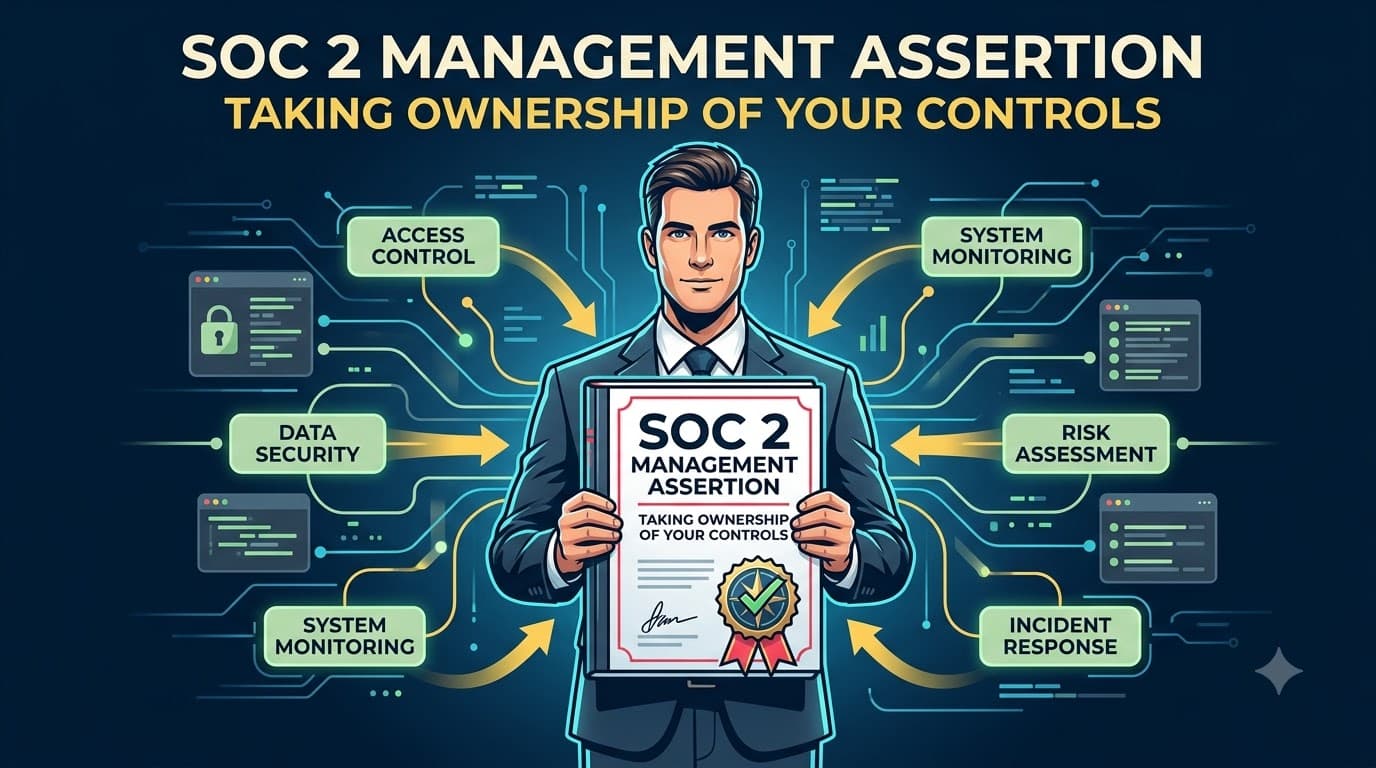
Elena Marsh had been VP of Engineering at Kestrel Ledger for three years when the email from Sales landed in her inbox on a Tuesday morning in March. Subject line: "RE: Meridian Trust — blocked on SOC 2." Kestrel Ledger builds ledger-reconciliation software for mid-market banks — the unglamorous plumbing that lets a $4 billion regional bank close its books at night without three analysts reconciling spreadsheets until 2 a.m. Meridian Trust, a fifty-branch bank holding company, had been circling a $2.4 million multi-year contract for months. Procurement had one non-negotiable gate left: a clean SOC 2 Type II report, no exceptions, no "we're working on it."
Elena had shepherded the engineering side of the audit for eleven months — access reviews, change management logs, encryption standards, the works. She assumed the finish line was mostly hers to cross. Then her company's fractional CFO, Sarah Lindqvist, forwarded her a draft document from their audit firm titled "Management's Assertion" and asked a question that stopped Elena cold: "Who's actually supposed to write this, and whose name goes on it?"
Elena had assumed — the way most technical leaders do — that this was boilerplate the auditors would draft, Kestrel would rubber-stamp, and everyone would move on. She was wrong, and the gap between what she assumed and what was actually true turned into a three-week detour that nearly cost Kestrel Ledger the Meridian deal. The management assertion is not a cover page. It is a formal, signed statement — usually from the CEO and CFO personally — in which the company's own leadership claims ownership of the system description and the controls protecting it. Get it wrong, sign it carelessly, or let someone else write it without real scrutiny, and you have created an accountability problem that outlives the audit itself.
This article exists because I have watched this exact scene play out in some form at a dozen-plus companies over fifteen years of consulting: a technical leader discovers, later than they should, that a document they assumed was administrative is actually the single place where their organization's most senior executives put their names behind a claim about the truth of their own controls.
Who This Is For, and What You'll Walk Away With
This is written for the people who will eventually have to sign, co-sign, or defend a SOC 2 management assertion — CEOs, CFOs, CISOs, VPs of Engineering, General Counsel, and the compliance/GRC leads who assemble the underlying evidence. You will walk away understanding exactly what the assertion legally and professionally represents, who should draft it versus who must sign it, how it differs from the system description and the auditor's opinion, and the specific mistakes that turn a routine attestation cycle into a scramble ten days before fieldwork. I will also give you a practical playbook — a drafting timeline, a RACI matrix, and a review checklist — you can hand to your own team this week.
What the Management Assertion Actually Is
Strip away the formality and the management assertion is a short, dense document — usually two to four pages — in which a service organization's leadership makes three claims in writing: that the system description is presented fairly, that the controls were suitably designed to meet the criteria the company committed to, and, for a Type II report, that those controls actually operated effectively across a defined stretch of time. It sits inside the finished SOC 2 report as its own numbered section, distinct from the narrative description of the system and distinct from the auditor's independent opinion.
What makes the assertion unusual, compared to most compliance paperwork a growing company produces, is that it is written in the first person plural — "we" — and it is signed by named individuals who are personally representing that the claims are true. It is not a checklist. It is not a policy. It is a sworn-in-spirit statement of fact, and every other artifact in the SOC 2 report exists to either support it or test it.
I tell clients to think of the assertion as the thesis statement of the entire audit. The system description is the evidence and argument. The auditor's opinion is the grade. But the thesis — the actual claim being examined — comes from management, not from the CPA firm, and not from the engineering team that built the controls.
Where It Sits in the Report: Section II, in Context
A finished SOC 2 report is not one document conceptually — it is four, bound together, each with a different author and a different job. Understanding where the assertion sits, and who is accountable for each surrounding piece, is the first thing I walk clients through before we ever discuss drafting.
Section | Common Name | What It Contains | Who Authors It |
|---|---|---|---|
Section I | Independent Service Auditor's Report | The CPA firm's opinion — unqualified, qualified, adverse, or disclaimer — on whether the assertion is fairly stated | The CPA/audit firm |
Section II | Management's Assertion | Management's written claim that the system description is fair and controls are suitably designed (and, for Type II, operated effectively) | Service organization's management (drafted with GRC/legal support) |
Section III | Description of the System | The narrative description of the system, its boundaries, components, and the Trust Services Criteria in scope | Service organization's management, typically with heavy GRC/compliance drafting support |
Section IV (Type II only) | Description of Tests of Controls and Results | The auditor's detailed test procedures and results for each control | The CPA/audit firm |
Notice the pattern: Sections I and IV belong to the auditor. Sections II and III belong to management. The auditor's role is to examine what management put in Sections II and III and render an opinion on it — not to originate the claims themselves. That distinction is the single most misunderstood fact about the entire SOC 2 process, and it is where Kestrel Ledger's three-week detour began.
Whose Job Is It, Really? Management vs. Auditor
Here is the sentence I say out loud in almost every SOC 2 kickoff call: your auditor does not attest that your system works the way you say it does — they attest that they examined your assertion about it and reached an independent opinion. That is a subtle distinction with enormous practical weight. An attestation is not the auditor vouching for the underlying truth of your environment from personal knowledge; it is the auditor's professional opinion, formed through evidence and testing, on whether your claim is fairly stated.
This is exactly backwards from how most engineering and product leaders instinctively think about audits. They picture the auditor as the one making claims — "the auditor said we're secure." In reality, the AICPA's attestation standards put the burden of the claim on management. The auditor examines, tests, and opines. Management asserts. If nobody inside the company steps up to own that assertion with real conviction, the entire audit rests on a foundation nobody actually built.
Dana Okafor, a partner at a fictional regional CPA firm I'll reference throughout this piece, put it to me this way during a case I consulted on:
"I've had founders ask me to 'just write the assertion the way it needs to be for a clean opinion.' I always say the same thing back: if I write your assertion, I've just eliminated the independence the entire report depends on. My job is to test what you claim, not to help you decide what to claim." — Dana Okafor, Partner, Okafor & Lee CPAs
That independence requirement is not a technicality — it is the entire reason a SOC 2 report has value to a customer reading it. If the auditor drafted the assertion and then opined on their own draft, the opinion would be worthless. The separation of author (management) from examiner (auditor) is what makes the report credible to the user entities — the customers — who will eventually read it.
What the Assertion Must Actually Claim
Every management assertion, regardless of company size or scope, has to make a small number of specific claims. Get the substance of these right and the rest of the document is largely formatting.
Claim One: The System Description Is Presented Fairly
Management must state that the system description — the narrative of what the system does, its boundaries, its components, and the commitments made to users — is presented fairly and in accordance with the description criteria the AICPA has established for this purpose. In practice, this means every material fact about how the system actually operates has to appear in the description, and nothing in the description can overstate or misrepresent reality. If your system description says all production access requires multi-factor authentication and that is only true for 80% of production systems, the assertion claiming "fair presentation" is now false on its face.
Claim Two: Controls Were Suitably Designed
Second, management asserts that the controls described were suitably designed to provide reasonable assurance that the applicable Trust Services Criteria would be met, if the controls operated effectively. This claim about design applies to both a Type I and a Type II report — it is the baseline claim every SOC 2 assertion makes, regardless of report type.
Claim Three: Controls Operated Effectively (Type II Only)
Third — and only for a Type II report — management asserts that the controls actually operated effectively throughout a specified period, commonly somewhere between three and twelve months. This is a materially heavier claim than design suitability. It is one thing to say "we built a lock." It is another to say "the lock was engaged, without exception or with only disclosed exceptions, every day for the last nine months." Type II assertions require management to have actually monitored their own controls closely enough, throughout the period, to make that statement honestly.
Assertion Component | What It Claims | Required for Type I | Required for Type II |
|---|---|---|---|
Fair presentation of system description | The narrative description accurately reflects the system as designed and implemented | Yes | Yes |
Suitability of control design | Controls, as designed, would meet the applicable Trust Services Criteria if operating as intended | Yes | Yes |
Operating effectiveness over the period | Controls actually operated as designed throughout the specified audit period | No | Yes |
Identification of the audit period | The specific start and end dates the operating-effectiveness claim covers | No (point-in-time date only) | Yes |
Disclosure of significant changes | Any material changes to the system or controls during the period are disclosed | Rarely applicable | Yes |
Three Artifacts, Not One: Assertion vs. Opinion vs. System Description
I want to name the single most common mix-up I encounter, because I have seen it derail otherwise well-prepared companies: people conflate the assertion, the opinion, and the system description as if they were interchangeable pieces of "the SOC 2 paperwork." They are three distinct artifacts, written by two different parties, serving three different purposes, and confusing them leads to real errors — like a CEO signing off on language they think is the auditor's professional judgment when it is actually their own company's claim.
Artifact | Author | Purpose | Where It Lives |
|---|---|---|---|
Management Assertion | Service organization's management (CEO/CFO typically) | States management's own claim about the fairness of the description and the design/effectiveness of controls | Section II |
System Description | Service organization's management | Narrates what the system is, its boundaries, and its Trust Services Criteria commitments | Section III |
Independent CPA firm | States the auditor's independent conclusion on whether the assertion is fairly stated, based on evidence | Section I |
The relationship is sequential and dependent: management writes the description, management asserts that the description and controls are what they claim, and only then does the auditor examine that assertion and issue an opinion on it. If any one of the three is drafted by the wrong party, or reflects claims the others don't support, the entire report loses coherence — and a sophisticated customer's security team, reading the report during due diligence, will catch it.
Who Signs It in Practice
The assertion is not signed by whoever happens to run the compliance program. It has to be signed by someone with actual authority over the system being examined — which almost always means the CEO, the CFO, or both, sometimes joined by a CISO, CTO, or VP of Compliance as a co-signer. A security engineer, a compliance analyst, or even a VP of Engineering typically cannot sign alone, because the assertion is a claim about the entire system and the organization's overall control environment — not just the technical controls one department owns.
Typical Signer | Why They Qualify | Common Alternate/Co-Signer |
|---|---|---|
CEO | Ultimate accountability for the organization and its representations to customers and auditors | COO, President |
CFO | Financial and operational authority; frequently owns the vendor/customer contractual relationship tied to the report | VP of Finance, Controller |
CISO/CTO | Direct authority over the technical control environment described in the system description | VP of Security, VP of Engineering |
VP of Compliance/GRC | Owns the evidence program and cross-functional coordination, occasionally co-signs at larger organizations | Head of Risk |
Auditors push for a senior signer — not out of formality, but because the assertion has to come from someone who can actually speak for the whole organization. A security engineer can tell you whether a specific access control worked. Only an executive with cross-functional authority can credibly claim the entire system description is fairly presented and the entire control environment was suitably designed. That requirement is what turns the assertion from a formality into an accountability event — the CPA firm is deliberately forcing a person with real organizational power to put their name on the line.
Sarah Lindqvist, Kestrel Ledger's CFO, described the moment she understood this to me directly:
"I'd signed plenty of financial representations before. The first time I read a SOC 2 assertion draft, I realized it was asking me to personally vouch for things happening in engineering standups I'd never sat in on. That's when I stopped treating it as paperwork and started treating it as due diligence." — Sarah Lindqvist, CFO, Kestrel Ledger
The Accountability Weight of a Signature
Signing the assertion is a formal representation — to the CPA firm conducting the examination, and indirectly to every user entity (every customer, prospect, or partner) who will eventually read the finished report. It is important to be precise about what kind of weight this carries, because SOC 2 is not a law or a regulation, and the assertion is not a criminal filing. But "not a statute" does not mean "no consequences."
A knowingly false, careless, or unsupported assertion exposes the signer and the organization to real reputational, contractual, and professional-liability risk. If a customer relies on a SOC 2 report showing an unqualified opinion, then discovers the underlying assertion was signed without genuine knowledge of significant control gaps, that customer has grounds to view the relationship — and any contract built on it — as compromised. Some enterprise contracts explicitly reference the SOC 2 report as a warranted representation; a materially false assertion in that context can become a contractual breach, independent of any dispute with the audit firm itself.
Priya Chandrasekaran, General Counsel at a fictional healthcare analytics company I've advised on similar issues, framed the exposure clearly:
"Executives sometimes think the audit firm carries the liability if something in the report turns out to be wrong. That's backwards. The auditor is liable for the quality of their examination. Management is liable for the truth of what they represented. If you sign an assertion you haven't actually verified, you've created personal and corporate exposure that has nothing to do with the audit firm's malpractice insurance." — Priya Chandrasekaran, General Counsel, Vireo Health Analytics
I am deliberately not framing this as a criminal-law issue, because it isn't one — SOC 2 carries no statutory force. But the professional and contractual consequences are real enough that I tell every executive the same thing before they sign: read every sentence, and if you cannot personally defend a claim under questioning, do not sign until you can.
Scenario | Likely Consequence |
|---|---|
Assertion signed without genuine review of underlying evidence | Auditor findings surface gaps late, jeopardizing the audit timeline and the signer's credibility with the board |
Assertion overstates control maturity relative to the system description | Report internally inconsistent; sophisticated customers flag it in due diligence, damaging trust |
Known control gap omitted from the assertion and description | If discovered post-report, exposes the organization to breach-of-contract claims from customers who relied on the representation |
Assertion signed by someone without real organizational authority | Auditor may reject the signature as insufficient, delaying report issuance |
Assertion not updated after a significant mid-period change (e.g., new subservice organization) | Report becomes materially inaccurate; may require reissuance or a bridge letter explaining the gap |
Careless/rushed assertion leads to a qualified opinion | Sales cycles stall on the qualified report; competitive deals may be lost to cleaner competitors |
How the Assertion Ties to the System Description
The assertion and the system description have to agree with each other in every material respect, because the assertion is, functionally, management's promise that the description is accurate. Every specific claim in the assertion — "controls were suitably designed to meet the Security criteria" — has to be backed by content that actually exists in the description. If the assertion claims encryption controls were in place and the description never mentions encryption, an auditor examining the assertion will flag the inconsistency immediately, and rightly so.
This is where I see the most avoidable friction in real engagements. Teams draft the system description first (often over months, iteratively, with GRC leading and engineering contributing details), and then treat the assertion as an afterthought — a two-page cover note bolted on at the end. That ordering is backwards in terms of scrutiny. Because the assertion is the shorter document, it gets less review time even though it is the document with a named signer's personal accountability attached. I now insist that whoever signs the assertion reads the entire system description line by line before signing — not a summary, not a GRC-prepared abstract, the actual document — specifically to verify that every claim they are about to make in the assertion is backed by something concrete in the description.
How the Assertion Ties to the Auditor's Opinion
The auditor's opinion is, in the most literal sense, the CPA firm's conclusion about whether management's assertion is fairly stated. The auditor does not independently write a competing description of your system; they test the specific claims management already made and then state whether the evidence supports those claims. A clean, unqualified opinion means the auditor found the assertion to be fairly stated in all material respects. Anything short of that — qualified, adverse, or a disclaimer of opinion — means the auditor found the assertion could not be fully supported by the evidence they gathered, governed by the AT-C sections of SSAE 18.
This dependency is why I tell clients the assertion is not something you finalize and then hope the evidence matches. It has to be the other way around: gather and validate the evidence first, then write an assertion that the evidence actually supports. Assertions drafted aspirationally — describing the control environment you're building toward rather than the one you actually have — are the single most common cause of a downgraded opinion I've seen in over a decade of these engagements.
Auditor's Ultimate Opinion | What It Means for the Assertion | Typical Consequence for the Organization |
|---|---|---|
Unqualified (clean) | Assertion was fairly stated in all material respects; evidence fully supported every claim | Report usable as intended in sales/procurement; no caveats |
Qualified | One or more specific exceptions found; assertion was fairly stated except for identified items | Report still usable but requires explanation to prospects; some deals stall or require compensating assurances |
Adverse | Material misstatement(s) found; assertion not fairly stated overall | Report largely unusable for sales purposes; significant remediation and re-audit typically required |
Disclaimer of opinion | Auditor could not gather sufficient evidence to form an opinion (often a scope limitation) | Report effectively incomplete; usually requires a new examination period once the limitation is resolved |
Type I vs. Type II — What Changes in the Assertion
The assertion's substance shifts meaningfully between report types, and I've found that leadership teams moving from a first Type I report to their first Type II are consistently surprised by how much more the assertion is asking of them the second time around.
Element | Type I Assertion | Type II Assertion |
|---|---|---|
Claim about design | Controls suitably designed as of a specific date | Controls suitably designed throughout the period |
Claim about operation | Not required | Controls operated effectively throughout the specified audit period |
Date specificity | A single "as of" date | An explicit start date and end date for the period covered |
Evidence burden behind the claim | Point-in-time documentation and walkthroughs | Continuous evidence — logs, tickets, access reviews — spanning the entire period |
Disclosure of exceptions | Rare (design either exists or doesn't) | Common — management must disclose known deviations during the period, even if remediated |
Practical difficulty of signing honestly | Lower — a snapshot in time is easier to verify | Higher — requires confidence that controls held for months, not just at one moment |
If you're still deciding which report type your organization needs in the first place, our companion article on choosing between Type I and Type II walks through that decision in depth — it's worth reading before you get anywhere near assertion drafting, since the type you choose determines exactly how much your signers are being asked to claim. For our fictional Kestrel Ledger, the shift from a first-year Type I to the Type II report Meridian Trust required was exactly where the difficulty concentrated. It's one thing to say "our access review process exists and is designed correctly." It's another to say, with your name on it, "that access review process ran on schedule every single month for nine straight months, with no unremediated exceptions." That second claim requires actual operational discipline, not just documentation.
From Assertion to Opinion: How the Process Actually Flows
The relationship between drafting, examination, and opinion is sequential, and I find a visual makes the dependency click faster than any explanation:
flowchart LR
    A["Management drafts system description"] --> B["Management prepares & signs written assertion"]
    B --> C["CPA firm performs examination (Type I: design only / Type II: design + operating effectiveness over period)"]
    C --> D{"Auditor evaluates evidence against assertion"}
    D -->|"Assertion fairly stated, no exceptions"| E["Unqualified (clean) opinion"]
    D -->|"Some exceptions noted"| F["Qualified opinion"]
    D -->|"Material misstatement"| G["Adverse opinion"]
    D -->|"Scope limitation"| H["Disclaimer of opinion"]
    E --> I["Final SOC 2 report issued: opinion + assertion + system description (+ tests of controls for Type II)"]
    F --> I
    G --> I
    H --> I
Every box on the left belongs to management. Everything from the diamond onward belongs to the auditor. The report that finally lands in a customer's inbox is the product of both halves working in sequence, never in parallel, and never with the auditor filling in management's half.
Preparing the Assertion: The Drafting Process
Good assertion drafting is not a writing exercise — it's an evidence-reconciliation exercise that happens to end in a written document. I run it as a distinct workstream, separate from (but dependent on) the system description drafting, with its own review gates. The process I use with clients has four stages: gather the underlying evidence for every claim you intend to make; draft the assertion language against that evidence, not against aspiration; circulate it for cross-functional review by people who can actually challenge it; and only then send it to the auditor — for review of fair presentation and consistency, never for drafting.
That last point is worth repeating because it's the mistake I see most often: bringing the auditor in too early, as a drafting resource rather than a review resource. Auditors are usually happy to comment on whether language is clear or consistent with typical report language. They should never be the ones originating the substantive claims. If they are, you've compromised the independence that gives the report its value, and — more practically — you've let someone outside your organization define what your own leadership is claiming to be true.
None of this works without a solid evidence base to draft from, which is really an extension of good pre-audit preparation. If your organization hasn't yet run a structured readiness assessment to identify gaps before fieldwork, that's the step that should precede assertion drafting, not run in parallel with it — trying to draft an honest assertion while gaps are still being discovered is how organizations end up in Northbridge Payments' position.
Who Should Be in the Room
Assertion drafting is not a solo exercise for the compliance lead, and it is not purely an executive exercise either. It needs represented voices from across the organization, each catching different classes of error.
Role | What They Contribute |
|---|---|
Legal / General Counsel | Reviews language for contractual and liability exposure; checks alignment with customer contract representations |
Compliance / GRC lead | Owns the evidence mapping — confirms every assertion claim has a corresponding, verifiable control artifact |
Engineering / Security leadership | Validates technical claims (encryption, access control, change management) against what's actually deployed, not what's planned |
Finance leadership (CFO) | Reviews financial and operational claims, and is frequently the final or co-signer |
CEO | Final accountability; must personally understand and be able to defend every claim before signing |
Auditor (CPA firm) | Reviews the finished draft for fair presentation and consistency with the description — does not originate claims |
I've sat in these review sessions more times than I can count, and the pattern that produces a strong assertion is always the same: someone from engineering pushes back on language that oversells a control's maturity, someone from legal flags a phrase that's broader than the evidence supports, and the CEO asks the blunt question — "can I actually stand behind this if a customer's security team calls me directly?" If nobody in the room is willing to ask that question, the review isn't doing its job.
Review Cycles and Timeline Before Fieldwork
Assertion drafting should not be compressed into the final week before fieldwork begins — and yet that is exactly when I most often see companies start it, treating it as a formality to knock out once the "real" work (evidence collection) is done. It deserves its own runway, ideally starting six to eight weeks ahead of fieldwork for a first-time Type II, less for a mature repeat engagement.
Weeks Before Fieldwork | Milestone | Primary Owner |
|---|---|---|
8 weeks | Kick off evidence-to-claim mapping; identify any control gaps that would undermine a planned claim | GRC/Compliance lead |
6 weeks | First draft of the assertion, built directly from validated evidence | GRC/Compliance lead, with Engineering/Security input |
5 weeks | Cross-functional review round 1 (Legal, Engineering, Finance) | Legal + Engineering leadership |
4 weeks | Remediate any flagged gaps or overstated claims; revise draft | Engineering/Security, GRC |
3 weeks | Cross-functional review round 2; CEO/CFO read-through of full system description alongside the assertion | CEO, CFO |
2 weeks | Auditor review pass for fair presentation and consistency (not drafting) | Auditor, GRC lead |
1 week | Final revisions incorporated; signatures collected | CEO, CFO (and co-signers) |
Fieldwork start | Signed assertion delivered to auditor as the basis for examination | CEO/CFO (signed), Auditor (receiving) |
Compressing this timeline is the single most common root cause of the "we found something ten days before fieldwork" scenario I'll walk through later in Northbridge Payments' case study. Six to eight weeks feels like a long runway when you first schedule it. It rarely feels like enough once cross-functional review actually starts surfacing real questions.
Preparation Step | Owner | Timing Before Fieldwork |
|---|---|---|
Map every intended assertion claim to specific, named evidence artifacts | GRC/Compliance lead | 8 weeks |
Confirm signer(s) have organizational authority over the full system in scope | CEO/CFO, Legal | 8 weeks |
Draft assertion language directly from validated evidence, not aspiration | GRC/Compliance lead | 6 weeks |
Cross-check every assertion claim against the system description for consistency | GRC/Compliance lead, Engineering | 5 weeks |
Circulate for legal and financial liability review | Legal, CFO | 5 weeks |
Remediate any control gaps discovered during review before finalizing claims | Engineering/Security leadership | 4 weeks |
Conduct a full read-through by the intended signer(s) | CEO, CFO | 3 weeks |
Send to auditor for fair-presentation review only | GRC lead | 2 weeks |
Collect final signatures | CEO, CFO (and co-signers) | 1 week |
Reconfirm no material system changes occurred since drafting | GRC lead | Day of delivery |
Common Mistakes Organizations Make
After fifteen years of watching companies go through this process, I could write the mistakes list from memory, and I mostly have. A few show up over and over, across companies of every size.
Mistake | Why It Matters | Fix |
|---|---|---|
Letting the auditor draft the assertion and just signing it | Compromises auditor independence; signer may not truly understand what they're claiming | Draft internally from evidence; use the auditor for review only |
Rubber-stamping without reading the full system description | Signer can't verify consistency between the assertion and the description they're vouching for | Require the signer to read the entire description before signing |
Vague or boilerplate language copied from a template | Doesn't reflect the organization's actual controls; can look evasive to sophisticated customers | Tailor every claim to the organization's real, current control environment |
Signing before known control gaps are remediated | Creates a false or overstated claim that the auditor's testing will likely surface anyway | Remediate first, or explicitly and accurately disclose the gap in the assertion/description |
Wrong signer — someone without real organizational authority | Auditor may reject it; undermines the accountability the assertion is meant to create | Confirm signer authority (CEO/CFO or equivalent) early in planning |
Not updating the assertion after a scope or period change | Report becomes materially inaccurate for the actual period/scope examined | Re-issue or formally revise the assertion whenever scope, subservice organizations, or the period changes |
Treating it as a one-time task instead of a recurring discipline | Each renewal cycle repeats the same last-minute scramble | Build assertion review into the annual audit calendar as a standing workstream |
Mismatches between assertion claims and system description content | Creates internal inconsistency an auditor — or a customer's security reviewer — will catch | Cross-check every claim against specific description content before finalizing |
What Happens When the Auditor Disagrees With the Assertion
Sometimes management drafts an assertion in good faith, and the auditor's testing simply doesn't support every claim. This isn't a failure of process — it's exactly what the examination is designed to catch. What happens next depends on how significant the gap is and how it's handled.
If the auditor identifies a narrow, well-documented exception — say, one quarter where an access review ran two weeks late — the typical outcome is a qualified opinion: the auditor states the assertion is fairly presented except for the specific item. This is manageable and common, especially in first Type II cycles. If the gap is broader or touches a criterion central to the report's purpose — say, encryption controls that were claimed but not actually enforced — the auditor may issue an adverse opinion, meaning the assertion is not fairly stated in a material respect. And if the auditor simply cannot gather enough evidence to reach a conclusion at all (a scope limitation, missing records, or a client who restricts access mid-engagement), the result is a disclaimer of opinion.
In practice, a well-run engagement rarely reaches an adverse opinion or a disclaimer, because a competent auditor flags emerging disagreements well before the report is finalized — often during fieldwork itself, once testing starts contradicting a specific claim. This is why the review cycle described earlier matters so much: the earlier a mismatch between claim and evidence surfaces, the more options management has — remediate the control, narrow the claim, or, if necessary, adjust the assertion language itself before it becomes a documented exception in a final report a customer will read.
Practical Accountability: A RACI View
Getting from "we need a signed assertion" to an actual, defensible, signed document is a cross-functional effort, and I've found that naming the roles explicitly — even informally — prevents the last-minute scramble I see in unprepared organizations.
Task | Legal | GRC/Compliance | Engineering/Security | Finance | CEO | Auditor |
|---|---|---|---|---|---|---|
Map assertion claims to evidence | Consulted | Responsible | Consulted | Informed | Informed | Informed |
Draft initial assertion language | Consulted | Responsible | Consulted | Consulted | Informed | Informed |
Validate technical control claims | Informed | Consulted | Responsible | Informed | Informed | Informed |
Review for legal/contractual exposure | Responsible | Consulted | Informed | Consulted | Informed | Informed |
Remediate flagged control gaps | Informed | Consulted | Responsible | Informed | Informed | Informed |
Final read-through before signing | Consulted | Consulted | Consulted | Accountable | Accountable | Informed |
Review for fair presentation/consistency | Informed | Consulted | Informed | Informed | Informed | Responsible |
Sign the assertion | Informed | Informed | Informed | Accountable | Accountable | Informed |
Examine the signed assertion | Informed | Informed | Informed | Informed | Informed | Responsible |
How This Compares to ISO 27001's Management Review and SoA Sign-Off
If your organization is also pursuing ISO 27001 — and a growing number of Kestrel Ledger's competitors were doing exactly that to serve European mid-market banks — the management assertion has a rough conceptual cousin: the ISO 27001 management review, combined with leadership's sign-off on the Statement of Applicability (SoA). Both mechanisms exist to force senior leadership to formally, personally engage with the state of the control environment rather than delegate it entirely to a compliance function.
The mechanisms aren't identical. ISO 27001's management review is a recurring governance activity — a documented meeting where leadership evaluates the information security management system's performance, typically at least annually, and is not a discrete signed claim submitted to an external examiner in the same way a SOC 2 assertion is. The SoA sign-off is closer in spirit: it's leadership formally endorsing which controls are in scope and why. But neither one asks a named executive to make a legally-flavored representation to an independent third party the way the SOC 2 assertion does. If you're weighing both frameworks, it's worth reading how the two compare more broadly in ISO 27001 vs. SOC 2: which one do you need, and if you're pursuing both simultaneously — as Kestrel Ledger eventually did — the practical playbook for running ISO 27001 and SOC 2 together is worth reviewing before you build parallel evidence programs that could otherwise be shared.
I mention this cross-pillar comparison because I frequently get asked, by boards especially, "don't we already do this under ISO 27001?" The honest answer is: you do something adjacent, and it's valuable, but it doesn't substitute for the SOC 2 assertion's specific, signed, externally-examined claim.
Case Study: How Kestrel Ledger Closed the Meridian Deal
Back to Elena Marsh and the email that started this article. Once Sarah Lindqvist realized the assertion wasn't the auditor's document to write, Kestrel Ledger paused its planned two-week "final review" and restructured it into the full six-week process described above — starting from an honest evidence-to-claim mapping rather than the auditor's boilerplate draft.
The mapping exercise surfaced a real problem: the draft description claimed quarterly access reviews across all production systems, but evidence showed one legacy reconciliation service — inherited from a small acquisition eighteen months earlier — had only had two reviews completed, not four, during the nine-month audit period. Elena's engineering team spent an intense ten days closing the gap: completing the missing reviews, documenting the remediation, and working with GRC to decide how to characterize the deviation honestly in both the description and the assertion rather than quietly smoothing it over.
The added review and remediation cycle cost Kestrel Ledger roughly three weeks against their original internal timeline. Sarah Lindqvist and the CEO delayed their signatures twice — once to demand more evidence on the access-review gap, once to confirm the remediation language was accurate — before finally signing. The resulting report carried a clean, unqualified opinion, with the access-review deviation disclosed honestly and shown as remediated within the period. Meridian Trust's security review team specifically called out, in their vendor risk notes, that the disclosed-and-remediated item gave them more confidence in the report than a suspiciously spotless one would have. The $2.4 million contract closed five weeks later than Kestrel's original sales forecast — but it closed, and Sarah later told me the delay was the cheapest insurance policy the company had ever bought.
Elena summarized the lesson in a way I now use verbatim with other engineering leaders:
"I used to think the assertion was the last box to check. It's actually the first place your leadership finds out whether they can defend what engineering has been telling them all year. We got lucky that we found our gap before the auditor did, not after." — Elena Marsh, VP of Engineering, Kestrel Ledger
Case Study: Northbridge Payments Refuses to Sign
Not every organization gets Kestrel Ledger's runway. Northbridge Payments, a fictional payments-processing company I'll use as our second case, discovered its problem far later — about ten days before fieldwork was scheduled to begin, well inside the danger zone this article has been warning about.
Marcus Webb, Northbridge's CISO, had assumed the assertion drafting was proceeding in parallel with evidence collection, delegated to a compliance analyst who had, in good faith, based the draft largely on the intended state of several controls rather than their actual, current state. When the CEO sat down for the mandatory pre-signing read-through, he asked a question nobody could immediately answer: could the team actually prove that privileged access reviews had been happening monthly, as the draft assertion claimed, for the full period? The honest answer, once GRC dug in, was no — reviews had been happening, but inconsistently, with two months skipped entirely during a leadership transition.
Northbridge's CEO refused to sign. That refusal triggered an emergency two-week remediation sprint: closing the missed reviews retroactively where possible, documenting the gap transparently where retroactive closure wasn't credible, and pushing fieldwork back by three weeks to allow the corrected evidence to be in place. The delay put a $1.1 million renewal at risk with their largest processing client, who had set a hard deadline tied to their own internal risk committee calendar. Northbridge ultimately delivered the report nine days after the client's deadline, with an honest disclosure of the corrected gap, and — critically — avoided what would very likely have been a qualified opinion had the original, unverified assertion language gone to the auditor unchallenged.
Marcus Webb doesn't sugarcoat what that sprint cost:
"We spent about $40,000 in contractor and overtime costs closing that gap in two weeks that should have taken us a normal sprint over six. But the alternative was my CEO signing a claim he couldn't back up, in writing, to an outside examiner. I'll take the $40,000 every time." — Marcus Webb, CISO, Northbridge Payments
Case Study: Lumen Data Systems Learns the Hard Way
Our third case is a cautionary tale without a last-minute save. Lumen Data Systems, a fictional early-stage startup, was moving fast toward its first SOC 2 Type II and treated the assertion almost exactly the way Elena Marsh initially assumed she could: as a document the audit firm would draft and the founder would sign.
Ben Ostrander, Lumen's founder and CEO, signed a version of the assertion that had been drafted almost entirely by the audit firm's staff, with only a cursory internal review — no cross-functional legal or engineering read-through, no evidence-to-claim mapping exercise. During fieldwork, the auditor's own testing turned up exactly the kind of inconsistency that a proper internal review would have caught beforehand: the assertion (and the description behind it) claimed encryption at rest was enforced across all customer data stores, but testing found one analytics data store, added during a rapid feature build six months into the period, that stored a subset of customer data unencrypted. Because nobody at Lumen had cross-checked the claim against current reality before signing, this surfaced as an auditor-identified exception rather than a management-disclosed item — a meaningfully worse outcome.
The result was a qualified opinion. Lumen's largest prospect at the time, a healthcare data platform evaluating Lumen as a subprocessor, put the deal on hold pending remediation and a follow-up report. Ben estimates the qualified opinion cost Lumen roughly four months of delayed revenue recognition on that deal (worth an estimated $340,000 in year-one value) plus close to $60,000 in remediation and re-audit costs to fix the encryption gap and commission an updated examination period.
Ben was candid with me about where the process broke down:
"I thought signing the assertion was like signing an NDA — you read it, it looks standard, you sign. I didn't understand I was making a specific factual claim about our own infrastructure that nobody on my team had actually verified line by line. That one blind spot cost us more than the entire audit did." — Ben Ostrander, Founder/CEO, Lumen Data Systems
Lessons Across the Three Case Studies
Company | What Happened | Root Cause | Quantified Outcome |
|---|---|---|---|
Kestrel Ledger | Cross-functional review caught an access-review gap before fieldwork; disclosed and remediated | Evidence-to-claim mapping done properly, ahead of schedule | ~3-week delay; $2.4M deal closed with unqualified opinion |
Northbridge Payments | CEO refused to sign until a privileged-access review gap was closed | Assertion drafted from intended state, not verified actual state | ~3-week fieldwork delay; ~$40K remediation cost; avoided likely qualified opinion; $1.1M renewal preserved |
Lumen Data Systems | Auditor found an unencrypted data store the assertion claimed didn't exist | Auditor-drafted assertion signed without internal cross-check | Qualified opinion; ~4-month delay on a $340K deal; ~$60K remediation/re-audit cost |
The pattern across all three is the same: the cost of catching a gap before you sign is always smaller than the cost of an auditor — or worse, a customer — catching it after.
Management's Job vs. the Auditor's Job, Side by Side
It helps to see the division of labor laid out plainly, because so much confusion in this process comes from blurring these two columns.
Responsibility | Management | Auditor |
|---|---|---|
Draft the system description | Yes | No |
Draft the management assertion | Yes | No |
Design and operate the controls | Yes | No |
Gather evidence of control design and operation | Yes (with GRC support) | No (auditor gathers independently for testing, but doesn't create the underlying operational evidence) |
Test whether controls actually operated as claimed | No | Yes |
Form an independent opinion on the assertion | No | Yes |
Sign the assertion | Yes | No |
Sign the audit opinion | No | Yes |
Determine the report's Trust Services Criteria scope | Yes (in consultation with the auditor) | Advisory only |
Remediate identified control gaps | Yes | No |
If you find yourself unsure which column a task belongs in, a decent rule of thumb: anything that involves claiming something is management's job; anything that involves verifying a claim is the auditor's. For a deeper walkthrough of how the finished report itself is structured section by section, see our companion piece on SOC 2 report structure and the auditor's report.
Anatomy of a Sample Assertion, Clause by Clause
Reading an actual assertion for the first time can feel dense — dry, formal language covering a lot of ground in a short space. Breaking it into its component clauses makes the structure much easier to follow, and it's the exercise I walk every first-time signer through before they read the real document.
Sample Clause (Paraphrased) | Plain-English Meaning |
|---|---|
"We are responsible for designing, implementing, and operating effective controls..." | We built and run these controls — this isn't the auditor's system, it's ours |
"...within the accompanying description of the [company]'s system..." | This claim refers specifically to the system description bound into this same report |
"The description presents the system... that was designed and implemented throughout the period..." | The description is accurate for the whole audit period, not just at the end |
"...in accordance with the description criteria..." | We followed the AICPA's established standard for what a fair system description must include |
"The controls stated in the description were suitably designed to provide reasonable assurance that the applicable trust services criteria would be met..." | If the controls worked as designed, they would satisfy the criteria we committed to (Security, and any optional criteria in scope) |
"...if the controls operated effectively throughout the period." | This is the design claim — separate from whether they actually did operate that way |
"The controls operated effectively throughout the period [dates] to provide reasonable assurance that the applicable trust services criteria were met." | (Type II only) The controls didn't just exist on paper — they actually functioned, continuously, for the stated dates |
Notice how much of the clause structure is doing careful, deliberate work to separate the design claim from the operating-effectiveness claim, and to tie both explicitly to a specific, named period. That precision is not legal padding — it's the substance of what's being claimed.
Trust Services Criteria Referenced in the Assertion
The assertion's claims are always scoped to a specific set of Trust Services Criteria, and getting the scope right is a decision management makes well before drafting begins — it shapes exactly what the assertion is claiming suitability and effectiveness about.
Trust Services Criteria | Required or Optional | One-Line Description |
|---|---|---|
Security (Common Criteria) | Required in every SOC 2 report | Protects against unauthorized access, both logical and physical, using the Common Criteria (CC1–CC9), mapped to COSO's principles |
Availability | Optional, based on scope/commitments | Systems are available for operation and use as committed or agreed |
Processing Integrity | Optional, based on scope/commitments | System processing is complete, valid, accurate, timely, and authorized |
Confidentiality | Optional, based on scope/commitments | Information designated as confidential is protected as committed or agreed |
Privacy | Optional, based on scope/commitments | Personal information is collected, used, retained, disclosed, and disposed of in conformity with commitments |
For a full breakdown of how these criteria work individually and how the Common Criteria map to COSO's 17 principles, see SOC 2 Complete Guide: Understanding AICPA Trust Services Criteria. Kestrel Ledger's assertion, for context, covered Security and Confidentiality — Security because it's mandatory, and Confidentiality because reconciliation data for mid-market banks is contractually sensitive enough that Meridian Trust's procurement team specifically asked for it in scope.
Evidence Behind Every Claim
An assertion is only as strong as the evidence sitting behind each sentence of it. I require every client to build an explicit evidence map before drafting a single line — a working document, internal only, that pairs each intended claim with the specific artifacts that support it.
Assertion Claim | Supporting Evidence Type | Typical Owner |
|---|---|---|
Fair presentation of the system description | Architecture diagrams, policy documents, subject-matter interviews, prior audit reports | GRC/Compliance lead |
Suitable design of access controls | Access control policy, provisioning/deprovisioning workflow documentation, role definitions | Engineering/Security leadership |
Operating effectiveness of access reviews | Completed access review tickets/logs for every review cycle in the period | Engineering/Security leadership |
Suitable design and operation of change management | Change management policy, pull request/approval logs, deployment records | Engineering leadership |
Suitable design and operation of monitoring/logging | SIEM configuration, alert logs, incident response records | Security/SRE leadership |
Encryption claims (at rest/in transit) | Configuration exports, key management records, infrastructure-as-code definitions | Engineering/Security leadership |
Vendor/subservice organization oversight | Vendor risk assessments, subservice organization SOC reports, contracts | GRC/Compliance lead, Legal |
Employee security awareness | Training completion records, onboarding/offboarding checklists | HR, GRC/Compliance lead |
Disclosure of any significant control gaps or changes | Remediation tickets, incident postmortems, change logs tied to the specific gap | GRC/Compliance lead, Engineering leadership |
This map is what makes the six-to-eight-week drafting timeline realistic rather than aspirational. Once every claim is tied to a named, retrievable artifact, drafting the actual assertion language becomes closer to summarizing a already-verified fact set than composing something from scratch.
Auditor Procedures Used to Test the Assertion's Claims
Understanding what the auditor will actually do with your evidence map helps you prepare a stronger assertion, because you can anticipate the specific procedures that will test each claim.
Auditor Procedure | What It Verifies |
|---|---|
Inquiry (interviews with control owners) | Whether the described control matches how personnel say it actually operates day to day |
Inspection of documentation/artifacts | Whether policies, configurations, and records match the claims in the description and assertion |
Observation of a control in action | Whether a control operates as described when the auditor watches it happen |
Re-performance of a control | Whether the auditor, repeating the control's steps independently, reaches the same result |
Sampling of evidence across the period (Type II) | Whether a control operated consistently throughout the period, not just at isolated points |
System walkthroughs | Whether the system description's technical claims match the actual architecture |
Confirmation with third parties (e.g., subservice organizations) | Whether external claims about vendor controls or carve-out/inclusive treatment are accurate |
Every one of these procedures is, at its core, a test of whether management's assertion holds up against independent scrutiny. An assertion drafted directly from verified evidence sails through this testing. An assertion drafted from aspiration or auditor boilerplate — as Lumen Data Systems learned — does not.
The Assertion vs. Adjacent Artifacts
I get asked constantly how the SOC 2 management assertion compares to other "leadership sign-off" mechanisms companies encounter as they mature their compliance posture. It's worth being precise, because these are not interchangeable, even though they superficially resemble each other.
Artifact | Framework | Who Signs/Owns It | Externally Examined? | Publicly Distributable? |
|---|---|---|---|---|
SOC 2 management assertion | SOC 2 (SSAE 18) | CEO/CFO (senior management with authority over the system) | Yes — examined by an independent CPA firm, opinion issued | No — restricted-use report, typically shared under NDA with prospects/customers |
SOC 3 summary | SOC 2/3 (SSAE 18) | Same underlying management, but no detailed assertion presented in the public document | Based on an underlying SOC 2 examination | Yes — freely distributable, general-use "seal," no detailed test results |
ISO 27001 management review | ISO/IEC 27001 | Top management (as a recurring governance activity) | Reviewed by the certification body during audits, but not a discrete signed claim to an external examiner | No — internal governance record, referenced during certification audits |
ISO 27001 SoA sign-off | ISO/IEC 27001 | Top management endorses the Statement of Applicability | Reviewed by the certification body | No — internal document, summarized during audits but not typically shared externally in full |
The practical takeaway: a SOC 3 report is a good example of how not every artifact carries the same weight as the management assertion — it is explicitly a public-facing summary and does not include the detailed management assertion, system description, or test results the way the full SOC 2 report does. If a prospect asks for "the SOC 3," understand you're handing them a marketing-safe seal, not the document containing your leadership's signed claims. For the full family comparison, see SOC 2 vs SOC 1 vs SOC 3: Understanding the SOC Framework Family. And if you're weighing which framework's leadership-accountability model fits your organization's stage, the ISO 27001, SOC 2 & NIST CSF crosswalk is a useful reference for mapping obligations across frameworks side by side.
The Assertion as a Trust Signal, Not Just a Compliance Chore
I want to close on a reframe, because I think most executives approach the management assertion with the wrong mental model. They see it as a bureaucratic gate — one more signature standing between them and a closed deal. I'd argue the opposite: a carefully prepared, genuinely owned assertion is itself a competitive differentiator, and sophisticated buyers can tell the difference.
Enterprise security reviewers read a lot of SOC 2 reports. They notice when a system description and assertion are internally consistent, when disclosed exceptions are handled honestly rather than buried, and when the assertion language reads like it was written by people who actually understand their own environment rather than copy-pasted from a template. Meridian Trust's procurement team, in Kestrel Ledger's case study, said as much directly — a disclosed-and-remediated gap read as more trustworthy than a suspiciously perfect report. That's not a coincidence; experienced buyers have seen enough thin, aspirational assertions to develop an instinct for the real thing.
There's a second, quieter benefit: the discipline of preparing a defensible assertion forces genuine cross-functional alignment between engineering, legal, finance, and executive leadership on what your control environment actually is — not what anyone assumes it is. That alignment tends to outlast the audit cycle. Companies that treat assertion prep as a real governance exercise, rather than paperwork, consistently tell me their next renewal cycle is faster, because the muscle memory and the evidence trail are already there.
If you're heading into your first — or your fifth — assertion cycle and want a structured starting point, our SOC 2 Readiness Checklist and SOC 2 Control Matrix / RACI Template are built to support exactly this kind of cross-functional preparation before fieldwork begins.
Where This Leaves You
The management assertion is the moment your organization's leadership stops delegating security claims to engineering and compliance teams and personally, formally owns them. That's uncomfortable the first time — Elena Marsh, Sarah Lindqvist, Marcus Webb, and Ben Ostrander all discovered that discomfort at different points in their companies' audit cycles — but it's also exactly what gives a SOC 2 report its credibility with the customers reading it. An assertion nobody genuinely stood behind isn't worth much more than the paper it's printed on, and experienced buyers can tell the difference between a report backed by real ownership and one that was rubber-stamped under deadline pressure.
If your organization is heading toward its own audit cycle and you want a second set of eyes on your assertion drafting process before fieldwork locks in, PentesterWorld's SOC 2 practice works with service organizations on exactly this kind of pre-audit preparation. Start with our SOC 2 Policy Pack to see whether your underlying documentation would support the claims you're about to make, take the "Are You SOC 2 Ready?" quiz for a quick gut-check on your current posture, or work through our SOC 2 Report Reader's Guide with your executive team so every eventual signer understands exactly what they're reading before they pick up the pen.