Marcus Chen had read Lighthouse Payments' SOC 2 Type II report seventeen times before the auditor's engagement partner ever saw it. Clean. Unqualified. Zero exceptions across sixty-eight controls, eleven months of continuous evidence, a report he'd personally walked three different enterprise security teams through on video calls. Marcus is the VP of Security at Lighthouse Payments, a 90-person fintech SaaS company in Denver that reconciles daily payment data for mid-market retailers. The report had closed four deals in its first quarter alone. Then, on a Wednesday in March, it almost cost him the company's second-largest customer instead.
Cascadia Outdoor Co., a $40 million-revenue outdoor gear retailer that piped daily settlement data through Lighthouse's platform, had a security incident: someone had used a shared administrator credential — one login, five people, no individual accountability, never rotated in fourteen months — to access a reporting dashboard that exposed transaction-level data for roughly 3,000 customers before anyone noticed. Cascadia's incident response vendor traced the exposure back to Lighthouse's platform, and within a day Cascadia's VP of Risk was on the phone demanding an explanation: "Your SOC 2 report says you're secure. Explain how this happened."
Marcus pulled the report back up — not the summary page this time, but Section III, six paragraphs he'd skimmed past a dozen times without really reading. There it was, exactly where it had always been: "User entities are responsible for maintaining unique login credentials for each individual user and for periodically reviewing and revoking access no longer required." Lighthouse had built the access-control infrastructure — role-based permissions, session logging, forced credential-rotation prompts, an audit trail down to the API call. What Lighthouse could not do, and had never claimed to do, was force Cascadia's own IT team to actually assign one login per person instead of sharing a single "reporting-team" account across five people because provisioning five separate accounts felt like friction nobody had time for.
The report was still accurate. The opinion was still unqualified. And Cascadia was still furious, because nobody on their side had ever read — or been told to read — the eleven sentences in Section III that described exactly what Lighthouse expected them to do. That gap, between a clean audit opinion and an actual security outcome, is where this article lives. It's the gap that complementary controls exist to close, and it's the gap that costs real money: Cascadia's incident cleanup, forensic review, and customer notification ran to roughly $340,000 before the renewal conversation even started, and it very nearly happened because two companies read the same report and only one of them read it in full.
Who This Is For
This article is for two overlapping audiences who usually read a SOC 2 report from opposite ends of the table. If you're a service organization preparing for or maintaining a SOC 2 report, you'll walk away knowing how to define, word, and communicate the controls your own report quietly depends on your customers operating — so an auditor doesn't have to write them vaguely and a customer doesn't discover them during an incident. If you're a user entity evaluating or managing a vendor's SOC 2 report, you'll walk away with a concrete process for finding those same controls in Section III, translating them into your own control environment, and tracking them the same way you'd track any other risk your organization owns. Either way, you'll leave understanding why a vendor's clean opinion is not a finish line — it's a handoff, and complementary controls are the paperwork that tells you what's actually in your hands.
What Complementary User Entity Controls Actually Are
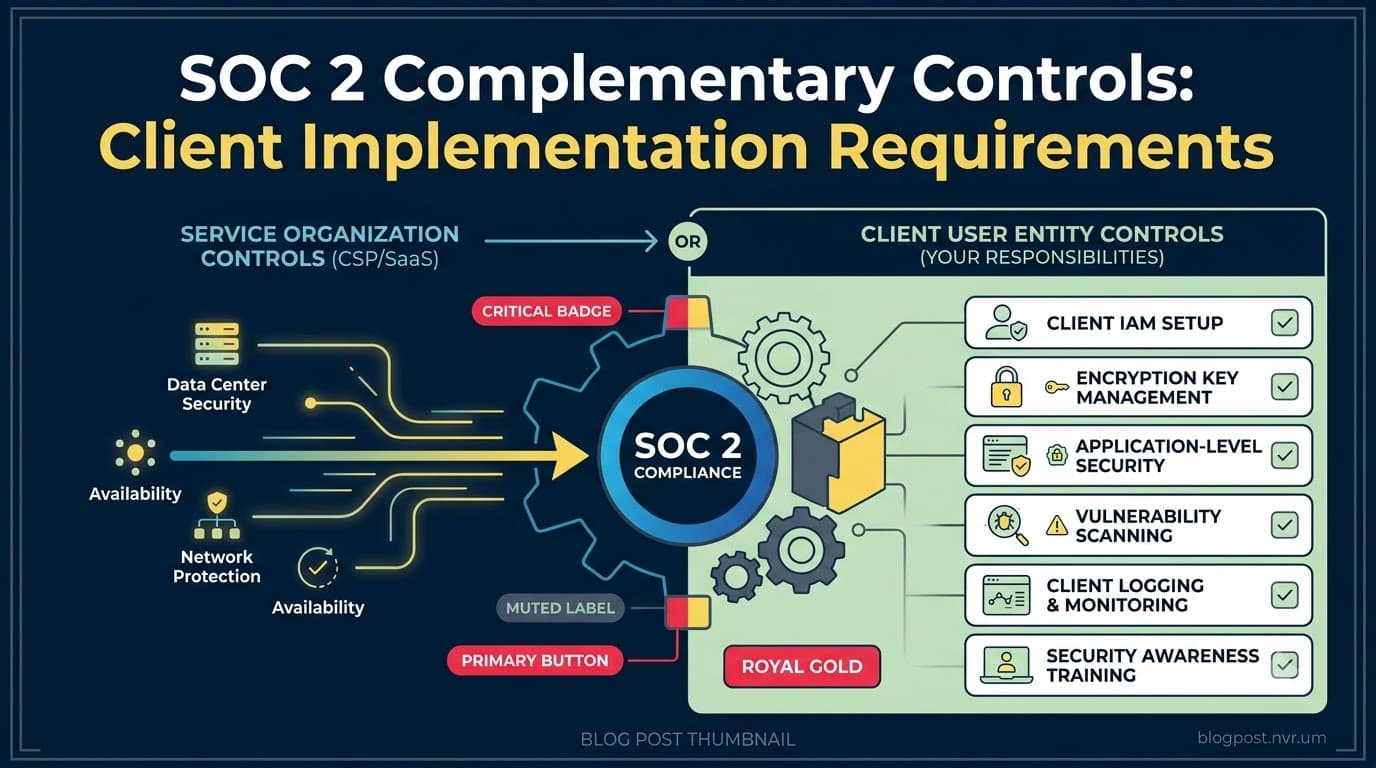
Complementary user entity controls — CUECs, pronounced "kwek" by almost everyone who works with them daily — are controls that a service organization's system description explicitly states the user entity (the customer) needs to operate for the Trust Services Criteria to actually be met. They are not suggestions, best practices, or a generic "please also be secure" disclaimer. They're specific, named assumptions baked into the design of the service organization's own controls — the customer-side half of a control that only works if both halves are present.
The Lighthouse example is the canonical case: Lighthouse's platform enforces access at the individual-account level, logs every action to the account that performed it, and can revoke access instantly on request. None of that works as a security control if the customer hands five humans one shared login. Lighthouse's control is real and well-designed; it simply cannot function without a customer-side control it doesn't own and can't enforce. That customer-side half — "maintain unique credentials, review access periodically" — is the CUEC.
CUECs show up because SOC 2 examines a service organization's control environment, not the customer's. An auditor testing Lighthouse's access controls can verify that Lighthouse's system supports unique logins, forces MFA, and logs revocations. The auditor has no authority to walk into Cascadia's office and test whether Cascadia's IT team actually assigned individual accounts — that's outside the audit scope entirely. So the report does the only honest thing available: it states the assumption plainly, in writing, so anyone relying on the report knows exactly where the service organization's responsibility ends and the customer's begins.
"I tell every client the same thing before their first SOC 2: your CUEC section is not legal boilerplate your lawyer adds at the end. It's the list of ways your product's security can still fail even when every one of your own controls passes testing. Write it like you mean it." — Renata Silva, Partner, Voss & Silva CPAs
What Complementary Subservice Organization Controls Actually Are
Complementary subservice organization controls — CSOCs — are the mirror image of CUECs, sitting on the opposite side of the service organization. Where a CUEC describes a control the customer must operate, a CSOC describes a control that a subservice organization — a vendor the service organization itself relies on, like a cloud infrastructure provider, a payment processor, or a data center operator — is assumed to operate.
CSOCs become relevant specifically under the carve-out method of handling subservice organizations. When a service organization carves out a subservice organization's controls — meaning the subservice organization's own control environment is excluded from direct testing in the service organization's report — the system description still has to account for the fact that the overall system depends on that vendor doing certain things correctly. Those assumed-but-untested controls are the CSOCs. A cloud-hosted SaaS company that carves out its infrastructure provider, for example, typically lists CSOCs like "the subservice organization maintains physical security over data center facilities" and "the subservice organization performs environmental monitoring and maintains redundant power" — things the SaaS company relies on completely but has no ability to test directly.
The practical difference between the two: a CUEC is a responsibility flowing downstream, from the service organization to its customer. A CSOC is a responsibility flowing upstream, from the service organization to its own vendor. Both exist for the identical underlying reason — no single party's SOC 2 report can test controls it doesn't own or operate — and both appear in the same section of the report, which is exactly why they get confused as often as they do.
CUEC vs. CSOC at a Glance
The two terms get mixed up constantly, usually because both start with "Complementary" and both live in the same paragraph of Section III. The table below is worth bookmarking; it's the single fastest way to keep them straight.
Table 1: CUEC vs. CSOC — Direction, Owner, and Purpose
Dimension | Complementary User Entity Control (CUEC) | Complementary Subservice Organization Control (CSOC) |
|---|---|---|
Who operates it | The customer (user entity) | The service organization's own vendor (subservice organization) |
Direction of reliance | Flows downstream — service org relies on the customer | Flows upstream — service org relies on its vendor |
Where it's disclosed | System description, typically its own labeled subsection | System description, typically alongside the carve-out disclosure |
Triggered by | Any control the service org's design assumes the customer completes | The carve-out method for a subservice organization |
Tested by the auditor? | No — outside the service org's audit scope, by definition | No — that's the entire point of a carve-out |
Who should be tracking it | The customer's own compliance/security/vendor-risk function | The service organization's vendor-risk or third-party-risk function |
Typical example | "User entities must configure MFA for their own users" | "The subservice organization maintains data center physical access controls" |
Consequence of it being unmet | Customer's own environment is exposed; service org's control design was still valid | Service org's system is exposed; may require inclusive-method testing or a switch of subservice organization |
Notice the pattern in the last two rows: in both cases, the party that wrote the report isn't the party left holding the risk if the complementary control fails. That's not a loophole — it's the entire structural reason complementary controls exist as a documented, named category rather than being silently assumed.
Why a Vendor's Clean SOC 2 Doesn't Cover Your Responsibilities
This is the sentence worth repeating to every stakeholder who treats a SOC 2 report as a checkbox: an unqualified opinion on a vendor's report means the vendor's own controls were suitably designed and, for a Type II report, operating effectively — it says nothing at all about whether your organization has done its part. Cascadia's incident happened inside a clean report, not despite one. Lighthouse's auditor's opinion was accurate on the day it was signed and remained accurate after the breach, because the auditor never tested — and had no basis to test — whether Cascadia assigned individual logins.
This is the single most common misreading of a SOC 2 report we encounter in vendor due diligence conversations: procurement and security teams treat "unqualified opinion" as a synonym for "nothing more to do here." In reality, an unqualified opinion is a statement about the service organization's controls, conditioned explicitly on the CUECs being met. Read the fine print most auditors include near the opinion itself — something close to "our opinion does not extend to whether complementary user entity controls have been suitably designed or operated effectively" — and the scope of the promise narrows considerably. The report is clean and incomplete, both at once, and both readings are correct.
This isn't a flaw in the SOC 2 framework; it's the honest reflection of a genuine architectural reality. No cloud-delivered service can secure a customer's own identity provider, enforce a customer's own password policy, or force a customer to review its own user list. A vendor's control environment and a customer's control environment are two separate systems that happen to be connected by an API and a contract, and the Trust Services Criteria — Security, and whichever of Availability, Processing Integrity, Confidentiality, and Privacy are in scope, covered in full in our breakdown of all five Trust Services Criteria — can only be verified as fully met end-to-end if both halves show up. A SOC 2 report proves one half. CUECs are the explicit, written acknowledgment that the other half exists and belongs to someone else.
"The phrase I've started using with our board is 'a clean SOC 2 buys you half the assurance.' It's not cynicism — it's literally what the opinion language says if you read past the first paragraph. The other half is a list, and somebody on our side has to own that list." — Dr. Aisha Kone, Director of Third-Party Risk, Meridian Health Systems
Where CUECs and CSOCs Sit in the Responsibility Chain
The clearest way to see how complementary controls fit together is to trace a single Trust Services Criterion — say, logical access — all the way from a subservice organization's data center up through a service organization's platform to the end customer's own environment. At every hop, one party's controls only close the loop if the next party's controls are also present.
flowchart TB
    SUB["Subservice Organization<br/>(e.g., cloud infrastructure provider)"] -->|"CSOCs: physical security,<br/>environmental controls,<br/>infrastructure patching"| SO["Service Organization<br/>(e.g., the SaaS platform)"]
    SO -->|"Operates its own tested controls +<br/>relies on CSOCs being met upstream"| REPORT["SOC 2 Report<br/>System Description + Trust Services Criteria"]
    REPORT -->|"CUECs: named in Section III as<br/>controls the customer must operate"| UE["User Entity / Customer"]
    UE -->|"Implements CUECs:<br/>MFA, access reviews,<br/>secure configuration, monitoring outputs"| OUTCOME["Trust Services Criteria<br/>Actually Met End-to-End"]
    SUB -.->|"Carve-out method:<br/>excluded from testing, CSOC disclosed instead"| REPORT
    SUB -.->|"Inclusive method:<br/>subservice controls tested directly, no CSOC needed"| REPORT
Read the diagram as a chain of custody for trust, not a chain of blame. The subservice organization's physical security either holds or it doesn't; the service organization's application-layer controls either hold or they don't; the customer's own configuration and user-management practices either hold or they don't. A SOC 2 report only ever documents the middle link directly. The two outer links — CSOCs on one side, CUECs on the other — are disclosed, not proven, which is exactly why both require independent verification by the party actually responsible for them.
How CUECs and CSOCs Appear in the Report Itself
Complementary controls aren't scattered randomly through a SOC 2 report — they follow a predictable structure, and knowing where to look cuts the time it takes to extract them from twenty minutes of skimming to about two.
Table 2: Where Complementary Controls Show Up in a SOC 2 Report
Report Section | What You'll Find There | What to Look For |
|---|---|---|
Independent auditor's report / opinion | A qualifying sentence noting the opinion doesn't extend to CUEC design or operation | Language like "our opinion does not extend to complementary user entity controls" |
A statement that management believes the CUECs are necessary, in addition to the service org's own controls | Confirms CUECs are a formal, management-endorsed part of the control design, not an afterthought — see our deeper walkthrough of taking ownership of your controls through the management assertion | |
System description (Section III) | A dedicated CUEC subsection, typically titled something like "Complementary User Entity Controls" | A numbered or bulleted list, often organized loosely by TSC or control area |
System description — subservice organization section | Disclosure of the carve-out (or inclusive) method and, if carved out, the associated CSOCs | A subsection or table listing what the subservice organization is assumed to be doing |
Description of tests of controls (Type II only) | Occasionally, a note where a specific control's test procedure references a related CUEC | Cross-references like "this control assumes the user entity has configured X" |
Trust Services Criteria mapping tables | Sometimes CUECs are cross-referenced next to the specific criterion they support | A footnote or column noting "supported by CUEC #4" next to a given control |
The single highest-value five minutes anyone spends reading a vendor's SOC 2 report is locating the CUEC list in Section III and reading every line of it slowly. Everything else in the report is largely a story about the vendor; this is the part that's actually about you.
Example CUECs by Trust Services Criteria
CUECs cluster naturally around whichever Trust Services Criteria a report covers, because each criterion implies a different kind of customer-side dependency. The examples below are illustrative — every service organization's actual CUEC list is specific to its own product architecture — but they represent the categories that show up in the overwhelming majority of reports we review.
Table 3: Example CUECs by Trust Services Criteria
TSC Category | Example CUEC | Why It's the Customer's Job, Not the Vendor's |
|---|---|---|
Security (Common Criteria) | "User entities are responsible for assigning unique user IDs and not sharing credentials among individuals." | Vendor's platform enforces per-account logging; it cannot force the customer to provision one account per person |
Security (Common Criteria) | "User entities are responsible for configuring and enforcing multi-factor authentication for their own user population." | Vendor may offer MFA as a feature; enabling and mandating it is a customer administrative decision |
Security (Common Criteria) | "User entities are responsible for promptly notifying the service organization of terminated employees requiring access revocation." | Vendor has no visibility into the customer's own HR/termination events |
Security (Common Criteria) | "User entities are responsible for periodically reviewing user access listings and reporting discrepancies." | Only the customer knows which of its own employees should still have access |
Availability (TSC) | "User entities are responsible for maintaining their own network connectivity and internet service to access the system." | The vendor cannot control a customer's own ISP or internal network availability |
Processing Integrity | "User entities are responsible for reviewing output reports for accuracy and reporting discrepancies within a defined window." | The vendor can guarantee correct processing of the data it receives, not the correctness of data the customer submitted |
Confidentiality | "User entities are responsible for classifying data submitted to the system and configuring confidentiality settings accordingly." | Only the customer knows which of its own data is sensitive |
Confidentiality | "User entities are responsible for restricting distribution of reports or exports generated from the system." | Once data leaves the vendor's platform as an export, the vendor has no further control over it |
Privacy (TSC) | "User entities are responsible for obtaining necessary consents before submitting personal information to the system." | The vendor processes what it's given; it cannot verify the legal basis under which the customer collected it |
Privacy (TSC) | "User entities are responsible for responding to data subject requests concerning data they control." | The underlying data relationship (controller vs. processor) usually places this obligation on the customer |
Read across this table and a pattern emerges: nearly every CUEC exists at a boundary where the vendor's platform stops and the customer's own organizational knowledge, decisions, or infrastructure begins. That boundary is exactly what a well-written CUEC should make explicit.
Mapping CUECs to the Common Criteria
Because the Common Criteria are mandatory in every SOC 2 report and map to COSO's internal-control structure, most CUECs cluster under a small handful of CC areas — overwhelmingly CC6 (logical and physical access) and CC7 (system operations), with a smaller but important tail under CC2 and CC9.
Table 4: Common CUEC Categories Mapped to the Common Criteria
CC Area | Focus | Typical CUEC Theme |
|---|---|---|
CC2 — Communication & Information | How security responsibilities are communicated internally and externally | User entity is responsible for reviewing system documentation and notifying the service org of changes to its own authorized contacts |
CC5 — Control Activities | Selection and enforcement of controls that mitigate risk | User entity is responsible for configuring available security features (e.g., IP allowlisting, session timeouts) appropriately for its risk profile |
CC6 — Logical & Physical Access Controls | Restricting access to systems and data | User entity is responsible for unique credentials, MFA enforcement, least-privilege role assignment, and timely access revocation |
CC7 — System Operations | Detecting and responding to anomalies | User entity is responsible for monitoring its own users' activity logs (where provided) and reporting suspected anomalies |
CC8 — Change Management | Controlling changes to systems and configurations | User entity is responsible for testing its own integrations before accepting a vendor's API or platform change |
CC9 — Risk Mitigation | Mitigating risk from disruptions and vendor relationships | User entity is responsible for maintaining its own business continuity plan for dependency on the vendor's service |
This mapping matters for two practical reasons. For a service organization, it's a design checklist — walk each CC area and ask "is there a customer-side dependency here I haven't written down?" For a customer, it's a translation tool: once you know a CUEC maps to CC6, you know it belongs in the same access-governance program that already owns your own access control policy, rather than being filed as a one-off vendor-management curiosity.
CUECs by Service Type: SaaS, IaaS, and PaaS
Not every service organization generates the same shape of CUEC list. The nature of what's being delivered — a finished application, raw infrastructure, or a development platform in between — determines how much of the control burden sits with the vendor versus the customer.
Table 5: How CUEC Profiles Differ by Service Model
Service Model | What the Vendor Typically Controls | What CUECs Typically Cover | Relative CUEC Volume |
|---|---|---|---|
SaaS (e.g., a finished application like Lighthouse's reconciliation platform) | Application logic, hosting, most infrastructure security, patching | Customer-side identity management, data classification of what's submitted, review of outputs, configuration of available security features | Moderate — narrower list, but each item tends to be operationally significant |
PaaS (e.g., a platform customers build applications on top of) | Underlying platform security, runtime patching, platform-level access controls | Customer's own application-layer security, secure coding on top of the platform, customer-managed identity federation, data handling within customer-built apps | Higher — customers inherit more of the "how it's used" responsibility |
IaaS (e.g., raw compute, storage, and networking) | Physical security, hypervisor/host security, network infrastructure, environmental controls | Nearly everything above the infrastructure layer: OS hardening, patching guest systems, network segmentation, application security, identity, encryption key management | Highest — the customer effectively owns most of the stack above "the lights stay on" |
The practical takeaway: the further "up the stack" a service sits, the shorter and more narrowly scoped its CUEC list tends to be, and the further "down the stack" — toward raw infrastructure — the longer and more consequential it gets. An IaaS customer that skims past the CUEC section is skipping the part of the report that describes most of their actual security responsibility, not a minor footnote to it.
"We host on top of an IaaS provider, and our own CUEC list to our customers is almost a direct pass-through of theirs, with our own application-layer items added on top. If you're three layers deep in a stack like that and haven't traced the CUECs all the way down, you don't actually know who owns what." — Tom Whitfield, CISO, BrightArc Cloud Infrastructure
Writing Good CUECs: A Service Organization's Playbook
Most CUEC lists we review during readiness work are written by whoever drafted the system description under deadline pressure, then copied forward, mostly unchanged, from one audit period to the next. That's how you end up with a CUEC like "user entities should maintain appropriate security practices" — technically present, functionally useless, and exactly the kind of vague language that leaves a customer with no idea what they're actually supposed to do.
A well-written CUEC does three things: it names a specific action, it's testable (an auditor, or a customer's own compliance team, should be able to look at evidence and say yes-or-no whether it happened), and it's traceable to the specific control on the service organization's side that depends on it. "User entities are responsible for reviewing user access listings on at least a quarterly basis and confirming access remains appropriate" is a CUEC someone can actually operate, evidence, and be held to. "User entities should manage access appropriately" is not.
Table 6: Writing Good CUECs — Do vs. Don't
Do | Don't |
|---|---|
Name a specific, discrete action ("configure MFA for all administrator accounts") | Use vague, unfalsifiable language ("maintain appropriate security posture") |
Tie each CUEC directly to a control on your side that depends on it | Write a generic disclaimer list disconnected from your actual control design |
Use active, ownership-clear language ("the user entity is responsible for...") | Use passive voice that obscures who's accountable ("access should be reviewed") |
Keep the list current — review it every audit cycle as your product changes | Copy-paste the same CUEC list forward for years without revisiting it |
Group CUECs logically (by TSC or by control area) so a reader can scan efficiently | Bury CUECs in a single unstructured paragraph |
Make each CUEC independently testable/evidenceable | Combine multiple obligations into one run-on CUEC that's impossible to evidence cleanly |
Cross-check the list against what your sales and success teams actually tell customers | Let the CUEC list and your customer-facing security messaging drift apart |
Involve engineering/product in drafting — they know exactly where the platform's assumptions live | Leave CUEC drafting entirely to whoever is writing the system description narrative |
The last row matters more than it looks. The people who best know where a platform quietly assumes customer-side behavior are usually the engineers who built the access model, not the compliance lead assembling the system description. A twenty-minute working session with engineering — "walk me through every place our security depends on the customer doing something correctly" — routinely surfaces two or three real CUECs that would otherwise have been missed entirely, discovered for the first time by an auditor, or worse, by an incident.
Auditing Your Own CUEC List: A Self-Check for Service Organizations
Before every audit renewal, it's worth running your own CUEC list through a short internal review rather than waiting for an auditor or a frustrated customer to do it for you. This isn't a formal control test — it's closer to an editorial pass, done by someone other than the original drafter, that asks whether each CUEC would actually survive contact with a real customer trying to act on it.
The review works best as a simple pass-fail exercise against each existing CUEC, one at a time. Read each line exactly as a customer's IT administrator would encounter it, with no additional context, and ask whether that person could act on it without a follow-up call to your support team. If the answer is no, the CUEC needs rewriting before the next audit cycle, not after.
Table 7: CUEC Self-Check Questions for Service Organizations
Self-Check Question | Fail Signal | Fix |
|---|---|---|
Can a customer administrator identify the exact setting or process this CUEC refers to? | The CUEC references a concept, not a specific action ("maintain good security hygiene") | Rewrite to name the specific control or configuration |
Does this CUEC map to a control we can point to on our own side? | Nobody on the engineering or compliance team can say which internal control depends on it | Either tie it to a real control or remove it if it's genuinely obsolete |
Has this exact wording changed since the product changed? | The CUEC describes a feature or workflow that no longer exists in the current product | Update or retire the CUEC to match current architecture |
Would a new customer, reading only the onboarding materials (not the SOC 2 report), already know this? | Onboarding makes no mention of the obligation described in the CUEC | Add the CUEC's substance to onboarding documentation |
Is there a way for us to detect, even indirectly, whether a customer is meeting this CUEC? | No visibility exists at all — the vendor is entirely blind to whether it's true | Consider adding a detection signal (e.g., flagging non-MFA accounts) where technically feasible |
Running this self-check doesn't eliminate the underlying reality that CUECs are, by definition, outside your ability to enforce — but it does eliminate the more common and more avoidable failure, which is a CUEC that's vague, stale, or disconnected from anything a customer could act on even if they tried. Lighthouse now runs this exact self-check every audit cycle, a direct product of the incident described at the start of this article.
Communicating CUECs Beyond the Report
A technically perfect CUEC list that only exists inside a restricted-distribution SOC 2 report still fails the customer who never reads Section III in full — which, based on how often we see incidents like Cascadia's, is most of them. Treating the report as the only place CUECs are communicated is a service organization's most common mistake, and it's an easy one to fix without touching a single line of the audit itself.
Table 8: CUEC Communication Checklist for Service Organizations
Channel | What to Include | Why It Matters |
|---|---|---|
Sales/security questionnaire responses | A plain-language summary of key CUECs relevant to the prospect's use case | Sets expectations before the contract is signed, not after an incident |
Customer onboarding documentation | A CUEC checklist mapped to actual product settings ("enable MFA here," "configure SSO here") | Converts an abstract obligation into a concrete setup task |
Contract or security addendum | Explicit reference to CUECs as shared conditions of the security commitments made in the agreement | Gives the CUECs contractual weight, not just disclosure weight |
Admin console / in-product guidance | Configuration prompts or warnings tied directly to unmet CUECs (e.g., "MFA is not enforced for your organization") | Turns a static document into an ongoing, visible nudge |
Annual account review / customer success check-in | A recurring conversation that revisits whether CUECs are still being met as the customer's usage grows | Catches drift — the CUEC that was true at onboarding and quietly stopped being true eighteen months later |
SOC 2 report itself | The full, precise CUEC list in Section III | The authoritative, auditable version — everything else should point back to this |
Lighthouse's post-incident fix, in fact, started here: Marcus's team built an onboarding checklist that mapped every CUEC in their report directly to a specific setting in the Lighthouse admin console, and added a banner that flags any customer organization still running shared or non-MFA-enforced admin accounts. The CUECs didn't change. Whether anyone besides an auditor would ever see them, did.
The Customer's Job: Finding CUECs in a Vendor's Report
From the user entity side, the job is more straightforward to describe and more commonly skipped in practice: read Section III of every vendor's SOC 2 report you rely on, in full, and extract the CUEC list into your own tracking system before you sign anything, not after an incident forces the question.
This process fits naturally alongside the broader pre-audit and vendor-diligence discipline covered in our guide to running a SOC 2 readiness assessment, except applied to a vendor's report instead of your own. A practical extraction process looks like this. First, locate the system description — usually Section III of the report — and find the subsection labeled something close to "Complementary User Entity Controls" (wording varies slightly by auditor and firm, but it's rarely hard to find once you know to look). Second, copy every individual CUEC into your own vendor register verbatim; don't paraphrase at this stage, because precise wording sometimes carries meaning that a summary loses. Third, for each CUEC, assign an internal owner — the person or team in your own organization actually responsible for making it true. Fourth, determine whether the CUEC is currently being met, partially met, or not met, and treat "not met" findings with the same urgency you'd apply to any other open risk. Fifth, set a review cadence — CUECs should be re-checked at least as often as the vendor's report renews, and ideally whenever your own usage of the vendor's product changes materially.
"I built a one-page rule for my team: no vendor SOC 2 report gets filed as 'reviewed' until someone has typed every CUEC into our tracker with a named internal owner next to it. A PDF sitting in a shared drive isn't risk management — it's a paperweight with an opinion letter attached." — Jordan Lee, Vendor Risk Analyst, Cascadia Outdoor Co.
Customer CUEC-Tracking Checklist
The extraction process above turns into a repeatable checklist once you're managing more than a handful of vendors, which is most organizations within about a year of adopting their first few SaaS tools that touch sensitive data. Item 2 below matters more than it looks — a vendor presenting a Type I report has a materially different CUEC picture than one presenting a Type II, since only a Type II confirms the vendor's own side of the arrangement actually operated as designed over time rather than simply being designed correctly on paper; our guide to choosing between a SOC 2 Type I and Type II audit covers that distinction from the vendor's side in more depth.
Table 9: Customer CUEC-Tracking Checklist
# | Checklist Item | Owner |
|---|---|---|
1 | SOC 2 report obtained directly from the vendor (not a stale copy from a prior renewal) | Vendor risk / procurement |
2 | Report type confirmed (Type I vs. Type II) and audit period checked for currency | Vendor risk |
3 | Auditor's opinion reviewed — unqualified, qualified, or otherwise | Vendor risk / security |
4 | Subservice organization treatment noted (carve-out vs. inclusive) and any associated CSOCs logged | Vendor risk |
5 | Full CUEC list extracted verbatim from Section III into internal tracker | Vendor risk |
6 | Each CUEC assigned an internal owner by name or role | Vendor risk lead |
7 | Each CUEC's current status assessed: met, partially met, not met | Control owner |
8 | Gaps ("not met" or "partially met") logged as findings with remediation dates | Control owner + vendor risk |
9 | High-risk unmet CUECs escalated to security leadership, not just logged silently | Security leadership |
10 | CUEC relevance re-checked against how the vendor's product is actually used internally | Vendor risk / relevant business unit |
11 | Contract or security addendum reviewed to confirm CUEC expectations are consistent with what's written in the report | Legal / procurement |
12 | Tracker reviewed and refreshed at every report renewal cycle | Vendor risk lead |
13 | Critical vendors' CUEC status included in periodic risk reporting to leadership/board | CISO / compliance |
Item 9 deserves a callout: not every unmet CUEC carries equal weight. A CUEC about reviewing quarterly usage reports for accuracy is a lower-stakes gap than one about enforcing MFA on privileged accounts. Triage matters as much as tracking.
Building a CUEC Tracking Register
Beyond the checklist, most mature vendor-risk functions maintain an actual register — a living document or system-of-record row for every CUEC across every critical vendor, not just a one-time review artifact. The sample below shows the shape that register typically takes.
Table 10: Sample CUEC Tracking Register (Illustrative Rows)
Vendor | CUEC (Summarized) | TSC/CC Mapped | Internal Owner | Status | Evidence Location | Next Review |
|---|---|---|---|---|---|---|
Lighthouse Payments | Maintain unique user credentials; no shared logins | CC6 | IT Operations Manager | Met (remediated post-incident) | IAM system export | Quarterly |
Lighthouse Payments | Enforce MFA for all users with reporting dashboard access | CC6 | IT Operations Manager | Met | SSO/MFA config screenshot | Quarterly |
Lighthouse Payments | Review user access listings quarterly | CC6 | Security Analyst | Met | Access review sign-off log | Quarterly |
CloudLedger Analytics | Review output reconciliation reports for accuracy monthly | Processing Integrity | Finance Controller | Partially met — reviewed, but not signed off | Email thread (not formal) | Next report renewal |
CloudLedger Analytics | Classify data submitted as confidential where applicable | Confidentiality | Data Governance Lead | Not met — no classification process exists yet | None | Immediate — 30-day remediation plan |
VaultStream Storage (subservice: BrightArc IaaS) | N/A (CSOC, not CUEC) — physical security maintained by subservice org | CC6/CC9 | Vendor Risk Lead (monitoring only) | Assumed met — no independent verification available | VaultStream's own SOC 2 references BrightArc's report | Annual |
That last row is a useful reminder that a customer's tracking register should log CSOCs too, even though the customer can't operate them directly — because a CSOC that turns out to be unmet is still the customer's exposure, several layers removed.
Common CUEC Categories and Who Should Own Them
Across the vendor registers we've reviewed, the same handful of CUEC categories recur so consistently that it's worth mapping them directly to the internal function that should own them, rather than leaving ownership to whoever happens to read the report first.
Table 11: Common CUEC Categories and Typical Internal Owners
CUEC Category | What It Usually Requires | Typical Internal Owner |
|---|---|---|
Identity & credential management | Unique logins, MFA enforcement, password policy alignment | IT / IAM team |
Access review & deprovisioning | Periodic access reviews, prompt termination-triggered revocation | IT / Security operations |
Data classification & handling | Classifying and labeling data submitted to the vendor appropriately | Data governance / privacy team |
Output/report review | Reviewing accuracy of reports, reconciliations, or processed data | Business unit (finance, operations) that consumes the output |
Configuration of security features | Enabling available settings — SSO, IP allowlisting, session timeouts, encryption options | IT / Security operations |
Incident/change notification | Notifying the vendor of relevant changes (e.g., authorized contacts, integration changes) | Vendor relationship owner |
Consent & privacy obligations | Obtaining consent before submitting personal data; handling data subject requests | Legal / privacy team |
Business continuity planning | Maintaining the customer's own continuity plan for dependency on the vendor | Business continuity / risk management |
Assigning explicit ownership by category — rather than dumping the entire CUEC list on a single vendor-risk analyst — is what separates organizations that actually operate their CUECs from organizations that merely file the report and hope. If you'd rather not build this ownership mapping from a blank sheet, PentesterWorld's SOC 2 Control Matrix / RACI Template uses the same category structure as the table above and is easy to adapt for CUEC ownership specifically, not just internal control ownership.
CSOCs, Carve-Out vs. Inclusive, and Why the Method Matters
The decision to handle a subservice organization via the carve-out method or the inclusive method determines whether CSOCs exist for that relationship at all — and it's a decision every service organization makes deliberately, usually during scoping, with real tradeoffs on both sides.
Under the carve-out method, the subservice organization's controls are excluded from direct testing. The service organization's auditor doesn't send a team to the cloud provider's data center; instead, the system description discloses the carve-out and lists the CSOCs the subservice organization is assumed to operate. This is by far the more common approach for major infrastructure providers, because it would be impractical (and often contractually impossible) for every one of a cloud provider's thousands of customers to individually audit its data centers. Under the inclusive method, the subservice organization's controls are tested directly as part of the service organization's own examination — the subservice organization's evidence flows into the same report, no CSOC disclosure is needed, because the controls were actually tested rather than assumed.
Table 12: Carve-Out vs. Inclusive Method — CSOC Implications
Factor | Carve-Out Method | Inclusive Method |
|---|---|---|
Subservice org's controls tested directly? | No | Yes |
CSOCs disclosed? | Yes — required to describe the assumed controls | No — controls were tested, not assumed |
Typical use case | Large infrastructure providers (cloud IaaS, major payment processors) serving many customers | Smaller or more tightly integrated subservice organizations, or where the relationship is closer/simpler to test jointly |
Customer's verification options | Review the subservice organization's own SOC 2 report independently, or rely on the CSOC disclosure | Rely directly on the service organization's report; no separate document needed |
Operational burden on service organization | Lower — no need to coordinate joint audit fieldwork | Higher — requires cooperation and evidence-sharing from the subservice organization during fieldwork |
Risk if the assumption is wrong | Higher — nobody in the service organization's own audit verified it | Lower — it was independently tested |
For a customer doing due diligence, the practical implication is this: when a vendor's report shows a carve-out, the CSOC list is a to-do item, not a comfort. A conscientious customer should ask the vendor for the subservice organization's own SOC 2 report (most reputable cloud and infrastructure providers publish one, often under NDA) and confirm that report's opinion and scope actually cover the CSOCs the primary vendor is relying on. Skipping this step means trusting an assumption two layers removed from your own organization, with nobody's signature actually behind it.
What Happens When a CUEC Isn't Implemented
An unmet CUEC doesn't automatically blow up a vendor's audit opinion — remember, CUECs sit outside the auditor's testing scope by definition — but it has real consequences on both sides of the relationship, and they escalate the longer the gap goes unnoticed.
Table 13: Consequences of an Unmet CUEC
Consequence | Falls On | Typical Trigger |
|---|---|---|
Security incident in the customer's own environment | Customer | The exact scenario Cascadia experienced — a customer-side control gap gets exploited despite the vendor's own controls holding |
Customer wrongly believes the vendor's report covers a risk it doesn't | Customer (discovers late) | Nobody at the customer read Section III before relying on the vendor's SOC 2 as blanket assurance |
Strained renewal or contract dispute | Both parties | A customer incident traced to an unmet CUEC creates confusion over whose "fault" it was, even when the report was technically accurate |
Increased scrutiny in the customer's next vendor risk review | Vendor (reputational) | A customer who's been burned once starts asking sharper questions of every vendor going forward |
Findings in the customer's own compliance audit (e.g., if the customer is itself SOC 2 or ISO 27001 scoped) | Customer | The customer's own auditor identifies the unmet CUEC as a control gap in the customer's environment |
Contractual breach exposure | Depends on contract language | If the security addendum ties specific obligations to CUEC fulfillment and it wasn't met |
Erosion of trust in future report reviews | Both parties | Once one CUEC is found unmet, both sides start double-checking everything else in the relationship |
The row worth sitting with longest is the fourth: a vendor whose customer suffers a CUEC-related incident rarely loses just that one account cleanly. What usually follows is a wave of harder due diligence questions from every other customer who hears about it, whether or not the vendor's own controls were ever at fault.
Case Study 1: Lighthouse Payments and Cascadia Outdoor Co. — Closing the Loop After an Incident
Back to Marcus Chen. Once the root cause was confirmed — a shared admin credential Lighthouse's system description had explicitly flagged as a customer responsibility — the conversation with Cascadia shifted from blame to process. Lighthouse's incident response team documented the timeline showing exactly which of its own controls held (session logging caught the unusual access pattern within hours; the underlying platform-level access model was never compromised) and exactly which customer-side CUEC had gone unmet for over a year. Cascadia's VP of Risk, initially furious, became Lighthouse's most engaged customer stakeholder once the distinction was clear: this wasn't a hidden vendor failure, it was a documented shared responsibility that nobody on either side had operationalized.
The fix had two halves. On Lighthouse's side, Marcus's team built the CUEC-to-console mapping described earlier, added an in-product warning for any customer organization running shared or non-MFA-enforced admin accounts, and started including a one-page "your responsibilities" summary in every onboarding packet, pulled directly from the CUEC section of the report. On Cascadia's side, Jordan Lee's vendor-risk team built a formal CUEC tracking register — the same shape as the sample shown earlier in this article — covering all of Cascadia's critical SaaS vendors, not just Lighthouse, with named internal owners for every line item. Within the same quarter, Cascadia found two more unmet CUECs at other vendors during the same exercise, both remediated before they became incidents.
Cascadia renewed with Lighthouse at the end of the contract term, at the same tier, with a signed security addendum that explicitly referenced the CUEC list going forward. Marcus estimates the CUEC-mapping and onboarding work took about three weeks of combined engineering and compliance time — considerably less than the $340,000 the original incident cost Cascadia, and a fraction of what losing a second-largest customer over an avoidable misunderstanding would have cost Lighthouse.
"I don't think Lighthouse did anything wrong on their side, and I told our board that directly. What we didn't have was a process for treating a vendor's CUEC list as our own risk register item, and that's on us. It's fixed everywhere now, not just with Lighthouse." — Jordan Lee, Vendor Risk Analyst, Cascadia Outdoor Co.
Case Study 2: BrightArc Cloud Infrastructure — Tracing CSOCs Through a Multi-Tier Stack
BrightArc Cloud Infrastructure is an IaaS provider whose customers include Vantify, a mid-sized SaaS company that resells BrightArc's compute and storage as the backbone of its own logistics-tracking platform. When one of Vantify's enterprise customers requested a full chain-of-custody review of their data's security controls, Vantify's compliance team discovered its own SOC 2 report's CSOC disclosure — "the subservice organization maintains physical and environmental security over hosting facilities" — had never actually been verified against BrightArc's own SOC 2 report. Vantify had carved BrightArc out, written the CSOC language correctly, and then simply never followed up.
Tom Whitfield's team at BrightArc had a current, unqualified Type II report covering exactly the physical and environmental controls Vantify's CSOC assumed — but Vantify had never requested it, and BrightArc, working from a self-service portal model with hundreds of infrastructure customers, had no reliable way of knowing which of its customers had actually pulled the report versus simply assumed it existed. The two companies built a lightweight annual attestation process: BrightArc now proactively pushes its current SOC 2 report and a one-page CSOC-alignment summary to every customer of record at each renewal, rather than waiting for requests, and Vantify added "confirm current subservice organization report obtained" as a standing item in its own annual CUEC and CSOC review.
The deeper lesson for both companies was about the multi-tier chain itself: Vantify's own customers were relying on a CUEC list that assumed Vantify's controls, which in turn depended on a CSOC that assumed BrightArc's controls, three layers deep, with no single document tying the whole chain together until this review happened. BrightArc now includes a simple diagram in its customer-facing security documentation showing exactly this chain, so resellers like Vantify can point their own downstream customers to it directly instead of re-explaining the dependency from scratch each time.
Table 14: Case Study Outcomes Summary
Case Study | Core Issue | Resolution | Quantified Outcome |
|---|---|---|---|
Lighthouse Payments / Cascadia Outdoor Co. | Unmet CUEC (shared admin credentials) led to a data exposure incident | CUEC-to-console mapping, onboarding checklist, formal customer-side CUEC register | ~$340,000 incident cost avoided going forward; renewal retained; ~3 weeks of remediation effort |
BrightArc Cloud / Vantify | CSOC disclosed but never independently verified across a multi-tier vendor chain | Proactive annual report distribution; standing CSOC verification item in Vantify's review cycle | Chain-of-custody gap closed before it affected an enterprise customer relationship |
Solstice Health Analytics | Manual CUEC tracking across 40+ vendors was inconsistent and slow | Centralized automated tracking platform mapped to vendor SOC 2 reports | Audit-prep time cut roughly in half; unmet CUECs surfaced proactively instead of reactively |
"The chain-of-custody question our enterprise customer asked was fair, and it exposed something we should have caught ourselves. Now every renewal cycle includes an explicit 'did you actually pull the subservice organization's report' checkpoint, not just a CSOC sentence nobody follows up on." — Tom Whitfield, CISO, BrightArc Cloud Infrastructure
Case Study 3: Solstice Health Analytics — Scaling CUEC Tracking Across 40+ Vendors
Solstice Health Analytics processes claims data for regional healthcare payers, and by the time Priya Nandakumar took over as Compliance Director, the company relied on more than forty SaaS and infrastructure vendors, each with its own SOC 2 report, renewal cycle, and CUEC list. The existing process — a shared spreadsheet updated inconsistently whenever someone remembered to review a new report — had quietly fallen more than a year behind for roughly a third of Solstice's critical vendors.
Priya's team ran a full catch-up review, extracting every CUEC from every current vendor report into a centralized register structured the way this article's sample register is laid out — vendor, CUEC summary, TSC/CC mapping, internal owner, status, evidence location, next review date — and then moved the ongoing process onto a vendor-risk management platform that could flag report renewals automatically and route new CUECs to the right internal owner without manual triage. The catch-up review alone surfaced six vendors where a CUEC was meaningfully unmet, including one payment-processing vendor whose CUEC around encryption key rotation had never been implemented on Solstice's side at all.
Solstice's dual position as both vendor and customer also shaped how the company approaches its own audit cadence — Priya's team treats running ISO 27001 and SOC 2 together as a single combined control-mapping exercise for the healthcare payer customers who ask for both, rather than duplicating vendor-review work across two separate frameworks. The measurable result, by Priya's own account, was less about any single incident avoided and more about a durable process: audit-prep time for Solstice's own SOC 2 renewal (Solstice is itself a service organization to its healthcare payer customers, sitting on both sides of this article's framing at once) dropped by roughly half once vendor CUEC status could be pulled from the tracking platform instead of reconstructed by hand, and unmet CUECs now surface as part of routine quarterly reporting to the security committee instead of being discovered during an annual scramble.
"Being both a vendor and a customer in this ecosystem changed how seriously I take CUECs on both sides. I write ours carefully because I know exactly how badly a vague one reads from the other side of the table, because I've sat on that side of the table myself." — Priya Nandakumar, Compliance Director, Solstice Health Analytics
Contracts, Vendor Risk Management, and CUECs
CUECs live most naturally inside a vendor risk management program, not off to the side as a compliance curiosity. The report tells you what's assumed; your contract is where you can give those assumptions actual teeth. A security addendum that references the vendor's SOC 2 report by name and explicitly ties the vendor's security commitments to both parties fulfilling their respective CUECs and the vendor's own controls gives you contractual leverage if either half fails — rather than discovering, mid-dispute, that the report's language was descriptive but the contract's language never mentioned it.
Legal and procurement teams that haven't been looped into CUEC review tend to write security addenda that promise blanket outcomes ("vendor shall maintain industry-standard security") without referencing the actual documented control boundary the vendor's own SOC 2 report describes. That's a missed opportunity in both directions: it doesn't protect the customer (a CUEC the customer never met can't be blamed on the vendor, addendum or not) and it doesn't protect the vendor (vague promises are harder to defend than a report whose scope and assumptions are precisely documented). The better pattern is to have legal, procurement, and the security/vendor-risk function co-review any SOC 2-referencing contract language together, so the addendum's promises match what the report actually covers.
This is also where CUEC tracking earns its keep beyond pure security value: a vendor-risk program that can show, on request, exactly which CUECs exist for a critical vendor, who owns each one internally, and their current status is in a materially stronger position during a customer's own procurement security review, a cyber-insurance underwriting questionnaire, or a regulator's inquiry than a program that can only produce a filed PDF and a shrug.
CUECs in Regulated Industries: Where Other Compliance Obligations Overlap
SOC 2 is a voluntary, contractually driven attestation, not a law — but the customer organizations reading a vendor's CUEC list are frequently operating under separate regulatory obligations of their own, and CUECs sit directly in the overlap. A healthcare payer relying on a claims-processing vendor's SOC 2 report, for example, still carries its own HIPAA obligations around access control and audit logging for protected health information, regardless of what the vendor's report says. A retailer processing card payments through a SaaS platform still carries its own PCI DSS scope obligations for how it configures and monitors that platform, independent of the vendor's own compliance posture. Solstice Health Analytics' dual position, described in Case Study 3, is a direct example of this overlap in practice: Solstice's CUEC obligations to its own healthcare payer customers exist inside a broader web of HIPAA-driven expectations that a SOC 2 report alone doesn't fully capture.
The practical implication for a customer in a regulated industry is that CUEC review shouldn't happen in isolation from the compliance function managing those other obligations. A CUEC around access review, for instance, might satisfy both a SOC 2 vendor-risk checklist and a HIPAA-mandated access review requirement — but only if the same evidence trail is built to serve both purposes rather than two disconnected efforts duplicating the same work. Organizations juggling SOC 2 vendor diligence alongside PCI DSS, HIPAA, GDPR, or similar obligations generally get the most value from mapping CUECs into whatever unified control framework already tracks those other regulatory commitments, rather than maintaining an entirely separate CUEC-only spreadsheet nobody else in the compliance function ever looks at.
For a service organization, the lesson runs the other direction: if your customer base skews toward regulated industries, expect your CUEC list to receive far more scrutiny than a typical customer's cursory read-through, because a regulated customer's own compliance team has a legal reason, not just a risk-management reason, to verify every assumption your report makes about them.
Tools and Automation for CUEC Tracking
As vendor counts grow past a handful, manual CUEC tracking in a shared spreadsheet — the Solstice starting point — becomes a liability of its own. A growing set of vendor-risk and compliance automation platforms now offer purpose-built support for exactly this workflow, though the underlying judgment calls still require a human.
Table 15: Tools and Automation Options for CUEC/CSOC Tracking
Capability | Manual Approach | Automated/Platform Approach |
|---|---|---|
Report intake and parsing | Manually reading each new SOC 2 report and copying CUECs into a spreadsheet | Upload-and-extract tooling that flags CUEC/CSOC language for review (still needs human verification) |
Ownership assignment and routing | Emailing or messaging the relevant owner manually each time | Automated routing rules that assign new/changed CUECs to a pre-mapped internal owner |
Renewal tracking | Manually calendaring each vendor's report renewal date | Automated alerts ahead of report expiration, tied to the vendor record |
Status monitoring | Periodic manual check-ins with control owners on CUEC status | Dashboards showing met/partially met/not met status across the full vendor portfolio |
Cross-vendor reporting | Manually compiling a summary for security committee or board reporting | Automated rollup reports across all tracked vendors and CUECs |
Evidence linkage | Evidence for CUEC fulfillment stored separately from the tracker | Direct links or attachments tying internal evidence to each CUEC record |
As with the readiness-stage automation many service organizations already use for their own control evidence, these platforms are a force multiplier, not a substitute for judgment — deciding which unmet CUEC is a same-day escalation versus a next-renewal-cycle fix still needs a person who understands both the vendor relationship and the actual risk. For teams that want a plain-language walkthrough of an entire report before investing in tooling, PentesterWorld's SOC 2 Report Reader's Guide eBook covers exactly where CUECs and CSOCs sit inside a real report, section by section, alongside the rest of the document.
Shared Responsibility: The Throughline Connecting All of This
Everything in this article is a specific instance of a much broader idea that security and compliance teams already recognize from cloud computing: shared responsibility. Cloud providers have trained a generation of security practitioners to expect a shared-responsibility model — the provider secures the infrastructure, the customer secures what they put on it. CUECs and CSOCs are SOC 2's formalized, documented version of the exact same principle, extended across every kind of service relationship the framework covers, not just cloud infrastructure.
Table 16: Shared Responsibility Framing — SOC 2 vs. Cloud Shared Responsibility vs. ISO 27001
Framework/Model | How Shared Responsibility Is Expressed | Where It's Documented |
|---|---|---|
SOC 2 | CUECs (customer's share) and CSOCs (subservice organization's share), explicitly named and disclosed | System description, Section III of the report |
Cloud provider shared-responsibility model | Provider secures "of the cloud" (infrastructure); customer secures "in the cloud" (data, configuration, identity) | Provider's published shared-responsibility documentation (not part of a formal attestation) |
Supplier relationship controls (Annex A, supplier security domain) and scope boundaries define what's inside vs. outside the ISMS | Statement of Applicability and supplier agreements, rather than a single named "customer control" list |
Our related deep dive on SOC 2 common controls and shared responsibility in service organizations covers the vendor-facing half of this same principle in more depth — the controls the service organization itself operates and how they divide across CC1–CC9. Read together, that article and this one describe the same responsibility chain shown in the diagram earlier, from two different vantage points: what the service organization owns outright, and what it can only assume someone else owns. Organizations running both an ISO 27001 and a SOC 2 program in parallel tend to recognize this pattern quickly, since ISO 27001's supplier-relationship controls ask a structurally similar question about where the organization's own boundary of control ends — a comparison worth reading in full if you're weighing both frameworks, covered in PentesterWorld's SOC 2 vs ISO 27001 Comparison Guide eBook.
Common Mistakes: Service Organization vs. Customer
Most of the failure patterns in this article repeat across companies in strikingly consistent ways. The table below separates them by which side of the relationship typically makes the mistake.
Table 17: Common CUEC/CSOC Mistakes by Role
Role | Common Mistake | Better Practice |
|---|---|---|
Service organization | Writing vague, boilerplate CUECs that don't map to a real control dependency | Draft CUECs with engineering input, tied directly to specific control design decisions |
Service organization | Treating the report as the only place CUECs are communicated | Push CUEC content into onboarding, contracts, and in-product messaging |
Service organization | Letting the CUEC list go stale as the product evolves | Review and update CUECs at every audit cycle, not just when an auditor asks |
Service organization | Assuming a carve-out CSOC disclosure is "handled" without any follow-up | Proactively distribute the subservice organization's current report to customers |
Customer | Filing a vendor's SOC 2 report as "reviewed" without reading Section III in full | Extract every CUEC into an internal tracker with a named owner before considering review complete |
Customer | Treating an unqualified opinion as blanket assurance covering the customer's own environment | Read the opinion's scope language and recognize what it explicitly excludes |
Customer | Reviewing CUECs once at vendor onboarding and never again | Re-review CUECs at every report renewal and whenever usage of the vendor changes |
Customer | Not verifying CSOCs when a vendor discloses a carve-out | Request the subservice organization's own report and confirm it actually covers the CSOC |
CUECs and CSOCs as a Trust Signal, Not Just a Compliance Footnote
It's tempting to treat this entire topic as fine print — the part of a SOC 2 report everyone skims past on the way to the opinion page. The organizations that get the most value out of complementary controls do the opposite: they treat a precise, well-communicated CUEC list as a genuine trust signal, on both sides of the relationship.
For a service organization, a sharp, specific CUEC list — actively surfaced in onboarding, contracts, and product design, not just buried in Section III — signals a level of security maturity that vague, generic language never will. Prospects doing real due diligence notice the difference between a vendor who can articulate exactly where its responsibility ends and a vendor who's never actually thought about it. That clarity closes deals faster and reduces the exact kind of incident-driven relationship strain Lighthouse and Cascadia went through, because expectations are set before anything goes wrong rather than argued about after.
For a customer, building a real CUEC and CSOC tracking discipline does more than reduce incident risk — it produces a genuinely useful artifact for every other stakeholder who asks "how do we know our vendors are secure?" A board, a cyber-insurance underwriter, a regulator, or an enterprise customer running their own due diligence on you all respond better to "here's our vendor register, showing every complementary control, its owner, and its status" than to "we have a folder of PDFs." Complementary controls, tracked properly, turn a defensive compliance obligation into evidence of a genuinely operated risk management program.
If your team is building out a SOC 2 program from either side of this relationship — writing a report's CUEC section for the first time, or standing up a vendor-risk function that actually tracks what your critical vendors expect of you — PentesterWorld's advisory team works exclusively on frameworks like SOC 2 and ISO 27001 and can review your current CUEC language, your vendor register, or both, against the patterns described in this article. For a quick reference while you're doing that work, PentesterWorld's SOC 2 Glossary covers CUEC, CSOC, and the rest of the terminology this article relies on in one place, and our SOC 2 Readiness Checklist folds complementary-control review directly into the broader pre-audit process covered elsewhere in this series.