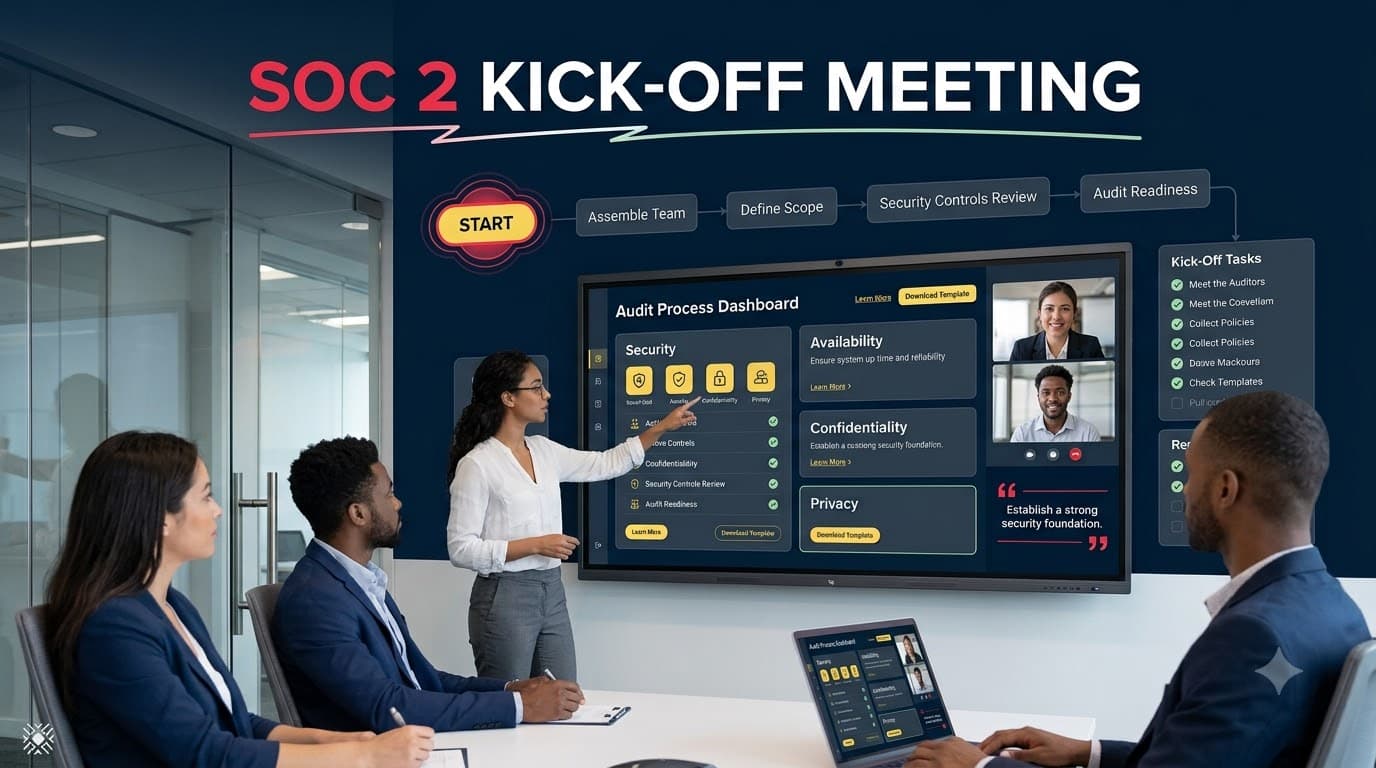
Priya Nandan had been staring at the same calendar invite for three days before she finally accepted it: "Meridian Ledger SOC 2 Type II — Audit Kick-Off," 90 minutes, Tuesday at 10 a.m., six attendees from Bristow & Cade LLP and four from her own team. Meridian Ledger was an 85-person B2B fintech that reconciled payment ledgers for mid-market healthcare billing companies, and its single largest customer, Vantage Health Systems, had made it explicit in the renewal term sheet: a clean SOC 2 Type II report, delivered by December 1, was a condition of the $3.1 million contract renewal. Priya, Meridian's newly minted Head of Security & Compliance, had exactly six months and one shot to get this right. She had read enough compliance forums to know the horror stories — audits that stalled for weeks because nobody could agree on what "in scope" meant, evidence requests that bounced between five different Slack channels, engineers blindsided by interview requests with two days' notice. She did not intend to become one of those stories. So instead of treating the kick-off meeting as a calendar formality to survive before the "real work" began, she treated it as the single highest-leverage 90 minutes of the entire engagement — the meeting where scope, timeline, roles, and expectations either got locked down cleanly or got left vague enough to cost her weeks later.
Fifteen years of running compliance programs and coaching clients through their first, second, and tenth SOC 2 cycles have taught me the same lesson Priya was about to learn: the kick-off meeting is not a ceremony. It is the moment where an abstract engagement letter becomes a concrete, staffed, scheduled project — and the quality of that one meeting predicts, with uncomfortable accuracy, whether fieldwork finishes on time or limps in three weeks late.
Who This Is For / What You'll Walk Away With
This article is for the person who just got the kick-off invite from their CPA firm — a compliance lead, engineering manager, VP of Security, or founder running their first (or fifth) SOC 2 audit — and wants to walk into that meeting prepared instead of reactive. You'll walk away with a concrete kick-off agenda you can adapt, a roles-and-responsibilities framework for both sides of the table, a breakdown of what "scope confirmation" and "PBC list walkthrough" actually mean in practice, a sample timeline with real milestones, and a clear picture of what your auditor expects from you in the 30, 60, and 90 days after the meeting ends. Treat it as a working template, not a theory lecture.
Why the Kick-Off Meeting Matters More Than It Seems
Most first-time SOC 2 clients underestimate the kick-off because nothing tangible happens in the room. No evidence changes hands. No controls get tested. It can feel like a scheduling call dressed up in a fancier name. That impression is wrong, and it's expensive to hold onto.
The kick-off is where four things get locked in simultaneously, and every one of them is load-bearing for the rest of the engagement: the exact audit scope and which Trust Services Criteria apply, the calendar that fieldwork and evidence deadlines will run against, the people who are accountable for each evidence category, and the operating rhythm — how often you talk, through what channel, and who escalates when something slips. Get any one of those wrong at kick-off and you don't find out until weeks later, usually in the worst possible way: a control owner who didn't know they owned anything, an evidence request that assumed a system was in scope when it wasn't, or a report deadline that nobody actually confirmed was achievable given the audit period length.
"I can tell within the first twenty minutes of a kick-off call whether an engagement is going to be smooth or painful. It's not about how mature their controls are — it's about whether they showed up with a scope document, a named point of contact for every system, and someone who can actually answer 'who owns access reviews' without looking around the room." — Elena Vasquez, CPA, Audit Partner, Bristow & Cade LLP
Kick-Off vs. Readiness Assessment vs. Fieldwork: Getting the Sequence Straight
New clients frequently conflate three distinct phases of a SOC 2 engagement, and that confusion causes real scheduling mistakes. The kick-off meeting is not a readiness assessment, and it is not the start of substantive testing. It sits precisely between contract signature and evidence collection.
Phase | Primary Purpose | Who Leads | Typical Timing | Output |
|---|---|---|---|---|
Readiness assessment (optional, often pre-engagement) | Identify control gaps before the formal audit begins | Internal team or a separate advisory firm | 4–12 weeks before engagement | Gap list, remediation plan |
Kick-off meeting | Confirm scope, TSC, timeline, roles, PBC logistics | CPA firm's engagement lead, with client compliance lead | Week 1 of the engagement, after signed engagement letter | Meeting notes, confirmed timeline, PBC list issued |
Evidence collection / fieldwork | Auditor tests controls against confirmed criteria | Auditor team, supported by control owners | Weeks 2 through end of audit period (Type II) or point-in-time (Type I) | Populated evidence, walkthroughs, testing workpapers |
Reporting | Draft report review, management response, finalization | Auditor, with client sign-off | Final 2–4 weeks | Draft report, final SOC 2 report |
If you skipped a formal readiness assessment, the kick-off meeting becomes even more consequential — it's the first structured moment where scope gaps or control ownership confusion can surface before they become fieldwork surprises. This is why the pre-audit checklist work you do in the two weeks before kick-off matters so much: it's the difference between walking in with answers and walking in to generate them live, on the auditor's clock.
Before the Kick-Off: What You Should Prepare in Advance
The most common mistake I see is treating the kick-off invite as the starting gun rather than the finish line of a short internal prep sprint. Firms schedule kick-off calls assuming the client has done homework. If you haven't, the meeting either runs long or produces vague, unconfirmed answers that get revisited later — which is its own kind of delay.
Prep Item | Why It Matters | Owner | Target Completion |
|---|---|---|---|
Draft system description outline | Gives the auditor a starting reference point for scope discussion | Compliance lead | Before kick-off |
List of in-scope systems, products, and environments | Prevents scope ambiguity from surfacing mid-fieldwork | Compliance lead + engineering lead | Before kick-off |
Proposed Trust Services Criteria selection | Confirms Security plus any optional categories (Availability, Confidentiality, etc.) | Compliance lead, informed by sales/legal commitments | Before kick-off |
Subservice organization inventory | Determines carve-out vs. inclusive treatment for each vendor | Compliance lead + procurement/vendor management | Before kick-off |
Internal control owner map (draft) | Speeds up PBC assignment after kick-off | Compliance lead | Before kick-off, refined after |
Prior year's report or bridge letter (if applicable) | Gives auditor context on continuity for repeat engagements | Compliance lead | Before kick-off |
List of proposed internal attendees | Ensures the right roles are in the room | Compliance lead | 3–5 days before |
Calendar constraints (blackout weeks, freezes, holidays) | Feeds directly into realistic milestone dates | Compliance lead + relevant department heads | Before kick-off |
Priya's version of this exercise took her two afternoons: a spreadsheet listing every production system, a one-page draft of Meridian's system boundary, and a note flagging that their payroll subservice organization would be handled via the carve-out method rather than included in testing. She brought that spreadsheet to the meeting instead of trying to construct it live, and it changed the entire tone of the call.
Who Should Attend the Kick-Off Meeting
Getting the attendee list right is a bigger deal than most first-timers expect. Too few people in the room and decisions made at kick-off get second-guessed later by someone who wasn't there. Too many, and the meeting turns into a status update instead of a working session.
Role | Side | Responsibility in the Meeting |
|---|---|---|
Engagement partner / audit partner | CPA firm | Sets overall tone, confirms opinion timeline, answers scope/risk questions |
Audit senior manager / engagement lead | CPA firm | Runs the agenda, owns the PBC list and fieldwork schedule |
Audit staff/senior (fieldwork team) | CPA firm | Notes control owner assignments, may lead interview scheduling |
Compliance lead / SOC 2 program owner | Client | Primary point of contact, owns the overall project timeline |
Engineering or IT leadership (CTO/VP Eng) | Client | Confirms technical scope, system boundary, infrastructure ownership |
HR representative | Client | Owns onboarding/offboarding and background check evidence discussion |
Security/GRC analyst | Client | Supports evidence logistics, may become day-to-day auditor liaison |
Executive sponsor (CEO/COO, as needed) | Client | Signals organizational priority; not always required for the full call |
Not every one of these needs to sit through all 90 minutes. A common pattern is a full-group opening (scope, timeline, expectations) followed by a shorter breakout for logistics with just the compliance lead and the audit senior manager. Whatever structure you choose, confirm it with the auditor in advance — showing up short-staffed to a scope discussion is one of the fastest ways to burn the meeting's first 20 minutes on introductions instead of substance.
"The single biggest predictor of a smooth engagement is whether the client brings an engineering decision-maker to kick-off, not just the compliance person. Scope questions about system boundaries need someone who can answer them on the spot, not 'let me check and get back to you.'" — Marcus Feld, Audit Senior Manager, Coretrust Assurance Partners
Building the Kick-Off Agenda
A well-run kick-off follows a predictable structure. Auditors bring their own template, but you should walk in with an expectation of what needs to be covered so nothing gets rushed or skipped. Below is the agenda structure I recommend clients propose if the auditor doesn't send one first.
# | Agenda Item | Time Allotted | Primary Owner |
|---|---|---|---|
1 | Introductions and roles | 5 min | Both sides |
2 | Engagement overview and report type confirmation (Type I/Type II) | 10 min | Auditor |
3 | Scope and Trust Services Criteria confirmation | 15 min | Both sides |
4 | System boundary and subservice organization treatment | 10 min | Both sides |
5 | Timeline and milestone alignment | 15 min | Auditor, confirmed by client |
6 | PBC list walkthrough and evidence logistics | 15 min | Auditor |
7 | Points of contact and escalation path | 5 min | Both sides |
8 | Interview scheduling approach | 5 min | Auditor |
9 | Communication cadence and tools | 5 min | Both sides |
10 | Open questions and next steps | 5 min | Both sides |
That's roughly 90 minutes if the room stays disciplined. In practice, item 3 (scope) and item 6 (PBC walkthrough) are the two that most often run long — which is fine, as long as you protect them rather than letting introductions or open-ended discussion eat the time.
Agenda Item: Confirming Scope and the Trust Services Criteria
This is the item Elena Vasquez was referring to earlier, and it deserves the most attention of anything in this article. SOC 2 engagements are built on the Trust Services Criteria — Security (the required Common Criteria) plus any combination of Availability, Processing Integrity, Confidentiality, and Privacy that reflects your actual commitments to customers. Kick-off is the last checkpoint to confirm that selection before it drives every subsequent evidence request.
Trust Services Category | Include If… | Common Trigger |
|---|---|---|
Security (Common Criteria) | Always — required in every SOC 2 report | Baseline requirement |
Availability | You make uptime/SLA commitments to customers | Contracts referencing uptime %, SLAs |
Processing Integrity | Your system processes, transforms, or calculates data for customers | Billing, ledger reconciliation, payment processing |
Confidentiality | You handle customer data designated as confidential under contract/NDA | B2B SaaS with data-handling clauses |
Privacy | You collect/process personal information as a core function | Consumer data, HR platforms, marketing tech |
Meridian Ledger's case was a clean example of why this matters: as a payment-ledger reconciliation platform, Processing Integrity was an obvious inclusion, not a maybe. Priya raised it explicitly in the kick-off rather than waiting for Bristow & Cade to ask, and that single proactive move saved a scope amendment two weeks into fieldwork. Compare that to a company that only discusses Availability commitments after the auditor stumbles across an SLA clause in a customer contract during evidence review — at that point, you're negotiating scope changes mid-engagement, which almost always adds time and sometimes fees.
Scope confirmation should also nail down the exact language of your system description — the products, infrastructure, locations, and business processes the report will describe. If your company runs multiple products and only one is being audited, kick-off is where you say that explicitly, in writing, not where you assume everyone already understands it.
Agenda Item: System Boundary and Subservice Organizations
Closely tied to scope is the question of your system boundary — literally, where does the audited system start and stop. This gets complicated fast once cloud infrastructure, SaaS vendors, and outsourced functions enter the picture, because every one of those third parties is technically a subservice organization that needs a documented treatment decision.
Subservice Organization Type | Typical Treatment | Kick-Off Discussion Point |
|---|---|---|
Cloud infrastructure (AWS/Azure/GCP) | Carve-out, supported by provider's own SOC 2/ISO reports | Confirm you'll obtain and reference their reports |
Payroll/HR platform | Carve-out | Identify complementary controls your org must still perform |
Customer support/ticketing tool | Usually carve-out unless it touches in-scope data heavily | Confirm data flow and access scope |
Managed security service provider | Case-by-case; sometimes inclusive if deeply integrated | Discuss whether their staff need direct testing |
Payment processor | Carve-out, but complementary user entity controls often apply | Document CUECs relevant to Processing Integrity |
The auditor will ask you to identify every vendor that touches in-scope systems or data, and for each one, confirm whether it's handled via the carve-out method (excluded from direct testing, with reliance on the vendor's own attestation) or the inclusive method (tested directly). Getting this list wrong at kick-off — forgetting a vendor, or assuming carve-out when the auditor expects inclusive treatment — is one of the more common sources of mid-audit scope surprises.
Agenda Item: Timeline and Milestone Alignment
Everyone walks into kick-off with a rough mental picture of the engagement timeline, usually anchored to a hard external deadline like a customer renewal or a sales cycle. The job of this agenda item is to convert that rough picture into a real calendar with named milestones — something you can hold both sides accountable to.
Milestone | Typical Timing (Type II, 6-month audit period) | Owner |
|---|---|---|
Engagement letter signed | Week 0 | Both |
Kick-off meeting | Week 1 | Both |
PBC list issued | Week 1 (at or just after kick-off) | Auditor |
Initial evidence submission (first tranche) | Weeks 2–3 | Client |
Walkthroughs of key processes | Weeks 3–6 | Both |
Interim testing / control observations | Ongoing through audit period | Auditor |
Mid-period check-in | Midpoint of audit period | Both |
Audit period ends | End of observation window | N/A |
Final evidence collection | 1–2 weeks after period end | Client |
Fieldwork completion | 2–4 weeks after period end | Auditor |
Draft report review | 1–2 weeks after fieldwork | Both |
Management response finalized | Within days of draft review | Client |
Final report issued | Per contractual deadline | Auditor |
For Priya, this table wasn't academic — it was the artifact she took back to her CEO to show exactly why the report couldn't be rushed past a five-month minimum audit period without becoming a Type I report instead, which Vantage Health's procurement team had already said they wouldn't accept. Confirming the audit process timeline and milestones explicitly at kick-off — rather than assuming everyone shared the same mental model — is what let her set internal expectations correctly from day one.
"Clients almost always come in wanting to compress the audit period to hit a deadline. My job at kick-off is to be the person who says, kindly but firmly, that a six-month Type II report needs six months of evidence — there's no shortcut, and pretending otherwise just moves the pain to month five instead of solving it in week one." — Marcus Feld, Audit Senior Manager, Coretrust Assurance Partners
Agenda Item: The PBC List Walkthrough
The PBC list — "provided by client" — is the master inventory of every document, screenshot, system export, policy, and log the auditor will need over the course of the engagement. Auditors typically issue a draft PBC list at or shortly after kick-off, and walking through its structure live, rather than letting the client read it cold afterward, prevents a huge amount of downstream confusion.
PBC Category | Example Items | Typical Owner |
|---|---|---|
Governance and policies | Information security policy, access control policy, incident response plan | Compliance/GRC lead |
Risk management | Risk register, risk assessment results, vendor risk assessments | Compliance/GRC lead |
Access management | User access lists, access review evidence, offboarding tickets | IT/security engineering |
Change management | Change tickets, code review approvals, deployment logs | Engineering leadership |
System operations | Monitoring/alerting configuration, incident tickets, capacity reports | DevOps/SRE |
HR and people | Background check records, security awareness training completion, org chart | HR |
Physical/environmental | Data center attestations, badge access logs (if applicable) | Facilities/IT |
Vendor management | Subservice organization reports, vendor contracts, due diligence records | Procurement/GRC |
Business continuity | DR test results, backup logs, BC/DR plan | Engineering/IT |
The single biggest logistics decision to nail down here is the evidence collection method: will you use a shared drive, a GRC platform, the auditor's own portal, or a mix? Mismatched expectations on this point — auditor assuming a portal upload, client assuming email attachments — is a low-drama but high-friction failure mode that eats real time in week two if it isn't settled in the kick-off room.
"We ask every client at kick-off: how do you want to receive and respond to evidence requests? Portal, shared drive, ticketing system, whatever works for you — but pick one and commit, because switching methods halfway through an engagement always loses evidence in the transition." — Elena Vasquez, CPA, Audit Partner, Bristow & Cade LLP
The full mechanics of what counts as sufficient audit evidence, how it's requested, and how gaps get resolved are covered in more depth in SOC 2 evidence collection — but kick-off is where the logistics of that process get set up, not just the content.
Agenda Item: Points of Contact and the Escalation Path
Every engagement needs a documented answer to a deceptively simple question: when something goes wrong, who calls whom? Kick-off should close with an explicit points-of-contact table, not a vague understanding that "we'll figure it out."
Function | Client Contact | Auditor Contact | Escalation Trigger |
|---|---|---|---|
Day-to-day evidence questions | Compliance/GRC analyst | Audit staff/senior | Response overdue by 2+ business days |
Scope or criteria questions | Compliance lead | Audit senior manager | Any disagreement on in/out-of-scope items |
Scheduling/logistics | Compliance lead or EA | Audit senior manager | Interview conflicts, calendar gaps |
Executive/contractual issues | Executive sponsor | Engagement partner | Timeline risk, fee disputes, report delays |
Technical/system architecture | Engineering lead | Audit senior/staff | Ambiguity on system boundary or data flow |
Write this table down during the meeting and circulate it in the follow-up notes. It sounds like overkill for a 90-minute meeting, but the alternative — a mid-audit evidence question that bounces between three inboxes for a week because nobody was formally designated to answer it — is a far more common failure than most first-time clients expect.
Agenda Item: Interview Scheduling Approach
Type II audits involve interviewing control owners across the organization — engineers, HR staff, IT admins, sometimes executives — to walk through how controls actually operate. Kick-off is where you agree on how those interviews get scheduled, not necessarily when.
Approach | Pros | Cons | Best For |
|---|---|---|---|
Auditor sends calendar invites directly to owners | Fast, removes a coordination step from the client | Can catch owners off guard without context | Smaller teams with informal culture |
Compliance lead pre-briefs owners, then auditor schedules | Owners arrive prepared, fewer reschedules | Adds a coordination step | Most mid-size and larger orgs |
Batch scheduling in defined "interview weeks" | Predictable, easier for owners to block calendar time | Less flexible if an owner is unavailable that week | Distributed/remote teams, busy engineering orgs |
Priya pushed for the second option and asked Bristow & Cade to route interview requests through her first. That single request meant every Meridian engineer walked into their walkthrough already knowing roughly what would be asked and why — which, according to Marcus Feld, cut average interview length by nearly a third compared to cold invites.
Agenda Item: Communication Cadence and Tools
The kick-off should end with a concrete, written answer to "how often do we talk, and through what channel, for the rest of this engagement." Leaving this loose is a quiet but real risk — momentum dies fastest when neither side is sure whose turn it is to follow up.
Cadence Option | Format | Best For |
|---|---|---|
Weekly status call (15–30 min) | Video call, standing agenda | Complex engagements, first-year audits, tight deadlines |
Biweekly status call | Video call | Straightforward repeat engagements with a mature control environment |
Async status updates | Shared doc or ticketing system, updated weekly | Distributed teams, mature PBC response process |
Milestone-only check-ins | Calls tied to specific dates (mid-period, pre-fieldwork, draft report) | Later-stage repeat engagements with high trust |
Dedicated Slack/Teams channel | Real-time messaging for quick questions | Supplement to, not replacement for, scheduled calls |
Meridian and Bristow & Cade settled on a weekly 20-minute status call plus a shared Slack Connect channel for quick questions — a combination that gave Priya both a forcing function to surface blockers and a low-friction channel for the small stuff that didn't need a meeting.
What the Auditor Expects From You After Kick-Off
Kick-off sets expectations, but the real test is whether the client organization lives up to them once the meeting ends. Auditors are watching a handful of specific behaviors in the weeks that follow, and clients who understand this upfront tend to have measurably smoother engagements.
Expectation | What It Looks Like in Practice | Consequence If Missed |
|---|---|---|
Timely evidence responses | PBC items delivered within the agreed SLA (commonly 5–10 business days per request) | Fieldwork gets pushed, testing windows compress |
A single accountable point of contact | One person routes and tracks all requests, even if others fulfill them | Requests get lost, duplicate work, missed deadlines |
Honest, proactive communication about gaps | Flagging a missing control or delayed evidence before the auditor discovers it | Erodes trust, can trigger broader scrutiny |
Consistent evidence format | Naming conventions, date ranges, and completeness matching what was requested | Repeated back-and-forth, evidence rejected and re-requested |
Availability for interviews as scheduled | Control owners show up prepared, reschedule sparingly | Interview backlog, compressed fieldwork at period end |
No unilateral scope changes mid-engagement | New systems or products discussed with the auditor before assuming inclusion/exclusion | Scope disputes, potential report qualification |
"The clients who struggle aren't usually the ones with weak controls — weak controls we can work with, that's literally the job. The ones who struggle are the ones who go quiet for two weeks after kick-off and then show up with a pile of mismatched evidence right before a deadline." — Devon Ashworth, CISO, Nimbus Cloud Systems
Case Study: When Scope Confirmation Gets Skipped
Devon Ashworth's Nimbus Cloud Systems learned this lesson the hard way, a year before the quote above. Nimbus had acquired a smaller company six months before its SOC 2 Type II kick-off, and in the rush to prepare, nobody flagged the acquisition's infrastructure as a scope question during the meeting — it simply wasn't on anyone's radar as something to discuss. The auditor assumed the system boundary matched the prior year's report; Nimbus assumed the new infrastructure was obviously out of scope since it hadn't been formally integrated yet.
The mismatch surfaced in week five, when an auditor doing a walkthrough noticed customer data flowing through the acquired company's still-separate database. What followed was a scope amendment negotiation, a revised system description, and a fresh round of evidence requests for infrastructure nobody had prepared documentation for. The engagement, originally slated for a 14-week fieldwork window, stretched to 17 weeks. Nimbus absorbed roughly $28,000 in additional audit fees for the expanded scope and testing, and — more painfully for Devon — had to explain to two enterprise prospects why the report was three weeks later than promised.
"We didn't lose the deals," Devon told me later, "but we spent political capital we didn't need to spend, over something that a fifteen-minute scope conversation at kick-off would have caught."
Case Study: The PBC Ownership Gap
Sana Iqbal's experience at Fortline Analytics, a data-analytics platform serving mid-market retailers, illustrates a different failure mode: a kick-off meeting that covered scope and timeline thoroughly but rushed through PBC ownership. The auditor issued a comprehensive PBC list, and Fortline's compliance team dutifully forwarded categories to what they assumed were the right owners — but nobody had confirmed those assignments in the room.
Three weeks in, it became clear that access management evidence — one of the largest and most time-consuming categories — had been assumed by both the security team and the IT operations team to belong to the other. Nobody was actively working it. By the time the gap was discovered, Fortline was six business days behind on a category that alone represented nearly a fifth of the total PBC list. Evidence collection for that single category ultimately took six weeks instead of the three originally planned, and the delay rippled into the final report timeline — pushing delivery back five weeks and delaying a $600,000 enterprise contract that had been contingent on the report.
"We didn't have a controls problem," Sana said. "We had an ownership problem, and it started because we didn't nail down who owned what while the auditor was still in the room to hear it agreed to out loud."
"A PBC list with categories but no confirmed owners is just a to-do list nobody signed up for. I now insist on assigning at least a first-pass owner to every category before the kick-off call ends, even if it changes later." — Sana Iqbal, Director of GRC, Fortline Analytics
Case Study: A Kick-Off That Set the Whole Engagement Up to Succeed
Back to Priya Nandan and Meridian Ledger. Her kick-off preparation — the pre-built system description outline, the subservice organization inventory, the proposed TSC selection — meant the 90-minute meeting covered every agenda item without running over. More importantly, it produced three concrete artifacts the same afternoon: a confirmed points-of-contact table, a first-pass PBC ownership map with a named owner against every category, and a written timeline with the audit period, interim check-in, and report deadline all dated against the calendar rather than described in relative terms like "a few months out."
Meridian's engineering team walked into their interviews pre-briefed, thanks to the interview-scheduling approach Priya negotiated. The weekly status call surfaced two minor evidence gaps early enough to fix them without drama. Fieldwork wrapped two weeks ahead of the original schedule, and the final report landed on November 14 — more than two weeks before the December 1 deadline Vantage Health had set as a renewal condition. Meridian closed the $3.1 million renewal with the report in hand, and Priya's CEO now cites the kick-off discipline as the template for every subsequent audit cycle, including the ISO 27001 certification effort Meridian began exploring the following year after several European prospects raised it during sales conversations — a decision informed in part by reading ISO 27001 vs. SOC 2: which one do you need as they scoped the additional work.
"People think the hard part of SOC 2 is the technical controls. The hard part is the project management. Kick-off is where you either build a project plan or build a hope-it-works-out plan. I've learned to always build the plan." — Priya Nandan, Head of Security & Compliance, Meridian Ledger
The Kick-Off-to-Fieldwork Flow
The following diagram maps how a well-run kick-off feeds directly into the phases that follow — and where the most common breakdowns tend to occur when a step is skipped or rushed.
flowchart TD
    A[Auditor Selection Finalized] --> B[Engagement Letter Signed]
    B --> C[Kick-Off Meeting]
    C --> D[Scope & TSC Confirmed]
    C --> E[Timeline & Milestones Set]
    C --> F[PBC List Issued & Owners Assigned]
    C --> G[Points of Contact Documented]
    D --> H[Evidence Collection Begins]
    E --> H
    F --> H
    G --> H
    H --> I[Walkthroughs & Interviews]
    I --> J[Interim Testing / Observation Period]
    J --> K[Final Evidence Collection]
    K --> L[Fieldwork Completion]
    L --> M[Draft Report & Management Response]
    M --> N[Final SOC 2 Report Issued]
Notice how every one of the four kick-off outputs — scope, timeline, PBC ownership, and points of contact — feeds directly into evidence collection. A weak link at kick-off doesn't stay contained; it propagates into every downstream phase, which is exactly the pattern behind both the Nimbus and Fortline case studies above.
Kick-Off Differences: Type I vs. Type II Audits
The core agenda structure is similar for both report types, but a handful of items carry different weight depending on whether you're pursuing a Type I report or a Type II report.
Kick-Off Element | Type I Emphasis | Type II Emphasis |
|---|---|---|
Audit period discussion | N/A — point-in-time assessment | Central topic; audit period length (often 3–12 months) drives the whole timeline |
Interview scheduling | Single round, concentrated near the assessment date | Spread across the observation period, sometimes multiple rounds |
PBC list | Focused on control design evidence (policies, configurations) | Design evidence plus operating evidence (logs, tickets, samples over time) |
Sampling methodology | Rarely discussed in depth | Important agenda topic — how audit sampling will be applied across the period |
Communication cadence | Often lighter — shorter overall engagement | Typically weekly or biweekly given the longer duration |
Mid-engagement check-in | Usually unnecessary | Strongly recommended at the audit period midpoint |
Most companies pursuing their very first SOC 2 report choose Type I as a stepping stone before committing to a Type II observation period, and it's worth explicitly asking at kick-off which type is being pursued if there's any ambiguity left over from contract negotiations — I've seen more than one client discover mid-engagement that their customer actually required Type II, after the audit had already been scoped as Type I.
Kick-Off Differences: First-Year vs. Repeat Engagements
A first-year kick-off and a fifth-year kick-off with the same firm are meaningfully different meetings, even though they share an agenda template.
Factor | First-Year (Year 1) Kick-Off | Repeat Engagement Kick-Off |
|---|---|---|
Scope discussion | Extensive — nothing is assumed | Focused on changes since last report (new systems, products, vendors) |
System description | Built from scratch | Reviewed and updated, not rewritten |
Bridge letter discussion | N/A | May be needed if there's a gap between the prior report period and the new one — see SOC 2 bridge letter |
PBC list | Comprehensive, every category new | Often lighter — auditor may accept prior-year evidence formats and request deltas |
Relationship/trust baseline | Being established | Already exists — conversations tend to move faster |
Common surprises | Underestimating evidence volume, control ownership confusion | Org changes (new hires, tool migrations, M&A) not flagged proactively |
Repeat clients sometimes make the opposite mistake of first-timers: they get complacent about kick-off because "we did this last year," and skip the scope-refresh conversation. That's exactly how organizational changes — a new cloud region, a new product line, a reorg that moved control ownership — slip through unflagged and surface mid-fieldwork instead.
Virtual vs. In-Person Kick-Off Meetings
Most SOC 2 kick-offs today happen over video call, but it's worth being deliberate about the choice rather than defaulting without discussion, especially for complex first-year engagements.
Factor | Virtual Kick-Off | In-Person Kick-Off |
|---|---|---|
Cost | Low — no travel required | Higher — travel/lodging for auditor team or client team |
Scheduling flexibility | High — easier to get full attendee list | Lower — coordinating travel adds lead time |
Whiteboard/diagram discussions (system boundary) | Workable with screen share, slightly less fluid | Often more effective for complex architecture discussions |
Relationship building | Adequate, especially for repeat engagements | Stronger for first-year, high-stakes, or complex engagements |
Recommended for | Repeat engagements, straightforward scope, distributed teams | First-year audits with complex architecture, M&A history, or multiple business units |
Bristow & Cade offered Priya both options; she chose virtual given Meridian's fully remote engineering team, but asked for the scope discussion (agenda item 3) to run as a dedicated screen-share walkthrough of their architecture diagram rather than a verbal description — a small adjustment that made the system boundary conversation far more concrete than it would have been over audio alone.
Documenting the Kick-Off: Meeting Minutes and Follow-Up
A kick-off meeting that isn't documented in writing within 24–48 hours effectively didn't happen — memory of "who agreed to what" degrades fast, and disputes about scope or timeline six weeks later almost always trace back to a decision that was made verbally and never confirmed in writing.
Documentation Item | Format | Owner | Due |
|---|---|---|---|
Meeting minutes / summary | Shared doc or email recap | Auditor (client should confirm receipt and accuracy) | Within 48 hours |
Confirmed scope and TSC selection | Written summary, ideally referencing the draft system description | Auditor + client sign-off | Within 1 week |
Finalized timeline with dated milestones | Shared calendar or project tracker | Compliance lead | Within 1 week |
PBC list with assigned owners | Spreadsheet or GRC platform | Compliance lead | Within 1 week |
Points of contact table | Shared doc, pinned in communication channel | Compliance lead | Immediately after meeting |
Open items / action list | Shared doc with owners and due dates | Both sides | Within 48 hours |
Insist on receiving (or producing, if the auditor doesn't) a written recap even for the smallest engagements. It costs fifteen minutes and prevents the single most common source of post-kick-off disputes: two parties who each remember the meeting slightly differently.
Red Flags to Watch for During the Kick-Off Meeting
Not every kick-off goes smoothly, and it's worth knowing what a troubled one looks like from the inside — both from your own team's side and from the auditor's side of the table.
Red Flag | What It Signals | Recommended Response |
|---|---|---|
Auditor can't clearly explain the PBC delivery method | Possible internal process immaturity at the firm | Ask directly for their standard tooling/process before proceeding |
Client can't name a single control owner in the room | Internal accountability gaps that will slow evidence collection | Assign at least provisional owners before the meeting ends |
Scope discussion gets deferred "for a follow-up call" | Risk of scope ambiguity persisting into fieldwork | Push to resolve at least the major scope questions live |
No one commits to a communication cadence | Risk of silent stalls mid-engagement | Propose a specific cadence yourself if the auditor doesn't |
Timeline discussion skips the audit period length entirely | Possible mismatch between client's deadline expectations and Type II requirements | Ask explicitly: does the audit period math support the target report date? |
Auditor seems unfamiliar with your industry/business model | Possible risk to the quality of scope and criteria recommendations | Ask about their experience with comparable clients; this ties back to the diligence covered in auditor selection |
If you notice more than one or two of these in a single kick-off call, it's worth a candid conversation with your engagement partner before evidence collection begins — problems at kick-off rarely fix themselves once fieldwork starts moving.
Post-Kick-Off: The First 30, 60, and 90 Days
The kick-off meeting itself is 90 minutes; the discipline it sets in motion needs to hold for months. Here's the cadence I coach clients toward in the aftermath.
Timeframe | Client Actions | Signals of a Healthy Engagement |
|---|---|---|
Days 1–30 | Confirm PBC owners, deliver first evidence tranche, hold first status call | First round of evidence delivered on time, no scope disputes raised |
Days 31–60 | Complete initial walkthroughs, address early auditor feedback, refine evidence formats | Fewer evidence rejections/re-requests than the first tranche |
Days 61–90 | Mid-period check-in (Type II), confirm remaining milestone dates still hold | Timeline unchanged from kick-off, no major scope amendments |
Ongoing to period end | Maintain evidence cadence, flag control changes proactively, prep for final evidence pull | Auditor reports no material surprises heading into final fieldwork |
Organizations that track this rhythm deliberately — rather than assuming momentum will sustain itself after the kick-off high wears off — are the ones whose control testing phases run close to schedule. Momentum built in week one is easy to lose by week six if nobody is actively protecting the cadence agreed to at kick-off.
Sample Interview Schedule Emerging From Kick-Off
One tangible output that should exist within a week or two of kick-off is a draft interview schedule, built from the PBC ownership map and the scheduling approach agreed to in the meeting.
Interview Topic | Typical Interviewee | Suggested Week (Type II, 6-month period) |
|---|---|---|
Governance and risk management | Compliance lead / CISO | Week 2 |
Access provisioning and deprovisioning | IT/security engineering | Week 3 |
Change management process | Engineering leadership | Week 3–4 |
Incident response process | Security/SRE lead | Week 4 |
HR onboarding and background checks | HR representative | Week 4–5 |
Vendor/subservice organization management | Procurement/GRC | Week 5 |
Business continuity and backup | Infrastructure/DevOps | Week 5–6 |
Monitoring and logging | SRE/security operations | Week 6 |
Having this schedule drafted early, rather than negotiated interview-by-interview as the engagement proceeds, is one of the more underrated outcomes of a disciplined kick-off — it turns a source of recurring friction into a solved problem in week one.
RACI for the Kick-Off-to-Fieldwork Handoff
A simple RACI matrix, built during or immediately after kick-off, resolves a huge share of the ambiguity that otherwise surfaces later.
Activity | Compliance Lead | Engineering/IT Lead | HR | Audit Senior Manager | Executive Sponsor |
|---|---|---|---|---|---|
Confirm scope and TSC | R/A | C | I | C | I |
Assign PBC owners | R/A | C | C | I | I |
Deliver evidence | R | R | R | A | I |
Schedule interviews | R/A | C | C | R | I |
Escalate blockers | R | C | C | I | A |
Approve final timeline | A | I | I | R | C |
Review draft report | R/A | I | I | R | C |
(R = Responsible, A = Accountable, C = Consulted, I = Informed.) This is a starting template, not a fixed rule — every organization's structure differs, but the exercise of assigning these explicitly at kick-off, rather than leaving them implicit, is what actually changes behavior once fieldwork starts.
Common Kick-Off Mistakes and Their Downstream Consequences
Beyond the three detailed case studies above, a handful of smaller mistakes show up repeatedly across the engagements I've advised on.
Mistake | Downstream Consequence | Prevention |
|---|---|---|
Treating kick-off as informational-only, not decision-making | Vague scope/timeline that requires renegotiation later | Come prepared to make and confirm decisions in the room |
Not inviting a technical decision-maker | Scope questions get deferred, delaying confirmation | Include engineering/IT leadership on the invite |
Assuming the auditor's PBC template needs no customization | Categories mismatch to your actual org structure, confusing owners | Walk through the PBC list live and adjust owner mapping together |
Skipping the communication cadence discussion | Silent stalls mid-engagement with no natural check-in point | Explicitly propose and confirm a cadence before the call ends |
Not documenting the meeting in writing | Disputes later about what was agreed | Circulate written minutes within 48 hours |
Ignoring subservice organization treatment until fieldwork | Scope amendments and delayed evidence for vendor-related controls | Inventory and classify vendors before kick-off |
Kick-Off as a Business Opportunity, Not Just an Audit Formality
It's tempting to treat the kick-off meeting purely as compliance overhead — a box to check on the way to the report you actually need. I'd push back on that framing. A well-run kick-off is one of the few moments in a SOC 2 engagement where you can materially shape the efficiency, cost, and even the tone of the entire audit relationship, and that has real business value beyond the report itself.
Companies that run tight kick-offs tend to run tight engagements overall — fewer scope disputes, less rework, fewer surprise fees, and reports that land on or ahead of schedule. That reliability compounds: a CPA firm that trusts your organization's project discipline is more flexible on scheduling in future years, more willing to accommodate a tight timeline when a real business need arises, and generally easier to work with on the inevitable edge cases every audit produces. For companies weighing whether to eventually pursue running ISO 27001 and SOC 2 together or mapping their existing evidence against a broader framework via something like an ISO 27001, SOC 2 and NIST CSF crosswalk, the project-management muscle built during a disciplined SOC 2 kick-off transfers directly — the scope-confirmation, PBC-ownership, and timeline-alignment habits are nearly identical across frameworks.
There's also a sales and customer-trust dimension worth naming. Prospects and customers doing vendor security reviews increasingly ask not just "do you have a SOC 2 report" but "how mature is your compliance program." A company that can describe a disciplined, repeatable audit kick-off process — clear scope, named owners, a real timeline — signals a level of operational maturity that resonates in procurement conversations well beyond the report itself.
Get the kick-off right, and everything downstream — evidence collection, walkthroughs, interim testing, the final report — inherits that discipline. Get it wrong, and you spend the rest of the engagement paying down a debt that a single well-prepared 90-minute meeting could have avoided.
"I tell every client the same thing before their first kick-off: this meeting is the cheapest hour you'll spend on this audit. Every question you resolve here saves you a much more expensive version of that same question in week eight." — Tom Reyes, SOC 2 Program Manager, Vellum Health Tech
If you're heading into your own kick-off meeting and want a head start, PentesterWorld's SOC 2 Readiness Checklist walks through the exact pre-meeting preparation covered in this article, and the SOC 2 Trust Services Criteria Mapping Template helps you arrive with a defensible TSC selection instead of guessing in the room. If you're still finalizing which firm to work with, revisit SOC 2 auditor selection before signing the engagement letter — the quality of your kick-off is partly a function of the quality of the firm you chose to run it.
Final Word
Priya Nandan's story isn't unusual because Meridian Ledger had perfect controls walking into their first SOC 2 Type II audit — they didn't, and Bristow & Cade found a handful of genuine gaps during fieldwork, same as any first-year engagement. It's unusual because the kick-off meeting gave both sides a shared, written, dated understanding of what the next six months would actually require. That clarity is what let a real gap get fixed in week three instead of discovered in week fourteen. If there's one habit worth carrying out of this article, it's this: walk into your kick-off meeting ready to make decisions, not just receive information — and leave it with those decisions written down.